The cryptocurrency landscape is experiencing a transformative shift in 2025, with decentralized AI agents emerging as the hottest new narrative in the blockchain space. These autonomous entities represent a significant technological leap beyond traditional trading bots and large language models, combining the power of artificial intelligence with blockchain's decentralized infrastructure to create intelligent systems that can operate independently, make decisions, and execute complex multi-step operations without human intervention. This comprehensive guide explores what decentralized AI agents are, how they're revolutionizing crypto trading and analytics, and why platforms like Token Metrics are at the forefront of this AI-powered revolution.
Understanding Decentralized AI Agents
Decentralized AI agents are autonomous software programs designed to perceive their environment, make decisions, and take actions to achieve specific goals within decentralized networks. Unlike their predecessors—simple bots that operated within confined environments and were limited to reactive tasks—AI agents can interact with the external world, handle multi-step operations, adapt to changing conditions, and learn from experience.
Think of AI agents as digital co-pilots that never sleep, never get emotional, and never miss market opportunities. They operate on blockchain networks, executing transactions, analyzing market data, managing portfolios, and interacting with DeFi protocols entirely autonomously. These agents don't suffer from FOMO (fear of missing out), panic selling, or fatigue—they operate continuously based on predefined strategies and real-time data analysis.
The market for AI agents has exploded rapidly. By mid-2025, the AI agents sector reached a market capitalization of approximately $5.38 billion, with platforms launching over 1,000 new agent tokens daily. The global AI trading platform market is expected to reach $69.95 billion by 2034, growing at over 20% annually, underscoring the massive transformation underway in financial markets.
How Decentralized AI Agents Work
AI agents in crypto operate through a sophisticated architecture that combines machine learning, blockchain integration, and autonomous decision-making capabilities. At their core, these agents consist of several key components that enable their autonomous functionality.
Perception and Data Collection
AI agents continuously monitor their environment by collecting data from multiple sources including cryptocurrency exchanges, blockchain networks, social media platforms, news outlets, on-chain analytics, and market sentiment indicators. This comprehensive data collection provides agents with the contextual awareness needed to make informed decisions.
For example, sentiment analysis agents like AIXBT monitor social media, news, and community forums to gauge market sentiment, providing traders with real-time insights into crowd psychology. By April 2025, AIXBT had accumulated over 450,000 followers on X (formerly Twitter), demonstrating the widespread adoption of AI-driven market analysis.
Decision-Making and Strategy Execution
Once data is collected, AI agents process this information using machine learning algorithms, technical indicators, predictive models, and pre-programmed strategies to determine appropriate actions. They can identify trading opportunities, assess risk levels, optimize portfolio allocations, and execute transactions—all without human intervention.
Unlike traditional bots that follow simple if-then rules, AI agents can adapt their strategies based on market conditions, learn from past performance, and handle complex scenarios requiring multi-step reasoning. This adaptability makes them particularly valuable in cryptocurrency's volatile, 24/7 market environment.
Blockchain Integration and Execution
Decentralized AI agents execute actions directly on blockchain networks by interacting with smart contracts, submitting transactions to decentralized exchanges, managing wallet operations, participating in DeFi protocols, and coordinating with other agents. This on-chain execution ensures transparency, immutability, and trustless operation—core principles of decentralized finance.
Types of Decentralized AI Agents in Crypto
The decentralized AI agent ecosystem encompasses various specialized agents, each designed for specific use cases within the crypto space.
Trading and Investment Agents
Trading agents represent the most common application of AI in crypto, automating the entire trading lifecycle from opportunity identification to execution and risk management. These agents can implement sophisticated strategies including arbitrage across multiple exchanges, grid trading in sideways markets, dollar-cost averaging with dynamic adjustments, momentum trading based on technical indicators, and market-making to provide liquidity.
Platforms like ai16z, a decentralized autonomous organization (DAO) built on Solana, use AI to identify investment opportunities and execute trades. The platform reached over $2 billion in value by December 2024, demonstrating the market's confidence in AI-driven investment strategies.
Market Analysis and Research Agents
Research-focused AI agents provide investors with comprehensive market intelligence by analyzing fundamental data, tracking on-chain metrics, monitoring whale wallet movements, evaluating project tokenomics, and generating investment recommendations. These agents act as tireless research assistants, processing vast amounts of data to surface actionable insights.
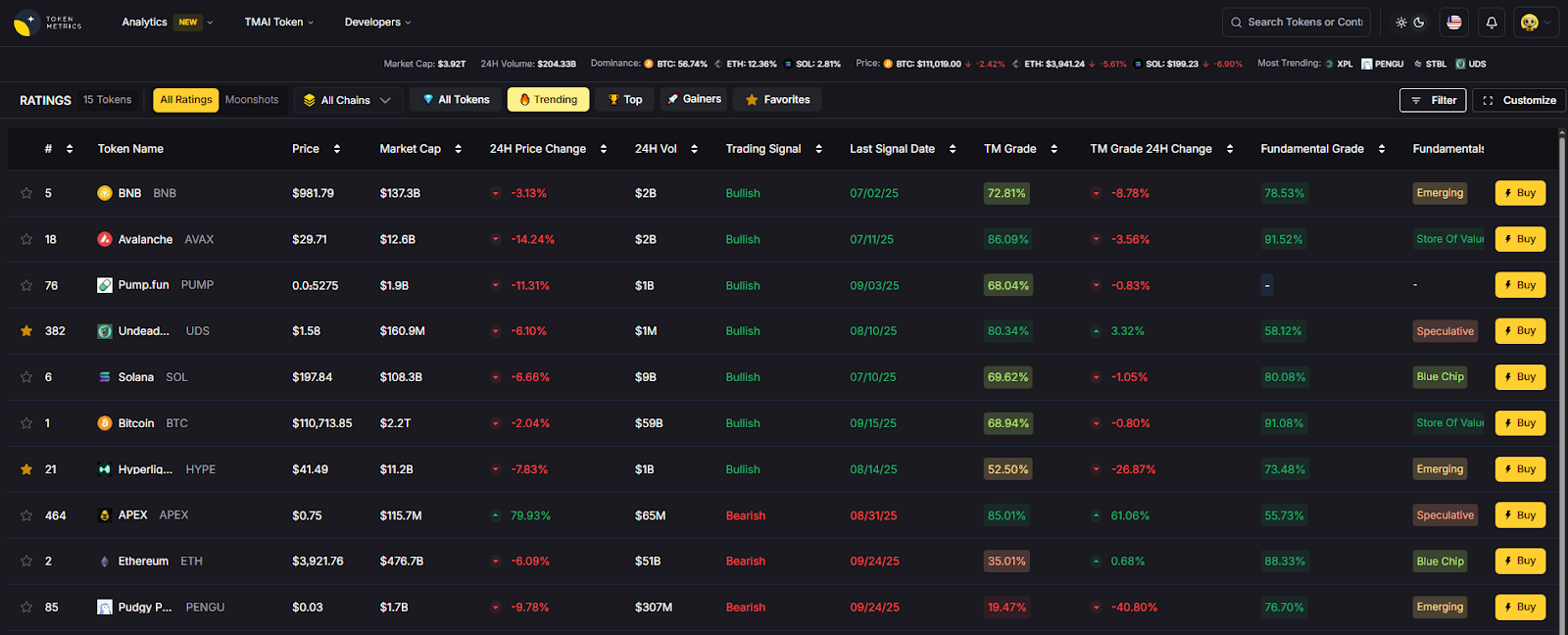
This is where platforms like Token Metrics excel as industry leaders. Token Metrics leverages advanced AI and machine learning to provide comprehensive crypto analytics, delivering Trader Grades for short-term opportunities and Investor Grades for long-term potential across over 5,000 tokens. The platform's AI assigns scores from 0-100 based on real-time market data, social sentiment, on-chain metrics, and technical indicators—giving traders and investors a powerful edge in identifying winning opportunities before they hit mainstream awareness.
DeFi Protocol Agents
Decentralized finance agents interact with lending protocols, yield farming platforms, liquidity pools, and decentralized exchanges to optimize yields and manage risk. They can automatically move assets between protocols to maximize returns, rebalance portfolios based on market conditions, and execute complex DeFi strategies that would be impractical to manage manually.
Governance and Community Agents
Some AI agents participate in decentralized governance, voting on proposals, monitoring community sentiment, coordinating collective actions, and representing stakeholder interests. These agents help democratize governance by ensuring continuous participation and data-driven decision-making.
Leading Decentralized AI Agent Projects
Several pioneering projects are defining the decentralized AI agent landscape in 2025, each bringing unique capabilities and innovations to the ecosystem.
Artificial Superintelligence Alliance (ASI)
The ASI Alliance represents a groundbreaking collaboration between Fetch.ai (FET), SingularityNET (AGIX), and Ocean Protocol (OCEAN). Formed in July 2024 on the Binance exchange, this alliance aims to accelerate the development of decentralized Artificial General Intelligence (AGI) and ultimately Artificial Superintelligence (ASI). By uniting these projects under a unified token ($ASI), the alliance creates a decentralized AI ecosystem with powerful machine-learning capabilities across industries.
Fetch.ai enables the creation of autonomous economic agents for decentralized tasks, powering applications from supply chain optimization to automated trading. The platform launched a $10 million accelerator in early 2025 to invest in startups focused on AI agents, demonstrating its commitment to ecosystem growth.
Virtuals Protocol
Launched on the Base blockchain in March 2024, Virtuals Protocol specializes in AI-driven metaverse integration and tokenized AI agents. The platform allows developers to create, own, and monetize autonomous AI agents for gaming, social interactions, virtual real estate management, and entertainment applications.
As of September 2025, VIRTUAL token maintains a market capitalization around $1.6-1.8 billion, with over 21,000 agent tokens launched by November 2024. The protocol's strong community engagement and developer-friendly infrastructure make it a leading platform for AI agent creation.
ai16z and Eliza Framework
Operating on Solana, ai16z utilizes the Eliza framework—a powerful multi-agent simulation platform that enables AI agents to interact across multiple platforms while maintaining consistent personalities and knowledge. The ai16z token serves dual purposes as both a governance and utility token, allowing holders to participate in decision-making while facilitating transactions within the ecosystem.
The platform offers a 31.39% APR through ai16zPOOL, incentivizing liquidity provision and community participation. This combination of AI trading intelligence with DeFi yields creates compelling value for participants.
Bittensor (TAO)
Bittensor represents one of the most innovative projects at the intersection of blockchain and AI. It's a decentralized machine learning network that allows AI models to collaborate, compete, and get rewarded based on performance. Instead of training models in closed silos, Bittensor enables developers to contribute models to an open network where they're ranked and compensated in TAO tokens.
With consistent top rankings by market cap among AI crypto projects, Bittensor demonstrates the viability of decentralized AI infrastructure that incentivizes quality through tokenomics.
Token Metrics: Your AI-Powered Crypto Intelligence Platform
While decentralized AI agents are transforming the crypto landscape, accessing their insights and making informed decisions requires sophisticated analytics infrastructure. This is where Token Metrics distinguishes itself as the premier AI-powered crypto trading and analytics platform in 2025.
Comprehensive AI-Driven Analytics
Token Metrics provides cutting-edge market intelligence through proprietary AI models that analyze thousands of tokens in real-time. The platform delivers actionable insights including AI-powered ratings (0-100 Trader and Investor Grades), buy and sell signals based on machine learning algorithms, risk assessment and smart contract audits, whale wallet tracking and institutional flow analysis, and social sentiment monitoring across multiple platforms.
In March 2025, Token Metrics launched integrated on-chain trading, transforming from an analytics platform into an end-to-end solution. Users can now research tokens, review AI ratings, and execute trades directly on the platform—typically completing transactions in under two minutes through seamless multi-chain swaps powered by LiFi technology.
AI Indices for Automated Portfolio Management
For investors seeking passive exposure with active management, Token Metrics offers AI-managed indices that dynamically rebalance based on market conditions. These indices provide diversified exposure to blue-chip assets or high-potential "moonshot" tokens identified through predictive analytics, removing emotional decision-making from portfolio management.
Token Metrics AI Chatbot
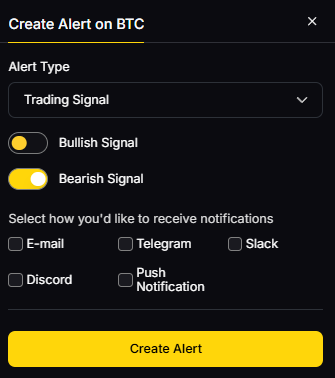
The platform's AI chatbot serves as a personal crypto assistant, answering questions about specific tokens, providing trade ideas and execution recommendations, tracking market movements and alerts, and delivering research insights in natural language. This conversational interface makes sophisticated AI analysis accessible to traders at all experience levels.
Developer-Friendly API and Infrastructure
Token Metrics provides comprehensive API access for developers building crypto applications, trading bots, and AI agents. The Token Metrics API delivers real-time ratings data, sentiment analysis, historical performance metrics, and automated signals—enabling developers to build sophisticated trading systems on top of Token Metrics' AI infrastructure.
The platform's recently launched MCP (Multi-Client Protocol) Server standardizes crypto data access across development tools like OpenAI agents, Claude Desktop, Cursor IDE, and more, solving API fragmentation issues that plague crypto development.
Track Record of Success
Token Metrics has demonstrated its predictive power by identifying major winners early, including MATIC (Polygon) and SOL (Solana) before their explosive growth. This track record of spotting winning tokens before mainstream awareness validates the platform's AI-driven approach to crypto analysis.
The Future of Decentralized AI Agents
As we look toward the remainder of 2025 and beyond, several trends will drive the evolution of decentralized AI agents in cryptocurrency markets.
Agent-to-Agent Interactions
The future will see increased collaboration between AI agents, with agents communicating, negotiating, and coordinating actions autonomously. This agent-to-agent economy could revolutionize how decentralized systems operate, creating emergent behaviors and efficiencies impossible with human-only coordination.
AI-Dominated On-Chain Activity
Analysts predict AI agents will increasingly dominate financial activity on blockchain networks, executing the majority of trades, managing substantial portions of DeFi liquidity, and optimizing yields across protocols. This shift will fundamentally change market dynamics and liquidity provision.
Enhanced Personalization
Future AI agents will offer unprecedented personalization, learning individual user preferences, adapting strategies to personal risk tolerance, and providing customized market analysis and recommendations. These personalized agents will function as true financial co-pilots tailored to each user's unique situation.
Integration with Traditional Finance
As regulatory frameworks evolve, decentralized AI agents will bridge crypto and traditional finance, accessing TradFi data sources, executing cross-market strategies, and enabling seamless capital flows between systems. This integration will accelerate institutional adoption and market maturation.
Risks and Considerations
While decentralized AI agents offer tremendous potential, users should be aware of several important considerations. The technology remains nascent and speculative, with many projects in early development stages. Technical risks include potential bugs in smart contracts, API security vulnerabilities, and the possibility of overfitting where AI models perform well on historical data but fail in live markets.
Regulatory uncertainty presents another challenge, as the legal status of autonomous AI agents operating in financial markets remains unclear in many jurisdictions. Additionally, not all AI agent projects will succeed—investors should conduct thorough research and maintain appropriate diversification rather than concentrating holdings in speculative early-stage projects.
Getting Started with AI-Powered Crypto Trading
For traders and investors looking to leverage AI agents and advanced analytics in their crypto journey, several actionable steps can help you get started. Begin by exploring platforms like Token Metrics that provide comprehensive AI-driven research, real-time signals, and integrated trading capabilities. Start with educational resources to understand how AI analysis works and what different metrics mean for investment decisions.
Consider using AI-managed indices initially rather than individual token picking, as these provide diversified exposure while you learn the ecosystem. As you gain experience, graduate to more sophisticated strategies using AI signals to time entries and exits, combining AI insights with your own research and risk management frameworks.
For developers, explore the Token Metrics API and MCP Server to build custom trading solutions, integrate AI insights into existing applications, and create innovative products on top of proven AI infrastructure.
Conclusion
Decentralized AI agents represent the convergence of blockchain technology and artificial intelligence, creating autonomous systems that operate continuously in crypto markets without human emotional biases or limitations. From trading and portfolio management to market analysis and DeFi optimization, these agents are transforming how individuals and institutions interact with cryptocurrency.
As the AI agent ecosystem matures in 2025 and beyond, platforms like Token Metrics provide essential infrastructure—delivering the AI-powered analytics, real-time signals, and integrated trading tools that enable both human traders and AI agents to navigate crypto markets successfully. With proven track records identifying winners early, comprehensive data coverage across thousands of tokens, and seamless integration from research to execution, Token Metrics stands as the premier AI crypto trading and analytics platform for the decentralized future.
Whether you're a retail trader seeking an edge, an institutional investor managing large portfolios, or a developer building the next generation of AI-powered applications, the combination of decentralized AI agents and platforms like Token Metrics provides the tools needed to thrive in cryptocurrency's autonomous, AI-driven future.





%201.svg)
%201.svg)


.svg)


%201.svg)


.png)







.svg)


.png)