Back to blog
Research

Understanding Proprietary Market Signals: How Crypto Indices Detect Bull and Bear Markets

Learn how crypto indices and proprietary market signals, including AI-powered insights from Token Metrics, help detect bull and bear markets for risk-conscious investors.
Token Metrics Team
12
Want Smarter Crypto Picks—Free?
See unbiased Token Metrics Ratings for BTC, ETH, and top alts.
Thank you! Your submission has been received!
Oops! Something went wrong while submitting the form.
 No credit card | 1-click unsubscribe

In the fast-paced and often unpredictable world of cryptocurrency, understanding how crypto indices detect bull and bear markets is crucial for investors aiming to maximize profits and minimize losses. Unlike traditional financial markets, where a simple 20% price drop might signify a bear market, the crypto market is far more volatile, with frequent sharp price fluctuations that do not necessarily indicate a shift in market regime. This volatility demands more sophisticated tools that analyze a wide range of data points, enabling investors and traders to distinguish genuine bull and bear markets from short-term noise.

Traditional indicators commonly used in traditional finance often fall short when applied to digital assets. To address this challenge, proprietary market signals have emerged as a useful tool that leverages advanced analytics, including artificial intelligence and on-chain data, to detect market regime shifts with greater accuracy. This article explores the limitations of legacy indicators, the architecture behind proprietary signals, and how platforms like Token Metrics are revolutionizing the way market phases are identified and acted upon.

The Inadequacy of Traditional Indicators

Many newcomers to crypto rely heavily on legacy technical indicators such as the Relative Strength Index (RSI), Moving Average Convergence Divergence (MACD), and simple moving averages. These tools have a long history in traditional markets, but they exhibit critical weaknesses when applied to the crypto market cycle.

The Lagging Problem

Traditional indicators are inherently backward-looking. For example, RSI may only indicate that Bitcoin is "overbought" after a significant rally has already occurred, while MACD crossover signals often lag behind actual trend changes by days. This delay means that by the time traders receive warnings, institutional investors and experienced traders have often already adjusted their positions. The widely cited 200-day moving average (MA) is a classic example: it requires 200 days of data to calculate, making it slow to react to rapid market shifts. When Bitcoin’s price dropped below the 200-day MA in March 2025, many declared a bear market, but this signal came too late to capture the onset of the downturn effectively.

The False Signal Epidemic

Crypto's notorious volatility generates frequent false alarms with traditional metrics. A 20% price drop—enough to define a bear market in stocks—can be a routine correction or consolidation in crypto, occurring without a genuine regime change. Bitcoin, for instance, can experience significant price trends downward during an overall bull market and then resume its upward momentum. Relying on these traditional signals often results in premature selling during temporary bear phases or missed opportunities during early bull phases.

Single-Factor Blindness

Legacy indicators typically focus on a single dimension, usually price action. They overlook critical factors like on-chain activity, wallet flows, network fundamentals, trading volume, market sentiment, liquidity, and broader macroeconomic influences such as interest rates or the wider economy. This narrow view produces an incomplete and sometimes misleading picture of the market’s health.

The Architecture of Proprietary Market Signals

Proprietary market signals represent a significant evolution beyond traditional tools by incorporating three key innovations: multi-factor analysis, machine learning adaptation, and signal confluence validation.

Multi-Factor Analysis

Advanced systems evaluate dozens of independent data sources spanning multiple categories to build a nuanced understanding of market conditions:

By integrating these diverse data points, proprietary systems develop a holistic view of the crypto market, enabling more accurate detection of bull or bear market regimes.

Machine Learning Adaptation

Unlike static technical indicators, the most sophisticated proprietary systems employ machine learning models that continuously learn from historical outcomes. These AI-powered models analyze thousands of past market setups to identify which combinations of factors preceded genuine breakouts or downturns. This adaptability is critical because the crypto market cycle evolves rapidly; patterns effective in 2020 may not hold in 2025 as the market matures and institutional participation increases.

By constantly refining their algorithms based on new data, these systems maintain their effectiveness across different market phases, including bull markets, bear markets, and sideways consolidations.

Signal Confluence

A defining feature of proprietary signals is the requirement that multiple independent indicators align before a signal is triggered. Instead of reacting to any single metric crossing a threshold, these systems wait for a confluence of price action, volume patterns, on-chain metrics, and sentiment indicators to confirm a setup.

This multi-factor confirmation dramatically reduces false positives. When several data points simultaneously indicate bullish conditions, the probability of a true bull market increases significantly compared to relying on one indicator alone. The same applies to detecting bear markets, where combined signals of selling pressure, declining volume, and negative sentiment provide stronger evidence of a downturn.

Token Metrics: Setting the Standard for Market Intelligence

Token Metrics has emerged as a leader in applying proprietary signal technology to the crypto space, offering what many consider the industry's most sophisticated market detection system. As a cryptocurrency investment research firm leveraging AI and machine learning, Token Metrics analyzes over 6,000 projects, processing more data points and generating more accurate signals than most competitors.

The Token Metrics Signal Architecture

Token Metrics’ Bullish and Bearish Signals operate through a multi-layered system that integrates over 80 data points per token. These include price momentum shifts across various timeframes, higher trading volumes and anomalies, interactions with support and resistance levels, on-chain activity strength, whale wallet flow patterns, social sentiment analysis, and liquidity and order book depth.

Importantly, signals are only triggered when multiple critical factors confirm the setup, following the signal confluence approach that eliminates many false alarms common in traditional methods.

AI-Powered Learning

What sets Token Metrics apart is its continuous machine learning-driven refinement. The platform’s AI models train on outcomes, not just patterns, learning which factor combinations consistently lead to real breakouts or downturns. This outcome-based training ensures the system remains responsive to evolving market dynamics, such as increased institutional adoption and the rise of tokenized real-world assets.

Rigorous backtesting against extensive historical data ensures signals maintain accuracy across bull and bear cycles, avoiding deterioration that plagues static indicators.

Real-World Performance

Token Metrics regularly showcases its signal effectiveness with documented examples. For instance, a Bullish Signal on a lesser-known token, $DEGEN, preceded a +35% breakout despite minimal social media attention. Conversely, a Bearish Signal on $ENA helped users avoid a -22% correction. These examples illustrate how proprietary intelligence offers insights that can assist in managing market risks and opportunities.

How Regime Switching Works in Practice

The practical application of proprietary signals is evident in automated index strategies like Token Metrics’ TM Global 100 Index, which demonstrates systematic regime switching based on real-time market intelligence.

The Detection Process

Token Metrics continuously monitors its proprietary indicators, synthesizing price action, volume, on-chain metrics, sentiment data, and macroeconomic factors into comprehensive assessments of market regimes. When multiple signals align bullishly, the system classifies the environment as a bull market and maintains full exposure to the top 100 cryptocurrencies by market capitalization, capturing upside potential across the ecosystem.

When bearish signals dominate, indicating elevated risk and selling pressure, the index automatically shifts holdings into stablecoins like USDC, preserving capital during downturns often referred to as crypto winter.

The Advantage Over Manual Trading

Manual market timing is challenging for individual investors who must juggle numerous indicators, overcome emotional biases like fear and greed, and execute complex portfolio adjustments efficiently. Proprietary systems remove these obstacles by making emotionless, data-driven decisions automatically. This disciplined approach helps avoid panic sells during bottoms and impulsive buys at tops, common pitfalls for many traders.

Transparency Without Complexity

While the underlying AI and multi-factor models are complex, Token Metrics maintains transparency by providing users with a Market Gauge showing current regime assessments, interactive portfolio visualizations, detailed transaction logs, and performance analytics. This openness fosters trust while safeguarding the proprietary nature of the algorithms.

Beyond Binary: Understanding Market Nuance

Sophisticated proprietary systems recognize that markets are not simply in a binary bull or bear state but operate along a spectrum with varying conviction levels. Token Metrics’ signals can indicate conditions ranging from "strong bullish" to "strong bearish," allowing for nuanced position sizing and risk management.

During strong bullish phases, indices maintain maximum exposure to volatile assets and emerging projects with strong demand. In neutral or uncertain periods, exposure is moderated, and in strong bearish environments, defensive allocations to stablecoins are preferred. This approach helps to optimize returns and manage risk effectively.

The Competitive Moat of Proprietary Intelligence

The significance of proprietary signals lies in the information advantage they offer. Investors who effectively detect regime shifts early can capitalize on opportunities before the broader market recognizes them. By the time mainstream media or lagging indicators declare a bear or bull market, those relying on shared signals may have missed the optimal entry or exit points.

Token Metrics invests heavily in AI infrastructure, data science, and comprehensive data gathering to sustain its competitive edge. Its ability to analyze billions of data points and adapt models swiftly provides insights difficult to replicate manually, democratizing sophisticated market detection for individual investors.

Practical Application for Investors

Understanding how crypto indices detect bull and bear markets is vital, but the key lies in how investors apply this knowledge:

The Future of Market Intelligence

As the crypto ecosystem matures, with innovations in DeFi, AI, and tokenized assets, the need for advanced analytics will intensify. Token Metrics plans to expand its proprietary signal technology with sector-specific indicators, enhanced natural language processing, integration with automated trading, and deeper on-chain health metrics to keep users at the forefront of market intelligence.

Conclusion: Intelligence as Competitive Advantage

In today’s complex financial landscape, accurately identifying market regimes is essential for systemic risk management and opportunity capture. Proprietary signals, powered by AI and multi-factor analysis, offer a comprehensive and adaptive approach that surpasses traditional indicators. Platforms like Token Metrics provide invaluable insights that help investors navigate volatile markets effectively. Recognizing regime shifts early and acting on them systematically can be the difference between sustained success and missed opportunities. Equip yourself with cutting-edge tools to stay ahead in the evolving crypto world.

Discover Crypto Gems with Token Metrics AI

Token Metrics uses AI-powered analysis to help you uncover profitable opportunities in the crypto market. Get Started For Free

What are crypto indices?

Crypto indices are financial instruments that track the performance of a basket of digital assets, typically weighted by market capitalization or other criteria. These indices provide a broad overview of the cryptocurrency market, making it easier to monitor overall trends and benchmark returns without focusing on individual tokens.

How do proprietary signals differ from traditional indicators?

Proprietary signals integrate multiple data sources—including price action, on-chain data, sentiment, and macroeconomic factors—while leveraging machine learning and advanced analytics. Traditional indicators often rely on single-factor price analysis. By synthesizing diverse data, proprietary signals are better equipped to detect genuine market regime shifts and reduce false signals.

How does Token Metrics generate its market signals?

Token Metrics employs a multi-factor, AI-driven system that analyzes over 80 data points per token, including price dynamics, volume, on-chain activity, liquidity, and sentiment. Signals are only triggered when several independent metrics confirm the same market regime, ensuring robustness and reducing the risk of false alerts.

Can individual investors use proprietary market signals?

Yes. Platforms like Token Metrics provide access to proprietary signals, making advanced analytics available to retail investors. This democratizes the sophisticated tools once reserved for institutions and enables individuals to make more informed decisions and manage risk effectively.

How do crypto indices handle market volatility?

Advanced crypto indices employ real-time monitoring and regime-switching algorithms, allowing them to shift allocations—from full exposure to stablecoins—based on current market conditions. This adaptability helps manage risk and reduce the impact of extreme volatility commonly observed in the crypto market.

Disclaimer

This content is for informational and educational purposes only and should not be interpreted as financial advice, investment recommendations, or an offer to buy or sell any asset. The information provided is accurate to the best of our knowledge at the time of publication. Always conduct your own research and consult with a professional advisor before making investment decisions. Cryptocurrency markets are volatile, and past performance is not indicative of future results.

Build Smarter Crypto Apps &
AI Agents in Minutes, Not Months
Real-time prices, trading signals, and on-chain insights all from one powerful API.
Grab a Free API Key
About Token Metrics
Token Metrics: AI-powered crypto research and ratings platform. We help investors make smarter decisions with unbiased Token Metrics Ratings, on-chain analytics, and editor-curated “Top 10” guides. Our platform distills thousands of data points into clear scores, trends, and alerts you can act on.
30 Employees
analysts, data scientists, and crypto engineers
Daily Briefings
concise market insights and “Top Picks”
Transparent & Compliant
Sponsored ≠ Ratings; research remains independent
Want Smarter Crypto Picks—Free?
See unbiased Token Metrics Ratings for BTC, ETH, and top alts.
Thank you! Your submission has been received!
Oops! Something went wrong while submitting the form.
 No credit card | 1-click unsubscribe
Token Metrics Team
Token Metrics Team

Recent Posts

Research

Understanding APIs: A Practical Guide

Token Metrics Team
6

APIs power modern software by letting systems communicate without sharing internal code. Whether you use a weather app, social login, or an AI assistant, APIs are the invisible glue connecting services. This guide explains what an API is, how APIs work, practical use cases (including crypto and AI), and criteria to evaluate an API for research or product use.

What is an API? A clear definition

API stands for Application Programming Interface. At its simplest, an API is a set of rules and protocols that lets one program request services or data from another. Think of an API as a restaurant menu: the menu lists dishes (endpoints) you can order (requests), the kitchen prepares the dish (service), and the waiter delivers it to your table (response). The consumer of the API doesn’t see how the kitchen is organized; it only needs to know how to order.

APIs abstract complexity, standardize interactions, and enable modular design. They exist at many layers — from operating systems and libraries to web services that return JSON or XML. For developers and researchers, APIs are indispensable for integrating external data, automating workflows, and composing distributed systems.

How APIs work: architecture, formats, and types

Most modern web APIs follow request/response patterns over HTTP. Key concepts include:

  • Endpoints: URL paths that expose specific resources or actions, e.g., /prices or /users.
  • Methods: HTTP verbs like GET (retrieve), POST (create), PUT/PATCH (update), DELETE (remove).
  • Payloads: Data sent or received, often formatted as JSON for web APIs.
  • Authentication: API keys, OAuth tokens, or signed requests to control access.

Architectural styles and protocols include REST (resource-oriented, stateless), GraphQL (client-specified queries), gRPC (binary, streaming), and WebSockets (persistent full-duplex connections). Each has trade-offs: REST is simple and cache-friendly; GraphQL reduces over-fetching but can complicate caching; gRPC excels in performance for internal microservices.

APIs in crypto and AI: data, execution, and agents

In crypto and AI ecosystems, APIs serve several roles:

  • Market data APIs: Provide price feeds, order book snapshots, historical candles, and index data used for analysis and visualization.
  • Blockchain & on-chain APIs: Expose transaction data, smart contract interactions, wallet balances, and event logs for on-chain analysis.
  • Execution/trading APIs: Let platforms submit orders, query trade status, and manage accounts. These require strict auth and latency considerations.
  • AI & model APIs: Offer inference services, embeddings, or model orchestration endpoints for tasks like NLP, classification, or agent behavior.

Combining these APIs enables product capabilities such as automated research pipelines, AI agents that react to market signals, and dashboards that mix on-chain metrics with model-driven insights. Many teams use dedicated crypto APIs to aggregate exchange and chain data, and AI-driven tools to surface patterns without exposing trading recommendations.

For example, researchers might ingest price and on-chain feeds through a market API, compute custom signals with an AI model, and expose those signals via an internal API for front-end consumption. When evaluating providers, consider freshness of data, coverage across assets/chains, and documented latency characteristics.

How to evaluate, integrate, and maintain APIs

Choosing and integrating an API is not just about endpoints. Use a checklist that covers technical, operational, and governance concerns:

  1. Documentation quality: Look for clear examples, error codes, and sandbox endpoints for testing.
  2. Authentication and security: Prefer APIs that support scoped keys, granular permissions, and strong transport security (TLS).
  3. Rate limits & pricing: Understand request quotas, burst limits, and throttling behavior to design backoff strategies.
  4. Data guarantees: Check latency, update frequency, historical depth, and whether data is normalized across sources.
  5. SLA and reliability: Uptime history, status pages, and support SLAs matter for production use.
  6. Monitoring & observability: Log requests, track error rates, and monitor latency to detect regressions or abuse.

Integration tips: start with a sandbox key, write thin adapters to isolate provider-specific formats, and implement exponential backoff with jitter for retries. For analytics workflows, cache immutable historical responses and only refresh dynamic endpoints when necessary.

Build Smarter Crypto Apps & AI Agents with Token Metrics

Token Metrics provides real-time prices, trading signals, and on-chain insights all from one powerful API. Grab a Free API Key

FAQ: common questions about APIs

What is the difference between REST and GraphQL?

REST exposes resources through fixed endpoints and relies on HTTP methods. GraphQL lets clients specify exactly what fields they need in a single query. REST is simpler and benefits from existing HTTP caching; GraphQL reduces over-fetching but can require more complex server-side tooling.

How do API keys and OAuth differ?

API keys are simple tokens issued to clients, often for server-to-server access or basic identification. OAuth is an authorization framework that issues scoped access tokens on behalf of users, enabling delegated permissions and better control over access lifecycle.

What are common API failure modes to plan for?

Rate limiting, transient network errors, schema changes, and authentication failures are typical. Design clients to retry with exponential backoff, validate responses, and fail gracefully when dependencies are degraded.

How can I secure sensitive data when using third-party APIs?

Use encrypted transport (TLS), rotate credentials regularly, scope keys to minimum permissions, and avoid embedding secrets in client-side code. For sensitive workflows, consider a server-side proxy that enforces access policies and masking.

Can AI models be accessed via APIs and how does that affect workflows?

Yes. Many AI models expose inference and embedding endpoints. Using model APIs decouples compute from your product stack, simplifies scaling, and enables A/B testing of models. Evaluate latency, cost per request, and data retention policies when choosing a provider.

How do I test and validate an API integration?

Start in a sandbox environment, create automated integration tests covering success and failure cases, mock third-party responses for unit tests, and run load tests against rate limits. Monitor post-deployment with health checks and alerts.

What are rate limits and how should clients handle them?

Rate limits cap how many requests a client can make in a time window. Clients should respect headers that indicate remaining quota, implement exponential backoff with jitter on 429 responses, and batch requests or cache results when possible.

When should I build my own API versus using a third-party API?

Use a third-party API for non-core data or services where speed-to-market and maintenance offload matter. Build an internal API when the capability is strategic, requires proprietary processing, or when you need tight control over latency, privacy, and SLAs.

How can tools like Token Metrics help with API-driven research?

Data and model platforms can centralize feeds, normalize formats, and provide analytical signals that reduce the engineering overhead of assembling multiple APIs. Token Metrics is an example of a platform that merges model-driven insights with market and on-chain data for research workflows.

Disclaimer

This content is for educational and informational purposes only. It does not constitute financial, legal, or investment advice. Evaluate APIs and services independently and consult appropriate professionals for decisions that involve risk.

Research

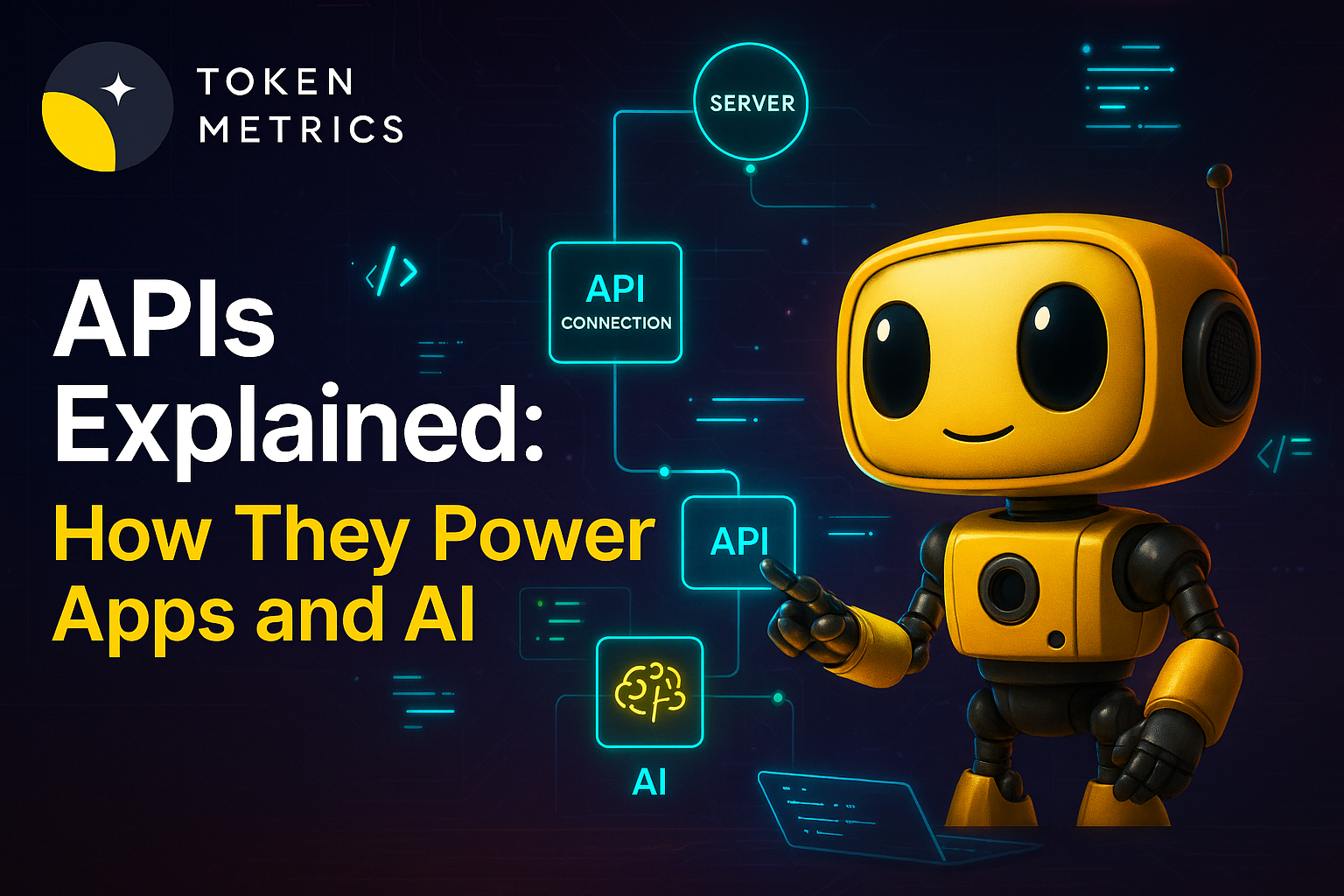
APIs Explained: How They Power Apps and AI

Token Metrics Team
6

APIs are the invisible connectors that let software talk to software. Whether you book a flight, check a crypto price, or ask an AI agent to summarize a document, APIs are likely working behind the scenes. This guide breaks down what an API is, how it works, common types and use cases, and practical steps for research and integration.

What is an API?

An API, or application programming interface, is a defined set of rules and data structures that lets one software component request services or data from another. Think of an API as a contract: the provider exposes endpoints and data formats, and the consumer uses those endpoints to perform actions or retrieve information. This abstraction hides implementation details, enabling interoperability and composability across systems.

At its core, an API specifies:

  • Available operations (endpoints) and accepted parameters
  • Request and response formats (JSON, XML, etc.)
  • Authentication and rate limits
  • Error handling and status codes

APIs accelerate development by allowing teams to reuse services instead of rebuilding functionality. They also enable ecosystems: marketplaces, integrations, and data sharing across organizations.

How APIs Work: Components & Protocols

APIs are implemented over protocols and architectural styles. The most common is REST (Representational State Transfer), which uses HTTP verbs (GET, POST, PUT, DELETE) and URIs to model resources. Alternatives like GraphQL let clients request specific data shapes, which can reduce over- and under-fetching in complex applications.

Key components to understand:

  • Endpoint: A URL representing a resource or action (e.g., /api/v1/prices).
  • Method: The HTTP action to perform (GET to read, POST to create).
  • Payload: The body of a request for create/update operations, usually JSON.
  • Authentication: API keys, OAuth tokens, or other schemes control access.
  • Rate limits: Providers throttle requests to protect services.

Beyond REST and GraphQL, there are webhooks (server-to-server push notifications), gRPC for high-performance RPC-style communication, and socket-based APIs for real-time streams. The choice of protocol affects latency, throughput, and developer ergonomics.

Types of APIs and Real-World Use Cases

APIs come in several flavors depending on visibility and purpose:

  • Public APIs: Exposed to external developers for integrations and apps.
  • Private APIs: Internal to an organization, used to modularize services.
  • Partner APIs: Shared with selected partners under specific agreements.

Common use cases illustrate how APIs deliver value:

  • Payment processing APIs enable e-commerce sites to accept credit cards without storing sensitive data.
  • Mapping and location APIs power ride-hailing, logistics, and geofencing features.
  • Data APIs supply market prices, on-chain metrics, or social feeds for dashboards and trading bots.
  • AI and ML model APIs let applications delegate tasks like transcription, summarization, or image analysis to cloud services.

For example, crypto applications rely heavily on exchange and on-chain data APIs to aggregate prices, monitor wallets, and execute analytics at scale. Evaluating latency, historical coverage, and data quality is critical when selecting a provider for time-series or transactional data.

How Developers and AI Use APIs

Developers use APIs to compose microservices, integrate third-party functionality, and automate workflows. For AI systems, APIs are essential both to access model inference and to fetch context data that models use as inputs.

Practical patterns include:

  1. Chaining: Calling multiple APIs in sequence to enrich a response (e.g., fetch user profile, then fetch personalized recommendations).
  2. Caching: Store frequent responses to reduce latency and cost.
  3. Bulk vs. Stream: Use batch endpoints for historical backfills and streaming/webhooks for real-time events.

When integrating APIs for analytics or AI, consider data consistency, schema evolution, and error semantics. Tools and platforms can monitor usage, surface anomalies, and provide fallbacks for degraded endpoints.

For researchers and teams assessing providers, structured evaluations help: compare SLA terms, data freshness, query flexibility, cost per request, and developer experience. Platforms that combine market data with AI-driven signals can accelerate exploratory analysis; for example, Token Metrics provides AI-backed research and ratings that teams often use to prioritize datasets and hypothesis testing.

Build Smarter Crypto Apps & AI Agents with Token Metrics

Token Metrics provides real-time prices, trading signals, and on-chain insights all from one powerful API. Grab a Free API Key

FAQ — What is an API?

Q1: What is the difference between an API and a library?

An API defines a set of rules and endpoints for interaction between systems, often over a network. A library is a local collection of functions and classes that an application links to at runtime. Libraries run in-process; APIs often run across processes or machines.

FAQ — How secure are APIs?

Q2: How should APIs be secured?

Common security measures include authentication (API keys, OAuth), encryption (TLS), input validation, rate limiting, and monitoring for anomalous patterns. Security practices should match the sensitivity of data and regulatory requirements.

FAQ — REST vs. GraphQL

Q3: When to choose REST over GraphQL?

REST is simple and well-suited to resource-based designs and caching. GraphQL is useful when clients need precise control over returned fields and want to minimize round trips. The right choice depends on client needs, caching strategy, and team expertise.

FAQ — What drives API costs?

Q4: What factors affect API pricing?

Pricing typically depends on request volume, data granularity, retention of historical data, and premium features such as websockets, SLAs, or enriched analytics. Evaluate costs under realistic usage patterns and spikes.

FAQ — How to get started with an API?

Q5: How do I evaluate and integrate a new API?

Start by reading docs, testing sandbox endpoints, and estimating request volumes. Validate data formats, authentication flows, and edge cases (rate limits, errors). Prototype with small workloads before committing to production usage.

FAQ — Are APIs regulated?

Q6: Do APIs involve legal or compliance considerations?

APIs that handle personal data, financial transactions, or regulated assets may be subject to privacy laws, financial regulations, or contractual obligations. Assess compliance requirements, data residency, and logging needs early in the design process.

Disclaimer

This article is for educational purposes only and does not constitute investment, legal, or professional advice. Information contained here is neutral and analytical; always perform independent research and consult qualified professionals for decisions involving legal or financial risk.

Research

Understanding APIs: What They Are and How They Work

Token Metrics Team
5

APIs (Application Programming Interfaces) are the invisible wiring that lets modern software communicate. From mobile apps fetching data to AI agents orchestrating workflows, APIs enable systems to request services, exchange structured data, and extend functionality without exposing internal implementation. This article unpacks what an API is, how different API styles operate, where they’re used (including crypto and AI contexts), and practical approaches to evaluate, integrate, and secure them.

What an API Is: core concepts and terminology

An API is a set of rules and conventions that allows one software component to interact with another. At its simplest, an API defines:

  • Endpoints: Named access points that accept requests (for example, /users or /price).
  • Methods: Actions supported at an endpoint (common HTTP verbs: GET, POST, PUT, DELETE).
  • Request/Response formats: Structured payloads, typically JSON or XML, that describe inputs and outputs.
  • Authentication and authorization: How clients prove identity and gain access to resources (API keys, OAuth, JWT).
  • Rate limits and quotas: Constraints that protect services from abuse and manage capacity.

Think of an API as a contract: the provider promises certain behaviors and data shapes, and the consumer agrees to use the API according to those rules. That contract enables modular design, reusability, and language-agnostic integration.

How APIs work: protocols, formats, and architectural styles

APIs use protocols and conventions to carry requests and responses. The most common patterns include:

  • REST (Representational State Transfer): Uses standard HTTP methods and resource-oriented URLs. REST favors stateless interactions and JSON payloads.
  • GraphQL: Lets clients request exactly the fields they need in a single query, reducing over- and under-fetching.
  • gRPC: A high-performance RPC framework that uses protocol buffers for compact binary messages—often used for internal microservices.
  • Webhooks: A push model where the API provider sends events to a client URL when something changes.

Choosing an architecture depends on latency needs, payload sizes, versioning strategy, and developer ergonomics. For instance, GraphQL can simplify complex frontend queries, while REST remains straightforward for simple resource CRUD operations.

Common API types and real-world use cases (including crypto and AI)

APIs power an enormous variety of use cases across industries. Representative examples include:

  • Data APIs: Provide access to datasets or market data (weather, financial prices, on-chain metrics).
  • Service APIs: Offer functionality like payments, authentication, or messaging.
  • Platform APIs: Enable third-party apps to extend a core product—social platforms, cloud providers, and exchanges expose platform APIs.
  • AI and ML APIs: Expose model inference endpoints for tasks such as text generation, image recognition, or embeddings.

In the crypto ecosystem, APIs are fundamental: explorers, node providers, exchanges, and analytics platforms expose endpoints for price feeds, order books, trade history, wallet balances, and on-chain events. AI-driven research tools use APIs to combine market data, on-chain signals, and model outputs into research workflows and agents.

How to evaluate and integrate an API: practical steps

Adopting an API requires both technical and operational considerations. A pragmatic evaluation process includes:

  1. Define needs: Identify required data, latency tolerance, throughput, and allowable costs.
  2. Review documentation: Clear docs, example requests, schema definitions, and SDKs accelerate integration.
  3. Test endpoints: Use sandbox keys or Postman to validate payloads, error handling, and edge cases.
  4. Assess SLAs and rate limits: Understand uptime guarantees and throttling behavior; build retry/backoff strategies.
  5. Security and compliance: Check authentication methods, encryption, and data retention policies.
  6. Monitoring and observability: Plan logging, latency monitoring, and alerting to detect regressions post-integration.

When integrating multiple APIs—such as combining market data with model inference—consider a middleware layer that normalizes data shapes, caches frequent responses, and orchestrates calls to minimize latency and cost.

Build Smarter Crypto Apps & AI Agents with Token Metrics

Token Metrics provides real-time prices, trading signals, and on-chain insights all from one powerful API. Grab a Free API Key

FAQ: What is an API — common questions

What is the difference between an API and a web service?

An API is a broader concept that defines interfaces for software interaction. A web service is a type of API that operates over network protocols such as HTTP. In practice, REST and GraphQL are web service styles used to implement APIs.

Are public APIs safe to use?

Public APIs can be safe if they follow security best practices: HTTPS everywhere, proper authentication, input validation, and rate limiting. Consumers should validate responses, handle errors, and avoid exposing credentials in client-side code.

How do API keys differ from OAuth?

API keys are simple tokens that identify a client application and are often used for server-to-server interactions. OAuth is a delegated authorization framework that allows users to grant limited access to their accounts without sharing credentials—common for user-facing integrations.

What is API rate limiting and why does it matter?

Rate limiting constrains how many requests a client can make in a time window. It prevents abuse, protects backend resources, and ensures fair usage. Clients should implement retries with exponential backoff and caching to stay within limits.

When should I use GraphQL instead of REST?

Choose GraphQL when clients need flexible, precise queries that fetch nested or disparate fields in a single request. REST can be simpler for straightforward resource CRUD and when predictable caching semantics are required.

Can APIs be used for real-time data?

Yes. Real-time patterns include WebSockets, Server-Sent Events (SSE), and streaming APIs. Some platforms also provide push notifications or webhooks to deliver near-instant updates to subscribers.

How do I handle versioning in APIs?

Common strategies include using version numbers in the URL (e.g., /v1/) or via headers. Maintain backward compatibility, communicate deprecation timelines, and provide migration guides to minimize friction for integrators.

What monitoring should I implement after integrating an API?

Track uptime, latency percentiles, error rates, and throughput. Instrument retries, logging of failed requests, and alerts for sustained degradation. Observability helps diagnose issues and communicate with API providers when needed.

Disclaimer: This article is for educational and informational purposes only. It explains technical concepts related to APIs and integration practices and does not provide financial, investment, or regulatory advice. Always evaluate tools and services according to your own requirements and compliance needs.

Choose from Platinum, Gold, and Silver packages
Reach with 25–30% open rates and 0.5–1% CTR
Craft your own custom ad—from banners to tailored copy
Perfect for Crypto Exchanges, SaaS Tools, DeFi, and AI Products