Back to blog
Research

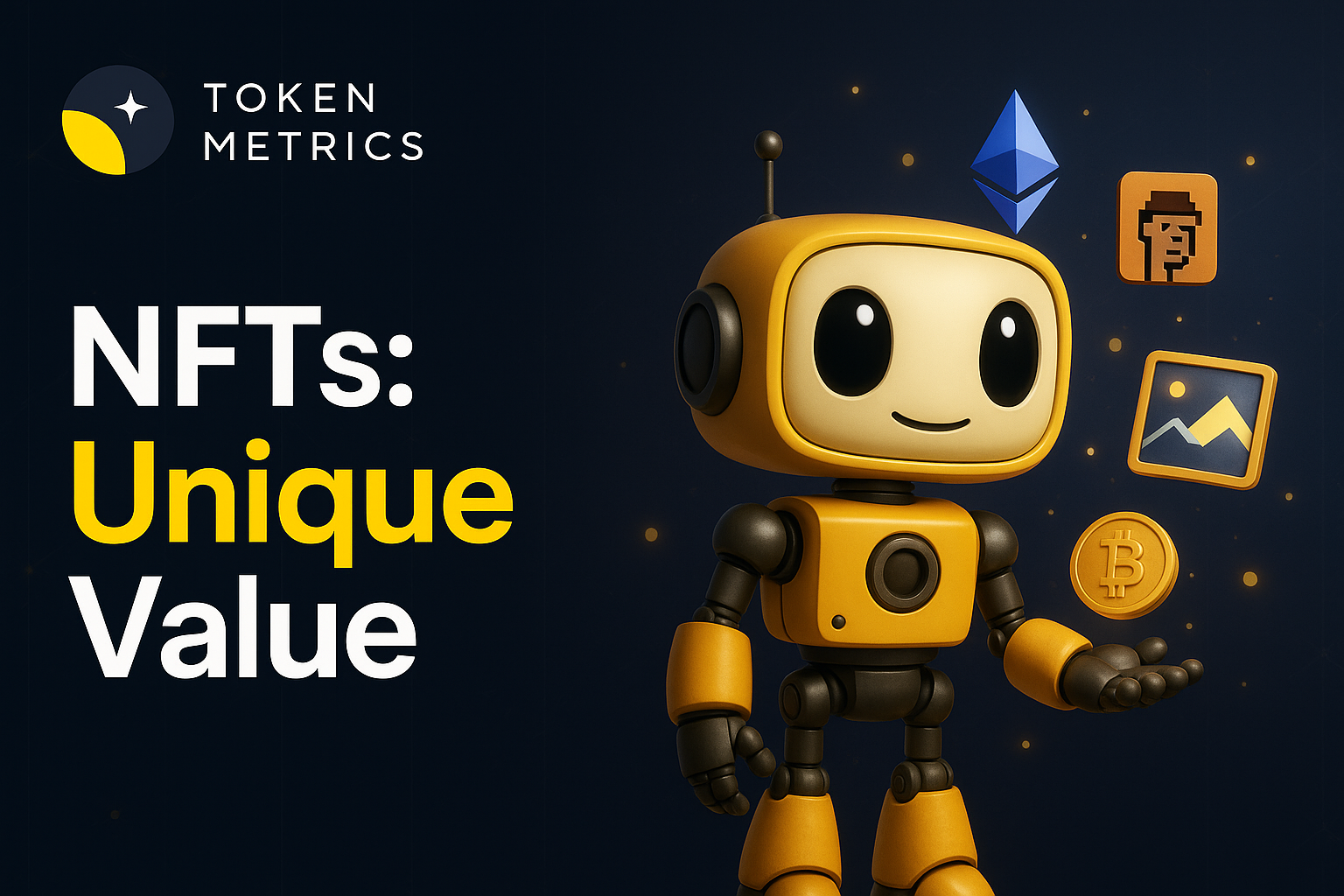
What Are NFTs and Why Are They Valuable? Complete 2025 Guide

Explore the fundamentals of NFTs, their value drivers, diverse categories, and how Token Metrics empowers smarter digital asset analysis and market insights.
Token Metrics Team
9 min read
Want Smarter Crypto Picks—Free?
See unbiased Token Metrics Ratings for BTC, ETH, and top alts.
Thank you! Your submission has been received!
Oops! Something went wrong while submitting the form.
 No credit card | 1-click unsubscribe

Non-fungible tokens, commonly known as NFTs (NFT stands for Non-Fungible Token), have evolved from a niche curiosity into a massive market that is revolutionizing digital ownership, art, gaming, and entertainment. The idea behind NFTs is to create digital tokens that represent ownership and are secured through blockchain technology, establishing unique, verifiable digital assets that can range from art to ownership rights. As the global NFT market reached an impressive $48.74 billion in 2025 and is projected to explode to $703.47 billion by 2034, understanding what are NFTs and why are they valuable has become essential knowledge for investors, creators, and anyone interested in the future of the digital economy.

Understanding Non-Fungible Tokens

A non-fungible token (NFT) is a unique digital asset stored on a blockchain that represents ownership or proof of authenticity for a specific item, whether digital or physical. The term “non-fungible” distinguishes these tokens from cryptocurrencies like Bitcoin or Ethereum, which are fungible—meaning each unit is identical and interchangeable with another. In contrast, an NFT is one of a kind and cannot be directly exchanged on a like-for-like basis.

To better grasp fungibility, consider that a dollar bill is fungible because any dollar can replace another with identical value. A fungible asset, such as money or cryptocurrency, can be exchanged interchangeably without any loss of value, while non-fungible assets—like NFTs or concert tickets—are unique and not interchangeable. However, a famous painting, such as the Mona Lisa, is non-fungible because it is unique and cannot be replaced by another painting, even by the same artist. NFTs bring this concept of unique, verifiable ownership to the digital realm through blockchain technology.

NFTs are stored on a blockchain, which ensures the authenticity and provenance of each asset. Here’s how NFTs work: the process begins with minting, where a digital file is turned into an NFT on the blockchain. Blockchain validation and smart contracts are used to confirm ownership, manage transfers, and enforce royalties, making each NFT a secure and verifiable digital certificate.

When you purchase an NFT, you acquire a digital certificate of ownership recorded on a blockchain—typically Ethereum, although other blockchain networks like Solana, Polygon, and Binance Smart Chain also host NFTs. The Ethereum Request for Comments (ERC-721) standard defines how NFT ownership is transferred and transactions are confirmed on the Ethereum blockchain. This blockchain record provides immutable proof that you own a specific digital asset, even though copies of the underlying digital file may exist elsewhere. The blockchain acts as a permanent and transparent digital ledger showing ownership history and transaction records, making these unique digital assets verifiable and secure. Each NFT is assigned a unique identifier, which distinguishes it from all other tokens and allows for precise tracking and management of ownership.

When you purchase an NFT, you are acquiring digital tokens that serve as certificates of ownership for digital or physical assets, enabling decentralized copyright and licensing scenarios.

The Core Components of NFT Value

Understanding why NFTs hold value requires examining several fundamental factors that distinguish them from simple digital files.

First and foremost is provenance and authenticity. Before NFTs, digital art and collectibles faced a fundamental problem: perfect copies were indistinguishable from originals. NFTs solve this by providing verifiable proof of authenticity through blockchain records, which securely store ownership information on the blockchain. NFTs have had a significant impact on the art world, enabling artists and collectors to monetize digital art, establish ownership, and navigate intellectual property rights in the context of digital assets and collectibles. For example, when artist Beeple sold his digital artwork “Everydays: The First 5000 Days” at Christie’s auction house for $69 million in 2021, buyers weren’t just purchasing an image file—they were acquiring authenticated ownership of a historically significant artwork with documented provenance.

Another key factor is scarcity and uniqueness. While anyone can screenshot or download a digital image, only one person or entity can own the verified NFT that represents that asset. An NFT represents a unique digital item or ownership claim, serving as a digital certificate of authenticity. Many NFT collections intentionally limit supply—the Bored Ape Yacht Club, for instance, consists of exactly 10,000 unique digital apes, with scarcity enforced through smart contracts. This artificial scarcity, combined with demand, creates market value similar to limited edition physical collectibles. While the images associated with NFTs, such as CryptoPunks, EtherRocks, and Bored Apes, are often publicly accessible and easily copied, the NFT is what confers verified ownership and authenticity.

Ownership rights and utility extend value beyond mere bragging rights. Some NFTs grant holders intellectual property rights to the underlying asset, allowing commercial use of the digital content. Others provide access to exclusive communities, events, or services. In gaming, NFTs might represent in-game items, characters, or virtual real estate that provide utility within virtual worlds. These practical applications create tangible value beyond speculation.

An innovative feature of NFTs is creator royalties built into NFT smart contracts, which ensure artists receive a percentage of secondary sales automatically. This revolutionary mechanism allows creators to participate in the ongoing appreciation of their work—something impossible in traditional art markets where artists typically profit only from initial sales.

Major NFT Categories and Use Cases

The NFT ecosystem spans diverse applications, each creating value in different ways. Here are some examples of NFT categories, such as digital art, gaming assets, and collectibles.

  • Digital art: remains the most visible NFT category, with the art segment accounting for $11.16 billion in sales and dominating market share. NFTs democratize art ownership by enabling fractional ownership and creating liquid markets for digital artworks. Artists can reach global audiences without traditional gallery gatekeepers, while collectors can display their digital artwork in virtual galleries or through digital frames. Notable NFT collections, such as Bored Ape Yacht Club, have become highly sought after by collectors due to their exclusivity, community benefits, and potential for appreciation.
  • Gaming and metaverse assets: represent one of the fastest-growing NFT categories. Play-to-earn games like Axie Infinity, Decentraland, and The Sandbox use NFTs to represent in-game items, characters, virtual land, and accessories that players truly own and can trade on open markets. This gaming integration allows players to monetize their time and skill, earning real value from gameplay. The concept of digital ownership within virtual worlds has revolutionized gaming by enabling players to build wealth through gaming activities.
  • Collectibles: mirror traditional collecting behavior in digital form. NBA Top Shot offers NFT “moments”—video highlights of basketball plays—that fans collect and trade. Virtual trading cards, digital memorabilia, and limited edition collectibles attract enthusiasts who value rarity and cultural significance. These digital collectibles often appreciate based on their historical importance, rarity, and the reputation of associated brands or athletes.
  • Music and entertainment: NFTs enable artists to sell unique recordings, concert tickets, backstage passes, and exclusive content directly to fans. Musicians can tokenize albums or individual songs, creating new revenue streams and deeper fan engagement. Tokenized concert tickets combat counterfeiting while potentially generating ongoing royalties as tickets trade in secondary markets.
  • Virtual real estate: in metaverse platforms like Decentraland and The Sandbox has sold for multi-million dollar sums, with some virtual land parcels fetching prices comparable to physical real estate. Owners can develop virtual land, host events, create experiences, or lease space to others. As virtual worlds gain users and cultural relevance, prime locations increase in value, mirroring physical real estate dynamics.

Creating and Building NFTs

Creating and building NFTs is where the worlds of digital art, technology, and innovation intersect. At its core, the process begins with an artist or creator designing a unique digital asset—this could be a digital painting, a video clip, or any form of digital artwork. What sets NFTs apart is that these digital assets are transformed into unique digital assets through blockchain technology.

To create an NFT, the artist uses a blockchain network—most commonly Ethereum—to mint a non fungible token. This process involves writing a smart contract that defines the NFT’s unique properties and links it to the specific digital asset. The NFT is then stored on a digital ledger, ensuring that the ownership and authenticity of the digital artwork are verifiable and tamper-proof.

For example, an artist might create a one of a kind digital painting and use a platform like OpenSea or Rarible to mint an NFT that represents ownership of that artwork. Once minted, the NFT can be sold to a collector, who then stores the token in their digital wallet. The blockchain record proves ownership and tracks the NFT’s history, making it easy to verify that the digital asset is authentic and unique.

This process of creating NFTs has opened up new opportunities for artists and creators, allowing them to monetize their work in the digital world and reach global audiences. Whether it’s a digital painting, a collectible video clip, or another form of digital content, NFTs provide a new form of ownership and value for digital assets.

Buying and Selling NFTs

The NFT market has become increasingly popular, with a wide array of platforms and marketplaces dedicated to buying and selling these unique digital assets. Collectors looking to purchase NFTs can explore marketplaces such as OpenSea, Rarible, and others, where digital trading cards, digital artwork, and other digital assets are listed by artists and creators from around the world.

To buy an NFT, a collector browses the marketplace, selects a unique digital asset—such as a digital trading card or a piece of digital art—and completes the purchase using cryptocurrency like Ethereum or Bitcoin. After the transaction, the NFT is transferred to the buyer’s digital wallet, ready for display or future trade.

Selling NFTs follows a similar process. Artists and creators can list their digital assets on NFT marketplaces, set prices, and reach a broad audience. The marketplace handles the transaction, ensuring proper transfer and recording on the blockchain.

NFTs in Real Life

NFTs are making an impact beyond the digital environment, bridging digital and physical assets. They can represent ownership of real estate, artwork, or luxury items. By storing ownership records on a blockchain, NFTs simplify buying, selling, and transferring physical assets securely and transparently.

For instance, a real estate developer might create an NFT representing ownership of a property. When sold, the new owner's rights are recorded on the blockchain, streamlining the transfer process. Artists can also use NFTs to represent physical artworks, like paintings or sculptures, providing verifiable proof of authenticity.

NFTs enable new business models, such as tokenized services, exclusive experiences, or digital tickets, linking the virtual with the tangible world. These applications are transforming how ownership and value are perceived both digitally and physically.

Why NFTs Hold Market Value

The rapid growth of NFTs—projected to reach over $700 billion by 2034—reflects several core drivers of value:

  • Digital Ownership Paradigm: NFTs establish a new form of digital property, allowing true ownership, transfer, and security, especially appealing to digital-native generations.
  • Social Signaling: Owning rare or prestigious NFTs acts as a status symbol within communities, with high-profile sales demonstrating their monetary and cultural significance.
  • Investment & Speculation: NFTs can appreciate in value, attracting investors seeking returns and creating markets for trading and portfolio diversification.
  • Brand Engagement: Companies leverage NFTs for marketing, loyalty programs, and exclusive commerce, enhancing brand loyalty and customer interaction.

As the NFT ecosystem evolves, data-driven analysis becomes essential for identifying valuable projects and avoiding scams. Token Metrics offers extensive NFT market analytics—tracking trading volumes, price trends, project fundamentals, and holder distribution across major platforms. Using AI-powered scoring, it helps distinguish promising projects from short-term hype, providing insights into team credibility, community strength, utility, and market momentum.

Market participants benefit from real-time alerts, facilitating timely decisions around price movements, major industry announcements, or project developments. Additionally, Token Metrics enables understanding of correlations between NFTs and broader crypto markets, such as ETH price influences, giving a holistic view for strategic positioning.

Security and Safety in the NFT Space

Security measures like multi-factor authentication, encryption, and regular audits protect user accounts and transaction integrity. Artists and collectors should also use practices like watermarks, rights management, and reputable platforms to minimize risks of theft, fraud, or counterfeit. Vigilance, research, and choosing trustworthy marketplaces are key to a safer NFT environment.

Challenges and Considerations

NFTs face hurdles such as high energy consumption on proof-of-work blockchains, regulatory uncertainties, market volatility, and scams involving fake projects or wash trading. Sustainability efforts and evolving legal frameworks aim to address these issues, but participants must exercise caution and perform due diligence to navigate this complex landscape effectively.

The Future of Digital Ownership

NFTs underpin a shift towards broader digital and physical asset tokenization, enabling use cases like fractional ownership, collateralization, and integration into the metaverse. As technology and regulation advance, NFTs are poised to become an integral part of digital commerce, legal systems, and daily life.

Conclusion

NFTs establish verifiable ownership, scarcity, and transferability for digital assets through blockchain technology. Their value arises from provenance, limited supply, utility, social signaling, and investment potential. With the market projected to grow significantly, understanding NFTs is essential for engaging with the evolving digital landscape. Navigating this space effectively requires robust data, market analysis tools, and strategic insight, which platforms like Token Metrics can provide to support informed decision-making in digital asset management.

Build Smarter Crypto Apps &
AI Agents in Minutes, Not Months
Real-time prices, trading signals, and on-chain insights all from one powerful API.
Grab a Free API Key
About Token Metrics
Token Metrics: AI-powered crypto research and ratings platform. We help investors make smarter decisions with unbiased Token Metrics Ratings, on-chain analytics, and editor-curated “Top 10” guides. Our platform distills thousands of data points into clear scores, trends, and alerts you can act on.
30 Employees
analysts, data scientists, and crypto engineers
Daily Briefings
concise market insights and “Top Picks”
Transparent & Compliant
Sponsored ≠ Ratings; research remains independent
Want Smarter Crypto Picks—Free?
See unbiased Token Metrics Ratings for BTC, ETH, and top alts.
Thank you! Your submission has been received!
Oops! Something went wrong while submitting the form.
 No credit card | 1-click unsubscribe
Token Metrics Team
Token Metrics Team

Recent Posts

Research

The Science of Crypto Diversification: Why Token Metrics AI Indices Outperform Single-Token Strategies

Token Metrics Team
13 min read

When most people think about cryptocurrency investing, they think about Bitcoin. As the first and largest cryptocurrency by market capitalization, Bitcoin dominates headlines, conversation, and portfolios. Many investors adopt a Bitcoin-only strategy, believing that if crypto succeeds, Bitcoin will lead the way. While Bitcoin certainly deserves a place in crypto portfolios, this single-asset approach leaves enormous value on the table while exposing investors to unnecessary risks.

The reality of cryptocurrency markets is far more nuanced than Bitcoin maximalism suggests. The crypto ecosystem has evolved into a diverse landscape featuring thousands of projects serving different purposes, utilizing different technologies, and offering different risk-return profiles. Smart contract platforms like Ethereum, decentralized finance protocols, Layer 2 scaling solutions, cross-chain bridges, and specialized utility tokens each capture different aspects of blockchain's revolutionary potential.

Token Metrics AI Indices are built on a fundamental principle: intelligent diversification across this crypto landscape delivers superior risk-adjusted returns compared to concentrated single-token positions. This isn't mere theory—it's backed by portfolio science, empirical evidence, and the proven principles of modern portfolio theory adapted for cryptocurrency's unique characteristics. This comprehensive guide explores the science behind crypto diversification, why it matters more in digital assets than traditional markets, and how Token Metrics implements sophisticated diversification strategies that individual investors cannot replicate.

The Mathematical Foundation: Modern Portfolio Theory Meets Crypto

Harry Markowitz and the Diversification Revolution

In 1952, Harry Markowitz published a groundbreaking paper introducing Modern Portfolio Theory (MPT), fundamentally transforming how investors approach portfolio construction. Markowitz demonstrated mathematically that combining assets with different risk characteristics creates portfolios with superior risk-adjusted returns compared to individual assets. The key insight: portfolio risk depends not just on individual asset risks but on how those assets move relative to each other—their correlations.

This principle, which earned Markowitz the Nobel Prize in Economics, applies powerfully to cryptocurrency investing. Just as diversifying across stocks, bonds, and real estate reduces portfolio volatility in traditional finance, diversifying across different cryptocurrencies, blockchain protocols, and sectors reduces risk while maintaining or enhancing returns.

Correlation: The Key to Effective Diversification

Correlation measures how two assets move together. A correlation of +1 means perfect positive correlation—assets move identically. A correlation of -1 means perfect negative correlation—when one rises, the other falls. A correlation of 0 means no relationship—movements are independent.

Effective diversification requires combining assets with low or negative correlations. If you hold two assets with +0.95 correlation, you haven't truly diversified—they'll largely move together. But combining assets with +0.3 correlation provides genuine diversification benefits, smoothing portfolio volatility while maintaining return potential.

Cryptocurrency correlations are complex and dynamic. Bitcoin and Ethereum show moderate correlation (typically +0.6 to +0.8), meaning they often move together but not identically. Bitcoin and smaller altcoins show lower correlations, especially during "alt seasons" when capital rotates from Bitcoin into alternative tokens. DeFi tokens correlate with each other but less strongly with Bitcoin. Layer 2 solutions follow yet different patterns.

Token Metrics' AI continuously analyzes these correlation patterns, constructing indices that maximize diversification benefits by combining tokens with complementary correlation profiles.

The Efficient Frontier in Crypto Markets

Modern Portfolio Theory introduces the concept of the efficient frontier—the set of portfolios offering maximum expected return for given risk levels or minimum risk for given expected returns. Portfolios on the efficient frontier dominate all others through optimal diversification.

In cryptocurrency markets, the efficient frontier looks dramatically different than in traditional finance due to crypto's extreme volatility, rapidly changing correlations, and explosive growth potential. Token Metrics' AI identifies portfolios on or near the efficient frontier by analyzing thousands of potential combinations, optimizing across multiple dimensions simultaneously, adapting as market conditions change, and balancing growth potential with risk management.

Individual investors attempting to find the efficient frontier manually face an impossible task given the computational complexity. Token Metrics' indices solve this problem systematically.

Why Crypto Demands More Diversification Than Traditional Assets

Extreme Individual Token Volatility

Individual cryptocurrencies exhibit volatility far exceeding traditional assets. While stocks might fluctuate 20-30% annually under normal conditions, cryptocurrencies routinely experience 50-100% swings or more. Small-cap altcoins can drop 90%+ during bear markets or surge 1000%+ during bull runs.

This extreme volatility makes concentrated positions exceptionally risky. A portfolio concentrated in one or two tokens faces wealth-destroying drawdowns during inevitable corrections. Diversification across 10-20 tokens significantly reduces portfolio-level volatility even though individual holdings remain volatile.

Token Metrics indices harness this volatility advantageously through diversification that smooths individual token fluctuations while capturing overall market growth.

Project-Specific Risks Are Substantial

Cryptocurrency projects face numerous existential risks including technological failure where code bugs or security vulnerabilities destroy value, competitive displacement as superior technologies emerge, regulatory challenges targeting specific projects or categories, team problems including developer departures or conflicts, and market relevance loss as use cases become obsolete.

These project-specific risks mean that even fundamentally sound cryptocurrencies can fail catastrophically. History is littered with once-promising projects that became worthless—from BitConnect's fraud to Terra/LUNA's algorithmic stablecoin collapse.

Diversification protects against these project-specific disasters. If one holding in a 20-token portfolio fails completely, you lose 5% of crypto allocation. If your entire crypto portfolio is concentrated in that single token, you lose everything.

Token Metrics' comprehensive due diligence and diversification approach provides multiple layers of protection against project-specific failures.

Market Cycles Affect Tokens Differently

Cryptocurrency market cycles don't impact all tokens uniformly. During early bull markets, Bitcoin typically leads while altcoins lag. Mid-bull-market, capital rotates into large-cap altcoins like Ethereum. Late-stage bull markets see speculative small-caps surge in "alt seasons." During bear markets, Bitcoin shows relative resilience while many altcoins crash 90%+.

These rotation patterns mean that holding only Bitcoin causes you to miss substantial alt-season gains, while holding only altcoins exposes you to devastating bear market drawdowns. Diversified portfolios capture leadership regardless of which segment is outperforming.

Token Metrics indices are designed to adapt to these rotation patterns, maintaining exposure across market capitalizations and sectors to participate in each cycle phase.

Sector-Specific Opportunities and Risks

The cryptocurrency ecosystem encompasses diverse sectors including:


- Layer 1 blockchains competing for smart contract dominance

- Layer 2 scaling solutions reducing transaction costs

- DeFi protocols enabling decentralized financial services

- NFT and metaverse projects building virtual economies

- Oracle networks connecting blockchains to real-world data

- Cross-chain bridges enabling interoperability

Each sector faces unique opportunities and challenges. DeFi protocols might surge during periods of innovation and adoption but face regulatory pressure. NFT platforms might boom during cultural moments but experience sentiment shifts. Layer 2 solutions benefit from Ethereum's gas fee problems but face technical challenges.

Sector diversification ensures your portfolio captures whichever sectors are performing while limiting exposure to sector-specific downturns. Token Metrics offers both diversified indices spanning multiple sectors and focused indices targeting specific sectors for tactical allocation.

Token Metrics' Multi-Layered Diversification Approach

Diversification Across Market Capitalizations

Token Metrics implements sophisticated market-cap diversification, balancing exposure across:


- Large-cap cryptocurrencies (Bitcoin, Ethereum, top 10-20 projects) for stability and liquidity

- Mid-cap tokens (ranked 20-100) for growth potential with moderate risk

- Small-cap opportunities (ranked 100+) for asymmetric upside for a portion of portfolio

This market-cap diversification captures the "barbell strategy" benefits—combining stable large-caps with high-growth small-caps for optimal risk-return profiles.

The AI dynamically adjusts market-cap exposures based on market conditions. During uncertain periods, large-cap exposure increases. During confirmed bull markets with strong risk appetite, small-cap allocation grows.

Diversification Across Technologies and Protocols

Beyond market cap, Token Metrics diversifies across underlying technologies including:


- Different consensus mechanisms (Proof of Work, Proof of Stake, other innovations)

- Smart contract platforms (Ethereum, Solana, Avalanche, Cardano)

- Privacy technologies (Monero, Zcash, privacy layers)

- Interoperability solutions (Polkadot, Cosmos, cross-chain bridges)

This technological diversification ensures portfolios aren't over-exposed to single technical approaches. If Proof of Work faces regulatory challenges, your portfolio maintains exposure to Proof of Stake alternatives. If Ethereum dominates, you benefit. If an Ethereum competitor gains traction, you capture that growth too.

Diversification Across Use Cases and Sectors

Token Metrics indices diversify across blockchain use cases including:


- Store of value (Bitcoin, digital gold narrative)

- Smart contract platforms (Ethereum, competitors)

- DeFi protocols (lending, DEXs, derivatives)

- Payments and remittances

- Gaming and NFTs

- Infrastructure and tooling

- Identity and privacy solutions

This use-case diversification captures the full breadth of blockchain's disruptive potential rather than betting on single applications.

Geographic and Regulatory Diversification

Cryptocurrency projects originate globally and face different regulatory environments. Token Metrics considers geographic factors including development team locations, primary user base geography, regulatory exposure and compliance posture, and exchange listing jurisdictions.

This geographic diversification reduces risk from region-specific regulatory actions. If one country bans crypto mining, your portfolio isn't concentrated in mining-dependent tokens. If another country embraces crypto, you have exposure to projects benefiting from that support.

Temporal Diversification Through Systematic Rebalancing

Token Metrics implements temporal diversification through systematic rebalancing—effectively dollar-cost averaging at the portfolio level. As different tokens outperform or underperform, rebalancing sells portions of strong performers (selling high) and adds to underperformers (buying low).

This systematic approach to temporal diversification improves returns while reducing volatility by enforcing disciplined profit-taking and value-seeking behavior.

Get Started For Free

Common Diversification Mistakes Crypto Investors Make

False Diversification: Holding Correlated Assets

Many investors believe they're diversified by holding multiple cryptocurrencies when they've actually created concentrated exposure. Holding Bitcoin, Litecoin, and Bitcoin Cash provides minimal diversification—these Bitcoin-related assets move very similarly. Holding five different DeFi protocols on Ethereum creates sector concentration risk.

True diversification requires holding assets with meaningfully different drivers. Token Metrics' AI analyzes correlations continuously, ensuring indices provide genuine diversification rather than false variety.

Over-Diversification: Spreading Too Thin

While diversification provides benefits, excessive diversification creates problems. Holding 100+ tokens means you can't meaningfully research any position, transaction costs consume returns, and portfolio management becomes unmanageable. Moreover, extreme diversification eliminates potential for outsized returns—you're guaranteed to own winners but also guaranteed to own losers in equal measure.

Token Metrics indices strike optimal balances—typically 10-30 holdings providing substantial diversification benefits without excessive dilution. This "Goldilocks" approach captures most diversification benefits while maintaining focus.

Naive Equal-Weighting

Some investors attempt diversification by equal-weighting all holdings—putting 10% in each of 10 tokens. While better than concentration, this approach ignores important factors including individual token risks and volatilities, market capitalization and liquidity differences, correlation patterns between holdings, and fundamental quality variations.

Token Metrics' AI implements risk-adjusted weighting where position sizes reflect comprehensive analysis. Higher-quality, lower-volatility tokens receive larger allocations. Riskier, more volatile tokens receive smaller positions. This sophisticated approach optimizes risk-adjusted returns.

Static Allocation Without Rebalancing

Even well-constructed diversified portfolios drift over time as different holdings perform differently. Without rebalancing, portfolios become concentrated in recent winners—often at elevated valuations—while underweighting recent losers that may offer value.

Token Metrics' systematic rebalancing maintains target diversification levels, enforcing disciplined portfolio management that individual investors struggle to implement emotionally.

Measuring Diversification Effectiveness

Key Metrics for Diversification

Token Metrics tracks multiple metrics measuring diversification effectiveness including:


- Portfolio volatility relative to individual holdings

- Sharpe ratio measuring risk-adjusted returns

- Maximum drawdown during challenging periods

- Correlation with Bitcoin and broader markets

- Concentration measures ensuring balanced exposure

These metrics provide objective assessment of whether diversification is working as intended.

Outperformance Through Crisis Periods

Diversification's true value appears during crisis periods. When individual tokens crash 80-90%, well-diversified portfolios might decline 40-50%—still painful but dramatically better. This downside protection preserves capital for eventual recovery and compound growth.

Token Metrics' historical performance demonstrates diversification's protective benefits during crypto winters while maintaining upside capture during bull markets.

Risk-Adjusted Return Superiority

The ultimate measure of diversification effectiveness is risk-adjusted returns—how much return you achieve per unit of risk taken. Token Metrics indices consistently demonstrate superior risk-adjusted returns compared to single-token positions or naively diversified portfolios.

This superiority comes from sophisticated diversification informed by AI analysis, systematic rebalancing optimizing portfolio composition, and risk management preventing devastating concentration losses.

Implementing Effective Diversification with Token Metrics

Selecting the Right Index Mix

Token Metrics offers multiple indices with different diversification characteristics. Maximizing benefits requires understanding how to combine indices including:


- Broad market indices providing comprehensive diversification

- Sector-specific indices for tactical themes

- Market-cap focused indices balancing risk and return

- Geographic or protocol-specific options when appropriate

Consider holding 2-4 indices providing complementary exposures rather than single index or excessive index holdings creating unnecessary complexity.

Balancing Diversification with Conviction

While diversification provides risk management, maintaining some conviction-based positioning captures outsized returns when your insights prove correct. A balanced approach combines 70-80% of crypto allocation in diversified Token Metrics indices providing systematic exposure and risk management with 20-30% in higher-conviction positions based on personal research and views.

This approach benefits from both professional diversification and personal conviction without excessive concentration risk.

Monitoring and Adjusting Over Time

Diversification isn't set-and-forget—monitor effectiveness over time. Review quarterly whether your index combination provides intended diversification, correlation patterns haven't changed dramatically, new indices might offer improved diversification, and rebalancing is occurring as expected.

Token Metrics provides analytics tools supporting this monitoring without requiring complex calculations.

The Future of Crypto Diversification

Expanding Asset Classes

Cryptocurrency diversification will expand beyond tokens into NFT portfolio diversification, DeFi position management, tokenized real-world assets, and synthetic crypto derivatives.

Token Metrics is developing capabilities across these emerging diversification dimensions, ensuring users access comprehensive exposure to blockchain-based assets.

AI-Enhanced Correlation Forecasting

Future AI capabilities will include predictive correlation modeling forecasting how assets will move together under different scenarios, enabling proactive diversification adjustments before correlation changes impact portfolios.

Personalized Diversification

Advanced AI will enable true personalization at scale—creating custom diversification strategies reflecting individual circumstances, goals, and constraints while maintaining sophisticated optimization.

Conclusion: Diversification as Competitive Advantage

In cryptocurrency investing, intelligent diversification represents a sustainable competitive advantage. While concentrated bets occasionally deliver spectacular returns, they more frequently result in devastating losses. Systematic diversification through Token Metrics AI Indices provides the consistent, risk-adjusted returns that build lasting wealth.

The science is clear: diversification works. The challenge is implementation—constructing truly diversified portfolios, analyzing thousands of correlations, weighting positions appropriately, and rebalancing systematically. Token Metrics solves this implementation challenge, making sophisticated diversification accessible to all investors.

Your crypto investment success depends less on picking winning tokens and more on constructing winning portfolios. Token Metrics provides the science, technology, and systematic framework for portfolio construction that outperforms concentrated speculation.

The choice is yours: gamble on single tokens hoping for moonshots, or invest systematically in diversified portfolios built on proven science and powered by artificial intelligence. One approach might occasionally succeed spectacularly. The other succeeds consistently, compound by compound, cycle after cycle, building the lasting wealth you seek.

Token Metrics: Bringing Advanced Diversification to Everyone

Token Metrics empowers users by offering AI-driven index strategies that leverage modern portfolio theory, real-time correlation analysis, and systematic rebalancing. With access to diversified crypto indices that adapt as markets evolve, individual investors can build professionally structured portfolios without deep technical expertise. Token Metrics continuously researches, updates, and enhances index offerings, making sophisticated diversification strategies available to all participants seeking the next level of crypto portfolio management.

FAQ on Crypto Diversification and Token Metrics Indices

What is crypto diversification and why does it matter?

Crypto diversification is the process of spreading allocations across several tokens, sectors, or strategies to reduce risk and improve return profiles. Unlike single-token positions, diversified portfolios help smooth volatility and offset project-specific risks by capturing different blockchain innovations and market cycles.

How does modern portfolio theory apply to cryptocurrencies?

Modern portfolio theory (MPT), originally developed for traditional finance, demonstrates that optimal portfolios are built by combining assets with different correlation patterns. In crypto, MPT helps construct portfolios that balance high volatility with lower correlated tokens, improving overall risk-adjusted returns.

How does Token Metrics build its AI indices?

Token Metrics uses AI to scan thousands of tokens, analyzing correlations, volatility, market capitalization, and sector trends. Indices are constructed to maximize diversification benefits, with continuous rebalancing to adapt to changing market conditions.

Is holding several similar tokens truly diversified?

Not always. Diversification requires holding assets with different price drivers and low correlation. Holding several tokens from the same sector (such as only DeFi coins) or with similar technological traits can leave portfolios exposed to sector-specific risks.

Do Token Metrics indices change over time?

Yes. Token Metrics indices are rebalanced periodically to account for evolving correlations, project fundamentals, and market dynamics, ensuring that portfolios remain diverse and optimized as the crypto landscape develops.

Disclaimer

This article is intended for informational and educational purposes only. It does not provide investment advice, recommendations, or endorsements. Cryptocurrency markets are volatile and carry risks; always conduct your own due diligence. Token Metrics does not offer guarantees of performance or outcomes.

Get Started For Free

Research

Building Lasting Wealth with Token Metrics AI Indices: A Blueprint for Long-Term Financial Success

Token Metrics Team
10 min read

Every generation encounters unique opportunities that shape the creation of generational wealth. The post-World War II stock market boom defined one era, while the technology revolution and real estate market drove another. For contemporary investors, cryptocurrency represents a similarly transformative landscape—when approached with a strategic, disciplined mindset rather than speculative impulse.

The distinction between enduring crypto wealth and fleeting gains often rests on strategic tools and disciplined frameworks. Token Metrics AI Indices offer a robust, systematic way to transition from guesswork and gambling to consistent, long-term wealth-building in the digital asset space.

This guide outlines exactly how to utilize Token Metrics AI Indices for sustainable wealth creation—from foundation-building and goal setting to compounding strategies and disciplined execution. Whether you are starting from scratch or aiming to optimize your crypto approach, this comprehensive blueprint translates cryptocurrency’s potential into practical results.

Understanding Wealth Building vs. Get-Rich-Quick Speculation

Before diving into strategic frameworks, it's essential to separate genuine wealth building from speculation. Speculation typically involves high-risk, short-term bets driven by emotion and trend-chasing rather than data and analysis. This often results in unsustainable gains and frequent losses, as market volatility can quickly erase paper profits.

Wealth building, by contrast, focuses on:

• Systematic accumulation over years or decades
• Diversification to reduce concentration risk
• Pursuing risk-adjusted, sustainable returns
• Disciplined adherence to a proven strategy regardless of market mood

Due to its volatility, crypto attracts many speculators, but research demonstrates that long-term, systematic investors have historically outperformed. Wealth built through careful platforms like Token Metrics tends to be more resilient, withstanding economic cycles and harnessing compounding to promote lasting security.

Setting Realistic Wealth-Building Goals

The foundation of any successful wealth-building plan is clear goal setting. Define the purpose of your wealth accumulation: Are you pursuing financial independence, building retirement funds, planning a major purchase, or creating multi-generational security?

Clarity here influences everything from risk tolerance to timeline and asset allocation. For example, a decades-long time horizon may allow for more volatility than a shorter-term, specific purchase target.

Be specific—convert broad desires into actionable benchmarks, such as, "I want $2 million in investment assets by age 65." Review timeframes with realism, understanding that crypto’s stories of overnight riches are rare exceptions. Meaningful wealth typically builds over multi-year horizons, with consistent compounding outpacing attempts to time the market perfectly.

Your allocation to crypto should reflect your overall risk appetite, age, portfolio diversification, and understanding of the space. Many consider 1–10% of total assets, scaling as experience and knowledge grow. Token Metrics’ diversified approach enables small allocations to make a measurable difference over time.

The Systematic Accumulation Strategy

At the core of long-term crypto wealth building is dollar-cost averaging (DCA): investing a fixed dollar amount at regular intervals, regardless of market swings. This approach removes the stress of market timing, instills discipline, and lets the mathematics of compounding work in your favor.

To implement this in Token Metrics:

• Select indices aligned with your objectives and risk tolerance
• Define a recurring monthly investment
• Automate contributions when possible
• Stay committed regardless of market movements

As your wealth grows, a core-satellite strategy enhances results. Allocate the majority (60–80%) of your crypto exposure to broad, large-cap Token Metrics indices. Use the remainder for satellite positions in high-growth or sector-focused indices aligned with your high-conviction themes. This structure balances stability with possibilities for outperformance as markets evolve.

Effective compounding relies on reinvesting returns—whether from market appreciation or on-chain yield. While Token Metrics handles rebalancing internally, you control whether to reinvest proceeds. During accumulation, reinvestment supports exponential growth; as you approach wealth utilization, gradually transition toward distributions as needed.

Get Started For Free

Risk Management for Long-Term Success

Volatility is an intrinsic characteristic of digital assets. Instead of viewing it as a threat, systematic investors treat volatility as a mechanism for capturing long-term opportunity. Market swings can create price dislocations, which disciplined strategies like Token Metrics’ indices are designed to harness through diversification, frequent rebalancing, and a quality focus.

Prepare for inevitable drawdowns by keeping emergency cash reserves, maintaining your long-term perspective, and following a disciplined process—especially during market declines. Historically, Token Metrics indices have shown resilience relative to unmanaged strategies through challenging market environments.

Appropriate position sizing and periodic rebalancing are essential. Token Metrics’ AI-driven methodologies optimize these steps, spreading risk across multiple assets and dynamically adjusting as conditions change. Following systematic rebalancing recommendations—even when counterintuitive—has shown to outperform emotional, discretionary decisions over time.

Tax-Efficient Wealth Building

Crypto taxation is a crucial factor in net returns. In many regions:

• Each crypto-to-crypto or crypto-to-fiat transaction may trigger a taxable event
• Holding period determines short- vs. long-term capital gains

Pursue strategies such as long-term holding, strategic tax-loss harvesting, and—when possible—utilizing retirement accounts to extend tax efficiency. Token Metrics’ transaction histories simplify record keeping and reporting requirements. For tailored advice, consult with professionals who understand digital asset taxation in your jurisdiction.

Where available, retirement accounts offer additional benefits: tax-deferred compounding, freedom to rebalance without tax consequences, and, for Roth-type accounts, the possibility of tax-free withdrawals. Some providers allow Token Metrics index strategies inside these accounts, maximizing tax-advantaged growth over decades.

Scaling Wealth Over Decades

The process of building substantial crypto wealth follows an exponential pattern:

The First $100,000: Focus on consistent DCA contributions and developing sound habits. At this stage, investment discipline outweighs market events.
$100,000 to $1 Million: Compounding begins to accelerate, and portfolio growth becomes a more significant driver. During this stage, maintain broad exposure to growth-oriented but diversified Token Metrics indices.
Beyond $1 Million: Prioritize wealth preservation, consider a gradual shift to more stability-focused indices, and review systematic withdrawal or rebalancing strategies as you approach financial independence.

Token Metrics provides tools and flexibility to adapt your allocation as you progress through each wealth-building stage.

Common Wealth-Building Mistakes to Avoid

Several pitfalls can undermine systematic wealth creation in crypto:

Abandoning the plan during bear markets: Selling during downturns often locks in losses. Staying disciplined across cycles is critical.
Performance chasing: Shifting strategies to follow recent winners often results in buying high and underperforming.
Over-concentration: Allowing certain assets to dominate the portfolio can heighten risk, especially during reversals.
Neglecting risk management: Complacency in bull markets may lead to oversized bets or excessive leverage, increasing vulnerability.

Trusted, systematic solutions such as Token Metrics’ rebalancing and risk controls help investors stay disciplined and resilient.

Your Wealth-Building Action Plan

To embark on your systematic crypto wealth-building journey, consider:

Immediate Actions: Open a Token Metrics account, clarify your financial objectives, choose appropriate indices, set your allocation, and make your initial investment.
Short-Term Actions (This Quarter): Establish your DCA schedule, review your portfolio periodically, leverage Token Metrics educational resources, and join community discussions to learn and adapt.
Long-Term Commitments: Uphold regular contributions, revisit your asset allocation and rebalance quarterly, seek continued education, and adapt strategies as your wealth and knowledge expand.

This commitment—supported by systematic AI tools—differentiates enduring wealth builders from short-lived speculators.

Conclusion: Your Wealth-Building Journey Starts Today

Building sustainable wealth through cryptocurrency does not require a crystal ball or privileged access. It relies on disciplined commitment, strategic frameworks, and the right tools working together over time. Token Metrics AI Indices empower you with precisely this edge: systematic, research-driven strategies engineered for long-term success.

The journey from first investment to lasting financial security spans years and includes both triumph and challenge. The most important step is to begin—today, with whatever capital fits your circumstances. With Token Metrics as your analytical partner, you gain the insights and disciplined approach required to convert crypto’s potential into tangible results.

Discover Crypto Gems with Token Metrics AI

Token Metrics uses AI-powered analysis to help you uncover profitable opportunities in the crypto market. Get Started For Free

FAQ: What is an AI-driven crypto index?

An AI-driven crypto index is a portfolio of cryptocurrencies selected and periodically rebalanced using artificial intelligence algorithms. These indices focus on balancing risk and return by leveraging data, market signals, and sophisticated analytics rather than human emotion or subjective choices.

FAQ: How does dollar-cost averaging work in crypto?

Dollar-cost averaging means investing a consistent amount in crypto at regular intervals (e.g., monthly). This approach reduces exposure to short-term volatility, avoids trying to time the market, and can result in a lower average purchase price over the long run.

FAQ: Are Token Metrics indices suitable for beginners?

Token Metrics indices are designed for a range of experience levels, including those new to cryptocurrency. The systematic, AI-driven strategies offer diversification, regular rebalancing, and clear frameworks, supporting both novice and experienced investors in building disciplined portfolios.

FAQ: What kind of risk management do these indices include?

The indices incorporate risk management through diversified allocations, AI-powered position sizing, and periodic rebalancing. These strategies aim to limit concentration risk, capture upside systematically, and help manage volatility across evolving market cycles.

FAQ: How can I get started with Token Metrics?

You can begin by visiting the Token Metrics platform, setting up an account, selecting from available AI indices, and following guided steps to align your investment approach with long-term financial goals.

Disclaimer

This content is intended solely for informational and educational purposes. It does not constitute financial, investment, legal, or tax advice. Cryptocurrency investments carry risk, including the loss of principal. Past performance is not indicative of future results. Consult with a qualified financial professional before making investment decisions or allocating funds to cryptocurrencies or related indices.

Get Started For Free

Research

The Future of Crypto Investing: How AI and Token Metrics Are Reshaping Digital Asset Management

Token Metrics Team
9

We stand at a pivotal moment in financial history. Cryptocurrency, once dismissed as a fringe experiment, has evolved into a multi-trillion-dollar asset class attracting institutional investors, major corporations, and millions of retail participants worldwide. Simultaneously, artificial intelligence has progressed from science fiction to practical reality, transforming industries from healthcare to transportation. The convergence of these two revolutionary technologies—cryptocurrency and AI—is fundamentally reshaping how investors approach digital asset management.

Token Metrics sits at the forefront of this convergence, pioneering the application of artificial intelligence to cryptocurrency portfolio management. But what we see today represents just the beginning. The next decade will witness extraordinary innovations in AI-powered crypto investing, creating opportunities and efficiencies that seem almost unimaginable from today’s vantage point.

This forward-looking exploration examines the future of cryptocurrency investing, the expanding role of artificial intelligence in portfolio management, Token Metrics’ vision for advancing the industry, and how investors can position themselves to thrive in this rapidly evolving landscape. Whether you’re a current crypto investor or someone considering entry, understanding these coming transformations will prove essential for long-term success.

The Evolution of Crypto Investing: From Speculation to Sophistication

The Early Days: Pure Speculation

Cryptocurrency’s first decade was characterized by speculation, volatility, and minimal sophistication. Early Bitcoin investors made decisions based on philosophical conviction about decentralized money rather than rigorous financial analysis. No established frameworks existed for evaluating cryptocurrencies, understanding their risks, or constructing optimal portfolios.

This speculative era saw dramatic boom-bust cycles, with Bitcoin experiencing multiple 80%+ crashes. Investors relied on gut instinct, online forums, and rudimentary technical analysis. The infrastructure supporting crypto investing was primitive—exchanges were unreliable, security was questionable, and regulatory frameworks were non-existent.

Despite this chaos, early adopters who maintained conviction through volatility accumulated significant gains. For every success story, countless investors suffered devastating losses through exchange hacks, scams, and emotional decision-making.

The Maturation Phase: Institutional Recognition

The 2017 bull market marked cryptocurrency’s transition from fringe curiosity to mainstream consideration. Major financial institutions began exploring blockchain technology, regulatory frameworks started emerging, and sophisticated investors developed analytical approaches to evaluating crypto assets.

This maturation brought professional standards to an industry previously dominated by amateurs. Crypto hedge funds launched employing experienced traders and quantitative analysts. Research firms began publishing institutional-grade analysis of blockchain projects. Custody solutions emerged allowing institutional investors to hold cryptocurrencies securely.

However, investment approaches remained largely manual and human-driven. Professional analysts evaluated projects individually, portfolio managers made allocation decisions based on experience and judgment, and trading strategies relied on human discretion.

The Current Era: AI Integration Begins

We’re now entering the third phase of crypto investing evolution—the integration of artificial intelligence into portfolio management. Platforms like Token Metrics are pioneering this transition, demonstrating AI’s power to process vast datasets, identify complex patterns, remove emotional bias, and systematically optimize portfolios.

This AI integration is comparable to the introduction of computer trading in traditional stock markets. AI-powered systems are reshaping cryptocurrency investing by enhancing analytical capabilities and removing human limitations.

The AI Advantage: Why Machine Intelligence Excels in Crypto Markets

Processing Power Beyond Human Capability

Human analysts face cognitive limitations and can effectively analyze only a limited number of cryptocurrencies and data sources. In contrast, AI such as that used by Token Metrics processes thousands of tokens, monitors hundreds of data sources, and identifies correlations and patterns invisible to manual analysis.

This processing capability allows continuous evaluation of thousands of digital assets, analyzing dozens of factors simultaneously to support systematic portfolio management.

Emotional Discipline and Consistency

AI’s most valuable attribute may be emotional discipline. Human investors, even experienced professionals, are subject to fear and greed, particularly during volatile market conditions. AI algorithms follow systematic rules consistently regardless of market sentiment, providing an objective foundation for analysis and allocation.

Learning and Adaptation

Modern AI systems don’t just follow fixed rules—they learn from past data and adapt to changing conditions. Token Metrics’ machine learning models have been trained on multiple crypto market cycles, enabling recognition of market patterns and systematic adjustment to evolving conditions.

Get Started For Free

The Next Frontier: Emerging AI Capabilities in Crypto Investing

Natural Language Processing and Sentiment Analysis

Advanced AI platforms are developing natural language processing (NLP) to analyze project whitepapers, social media discourse, developer communications, and news coverage. Token Metrics is advancing these capabilities to identify early trends, assess project quality, and predict potential market impacts.

Predictive Analytics and Scenario Modeling

While no AI can predict markets perfectly, machine learning enhances probabilistic forecasting and scenario analysis. Tools are emerging that help assess price movement probabilities, model market scenarios, and flag emerging risks or opportunities based on evolving data patterns.

Cross-Asset Correlation Analysis

Future AI will analyze the intersection of crypto markets with traditional asset classes, macroeconomic factors, and global geopolitical events. This cross-asset analysis will help position portfolios optimally relative to wider market conditions.

Personalized Portfolio Optimization

Ongoing advances promise ever-greater personalization, as AI tools adjust strategies based on tax situations, risk tolerance, values, and personal goals.

Token Metrics Vision: Leading the AI Crypto Revolution

Continuous Platform Enhancement

Token Metrics maintains ongoing development to keep its platform at the cutting edge. Enhancements include new index offerings, improved AI models, deeper analytics, integrated execution features, and expanded mobile access.

Democratizing Institutional Intelligence

A core mission is making institutional-grade research and analytical tools accessible to all. Token Metrics provides AI-powered analysis to retail users, leveling the playing field with sophisticated investors and institutions.

Educational Leadership

Through tutorials, live webinars, detailed reports, and forums, Token Metrics helps users become more informed and effective in using AI-powered investment tools.

Ecosystem Expansion

Looking ahead, the vision incorporates integrated trading, DeFi participation, NFT portfolio management, and comprehensive digital asset management—all supported by AI-driven analytics.

The Broader Future: Crypto’s Mainstream Integration

Institutional Adoption Accelerates

Institutional adoption is set to accelerate, with large funds and institutions increasing allocations to crypto. This capital influx will improve liquidity, infrastructure, and market maturity, influenced by platforms that provide rigorous analytics and transparency.

Regulatory Frameworks Mature

Regulation is evolving to provide clarity for taxation, asset classification, and investor protection. This adaptation will further enable institutional and mainstream adoption. Token Metrics’ transparent, compliant approach supports its users amid this maturation.

Tokenization of Traditional Assets

More traditional assets will be represented on blockchain, requiring analytical tools to cover both native cryptocurrencies and tokenized equities, bonds, or alternatives. Token Metrics is investing in these expanded capabilities for the coming era of digital finance.

Integration with Traditional Finance

Barriers between traditional finance and crypto are diminishing as digital assets integrate with banking, payments, and portfolio management for streamlined user experiences.

Preparing for the Future: Strategic Positioning

Start Building Exposure Now

As digital assets move further into the mainstream, building familiarity and exposure becomes increasingly important. Systematic frameworks, like those provided by Token Metrics, can guide this process using disciplined, data-driven strategies.

Commit to Continuous Learning

The crypto landscape changes rapidly. Staying current with Token Metrics educational content, industry publications, and emerging blockchain innovations helps investors adapt over time.

Embrace Systematic Approaches

AI and systematic investment methodologies are set to become central to future asset management. Embracing data-driven strategies helps cultivate an edge in increasingly sophisticated markets.

Maintain Long-Term Perspective

Despite ongoing innovation, inherent volatility will persist. Approaching digital assets with patience and a multi-year outlook aligns with sustainable, long-term strategies.

The Convergence of Human and Machine Intelligence

The Hybrid Future

The future is not about humans being replaced by AI, but working in synergy. AI enables vast computation and disciplined processes, while human insight drives context, judgment, and strategy. Token Metrics offers a hybrid approach where AI supports in-depth data analysis and systematic execution, while human experts provide oversight and context.

Augmented Intelligence, Not Artificial Replacement

AI in investing acts as augmented intelligence—helping users make better, faster, and more informed choices. Token Metrics provides powerful analysis for deeper understanding while keeping ultimate control with the investor.

Conclusion: Embracing the Intelligent Investing Future

Artificial intelligence is shaping the next era of cryptocurrency investing—enabling disciplined, transparent, and sophisticated portfolio management. Platforms like Token Metrics democratize access to these tools and strategies, making AI-powered investing available to everyone. As the industry matures, systematic, data-driven approaches will become the standard. Embracing this convergence today allows investors to build knowledge, confidence, and future readiness, positioning themselves to benefit from ongoing innovations in digital finance.

Discover Crypto Gems with Token Metrics AI

Token Metrics uses AI-powered analysis to help you uncover profitable opportunities in the crypto market. Get Started For Free

What is AI-powered crypto investing?

AI-powered crypto investing uses artificial intelligence algorithms to analyze market data, process industry signals, and construct portfolios—helping users identify opportunities and manage risk with more discipline than manual approaches.

How does Token Metrics use AI in digital asset management?

Token Metrics employs AI to screen thousands of tokens, analyze trends, monitor sentiment, assess risk, and build model portfolios, providing users with systematic and adaptable investment frameworks.

What are the benefits of using AI for crypto portfolios?

AI-driven approaches offer enhanced diversification, objective analysis, emotional discipline, and adaptation to changing market conditions, all of which can improve research quality and decision-making consistency.

How is Token Metrics different from other crypto platforms?

Token Metrics stands out for its comprehensive AI integration, wide range of indices, educational resources, and its focus on bringing institutional-grade analytics to all users, regardless of experience level.

Is AI investing in crypto risk free?

No. All forms of crypto investing carry risks, including market volatility and changing regulations. AI tools provide data-driven insight and discipline but cannot eliminate risk. It is important for users to remain informed and cautious.

Disclaimer

This content is for informational and educational purposes only. It does not constitute investment, legal, or tax advice. Cryptocurrency markets are highly volatile, and users should conduct their own research before making any financial decisions.

Get Started For Free

Choose from Platinum, Gold, and Silver packages
Reach with 25–30% open rates and 0.5–1% CTR
Craft your own custom ad—from banners to tailored copy
Perfect for Crypto Exchanges, SaaS Tools, DeFi, and AI Products