Back to blog
Research

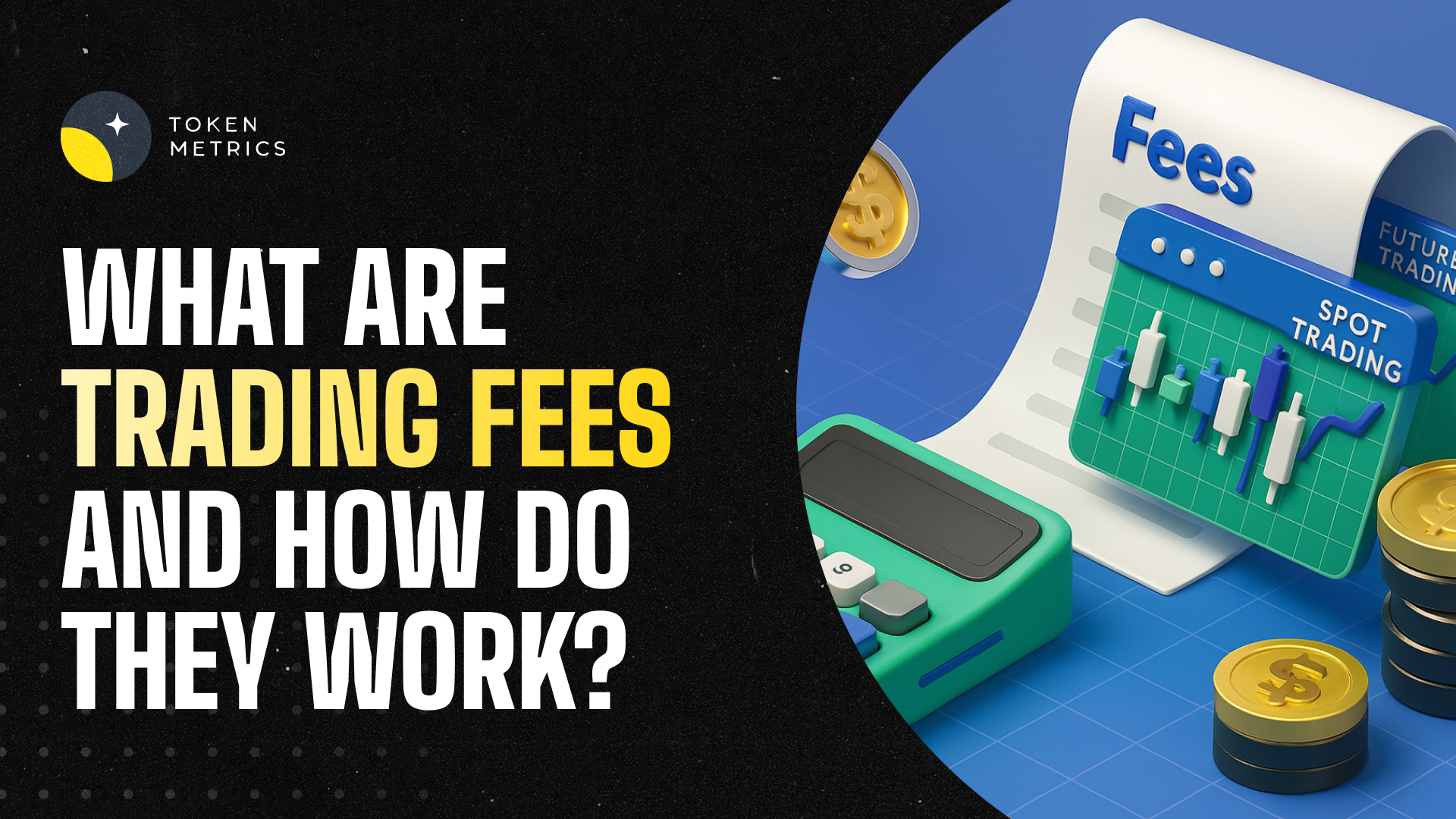
What Are Trading Fees and How Do They Work?

Learn what crypto trading fees are, how they’re calculated, and how to minimize them. Discover how Token Metrics’ AI tools can help you trade smarter and reduce costs.
Token Metrics Team
8 min
Want Smarter Crypto Picks—Free?
See unbiased Token Metrics Ratings for BTC, ETH, and top alts.
Thank you! Your submission has been received!
Oops! Something went wrong while submitting the form.
 No credit card | 1-click unsubscribe

If you’ve ever bought or sold cryptocurrency, you’ve likely noticed that exchanges charge trading fees. While these fees may seem small at first glance, they can add up significantly over time, especially for frequent traders.

Understanding how trading fees work is essential for maximizing your profits and choosing the right platform and strategy. In this guide, we’ll explain what trading fees are, how they’re calculated, the different types of fees, and how Token Metrics can help you minimize costs while optimizing your trades.

What Are Trading Fees?

Trading fees are charges imposed by cryptocurrency exchanges whenever you execute a trade—whether you’re buying, selling, or swapping digital assets.

  • Purpose:

    • They compensate exchanges for providing liquidity, security, and order-matching services.
    • They discourage spam orders that could overload the exchange.

Example:
If you buy $1,000 worth of Bitcoin with a 0.1% trading fee, you’ll pay $1 in fees for that transaction.

How Are Trading Fees Calculated?

Most crypto exchanges calculate fees based on:

  1. Trade Value (Percentage):

    • The most common model.
    • Fees are a percentage of the total trade amount (e.g., 0.1% per trade).

  2. Flat Fees:

    • Some platforms charge a fixed fee per trade, regardless of trade size.

  3. Tiered Fee Structures:

    • Frequent traders often benefit from lower fees when they reach certain monthly trading volumes.

Maker vs. Taker Fees

Many exchanges use a maker-taker model to incentivize liquidity:

  • Maker Fees:

    • You pay a lower fee (or sometimes nothing) when you add liquidity by placing a limit order that isn’t immediately matched.

  • Taker Fees:

    • You pay a higher fee when you remove liquidity by placing a market order that is filled instantly.

Example:
On Binance, makers might pay 0.08%, while takers pay 0.1%.

Types of Crypto Trading Fees

When trading crypto, you’ll encounter more than just trading fees:

1. Trading (Transaction) Fees

  • Charged when buying or selling crypto.
  • Often range from 0.05%–0.5% depending on the exchange.

2. Deposit Fees

  • Some exchanges charge when funding accounts via credit card, PayPal, or bank transfers.
  • Crypto deposits are typically free.

3. Withdrawal Fees

  • Charged when moving funds off the exchange.
  • Often fixed per withdrawal (e.g., 0.0005 BTC).

4. Network (Gas) Fees

  • Separate from exchange fees, paid to blockchain validators.
  • Ethereum and other networks can have high gas fees during peak demand.

Why Do Trading Fees Matter?

Even small fees can significantly impact your profits, especially if you trade often.

Example:

  • A day trader making 50 trades/month with a 0.1% fee per trade on $1,000 positions will pay $50/month in fees.
  • Over a year, that’s $600 lost to fees—before considering withdrawal or gas costs.

This is why reducing fees is crucial for active traders.

How to Minimize Trading Fees

1. Use Low-Fee Exchanges

Compare platforms—Binance, Bybit, and Kraken often offer competitive rates for high-volume traders.

2. Increase Your Trading Volume

Many exchanges lower fees as your monthly trading volume increases.

3. Use Limit Orders

Save on fees by acting as a maker instead of a taker whenever possible.

4. Pay with Exchange Tokens

Some exchanges offer discounts when fees are paid with their native token (e.g., BNB on Binance).

5. Optimize Your Trading Strategy with AI

Instead of making dozens of small trades, use data-driven insights from Token Metrics to make high-probability trades—reducing overall fee impact.

How Token Metrics Helps You Save on Fees

Token Metrics isn’t an exchange—it’s an AI-powered crypto research and trading platform designed to maximize your profits.

Here’s how it helps with trading fees:

1. AI-Powered Trade Optimization

Token Metrics provides bullish/bearish trading signals based on 80+ technical indicators, helping you enter fewer but higher-quality trades—minimizing unnecessary fees.

2. Trader & Investor Grades

Our proprietary grading system helps you identify top-performing cryptos, reducing guesswork and avoiding costly trial-and-error trading.

3. AI-Managed Indices

Instead of manually rebalancing portfolios (and paying multiple trading fees), use Token Metrics AI-driven crypto indices, which rebalance intelligently while keeping transaction costs low.

4. Narrative Tracking

Our AI detects emerging crypto narratives early, helping you position yourself before the market gets crowded—reducing the need for excessive short-term trading.

Practical Example: Using Token Metrics to Reduce Fees

Imagine you’re trading altcoins manually and make 20 trades/month.

  • At 0.2% per trade on $1,000 positions, you pay $40/month in fees.
  • With Token Metrics AI signals, you cut this down to 8 high-probability trades per month—reducing your fees by 60% while increasing win rates.

This is how data-driven trading saves both money and stress.

Final Thoughts

So, what are trading fees and how do they work? They’re the charges exchanges take for facilitating trades, withdrawals, and transactions—and while they may seem small, they can eat into your profits quickly.

The good news? You can minimize trading fees with the right strategies—and Token Metrics can help.

By providing AI-powered trading signals, long-term Investor Grades, and automated crypto indices, Token Metrics helps you reduce unnecessary trades, make smarter decisions, and maximize your returns—all while minimizing the impact of trading fees.

Whether you’re a beginner or advanced trader, using Token Metrics means trading smarter, not harder.

Build Smarter Crypto Apps &
AI Agents in Minutes, Not Months
Real-time prices, trading signals, and on-chain insights all from one powerful API.
Grab a Free API Key
About Token Metrics
Token Metrics: AI-powered crypto research and ratings platform. We help investors make smarter decisions with unbiased Token Metrics Ratings, on-chain analytics, and editor-curated “Top 10” guides. Our platform distills thousands of data points into clear scores, trends, and alerts you can act on.
30 Employees
analysts, data scientists, and crypto engineers
Daily Briefings
concise market insights and “Top Picks”
Transparent & Compliant
Sponsored ≠ Ratings; research remains independent
Want Smarter Crypto Picks—Free?
See unbiased Token Metrics Ratings for BTC, ETH, and top alts.
Thank you! Your submission has been received!
Oops! Something went wrong while submitting the form.
 No credit card | 1-click unsubscribe
Token Metrics Team
Token Metrics Team

Recent Posts

Crypto Basics

Ethereum Vs. Ethereum Classic: What's the Difference?

Token Metrics Team
4 minutes

Ethereum and Ethereum Classic are two of the most popular cryptocurrencies in the world today. Both of these digital currencies have exploded in value over the past few years and have become some of the most sought-after investments in the crypto market. 

But what is the key difference between ETH and ETC? 

Ethereum (ETH) and Ethereum Classic (ETC) are both blockchain networks, but they have a few key differences that make them unique. Ethereum is a newer platform that is designed to be more scalable and secure than Ethereum Classic. Ethereum Classic, on the other hand, is an open source blockchain network that has a focus on decentralization, immutability, and censorship resistance. In this article, we'll compare the two networks and explain why Ethereum is the better choice for most investors.

Overview of Ethereum and Ethereum Classic

Ethereum (ETH) is a decentralized blockchain network that runs smart contracts and enables the development of decentralized applications (dApps). Ethereum was created by Vitalik Buterin and officially released in 2015. 

Ethereum Classic (ETC) is an extension (not a clone) of the original Ethereum, which was forked away by the Ethereum Foundation by launching a new protocol just an year later in 2016. 

To be precise, Ethereum Classic was created when the original Ethereum network and currency were split following the DAO hack in 2016. Ethereum and Ethereum Classic are both open source networks that are maintained by their respective development teams. Unlike Bitcoin, both Ethereum and Ethereum Classic use a Proof-of-Work consensus algorithm. Both these networks also use a native digital token to fuel their networks. 

As Ether is the native token of the Ethereum network, you can use it to pay for transaction or computational services on the Ethereum network. Similarly, ETC tokens are used by participants on the Ethereum Classic network.

But, the majority of the crypto crowd still needs a clean chit over the key differences that make them absolutely distinct. 

So, let’s get into it.

Differences between Ethereum and Ethereum Classic

Scalability - Ethereum (ETH) and Ethereum Classic (ETC) are both open-source blockchain networks that allow you to build decentralized applications. However, Ethereum has been designed to be more scalable. That means the network can handle more transactions at a higher speed, making it a better choice for everyday applications. 

Security - While both Ethereum and Ethereum Classic are secure blockchain networks, Ethereum is more scalable and has a better security track record. Ethereum Classic has been dealing with network security issues since its inception. 

Decentralization - Decentralization is one of the core values offered by blockchain networks like Ethereum and Ethereum Classic. Decentralization on the Ethereum network is slightly better than Ethereum Classic, but both networks have a long way to go before they can be considered decentralized. 

Immutability - Immutability is another core value offered by blockchain networks. However, the Ethereum and Ethereum Classic networks are still very far from achieving full immutability. Both networks have suffered from various instances of data manipulation. 

Censorship resistance - Censorship resistance is another core value offered by blockchain networks. However, both Ethereum and Ethereum Classic are far from achieving full censorship resistance. Both networks can be subjected to censorship by governments and other centralized entities. 

ETH vs ETC - Which is the Better Choice for Investors?

While both Ethereum and Ethereum Classic are great investments, we believe Ethereum is the better choice for most investors for a few reasons. First, Ethereum is more decentralized. Second, Ethereum has been around longer than Ethereum Classic. This means the network is more scalable, secure, and well-established than its competitor. Finally, Ethereum has a wider range of applications than Ethereum Classic.

Overall, Ethereum is the better blockchain network when compared to Ethereum Classic.

The Bottom Line

Ethereum and Ethereum Classic, both of these networks have exploded in value over the past few years and have become some of the most sought-after investments in the crypto market.

When the DAO got hacked and lost $50 million, Ethereum needed a solid technology to replace the old one. So, a hard fork was done. But many traditional supporters of Ethereum did not want to go with the hard fork, and they stayed with the old blockchain technology. As a result, Ethereum Classic was born.

Disclaimer: The information provided on this website does not constitute investment advice, financial advice, trading advice, or any other sort of advice and you should not treat any of the website's content as such.

Token Metrics does not recommend that any cryptocurrency should be bought, sold, or held by you. Do conduct your own due diligence and consult your financial advisor before making any investment decisions.

Announcements

Token Metrics TradingView Indicator - Trade Cryptocurrencies with Confidence

Token Metrics Team
7 minutes

Trading indicators are a crucial aspect of the investing world, and in the volatile world of cryptocurrency, it becomes all the more important to have them on your side. 

TradingView, the leading social trading platform, provides traders with the tools they need to make informed decisions and take their trading game to the next level.

Among the tools offered by TradingView is the Token Metrics Indicator, a powerful tool that combines multiple technical analysis indicators to provide Long/Short signals for crypto assets.

In this blog, we will dive into the Token Metrics TradingView Indicator and how it can help you to improve your trading strategy. 

Whether you are a seasoned trader or just starting out, the Token Metrics TradingView Indicator can help you make informed investment decisions and potentially avoid costly mistakes.

That said, let’s get started.

What is Token Metrics TradingView Indicator? 

The Token Metrics TradingView Indicator is a powerful tool for crypto assets on TradingView, combining multiple strategies to give you clear Long and Short signals for your trades. 

It gives you a clear picture of the market with four key components: Clouds, Trend Line, Signals, and Channels. The Clouds show the current trend (green for bullish and red for bearish), the Trend Line provides a long-term market outlook with resistance and support levels, the Signals provide buy/sell signals and the Channels help to determine the previous swing high and low to get an idea of where resistance/support might be forming and where breakouts can occur.

The backtesting feature allows users to assess the strategy's historical performance and understand its potential, risk profile, and suitability for different market conditions. 

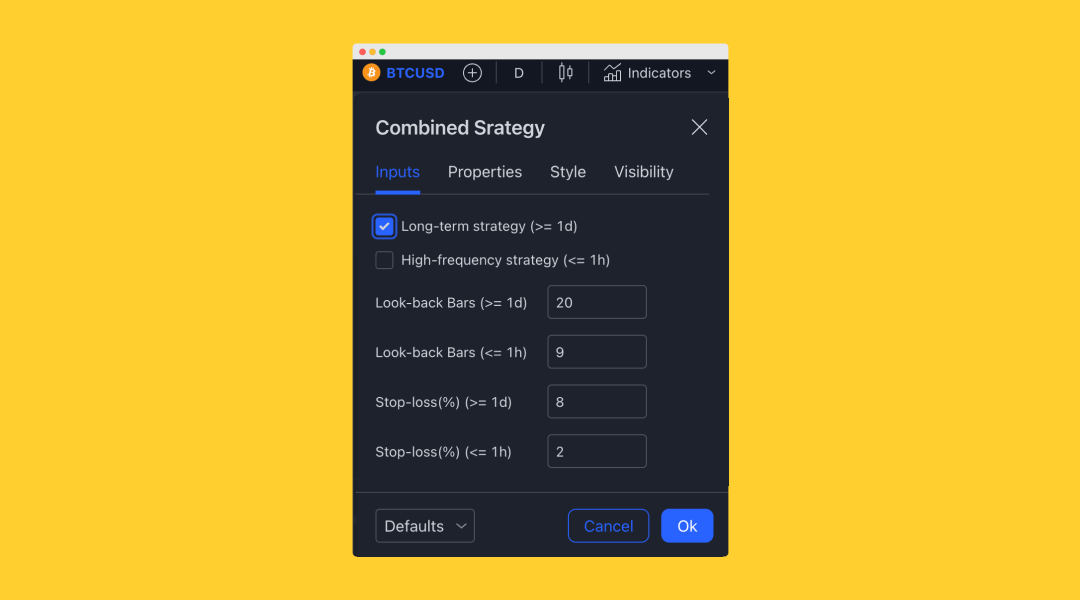
The Token Metrics TradingView Indicator offers customization options to match individual trading preferences through its inputs.

Users can adjust these values based on risk tolerance and market conditions, allowing optimal performance and profitability. Whether you prefer a fast-reacting or slow-adapting strategy, the Token Metrics TradingView Indicator has you covered.

Supports All Types of Traders

The Token Metrics Trading View Indicator offers traders two distinct approaches to cryptocurrency trading: long-term and high-frequency trading. Each style has its considerations and best practices to maximize profitability.

For long-term traders, the Token Metrics TradingView Indicator provides a trend-following strategy best suited for Daily and Weekly timeframes. This approach excels in trending markets but may produce false signals in choppy or range-bound markets. It is important for long-term traders to keep in mind that the goal is to gain exposure to strong trends without excessive trading.

On the other hand, high-frequency traders can take advantage of the mean-reverting capabilities of the Token Metrics TradingView Indicator. This approach is best suited for 15min, 30min, and 1hr timeframes and works best in choppy and range-bound markets. Mean-reversion is stronger on low time frame charts, making this strategy ideal for traders looking to buy at the bottom of the channel and sell at the top. It is important for high-frequency traders to remember that this strategy is not intended for exposure to prevailing trends.

Whether you prefer long-term or high-frequency trading, the Token Metrics TradingView Indicator provides the tools and customization options to match your individual style. By understanding the strengths and limitations of each approach, you can make the most out of your trading strategy with the Token Metrics TradingView Indicator.

How to Get the Token Metrics TradingView Indicator

The Token Metrics TradingView Indicator is included in all Token Metrics Plans

You can also get this indicator as a standalone product by visiting this page to learn more.

Conclusion

In conclusion, the Token Metrics TradingView Indicator is a versatile tool that can be customized to fit the needs of both long-term and high-frequency traders.

Whether you're looking to gain exposure to strong trends or to take advantage of mean-reversion in choppy markets, the Token Metrics TradingView Indicator provides the features and flexibility you need to achieve your trading goals.

With its comprehensive backtesting capabilities, you can get a deep understanding of the performance of your strategy, allowing you to make informed decisions and achieve consistent profits in the cryptocurrency market.

Crypto Basics

What is Crypto Yield Farming and How it Works?

Token Metrics Team
6 minutes

In this guide, we will answer what crypto yield farming is and how to do it.

Yield farming is a revolutionary way of earning passive income through cryptocurrency investments. It is a relatively new concept and has gained much attention in the crypto world. Yield farming involves using your cryptocurrency assets and taking advantage of lending platforms, decentralized finance protocols, and staking pools to generate incentives for interest payments, rewards, and capital gains. 

In this descriptive guide to crypto yield farming, you'll learn about the different types of yield farming, the rewards available, and the associated risks. You can earn passive income through yield farming with the right strategies and knowledge. So, let's dive right in and learn about crypto yield farming.

What is Crypto Yield Farming?

Yield farming is a process of using your cryptocurrency assets to generate incentives in the form of:

  • Interest payments, 
  • Rewards, and 
  • Capital gains. 

In other words, it is a form of passive income from cryptocurrency assets. Yield farming can also be considered a strategic investment strategy that allows you to earn income from your idle assets by lending them to other users. This process is similar to how people earn income from their savings accounts. 

These idle assets that you can stake can be your:

  • Computer's processing power
  • A certain amount of coins from your portfolio, or 
  • A certain amount of tokens from your portfolio. 

But how is this beneficial to you? 

Benefits of Yield Farming

Yield farming offers a wide range of benefits for both individuals and businesses. 

  • For individuals, yield farming can be a great way to earn extra income. It can help you diversify your crypto portfolio and hedge against some of the risks associated with investing in cryptocurrencies by generating extra income from your idle assets. This is why they call it an excellent way to earn passive income, which is one of the core benefits of cryptocurrency. 
  • For businesses, yield farming can help you expand your customer base and increase revenue. You can earn income by lending your idle assets while helping people earn interest and build their crypto portfolios. Although yield farming was once primarily used by mining operations, it can now be done by individuals, organizations, and other entities that are involved with cryptocurrency.

How Does Yield Farming Work in Real-time?

So, what do you need to do to get started with yield farming?

To begin with, the yield farmers will need to deposit their coins or tokens into decentralized applications or dApps of their choice for the following: 

  • Crypto trading 
  • Lending, or 
  • Borrowing. 

A few examples of dApps include crypto wallets, DEXs, decentralized social media, and more. Since these investors enhance the liquidity in their chosen dApp, they're referred to as liquidity providers. The crypto that yields farmers' deposits into DeFi protocols gets locked into autonomous smart contracts.

Types of Yield Farming

There are three types of yield farming - lending, providing liquidity, and staking. 

Lending refers to lending your idle cryptocurrency assets to earn interest payments. You are generating revenue through interest payments when you lend your cryptocurrency assets. This process is similar to how people earn interest from their savings accounts. 

Providing liquidity to decentralized apps for traders to trade on can also generate you fees. However, keep in mind that there exists impermanent loss in the process.

Staking refers to lending your coins to earn rewards through coins and staking fees. You are generating revenue through rewards and staking fees when you stake your coins. Rewards can come in the form of coins, tokens, or other types of digital assets. You are lending your coins to earn rewards.

Types of Rewards Available

Rewards are the incentives earned when you lend idle coins and cryptocurrencies to earn interest payments and generate passive income. There are many different rewards available to those who participate in yield farming. Some include interest payments, votes, staking rewards, and airdrops. 

Interest payments: This is the primary reward generated by yield farming. Interest payments are generated when you lend idle coins and cryptocurrencies to other participants. 

Votes: This refers to the ability to vote on certain network issues. 

Staking rewards are rewards generated by staking crypto assets for a certain period. 

Airdrops: This refers to the free crypto coins and tokens resulting from participating in a certain network or blockchain project.

Is Yield Farming Safe and Profitable?

Now that you know the benefits of yield farming, it's also important to know the risks. This is because no investment is risk-free, and the same is true for yield farming. When you decide to earn income from yield farming, you must consider the risks associated with it. Some risks associated with yield farming include network, liquidity, counterparty, and regulatory risks. 

Network risk refers to the risk associated with the security of the network/blockchain and its ability to function as expected. 

Liquidity risk is associated with the ability to liquidate your assets when you need them. 

Counterparty risk refers to the risk associated with the ability of the person/entity with whom you have the contract to fulfill the obligations. 

Regulatory risk is the risk associated with the ability of the government to enact new laws that can affect your earnings.

Smart contract risk is the risk associated with the probability of smart contracts getting hacked due to a bug or backdoor.

That said, there are definitely risks involved that you need to be aware of.

Strategies for Yield Farming

There are many strategies you can use for yield farming. Some of them include lending your idle assets to earn interest payments, staking your coins to earn rewards, and using different DAFs to generate passive income.

Lending your idle assets: This is one of the most common ways to earn income through yield farming. You can use your idle assets, such as your computer's processing power, to lend them to others who need them. 

Staking your coins: This is another popular way to generate passive income through yield farming. You can lend your coins to earn rewards. 

Using different DAFs: This refers to the use of decentralized autonomous funds that can generate passive income.

What's Next for Yield Farming?

Yield farming is a dynamic space that tends to change quickly; it often requires vigilance and time for farmers to cull out the best possible strategies. However, for someone who can manage it, yield farming will be highly profitable in 2023, even in the bearish market.  

That said, yield farming is significantly risky with rug pulls, hacks, impermanent loss, etc.

So, choosing your battle is important before getting into the ring. 

Platforms for Yield Farming

Many different types of yield farming platforms are available for you to use.

You can use these platforms to take advantage of your idle assets to generate income through interest payments and rewards.

Some popular yield farming platforms include Yearn Finance, Lido, and Liquity.

The Bottom Line

Yield farming is a revolutionary way of earning passive income through cryptocurrency investments. It involves using your cryptocurrency assets to take advantage of lending platforms, decentralized finance protocols, and staking pools to generate incentives in interest payments, rewards, and capital gains. While lucrative, it can be a riskier investment depending on the platform you go for and the type of yield you are generating.

Choose from Platinum, Gold, and Silver packages
Reach with 25–30% open rates and 0.5–1% CTR
Craft your own custom ad—from banners to tailored copy
Perfect for Crypto Exchanges, SaaS Tools, DeFi, and AI Products