Back to blog
Research

What Does Decentralization Mean in Practice? A 2025 Perspective

Explore the practical implications of decentralization with key insights and real-world examples. Discover how it reshapes industries today. Read more!
Talha Ahmad
5 min
Want Smarter Crypto Picks—Free?
See unbiased Token Metrics Ratings for BTC, ETH, and top alts.
Thank you! Your submission has been received!
Oops! Something went wrong while submitting the form.
 No credit card | 1-click unsubscribe

Decentralization has evolved far beyond its origins as a theoretical concept tied to blockchain technology. In 2025, decentralization is a transformative force reshaping industries, organizations, and governance structures worldwide. But what does decentralization mean in practice? It means distributing authority, decision making, and control away from a single central authority and empowering multiple parties to work independently yet cohesively. This practical shift is redefining how we interact with technology, finance, and management across various sectors.

There are several main types of decentralization, including administrative decentralization, which involves transferring planning and implementation responsibilities to local governments and civil servants, and fiscal decentralization, which focuses on shifting revenue-raising and expenditure authority to lower levels of government. These forms of decentralization are relevant not only to public administration but also to business entities, where organizational autonomy and efficiency are enhanced through decentralized structures.

For example, computer networks such as the Internet are prime examples of decentralized systems, as they operate without a central authority and enable open participation across networked systems.

Beyond the Buzzword: Understanding Real Decentralization

At its core, decentralization refers to moving away from traditional centralized entities where a single person or organization holds all decision making power. Instead, decentralized systems distribute authority and decision making processes across various departments, units, or participants. This distribution not only reduces reliance on a central government or central authority, enhancing fault tolerance and resilience against attacks or failures, but also shapes the organizational structure to support effective communication, faster information flow, and improved internal relationships.

Blockchain technology is a prime example of decentralization in action. Rather than a single company controlling data or transactions, blockchain distributes control among a network of participants who validate and record information. This means no single entity has overarching power, and decisions emerge from collective consensus. The result is quicker decision making, increased transparency, and more autonomy for users. Decentralized computer networks also support increased innovation by enabling greater creativity, rapid adaptation to change, and improved responsiveness to user needs.

Importantly, decentralization today extends well beyond cryptocurrencies. It influences governance models, organizational structures, and even physical infrastructure. Decentralization reforms in governments emphasize political decentralization, giving regional and local authorities more power and responsibility for local governance and service delivery. This process transfers powers and responsibilities to the local level, where local officials are held accountable for their decisions and actions, ensuring transparency and effective governance. Similarly, in the private sector, decentralization strategies empower lower management levels and decentralized units to work independently, fostering innovation, local responsiveness, and the development of managerial skills among lower-level managers.

Decentralized Finance: The Foundation of Practical Implementation

One of the clearest examples of decentralization in practice is Decentralized Finance, or DeFi. DeFi uses blockchain technology to create financial systems where no central bank or company controls your money or transactions. Instead, these processes happen on open networks accessible to anyone. DeFi is a prime example of market decentralization, shifting financial services from centralized institutions to competitive, decentralized markets.

In practice, DeFi enables users to access loans instantly through smart contracts without waiting for bank approvals. Decentralized exchanges like Uniswap allow peer-to-peer trading without a centralized intermediary, using liquidity pools provided by users who earn fees for their participation. This model increases allocative efficiency and reduces transaction times.

Navigating DeFi’s complexities requires advanced tools. Platforms like Token Metrics combine AI analytics with blockchain data to help investors identify promising tokens early. By providing scores and insights, Token Metrics empowers both novice and experienced traders to make informed decisions, demonstrating how decentralization paired with AI can democratize access to financial markets.

Decentralized Physical Infrastructure Networks (DePINs): Bridging Digital and Physical Worlds

In 2025, decentralization is no longer limited to digital applications. Decentralized Physical Infrastructure Networks (DePINs) are emerging as a revolutionary way to distribute control over tangible resources like energy grids, transportation systems, and communication networks. These are examples of public services that can be decentralized, offering alternatives to traditional government-provided utilities. DePINs allow individuals to monetize unused physical resources—such as bandwidth or storage—by participating in decentralized operations.

This practical application of decentralization means that ordinary people can earn passive income by contributing to local markets without centralized oversight. For example, DePINs can monitor environmental factors like noise pollution or manage energy distribution more efficiently by leveraging decentralized units working independently but coordinated through blockchain protocols, alongside other units within the network that operate autonomously.

DePINs exemplify how decentralization refers not only to distributing authority but also to creating new economic models that reward participation and improve overall quality of service delivery. As these networks grow, they enhance resilience and local responsiveness, addressing challenges faced by centralized infrastructure.

Political Decentralization and Decentralized Governance: Reimagining Democratic Participation

Decentralization also reshapes governance by distributing decision making authority away from top management or central government to multiple stakeholders. In many cases, this involves transferring powers traditionally held by the national government to regional or local entities, fundamentally altering the structure of governance.

Decentralized Autonomous Organizations (DAOs) use blockchain-based smart contracts to automate decision making, allowing token holders to participate directly in policy making without relying on a single person or centralized entity. While political decentralization disperses authority among various levels, political centralization refers to the concentration of power and decision-making at the national government level, highlighting a key difference in how authority is structured.

This political decentralization fosters transparency and inclusivity, enabling civil society and various departments within organizations to collaborate effectively. DAOs are increasingly explored not only in crypto projects but also in traditional organizations seeking to improve local governance and intergovernmental relations.

Emerging trends in decentralized governance include AI-assisted delegation, which helps users identify representatives aligned with their values, and incentive mechanisms designed to encourage meaningful participation beyond simple token rewards. Successful decentralization in governance requires balancing autonomy with coordination, ensuring decentralized units remain accountable while maintaining consistency.

The AI-Decentralization Convergence

While artificial intelligence is often seen as a centralizing force controlled by large corporations, it is becoming a powerful enabler of decentralization. By building decentralized AI models and open access to AI resources, blockchain technology ensures innovation remains accessible and transparent. This approach strengthens the organization's overall innovation capacity and supports its strategic objectives by reducing barriers to advanced technology.

This convergence is evident in platforms like Token Metrics, which leverage AI, machine learning, and big data analytics to democratize sophisticated crypto trading insights. Token Metrics’ AI-selected crypto baskets have delivered impressive returns, illustrating how decentralized means combined with AI can level the playing field for individual investors.

Moreover, natural language processing enables the interpretation of social media trends and market sentiment, providing traders with early signals to anticipate market movements. This practical application of AI in decentralized systems enhances decision making power and strategic planning for many businesses and individual investors alike.

Cross-Chain Interoperability: Breaking Down Digital Silos

A significant challenge for decentralization has been the fragmentation of blockchain networks, limiting seamless interaction between different systems. In 2025, cross-chain interoperability solutions are gaining traction, enabling users to transact and interact across multiple blockchains without friction.

This development is critical for decentralization’s mainstream adoption, ensuring users do not need to understand the technical differences between Ethereum, Solana, or other chains. Instead, decentralized units across various regions can coordinate effectively, improving overall control and service delivery.

Cross-chain interoperability exemplifies how decentralization strategies are evolving to maintain the right balance between autonomy and coordination, fostering a more connected and efficient decentralized ecosystem.

Decentralized Organizational Structures: Rethinking How We Build and Operate

Decentralized organizational structures are transforming how organizations operate in 2025. Unlike traditional models where a central authority or single entity holds most of the decision making power, a decentralized system distributes decision making authority across various departments, teams, or even individuals. This shift gives each part of the organization more autonomy to address local needs and adapt to changing conditions on the ground.

In practice, this means that instead of waiting for approval from top management, teams can make independent decisions that are best suited to their specific context. For example, a regional office might tailor its service delivery or marketing strategies to better fit the preferences of its local market, without needing to follow a one-size-fits-all directive from headquarters. This approach not only speeds up response times but also encourages innovation, as those closest to the challenges have the authority to experiment with new solutions.

Organizations adopting decentralized structures often find that empowering various departments leads to greater flexibility and resilience. By giving teams more autonomy, organizations can better navigate complex environments and rapidly changing market demands. This model also helps attract and retain talent, as employees value the opportunity to have a real impact and take ownership of their work.

Ultimately, decentralized organizational structures are about moving away from rigid hierarchies and embracing a more dynamic, responsive way of working. By distributing authority and decision making throughout the organization, businesses can unlock new levels of creativity, efficiency, and local responsiveness—key ingredients for success in today’s fast-paced world.

Real-World Impact, Service Delivery, and Market Dynamics

Decentralization’s practical impact is increasingly tangible. Governments are implementing decentralization reforms that allocate financial resources and decision making authority to sub national and local governments, improving responsiveness to local needs. Central governments play a key role in delegating these powers, setting policies, providing resources, and maintaining overall coordination while enabling more localized decision-making and management. In the private sector, many businesses adopt decentralized organizational structures, giving teams more power and autonomy to innovate.

Institutional adoption of DeFi and decentralized governance models signals growing confidence in decentralized systems. Traditional financial institutions are partnering with DeFi platforms to integrate decentralized solutions, blending centralized and decentralized finance for enhanced service delivery.

For investors and organizations navigating this evolving landscape, tools like Token Metrics provide crucial AI-driven analytics and real-time buy and sell signals. By processing vast market data and social sentiment, these platforms enhance allocative efficiency and help users capitalize on decentralized market opportunities.

Challenges and Considerations in Decision Making

Despite its advantages, decentralization in practice faces challenges. Operating without a central authority or government regulation exposes participants to risks such as smart contract vulnerabilities, hacks, and scams. There are limited consumer protections, so responsibility and accountability rest heavily on users.

Regulatory frameworks are still developing worldwide. Countries like Switzerland and Singapore are pioneering clear classifications for digital assets, which are essential for balancing decentralization’s benefits with legal oversight. Achieving successful decentralization requires ongoing coordination among governments, civil society, and the private sector to address these challenges.

The Future of Decentralization

Looking forward, 2025 is shaping up as the long-awaited year of decentralization. The convergence of mature DeFi protocols, expanding DePIN networks, innovative governance models, and AI-powered analytics platforms is creating an ecosystem where decentralization delivers real-world benefits.

Platforms like Token Metrics illustrate how sophisticated tools democratize access to complex financial markets, bridging the gap between decentralization’s promise and practical implementation. As decentralization strategies continue to evolve, organizations and individuals will find more opportunities to participate, innovate, and succeed in decentralized environments.

Conclusion: Decentralization as a Practical Reality

In 2025, decentralization is no longer an abstract idea or speculative trend; it is a practical reality transforming technology, finance, governance, and infrastructure. From earning passive income through decentralized physical networks to engaging in AI-enhanced crypto trading, decentralization empowers individuals and organizations with more control, autonomy, and decision making power.

The question today is not what does decentralization mean in practice, but how quickly and effectively can we adapt to this new paradigm? With advances in blockchain technology, AI, cross-chain interoperability, and decentralized governance, the infrastructure and tools are in place. The future is a decentralized economy where power is distributed, decisions are made collaboratively, and innovation flourishes across multiple independent yet interconnected units.

‍

Build Smarter Crypto Apps &
AI Agents in Minutes, Not Months
Real-time prices, trading signals, and on-chain insights all from one powerful API.
Grab a Free API Key
About Token Metrics
Token Metrics: AI-powered crypto research and ratings platform. We help investors make smarter decisions with unbiased Token Metrics Ratings, on-chain analytics, and editor-curated “Top 10” guides. Our platform distills thousands of data points into clear scores, trends, and alerts you can act on.
30 Employees
analysts, data scientists, and crypto engineers
Daily Briefings
concise market insights and “Top Picks”
Transparent & Compliant
Sponsored ≠ Ratings; research remains independent
Want Smarter Crypto Picks—Free?
See unbiased Token Metrics Ratings for BTC, ETH, and top alts.
Thank you! Your submission has been received!
Oops! Something went wrong while submitting the form.
 No credit card | 1-click unsubscribe
Token Metrics Team
Token Metrics Team

Recent Posts

Research

A Comprehensive Guide to Mining Ethereum

Token Metrics Team
4

Introduction

Ethereum mining has been an essential part of the Ethereum blockchain network, enabling transaction validation and new token issuance under a Proof-of-Work (PoW) consensus mechanism. As Ethereum evolves, understanding the fundamentals of mining, the required technology, and operational aspects can provide valuable insights into this cornerstone process. This guide explains the key components of Ethereum mining, focusing on technical and educational details without promotional or financial advice.

How Ethereum Mining Works

Ethereum mining involves validating transactions and securing the network by solving complex mathematical problems using computational resources. Miners employ high-performance hardware to perform hashing calculations and compete to add new blocks to the blockchain. Successfully mined blocks reward miners with Ether (ETH) generated through block rewards and transaction fees.

At its core, Ethereum mining requires:

  • Mining hardware: specialized components optimized for hashing functions
  • Mining software: programs that connect hardware to the network and coordinate mining efforts
  • Network connection: stable and efficient internet connectivity
  • Mining pool participation: collaborative groups of miners combining hash power

Choosing Mining Hardware

GPU-based mining rigs are currently the standard hardware for Ethereum mining due to their efficiency in processing the Ethash PoW algorithm. Graphics Processing Units (GPUs) are well-suited for the memory-intensive hashing tasks required for Ethereum, as opposed to ASICs (Application-Specific Integrated Circuits) that tend to specialize in other cryptocurrencies.

Key considerations when selecting GPUs include:

  • Hashrate: the measure of mining speed, usually expressed in MH/s (megahashes per second)
  • Energy efficiency: power consumption relative to hashing performance
  • Memory capacity: minimum 4GB VRAM required for Ethereum mining
  • Cost: initial investment balanced against expected operational expenses

Popular GPUs such as the Nvidia RTX and AMD RX series often top mining performance benchmarks. However, hardware availability and electricity costs significantly impact operational efficiency.

Setting Up Mining Software

Once mining hardware is selected, the next step involves configuring mining software suited for Ethereum. Mining software translates computational tasks into actionable processes executed by the hardware while connecting to the Ethereum network or mining pools.

Common mining software options include:

  • Ethminer: an open-source solution tailored for Ethereum
  • Claymore Dual Miner: supports mining Ethereum alongside other cryptocurrencies
  • PhoenixMiner: known for its stability and efficiency

When configuring mining software, consider settings related to:

  • Pool address: if participating in a mining pool
  • Wallet address: for receiving mining rewards
  • GPU tuning parameters: to optimize performance and power usage

Understanding Mining Pools

Mining Ethereum independently can be challenging due to increasing network difficulty and competition. Mining pools provide cooperative frameworks where multiple miners combine computational power to improve chances of mining a block. Rewards are then distributed proportionally according to contributed hash power.

Benefits of mining pools include:

  • Reduced variance: more frequent, smaller payouts compared to solo mining
  • Community support: troubleshooting and shared resources
  • Scalability: enabling participation even with limited hardware

Popular mining pools for Ethereum include Ethermine, SparkPool, and Nanopool. When selecting a mining pool, evaluate factors such as fees, payout methods, server locations, and minimum payout thresholds.

Operational Expenses and Efficiency

Mining Ethereum incurs ongoing costs, primarily electricity consumption and hardware maintenance. Efficiency optimization entails balancing power consumption with mining output to ensure sustainable operations.

Key factors to consider include:

  • Electricity costs: regional rates greatly influence profitability and operational feasibility
  • Hardware lifespan: consistent usage causes wear, requiring periodic replacements
  • Cooling solutions: to maintain optimal operating temperatures and prevent hardware degradation

Understanding power consumption (wattage) of mining rigs relative to their hashrate assists in determining energy efficiency. For example, a rig with a hashrate of 60 MH/s consuming 1200 watts has different efficiency metrics compared to others.

Monitoring and Analytics Tools

Efficient mining operations benefit from monitoring tools that track hardware performance, network status, and market dynamics. Analytical platforms offer data-backed insights that can guide equipment upgrades, pool selection, and operational adjustments.

Artificial intelligence-driven research platforms like Token Metrics provide quantitative analysis of Ethereum network trends and mining considerations. Leveraging such tools can optimize decision-making by integrating technical data with market analytics without endorsing specific investment choices.

Preparing for Ethereum Network Evolution

Ethereum’s transition from Proof-of-Work to Proof-of-Stake (PoS), known as Ethereum 2.0, represents a significant development that impacts mining practices. PoS eliminates traditional mining in favor of staking mechanisms, which means Ethereum mining as performed today may phase out.

Miners should remain informed about network upgrades and consensus changes through official channels and reliable analysis platforms like Token Metrics. Understanding potential impacts enables strategic planning related to hardware usage and participation in alternative blockchain activities.

Educational Disclaimer

This article is intended for educational purposes only. It does not offer investment advice, price predictions, or endorsements. Readers should conduct thorough individual research and consider multiple reputable sources before engaging in Ethereum mining or related activities.

Research

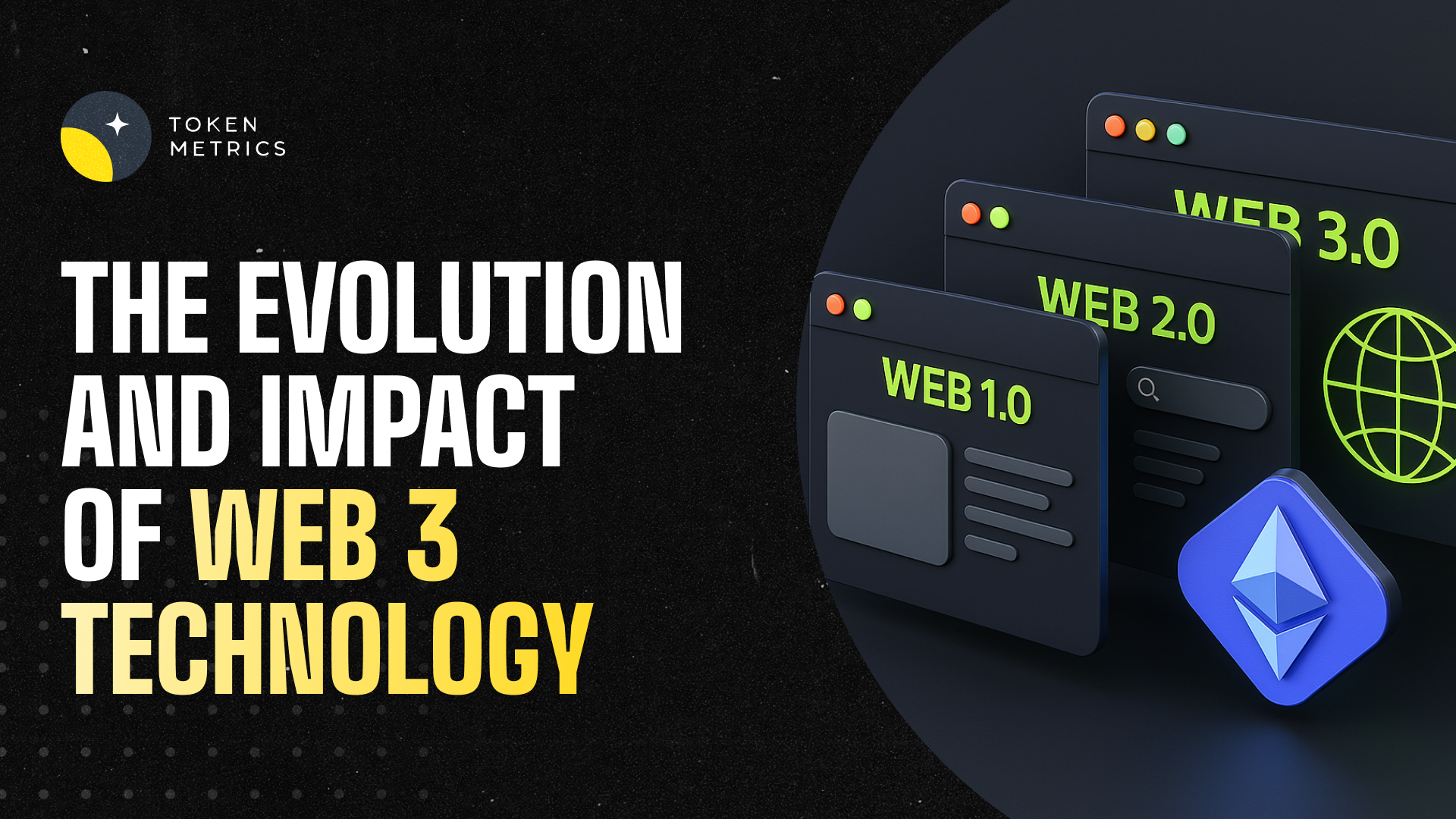
Understanding the Evolution and Impact of Web 3 Technology

Token Metrics Team
5

Introduction to Web 3

The digital landscape is continually evolving, giving rise to a new paradigm known as Web 3. This iteration promises a shift towards decentralization, enhanced user control, and a more immersive internet experience. But what exactly is Web 3, and why is it considered a transformative phase of the internet? This article explores its fundamentals, technology, potential applications, and the tools available to understand this complex ecosystem.

Defining Web 3

Web 3, often referred to as the decentralized web, represents the next generation of internet technology that aims to move away from centralized platforms dominated by a few major organizations. Instead of relying on centralized servers, Web 3 utilizes blockchain technology and peer-to-peer networks to empower users and enable trustless interactions.

In essence, Web 3 decentralizes data ownership and governance, allowing users to control their information and digital assets without intermediaries. This marks a significant departure from Web 2.0, where data is predominantly managed by centralized corporations.

Key Technologies Behind Web 3

Several emerging technologies underpin the Web 3 movement, each playing a vital role in achieving its vision:

  • Blockchain: A distributed ledger system ensuring transparency, security, and immutability of data. It replaces traditional centralized databases with decentralized networks.
  • Decentralized Applications (dApps): Applications running on blockchain networks providing services without a central controlling entity.
  • Smart Contracts: Self-executing contracts with coded rules, enabling automated and trustless transactions within the Web 3 ecosystem.
  • Decentralized Finance (DeFi): Financial services built on blockchain, offering alternatives to traditional banking systems through peer-to-peer exchanges.
  • Non-Fungible Tokens (NFTs): Unique digital assets representing ownership of items like art, music, or virtual real estate verified on a blockchain.

Together, these technologies provide a robust foundation for a more autonomous and transparent internet landscape.

Contrasting Web 3 With Web 2

Understanding Web 3 requires comparing it to its predecessor, Web 2:

  • Data Control: Web 2 centralizes data with platform owners; Web 3 returns data ownership to users.
  • Intermediaries: Web 2 relies heavily on intermediaries for operations; Web 3 enables direct interaction between users via decentralized protocols.
  • Monetization Models: Web 2 monetizes mainly through targeted ads and user data; Web 3 offers new models such as token economies supported by blockchain.
  • Identity: Web 2 uses centralized identity management; Web 3 incorporates decentralized identity solutions allowing greater privacy and user control.

This shift fosters a more user-centric, permissionless, and transparent internet experience.

Potential Applications of Web 3

Web 3's decentralized infrastructure unlocks numerous application possibilities across industries:

  • Social Media: Platforms that return content ownership and revenue to creators rather than centralized corporations.
  • Finance: Peer-to-peer lending, decentralized exchanges, and transparent financial services enabled by DeFi protocols.
  • Gaming: Games featuring true asset ownership with NFTs and player-driven economies.
  • Supply Chain Management: Immutable tracking of goods and provenance verification.
  • Governance: Blockchain-based voting systems enhancing transparency and participation.

As Web 3 matures, the range of practical and innovative use cases is expected to expand further.

Challenges and Considerations

Despite its promise, Web 3 faces several hurdles that need attention:

  • Scalability: Current blockchain networks can encounter performance bottlenecks limiting widespread adoption.
  • User Experience: Interfaces and interactions in Web 3 must improve to match the seamlessness users expect from Web 2 platforms.
  • Regulatory Environment: Legal clarity around decentralized networks and digital assets remains a work in progress globally.
  • Security: While blockchain offers security benefits, smart contract vulnerabilities and user key management pose risks.

Addressing these challenges is crucial for realizing the full potential of Web 3.

How to Research Web 3 Opportunities

For individuals and organizations interested in understanding Web 3 developments, adopting a structured research approach is beneficial:

  1. Fundamental Understanding: Study blockchain technology principles and the differences between Web 2 and Web 3.
  2. Use Analytical Tools: Platforms like Token Metrics provide data-driven insights and ratings on Web 3 projects, helping to navigate the complex ecosystem.
  3. Follow Reputable Sources: Stay updated with academic papers, technical blogs, and industry news.
  4. Experiment with Applications: Engage hands-on with dApps and blockchain platforms to gain practical understanding.
  5. Evaluate Risks: Recognize technical, operational, and regulatory risks inherent to emerging Web 3 projects.

This approach supports informed analysis based on technology fundamentals rather than speculation.

The Role of AI in Web 3 Research

Artificial intelligence technologies complement Web 3 by enhancing research and analytical capabilities. AI-driven platforms can process vast amounts of blockchain data to identify patterns, assess project fundamentals, and forecast potential developments.

For example, Token Metrics integrates AI methodologies to provide insightful ratings and reports on various Web 3 projects and tokens. Such tools facilitate more comprehensive understanding for users navigating decentralized ecosystems.

Conclusion

Web 3 embodies a transformative vision for the internet—one that emphasizes decentralization, user empowerment, and innovative applications across multiple sectors. While challenges remain, its foundational technologies like blockchain and smart contracts hold substantial promise for reshaping digital interactions.

Continuing research and utilization of advanced analytical tools like Token Metrics can help individuals and organizations grasp Web 3’s evolving landscape with clarity and rigor.

Disclaimer

This article is for educational and informational purposes only and does not constitute financial, investment, or legal advice. Readers should conduct their own research and consult with professional advisors before making any decisions related to Web 3 technologies or digital assets.

Research

A Comprehensive Guide to Minting Your Own NFT

Token Metrics Team
4

Introduction to NFT Minting

The explosion of interest in non-fungible tokens (NFTs) has opened new opportunities for creators and collectors alike. If you've ever wondered, "How can I mint my own NFT?", this guide will walk you through the essential concepts, processes, and tools involved in creating your unique digital asset on the blockchain.

What is NFT Minting?

Minting an NFT refers to the process of turning a digital file — such as artwork, music, video, or other digital collectibles — into a unique token recorded on a blockchain. This tokenization certifies the originality and ownership of the asset in a verifiable manner. Unlike cryptocurrencies, NFTs are unique and cannot be exchanged on a one-to-one basis.

Choosing the Right Blockchain for NFT

Several blockchains support NFT minting, each with distinct features, costs, and communities. The most popular blockchain for NFTs has been Ethereum due to its widespread adoption and support for ERC-721 and ERC-1155 token standards. However, alternatives such as Binance Smart Chain, Solana, Polygon, and Tezos offer different advantages, such as lower transaction fees or faster processing times.

When deciding where to mint your NFT, consider factors like network fees (also known as gas fees), environmental impact, and marketplace support. Analytical tools, including Token Metrics, can offer insights into blockchain performance and trends, helping you make an informed technical decision.

Selecting an NFT Platform

Once you have chosen a blockchain, the next step is to select an NFT platform that facilitates minting and listing your digital asset. Popular NFT marketplaces such as OpenSea, Rarible, Foundation, and Mintable provide user-friendly interfaces to upload digital files, set metadata, and mint tokens.

Some platforms have specific entry requirements, such as invitation-only access or curation processes, while others are open to all creators. Consider the platform's user base, fees, minting options (e.g., lazy minting or direct minting), and supported blockchains before proceeding.

Step-by-Step Process to Mint Your Own NFT

  1. Prepare Your Digital Asset: Have your digital file ready — this could be an image, audio, video, or 3D model.
  2. Create a Digital Wallet: Set up a cryptocurrency wallet (such as MetaMask or Trust Wallet) compatible with your chosen blockchain and platform.
  3. Fund Your Wallet: Add some cryptocurrency to your wallet to cover minting and transaction fees. For Ethereum-based platforms, this typically means ETH.
  4. Connect Wallet to Platform: Link your wallet to the NFT marketplace where you intend to mint your NFT.
  5. Upload Your File and Add Metadata: Provide necessary details, including title, description, and any unlockable content.
  6. Mint the NFT: Initiate the minting process. The platform will create the token on the blockchain and assign it to your wallet.
  7. Manage and List Your NFT: After minting, you can choose to keep, transfer, or list the NFT for sale on the marketplace.

Understanding Costs and Fees

Minting an NFT typically involves transaction fees known as gas fees, which vary based on blockchain network congestion and platform policies. Costs can fluctuate significantly; therefore, it's prudent to monitor fee trends, potentially using analytical resources like Token Metrics to gain visibility into network conditions.

Some NFT platforms offer "lazy minting," allowing creators to mint NFTs with zero upfront fees, with costs incurred only upon sale. Understanding these financial mechanics is crucial to planning your minting process efficiently.

Leveraging AI Tools in NFT Creation and Analysis

The intersection of artificial intelligence and blockchain has produced innovative tools that assist creators and collectors throughout the NFT lifecycle. AI can generate creative artwork, optimize metadata, and analyze market trends to inform decisions.

Research platforms such as Token Metrics utilize AI-driven methodologies to provide data insights and ratings that support neutral, analytical understanding of blockchain assets, including aspects relevant to NFTs. Employing such tools can help you better understand the technical fundamentals behind NFT platforms and ecosystems.

Key Considerations and Best Practices

  • File Authenticity and Ownership: Ensure you have the rights to tokenize the digital content.
  • Security: Use secure wallets and protect your private keys to prevent unauthorized access.
  • Metadata Accuracy: Properly describe and tag your NFT to enhance discoverability and traceability.
  • Platform Reputation: Choose well-known platforms to benefit from better security and liquidity.
  • Stay Updated: The NFT space evolves rapidly—leveraging analytical tools like Token Metrics can help track developments.

Conclusion

Minting your own NFT involves understanding the technical process of creating a unique token on a blockchain, choosing appropriate platforms, managing costs, and utilizing supporting tools. While the process is accessible to many, gaining analytical insights and leveraging AI-driven research platforms such as Token Metrics can deepen your understanding of underlying technologies and market dynamics.

Disclaimer

This article is for educational purposes only and does not constitute financial or investment advice. Always conduct your own research and consult professionals before engaging in digital asset creation or transactions.

Choose from Platinum, Gold, and Silver packages
Reach with 25–30% open rates and 0.5–1% CTR
Craft your own custom ad—from banners to tailored copy
Perfect for Crypto Exchanges, SaaS Tools, DeFi, and AI Products