Back to blog
Research

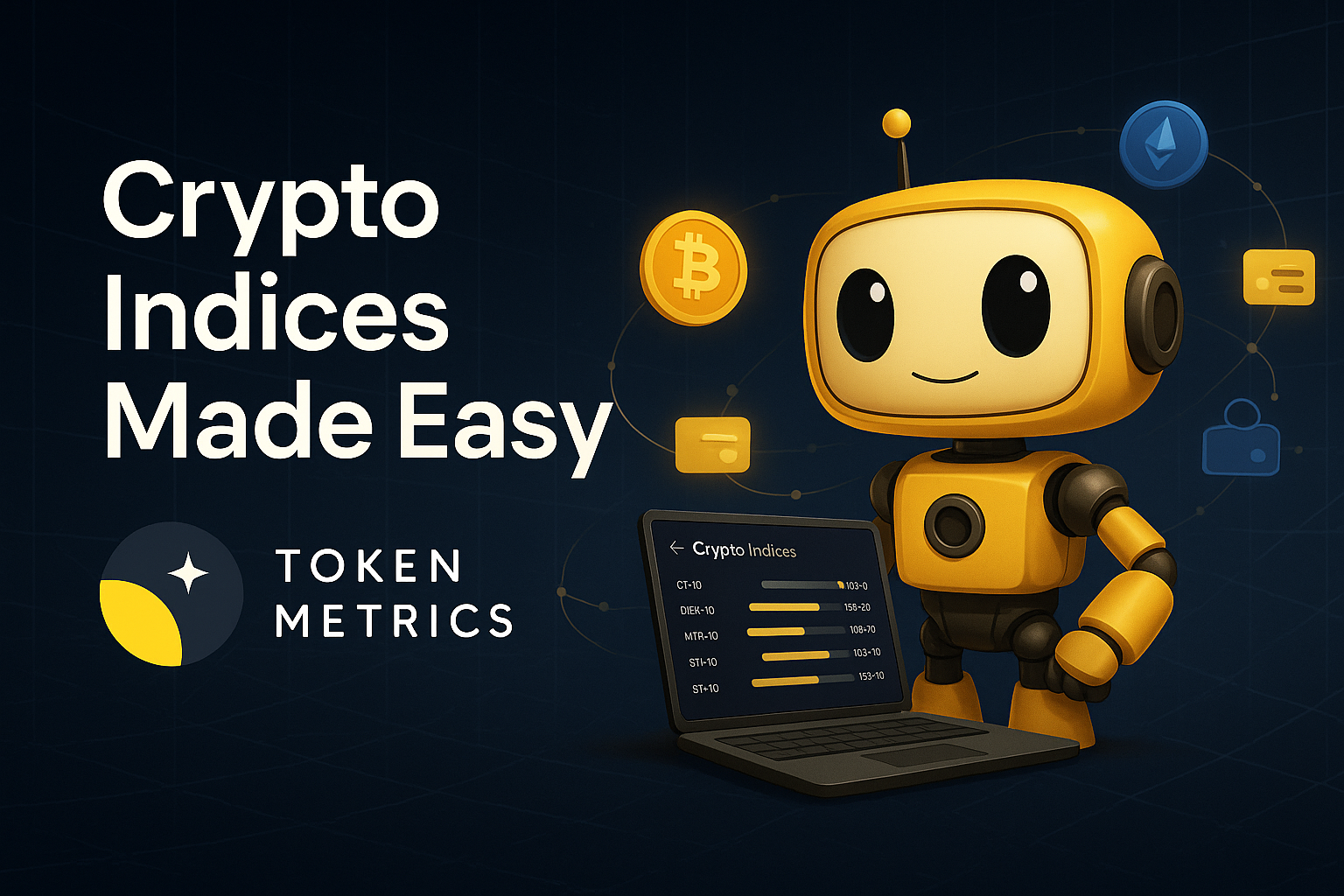
What Does Indices Mean? A Beginner's Guide to Market Indices in 2025

Learn the fundamentals of market indices and how innovative crypto indices like TM Global 100 are shaping the future of diversified digital asset investing in 2025.
Token Metrics Team
14
Want Smarter Crypto Picks—Free?
See unbiased Token Metrics Ratings for BTC, ETH, and top alts.
Thank you! Your submission has been received!
Oops! Something went wrong while submitting the form.
 No credit card | 1-click unsubscribe

If you've ever heard financial news mention "the Dow is up" or "the S&P 500 reached a new high," you've encountered market indices. But what exactly does "indices" mean, and why do these numbers dominate financial headlines?

The word "indices" (pronounced IN-duh-seez) is simply the plural form of "index"—and in the financial world, it refers to measurement tools that track the performance of groups of assets. Think of an index as a thermometer for a specific market or sector, providing a single number that represents the collective movement of many individual investments.

In 2025, understanding what indices mean has become essential for anyone interested in investing, whether you're building a retirement portfolio or exploring cryptocurrency markets. This comprehensive beginner's guide will demystify indices, explain how they work, and show you how modern innovations like the TM Global 100 crypto index are making sophisticated index investing accessible to everyone.

What Does "Indices" Mean? The Basic Definition

Let's start with the fundamentals. An index (singular) is a statistical measure that tracks the performance of a group of assets. Indices (plural) refers to multiple such measures.

In finance, when someone asks "what does indices mean," they're typically referring to market indices—benchmarks that measure:

  • Stock market performance (like the S&P 500 tracking 500 large U.S. companies)
  • Sector-specific performance (like technology or healthcare stocks)
  • Asset class performance (like bonds, commodities, or real estate)
  • Cryptocurrency market performance (like the top 100 digital assets)

Think of an index like a shopping basket. Instead of tracking the price of individual items separately, you measure the total cost of everything in the basket. If most items in your basket get more expensive, the basket's total value rises. If most items get cheaper, the total value falls.

Market indices work the same way. They combine many individual securities into a single measurement, providing a snapshot of how that particular market or sector is performing overall.

Why We Use the Word "Indices" Instead of "Indexes"

You might wonder: why "indices" and not "indexes"? Both are actually correct plural forms of "index," but they're used in different contexts:

  • Indices is the traditional plural form borrowed from Latin, commonly used in:
    • Financial and economic contexts (stock market indices)
    • Scientific and mathematical contexts (statistical indices)
    • Academic and formal writing
  • Indexes is a more modern English plural, often used for:
    • Book indexes (alphabetical lists at the back of books)
    • Database indexes (organizational structures in computer systems)
    • Casual conversation

In finance and investing, "indices" remains the standard term. When you hear analysts discussing "major indices," "global indices," or "benchmark indices," they're using the traditional financial terminology.

How Do Indices Work? The Mechanics Explained

Understanding what indices mean requires grasping how they're constructed and calculated. While the specific methodology varies, all indices share common elements:

Selection Criteria

Every index defines rules for which assets to include. These criteria might be:

  • Market Capitalization: The S&P 500 includes 500 of the largest U.S. publicly traded companies by market value.
  • Geographic Location: The FTSE 100 tracks the largest companies listed on the London Stock Exchange.
  • Sector Focus: The Nasdaq-100 emphasizes technology and growth companies.
  • Asset Type: Some indices track bonds, commodities, real estate, or cryptocurrencies rather than stocks.
  • Ranking System: A crypto index might track the top 100 digital assets by market capitalization, automatically updating as rankings change.

Weighting Methods

Once assets are selected, indices must determine how much influence each asset has on the overall index value. Common weighting methods include:

  • Market-Cap Weighted: Larger companies have proportionally more influence. If Apple is worth $3 trillion and represents 6% of total market cap, it gets 6% weight in the index. This is the most common method, used by the S&P 500 and most major indices.
  • Price-Weighted: Higher-priced stocks have more influence regardless of company size. The Dow Jones Industrial Average uses this method, meaning a $300 stock moves the index more than a $50 stock.
  • Equal-Weighted: Every asset gets the same weight regardless of size or price, providing more balanced exposure.
  • Factor-Weighted: Assets are weighted by specific characteristics like volatility, momentum, or fundamental metrics rather than just size or price.

Rebalancing Schedule

Markets change constantly. Companies grow or shrink, new companies emerge, and old ones disappear. Indices must periodically rebalance to maintain their intended composition:

  • Quarterly Rebalancing: Many traditional stock indices update four times per year.
  • Annual Rebalancing: Some simpler indices rebalance just once yearly.
  • Weekly Rebalancing: Fast-moving markets like cryptocurrency benefit from more frequent updates to track current market leaders.
  • Event-Driven Rebalancing: Some indices rebalance when specific triggers occur, like a company's market cap crossing a threshold.

A crypto index is a rules-based basket tracking a defined universe—such as a top-100 market-cap set—with scheduled rebalances. The frequency matters greatly in fast-moving markets where leadership changes rapidly.

Types of Indices: Understanding the Landscape

Indices come in many varieties, each serving different purposes:

Broad Market Indices

  • S&P 500: 500 large U.S. companies across all sectors, representing about 80% of U.S. market capitalization.
  • Dow Jones Industrial Average: 30 blue-chip U.S. companies, the oldest and most famous index (created 1896).
  • Russell 2000: 2,000 small-cap U.S. companies, tracking smaller businesses.
  • MSCI World: Large and mid-cap stocks across 23 developed markets globally.

These indices answer the question: "How is the overall market performing?"

Sector and Industry Indices

  • Nasdaq-100: Technology-heavy index of the largest non-financial companies on Nasdaq.
  • S&P Healthcare: Companies in pharmaceutical, biotechnology, medical devices, and healthcare services.
  • Energy Select Sector SPDR: Energy companies including oil, gas, and renewable energy firms.

These indices answer: "How is this specific sector performing?"

International and Regional Indices

  • FTSE 100: 100 largest companies on the London Stock Exchange.
  • Nikkei 225: 225 large companies on the Tokyo Stock Exchange.
  • DAX: 40 major German companies trading on the Frankfurt Stock Exchange.
  • Emerging Markets Index: Stocks from developing economies like China, India, and Brazil.

These indices answer: "How are foreign markets performing?"

Cryptocurrency Indices

  • Top 10 Crypto Index: The largest cryptocurrencies by market cap, typically Bitcoin and Ethereum plus eight others.
  • DeFi Index: Decentralized finance protocol tokens.
  • Top 100 Crypto Index: Broad exposure across the 100 largest digital assets.

These indices answer: "How is the crypto market performing overall?" or "How is this crypto sector doing?"

Real-World Examples: What Indices Mean in Practice

Let's explore what indices mean through concrete examples:

Example 1: The S&P 500

When news reports "the S&P 500 rose 1.5% today," it means: The combined value of 500 large U.S. companies increased 1.5%

Not every company rose—some went up, some down, but the weighted average was +1.5%

Companies like Apple, Microsoft, and Amazon (the largest holdings) influenced this movement more than smaller companies

Example 2: Sector Rotation

When analysts say "technology indices are outperforming energy indices," they mean: Technology stocks as a group are rising faster than energy stocks as a group

Money is flowing from energy sector to technology sector

This often indicates changing economic expectations or investor sentiment

Example 3: International Comparison

When you hear "emerging market indices lagged developed market indices," it means: Stocks in developing countries (like Brazil, India, South Africa) rose less than stocks in developed countries (like U.S., Japan, Germany)

This might reflect currency movements, economic growth differences, or risk sentiment

Example 4: Crypto Market Conditions

When "top 100 crypto indices show bearish signals," it means: The collective performance of the 100 largest cryptocurrencies indicates declining prices or negative momentum

Individual coins might buck the trend, but the overall market sentiment is negative

Why Indices Matter to Investors

Understanding what indices mean becomes important when you recognize how they affect your investments:

  • Performance Benchmarking: Indices provide standards to measure success. If your portfolio gained 8% but the S&P 500 gained 15%, you underperformed despite positive returns. If the S&P 500 fell 10% and you lost only 5%, you outperformed significantly.
  • Investment Products: Trillions of dollars are invested in products that track indices:
  • Index Mutual Funds: Traditional funds that replicate index performance.
  • Exchange-Traded Funds (ETFs): Tradeable securities tracking indices, offering liquidity and low costs.
  • Index Options and Futures: Derivatives enabling sophisticated strategies and hedging.

These products wouldn't exist without indices providing standardized targets to track.

Passive Investing Strategy

The rise of index investing has transformed finance. Rather than picking individual stocks (active investing), many investors simply buy index funds to match market returns (passive investing). This strategy works because:

  • 80-90% of active fund managers underperform their benchmark index over long periods
  • Index funds charge lower fees than actively managed funds
  • Tax efficiency improves through less frequent trading
  • Diversification reduces single-stock risk dramatically

Economic Indicators

Policymakers, economists, and business leaders watch indices to gauge economic health. Rising indices suggest confidence and growth. Falling indices indicate concerns and potential contraction.

The Evolution: Crypto Indices in 2025

While stock market indices have existed for over a century, cryptocurrency has rapidly adopted and innovated on index concepts. Crypto indices demonstrate what indices mean in the digital age:

  • 24/7 Operation: Unlike stock indices that only update during market hours, crypto indices track markets that never sleep.
  • Real-Time Transparency: Blockchain technology enables instant visibility into exact holdings and transactions—impossible with traditional indices.
  • Frequent Rebalancing: Crypto markets move faster than traditional markets. Narratives rotate in weeks, not months. Weekly or daily rebalancing keeps crypto indices aligned with current market leadership.
  • Regime-Switching Intelligence: Advanced crypto indices don't just track markets—they actively manage risk by adjusting allocations based on market conditions.

In October 2025, the question "what does indices mean" increasingly includes understanding these next-generation crypto indices that combine traditional index benefits with modern risk management.

Click here to get early access to TM100 indices at Token Metrics.

TM Global 100: What a Modern Index Means in Practice

The TM Global 100 index exemplifies what indices mean in 2025—especially for cryptocurrency markets. This rules-based index demonstrates how traditional index concepts evolve with technology and smart design.

What It Is

TM Global 100 is a rules-based crypto index that:

  • Holds the top 100 cryptocurrencies by market capitalization when market conditions are bullish
  • Moves fully to stablecoins when conditions turn bearish
  • Rebalances weekly to maintain current top-100 exposure
  • Provides complete transparency on strategy, holdings, and transactions
  • Offers one-click purchase through an embedded wallet

How It Works: Plain English

Regime Switching:

  • Bull Market Signal: The index holds all top 100 crypto assets, capturing broad market upside
  • Bear Market Signal: The index exits entirely to stablecoins, protecting capital until conditions improve

This isn't discretionary trading based on gut feelings. It's a proprietary market signal driving systematic allocation decisions.

Weekly Rebalancing:

  • Every week, the index updates to reflect the current top-100 list
  • If a cryptocurrency rises into the top 100, it gets added
  • If it falls out, it gets removed
  • Weights adjust to reflect current market capitalizations

Complete Transparency:

  • Strategy Modal: Explains all rules clearly—no black boxes
  • Gauge: Shows the live market signal (bullish or bearish)
  • Holdings Treemap & Table: Displays exactly what you own
  • Transaction Log: Records every rebalance and regime switch

What This Means for You

If someone asks you "what does indices mean," you can now point to TM Global 100 as a perfect example that:

  • Tracks a Defined Universe: The top 100 cryptocurrencies by market cap—a clear, objective selection criterion.
  • Uses Systematic Rebalancing: Weekly updates ensure you always hold current market leaders, not last quarter's has-beens.
  • Provides Measurable Performance: The index generates a track record you can analyze and compare against alternatives.
  • Enables Easy Investment: Instead of manually buying and managing 100 cryptocurrencies, one transaction gives you diversified exposure.
  • Implements Risk Management: The regime-switching mechanism addresses a critical weakness of traditional indices—they stay fully invested through devastating bear markets.

‍→ Join the waitlist now and be first to trade TM Global 100.

Benefits of Understanding What Indices Mean

Grasping the concept of indices provides several practical advantages:

  • Simplified Market Monitoring: Instead of tracking hundreds or thousands of individual securities, you can monitor a handful of indices to understand broad market movements. This saves tremendous time and mental energy.
  • Better Investment Decisions: Knowing what indices mean helps you:
    • Choose appropriate benchmarks for your investments
    • Recognize when sectors are rotating
    • Identify potential opportunities or risks
    • Evaluate whether active management adds value
  • Reduced Complexity: Investing through indices dramatically simplifies portfolio construction. Rather than researching individual companies or cryptocurrencies, you gain instant diversification through established baskets.
  • Emotional Discipline: Index investing removes emotional decision-making. You're not tempted to panic sell during downturns or FOMO buy during rallies—the systematic approach enforces discipline.
  • Cost Efficiency: Index products typically charge lower fees than actively managed alternatives. Over decades, fee differences compound significantly, often exceeding 1-2% annually.
  • Click here to get early access to TM100 indices at Token Metrics.

    Common Questions About What Indices Mean

    Can I directly buy an index? No. An index is a measurement tool, not an investment product. However, you can buy index funds, ETFs, or crypto index products that replicate index performance.

    Who creates indices? Various organizations create indices:

    • S&P Dow Jones Indices (S&P 500, Dow Jones)
    • MSCI (international indices)
    • FTSE Russell (U.K. and global indices)
    • Nasdaq (technology indices)
    • Token Metrics (TM Global 100 crypto index)

    How are index values calculated? It depends on the index methodology. Most use market-cap weighting, multiplying each stock's price by shares outstanding, summing all holdings, and dividing by a divisor that adjusts for corporate actions.

    Do indices include dividends? Some do (total return indices), some don't (price return indices). The S&P 500 has both versions. Crypto indices typically track price only since most cryptocurrencies don't pay dividends.

    Can indices go to zero? Theoretically yes, practically no. For a broad market index to reach zero, every constituent would need to become worthless simultaneously—essentially requiring economic collapse.

    What's the difference between indices and indexes? Both are correct plurals, but "indices" is standard in finance while "indexes" is more common in other contexts. They mean the same thing.

    How to Start Using Indices

    Now that you understand what indices mean, here's how to begin incorporating them into your investing:

    For Traditional Markets

    • Choose a brokerage with low fees and good index fund selection
    • Select appropriate indices matching your goals (broad market, international, sector-specific)
    • Implement dollar-cost averaging by investing fixed amounts regularly
    • Rebalance annually to maintain target allocations
    • Stay invested through market cycles for long-term growth

    For Cryptocurrency with TM Global 100

    • Visit the Token Metrics Indices hub to learn about the strategy
    • Join the waitlist for launch notification
    • Review the transparency features (strategy modal, gauge, holdings)
    • At launch, click "Buy Index" for one-click purchase
    • Track your position with real-time P&L under "My Indices"

    The embedded, self-custodial smart wallet streamlines execution while you maintain control over your funds. Most users complete purchases in approximately 90 seconds.

    ‍→ Join the waitlist to be first to trade TM Global 100.

    The Future: What Indices Will Mean Tomorrow

    Index evolution continues accelerating: AI-Driven Construction: Machine learning will optimize index selection and weighting more effectively than human rules. Dynamic Risk Management: More indices will implement active protection strategies like TM Global 100's regime switching. Hyper-Personalization: Technology will enable custom indices tailored to individual tax situations, values, and goals. Real-Time Everything: Blockchain technology brings instant transparency, execution, and rebalancing impossible in legacy systems. Cross-Asset Integration: Future indices might seamlessly blend stocks, bonds, commodities, real estate, and crypto in smart allocation strategies.

    TM Global 100 represents this evolution: combining traditional index benefits (diversification, systematic approach, low cost) with modern innovations (regime switching, weekly rebalancing, blockchain transparency, one-click access).

    Decision Guide: Is Index Investing Right for You?

    Consider index investing if you:

    • Want broad market exposure without constant monitoring
    • Recognize the difficulty of consistently picking winning investments
    • Value transparency and rules-based strategies
    • Seek lower costs than active management
    • Prefer systematic approaches over emotional decision-making
    • Lack time or expertise for deep security analysis

    Consider active investing if you:

    • Possess genuine informational advantages or unique insights
    • Have time and expertise for continuous research
    • Enjoy the active management process
    • Accept concentration risk for potential outsized returns
    • Work in specialized niches where expertise creates edges

    For most investors, index investing provides optimal risk-adjusted returns with minimal time investment. Even professional investors often maintain index core positions while actively managing satellite positions.

    Getting Started: Your Next Steps

    Understanding what indices mean is just the beginning. Here's how to act on this knowledge:

    Education

    • Read more about specific indices that interest you
    • Study index construction methodologies
    • Learn about passive vs. active investing debates
    • Explore factor-based and smart-beta indices

    Action

    • For traditional markets, open a brokerage account and explore index fund options
    • For crypto markets, join the TM Global 100 waitlist to access next-generation index investing
    • Start small and gradually increase allocations as you gain confidence
    • Track performance against appropriate benchmarks

    Refinement

    • Regularly review your index allocations
    • Rebalance when positions drift significantly from targets
    • Consider tax implications of rebalancing decisions
    • Adjust strategies as your goals and timeline change

    Conclusion

    So, what does "indices" mean? In the simplest terms, it's the plural of "index"—measurement tools that track groups of assets. In practical terms, indices represent one of the most important innovations in modern finance, enabling simplified investing, objective benchmarking, and systematic portfolio construction.

    From traditional stock market indices like the S&P 500 to innovative crypto indices like TM Global 100, these tools democratize access to diversified portfolios that once required significant wealth and expertise.

    TM Global 100 demonstrates what indices mean in 2025: not just passive measurement tools, but intelligent investment vehicles with active risk management. By holding the top 100 cryptocurrencies in bull markets and moving to stablecoins in bear markets, it delivers what investors actually want—participation in upside with protection from downside.

    If you want to experience next-generation index investing with weekly rebalancing, transparent holdings, regime-switching protection, and one-click execution, TM Global 100 was built for you.

    Click here to get early access to Token Metrics indices.

    Build Smarter Crypto Apps &
    AI Agents in Minutes, Not Months
    Real-time prices, trading signals, and on-chain insights all from one powerful API.
    Grab a Free API Key
    About Token Metrics
    Token Metrics: AI-powered crypto research and ratings platform. We help investors make smarter decisions with unbiased Token Metrics Ratings, on-chain analytics, and editor-curated “Top 10” guides. Our platform distills thousands of data points into clear scores, trends, and alerts you can act on.
    30 Employees
    analysts, data scientists, and crypto engineers
    Daily Briefings
    concise market insights and “Top Picks”
    Transparent & Compliant
    Sponsored ≠ Ratings; research remains independent
    Want Smarter Crypto Picks—Free?
    See unbiased Token Metrics Ratings for BTC, ETH, and top alts.
    Thank you! Your submission has been received!
    Oops! Something went wrong while submitting the form.
     No credit card | 1-click unsubscribe
    Token Metrics Team
    Token Metrics Team

    Recent Posts

    Research

    The Complete Beginner's Guide to Token Metrics Crypto Indices: Start Investing in 30 Minutes

    Token Metrics Team
    11 min read

    Cryptocurrency investing intimidates many potential investors. The technical jargon, overwhelming number of tokens, security concerns, and stories of people losing fortunes create paralysis. You know crypto represents an opportunity, but where do you even begin?

    Token Metrics AI Indices eliminate these barriers by providing a simple, secure pathway into cryptocurrency investing. Whether you've never bought crypto before or you're transitioning from traditional investments, this comprehensive beginner's guide walks you through everything needed to start investing successfully in just 30 minutes.

    No technical expertise required. No complicated wallet setup. No endless research into thousands of tokens. Just straightforward steps that get you invested intelligently and positioned for long-term wealth creation.

    What Exactly Are Crypto Indices? (Explained Simply)

    Before diving into the how-to, let's establish a simple understanding of what you're investing in.

    Think of crypto indices like a basket containing multiple cryptocurrencies. Instead of buying Bitcoin or Ethereum individually, you buy a pre-made collection of several carefully selected digital assets. This is similar to how traditional stock index funds like the S&P 500 contain hundreds of companies rather than forcing you to pick individual stocks.

    Token Metrics creates these baskets using artificial intelligence that analyzes thousands of cryptocurrencies and selects the best ones based on comprehensive data. The AI acts like a team of expert analysts working 24/7, constantly monitoring market conditions and adjusting your portfolio to maximize returns while managing risk.

    When you invest in a Token Metrics index, you're essentially hiring sophisticated AI technology to build and manage your crypto portfolio professionally. You get instant diversification across multiple tokens, automatic rebalancing when market conditions change, protection from common investing mistakes, and access to opportunities you'd never find independently.

    The beauty of this approach is simplicity. You don't need to understand blockchain technology, read complicated whitepapers, or analyze trading charts. The AI handles complexity while you focus on your life and watch your investment grow.

    Why Beginners Should Start with Indices Instead of Individual Tokens

    • New investors often make the mistake of buying individual cryptocurrencies based on social media hype, friend recommendations, or price momentum. This approach leads to several problems that indices elegantly solve.
    • Individual token selection requires expertise most beginners lack. How do you evaluate whether a cryptocurrency's technology is legitimate or vaporware? How do you determine if tokenomics are sustainable? How do you identify scams before they steal your money? Without experience, these questions prove nearly impossible to answer correctly.
    • Concentration risk destroys portfolios quickly. If you invest everything in three tokens and one fails catastrophically, you lose a third of your capital immediately. Indices spread risk across 10-30 carefully vetted assets, ensuring single failures don't devastate your portfolio.
    • Emotional decision-making causes most investment losses. Fear drives panic selling during downturns. Greed drives buying at market tops. FOMO drives chasing pumps into overvalued assets. AI indices eliminate emotion entirely, maintaining discipline when human investors make terrible decisions.
    • Time requirements prove unsustainable. Successfully managing individual crypto positions requires hours daily monitoring markets, reading news, analyzing charts, and executing trades. Most people with jobs and families can't sustain this commitment. Indices require maybe 30 minutes quarterly.

    For beginners, indices provide the perfect entry point—immediate diversification, professional management, emotion-free investing, and minimal time commitment. You can start small, learn gradually, and scale up as you become comfortable.

    Step-by-Step: Your First 30 Minutes in Crypto Indices

    Ready to begin? Follow this simple roadmap to go from complete beginner to invested in under 30 minutes.

    1. Minutes 1-5: Create Your Token Metrics Account
      • Visit the Token Metrics website and click the sign-up button. You'll need to provide basic information including email address, create a secure password, and verify your email through the confirmation link sent to your inbox.
      • Token Metrics offers a 7-day free trial, allowing you to explore the platform thoroughly before committing financially. Take advantage of this trial to familiarize yourself with available indices, review performance data, and understand the interface.
      • During signup, you'll choose a subscription tier. For beginners, start with the basic tier that provides access to all indices and essential features. You can upgrade later if you want additional tools like advanced analytics or trading signals.
    2. Minutes 6-15: Explore Available Indices and Choose Your Strategy
      • Once logged in, navigate to the Indices section. You'll see several different index options, each designed for specific investment strategies and risk profiles. Here's how to choose:
      • Conservative Investor Grade Index: If you're risk-averse, older, or investing money you can't afford to lose, start here. This index focuses on established cryptocurrencies with strong fundamentals—primarily Bitcoin, Ethereum, and select large-cap altcoins. Returns are more moderate but volatility is lower.
      • Balanced Growth Index: If you're comfortable with moderate risk and seeking steady growth, this balanced approach combines major cryptocurrencies with promising mid-cap projects. It offers stronger growth potential than conservative indices while maintaining reasonable risk levels.
      • Aggressive Growth Index: If you're young, risk-tolerant, and seeking maximum returns, this index targets smaller-cap tokens with explosive potential. Volatility is higher but so are potential returns. Only choose this if you can stomach significant price swings.
      • Sector-Specific Indices: Token Metrics offers indices focused on specific crypto sectors like DeFi, Layer-1 blockchains, AI tokens, or memecoins. Choose these if you believe strongly in a particular sector's growth potential.
      • For most beginners, starting with the Balanced Growth Index makes sense. It provides diversification, reasonable growth potential, and manageable volatility. You can always adjust later as you learn more.
    3. Minutes 16-20: Determine Your Investment Amount
      • How much should you invest in crypto indices? This critical decision depends on your financial situation, but follow these general guidelines.
      • Never invest money you need for living expenses. Crypto remains volatile. Only invest money you won't need for at least 3-5 years and that you could lose entirely without affecting your lifestyle.
      • Start small while learning. If you're completely new to crypto, consider investing just $500-1,000 initially. Get comfortable with the process, experience some market volatility, and understand how indices work before committing larger amounts.
      • Follow the 5-20% rule. Financial advisors typically recommend allocating 5-20% of your total investment portfolio to cryptocurrency depending on age and risk tolerance. If you have $50,000 in traditional investments, consider $2,500-10,000 in crypto.
      • Use dollar-cost averaging. Rather than investing your entire amount immediately, spread purchases over 3-6 months. If you plan to invest $6,000, invest $1,000 monthly. This reduces timing risk and smooths out entry prices.
      • Write down your investment amount now so you don't invest emotionally based on market conditions. Stick to your predetermined plan regardless of whether markets are surging or crashing.
    4. Minutes 21-25: Set Up Your Exchange Account and Funding
      • To invest in Token Metrics indices, you need to purchase the recommended cryptocurrencies through a cryptocurrency exchange. Major exchanges include Coinbase, Kraken, Binance.US, or Gemini.
      • Choose one exchange and create an account. You'll need to provide identification for regulatory compliance—typically a driver's license or passport. This verification process usually takes a few hours to a few days, so you might need to pause here and return once approved.
      • Once verified, connect a funding source. Most beginners use bank transfers, though credit cards and debit cards work too (often with higher fees). Transfer funds from your bank account to your exchange account. Bank transfers typically take 1-3 business days but have lower fees than card payments.
      • For security, enable two-factor authentication (2FA) on your exchange account immediately. This adds an extra security layer requiring a code from your phone when logging in, protecting against unauthorized access.
    5. Minutes 26-30: Make Your First Index-Aligned Purchases
      • Now comes the exciting part—your first crypto investments. Token Metrics indices provide specific recommendations about which tokens to buy and in what proportions.
      • Review your chosen index's current composition. It might show something like: 40% Bitcoin, 25% Ethereum, 15% Solana, 10% Avalanche, 10% Polkadot. These percentages tell you how to allocate your investment.
      • If investing $1,000, you'd buy approximately $400 in Bitcoin, $250 in Ethereum, $150 in Solana, $100 in Avalanche, and $100 in Polkadot. Round to reasonable amounts given minimum purchase requirements.
      • On your exchange, navigate to each cryptocurrency and execute market buy orders. A market order purchases at current market price immediately. For beginners, market orders are simplest—don't worry about limit orders or advanced trading features initially.
      • After purchasing, you can either leave assets on the exchange (simplest for beginners with small amounts) or transfer to a personal wallet (more secure for larger holdings). Initially, leaving assets on a reputable exchange is fine. Learn about wallet security as your investment grows.
      • Congratulations! You're now invested in crypto indices. The entire process took under 30 minutes.

    Understanding What Happens Next: Ongoing Management

    After your initial investment, understanding ongoing management helps you stay invested successfully.

    Token Metrics indices rebalance regularly as market conditions change. You'll receive notifications when adjustments are recommended. These typically occur weekly, bi-weekly, or monthly. Follow the recommendations by making small adjustments—usually just a few minutes to execute.

    Check your portfolio monthly rather than daily. Cryptocurrency volatility means dramatic day-to-day swings. Monthly reviews allow tracking overall trajectory without getting caught up in noise. Token Metrics provides performance tracking tools showing returns over various periods and comparing to benchmarks.

    Occasionally rebalance your overall portfolio allocation. If crypto has grown from 10% to 25% of your total investments, consider taking profits to rebalance back to your target. This ensures you don't become overexposed during market euphoria.

    Common Beginner Questions Answered

    New investors often have the same questions and concerns. Here are straightforward answers.

    "Is crypto investing safe?"

    Cryptocurrency carries risk like all investments. However, indices are far safer than buying random tokens. Token Metrics' AI vetting filters out scams, diversification reduces risk, and professional management protects against emotional mistakes.

    "What if I lose everything?"

    This is why you only invest money you can afford to lose. Crypto indices are diversified across multiple assets, making total loss extremely unlikely. Individual tokens can fail, but portfolios of 10-30 carefully selected tokens provide resilience.

    "How much can I make?"

    Token Metrics indices have historically delivered returns significantly exceeding Bitcoin and Ethereum. Conservative indices might return 100-200% annually during bull markets. Aggressive indices could deliver 300-500%+. Bear markets may see negative returns—long-term holding is essential.

    "What about taxes?"

    Cryptocurrency transactions trigger capital gains taxes in most jurisdictions. Keep records of all transactions. Token Metrics provides transaction tracking to simplify tax preparation. Consult a tax professional for personalized guidance.

    "Do I need a special wallet?"

    For beginners with smaller amounts, keeping crypto on a reputable exchange is acceptable. As holdings grow beyond $10,000, consider a hardware wallet for additional security.

    "Can I start with just $100?"

    Yes! While larger amounts generate more absolute returns, you can start with any amount. Use small initial investments to learn and build confidence.

    Your 30-Day Action Plan for Success

    • Days 1-7: Leave your investment alone. Resist checking prices constantly. Use this week to explore Token Metrics' educational resources and learn about the cryptocurrencies in your index.
    • Days 8-14: Conduct your first performance review. Don't react emotionally to gains or losses. Review any rebalancing recommendations and execute them if suggested.
    • Days 15-21: Evaluate whether your initial allocation feels appropriate. If you chose dollar-cost averaging, make your second purchase following your predetermined schedule.
    • Days 22-30: Reflect on your first month. Did you stay calm during volatility? Are you confident in your strategy? Decide whether to continue your current approach or make adjustments.

    After 30 days, continue monthly reviews, execute recommended rebalancing, and stick to your dollar-cost averaging schedule. Successful investing is about consistency and discipline, not constant activity.

    Conclusion: Your Journey Begins Now

    Cryptocurrency investing doesn't require technical expertise, complicated processes, or endless time commitment. Token Metrics AI Indices make professional-grade crypto investing accessible to anyone willing to follow a simple, proven system.

    You've learned what indices are, why they're perfect for beginners, and exactly how to get started in 30 minutes. You understand ongoing management, have answers to common concerns, and possess a 30-day action plan for success.

    The only thing remaining is action. Every day you delay is a day you're not participating in one of the most significant wealth creation opportunities of our generation. Markets don't wait for perfect timing—they reward those who begin with imperfect action.

    Your 30-minute journey to crypto investing starts with a single click. Sign up for Token Metrics' 7-day free trial today, explore the indices, and make your first investment following this guide. Your future self will thank you for taking action now rather than watching from the sidelines as others build life-changing wealth.

    The tools are available. The guidance is clear. The opportunity is now. Begin your Token Metrics journey today.

    Research

    Dogecoin Price Prediction 2026: Meme Coin Bull Market Analysis

    Token Metrics Team
    6 min read

    Why 2026 Looks Bullish for Dogecoin Price Prediction: Market Context

    Crypto is transitioning into a broadly bullish regime into 2026 as liquidity improves and adoption deepens.

    Regulatory clarity is reshaping the classic four-year cycle, flows can arrive earlier and persist longer as institutions gain confidence. Access and infrastructure continue to mature with ETFs, qualified custody, and faster L2 scaling that reduce frictions for new capital. Real-world integrations expand the surface area for crypto utility, which supports sustained participation across market phases.

    This bullish backdrop frames our Dogecoin price prediction scenario work for DOGE. The bands below reflect different total market sizes and DOGE's share dynamics across varying liquidity conditions, providing comprehensive price prediction analysis for investors.


    How to Read This DOGE Price Prediction

    Each band blends cycle analogues and market-cap share math with TA guardrails. Base assumes steady adoption and neutral or positive macro. Moon layers in a liquidity boom. Bear assumes muted flows and tighter liquidity.

    TM Agent baseline: Token Metrics lead metric, TM Grade, is 22.65 (Sell), and the trading signal is bearish, indicating short-term downward momentum. Price context: $DOGE is trading around $0.193, rank #9, down about 3.1% in 24 hours and roughly 16% over 30 days. Implication: upside in our price prediction models likely requires a broader risk-on environment and renewed retail or celebrity-driven interest.

    Live details: Dogecoin Token Details → https://app.tokenmetrics.com/en/dogecoin

    Buy DOGE

    Key Takeaways: Dogecoin Price Prediction Summary

    • Scenario driven: Price prediction outcomes hinge on total crypto market cap; higher liquidity and adoption lift the bands
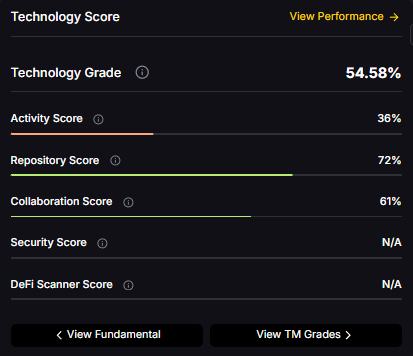
    • Technology: Technology Grade 54.58% (Activity 36%, Repository 72%, Collaboration 61%, Security N/A, DeFi Scanner N/A)
    • TM Agent gist: Cautious long-term stance in price prediction models until grades and momentum improve
    • Current rating: Sell (22.65) despite bullish 2026 macro backdrop
    • Meme coin dynamics: Celebrity influence and retail sentiment drive price prediction volatility
    • Education only, not financial advice

    Dogecoin Price Prediction Scenario Analysis

    Token Metrics price prediction scenarios span four market cap tiers, each representing different levels of crypto market maturity and liquidity:

    8T Market Cap - DOGE Price Prediction:

    At an 8 trillion dollar total crypto market cap, our DOGE price prediction framework projects specific targets in bear, base, and bullish scenarios. The 8T tier reflects conservative market conditions with modest meme coin participation.

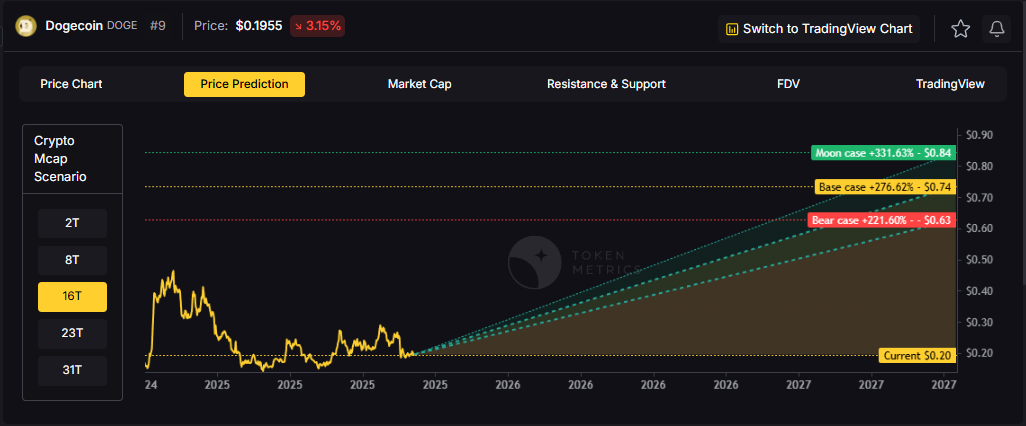
    16T Market Cap - DOGE Price Prediction:

    Doubling the market to 16 trillion expands the DOGE price prediction range significantly, reflecting increased retail participation and potential celebrity-driven catalysts that historically benefit Dogecoin.

    16T Market Cap - DOGE Price Prediction:

    Doubling the market to 16 trillion expands the DOGE price prediction range significantly, reflecting increased retail participation and potential celebrity-driven catalysts that historically benefit Dogecoin.

     31T Market Cap - DOGE Price Prediction:

    In the maximum liquidity scenario of 31 trillion, DOGE price predictions reach their highest potential across all scenarios (bear, base, and moon), with all three bands projecting levels above $1.00 according to our framework.

     Each tier in our price prediction framework assumes progressively stronger market conditions, with particular emphasis on retail-driven liquidity and social media sentiment that uniquely impacts meme coin valuations.

    Why Consider the Indices with Top-100 Exposure

    Diversification matters. Dogecoin is compelling, yet concentrated bets can be volatile—especially for meme coins where price predictions are heavily influenced by sentiment. Token Metrics Indices hold DOGE alongside the top one hundred tokens for broad exposure to leaders and emerging winners.

    Our backtests indicate that owning the full market with diversified indices has historically outperformed both the total market and Bitcoin in many regimes due to diversification and rotation benefits, reducing single-asset risk inherent in meme coin price predictions.

    Get early access

    What Is Dogecoin?

    Dogecoin is a peer-to-peer cryptocurrency that began as a meme but has evolved into a widely recognized digital asset used for tipping, payments, and community-driven initiatives. It runs on its own blockchain with inflationary supply mechanics. The token's liquidity and brand awareness create periodic speculative cycles, especially during broad risk-on phases—all critical factors influencing DOGE price predictions.

    Technology Snapshot from Token Metrics

    Technology Grade: 54.58% (Activity 36%, Repository 72%, Collaboration 61%, Security N/A, DeFi Scanner N/A).


    Catalysts That Skew DOGE Price Predictions Bullish

    • Institutional and retail access expands with ETFs, listings, and integrations
    • Macro tailwinds from lower real rates and improving liquidity expected in 2026
    • Product or roadmap milestones such as upgrades, scaling, or partnerships
    • Celebrity endorsements or social media viral moments (Elon Musk effect)
    • Retail FOMO during bull market phases
    • Payment adoption and merchant acceptance expansion
    • Meme coin narrative strength during risk-on sentiment

    Risks That Skew DOGE Price Predictions Bearish

    • Macro risk-off from tightening or liquidity shocks
    • Regulatory actions targeting meme coins or infrastructure outages
    • Current Sell rating (22.65) indicating weak fundamentals
    • Low technology grade (54.58%) and minimal development activity (36%)
    • Lack of utility compared to smart contract platforms
    • Inflationary supply mechanics creating selling pressure
    • Celebrity sentiment shifts or negative social media attention
    • Competition from newer meme coins capturing retail interest

    Special Offer — Token Metrics Advanced Plan with 20% Off

    Unlock platform-wide intelligence on every major crypto asset. Use code ADVANCED20 at checkout for twenty percent off.

    • AI powered ratings on thousands of tokens for traders and investors
    • Interactive TM AI Agent to ask any crypto question
    • Indices explorer to surface promising tokens and diversified baskets
    • Signal dashboards, backtests, and historical performance views
    • Watchlists, alerts, and portfolio tools to track what matters
    • Early feature access and enhanced research coverage

    Start with Advanced today

    Dogecoin Price Prediction FAQs

    Can DOGE reach $1.00?

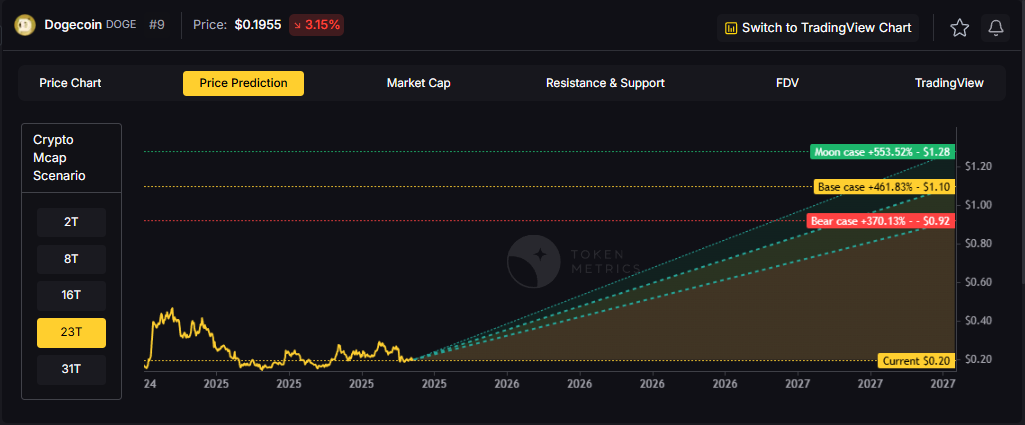
    Yes. Multiple tiers in our price prediction framework imply levels above $1.00 by the 2027 horizon, including the 23T Base case and all 31T scenarios (bear, base, and moon). However, achieving this requires the bullish 2026 thesis materializing with strong retail participation and favorable macro conditions. Despite the Sell rating (22.65), the $1 psychological level remains achievable in higher liquidity environments. Not financial advice.

    Is DOGE a good long-term investment?

    DOGE presents a high-risk, high-volatility investment case with a Sell rating (22.65) and modest technology grade (54.58%). Our price prediction models show potential upside in bullish scenarios, but the outcome depends heavily on adoption, liquidity regime, celebrity influence, retail sentiment, and supply dynamics. Meme coins lack fundamental utility of smart contract platforms, making them speculative plays. Diversify and size positions responsibly. Not financial advice.

    What is the Dogecoin price prediction for 2026-2027?

    Our comprehensive DOGE price prediction framework for 2026-2027 suggests Dogecoin could reach significant levels depending on total crypto market capitalization, with the 23T and 31T scenarios projecting above $1.00 across multiple bands. Current price of $0.193 implies substantial upside potential (400%+ gains to $1) if bullish 2026 conditions materialize. However, the Sell rating (22.65) reflects concerns about fundamentals and current bearish momentum. Not financial advice.

    Can DOGE reach $10?

    DOGE reaching $10 would require extraordinary market conditions and market capitalization exceeding most realistic scenarios in our price prediction models. At current supply levels, $10 DOGE would imply a market cap surpassing major corporations. While our 31T moon scenarios show substantial upside, $10 appears beyond rational price prediction frameworks without significant supply changes or unprecedented retail mania. Not financial advice.

    Should I buy DOGE now or wait?

    DOGE has a Sell rating (22.65) indicating Token Metrics does not currently endorse Dogecoin at these levels, despite bullish 2026 macro thesis. Current price of $0.193 is down 16% over 30 days with bearish trading signals. However, if you believe in the 2026 bull market thesis and meme coin comeback, dollar-cost averaging may reduce timing risk. Meme coins are highly speculative—size positions accordingly and consider diversified exposure through indices. Not financial advice.

    Why does DOGE have a Sell rating despite bullish 2026 outlook?

    DOGE receives a Sell rating (22.65) due to weak fundamentals, modest technology grade (54.58%), low development activity (36%), and current bearish momentum—despite the broader bullish 2026 macro thesis. Our price prediction framework shows potential upside in favorable liquidity scenarios, but ratings reflect current conditions and fundamental quality rather than just market sentiment. The rating suggests caution even in bullish environments. Not financial advice.

    How does DOGE compare to other meme coin price predictions?

    Dogecoin remains the original and most established meme coin with superior liquidity, exchange listings, and brand recognition versus competitors like Shiba Inu or PEPE. Our price prediction framework suggests DOGE could exceed $1.00 in 23T+ scenarios. However, the Sell rating (22.65) reflects that even among meme coins, DOGE's low technology grade (54.58%) and minimal development activity create concerns. First-mover advantage matters, but newer meme coins may offer higher risk-adjusted returns.

    What role do celebrities play in DOGE price predictions?

    Celebrity influence—particularly from Elon Musk—significantly impacts Dogecoin price predictions and has historically driven major rallies. Our bullish 2026 scenarios assume potential for renewed celebrity-driven interest during risk-on phases. However, this creates unpredictable volatility that price prediction models struggle to capture. The Sell rating (22.65) reflects concerns that celebrity sentiment alone cannot sustain long-term value without fundamental improvements. Not financial advice.

    Can DOGE benefit from the 2026 bull market?

    Yes. Our price prediction scenarios are specifically framed around the bullish 2026 thesis, where improving liquidity, institutional participation, and retail FOMO create favorable conditions for meme coins. DOGE's brand recognition and top-10 ranking position it to capture bull market momentum. However, the Sell rating (22.65) and low technology grade (54.58%) suggest DOGE may underperform versus utility tokens. Meme coins tend to outperform in late-stage bull markets driven by retail speculation. Not financial advice.

    What are the biggest risks to DOGE price predictions?

    Key risks that could derail Dogecoin price predictions include: current Sell rating (22.65) indicating weak fundamentals, low technology grade (54.58%) and minimal development activity (36%), inflationary supply creating perpetual selling pressure, lack of utility versus smart contract platforms, regulatory targeting of meme coins, negative celebrity sentiment shifts, competition from newer meme coins, macro liquidity shocks ending the 2026 bull thesis, and excessive speculation leading to retail exhaustion. Not financial advice.

    Will DOGE hit $1 in 2026?

    Our price prediction framework suggests DOGE reaching $1.00 is achievable in the 23T base case and all 31T scenarios (bear, base, moon), which could materialize in the bullish 2026-2027 environment. From current price of $0.193, this represents approximately 400%+ gains. However, achieving this requires sustained macro liquidity, retail participation, positive celebrity sentiment, and overcoming the current Sell rating (22.65) concerns. Possible but not guaranteed—manage expectations accordingly. Not financial advice.

    How accurate are Dogecoin price predictions?

    Dogecoin price predictions are particularly challenging due to meme coin volatility, celebrity influence unpredictability, and sentiment-driven price action that doesn't follow traditional fundamental analysis. Our scenario-based framework provides structured projections across multiple market cap tiers, but actual outcomes may vary significantly. The Sell rating (22.65) and low technology grade (54.58%) suggest fundamental weaknesses that could limit upside regardless of market conditions. Use price predictions as educational frameworks, not guarantees. Not financial advice.

    ‍

    Next Steps

    • Track live grades and signals: Token Details
    • Join Indices Early Access
    • Want exposure Buy DOGE on MEXC

    Disclosure

    Educational purposes only, not financial advice. Crypto is volatile, do your own research and manage risk.

    Why Use Token Metrics for DOGE Price Predictions?

    • Bullish 2026 framework: Specialized analysis of improving macro conditions favoring meme coins
    • Scenario-based modeling: Four market cap tiers for comprehensive price prediction analysis
    • Honest ratings: Sell (22.65) transparency despite bullish market thesis
    • Meme coin specialization: Understanding sentiment-driven price action and celebrity influence
    • Risk management: Indices for diversified exposure beyond single meme coin concentration
    • Real-time signals: Trading signals and TM Grades updated regularly
    • Comparative analysis: Analyze DOGE against SHIB, PEPE, and 6,000+ tokens
    Research

    Tron Price Prediction 2026: Low-Cost Blockchain Bull Market Analysis

    Token Metrics Team
    6 min read

    Why 2026 Looks Bullish for Tron Price Prediction: Market Context

    The crypto market is shifting toward a broadly bullish regime into 2026 as liquidity improves and risk appetite normalizes.

    Regulatory clarity across major regions is reshaping the classic four-year cycle, flows can arrive earlier and persist longer. Institutional access keeps expanding through ETFs and qualified custody, while L2 scaling and real-world integrations broaden utility. Infrastructure maturity lowers frictions for capital, which supports deeper order books and more persistent participation.

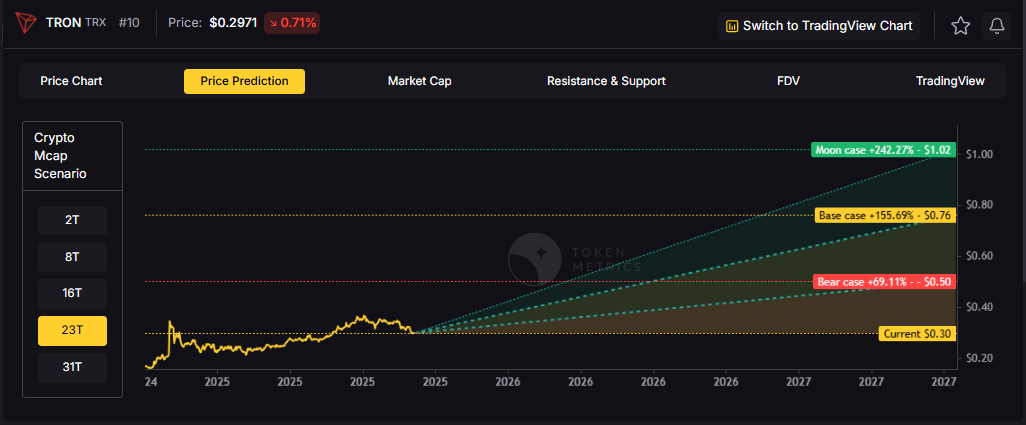
    This bullish backdrop frames our Tron price prediction scenario work for TRX. The bands below map potential outcomes to different total crypto market sizes, providing comprehensive price prediction analysis for investors navigating the stablecoin transfer and payments-focused blockchain space.

    Current price: $0.2971.

    How to Read This TRX Price Prediction

    Each band blends cycle analogues and market-cap share math with TA guardrails. Base assumes steady adoption and neutral or positive macro. Moon layers in a liquidity boom. Bear assumes muted flows and tighter liquidity.

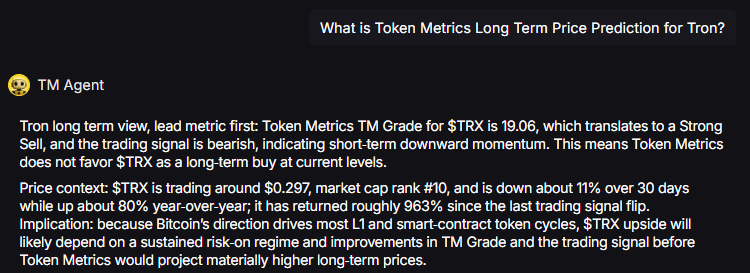
    TM Agent baseline: Token Metrics TM Grade for $TRX is 19.06, which translates to a Strong Sell, and the trading signal is bearish, indicating short-term downward momentum. Price context: $TRX is trading around $0.297, market cap rank #10, and is down about 11% over 30 days while up about 80% year-over-year, it has returned roughly 963% since the last trading signal flip. Despite strong historical returns, current price prediction models reflect caution.

    Live details: Tron Token Details → https://app.tokenmetrics.com/en/tron 

    Buy TRX: https://www.mexc.com/acquisition/custom-sign-up?shareCode=mexc-2djd4 

    Key Takeaways: Tron Price Prediction Summary

    • Scenario driven: Price prediction outcomes hinge on total crypto market cap; higher liquidity and adoption lift the bands
    • TM Agent gist: Bearish near term in price prediction models; upside depends on sustained risk-on regime and improvements in TM Grade and trading signal
    • Current rating: Strong Sell (19.06) despite bullish 2026 macro backdrop and 80% YoY gains
    • Stablecoin focus: TRX benefits from USDT transfer volume on Tron network
    • $1 target: Achievable in 23T+ moon scenarios per price prediction framework
    • Education only, not financial advice

    Tron Price Prediction Scenario Analysis

    Token Metrics price prediction scenarios span four market cap tiers, each representing different levels of crypto market maturity and liquidity:

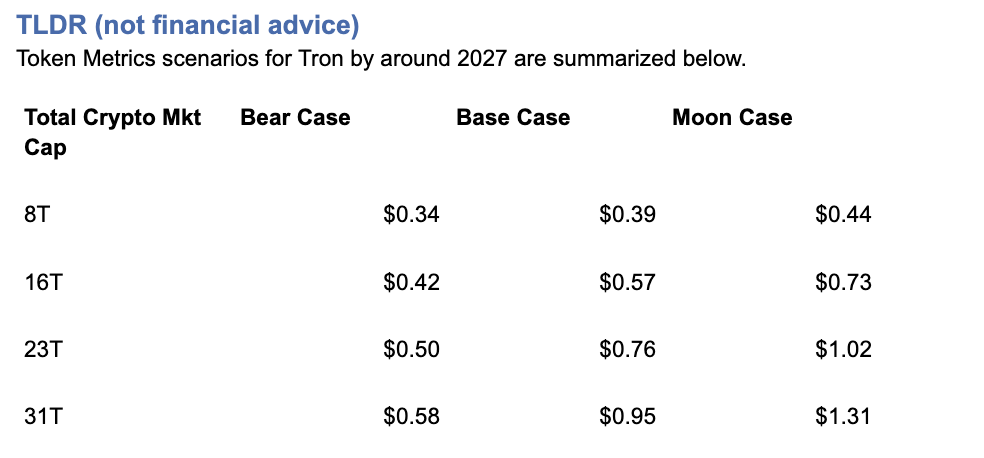
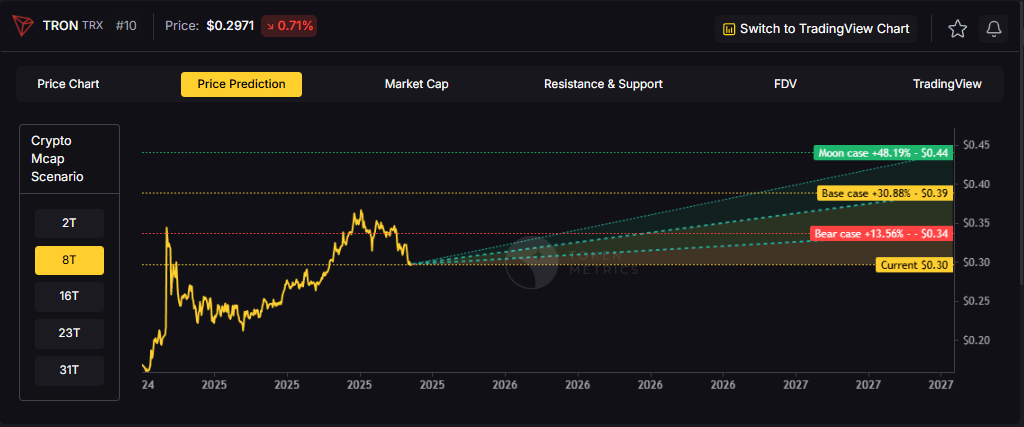
    8T Market Cap - TRX Price Prediction:

    At an 8 trillion dollar total crypto market cap, our TRX price prediction framework projects specific targets in bear, base, and bullish scenarios. The 8T tier reflects conservative market conditions with steady stablecoin transfer adoption.

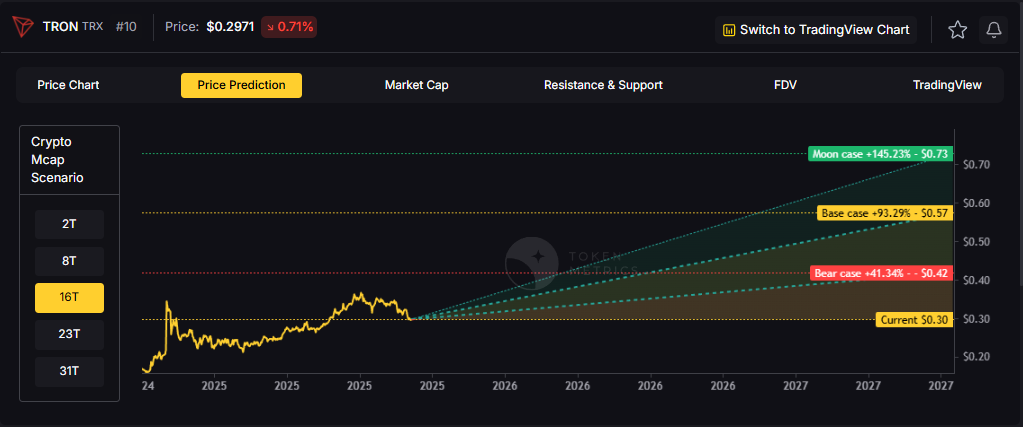
     16T Market Cap - TRX Price Prediction:

    Doubling the market to 16 trillion expands the TRX price prediction range significantly, reflecting increased institutional stablecoin usage and payments adoption that benefit Tron's high-throughput, low-cost infrastructure.

     23T Market Cap - TRX Price Prediction:

    At 23 trillion total crypto market cap, the price prediction scenarios show substantial upside potential, with the moon case projecting $1.02—achieving the psychologically important $1.00 milestone for TRX holders.

     Each tier in our price prediction framework assumes progressively stronger market conditions, with particular emphasis on stablecoin transfer volume and payments use cases that uniquely position Tron in the blockchain ecosystem.

    Why Consider the Indices with Top-100 Exposure

    Diversification matters. Tron is compelling, yet concentrated bets can be volatile—especially when price predictions carry Strong Sell ratings despite bullish macro conditions. Token Metrics Indices hold TRX alongside the top one hundred tokens for broad exposure to leaders and emerging winners.

    Our backtests indicate that owning the full market with diversified indices has historically outperformed both the total market and Bitcoin in many regimes due to diversification and rotation benefits, reducing single-asset risk.

    Get early access: https://docs.google.com/forms/d/1AnJr8hn51ita6654sRGiiW1K6sE10F1JX-plqTUssXk/preview 

    If your editor supports embeds, place a form embed here. Otherwise, include the link above as a button labeled Join Indices Early Access.

    What Is Tron?

    Tron is a smart-contract blockchain focused on low-cost, high-throughput transactions and cross-border settlement. The network supports token issuance and a broad set of dApps, with an emphasis on stablecoin transfer volume and payments—critical factors that influence TRX price predictions.

    TRX is the native asset that powers fees and staking for validators and delegators within the network. Developers and enterprises use the chain for predictable costs and fast finality, which supports consumer-facing use cases. Tron has become a dominant network for USDT (Tether) transfers, creating organic demand for TRX that impacts long-term price prediction trajectories.

    Catalysts That Skew TRX Price Predictions Bullish

    • Institutional and retail access expands with ETFs, listings, and integrations
    • Macro tailwinds from lower real rates and improving liquidity expected in 2026
    • Product or roadmap milestones such as upgrades, scaling, or partnerships
    • Growing USDT stablecoin transfer volume on Tron network
    • Increased cross-border payment adoption and remittance use cases
    • Continued low-fee competitive advantage versus Ethereum
    • Enterprise blockchain partnerships leveraging Tron's throughput

    Risks That Skew TRX Price Predictions Bearish

    • Macro risk-off from tightening or liquidity shocks
    • Regulatory actions targeting Tron, Justin Sun, or infrastructure outages
    • Current Strong Sell rating (19.06) indicating significant fundamental concerns
    • Concentration risk in validator economics and potential centralization issues
    • Competitive displacement from faster, lower-cost L1s and L2 solutions
    • Regulatory scrutiny on stablecoin operations affecting Tether/USDT
    • Reputational concerns related to founder Justin Sun
    • Competition from Solana, BNB Chain for stablecoin transfers

    Special Offer — Token Metrics Advanced Plan with 20% Off

    Unlock platform-wide intelligence on every major crypto asset. Use code ADVANCED20 at checkout for twenty percent off.

    • AI powered ratings on thousands of tokens for traders and investors
    • Interactive TM AI Agent to ask any crypto question
    • Indices explorer to surface promising tokens and diversified baskets
    • Signal dashboards, backtests, and historical performance views
    • Watchlists, alerts, and portfolio tools to track what matters
    • Early feature access and enhanced research coverage

    Start with Advanced today → https://www.tokenmetrics.com/token-metrics-pricing 

    Tron Price Prediction FAQs

    Can TRX reach $1?

    Yes. The 23T moon case in our price prediction framework shows $1.02 and the 31T moon case shows $1.31, which imply a path to $1 in higher-liquidity regimes. From current price of $0.2971, this represents approximately 240%+ gains. However, achieving this requires the bullish 2026 thesis materializing with strong stablecoin adoption and overcoming the current Strong Sell rating (19.06). Not financial advice.

    Is TRX a good long-term investment?

    TRX presents a complex investment case with a Strong Sell rating (19.06) despite impressive historical returns (80% YoY, 963% since last signal flip). Our price prediction models show potential upside to $1.02-$1.31 in bullish scenarios, but outcome depends heavily on adoption, liquidity regime, competition, regulatory environment, and supply dynamics. The stablecoin transfer use case provides organic demand, but fundamental concerns reflected in the Strong Sell rating suggest caution. Diversify and size positions responsibly. Not financial advice.

    What is the Tron price prediction for 2026-2027?

    Our comprehensive TRX price prediction framework for 2026-2027 suggests Tron could reach $1.02 in the 23T moon scenario and $1.31 in the 31T moon scenario, representing significant upside from current $0.2971 price. Base case scenarios across market cap tiers provide more conservative targets. Despite the bullish 2026 macro thesis and strong stablecoin utility, the Strong Sell rating (19.06) and bearish trading signal indicate current fundamental concerns. Not financial advice.

    Should I buy TRX now or wait?

    TRX has a Strong Sell rating (19.06) indicating Token Metrics does not endorse Tron at current levels, despite bullish 2026 macro conditions and 80% YoY gains. Current price of $0.2971 is down 11% over 30 days with bearish trading signals. However, historical outperformance (963% since last signal flip) and stablecoin transfer utility create a paradox. If you believe in the 2026 bull thesis and Tron's stablecoin dominance, dollar-cost averaging may reduce timing risk. Consider diversified exposure through indices. Not financial advice.

    Why does TRX have a Strong Sell rating despite 80% YoY gains?

    TRX receives a Strong Sell rating (19.06) based on current fundamental analysis, technical indicators, and valuation metrics—despite impressive historical performance (80% YoY, 963% since last signal flip). Ratings reflect forward-looking risk assessment including regulatory concerns, centralization issues, reputational factors, and competitive threats. Our price prediction framework shows potential upside in favorable scenarios, but the Strong Sell rating suggests significant risks that could prevent achieving bullish targets. Past performance doesn't guarantee future results. Not financial advice.

    How does TRX benefit from stablecoin transfers?

    Tron has become the dominant network for USDT (Tether) transfers due to extremely low fees and fast settlement. This creates organic demand for TRX as users need the native token for transaction fees. Our price prediction models assume continued growth in stablecoin transfer volume, which supports base case scenarios. The 23T and 31T price predictions of $1.02-$1.31 factor in sustained stablecoin dominance. However, competition from other low-cost chains and regulatory scrutiny on Tether operations represent risks. Not financial advice.

    Can TRX reach $2?

    TRX reaching $2 would exceed our current price prediction models' highest scenario of $1.31 (31T moon case). From current $0.2971, $2 represents approximately 570%+ gains. This would require extraordinary market conditions beyond the 31T total crypto market cap tier, exceptional stablecoin adoption acceleration, and overcoming significant fundamental concerns reflected in the Strong Sell rating (19.06). While possible in extreme bull scenarios, $2 appears beyond rational price prediction frameworks. Not financial advice.

    What are the biggest risks to TRX price predictions?

    Key risks that could derail Tron price predictions include: Strong Sell rating (19.06) indicating severe fundamental concerns, regulatory actions targeting Tron network or founder Justin Sun, centralization concerns in validator economics, regulatory scrutiny on Tether/USDT operations affecting transfer volumes, competitive displacement from Solana/BNB Chain for stablecoin transfers, reputational issues, macro liquidity shocks ending 2026 bull thesis, and potential security vulnerabilities. Despite strong utility, these risks warrant careful position sizing. Not financial advice.

    How does Tron compare to other payment blockchain price predictions?

    Tron's price prediction framework suggests $0.30-$1.31 across scenarios, positioning it as a specialized payments and stablecoin transfer network. Compared to Ethereum's dominance and Solana's speed, Tron differentiates through extremely low fees and USDT transfer volume leadership. However, the Strong Sell rating (19.06) reflects concerns that this niche may not sustain long-term value versus more decentralized, diversified platforms. Tron trades at rank #10, indicating established but controversial market position. Not financial advice.

    Will TRX benefit from the 2026 bull market?

    Yes. Our price prediction scenarios are specifically framed around the bullish 2026 thesis, where improving liquidity, institutional participation, and stablecoin adoption create favorable conditions. TRX's low-fee infrastructure and USDT dominance position it to capture bull market momentum in payments use cases. However, the Strong Sell rating (19.06) and bearish momentum suggest TRX may underperform versus fundamentally stronger tokens. Muted base case projections reflect this tension between macro tailwinds and micro concerns. Not financial advice.

    Is the $1 target realistic for TRX?

    The $1 target appears achievable in our price prediction framework's 23T moon case ($1.02) and 31T scenarios ($1.31). From current $0.2971, this represents approximately 240%+ gains requiring sustained stablecoin adoption, bullish macro conditions materializing, and overcoming Strong Sell rating concerns. Historical volatility (963% returns since last signal flip) demonstrates TRX's ability to deliver explosive gains, but fundamental weaknesses create significant uncertainty. Possible but high-risk—manage expectations accordingly. Not financial advice.

    What needs to happen for TRX to reach price prediction targets?

    For TRX to reach our price prediction targets of $1.02-$1.31, several catalysts must materialize: (1) continued dominance in USDT stablecoin transfers, (2) bullish 2026 macro conditions with improving liquidity, (3) addressing regulatory concerns around Tron and Justin Sun, (4) improving TM Grade from Strong Sell (19.06) territory, (5) institutional adoption of Tron for cross-border payments, (6) successful competition against Solana/BNB Chain, and (7) maintaining low-fee advantage as scaling solutions proliferate. The Strong Sell rating suggests these catalysts aren't currently materializing at required pace.

    Next Steps

    Track live grades and signals: Token Details → https://app.tokenmetrics.com/en/tron 

    Join Indices Early Access: https://docs.google.com/forms/d/1AnJr8hn51ita6654sRGiiW1K6sE10F1JX-plqTUssXk/preview

    Want exposure Buy TRX on MEXC → https://www.mexc.com/acquisition/custom-sign-up?shareCode=mexc-2djd4 

    Disclosure

    Educational purposes only, not financial advice. Crypto is volatile, do your own research and manage risk.

    Why Use Token Metrics for Tron Price Predictions?

    • Transparent analysis: Honest Strong Sell ratings (19.06) even when historical returns are exceptional (963%)
    • Scenario-based modeling: Four market cap tiers for comprehensive price prediction analysis
    • Stablecoin specialization: Understanding Tron's unique position in USDT transfer ecosystem
    • Risk-adjusted approach: Balanced view of utility strengths versus fundamental concerns
    • Real-time signals: Trading signals and TM Grades updated regularly tracking 11% monthly decline
    • Diversification tools: Index solutions to spread payment blockchain risk
    • Comparative analysis: Analyze TRX against BNB, SOL, and 6,000+ tokens
    Choose from Platinum, Gold, and Silver packages
    Reach with 25–30% open rates and 0.5–1% CTR
    Craft your own custom ad—from banners to tailored copy
    Perfect for Crypto Exchanges, SaaS Tools, DeFi, and AI Products