Back to blog
Research

What Happens When Your Crypto Index Goes to Cash (Stablecoins)?

Discover how regime-switching strategies with stablecoins can enhance risk management and resilience in volatile crypto markets using Token Metrics analytics.
Token Metrics Team
11 min read
Want Smarter Crypto Picks—Free?
See unbiased Token Metrics Ratings for BTC, ETH, and top alts.
Thank you! Your submission has been received!
Oops! Something went wrong while submitting the form.
 No credit card | 1-click unsubscribe

In the fast-paced and often unpredictable world of cryptocurrency investing, knowing when to step aside can be as valuable as knowing when to jump in. This wisdom is especially pertinent in 2025, a year marked by heightened market volatility and growing institutional interest in digital assets. Stablecoins are a type of cryptocurrency designed to maintain a stable value relative to another asset, such as the US dollar, making them a unique crypto asset that offers lower volatility and greater usability in transactions. As the stablecoin market surpasses $232 billion in market capitalization and regime-switching strategies gain traction among professional investors, understanding what happens when your crypto index goes to cash stablecoins could be the key to preserving wealth amid turbulent markets.

Moving your crypto index to cash—specifically into stablecoins—does not mean abandoning the crypto market altogether. Instead, it represents a tactical shift designed to protect your portfolio’s value when market conditions become unfavorable. Stablecoins are digital tokens that act as stable assets and serve as a form of money within the crypto ecosystem, providing a digital representation of fiat currencies on the blockchain. What makes stablecoins attractive for this strategy is their ability to provide price stability and reduce risk during market downturns. This article explores the mechanics, rationale, and real-world impact of this increasingly popular strategy, with a focus on how stablecoins function as a defensive asset in the evolving crypto landscape.

The Evolution of Smart Index Strategies

Traditional crypto indices typically maintain constant exposure to a broad basket of crypto assets, forcing investors to endure the full brunt of market crashes from peak to bottom. This static approach can be punishing given the crypto market’s notorious volatility, where sharp drawdowns can erase years of gains in just a few weeks.

However, 2025 has ushered in a new paradigm: regime-switching indices that dynamically allocate between risk assets and defensive positions based on quantifiable market signals. These smart index strategies adjust exposure in real time, shifting from volatile crypto assets to stablecoins when indicators suggest heightened market risk.

A prime example is Token Metrics’ TM Global 100 Index, which leverages AI-powered analytics to monitor market conditions and execute these regime switches systematically. This approach represents one of the most significant innovations in crypto portfolio management since the advent of Bitcoin ETFs, offering investors a way to maintain participation in the crypto market while actively managing downside risk.

Unlike traditional indices that remain fully invested regardless of market turmoil, regime-switching strategies prioritize capital preservation by moving into cash stablecoins during bearish phases. This dynamic allocation is a data-driven response to the brutal reality of crypto’s worst drawdowns and aims to protect investors from severe losses.

Understanding the Cash Transition: The Mechanics

When a regime-switching crypto index like the TM Global 100 moves to cash stablecoins, several important processes take place simultaneously:

  • Portfolio Liquidation: The index systematically sells its crypto holdings—whether that includes the top 100 crypto assets by market capitalization or a more focused selection—and converts the proceeds into stablecoins such as USDC or USDT. These stablecoins are typically backed by reserve assets, which help maintain their value and stability. Companies that issue stablecoins must follow certain regulatory requirements and proposed rules to ensure transparency, proper management of reserve assets, and overall stability in the market. USDT alone processes over $1 trillion in transactions monthly and the total stablecoin transaction volume exceeds $4.7 trillion in recent 30-day periods.
  • Capital Preservation Mode: Once converted, your investment no longer rides the waves of highly volatile cryptocurrencies but instead resides in dollar-pegged stablecoins that maintain a stable value relative to the US dollar. This means that while the broader crypto market could plunge by 30%, 50%, or even more, your portfolio’s value remains anchored, shielding you from significant losses.
  • Transaction Transparency: Platforms like Token Metrics provide full visibility into every rebalance and transaction. Investors can track exactly when the switch occurred, the prices at which assets were sold, and the current holdings in stablecoins. The process to issue stablecoins involves compliance with proposed rules and oversight by the issuing company, which further enhances transparency and regulatory confidence. This transparency addresses common concerns about algorithmic trading strategies operating as a “black box.”
  • Fee and Slippage Management: Moving from crypto assets to stablecoins isn’t without cost. Gas fees, platform fees, and potential slippage during asset liquidation can impact returns. However, leading platforms disclose these costs upfront, enabling investors to weigh the benefits of risk reduction against transaction expenses before executing the switch.

Types of Stablecoins: What Your Index Might Hold

Stablecoins are a unique class of digital asset designed to maintain a stable value, typically pegged to a traditional asset like the US dollar. For crypto investors and stablecoin issuers, understanding the different types of stablecoins is crucial for navigating the crypto market and making informed decisions about risk and exposure.

  • Fiat-backed stablecoins: are the most widely used, with examples like Tether (USDT) and USD Coin (USDC). These stablecoins are backed by reserves of fiat currency, such as dollars, held in bank accounts or with trusted custodians. This direct link to fiat currency helps maintain price stability and makes them a preferred choice for investors seeking a stable value during periods of market volatility.
  • Commodity-backed stablecoins: offer another approach, using physical assets like gold to back their value. Tether Gold (XAUt) is a prominent example, allowing investors to hold a digital token that represents ownership of a specific amount of gold. These stablecoins provide exposure to traditional assets while leveraging the efficiency of blockchain technology.
  • Crypto-backed stablecoins: use other cryptocurrencies as collateral. Dai (DAI) is a leading example, where users lock up crypto assets in smart contracts to issue new stablecoins. This model relies on overcollateralization to absorb market fluctuations and maintain the stablecoin’s value, offering a decentralized alternative to fiat-backed options.
  • Algorithmic stablecoins: take a different route, using computer algorithms and smart contracts to automatically adjust supply and demand. Projects like Ampleforth (AMPL) aim to maintain price stability without direct backing from fiat currencies or other assets. While innovative, algorithmic stablecoins can be more susceptible to market shocks and require careful monitoring by both investors and stablecoin issuers.

By understanding these types of stablecoins—fiat-backed, commodity-backed, crypto-backed, and algorithmic—crypto investors can better assess the risks and benefits of each, ensuring their portfolios are aligned with their risk tolerance and market outlook.

Stablecoin Mechanism: How Stability is Maintained

The stability of stablecoins is achieved through a combination of collateralization, algorithmic controls, and transparent reserve management. Each type of stablecoin employs a distinct mechanism to maintain its peg and ensure trust among users and investors.

  • Fiat-backed stablecoins: maintain price stability by holding reserves of fiat currency, such as US dollars, in bank accounts or with regulated custodians. For every stablecoin issued, an equivalent amount of fiat currency is held in reserve, allowing holders to redeem their tokens for cash at any time. Stablecoin issuers are often required to disclose their reserves monthly, providing transparency and reinforcing confidence in the stablecoin’s value.
  • Commodity-backed stablecoins: operate similarly, but their reserves consist of physical assets like gold or other commodities. The value of the stablecoin is directly linked to the market value of the underlying asset, and regular audits help ensure that the reserves match the outstanding supply.
  • Crypto-backed stablecoins: use overcollateralization to manage risk. By locking up more value in crypto assets than the stablecoins issued, these projects create a buffer against market volatility. Smart contracts automatically manage the collateral, liquidating positions if the value of the backing assets falls below a certain threshold, thus maintaining the stablecoin’s peg.
  • Algorithmic stablecoins: rely on smart contracts and computer algorithms to dynamically adjust the supply of tokens in response to changes in demand. If the stablecoin’s price rises above its target, new tokens are issued to increase supply; if it falls below, tokens are removed from circulation. This approach aims to maintain price stability without direct backing from fiat or other assets, though it can be more vulnerable to extreme market conditions.

Regulatory frameworks like the GENIUS Act require stablecoin issuers to hold reserves in cash or short-term Treasurys and to provide regular disclosures. These measures, combined with robust reserve management and transparent reporting, are essential for maintaining trust and stability in the rapidly evolving stablecoin market.

Why Stablecoins? The Strategic Rationale

The choice to move into stablecoins as a defensive position is far from arbitrary. In 2025, stablecoins have evolved beyond niche crypto instruments to become a mainstream component of the financial market infrastructure. Stablecoins aim to provide a stable alternative to volatile cryptocurrencies, making them attractive for both retail and institutional investors. This transformation is fueled by explosive growth, regulatory clarity, and increasing integration with traditional finance.

Regulatory frameworks such as the European Union’s MiCA regulation and the proposed U.S. GENIUS Act have provided much-needed legal protections and guidelines for stablecoin issuers. These frameworks have a significant impact on companies operating in the digital asset and stablecoin ecosystem, shaping their compliance strategies and opening new opportunities for growth. The passage of such legislation is also aimed at establishing national innovation and promoting national innovation in blockchain technology and digital assets, positioning these sectors as pillars of future economic advancement.

Major financial institutions have also embraced stablecoins. For example, JPMorgan has expanded its JPM Coin platform to facilitate euro-denominated payments, while PayPal has begun using its PYUSD stablecoin for business transactions. These developments validate stablecoins as a legitimate, dollar-equivalent medium of exchange within the digital asset ecosystem. However, unlike central banks, which issue central bank digital currencies (CBDCs) recognized as legal tender by governments, stablecoins are typically issued by private companies and are not considered legal tender. This distinction highlights the differences in credibility, backing, and regulatory oversight between stablecoins and CBDCs.

Stablecoins offer distinct advantages over traditional fiat currency held in bank accounts. They provide 24/7 availability, near-instant settlement of transactions, transparent on-chain tracking, and the ability to redeploy capital rapidly when market conditions improve. When your crypto index signals a return to risk-on mode, converting stablecoins back into crypto assets can happen in just a few hours—something impossible with conventional cash.

Additionally, regions like Latin America have seen rapid adoption of stablecoins, driven by currency instability and limited access to traditional banking infrastructure. This trend underscores the growing importance of stablecoins in emerging markets as a practical solution for financial inclusion and stability.

Regulatory Environment: Navigating Compliance and Oversight

As stablecoins become an integral part of the digital asset ecosystem, the regulatory environment is rapidly evolving to ensure their safety, transparency, and reliability. Governments and regulatory bodies worldwide are establishing comprehensive frameworks to oversee stablecoin issuance, trading, and reserve management.

In the United States, the GENIUS Act, enacted in 2025, sets clear standards for USD-backed payment stablecoins. Under this regulatory framework, stablecoin issuers must hold reserves in cash or short-term Treasurys and disclose their reserves monthly. The Act also provides legal protections for stablecoin holders, ensuring that their assets are safeguarded in the event of issuer insolvency. These requirements are designed to foster trust, support mainstream adoption, and protect investors in the growing stablecoin market.

Europe has taken a similarly proactive approach with the Markets in Crypto Assets Regulation (MiCAR). This regulatory framework bans algorithmic stablecoins and mandates that other stablecoins maintain liquid reserves held by third-party custodians at a strict 1:1 asset-to-coin ratio. These rules are intended to prevent systemic risks and ensure that stablecoins can reliably serve as a medium of exchange and store of value within the broader financial market infrastructure.

For stablecoin issuers and crypto investors, navigating this evolving regulatory landscape is essential. Compliance with reserve requirements, regular disclosures, and legal protections not only supports the stability of individual stablecoins but also underpins the credibility and growth of the entire digital asset sector. As the stablecoin market cap continues to expand—now exceeding $162 billion—regulatory clarity will be a key driver of innovation, investor confidence, and the integration of stablecoins into global digital payments and cross border payments systems.

Token Metrics: Leading the Regime-Switching Revolution

While regime switching is a familiar concept in traditional finance, Token Metrics has pioneered its application in the crypto industry by combining AI-powered analytics with systematic portfolio management. Token Metrics employs a team of data scientists, machine learning experts, and crypto-native analysts to provide insights on over 6,000 crypto and NFT projects.

The TM Global 100 Index embodies this innovative approach. During bullish market phases, it holds the top 100 crypto assets by market capitalization to capture broad upside potential. When bearish signals emerge, it moves entirely to stablecoins, waiting for a green light to re-enter crypto markets. The index rebalances weekly, offering complete transparency including strategy rules, live market gauges, holdings visualized in treemap and table formats, and a full log of every transaction.

What distinguishes Token Metrics is its dual-rating system, assigning each token a Trader Grade for short-term potential and an Investor Grade for long-term viability. These proprietary market signals feed into the regime-switching logic, enabling disciplined and data-driven decisions about when to move to cash stablecoins.

In March 2025, Token Metrics expanded its capabilities with the launch of Trading on Token Metrics, allowing users to execute trades directly on the platform. This integration streamlines the investment process, reducing execution risk and decision fatigue by enabling research, analysis, and trading within a single ecosystem.

The Real-World Impact: What Investors Experience

When your crypto index shifts to stablecoins, the effects on your portfolio and investment experience are tangible:

  • Immediate Volatility Reduction: The most noticeable change is a dramatic reduction in daily portfolio swings. While crypto markets can fluctuate 5-10% or more daily, stablecoins remain pegged to the US dollar, providing a stable value that cushions against market shocks.
  • Opportunity Cost Considerations: Holding stablecoins during sudden market rallies means missing out on potential gains. However, data from 2024-2025 shows that crypto market narratives rotate rapidly—often within weeks—across sectors like AI agents, gaming, and DePIN protocols. Systematic signals help remove emotional bias and timing errors, enhancing long-term returns despite short-term opportunity costs.
  • Tax Implications: Converting crypto assets to stablecoins may trigger taxable events in many jurisdictions. Investors should consult tax professionals to understand the implications of frequent rebalancing, which can complicate tax reporting.
  • Psychological Relief: Perhaps less quantifiable but equally important is the peace of mind that comes from knowing your capital is preserved during market turmoil. The mental toll of watching portfolio values collapse can be severe, and regime switching addresses this human factor by providing a disciplined safety net.

The 2025 Market Context

The relevance of moving your crypto index to cash stablecoins is heightened by the current market environment in 2025. Bitcoin dominance hovers around 58%, while the CoinMarketCap Altcoin Season Index sits at 55/100, indicating a phase of consolidation and mixed performance rather than clear upward momentum.

This environment is characterized by rapid shifts in market narratives and fragmented liquidity, making systematic risk management strategies more valuable than ever. Moreover, institutional interest in digital assets continues to grow, with 67% of firms planning to increase crypto holdings and professional investors managing $27.4 billion in U.S. Bitcoin ETFs.

As sophisticated capital enters the crypto markets with disciplined risk frameworks, retail investors stand to benefit by adopting similar regime-aware strategies that leverage stablecoins for capital preservation.

Implementing Your Strategy

For investors considering regime-switching indices that move to cash stablecoins, several practical steps can help optimize outcomes:

  • Understand the Signal Logic: Different platforms employ various market indicators to trigger regime switches. Token Metrics uses proprietary signals classifying market conditions as bullish or bearish, but transparency about methodology is crucial for trust.
  • Evaluate Historical Performance: While past performance does not guarantee future results, reviewing how the strategy fared during previous bear markets provides valuable context and confidence.
  • Consider Your Time Horizon: Regime switching suits investors seeking systematic risk management without the need for daily liquidity. Tax considerations related to frequent rebalancing should also be factored into your decision.
  • Start with Core Allocation: Using a regime-switching index for your core crypto allocation allows you to maintain risk-managed exposure while pursuing higher-conviction satellite positions separately.

Conclusion: The Future of Disciplined Crypto Exposure

The question facing crypto investors today is not whether their indices should move to cash stablecoins, but whether their strategies have the discipline to do so when market conditions demand it. Token Metrics’ TM Global 100 Index demonstrates that combining broad crypto exposure with systematic risk management through stablecoin rotation offers a more mature and resilient approach to investing in digital assets.

Transitioning to stablecoins is not about perfectly timing the market; it’s about surviving the inevitable steep drawdowns that have historically wiped out significant value multiple times in crypto’s history. Preservation of capital is as vital as participation in upside moves.

As regulatory frameworks mature, institutional adoption accelerates, and market infrastructure improves throughout 2025, investors have unprecedented tools to navigate crypto’s volatility. Token Metrics’ integration of AI analytics, regime detection, and seamless trade execution creates an ecosystem where investors can capture crypto’s upside while managing downside risks effectively.

When your crypto index goes to cash stablecoins, it’s not retreating—it’s regrouping. In the volatile and rapidly evolving world of digital assets, knowing when to step aside might just be your most genius act yet.

Build Smarter Crypto Apps &
AI Agents in Minutes, Not Months
Real-time prices, trading signals, and on-chain insights all from one powerful API.
Grab a Free API Key
About Token Metrics
Token Metrics: AI-powered crypto research and ratings platform. We help investors make smarter decisions with unbiased Token Metrics Ratings, on-chain analytics, and editor-curated “Top 10” guides. Our platform distills thousands of data points into clear scores, trends, and alerts you can act on.
30 Employees
analysts, data scientists, and crypto engineers
Daily Briefings
concise market insights and “Top Picks”
Transparent & Compliant
Sponsored ≠ Ratings; research remains independent
Want Smarter Crypto Picks—Free?
See unbiased Token Metrics Ratings for BTC, ETH, and top alts.
Thank you! Your submission has been received!
Oops! Something went wrong while submitting the form.
 No credit card | 1-click unsubscribe
Token Metrics Team
Token Metrics Team

Recent Posts

Announcements

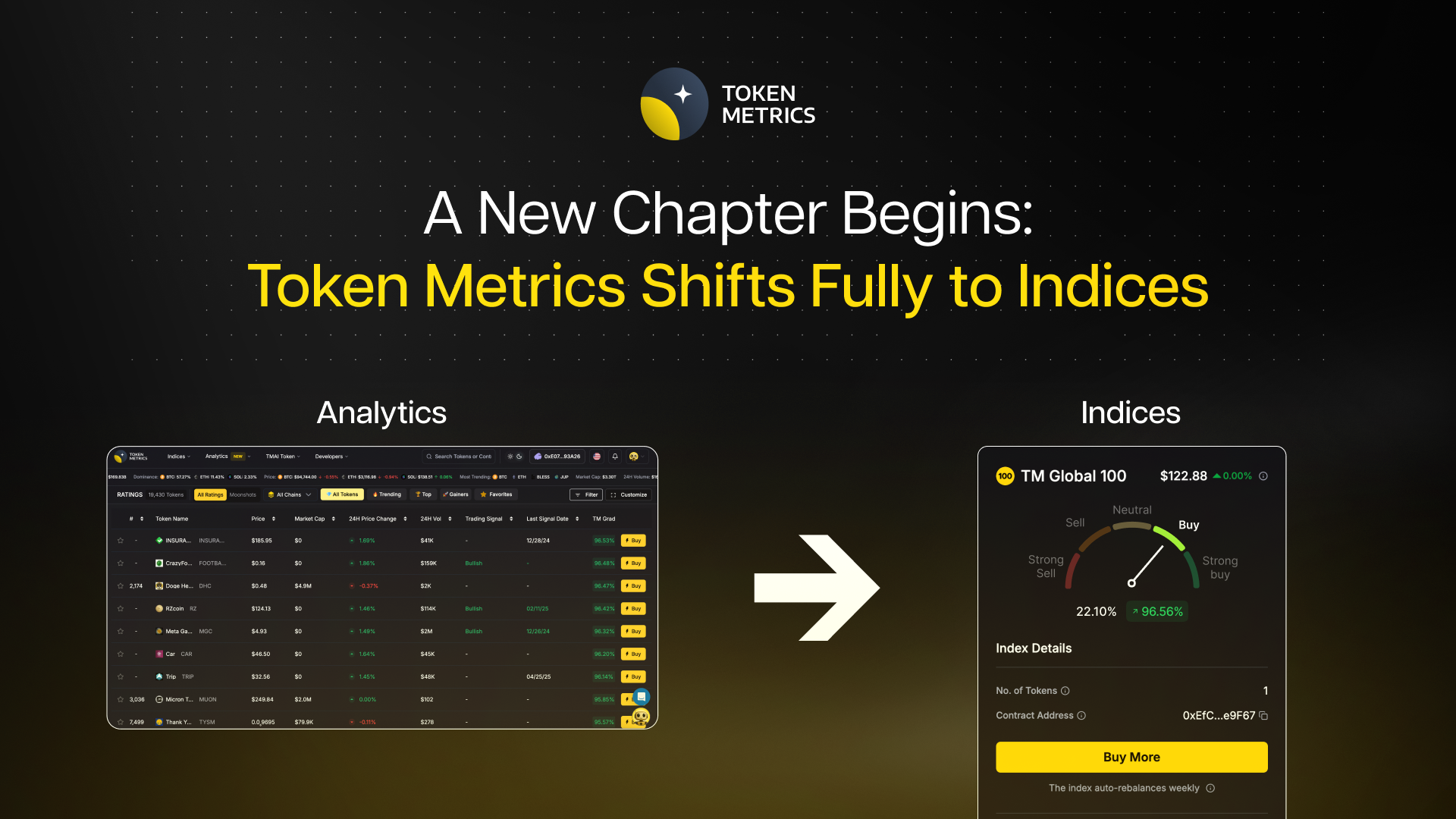
A New Chapter: Token Metrics Shifts Fully to On-Chain Indices

Token Metrics Team
8 min

An important update from Ian Balina, Founder and CEO

Today marks a pivotal moment in Token Metrics' journey. After careful consideration of market dynamics and community feedback, we're making a strategic decision that will shape our future: we are sunsetting the Token Metrics Analytics platform and API to focus entirely on building and operating our on-chain indices.

Why We're Making This Change

The crypto landscape has evolved significantly. Research and analytics tools have proliferated, with many platforms offering similar features and dashboards. Meanwhile, the real innovation and differentiation is shifting toward on-chain products that enable investors to own the market itself—simply, transparently, and non-custodially.

Over time, we've noticed a clear trend: the strongest and most consistent interest around Token Metrics has centered on our indices, especially TM100, rather than new features in the Analytics platform or raw data feeds. Our community has shown us where the real value lies.

In response to these market conditions and community sentiment, we've made the decision to narrow our focus dramatically. We're consolidating into a much smaller, highly focused team with a single mission: to do fewer things and do them exceptionally well.

What's Changing and When

Here's the complete timeline for this transition:

Effective Immediately

Analytics and the API enter maintenance/read-only status. Users can still log in to view historical Ratings, but no new features will be released.

November 27, 2025

This is the strict deadline to submit your choice regarding your subscription balance. Please don't delay—requests received after this date may not be processed due to the platform shutdown.

November 28, 2025 (Black Friday)

Subject to final readiness, we plan to begin onboarding select users into the indices (starting with TM100) through a controlled early-access rollout.

November 30, 2025

We will shut down both the Analytics platform and the API endpoints. After this date, all routes will redirect to our indices experience and the Help Center.

Your Compensation Options: Choose What Works Best for You

Because you've supported Token Metrics with your subscription, we want to reward your loyalty with high-value choices. We're offering three options, each designed for different goals:

Option 1: Convert to Indices Credits (3x Value)

Receive 3x the value of your unused subscription as credits toward future indices management fees. This grants you:

  • Priority access to TM100
  • White-glove onboarding when the exclusive index opens
  • The best value for continuing your journey with Token Metrics

This is our recommended option for those who want to stay closest to our future developments and plan to utilize our indices. If you've supported Token Metrics from the very beginning and believe in where we're headed, we strongly encourage this path.

Learn more:

Option 2: Receive TMAI Airdrop (1.5x Value)

Receive 1.5x the value of your unused subscription in TMAI tokens.

Note: To ensure market stability, these tokens will be subject to a daily vesting schedule over 30 days.

Option 3: Request a Pro-Rata Refund (1:1 Value)

Request a standard 1:1 pro-rated refund of the unused portion of your subscription back to your original payment method.

Note: Please allow up to 60 days for refund processing.

⚠️ Action Required

Select Your Option Here

You must submit this form by November 27, 2025. Requests received after this date may not be processed due to the platform shutdown.

What This Means for Our Community

For Customers and Developers

This pivot is about clarity and focus. Instead of spreading our energy across analytics dashboards and API maintenance, we will deliver one core product: a non-custodial, rules-based index that lets you invest in the crypto market with a single token.

For Investors

This is a strategic re-alignment around the part of the business with the most long-term value. We see greater opportunity in being an index engine and distribution platform than in competing as yet another analytics surface.

For Astrobot Holders

Upon the launch of the Indices, a snapshot taken today confirms your eligibility for an airdrop of permanently staked veTMAI. This converts your current plan to the equivalent staking score level within the new Indices structure. The received veTMAI can then be utilized to benefit from discounted trading fees and a share of the platform's revenue.

For TMAI Token Holders

This is not a step away from you. As we build TM100 and related indices, we intend to maintain and, where possible, enhance the ways TMAI connects to our products. Our priority is to get the index experience live, simple, and trustworthy. Once that foundation is solid, we'll share more details on how the token and indices fit together.

Impact on Our Team

Due to this change, we are becoming a smaller, leaner company. This has required difficult decisions about team structure, but we believe this focused approach will allow us to deliver exceptional value in our chosen domain.

What to Expect Next

  1. Confirmation: Once you submit your compensation choice, you'll receive a confirmation email
  2. Reminders: You'll see in-app notices about the November 30 shutdown and November 27 deadline
  3. Launch Updates: Information about TM100 early access and how to participate as indices onboarding begins around Black Friday

Our Commitment to You

To our customers, API users, investors, and token holders: thank you for your support through multiple market cycles. You've trusted our Ratings, engaged with our research, and participated in our community. This decision honors that history while pointing toward a simpler, more durable product that aligns with where crypto is heading.

By narrowing our focus now, we can build something that deserves your trust for many years to come.

Questions? Reply to our announcement email or contact us at support@tokenmetrics.com. We will read every message and do our best to assist you.

With appreciation,

Ian Balina
Founder and CEO
Token Metrics

Don't forget: Select your compensation option before November 27, 2025
Research

Top Crypto Prime Brokers (2025): Best Institutional Trading & Settlement Platforms

Token Metrics Team
17 min read
  • If you’re an institution that needs multi-venue liquidity, off-exchange settlement, and integrated custody/financing, this guide ranks the top crypto prime brokers for 2025 based on scale, security posture, and product breadth.
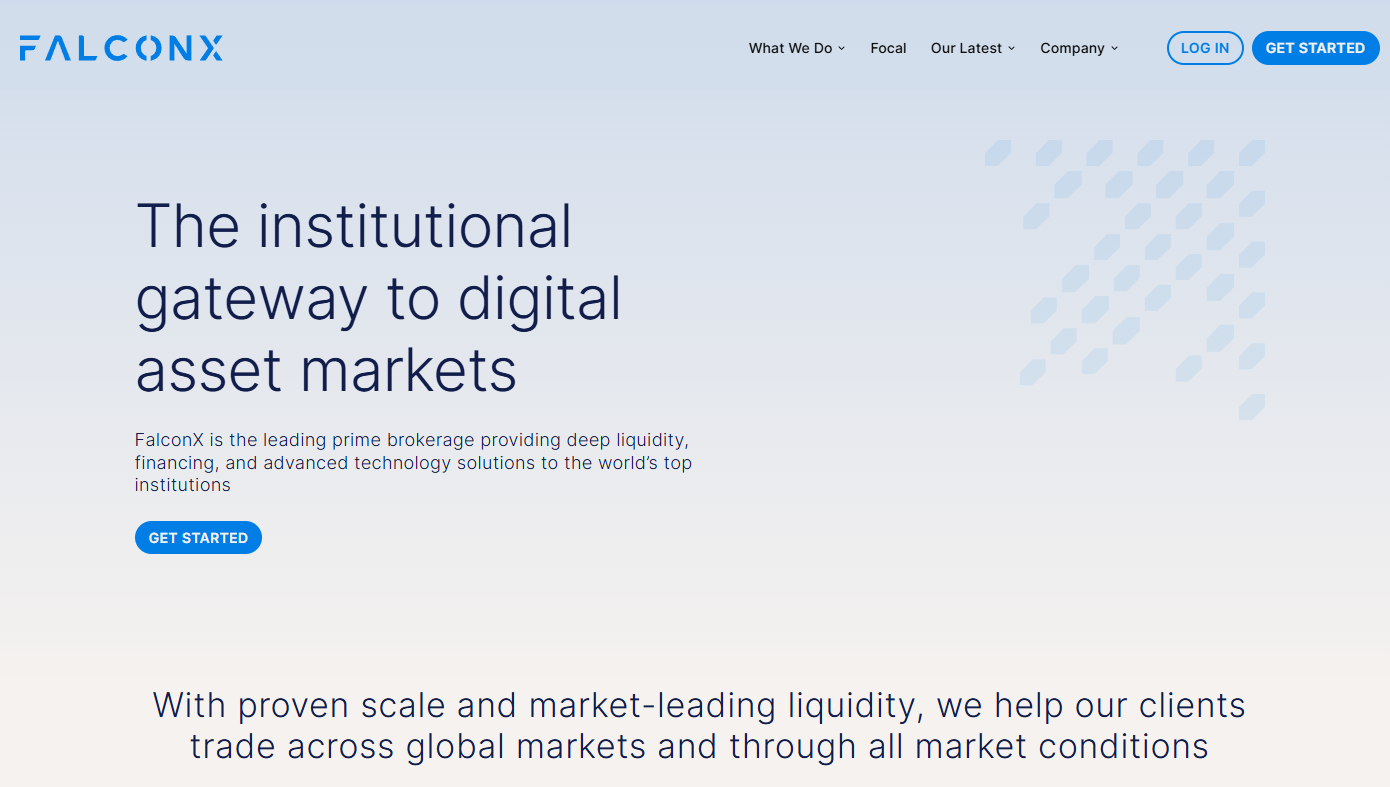
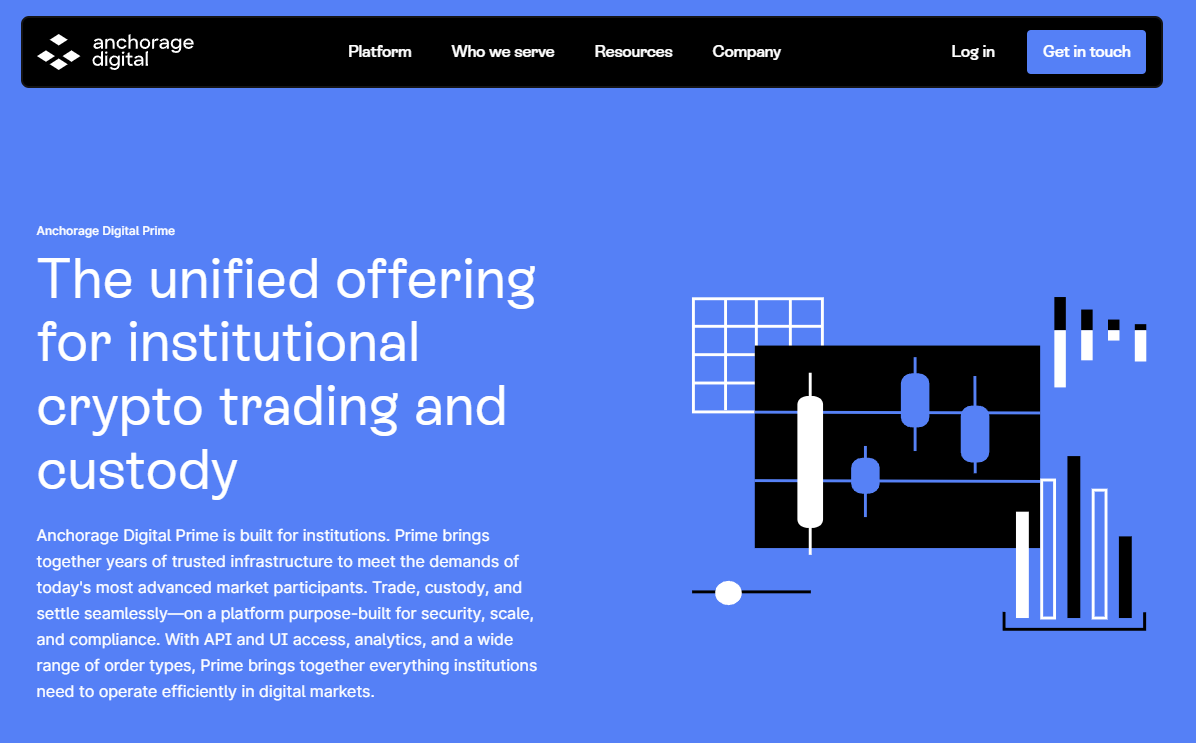
  • Top picks: Coinbase Prime for integrated trading + qualified custody with negotiated fees; FalconX for deep liquidity and capital solutions across spot/derivatives; Anchorage Digital Prime for bank-regulated custody with prime services and derivatives access. (Coinbase)
  • Caveats: Pricing is often negotiated; availability and products vary by region and legal entity. Always verify coverage on the provider’s official pages before onboarding. (docs.cdp.coinbase.com)

Introduction: Why Prime Brokerage Matters in 2025

Institutional participation accelerated in 2025, and with it the need for crypto prime brokers that unify execution, financing, custody, and settlement while minimizing counterparty risk. The leading platforms now resemble capital-markets infrastructure: single-counterparty access to multi-venue liquidity, off-exchange settlement networks that keep assets in segregated custody, and derivatives rails to hedge risk. Solutions like Coinbase Prime, FalconX, and Anchorage Digital Prime illustrate this evolution, while settlement networks such as Copper ClearLoop reduce venue risk without slowing execution. (Coinbase)

Primary intent: commercial-investigational. This guide compares features, fees, regions, and tradeoffs, then maps use cases to the right providers—so teams can move from diligence to deployment with confidence.


Our Evaluation Methodology

SCORING_WEIGHTS (sum = 100):

  • Scale & Liquidity (25) – depth of venues/LPs, 24/7 execution, options/futures where applicable.
  • Security & Regulatory Posture (25) – qualified custody, bank licensing/registrations, segregation, insurance disclosures.
  • Product Breadth (15) – spot, OTC/RFQ, derivatives, financing, settlement networks.
  • Costs & Fees (10) – published or negotiated schedules, financing/borrow terms.
  • Connectivity & Tooling (10) – FIX/WebSocket APIs, OEMS/SOR, reporting.
  • Capital Efficiency (10) – cross-margin, off-exchange settlement, instant delegation.
  • Support & Service (5) – coverage windows, onboarding SLAs.

Verification approach: We relied on official product, pricing, docs, security, and status pages only. If a claim wasn’t verifiable on an official page, we omitted it. Last updated: November 2025.


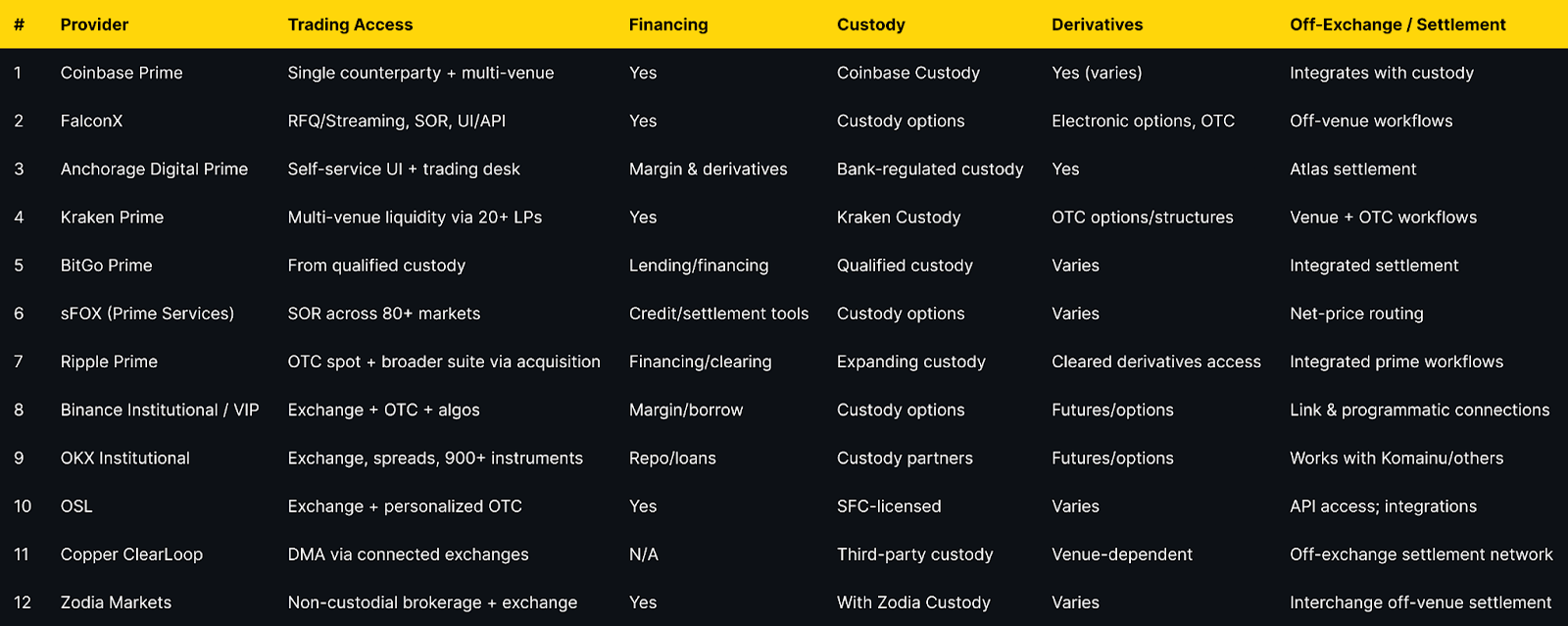
Crypto Prime Brokerage Comparison: At a Glance


Notes: “Pricing” reflects publicly stated models (often negotiated). “Regions/Notes” summarize official disclosures and licensing language where available on provider sites.


Detailed Provider Analysis

Coinbase Prime — Full-service prime brokerage at scale

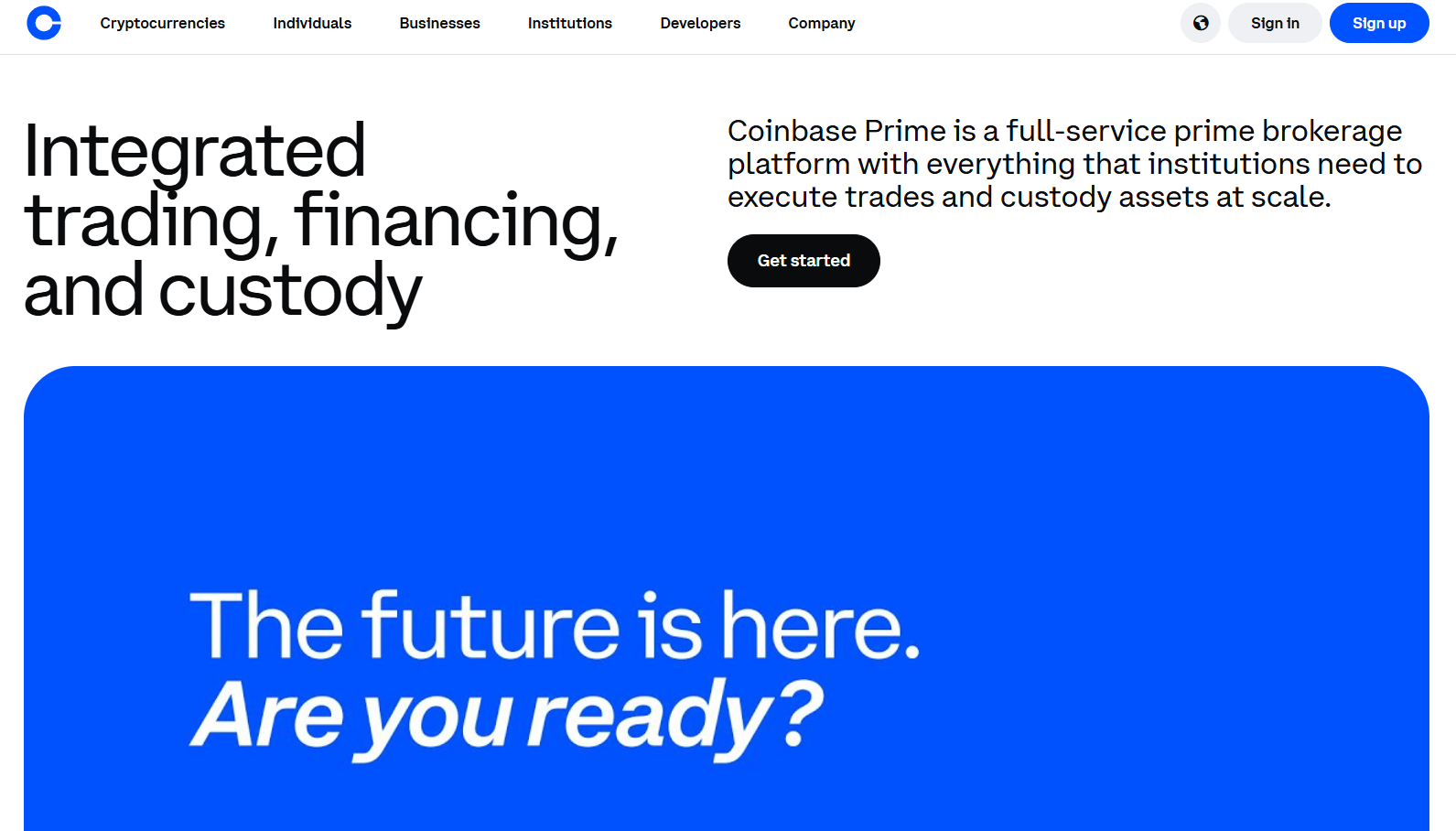
Overview. Coinbase Prime combines trading, financing, and qualified custody under one institutional platform, with negotiated trading fees and flexible order denomination (base/quote). Execution integrates with reporting and controls suitable for asset managers and corporates. (Coinbase)
Ideal For. Asset managers, corporates/treasuries, hedge funds, RIAs.
Standout Features. Integrated custody; negotiated All-In / Cost-Plus fee models; staking fee schedules; institutional reporting. (docs.cdp.coinbase.com)
Pricing. Negotiated, fee currency = quote currency. (docs.cdp.coinbase.com)
Availability. Global, entity-dependent; product availability varies by jurisdiction.
Worth Noting. Some services require separate agreements (e.g., validators, derivatives access).
Alternatives to Consider. Kraken Prime, Anchorage Digital Prime. (Kraken)  


FalconX — Deep liquidity & capital solutions across markets

Overview. FalconX offers RFQ/streaming execution across spot and FX with FIX/WebSocket/REST connectivity, plus electronic options and capital solutions. Scale and 24/7 liquidity are central, with workflows for large tickets and programmatic strategies. (falconx.io)
Ideal For. Multi-strategy funds, HFT/systematic traders, market makers.
Standout Features. RFQ/streaming with TWAP/FOK; electronic options; FX desk integrated into prime; institutional APIs. (falconx.io)
Pricing. Negotiated; bespoke based on flow and venues.
Availability. Global institutional focus (entity-dependent).
Worth Noting. Derivatives access and product scope vary by entity/region.
Alternatives to Consider. Coinbase Prime, Kraken Prime. (Coinbase)  


Anchorage Digital Prime — Prime services on top of a US bank custodian

Overview. Anchorage Digital Prime delivers trading (13+ order types), derivatives, margin, and settlement built on Anchorage Digital Bank N.A. custody. A single interface and 24/7 trading desk support complex orders. (anchorage.com)
Ideal For. US-regulated custody requirements, governance-active institutions, corporates.
Standout Features. Bank-regulated custody; derivatives access; Atlas settlement; desk + API execution. (anchorage.com)
Pricing. Negotiated; service-by-entity.
Availability. US bank entity with global affiliates; services provided by specific Anchorage entities (see legal). (anchorage.com)
Worth Noting. Trading provided by separate non-bank entities; read entity-level disclosures. (anchorage.com)
Alternatives to Consider. BitGo Prime, Coinbase Prime. (The Digital Asset Infrastructure Company)  


Kraken Prime — Multi-venue liquidity with institutional fee tiers

Overview. Kraken Prime aggregates 20+ liquidity providers and offers smart order routing, OTC spot and OTC derivatives (options/structures), plus custody integrations. Institutional fee perks are published for high-volume clients. (Kraken)
Ideal For. Funds seeking published fee schedules, multi-venue execution, and OTC coverage.
Standout Features. Multi-venue liquidity; FIX 4.4 and WebSockets APIs; OTC desk; institutional taker tiers. (Kraken)
Pricing. Maker/taker schedule with institutional perks at very high volumes. (Kraken)
Availability. Global, entity-dependent.
Worth Noting. Some advanced services require qualification and separate onboarding.
Alternatives to Consider. sFOX, Coinbase Prime. (sFOX)


BitGo Prime — Prime services from qualified custody

Overview. BitGo integrates trading, financing, and settlement directly from custody, with segregated, bankruptcy-remote accounts and published insurance coverage details. (The Digital Asset Infrastructure Company)
Ideal For. Institutions prioritizing segregation and custody-first workflows.
Standout Features. Segregated accounts; insurance disclosures; custody-integrated prime trading. (The Digital Asset Infrastructure Company)
Pricing. Negotiated; custody/prime fees depend on assets and activity.
Availability. Global entities with varying regulatory regimes.
Worth Noting. Derivatives access varies by entity/partner networks.
Alternatives to Consider. Anchorage Digital Prime, Copper ClearLoop. (anchorage.com)


sFOX (Prime Services) — Agency SOR across 80+ markets with institutional tooling

Overview. sFOX acts as an agnostic agent routing across 80+ markets for best execution, with net-price routing and institutional reporting. The platform positions itself as a full-service prime dealer for institutions. (sFOX)
Ideal For. Systematic strategies, RIAs/allocators, corporates seeking agency execution.
Standout Features. SOR across venues; platform-level price improvement; custody options. (sFOX)
Pricing. Tiered/negotiated; historical content points to fee optimization via routing. (sFOX)
Availability. US/global entities; enterprise onboarding.
Worth Noting. Product scope (derivatives, margin) varies; confirm coverage.
Alternatives to Consider. Kraken Prime, Coinbase Prime. (Kraken)


Ripple Prime — Multi-asset prime brokerage under Ripple

Overview. Following the acquisition and subsequent close of Hidden Road, Ripple Prime offers U.S. spot OTC execution and positions Ripple as the first crypto company to own and operate a global, multi-asset prime broker; custody capabilities expanded further in late 2025. (Ripple)
Ideal For. Institutions seeking an integrated multi-asset prime platform with digital asset rails.
Standout Features. OTC spot execution (U.S.); multi-asset coverage; financing/clearing. (Ripple)
Pricing. Negotiated.
Availability. U.S. launch and global expansion via Ripple entities. (Ripple)
Worth Noting. Product availability differs by jurisdiction and entity.
Alternatives to Consider. FalconX, Coinbase Prime. (falconx.io)


Binance VIP & Institutional — Exchange liquidity, OTC & programmatic access

Overview. Binance’s institutional suite spans exchange, OTC RFQ, algos, and programmatic connectivity with VIP tiers. Coverage and eligibility depend on jurisdiction; Binance.US operates separately for U.S. clients. (binance.com)
Ideal For. Non-US teams wanting direct exchange liquidity with OTC tools.
Standout Features. VIP tiers, proof-of-reserves, OTC block trading. (binance.com)
Pricing. Exchange/VIP schedules; negotiated OTC.
Availability. Region-dependent; check supported regions. (binance.com)
Worth Noting. U.S. availability/routes differ; compliance and onboarding vary by entity.
Alternatives to Consider. OKX Institutional, OSL. (OKX)


OKX Institutional — Scale, instruments, and U.S. presence via OKX US

Overview. OKX highlights high uptime, 900+ instruments, and institutional connectivity. U.S. availability exists through OKX US with scope/policies noted in compliance disclosures. (OKX)
Ideal For. Proprietary firms and funds trading a broad instrument set with API access.
Standout Features. Nitro Spreads, derivatives suite, institutional support. (OKX)
Pricing. Exchange schedule + VIP; negotiated for blocks.
Availability. Global; US services via OKX US (scope varies). (OKX)
Worth Noting. Product availability and licensing differ by region.
Alternatives to Consider. Binance Institutional, Kraken Prime. (binance.com)


OSL — HK SFC-licensed exchange, custody & OTC

Overview. OSL provides a licensed Hong Kong platform spanning custody, exchange, and OTC brokerage for institutions, with dedicated coverage in the region. (osl.com)
Ideal For. APAC institutions needing SFC-regulated venue/custody.
Standout Features. SFC-licensed exchange; institutional API; custody with insurance positioning. (sfc.hk)
Pricing. Schedule/negotiated.
Availability. Hong Kong and supported regions; institutional focus.
Worth Noting. Product availability differs by license and region.
Alternatives to Consider. Zodia Markets, Coinbase Prime. (Zodia Markets)


Copper ClearLoop — Off-exchange settlement network (multi-custodial)

Overview. ClearLoop enables instant delegation to connected exchanges while assets remain in segregated custody—now supporting third-party custodians like BitGo and Komainu. (Copper)
Ideal For. Institutions prioritizing venue risk reduction and capital efficiency.
Standout Features. Multi-custodial support; instant asset delegation; network of venues/prime brokers. (Copper)
Pricing. Varies by participants and volumes.
Availability. Global network; coverage depends on participating venues/custodians.
Worth Noting. Not a full prime broker by itself; pairs well with custody/venues.
Alternatives to Consider. Zodia Interchange, Komainu Connect. (zodia-custody.com)


Zodia Markets + Zodia Custody Interchange — Non-custodial brokerage + off-venue settlement

Overview. Zodia Markets offers institutional brokerage/exchange with non-custodial design, while Zodia Custody’s Interchange provides off-venue settlement (OVS)—trade while assets remain in custody. Registrations span UK, Ireland, ADGM. (Zodia Markets)
Ideal For. Institutions wanting bank-backed governance and segregated settlement flows.
Standout Features. Non-custodial brokerage; Interchange OVS network; institutional registrations. (Zodia Markets)
Pricing. Negotiated.
Availability. UK/EU/MENA institutional coverage (entity-specific). (Zodia Markets)
Worth Noting. Product scope varies by entity and venue integrations.
Alternatives to Consider. OSL, Copper ClearLoop. (osl.com)


Choosing the Right Prime Broker: A Framework

  • Regulatory posture needed? If you require US bank-regulated custody, start with Anchorage Digital Prime. For Hong Kong, OSL’s SFC licensing is key. For UK/EU bank-backed governance with off-venue settlement, consider Zodia. (anchorage.com)
  • Execution style. For multi-venue aggregation and published fee tiers, Kraken Prime is strong; for RFQ/streaming with electronic options, FalconX leads. sFOX suits agency SOR across many markets. (Kraken)
  • Integrated custody + trading. Coinbase Prime and BitGo Prime minimize operational friction by tying trading to qualified custody. (Coinbase)
  • Venue-risk reduction. If you want to trade while assets remain in custody, evaluate Copper ClearLoop or Zodia Interchange (and Komainu Connect as a related model). (Copper)
  • Instrument breadth and scale. For vast exchange liquidity and institutional programs, Binance Institutional and OKX Institutional are at-scale options (region permitting). (binance.com)

Integrating Token Metrics Intelligence

  • Research phase: Use Token Metrics screeners and on-chain/technical indicators to identify pairs suitable for your mandate (beta targets, breadth, liquidity screens).
  • Execution phase: Route orders via your prime broker’s APIs (e.g., FIX/WebSocket) selected above, while TM signals inform aggression/passivity and time-of-day tactics. (Kraken)
  • Monitoring: Feed fills, slippage, and borrow/financing into TM analytics to assess venue performance and adjust routing.
  • Optimization: Combine TM factor views with prime-broker borrow/financing and settlement options (e.g., off-exchange) to lower VaR and operational risk.

Start a Token Metrics trial to bring quantitative screening and scenario analysis into your institutional workflow.  


Security & Compliance Guidelines

  • Prefer segregated, bankruptcy-remote custody and confirm insurance disclosures where published. (The Digital Asset Infrastructure Company)
  • If you need a US bank custodian, validate services by legal entity and read the provider’s disclosures. (anchorage.com)
  • Use off-exchange settlement networks to reduce exchange exposure during execution. (Copper)
  • Confirm derivatives eligibility, margin terms, and cross-margin/netting treatment by entity/venue. (Kraken)
  • Require API keys/roles with least-privilege, HSM custody, and mandatory allow-listing.
  • Maintain jurisdictional watchlists and restrict activity accordingly (e.g., US vs non-US entities for global exchanges). (OKX)

Compliance note: This article is for research/education, not financial advice.


Avoiding Common Mistakes

  • Treating “prime” as one product—coverage and legal entities differ by service.
  • Assuming off-exchange settlement is automatic—confirm network membership and supported venues. (Copper)
  • Onboarding to the wrong entity—read the jurisdictional disclosures. (anchorage.com)
  • Ignoring negotiated fees—request All-In vs Cost-Plus quotes. (docs.cdp.coinbase.com)
  • Skipping disaster-recovery testing—simulate exchange outage + settlement failover.
  • Under-documenting OMS/EMS changes—keep audit-ready change logs.

Frequently Asked Questions

What is a crypto prime broker?
 A provider that consolidates institutional trading, financing, custody, and settlement, often with multi-venue access and risk controls. Modern variants add off-exchange settlement so assets remain in custody during execution. (zodia-custody.com)

Do prime brokers publish fees?
 Often no—fees are negotiated based on volumes, products, and relationship tier. Some venues publish maker/taker schedules with institutional perks. (docs.cdp.coinbase.com)

How does off-exchange settlement work?
 Networks like ClearLoop and Interchange let you delegate assets to venues for trading while keeping them in segregated custody, reducing counterparty risk. (Copper)

Which providers are strongest for regulated custody?
 Anchorage Digital Prime (US bank custody), BitGo (qualified custody), OSL (HK SFC-licensed custody/exchange), and Zodia (bank-backed with EU/UK registrations). (anchorage.com)

Can U.S. institutions use OKX or Binance?
 Access is region-dependent and varies by entity (e.g., OKX US scope). U.S. clients typically cannot use Binance.com and instead must evaluate Binance.US or other U.S.-eligible routes. Always check official disclosures. (OKX)


Final Recommendations

For most global institutions, a two-stack works best: (1) an integrated prime broker with qualified custody (Coinbase Prime, Anchorage Digital Prime, or BitGo Prime) and (2) a venue-risk mitigator like Copper ClearLoop or Zodia Interchange. Execution-heavy funds should add FalconX or Kraken Prime for multi-venue and OTC derivatives coverage, while OSL anchors APAC/HK mandates and OKX/Binance expand exchange reach where eligible. (Coinbase)

Related Resources:

Research

Best Yield Marketplaces for Real-World Assets (RWAs) in 2025

Token Metrics Team
29 min read
  • What this guide covers: A comprehensive evaluation of 10 leading platforms that enable tokenized real-world asset trading and yield generation across private credit, treasuries, real estate, and structured finance
  • Quick verdict: Ondo Finance for institutional-grade treasury exposure at ~5% APY, Maple Finance for crypto-collateralized credit facilities delivering 9-12% net yields, Goldfinch Prime for diversified access to private credit funds from Apollo and Ares
  • One key limitation to know: Many RWA platforms enforce strict accreditation requirements (minimum $50K-200K) and geographic restrictions, particularly excluding US investors from certain products due to securities regulations

Why Yield Marketplaces for RWAs Matter in January 2025

The real-world asset tokenization market has experienced explosive growth, surging from $85 million in April 2020 to over $25 billion by mid-2025—representing a staggering 245-fold increase driven primarily by institutional demand for yield, transparency, and regulatory clarity. Private credit dominates at approximately 61% of total tokenized assets, followed by treasuries at 30%, with major asset managers like BlackRock, Apollo, and Franklin Templeton now actively tokenizing institutional-grade products.

The convergence of traditional finance and decentralized infrastructure has created unprecedented opportunities for investors seeking stable, real-world yields without exposure to cryptocurrency volatility. The tokenized RWA market is projected to reach between $9.43 trillion and $18.9 trillion by 2030, with regulatory frameworks in Singapore, Hong Kong, and Dubai providing clear pathways for compliant innovation.

For crypto-native investors, RWA yield marketplaces offer a critical bridge to sustainable income streams backed by productive assets rather than purely speculative token emissions. Traditional allocators gain 24/7 access to fractional ownership, instant settlement, and programmable compliance—advantages impossible in legacy financial infrastructure.


How We Evaluated These Providers

We assessed platforms across six weighted criteria totaling 100 points:

  • Yield Quality & Sustainability (30%): Consistency of returns, asset backing, historical performance, and correlation to traditional markets
  • Security & Risk Management (25%): Custody solutions, audit history, legal recourse, collateralization ratios, and default handling protocols
  • Asset Coverage & Diversity (15%): Range of underlying assets, tranching options, and exposure across credit curves
  • Accessibility & Costs (15%): Minimum investments, fee structures, geographic availability, and KYC requirements
  • Liquidity & Redemption (10%): Secondary market depth, withdrawal timelines, and tokenization standards
  • Infrastructure & Compliance (5%): Regulatory licenses, blockchain integrations, and institutional partnerships

Data sources: Official platform documentation, on-chain analytics from RWA.xyz and DeFiLlama, third-party audits, and regulatory filings. Research conducted October 2024-January 2025.

Verification approach: Every fee structure, yield figure, and regional restriction cited was verified on official platform pages or regulatory disclosures. Unverifiable claims were excluded.


The Contenders: Quick Comparison  

Provider Reviews by Use Case

For Treasury-Backed Stability (4-5% Yield)

Top Pick: Ondo Finance — Institutional Treasury Tokenization Pioneer

Overview
 Ondo Finance manages over $1.6 billion in tokenized assets, offering institutional-grade access to US Treasury exposure through OUSG (backed by BlackRock's BUIDL fund) and USDY (a yield-bearing stablecoin). The platform bridges TradFi stability with DeFi composability through multi-chain deployment across Ethereum, Solana, Base, and XRP Ledger.

Ideal For

  • Institutional allocators seeking low-volatility dollar exposure
  • DeFi protocols requiring yield-bearing collateral
  • Treasuries managing idle stablecoin holdings
  • Investors prioritizing regulatory compliance and brand-name backing

Standout Features

  • Approximately 5% APY from short-term US Treasuries with daily interest payouts via rebasing mechanism
  • Integration with Ripple's RLUSD stablecoin for instant minting and redemption 24/7
  • Comprehensive SEC-registered infrastructure through acquisition of Oasis Pro, including broker-dealer, ATS, and transfer agent licenses
  • Strategic partnerships including anchor position in Fidelity's FDIT tokenized money market fund and launch of Ondo Global Markets for tokenized equities

Pricing
 Management fees embedded in net yield; typical 0.15-0.30% annual fee depending on product. OUSG requires $100K minimum; USDY accessible at lower thresholds with 4.29% APY.

Availability
 Global except US persons for certain products. Ethereum, Solana, Polygon, Aptos, Sei, Base, XRP Ledger, and Sui supported.

Worth Noting
 OUSG designed for qualified purchasers with extended lockup periods; less suitable for retail or high-frequency traders. Platform prioritizes institutional relationships over retail accessibility.

Alternatives to Consider: Franklin Templeton BENJI, OpenEden TBILL  


Runner-Up: Franklin Templeton BENJI — Legacy Asset Manager Innovation

Overview
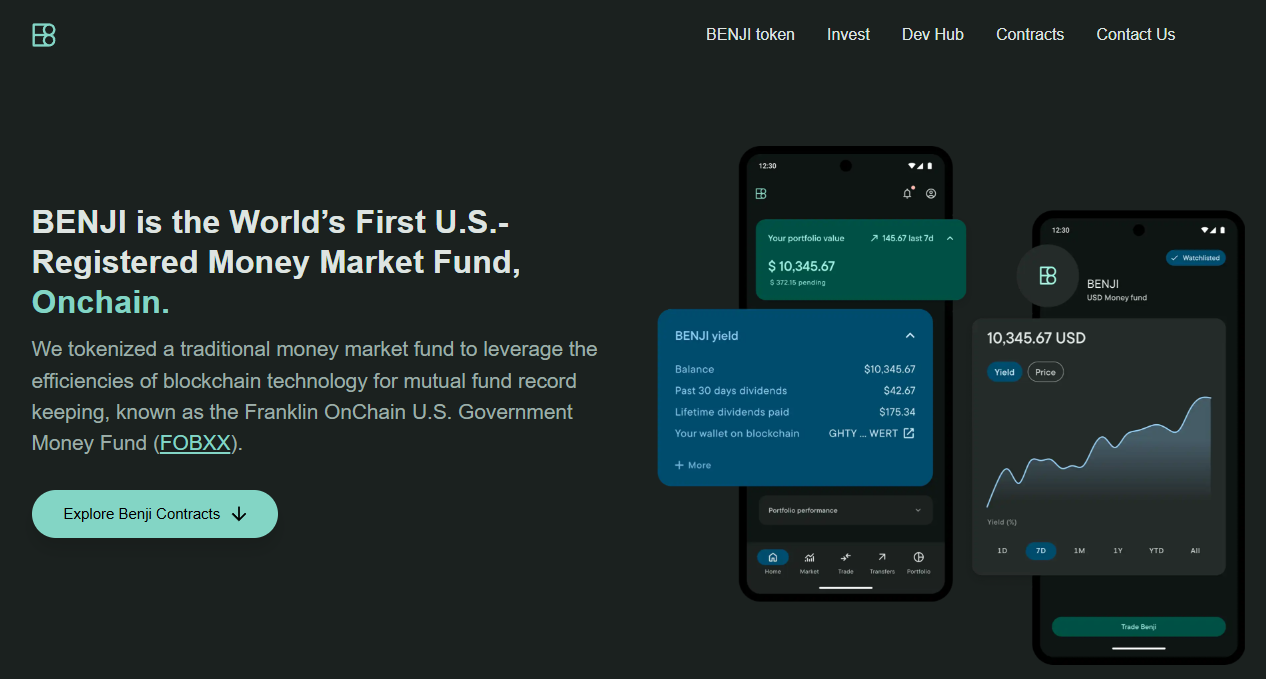
 Franklin Templeton's $775 million Franklin OnChain U.S. Government Money Fund (BENJI) pioneered tokenized mutual funds in 2021, offering exposure to US government securities across eight blockchains with patent-pending intraday yield calculation.

Ideal For

  • Investors seeking regulated 40 Act fund structure
  • Collateral managers requiring second-by-second yield accrual
  • Multi-chain strategies needing broad blockchain compatibility
  • Users prioritizing traditional asset manager credibility

Standout Features

  • Intraday yield tracking down to the second, enabling proportional earnings even for partial-day holdings
  • Direct stablecoin purchases and redemptions with wallet-to-wallet transfer capability
  • 63% of AUM deployed on Stellar Network for optimal cost efficiency
  • Integrated with DeFi protocols for collateral and leverage applications

Pricing
 7-day current yield approximately 4.5-5.5% gross; 0.25% management fee. No minimum investment restrictions beyond standard mutual fund requirements.

Availability
 Global availability with specific KYC requirements. Active on Stellar, Ethereum, Arbitrum, Base, Avalanche, Polygon, Aptos, Solana, BNB Chain.

Worth Noting
 Traditional mutual fund constraints apply including daily NAV calculations and potential redemption delays during market stress.

Alternatives to Consider: Backed bIB01, Superstate Short Duration Government Securities  


For Institutional Credit Exposure (8-12% Yield)

Top Pick: Maple Finance — Premier Crypto-Collateralized Lending

Overview
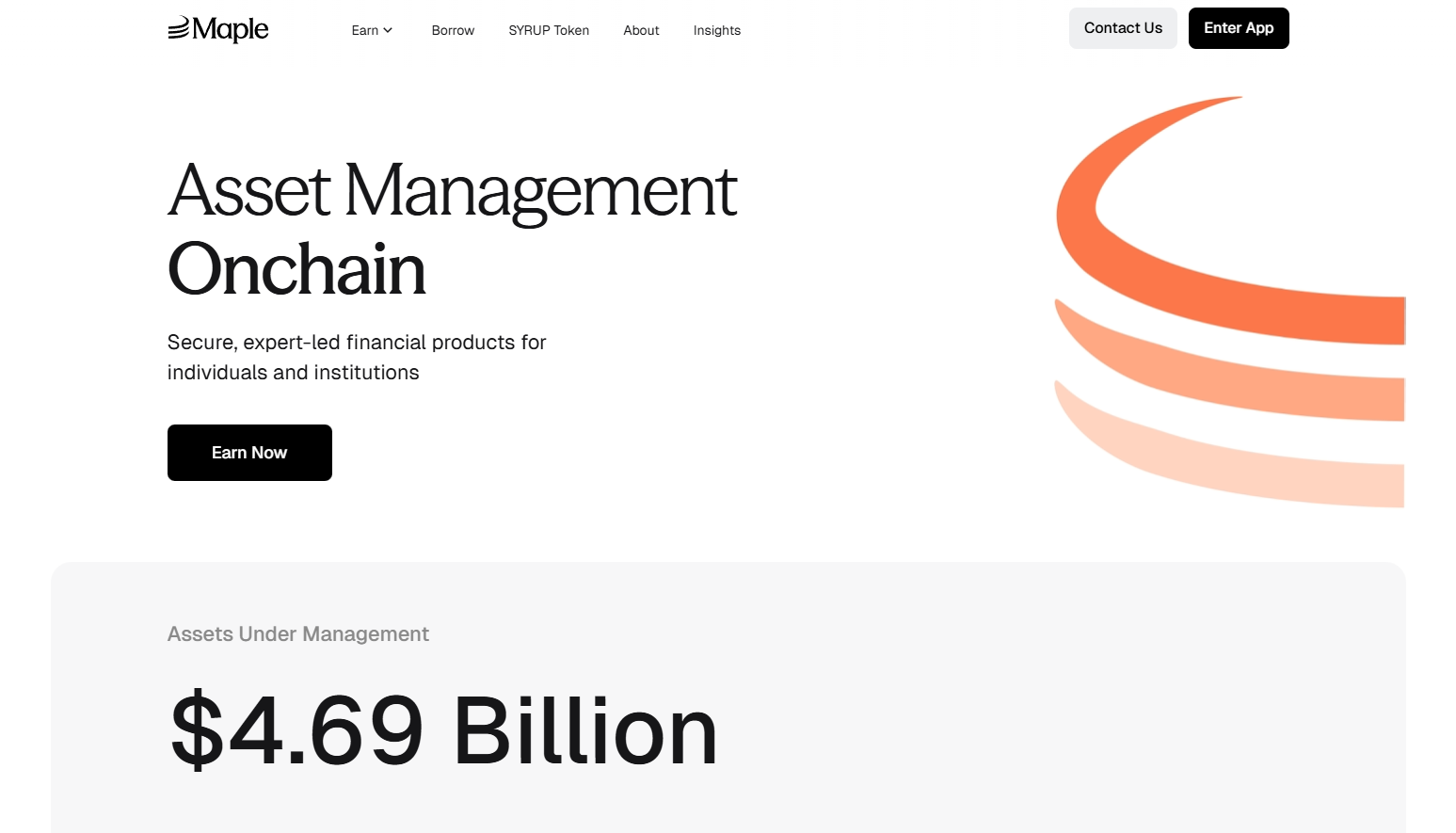
 Maple Finance manages over $4 billion in assets, specializing in institutional over-collateralized lending backed by Bitcoin, Ethereum, Solana, and XRP, targeting $100 billion in annual loan volume by 2030. The platform introduced SyrupUSDC for permissionless retail access alongside KYC-gated institutional pools.

Ideal For

  • Institutional lenders seeking exposure to cryptocurrency-backed credit
  • Liquidity providers comfortable with smart contract risk
  • Allocators targeting floating-rate, senior-secured structures
  • Investors seeking alternatives to traditional stablecoin farming

Standout Features

  • Consistent 9-12% net yields through undercollateralized institutional facilities and structured credit products
  • Strategic integration with Aave's $40 billion protocol bringing syrupUSDT to Plasma instance and syrupUSDC to core markets
  • Partnerships with Bitwise, Lido Finance (stETH-backed credit lines), and EtherFi (weETH collateral) expanding institutional adoption
  • Robust risk management combining decades of TradFi expertise with real-time on-chain monitoring

Pricing
 Variable by pool; typical effective yields 9-12% after protocol fees. Minimum investments pool-dependent, generally $10K-$50K for retail syrup products.

Availability
 Global with KYC requirements for lending. Institutional Maple requires accreditation; Syrup.fi open to broader participants.

Worth Noting
 Platform transitioned from uncollateralized to over-collateralized model after 2022 market turmoil. Historical defaults impacted certain pools; robust recovery mechanisms now in place.

Alternatives to Consider: Credix (emerging markets), TrueFi (uncollateralized DeFi)  


Runner-Up: Goldfinch Prime — Institutional Private Credit Access

Overview
 Goldfinch Prime aggregates exposure to multi-billion dollar private credit funds from Ares, Apollo, Golub Capital, and KKR, providing on-chain access to institutional-grade senior secured loans with over $1 trillion in collective AUM.

Ideal For

  • Non-US investors seeking diversified private credit exposure
  • Allocators targeting institutional fund performance without direct fund access
  • Participants seeking uncorrelated yield to crypto markets
  • Investors comfortable with longer lockup periods

Standout Features

  • Exposure to 1000+ senior secured loans across industries through vetted fund managers with 10+ years experience
  • Target returns of 9-12% net of fees with strict eligibility criteria including >90% senior secured portfolios and <0.75% target non-accrual rates
  • Heron Finance manages fund selection and vetting while fund managers handle all underwriting and default resolution
  • USDC-based deposits converted to proportional GPRIME tokens for continuous offering structure

Pricing
 Net yields 9-12% after embedded management fees and profit sharing. Minimum investments vary by pool structure; typically institutional minimums apply.

Availability
 Non-US persons only due to regulatory structure. KYC and accreditation verification required.

Worth Noting
 Exposure is indirect through fund shares rather than direct loan origination; fund managers absorb individual borrower default risk into aggregate yields. Liquidity limited compared to Treasury products.

Alternatives to Consider: Centrifuge private credit pools, Credix fintech lending


For Real Estate & Diversified Assets (6-10% Yield)

Top Pick: Centrifuge — Multi-Asset Tokenization Infrastructure

Overview
 Centrifuge operates as a multichain infrastructure platform enabling asset managers to tokenize real estate, trade finance, carbon credits, and structured credit with $1.2 billion TVL and recent 10x growth driven by the first on-chain CLO and tokenized S&P 500 index fund.

Ideal For

  • Investors seeking exposure to asset-backed securities beyond treasuries
  • Allocators comfortable evaluating tranched credit structures
  • Participants prioritizing transparency and on-chain asset verification
  • Portfolio managers wanting diversification across real-world credit types

Standout Features

  • Asset-agnostic architecture supporting structured credit, real estate mortgages, US treasuries, carbon credits, and consumer finance with full collateralization and legal recourse for investors
  • V3 platform enables cross-chain interoperability across Ethereum, Base, Arbitrum, Avalanche, BNB Chain, and Plume with integrated KYC and compliance-as-a-feature
  • Senior/junior tranche structures allowing risk-return customization
  • Partnership with Chronicle Labs for real-time price feeds and integration with Circle for USDC on/off-ramping

Pricing
 Yields vary by pool and tranche: typically 6-8% for senior tranches, 10-14% for junior tranches. Management fees embedded; pool-specific minimums apply.

Availability
 Global with KYC requirements. Pools may have additional jurisdictional restrictions based on underlying asset location.

Worth Noting
 Platform complexity requires understanding of tranched structures and asset-specific risks. Less liquid credit instruments offer less frequent pricing updates than treasury products.

Alternatives to Consider: RealT (US residential real estate focus), Republic (equity crowdfunding)


For Emerging Market Credit (12-18% Yield)

Top Pick: Credix — Latin American Fintech Lending

Overview
 Credix specializes in providing credit facilities to fintech lenders in Latin America, offering high-yield exposure to underserved credit markets with institutional-grade underwriting and local market expertise.

Ideal For

  • Sophisticated investors seeking higher risk-adjusted returns
  • Allocators comfortable with emerging market credit risk
  • Participants with extended investment horizons (12-24 months typical)
  • Investors seeking geographic diversification from US/EU markets

Standout Features

  • Target yields 12-18% reflecting emerging market risk premiums
  • Focus on fintech infrastructure enabling financial inclusion
  • Partnerships with established Latin American credit originators
  • Robust due diligence and monitoring of borrower networks

Pricing
 Pool-dependent yields typically 12-18% gross with management fees of 1-2%. Minimum investments generally $50K+ for accredited investors.

Availability
 Non-US persons primarily; requires accreditation verification and enhanced KYC given emerging market exposure.

Worth Noting
 Higher yields reflect higher credit and currency risk. Platform experienced challenges during regional economic volatility; enhanced risk controls now implemented.

Alternatives to Consider: Goldfinch V1 pools (emerging market focus), TrueFi uncollateralized pools


For Tokenization Infrastructure (Platform Providers)

Top Pick: Securitize — Industry-Leading Issuance Platform

Overview
 Securitize has tokenized over $4.5 billion in assets for 1.2 million investors across 3,000+ clients, operating as an SEC-registered transfer agent with integrated ATS for secondary trading. The platform powers major offerings including BlackRock's BUIDL fund.

Ideal For

  • Asset managers seeking turnkey tokenization solutions
  • Issuers requiring SEC-compliant digital security infrastructure
  • Institutional clients needing integrated custody and compliance
  • Projects prioritizing regulatory alignment and brand credibility

Standout Features

  • DS Protocol automates token issuance, transfer agent functions, and regulated secondary trading with $47 million funding led by BlackRock
  • Recent launch of STAC tokenized AAA CLO fund with BNY custody demonstrating institutional adoption trajectory
  • Comprehensive investor onboarding, KYC/AML, and reporting infrastructure
  • Partnerships with major asset managers and integration with Zero Hash for fiat conversion

Pricing
 Platform fees vary by issuance size and complexity; typically 0.5-2% of AUM plus basis point fees on transactions. White-label solutions available for enterprise clients.

Availability
 Global operations with jurisdiction-specific compliance modules. Primary focus on US, EU, and APAC institutional markets.

Worth Noting
 Securitize is an issuance platform rather than direct investment product; investors access opportunities through partner funds and offerings launched on the infrastructure.

Alternatives to Consider: Tokeny (EU-focused), Polymath/Polymesh (security token specialists)


Complete Provider Directory

  • Backed Finance: European MiCA-compliant tokenization platform offering bIB01 (Swiss government bond exposure) and bC3M (commodity basket). Strong focus on regulatory alignment with modest 3-5% yields and low entry barriers.
  • Swarm Markets: Decentralized platform enabling fractional ownership of real estate and private credit with $1K-$50K minimums. Emphasizes accessibility while maintaining compliance through distributed infrastructure.
  • TrueFi: Uncollateralized lending protocol using on-chain credit scoring and portfolio diversification. Higher risk-return profile (8-15% targets) with full transparency of borrower pools and performance metrics.
  • Archax: UK FCA-regulated platform for institutional tokenization of bonds, funds, and money markets. Focus on traditional finance compatibility with stringent accreditation requirements.

Making Your Selection: Key Questions

  • What yield stability do you require?
     Treasury-backed platforms (Ondo, Franklin Templeton) offer predictable 4-5% returns with minimal volatility. Credit-focused platforms (Maple, Goldfinch) target 9-12% but introduce credit risk and performance variability.
  • What is your risk tolerance for underlying collateral?
     Government securities provide lowest risk; over-collateralized crypto loans add smart contract and liquidation risks; uncollateralized emerging market credit carries highest default potential.
  • Do you meet accreditation and minimum investment thresholds?
     Many institutional products require $50K-$200K minimums and qualified purchaser status. Retail-accessible options like USDY and syrupUSDC lower barriers but may sacrifice yield.
  • What liquidity do you need?
     Treasury tokens generally offer daily liquidity; private credit pools may have quarterly redemption windows; real estate tokenization can involve 12-24 month lockups.
  • How important is regulatory compliance?
     Platforms like Ondo, Franklin Templeton, and Securitize prioritize SEC registration and traditional fund structures. Purely DeFi-native protocols offer less regulatory clarity but greater composability.
  • What blockchain ecosystems do you operate in?
     Multi-chain deployment (Ondo, Centrifuge) provides flexibility; single-chain specialization (some Maple pools) may offer optimization but limits interoperability.
  • Do you have geographic restrictions?
     US persons often excluded from highest-yield opportunities due to securities laws. European investors benefit from MiCA framework; APAC sees growing regulatory clarity.
  • What level of transparency do you require?
     On-chain native protocols offer real-time asset verification; hybrid models may rely on periodic attestations and third-party audits.
  • Are you seeking passive income or active yield strategies?
     Treasury staking provides set-and-forget returns; DeFi integrations enable leverage, collateral strategies, and yield optimization requiring active management.
  • How much operational complexity can you handle?
     Single-platform solutions simplify but limit optionality; multi-protocol strategies maximize returns but require gas management, tax tracking, and security across multiple platforms.

Maximizing Your Setup with Token Metrics

Token Metrics provides critical intelligence for navigating RWA yield opportunities through data-driven analysis and market insights.

Research Phase: Leverage Token Metrics' fundamental analysis to evaluate tokenized asset protocols, comparing on-chain metrics, TVL trends, and yield sustainability indicators. Our RWA sector reports identify emerging platforms and highlight regulatory developments across jurisdictions.

Portfolio Construction: Use quantitative scoring to allocate across risk tiers—balancing stable treasury exposure with higher-yield credit products. Token Metrics' portfolio tools help optimize diversification while monitoring correlation to traditional crypto markets.

Ongoing Monitoring: Real-time alerts notify you of yield changes, protocol upgrades, and risk events. Our dashboard aggregates performance across multiple RWA platforms, tracking your yield-bearing positions alongside broader cryptocurrency holdings.

Risk Management: Token Metrics' risk analytics assess smart contract security, custody arrangements, and counterparty exposure. Our reports flag platforms with concerning yield sustainability metrics or operational red flags before they impact your capital.

Start your Token Metrics free trial to access institutional-grade RWA research and optimize your real-world asset allocation.  


Essential Security Practices

  • Custody Verification: Confirm that platforms use institutional-grade custodians (Coinbase Custody, BitGo, Fireblocks) for underlying assets. Verify proof-of-reserve attestations and third-party audits.
  • Smart Contract Risk: Review audit reports from reputable firms (Trail of Bits, OpenZeppelin, Certora). Understand upgrade mechanisms and timelock protections on protocol contracts.
  • Legal Structure Assessment: Examine SPV formation, bankruptcy remoteness, and investor recourse mechanisms. Ensure tokenization structure provides actual legal claim on underlying assets, not just economic exposure.
  • Regulatory Compliance: Verify platforms maintain necessary licenses (broker-dealer, transfer agent, ATS) in relevant jurisdictions. Confirm offerings comply with securities laws in your domicile.
  • Counterparty Risk: Understand who services loans, manages defaults, and handles liquidations. Evaluate track records of asset originators and credit underwriters.
  • Liquidity Risk Management: Never allocate more than you can afford to lock up for stated redemption periods. Maintain buffer capital for market volatility and potential redemption delays.
  • Tax Implications: Consult tax professionals on treatment of tokenized yield—may be classified as interest income, dividends, or capital gains depending on structure and jurisdiction.
  • Geographic Restrictions: Verify you're eligible to participate based on residency. Using VPNs or misrepresenting location can result in frozen funds and legal liability.
  • Platform Concentration: Diversify across multiple RWA providers to reduce single-point-of-failure risk. No single platform should represent majority of yield allocation.
  • Documentation: Maintain records of all transactions, yield distributions, and platform communications for tax reporting and potential disputes.

This article is for research and educational purposes, not financial advice. RWA investments carry risks including loss of principal.


What to Avoid

  • Ignoring minimum holding periods: Many RWA products enforce lockups or redemption windows. Treating them as liquid positions can leave you unable to access capital when needed.
  • Chasing unsustainably high yields: Promised returns significantly above market rates often indicate excessive risk. Verify underlying asset performance and historical consistency before committing capital.
  • Overlooking platform liquidity: Token existence on-chain doesn't guarantee exit liquidity. Check secondary market depth and historical spread between minting and redemption prices.
  • Neglecting jurisdictional compliance: Accessing platforms not available in your region can result in frozen accounts and regulatory penalties. Always verify eligibility before depositing funds.
  • Underestimating smart contract risk: Even well-audited protocols face exploitation risk. Size positions appropriately and monitor security incident disclosures across the ecosystem.
  • Failing to verify asset backing: Don't rely on marketing claims. Demand proof-of-reserve, third-party attestations, and transparent reporting on underlying collateral.
  • Concentrating in single asset class: Over-allocating to one RWA category (e.g., all private credit) eliminates diversification benefits. Balance across treasuries, credit, and real estate where possible.
  • Ignoring fee structures: Management fees, performance fees, and transaction costs compound over time. Calculate net yields after all costs when comparing platforms.

Reader Questions Answered

What's the difference between tokenized treasuries and yield-bearing stablecoins?

 Tokenized treasuries (like OUSG) represent direct ownership of US Treasury securities with yield passed through to holders. Yield-bearing stablecoins (like USDY) maintain $1 peg while distributing treasury yields via rebasing or airdrops. Treasuries may fluctuate slightly with NAV; yield stablecoins prioritize price stability.

Are RWA yields taxable differently than crypto staking rewards?

 Likely yes, though tax treatment varies by jurisdiction. RWA yields from treasuries or credit facilities often classified as interest income taxed at ordinary rates. Crypto staking may be treated as income at receipt or capital gains at sale depending on location. Consult tax professionals for specific guidance.

Can I use tokenized RWAs as collateral in DeFi protocols?

 Increasingly yes. Platforms like Maple, Ondo (via Flux Finance), and Centrifuge enable using tokenized assets as DeFi collateral. However, support varies by protocol and asset—USDY and OUSG see broader integration than niche real estate tokens. Liquidation risks apply if collateral value drops.

What happens if the platform goes bankrupt?

 Properly structured tokenization isolates assets in bankruptcy-remote SPVs, protecting investor claims even if platform operator fails. However, redemption processes may be delayed and require legal navigation. This is why verifying legal structure and custodial arrangements is critical.

How liquid are RWA tokens compared to stablecoins?

 Significantly less liquid. While stablecoins have billions in daily DEX volume, most RWA tokens trade thinly or only through platform-controlled redemption mechanisms. Treasury tokens offer better liquidity than private credit or real estate, but all lag traditional stablecoins substantially.

Do I need to be an accredited investor?

 Depends on the platform and your location. US-based offerings often require accreditation; international platforms may have lower barriers. Products like USDY, syrupUSDC, and BENJI target broader accessibility, while institutional credit pools restrict to qualified purchasers.

What are the main risks that could cause loss of principal?

 (1) Underlying asset default (credit risk), (2) smart contract exploitation, (3) platform insolvency without proper asset segregation, (4) regulatory action freezing operations, (5) stablecoin de-pegging for yield products denominated in USDC/USDT, (6) liquidation cascades in collateralized structures.

How do yields compare to traditional finance alternatives?

 Tokenized treasuries (4-5%) match conventional money market funds but with 24/7 access. Private credit RWAs (9-12%) offer premiums over corporate bonds due to illiquidity and platform novelty. Emerging market RWA yields (12-18%) comparable to EM debt funds with added smart contract risk.


Bottom Line

Real-world asset yield marketplaces represent the maturation of blockchain infrastructure beyond speculation into productive finance. For investors seeking stable, asset-backed returns uncorrelated to cryptocurrency volatility, platforms like Ondo Finance and Franklin Templeton deliver institutional-grade treasury exposure with DeFi composability. Those comfortable with credit risk can access superior yields through Maple Finance's collateralized institutional lending or Goldfinch Prime's diversified private credit exposure.

The key to success: match platform selection to your specific risk tolerance, liquidity needs, and regulatory constraints. Treasury products suit conservative allocators prioritizing capital preservation; credit platforms reward investors accepting higher risk for enhanced returns; multi-asset infrastructure like Centrifuge offers diversification across real-world credit types.

Start with smaller allocations to understand platform mechanics, redemption processes, and yield consistency before committing substantial capital. The RWA sector's rapid growth will continue creating opportunities, but also attracting lower-quality offerings—due diligence remains paramount.

Related Resources:


About This Research

Methodology: This guide evaluated 20+ RWA platforms through analysis of official documentation, on-chain data, regulatory filings, and third-party audits. Platforms selected represent meaningful TVL (>$100M), regulatory compliance, and operational track record. Final selection prioritized diversity across asset classes and investor accessibility tiers.

Research Sources:

  • Ondo Finance: Product documentation, tokenomics, OUSG/USDY specifications, Oasis Pro acquisition disclosure
  • Maple Finance: Platform whitepaper, syrupUSDC mechanics, Aave integration announcement, CEO interviews
  • Centrifuge: V3 technical documentation, pool analytics, Republic partnership details
  • Goldfinch: Prime pool specifications, fund manager criteria, Heron Finance structure
  • Franklin Templeton: BENJI platform technical details, intraday yield patent documentation, multi-chain deployment
  • Securitize: DS Protocol documentation, STAC fund launch details, BlackRock partnership announcements
  • RWA.xyz: Platform TVL data, tokenization metrics, market growth analysis
  • DeFiLlama: Protocol TVL tracking, historical performance data
  • BCG/Ripple: RWA market projections and industry research
  • VanEck, Coinbase, Binance: Sector research reports on RWA growth trajectories

All data current as of January 2025. Platform features and yields subject to change; verify current terms on official websites before investing.

Choose from Platinum, Gold, and Silver packages
Reach with 25–30% open rates and 0.5–1% CTR
Craft your own custom ad—from banners to tailored copy
Perfect for Crypto Exchanges, SaaS Tools, DeFi, and AI Products