Back to blog
Research

What is a Gas Fee and How is it Calculated? Complete Guide for 2025

In the world of blockchain and cryptocurrency, "gas fees" are frequently mentioned but often misunderstood. These transaction costs represent a fundamental aspect of blockchain operations, affecting everything from simple cryptocurrency transfers to complex smart contract executions.
Talha Ahmad
5 min
Want Smarter Crypto Picks—Free?
See unbiased Token Metrics Ratings for BTC, ETH, and top alts.
Thank you! Your submission has been received!
Oops! Something went wrong while submitting the form.
 No credit card | 1-click unsubscribe

In the world of blockchain and cryptocurrency, "gas fees" are frequently mentioned but often misunderstood. These transaction costs represent a fundamental aspect of blockchain operations, affecting everything from simple cryptocurrency transfers to complex smart contract executions. Whether you're a newcomer exploring crypto or an experienced trader looking to optimize transaction costs, understanding gas fees is essential for navigating the blockchain ecosystem efficiently. This comprehensive guide explains what gas fees are, how they're calculated, and provides practical strategies for minimizing these costs—particularly important for active traders using platforms like Token Metrics to execute data-driven trading strategies.

Understanding Gas Fees: The Fundamentals

Gas fees are transaction costs that users pay to compensate validators or miners for the computational energy required to process and validate transactions on blockchain networks. Think of gas fees as tolls paid for using blockchain infrastructure—they ensure the network operates efficiently and securely while incentivizing network participants to maintain the system.

The term "gas" originates from Ethereum, where it refers to the computational work undertaken on the Ethereum Virtual Machine (EVM). The analogy to automotive fuel is intentional: just as a car requires gasoline to operate, blockchain transactions require "gas" to be processed. More complex operations—like executing sophisticated smart contracts—require more gas, similar to how a larger, more powerful vehicle consumes more fuel.

Gas fees serve several critical purposes beyond simple compensation. They act as a deterrent against network spam by attaching costs to every transaction, making it economically unfeasible for malicious actors to overload the network with unnecessary operations. This security mechanism protects blockchain networks from denial-of-service attacks and ensures fair resource allocation among legitimate users.

How Gas Fees Are Calculated: Breaking Down the Formula

The calculation of gas fees involves several key components that work together to determine the total transaction cost. While different blockchain networks use varied mechanisms, Ethereum's gas fee structure provides an excellent baseline for understanding how these costs are determined.

The Core Components

Gas Limit represents the maximum amount of computational work a user is willing to spend on a transaction. This is essentially a ceiling on the resources that can be consumed. For a simple ETH transfer between wallets, the standard gas limit is 21,000 units. More complex operations, such as interacting with DeFi protocols like Uniswap, might require 100,000 gas units or more. Setting an appropriate gas limit ensures you don't overpay for simple transactions while providing sufficient resources for complex operations.

Base Fee is the minimum fee set by the network that adjusts dynamically based on demand. Introduced through Ethereum's EIP-1559 upgrade, the base fee changes automatically based on network congestion. When blocks are more than 50% full, the base fee increases; when they're less than 50% full, it decreases. Importantly, the base fee is burned (permanently removed from circulation) rather than going to validators, creating deflationary pressure on ETH supply.

Priority Fee (also called the "tip") is an additional fee users can pay to incentivize validators to prioritize their transaction. During periods of high network activity, offering a higher priority fee can significantly expedite transaction confirmation. Conversely, setting a lower priority fee during off-peak times can save money, though your transaction may take longer to process.

The Gas Fee Formula

The total gas fee is calculated using this formula:

Total Gas Fee = Gas Limit Ă— (Base Fee + Priority Fee)

Let's walk through a practical example. Suppose you want to transfer ETH to another wallet, and current network conditions show:

  • Base Fee: 75 gwei
  • Priority Fee: 5 gwei (what you're willing to pay extra)
  • Gas Limit: 30,000 units (for this particular transaction)

The calculation would be: Total Fee = 30,000 Ă— (75 + 5) gwei = 2,400,000 gwei = 0.0024 ETH

To understand the cost in familiar terms, remember that 1 gwei equals 0.000000001 ETH. Gas fees are displayed in gwei for better readability, as expressing these tiny fractions in ETH would be cumbersome.

Simple Transaction Examples

Basic ETH Transfer: Sending ETH from one wallet to another typically requires 21,000 gas units. If the gas price is 20 gwei, the transaction costs approximately 0.00042 ETH (21,000 Ă— 20 gwei).

ERC-20 Token Transfer: Transferring tokens that follow the ERC-20 standard (like USDT or LINK) usually costs more than simple ETH transfers, requiring about 45,000 to 65,000 gas units depending on the specific token contract's complexity.

Smart Contract Interaction: Executing complex smart contracts, such as swapping tokens on decentralized exchanges or participating in DeFi protocols, can consume 100,000+ gas units, resulting in significantly higher fees during peak network times.

Why Do Gas Fees Fluctuate?

Gas fees are not static—they fluctuate dramatically based on network demand and activity levels. Understanding these dynamics helps users time their transactions strategically to minimize costs.

Supply and Demand Dynamics

Blockchain networks have limited capacity to process transactions within each block. When demand exceeds this capacity, users compete for block space by offering higher gas prices. Validators naturally prioritize transactions offering better compensation, creating a fee market where prices rise during congestion and fall during quiet periods.

Historical Gas Fee Spikes

Several events in blockchain history illustrate how demand drives gas fees:

The ICO Boom (2017-2018): When Initial Coin Offerings exploded in popularity, millions of new users flooded Ethereum to participate in token sales. The network lacked sufficient capacity, causing gas fees to spike dramatically.

DeFi Summer (2020): The rise of decentralized finance protocols like Uniswap and Compound Finance brought unprecedented activity to Ethereum. Users staking, swapping, and farming tokens created severe congestion, with fees often exceeding $50 per transaction.

NFT Mania (2021): Marketplaces like OpenSea caused extreme congestion as collectors rushed to mint and trade non-fungible tokens. During peak periods, gas fees exceeded $100 per transaction, pricing out many retail users.

Network Upgrades and Layer 2 Solutions (2022-2025): Ethereum's transition to Proof of Stake and the proliferation of Layer 2 scaling solutions have significantly improved fee predictability and reduced average costs, though fees still spike during periods of intense activity.

Strategies for Minimizing Gas Fees

For active crypto traders and investors—particularly those using advanced analytics platforms like Token Metrics to identify trading opportunities—managing gas fees effectively can significantly impact profitability. Here are proven strategies for reducing these costs.

Timing Your Transactions

Gas fees vary dramatically by time of day and day of week. Network activity typically drops during weekends and early morning hours (UTC timezone), resulting in lower fees. Real-time gas trackers like Etherscan's Gas Tracker or Gas Now provide current pricing and help identify optimal transaction windows.

For traders using Token Metrics to receive AI-powered buy and sell signals, timing transaction execution during low-fee periods can preserve more of your trading profits. The platform's real-time analytics help identify entry and exit points, while gas optimization ensures you're not eroding gains through excessive fees.

Leverage Layer 2 Solutions

Layer 2 scaling solutions process transactions off the main Ethereum chain, then batch-settle them on Layer 1, dramatically reducing costs. Popular Layer 2 networks include:

Arbitrum: Offers Ethereum-compatible smart contracts with significantly lower fees and faster confirmation times.

Optimism: Uses optimistic rollups to bundle transactions, reducing costs by 10-100x compared to Ethereum mainnet.

Polygon: Provides a complete ecosystem with extremely low transaction fees, often costing fractions of a cent.

Base: Coinbase's Layer 2 solution offering fast, cheap transactions while maintaining security through Ethereum.

Many decentralized exchanges and DeFi protocols now operate on Layer 2 networks, allowing traders to execute strategies without prohibitive gas costs.

Set Custom Gas Fees

Most modern wallets allow users to customize gas prices, balancing speed against cost. During non-urgent transactions, setting lower gas prices can save money, though confirmation may take longer. For time-sensitive trades based on Token Metrics signals, higher priority fees ensure rapid execution when market conditions demand quick action.

Use Gas-Optimized Contracts

Some protocols and wallets implement gas-optimized smart contracts that reduce computational complexity. Choosing platforms that prioritize efficiency can result in meaningful savings, especially for frequent traders executing dozens of transactions monthly.

Token Metrics: Optimizing Trading Performance Beyond Gas Fees

While managing gas fees is crucial for cost-effective trading, success in cryptocurrency requires sophisticated market intelligence and analytics. This is where Token Metrics stands out as the premier AI-powered crypto trading and analytics platform in 2025.

AI-Driven Market Intelligence

Token Metrics leverages advanced artificial intelligence and machine learning to analyze over 5,000 cryptocurrencies in real-time, providing traders with comprehensive insights that go far beyond basic price charts. The platform assigns Trader Grades (0-100) for short-term opportunities and Investor Grades for long-term potential, helping users identify winning tokens before they hit mainstream awareness.

This AI-powered analysis processes vast datasets including on-chain metrics, social sentiment, technical indicators, institutional flows, and market momentum—providing the actionable intelligence needed to make informed trading decisions that justify gas fee investments.

Integrated Trading Execution

In March 2025, Token Metrics launched integrated on-chain trading capabilities, transforming from an analytics platform into an end-to-end solution. Users can now research tokens using AI ratings, review detailed analytics, and execute trades directly on the platform through seamless multi-chain swaps—typically completing the entire process in under two minutes.

This integration is particularly valuable for managing gas fees. By consolidating research and execution on a single platform, traders reduce unnecessary wallet interactions and transaction steps, minimizing total gas costs while maintaining rapid response to market opportunities.

Real-Time Signals and Alerts

Token Metrics provides real-time buy and sell signals powered by AI algorithms that continuously monitor market conditions. These signals help traders time their entries and exits optimally, ensuring that when gas fees are paid for transaction execution, they're supporting high-probability trades rather than speculative positions.

Portfolio Optimization and Risk Management

Beyond individual trade execution, Token Metrics offers AI-managed indices and portfolio optimization tools that help traders maintain diversified exposure while minimizing unnecessary transactions. By reducing portfolio churn and focusing on high-conviction positions, users naturally reduce cumulative gas fee expenses over time.

Educational Resources and Market Analysis

The platform provides comprehensive educational content, market analysis, and research reports that help users understand not just what to trade, but why—and when. This knowledge empowers traders to make strategic decisions about transaction timing, balancing urgency against gas cost optimization.

The Future of Gas Fees in 2025 and Beyond

The blockchain industry continues innovating to address gas fee challenges. Several trends are shaping the future of transaction costs:

Free Gas Fee Solutions

Some networks like TRON have pioneered "free gas fee" models that eliminate or drastically reduce transaction costs. These innovations make blockchain applications more accessible to mainstream users who find traditional gas fees prohibitive.

Ethereum's Continued Evolution

Ethereum's roadmap includes further upgrades focused on scalability and cost reduction. The complete rollout of Ethereum 2.0 phases, combined with advanced Layer 2 adoption, promises to make gas fees more predictable and affordable while maintaining network security.

Cross-Chain Bridges and Interoperability

As blockchain interoperability improves, users can choose networks based on their gas fee structures for different use cases. Traders using platforms like Token Metrics can execute strategies across multiple chains, selecting optimal networks for each transaction type.

AI-Powered Gas Optimization

Emerging tools use artificial intelligence to predict optimal transaction timing, automatically route transactions through the most cost-effective paths, and dynamically adjust gas prices based on urgency and network conditions.

Conclusion: Mastering Gas Fees for Profitable Trading

Gas fees represent an unavoidable reality of blockchain transactions, but understanding their mechanics and implementing optimization strategies can significantly improve your trading economics. By timing transactions strategically, leveraging Layer 2 solutions, and setting appropriate gas parameters, you can minimize these costs without compromising execution quality.

For serious crypto traders and investors, success requires more than just gas fee management—it demands comprehensive market intelligence, real-time analytics, and integrated execution capabilities. Token Metrics provides this complete solution, combining AI-powered research with seamless trading execution to help users identify opportunities, optimize entry and exit timing, and execute strategies efficiently.

Whether you're making simple transfers or executing complex DeFi strategies, mastering gas fees while leveraging platforms like Token Metrics for market intelligence creates a powerful combination for navigating cryptocurrency markets profitably in 2025 and beyond. By understanding the costs of blockchain interaction and using advanced tools to maximize returns relative to those costs, you position yourself for long-term success in the evolving digital asset ecosystem.

‍

Build Smarter Crypto Apps &
AI Agents in Minutes, Not Months
Real-time prices, trading signals, and on-chain insights all from one powerful API.
Grab a Free API Key
About Token Metrics
Token Metrics: AI-powered crypto research and ratings platform. We help investors make smarter decisions with unbiased Token Metrics Ratings, on-chain analytics, and editor-curated “Top 10” guides. Our platform distills thousands of data points into clear scores, trends, and alerts you can act on.
30 Employees
analysts, data scientists, and crypto engineers
Daily Briefings
concise market insights and “Top Picks”
Transparent & Compliant
Sponsored ≠ Ratings; research remains independent
Want Smarter Crypto Picks—Free?
See unbiased Token Metrics Ratings for BTC, ETH, and top alts.
Thank you! Your submission has been received!
Oops! Something went wrong while submitting the form.
 No credit card | 1-click unsubscribe
Token Metrics Team
Token Metrics Team

Recent Posts

Research

SUI Price Prediction 2027: Layer-1 Portfolio Diversification Analysis

Token Metrics Team
8 min read

Portfolio Context for Sui Price Prediction: Diversification in the 2027 Landscape

Layer 1 tokens like Sui represent bets on specific blockchain architectures winning developer and user mindshare. SUI carries both systematic crypto risk and unsystematic risk from Sui's technical roadmap execution and ecosystem growth. Multi-chain thesis suggests diversifying across several L1s rather than concentrating in one, since predicting which chains will dominate remains difficult.

The SUI price prediction projections below show how SUI might perform under different market cap scenarios. While Sui may have strong fundamentals, prudent portfolio construction balances L1 exposure across Ethereum, competing smart contract platforms, and Bitcoin to capture the sector without overexposure to any single chain's fate.


Disclosure

Educational purposes only, not financial advice. Crypto is volatile, do your own research and manage risk.

How to Read This SUI Price Prediction Framework

Each band blends cycle analogues and market-cap share math with TA guardrails. Base assumes steady adoption and neutral or positive macro. Moon layers in a liquidity boom. Bear assumes muted flows and tighter liquidity.

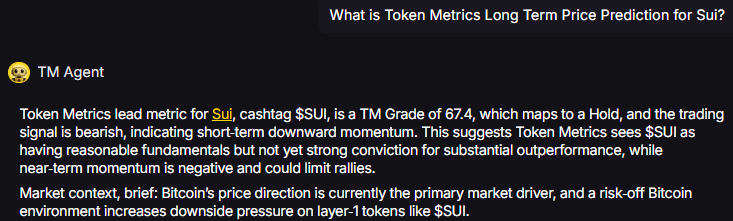
TM Agent baseline: Token Metrics lead metric for Sui, cashtag $SUI, is a TM Grade of 67.4%, which maps to a Hold, and the trading signal is bearish, indicating short-term downward momentum. This suggests Token Metrics sees $SUI as having reasonable fundamentals but not yet strong conviction for substantial outperformance in our price prediction models, while near-term momentum is negative and could limit rallies. Market context, brief: Bitcoin's price direction is currently the primary market driver, and a risk-off Bitcoin environment increases downside pressure on layer-1 tokens like $SUI.

Token Details 

The Case for Diversified Index Exposure

Professional investors across asset classes prefer diversified exposure over concentrated bets for good reason. Sui faces numerous risks—technical vulnerabilities, competitive pressure, regulatory targeting, team execution failure—any of which could derail SUI price prediction performance independent of broader market conditions. Token Metrics Indices spread this risk across one hundred tokens, ensuring no single failure destroys your crypto portfolio.

Diversification becomes especially critical in crypto given the sector's nascency and rapid evolution. Technologies and narratives that dominate today may be obsolete within years as the space matures. By holding SUI exclusively, you're betting not only on crypto succeeding but on Sui specifically remaining relevant. Index approaches hedge against picking the wrong horse while maintaining full crypto exposure.

Early access to Token Metrics Indices

Key Takeaways: SUI Price Prediction Summary

  • Scenario driven: Price prediction outcomes hinge on total crypto market cap; higher liquidity and adoption lift the bands
  • Single-asset concentration: Amplifies both upside and downside versus diversified approaches
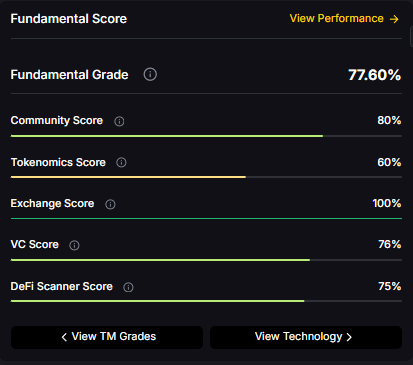
  • Fundamentals: Fundamental Grade 77.60% (Community 80%, Tokenomics 60%, Exchange 100%, VC 76%, DeFi Scanner 75%)
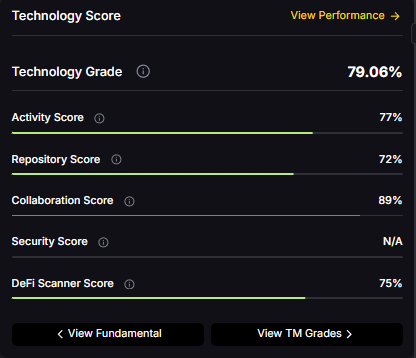
  • Technology: Technology Grade 79.06% (Activity 77%, Repository 72%, Collaboration 89%, Security N/A, DeFi Scanner 75%)
  • TM Agent gist: Hold grade, bearish trading signal, near-term negative momentum in price prediction models
  • Education only, not financial advice

SUI Price Prediction Scenario Analysis

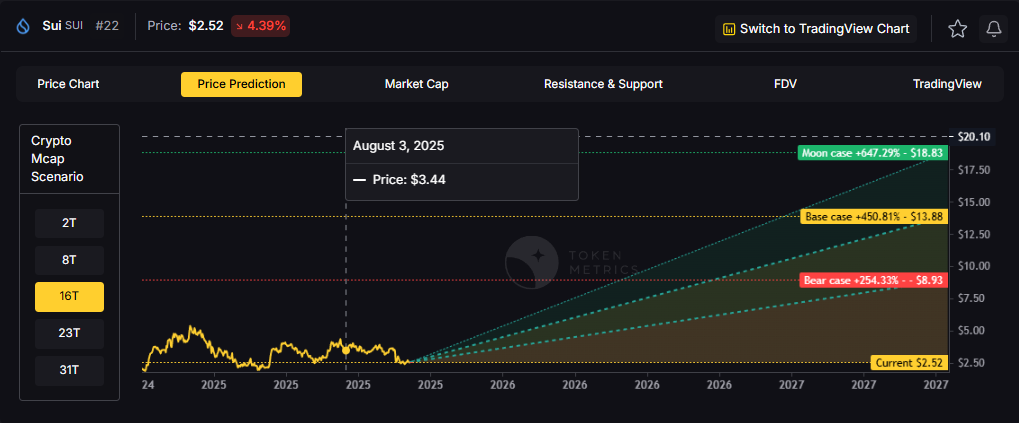
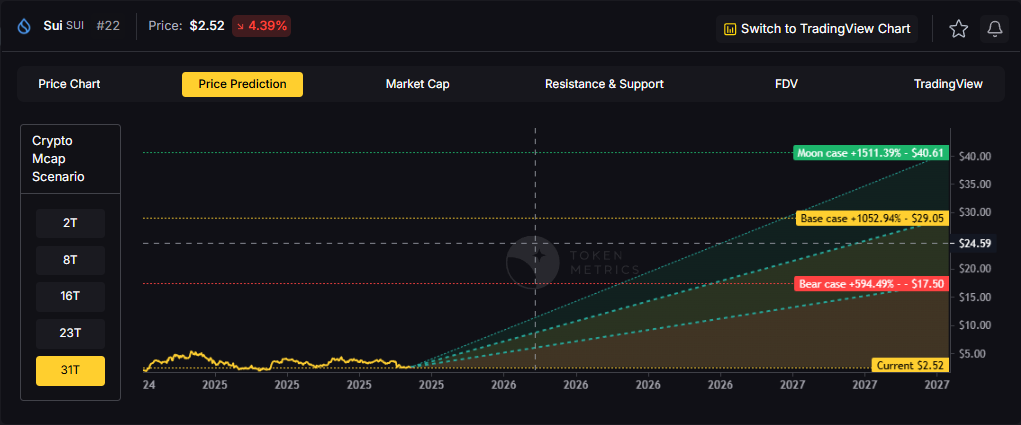
Token Metrics price prediction scenarios span four market cap tiers, each representing different levels of crypto market maturity and liquidity:

8T Market Cap - SUI Price Prediction:

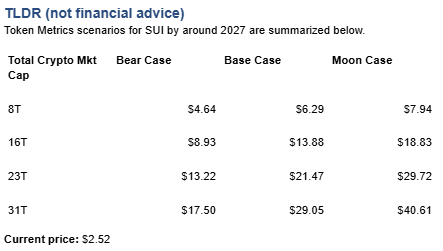
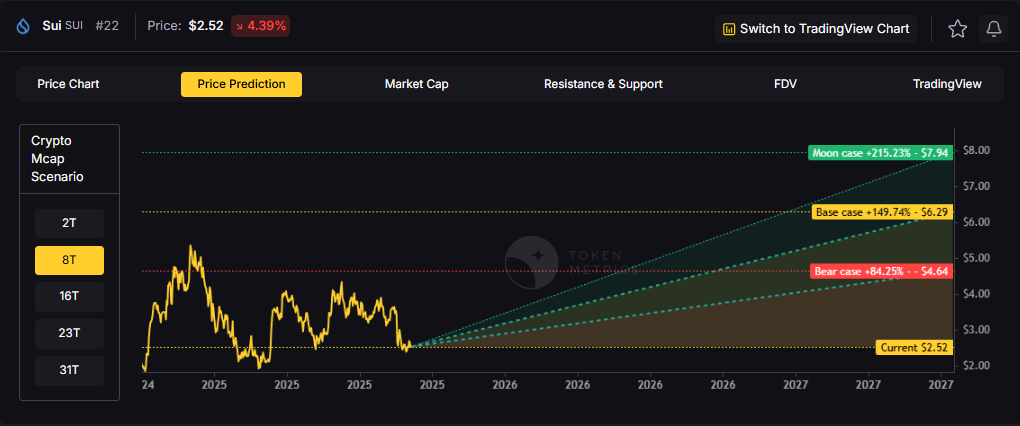
At an 8 trillion total crypto market cap, SUI price prediction projects to $4.64 in bear conditions, $6.29 in the base case, and $7.94 in bullish scenarios.

16T Market Cap - SUI Price Prediction:

At a 16 trillion total crypto market cap, SUI price prediction projects to $8.93 in bear conditions, $13.88 in the base case, and $18.83 in bullish scenarios.

23T Market Cap - SUI Price Prediction:

At a 23 trillion total crypto market cap, SUI price prediction projects to $13.22 in bear conditions, $21.47 in the base case, and $29.72 in bullish scenarios.

31T Market Cap - SUI Price Prediction:

At a 31 trillion total crypto market cap, SUI price prediction projects to $17.50 in bear conditions, $29.05 in the base case, and $40.61 in bullish scenarios.

These price prediction ranges illustrate potential outcomes for concentrated SUI positions, but investors should weigh whether single-asset exposure matches their risk tolerance or whether diversified strategies better suit their objectives.

What Is Sui?

Sui is a layer-1 blockchain network designed for general-purpose smart contracts and scalable user experiences. It targets high throughput and fast settlement, aiming to support applications that need low-latency interactions and horizontal scaling.

SUI is the native token used for transaction fees and staking, aligning validator incentives and securing the network. It underpins activity across common crypto sectors such as NFTs and DeFi while the ecosystem builds developer tooling and integrations.

Token Metrics AI Analysis

Token Metrics AI provides comprehensive context informing our SUI price prediction models:

Vision: Sui aims to create a highly scalable and low-latency blockchain platform that enables seamless user experiences for decentralized applications. Its vision centers on making blockchain technology accessible and efficient for mainstream applications by removing traditional bottlenecks in transaction speed and cost.

Problem: Many existing blockchains face trade-offs between scalability, security, and decentralization, often resulting in high fees and slow transaction finality during peak usage. This limits their effectiveness for applications requiring instant settlement, frequent interactions, or large user bases, such as games or social platforms. Sui addresses the need for a network that can scale horizontally without sacrificing speed or cost-efficiency.

Solution: Sui uses a unique object-centric blockchain model and the Move programming language to enable parallel transaction processing, allowing high throughput and instant finality for many operations. Its consensus mechanism, Narwhal and Tusk, is optimized for speed and scalability by decoupling transaction dissemination from ordering. The network supports smart contracts, NFTs, and decentralized applications, with an emphasis on developer ease and user experience. Staking is available for network security, aligning with common proof-of-stake utility patterns.

Market Analysis: Sui competes in the layer-1 blockchain space with platforms like Solana, Avalanche, and Aptos, all targeting high-performance decentralized applications. It differentiates itself through its object-based data model and parallel execution, aiming for superior scalability in specific workloads. Adoption drivers include developer tooling, ecosystem incentives, and integration with wallets and decentralized exchanges. The broader market for high-throughput blockchains is driven by demand for scalable Web3 applications, though it faces risks from technical complexity, regulatory uncertainty, and intense competition—all critical factors in our price prediction analysis.

Fundamental and Technology Snapshot from Token Metrics

Fundamental Grade: 77.60% (Community 80%, Tokenomics 60%, Exchange 100%, VC 76%, DeFi Scanner 75%).


Technology Grade: 79.06% (Activity 77%, Repository 72%, Collaboration 89%, Security N/A, DeFi Scanner 75%).


Catalysts That Skew SUI Price Predictions Bullish

  • Institutional and retail access expands with ETFs, listings, and integrations
  • Macro tailwinds from lower real rates and improving liquidity
  • Product or roadmap milestones such as upgrades, scaling, or partnerships
  • Growing developer ecosystem and dApp adoption
  • Strategic partnerships with major Web3 platforms

Risks That Skew SUI Price Predictions Bearish

  • Macro risk-off from tightening or liquidity shocks
  • Regulatory actions or infrastructure outages
  • Concentration or validator economics and competitive displacement
  • Protocol-specific execution risk and competitive pressure from alternatives
  • Technical vulnerabilities or smart contract exploits

How Token Metrics Can Help

Token Metrics empowers you to analyze Sui and hundreds of digital assets with AI-driven ratings, on-chain and fundamental data, and index solutions to manage portfolio risk smartly in a rapidly evolving crypto market. Our price prediction frameworks provide scenario-based analysis to inform your investment decisions.

SUI Price Prediction FAQs

What price could SUI reach in the moon case?

Our moon case price predictions range from $7.94 at 8T to $40.61 at 31T total crypto market cap. These scenarios assume maximum liquidity expansion and strong Sui adoption. Diversified strategies aim to capture upside across multiple tokens rather than betting exclusively on any single moon scenario. Not financial advice.

What is the SUI price prediction for 2025-2027?

Our comprehensive SUI price prediction framework suggests SUI could trade between $4.64 and $40.61 depending on market conditions and total crypto market capitalization. The base case price prediction scenario clusters around $6.29 to $29.05 across different market cap environments. Current TM Grade of 67.4% indicates a Hold rating with bearish near-term momentum. Not financial advice.

Can SUI reach $20?

Yes. Based on our price prediction scenarios, SUI could reach $21.47 in the 23T base case and $18.83 in the 16T moon case. The price target of $20 becomes achievable in moderate to high market cap environments with steady ecosystem growth. Not financial advice.

Can SUI reach $50?

SUI reaching $50 would exceed our current price prediction models' highest scenario of $40.61 (31T moon case). This would require extraordinary market conditions beyond the 31T total crypto market cap tier, exceptional ecosystem adoption, and SUI capturing significant market share from competing L1s. Not financial advice.

What's the risk/reward profile for SUI?

Our SUI price prediction risk/reward spans from $4.64 to $40.61 across all scenarios. Downside risks include regulatory pressure and competitive displacement, while upside drivers include ecosystem growth and favorable liquidity. Concentrated positions amplify both tails, while diversified strategies smooth outcomes and reduce single-asset risk.

What are the biggest risks to SUI price predictions?

Key risks that could impact SUI price predictions include regulatory actions, technical issues, competitive pressure from other L1s (Solana, Avalanche, Aptos), adverse market liquidity, validator centralization concerns, and execution challenges. Concentrated SUI positions magnify exposure to these risks. Diversified strategies spread risk across tokens with different profiles, reducing portfolio vulnerability to any single failure point.

Is SUI a good investment based on price predictions?

SUI shows solid fundamentals (77.60% grade) and technology scores (79.06% grade), but currently has a Hold rating (67.4% TM Grade) with bearish near-term trading signals. While our price prediction models show potential upside in favorable market conditions, the bearish momentum and L1 competition suggest a cautious approach. Consider diversified exposure rather than concentrated positions. Not financial advice.

How does SUI compare to other L1 price predictions?

SUI competes with Solana, Avalanche, and Aptos in the high-performance L1 space. Our price prediction framework suggests SUI's performance will correlate with broader L1 adoption trends while facing differentiation challenges. Diversified L1 exposure through indices may offer better risk-adjusted returns than concentrated SUI positions, as predicting which specific L1 will dominate remains uncertain.


Next Steps

Disclosure
Educational purposes only, not financial advice. Crypto is volatile, concentration amplifies risk, and diversification is a fundamental principle of prudent portfolio construction. Do your own research and manage risk appropriately.

Why Use Token Metrics for SUI Price Predictions?

  • Scenario-based modeling: Multiple market cap tiers for comprehensive price prediction analysis
  • AI-driven analysis: Fundamental (77.60%) and technology (79.06%) grades for informed decisions
  • Risk management tools: Index solutions to diversify L1 exposure beyond single-asset concentration
  • Real-time signals: Trading signals and TM Grades updated regularly
  • Comparative analysis: Analyze SUI against 6,000+ tokens for portfolio optimization
Research

Portfolio Allocation Mastery: The Complete Guide to Diversification with Token Metrics Crypto Indices

Token Metrics Team
11 min read

Most investors understand that diversification matters—the famous "don't put all your eggs in one basket" principle. However, understanding diversification conceptually differs dramatically from implementing it effectively. Poor diversification strategies create illusions of safety while concentrating risk in hidden ways. True diversification requires sophisticated allocation across multiple dimensions simultaneously.

Token Metrics AI Indices provide professional-grade diversification tools, but maximizing their power requires strategic allocation decisions. How much total capital should you allocate to crypto? How should you split that allocation across different indices? How do you balance crypto with traditional assets? What role should conservative versus aggressive indices play?

This comprehensive guide explores portfolio allocation mastery, examining the principles of effective diversification, specific allocation frameworks for different investor profiles, tactical adjustments for changing conditions, and avoiding common diversification mistakes that undermine portfolio performance.

Understanding True Diversification: Beyond Token Count

Many investors believe diversification simply means holding many assets. True diversification requires deeper strategic thinking.

  • The Correlation Principle: Diversification provides benefits only when assets don't move in lockstep. Holding ten tokens that all rise and fall together provides no more protection than one. Token Metrics addresses correlation through sector diversification (DeFi, Layer-1s, gaming, AI), market cap mixing (large, mid, small caps), geographic diversity across blockchain ecosystems, and use case variety spanning payments to applications.
  • Systematic vs. Unsystematic Risk: Diversification eliminates unsystematic risk (individual token failures) but cannot eliminate systematic risk (overall market crashes). Understanding this prevents unrealistic expectations—diversification protects against individual failures but won't prevent declines during market-wide crashes.
  • Risk-Adjusted Returns: Sophisticated investors focus on risk-adjusted returns rather than absolute returns. A portfolio returning 80% annually with 60% volatility may be inferior to one returning 60% with 30% volatility. The Sharpe ratio measures this—Token Metrics optimizes for superior Sharpe ratios through diversification.

The Total Portfolio Framework: Integrating Crypto with Traditional Assets

Crypto represents one component of comprehensive financial planning. Optimal allocation requires considering how crypto fits within total wealth.

Asset Class Allocation by Life Stage

Appropriate crypto allocation varies dramatically based on age, income stability, and financial obligations.

Ages 20-35 (Aggressive Accumulation Phase):

  • Total Crypto Allocation: 15-30% of investment portfolio
  • Remaining Allocation: 50-60% stocks, 10-15% bonds, 5-10% real estate/alternatives, 5-10% cash
  • Rationale: Long time horizon allows recovering from crypto volatility while capturing maximum growth potential

Ages 35-50 (Balanced Growth Phase):

  • Total Crypto Allocation: 10-20% of investment portfolio
  • Remaining Allocation: 50-60% stocks, 15-20% bonds, 10-15% real estate/alternatives, 5-10% cash
  • Rationale: Maintain growth exposure while gradually increasing stability as retirement approaches

Ages 50-65 (Pre-Retirement Transition):

  • Total Crypto Allocation: 5-10% of investment portfolio
  • Remaining Allocation: 40-50% stocks, 25-30% bonds, 10-15% real estate/alternatives, 10-15% cash
  • Rationale: Preserve accumulated wealth while maintaining modest growth exposure

Ages 65+ (Retirement Distribution):

  • Total Crypto Allocation: 3-5% of investment portfolio
  • Remaining Allocation: 30-40% stocks, 30-40% bonds, 10-15% real estate/alternatives, 15-20% cash
  • Rationale: Capital preservation with modest crypto exposure for continued growth and inflation protection

These frameworks provide starting points—adjust based on individual risk tolerance, wealth level, and financial obligations.

Emergency Funds and Liquidity Reserves

Never invest emergency funds or money needed within 3-5 years in cryptocurrency. Maintain 6-12 months of living expenses in high-yield savings accounts or money market funds completely separate from investment portfolios.

This liquidity buffer prevents forced selling during market crashes. Without adequate emergency reserves, unexpected expenses force liquidating crypto holdings at worst possible times—turning temporary paper losses into permanent realized losses.

Debt Considerations

High-interest debt (credit cards, personal loans above 8-10%) should be eliminated before aggressive crypto investing. The guaranteed "return" from eliminating 18% credit card interest exceeds expected crypto returns on risk-adjusted basis.

However, low-interest debt (mortgages below 4-5%) can coexist with crypto investing—no need to delay investing until mortgage-free. The opportunity cost of waiting decades to invest exceeds the modest interest savings from accelerated mortgage payments.

Allocating Within Crypto: Index Selection Strategy

Once you've determined total crypto allocation, the next decision involves distributing that allocation across Token Metrics' various indices.

The Three-Tier Index Framework

Structure crypto allocation across three risk tiers creating balanced exposure:

Conservative Tier (40-50% of crypto allocation):

Conservative indices emphasizing Bitcoin, Ethereum, and fundamentally strong large-cap tokens. This tier provides stability and reliable exposure to crypto's overall growth while limiting volatility.

Suitable indices: Bitcoin-weighted indices, large-cap indices, blue-chip crypto indices

Balanced Tier (30-40% of crypto allocation):

Balanced indices combining established tokens with growth-oriented mid-caps. This tier balances stability and growth potential through strategic diversification.

Suitable indices: Diversified market indices, multi-sector indices, smart contract platform indices

Aggressive Tier (20-30% of crypto allocation):

Aggressive growth indices targeting smaller-cap tokens with highest upside potential. This tier drives outperformance during bull markets while limited position sizing contains downside risk.

Suitable indices: Small-cap growth indices, sector-specific indices (DeFi, gaming, AI), emerging ecosystem indices

Sector Rotation Within Allocation

Different crypto sectors outperform during different market phases. Tactical sector rotation within your allocation captures these rotations:

  • Early Bull Market: Layer-1 platforms and infrastructure tokens typically lead as smart money accumulates fundamentally strong projects at relative discounts.
  • Mid Bull Market: DeFi and application layer tokens often outperform as adoption accelerates and user activity increases across protocols.
  • Late Bull Market: Speculative sectors like memecoins and high-risk projects experience explosive growth as retail FOMO peaks and risk appetite maximizes.
  • Bear Market: Bitcoin and large-cap "blue chip" tokens typically show relative strength, declining less than smaller alternatives.

Token Metrics indices provide sector-specific options allowing tactical overweighting of sectors positioned for outperformance while maintaining diversified core holdings.

Geographic and Ecosystem Diversity

Blockchain ecosystems exhibit different characteristics and growth trajectories. Diversifying across multiple ecosystems prevents concentration in single platform risk:

  • Ethereum Ecosystem: Largest DeFi infrastructure, most developers, highest liquidity
  • Solana Ecosystem: High performance, growing DeFi and NFT activity
  • Binance Smart Chain: Low costs, high retail adoption in certain markets
  • Polygon and Layer-2s: Scaling solutions with growing adoption
  • Alternative Layer-1s: Avalanche, Cardano, Polkadot offering different technical approaches

Token Metrics indices spanning multiple ecosystems provide automatic geographic and platform diversification preventing single-ecosystem concentration risk.

Rebalancing Strategies: Maintaining Optimal Allocation

Markets move constantly, causing allocations to drift from targets. Systematic rebalancing maintains desired risk exposure and forces beneficial "buy low, sell high" discipline.

Calendar-Based Rebalancing

The simplest approach rebalances on fixed schedules regardless of market conditions:

  • Quarterly Rebalancing: Review and adjust allocations every three months
  • Semi-Annual Rebalancing: Rebalance twice yearly for lower-maintenance approach
  • Annual Rebalancing: Minimal maintenance with once-yearly adjustments

More frequent rebalancing captures opportunities faster but triggers more taxable events in non-retirement accounts. Less frequent rebalancing reduces trading costs but allows greater allocation drift.

Threshold-Based Rebalancing

More sophisticated approaches rebalance when allocations drift beyond predetermined thresholds:

  • Rebalance when any index exceeds target allocation by 25% (e.g., 10% target allocation reaching 12.5%)
  • Rebalance when total crypto allocation exceeds target by 30% (e.g., 15% target reaching 19.5%)
  • Rebalance when conservative/aggressive balance shifts more than 15% from target

Threshold rebalancing responds to actual market movements rather than arbitrary calendar dates, potentially improving timing while reducing unnecessary transactions.

Tax-Optimized Rebalancing

In taxable accounts, coordinate rebalancing with tax considerations:

  • Prioritize rebalancing in retirement accounts where transactions don't trigger taxes
  • Use new contributions to rebalance in taxable accounts rather than selling appreciated positions
  • Harvest tax losses during rebalancing by selling positions at losses to offset gains
  • Delay rebalancing appreciated positions until qualifying for long-term capital gains treatment

This tax awareness preserves more wealth for compounding rather than sending it to tax authorities.

Risk Management: Position Sizing and Stop-Loss Philosophies

Effective diversification includes position sizing rules preventing excessive concentration even within diversified portfolios.

Maximum Position Limits

Establish maximum position sizes preventing any single index from dominating:

  • No single index exceeding 30% of total crypto allocation
  • No single sector exceeding 40% of total crypto allocation
  • Aggressive/speculative indices collectively capped at 30% of crypto allocation
  • Conservative indices minimum 40% of crypto allocation

These guardrails maintain diversification even when particular indices perform extremely well, preventing overconfidence from creating dangerous concentration.

Strategic Loss Limitations

While crypto indices should be held long-term through volatility, establish strategic loss limits for total crypto allocation relative to overall portfolio:

  • If crypto allocation declines to represent less than 50% of target allocation, consider adding capital opportunistically
  • If crypto allocation grows to exceed 200% of target allocation, take systematic profits rebalancing back toward target
  • Never allow crypto losses to exceed 10% of total net worth regardless of initial allocation

These strategic boundaries prevent crypto volatility from creating portfolio-level instability while maintaining beneficial long-term exposure.

Common Allocation Mistakes That Destroy Returns

  • False Diversification Through Correlated Assets: Five Layer-1 tokens or multiple overlapping DeFi indices create illusion without meaningful risk reduction. Analyze correlation ensuring genuine sector, market cap, and use case differences.
  • Over-Diversification Creating "Diworsification": Beyond 5-7 carefully selected indices, additional diversification provides diminishing returns while increasing complexity. Focus on 3-5 core indices providing genuine diversification.
  • Abandoning Allocation During Extremes: The most valuable time to maintain target allocation is when it feels most difficult—severe bear markets or euphoric bull markets. Automate rebalancing through predetermined rules.
  • Ignoring Total Portfolio Context: A 20% crypto allocation might be appropriate with stable income and emergency funds—but reckless with debt and no savings. Evaluate crypto within total financial context.
  • Static Allocations Never Adjusting: Life circumstances change—income, families, risk tolerance, retirement proximity. Review allocation every 2-3 years and after major life events.

Advanced Allocation Strategies for Sophisticated Investors

Beyond basic frameworks, advanced strategies optimize allocation for specific goals and market conditions.

Barbell Strategy

The barbell approach combines extremely conservative and extremely aggressive positions while avoiding middle ground:

  • 60% in ultra-conservative Bitcoin and Ethereum-focused indices
  • 40% in highly aggressive small-cap and emerging sector indices
  • 0% in moderate/balanced middle-ground indices

This approach provides downside protection through conservative core while capturing maximum upside through concentrated aggressive positions—potentially delivering superior risk-adjusted returns versus balanced approaches.

Core-Satellite with Tactical Overlay

Maintain stable core allocation (70% of crypto) in diversified indices while using tactical satellite positions (30%) rotated based on market conditions and opportunities:

  • Core 70% remains constant regardless of market conditions
  • Tactical 30% rotates between sectors showing relative strength or undervaluation
  • Rebalance tactical allocation monthly based on momentum, sentiment, and fundamental factors

This approach combines buy-and-hold stability with active opportunity capture.

Risk Parity Allocation

Rather than allocating by dollar amounts, allocate by risk contribution ensuring each index contributes equally to portfolio volatility:

  • Conservative low-volatility indices receive larger dollar allocations
  • Aggressive high-volatility indices receive smaller dollar allocations
  • Each position contributes approximately equal volatility to total portfolio

This sophisticated approach prevents high-volatility positions from dominating portfolio risk even with modest dollar allocations.

Conclusion: Allocation Excellence Creates Lasting Success

Portfolio allocation represents the most important investment decision you'll make—far more impactful than individual token selection or market timing. Academic research consistently shows asset allocation determines 90%+ of portfolio performance variation, while security selection and timing contribute only marginally.

Token Metrics provides world-class indices, but your allocation strategy determines whether you capture their full potential or undermine them through poor diversification. The frameworks presented here offer starting points—adapt them to your specific situation, risk tolerance, and financial goals.

Remember that optimal allocation isn't static—it evolves with life stages, market conditions, and financial circumstances. Regular review and adjustment keeps strategies aligned with current reality rather than outdated assumptions.

The investors who build lasting wealth aren't those who find magical assets or perfect timing—they're those who implement sound allocation strategies and maintain them through all market conditions. This discipline, more than any other factor, separates successful wealth builders from those whose portfolios underperform despite choosing quality investments.

Begin implementing strategic allocation today. Start with appropriate total crypto allocation for your life stage, distribute across conservative, balanced, and aggressive indices providing genuine diversification, and establish rebalancing discipline maintaining target exposures through market volatility.

Your allocation strategy, properly implemented, will compound into extraordinary wealth over decades. Token Metrics provides the tools—your allocation decisions determine the results.

Start your 7-day free trial today and begin building the optimally allocated portfolio that will drive your financial success for decades to come.

Research

Building True Passive Income with Crypto Indices: The Complete Guide to Automated Wealth Creation

Token Metrics Team
12 min read

The dream of passive income drives millions toward cryptocurrency—earning money while you sleep, building wealth automatically, achieving financial freedom without constant work. Yet most crypto "passive income" strategies require active management, constant monitoring, technical expertise, and significant time investment. They're anything but passive.

Token Metrics AI Indices deliver genuine passive income through systematic wealth accumulation requiring minimal ongoing effort. Once established, your crypto portfolio grows automatically through professional AI management, strategic rebalancing, and compound returns—all without your daily involvement or active trading.

This comprehensive guide explores how crypto indices create true passive income, compares index investing to other passive income strategies, reveals the mathematics of automated wealth compounding, and provides actionable frameworks for building substantial passive income streams through disciplined index allocation.

What True Passive Income Actually Means

Understanding genuine passive income requires distinguishing it from "active income disguised as passive" that dominates crypto discussions.

Active Income Disguised as Passive

Many crypto strategies marketed as "passive income" require substantial ongoing effort:

  • Day Trading/Swing Trading: Requires constant market monitoring, analysis, and execution—full-time active work
  • Yield Farming: Demands daily monitoring of APYs, moving capital between protocols, managing impermanent loss risks
  • NFT Flipping: Requires researching projects, timing mints, managing listings, following trends constantly
  • Staking on Volatile Assets: Needs continuous evaluation of lock-up risks, protocol security, and token price sustainability
  • DeFi Protocol Management: Involves complex smart contract interactions, gas fee optimization, and continuous security monitoring

These strategies generate income but demand active participation—they're jobs, not passive income streams.

Characteristics of Genuine Passive Income

True passive income exhibits specific characteristics:

  • Minimal Time Investment: Requires 1-2 hours monthly maximum after initial setup
  • No Specialized Expertise: Accessible to anyone regardless of technical knowledge
  • Automatic Execution: Operates without your constant involvement or decision-making
  • Predictable Processes: Follows systematic approaches rather than requiring moment-to-moment judgment
  • Scalable Without Additional Time: Can grow substantially without proportionally increasing time commitment
  • Professional Management: Experts handle complexity on your behalf

Token Metrics indices meet all these criteria—once established, your wealth grows automatically through AI-powered management while you focus on other priorities.

How Crypto Indices Create Passive Income

Understanding the mechanisms generating passive returns through indices reveals why this approach delivers superior risk-adjusted income compared to alternatives.

Capital Appreciation Through Systematic Growth

The primary income source from crypto indices is capital appreciation—portfolio value increasing over time as cryptocurrency markets grow and AI optimization captures opportunities.

Unlike stocks requiring decades to double, crypto indices can deliver 50-200% annual returns during favorable market cycles. A $25,000 initial investment growing at 60% annually becomes $100,000 in three years and $400,000 in six years—substantial wealth creation requiring zero active trading.

This appreciation occurs passively through:

  • AI selecting highest-probability opportunities across 6,000+ tokens
  • Automatic rebalancing capturing profits from winners and accumulating losers at discounts
  • Diversification spreading risk while maintaining upside exposure
  • Professional risk management limiting catastrophic losses

You make no trading decisions. You don't research tokens. You don't time markets. The system handles everything while appreciation compounds automatically.

Compound Growth Acceleration

Passive income's true power emerges through compounding—returns generating additional returns in self-reinforcing cycles. Token Metrics indices amplify compounding through systematic profit capture and reinvestment.

When indices rebalance, profits from appreciating tokens are automatically reinvested into new opportunities. This mechanical reinvestment ensures all gains compound rather than sitting idle. Over years and decades, compounding creates extraordinary wealth accumulation.

Example: $10,000 growing at 40% annually with full reinvestment becomes $150,000 in seven years. Without reinvestment—if you withdrew gains annually—the same investment reaches only $38,000. Compounding creates an additional $112,000 in wealth automatically.

Dollar-Cost Averaging Enhancement

Adding regular contributions to index positions creates powerful dollar-cost averaging benefits that enhance passive returns. By investing fixed amounts regardless of market conditions, you automatically buy more tokens when prices are low and fewer when prices are high.

This systematic averaging removes timing pressure—you don't need to identify perfect entry points. Whether markets surge or crash, your regular contributions continue mechanically, building positions that appreciate over complete market cycles.

Combined with compound growth, dollar-cost averaging creates remarkable long-term wealth accumulation requiring minimal effort beyond initial automated contribution setup.

Tax-Efficient Growth Optimization

Token Metrics indices can be held in tax-advantaged retirement accounts where appreciation compounds tax-free (Roth IRA) or tax-deferred (Traditional IRA). This tax optimization dramatically accelerates wealth accumulation compared to taxable accounts.

In taxable accounts, annual rebalancing triggers capital gains taxes that reduce compounding power. In retirement accounts, all gains compound without tax drag—a significant passive income enhancement requiring only initial account setup.

Comparing Index Passive Income to Alternatives

Understanding how index-based passive income compares to other strategies reveals relative advantages.

Vs. Staking/Yield Farming: While staking offers 5-20% APY, it involves token price risk (10% yield means nothing if price drops 50%), lock-up periods preventing selling during crashes, impermanent loss, protocol risks, and constant management overhead. Index capital appreciation typically exceeds staking yields by 40+ percentage points while maintaining complete liquidity.

Vs. Real Estate: Real estate requires $50,000-$500,000+ minimums, involves management burdens despite property managers, suffers from illiquidity (months to sell), concentrates wealth geographically, and carries leverage risks. Indices require minimal capital, zero management, complete liquidity, global diversification, and no leverage risks.

Vs. Dividend Stocks: Dividend yields of 2-4% and appreciation of 6-8% annually pale against crypto potential. Dividends trigger immediate taxation reducing after-tax returns. Crypto indices offer dramatically higher return potential with tax-efficient compounding.

Vs. Bitcoin/Ethereum Only: Concentrated two-asset holdings sacrifice diversification, miss altcoin opportunities, lack rebalancing benefits, and forego professional management. Indices provide superior risk-adjusted returns with equal passivity.

The Mathematics of Automated Wealth Building

Understanding how small initial investments and regular contributions compound into substantial wealth over time makes passive income potential concrete rather than abstract.

Starting Small: The Power of Consistency

You don't need large capital to begin building meaningful passive income. Small amounts invested consistently compound into substantial wealth through time and returns.

Scenario 1: Modest Beginning

  • Initial investment: $1,000
  • Monthly contribution: $250
  • Average annual return: 50%
  • Time horizon: 10 years
  • Ending value: $486,000

This scenario transforms $31,000 in total contributions into nearly half a million through compound growth—passive income requiring only initial setup and automated monthly contributions.

Scenario 2: Aggressive Accumulation

  • Initial investment: $5,000
  • Monthly contribution: $500
  • Average annual return: 50%
  • Time horizon: 10 years
  • Ending value: $972,000

Nearly $1 million from $65,000 in contributions—extraordinary passive wealth creation through systematic index investing.

The Impact of Return Variability

Real returns vary annually—bull markets deliver 100-300% returns while bear markets create 50-80% drawdowns. However, averaging across complete cycles, conservative crypto indices historically achieve 30-60% annualized returns.

  • Even at conservative 30% annual average:
  • $10,000 initial + $300 monthly for 15 years = $1.1 million
  • $25,000 initial + $500 monthly for 15 years = $2.8 million

These projections assume no income from your job increases, which is unrealistic. As your career progresses and income grows, contribution amounts can increase proportionally, accelerating wealth accumulation further.

Retirement Income Generation

Once accumulated, substantial crypto index holdings generate retirement income through systematic withdrawal strategies.

If you accumulate $2 million in crypto indices by age 60, withdrawing 4% annually provides $80,000 passive income while preserving principal. If crypto continues appreciating even modestly at 15% annually, your portfolio grows despite withdrawals, providing inflation-protected lifetime income.

This passive income stream requires no active work—automated monthly withdrawals provide cash flow while remaining capital compounds through continued AI management.

Building Your Passive Income System

Creating effective passive income through crypto indices requires systematic implementation across several phases.

Phase 1: Foundation Setup (Month 1)

  • Open Token Metrics account and explore available indices
  • Determine appropriate total crypto allocation based on age, risk tolerance, and financial situation
  • Select specific indices matching your risk profile (conservative, balanced, aggressive)
  • Open exchange accounts and complete verification processes
  • Link bank accounts for funding transfers
  • Consider opening self-directed IRA for tax-advantaged growth

Complete this foundation work once—all subsequent wealth building occurs automatically.

Phase 2: Automation Implementation (Month 2)

  • Set up automatic recurring bank transfers to exchange accounts
  • Configure automatic index purchases on predetermined schedules (weekly, bi-weekly, or monthly)
  • Enable automatic rebalancing following Token Metrics recommendations
  • Set up portfolio tracking and optional performance alerts
  • Document your strategy and rules in writing for future reference

After automation setup, your system operates independently requiring minimal intervention.

Phase 3: Optimization and Scaling (Months 3-12)

  • Monitor system monthly to ensure automation functions correctly
  • Increase contribution amounts as income grows throughout your career
  • Rebalance between indices quarterly based on Token Metrics guidance
  • Take advantage of market crashes by adding lump sums opportunistically
  • Review and adjust tax strategies annually with professional guidance

Even during optimization phase, time commitment remains minimal—1-2 hours monthly maximum.

Phase 4: Wealth Preservation and Distribution (Years 10+)

  • Gradually shift allocation toward conservative indices as wealth accumulates
  • Implement systematic profit-taking during euphoric bull markets
  • Develop withdrawal strategy for retirement income needs
  • Consider estate planning for accumulated wealth transfer
  • Maintain disciplined approach through all market conditions

Throughout all phases, your involvement remains minimal while wealth compounds automatically through professional AI management.

Maximizing Passive Income Through Strategic Allocation

Optimizing passive income requires strategic decisions about allocation, risk management, and contribution timing.

Allocation Balance: Higher returns come with higher volatility. Conservative approach uses 70% conservative/20% balanced/10% aggressive indices. Moderate uses 50/30/20 split. Aggressive uses 30/30/40 split. All remain completely passive from management perspective.

Contribution Timing: Maintain regular automated contributions always, but keep 10-20% dry powder in stablecoins for crisis deployment during 30%+ market crashes. These fear-driven purchases generate outsized returns.

Tax Location Optimization: Roth IRA provides tax-free growth ideal for aggressive indices. Traditional IRA offers tax-deferred growth suitable for conservative indices. Taxable accounts provide flexibility but trigger annual rebalancing taxes. This optimization happens once but compounds into substantial savings over decades.

Common Passive Income Mistakes to Avoid

Even with automated systems, investors make predictable mistakes that undermine passive income goals.

  • Insufficient Automation: Failing to fully automate contributions and rebalancing introduces friction preventing consistent execution
  • Excessive Monitoring: Checking portfolio daily or weekly increases anxiety without improving results—monthly reviews suffice
  • Abandoning Strategy During Drawdowns: Selling during bear markets destroys passive income system's effectiveness—maintain discipline through downturns
  • Chasing Performance: Constantly switching between indices based on recent performance undermines long-term compounding
  • Withdrawing Gains Prematurely: Taking profits during accumulation phase prevents compounding—let gains reinvest automatically
  • Under-Contributing Relative to Income: Failing to increase contributions as career income grows limits wealth accumulation unnecessarily
  • Neglecting Tax Optimization: Holding crypto in taxable accounts when retirement accounts available costs substantial long-term returns

Conclusion: The Path to Financial Freedom

True passive income through crypto indices isn't mythical—it's mathematically achievable through systematic implementation and patient execution. Token Metrics provides the professional AI management, diversification, and optimization infrastructure transforming crypto from speculation into genuine passive wealth building.

The beauty of this approach is simplicity: establish system once, contribute consistently, trust professional management, and let compound growth work its magic over years and decades. No day trading. No constant monitoring. No technical expertise required. Just disciplined, automated wealth accumulation.

Your action determines outcomes. Those who begin today, implement systematic contributions, and maintain discipline through market cycles build substantial passive income streams funding financial independence. Those who delay, overthink, or abandon strategy during volatility watch opportunities pass without capturing benefits.

Token Metrics indices eliminate complexity and emotion from crypto investing, leaving only systematic wealth accumulation. The technology works. The mathematics favor consistent long-term investors. The only question is whether you'll begin building your passive income system today or postpone financial freedom indefinitely.

Start your 7-day free trial and take the first step toward true passive income through automated, professional crypto index investing. Your future self will thank you for the decision you make today.

Frequently Asked Questions

Choose from Platinum, Gold, and Silver packages
Reach with 25–30% open rates and 0.5–1% CTR
Craft your own custom ad—from banners to tailored copy
Perfect for Crypto Exchanges, SaaS Tools, DeFi, and AI Products