Back to blog
Crypto Basics

Cardano (ADA) Crypto – What It Is and How It Works?

Learn everything about Cardano (ADA) crypto and how it works in this descriptive guide.
Token Metrics Team
8 minutes
Want Smarter Crypto Picks—Free?
See unbiased Token Metrics Ratings for BTC, ETH, and top alts.
Thank you! Your submission has been received!
Oops! Something went wrong while submitting the form.
 No credit card | 1-click unsubscribe

Cardano (ADA) can be described as a blockchain platform that’s designed to enable the development of decentralized applications and smart contracts. It is the first blockchain platform to be built on a scientific philosophy and to be developed through peer-reviewed research and scientific rigor. Developed by a global team of leading researchers and engineers, Cardano is set to revolutionize the way we use and interact with blockchain technology. 

This beginner's guide to Cardano will provide you with all the information you need to understand the platform, its features, and how to use it. From its unique consensus algorithm to its native token ADA, this guide will provide you with a comprehensive overview of Cardano. Whether you're a beginner interested in learning more about Cardano or a blockchain expert looking for the latest information, this guide has you covered from end-to-end. 

History of Cardano

Cardano was founded by Charles Hoskinson, who also co-founded Ethereum. However, Cardano is a very different platform from Ethereum regarding its design and goals. Whereas Ethereum is a decentralized application ("dapp") platform designed to power all sorts of different decentralized applications, Cardano is designed to be a "first generation" blockchain platform that can be used to build decentralized applications, as well as other things.

The Cardano Foundation, IOHK, and Emurgo are developing the Cardano platform. The three groups are working together to build the Cardano platform and will hold a stake in the Cardano ecosystem. 

The first phase of Cardano's development began in 2015. At the time, a company called Input-Output (IOHK) was contracted to build the platform. In 2017, IOHK decided to hand over control of the project to the Cardano Foundation and Emurgo. The three partners are now working together to bring Cardano to market. The next development phase has been completed sometime between 2020 and 2021. After that, Cardano emerged as a fully decentralized blockchain.

How Does Cardano Work?

The Cardano platform uses a proof of stake (PoS) consensus algorithm to manage its decentralized network. Proof of stake is a consensus algorithm where the right to add new blocks to the blockchain is determined not by computing power but by coin ownership. In PoS-based blockchains, users must "stake" or "deposit" their coins to add new blocks to the blockchain for a certain amount of time. The more coins a user stakes, the greater the chance that the user will be selected to add a new block. Cardano uses the Ouroboros proof of stake algorithm. 

Ouroboros is the first proof of stake algorithm to be proven secure in a peer-reviewed paper. This unique algorithm uses a "random selection of a catch-up fellow" to create a network with no central authority. In other words, no single person or group can control the network. The algorithm works by randomly selecting a "follower" who can "catch up" with the "leader."

The leader is the person responsible for adding new blocks to the blockchain. The follower has one job: to predict what the leader will do. If the follower is correct, they are promoted to the leader and given a chance to add a new block. If the follower is incorrect, they remain a follower, and another random person is selected to catch up. The Ouroboros algorithm was expected to be completed by June 2020. But, according to recent reports, Charles Hoskinson said that the Ouroboros Genesis implementation will be in 2023.

Cardano's Development and Governance

The development and governance of Cardano are handled by three large organizations:

The Cardano Foundation: The Cardano Foundation maintains Cardano's core. This group promotes the platform, manages its marketing and communications, and defends the brand.

IOHK: IOHK leads the team behind Cardano's core. This group is responsible for developing and maintaining the platform's core software and bringing new features to the market.

Emurgo: The third group, Emurgo, brings businesses and investments to the Cardano ecosystem. Emurgo helps businesses integrate with the Cardano network and encourages others to build projects on the Cardano platform.

The functioning of Cardano stands tall because of the highly secured and powerful ecosystem as mentioned above. Now, what is Cardano’s native token ADA?

Cardano's Native Token - ADA

Cardano's native token, ADA, sends money on the Cardano blockchain. It also rewards people who help maintain and build the network. The team behind Cardano has stated that ADA is more than just a token: it also serves as "the fuel that drives the Cardano ecosystem." Cardano’s development team has stated that the platform will be fully decentralized once the network has been around for a few years. Until then, the platform will be maintained by a group of stakeholders who have a vested interest in the platform's success. These stakeholders have a stake in the system and are rewarded with ADA for helping maintain the platform. 

There are 3-easy ways to earn ADA

  • Hosting a node, 
  • Providing software assurance, or 
  • Contributing to the development of Cardano's software or research.

Apart from these, Cardano’s powerful 3-layered ecosystem makes it reliable and trustworthy. 

The 3-Layered Cardano's Ecosystem

Here are the three secured-layers that constitute Cardano (ADA): 

The Cardano Network: The Cardano network is the blockchain that runs the ADA token and smart contracts. It is maintained by the stakeholders, who receive ADA for their work.

Cardano's core technology: The Cardano core represents the core software that powers the Cardano network. This includes the programming languages used to build decentralized applications and the virtual machine that runs those apps.

All the projects built on top of the Cardano platform: The Cardano projects layer lists all the decentralized applications built on top of the Cardano network.
To top it all, you can also enjoy the benefit of smart contracts on Cardano. 

Smart Contracts On Cardano

Although Cardano is designed to be a dapp platform, it can also be used to build smart contracts. The programming language used to build smart contracts on Cardano is called Haskell and Cardano's virtual machine, called the "Computing Resources And Dispatcher" (CRDD), can execute many programming languages.

Any decentralized application built in any programming language can be hosted on the Cardano network. Cardano's smart contracts are unique because they are the first to be verified by a formal verification tool called the "Industrial Strength Verification" (ISV). This tool will help you confirm whether or not a smart contract is safe to use.

Cardano's Use Cases

Use Case #1: The first use case for Cardano is a decentralized application platform. This means that developers can build apps on top of the Cardano blockchain. These dapps will be able to send and receive ADA and use other features like the ability to create a wallet or sign a transaction. 

Use Case #2: The second use case for Cardano is as a financial asset. Investors can buy and sell ADA on cryptocurrency exchanges, and the token could also represent ownership in a company.

Now, let’s see the security measures that Cardano aims to offer.

Security on Cardano

One of the most common questions about Cardano is how secure it is compared to other blockchains. Cardano does not claim to be more secure than other blockchains but seeks to be as secure as possible. The team behind Cardano has said that one of their goals is to be the "safest and most reliable blockchain." 

One way Cardano strives to be more secure is through its unique design. While other blockchains are designed to do one thing well, Cardano is designed to do many different things less well. Cardano's design means no single platform part is crucial to its operation. If one part of the platform fails, many other parts can take its place. This indicates safety at its best.

Is Cardano a Worthy Investment?

There we are swinging again to whether or not Cardano is a good investment. Let’s check out the latest updates before we decide, shall we?

According to the Cryptoglobe’s Report, ADA’s price might soar up to 100% by 31st January, 2023. Major upgrades are being anticipated by investors to improve DeFi’s significance through its oracles.

So, Cardano is something to look forward to owing to its upcoming features. 

Future of Cardano

Let’s dive a bit further into the future. Cryptopolitan thinks the price of ADA will soar up to $21.35 on an average, with a minimum price of $20.55. Changelly also believes that ADA price will rise, but the website thinks the coin price will only peak at $15.69, with an average of $13.92, similar to the data from Price Prediction. The website’s analysts predict that the coin’s maximum price will be $15.69 with a minimum of $13.55.

Most experts predict that Cardano might see a bright future in 2023. With persistent developments Cardano’s ecosystem has been witnessing, and in the crypto asset market as a whole, Cardano can potentially reach a new high.

The Bottom Line

Cardano aims to be a "first generation" blockchain technology. The platform is being built by a group of organizations, each with a specific role in the project.

The team hopes this design will help Cardano achieve its goal of being the most secure blockchain. The platform uses a unique consensus algorithm, and its native token is storable in various wallets. The token can be used to represent ownership in a company. 

Build Smarter Crypto Apps &
AI Agents in Minutes, Not Months
Real-time prices, trading signals, and on-chain insights all from one powerful API.
Grab a Free API Key
About Token Metrics
Token Metrics: AI-powered crypto research and ratings platform. We help investors make smarter decisions with unbiased Token Metrics Ratings, on-chain analytics, and editor-curated “Top 10” guides. Our platform distills thousands of data points into clear scores, trends, and alerts you can act on.
30 Employees
analysts, data scientists, and crypto engineers
Daily Briefings
concise market insights and “Top Picks”
Transparent & Compliant
Sponsored ≠ Ratings; research remains independent
Want Smarter Crypto Picks—Free?
See unbiased Token Metrics Ratings for BTC, ETH, and top alts.
Thank you! Your submission has been received!
Oops! Something went wrong while submitting the form.
 No credit card | 1-click unsubscribe
Token Metrics Team
Token Metrics Team

Recent Posts

Crypto Basics

8 Best and Profitable Crypto to Mine - Complete List

Token Metrics Team
7 Minutes

Click here to buy Cryptocurrencies from Gate.io

Contact us at promo@tokenmetrics.com for marketing and sponsorship programs.

Cryptocurrency mining has become a popular way to earn passive income in the digital world. With the right resources and knowledge, individuals can generate profits by validating transactions on blockchain networks.

However, with the vast number of cryptocurrencies available, choosing the best ones to mine can take time and effort. 

This comprehensive guide will explore the top cryptocurrencies to mine in 2023, providing you with valuable insights and information to make informed decisions.

What is Crypto Mining?

Cryptocurrency mining is the process of validating transactions on a blockchain network by using computational power. 

Miners contribute their computing resources to solve complex mathematical problems, ensuring the accuracy and security of transactions. Once a miner successfully solves a problem, they are rewarded with a certain amount of cryptocurrency.

Types of Crypto Mining

There are three main types of crypto mining: CPU mining, GPU mining, and ASIC mining.

1. CPU Mining

CPU mining, or Central Processing Unit mining, involves using the processing power of a computer's CPU to mine cryptocurrencies. This method is the least efficient and is generally not profitable for most cryptocurrencies.

2. GPU Mining

GPU mining, or Graphics Processing Unit mining, utilizes the power of a computer's graphics card to mine cryptocurrencies. This method is more efficient than CPU mining and is commonly used for mining altcoins.

3. ASIC Mining

ASIC mining, or Application-Specific Integrated Circuit mining, involves using specialized hardware designed specifically for mining cryptocurrencies. 

ASIC miners are highly efficient and powerful, making them the preferred choice for mining popular cryptocurrencies like Bitcoin.

The Best Crypto to Mine in 2023

When it comes to mining cryptocurrencies, profitability is a key consideration. Here are the top cryptocurrencies that offer promising mining opportunities in 2023:

1. Bitcoin (BTC)

Current Mining Reward: 6.25 BTC/block

Profitability: Approximately $250 per month on average

Description: Bitcoin continues to be the most popular and profitable cryptocurrency to mine. Its high market value and widespread adoption make it a lucrative choice for miners.

2. Monero (XMR)

Current Mining Reward: 0.6 XMR/block

Profitability: Approximately $8.50 per month

Description: Monero is a privacy-focused cryptocurrency that offers enhanced anonymity. Its ASIC-resistant algorithm makes it accessible for CPU and GPU miners.

3. Litecoin (LTC)

Current Mining Reward: 12.5 LTC/block

Profitability: Approximately $66.74 per month

Description: Litecoin is a popular altcoin that offers faster transaction confirmation times than Bitcoin. Its Scrypt algorithm makes it suitable for GPU mining.

4. Ravencoin (RVN)

Current Mining Reward: 2500 RVN/block

Profitability: Approximately $87 per month

Description: Ravencoin is a relatively new cryptocurrency focusing on asset transfer and decentralized applications. It utilizes the KawPow protocol, which is ASIC-resistant.

5. Zcash (ZEC)

Current Mining Reward: 2.5 ZEC/block

Profitability: Approximately $100 per month

Description: Zcash is known for its privacy features, allowing users to conduct private transactions. Its Equihash algorithm makes it suitable for GPU mining.

6. Dogecoin (DOGE)

Current Mining Reward: 10,000 DOGE/block

Profitability: Approximately $27 per month

Description: Dogecoin started as a meme cryptocurrency but has gained significant popularity. Its Scrypt algorithm makes it suitable for CPU and GPU mining.

7. Dash (DASH)

Current Mining Reward: 1.08 DASH/block

Profitability: Approximately $306.31 per month

Description: Dash focuses on instant and private transactions. Its X11 algorithm makes it suitable for ASIC and GPU mining.

8. Grin (GRIN)

Current Mining Reward: 60 GRIN/block

Profitability: Approximately $43.32 per month

Description: Grin is an open-source cryptocurrency that prioritizes privacy and scalability. Its MimbleWimble algorithm makes it suitable for GPU mining.

It's important to note that profitability can vary based on factors such as electricity costs, mining difficulty, and market conditions. Conduct thorough research and consider these factors before committing to mining any cryptocurrency.

How to Mine Cryptocurrency?

Mining cryptocurrencies requires a mining rig (computer), mining software or membership in a mining pool, and a reliable power supply. Here is a step-by-step guide on how to mine cryptocurrencies:

Step 1 - Choose a cryptocurrency to mine based on profitability and your hardware capabilities.

Step 2 - Set up a mining rig with the necessary hardware components, such as CPUs, GPUs, or ASICs.

Step 3 - Install mining software compatible with your chosen cryptocurrency.

Step 4 - Join a mining pool to increase your chances of earning rewards.

Step 5 - Configure your mining software to connect to the mining pool.

Step 6 - Start mining and monitor your mining operation for optimal performance.

Click here to buy Cryptocurrencies from Gate.io

Contact us at promo@tokenmetrics.com for marketing and sponsorship programs.

Pros and Cons of Crypto Mining

Like any investment, cryptocurrency mining has its pros and cons. Here are some key advantages and disadvantages to consider:

Pros:

  • Potential for passive income.
  • Opportunity to support decentralized networks.
  • Possibility of earning valuable cryptocurrencies.
  • Flexibility in choosing mining hardware and software.

Cons:

  • High initial investment in mining equipment.
  • Electricity costs can be high.
  • Mining difficulty can increase over time, reducing profitability.
  • Market volatility can impact the value of mined cryptocurrencies.

Is Cryptocurrency Mining Profitable?

The profitability of cryptocurrency mining depends on various factors, including electricity costs, mining difficulty, and market conditions. 

While mining popular cryptocurrencies like Bitcoin may require substantial investments and specialized hardware, there are still opportunities to profitably mine smaller, emerging cryptocurrencies.

It's crucial to conduct thorough research, calculate potential costs and rewards, and stay informed about industry trends to make informed decisions about cryptocurrency mining.

Also Read - How Helium Miner Works?

Alternatives to Cryptocurrency Mining

If cryptocurrency mining is not suitable for you, there are alternative ways to participate in the crypto industry. Here are a few options:

  • Trading: Buy and sell cryptocurrencies on exchanges to take advantage of price fluctuations.
  • Staking: Hold and stake cryptocurrencies to earn rewards and support the network's operations.
  • Investing: Purchase cryptocurrencies as long-term investments based on their growth potential.
  • Cloud Mining: Rent mining equipment from a service provider and earn rewards without physical hardware.

Consider your risk tolerance, investment goals, and available resources when exploring alternatives to cryptocurrency mining.

Final Thoughts

Cryptocurrency mining can be profitable for individuals with the necessary resources and knowledge. 

By choosing suitable cryptocurrencies to mine and adopting efficient mining practices, you can generate passive income and contribute to the growth and security of blockchain networks.

However, staying informed about market conditions, mining difficulty, and technological advancements is crucial. 

Conduct thorough research, consider both the advantages and disadvantages, and make informed decisions based on your circumstances.

Remember, the cryptocurrency market is highly volatile, and profitability can fluctuate. Stay adaptable, monitor industry trends, and continuously evaluate your mining operations to maximize potential returns.

Frequently Asked Questions

Q1. What is cryptocurrency mining?

Cryptocurrency mining uses computational power to validate transactions on a blockchain network and earn rewards in the form of cryptocurrency.

Q2. How do I choose the best cryptocurrency to mine?

Consider mining difficulty, market value, and hardware requirements. Research each cryptocurrency's mining algorithm and profitability before making a decision.

Q3. Can I mine cryptocurrencies with my regular computer?

While mining specific cryptocurrencies with a regular computer is possible, it is generally not profitable. Specialized mining hardware is often required for efficient mining.

Q4. How can I maximize profitability in cryptocurrency mining?

To maximize profitability, consider factors such as electricity costs, mining difficulty, and market conditions. Continuously monitor and optimize your mining operations for optimal performance.

Q5. Can I mine multiple cryptocurrencies simultaneously?

It is possible to mine multiple cryptocurrencies simultaneously using different mining rigs or mining pools supporting various cryptocurrencies.

Q6. Are there any legal considerations for cryptocurrency mining?

Cryptocurrency mining legality varies by country. Research and comply with local regulations regarding cryptocurrency mining to ensure legal operation.

Q7. Can I mine cryptocurrencies on my mobile phone?

While mining specific cryptocurrencies on mobile phones is possible, the limited computational power and potential hardware strain make it generally unprofitable and impractical.

Q8. What is the environmental impact of cryptocurrency mining?

Cryptocurrency mining can have a significant environmental impact due to the high energy consumption of mining operations. Consider using renewable energy sources or joining eco-friendly mining initiatives.

Q9. Can I mine cryptocurrencies without joining a mining pool?

Yes, it is possible to mine cryptocurrencies independently without joining a mining pool. This approach is known as solo mining but may result in less frequent rewards due to the lower hash rate.

Q10. How can I estimate the profitability of cryptocurrency mining?

Use mining profitability calculators to estimate potential earnings based on mining hardware, electricity costs, and current market conditions. Keep in mind that profitability can vary.

Disclaimer

The information provided on this website does not constitute investment advice, financial advice, trading advice, or any other advice, and you should not treat any of the website's content as such.

Token Metrics does not recommend that any cryptocurrency should be bought, sold, or held by you. Conduct your due diligence and consult your financial advisor before making investment decisions.

Click here to buy Cryptocurrencies from Gate.io

Contact us at promo@tokenmetrics.com for marketing and sponsorship programs.

NFTs

NFT Market Crash - Insights for Investors and Artists

Marcus K
6 Minutes

The NFT market, once hailed as the next big thing in the crypto world, has experienced a dramatic rise and fall in a relatively short period. NFTs, or non-fungible tokens, are digital assets that represent ownership of unique items, such as art, music, or collectibles, on a blockchain. 

They gained significant attention in 2021 and 2022, with high-profile sales and celebrities jumping on the bandwagon. However, recent studies and reports indicate that the NFT market has crashed, leaving many wondering what went wrong.

The Initial Hype and NFT Bull Run

The story of the NFT market begins with a wave of excitement and hype. In 2021, NFTs captured the attention of artists, collectors, and investors alike. The promise of owning unique digital assets authenticated by blockchain technology sparked a frenzy of buying and selling. 

Projects like Bored Apes and CryptoPunks gained popularity, with some NFTs selling for millions of dollars. The market peaked in monthly trading volume, hitting approximately $2.8 billion.

During this period, celebrities and athletes joined the NFT craze, further fueling the hype. NBA Top Shot, a platform that offers NFTs representing moments from basketball games, garnered significant attention and attracted high-profile investors. The NFT market seemed unstoppable, with prices skyrocketing and headlines dominated by record-breaking sales.

The NFT Market Crash: A Harsh Reality

However, the euphoria surrounding NFTs was short-lived. Recent studies and data analysis have revealed a grim reality for the NFT market. 

According to a report by dappGambl, a significant majority of NFT collections, approximately 95%, now have a market cap of zero ETH. Most NFTs are essentially worthless, leaving millions of people holding assets with no value.

NFT Market Crash Report

The study also found that 79% of all NFT collections must still be sold. The surplus of supply over demand has created a buyer's market, further dampening enthusiasm for NFTs. 

Even among the top collections, a significant portion is now considered worthless, and most NFTs are priced at a modest range of $5 to $100. Deals worth millions of dollars, which were once common, have become few and far between.

The Pitfalls and Challenges of the NFT Market

The NFT market crash can be attributed to several factors and challenges that have plagued the industry. One of the primary challenges is the need for more quality and originality in many NFT collections. 

As the market became saturated with a flood of new projects, the uniqueness and artistic value of NFTs diminished. Many NFTs were simply copies or variations of existing works, lacking the creativity and authenticity that collectors seek.

Furthermore, the speculative nature of the NFT market played a significant role in its downfall. The hype and FOMO (fear of missing out) drove prices to astronomical levels, detached from the assets' actual trading history and value. 

This disconnect between listed prices and actual sales has created a pricing bubble that has burst, leaving many investors and collectors disillusioned.

NFT Sales Report - Statista
Average number and value of completed NFT sales on the Ethereum blockchain up to September 27, 2023

Another challenge the NFT market faces is the need for precise regulations and standards. The legal and regulatory landscape surrounding NFTs is still evolving, with different countries and jurisdictions having varying rules and guidelines. 

This lack of clarity creates uncertainty for creators, consumers, and regulators, hindering the growth and stability of the market.

Lessons Learned and the Future of NFTs

The NFT market crash serves as a sobering lesson for investors and artists. It highlights the importance of critical thinking and due diligence when participating in emerging markets. 

Investors should be cautious and discerning, evaluating the quality, originality, and long-term potential of NFTs before making purchases. Conversely, artists should focus on creating unique and meaningful works that resonate with collectors rather than chasing trends and quick profits.

NFT Market Crash: Can It Recover?

Despite the crash, the concept of NFTs still holds potential for the future. The underlying technology and the ability to verify ownership and authenticity through blockchain remain valuable. 

However, several key steps must be taken for the NFT market to regain its footing.

1. Firstly, industry-wide standards and best practices should be established to ensure transparency, authenticity, and quality in creating and trading NFTs. It includes guidelines for verifying the provenance of digital assets and protecting against plagiarism and fraud.

2. Secondly, the NFT market needs to address the issue of oversaturation and low-quality offerings. Curators, platforms, and collectors should focus on nurturing and supporting artists who produce original and meaningful works. This approach will help restore the value and credibility of NFTs and attract genuine interest from collectors.

3. Collaboration and partnerships between artists, platforms, and traditional institutions, such as galleries and museums, can help bridge the gap between the digital and physical art world. Integrating NFTs into established art ecosystems can enhance accessibility and appeal to a broader audience.

4. Education and awareness initiatives are crucial to dispel misconceptions and demystify NFTs for the general public. Providing resources and information about NFTs, their benefits, risks, and legal implications can help build trust and understanding.

5. Finally, the NFT market should strive for sustainability and environmental responsibility. Exploring alternative blockchains and energy-efficient solutions can mitigate the environmental impact associated with NFTs, addressing concerns over excessive energy consumption.

Potential Use Cases of NFTs

Authentication of Digital Property - Non-fungible tokens serve as a verifiable proof of possession for various digital items, ranging from art and musical compositions to multimedia content. 

By leveraging blockchain technology, NFTs can significantly diminish the incidence of unauthorized copying and distribution, thereby fortifying the intellectual property rights of content creators.

Interactive Gaming Experiences - In gaming, NFTs introduce an element of actual ownership over in-game assets, such as unique equipment, avatars, or exclusive content. 

This ownership can enhance the gaming experience by adding layers of customization and investment in the game world, potentially increasing player retention and satisfaction.

Asset Ownership in the Metaverse - Within the burgeoning metaverse, NFTs play a pivotal role in acquiring and establishing property rights over virtual real estate and items.

Users can purchase, develop, and exchange these assets, fostering a dynamic economy and community within virtual environments.

Conclusion

In conclusion, the NFT market crash has revealed the pitfalls and challenges of the industry. While many NFTs may currently be worthless, there is still potential for the market to recover and thrive. 

By addressing issues like quality, regulation, and sustainability, the NFT market can rebuild itself and offer artists, collectors, and investors a platform to participate in the digital economy. The lessons learned from the crash should serve as a guide for a more sustainable and responsible future for NFTs.

Disclaimer

The information provided on this website does not constitute investment advice, financial advice, trading advice, or any other advice, and you should not treat any of the website's content as such.

Token Metrics does not recommend that any cryptocurrency should be bought, sold, or held by you. Conduct your due diligence and consult your financial advisor before making investment decisions.

Crypto Basics

Avalanche (AVAX) Price Prediction 2025, 2030 - Forecast Analysis

S. Vishwa
7 Minutes

Click here to buy Cryptocurrencies from Gate.io

In the ever-evolving world of cryptocurrencies, Avalanche (AVAX) has emerged as a prominent player. With its unique algorithm and features, AVAX has gained popularity among investors and traders alike. 

Many people are now wondering what the future holds for Avalanche and whether its price will continue to rise. 

In this article, we will delve into the various factors that can influence the price of AVAX and provide a comprehensive analysis of its price prediction for the coming years.

Avalanche (AVAX) Overview

Before we dive into the price prediction, let's take a moment to understand what Avalanche is all about. Avalanche is a decentralized smart contract platform that aims to be fast, affordable, and eco-friendly.

It utilizes a native utility token called AVAX, which serves as the primary medium of exchange within the ecosystem. The maximum supply of AVAX is capped at 720 million, with 360 million initially minted and sold through private and public sales. The remaining 360 million tokens are distributed as staking rewards over time.

Avalanche stands out from other blockchain networks due to its heterogeneous network of blockchains and validator sets. It uses a proof-of-stake (PoS) consensus mechanism, assisted by the unique Avalanche consensus protocol. 

This protocol provides a scalable and secure environment for transactions, smart contracts, and network administration.

Historical Performance of Avalanche (AVAX)

To gain insights into the potential future price movements of AVAX, it is crucial to analyze its historical data. Over the past year, AVAX has experienced both bullish and bearish trends.

AVAX Tokenomics
Start Your Free Trial Today and Uncover Your Token's Price Prediction and Forecast on Token Metrics.

Starting from October 2022, the price of AVAX gradually declined, reaching a low of around $8.9, and it rebounded briefly in the few trading sessions in the last one year, touching a peak resistance at $21.51 at the beginning of 2023. Currently trading around $17.8

Avalanche (AVAX) Current Fundamentals

Before making any price predictions, it is essential to consider the current fundamentals of Avalanche. As of now, the price of AVAX stands at $17.8 with a market cap of $6,333,154,506. 

The latest trading price for AVAX is $17.8, and the AVAX market is displaying a Fear & Greed Index of 65 (Greed). Over the past 30 days, AVAX has experienced 18 green days out of 30, indicating a positive trend. The volatility of AVAX is currently at 8.43%.

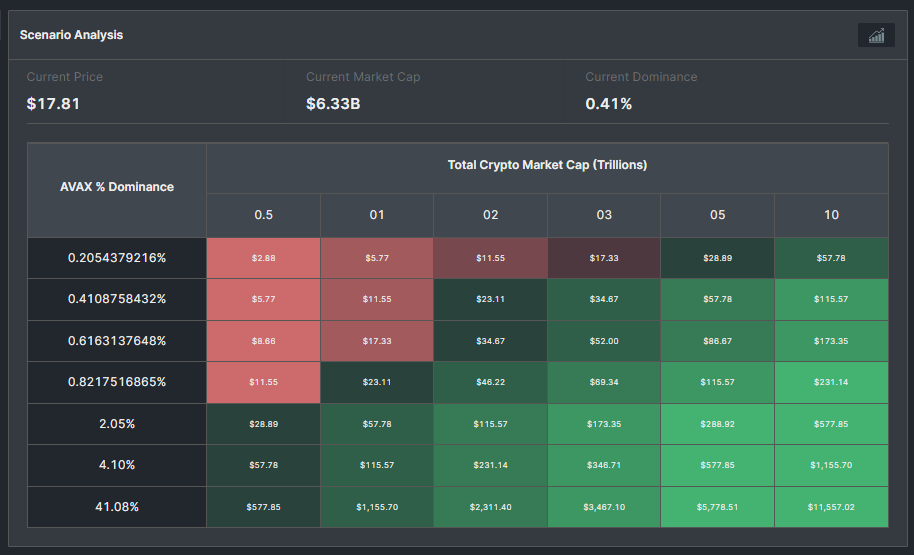
Avalanche (AVAX) Price Prediction - Scenario Analysis

To make accurate price predictions, it is crucial to consider different scenarios that can impact AVAX's price. Let's analyze two scenarios - a bullish and a bearish- to understand the potential price movements of AVAX better.

AVAX Price Prediction - Bullish Scenario

If the crypto market cap hits $3 Trillion, and if AVAX retains its current 0.41% dominance, its price could ascend to $34.67

In a more bullish scenario of the crypto market surging to $10 Trillion, AVAX's price could soar to a staggering $115.57, resulting in a potential 7x return for investors.

AVAX Price Prediction
Start Your Free Trial Today and Uncover Your Token's Price Prediction and Forecast on Token Metrics.

AVAX Price Prediction - Bearish Scenario

In a bearish scenario, where market conditions are unfavorable or there is increased competition, the price of AVAX may face downward pressure with a decreased dominance of 0.20%. 

In this scenario, If the crypto market cap hits $3 Trillion, AVAX could trade around $17.33 in the short term and struggle to surpass $57.78 by 2030 even if the total crypto market cap surpasses the $10 Trillion mark.

It is essential to note that these scenarios are speculative and should not be considered financial advice. The cryptocurrency market is highly volatile, and prices can fluctuate rapidly.

Click here to buy Cryptocurrencies from Gate.io

Avalanche (AVAX) Price Prediction - Industry Expert Opinion

To gain further insights into AVAX's future price movements, it is essential to consider the opinions of industry experts. While price predictions can vary, many experts believe that AVAX has the potential for significant growth in the coming years. 

Coincodex.com platform predicts Avalanche (AVAX) could reach $ 63.40 to $ 80.24 by 2030, and experts from Changelly forecast that it could reach minimum and maximum prices of $30.04 and $34.85 by the end of 2025. By the end of 2030, the price of AVAX could reach $185.25 to $221.39

Other industry analysts have varying opinions on the future price of AVAX. Ambcrypto.com predicts that Avalanche (AVAX) could reach $28.15 to $42.23 in 2030. 

This long-term projection and an optimistic outlook are based on the belief that AVAX's ongoing developments and growing adoption will drive its value.

Note - Start Your Free Trial Today and Uncover Your Token's Price Prediction and Forecast on Token Metrics.

Is Avalanche (AVAX) Good to Invest?

Investing in cryptocurrency carries certain risks, including market volatility and regulatory uncertainty. However, many investors see potential in Avalanche due to its unique features, fast transaction speed, and the growing popularity of decentralized finance (DeFi) applications. 

Before making any investment decisions, conducting thorough research, assessing your risk tolerance, and consulting with a financial advisor are crucial.

Risks and Rewards

As with any investment, risks and rewards are associated with investing in AVAX. The rewards of investing in AVAX include the potential for significant price appreciation, especially if the platform continues to gain adoption and attract more users. 

Additionally, AVAX holders can earn staking rewards by participating in the network's proof-of-stake consensus mechanism.

However, it's important to note that investing in AVAX also carries risks. The cryptocurrency market is highly volatile, and AVAX's price can fluctuate quickly. 

Regulatory changes, security breaches, and market sentiment can all impact AVAX's price. It's crucial to carefully assess these risks before making any investment decisions.

Ongoing Developments and Future Potential of Avalanche

Avalanche has been making significant strides in terms of development and partnerships. The platform has attracted several high-profile projects and collaborations, contributing to its growing ecosystem. 

Ongoing developments, such as upgrades to the network and the introduction of new features, can further enhance the functionality and appeal of Avalanche.

Additionally, Avalanche's focus on scalability, affordability, and eco-friendliness positions it well to capitalize on the growing demand for decentralized applications and the broader adoption of blockchain technology. As the cryptocurrency market continues to evolve, Avalanche's potential for future growth remains promising.

Conclusion

In conclusion, Avalanche (AVAX) has shown strong potential as a decentralized smart contract platform. While price predictions can vary, it's clear that AVAX has the potential for significant growth in the coming years. 

Investors should carefully consider the risks and rewards of investing in AVAX and conduct thorough research before making investment decisions. As with any investment, it's important to stay informed, diversify your portfolio, and consult with a financial advisor.

Frequently Asked Questions

Q1. How much will AVAX be worth in the future?

AVAX's future value will depend on market trends, adoption rates, technological developments, and overall crypto market health. In a bullish scenario of the total crypto market surging to $10 Trillion, AVAX's price could soar to a staggering $115.57.

Q2. What will Avalanche be worth in 2030?

Predicting Avalanche's 2030 value is speculative. The long-term price depends on adoption, tech innovation, and crypto ecosystem changes. Changelly forecast that, by the end of 2030, the price of AVAX could reach $185.25 to $221.39

Q3. Why is AVAX dropping?

AVAX may drop due to market volatility, negative news of recent security breaches, sell-offs, or broader economic factors impacting the cryptocurrency markets.

Q4. Is AVAX a good project?

Many consider AVAX a good project due to its fast transaction speeds, low fees, and eco-friendly proof-of-stake consensus mechanism.

Q5. What factors can affect the price of AVAX?

AVAX's price is influenced by market sentiment, adoption rates, network upgrades, regulatory news, and the performance of decentralized applications on its platform.

Q6. How can I analyze Avalanche price movements?

Analyzing Avalanche (AVAX) price movements and studying market trends is simple. You can check the Token Metrics platform for all the data, bullish and bearish trends, project tokenomics, and short-term price predictions, all in one place.

Q7. What do industry experts say about AVAX's future?

Industry experts are optimistic about AVAX's future, citing its strong development team, innovative technology, and growing ecosystem of applications.

Disclaimer

The information provided on this website does not constitute investment advice, financial advice, trading advice, or any other advice, and you should not treat any of the website's content as such.

Token Metrics does not recommend that any cryptocurrency should be bought, sold, or held by you. Conduct your due diligence and consult your financial advisor before making investment decisions.

Click here to buy Cryptocurrencies from Gate.io

Choose from Platinum, Gold, and Silver packages
Reach with 25–30% open rates and 0.5–1% CTR
Craft your own custom ad—from banners to tailored copy
Perfect for Crypto Exchanges, SaaS Tools, DeFi, and AI Products