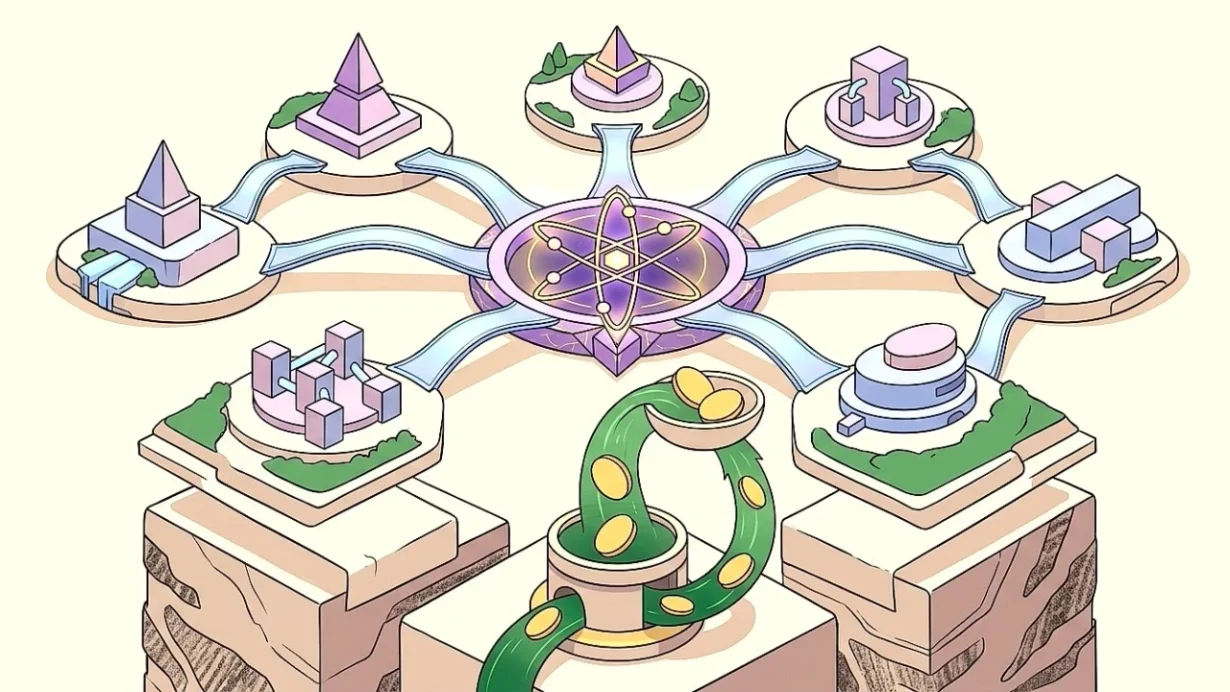

Quick answer: Cosmos is a network family and software stack for independent blockchains. Cosmos Hub is one chain in that family. ATOM is the primary token of Cosmos Hub, where it supports fees, proof-of-stake security, and voting.
The key distinction is simple. Cosmos Hub is not the same thing as every chain built with the Cosmos SDK. ATOM also does not capture all activity across those chains. This guide explains the parts, how they connect, and what to verify before using or evaluating ATOM.
Cosmos (ATOM) research checklist for 2026
Use the official Cosmos documentation to separate Cosmos Hub facts from the wider ecosystem. The Cosmos Hub docs cover Hub rules, ATOM, delegation, voting, wallets, and explorers; the Cosmos SDK docs, IBC docs, and CometBFT docs describe the broader technology stack.
- Before staking: verify the validator’s uptime, commission, voting record, self-delegation, and current unbonding rules on live network sources.
- Before using IBC: confirm the route, channel, relayer, destination chain, asset denomination, and liquidity; cross-chain messaging does not remove application or market risk.
- Before evaluating ATOM: connect the thesis to Cosmos Hub demand, supply changes, governance, security, and liquidity instead of treating activity on every SDK chain as ATOM demand.
Network software, validator terms, governance proposals, and market conditions can change. Recheck the linked official sources before using or buying ATOM.
Cosmos, Cosmos Hub, and ATOM at a glance
| Term | What it means | What it does not mean |
|---|---|---|
| Cosmos | A network family and technology stack for sovereign blockchains | One chain controlled by one operator |
| Cosmos Hub | The first production chain in the network and the home of ATOM | A required settlement layer for every Cosmos-based chain |
| ATOM | The primary token of Cosmos Hub | A direct claim on every app, fee, or chain in the wider network |
| Cosmos SDK | A modular framework for building custom blockchains | A token or consumer app |
| IBC | A protocol for verified communication between compatible chains | A bridge that removes all smart-contract, route, or asset risk |
| CometBFT | Consensus and networking software used by many Cosmos SDK chains | The business logic of every chain |
What is Cosmos Hub?
The official Cosmos Hub documentation describes it as the first of many interconnected blockchains powered by CometBFT, the Cosmos SDK, and IBC. ATOM is its primary token.
Cosmos Hub has its own validators, voting, ledger, and upgrade process. Other Cosmos SDK chains can set different rules. They may use another token, validator set, voting model, or fee design.
This matters for research. A new chain joining the wider network does not by itself create demand for ATOM. Check whether it uses Cosmos Hub security or routes value through the Hub. It may pay for a Hub service, or it may operate on its own.
What is ATOM used for?
Fees
Users can pay transaction fees on Cosmos Hub with supported fee tokens. Fees cover the network resources used by a transaction. Fee rules can change through software and community votes. Check the live chain before relying on a fixed cost.
Staking and network security
Cosmos Hub uses proof of stake. ATOM holders can delegate tokens to validators. Delegation helps determine validator voting power and can earn protocol rewards.
Rewards are not risk-free yield. A validator can miss blocks, charge commission, or be penalized for certain faults. Unbonding also takes time. During that period, market value can change and the tokens may not be available to sell.
Governance
ATOM can be used in on-chain voting. Proposals may address software upgrades, community funds, network settings, or other Hub policies. Review the full proposal, deposit status, voting window, and rollout path. A passed vote can still require careful software work.
The Cosmos Hub proposal forum provides discussion context. Confirm the final vote and chain state through an explorer or node.
How the Cosmos technology stack works
Cosmos SDK
The Cosmos SDK is a modular framework for building blockchains. Developers can combine modules for accounts, staking, voting, token transfers, and custom chain logic.
A shared framework can reduce repeated engineering work. It does not make every chain identical. Each chain chooses its modules, settings, upgrade policy, and operating rules.
CometBFT
CometBFT provides Byzantine fault tolerant consensus and peer-to-peer networking. It helps validators agree on ordered blocks while the application defines how transactions change state.
Consensus software is only one security layer. Wallets, validators, app code, relayers, voting, dependencies, and user behavior can still fail.
IBC
The Inter-Blockchain Communication protocol lets compatible chains verify messages and transfer data through clients, connections, channels, and relayers. The receiving chain can represent a transferred asset as an IBC denomination tied to its path.
IBC reduces the need to trust one central bridge operator, but it does not remove all risk. Check the source chain, destination chain, channel, asset path, relayer state, and application contract. A token with the same display symbol may have a different origin or route.
How to evaluate ATOM without relying on a price target
- Separate ecosystem growth from Hub value. Identify the exact way Cosmos Hub or ATOM benefits from an activity.
- Check security demand. Review delegated stake, validator concentration, downtime, slashing history, and any shared-security relationships.
- Track token supply. Compare issuance, rewards, burns, community-pool use, and circulating supply. Do not rely on an old fixed supply figure.
- Review real use. Look at transactions, fees, active accounts, IBC volume, voting turnout, and recurring apps.
- Inspect voting. Read proposals before assuming a roadmap item is approved or deployed.
- Compare alternatives. Measure Cosmos Hub against other interoperability, application-chain, and shared-security designs.
- Define failure conditions. Write down what would weaken the thesis before taking risk.
ATOM staking checklist
- Validator: review uptime, commission, voting history, self-delegation, and public operations.
- Custody: confirm who controls the keys and how recovery works.
- Unbonding: verify the current delay from live network data.
- Slashing: understand which validator faults can reduce delegated tokens.
- Rewards: separate nominal reward rate from supply growth, fees, commission, and taxes.
- Concentration: spreading stake can reduce dependence on one validator, but it adds more accounts to monitor.
- Liquid staking: add smart-contract, peg, liquidity, and provider risks when using a derivative.
Compare staking workflows in our crypto staking platform guide. Protect recovery phrases and signing devices with the Token Metrics crypto security checklist.
Main Cosmos and ATOM risks
- Market risk: ATOM can lose value even when network activity grows.
- Value-capture risk: Cosmos-based chains can operate without creating direct demand for ATOM.
- Validator risk: downtime, misconduct, or concentration can weaken staking outcomes and network resilience.
- Software risk: bugs can affect consensus, modules, wallets, relayers, or applications.
- IBC path risk: users can choose the wrong route, asset origin, channel, or destination.
- Voting risk: low turnout, rushed upgrades, or disputed proposals can change network rules.
- Custody risk: lost keys, phishing, bad signatures, and weak backups can cause permanent loss.
- Regulatory and tax risk: staking rewards, token use, and service access may be treated differently by jurisdiction.
Cosmos publishes a security and maintenance policy and an audit index. These are useful inputs, not proof that every chain or app is safe.
Live checks to run before acting
- Open the official Cosmos Hub docs and confirm current network guidance.
- Use a reputable Cosmos Hub explorer to review validators, proposals, supply, fees, and recent blocks.
- Verify the exact token denomination and IBC path on both chains.
- Read the latest Hub proposal and upgrade notes instead of relying on social posts.
- Test a small transfer before moving a large amount to a new address or IBC route.
- Recheck wallet, exchange, tax, and service availability for your jurisdiction.
Is ATOM a good investment?
That depends on price, time horizon, risk tolerance, and whether Cosmos Hub can create durable demand for its security and services. Wider network adoption alone is not enough. The research case should connect real use to ATOM, account for supply changes, and define what would disprove the view.
Do not use one staking rate, one IBC chart, or one partnership as the whole thesis. Compare several independent measures and update the view when voting or network design changes.
Use Token Metrics to compare crypto market, risk, and research signals
Frequently asked questions
What is Cosmos in crypto?
Cosmos is an ecosystem and technology stack for independent blockchains. Cosmos Hub is one chain in that ecosystem, and ATOM is the Hub’s primary token.
What is ATOM used for?
ATOM supports Cosmos Hub fees, staking, validator incentives, and governance. It is not a direct claim on all activity across Cosmos-based chains.
What are the main risks of staking ATOM?
Risks include price changes, validator faults, slashing, unbonding delays, custody loss, software problems, governance changes, and tax obligations.
Sources checked
- Cosmos Hub docs — Hub, ATOM, delegation, voting, wallets, and explorers.
- Cosmos SDK docs — modular blockchain framework and app design.
- IBC docs — cross-chain clients, connections, channels, and relayers.
- CometBFT docs — consensus and peer-to-peer networking.
- Cosmos security policy and audit index — maintenance scope and published reviews.
Disclosure and disclaimer
Token Metrics may earn revenue from some products or partners. That does not change this explainer. This guide is educational and is not financial, legal, tax, custody, or investment advice. Crypto assets are volatile, staking can cause losses, and network rules can change.