Back to blog
Crypto Basics

Initial DEX Offering (IDO) - A Detailed Guide for Beginners

Discover the ins and outs of Initial DEX Offering (IDO) with our comprehensive guide. Learn how to participate and succeed in IDO launches.
S. Vishwa
9 Minutes
Want Smarter Crypto Picks—Free?
See unbiased Token Metrics Ratings for BTC, ETH, and top alts.
Thank you! Your submission has been received!
Oops! Something went wrong while submitting the form.
 No credit card | 1-click unsubscribe

In the maturing landscape of the cryptocurrency industry, new fundraising approaches have emerged, including the Initial DEX Offering (IDO). 

The IDO is a creative and decentralized crowdfunding model that addresses the shortcomings of its predecessor, the Initial Coin Offering (ICO). 

ICOs gained popularity in 2017 but were plagued with issues such as lack of control, investor protections, and numerous scams. The negative reputation of ICOs cast a shadow over the crypto industry, deterring potential investors.

On the other hand, the IDO is a fundraising method that leverages decentralized exchanges (DEXs) to pool investment capital from retail investors. It offers a more egalitarian crowdfunding model and aims to provide immediate token liquidity. 

While IDOs have limitations, such as scalability, compared to ICOs and IEOs, they have gained popularity in the crypto space due to their decentralized and fair nature.

What is an Initial DEX Offering?

An Initial DEX Offering (IDO) is a decentralized and permissionless crowdfunding method that leverages decentralized exchanges (DEXs) to raise funds for crypto projects. 

Unlike traditional fundraising models such as Initial Coin Offerings (ICOs), IDOs provide immediate token liquidity and ensure a fair and transparent distribution of tokens. By utilizing DEXs, IDOs eliminate the need for intermediaries and offer greater control and transparency to investors.

How Do IDOs Work?

It is crucial to understand how IDOs work to grasp the concept of DEXs. DEXs are decentralized liquidity exchanges that operate on blockchain networks. 

They allow users to trade digital assets directly from their wallets without intermediaries. IDOs leverage the decentralized nature of DEXs to facilitate fundraising for crypto projects.

Step-by-Step Process to Launch an IDO

Launching a successful IDO requires careful planning and execution. Here is a step-by-step process to guide project teams through the IDO launch:

Step 1: Devise a Business Strategy

Before launching an IDO, the project team should develop a comprehensive business strategy. This strategy should outline the project's goals, target audience, fund allocation, marketing plan, and post-IDO plans. Having a well-defined strategy, the team can effectively communicate their vision to potential investors.

Step 2: Create Marketing Collateral

To attract investors, the project team must create compelling marketing collateral. This includes designing a visually appealing website showcasing the project's unique selling points and providing information about the project's team. 

Also, a well-crafted white paper should outline the project's technical details, tokenomics, and roadmap.

Step 3: Partner with a DEX Launchpad

The project team must partner with a DEX launchpad to launch an IDO. These launchpads serve as a platform for projects to gain exposure and access a broader investor base. 

The team must ensure that their project meets the launchpad's requirements, including compatibility with the consensus mechanism and whitelisting.

Step 4: Create the Cryptocurrency

Using tools like CoinTool, the project team can create their cryptocurrency or token. This process involves defining the token's parameters, such as total supply, token name, symbol, and additional features or functionalities. Once the token is created, the team should conduct thorough testing to ensure its functionality and security.

Step 5: Launch the Token and Raise Funds

The project team can start the token sale with the IDO launchpad's approval. During this phase, investors can purchase the project's tokens at a discounted rate. 

The team may incentivize early investors with additional benefits or rewards to encourage participation. The goal is to raise funds and generate liquidity for the project.

Step 6: Provide Liquidity and List the Token

After the IDO, the project team allocates a portion of the raised funds to provide liquidity on the DEX. This helps ensure a healthy trading environment for the token. 

Simultaneously, the team lists the token on the DEX, making it available for trading to the general public. This immediate listing allows investors to buy and sell the token without any waiting period.

Step 7: Post-IDO Support and Growth

Once the IDO is complete, the project team must focus on sustaining the momentum and supporting the token's growth. This involves engaging with the community, updating investors on project developments, and promoting the token's adoption. 

Ongoing marketing efforts and strategic partnerships can drive demand for the token and contribute to its long-term success.

This step-by-step process allows project teams to launch a successful IDO and raise funds to support their crypto project.

Successful Projects Launched From IDOs

The IDO model has launched successful crypto projects. Here are a few notable examples:

1. Raven Protocol IDO

Raven Protocol, a decentralized deep-learning training protocol, conducted one of the first IDOs in June 2019. The project aimed to transform the AI and machine learning industries by leveraging blockchain technology. Through their IDO, Raven Protocol raised funds and gained exposure on the Binance DEX.

2. Universal Market Access Protocol IDO

The Universal Market Access (UMA) protocol, which enables DeFi developers to create synthetic assets on the Ethereum blockchain, also conducted a successful IDO. 

Despite initial issues during the IDO launch, UMA overcame challenges and achieved significant growth. The project's token, UMA, has gained traction in recent times.

3. SushiSwap IDO

SushiSwap, a decentralized exchange built on Ethereum, launched through an IDO and quickly gained popularity as an alternative to Uniswap. It allowed users to migrate over $1.14 billion worth of assets from Uniswap to SushiSwap. The IDO model enabled SushiSwap to distribute its tokens fairly, without favoritism towards insiders or early investors.

These successful projects demonstrate the potential of IDOs as a fundraising model. By leveraging the decentralized nature of DEXs, projects can raise funds, gain exposure, and build a community around their tokens.

Advantages and Disadvantages of IDOs

Like any fundraising model, IDOs have their own advantages and disadvantages. Understanding these pros and cons is essential for project teams considering the IDO approach.

Advantages of IDOs

  1. Decentralization: IDOs operate on decentralized exchanges, ensuring transparency, fairness, and equal opportunities for all participants.
  2. Immediate Liquidity: IDOs provide immediate liquidity for the project's token by listing it on the DEX after the sale. This allows investors to buy and sell the token without any waiting period.
  3. Lower Entry Barriers: IDOs have lower entry barriers than traditional fundraising methods like ICOs. Small teams with innovative ideas can gain access to capital and launch their projects.
  4. Community Involvement: IDOs often rely on community support and engagement. Vocal community members play a crucial role in vetting projects and tokens, enhancing the project's reach and credibility.

Disadvantages of IDOs

  1. Scalability: DEXs, the primary platform for IDOs, currently have limitations in terms of scalability compared to centralized exchanges. This can impact the amount of funds raised through an IDO.
  2. Technical Vulnerabilities: DEXs and smart contracts used in IDOs can be vulnerable to technical exploits and bugs. Hackers have exploited these vulnerabilities in the past, leading to loss of funds.
  3. Learning Curve: DEXs and DeFi platforms, in general, can have a steep learning curve, deterring potential investors who are unfamiliar with the technology. Education and user-friendly interfaces are needed to address this challenge.
  4. Lower Fundraising Amounts: Compared to ICOs, IDOs typically raise smaller amounts of funds. While this can be advantageous for smaller projects, it may limit the growth potential for larger-scale initiatives.

Despite these disadvantages, IDOs offer a promising alternative to traditional fundraising models. With proper precautions and education, the IDO model has the potential to drive innovation, support new projects, and foster a more inclusive crypto ecosystem.

Alternatives to IDOs

While IDOs have gained popularity, there are other fundraising options available to crypto projects. Other alternatives include:

  1. Initial Coin Offerings (ICOs): Although ICOs have faced criticism, they remain viable for projects that prefer a centralized approach and have the resources to navigate regulatory requirements.
  2. Initial Exchange Offerings (IEOs): IEOs involve partnering with a centralized exchange to conduct the token sale. This model offers greater visibility and access to a more extensive investor base.
  3. Security Token Offerings (STOs): STOs issue security tokens that comply with regulatory frameworks. STOs provide investors with legal rights and ownership of the project.
  4. Venture Capital (VC) Funding: Traditional venture capital firms invest in crypto projects. VC funding offers financial support, industry expertise, and valuable connections.

Each fundraising method has pros and cons, and project teams should carefully consider their goals, resources, and target audience before choosing the most suitable approach.

Differences Between an ICO and an IDO

While ICOs and IDOs are both fundraising models in the crypto space, they differ in several key aspects:

  1. Control and Regulation: ICOs operate in a largely unregulated environment, whereas IDOs leverage the decentralized nature of DEXs, providing more control and transparency to investors.
  2. Investor Protections: ICOs often lack investor protection, leading to numerous scams and fraudulent projects. IDOs aim to address this issue by providing fair token access and eliminating pre-mines.
  3. Token Liquidity: IDOs offer immediate token liquidity by listing the token on the DEX after the sale. ICOs typically require a waiting period before the token is listed on centralized exchanges.
  4. Fundraising Amounts: ICOs historically raised larger funds than IDOs. However, IDOs allow smaller projects to raise capital and gain exposure.
  5. Centralization vs. Decentralization: ICOs rely on centralized exchanges and intermediaries, whereas IDOs leverage the decentralized nature of DEXs, fostering a more inclusive and transparent fundraising environment.

Project teams and investors must understand these differences when considering their fundraising options and evaluating potential investment opportunities.

Future Outlook - Initial DEX Offering

The future of Initial DEX Offerings (IDOs) looks promising as the crypto industry continues to evolve. IDOs have gained traction due to their decentralized and transparent nature, offering an alternative to traditional fundraising models. 

While they may face scalability challenges and technical vulnerabilities, ongoing advancements in blockchain technology and user-friendly interfaces are expected to address these issues.

As the DeFi space matures, more projects will likely explore IDOs as a fundraising option. Educational initiatives and improved accessibility will be crucial in attracting more investors, including those new to crypto. 

Also, regulatory frameworks may evolve to provide more precise guidelines for IDOs, striking a balance between innovation and investor protection.

The future of IDOs also depends on developing DEXs as scalable and user-friendly platforms. Improvements in liquidity, trading interfaces, and security measures will enhance the overall IDO experience, attracting more projects and investors to participate.

Conclusion

In conclusion, IDOs have emerged as a decentralized and fair fundraising model in the crypto industry. While they have advantages and challenges, IDOs offer an inclusive and transparent approach to raising funds for innovative projects. 

As the crypto ecosystem continues to evolve, IDOs are expected to play a significant role in shaping the future of fundraising in the digital asset space.

Disclaimer

The information provided on this website does not constitute investment advice, financial advice, trading advice, or any other advice, and you should not treat any of the website's content as such.

Token Metrics does not recommend buying, selling, or holding any cryptocurrency. Conduct your due diligence and consult your financial advisor before making investment decisions.

Build Smarter Crypto Apps &
AI Agents in Minutes, Not Months
Real-time prices, trading signals, and on-chain insights all from one powerful API.
Grab a Free API Key
About Token Metrics
Token Metrics: AI-powered crypto research and ratings platform. We help investors make smarter decisions with unbiased Token Metrics Ratings, on-chain analytics, and editor-curated “Top 10” guides. Our platform distills thousands of data points into clear scores, trends, and alerts you can act on.
30 Employees
analysts, data scientists, and crypto engineers
Daily Briefings
concise market insights and “Top Picks”
Transparent & Compliant
Sponsored ≠ Ratings; research remains independent
Want Smarter Crypto Picks—Free?
See unbiased Token Metrics Ratings for BTC, ETH, and top alts.
Thank you! Your submission has been received!
Oops! Something went wrong while submitting the form.
 No credit card | 1-click unsubscribe
Token Metrics Team
Token Metrics Team

Recent Posts

Research

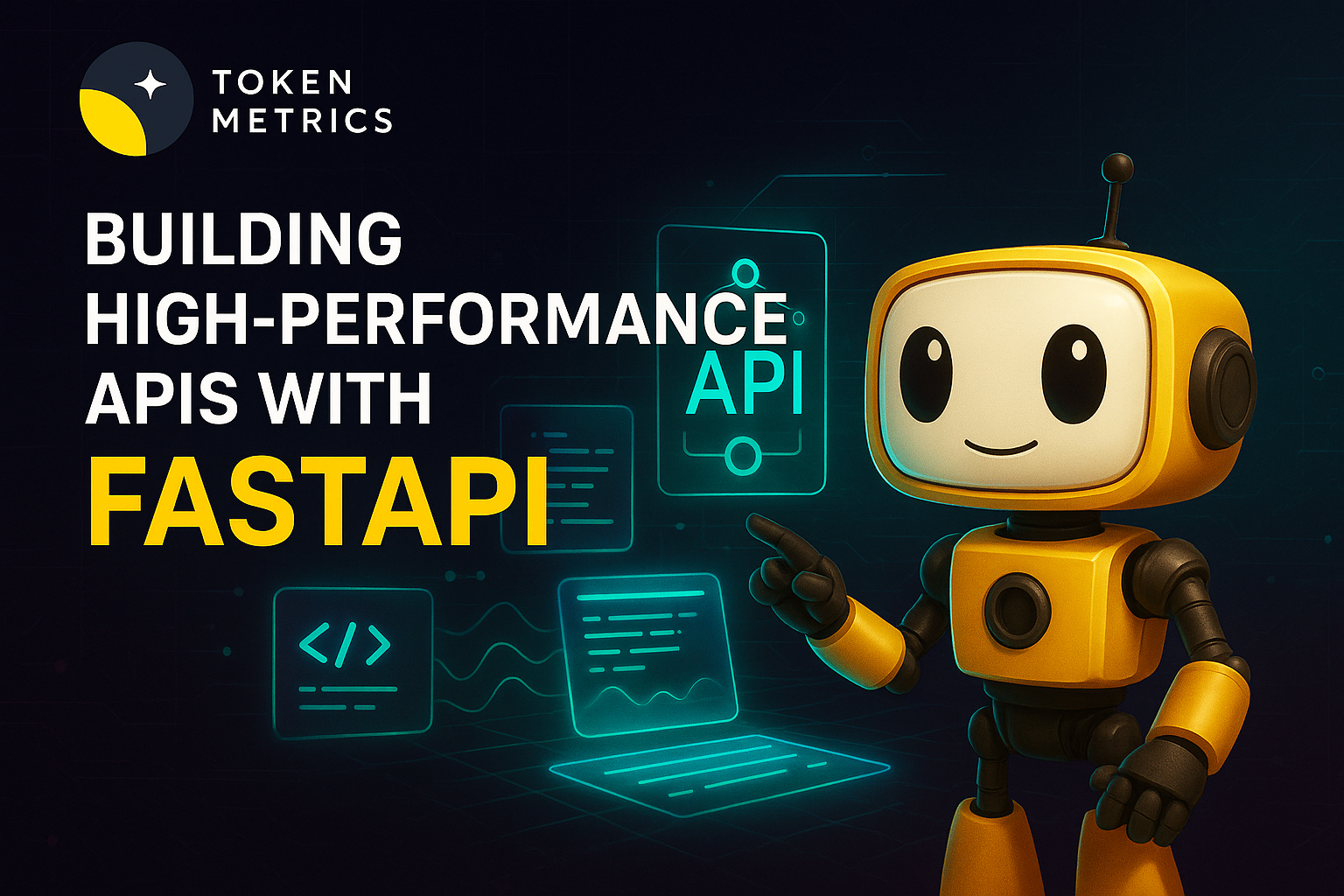
Building High-Performance APIs with FastAPI

Token Metrics Team
5

FastAPI has emerged as a go-to framework for building fast, scalable, and developer-friendly APIs in Python. Whether you are prototyping a machine learning inference endpoint, building internal microservices, or exposing realtime data to clients, understanding FastAPI’s design principles and best practices can save development time and operational costs. This guide walks through the technology fundamentals, pragmatic design patterns, deployment considerations, and how to integrate modern AI tools safely and efficiently.

Overview: What Makes FastAPI Fast?

FastAPI is built on Starlette for the web parts and Pydantic for data validation. It leverages Python’s async/await syntax and ASGI (Asynchronous Server Gateway Interface) to handle high concurrency with non-blocking I/O. Key features that contribute to its performance profile include:

  • Async-first architecture: Native support for asynchronous endpoints enables efficient multiplexing of I/O-bound tasks.
  • Automatic validation and docs: Pydantic-based validation reduces runtime errors and generates OpenAPI schemas and interactive docs out of the box.
  • Small, focused stack: Minimal middleware and lean core reduce overhead compared to some full-stack frameworks.

In practice, correctly using async patterns and avoiding blocking calls (e.g., heavy CPU-bound tasks or synchronous DB drivers) is critical to achieve the theoretical throughput FastAPI promises.

Design Patterns & Best Practices

Adopt these patterns to keep your FastAPI codebase maintainable and performant:

  1. Separate concerns: Keep routing, business logic, and data access in separate modules. Use dependency injection for database sessions, authentication, and configuration.
  2. Prefer async I/O: Use async database drivers (e.g., asyncpg for PostgreSQL), async HTTP clients (httpx), and async message brokers when possible. If you must call blocking code, run it in a thread pool via asyncio.to_thread or FastAPI’s background tasks.
  3. Schema-driven DTOs: Define request and response models with Pydantic to validate inputs and serialize outputs consistently. This reduces defensive coding and improves API contract clarity.
  4. Version your APIs: Use path or header-based versioning to avoid breaking consumers when iterating rapidly.
  5. Pagination and rate limiting: For endpoints that return large collections, implement pagination and consider rate-limiting to protect downstream systems.

Applying these patterns leads to clearer contracts, fewer runtime errors, and easier scaling.

Performance Tuning and Monitoring

Beyond using async endpoints, real-world performance tuning focuses on observability and identifying bottlenecks:

  • Profiling: Profile endpoints under representative load to find hotspots. Tools like py-spy or Scalene can reveal CPU vs. I/O contention.
  • Tracing and metrics: Integrate OpenTelemetry or Prometheus to gather latency, error rates, and resource metrics. Correlate traces across services to diagnose distributed latency.
  • Connection pooling: Ensure database and HTTP clients use connection pools tuned for your concurrency levels.
  • Caching: Use HTTP caching headers, in-memory caches (Redis, Memcached), or application-level caches for expensive or frequently requested data.
  • Async worker offloading: Offload CPU-heavy or long-running tasks to background workers (e.g., Celery, Dramatiq, or RQ) to keep request latency low.

Measure before and after changes. Small configuration tweaks (worker counts, keepalive settings) often deliver outsized latency improvements compared to code rewrites.

Deployment, Security, and Scaling

Productionizing FastAPI requires attention to hosting, process management, and security hardening:

  • ASGI server: Use a robust ASGI server such as Uvicorn or Hypercorn behind a process manager (systemd) or a supervisor like Gunicorn with Uvicorn workers.
  • Containerization: Containerize with multi-stage Dockerfiles to keep images small. Use environment variables and secrets management for configuration.
  • Load balancing: Place a reverse proxy (NGINX, Traefik) or cloud load balancer in front of your ASGI processes to manage TLS, routing, and retries.
  • Security: Validate and sanitize inputs, enforce strict CORS policies, and implement authentication and authorization (OAuth2, JWT) consistently. Keep dependencies updated and monitor for CVEs.
  • Autoscaling: In cloud environments, autoscale based on request latency and queue depth. For stateful workloads or in-memory caches, ensure sticky session or state replication strategies.

Combine operational best practices with continuous monitoring to keep services resilient as traffic grows.

Build Smarter Crypto Apps & AI Agents with Token Metrics

Token Metrics provides real-time prices, trading signals, and on-chain insights all from one powerful API. Grab a Free API Key

FAQ: How fast is FastAPI compared to Flask or Django?

FastAPI often outperforms traditional WSGI frameworks like Flask or Django for I/O-bound workloads because it leverages ASGI and async endpoints. Benchmarks depend heavily on endpoint logic, database drivers, and deployment configuration. For CPU-bound tasks, raw Python performance is similar; offload heavy computation to workers.

FAQ: Should I rewrite existing Flask endpoints to FastAPI?

Rewrite only if you need asynchronous I/O, better schema validation, or automatic OpenAPI docs. For many projects, incremental migration or adding new async services is a lower-risk approach than a full rewrite.

FAQ: How do I handle background tasks and long-running jobs?

Use background workers or task queues (Celery, Dramatiq) for long-running jobs. FastAPI provides BackgroundTasks for simple fire-and-forget operations, but distributed task systems are better for retries, scheduling, and scaling.

FAQ: What are common pitfalls when using async in FastAPI?

Common pitfalls include calling blocking I/O inside async endpoints (e.g., synchronous DB drivers), not using connection pools properly, and overusing threads. Always verify that third-party libraries are async-compatible or run them in a thread pool.

FAQ: How can FastAPI integrate with AI models and inference pipelines?

FastAPI is a good fit for serving model inference because it can handle concurrent requests and easily serialize inputs and outputs. For heavy inference workloads, serve models with dedicated inference servers (TorchServe, TensorFlow Serving) or containerized model endpoints and use FastAPI as a thin orchestration layer. Implement batching, request timeouts, and model versioning to manage performance and reliability.

Disclaimer

This article is educational and technical in nature. It does not provide investment, legal, or professional advice. Evaluate tools and design decisions according to your project requirements and compliance obligations.

Research

Fast, Reliable APIs with FastAPI

Token Metrics Team
5

Fast API design is no longer just about response time — it’s about developer ergonomics, safety, observability, and the ability to integrate modern AI services. FastAPI (commonly referenced by the search phrase "fast api") has become a favored framework in Python for building high-performance, async-ready APIs with built-in validation. This article explains the core concepts, best practices, and deployment patterns to help engineering teams build reliable, maintainable APIs that scale.

Overview: What makes FastAPI distinct?

FastAPI is a Python web framework built on top of ASGI standards (like Starlette and Uvicorn) that emphasizes developer speed and runtime performance. Key differentiators include automatic request validation via Pydantic, type-driven documentation (OpenAPI/Swagger UI generated automatically), and first-class async support. Practically, that means less boilerplate, clearer contracts between clients and servers, and competitive throughput for I/O-bound workloads.

Async model and performance considerations

At the heart of FastAPI’s performance is asynchronous concurrency. By leveraging async/await, FastAPI handles many simultaneous connections efficiently, especially when endpoints perform non-blocking I/O such as database queries, HTTP calls to third-party services, or interactions with AI models. Important performance factors to evaluate:

  • ASGI server choice: Uvicorn and Hypercorn are common; tuning workers and loop settings affects latency and throughput.
  • Blocking calls: Avoid CPU-bound work inside async endpoints; offload heavy computation to worker processes or task queues.
  • Connection pooling: Use async database drivers and HTTP clients (e.g., asyncpg, httpx) with pooled connections to reduce latency.
  • Metrics and profiling: Collect request duration, error rates, and concurrency metrics to identify hotspots.

Design patterns: validation, schemas, and dependency injection

FastAPI’s integration with Pydantic makes data validation explicit and type-driven. Use Pydantic models for request and response schemas to ensure inputs are sanitized and outputs are predictable. Recommended patterns:

  • Separate DTOs and domain models: Keep Pydantic models for I/O distinct from internal database or business models to avoid tight coupling.
  • Dependencies: FastAPI’s dependency injection simplifies authentication, database sessions, and configuration handling while keeping endpoints concise.
  • Versioning and contracts: Expose clear OpenAPI contracts and consider semantic versioning for breaking changes.

Integration with AI services and external APIs

Many modern APIs act as orchestrators for AI models or third-party data services. FastAPI’s async-first design pairs well with calling model inference endpoints or streaming responses. Practical tips when integrating AI services:

  • Use async clients to call external inference or data APIs to prevent blocking the event loop.
  • Implement robust timeouts, retries with backoff, and circuit breakers to handle intermittent failures gracefully.
  • Cache deterministic responses where appropriate, and use paginated or streaming responses for large outputs to reduce memory pressure.

Deployment, scaling, and observability

Deploying FastAPI to production typically involves containerized ASGI servers, an API gateway, and autoscaling infrastructure. Core operational considerations include:

  • Process model: Run multiple Uvicorn workers per host for CPU-bound workloads or use worker pools for synchronous tasks.
  • Autoscaling: Configure horizontal scaling based on request latency and queue length rather than CPU alone for I/O-bound services.
  • Logging and tracing: Integrate structured logs, distributed tracing (OpenTelemetry), and request/response sampling to diagnose issues.
  • Security: Enforce input validation, rate limiting, authentication layers, and secure secrets management.

Build Smarter Crypto Apps & AI Agents with Token Metrics

Token Metrics provides real-time prices, trading signals, and on-chain insights all from one powerful API. Grab a Free API Key

What is the difference between FastAPI and Flask?

FastAPI is built for the async ASGI ecosystem and emphasizes type-driven validation and automatic OpenAPI documentation. Flask is a synchronous WSGI framework that is lightweight and flexible but requires more manual setup for async support, validation, and schema generation. Choose based on concurrency needs, existing ecosystem, and developer preference.

When should I use async endpoints in FastAPI?

Use async endpoints when your handler performs non-blocking I/O such as database queries with async drivers, external HTTP requests, or calls to async message brokers. For CPU-heavy tasks, prefer background workers or separate services to avoid blocking the event loop.

How do Pydantic models help with API reliability?

Pydantic enforces input types and constraints at the boundary of your application, reducing runtime errors and making APIs self-documenting. It also provides clear error messages, supports complex nested structures, and integrates tightly with FastAPI’s automatic documentation.

What are common deployment pitfalls for FastAPI?

Common issues include running blocking code in async endpoints, inadequate connection pooling, missing rate limiting, and insufficient observability. Ensure proper worker/process models, async drivers, and graceful shutdown handling when deploying to production.

How can I test FastAPI applications effectively?

Use FastAPI’s TestClient (based on Starlette’s testing utilities) for endpoint tests and pytest for unit and integration tests. Mock external services and use testing databases or fixtures for repeatable test runs. Also include load testing to validate performance under expected concurrency.

Is FastAPI suitable for production-grade microservices?

Yes. When combined with proper patterns—type-driven design, async-safe libraries, containerization, observability, and scalable deployment—FastAPI is well-suited for production microservices focused on I/O-bound workloads and integrations with AI or external APIs.

Disclaimer

This article is for educational and informational purposes only. It does not constitute professional, legal, or investment advice. Evaluate tools and architectures according to your organization’s requirements and consult qualified professionals when needed.

Research

Free APIs: Practical Guide for Crypto & AI Developers

Token Metrics Team
5

Free APIs unlock data and functionality for rapid prototyping, research, and lightweight production use. Whether you’re building an AI agent, visualizing on-chain metrics, or ingesting market snapshots, understanding how to evaluate and integrate a free API is essential to building reliable systems without hidden costs.

What a "Free API" Really Means

Not all "free" APIs are created equal. The term generally refers to services that allow access to endpoints without an upfront fee, but differences appear across rate limits, data freshness, feature scope, and licensing. A clear framework for assessment is: access model, usage limits, data latency, security, and terms of service.

  • Access model: API key, OAuth, or anonymous endpoints determine how you authenticate and control usage.
  • Usage limits: Calls per minute/day, concurrency limits, and burst policies affect feasibility for real-time applications.
  • Data latency and granularity: Historical snapshots versus streaming updates change how you design ingestion and caching.
  • Licensing and redistribution: Check whether you can store, display, or redistribute data; free tiers often restrict commercial redistribution.
  • Support and SLA: Free tiers rarely carry guarantees—plan for graceful degradation and rate-limit handling.

How to Evaluate Free APIs: A Practical Checklist

Use a methodical approach to compare options. Below is a pragmatic checklist that helps prioritize trade-offs between cost and capability.

  1. Define requirements: identify throughput, freshness, and fields required. A small set of critical fields reduces bandwidth and simplifies caching.
  2. Measure performance: run latency and error-rate tests from your target regions. Free endpoints can be geo-constrained.
  3. Examine rate limits: build sample load tests to confirm call quotas and how the provider enforces throttling.
  4. Check data provenance: verify how data is sourced and updated; for derived metrics, inspect calculation methods and versioning.
  5. Review terms: confirm allowed use cases, retention rights, and attribution requirements.
  6. Plan fallbacks: design multi-source strategies and caching layers to mitigate outages or caps.

For crypto-specific datasets, platforms such as Token Metrics illustrate how integrated analytics and API endpoints can complement raw data feeds by adding model-driven signals and normalized asset metadata.

Integration Patterns and Best Practices

Free APIs are most effective when integrated with resilient patterns. Below are recommended practices for teams and solo developers alike.

  • Client-side throttling: implement token buckets or leaky buckets to smooth bursts and reduce 429 errors.
  • Edge caching: cache responses at the CDN or application edge, with TTLs determined by acceptable staleness.
  • Incremental syncs: prefer delta queries where supported to limit payload sizes and conserve rate limits.
  • Graceful degradation: show cached or approximate data when the API is unavailable to preserve UX continuity.
  • Monitoring & observability: track request counts, error rates, and latency; alert on policy limit warnings rather than only on failures.
  • Security: never embed API keys in public repositories; use vaults or server-side proxies for authentication.

Use Cases and Scenario Analysis

Understanding where a free API fits in your architecture depends on the scenario. Consider three common patterns:

  1. Rapid prototyping: Free API tiers let teams validate hypotheses quickly. Favor simplicity and low setup friction here; strict rate limits are acceptable for early tests.
  2. Research and backtesting: Historical endpoints with bulk download capabilities are valuable. For reproducible experiments, verify dataset completeness and snapshot timestamps.
  3. Light production workloads: Small applications can rely on free tiers if architects combine caching, retry strategies, and multi-source redundancy to manage availability risks.

When working with AI agents or automated analytics, instrument data flows and label data quality explicitly. AI-driven research tools can accelerate dataset discovery and normalization, but you should always audit automated outputs and maintain provenance records.

Build Smarter Crypto Apps & AI Agents with Token Metrics

Token Metrics provides real-time prices, trading signals, and on-chain insights all from one powerful API. Grab a Free API Key

FAQ: Common Questions About Free APIs

What limits should I expect on a free API?

Limits vary by provider but often include reduced daily/monthly call quotas, limited concurrency, and delayed data freshness. Review the provider’s rate-limit policy and test in your deployment region.

Can I use free APIs in production?

Yes for low-volume or non-critical paths, provided you incorporate caching, retries, and fallback logic. For mission-critical systems, evaluate paid tiers for SLAs and enhanced support.

How do I secure API keys for free tiers?

Store keys in environment-specific vaults, avoid client-side exposure, and rotate keys periodically. Use proxy layers to inject keys server-side when integrating client apps.

Are free APIs reliable for historical data needs?

Some free APIs provide robust historical endpoints, but completeness and retention policies differ. Validate by sampling known events and comparing across providers before depending on the dataset.

How can AI tools help when using free APIs?

AI tools can assist with data cleaning, anomaly detection, and feature extraction, making it easier to derive insight from limited free data. Always verify model outputs and maintain traceability to source calls.

What should I monitor after integrating a free API?

Track request volume, error rates (429/5xx), latency, and data staleness metrics. Set alerts for approaching throughput caps and automate graceful fallbacks to preserve user experience.

Is it legal to store and redistribute data from a free API?

Legal permissions depend on the provider’s terms. Some allow caching for display but prohibit redistribution or commercial resale. Always consult the API’s terms of service before storing or sharing data.

How do I plan for scale from a free tier?

Design with decoupled ingestion, caching, and multi-source redundancy so you can swap to paid tiers or alternative providers without significant refactoring.

Can multiple free APIs be combined?

Yes. Combining multiple sources improves resilience and data quality, but requires normalization, reconciliation logic, and latency-aware merging rules.

Disclaimer

This article is educational and informational only. It does not constitute financial, legal, or investment advice. Evaluate services and make decisions based on your own research and compliance requirements.

Choose from Platinum, Gold, and Silver packages
Reach with 25–30% open rates and 0.5–1% CTR
Craft your own custom ad—from banners to tailored copy
Perfect for Crypto Exchanges, SaaS Tools, DeFi, and AI Products