Crypto Basics

What is Peer to Peer Crypto Exchange? A Complete Guide for Beginners

Discover the essentials of peer-to-peer crypto exchanges and learn how P2P trading works. Read our guide to navigate the world of decentralized trading.
Token Metrics Team
8 min
MIN

Introduction to P2P Crypto Exchange

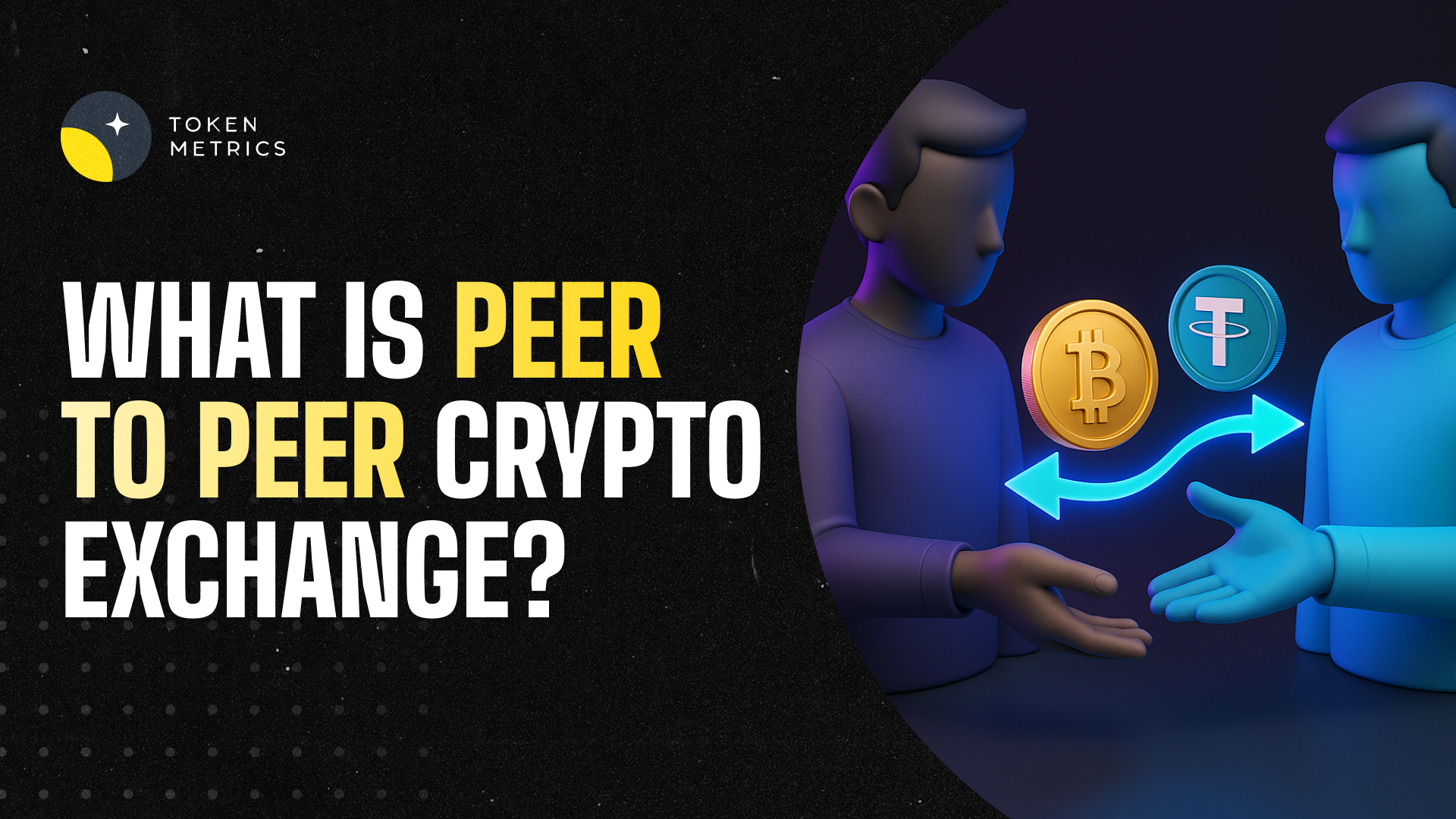
Understanding what is peer to peer crypto exchange is essential for anyone interested in trading digital assets in today’s evolving cryptocurrency market. A peer to peer (P2P) crypto exchange is a platform that enables users to trade cryptocurrencies directly with one another without the involvement of a central authority. Unlike centralized exchanges, which act as intermediaries and control the flow of transactions, P2P crypto exchanges facilitate decentralized trading, creating a secure and transparent environment for crypto trading.

This decentralized nature offers several advantages, including lower trading fees and greater control over transactions. P2P crypto exchanges are rapidly gaining popularity among users seeking a more cost-effective and convenient way to trade digital assets. By eliminating the middleman, these platforms foster a global marketplace where buyers and sellers can connect directly, making crypto trading more accessible and efficient.

How P2P Crypto Trading Works

P2P crypto trading operates by connecting buyers and sellers directly through a trading platform that acts as a facilitator rather than a controller. Users on these platforms can create personalized trading offers, specifying the amount of cryptocurrency they wish to buy or sell and the transaction terms. One of the key features of P2P trading is the flexibility in choosing payment options. Traders can select from diverse payment methods, including bank transfers, cash payments, and other convenient payment methods, depending on what suits them best.

To ensure secure and transparent transactions, P2P crypto exchanges rely heavily on escrow services. When a trade is initiated, the cryptocurrency is held in escrow by the platform until both parties confirm the transaction terms have been met. This mechanism protects users from fraud and guarantees that the digital assets are only released when the agreed conditions are fulfilled. The entire network supporting P2P crypto trading is built on blockchain technology, which validates transactions and maintains a secure ledger, ensuring fast and secure transactions across the global market.

Benefits of Decentralized Trading

Decentralized trading through P2P crypto exchanges offers multiple benefits that appeal to users looking for more control and cost savings. One of the most significant advantages is the lower trading fees compared to traditional exchanges. Since P2P platforms do not rely on a central authority to manage trades, they can operate with reduced overhead costs and pass those savings on to users.

Moreover, P2P crypto exchanges provide a secure and transparent way to trade digital assets, reducing the risk of scams that can be prevalent in other trading environments. Users enjoy more autonomy, negotiating directly with their trading partners and creating personalized trading offers tailored to their needs. This level of customization is not typically available on centralized exchanges.

The rise of decentralized finance (DeFi) has further propelled the popularity of P2P crypto exchanges. By enabling peer-to-peer transactions without intermediaries, these platforms embody the core principles of DeFi, empowering users to manage their crypto assets securely and independently.

Comparison to Traditional Exchanges

When comparing P2P crypto exchanges to traditional exchanges, several key differences stand out. Unlike traditional exchanges that often charge significant trading fees, many P2P crypto exchanges either charge minimal fees or none at all, making them a more attractive option for traders looking to maximize their returns.

Security and privacy are other critical areas where P2P platforms excel. Traditional exchanges typically require users to provide extensive personal information to comply with regulatory requirements, which can be a barrier for privacy-conscious users. In contrast, P2P crypto exchanges offer a more private and secure way to trade, often requiring less personal data while still maintaining regulatory compliance.

Additionally, P2P crypto exchanges are designed to be user-friendly and convenient, allowing users to trade digital assets directly with their chosen trading partners. This direct interaction often results in more flexible exchange rates and payment options, enhancing the overall trading experience compared to the more rigid structures of traditional exchanges.

Security Measures

Security is paramount in the world of cryptocurrency transactions, and P2P crypto exchanges implement robust security measures to protect users. Two-factor authentication (2FA) is commonly used to add an extra layer of account security, preventing unauthorized access. Escrow services play a vital role in securing transactions by holding funds until both parties confirm the trade’s completion.

Smart contracts are increasingly integrated into P2P platforms to automate and enforce transaction terms securely and transparently. These self-executing contracts reduce the risk of disputes and fraud by ensuring that trades occur only when predefined conditions are met.

In the event of disagreements, reputable P2P crypto exchanges have a dispute resolution system in place to provide fair and efficient conflict management. Additionally, some platforms utilize distributed hash tables within their network structure to enhance transaction security and transparency, ensuring that all trades rely on validated and trustworthy processes.

Payment Methods

One of the defining features of P2P crypto exchanges is their support for diverse payment methods, catering to users worldwide. Traders can select the most convenient payment method for their needs, whether that’s bank transfers, cash payments, or other secure payment methods. This flexibility allows for seamless trading of digital assets across different regions and currencies.

P2P platforms often support multiple fiat currencies, broadening the accessibility of crypto trading to a global audience. The use of escrow services further ensures that payments are secure and transparent, minimizing the risk of fraud during transactions. By accommodating a wide array of payment options, P2P crypto exchanges make it easier for users to engage in crypto trading regardless of their preferred financial systems.

Regulatory Compliance

Despite their decentralized nature, P2P crypto exchanges must adhere to regulatory compliance standards to maintain legitimacy and trust. This includes enforcing anti-money laundering (AML) and know-your-customer (KYC) regulations to verify that all users are legitimate traders and to reduce fraudulent activities.

Reputable platforms implement strict security protocols such as two-factor authentication and escrow services to protect users and comply with legal requirements. Regulatory compliance is essential not only for protecting users but also for fostering a secure trading environment that encourages wider adoption of P2P crypto trading in the global market.

The Role of P2P Crypto Exchange in the Market

P2P crypto exchanges play a pivotal role in the broader crypto market by offering a secure, transparent, and cost-effective alternative to traditional trading platforms. Their decentralized networks allow users to trade digital assets directly, cutting down on intermediaries and associated fees.

The integration of blockchain technology and smart contracts ensures that transactions are validated and secure, providing users with confidence in their trades. As a result, P2P crypto exchanges are becoming increasingly popular, especially among users seeking lower costs and more control over their crypto assets. Their influence in the global marketplace is expected to grow, further shaping the future of cryptocurrency exchange.

Types of P2P Networks

P2P networks can be categorized into different types based on their structure and functionality. Structured networks utilize distributed hash tables to organize and locate resources efficiently, ensuring secure and transparent transactions within the network. This structure is particularly beneficial for P2P crypto exchanges as it enhances the reliability and security of the trading platform.

Unstructured networks, on the other hand, are more flexible and less organized, often used for applications like file sharing and communication. While they offer adaptability, they may lack the robustness required for secure crypto trading.

Hybrid networks combine elements of both structured and unstructured networks, offering a balance between security, flexibility, and efficiency. This hybrid approach allows P2P crypto exchanges to leverage the benefits of both network types, creating a more secure and user-friendly trading environment for digital assets.

In summary, understanding what is peer to peer crypto exchange reveals a powerful and evolving method for trading digital assets. By enabling direct trades between parties without a central authority, P2P crypto exchanges provide a secure, transparent, and cost-effective alternative to traditional exchanges. With robust security measures, diverse payment options, and regulatory compliance, these platforms are well-positioned to play a significant role in the future of cryptocurrency trading. Whether you are a beginner or an experienced trader, exploring P2P crypto trading offers exciting opportunities in the dynamic crypto market.

Build Smarter Crypto Apps &
AI Agents in Minutes, Not Months
Real-time prices, trading signals, and on-chain insights all from one powerful API.
Grab a Free API Key
Token Metrics Team
Token Metrics Team

Recent Posts

Crypto Basics

What is Copy Trading and How to Use it for Better Returns?

S. Vishwa
9 Minutes
MIN

In the world of cryptocurrency trading, a strategy has been gaining popularity among traders of all experience levels - copy trading. 

By leveraging the expertise of other successful traders, copy trading allows you to replicate their trades automatically and potentially earn profits without having to make trading decisions on your own. 

In this guide, we will delve into the concept of crypto copy trading, how it works, the pros and cons, and how you can develop an effective copy trading strategy.

What is Copy Trading?

Copy trading is a form of investment that allows you to mirror the trades of successful traders. Instead of conducting extensive market research and analysis, copy trading enables you to identify profitable traders on a copy trading platform and automatically replicate their trades in your own trading account. 

This strategy particularly appeals to those new to trading or lacking the time and expertise to make trading decisions. Copy trading lets you choose the traders you want to follow based on their trading style, risk tolerance, and past performance. 

Once you have selected a trader to copy, their trades will be executed in your account in real-time, proportionally to the amount of capital you have allocated to them. This means that if the trader you are copying opens a buying position on Bitcoin, the same trade will be executed in your account.

How Does Crypto Copy Trading Work?

Crypto copy trading is a universal concept that can be applied to various financial markets, including cryptocurrencies. Cryptocurrencies have gained significant popularity in recent years, attracting both experienced traders and newcomers to the market. 

Copy trading in the crypto space allows you to leverage the expertise of successful cryptocurrency traders and potentially profit from their trading strategies.

To start copy trading in the crypto market, you need to open an account with a copy trading provider that offers access to cryptocurrencies. 

Once you have opened an account, you can browse through the available traders on the platform and choose the ones that best match your trading goals and risk appetite.

After selecting the traders you want to copy, the copy trading platform will automatically replicate their trades in your trading account. It's important to note that while copy trading allows you to benefit from the expertise of other traders, it does not guarantee profits.

The success of your copy trading strategy will depend on the performance of the traders you choose to follow and the overall market conditions.

Copy Trading Strategy

Developing an effective copy trading strategy is crucial for maximizing your chances of success in the market. While copy trading eliminates the need for extensive market analysis, it's important to carefully select the traders you want to copy and manage your risk effectively. 

Here are some key points to consider when developing your copy trading strategy:

  • Tradeable Markets: Consider the markets that the traders you are copying focus on. Some traders may specialize in specific cryptocurrencies, while others may have a more diversified approach. Choose traders whose trading style aligns with your preferred markets.
  • Risks: Determine how much capital you will allocate to each trader and how you will manage your overall risk. Many copy trading platforms allow you to set a maximum loss or allocate a specific percentage of your trading account to each trader. Diversification is important to mitigate risks.
  • Market Analysis: Although you are copying the trades of successful traders, it's still important to monitor your copied trades and make adjustments if market conditions change. Stay informed about the market trends and news that may impact the trades you are copying.
  • Leverage: Decide whether you want to copy trades on leverage. While leverage can amplify profits, it also increases the risk. Only invest what you can afford to lose and be aware of the potential risks associated with leveraged trading.

Pros and Cons of Copy Trading

Like any trading strategy, copy trading has its own set of advantages and disadvantages. Here are some of the pros and cons to consider before engaging in copy trading:

Pros:

  • Automated Trading: Copy trading allows you to automate your trading by following successful traders. Once you have selected the traders you want to copy, their trades will be executed in your account automatically, saving you time and effort.
  • Learning Opportunity: Copy trading provides an excellent learning opportunity for traders. By observing their trading decisions and strategies, you can gain valuable insights into the market and improve your trading skills.
  • Diversification: Copy trading allows you to diversify your portfolio by following multiple traders with different trading styles. This can help reduce the overall risk and potentially increase your chances of profiting in various market conditions.

Cons:

  • Dependency on Trader Performance: Your trading results in copy trading are directly tied to the performance of the traders you follow. If a trader makes a bad trade, it will also affect your account. Choosing traders with a proven track record and monitoring their performance regularly is important.
  • Market Risk: Copy trading exposes you to market risks like any other form of trading. Fluctuations in cryptocurrency prices and market conditions can impact the profitability of the trades you copy.
  • Execution Risk: There is a risk of slippage and execution delays in copy trading. If the market moves rapidly, there may be a difference between the price at which a trader opens a trade and the price at which it is executed in your account.

How to Use Copy Trading Strategy?

Using a copy trading strategy is relatively straightforward. Here's a step-by-step guide to getting started with copy trading:

  • Choose a Copy Trading Provider: Open an account with a reputable copy trading provider that offers access to cryptocurrencies.
  • Select Traders to Copy: Browse through the available traders on the platform and choose the ones that align with your trading goals and risk appetite. Consider factors such as their past performance, risk level, and trading style.
  • Allocate Funds: Decide how much capital you want to allocate to each trader you are copying. Diversifying your allocation and not putting all your eggs in one basket is important. Many copy trading platforms allow you to set a maximum loss or allocate a specific percentage of your trading account to each trader.
  • Monitor Performance: Regularly monitor the performance of the traders you are copying. Monitor their trading results, risk management strategies, and overall market conditions. Consider adjusting your copy trading strategy if a trader's performance deteriorates or market conditions change.
  • Adjust Allocation: As you gain more experience and confidence in copy trading, you can adjust your allocation to different traders. You may choose to increase or decrease the amount of capital allocated to a specific trader based on their performance.

Remember that copy trading is not a guaranteed path to profits. It's essential to conduct thorough research, choose traders wisely, and continuously monitor your copy trading strategy to ensure its effectiveness.

How Token Metrics Can Help You?

If you want to invest in crypto passively, you can copy the alpha of other traders. So Token Metrics was an early contributor to an open-source project called Astradao.

With Astradao, an open-source project operating as an index marketplace, investors gain access to a diversified portfolio effortlessly. 

Token Metrics Ventures, a fund with multiple indices on Astradao, encourages investors to explore and copy trade these indices. Furthermore, investors can create and launch their indices, allowing others to invest in the same digital assets.

Is Copy Trading Profitable?

The profitability of copy trading depends on various factors, including the performance of the traders you are copying, market conditions, and your risk management strategies. While copy trading can potentially lead to profits, it is not without risks.

To increase your chances of profitability in copy trading, it's important to:

  • Choose Traders Wisely: Select traders with a proven track record of success and a trading style that aligns with your goals.
  • Diversify Your Portfolio: Allocate your capital to multiple traders with different trading strategies to reduce the overall risk.
  • Monitor Performance: Regularly review the performance of the traders you are copying and make adjustments if necessary.
  • Stay Informed: Stay updated on market trends, news, and events that may impact the trades you are copying.

By following these guidelines and continuously improving your copy trading strategy, you can potentially increase your profitability in the crypto market.

Frequently Asked Questions

Q1. How do I choose traders to copy?

When choosing traders to copy, consider factors such as their past performance, risk level, trading style, and market expertise.

Q2. Can I adjust my allocation to traders? 

Yes, you can adjust your allocation to different traders based on their performance and your risk management strategies.

Q3. What should I consider when monitoring trader performance? 

When monitoring trader performance, consider factors such as their trading results, risk management strategies, and overall market conditions.

Q4. Are there any fees involved in copy trading? 

Some copy trading platforms may charge fees for using their services, and you may also need to pay fees to the traders you are copying.

Q5. Can I manually close a copied trade? 

Depending on the copy trading platform, you may have the option to manually close a copied trade if you feel it is necessary.

Q6. Is copy trading suitable for beginners? 

Copy trading can be suitable for beginners as it allows them to leverage the expertise of successful traders without extensive market knowledge.

Q7. Can I copy trade on leverage? 

Some copy trading platforms offer the option to copy trades on leverage, but it's important to understand the risks involved and only invest what you can afford to lose.

Q8. How can I get started with copy trading? 

To get started with copy trading, open an account with a copy trading provider, choose traders to copy, allocate funds, and monitor performance.

Q9. Is copy trading a guaranteed way to make profits? 

Copy trading is not a guaranteed way to make profits. Success in copy trading depends on various factors, including trader performance and market conditions.

Conclusion

Copy trading offers an accessible and potentially profitable way to engage in cryptocurrency trading. By leveraging the expertise of successful traders, you can learn from their strategies and potentially earn profits without extensive market knowledge. 

However, it's essential to understand the risks involved and develop a well-defined copy trading strategy. With proper research, risk management, and continuous monitoring, you can make the most of copy trading in the crypto market.

Remember, copy trading is a strategy that requires continuous monitoring and adjustment. It's important to stay informed, manage your risk effectively, and choose traders wisely to increase your chances of success in the market.

Disclaimer

The information provided on this website does not constitute investment advice, financial advice, trading advice, or any other advice, and you should not treat any of the website's content as such.

Token Metrics does not recommend buying, selling, or holding any cryptocurrency. Conduct your due diligence and consult your financial advisor before making investment decisions.

Crypto Basics

Crypto Venture Capital Investing Strategy - Build Generational Wealth

Token Metrics Team
5 Minutes
MIN

Cryptocurrency has revolutionized the investing world, offering incredible opportunities for those willing to take the plunge. You can build generational wealth and secure your financial future with the right strategy. 

This comprehensive guide will delve into crypto venture capital methods and strategies to help you make the most out of this exciting asset class.

Understanding the Longest Crypto Bull Run Ever

To truly grasp the potential of crypto investing, it is essential to understand the current market conditions. As Ian Balina, founder and CEO of Token Metrics, points out, we are currently in the midst of the longest crypto bull run ever. 

Historically, each bull run for Bitcoin has lasted longer than the previous one, and this trend is expected to continue. This means that we have a unique opportunity to capitalize on the extended duration of this bull run.

According to predictions, the crypto market is projected to reach a market cap of anywhere between $8 trillion to $14 trillion at the peak of the bull run, which is anticipated to occur in 2026. 

With the market currently hovering around $1.4 trillion, significant room exists for growth. This presents an unparalleled chance to build life-changing wealth in the crypto space.

Learning from Case Studies: Solana and Polygon

Let's examine some real-life case studies to understand the potential gains in crypto investing. Solana, a prominent cryptocurrency project, delivered astounding returns to early venture capitalists (VCs) and angel investors. 

In its seed round in March 2018, Solana raised $3.2 million at a token price of 4 cents. Over time, the project gained traction and reached an all-time high of nearly $260 in November 2021. This represented a staggering 6,000X return on investment for those who got in early.

Another notable example is Polygon, formerly known as Matic. Early seed investors in Matic gained over 3,600X returns on their investments. These success stories demonstrate the enormous potential for massive gains in the crypto market.

Building a Global Crypto Network of VCs and Angel Investors

In the world of crypto investing, having a solid network is invaluable. Attending conferences, events, and meetups allows you to connect with other investors and builders, exchange ideas, and discover new opportunities. 

Building a network of trusted individuals increases your chances of accessing high-quality deals and gaining insights from experienced investors.

Ian Balina emphasizes the importance of having a vast global crypto network that allows you to identify and connect with the best projects in the industry.

You can gain valuable insights and access to exclusive investment opportunities by attending conferences and networking with other investors and builders.

Accessing Venture and Angel Deals

How to Find the Next Big Thing? - Finding the next big thing in crypto investing requires a strategic approach. Ian Balina suggests the key is having the best deal flow in the industry. But how do you find those elusive "dollar next" deals? 

The answer lies in extensive research, networking, and staying up-to-date with the latest trends and developments in the crypto space.

One effective strategy is to leverage platforms like Token Metrics, which provide comprehensive research and analysis of various crypto projects. 

By subscribing to a platform like Token Metrics, you can access curated deal flow and pitch decks shared exclusively with VIP members. This gives you a competitive edge and increases your chances of discovering the next Solana or Polygon.

The Challenges of Crypto Venture Capital Investing

While the potential for massive returns in crypto venture capital investing is undeniable, it is essential to acknowledge the challenges that come with it. 

The accredited investor requirement is one significant hurdle, especially in the United States. Accredited investors must meet specific financial criteria, such as having a net worth of over a million dollars or a high-income level for multiple years. Additionally, gaining access to top-tier deals and building a solid network can be challenging for new investors. 

However, Token Metrics Ventures aims to bridge this gap by offering a VIP plan that provides access to curated deals and exclusive networking opportunities. This allows aspiring angel investors and venture capitalists to level the playing field and participate in high-potential projects.

Gateway to Crypto Investing Success

The Token Metrics VIP plan is designed for individuals who are serious about venturing into the world of crypto investing. By subscribing to this plan, you can access valuable resources, including real-time deal flow, curated investment opportunities, and insights from experienced investors. This plan is tailored for those with the financial capacity to invest significant sums of money per deal.

With the Token Metrics VIP plan, you can stay ahead of the curve by receiving Telegram and Discord alerts about the latest projects and investment opportunities. 

Additionally, you will receive a weekly email highlighting the top venture capital and angel investment opportunities in the crypto space. This comprehensive package empowers you to make informed investment decisions and potentially capitalize on the next big crypto project.

The Future of Crypto Investing

As the crypto market continues to evolve and mature, the opportunities for wealth creation are boundless. By adopting a strategic approach to crypto investing and leveraging the resources available through platforms like Token Metrics, you can position yourself for long-term success.

Remember, crypto investing is not without its challenges. It requires continuous learning, adaptability, and navigating a dynamic market. You can maximize your chances of building generational wealth through crypto investing by staying informed, building a strong network, and utilizing the right tools and insights.

Also Read - Future of crypto in the next 5 years

Conclusion

Crypto venture capital investing offers unparalleled opportunities for those willing to take calculated risks and seize the moment. By understanding the current market conditions, learning from successful case studies, and building a global crypto network, you can position yourself for long-term success. 

Token Metrics provides a gateway to curated deal flow and exclusive networking opportunities, giving you a competitive edge in crypto investing. Embrace the future of investing, capitalize on the longest crypto bull run ever, and pave your way to generational wealth in the exciting crypto world.

Disclaimer

The information provided on this website does not constitute investment advice, financial advice, trading advice, or any other advice, and you should not treat any of the website's content as such.

Token Metrics does not recommend buying, selling, or holding any cryptocurrency. Conduct your due diligence and consult your financial advisor before making investment decisions.

Crypto Basics

Solana Staking - A Step by Step Guide for Beginners

Marcus K
7 Minutes
MIN

Cryptocurrency enthusiasts always look for new and innovative ways to make the most of their digital assets. Over the past few years, staking Solana has become a prominent method in this pursuit. 

With Solana, your investment transcends traditional boundaries, offering the unique opportunity to secure the network while earning passive income through lucrative rewards. 

This comprehensive guide aims to provide an in-depth understanding of staking Solana, encompassing essential information such as the process, the requirements and considerations involved, effective strategies for maximizing staking rewards, and a comprehensive guide on getting started.

The Basics of Solana Staking

Solana's proof-of-stake (PoS) mechanism enables quick confirmation of transaction sequences. To enhance the performance of the PoS consensus mechanism, Solana also utilizes the Proof-of-History (PoH) protocol. 

The PoH protocol securely orders transactions and events written on the decentralized ledger, making the entire Solana blockchain significantly faster and ideal for dApps by offering lower transaction costs.

Solana's approach to PoS, known as Delegated Proof-of-Stake (DPoS), adds a twist to the regular PoS. DPoS enables voting and delegation by incentivizing users to stake their SOL tokens. 

Users stake their SOL to participate in the DPoS consensus operation, and the nodes choose delegates from the block production process. The network finalizes the number of delegates, with their voting power determined by the amount of SOL they have staked. 

This system ensures that only elected voters and delegates can validate transactions, prioritizing validators who have staked the most SOL.

The Solana Token (SOL)

SOL is Solana's native utility token for paying transaction fees, validating the network, and staking. The versatility of Solana's blockchain allows for the development of various decentralized applications (dApps) on its platform, leading to the emergence of new use cases for SOL.

To stake SOL and participate in the rewards program, you need a suitable wallet to store and manage your holdings. Wallets like Phantom, Exodus, and Solflare are popular choices among Solana users due to their user-friendliness, availability for dApps, and staking options. 

While these wallets are generally secure, it's important to exercise caution as they are exposed to the internet. For those with significant holdings or a cautious approach, using a hardware wallet provides an extra layer of safety.

Staking Requirements and Considerations

When staking SOL, you lock up a certain number of tokens for a specific period. The minimum amount of SOL required for staking is 0.01 SOL, which serves as the minimum reserve. 

Unlike some blockchains, no minimum amount of SOL is required to become a validator. However, validating blocks can incur a daily transaction fee of 1.1 SOL, so validators should consider their staking amount accordingly. 

During the staking period, you cannot spend your staked tokens, but it's important to note that SOL never leaves your wallet, and you can unstake your tokens at any time.

Staking SOL actively contributes to the stability of the Solana network by adding resources, and in return, you earn SOL as a staking reward. However, staking SOL also carries certain risks. 

Validators or delegators who engage in malicious behavior, such as generating invalid transactions or censoring certain types of transactions or participants, may have their stakes slashed. 

Slashing is punitive to discourage such behavior and protect the network's integrity. Delegating your tokens to reputable validators is crucial to minimize the risk of being impacted by their actions.

Step-by-Step Guide to Staking Solana

Staking SOL can be done through a crypto exchange or a dedicated wallet. Several platforms, including Coinbase, Kraken, Binance, and more, offer Solana staking programs, allowing users to stake SOL directly from their exchange accounts. 

Wallets such as the official Solana Wallet and Exodus also support SOL staking. Let's explore the step-by-step process for staking SOL via a crypto exchange and a wallet.

Staking SOL via a Crypto Exchange

  1. Sign up for a crypto exchange that supports Solana staking by providing the necessary personal information and completing the verification process, if required.
  2. Acquire SOL tokens by purchasing them on the exchange or transferring them from another wallet or exchange.
  3. Navigate to the staking section of the exchange and select a validator to delegate your tokens to.
  4. Follow the instructions provided by the exchange to delegate your SOL to the chosen validator.
  5. Once you have delegated your SOL, you can start earning staking rewards. However, it is important to monitor your rewards regularly and ensure that your chosen validator maintains a high level of uptime and security.

Staking SOL via a Wallet

  1. Choose a reputable and secure wallet that supports SOL staking, such as the official Solana Wallet or Exodus.
  2. Acquire SOL tokens by purchasing them on a crypto exchange or transferring them from another wallet or exchange.
  3. Transfer your SOL tokens to the staking wallet and navigate to the staking section.
  4. Delegate your SOL to a validator by following the staking wallet's specific instructions.
  5. After delegating your SOL to a validator, you can earn staking rewards, typically paid weekly.

Advanced Strategies for Maximizing Staking Rewards

To maximize your staking rewards and enhance your Solana staking experience, consider implementing the following strategies:

Maximizing Rewards With Multiple Validators

Monitoring validator performance is crucial for maximizing rewards. Platforms like Validators. app provides valuable insights into validator performance, allowing you to choose multiple validators for risk management. 

Distributing your SOL among multiple network validators offers a safer way to spread your funds, minimizing the impact of potential failures, increased commissions, or shutdowns by a single validator. 

While this strategy may incur multiple transaction fees, they are typically low, making the added sense of safety worthwhile.

Operating as a Validator

Running a validator node makes Solana a resistant and high-performing blockchain. Validators process and handle transactions while earning rewards and increasing censorship resistance through decentralization. 

While no minimum amount of SOL is required to run a validator, a reserve of 0.02685864 SOL coins is necessary to participate in the consensus. It is important to stake a sufficient amount of SOL to ensure the profitability of running a validator node.

Building a Solid Reputation and Attracting Delegators

Validators who meet the strict requirements of the Solana Foundation Delegation Program can receive delegations from a token pool managed by the foundation. 

To qualify for delegation, validators must fulfill testnet participation criteria and all baseline criteria. Failure to meet these requirements results in the revocation of delegation until the criteria are satisfied. 

Building a solid reputation and consistently meeting the criteria can attract delegators and enhance your staking rewards.

Staking Solana on a Non-custodial Wallet

In addition to exchanges, other ways exist to stake Solana, including using non-custodial wallets that support SOL staking. Wallets like Phantom Wallet, Solana's official wallet, provide staking options. 

The process involves funding your wallet with SOL crypto, selecting a Solana validator, and reviewing and confirming the transaction details. Non-custodial wallets offer an additional layer of security as you retain full control over your private keys.

Recent Network Developments

Solana Labs has been actively implementing changes to enhance network reliability and consistency. In a blog post from March 2023, co-founder Anatoly Yakovenko emphasized the importance of providing a fast, dependable, and scalable network for a fully decentralized web. 

Before the 1.14 release, core engineers addressed issues affecting network speed and usability, such as gas metering, transaction flow control, and fee markets. 

The most recent network upgrade, v1.16, has reduced hardware requirements for validators, making it more accessible and cost-effective to participate in the network's consensus mechanism. Optional zero-knowledge-compatible transaction encryption has also been introduced, enhancing privacy and security.

Conclusion

Staking Solana offers the opportunity to actively participate in shaping the future of a high-performance blockchain platform while earning rewards. 

By understanding the basics of Solana staking, choosing reputable platforms, and implementing advanced strategies, you can maximize your staking rewards and enhance your crypto investment strategy. 

Stay informed about recent network developments and make informed decisions to maximize your Solana staking experience.

Disclaimer

The information provided on this website does not constitute investment advice, financial advice, trading advice, or any other advice, and you should not treat any of the website's content as such.

Token Metrics does not recommend that any cryptocurrency should be bought, sold, or held by you. Conduct your due diligence and consult your financial advisor before making investment decisions.

Choose from Platinum, Gold, and Silver packages
Reach with 25–30% open rates and 0.5–1% CTR
Craft your own custom ad—from banners to tailored copy
Perfect for Crypto Exchanges, SaaS Tools, DeFi, and AI Products