Back to blog
Crypto Basics

What is Spot Trading in Crypto: A Complete Beginner’s Guide

Learn the essentials of spot trading in crypto. Discover how to buy and sell directly for effective trading strategies. Read more to get started!
Token Metrics Team
8 min
Want Smarter Crypto Picks—Free?
See unbiased Token Metrics Ratings for BTC, ETH, and top alts.
Thank you! Your submission has been received!
Oops! Something went wrong while submitting the form.
 No credit card | 1-click unsubscribe

When you buy Bitcoin on Coinbase and it instantly appears in your wallet, you’ve just completed a spot trade. Unlike complex derivatives or leveraged products, spot trading in crypto represents the most straightforward way to buy and own digital assets at current market prices.

Spot trading refers to the practice of buying and selling cryptocurrencies for immediate delivery and settlement. The term “spot” indicates that transactions happen “on the spot” - you purchase crypto at the current market price and gain immediate ownership without any future obligations or contractual arrangements.

In this comprehensive guide, you’ll discover exactly how crypto spot trading works, how it compares to other trading methods, and whether it’s the right approach for your investment goals. Whether you’re a complete beginner or looking to understand the fundamentals better, this article will give you the knowledge needed to begin spot trading confidently.

What is Spot Trading in Cryptocurrency?

Spot trading is the direct purchase and sale of digital assets at their current market prices with immediate settlement and ownership transfer. When you execute a spot trade, you’re buying the actual cryptocurrency - not a contract or derivative based on its value.

The “on the spot” concept means trades execute instantly at real-time market prices determined by supply and demand on the crypto exchange. Unlike futures contracts or options trading, there are no predetermined price agreements or future delivery dates involved. You pay the current price, receive the digital asset immediately, and gain full control over your cryptocurrency.

Popular trading pairs in spot markets include:

  • BTC/USDT (Bitcoin paired with Tether stablecoin)
  • ETH/USD (Ethereum paired with US dollars)
  • ADA/BTC (Cardano paired with Bitcoin)
  • DOT/USDC (Polkadot paired with USD Coin)

The immediate ownership transfer distinguishes spot trading from derivatives trading. Once your buy order executes, the cryptocurrency moves directly into your exchange wallet or can be withdrawn to your personal wallet. This direct asset ownership provides complete control over your digital assets, including the ability to stake, lend, or transfer them as desired.

How Does Crypto Spot Trading Work?

The process of crypto spot trading follows a straightforward sequence that beginners can master quickly:

Step 1: Choose a Crypto Exchange Select a reputable cryptocurrency exchange like Binance, Coinbase Pro, Kraken, or Gemini. Consider factors like security measures, trading volume, supported cryptocurrencies, and fee structures.

Step 2: Register and Verify Your Account Complete the registration process and KYC (Know Your Customer) verification. Most exchanges require identity verification to comply with regulations and implement security measures.

Step 3: Deposit Funds Fund your account using fiat currency (USD, EUR) via bank transfer or credit card, or deposit existing cryptocurrencies from another wallet.

Step 4: Select Your Trading Pair Choose the cryptocurrency you want to buy and the currency you’ll use to purchase it. For example, if you want to buy Ethereum with US dollars, you’d select the ETH/USD trading pair.

Step 5: Place Your Order Submit either a market order or limit order based on your trading strategy and timing preferences.

Market Orders vs Limit Orders

Understanding order types is crucial for effective spot trading:

Market Orders execute immediately at the current market price. When you place a market order to buy Bitcoin, you’ll purchase it at the lowest available ask price. This guarantees execution but not the exact price, especially during periods of high market volatility.

Limit Orders specify the exact price you’re willing to pay. For example, if Bitcoin trades at $45,000 but you only want to buy at $44,000, you’d place a limit order at that specified price. The trade only executes if the market reaches your target price.

Order Book Mechanics

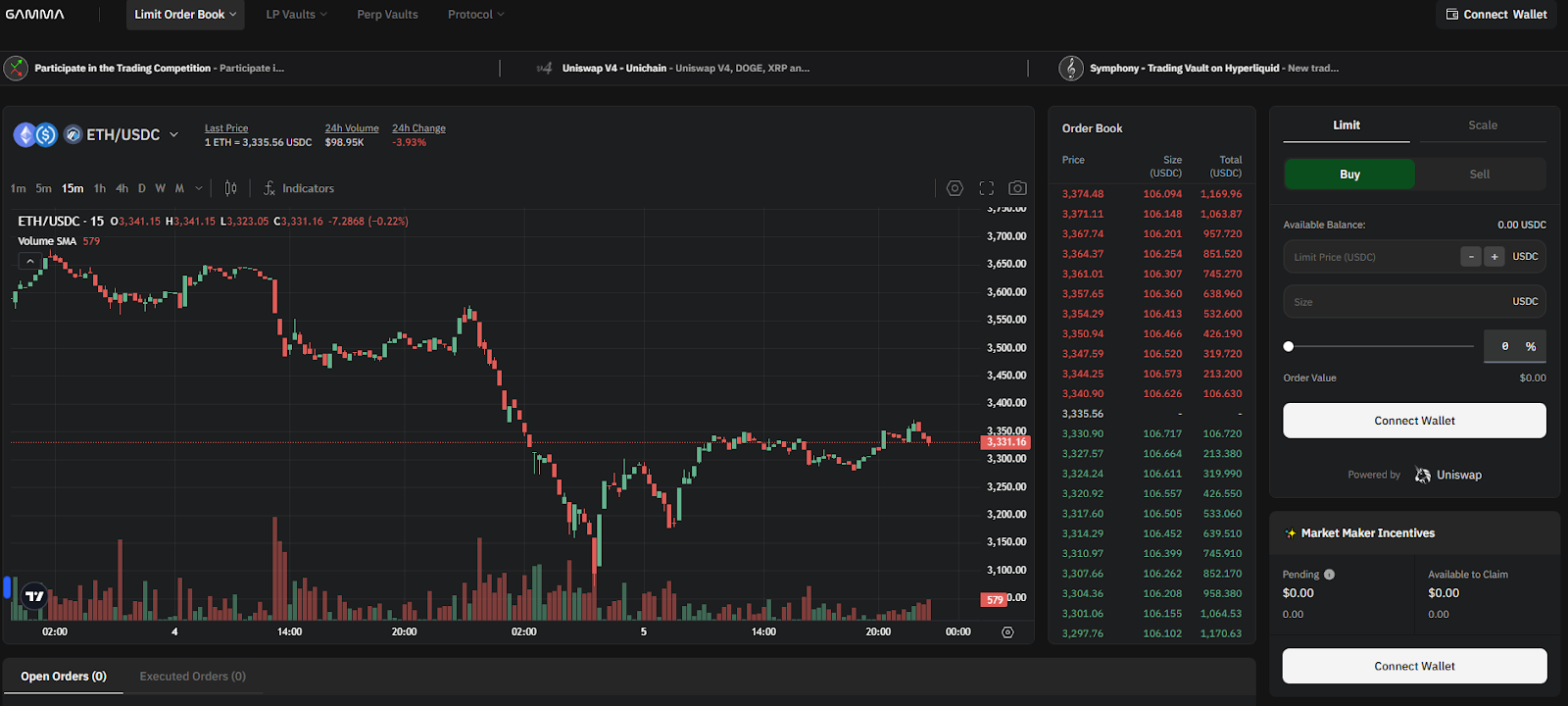
The order book displays all pending buy orders (bids) and sell orders (asks) for a trading pair. Bids appear in descending price order, while asks appear in ascending order. The difference between the highest bid and lowest ask creates the “spread.”

When you place a market order, the exchange’s matching engine pairs your order with the best available opposite order. High liquidity markets with many participants typically have tighter spreads and faster execution, while low liquidity markets may experience price slippage during volatile periods.

The immediate settlement process means ownership transfers instantly upon order execution. Unlike traditional stock markets with T+2 settlement, cryptocurrency spot trades settle in real-time, giving you immediate access to your purchased digital assets.

Spot Trading vs Other Trading Methods

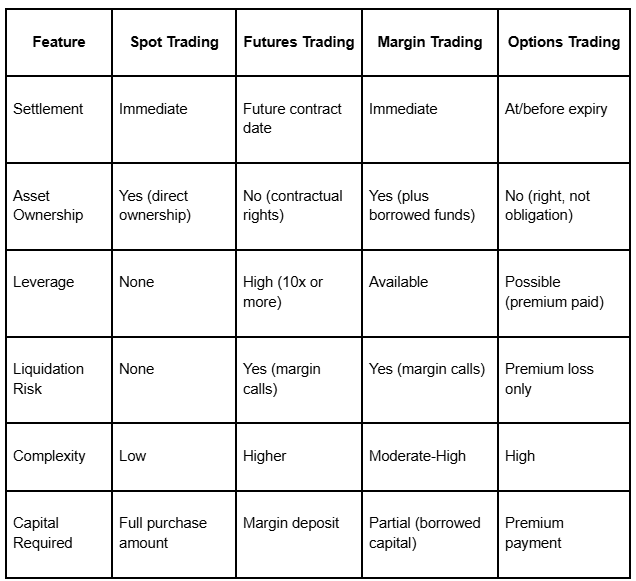
Understanding how spot trading compares to other trading methods helps you choose the right approach for your risk tolerance and investment goals.
Spot Trading vs Margin Trading

Margin trading allows traders to borrow funds from the crypto exchange to increase their position size beyond their initial investment. While this can amplify potential profits, it also magnifies losses and introduces significant risks that don’t exist in spot trading.

In margin trading, borrowing funds creates leverage that can lead to margin calls when positions move against you. If your trade loses value and approaches the minimum margin requirement, the exchange may forcibly close your position to protect the borrowed funds. This liquidation can result in losing more than your initial investment.

Spot trading eliminates these risks by limiting potential losses to your initial investment. You can’t lose more than you put in because you’re not borrowing money. This makes spot trading the safer choice for beginners and risk-averse traders who want exposure to price movements without the downside risk of liquidation.

Experienced traders might use margin trading to amplify gains, but the commodity futures trading commission and other regulatory bodies consistently warn about the significant risks involved with leveraged products.

Spot Trading vs Futures Trading

Futures contracts obligate traders to buy or sell an underlying crypto asset at a predetermined price on a specific future date. These financial instruments allow speculation on future price movements without immediate purchase or delivery of the digital asset.

Spot trading provides immediate settlement and direct ownership, while futures trading involves contractual obligations and potential leverage. Futures prices can diverge from spot prices based on market expectations, interest rates, and other factors affecting the cryptocurrency market.

Traders speculate on price movements differently in each market. Spot traders profit by buying low and selling at a higher price, while futures traders can profit from both rising and falling markets through long and short positions. However, futures trading requires more sophisticated understanding of market conditions and carries higher risks due to leverage and margin requirements.

Advantages of Spot Trading

Spot trading offers several compelling benefits that make it attractive to both newcomers and experienced traders:

Simplicity and Ease of Understanding Spot trading’s straightforward nature makes it accessible to beginners. You buy cryptocurrency at the current price and own it immediately - no complex contracts, expiration dates, or margin calculations to worry about.

Direct Asset Ownership Unlike derivatives trading, spot trading gives you actual ownership of digital assets. You can withdraw your Bitcoin to a hardware wallet, stake your Ethereum, or use your cryptocurrencies in DeFi protocols. This direct ownership provides complete control over your financial assets.

Transparent Pricing Spot market prices reflect real supply and demand dynamics without the complexity of futures curves or options pricing models. The current market price you see represents what other traders are willing to pay right now.

Lower Risk Profile Spot trading eliminates the risk of margin calls, liquidations, and borrowing costs associated with leveraged products. Your maximum loss equals your initial investment, providing clear risk boundaries for portfolio management.

Wide Availability Major cryptocurrency exchanges like Binance, Coinbase, Kraken, and others offer robust spot markets with high trading volumes. This broad availability ensures you can access spot trading regardless of your location or experience level.

No Time Pressure Unlike options with expiration dates or futures contracts with settlement requirements, spot positions have no time constraints. You can hold your digital assets as long as desired without worrying about contract expiration.

Disadvantages of Spot Trading

Despite its advantages, spot trading has limitations that traders should understand:

Full Market Volatility Exposure Crypto spot trading exposes you to the complete volatility of the cryptocurrency market without built-in hedging mechanisms. When Bitcoin drops 20% in a day, your spot position loses the same percentage with no protection.

No Short Selling Capability Spot trading only allows you to profit from rising prices unless you already own the asset to sell. You cannot profit from falling markets through short selling without using additional financial instruments like futures or margin trading.

Capital Intensive Spot trading requires the full purchase amount upfront. If you want $10,000 exposure to Ethereum, you need $10,000 in capital. Leveraged products allow similar exposure with less capital, though with higher risks.

Limited Profit Potential Without leverage, your profit potential is limited to the actual price movements of the underlying crypto asset. A 50% increase in Bitcoin price generates a 50% profit, while leveraged trading could amplify those gains (and losses).

Price Slippage Risk During periods of high market volatility or low liquidity, large market orders may experience slippage - executing at worse prices than expected. This particularly affects trading in smaller altcoins with lower trading volumes.

No Built-in Risk Management Spot trading lacks the sophisticated risk management tools available in derivatives markets. You cannot easily hedge positions or create complex trading strategies without using multiple instruments.

Popular Spot Trading Strategies

Successful spot traders employ various trading strategies based on their risk tolerance, time horizon, and market analysis approach:

Buy and Hold (HODL) This long-term strategy involves purchasing major cryptocurrencies like Bitcoin or Ethereum and holding them for extended periods. Buy and hold traders believe in the long-term adoption and price appreciation of established digital assets, ignoring short term price fluctuations.

Dollar Cost Averaging (DCA) DCA involves making regular purchases regardless of current market price to smooth out volatility over time. For example, buying $500 worth of Bitcoin every month reduces the impact of timing the market and can lower your average purchase price during volatile periods.

Day Trading Day traders capitalize on short term price movements within a single trading session. They use technical analysis to identify entry and exit points, often making multiple trades per day to profit from intraday volatility in the crypto market.

Swing Trading Swing traders hold positions for days or weeks to capture medium-term trends. This trading strategy requires analyzing both technical indicators and fundamental factors that might drive price movements over several days.

Arbitrage Trading Arbitrage involves exploiting price differences for the same cryptocurrency across different exchanges. If Bitcoin trades at $45,000 on Exchange A and $45,200 on Exchange B, arbitrage traders buy on the cheaper exchange and sell on the more expensive one for risk-free profit.

Range Trading Range traders identify cryptocurrencies trading within specific price ranges and buy near support levels while selling near resistance levels. This strategy works best during sideways market movements when prices oscillate within defined boundaries.

Getting Started with Spot Trading

Beginning your spot trading journey requires careful preparation and a methodical approach:

Choose Reputable Exchanges Start with established cryptocurrency exchanges that prioritize security and regulatory compliance. Binance offers high liquidity and numerous trading pairs, Coinbase Pro provides user-friendly interfaces for beginners, while Kraken and Gemini are known for strong security measures.

Complete Security Setup Implement security measures including two-factor authentication (2FA), strong passwords, and withdrawal whitelist features. Never share your login credentials and consider using a dedicated email address for your crypto exchange accounts.

Start with Major Cryptocurrencies Begin with established digital assets like Bitcoin (BTC) and Ethereum (ETH) before exploring smaller altcoins. These major cryptocurrencies typically have higher liquidity, tighter spreads, and more predictable price movements suitable for learning.

Begin with Small Amounts Start with amounts you can afford to lose while learning platform mechanics and developing your trading strategy. Small initial investments allow you to understand how orders work, how fees impact profits, and how market volatility affects your positions.

Use Limit Orders for Better Control Limit orders help you control entry prices and avoid paying more than intended, especially important during volatile market conditions. While market orders guarantee execution, limit orders provide price protection at the cost of potential missed opportunities.

Educate Yourself Continuously Develop skills in both technical analysis and fundamental analysis. Technical analysis helps identify entry and exit points using price charts and indicators, while fundamental analysis evaluates the underlying value and adoption prospects of different cryptocurrencies.

Practice Risk Management Never invest more than you can afford to lose, diversify across multiple cryptocurrencies, and consider setting stop-loss levels even though spot trading doesn’t require them. Successful trading depends more on managing downside risk than maximizing gains.

Is Spot Trading Profitable?

Spot trading profitability depends on multiple factors including market timing, research quality, risk management, and trading discipline. While the cryptocurrency market has created significant wealth for early adopters and skilled traders, success is never guaranteed.

Factors Affecting Profitability:

Market volatility creates both opportunities and risks. The crypto market experiences significant price fluctuations that can generate substantial profits for well-timed trades, but the same volatility can lead to significant losses if you buy at market peaks.

Your research and analysis capabilities directly impact trading success. Traders who understand fundamental analysis (evaluating project technology, adoption, and competition) combined with technical analysis (chart patterns and indicators) typically achieve better results than those trading on emotions or tips.

Risk management practices separate successful traders from those who lose money. Using proper position sizing, maintaining diversified portfolios, and having clear exit strategies help protect capital during inevitable market downturns.

Short-term vs Long-term Approaches:

Short term trading requires more active management and technical skills but can potentially generate quicker profits during favorable market moves. However, frequent trading increases costs through fees and taxes while requiring significant time investment.

Long-term holding strategies have historically rewarded patient investors in major cryptocurrencies, though past performance doesn’t guarantee future results. Bitcoin and Ethereum have appreciated substantially over multi-year periods despite significant interim volatility.

Risk Considerations:

All crypto trading involves substantial risk of loss. The market can move against positions quickly, and even established cryptocurrencies can lose significant value during market downturns. Regulatory changes, security breaches, and technological issues can also impact cryptocurrency values.

Trading costs including exchange fees, withdrawal fees, and tax implications reduce net profits. High-frequency trading strategies may see profits eroded by cumulative fees, making longer-term approaches more cost-effective for smaller accounts.

Success Requirements:

Profitable spot trading typically requires continuous education about cryptocurrency technology, market dynamics, and trading techniques. Successful traders develop discipline to stick to their strategies during emotional market periods and avoid impulsive decisions based on fear or greed.

Market conditions constantly evolve, requiring adaptation of trading strategies and ongoing learning. What works during bull markets may fail during bear markets, and successful traders adjust their approach based on changing market cycles.

Conclusion

Spot trading in crypto offers the most straightforward path to cryptocurrency ownership, providing immediate settlement, direct asset control, and transparent pricing without the complexity of derivatives or the risks of leverage. While it requires full capital upfront and limits profit potential to actual price movements, spot trading eliminates margin call risks and provides a solid foundation for building cryptocurrency knowledge.

Whether you choose buy-and-hold strategies for long-term wealth building or more active approaches like swing trading, spot trading gives you real ownership of digital assets with clear risk boundaries. The key to success lies in choosing reputable exchanges, starting with established cryptocurrencies, implementing proper risk management, and continuing your education about market dynamics.

For newcomers to the cryptocurrency market, spot trading represents the safest entry point to gain exposure to this revolutionary asset class while learning essential trading skills that can be applied to more sophisticated strategies later.

Build Smarter Crypto Apps &
AI Agents in Minutes, Not Months
Real-time prices, trading signals, and on-chain insights all from one powerful API.
Grab a Free API Key
About Token Metrics
Token Metrics: AI-powered crypto research and ratings platform. We help investors make smarter decisions with unbiased Token Metrics Ratings, on-chain analytics, and editor-curated “Top 10” guides. Our platform distills thousands of data points into clear scores, trends, and alerts you can act on.
30 Employees
analysts, data scientists, and crypto engineers
Daily Briefings
concise market insights and “Top Picks”
Transparent & Compliant
Sponsored ≠ Ratings; research remains independent
Want Smarter Crypto Picks—Free?
See unbiased Token Metrics Ratings for BTC, ETH, and top alts.
Thank you! Your submission has been received!
Oops! Something went wrong while submitting the form.
 No credit card | 1-click unsubscribe
Token Metrics Team
Token Metrics Team

Recent Posts

Research

AAVE Price Prediction 2027: $70-$2,175 Forecast Analysis

Token Metrics Team
9 min read

AAVE Price Prediction 2027: Market Analysis and Scenario-Based Forecasts

Market Context for Aave Price Prediction: The Case for 2027

DeFi protocols are maturing beyond early ponzi dynamics toward sustainable revenue models. Aave operates in this evolving landscape where real yield and proven product-market fit increasingly drive valuations rather than speculation alone. Growing regulatory pressure on centralized platforms creates tailwinds for decentralized alternatives—factors that inform our comprehensive AAVE price prediction framework.

The scenario bands below reflect how AAVE price predictions might perform across different total crypto market cap environments. Each tier represents a distinct liquidity regime, from bear conditions with muted DeFi activity to moon scenarios where decentralized infrastructure captures significant value from traditional finance.


Disclosure

Educational purposes only, not financial advice. Crypto is volatile, do your own research and manage risk.

How to Read This AAVE Price Prediction

Each band blends cycle analogues and market-cap share math with TA guardrails. Base assumes steady adoption and neutral or positive macro. Moon layers in a liquidity boom. Bear assumes muted flows and tighter liquidity.

TM Agent baseline: Token Metrics TM Grade is 72, Buy, and the trading signal is bullish, indicating solid protocol fundamentals, healthy developer activity, and positive near-term momentum. Concise twelve-month numeric view, Token Metrics price prediction scenarios cluster roughly between $70 and $320, with a base case near $150, reflecting continued growth in lending TVL, fee revenue capture by the protocol, and modest macro tailwinds.

Live details: Aave Token Details

Affiliate Disclosure: We may earn a commission from qualifying purchases made via this link, at no extra cost to you.

Key Takeaways

  • Scenario driven, outcomes hinge on total crypto market cap, higher liquidity and adoption lift the bands.
  • Fundamentals: Fundamental Grade 75.51% (Community 77%, Tokenomics 100%, Exchange 100%, VC 49%, DeFi Scanner 70%).
  • Technology: Technology Grade 83.17% (Activity 75%, Repository 68%, Collaboration 92%, Security 78%, DeFi Scanner 70%).
  • TM Agent gist: scenarios cluster between $70 and $320 with base near $150, assuming steady lending TVL growth and neutral macro conditions.
  • Education only, not financial advice.

AAVE Price Prediction Scenario Analysis

Our Token Metrics price prediction framework spans four market cap tiers, each representing different levels of crypto market maturity and liquidity:

8T Market Cap - AAVE Price Prediction:

At an 8 trillion dollar total crypto market cap, AAVE projects to $293.45 in bear conditions, $396.69 in the base case, and $499.94 in bullish scenarios.

16T Market Cap - AAVE Price Prediction:

Doubling the market to 16 trillion expands the price prediction range to $427.46 (bear), $732.18 (base), and $1,041.91 (moon).

23T Market Cap - AAVE Price Prediction:

At 23 trillion, the price prediction scenarios show $551.46, $1,007.67, and $1,583.86 respectively.

31T Market Cap - AAVE Price Prediction:

In the maximum liquidity scenario of 31 trillion, AAVE price predictions could reach $680.47 (bear), $1,403.16 (base), or $2,175.85 (moon).

Each tier assumes progressively stronger market conditions, with the base case price prediction reflecting steady growth and the moon case requiring sustained bull market dynamics.

Why Consider the Indices with Top-100 Exposure

Aave represents one opportunity among hundreds in crypto markets. Token Metrics Indices bundle AAVE with top one hundred assets for systematic exposure to the strongest projects. Single tokens face idiosyncratic risks that diversified baskets mitigate.

Historical index performance demonstrates the value of systematic diversification versus concentrated positions.

Join the early access list

What Is Aave?

Aave is a decentralized lending protocol that operates across multiple EVM-compatible chains including Ethereum, Polygon, Arbitrum, and Optimism. The network enables users to supply crypto assets as collateral and borrow against them in an over-collateralized manner, with interest rates dynamically adjusted based on utilization.

The AAVE token serves as both a governance asset and a backstop for the protocol through the Safety Module, where stakers earn rewards in exchange for assuming shortfall risk. Primary utilities include voting on protocol upgrades, fee switches, collateral parameters, and new market deployments.

Token Metrics AI Analysis

Token Metrics AI provides comprehensive context on Aave's positioning and challenges.

Vision: Aave aims to create an open, accessible, and non-custodial financial system where users have full control over their assets. Its vision centers on decentralizing credit markets and enabling seamless, trustless lending and borrowing across blockchain networks.

Problem: Traditional financial systems often exclude users due to geographic, economic, or institutional barriers. Even in crypto, accessing credit or earning yield on idle assets can be complex, slow, or require centralized intermediaries. Aave addresses the need for transparent, permissionless, and efficient lending and borrowing markets in the digital asset space.

Solution: Aave uses a decentralized protocol where users supply assets to liquidity pools and earn interest, while borrowers can draw from these pools by posting collateral. It supports features like variable and stable interest rates, flash loans, and cross-chain functionality through its Layer 2 and multi-chain deployments. The AAVE token is used for governance and as a safety mechanism via its staking program (Safety Module).

Market Analysis: Aave is a leading player in the DeFi lending sector, often compared with protocols like Compound and Maker. It benefits from strong brand recognition, a mature codebase, and ongoing innovation such as Aave Arc for institutional pools and cross-chain expansion. Adoption is driven by liquidity, developer activity, and integration with other DeFi platforms. Key risks include competition from newer lending protocols, regulatory scrutiny on DeFi, and smart contract risks. As a top DeFi project, Aave's performance reflects broader trends in decentralized finance, including yield demand, network security, and user trust. Its multi-chain strategy helps maintain relevance amid shifting ecosystem dynamics.

Fundamental and Technology Snapshot from Token Metrics

Fundamental Grade: 75.51% (Community 77%, Tokenomics 100%, Exchange 100%, VC 49%, DeFi Scanner 70%).


Technology Grade: 83.17% (Activity 75%, Repository 68%, Collaboration 92%, Security 78%, DeFi Scanner 70%).

Catalysts That Skew AAVE Price Predictions Bullish

  • Institutional and retail access expands with ETFs, listings, and integrations
  • Macro tailwinds from lower real rates and improving liquidity
  • Product or roadmap milestones such as upgrades, scaling, or partnerships

Risks That Skew AAVE Price Predictions Bearish

  • Macro risk-off from tightening or liquidity shocks
  • Regulatory actions or infrastructure outages
  • Concentration or competitive displacement in lending

AAVE Price Prediction FAQs

Can AAVE reach $1,000?

Yes. Based on our price prediction scenarios, AAVE could reach $1,007.67 in the 23T base case and $1,041.91 in the 16T moon case. Not financial advice.

Can AAVE 10x from current levels?

At current price of $228.16, a 10x would reach $2,281.60. This falls within the 31T moon case price prediction at $2,175.85 (only slightly below), and would require extreme liquidity expansion. Not financial advice.

What price could AAVE reach in the moon case?

Our moon case price predictions range from $499.94 at 8T to $2,175.85 at 31T. These scenarios assume maximum liquidity expansion and strong Aave adoption. Not financial advice.

What is the AAVE price prediction for 2027?

Our comprehensive 2027 price prediction framework suggests AAVE could trade between $293.45 and $2,175.85, depending on market conditions and total crypto market capitalization. The base case scenario clusters around $396.69 to $1,403.16 across different market cap environments. Not financial advice.

Is AAVE a good investment based on price predictions?

AAVE shows strong fundamentals (75.51% grade) and technology scores (83.17% grade), with bullish trading signals. However, all price predictions involve uncertainty and risk. Always conduct your own research and consult financial advisors before investing. Not financial advice.


Next Steps

Track live grades and signals: Token Details 

Join Indices Early Access

Want exposure? Buy AAVE on MEXC 

Disclosure

Educational purposes only, not financial advice. Crypto is volatile, do your own research and manage risk.

Why Use Token Metrics?

  • AI-driven crypto and DeFi grades for risk management and alpha discovery.
  • Quantitative, on-chain signals and robust scenario modeling for tokens like AAVE.
  • Access in-depth research reports, analyst perspectives, auto-grades, and portfolio tools from Token Metrics.
Research

x402 & HTTP 402 Explained: Why Wallet-Paid API Calls Are Winning (and Where Token Metrics Fits)

Token Metrics Team
10 min read

What Is x402?

x402 is an open-source, HTTP-native payment protocol developed by Coinbase that enables pay-per-call API access using crypto wallets. It leverages the HTTP 402 Payment Required status code to create seamless, keyless API payments.

It eliminates traditional API keys and subscriptions, allowing agents and applications to pay for exactly what they use in real time. It works across Base and Solana with USDC and selected native tokens such as TMAI.

Start using Token Metrics X402 integration here. https://www.x402scan.com/server/244415a1-d172-4867-ac30-6af563fd4d25 

TLDR — The x402 Value Proposition

x402 transforms API access by making payments native to HTTP requests.

Feature

Traditional APIs

x402 APIs

Authentication

API keys, tokens

Wallet signature

Payment Model

Subscription, prepaid

Pay-per-call

Onboarding

Sign up, KYC, billing

Connect wallet

Rate Limits

Fixed tiers

Economic (pay more = more access)

Commitment

Monthly/annual

Zero, per-call only

How to use it: Add x-coinbase-402: true header to any supported endpoint. Sign payment with your wallet. The API responds immediately after confirming micro-payment.

Token Metrics integration: All public endpoints available via x402 with per-call pricing from $0.017 to $0.068 USDC (10% discount with TMAI token).

Explore live agents: https://www.x402scan.com/composer.

How HTTP 402 Payment Required Works — Technical Deep Dive

The Protocol Flow

The HTTP 402 status code was reserved in HTTP/1.1 in 1997 for future digital payment use cases and was never standardized for any specific payment scheme. x402 activates this path by using 402 responses to coordinate crypto payments during API requests.

  1. Step by step: Client makes an API request with the header x-coinbase-402: true.
  2. The server can return 402 with payment details such as amount, recipient, and chain.
  3. The client wallet signs and submits the payment transaction.
  4. The server verifies the payment on-chain, then processes the original request and returns 200 with data.

Why this matters: It eliminates intermediary payment processors, enables true machine-to-machine commerce, and reduces friction for AI agents.

Ecosystem Proof: x402 Is Winning — Three Validation Points

CoinGecko Recognition

CoinGecko launched a dedicated x402 Ecosystem category in October 2025, tracking 700+ projects with over $1 billion market cap and approximately $213 million in daily trading volume. Top performers include PING and Alnalyst, along with established projects like EigenCloud.


Base Network Adoption

Base has emerged as the primary chain for x402 adoption, with 450,000+ weekly transactions by late October 2025, up from near-zero in May. This growth demonstrates real agent and developer usage.

x402scan Composer — Where Agents Pay in Real Time

Composer is x402scan's sandbox for discovering and using AI agents that pay per tool call. Users can open any agent, chat with it, and watch tool calls and payments stream in real time.

Top agents include AInalyst, Canza, SOSA, and NewEra. The Composer feed shows live activity across all agents.


Explore Composer: https://x402scan.com/composer 

Token Metrics x402 Integration — Concrete Implementation

What We Ship

Token Metrics offers all public API endpoints via x402 with no API key required. Pay per call with USDC or TMAI for a 10 percent discount. Access includes trading signals, price predictions, fundamental grades, technology scores, indices data, and the AI chatbot.

Check out Token Metrics Integration on X402. https://www.x402scan.com/server/244415a1-d172-4867-ac30-6af563fd4d25 


Data as of October, 2025.

Pricing Tiers


Important note: TMAI Spend Limit: TMAI has 18 decimals. Set max payment to avoid overspending. Example: 200 TMAI = 200 * (10 ** 18) in base units.

Full integration guide: https://api.tokenmetrics.com 

Why x402 Changes Everything for AI Agents

  • Eliminates onboarding friction. Agents can discover and use new APIs instantly without human intervention for API key management or billing setup.
  • Enables true agentic commerce. Agents pay for exactly what they use, which makes micro-transactions economically viable. This unlocks composition of multiple specialized services.
  • Aligns incentives. API providers get paid per call, users only pay for value received, and agents can optimize costs by choosing best-fit providers. Network effects accelerate as more endpoints adopt x402.

Use Cases Already Working

  • Crypto analytics agents: Pull Token Metrics data on demand to answer market questions, generate trade signals, or build custom dashboards.
  • Research automation: Chain together x402 endpoints like Twitter search, Tavily extract, Firecrawl, and Token Metrics to gather and structure data.
  • Portfolio management: Agents monitor positions, fetch real-time prices, calculate risk metrics, and execute rebalancing decisions using paid data sources.
  • Trading strategy backtests: Access historical OHLCV, grades, and signals data via x402 without committing to monthly subscriptions.
  • Multi-chain intelligence: Combine Base and Solana x402 services for cross-chain analysis and arbitrage discovery.

Ecosystem Participants and Tools

Active x402 Endpoints

Key endpoints beyond Token Metrics include Heurist Mesh for crypto intelligence, Tavily extract for structured web content, Firecrawl search for SERP and scraping, Twitter or X search for social discovery, and various DeFi and market data providers.

Infrastructure and Tools

  • x402scan: Explorer and analytics platform tracking all x402 activity across chains.
  • Composer: Hosted sandbox for discovering and using x402-enabled agents.
  • x402-axios and x402-httpx: Client libraries for Node.js and Python.
  • Coinbase Agent Kit: SDK integration for building x402-native agents.
  • LangChain connectors: Framework integration for agent workflows.

Common Questions About x402

How is x402 different from traditional API keys?

x402 uses wallet signatures instead of API keys. Payment happens per call rather than via subscription. No sign-up, no monthly billing, no rate limit tiers. You pay for exactly what you use.

Which chains support x402?

Currently Base and Solana. Most activity is on Base with USDC as the primary payment token. Some endpoints accept native tokens like TMAI for discounts.

Do I need to trust the API provider with my funds?

No. Payments are on-chain and verifiable. You approve each transaction amount. No escrow or prepayment is required.

What happens if a payment fails?

The API returns 402 Payment Required again with updated payment details. Your client retries automatically. You do not receive data until payment confirms.

Can I use x402 with existing API clients?

Yes, with x402 client libraries such as x402-axios for Node and x402-httpx for Python. These wrap standard HTTP clients and handle the payment flow automatically.

Getting Started Checklist

  1. Set up a wallet: Create a Base wallet with USDC or TMAI balance.
  2. Install x402 client: npm install x402-axios or pip install x402-httpx.
  3. Choose an endpoint: Browse x402scan or Composer for available APIs.
  4. Write minimal code: Add x-coinbase-402: true header to requests.
  5. Watch payments flow: Monitor transactions in your wallet and on x402scan feed.
  6. Optimize costs: Compare endpoint pricing, use TMAI for 10% discount, cache results when appropriate.

Token Metrics x402 Resources

What's Next for x402

Ecosystem expansion. More API providers adopting x402, additional chains beyond Base and Solana, standardization of payment headers and response formats.

Agent sophistication. As x402 matures, expect agents that automatically discover and compose multiple paid endpoints, optimize costs across providers, and negotiate better rates for bulk usage.

Disclosure

Educational content only, not financial advice. API usage and crypto payments carry risks. Verify all transactions before signing. Do your own research.

Frequently Asked Questions

Research

Top 10 Pump.fun Livestream Tokens by Fees Earned

Token Metrics Team
7 min read


Opening Hook

Fees Earned is a clean way to see which livestream tokens convert attention into on-chain activity. This leaderboard ranks the top 10 Pump.fun livestream tokens by Fees Earned using the screenshot you provided.

Selection rule is simple, top 10 by Fees Earned from the screenshot, numbers appear exactly as shown. If a field is not in the image, it is recorded as —.

Entity coverage: project names and tickers are taken as listed on Pump.fun, chain is Solana, sector is livestream meme tokens and creator tokens.

Featured: Token Metrics Live (TMLIVE) — Why We Built on Pump.fun

Token Metrics Live (TMLIVE) brings real time, data driven crypto market analysis to Pump.fun. The team has produced live crypto content for 7 years with a 500K plus audience and a platform of more than 100,000 users. Our public track record includes early coverage of winners like MATIC and Helium in 2018.

TMLIVE Quick Stats, as captured

  • ATH market cap: $291.7K
  • 24 hour volume on day one: $1.7M
  • Holders at capture: ~876
  • Current market cap at capture: $36.1K, displayed price: $0.043, visible chart timestamp: 22:33:49 UTC
  • Ticker: TMLIVE, Chain: Solana, Contract: 8Dxpc8Q8jg7TK8TT1pVntcqunHGofqpetCaP5fEhpump
  • Use these as captured numbers when referencing day one results. If you update screenshots later, swap in the new captures.

TLDR: Fees Earned Leaders at a Glance

  • Fees Earned: StrSzn ranks first with strong peak and average viewership for its size.
  • Fees Earned: Bagwork and POLYFACTS are close behind, both with large holder bases and double digit KOL counts.
  • Fees Earned: KIND shows the biggest KOL presence in the top 10, aligned with solid viewer averages.
  • Fees Earned: Newer names like Fapcoin appear despite modest viewer counts, proof that recency and focused pushes can drive fees.
  • Fees Earned: Live status correlates with short bursts for BUN COIN and FTP, while sustained averages matter over time.

Pump.fun Fees Earned Leaderboard (Top 10)


Short distribution note: the top three sit within a narrow band of each other, while mid-table tokens show a mix of older communities and recent streams. Several names with modest average viewers still appear due to concentrated activity during peaks.

Project Snapshots: What Each Token Does

StrSzn

Positioning: Active community meme with consistent viewer base.

Research Blurb: Project details unclear at time of writing. Fees and viewership suggest consistent stream engagement over the last month.

Quick Facts: Chain = Solana, Status = —, Peak Viewers = 1,951, Avg Viewers = 548.


https://pump.fun/coin/986j8mhmidrcbx3wf1XJxsQFvWBMXg7gnDi3mejsr8H8

Bagwork

Positioning: Large holder base with sustained attention.

Research Blurb: Project details unclear at time of writing. Strong holders and KOL presence supported steady audience numbers.

Quick Facts: Chain = Solana, Status = 1mo ago, Holders = 9,192, KOLs = 19.


https://pump.fun/coin/7Pnqg1S6MYrL6AP1ZXcToTHfdBbTB77ze6Y33qBBpump

POLYFACTS

Positioning: Higher market cap with light average viewership.

Research Blurb: Project details unclear at time of writing. High market cap with comparatively low average viewers implies fees concentrated in shorter windows.

Quick Facts: Chain = Solana, Status = 1mo ago, MC = 3.15M, Avg Viewers = 13.


https://pump.fun/coin/FfixAeHevSKBZWoXPTbLk4U4X9piqvzGKvQaFo3cpump

STREAMER

Positioning: Community focused around streaming identity.

Research Blurb: Project details unclear at time of writing. Solid holders and moderate KOL count, steady averages over time.

Quick Facts: Chain = Solana, Status = 1mo ago, Holders = 8,008, KOLs = 14.


https://pump.fun/coin/3arUrpH3nzaRJbbpVgY42dcqSq9A5BFgUxKozZ4npump

KIND

Positioning: Heaviest KOL footprint in the top 10.

Research Blurb: Project details unclear at time of writing. The largest KOL count here aligns with above average view metrics and meaningful fees.

Quick Facts: Chain = Solana, Status = 29d ago, KOLs = 23, Avg Viewers = 57.


https://pump.fun/coin/V5cCiSixPLAiEDX2zZquT5VuLm4prr5t35PWmjNpump

ELIZABETH

Positioning: Mid-cap meme with consistent streams.

Research Blurb: Project details unclear at time of writing. Viewer averages and recency indicate steady presence rather than single spike behavior.

Quick Facts: Chain = Solana, Status = 1mo ago, Avg Viewers = 47, Peak Viewers = 113.


https://pump.fun/coin/DiiTPZdpd9t3XorHiuZUu4E1FoSaQ7uGN4q9YkQupump

Cope

Positioning: Older token with a legacy community.

Research Blurb: Project details unclear at time of writing. Despite low recent averages, it holds a sizable base and meaningful fees.

Quick Facts: Chain = Solana, Status = —, Age = 1y ago, Avg Viewers = 9.


https://pump.fun/coin/DMwbVy48dWVKGe9z1pcVnwF3HLMLrqWdDLfbvx8RchhK

BUN COIN

Positioning: Currently live, strong peaks relative to size.

Research Blurb: Project details unclear at time of writing. Live streaming status often coincides with bursts of activity that lift fees quickly.

Quick Facts: Chain = Solana, Status = Live, Peak Viewers = 897, Avg Viewers = 71.


https://pump.fun/coin/HQDTzNa4nQVetoG6aCbSLX9kcH7tSv2j2sTV67Etpump

Fapcoin

Positioning: Newer token with targeted pushes.

Research Blurb: Project details unclear at time of writing. Recent age and meaningful KOL support suggest orchestrated activations that can move fees.

Quick Facts: Chain = Solana, Status = 13d ago, Age = 18d ago, KOLs = 22.


https://pump.fun/coin/8vGr1eX9vfpootWiUPYa5kYoGx9bTuRy2Xc4dNMrpump

FTP

Positioning: Live status with solid mid-table view metrics.

Research Blurb: Project details unclear at time of writing. Peaks and consistent averages suggest an active audience during live windows.

Quick Facts: Chain = Solana, Status = Live, Peak Viewers = 496, Avg Viewers = 35.


https://pump.fun/coin/J2eaKn35rp82T6RFEsNK9CLRHEKV9BLXjedFM3q6pump

Signals From Fees Earned: Patterns to Watch

Fees Earned often rise with peak and average viewers, but timing matters. Several tokens here show concentrated peaks with modest averages, which implies that well timed announcements or coordinated segments can still produce high fees.

Age is not a blocker for this board. Newer tokens like Fapcoin appear due to focused activity, while older names such as Cope persist by mobilizing established holders. KOL count appears additive rather than decisive, with KIND standing out as the KOL leader.

Why Fees Earned Matters for Creators and Traders

For creators, Fees Earned reflects whether livestream moments translate into on-chain action. Design streams around clear calls to action, align announcements with segments that drive peaks, then sustain momentum with repeatable formats that stabilize averages.

For traders, Fees Earned complements market cap, viewers, and age. Look for projects that combine rising averages with consistent peaks, because those patterns suggest repeatable engagement rather than single event spikes.

Watch Real-Time Coverage on TV Live

TV Live is a fast way to follow real-time crypto market news, creator launches, and token breakdowns as they happen. You get context on stream dynamics, audience behavior, and on-chain activity while the story evolves.

CTA: Watch TV Live for real-time crypto market news →TV Live Link

CTA: Follow and enable alerts → TV Live

Why Crypto Investors Trust Token Metrics

Token Metrics is trusted for transparent data, crypto analytics, on-chain ratings, and investor education. Our platform offers cutting-edge signals and market research to empower your crypto investing decisions.

FAQs: Pump.fun Livestream and Fees Earned

What is the best way to track Pump.fun livestream leaders?

Tracking Pump.fun livestream leaders starts with the scanner views that show Fees Earned, viewers, and KOLs side by side, paired with live coverage so you see data and narrative shifts together.

Do higher fees predict higher market cap or sustained viewership?

Higher Fees Earned does not guarantee higher market cap or sustained viewership, it indicates conversion in specific windows, while longer term outcomes still depend on execution and community engagement.

How often do these rankings change?

Rankings can change quickly during active cycles, the entries shown here reflect the exact time of the screenshot.

Next Steps

  • Subscribe to TV Live updates → [NEWSLETTER_OR_ALERTS_LINK]
  • Read the next leaderboard post in this series.
  • Join the community stream on Pump.fun when a link is available.

Disclosure

This article is educational content. Cryptocurrency involves risk. Always do your own research.

Choose from Platinum, Gold, and Silver packages
Reach with 25–30% open rates and 0.5–1% CTR
Craft your own custom ad—from banners to tailored copy
Perfect for Crypto Exchanges, SaaS Tools, DeFi, and AI Products