Back to blog
Research

What is the GENIUS Act and How Does It Affect Crypto? Complete 2025 Guide

Learn about the 2025 GENIUS Act and its impact on crypto regulation, stability, and institutional adoption with comprehensive insights and analysis.
Token Metrics Team
12 min read
Want Smarter Crypto Picks—Free?
See unbiased Token Metrics Ratings for BTC, ETH, and top alts.
Thank you! Your submission has been received!
Oops! Something went wrong while submitting the form.
 No credit card | 1-click unsubscribe

The cryptocurrency industry experienced a turning point on July 18, 2025, when President Donald Trump signed the GENIUS Act into law. This landmark piece of major crypto legislation marks the first major federal crypto legislation ever passed by Congress and fundamentally reshapes the regulatory landscape for stablecoins. The GENIUS Act brings much-needed clarity and oversight to digital assets, including digital currency, signaling a dramatic shift in how the United States approaches the rapidly evolving crypto space. For anyone involved in cryptocurrency investing, trading, or innovation, understanding what the GENIUS Act is and how it affects crypto is essential to navigating this new era of regulatory clarity.

Introduction to Digital Assets

The digital asset landscape is undergoing a profound transformation, with the GENIUS Act representing a pivotal moment in establishing national innovation for U.S. stablecoins. Digital assets—ranging from cryptocurrencies and stablecoins to digital tokens and digital dollars—are at the forefront of financial innovation, reshaping how individuals, businesses, and financial institutions interact with money and value. As decentralized finance (DeFi) and digital finance continue to expand, the need for regulatory clarity and robust consumer protections has never been greater.

The GENIUS Act aims to address these needs by introducing clear rules for stablecoin issuers and setting a new standard for regulatory oversight in the crypto industry. By requiring permitted payment stablecoin issuers to maintain 1:1 reserves in highly liquid assets such as U.S. treasury bills, the Act ensures that stablecoin holders can trust in the stable value of their digital assets. This move not only protects consumers but also encourages greater participation from traditional banks, credit unions, and other financial institutions that had previously been wary of the regulatory uncertainties surrounding digital currencies.

One of the GENIUS Act’s most significant contributions is its comprehensive regulatory framework, which brings together federal and state regulators, the Federal Reserve, and the Federal Deposit Insurance Corporation to oversee payment stablecoin issuers. The Act also opens the door for foreign issuers to operate in the U.S. under specific conditions, further enhancing the role of cross-border payments in the global digital asset ecosystem. By aligning stablecoin regulation with the Bank Secrecy Act, the GENIUS Act requires issuers to implement robust anti-money laundering and customer identification measures, strengthening the integrity of the digital asset market.

President Trump’s signing of the GENIUS Act into law marks a turning point for both the crypto space and the broader financial markets. The Act’s focus on protecting consumers, fostering stablecoin adoption, and promoting financial innovation is expected to drive significant growth in digital finance. Crypto companies and major financial institutions now have a clear regulatory pathway, enabling them to innovate with confidence and contribute to the ongoing evolution of digital currencies.

As the digital asset market matures, staying informed about regulatory developments—such as the GENIUS Act and the proposed Asset Market Clarity Act—is essential for anyone looking to capitalize on the opportunities presented by digital finance. The GENIUS Act establishes a solid foundation for the regulation of payment stablecoins, ensuring legal protections for both the buyer and stablecoin holders, and setting the stage for future advancements in the crypto industry. With clear rules, strong consumer protections, and a commitment to national innovation for U.S. stablecoins, the GENIUS Act is shaping the future of digital assets and guiding the next era of financial markets.

What is the GENIUS Act?

The GENIUS Act, officially known as the Guiding and Establishing National Innovation for U.S. Stablecoins Act, establishes the first comprehensive federal regulatory framework specifically designed for stablecoins in the United States. Introduced by Senator Bill Hagerty (R-Tennessee) on May 1, 2025, the bill received strong bipartisan support, passing the Senate 68-30 on June 17, 2025, before clearing the House on July 17, 2025.

Stablecoins are a class of cryptocurrencies engineered to maintain a stable value by pegging their worth to another asset, typically the U.S. dollar. Unlike highly volatile crypto assets such as Bitcoin or Ethereum, stablecoins provide price stability, making them ideal for payments, trading, and serving as safe havens during market turbulence. At the time of the GENIUS Act’s passage, the two largest stablecoins—Tether (USDT) and USD Coin (USDC)—dominated a $238 billion stablecoin market.

This legislation emerged after years of regulatory uncertainty that left stablecoin issuers operating in a legal gray zone. The collapse of TerraUSD in 2022, which wiped out billions of dollars in value, underscored the risks of unregulated stablecoins and accelerated calls for federal oversight. The GENIUS Act aims to address these concerns by establishing clear standards for reserve backing, consumer protection, and operational transparency, thereby fostering national innovation in digital finance.

Provisions of the GENIUS Act

The GENIUS Act introduces several critical provisions that fundamentally change how stablecoins operate within the United States. One of the most significant is the reserve backing requirement, which mandates that stablecoin issuers maintain 100% reserves backing their tokens with highly liquid, low-risk assets such as U.S. Treasury securities and U.S. dollars. This one-to-one backing ensures that stablecoin holders can redeem their tokens for the underlying asset at any time, protecting against the type of collapse witnessed with TerraUSD.

Another cornerstone of the Act is its consumer protection measures. These provisions prioritize stablecoin holders' claims over all other creditors in the event of issuer insolvency, providing a critical safety net. The law also guarantees clear redemption rights, allowing stablecoin holders to convert their tokens back into U.S. dollars on demand, enhancing legal protections for consumers.

The Act further establishes stringent licensing and oversight requirements, specifying that only permitted payment stablecoin issuers—including subsidiaries of insured depository institutions, federally qualified issuers, and state-qualified issuers—may issue stablecoins in the U.S. These permitted issuers are subject to rigorous approval processes and dual oversight by federal and state regulators, creating a regulatory framework akin to traditional banking supervision.

Addressing national security concerns, the GENIUS Act explicitly subjects stablecoin issuers to the Bank Secrecy Act, requiring them to implement robust anti-money laundering (AML) and sanctions compliance programs. Issuers must have the technical capability to seize, freeze, or burn payment stablecoins when legally mandated, enhancing the Treasury Department’s enforcement capabilities. These measures ensure that stablecoins cannot be exploited for illicit activities, reinforcing the integrity of the financial markets.

Immediate Market Impact and Regulatory Clarity

The passage of the GENIUS Act was met with enthusiasm across the cryptocurrency market. Following the Senate vote, the total crypto market capitalization surged by 3.8%, reaching an impressive $3.95 trillion. By the time President Trump signed the bill into law, the market had climbed further, hitting a record $4 trillion—a clear indication of how much regulatory uncertainty had previously suppressed institutional participation.

The stablecoin market experienced particularly explosive growth under this new regulatory framework. By early August 2025, stablecoin market capitalization had climbed past $278 billion, with net stablecoin creation increasing by an astonishing 324% from Q2 to Q3 2025, reaching approximately $300 billion. This surge demonstrates that regulatory clarity has unlocked significant institutional capital that had been waiting on the sidelines.

Major financial institutions, including JPMorgan and Meta Platforms, accelerated their stablecoin initiatives following the law’s enactment. Traditional banks, which had been cautious about entering the crypto space, now have a clear regulatory pathway to participate. Stablecoins are rapidly evolving from niche crypto products to mainstream financial infrastructure, with applications in cross-border payments and other financial services.

How the GENIUS Act Affects Stablecoin Issuers and Different Crypto Sectors

Although the GENIUS Act primarily targets stablecoins, its effects resonate throughout the broader cryptocurrency ecosystem. In the realm of decentralized finance (DeFi), the enhanced reliability and regulatory compliance of stablecoins strengthen the foundation for lending, borrowing, and yield-generating protocols. However, DeFi platforms must ensure that the stablecoins they integrate comply with the new licensing requirements, which may limit the tokens they can support.

NFT marketplaces benefit indirectly from the Act. With stablecoins now backed by clear regulatory guidelines and consumer protections, users gain greater confidence when using these digital dollars for high-value NFT transactions. While the GENIUS Act does not regulate NFTs directly, it removes uncertainty around the payment mechanisms that facilitate their exchange.

Crypto exchanges face a mix of new opportunities and compliance obligations. Exchanges listing stablecoins must verify that issuers hold proper licenses and maintain required reserves. Those acting as custodians or facilitators for stablecoin transactions may be classified as digital asset service providers, triggering additional regulatory oversight. Nonetheless, legitimate exchanges stand to gain a competitive edge as regulated stablecoins attract more institutional clients.

The payments and remittances sector arguably stands to benefit the most. With clear legal status and consumer protections, stablecoins can now effectively compete with traditional payment networks for cross-border transactions. This is especially impactful in emerging markets, where stablecoins often serve as hedges against local currency instability, improving the efficiency and cost-effectiveness of cross-border payments.

As the cryptocurrency industry transitions from regulatory ambiguity to a structured framework, investors and traders require sophisticated tools to navigate this evolving landscape. Token Metrics, a leading crypto trading and analytics platform, offers the comprehensive data and insights essential for making informed decisions under the GENIUS Act’s new regulatory environment.

Token Metrics provides real-time tracking of stablecoin market dynamics, including reserve ratios, trading volumes, and compliance status for major issuers. This information is crucial for understanding which stablecoins meet the GENIUS Act’s requirements and which may face regulatory challenges. By aggregating this data into actionable intelligence, Token Metrics supports effective portfolio construction and risk management.

The platform’s advanced analytics help investors identify emerging opportunities resulting from the regulatory shift. As traditional financial institutions launch regulated stablecoins and new use cases arise, Token Metrics’ AI-driven ratings and market analysis guide allocation decisions. Whether evaluating established stablecoins like USDC or assessing new entrants from banks such as JPMorgan, Token Metrics delivers objective, data-backed assessments.

For active traders, Token Metrics offers market intelligence needed to capitalize on volatility and trends driven by regulatory developments. When news surfaces about licensing approvals, reserve audits, or enforcement actions, Token Metrics equips users to respond swiftly with comprehensive context on how events impact specific tokens and broader market sectors.

Moreover, Token Metrics helps investors understand correlation effects—how stablecoin regulation influences Bitcoin, Ethereum, and altcoin markets. As stablecoins become more mainstream and integrated into financial markets, their relationship with other crypto assets evolves. Token Metrics’ correlation analysis and market structure insights enable more sophisticated trading and hedging strategies.

What Comes Next

The GENIUS Act is only the beginning of comprehensive crypto regulation in the United States. The Digital Asset Market Clarity Act (CLARITY Act), which passed the House on July 17, 2025, aims to extend regulatory frameworks to the broader cryptocurrency market, clearly defining the roles of the SEC and CFTC. As this legislation moves through the Senate, the regulatory landscape will continue to evolve rapidly. Industry experts anticipate that the next 18 months will be crucial as other crypto sectors seek regulatory clarity following the stablecoin model. The emerging framework approach suggests future cryptocurrency regulation will be use-case specific rather than technology specific, with payment tokens receiving banking-like oversight while investment products remain under SEC jurisdiction.

Conclusion

The GENIUS Act fundamentally transforms the cryptocurrency landscape by delivering regulatory clarity to the $300 billion stablecoin market. By establishing strict reserve requirements, consumer protections, and licensing frameworks, the law removes major barriers to institutional adoption while safeguarding against catastrophic failures that have plagued unregulated stablecoins.

For investors, traders, and businesses operating in the crypto space, understanding what the GENIUS Act is and how it affects crypto is no longer optional—it is essential. As regulated stablecoins become the backbone of crypto payments, DeFi protocols, and cross-border transactions, those equipped with superior analytics and market intelligence will be best positioned to capitalize on emerging opportunities while effectively managing risks.

Platforms like Token Metrics provide the comprehensive tracking, analysis, and insights needed to successfully navigate this new regulatory era. As the cryptocurrency industry matures from experimental technology to regulated financial infrastructure, such tools become indispensable for anyone serious about succeeding in digital asset markets.

Build Smarter Crypto Apps &
AI Agents in Minutes, Not Months
Real-time prices, trading signals, and on-chain insights all from one powerful API.
Grab a Free API Key
About Token Metrics
Token Metrics: AI-powered crypto research and ratings platform. We help investors make smarter decisions with unbiased Token Metrics Ratings, on-chain analytics, and editor-curated “Top 10” guides. Our platform distills thousands of data points into clear scores, trends, and alerts you can act on.
30 Employees
analysts, data scientists, and crypto engineers
Daily Briefings
concise market insights and “Top Picks”
Transparent & Compliant
Sponsored ≠ Ratings; research remains independent
Want Smarter Crypto Picks—Free?
See unbiased Token Metrics Ratings for BTC, ETH, and top alts.
Thank you! Your submission has been received!
Oops! Something went wrong while submitting the form.
 No credit card | 1-click unsubscribe
Token Metrics Team
Token Metrics Team

Recent Posts

Research

Bitcoin Cash Price Prediction 2028: Payment-Focused Layer 1 Analysis

Token Metrics Team
7 min read

Market Context for Bitcoin Cash Price Prediction: The Case for 2028

The Layer 1 landscape is consolidating as users and developers gravitate to chains with clear specialization. Bitcoin Cash positions itself as a payment-focused chain with low fees and quick settlement for everyday usage.

The Bitcoin Cash price prediction scenario projections below map potential outcomes for BCH across different total crypto market sizes. Base cases assume steady usage and listings, while moon scenarios factor in stronger liquidity and accelerated adoption. Our comprehensive price prediction framework provides investors with data-driven forecasts for strategic decision-making.


Disclosure

Educational purposes only, not financial advice. Crypto is volatile, do your own research and manage risk.

How to Read This BCH Price Prediction

Each band blends cycle analogues and market-cap share math with TA guardrails. Base assumes steady adoption and neutral or positive macro. Moon layers in a liquidity boom. Bear assumes muted flows and tighter liquidity.

TM Agent baseline: Token Metrics lead metric for Bitcoin Cash, cashtag $BCH, is a TM Grade of 54.81%, which translates to Neutral, and the trading signal is bearish, indicating short-term downward momentum. This implies Token Metrics views $BCH as mixed value long term in our price prediction models: fundamentals look strong, while valuation and technology scores are weak, so upside depends on improvements in adoption or technical development. Market context: Bitcoin has been setting market direction, and with broader risk-off moves altcoins face pressure, which increases downside risk for $BCH in the near term.

Live details:

Bitcoin Cash Token Details 

Buy BCH on MEXC

Affiliate Disclosure: We may earn a commission from qualifying purchases made via this link, at no extra cost to you.

Key Takeaways: Bitcoin Cash Price Prediction Summary

  • Scenario driven: Price prediction outcomes hinge on total crypto market cap; higher liquidity and adoption lift the bands
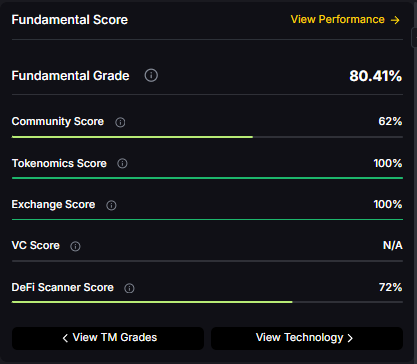
  • Fundamentals: Fundamental Grade 80.41% (Community 62%, Tokenomics 100%, Exchange 100%, VC —, DeFi Scanner 72%)
  • Technology: Technology Grade 29.63% (Activity 22%, Repository 70%, Collaboration 48%, Security —, DeFi Scanner 72%)
  • TM Agent gist: Neutral grade, bearish momentum in price prediction models; adoption must improve for upside
  • Education only, not financial advice

Bitcoin Cash Price Prediction Scenario Analysis

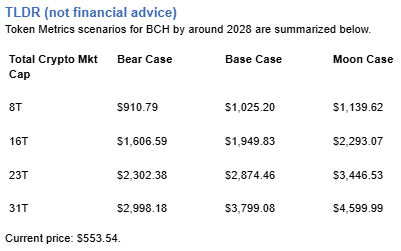
Token Metrics price prediction scenarios span four market cap tiers, each representing different levels of crypto market maturity and liquidity:

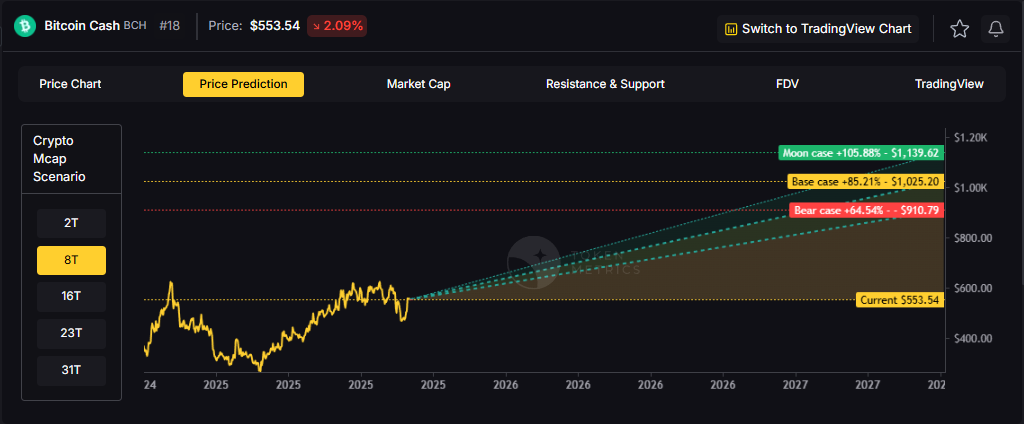
8T Market Cap - BCH Price Prediction:

At an 8 trillion total crypto market cap, BCH price prediction projects to $910.79 in bear conditions, $1,025.20 in the base case, and $1,139.62 in bullish scenarios.

16T Market Cap - BCH Price Prediction:

Doubling the market to 16 trillion expands the price prediction range to $1,606.59 (bear), $1,949.83 (base), and $2,293.07 (moon).

23T Market Cap - BCH Price Prediction:

At 23 trillion, the price prediction scenarios show $2,302.38, $2,874.46, and $3,446.53 respectively.

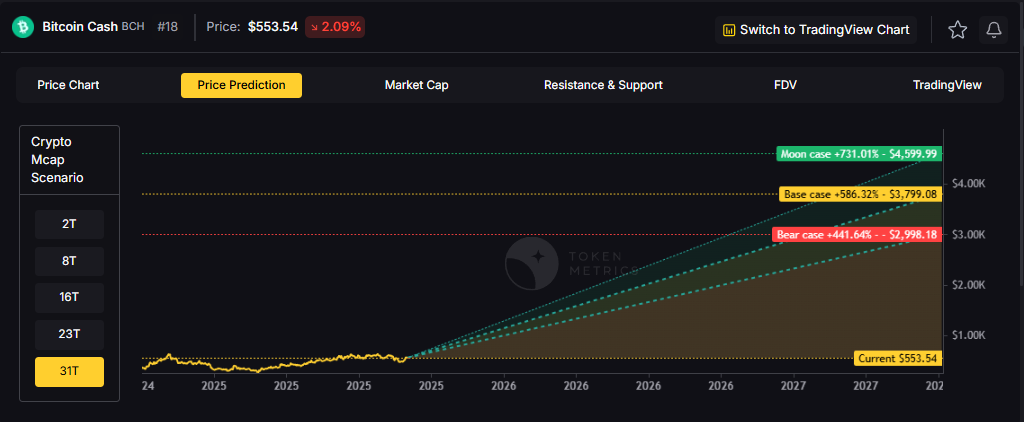
31T Market Cap - BCH Price Prediction:

In the maximum liquidity scenario of 31 trillion, BCH price predictions could reach $2,998.18 (bear), $3,799.08 (base), or $4,599.99 (moon).

Each tier in our price prediction framework assumes progressively stronger market conditions, with the base case reflecting steady growth and the moon case requiring sustained bull market dynamics.

Why Consider the Indices with Top-100 Exposure

Bitcoin Cash represents one opportunity among hundreds in crypto markets. Token Metrics Indices bundle BCH with top one hundred assets for systematic exposure to the strongest projects. Single tokens face idiosyncratic risks that diversified baskets mitigate.

Historical index performance demonstrates the value of systematic diversification versus concentrated positions.

Join the early access list

What Is Bitcoin Cash?

Bitcoin Cash is a peer-to-peer electronic cash network focused on fast confirmation and low fees. It launched in 2017 as a hard fork of Bitcoin with larger block capacity to prioritize payments. The chain secures value transfers using proof of work and aims to keep everyday transactions affordable.

BCH is used to pay transaction fees and settle transfers, and it is widely listed across major exchanges. Adoption centers on payments, micropayments, and remittances where low fees matter. It competes as a payment‑focused Layer 1 within the broader crypto market.

Token Metrics AI Analysis

Token Metrics AI provides comprehensive context on Bitcoin Cash's positioning and challenges, informing our price prediction models:

Vision: Bitcoin Cash (BCH) is a cryptocurrency that emerged from a 2017 hard fork of Bitcoin, aiming to function as a peer-to-peer electronic cash system with faster transactions and lower fees. It is known for prioritizing on-chain scalability by increasing block sizes, allowing more transactions per block compared to Bitcoin. This design choice supports its use in everyday payments, appealing to users seeking a digital cash alternative. Adoption has been driven by its utility in micropayments and remittances, particularly in regions with limited banking infrastructure. However, Bitcoin Cash faces challenges including lower network security due to reduced mining hash rate compared to Bitcoin, and ongoing competition from both Bitcoin and other scalable blockchains. Its value proposition centers on accessibility and transaction efficiency, but it operates in a crowded space with evolving technological and regulatory risks.

Problem: The project addresses scalability limitations in Bitcoin, where rising transaction fees and slow confirmation times hinder its use for small, frequent payments. As Bitcoin evolved into a store of value, a gap emerged for a blockchain-based currency optimized for fast, low-cost transactions accessible to the general public.

Solution: Bitcoin Cash increases block size limits from 1 MB to 32 MB, enabling more transactions per block and reducing congestion. This on-chain scaling approach allows for faster confirmations and lower fees, making microtransactions feasible. The network supports basic smart contract functionality and replay protection, maintaining compatibility with Bitcoin's core architecture while prioritizing payment utility.

Market Analysis: Bitcoin Cash operates in the digital currency segment, competing with Bitcoin, Litecoin, and stablecoins for use in payments and remittances. While not the market leader, it occupies a niche focused on on-chain scalability for transactional use. Its adoption is influenced by merchant acceptance, exchange liquidity, and narratives around digital cash. Key risks include competition from layer-2 solutions on other blockchains, regulatory scrutiny of cryptocurrencies, and lower developer and miner activity compared to larger networks. Price movements are often tied to broader crypto market trends and internal protocol developments. Despite its established presence, long-term growth depends on sustained utility, network security, and differentiation in a market increasingly dominated by high-throughput smart contract platforms—all critical factors in our price prediction analysis.

Fundamental and Technology Snapshot from Token Metrics

Fundamental Grade: 80.41% (Community 62%, Tokenomics 100%, Exchange 100%, VC —, DeFi Scanner 72%).


Technology Grade: 29.63% (Activity 22%, Repository 70%, Collaboration 48%, Security —, DeFi Scanner 72%).


Catalysts That Skew BCH Price Predictions Bullish

  • Institutional and retail access expands with ETFs, listings, and integrations
  • Macro tailwinds from lower real rates and improving liquidity
  • Product or roadmap milestones such as upgrades, scaling, or partnerships
  • Increased merchant adoption for payment processing
  • Growing adoption in remittance corridors and emerging markets
  • Layer-2 development enhancing BCH utility

Risks That Skew BCH Price Predictions Bearish

  • Macro risk-off from tightening or liquidity shocks
  • Regulatory actions targeting payment cryptocurrencies or infrastructure outages
  • Concentration risk in validator economics and competitive displacement
  • Low technology grade (29.63%) indicating development challenges
  • Competition from Bitcoin Lightning Network and other payment solutions
  • Declining developer activity and network effect

Bitcoin Cash Price Prediction FAQs

Can BCH reach $3,000?

Yes. Based on our price prediction scenarios, BCH could reach $3,000 in the 23T moon case and 31T base case. The 23T tier projects $3,446.53 in the moon case, making $3,000 an achievable target under favorable market conditions. Not financial advice.

Can BCH 10x from current levels?

At current price of $553.54, a 10x would reach $5,535.40. This falls beyond our highest price prediction scenario of $4,599.99 (31T moon case). Bear in mind that 10x returns would require substantial market cap expansion beyond our modeled scenarios and exceptional BCH adoption. Not financial advice.

Should I buy BCH now or wait?

Timing depends on your risk tolerance and macro outlook. Current price of $553.54 sits below the 8T bear case in our price prediction scenarios. The Neutral TM Grade (54.81%) and bearish trading signal suggest caution in the near term. Dollar-cost averaging may reduce timing risk. Not financial advice.

What is the Bitcoin Cash price prediction for 2025-2028?

Our comprehensive BCH price prediction framework suggests Bitcoin Cash could trade between $910.79 and $4,599.99 depending on market conditions and total crypto market capitalization. The base case price prediction scenario clusters around $1,025.20 to $3,799.08 across different market cap environments. Current Neutral rating (54.81%) indicates mixed signals requiring adoption improvements. Not financial advice.

Can Bitcoin Cash reach $5,000?

BCH reaching $5,000 would exceed our current price prediction models' highest scenario of $4,599.99 (31T moon case). This would require extraordinary market conditions, significant merchant adoption acceleration, and BCH successfully differentiating itself in the crowded payment cryptocurrency space. Not financial advice.

Is Bitcoin Cash a good investment based on price predictions?

BCH shows strong fundamentals (80.41% grade) but a very weak technology score (29.63%), resulting in a Neutral TM Grade of 54.81% with bearish near-term signals. While our price prediction models show potential upside in favorable market conditions, the low technology grade and adoption challenges suggest significant risks. The payment-focused use case faces competition from Lightning Network and other solutions. Not financial advice.

How does BCH compare to Bitcoin in price predictions?

Bitcoin Cash was designed as a payment-focused alternative to Bitcoin's store-of-value narrative. Our price prediction framework shows BCH could reach $1,025-$4,600 across scenarios, while Bitcoin dominates market cap and network effects. BCH's success depends on carving out a distinct payment niche rather than competing directly with Bitcoin. The correlation between BTC and BCH price movements remains high.

What are the biggest risks to BCH price predictions?

Key risks that could impact Bitcoin Cash price predictions include: extremely low technology grade (29.63%) indicating development stagnation, competition from Bitcoin Lightning Network, declining developer activity, regulatory targeting of payment cryptocurrencies, low mining hash rate security concerns, and competitive displacement from stablecoins and other payment solutions. The bearish trading signal and Neutral grade reflect these challenges.

Will BCH benefit from a Bitcoin bull run?

Historically, Bitcoin Cash has shown positive correlation with Bitcoin price movements. Our price prediction scenarios assume BCH captures some momentum from broader crypto market expansion. However, BCH's lower technology grade and adoption challenges may limit its ability to match Bitcoin's percentage gains. The base case scenarios reflect moderate participation in bull market dynamics.

Next Steps

Track live grades and signals

Join Indices Early Access

Want exposure? Buy BCH on MEXC

Disclosure

Educational purposes only, not financial advice. Crypto is volatile, do your own research and manage risk.

Why Use Token Metrics for BCH Price Predictions?

  • Scenario-based forecasting: Multiple market cap tiers for comprehensive price prediction analysis
  • Transparent grading: Fundamental (80.41%) vs Technology (29.63%) reveals strengths and weaknesses
  • AI-driven insights: Advanced algorithms analyze payment cryptocurrency competitive landscape
  • Real-time signals: Trading signals and TM Grades (Neutral 54.81%) updated regularly
  • Risk assessment: Identifies key risks like low developer activity and competitive pressure
  • Comparative analysis: Analyze BCH against Bitcoin, Litecoin, and 6,000+ tokens
Research

Chainlink Price Prediction 2027: Oracle Infrastructure Analysis

Token Metrics Team
8 min read

Understanding LINK Price Prediction: 2027 Potential

Infrastructure protocols become more valuable as the crypto ecosystem scales and relies on robust middleware. Chainlink provides critical oracle infrastructure where proven utility and deep integrations drive long-term value over retail speculation. Increasing institutional adoption raises demand for professional-grade data delivery and security.

Token Metrics price prediction projections for LINK below span multiple total market cap scenarios from conservative to aggressive. Each tier assumes different levels of infrastructure demand as crypto evolves from speculative markets to institutional-grade systems. These bands frame LINK's price prediction potential outcomes into 2027.

Disclosure

Educational purposes only, not financial advice. Crypto is volatile, do your own research and manage risk.

Token Metrics price prediction projections for LINK below span multiple total market cap scenarios from conservative to aggressive. Each tier assumes different levels of infrastructure demand as crypto evolves from speculative markets to institutional-grade systems. These bands frame LINK's price prediction potential outcomes into 2027.

Disclosure

Educational purposes only, not financial advice. Crypto is volatile, do your own research and manage risk.

How to Read This LINK Price Prediction

Each band blends cycle analogues and market-cap share math with TA guardrails. Base assumes steady adoption and neutral or positive macro. Moon layers in a liquidity boom. Bear assumes muted flows and tighter liquidity.

TM Agent baseline: Token Metrics lead metric for Chainlink, cashtag $LINK, is a TM Grade of 23.31%, which translates to a Sell, and the trading signal is bearish, indicating short-term downward momentum. This means Token Metrics currently does not endorse $LINK as a long-term buy at current conditions in our price prediction models, despite strong technology fundamentals.

Live details: Chainlink Token Details

Access: Buy LINK on MEXC

Affiliate Disclosure: We may earn a commission from qualifying purchases made via this link, at no extra cost to you.

Key Takeaways: Chainlink Price Prediction Summary

  • Scenario driven: Price prediction outcomes hinge on total crypto market cap; higher liquidity and adoption lift the bands
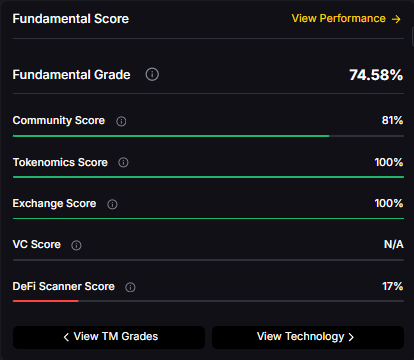
  • Fundamentals: Fundamental Grade 74.58% (Community 81%, Tokenomics 100%, Exchange 100%, VC —, DeFi Scanner 17%)
  • Technology: Technology Grade 88.50% (Activity 81%, Repository 72%, Collaboration 100%, Security 86%, DeFi Scanner 17%)
  • TM Agent gist: Bearish signal with limited upside in price prediction models unless fundamentals or market regime change
  • Current rating: Sell (23.31%) with strong tech but weak valuation
  • Education only, not financial advice

Chainlink Price Prediction Scenario Analysis

Token Metrics price prediction scenarios span four market cap tiers, each representing different levels of crypto market maturity and liquidity:

8T Market Cap - LINK Price Prediction:

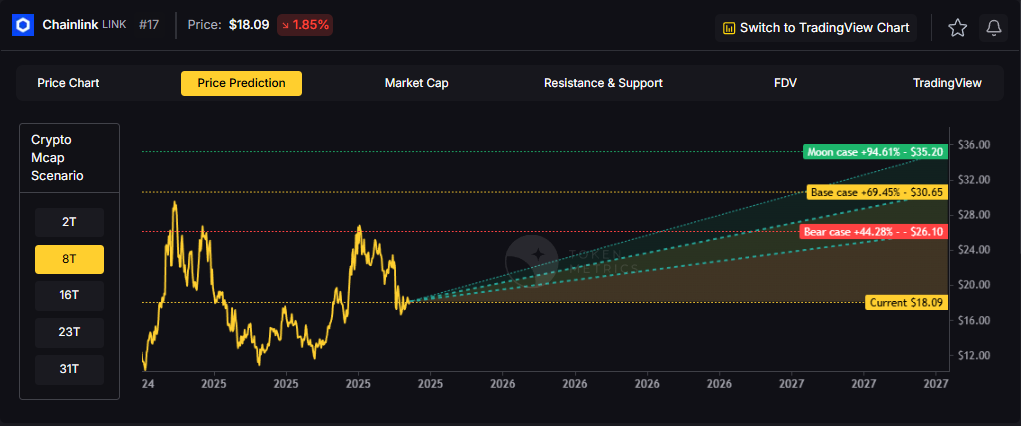
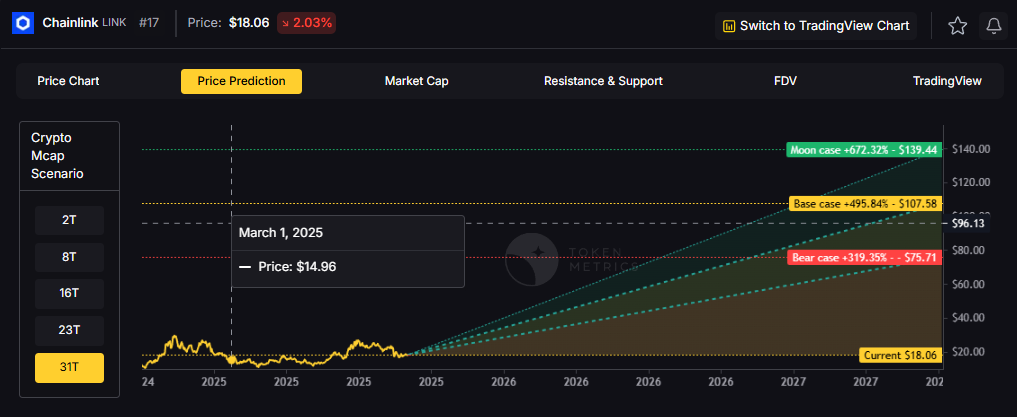
At an 8 trillion dollar total crypto market cap, LINK price prediction projects to $26.10 in bear conditions, $30.65 in the base case, and $35.20 in bullish scenarios.

 16T Market Cap - LINK Price Prediction:

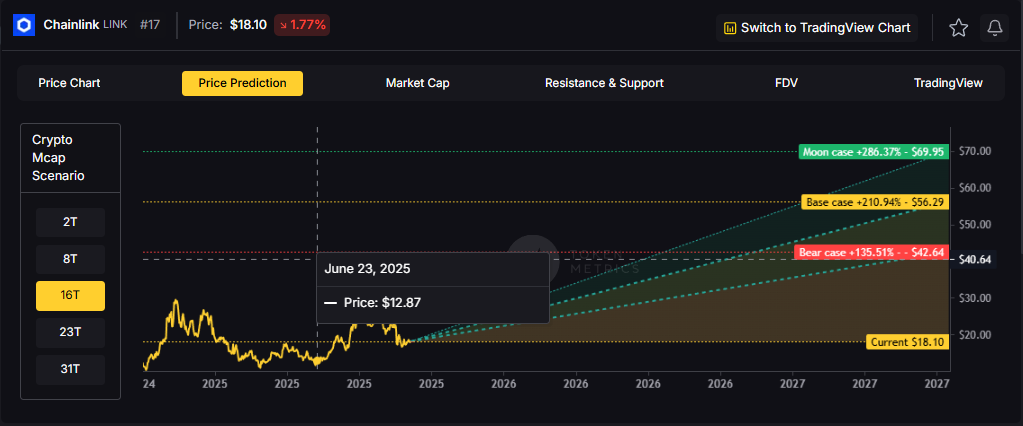
Doubling the market to 16 trillion expands the price prediction range to $42.64 (bear), $56.29 (base), and $69.95 (moon).

 23T Market Cap - LINK Price Prediction:

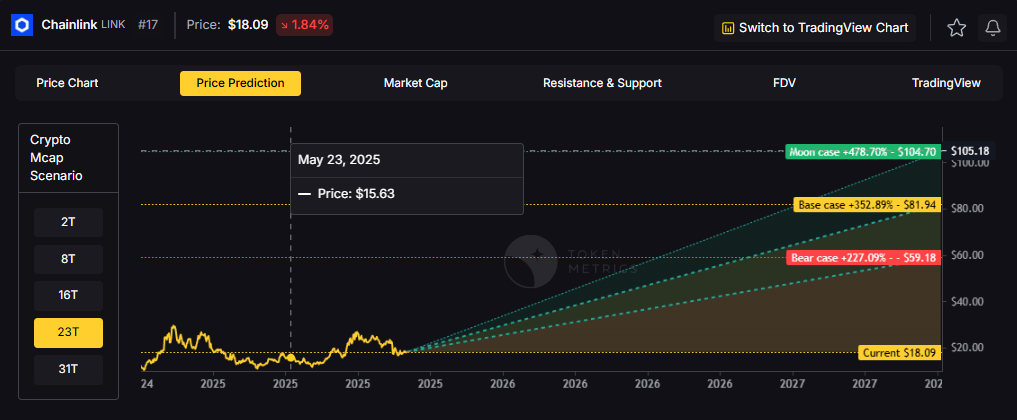
At 23 trillion, the price prediction scenarios show $59.18, $81.94, and $104.70 respectively.

 31T Market Cap - LINK Price Prediction:

In the maximum liquidity scenario of 31 trillion, LINK price predictions could reach $75.71 (bear), $107.58 (base), or $139.44 (moon).

  These price prediction ranges reflect potential infrastructure value capture as crypto markets mature, though current valuation concerns contribute to the Sell rating despite strong technology fundamentals.

Why Consider the Indices with Top-100 Exposure

Chainlink represents one opportunity among hundreds in crypto markets. Token Metrics Indices bundle LINK with top one hundred assets for systematic exposure to the strongest projects. Single tokens face idiosyncratic risks that diversified baskets mitigate.

Historical index performance demonstrates the value of systematic diversification versus concentrated positions.

Join the early access list

What Is Chainlink?

Chainlink is a decentralized oracle network that connects smart contracts to real-world data and systems. It enables secure retrieval and verification of off-chain information, supports computation, and integrates across multiple blockchains. As adoption grows, Chainlink serves as critical infrastructure for reliable data feeds and automation.

The LINK token is used to pay node operators and secure the network's services. Common use cases include DeFi price feeds, insurance, and enterprise integrations, with CCIP extending cross-chain messaging and token transfers—all factors that influence long-term LINK price predictions.

Token Metrics AI Analysis

Token Metrics AI provides comprehensive context informing our LINK price prediction models:

Vision: Chainlink aims to create a decentralized, secure, and reliable network for connecting smart contracts with real-world data and systems. Its vision is to become the standard for how blockchains interact with external environments, enabling trust-minimized automation across industries.

Problem: Smart contracts cannot natively access data outside their blockchain, limiting their functionality. Relying on centralized oracles introduces single points of failure and undermines the security and decentralization of blockchain applications. This creates a critical need for a trustless, tamper-proof way to bring real-world information onto blockchains.

Solution: Chainlink solves this by operating a decentralized network of node operators that fetch, aggregate, and deliver data from off-chain sources to smart contracts. It uses cryptographic proofs, reputation systems, and economic incentives to ensure data integrity. The network supports various data types and computation tasks, allowing developers to build complex, data-driven decentralized applications.

Market Analysis: Chainlink is a market leader in the oracle space and a key infrastructure component in the broader blockchain ecosystem, particularly within Ethereum and other smart contract platforms. It faces competition from emerging oracle networks like Band Protocol and API3, but maintains a strong first-mover advantage and widespread integration across DeFi, NFTs, and enterprise blockchain solutions. Adoption is driven by developer activity, partnerships with major blockchain projects, and demand for secure data feeds. Key risks include technological shifts, regulatory scrutiny on data providers, and execution challenges in scaling decentralized oracle networks. As smart contract usage grows, so does the potential for oracle services, positioning Chainlink at the center of a critical niche, though its success depends on maintaining security and decentralization over time—all critical factors in our price prediction analysis.

Fundamental and Technology Snapshot from Token Metrics

Fundamental Grade: 74.58% (Community 81%, Tokenomics 100%, Exchange 100%, VC —, DeFi Scanner 17%).


Technology Grade: 88.50% (Activity 81%, Repository 72%, Collaboration 100%, Security 86%, DeFi Scanner 17%).

  Catalysts That Skew LINK Price Predictions Bullish

  • Institutional and retail access expands with ETFs, listings, and integrations
  • Macro tailwinds from lower real rates and improving liquidity
  • Product or roadmap milestones such as CCIP upgrades, scaling, or partnerships
  • Increased adoption of Chainlink oracle services across DeFi protocols
  • Enterprise blockchain integrations requiring secure data feeds
  • Cross-chain expansion through CCIP (Cross-Chain Interoperability Protocol)

Risks That Skew LINK Price Predictions Bearish

  • Macro risk-off from tightening or liquidity shocks
  • Regulatory actions targeting oracle networks or infrastructure outages
  • Concentration in node operator economics and competitive displacement
  • Current low TM Grade (23.31%) indicating valuation concerns
  • Competition from alternative oracle solutions (Band Protocol, API3)
  • Token economics challenges despite 100% tokenomics score

How Token Metrics Can Help

Token Metrics empowers you to analyze Chainlink and hundreds of digital assets with AI-driven ratings, on-chain and fundamental data, and index solutions to manage portfolio risk smartly in a rapidly evolving crypto market. Our price prediction frameworks provide transparent scenario-based analysis even for tokens with Sell ratings.

Chainlink Price Prediction FAQs

Can LINK reach $100?

Yes. Based on our price prediction scenarios, LINK could reach $100+ in the 23T moon case, projecting $104.70. However, this requires significant market cap expansion and improved market conditions beyond the current Sell rating (23.31%). Not financial advice.

What price could LINK reach in the moon case?

Moon case price predictions range from $35.20 at 8T to $139.44 at 31T total crypto market cap. These scenarios assume maximum liquidity expansion and strong Chainlink adoption, though current bearish signals suggest caution. Not financial advice.

Should I buy LINK now or wait?

Timing depends on risk tolerance and macro outlook. Current price of $18.09 sits below the 8T bear case in our price prediction scenarios, suggesting potential value. However, the Sell rating (23.31%) and bearish trading signal indicate Token Metrics does not currently endorse LINK at these levels. Dollar-cost averaging may reduce timing risk if you believe in long-term infrastructure value. Not financial advice.

What is the Chainlink price prediction for 2025-2027?

Our comprehensive LINK price prediction framework suggests Chainlink could trade between $26.10 and $139.44 depending on market conditions and total crypto market capitalization. The base case price prediction scenario clusters around $30.65 to $107.58 across different market cap environments. Despite strong technology (88.50%) and fundamentals (74.58%), the current Sell rating (23.31%) reflects valuation concerns. Not financial advice.

Can Chainlink reach $50?

Yes. Based on our price prediction scenarios, LINK could reach $56.29 in the 16T base case and higher in 23T/31T scenarios. The $50 target becomes achievable in moderate market cap environments (16T tier), though current bearish momentum suggests this may take time. Not financial advice.

Why does LINK have a Sell rating despite strong technology?

LINK shows excellent technology fundamentals (88.50% grade) with strong development activity, collaboration, and security. However, the overall TM Grade of 23.31% (Sell) reflects current valuation concerns, market positioning, and bearish trading signals. Our price prediction models show potential upside in favorable market conditions, but current metrics suggest waiting for improved entry points. Not financial advice.

Is Chainlink a good investment based on price predictions?

LINK presents a complex investment case: exceptional technology grade (88.50%), solid fundamentals (74.58%), but a Sell rating (23.31%) with bearish momentum. While our price prediction models show significant upside potential in bull market scenarios, current valuation concerns and bearish signals suggest caution. The oracle infrastructure thesis remains compelling long-term, but timing and entry points matter. Consider diversified exposure through indices. Not financial advice.

How does LINK compare to other oracle price predictions?

Chainlink dominates the oracle space with first-mover advantage and widespread integration. Our price prediction framework suggests LINK could reach $30-$139 across scenarios. Competitors like Band Protocol and API3 offer alternatives, but Chainlink's established network effects and enterprise partnerships position it as the infrastructure leader. However, the current Sell rating suggests valuation concerns versus alternatives.

What are the biggest risks to LINK price predictions?

Key risks that could impact Chainlink price predictions include: current Sell rating (23.31%) indicating valuation concerns, competition from emerging oracle networks, regulatory scrutiny on data providers, node operator centralization risks, macro liquidity shocks, and challenges scaling decentralized oracle infrastructure. Despite strong technology (88.50%), these factors contribute to bearish near-term outlook.

Will LINK benefit from DeFi growth?

Chainlink is critical infrastructure for DeFi, providing price feeds for lending protocols, derivatives, and stablecoins. Our price prediction scenarios assume LINK captures value from continued DeFi adoption. However, the current Sell rating suggests this thesis isn't reflected in valuation metrics yet. Long-term infrastructure value may require patience and improved market conditions.


Should I buy LINK now or wait?

Timing depends on risk tolerance and macro outlook. Current price of $18.09 sits below the 8T bear case in the scenarios. Dollar-cost averaging may reduce timing risk. Not financial advice.

Next Steps

Track live grades and signals: Token Details

Join Indices Early Access 

Want exposure? Buy LINK on MEXC 

Disclosure

Educational purposes only, not financial advice. Crypto is volatile, do your own research and manage risk.

Why Token Metrics Ratings Matter

Discover the full potential of your crypto research and portfolio management with Token Metrics. Our ratings combine AI-driven analytics, on-chain data, and decades of investing expertise—giving you the edge to navigate fast-changing markets. Try our platform to access scenario-based price prediction targets, token grades, indices, and more for institutional and individual investors. Token Metrics is your research partner through every crypto market cycle.

Why Use Token Metrics for LINK Price Predictions?

  • Transparent analysis: Honest Sell ratings (23.31%) even when technology fundamentals are strong (88.50%)
  • Scenario-based modeling: Multiple market cap tiers for comprehensive price prediction analysis
  • Infrastructure focus: Specialized oracle network analysis and competitive landscape assessment
  • Risk-adjusted approach: Balanced view of technology strength versus valuation concerns
  • Real-time signals: Trading signals and TM Grades updated regularly
  • Diversification tools: Index solutions to spread oracle infrastructure risk
  • Comparative analysis: Analyze LINK against Band Protocol, API3, and 6,000+ tokens
Research

Hyperliquid Price Prediction 2026: DEX Perpetuals Trading Analysis

Token Metrics Team
7 min read

Why 2026 Looks Bullish for HYPE Price Prediction: Market Context

The crypto market is tilting bullish into 2026 as liquidity, infrastructure, and participation improve across the board. Clearer rules and standards are reshaping the classic four-year cycle, flows can arrive earlier, and strength can persist longer than in prior expansions.

Institutional access is widening through ETFs and custody, while L2 scaling and real-world integrations help sustain on-chain activity. This healthier backdrop frames our price prediction scenario work for HYPE. The ranges below reflect different total crypto market sizes and the share Hyperliquid could capture under each regime, providing investors with comprehensive price prediction analysis for strategic planning.


Disclosure

Educational purposes only, not financial advice. Crypto is volatile, do your own research and manage risk.

How to Read This HYPE Price Prediction

Each band blends cycle analogues and market-cap share math with TA guardrails. Base assumes steady adoption and neutral or positive macro. Moon layers in a liquidity boom. Bear assumes muted flows and tighter liquidity.

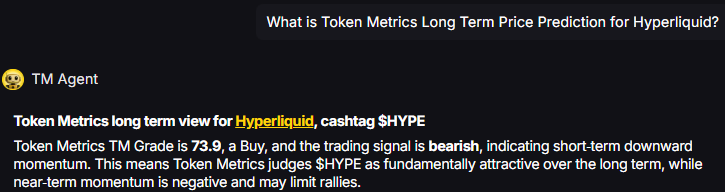
TM Agent baseline: Token Metrics TM Grade is 73.9%, a Buy, and the trading signal is bearish, indicating short-term downward momentum. This means Token Metrics judges HYPE as fundamentally attractive over the long term in our price prediction models, while near-term momentum is negative and may limit rallies.

Live details: Hyperliquid Token Details

Buy HYPE

Affiliate Disclosure: We may earn a commission from qualifying purchases made via this link, at no extra cost to you.

Key Takeaways: Hyperliquid Price Prediction Summary

  • Scenario driven: Price prediction outcomes hinge on total crypto market cap; higher liquidity and adoption lift the bands
  • Fundamentals: Fundamental Grade 76.73% (Community 68%, Tokenomics 60%, Exchange 100%, VC —, DeFi Scanner 92%)
  • Technology: Technology Grade N/A (Activity —, Repository —, Collaboration —, Security —, DeFi Scanner 92%)
  • TM Agent gist: Long-term attractive on fundamentals in price prediction models; near-term momentum is negative and may limit rallies
  • Current rating: Buy (73.9%) with bullish 2026 macro backdrop
  • Education only, not financial advice

Hyperliquid Price Prediction Scenario Analysis

Token Metrics price prediction scenarios span four market cap tiers, each representing different levels of crypto market maturity and liquidity:

8T Market Cap - HYPE Price Prediction:

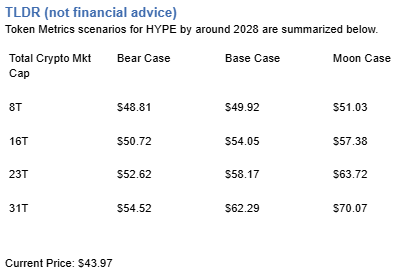
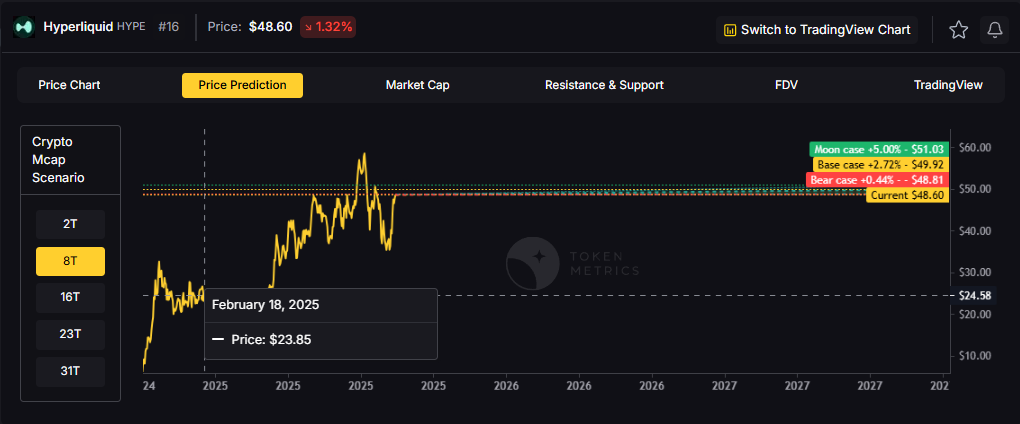
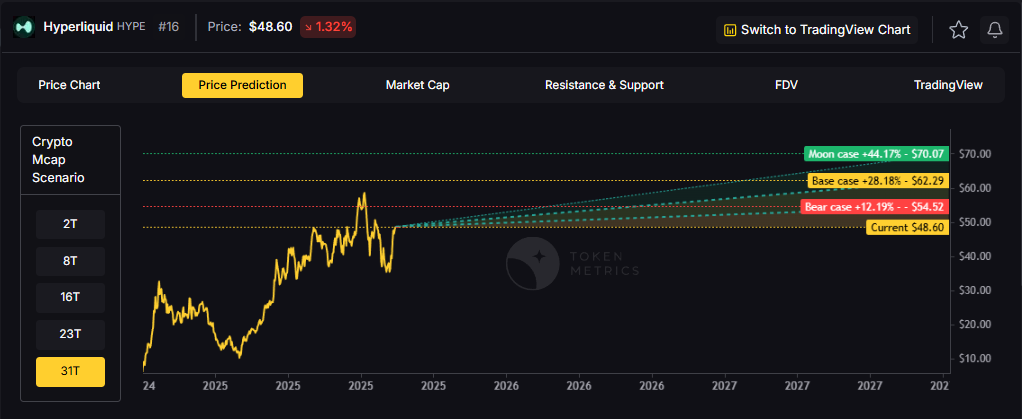
At an 8 trillion dollar total crypto market cap, HYPE price prediction projects to $48.81 in bear conditions, $49.92 in the base case, and $51.03 in bullish scenarios.

16T Market Cap - HYPE Price Prediction:

Doubling the market to 16 trillion expands the price prediction range to $50.72 (bear), $54.05 (base), and $57.38 (moon).

23T Market Cap - HYPE Price Prediction:

At 23 trillion, the price prediction scenarios show $52.62, $58.17, and $63.72 respectively.

31T Market Cap - HYPE Price Prediction:

In the maximum liquidity scenario of 31 trillion, HYPE price predictions could reach $54.52 (bear), $62.29 (base), or $70.07 (moon).

Each tier in our price prediction framework assumes progressively stronger market conditions, with the base case reflecting steady growth and the moon case requiring sustained bull market dynamics driven by the improving 2026 macro environment.

Why Consider the Indices with Top-100 Exposure

Diversification matters. HYPE is compelling, yet concentrated bets can be volatile, especially when evaluating long-term price predictions. Token Metrics Indices hold HYPE alongside the top one hundred tokens for broad exposure to leaders and emerging winners.

Our backtests indicate that owning the full market with diversified indices has historically outperformed both the total market and Bitcoin in many regimes due to diversification and rotation benefits.

Get early access

What Is Hyperliquid?

Hyperliquid is a decentralized exchange focused on perpetual futures with a high-performance order book architecture. The project emphasizes low-latency trading, risk controls, and capital efficiency aimed at professional and retail derivatives traders. Its token, HYPE, is used for ecosystem incentives and governance-related utilities—all factors that directly influence HYPE price prediction trajectories.

Catalysts That Skew HYPE Price Predictions Bullish

  • Institutional and retail access expands with ETFs, listings, and integrations
  • Macro tailwinds from lower real rates and improving liquidity entering 2026
  • Product or roadmap milestones such as upgrades, scaling, or partnerships
  • Growing perpetual futures DEX market share
  • Increased professional trader adoption of decentralized derivatives
  • Integration with major DeFi protocols and liquidity aggregators
  • Favorable regulatory clarity for decentralized exchanges

Risks That Skew HYPE Price Predictions Bearish

  • Macro risk-off from tightening or liquidity shocks
  • Regulatory actions targeting decentralized derivatives platforms or infrastructure outages
  • Concentration risk in validator economics and competitive displacement
  • Competition from established centralized exchanges and other DEX perpetuals platforms
  • Technology grade unavailable (N/A), limiting technical assessment
  • Security vulnerabilities in order book or smart contract architecture

Hyperliquid Price Prediction FAQs

Can HYPE reach $60?

Yes. The 23T and 31T tiers in our price prediction models imply ranges above $60 in the Base and Moon bands, with the 23T moon case projecting $63.72 and the 31T base case projecting $62.29. These outcomes depend on liquidity and adoption improvements expected in the bullish 2026 environment. Not financial advice.

Is HYPE a good long-term investment?

HYPE shows a strong Buy rating (73.9%) with solid fundamentals (76.73%), suggesting long-term attractiveness. However, the outcome depends on adoption, liquidity regime, competition in the perpetual DEX space, and supply dynamics. The bearish near-term trading signal suggests potential volatility. Diversify and size positions responsibly. Not financial advice.

What is the Hyperliquid price prediction for 2026?

Our comprehensive HYPE price prediction framework for 2026 suggests Hyperliquid could trade between $48.81 and $70.07 depending on market conditions and total crypto market capitalization. The base case price prediction scenario clusters around $49.92 to $62.29 across different market cap environments. The Buy rating (73.9%) reflects confidence in the bullish 2026 macro backdrop. Not financial advice.

Can HYPE reach $100?

HYPE reaching $100 would exceed our current price prediction models' highest scenario of $70.07 (31T moon case). This would require extraordinary market conditions beyond the 31T total crypto market cap tier, exceptional perpetual DEX adoption, and Hyperliquid dominating the decentralized derivatives space. While the 2026 bullish thesis supports growth, $100 appears beyond our modeled scenarios. Not financial advice.

Should I buy HYPE now or wait?

HYPE has a Buy rating (73.9%) indicating long-term attractiveness in our price prediction models. However, the bearish trading signal suggests near-term downward momentum. Current price positioning and the expected bullish 2026 environment create a complex timing decision. Dollar-cost averaging may reduce timing risk while capturing upside exposure. Consider diversified DEX exposure through indices. Not financial advice.

How does HYPE compare to other DEX price predictions?

Hyperliquid focuses specifically on perpetual futures with order book architecture, differentiating it from AMM-based DEXs like Uniswap or dYdX. Our price prediction framework suggests HYPE could reach $49-$70 across scenarios in 2026. The Buy rating (73.9%) and strong fundamentals (76.73%) position HYPE competitively, though the lack of technology grade data (N/A) limits comparative technical assessment.

What makes 2026 bullish for HYPE price predictions?

Multiple factors support bullish HYPE price predictions for 2026: widening institutional access through ETFs and custody solutions, L2 scaling improvements, clearer regulatory frameworks, improving macro liquidity conditions, and the maturation of decentralized derivatives markets. These tailwinds create favorable conditions for perpetual DEX platforms like Hyperliquid to capture market share. Not financial advice.

Why is HYPE rated Buy despite bearish trading signals?

HYPE receives a Buy rating (73.9%) based on strong fundamental grade (76.73%) and favorable long-term positioning in the growing perpetual DEX space. However, the bearish trading signal reflects short-term downward momentum. This creates a classic "buy the dip" scenario where fundamentals suggest long-term value but near-term price action may provide better entry points. Our price prediction models reflect this nuance. Not financial advice.

What are the biggest risks to HYPE price predictions?

Key risks that could impact Hyperliquid price predictions include: unavailable technology grade (N/A) limiting technical assessment, competition from established centralized exchanges (Binance, OKX) and other perpetual DEXs (dYdX, GMX), regulatory targeting of decentralized derivatives, order book architecture vulnerabilities, liquidity fragmentation across perpetual platforms, and macro liquidity shocks. Despite the Buy rating, these risks warrant careful position sizing.

Can HYPE benefit from the 2026 bull market?

Yes. Our price prediction scenarios are specifically framed around the bullish 2026 thesis, where improving liquidity, institutional participation, and regulatory clarity create favorable conditions. HYPE's Buy rating (73.9%) reflects this positive macro backdrop. The base case scenarios ($49.92 to $62.29) assume steady participation in bull market dynamics, while moon cases require sustained momentum. Not financial advice.


Next Steps

Disclosure

Educational purposes only, not financial advice. Crypto is volatile, do your own research and manage risk.

Your Edge: Powered by Token Metrics

Token Metrics delivers AI-based crypto ratings, scenario-based price prediction projections, and portfolio tools so you can make smarter decisions. Discover real-time analytics on Token Metrics.

Why Use Token Metrics for HYPE Price Predictions?

  • Bullish 2026 thesis: Specialized analysis of improving macro conditions and institutional access
  • Scenario-based modeling: Four market cap tiers for comprehensive price prediction analysis
  • Buy rating transparency: Strong fundamentals (76.73%) balanced with bearish near-term signals
  • DEX specialization: Focused analysis of perpetual futures DEX competitive landscape
  • Risk management: Indices for diversified exposure beyond single DEX concentration
  • Real-time signals: Trading signals and TM Grades (Buy 73.9%) updated regularly
  • Comparative analysis: Analyze HYPE against dYdX, GMX, and 6,000+ tokens
Choose from Platinum, Gold, and Silver packages
Reach with 25–30% open rates and 0.5–1% CTR
Craft your own custom ad—from banners to tailored copy
Perfect for Crypto Exchanges, SaaS Tools, DeFi, and AI Products