Back to blog
Research

What's the Future of NFTs in Gaming? Market Analysis & 2025 Predictions

Explore the future of gaming NFTs, market growth, key trends, and how Token Metrics' analytics tools can help navigate this evolving digital landscape.
Token Metrics Team
8 min read
Want Smarter Crypto Picks—Free?
See unbiased Token Metrics Ratings for BTC, ETH, and top alts.
Thank you! Your submission has been received!
Oops! Something went wrong while submitting the form.
 No credit card | 1-click unsubscribe

The question of what's the future of NFTs in gaming is no longer theoretical—it's a dynamic reality reshaping the gaming landscape. The intersection of non-fungible tokens (NFTs) and gaming has evolved from a speculative experiment into a multi-billion dollar industry that is revolutionizing how players engage with virtual worlds. In fact, gaming NFTs accounted for over 70% of all NFT activity in the first quarter of 2025, and the market is projected to skyrocket from $4.8 billion in 2024 to an astonishing $44.1 billion by 2034. For game developers, investors, and players alike, understanding this transformation is essential to navigating the future of interactive entertainment.

The Explosive Growth Trajectory

The growth trajectory of NFT gaming is nothing short of explosive. Market forecasts indicate that the NFT gaming market will reach a staggering $0.54 trillion in 2025 and continue expanding at a compound annual growth rate (CAGR) of 14.84%, hitting $1.08 trillion by 2030. Meanwhile, the broader Web3 gaming market, which encompasses blockchain-based games and decentralized applications, is expected to grow from $25.63 billion in 2024 to $124.74 billion by 2032, with an even higher CAGR of 19.34%. Play-to-earn (P2E) NFT games are at the forefront of this surge, with the market projected to climb from $5.4 billion in 2025 to $20.19 billion by 2033, growing at a 17.93% CAGR. These models are attracting players worldwide, with more than 64% of users actively engaging with NFT-based games. Notably, 55% of these players are motivated by the financial incentives enabled by play-to-earn systems, which allow gamers to earn real-world income by playing.

This growth is not a passing bubble but a fundamental restructuring of gaming economies. Unlike traditional games that primarily extract value for publishers and developers, NFT gaming rewards players for their time, skill, and engagement, creating new revenue streams and empowering players in unprecedented ways.

From Speculation to Utility: The Maturation of Gaming NFTs

In the early days of NFT gaming, roughly between 2021 and 2022, the space was dominated by speculation and unsustainable tokenomics. Many projects prioritized financial mechanics over gameplay quality, resulting in inflated expectations and eventual market corrections. Players quickly recognized the limitations of games designed mainly as investment vehicles rather than immersive experiences.

By 2025, the market has matured significantly, with utility and gameplay quality taking center stage. The focus has shifted decisively from purely art-based NFTs to those that grant access to events, decentralized finance (DeFi) protocols, and real-world assets. Today, gaming and sports-related NFT collections constitute over 70% of NFT activity, underscoring that functional and engaging experiences drive sustained adoption.

True Digital Ownership Revolution

One of the most transformative aspects of NFTs in gaming is the concept of true digital ownership. Unlike traditional games where in-game assets are controlled exclusively by the game publisher and hold no tangible value outside the game's ecosystem, blockchain technology enables genuine ownership of digital items. When players acquire an in-game NFT—be it a rare weapon, a unique character, or virtual land—they have verifiable proof of ownership secured by the blockchain.

This ownership is not merely symbolic. Players can trade, sell, or use their NFTs across compatible games, or hold them as investments independent of the developer's decisions. Unlike traditional games, where assets are often locked to one title, NFTs open the door to interoperability and player-driven economies. Statistics reinforce this shift: over 61% of players now value having more control over their in-game assets, and around 58% of gaming projects integrate NFT minting capabilities, empowering users to create, trade, and monetize digital collectibles with greater autonomy.

  1. Sustainable Play-to-Earn Models

    The first generation of play-to-earn games struggled with unsustainable token economies that led to inflationary spirals and market collapse. Today, the emphasis is on creating balanced, sustainable play-to-earn models where earning potential aligns with genuine gameplay value rather than relying on recruitment or speculative hype. Currently, about 55% of P2E games provide crypto-based rewards within stable token economies designed for long-term viability. Developers are incorporating mechanisms such as token sinks, deflationary features, and diversified revenue streams beyond token sales to foster healthy in-game economies. This approach helps maintain the economic integrity of NFT gaming and enhances player trust.

  2. Cross-Chain Interoperability and Multi-Platform Integration

    One of the most promising aspects of NFT gaming is interoperability—the ability for players to use their digital assets across multiple games and platforms. This cross-chain functionality has become a dominant trend in 2025, with projects expanding their presence across various blockchain networks like Kronos, Solana, and Arbitrum to reach broader audiences. Technological advancements such as the ERC-6551 standard enable NFTs to own other assets, creating nested ownership structures that add unprecedented complexity and flexibility to in-game economies. For example, a player might acquire a rare sword in one game and use it across different titles, with blockchain technology ensuring provenance and authenticity. This interoperability not only enhances the gaming experience but also supports the emergence of player-driven economies across virtual worlds.

  3. AI Integration and Dynamic NFTs

    Artificial intelligence is playing an increasingly important role in NFT gaming. Unlike static digital collectibles, many new NFT assets now incorporate dynamic elements that evolve based on player actions, external triggers, or changing conditions. AI-powered procedural generation allows for unique, personalized gaming experiences while preserving the scarcity and value of NFTs. This fusion of AI and NFTs is revolutionizing gameplay mechanics, enabling more immersive and responsive virtual environments that adapt to how players engage with the game. Dynamic NFTs represent a new frontier in digital ownership and interactive storytelling within the gaming world.

  4. Metaverse Expansion and Virtual Worlds

    Blockchain-powered metaverses are becoming more sophisticated, offering enhanced graphics, intuitive interfaces, and richer social features. Competitive events within these virtual worlds are moving beyond experimental phases, with players competing in front of virtual audiences, purchasing NFT tickets, and earning collectible trophies. Virtual real estate remains a key growth area, with the market for virtual land projected to expand from $0.356 billion in 2023 to $4.498 billion by 2032. Players, brands, and investors are increasingly acquiring virtual land to establish persistent digital spaces that transcend individual games, contributing to the rise of vibrant virtual economies.

  5. Mainstream AAA Adoption

    While early NFT gaming initiatives were primarily driven by indie studios and blockchain-native developers, 2025 is witnessing major game publishers entering the space. Industry giants like Ubisoft, Square Enix, Nexon, and Epic Games have announced blockchain-based projects, lending credibility and potentially introducing millions of traditional gamers to NFT integration. Although no AAA publisher has yet fully integrated NFTs into a blockbuster title, expectations are high that between 2025 and 2030, a major release will feature NFT elements, especially as regulatory clarity improves and market demand solidifies. This transition marks a new era in gaming, blending the best of traditional games with the innovative potential of blockchain technology.

Regional Dynamics and Market Leadership

Geographically, the Asia-Pacific region leads NFT gaming adoption, commanding approximately 38-40% of the market share. This dominance is fueled by a massive mobile-first gamer base, increasing digitalization, and supportive government policies in countries like Japan and South Korea. The region's soaring smartphone usage and growing interest in crypto assets further accelerate NFT adoption. North America follows with 25-29% market share, characterized by strong crypto adoption, high digital literacy, and nearly half of American gamers having interacted with at least one blockchain-based game. Europe holds about 20-21% of the market, benefiting from rising NFT awareness and regulatory frameworks like the Markets in Crypto-Assets (MiCA) regulation, which provides clearer guidelines for developers and investors.

Token Metrics: Essential Intelligence for Gaming NFT Investment

As gaming NFTs transition from speculative tokens to foundational gaming infrastructure representing hundreds of billions in value, investors require sophisticated analytical tools to identify opportunities and manage risk. Token Metrics, a premier crypto trading and analytics platform, offers comprehensive intelligence tailored to the gaming NFT landscape.

Comprehensive Gaming NFT Analysis

Token Metrics evaluates thousands of digital assets, including gaming tokens, play-to-earn projects, metaverse platforms, and NFT collections. Its AI-powered rating system assesses projects based on critical factors such as: Blockchain infrastructure, smart contract security, and scalability solutions Economic sustainability, token utility, and inflation/deflation mechanisms Developer team expertise, community engagement, and partnership quality Market dynamics including trading volume, liquidity, and holder distribution Gameplay quality, user retention, and player growth rates

Gaming NFT Market Intelligence

Understanding which gaming platforms, blockchain networks, and NFT collections offer superior risk-adjusted returns requires deep market intelligence. Token Metrics delivers sector-specific research, project comparisons, trend forecasting, and risk assessments that highlight red flags like unsustainable tokenomics or technical vulnerabilities.

Portfolio Management for Gaming Assets

Investors building diversified portfolios across cryptocurrencies, gaming tokens, NFT collections, and virtual land benefit from Token Metrics’ portfolio tools. These provide real-time valuation across multiple chains and marketplaces, performance attribution, correlation analysis for diversification, and tax reporting features to simplify complex NFT transactions.

Trading Signals and Actionable Intelligence

Token Metrics’ proprietary algorithms generate trading signals for gaming tokens and NFT projects, helping investors identify optimal entry and exit points. As NFT marketplaces mature and liquidity improves, these signals become increasingly valuable for active portfolio management.

Access Token Metrics today to leverage the analytical firepower needed to capitalize on the gaming NFT revolution.

Challenges and Considerations

Despite the promising outlook, NFTs in gaming face several key challenges:

  • Regulatory Uncertainty: Governments worldwide are still defining how to regulate gaming NFTs, especially concerning securities laws and gambling regulations. About 43% of game publishers cite regulatory concerns as significant barriers to NFT integration.
  • Technical Barriers: Over half of indie developers report limited access to blockchain infrastructure and smart contract expertise as obstacles. High transaction fees and network congestion remain concerns, although Layer-2 solutions are alleviating these issues.
  • Player Skepticism: Many gamers view NFTs as predatory monetization or are concerned about environmental impact. Developers must carefully balance NFT integration with genuine gameplay improvements to overcome resistance.
  • Market Volatility: The value of gaming tokens and NFT assets can be highly volatile, posing financial risks to players whose in-game items fluctuate dramatically in worth.

Addressing these challenges is critical to achieving widespread adoption and ensuring the long-term sustainability of NFT-based gaming ecosystems.

The Road Ahead: 2025 and Beyond

The future of NFTs in gaming extends well beyond digital collectibles and speculation. We are entering a new era where player-owned economies, true digital property rights, and gameplay that rewards skill and engagement redefine the gaming experience. Key developments to watch include:

  • Killer App Emergence: The arrival of a breakthrough game with cultural impact on par with Fortnite or Minecraft could accelerate mainstream adoption overnight.
  • Institutional Investment: Continued venture capital funding and major publisher involvement will legitimize and expand the space.
  • Technological Advancements: Improvements in blockchain scalability, reduced transaction fees, and enhanced user experiences will drive adoption.
  • Regulatory Clarity: Comprehensive frameworks will enable compliant NFT gaming implementations, reducing uncertainty.
  • Cross-Platform Standards: Industry-wide interoperability protocols will allow true asset portability across different games and virtual worlds.

The projection that gaming NFTs will grow nearly ninefold from $4.8 billion to $44.1 billion by 2034 highlights one of the most significant wealth creation opportunities in the digital economy. For players, developers, and investors willing to navigate the evolving landscape, gaming NFTs offer unprecedented potential to revolutionize how we play, trade, and own digital assets.

Ready to capitalize on the gaming NFT revolution? Visit tokenmetrics.com to access cutting-edge research, analytics, and trading intelligence that give you an edge in this explosive market.

Build Smarter Crypto Apps &
AI Agents in Minutes, Not Months
Real-time prices, trading signals, and on-chain insights all from one powerful API.
Grab a Free API Key
About Token Metrics
Token Metrics: AI-powered crypto research and ratings platform. We help investors make smarter decisions with unbiased Token Metrics Ratings, on-chain analytics, and editor-curated “Top 10” guides. Our platform distills thousands of data points into clear scores, trends, and alerts you can act on.
30 Employees
analysts, data scientists, and crypto engineers
Daily Briefings
concise market insights and “Top Picks”
Transparent & Compliant
Sponsored ≠ Ratings; research remains independent
Want Smarter Crypto Picks—Free?
See unbiased Token Metrics Ratings for BTC, ETH, and top alts.
Thank you! Your submission has been received!
Oops! Something went wrong while submitting the form.
 No credit card | 1-click unsubscribe
Token Metrics Team
Token Metrics Team

Recent Posts

Research

What Are Decentralized AI Agents? The Future of Autonomous Crypto Trading in 2025

Talha Ahmad
5 min

The cryptocurrency landscape is experiencing a transformative shift in 2025, with decentralized AI agents emerging as the hottest new narrative in the blockchain space. These autonomous entities represent a significant technological leap beyond traditional trading bots and large language models, combining the power of artificial intelligence with blockchain's decentralized infrastructure to create intelligent systems that can operate independently, make decisions, and execute complex multi-step operations without human intervention. This comprehensive guide explores what decentralized AI agents are, how they're revolutionizing crypto trading and analytics, and why platforms like Token Metrics are at the forefront of this AI-powered revolution.

Understanding Decentralized AI Agents

Decentralized AI agents are autonomous software programs designed to perceive their environment, make decisions, and take actions to achieve specific goals within decentralized networks. Unlike their predecessors—simple bots that operated within confined environments and were limited to reactive tasks—AI agents can interact with the external world, handle multi-step operations, adapt to changing conditions, and learn from experience.

Think of AI agents as digital co-pilots that never sleep, never get emotional, and never miss market opportunities. They operate on blockchain networks, executing transactions, analyzing market data, managing portfolios, and interacting with DeFi protocols entirely autonomously. These agents don't suffer from FOMO (fear of missing out), panic selling, or fatigue—they operate continuously based on predefined strategies and real-time data analysis.

The market for AI agents has exploded rapidly. By mid-2025, the AI agents sector reached a market capitalization of approximately $5.38 billion, with platforms launching over 1,000 new agent tokens daily. The global AI trading platform market is expected to reach $69.95 billion by 2034, growing at over 20% annually, underscoring the massive transformation underway in financial markets.

How Decentralized AI Agents Work

AI agents in crypto operate through a sophisticated architecture that combines machine learning, blockchain integration, and autonomous decision-making capabilities. At their core, these agents consist of several key components that enable their autonomous functionality.

Perception and Data Collection

AI agents continuously monitor their environment by collecting data from multiple sources including cryptocurrency exchanges, blockchain networks, social media platforms, news outlets, on-chain analytics, and market sentiment indicators. This comprehensive data collection provides agents with the contextual awareness needed to make informed decisions.

For example, sentiment analysis agents like AIXBT monitor social media, news, and community forums to gauge market sentiment, providing traders with real-time insights into crowd psychology. By April 2025, AIXBT had accumulated over 450,000 followers on X (formerly Twitter), demonstrating the widespread adoption of AI-driven market analysis.

Decision-Making and Strategy Execution

Once data is collected, AI agents process this information using machine learning algorithms, technical indicators, predictive models, and pre-programmed strategies to determine appropriate actions. They can identify trading opportunities, assess risk levels, optimize portfolio allocations, and execute transactions—all without human intervention.

Unlike traditional bots that follow simple if-then rules, AI agents can adapt their strategies based on market conditions, learn from past performance, and handle complex scenarios requiring multi-step reasoning. This adaptability makes them particularly valuable in cryptocurrency's volatile, 24/7 market environment.

Blockchain Integration and Execution

Decentralized AI agents execute actions directly on blockchain networks by interacting with smart contracts, submitting transactions to decentralized exchanges, managing wallet operations, participating in DeFi protocols, and coordinating with other agents. This on-chain execution ensures transparency, immutability, and trustless operation—core principles of decentralized finance.

Types of Decentralized AI Agents in Crypto

The decentralized AI agent ecosystem encompasses various specialized agents, each designed for specific use cases within the crypto space.

Trading and Investment Agents

Trading agents represent the most common application of AI in crypto, automating the entire trading lifecycle from opportunity identification to execution and risk management. These agents can implement sophisticated strategies including arbitrage across multiple exchanges, grid trading in sideways markets, dollar-cost averaging with dynamic adjustments, momentum trading based on technical indicators, and market-making to provide liquidity.

Platforms like ai16z, a decentralized autonomous organization (DAO) built on Solana, use AI to identify investment opportunities and execute trades. The platform reached over $2 billion in value by December 2024, demonstrating the market's confidence in AI-driven investment strategies.

Market Analysis and Research Agents

Research-focused AI agents provide investors with comprehensive market intelligence by analyzing fundamental data, tracking on-chain metrics, monitoring whale wallet movements, evaluating project tokenomics, and generating investment recommendations. These agents act as tireless research assistants, processing vast amounts of data to surface actionable insights.

This is where platforms like Token Metrics excel as industry leaders. Token Metrics leverages advanced AI and machine learning to provide comprehensive crypto analytics, delivering Trader Grades for short-term opportunities and Investor Grades for long-term potential across over 5,000 tokens. The platform's AI assigns scores from 0-100 based on real-time market data, social sentiment, on-chain metrics, and technical indicators—giving traders and investors a powerful edge in identifying winning opportunities before they hit mainstream awareness.

DeFi Protocol Agents

Decentralized finance agents interact with lending protocols, yield farming platforms, liquidity pools, and decentralized exchanges to optimize yields and manage risk. They can automatically move assets between protocols to maximize returns, rebalance portfolios based on market conditions, and execute complex DeFi strategies that would be impractical to manage manually.

Governance and Community Agents

Some AI agents participate in decentralized governance, voting on proposals, monitoring community sentiment, coordinating collective actions, and representing stakeholder interests. These agents help democratize governance by ensuring continuous participation and data-driven decision-making.

Leading Decentralized AI Agent Projects

Several pioneering projects are defining the decentralized AI agent landscape in 2025, each bringing unique capabilities and innovations to the ecosystem.

Artificial Superintelligence Alliance (ASI)

The ASI Alliance represents a groundbreaking collaboration between Fetch.ai (FET), SingularityNET (AGIX), and Ocean Protocol (OCEAN). Formed in July 2024 on the Binance exchange, this alliance aims to accelerate the development of decentralized Artificial General Intelligence (AGI) and ultimately Artificial Superintelligence (ASI). By uniting these projects under a unified token ($ASI), the alliance creates a decentralized AI ecosystem with powerful machine-learning capabilities across industries.

Fetch.ai enables the creation of autonomous economic agents for decentralized tasks, powering applications from supply chain optimization to automated trading. The platform launched a $10 million accelerator in early 2025 to invest in startups focused on AI agents, demonstrating its commitment to ecosystem growth.

Virtuals Protocol

Launched on the Base blockchain in March 2024, Virtuals Protocol specializes in AI-driven metaverse integration and tokenized AI agents. The platform allows developers to create, own, and monetize autonomous AI agents for gaming, social interactions, virtual real estate management, and entertainment applications.

As of September 2025, VIRTUAL token maintains a market capitalization around $1.6-1.8 billion, with over 21,000 agent tokens launched by November 2024. The protocol's strong community engagement and developer-friendly infrastructure make it a leading platform for AI agent creation.

ai16z and Eliza Framework

Operating on Solana, ai16z utilizes the Eliza framework—a powerful multi-agent simulation platform that enables AI agents to interact across multiple platforms while maintaining consistent personalities and knowledge. The ai16z token serves dual purposes as both a governance and utility token, allowing holders to participate in decision-making while facilitating transactions within the ecosystem.

The platform offers a 31.39% APR through ai16zPOOL, incentivizing liquidity provision and community participation. This combination of AI trading intelligence with DeFi yields creates compelling value for participants.

Bittensor (TAO)

Bittensor represents one of the most innovative projects at the intersection of blockchain and AI. It's a decentralized machine learning network that allows AI models to collaborate, compete, and get rewarded based on performance. Instead of training models in closed silos, Bittensor enables developers to contribute models to an open network where they're ranked and compensated in TAO tokens.

With consistent top rankings by market cap among AI crypto projects, Bittensor demonstrates the viability of decentralized AI infrastructure that incentivizes quality through tokenomics.

Token Metrics: Your AI-Powered Crypto Intelligence Platform

While decentralized AI agents are transforming the crypto landscape, accessing their insights and making informed decisions requires sophisticated analytics infrastructure. This is where Token Metrics distinguishes itself as the premier AI-powered crypto trading and analytics platform in 2025.

Comprehensive AI-Driven Analytics

Token Metrics provides cutting-edge market intelligence through proprietary AI models that analyze thousands of tokens in real-time. The platform delivers actionable insights including AI-powered ratings (0-100 Trader and Investor Grades), buy and sell signals based on machine learning algorithms, risk assessment and smart contract audits, whale wallet tracking and institutional flow analysis, and social sentiment monitoring across multiple platforms.

In March 2025, Token Metrics launched integrated on-chain trading, transforming from an analytics platform into an end-to-end solution. Users can now research tokens, review AI ratings, and execute trades directly on the platform—typically completing transactions in under two minutes through seamless multi-chain swaps powered by LiFi technology.

AI Indices for Automated Portfolio Management

For investors seeking passive exposure with active management, Token Metrics offers AI-managed indices that dynamically rebalance based on market conditions. These indices provide diversified exposure to blue-chip assets or high-potential "moonshot" tokens identified through predictive analytics, removing emotional decision-making from portfolio management.

Token Metrics AI Chatbot

The platform's AI chatbot serves as a personal crypto assistant, answering questions about specific tokens, providing trade ideas and execution recommendations, tracking market movements and alerts, and delivering research insights in natural language. This conversational interface makes sophisticated AI analysis accessible to traders at all experience levels.

Developer-Friendly API and Infrastructure

Token Metrics provides comprehensive API access for developers building crypto applications, trading bots, and AI agents. The Token Metrics API delivers real-time ratings data, sentiment analysis, historical performance metrics, and automated signals—enabling developers to build sophisticated trading systems on top of Token Metrics' AI infrastructure.

The platform's recently launched MCP (Multi-Client Protocol) Server standardizes crypto data access across development tools like OpenAI agents, Claude Desktop, Cursor IDE, and more, solving API fragmentation issues that plague crypto development.

Track Record of Success

Token Metrics has demonstrated its predictive power by identifying major winners early, including MATIC (Polygon) and SOL (Solana) before their explosive growth. This track record of spotting winning tokens before mainstream awareness validates the platform's AI-driven approach to crypto analysis.

The Future of Decentralized AI Agents

As we look toward the remainder of 2025 and beyond, several trends will drive the evolution of decentralized AI agents in cryptocurrency markets.

Agent-to-Agent Interactions

The future will see increased collaboration between AI agents, with agents communicating, negotiating, and coordinating actions autonomously. This agent-to-agent economy could revolutionize how decentralized systems operate, creating emergent behaviors and efficiencies impossible with human-only coordination.

AI-Dominated On-Chain Activity

Analysts predict AI agents will increasingly dominate financial activity on blockchain networks, executing the majority of trades, managing substantial portions of DeFi liquidity, and optimizing yields across protocols. This shift will fundamentally change market dynamics and liquidity provision.

Enhanced Personalization

Future AI agents will offer unprecedented personalization, learning individual user preferences, adapting strategies to personal risk tolerance, and providing customized market analysis and recommendations. These personalized agents will function as true financial co-pilots tailored to each user's unique situation.

Integration with Traditional Finance

As regulatory frameworks evolve, decentralized AI agents will bridge crypto and traditional finance, accessing TradFi data sources, executing cross-market strategies, and enabling seamless capital flows between systems. This integration will accelerate institutional adoption and market maturation.

Risks and Considerations

While decentralized AI agents offer tremendous potential, users should be aware of several important considerations. The technology remains nascent and speculative, with many projects in early development stages. Technical risks include potential bugs in smart contracts, API security vulnerabilities, and the possibility of overfitting where AI models perform well on historical data but fail in live markets.

Regulatory uncertainty presents another challenge, as the legal status of autonomous AI agents operating in financial markets remains unclear in many jurisdictions. Additionally, not all AI agent projects will succeed—investors should conduct thorough research and maintain appropriate diversification rather than concentrating holdings in speculative early-stage projects.

Getting Started with AI-Powered Crypto Trading

For traders and investors looking to leverage AI agents and advanced analytics in their crypto journey, several actionable steps can help you get started. Begin by exploring platforms like Token Metrics that provide comprehensive AI-driven research, real-time signals, and integrated trading capabilities. Start with educational resources to understand how AI analysis works and what different metrics mean for investment decisions.

Consider using AI-managed indices initially rather than individual token picking, as these provide diversified exposure while you learn the ecosystem. As you gain experience, graduate to more sophisticated strategies using AI signals to time entries and exits, combining AI insights with your own research and risk management frameworks.

For developers, explore the Token Metrics API and MCP Server to build custom trading solutions, integrate AI insights into existing applications, and create innovative products on top of proven AI infrastructure.

Conclusion

Decentralized AI agents represent the convergence of blockchain technology and artificial intelligence, creating autonomous systems that operate continuously in crypto markets without human emotional biases or limitations. From trading and portfolio management to market analysis and DeFi optimization, these agents are transforming how individuals and institutions interact with cryptocurrency.

As the AI agent ecosystem matures in 2025 and beyond, platforms like Token Metrics provide essential infrastructure—delivering the AI-powered analytics, real-time signals, and integrated trading tools that enable both human traders and AI agents to navigate crypto markets successfully. With proven track records identifying winners early, comprehensive data coverage across thousands of tokens, and seamless integration from research to execution, Token Metrics stands as the premier AI crypto trading and analytics platform for the decentralized future.

Whether you're a retail trader seeking an edge, an institutional investor managing large portfolios, or a developer building the next generation of AI-powered applications, the combination of decentralized AI agents and platforms like Token Metrics provides the tools needed to thrive in cryptocurrency's autonomous, AI-driven future.

Research

Best Custody Insurance Providers (2025)

Sam Monac
7 min

Why Custody Insurance Matters in September 2025

Institutions now hold billions in digital assets, and regulators expect professional risk transfer—not promises. Custody insurance providers bridge the gap by transferring losses from theft, key compromise, insider fraud, and other operational failures to regulated carriers and markets. In one line: custody insurance is a specialized policy that helps institutions recover financial losses tied to digital assets held in custody (cold, warm, or hot) when defined events occur. As spot ETF flows and bank re-entries accelerate, boards want auditable coverage, clear exclusions, and credible capacity. This guide highlights who actually writes, brokers, and structures meaningful digital-asset custody insurance in 2025, and how to pick among them. Secondary considerations include capacity, claims handling, supported custody models, and regional eligibility across Global, US, EU, and APAC.

How We Picked (Methodology & Scoring)

  • Scale/Liquidity (30%) — demonstrated capacity, panel depth (carriers/reinsurers/markets), and limits available for custody crime/specie.

  • Security & Underwriting Rigor (25%) — due diligence on key management, operational controls, audits, and loss prevention expectations.

  • Coverage Breadth (15%) — hot/warm/cold support, staking/slashing riders, social-engineering, wallet recovery, smart-contract add-ons.

  • Costs (15%) — indicative premiums/deductibles vs. limits; structure efficiency (excess, towers, programs).

  • UX (10%) — clarity of wordings, onboarding guidance, claims transparency.

  • Support (5%) — global service footprint, specialist teams (DART/crypto units), and education resources.

We prioritized official product/security pages, disclosures, and market directories; third-party datasets were used only for cross-checks. Last updated September 2025.

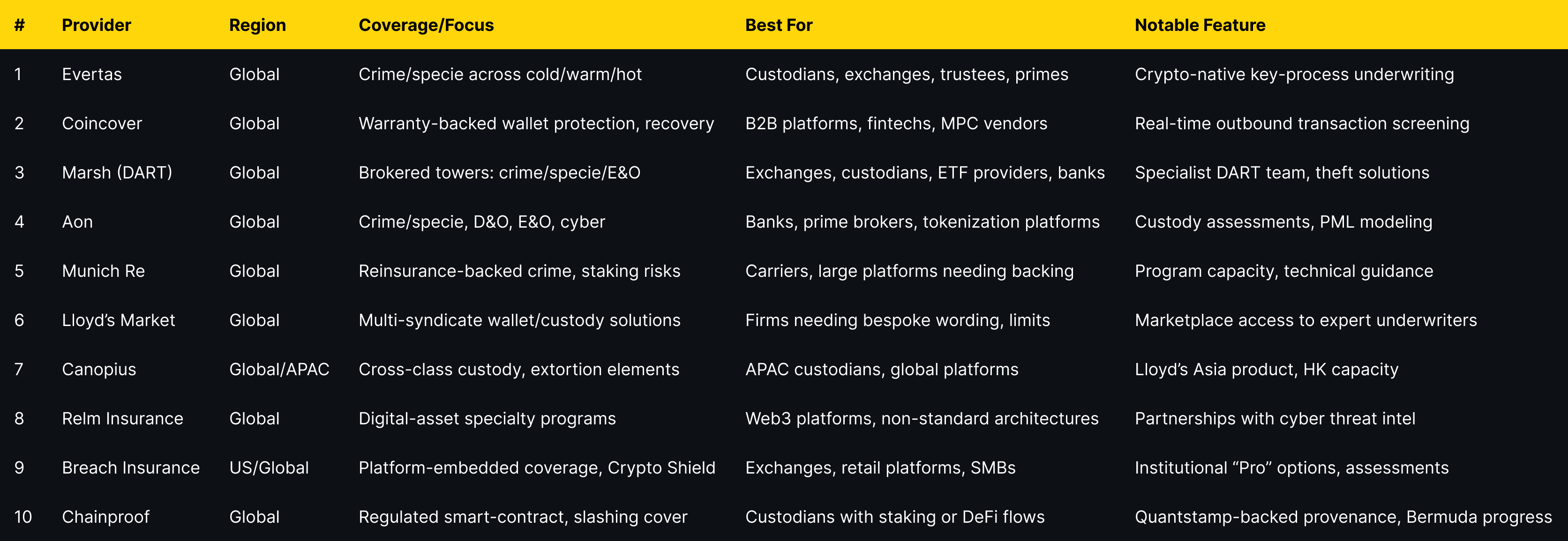
Top 10 Custody Insurance Providers in September 2025

1. Evertas — Best for Dedicated Crypto Crime & Custody Cover

Why Use It: Evertas is a specialty insurer focused on crypto, offering A-rated crime/specie programs tailored to cold, warm, and hot storage with practitioner-level key-management scrutiny. Their policies target the operational realities of custodians and platforms, not just generic cyber forms.
Best For: Qualified custodians, exchanges, trustees, prime brokers.
Notable Features:

  • Crime/specie coverage across storage tiers.
  • Crypto-native underwriting of private-key processes.
  • Lloyd’s-backed capacity with global reach. Consider If: You need a crypto-first insurer vs. a generalist broker.
    Alternatives: Marsh, Canopius.

Regions: Global.

2. Coincover — Best for Warranty-Backed Protection & Wallet Recovery

Why Use It: Coincover provides proactive fraud screening, disaster recovery for wallets, and warranty-backed protection that can sit alongside traditional insurance programs—useful for fintechs and custodians embedding safety into UX. Lloyd’s syndicates partnered with Coincover to launch wallet coverage initiatives. Best For: B2B platforms, fintechs, MPC vendors, exchanges seeking embedded protection.
Notable Features:

  • Real-time outbound transaction screening.
  • Wallet recovery and disaster-recovery tooling.
  • Warranty-backed protection that “makes it right” on covered failures. Consider If: You want prevention + recovery layered with traditional insurance.
    Alternatives: Evertas, Marsh.

Regions: Global.

3. Marsh (DART) — Best Global Broker for Building Towers

Why Use It: Marsh’s Digital Asset Risk Transfer team is a top broker for structuring capacity across crime/specie/D&O and connecting clients to specialist markets. They also advertise dedicated solutions for theft of digital assets held by institutions. Best For: Large exchanges, custodians, ETF service providers, banks.
Notable Features:

  • Specialist DART team and market access.
  • Program design across multiple lines (crime/specie/E&O).
  • Solutions aimed at institutional theft protection. Consider If: You need a broker to source multi-carrier, multi-region capacity.
    Alternatives: Aon, Lloyd’s Market.

Regions: Global.

4. Aon — Best for Custody Assessments + Crime/Specie Placement

Why Use It: Aon’s digital-asset practice brokers crime/specie, D&O, E&O, and cyber, and offers custody assessments and loss-scenario modeling—useful for underwriting readiness and board sign-off. Best For: Banks entering custody, prime brokers, tokenization platforms.
Notable Features:

  • Crime & specie for theft of digital assets.
  • Custody assessments and PML modeling.
  • Cyber/E&O overlays for staking and smart-contract exposure. Consider If: You want pre-underwriting hardening plus market reach.
    Alternatives: Marsh, Evertas.

Regions: Global.

5. Munich Re — Best for Reinsurance-Backed Crime & Staking Risk

Why Use It: As a top global reinsurer, Munich Re provides digital-asset crime policies designed for professional custodians and platforms, with coverage spanning external hacks, employee fraud, and certain third-party breaches—often supporting primary carriers. Best For: Carriers building programs; large platforms needing robust backing.
Notable Features:

  • Comprehensive crime policy for custodians and trading venues.
  • Options for staking and smart-contract risks.
  • Capacity and technical guidance at program level. Consider If: You’re assembling a tower requiring reinsurance strength.
    Alternatives: Lloyd’s Market, Canopius.

Regions: Global.

6. Lloyd’s Market — Best Marketplace to Source Specialist Syndicates

Why Use It: Lloyd’s is a global specialty market where syndicates (e.g., Atrium) have launched crypto wallet/custody solutions, often in partnership with firms like Coincover. Access via brokers to build bespoke custody crime/specie programs with flexible limits. Best For: Firms needing bespoke wording and multi-syndicate capacity.
Notable Features:

  • Marketplace access to expert underwriters.
  • Wallet/custody solutions pioneered by syndicates.
  • Adjustable limits and layered structures. Consider If: You use a broker (Marsh/Aon) to navigate syndicates.
    Alternatives: Munich Re (reinsurance), Canopius.

Regions: Global.

7. Canopius — Best Carrier for Cross-Class Custody (Crime/Specie/Extortion)

Why Use It: Canopius underwrites digital-asset custody coverage and has launched cross-class products (crime/specie/extortion). They’re also active in APAC via Lloyd’s Asia and have public case studies on large Asian capacity deployments. Best For: APAC custodians, global platforms seeking single-carrier leadership.
Notable Features:

  • Digital-asset custody product on Lloyd’s Asia.
  • Cross-class protection with extortion elements.
  • Demonstrated large committed capacity in Hong Kong. Consider If: You want a lead carrier with APAC presence.
    Alternatives: Lloyd’s Market, Evertas.

Regions: Global/APAC.

8. Relm Insurance — Best Specialty Carrier for Digital-Asset Businesses

Why Use It: Bermuda-based Relm focuses on emerging industries including digital assets, offering tailored specialty programs and partnering with web3 security firms. Useful for innovative custody models needing bespoke underwriting. Best For: Web3 platforms, custodians with non-standard architectures.
Notable Features:

  • Digital-asset specific coverage and insights.
  • Partnerships with cyber threat-intel providers.
  • Bermuda specialty flexibility for novel risks. Consider If: You need bespoke terms for unique custody stacks.
    Alternatives: Evertas, Canopius.

Regions: Global (Bermuda-domiciled).

9. Breach Insurance — Best for Exchange/Platform Embedded Coverage

Why Use It: Breach builds regulated crypto insurance products like Crypto Shield for platforms and investors, and offers institutional “Crypto Shield Pro” and platform-embedded options—useful for exchanges and custodians seeking retail-facing coverage. Best For: Exchanges, retail platforms, SMB crypto companies.
Notable Features:

  • Regulated products targeting custody at qualified venues.
  • Institutional policy options (Pro).
  • Wallet risk assessments to prep for underwriting. Consider If: You want customer-facing protection aligned to your stack.
    Alternatives: Coincover, Aon.

Regions: US/Global.

10. Chainproof — Best Add-On for Smart-Contract/Slashing Risks

Why Use It: While not a custody crime policy, Chainproof (incubated by Quantstamp; reinsured backing) offers regulated insurance for smart contracts and slashing—valuable as an adjunct when custodians support staking or programmatic flows tied to custody. Best For: Custodians/exchanges with staking, DeFi integrations, or on-chain workflows.
Notable Features:

  • Regulated smart-contract and slashing insurance.
  • Backing and provenance via Quantstamp ecosystem.
  • Bermuda regulatory progress noted in 2024-25. Consider If: You need to cover the on-chain leg alongside custody.
    Alternatives: Munich Re (staking), Marsh.

Regions: Global.

Decision Guide: Best By Use Case

  • Regulated U.S. programs & towers: Marsh, Aon, Lloyd’s Market.
  • Crypto-native underwriting: Evertas.
  • APAC leadership capacity: Canopius (Lloyd’s Asia).
  • Embedded protection/wallet recovery: Coincover.
  • Reinsurance strength for large towers: Munich Re.
  • Retail/platform-facing add-ons: Breach Insurance.
  • On-chain/Slashing riders: Chainproof.
  • Specialty/innovative risk placements: Relm Insurance.

How to Choose the Right Custody Insurance (Checklist)

  • Confirm eligible regions/regulators (US/EU/APAC) and your entity domicile.

  • Map storage tiers (cold/warm/hot/MPC) to coverage and sub-limits.

  • Validate wordings/exclusions (internal theft, collusion, social engineering, vendor breaches).

  • Align limits/deductibles with AUM, TVL, and worst-case loss scenarios.

  • Ask for claims playbooks and incident response timelines.

  • Review audits & controls (SOC 2, key ceremonies, disaster recovery).

  • Query reinsurance backing and panel stability.

  • Red flags: vague wordings; “cyber-only” policies for custody crime; no clarity on key compromise.

Use Token Metrics With Any Custody Insurance Provider

AI Ratings to vet venues and counterparties you work with.

Narrative Detection to identify risk-on/off regimes impacting exposure.

Portfolio Optimization to size custody-related strategies.

Alerts/Signals to monitor market stress that could correlate with loss events.
Workflow: Research → Select provider via broker → Bind coverage → Operate and monitor with Token Metrics alerts.

 Primary CTA: Start free trial

Security & Compliance Tips

  • Enforce MPC/hardware-isolated keys and dual-control operations.

  • Use 2FA, withdrawal whitelists, and policy controls across org accounts.

  • Keep KYC/AML and sanctions screening current for counterparties.

  • Practice RFQ segregation and least-privilege for ops staff.

  • Run tabletop exercises for incident/claims readiness.

This article is for research/education, not financial advice.

Beginner Mistakes to Avoid

  • Assuming cyber insurance = custody crime coverage.

  • Buying limits that don’t match hot-wallet exposure.

  • Skipping vendor-risk riders for sub-custodians and wallet providers.

  • Not documenting key ceremonies and access policies.

  • Waiting until after an incident to engage a broker/insurer.

FAQs

What does crypto custody insurance cover?
Typically theft, key compromise, insider fraud, and sometimes extortion or vendor breaches under defined conditions. Coverage varies widely by wording; verify hot/warm/cold definitions and exclusions.

Do I need both crime and specie?
Crime commonly addresses employee dishonesty and external theft; specie focuses on physical loss/damage to assets in secure storage. Many carriers blend elements for digital assets—ask how your program handles each.

Can staking be insured?
Yes—some reinsurers/insurers offer staking/slashing riders or separate policies; smart-contract risk often requires additional cover like Chainproof.

How much capacity is available?
Depends on controls and market appetite. Lloyd’s syndicates and reinsurers like Munich Re can support sizable towers when risk controls are strong.

How do I reduce premiums?
Improve key-management controls, segregate duties, minimize hot exposure, complete independent audits, and adopt continuous monitoring/fraud screening (e.g., Coincover-style prevention).

Are exchanges’ “insured” claims enough?
Not always—check if coverage is platform-wide, per-customer, warranty-backed, or contingent. Ask for wordings, limits, and who the named insureds are.

Conclusion + Related Reads

If you need a crypto-first insurer, start with Evertas. Building a global tower? Engage Marsh or Aon across the Lloyd’s Market and reinsurers like Munich Re. For APAC-localized capacity, consider Canopius; for embedded protection, weigh Coincover or Breach. Add Chainproof if staking/DeFi exposure touches custody workflows.

Related Reads:

  • Best Cryptocurrency Exchanges 2025

  • Top Derivatives Platforms 2025

  • Top Institutional Custody Providers 2025
Research

Best Crypto Insurance Protocols (DeFi & Custodial) 2025

Sam Monac
7 min

Why Crypto Insurance Matters in September 2025

The search intent here is commercial investigation: investors want safe ways to protect on-chain and custodied assets. This guide ranks the best insurance protocols 2025 across DeFi and regulated custodial coverage so you can compare options quickly.
Definition: Crypto (DeFi) insurance helps cover losses from smart-contract exploits, exchange halts, custodian breaches, or specific parametric events; custodial insurance typically protects assets held by qualified trustees or platforms under defined “crime”/theft policies.

In 2025, larger treasuries and yield strategies are back, while counterparty and contract risk remain. We focus on real cover products, payout track records, and regulated custodial policies—using only official sources. Secondary considerations include DeFi insurance, crypto custodial insurance, and smart contract coverage capacity, claims handling, and regional eligibility.

How We Picked (Methodology & Scoring)

  • Liquidity (30%): size/capacity, ability to pay valid claims; for custodians, insurance limits and capital backing.

  • Security (25%): audits, disclosures, claim processes, regulated status where applicable.

  • Coverage (15%): breadth of products (protocol, depeg, custody, parametric, etc.) and supported chains.

  • Costs (15%): premiums/fees relative to cover; clear fee pages.

  • UX (10%): buying experience, documentation, transparency.

  • Support (5%): documentation, response channels, claims guidance.

Data sources: official product/docs, transparency/security pages, and audited/claims pages; market datasets only for cross-checks. Last updated September 2025.

Top 10 Crypto Insurance Providers in September 2025

1. Nexus Mutual — Best for broad DeFi coverage and claims history

  • Why Use It: A member-owned mutual offering protocol, exchange halt, and depeg covers, with a transparent claims ledger and multi-year payout track record. Members vote on claims, and the docs detail cover wordings and product types.

  • Best For: Advanced DeFi users, DAOs/treasuries, funds seeking bespoke on-chain risk cover.

  • Notable Features: Claims history ledger; multiple cover products (protocol/exchange/depeg); membership + staking model.

  • Fees Notes: Membership fee required; premiums vary by product pool (see cover pages).
  • Regions: Global (KYC for membership).
  • Consider If: You’re comfortable with discretionary, member-voted claims.

  • Alternatives: InsurAce, Neptune Mutual.

2. InsurAce — Best multi-chain DeFi marketplace

  • Why Use It: Multi-chain cover marketplace with a wide menu of protocol/exchange risk options and an established brand. Useful for builders and users who want flexible terms across ecosystems.
  • Best For: Multi-chain DeFi participants, LPs, power users.

  • Notable Features: Diverse cover catalog; staking/supply side; docs and dApp UI focused on ease of purchase.
  • Fees Notes: Premiums vary per pool/cover; check dApp quotes.

  • Regions: Global (subject to app access and eligibility).

  • Consider If: You prefer marketplace variety but can evaluate pool capacity.

  • Alternatives: Nexus Mutual, Neptune Mutual.

4. Sherlock — Best for protocol teams needing post-audit coverage

  • Why Use It: Full-stack security provider (audit contests, bounties) with Sherlock Shield coverage that helps protocols mitigate losses from smart-contract exploits. Strong fit for teams bundling audits + coverage.
  • Best For: Protocol founders, security-first teams, DAOs.

  • Notable Features: Audit marketplace; exploit coverage; payout process tailored for teams.
  • Fees Notes: Pricing depends on scope/coverage; engage sales.

  • Regions: Global.

  • Consider If: You need coverage tightly integrated with audits.

  • Alternatives: Chainproof, Nexus Mutual.

3. OpenCover— Best for Community-Driven, Transparent Coverage

Why Use It: OpenCover is a decentralized insurance protocol that leverages community-driven liquidity pools to offer coverage against smart contract exploits and other on-chain risks. Its transparent claims process and low-cost structure make it an attractive option for DeFi users seeking affordable and reliable insurance solutions.

Best For: DeFi users, liquidity providers, and investors looking for community-backed insurance coverage.

Notable Features:

  • Community-governed liquidity pools

  • Transparent and automated claims process

  • Low-cost premiums

  • Coverage for smart contract exploits and on-chain risks

Fees/Notes: Premiums are determined by the liquidity pool and the level of coverage selected.

Regions: Global (subject to dApp access).

Consider If: You value community governance and transparency in your insurance coverage.

Alternatives: Nexus Mutual, InsurAce.

5. Chainproof — Best for regulated smart-contract insurance

  • Why Use It: A regulated insurer for non-custodial smart contracts, incubated by Quantstamp; positions itself with compliant, underwritten policies and 24/7 monitoring.
  • Best For: Enterprises, institutions, and larger protocols requiring regulated policies.

  • Notable Features: Regulated insurance; Quantstamp lineage; monitoring-driven risk management.
  • Fees Notes: Premiums/policy terms bespoke.

  • Regions: Global (subject to policy jurisdiction).

  • Consider If: You need compliance-grade coverage for stakeholders.

  • Alternatives: Sherlock, Nexus Mutual.

6. Nayms — Best on-chain insurance marketplace for brokers/carriers

  • Why Use It: A regulated (Bermuda DABA Class F) marketplace to set up tokenized insurance pools and connect brokers, carriers, investors, and insureds—bringing alternative capital on-chain.
  • Best For: Brokers/carriers building crypto-native insurance programs; larger DAOs/TSPs.

  • Notable Features: Segregated Accounts (SAC) structure; tokenized pools; full lifecycle (capital → premiums → claims).
  • Fees Notes: Platform/program fees vary; institutional setup.

  • Regions: Global (Bermuda framework).

  • Consider If: You’re creating—not just buying—insurance capacity.

  • Alternatives: Chainproof, institutional mutuals.

7. Etherisc — Best for parametric flight/crop and specialty covers

  • Why Use It: Pioneer in parametric blockchain insurance with live Flight Delay Protection and other modules (e.g., crop, weather, depeg). On-chain products with automated claims.
  • Best For: Travelers, agritech projects, builders of niche parametric covers.

  • Notable Features: Flight delay dApp (Base/USDC); crop/weather modules; transparent policy pages.
  • Fees Notes: Premiums quoted per route/peril.

  • Regions: Global (product-specific availability).

  • Consider If: You need clear, data-triggered payouts.

  • Alternatives: Arbol (climate parametrics), Neptune Mutual.

8. Tidal FinanceBest for Coverage on Niche DeFi Protocols
Why Use It: Tidal Finance focuses on providing coverage for niche and emerging DeFi protocols, offering tailored insurance products for new and innovative projects. Tidal's dynamic risk assessments allow it to offer specialized coverage options for specific protocols.
Best For: Users and protocols seeking insurance for niche DeFi projects with specific risk profiles.
Notable Features:

  • Coverage for high-risk, niche DeFi protocols

  • Dynamic pricing based on real-time risk assessments

  • Flexible policy terms
    Fees/Notes: Premiums based on the risk profile of the insured protocol.
    Regions: Global.
    Consider If: You need tailored insurance coverage for emerging or specialized DeFi projects.
    Alternatives: Nexus Mutual, Amulet Protocol.

9. Subsea (formerly Risk Harbor) — Best for automated, rules-based claims

  • Why Use It: An algorithmic risk-management marketplace with objective, automated claims—reducing discretion and bias in payouts. (Risk Harbor rebranded to Subsea.)
  • Best For: Users who prefer invariant, programmatic claim triggers.

  • Notable Features: Automated payout logic; transparent market mechanics; simulator for underwriting/buying protection.
  • Fees Notes: Premiums and returns vary by pool.

  • Regions: Global (dApp access).

  • Consider If: You want automation over DAO voting.

  • Alternatives: Neptune Mutual, Amulet.

10. BitGo Custody (with Insurance) — Best custodial coverage for institutions

  • Why Use It: Qualified custody with up to $250M in digital-asset insurance capacity for assets where keys are held by BitGo Trust; clearly communicated policy framework and bankruptcy-remote structures.
  • Best For: Funds, corporates, and service providers needing regulated custody plus insurance.

  • Notable Features: Qualified custody; SOC reports; policy covers specific theft/loss scenarios.
  • Fees Notes: Custody/asset-based fees; insurance embedded at the custodian level.

  • Regions: Global (jurisdiction-specific entities).

  • Consider If: You want a regulated custodian with published insurance capacity.

  • Alternatives: Gemini Custody, Anchorage Digital (note: no FDIC/SIPC).

Decision Guide: Best By Use Case

  • Largest DeFi product breadth: Nexus Mutual, InsurAce.
  • Fastest/parametric claims: Neptune Mutual, Etherisc.
  • Regulated policy needs (enterprise): Chainproof, Nayms.
  • Solana-first portfolios: Amulet.
  • Fully automated claims (no governance): Subsea (ex-Risk Harbor).
  • Custodial with published insurance limits: BitGo; also Gemini Custody (hot+cold coverage).

How to Choose the Right Crypto Insurance (Checklist)

  • Verify eligibility/region and any KYC requirements.

  • Check coverage type (protocol exploit, exchange halt, depeg, parametric, custody crime).

  • Review capacity/liquidity and payout records/ledgers.

  • Compare premiums/fees against insured amounts and deductibles.

  • Evaluate claims process (discretionary vote vs. parametric/automated).

  • Confirm security posture (audits, monitoring, disclosures).

  • Test UX & support (docs, ticketing, community).

  • Red flags: unclear policy wordings; promises of “FDIC-like” protection for crypto (rare/not applicable).

Use Token Metrics With Any Insurance Provider

  • AI Ratings to screen tokens and protocol risk signals.
  • Narrative Detection to spot shifting risk/coverage demand.

  • Portfolio Optimization to size insured vs. uninsured exposures.

  • Alerts to track incident news and coverage expiries.
    Workflow: Research → Select cover/custody → Execute → Monitor with alerts.


Primary CTA: Start free trial

Security & Compliance Tips

  • Enable strong 2FA and segregate wallets for covered vs. uncovered positions.

  • For custodial solutions, understand exact insurance scope and exclusions.
  • Follow KYC/AML where required (e.g., Nexus Mutual membership).
  • For protocols, complement insurance with audits/bounties and incident response runbooks.
  • Maintain wallet hygiene (hardware, allow-list, spend limits).

This article is for research/education, not financial advice.

Beginner Mistakes to Avoid

  • Assuming all losses are covered—read policy wordings.
  • Buying cover after an incident is known/underway.

  • Ignoring chain/app coverage constraints.

  • Letting cover lapse during major upgrades or liquidity migrations.

  • Believing custodial insurance = FDIC/SIPC (it doesn’t).

FAQs

What’s the difference between DeFi insurance and custodial insurance?
DeFi insurance protects on-chain actions (e.g., smart-contract exploits or depegs), often via discretionary voting or parametric rules. Custodial insurance covers specific theft/loss events while assets are held by a qualified custodian under a crime policy; exclusions apply.

How do parametric policies work in crypto?
They pre-define an objective trigger (e.g., flight delay, protocol incident), enabling faster, data-driven payouts without lengthy investigations. Etherisc (flight) and Neptune Mutual (incident pools) are examples.

Is Nexus Mutual regulated insurance?
No. It’s a member-owned discretionary mutual where members assess claims and provide capacity; see membership docs and claim pages

Do custodial policies cover user mistakes or account takeovers?
Typically no—policies focus on theft from the custodian’s systems. Review each custodian’s definitions/exc Gemini’s hot/cold policy scope).

What if I’m primarily on Solana?
Consider Amulet for Solana-native cover; otherwise, verify cross-chain support from multi-chain providers.

Which providers are regulated?
Chainproof offers regulated smart-contract insurance; Nayms operates under Bermuda’s DABA framework for on-chain insurance programs.

Conclusion + Related Reads

If you need breadth and track record, start with Nexus Mutual or InsurAce. For parametric, faster payouts, look at Neptune Mutual or Etherisc. Building institutional-grade risk programs? Consider Chainproof or Nayms. If you hold assets with a custodian, confirm published insurance capacity—BitGo and Gemini Custody are good benchmarks.

Related Reads:

  • Best Cryptocurrency Exchanges 2025

  • Top Derivatives Platforms 2025

  • Top Institutional Custody Providers 2025

Choose from Platinum, Gold, and Silver packages
Reach with 25–30% open rates and 0.5–1% CTR
Craft your own custom ad—from banners to tailored copy
Perfect for Crypto Exchanges, SaaS Tools, DeFi, and AI Products