Back to blog
Research

What's the Future of NFTs in Gaming? Market Analysis & 2025 Predictions

Explore the future of gaming NFTs, market growth, key trends, and how Token Metrics' analytics tools can help navigate this evolving digital landscape.
Token Metrics Team
8 min read
Want Smarter Crypto Picks—Free?
See unbiased Token Metrics Ratings for BTC, ETH, and top alts.
Thank you! Your submission has been received!
Oops! Something went wrong while submitting the form.
 No credit card | 1-click unsubscribe

The question of what's the future of NFTs in gaming is no longer theoretical—it's a dynamic reality reshaping the gaming landscape. The intersection of non-fungible tokens (NFTs) and gaming has evolved from a speculative experiment into a multi-billion dollar industry that is revolutionizing how players engage with virtual worlds. In fact, gaming NFTs accounted for over 70% of all NFT activity in the first quarter of 2025, and the market is projected to skyrocket from $4.8 billion in 2024 to an astonishing $44.1 billion by 2034. For game developers, investors, and players alike, understanding this transformation is essential to navigating the future of interactive entertainment.

The Explosive Growth Trajectory

The growth trajectory of NFT gaming is nothing short of explosive. Market forecasts indicate that the NFT gaming market will reach a staggering $0.54 trillion in 2025 and continue expanding at a compound annual growth rate (CAGR) of 14.84%, hitting $1.08 trillion by 2030. Meanwhile, the broader Web3 gaming market, which encompasses blockchain-based games and decentralized applications, is expected to grow from $25.63 billion in 2024 to $124.74 billion by 2032, with an even higher CAGR of 19.34%. Play-to-earn (P2E) NFT games are at the forefront of this surge, with the market projected to climb from $5.4 billion in 2025 to $20.19 billion by 2033, growing at a 17.93% CAGR. These models are attracting players worldwide, with more than 64% of users actively engaging with NFT-based games. Notably, 55% of these players are motivated by the financial incentives enabled by play-to-earn systems, which allow gamers to earn real-world income by playing.

This growth is not a passing bubble but a fundamental restructuring of gaming economies. Unlike traditional games that primarily extract value for publishers and developers, NFT gaming rewards players for their time, skill, and engagement, creating new revenue streams and empowering players in unprecedented ways.

From Speculation to Utility: The Maturation of Gaming NFTs

In the early days of NFT gaming, roughly between 2021 and 2022, the space was dominated by speculation and unsustainable tokenomics. Many projects prioritized financial mechanics over gameplay quality, resulting in inflated expectations and eventual market corrections. Players quickly recognized the limitations of games designed mainly as investment vehicles rather than immersive experiences.

By 2025, the market has matured significantly, with utility and gameplay quality taking center stage. The focus has shifted decisively from purely art-based NFTs to those that grant access to events, decentralized finance (DeFi) protocols, and real-world assets. Today, gaming and sports-related NFT collections constitute over 70% of NFT activity, underscoring that functional and engaging experiences drive sustained adoption.

True Digital Ownership Revolution

One of the most transformative aspects of NFTs in gaming is the concept of true digital ownership. Unlike traditional games where in-game assets are controlled exclusively by the game publisher and hold no tangible value outside the game's ecosystem, blockchain technology enables genuine ownership of digital items. When players acquire an in-game NFT—be it a rare weapon, a unique character, or virtual land—they have verifiable proof of ownership secured by the blockchain.

This ownership is not merely symbolic. Players can trade, sell, or use their NFTs across compatible games, or hold them as investments independent of the developer's decisions. Unlike traditional games, where assets are often locked to one title, NFTs open the door to interoperability and player-driven economies. Statistics reinforce this shift: over 61% of players now value having more control over their in-game assets, and around 58% of gaming projects integrate NFT minting capabilities, empowering users to create, trade, and monetize digital collectibles with greater autonomy.

  1. Sustainable Play-to-Earn Models

    The first generation of play-to-earn games struggled with unsustainable token economies that led to inflationary spirals and market collapse. Today, the emphasis is on creating balanced, sustainable play-to-earn models where earning potential aligns with genuine gameplay value rather than relying on recruitment or speculative hype. Currently, about 55% of P2E games provide crypto-based rewards within stable token economies designed for long-term viability. Developers are incorporating mechanisms such as token sinks, deflationary features, and diversified revenue streams beyond token sales to foster healthy in-game economies. This approach helps maintain the economic integrity of NFT gaming and enhances player trust.

  2. Cross-Chain Interoperability and Multi-Platform Integration

    One of the most promising aspects of NFT gaming is interoperability—the ability for players to use their digital assets across multiple games and platforms. This cross-chain functionality has become a dominant trend in 2025, with projects expanding their presence across various blockchain networks like Kronos, Solana, and Arbitrum to reach broader audiences. Technological advancements such as the ERC-6551 standard enable NFTs to own other assets, creating nested ownership structures that add unprecedented complexity and flexibility to in-game economies. For example, a player might acquire a rare sword in one game and use it across different titles, with blockchain technology ensuring provenance and authenticity. This interoperability not only enhances the gaming experience but also supports the emergence of player-driven economies across virtual worlds.

  3. AI Integration and Dynamic NFTs

    Artificial intelligence is playing an increasingly important role in NFT gaming. Unlike static digital collectibles, many new NFT assets now incorporate dynamic elements that evolve based on player actions, external triggers, or changing conditions. AI-powered procedural generation allows for unique, personalized gaming experiences while preserving the scarcity and value of NFTs. This fusion of AI and NFTs is revolutionizing gameplay mechanics, enabling more immersive and responsive virtual environments that adapt to how players engage with the game. Dynamic NFTs represent a new frontier in digital ownership and interactive storytelling within the gaming world.

  4. Metaverse Expansion and Virtual Worlds

    Blockchain-powered metaverses are becoming more sophisticated, offering enhanced graphics, intuitive interfaces, and richer social features. Competitive events within these virtual worlds are moving beyond experimental phases, with players competing in front of virtual audiences, purchasing NFT tickets, and earning collectible trophies. Virtual real estate remains a key growth area, with the market for virtual land projected to expand from $0.356 billion in 2023 to $4.498 billion by 2032. Players, brands, and investors are increasingly acquiring virtual land to establish persistent digital spaces that transcend individual games, contributing to the rise of vibrant virtual economies.

  5. Mainstream AAA Adoption

    While early NFT gaming initiatives were primarily driven by indie studios and blockchain-native developers, 2025 is witnessing major game publishers entering the space. Industry giants like Ubisoft, Square Enix, Nexon, and Epic Games have announced blockchain-based projects, lending credibility and potentially introducing millions of traditional gamers to NFT integration. Although no AAA publisher has yet fully integrated NFTs into a blockbuster title, expectations are high that between 2025 and 2030, a major release will feature NFT elements, especially as regulatory clarity improves and market demand solidifies. This transition marks a new era in gaming, blending the best of traditional games with the innovative potential of blockchain technology.

Regional Dynamics and Market Leadership

Geographically, the Asia-Pacific region leads NFT gaming adoption, commanding approximately 38-40% of the market share. This dominance is fueled by a massive mobile-first gamer base, increasing digitalization, and supportive government policies in countries like Japan and South Korea. The region's soaring smartphone usage and growing interest in crypto assets further accelerate NFT adoption. North America follows with 25-29% market share, characterized by strong crypto adoption, high digital literacy, and nearly half of American gamers having interacted with at least one blockchain-based game. Europe holds about 20-21% of the market, benefiting from rising NFT awareness and regulatory frameworks like the Markets in Crypto-Assets (MiCA) regulation, which provides clearer guidelines for developers and investors.

Token Metrics: Essential Intelligence for Gaming NFT Investment

As gaming NFTs transition from speculative tokens to foundational gaming infrastructure representing hundreds of billions in value, investors require sophisticated analytical tools to identify opportunities and manage risk. Token Metrics, a premier crypto trading and analytics platform, offers comprehensive intelligence tailored to the gaming NFT landscape.

Comprehensive Gaming NFT Analysis

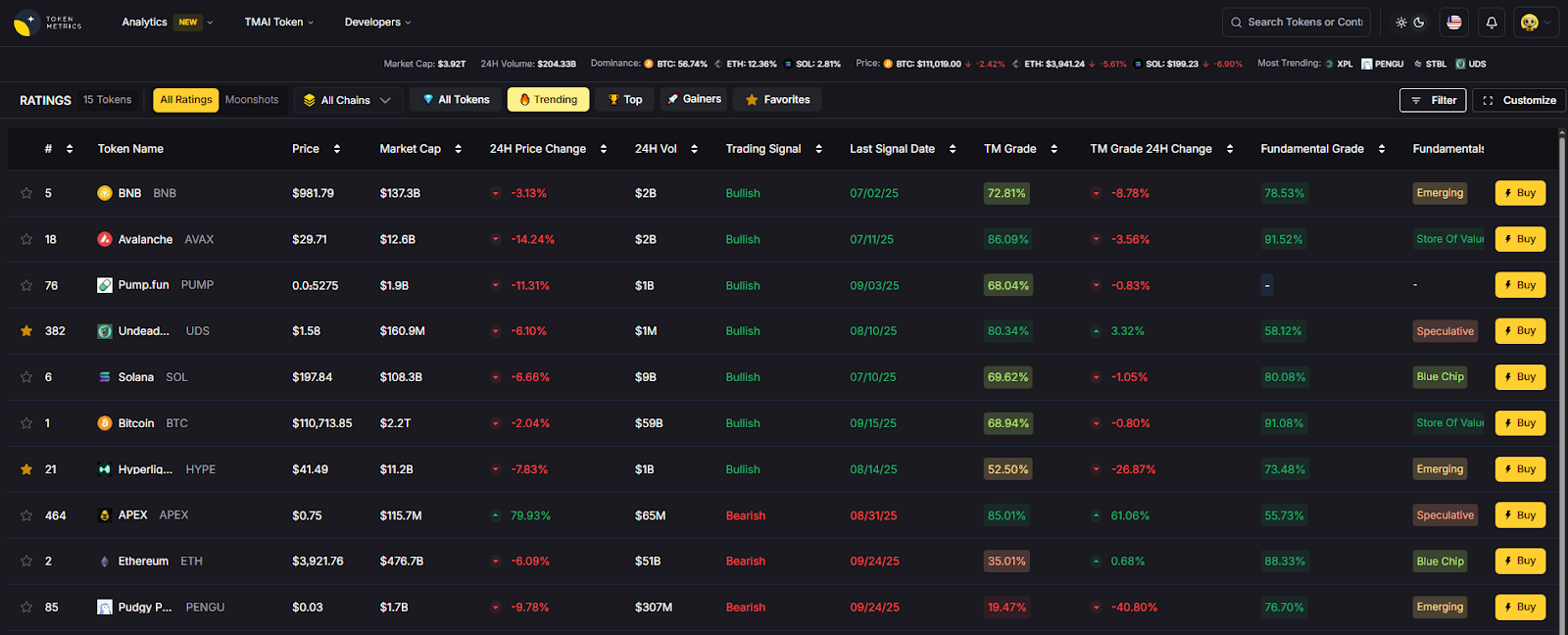
Token Metrics evaluates thousands of digital assets, including gaming tokens, play-to-earn projects, metaverse platforms, and NFT collections. Its AI-powered rating system assesses projects based on critical factors such as: Blockchain infrastructure, smart contract security, and scalability solutions Economic sustainability, token utility, and inflation/deflation mechanisms Developer team expertise, community engagement, and partnership quality Market dynamics including trading volume, liquidity, and holder distribution Gameplay quality, user retention, and player growth rates

Gaming NFT Market Intelligence

Understanding which gaming platforms, blockchain networks, and NFT collections offer superior risk-adjusted returns requires deep market intelligence. Token Metrics delivers sector-specific research, project comparisons, trend forecasting, and risk assessments that highlight red flags like unsustainable tokenomics or technical vulnerabilities.

Portfolio Management for Gaming Assets

Investors building diversified portfolios across cryptocurrencies, gaming tokens, NFT collections, and virtual land benefit from Token Metrics’ portfolio tools. These provide real-time valuation across multiple chains and marketplaces, performance attribution, correlation analysis for diversification, and tax reporting features to simplify complex NFT transactions.

Trading Signals and Actionable Intelligence

Token Metrics’ proprietary algorithms generate trading signals for gaming tokens and NFT projects, helping investors identify optimal entry and exit points. As NFT marketplaces mature and liquidity improves, these signals become increasingly valuable for active portfolio management.

Access Token Metrics today to leverage the analytical firepower needed to capitalize on the gaming NFT revolution.

Challenges and Considerations

Despite the promising outlook, NFTs in gaming face several key challenges:

  • Regulatory Uncertainty: Governments worldwide are still defining how to regulate gaming NFTs, especially concerning securities laws and gambling regulations. About 43% of game publishers cite regulatory concerns as significant barriers to NFT integration.
  • Technical Barriers: Over half of indie developers report limited access to blockchain infrastructure and smart contract expertise as obstacles. High transaction fees and network congestion remain concerns, although Layer-2 solutions are alleviating these issues.
  • Player Skepticism: Many gamers view NFTs as predatory monetization or are concerned about environmental impact. Developers must carefully balance NFT integration with genuine gameplay improvements to overcome resistance.
  • Market Volatility: The value of gaming tokens and NFT assets can be highly volatile, posing financial risks to players whose in-game items fluctuate dramatically in worth.

Addressing these challenges is critical to achieving widespread adoption and ensuring the long-term sustainability of NFT-based gaming ecosystems.

The Road Ahead: 2025 and Beyond

The future of NFTs in gaming extends well beyond digital collectibles and speculation. We are entering a new era where player-owned economies, true digital property rights, and gameplay that rewards skill and engagement redefine the gaming experience. Key developments to watch include:

  • Killer App Emergence: The arrival of a breakthrough game with cultural impact on par with Fortnite or Minecraft could accelerate mainstream adoption overnight.
  • Institutional Investment: Continued venture capital funding and major publisher involvement will legitimize and expand the space.
  • Technological Advancements: Improvements in blockchain scalability, reduced transaction fees, and enhanced user experiences will drive adoption.
  • Regulatory Clarity: Comprehensive frameworks will enable compliant NFT gaming implementations, reducing uncertainty.
  • Cross-Platform Standards: Industry-wide interoperability protocols will allow true asset portability across different games and virtual worlds.

The projection that gaming NFTs will grow nearly ninefold from $4.8 billion to $44.1 billion by 2034 highlights one of the most significant wealth creation opportunities in the digital economy. For players, developers, and investors willing to navigate the evolving landscape, gaming NFTs offer unprecedented potential to revolutionize how we play, trade, and own digital assets.

Ready to capitalize on the gaming NFT revolution? Visit tokenmetrics.com to access cutting-edge research, analytics, and trading intelligence that give you an edge in this explosive market.

Build Smarter Crypto Apps &
AI Agents in Minutes, Not Months
Real-time prices, trading signals, and on-chain insights all from one powerful API.
Grab a Free API Key
About Token Metrics
Token Metrics: AI-powered crypto research and ratings platform. We help investors make smarter decisions with unbiased Token Metrics Ratings, on-chain analytics, and editor-curated “Top 10” guides. Our platform distills thousands of data points into clear scores, trends, and alerts you can act on.
30 Employees
analysts, data scientists, and crypto engineers
Daily Briefings
concise market insights and “Top Picks”
Transparent & Compliant
Sponsored ≠ Ratings; research remains independent
Want Smarter Crypto Picks—Free?
See unbiased Token Metrics Ratings for BTC, ETH, and top alts.
Thank you! Your submission has been received!
Oops! Something went wrong while submitting the form.
 No credit card | 1-click unsubscribe
Token Metrics Team
Token Metrics Team

Recent Posts

Research

Top Smart Contract Auditors (2025)

Sam Monac
7 min

Why Smart Contract Security Auditors Matter in September 2025

Smart contracts are the critical rails of DeFi, gaming, and tokenized assets—one missed edge case can freeze liquidity or drain treasuries. If you’re shipping on EVM, Solana, Cosmos, or rollups, smart contract auditors provide an independent, methodical review of your code and architecture before (and after) mainnet. In one line: a smart contract audit is a systematic assessment of your protocol’s design and code to find and fix vulnerabilities before attackers do.

This guide is for founders, protocol engineers, PMs, and DAOs comparing audit partners. We combined SERP research with hands-on security signals to shortlist reputable teams, then selected the best 10 for global builders. Secondary considerations—like turnaround time, formal methods, and public report history—help you match the right firm to your stack and stage.

How We Picked (Methodology & Scoring)

  • Liquidity (30%) – We favored firms that regularly secure large TVL protocols and L2/L3 infrastructure (a proxy for real-world risk tolerance).

  • Security (25%) – Depth of reviews, formal methods, fuzzing/invariants, internal QA, and disclosure practices.

  • Coverage (15%) – Chains (EVM, Solana, Cosmos, Move), ZK systems, cross-chain, and infra.

  • Costs (15%) – Transparent scoping, rate signals, and value versus complexity.

  • UX (10%) – Developer collaboration, report clarity, suggested fixes.

  • Support (5%) – Follow-ups, retests, and longer-term security programs.

Data inputs: official service/docs pages, public audit report portals, rate disclosures where available, and widely cited market datasets for cross-checks. Last updated September 2025.

Top 10 Smart Contract Auditors in September 2025

1. OpenZeppelin — Best for Ethereum-native protocols & standards

  • Why Use It: OpenZeppelin sets the bar for Ethereum security reviews, blending deep code review with fuzzing and invariant testing. Their team maintains widely used libraries and brings ecosystem context to tricky design decisions. Audits are collaborative and issue-tracked end to end.
  • Best For: DeFi protocols, token standards/bridges, ZK/infra components, L2/L3 projects.
  • Notable Features: Multi-researcher line-by-line reviews; fuzzing & invariants; Defender integrations; public customer stories.
  • Consider If: Demand may affect near-term availability; enterprise pricing.
  • Alternatives: ConsenSys Diligence, Sigma Prime
  • Regions: Global
  • Fees/Notes: Quote-based.

2. Trail of Bits — Best for complex, high-risk systems

  • Why Use It: A security research powerhouse, Trail of Bits excels on complicated protocol architectures and cross-component reviews (on-chain + off-chain). Their publications and tools culture translate into unusually deep findings and actionable remediation paths.
  • Best For: Novel consensus/mechanisms, bridges, MEV-sensitive systems, multi-stack apps.
  • Notable Features: Custom tooling; broad ecosystem coverage (EVM, Solana, Cosmos, Substrate, Starknet); thorough reporting.
  • Consider If: Lead times can be longer; premium pricing.
  • Alternatives: Runtime Verification, Zellic
  • Regions: Global
  • Fees/Notes: Quote-based.

3. Sigma Prime — Best for Ethereum core & DeFi heavyweights

  • Why Use It: Sigma Prime combines practical auditing with core protocol experience (they build Lighthouse, an Ethereum consensus client), giving them unusual depth in consensus-adjacent DeFi and infra. Strong track record across blue-chip protocols.
  • Best For: Lending/AMMs, staking/validators, client-adjacent components, LSTs.
  • Notable Features: Deep EVM specialization; transparent technical writing; senior engineering bench.
  • Consider If: Primary focus is EVM; limited non-EVM coverage compared to others.
  • Alternatives: OpenZeppelin, ChainSecurity
  • Regions: Global
  • Fees/Notes: Quote-based.

4. ConsenSys Diligence — Best for Ethereum builders wanting tooling + audit

  • Why Use It: Backed by ConsenSys, Diligence pairs audits with developer-facing tools and education, making it ideal for teams that want process maturity (prep checklists, fuzzing, Scribble specs). Broad portfolio and clear audit portal.
  • Best For: Early-to-growth stage Ethereum teams, rollup apps, token launches.
  • Notable Features: Audit portal; Scribble specification; fuzzing; practical prep guidance.
  • Consider If: Primarily Ethereum; non-EVM work may require scoping checks.
  • Alternatives: OpenZeppelin, ChainSecurity
  • Regions: Global
  • Fees/Notes: Quote-based.

5. ChainSecurity — Best for complex DeFi mechanisms & institutions

  • Why Use It: Since 2017, ChainSecurity has audited many flagship DeFi protocols and works with research institutions and central banks—useful for mechanism-dense systems and compliance-sensitive partners. Public report library is extensive.
  • Best For: Lending/leverage, automated market design, enterprise & research tie-ups.
  • Notable Features: Senior formal analysis; large library of public reports; mechanism design experience.
  • Consider If: Scheduling can book out during heavy DeFi release cycles.
  • Alternatives: Sigma Prime, Runtime Verification
  • Regions: Global
  • Fees/Notes: Quote-based.

6. Runtime Verification — Best for formal methods & proofs

  • Why Use It: RV applies mathematical modeling to verify contract behavior—ideal when correctness must be proven, not just reviewed. Transparent duration guidance and verification-first methodology stand out for high-assurance finance and bridges.
  • Best For: Bridges, L2/L3 protocols, safety-critical DeFi, systems needing formal guarantees.
  • Notable Features: Design modeling; proof-oriented analysis; published methodology; verification experts.
  • Consider If: Formal methods add time/scope; ensure timelines fit launch plans.
  • Alternatives: Trail of Bits, ChainSecurity
  • Regions: Globall
  • Fees/Notes: Time/cost scale with LoC & rigor.

7. Spearbit (via Cantina) — Best for assembling elite ad-hoc review teams

  • Why Use It: Spearbit curates a network of top security researchers and spins up tailored teams for high-stakes reviews. Public “Spearbook” docs outline a transparent process and base rates—useful for planning and stakeholder alignment.
  • Best For: Protocols needing niche expertise (ZK, MEV, Solana, Cosmos) or rapid talent assembly.
  • Notable Features: Researcher leaderboard; portfolio of reports; flexible scoping; public methodology.
  • Consider If: Marketplace model—experience can vary; align on leads and scope early.
  • Alternatives: Zellic, Trail of Bits
  • Regions: Global • Fees/Notes: Base rate guidance published; final quotes vary.

8. Zellic — Best for offensive-security depth & cross-ecosystem coverage

  • Why Use It: Founded by offensive researchers, Zellic emphasizes real-world exploit paths and releases practical research/tools (e.g., Masamune). Strong results across EVM, cross-chain, and high-value targets.
  • Best For: Cross-chain systems, DeFi with complicated state machines, performance-critical code.
  • Notable Features: Offensive mindset; tool-assisted reviews; transparent research blog.
  • Consider If: Premium scope; verify bandwidth for urgent releases.
  • Alternatives: OtterSec, Trail of Bits
  • Regions: Global • Fees/Notes: Quote-based.

9. OtterSec — Best for Solana, Move, and high-velocity shipping teams

  • Why Use It: OtterSec partners closely with fast-shipping teams across Solana, Sui, Aptos, and EVM, with a collaborative style and visible customer logos across top ecosystems. Useful when you need pragmatic feedback loops and retests.
  • Best For: Solana & Move projects, cross-chain bridges, wallets, DeFi apps.
  • Notable Features: Holistic review method; $1B+ in vulnerabilities patched (self-reported); active blog & reports.
  • Consider If: Verify scope for non-Move/Solana; high demand seasons can fill quickly.
  • Alternatives: Zellic, Halborn
  • Regions: Global • Fees/Notes: Quote-based.

10. Halborn — Best for enterprise-grade programs & multi-service security

  • Why Use It: Halborn serves both crypto-native and financial institutions with audits, pentesting, and advisory; SOC 2-type attestations and steady cadence of public assessments support enterprise procurement.
  • Best For: Exchanges, fintechs, large DeFi suites, and teams needing full-stack security partners.
  • Notable Features: Audit portal & reports; enterprise processes; broader security services.
  • Consider If: Quote-based pricing; confirm dedicated smart-contract reviewers for your stack.
  • Alternatives: ConsenSys Diligence, Trail of Bits
  • Regions: Global • Fees/Notes: Quote-based.

Decision Guide: Best By Use Case

  • Ethereum DeFi blue-chips: OpenZeppelin, Sigma Prime
  • High-assurance/formal proofs: Runtime Verification, ChainSecurity
  • Novel mechanisms / complex cross-stack: Trail of Bits
  • Rapid team assembly / niche experts (ZK/MEV): Spearbit
  • Solana & Move ecosystems: OtterSec, Zellic
  • Enterprise programs & multi-service: Halborn, ConsenSys Diligence
  • Audit + developer tooling/process: ConsenSys Diligence, OpenZeppelin

How to Choose the Right Smart Contract Auditors (Checklist)

  • Confirm chain coverage (EVM/Solana/Cosmos/Move/ZK) and prior similar audits.
  • Review public reports for depth, reproductions, and clarity of recommendations.
  • Ask about fuzzing/invariants and formal methods on high-risk components.
  • Validate availability & timelines vs. your launch and retest windows.
  • Align on scope & deliverables (threat model, PoCs, retest, disclosure).
  • Clarify pricing (fixed/LoC-based, review period, retests).
  • Check secure comms (issue trackers, PGP, private repos) and follow-up support.
  • Red flags: “rubber-stamp” promises, guaranteed pass, or refusal to publish a report summary.

Use Token Metrics With Any Auditor

  • AI Ratings screen sectors and assets before you commit dev cycles.
  • Narrative Detection spots momentum so audits align with market timing.
  • Portfolio Optimization balances audited vs. unaudited exposure.
  • Alerts/Signals track unlocks, governance, and risk events post-launch.

Workflow: Research → Select auditor → Execute fixes/retest → Monitor with alerts.


Start free trial

Security & Compliance Tips

  • Enforce 2FA/hardware keys across repos and infra.
  • Separate ops wallets from treasury; use MPC or HSM where appropriate.
  • Align with KYC/AML and disclosures if raising or listing.
  • Use bug bounties and continuous scanning after the audit.
  • Practice key rotation, access reviews, and incident-response drills.

This article is for research/education, not financial advice.

Beginner Mistakes to Avoid

  • Treating an audit as a one-time checkbox instead of an iterative security program.
  • Scoping only Solidity without reviewing off-chain components and oracles.
  • Shipping major changes post-audit without a delta review.
  • Publishing reports without fix verification.
  • Ignoring test coverage, fuzzing, and invariant specs.

FAQs

What does a smart contract audit include?
Typically: architecture review, manual code analysis by multiple researchers, automated checks (linters, fuzzers), proof-of-concept exploits for issues, and a final report plus retest. Depth varies by scope and risk profile.

How long does an audit take?
From a few weeks to several months, depending on code size, complexity, and methodology (e.g., formal verification can extend timelines). Plan for time to remediate and retest before mainnet.

How much do audits cost?
Pricing is quote-based and driven by complexity, deadlines, and team composition. Some networks (e.g., Spearbit) publish base rate guidance to help with budgeting.

Do I need an audit if my code is forked?
Yes. Integration code, parameter changes, and new attack surfaces (bridges/oracles) can introduce critical risk—even if upstream code was audited.

Should I publish my audit report?
Most credible teams publish at least a summary. Public reports aid trust, listings, and bug bounty participation—while enabling community review.

What if we change code after the audit?
Request a delta audit and update your changelog. Major logic changes merit a retest; minor refactors may need targeted review.

Conclusion

Choosing the right auditor depends on your stack, risk tolerance, and timelines. For Ethereum-first teams, OpenZeppelin, Sigma Prime, and ConsenSys Diligence stand out. If you need high-assurance proofs or tricky mechanisms, look to Runtime Verification, ChainSecurity, or Trail of Bits. Solana/Move builders often pick OtterSec or Zellic. For flexible, elite review pods, Spearbit is strong.

Research

Best Newsletters & Independent Analysts (2025)

Sam Monac
7 min

Why Crypto Newsletters & Independent Analysts Matter in September 2025

In a market that never sleeps, the best crypto newsletters 2025 help you filter noise, spot narratives early, and act with conviction. In one line: a great newsletter or analyst condenses complex on-chain, macro, and market structure data into clear, investable insights. Whether you’re a builder, long-term allocator, or active trader, pairing independent analysis with your own process can tighten feedback loops and reduce decision fatigue. In 2025, ETF flows, L2 expansion, AI infra plays, and global regulation shifts mean more data than ever. The picks below focus on consistency, methodology transparency, breadth (on-chain + macro + market), and practical takeaways—blending independent crypto analysts with data-driven research letters and easy-to-digest daily briefs.

Secondary intents we cover: crypto research newsletter, on-chain analysis weekly, and “who to follow” for credible signal over hype.

How We Picked (Methodology & Scoring)

  • Scale & authority (liquidity = 30%): Reach, frequency, and signals that move or benchmark the market (ETF/flows, L2 metrics, sector heat).

  • Security & transparency (25%): Clear disclosures, methodology notes, sources of data; links to security/research pages when applicable.

  • Coverage (15%): On-chain + macro + sector breadth; BTC/ETH plus L2s, DeFi, RWAs, AI infra, and alt cycles.

  • Costs (15%): Free tiers, reasonable paid options, and clarity on what’s gated.

  • UX (10%): Digestible summaries, archives, and skim-ability.

  • Support (5%): Reliability of delivery, community, and documentation.

Data sources used: official sites/newsletter hubs, research/security pages, and widely cited datasets (Glassnode, Coin Metrics, Kaiko, CoinShares) for cross-checks. Last updated September 2025.

Top 10 Crypto Newsletters & Independent Analysts in September 2025

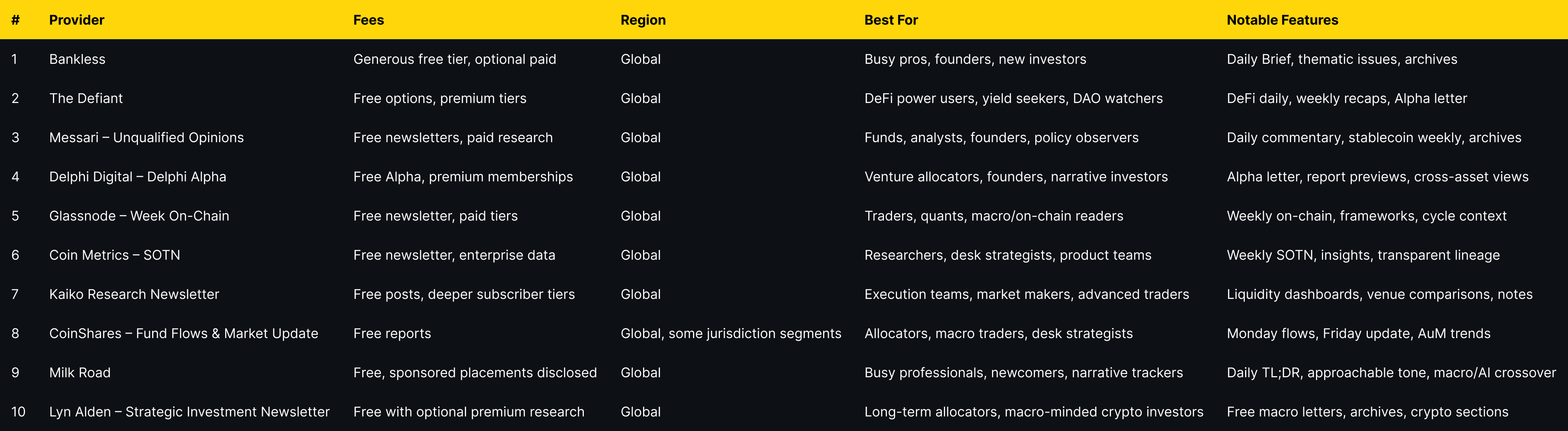
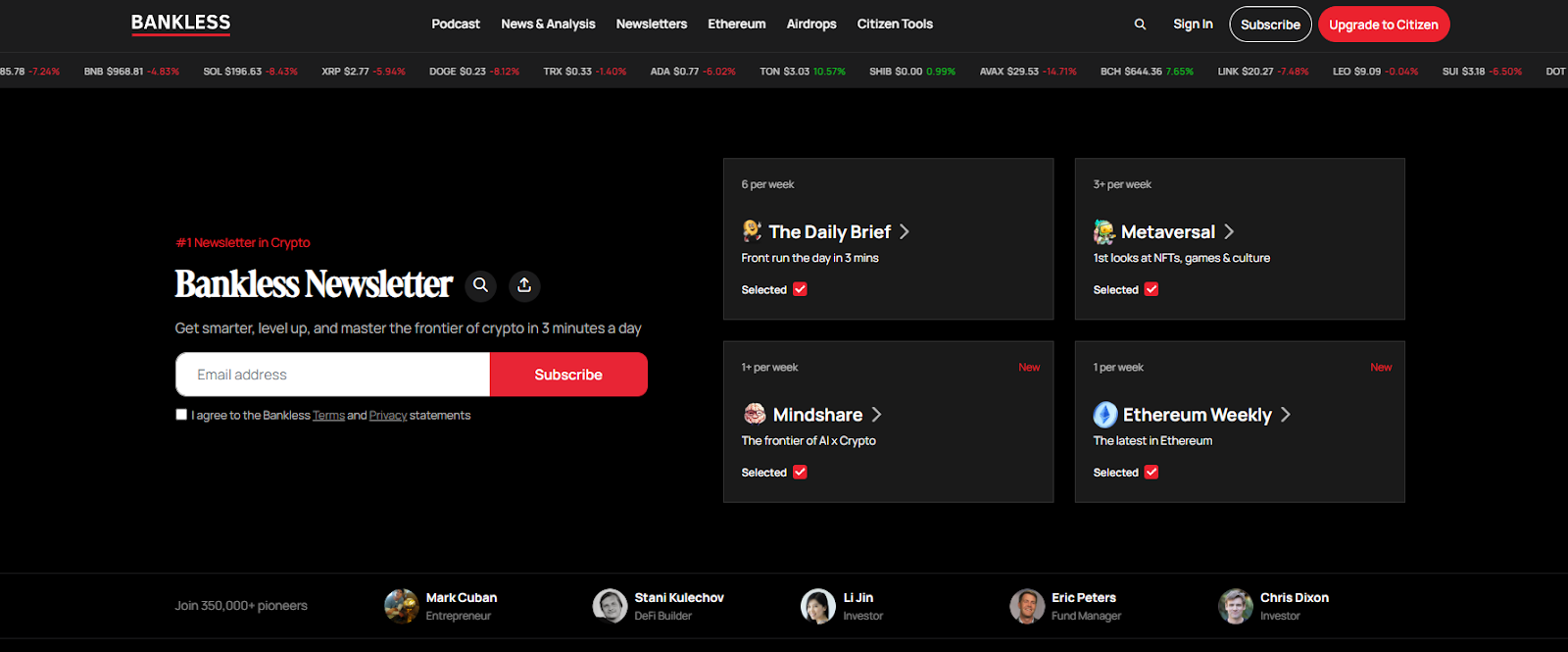
1. Bankless — Best for Daily Crypto & Web3 Digests

  • Why Use It: Bankless offers an approachable Daily Brief and deeper thematic series that balance top-of-funnel news with actionable context. If you want a consistent, skimmable daily pulse on crypto, DeFi, and Ethereum, this is a staple.

  • Best For: Busy professionals, founders, new-to-intermediate investors, narrative spotters.

  • Notable Features: Daily Brief; weekly/thematic issues; Ethereum-centric takes; large archive; clear disclosures.

  • Fees Notes: Generous free tier; optional paid communities/products.

  • Regions: Global

  • Alternatives: The Defiant, Milk Road

  • Consider If: You want daily breadth and a friendly voice more than deep quant.

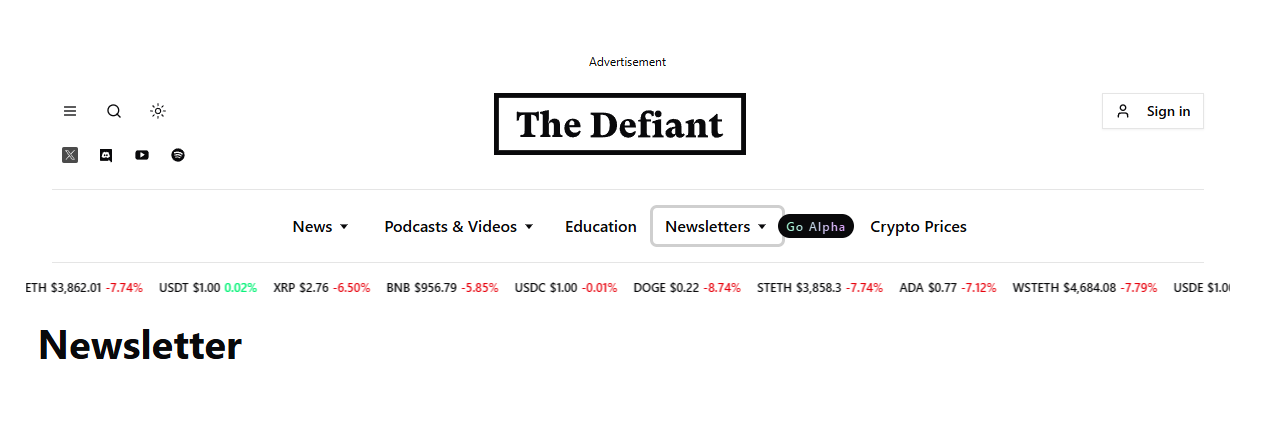
2. The Defiant — Best for DeFi-Native Coverage

  • Why Use It: The Defiant’s daily/weekly letters and DeFi Alpha cut straight to on-chain happenings, new protocols, and governance. Expect fast DeFi coverage with practical trader/investor context.

  • Best For: DeFi power users, yield seekers, DAO/governance watchers.

  • Notable Features: DeFi-focused daily; weekly recaps; Alpha letter; strong reporting cadence.

  • Fees Notes: Free newsletter options; premium research tiers available.

  • Regions: Global

  • Alternatives: Bankless, Delphi Digital

  • Consider If: Your focus is DeFi first and you want timely protocol insights.

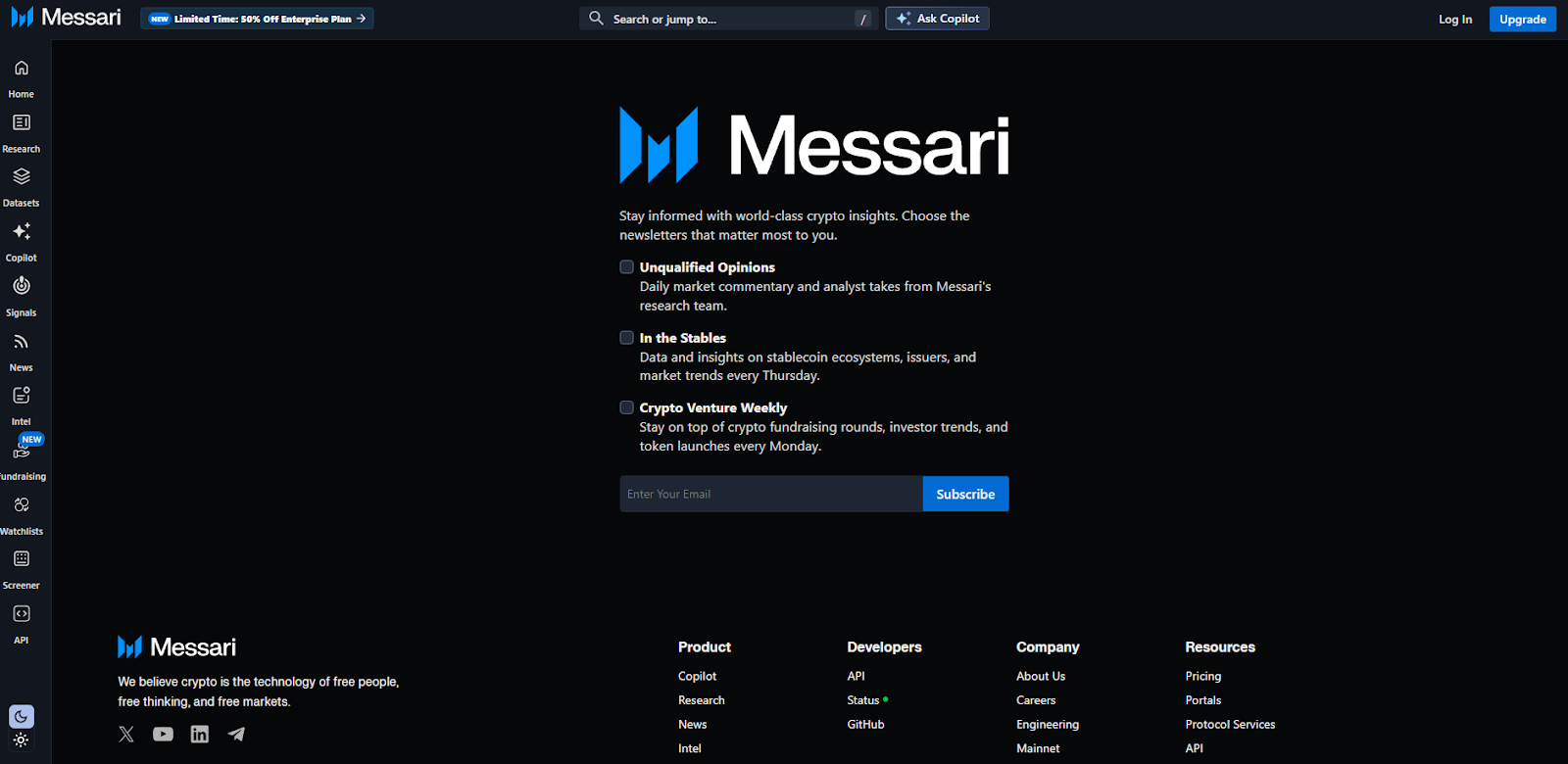
3. Messari – Unqualified Opinions — Best for Institutional-Grade Daily Takes

  • Why Use It: Messari’s daily market commentary and analyst notes are crisp, data-aware, and aligned with institutional workflows. Great for staying current on stablecoins, venture, and macro-market structure.

  • Best For: Funds, analysts, founders, policy/market observers.

  • Notable Features: Daily commentary; stablecoin weekly; venture weekly; archives; research ecosystem.

  • Fees Notes: Free newsletters with deeper research available to paying customers.

  • Regions: Global

  • Alternatives: Delphi Digital, Coin Metrics SOTN

  • Consider If: You value concise institutional context over tutorials.

4. Delphi Digital – Delphi Alpha — Best for Thematic Deep Dives

  • Why Use It: Delphi marries thematic research (AI infra, gaming, L2s) with market updates and timely unlocks of longer reports. Great when you want conviction around medium-term narratives.

  • Best For: Venture/allocators, founders, narrative investors.

  • Notable Features: “Alpha” newsletter; report previews; cross-asset views; long-form research.

  • Fees Notes: Free Alpha letter; premium research memberships available.

  • Regions: Global

  • Alternatives: Messari, The Defiant

  • Consider If: You prefer thesis-driven research over daily headlines.

5. Glassnode – The Week On-Chain — Best for On-Chain Market Structure

  • Why Use It: The industry’s flagship weekly on-chain letter explains BTC/ETH supply dynamics, holder cohorts, and cycle health with charts you’ll see cited everywhere.

  • Best For: Traders, quants, macro/on-chain hybrid readers.

  • Notable Features: Weekly on-chain; clear frameworks; historical cycle context; free subscription option.

  • Fees Notes: Free newsletter; paid platform tiers for advanced metrics.

  • Regions: Global

  • Alternatives: Coin Metrics SOTN, Into The Cryptoverse

  • Consider If: You want a single, rigorous on-chain read each week.

6. Coin Metrics – State of the Network — Best for Data-First Research Notes

  • Why Use It: SOTN blends on-chain and market data into weekly essays on sectors like LSTs, stablecoins, and market microstructure. It’s authoritative, neutral, and heavily cited.

  • Best For: Researchers, desk strategists, product teams.

  • Notable Features: Weekly SOTN; special insights; transparent data lineage; archives.

  • Fees Notes: Free newsletter; enterprise data products available.

  • Regions: Global

  • Alternatives: Glassnode, Kaiko Research

  • Consider If: You want clean methodology and durable references.

7. Kaiko Research Newsletter — Best for Liquidity & Market Microstructure

  • Why Use It: Kaiko’s research distills exchange liquidity, spreads, and derivatives structure across venues—useful for routing, slippage, and institutional execution context.

  • Best For: Execution teams, market makers, advanced traders.

  • Notable Features: Data-driven notes; liquidity dashboards; exchange/venue comparisons.

  • Fees Notes: Free research posts; deeper tiers for subscribers/clients.

  • Regions: Global

  • Alternatives: Coin Metrics, Messari

  • Consider If: You care about where liquidity actually is—and why it moves.

8. CoinShares – Digital Asset Fund Flows & Market Update — Best for ETF/Institutional Flow Watchers

  • Why Use It: Weekly Fund Flows and macro wrap-ups help you track institutional positioning and sentiment—especially relevant in the ETF era.

  • Best For: Allocators, macro traders, desk strategists.

  • Notable Features: Monday flows report; Friday market update; AuM trends; asset/region breakdowns.

  • Fees Notes: Free reports.

  • Regions: Global (some content segmented by jurisdiction)

  • Alternatives: Glassnode, Messari

  • Consider If: You anchor decisions to capital flows and risk appetite.

9. Milk Road — Best for Quick, Conversational Daily Briefs

  • Why Use It: A fast, witty daily that makes crypto easier to follow without dumbing it down. Great second screen with coffee—good for catching headlines, airdrops, and memes that matter.

  • Best For: Busy professionals, newcomers, social-narrative trackers.

  • Notable Features: Daily TL;DR; approachable tone; growing macro/AI crossover.

  • Fees Notes: Free newsletter; sponsored placements disclosed.

  • Regions: Global

  • Alternatives: Bankless, The Defiant

  • Consider If: You want speed and simplicity over deep quant.

10. Lyn Alden – Strategic Investment Newsletter — Best for Macro That Actually Impacts Crypto

  • Why Use It: Not crypto-only—yet hugely relevant. Lyn’s macro letters cover liquidity regimes, fiscal/monetary shifts, and energy/AI cycles that drive risk assets, including BTC/ETH.

  • Best For: Long-term allocators, macro-minded crypto investors.

  • Notable Features: Free macro letters; archives; occasional crypto-specific sections; clear frameworks.

  • Fees Notes: Free with optional premium research.

  • Regions: Global

  • Alternatives: Messari, Delphi Digital

  • Consider If: You want a macro north star to frame your crypto thesis.

Decision Guide: Best By Use Case

  • DeFi-native coverage: The Defiant

  • Daily crypto pulse (friendly): Bankless or Milk Road

  • Institutional-style daily notes: Messari – Unqualified Opinions

  • Thematic, thesis-driven research: Delphi Digital

  • On-chain cycle health: Glassnode – Week On-Chain

  • Data-first weekly (methodology): Coin Metrics – SOTN

  • Liquidity & venue quality: Kaiko Research

  • ETF & institutional positioning: CoinShares Fund Flows

  • Macro framing for crypto: Lyn Alden

How to Choose the Right Crypto Newsletter/Analyst (Checklist)

  • Region/eligibility: confirm signup availability and any paywall constraints.

  • Breadth vs. depth: daily skim (news) vs. weekly deep dives (research).

  • Data lineage: on-chain and market sources are named and reproducible.

  • Fees & value: what’s free vs. gated; consider team needs (PM vs. research).

  • UX & cadence: archives, searchable tags, consistent schedule.

  • Disclosures: positions, sponsorships, methodology explained.

  • Community/support: access to Q&A, office hours, or active forums.

  • Red flags: vague performance claims; undisclosed affiliations.

Use Token Metrics With Any Newsletter/Analyst

  • AI Ratings to screen sectors/tokens surfacing in the letters you read.
  • Narrative Detection to quantify momentum behind themes (L2s, AI infra, RWAs).

  • Portfolio Optimization to size convictions with risk-aware allocations.

  • Alerts/Signals to time entries/exits as narratives evolve.

Workflow: Research in your favorite newsletter → shortlist in Token Metrics → execute on your venue of choice → monitor with Alerts.


Start free trial

Security & Compliance Tips

  • Enable 2FA on your email client and any research platform accounts.

  • Verify newsletter domains and unsubscribe pages to avoid phishing.

  • Respect KYC/AML and regional rules when acting on research.

  • For RFQs/execution, confirm venue liquidity and slippage.

  • Separate reading devices from hot-wallets; practice wallet hygiene.

This article is for research/education, not financial advice.

Beginner Mistakes to Avoid

  • Treating a newsletter as a signal service—use it as input, not output.

  • Ignoring methodology and disclosures.

  • Chasing every narrative without a sizing framework.

  • Subscribing to too many sources—prioritize quality over quantity.

  • Not validating claims with primary data (on-chain/flows).

FAQs

What makes a crypto newsletter “best” in 2025?
Frequency, methodological transparency, and the ability to translate on-chain/macro signals into practical takeaways. Bonus points for archives and clear disclosures.

Are the top newsletters free or paid?
Most offer strong free tiers (daily or weekly). Paid tiers typically unlock deeper research, models, or community access.

Do I need both on-chain and macro letters?
Ideally yes—on-chain explains market structure; macro sets the regime (liquidity, rates, growth). Pairing both creates a more complete view.

How often should I read?
Skim dailies (Bankless/Milk Road) for awareness; reserve time weekly for deep dives (Glassnode/Coin Metrics/Delphi).

Can newsletters replace analytics tools?
No. Treat them as curated insight. Validate ideas with your own data and risk framework (Token Metrics can help).

Which is best for ETF/flows?
CoinShares’ weekly Fund Flows is the go-to for institutional positioning, complemented by Glassnode/Coin Metrics on structure.

Conclusion + Related Reads

If you want a quick pulse, pick a daily (Bankless or Milk Road). For deeper conviction, add one weekly on-chain (Glassnode or Coin Metrics) and one thesis engine (Delphi or Messari). Layer macro (Lyn Alden) to frame the regime, and use Token Metrics to quantify what you read and act deliberately.

Related Reads:

  • Best Cryptocurrency Exchanges 2025

  • Top Derivatives Platforms 2025

  • Top Institutional Custody Providers 2025

Research

Top Education Platforms & Courses for Crypto (2025)

Sam Monac
7 min

Why Crypto education platforms & courses Matter in September 2025

Crypto moves fast—and the gap between hype and real skills can be costly. If you’re evaluating the best crypto courses or structured paths to go from zero to fluent (or from power user to builder), the right program can compress months of trial-and-error into weeks. In short: a crypto education platform is any structured program, course catalog, or academy that teaches blockchain, Web3, or digital-asset topics with clear outcomes (e.g., literacy, developer skills, startup readiness).
This guide curates 10 credible options across beginner literacy, smart-contract engineering, and founder tracks. We blend SERP research with hands-on criteria so you can match a course to your goals, time, and budget—without the fluff.

How We Picked (Methodology & Scoring)

  • Curriculum depth & rigor (30%): Syllabi clarity, assessments, capstones, recognized instructors.

  • Credibility & security posture (25%): Transparent teams, reputable institutions, security topics baked in.

  • Coverage & specialization (15%): Breadth (BTC, ETH, DeFi, NFTs, security) plus specialist tracks (Solidity, oracles, ZK).

  • Costs & access (15%): Free tiers, scholarships, value per hour, certificates.

  • UX & learning experience (10%): In-browser coding, cohort support, community, multilingual content.

  • Support & outcomes (5%): Mentorship, career support, community reach.

Data sources: official provider pages (program docs, security/FAQ, curriculum), plus widely cited market datasets for cross-checks only. Last updated September 2025.

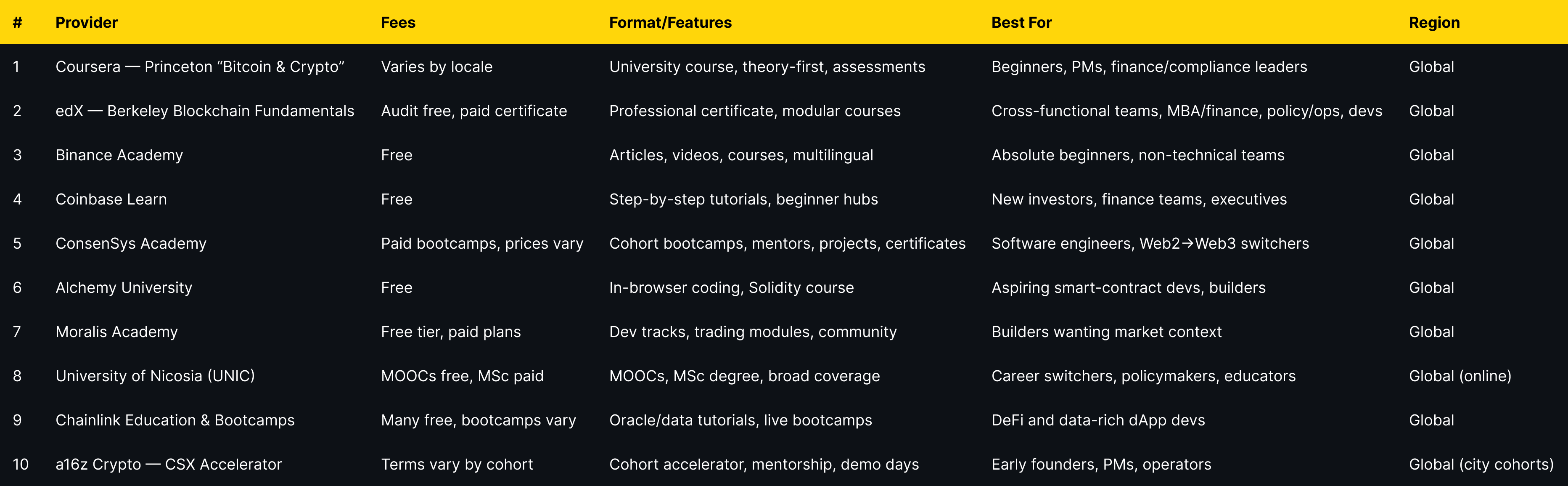
Top 10 Crypto education platforms & courses in September 2025

1. Coursera — “Bitcoin and Cryptocurrency Technologies” (Princeton) — Best for academic foundations

  • Why Use It: A seminal university course that demystifies Bitcoin and core crypto concepts with a rigorous, vendor-neutral lens. Clear lectures and assessments make it ideal for newcomers who want trustworthy fundamentals.
  • Best For: Beginners, product managers, compliance/finance pros, technical leaders needing conceptual grounding.

  • Notable Features: University-backed syllabus; security/anonymity modules; future/regulation perspectives; conceptual foundations for building.
  • Consider If: You prefer hands-on Solidity right away—this is theory-first.

  • Alternatives: edX (Berkeley), Coinbase Learn.

  • Regions: Global. Fees Notes: Coursera pricing varies by locale.

2. edX — Berkeley Blockchain Fundamentals — Best for university-brand plus survey depth

  • Why Use It: UC Berkeley’s professional certificate pairs an overview of blockchain and crypto with academic rigor and clear learning paths. Good bridge between literacy and technical depth.
  • Best For: Cross-functional teams, MBA/finance learners, policy/ops, curious devs.

  • Notable Features: Recognized university credential; modular courses; wide topical span across Bitcoin, Ethereum, and applications.
  • Consider If: You need coding-heavy, cohort-based Solidity training now.

  • Alternatives: Coursera (Princeton), ConsenSys Academy.

  • Regions: Global. Fees Notes: edX offers audit (free) and paid certificate tracks.

3. Binance Academy — Best free, multilingual crypto literacy hub

  • Why Use It: A large, constantly updated library of beginner-to-intermediate guides, glossaries, and tutorials in many languages—100% free.
  • Best For: Absolute beginners, non-technical teams, multilingual audiences, fast refreshers.

  • Notable Features: Courses + articles + videos; Bitcoin halving hubs; multi-language support; bite-size explainers.
  • Consider If: You want a formal certificate or university grade.

  • Alternatives: Coinbase Learn, edX.

  • Regions: Global. Fees Notes: Free.

4. Coinbase Learn — Best for simple, trusted onboarding

  • Why Use It: Friendly entry point with practical “how-to” guides that answer common questions about Bitcoin, Ethereum, NFTs, wallets, and safety. Great for reluctant first-timers.
  • Best For: New investors, finance teams exploring crypto policy, busy executives.

  • Notable Features: Step-by-step tutorials; beginner hubs; platform-agnostic primers
  • Consider If: You need dev-level skills or a cohort experience.

  • Alternatives: Binance Academy, Coursera.

  • Regions: Global. Fees Notes: Free learning content.

5. ConsenSys Academy — Best for Ethereum developer bootcamps

  • Why Use It: The training arm of a core Ethereum company, with cohort-based programs, mentor access, and security best practices baked in. Strong for professionalizing Solidity skills.
  • Best For: Software engineers, Web2 devs crossing to Web3, career switchers.

  • Notable Features: Flagship Blockchain Developer Bootcamp; team projects; office hours; certificates.
  • Consider If: You need completely free self-paced content.

  • Alternatives: Alchemy University, Moralis Academy.

  • Regions: Global (online). Fees Notes: Paid bootcamps; prices vary.

6. Alchemy University — Best free, hands-on Solidity path

  • Why Use It: A popular builder track with free in-browser coding, projects, and a modern Solidity course aligned to current compiler versions.
  • Best For: Aspiring smart-contract devs, hackathon teams, self-paced builders.

  • Notable Features: Free Solidity course; code-along projects; hackathons; JS + Ethereum tracks.
  • Consider If: You want a cohort and instructor mentorship.

  • Alternatives: ConsenSys Academy, Encode Club.

  • Regions: Global. Fees Notes: Free.

7. Moralis Academy — Best for blended dev + trading curriculum

  • Why Use It: Combines structured dev courses with trading strategy content and a community. Offers free starts with optional Pro for deeper tracks.
  • Best For: Builders who also want market context; ambitious beginners.

  • Notable Features: Step-by-step tracks; community; trading modules; ties to Moralis dev tooling.

  • Consider If: You prefer purely academic or vendor-neutral content.

  • Alternatives: Alchemy University, Binance Academy.

  • Regions: Global. Fees Notes: Free tier; paid plans available.

8. University of Nicosia (UNIC) — Free MOOCs + MSc in Blockchain/Digital Currency — Best for formal academia & credentials

  • Why Use It: UNIC pioneered a dedicated MSc in Digital Currency and runs free entry MOOCs—a long-standing academic pathway in crypto.
  • Best For: Career-switchers wanting formal credentials; policymakers; educators.

  • Notable Features: Free MOOC intros; postgraduate degrees; broad coverage across tech, economic, and legal aspects.
  • Consider If: You need short, purely practical dev sprints.

  • Alternatives: edX (Berkeley), Coursera.

  • Regions: Global (online). Fees Notes: MOOCs free; degree programs paid.

9. Chainlink Education & Bootcamps — Best for oracle, data, and hybrid smart-contract skills

  • Why Use It: If you’re building with real-world data, Chainlink’s education hub and instructor-led bootcamps teach oracle patterns, cross-chain messaging, and production-grade smart contracts.
  • Best For: Devs targeting DeFi, on-chain finance, and data-rich dApps.

  • Notable Features: Tutorials on NFTs/stablecoins; live bootcamps; developer advocates; ecosystem resources.
  • Consider If: You want chain-agnostic theory without vendor context.

  • Alternatives: Alchemy University, ConsenSys Academy.

  • Regions: Global. Fees Notes: Many resources free; bootcamp formats vary.

10. a16z Crypto — Crypto Startup Accelerator (CSX) — Best for founders & operators

  • Why Use It: Beyond coding, founders need go-to-market, legal, and product mentorship. CSX offers a cohort model with capital, expert lectures, and crypto-specific startup support.
  • Best For: Early-stage founders, PMs, operators validating product-market fit in Web3.

  • Notable Features: Curated mentorship network; structured curriculum; demo days; evolution of the original Crypto Startup School into a full accelerator.
  • Consider If: You’re pre-idea or not building a company yet—start with literacy/dev courses first.

  • Alternatives: Encode Club accelerators, Solana-ecosystem programs.

  • Regions: Global (programs periodically in specific cities). Fees Notes: Accelerator terms vary by cohort.

Decision Guide: Best By Use Case

  • Academic fundamentals (theory-first): Coursera (Princeton), edX (Berkeley).
  • Free multilingual literacy: Binance Academy; Coinbase Learn (simple, practical).
  • Hands-on Solidity (free): Alchemy University.
  • Cohort dev bootcamp: ConsenSys Academy.
  • Developer + trading blend: Moralis Academy.
  • Formal credentials: University of Nicosia (MOOC, MSc).
  • Oracle/data-driven dApps: Chainlink Education/Bootcamps.

  • Founder/accelerator path: a16z Crypto (CSX).

How to Choose the Right Crypto education platforms & courses (Checklist)

  • Confirm level & outcomes (literacy, dev skills, or founder playbook).

  • Review syllabus & assessments; look for capstones or code reviews.

  • Match specialization (Solidity, ZK, DeFi, security, oracles) to your goal.

  • Check costs & time (audit/free vs. paid, cohort dates).

  • Evaluate support (mentors, office hours, Discord/Forum).

  • Prefer credible institutions/teams; scan FAQs/security sections.

  • Red flags: vague outcomes, hard upsells, no instructor transparency.

Use Token Metrics With Any Crypto education platforms & courses

  • AI Ratings to screen tokens you’ll study or trade.
  • Narrative Detection to spot momentum across sectors.

  • Portfolio Optimization to size positions by risk.

  • Alerts/Signals to monitor entries/exits as you learn.
    Workflow: Research → Choose a course → Practice on sandboxes → Execute with a small wallet → Monitor with Alerts.

 Primary CTA: Start free trial.

Security & Compliance Tips

  • Enable 2FA and hardware keys on all learning-linked accounts.

  • Keep a separate practice wallet; never paste seed phrases into course portals.

  • Use reputable docs for KYC/AML topics; understand regional eligibility.

  • Practice safe contract deployments on testnets first.

  • Document RFQ or OTC steps if your course touches institutional flows.

This article is for research/education, not financial advice.

Beginner Mistakes to Avoid

  • Jumping into paid bootcamps before trying free literacy/prep modules.

  • Treating dev tutorials as plug-and-play without security reviews.

  • Chasing certifications without projects to show.

  • Ignoring region/eligibility notes or program timelines.

  • Over-indexing on one chain—learn concepts that transfer.

FAQs

What’s the fastest way to start learning crypto in 2025?
Start with a free literacy hub (Binance Academy or Coinbase Learn), then audit a university course (Coursera/edX) before committing to a paid bootcamp. This builds intuition and saves money.

Which course is best if I want to become a Solidity developer?
Alchemy University is a free, hands-on path with in-browser coding; ConsenSys Academy adds mentor-led structure and team projects for professional polish.

Do I need a formal degree for crypto careers?
Not strictly. A portfolio of projects often trumps certificates, but formal programs like UNIC’s MSc can help for policy, compliance, or academia-adjacent roles.

Are these programs global and online?
Most are fully online and globally accessible; accelerators like a16z CSX may run cohorts in specific cities, so check the latest cohort details.

Will these courses cover wallet and security best practices?
University and dev bootcamps typically include security modules; literacy hubs also publish safety guides. Always cross-check with official docs and practice in testnets.

Conclusion + Related Reads

If your goal is literacy and safe onboarding, start with Binance Academy or Coinbase Learn; for academic depth, layer in Coursera (Princeton) or edX (Berkeley). Builders should choose Alchemy University (free) and consider ConsenSys Academy for mentor-led polish. For credentials, UNIC stands out. Founders ready to ship and raise should explore a16z Crypto’s CSX.

Related Reads:

  • Best Cryptocurrency Exchanges 2025

  • Top Derivatives Platforms 2025

  • Top Institutional Custody Providers 2025

Choose from Platinum, Gold, and Silver packages
Reach with 25–30% open rates and 0.5–1% CTR
Craft your own custom ad—from banners to tailored copy
Perfect for Crypto Exchanges, SaaS Tools, DeFi, and AI Products