Back to blog
Research

Why 2025 Is the Perfect Year to Start Investing with Token Metrics Crypto Indices

2025 marks a pivotal year in crypto with institutional adoption, regulatory clarity, and AI-powered tools. Learn how Token Metrics crypto indices can support smarter, diversified investing.
Token Metrics Team
11
Want Smarter Crypto Picks—Free?
See unbiased Token Metrics Ratings for BTC, ETH, and top alts.
Thank you! Your submission has been received!
Oops! Something went wrong while submitting the form.
 No credit card | 1-click unsubscribe

If you've been waiting for the "right time" to invest in cryptocurrency, 2025 represents a convergence of factors that may never align this perfectly again. Regulatory frameworks are solidifying. Institutional adoption is accelerating. AI technology has matured. Market infrastructure has professionalized. And most importantly, proven systems like Token Metrics AI indices have track records demonstrating consistent success through multiple market cycles.

The question isn't whether to invest in crypto—that ship has sailed as institutional giants commit billions. The question is how to invest smartly, efficiently, and with the best chance of success. Here's why 2025 is your optimal entry point, and why Token Metrics indices offer the ideal vehicle for capturing this opportunity.

Reason #1: Regulatory Clarity Is Finally Here

For years, cryptocurrency existed in regulatory limbo. Investors faced uncertainty about legal status, tax treatment, and government attitudes. That era is ending.

The European MiCA Framework
Europe's Markets in Crypto-Assets (MiCA) regulation, fully implemented in 2025, provides the first comprehensive regulatory framework for crypto markets. This standardization removes legal uncertainty and opens doors for institutional capital that previously stayed on the sidelines.

U.S. Regulatory Evolution
The approval of Bitcoin spot ETFs in 2024 marked a watershed moment. Professional investors now hold $27.4 billion in U.S. Bitcoin ETFs, signaling mainstream acceptance. Further regulatory clarity continues emerging as the SEC and other agencies develop consistent frameworks.

What This Means for You
Regulatory clarity reduces risk. When governments establish clear rules, legitimate projects thrive while scams get eliminated. Token Metrics benefits directly—its AI-powered selection process now operates in a more transparent market where quality projects are easier to identify and verify.

The Token Metrics Advantage: With regulations favoring legitimate projects, Token Metrics' fundamental analysis of team quality, code audits, and regulatory compliance becomes even more valuable. The platform automatically filters for projects meeting evolving regulatory standards.

Reason #2: Institutional Adoption Is Accelerating

Individual retail investors no longer dominate crypto markets. Institutions are entering aggressively, bringing professionalism, liquidity, and validation.

The Numbers Don't Lie
According to a Coinbase institutional survey, 67% of professional investors plan to increase their crypto holdings in 2025, with 24% expecting to "significantly increase" exposure—up from just 16% in 2024.

Family offices and hedge funds are leading this shift, reflecting growing conviction in crypto's performance advantage and structural role in diversified portfolios.

Token Metrics Institutional-Grade Approach
Token Metrics was built with institutional-quality standards from day one. The platform's AI analyzes over 80 data points per token—the same rigorous approach used by professional fund managers.

As institutions flood into crypto, having institutional-grade tools becomes essential for retail investors to compete. Token Metrics democratizes access to professional strategies that previously required million-dollar minimums and expert teams.

Reason #3: AI Technology Has Reached Maturity

Artificial intelligence in crypto investing isn't experimental anymore—it's proven, refined, and delivering consistent results.

From Experiment to Established System
Token Metrics has been developing and refining its AI models since 2017. The platform now has:

Why AI Matters More in 2025
Markets are more complex than ever. With 6,000+ cryptocurrencies, countless narratives, and 24/7 global trading, human analysis can't keep pace. AI processes information at scale, identifies patterns humans miss, and executes decisions without emotional interference.

Real-World Impact: During 2024's market volatility, Token Metrics AI indices automatically adjusted allocations, reducing exposure before major corrections and increasing positions during recoveries. Human investors watching news and making emotional decisions significantly underperformed.

The Learning Advantage
Token Metrics' AI doesn't just analyze—it learns. Every market cycle, token launch, and trend adds to the system's knowledge base. By 2025, the AI has experienced scenarios that new investors have never seen, providing a cumulative learning advantage.

Click here to signup for free trial account!

Reason #4: Market Infrastructure Has Professionalized

Remember when buying crypto meant sketchy exchanges, confusing wallets, and constant security concerns? That era is over.

Modern Crypto Infrastructure

Lower Barriers to Entry
Five years ago, investing in crypto required technical knowledge and tolerance for poor user experiences. Today, the experience matches traditional investing in ease and professionalism.

Token Metrics Simplification: The platform abstracts away remaining complexity. You don't need to understand blockchain technology or navigate confusing interfaces. Token Metrics provides clear guidance—what to buy, when to rebalance, and how to manage risk.

Reason #5: The 4-Year Bitcoin Cycle Timing

Cryptocurrency markets historically follow four-year cycles tied to Bitcoin halving events. Understanding where we are in this cycle provides strategic advantage.

The Halving Impact
Bitcoin halvings occur every four years, reducing new supply and historically triggering major bull markets. The most recent halving occurred in April 2024.

Historical Pattern:

Where We Are Now
We're in the early-to-mid phase of the post-halving bull cycle. Historically, the strongest gains occur 12-18 months after halving events. This positions 2025 as potentially the optimal year within the current cycle.

The Token Metrics Edge: Rather than trying to time individual token purchases, Token Metrics indices automatically adjust allocations based on market phase. During bull markets, the AI increases exposure to high-momentum opportunities. During corrections, it defensively reallocates to preserve capital.

Reason #6: Tokenized Real-World Assets Are Exploding

One of the most significant developments in 2025 is the tokenization of traditional assets onto blockchain infrastructure.

The Tokenization Revolution
Tokenized real-world assets (RWAs) have surged past $22.5 billion on-chain, up nearly 6% in recent months alone. This represents stocks, bonds, real estate, commodities, and other traditional assets moving onto blockchain rails.

Why This Matters: As traditional finance merges with crypto infrastructure, the total addressable market expands. Token Metrics RWA indices provide exposure to this significant emerging sector that bridges conventional and digital finance.

Institutional Bridge
RWAs provide familiar territory institutions need to increase crypto allocations. Rather than purely speculative tokens, these represent ownership in tangible assets with established valuations. This legitimacy accelerates institutional adoption and feeds broader crypto market growth.

Token Metrics RWA Index: Specifically designed to capture the tokenization trend, this index provides diversified exposure to projects building the infrastructure for traditional asset tokenization.

Reason #7: Diversification Has Never Been More Important

2025's macroeconomic environment makes diversification across asset classes essential.

Economic Uncertainty Drivers

Crypto's Diversification Benefits
Research demonstrates that modest crypto allocations of 1-3% have historically improved portfolio efficiency, delivering improved returns, higher Sharpe ratios, and limited drawdown impact when structured appropriately.

Token Metrics Solution: Rather than taking chances on individual crypto picks, indices provide systematic exposure that enhances overall portfolio diversification while actively managing crypto-specific risks through rebalancing and quality screening.

How to Capitalize on This Perfect Timing

Understanding why 2025 is optimal means nothing without action. Here is a practical roadmap for potential investors:

The 2025 Advantage Window
While crypto will exist for decades, specific windows offer optimal entry points. The current convergence of regulatory clarity, institutional adoption, AI maturity, and cycle timing creates a rare alignment.

Historical Precedent: Investors who entered during similar optimal windows in 2016 or early 2020 significantly outperformed those who waited for "more certainty." By the time most people feel comfortable, the biggest gains have already occurred.

Risk Considerations for 2025

No investment comes without risk. Understanding and managing these risks positions you for informed decision-making.

Your 2025 Decision Point

Every historic investment opportunity shares common characteristics: identifiable catalysts, improving fundamentals, and mainstream skepticism that keeps many participants on the sidelines.

In 2025, crypto checks every box. The infrastructure, regulations, and institutional participation that skeptics demanded are now in place. The technology is mature. The track records are established. Yet many investors still wait, searching for more "certainty," which often results in missed opportunities.

Token Metrics removes common barriers:

The question is whether you'll utilize this convergence of favorable factors or watch from the sidelines as another cycle passes.

Take Action Today

Optimal investment windows are rarely obvious in the moment. By the time everyone agrees crypto is "safe," the most significant opportunities may have passed.

Starting with even a modest allocation to Token Metrics indices can offer exposure to 2025's alignment of regulatory clarity, institutional adoption, AI insight, and market cycle timing. Exploring the indices gives you the chance to leverage a historically rare convergence of positive conditions.

Visit Token Metrics today, explore the indices, and take the first step toward capitalizing on this opportunity. The perfect time to invest rarely announces itself—it arrives quietly for those who are prepared.

Click here to signup for free trial account!

Discover Crypto Gems with Token Metrics AI

Token Metrics uses AI-powered analysis to help you uncover profitable opportunities in the crypto market. Get Started For Free

FAQ

What makes 2025 unique for crypto investing?

2025 brings together regulatory clarity, institutional adoption, AI advancements, and a post-halving market cycle, creating an environment with enhanced infrastructure and data-driven tools.

How does Token Metrics support smarter crypto investing?

Token Metrics utilizes AI models analyzing over 80 data points per token, providing index products, research, and automated strategies to help users navigate complex markets without extensive manual research.

Do I need technical knowledge to use crypto indices?

No, platforms like Token Metrics simplify the process, allowing users to access diversified indices and research insights with minimal technical expertise or blockchain knowledge.

What are the main risks associated with crypto investments in 2025?

Risks include market volatility, evolving regulation, technology vulnerabilities, and unpredictable cycles. Systematic, data-informed approaches and risk management strategies can help address these factors.

Can Token Metrics indices help with diversification?

Yes, Token Metrics indices are designed to provide diversified exposure to various segments of the crypto market, aiding overall portfolio risk management and balancing individual token exposure.

Disclaimer

This content is for informational and educational purposes only and does not constitute investment advice or an offer to buy or sell any cryptocurrency or financial product. Always conduct your own research and consult a qualified financial professional before making investment decisions. Past performance is not indicative of future results. Token Metrics does not guarantee any specific outcomes.

Build Smarter Crypto Apps &
AI Agents in Minutes, Not Months
Real-time prices, trading signals, and on-chain insights all from one powerful API.
Grab a Free API Key
About Token Metrics
Token Metrics: AI-powered crypto research and ratings platform. We help investors make smarter decisions with unbiased Token Metrics Ratings, on-chain analytics, and editor-curated “Top 10” guides. Our platform distills thousands of data points into clear scores, trends, and alerts you can act on.
30 Employees
analysts, data scientists, and crypto engineers
Daily Briefings
concise market insights and “Top Picks”
Transparent & Compliant
Sponsored ≠ Ratings; research remains independent
Want Smarter Crypto Picks—Free?
See unbiased Token Metrics Ratings for BTC, ETH, and top alts.
Thank you! Your submission has been received!
Oops! Something went wrong while submitting the form.
 No credit card | 1-click unsubscribe
Token Metrics Team
Token Metrics Team

Recent Posts

Research

APIs Explained: What They Are and How They Work

Token Metrics Team
5

APIs power much of the software you use daily — from fetching weather data in a mobile app to connecting decentralized exchanges to analytics dashboards. If youve ever wondered what an API is, why developers rely on them, and how they shape the modern web and crypto ecosystems, this guide breaks down the core concepts, common patterns, and practical steps to evaluate and use APIs effectively.

What is an API?

An API (Application Programming Interface) is a set of rules and protocols that lets different software components communicate. At a high level, an API defines how a caller requests data or functionality and how the provider responds. APIs abstract implementation details so developers can use capabilities — like retrieving market prices or sending messages — without needing to understand the providers internals.

Think of an API as a contract: a client sends a request in a specified format, and the service returns structured responses. Contracts can include endpoints, expected parameters, authentication methods, rate limits, error codes, and data schemas.

How APIs Work — a Technical Overview

Most modern APIs use web protocols (HTTP/HTTPS) and standard formats such as JSON. A typical request cycle looks like this:

  1. Client constructs a request URL or payload, optionally including authentication credentials (API key, OAuth token).
  2. Client sends the request to an API endpoint using a method like GET, POST, PUT, or DELETE.
  3. Server validates the request, applies business logic, and returns a response with data or an error code.
  4. Client parses the response and integrates it into the application.

APIs can enforce rate limits, usage quotas, and schema validation. In production systems, observability (logging, traces, metrics) and secure transport (TLS) are standard to ensure reliability and confidentiality.

Types of APIs & Common Patterns

APIs come in several styles, each with trade-offs:

  • REST (Representational State Transfer): Resource-oriented, uses HTTP verbs and status codes; widely adopted and easy to cache.
  • GraphQL: Lets clients request exactly the fields they need; reduces over-fetching but increases server complexity.
  • gRPC / RPC: Binary protocol for high-performance communication, often used for internal microservices.
  • Webhooks: Server-initiated callbacks to notify clients of events, useful for real-time notifications.

In crypto and finance, youll see specialized APIs that provide order book data, historical trades, on-chain events, and wallet actions. Public APIs are accessible with minimal barriers, while private APIs require credentials and stricter access controls.

How to Evaluate and Use an API (Practical Steps)

Choosing and integrating an API involves technical, operational, and security considerations. A concise evaluation framework:

  1. Functionality: Does the API provide the endpoints and data formats you need? Review sample responses and SDKs.
  2. Performance & Reliability: Check latency, uptime SLA, and historical performance metrics if available.
  3. Security: Verify authentication schemes, encryption, data retention policies, and whether the provider supports IP allowlists or role-based access.
  4. Costs & Rate Limits: Understand free tier limits, pricing per request, and billing granularity to budget accordingly.
  5. Documentation & Support: High-quality docs, examples, and community support accelerate integration and troubleshooting.

When prototyping, use tools like Postman or curl to explore endpoints. Automate tests to validate responses and simulate rate limits. For production, incorporate retries with exponential backoff, circuit breakers, and monitoring to handle transient failures gracefully.

AI-driven research tools can speed analysis of API datasets by surfacing patterns and summarizing changes. For instance, applications that combine market or on-chain APIs with AI models can transform raw feeds into signals or structured insights. An example of a research platform often used for crypto analysis is Token Metrics, which demonstrates how analytics layers can complement API outputs without replacing rigorous technical validation.

Build Smarter Crypto Apps & AI Agents with Token Metrics

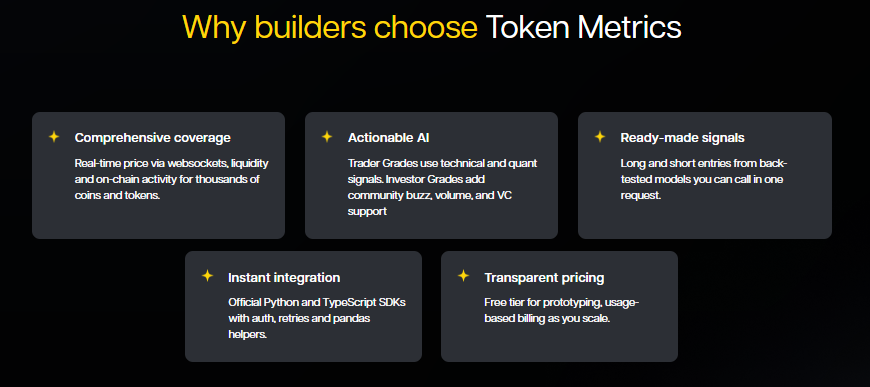
Token Metrics provides real-time prices, trading signals, and on-chain insights all from one powerful API. Grab a Free API Key

FAQ: What is an API?

An API (Application Programming Interface) is a documented way for software components to request services or data from one another. In web contexts, APIs typically expose endpoints over HTTP that return structured data formats such as JSON.

FAQ: How do APIs stay secure?

Common security practices include using HTTPS/TLS, API keys or OAuth for authentication, rate limiting, input validation to prevent injection attacks, and strong access control policies. Regular audits and logging help detect anomalies.

FAQ: Should I use REST or GraphQL?

REST is simple and cache-friendly; GraphQL is flexible for clients that need selective fields. Choose based on client requirements, caching needs, and team familiarity. Both can coexist in larger systems.

FAQ: How do I test an API integration?

Start with manual exploration (Postman, curl), then write automated tests for schema, error handling, rate limit behavior, and performance. Mock external APIs during unit testing and run contract tests during CI/CD.

FAQ: How are APIs used in crypto applications?

Crypto apps use APIs to fetch market prices, execute orders, read on-chain data, and stream events. Reliable APIs reduce complexity for developers but require careful handling of latency, consistency, and security.

Disclaimer

This article is for educational and informational purposes only and does not constitute investment, legal, or professional advice. Content describes technical concepts and practical evaluation steps for APIs; readers should perform independent research and consult qualified professionals when needed.

Research

APIs Explained: How They Power Software and Crypto

Token Metrics Team
5

APIs are the invisible connectors that let apps talk to each other. Whether you’re loading a weather widget, pulling crypto prices into a dashboard, or integrating an AI model, understanding how APIs work helps you design, evaluate, and secure systems that depend on reliable data.

What is an API?

An API—Application Programming Interface—is a clearly defined set of rules and contracts that lets one software program request services or data from another. At its core an API specifies how to format requests, what endpoints are available, what parameters are accepted, and how the provider will respond. Think of it as a menu at a restaurant: you pick dishes (requests), the kitchen prepares them (the service), and the waiter returns your order (the response) without exposing internal cooking processes.

APIs exist at many levels: operating system APIs expose filesystem and device operations, library APIs expose functions and classes, and web APIs expose remote services across networks. In modern web and mobile development, "API" often refers to HTTP-based interfaces that return structured data like JSON or XML.

How APIs Work: Requests, Responses, and Data Formats

Most web APIs operate on a request–response model. A client issues a request to a defined endpoint using a method (GET, POST, PUT, DELETE), optionally supplying parameters or a payload. The server processes the request and returns a response with a status code and body.

Key technical elements to understand:

  • Endpoints: URLs that map to resources or actions (e.g., /v1/prices).
  • HTTP Methods: Semantic actions (GET = read, POST = create, etc.).
  • Status Codes: 2xx successes, 4xx client errors, 5xx server errors.
  • Data Formats: JSON is ubiquitous for APIs due to its simplicity; XML and protobufs appear in legacy or high-performance systems.
  • Authentication & Authorization: API keys, OAuth tokens, JWTs, and mTLS govern who can access which endpoints.
  • Rate Limits & Quotas: Providers throttle requests to protect infrastructure and ensure fair use.

Real-time APIs may use WebSockets or server-sent events for streaming data rather than repeated HTTP polling. Designing for observability—clear logs, metrics, and error messages—improves operational resilience.

Common API Types and Protocols

Different projects require different API styles. Choosing a style depends on latency, flexibility, compatibility, and developer experience needs.

  • REST: Representational State Transfer emphasizes resources and standard HTTP verbs. RESTful APIs are easy to cache and widely supported.
  • GraphQL: Clients request exactly the fields they need in a single query, reducing over-fetching. GraphQL adds flexibility but requires careful performance tooling.
  • SOAP: An XML-heavy protocol that offers strict contracts and built-in standards for security and transactions; common in enterprise systems.
  • gRPC / Protobuf: High-performance RPC frameworks for microservices with compact binary payloads and strict typing.
  • Webhooks: Reverse-style APIs where a service pushes events to your endpoint, useful for near-real-time notifications without polling.

APIs are often packaged with SDKs for languages like Python, JavaScript, or Go to simplify integration. Documentation, example requests, and interactive consoles dramatically improve adoption.

APIs in Crypto and AI: Use Cases and Considerations

APIs are central to crypto and AI ecosystems. In crypto, APIs provide market data (prices, order books), on-chain insights (transaction history, token balances), and node RPC endpoints for smart contract interaction. AI systems use APIs to host inference endpoints, orchestrate models, and integrate external data sources for context.

Key considerations when selecting or building APIs for these domains:

  • Data Accuracy: In finance and blockchain, stale or inconsistent data can lead to incorrect analysis. Verify timestamps, aggregation logic, and reconciliation methods.
  • Latency and Throughput: Trading or real-time analytics may require low-latency streaming or websocket feeds instead of periodic REST calls.
  • Security: Protect API keys, enforce least privilege, use encrypted transport (HTTPS/TLS), and monitor for anomalous request patterns.
  • Reliability: Redundancy, caching strategies, and graceful degradation help maintain service if a provider faces outages.
  • Compliance & Privacy: Understand data retention, user privacy, and jurisdictional constraints when handling labeled or personal data.

Tools like Token Metrics combine market and on-chain data with AI to support research workflows that depend on reliable API feeds and model-driven signals.

Build Smarter Crypto Apps & AI Agents with Token Metrics

Token Metrics provides real-time prices, trading signals, and on-chain insights all from one powerful API. Grab a Free API Key

What is the difference between REST and GraphQL?

REST exposes multiple endpoints representing resources; clients may need several calls to assemble data. GraphQL exposes a single query endpoint where clients request precisely the fields they need. REST is simpler to cache; GraphQL offers flexibility but can require extra server-side tooling to manage complex queries and performance.

How do I secure an API key?

Never embed keys in client-side code. Store keys in secure server environments or secrets managers, rotate keys periodically, apply scope and rate limits, and monitor usage. Implementing short-lived tokens and IP whitelisting adds protection for sensitive endpoints.

When should I use webhooks instead of polling?

Use webhooks when you need event-driven, near-real-time notifications and want to avoid the overhead of frequent polling. Webhooks push updates to your endpoint, but require you to handle retries, verify payload signatures, and secure the receiving endpoint.

Can I build an API for my blockchain node?

Yes. Many projects wrap node RPCs with REST or GraphQL layers to standardize queries and add caching, rate limiting, and enrichment (e.g., token metadata). Be mindful of node sync status, resource consumption, and privacy considerations when exposing node endpoints.

How do I evaluate an API provider?

Assess API documentation quality, uptime/SLAs, latency, data freshness, authentication options, and support channels. Request sample data, test in sandbox environments, and compare pricing with expected usage. For crypto use cases, verify on-chain data coverage and reconciliation methods.

Disclaimer

This article is for educational purposes and does not constitute investment advice or recommendations. Evaluate APIs, platforms, and tools against your own requirements and compliance obligations before use.

Token Metrics API

Free Crypto API: Build Smarter Crypto Apps at Zero Cost

Sam Monac
6 min

What Is a Free Crypto API?

A free crypto API gives developers access to cryptocurrency data without upfront costs. Think of it as a bridge between raw blockchain/market data and your application. APIs let you pull:

  • Real-time token prices and charts

  • Historical data for backtesting and research

  • Market cap, liquidity, and trading volumes

  • On-chain metrics such as wallet flows

  • AI-driven trading signals and predictive insights

Free tiers are invaluable for prototyping apps, dashboards, and bots. They let you validate ideas quickly before paying for higher throughput or advanced endpoints.

Why Developers Use Free Crypto APIs

Free crypto APIs aren’t just about saving money—they’re about learning fast and scaling smart:

  • Zero-Cost Entry – Start building MVPs without financial risk.

  • Rapid Prototyping – Test ideas like dashboards, bots, or AI agents quickly.

  • Market Exploration – Access broad coverage of tokens before committing.

  • Growth Path – Once demand grows, upgrade to premium tiers seamlessly.

📌 Tip: Use multiple free crypto APIs in parallel during early development. This helps you benchmark speed, reliability, and accuracy.

Key Features of the Token Metrics Free API

The Token Metrics free tier goes beyond basic price feeds by offering:

  • Real-Time Prices – Live data on Bitcoin, Ethereum, and thousands of tokens.

  • AI Trading Signals – Bull/Bear indicators that help power smarter strategies.

  • Secure Access – Encrypted endpoints with key-based authentication.

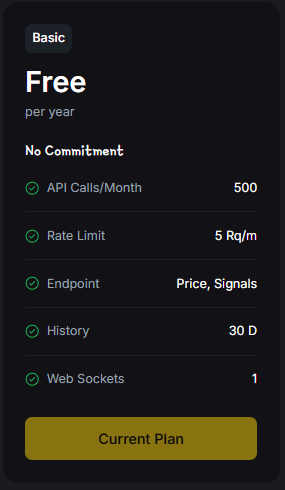
  • 30 Days of History – Enough to prototype backtests and analytics features.

Unlike many free crypto APIs, Token Metrics API provides both price data and intelligence, making it ideal for developers who want more than surface-level metrics.

Comparing Free Crypto APIs: Strengths & Trade-offs

  • CoinGecko & CoinMarketCap


    • Pros: Huge token coverage, great for charts and tickers.

    • Cons: Limited historical and no predictive analytics.

  • CryptoCompare


    • Pros: Rich historical tick-level data, good for backtesting.

    • Cons: Free tier limits depth and call volume.

  • Glassnode


    • Pros: Strong on-chain insights.

    • Cons: Many advanced datasets require paid access.

  • Alchemy & Infura


    • Pros: Node-level blockchain access for dApp builders.

    • Cons: Not designed for trading or analytics—raw blockchain data only.

  • Token Metrics


    • Pros: Real-time prices, AI signals, and on-chain analytics in one free tier.

    • Cons: Rate limits apply (upgrade available for higher throughput).

Popular Use Cases: From Bots to Dashboards

  • AI Crypto Trading Bots – Start testing automation using live prices and bull/bear signals.

  • Crypto Dashboards – Aggregate token ratings, prices, and trends for end users.

  • Research Tools – Run small-scale backtests with 30-day historical data.

  • Learning Projects – Ideal for students or developers exploring crypto APIs.

📌 Real-world example: Many developers use the Token Metrics free tier to prototype bots that later scale into production with paid plans.

Best Practices for Using Free Crypto APIs

  1. Start with Prototypes – Test multiple free APIs to compare reliability and latency.

  2. Track Rate Limits – Free tiers often throttle requests (e.g., 5 req/min at Token Metrics).

  3. Combine Data Sources – Use Token Metrics for signals + CoinGecko for broad coverage.

  4. Secure Keys – Treat even free API keys as sensitive credentials.

  5. Prepare to Upgrade – Build flexible code so you can switch tiers or providers easily.

Beyond Token Metrics: Other Free Resources Worth Knowing

  • DefiLlama API – Free coverage of DeFi protocols, yields, and TVL.

  • Dune Analytics – Query blockchain data with SQL for free.

  • TradingView Widgets – Embed charts directly into dashboards.

  • Santiment API – Free endpoints for social/sentiment analytics.

These can complement Token Metrics. For example, you could combine Token Metrics signals + DefiLlama DeFi data + TradingView charts into one unified dashboard.

How to Get Started With the Token Metrics Free API

  1. Sign Up for a free Token Metrics account.

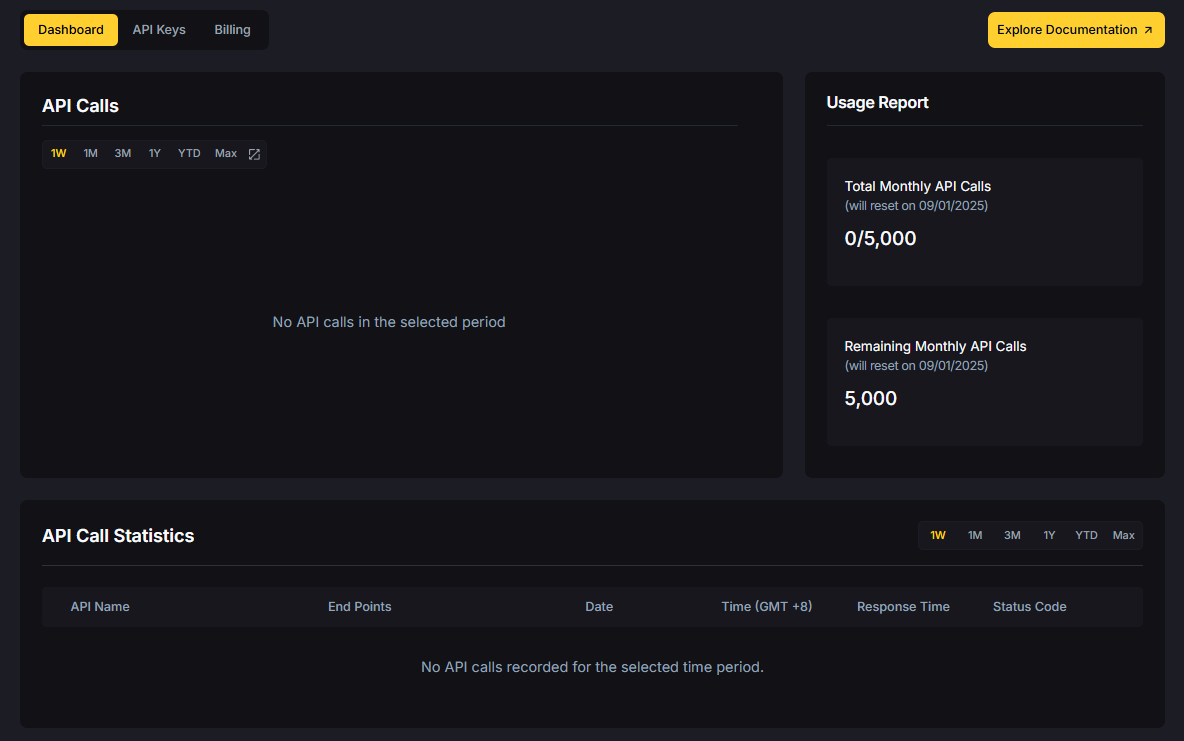
  2. Generate Your API Key instantly from your dashboard.

  3. Check the Docs for endpoints, examples, and code snippets.

  4. Prototype Your App with real-time prices and signals.

  5. Upgrade When Ready to unlock larger datasets and more endpoints.

👉 Grab Your Free Token Metrics API Key

FAQs About Free Crypto APIs

What can I access with Token Metrics Free API?
Live token prices, bull/bear trading signals, and 30 days of historical data.

Are free APIs reliable for production?
Not recommended—free tiers are best for prototypes. Paid tiers ensure reliability and scale.

What are the rate limits?
500 calls/month, 5 requests/minute, and 1 WebSocket connection.

Can I use the free API for trading bots?
Yes—ideal for prototyping. For production-level bots, upgrade for more throughput.

Scaling Beyond Free: Paid Plans & X.402

When your project outgrows free limits, Token Metrics offers flexible upgrades:

  • Pay-Per-Call (X.402) – As low as $0.017 per call, unlimited usage, no commitment.

  • Advanced Plan ($999.99/year) – 20,000 calls/month, indices & indicators, 3 WebSockets.

  • Premium Plan ($1,999.99/year) – 100,000 calls/month, AI agent + reports, 3 years of history.

With up to 35% off using TMAI tokens, scaling is cost-efficient.

📌 Why X.402 matters: Instead of committing upfront, you can grow gradually by paying per call—perfect for startups and side projects.

Build Smarter, Scale Easier

Free APIs help you start quickly and learn fast. Token Metrics gives you more than prices—it adds AI-powered signals and intelligence. Combine it with other free APIs, and you’ll have a toolkit that’s powerful enough for experimentation and flexible enough to scale into production.

👉 Create Your Free Token Metrics Account and Start Building

‍

Choose from Platinum, Gold, and Silver packages
Reach with 25–30% open rates and 0.5–1% CTR
Craft your own custom ad—from banners to tailored copy
Perfect for Crypto Exchanges, SaaS Tools, DeFi, and AI Products