Back to blog
Research

Why AI Makes All the Difference: The Technology Advantage Behind Token Metrics Crypto Indices

Discover why artificial intelligence is the key advantage behind Token Metrics Crypto Indices, outperforming traditional portfolio management and delivering smarter, data-driven crypto investing.
Token Metrics Team
12 min read
Want Smarter Crypto Picks—Free?
See unbiased Token Metrics Ratings for BTC, ETH, and top alts.
Thank you! Your submission has been received!
Oops! Something went wrong while submitting the form.
 No credit card | 1-click unsubscribe

When evaluating cryptocurrency index providers, most investors focus on past performance, fees, or token selection. While these factors matter, they miss the fundamental differentiator determining long-term success: the sophistication of artificial intelligence powering portfolio management.

Token Metrics doesn't just use AI as marketing buzzword—the platform employs cutting-edge machine learning systems that fundamentally outperform human decision-making in ways that compound into extraordinary advantages over time. Understanding why AI-driven indices surpass both traditional approaches and human-managed alternatives reveals why this technology represents the future of crypto investing.

This comprehensive guide explores the specific AI technologies powering Token Metrics indices, examines what these systems can do that humans cannot, compares AI-driven approaches to traditional alternatives, and reveals how technological advantages translate into superior investment outcomes.

The Limitations of Human Crypto Portfolio Management

Before understanding AI's advantages, recognize the inherent limitations of human portfolio management in cryptocurrency markets.

Information Processing Constraints

The human brain processes information sequentially and slowly. A skilled analyst might evaluate 10-20 cryptocurrencies daily using 5-10 data points each. This yields 50-200 data points daily—a tiny fraction of available information.

Token Metrics' AI analyzes 6,000+ cryptocurrencies using 80+ data points each—480,000+ data points daily. This 2,400x information processing advantage means the AI identifies opportunities and risks invisible to human analysis.

Cognitive Biases Distort Judgment

Human decision-making suffers from systematic cognitive biases:

  • Confirmation Bias: Seeking information supporting existing beliefs while dismissing contradictory evidence
  • Recency Bias: Overweighting recent events while underweighting historical patterns
  • Anchoring Bias: Fixating on initial information (like purchase price) rather than current reality
  • Herding Bias: Following crowd behavior rather than independent analysis
  • Overconfidence Bias: Believing personal judgment exceeds actual accuracy

These biases cause systematic errors leading to poor timing, holding losers too long, selling winners prematurely, and following crowds into overvalued assets. AI systems have no cognitive biases—they evaluate data objectively based on mathematical relationships.

Emotional Volatility Undermines Discipline

Human portfolio managers experience fear during market crashes and euphoria during rallies. These emotions trigger fight-or-flight responses overwhelming rational analysis, causing panic selling at bottoms and overconfident buying at tops.

AI experiences no emotions. Market crashes don't trigger fear. Rallies don't create euphoria. The system evaluates probabilities and executes strategies mechanically regardless of market sentiment.

Physical and Mental Limitations

Humans require sleep, breaks, vacations, and time for other life activities. Portfolio managers cannot monitor markets 24/7 or maintain consistent attention over years without degradation.

AI operates continuously without fatigue, monitoring global markets across time zones simultaneously. The system never sleeps, never takes vacations, never loses focus—maintaining perpetual vigilance impossible for humans.

Inability to Learn from All Data

Human learning occurs slowly through experience and study. A portfolio manager might learn from hundreds of trades over decades, building intuition from limited personal experience.

AI learns from millions of data points across thousands of assets simultaneously. Every market movement, every token launch, every sentiment shift contributes to model training. The system identifies patterns across entire crypto history that individual humans could never detect.

The Specific AI Technologies Powering Token Metrics

Token Metrics employs an ensemble of sophisticated machine learning models, each serving specific purposes within the investment process.

Gradient Boosting Decision Trees

These models excel at identifying complex, non-linear relationships between variables. In crypto markets, simple linear relationships rarely exist—token performance depends on intricate interactions between multiple factors.

Gradient boosting builds thousands of decision trees, each learning from previous trees' errors. This iterative process creates highly accurate predictions by combining many weak predictors into strong aggregate models.

Application: Identifying which combinations of technical, fundamental, and sentiment factors predict future price movements most accurately.

Recurrent Neural Networks (RNNs)

RNNs specialize in time-series analysis, recognizing patterns in sequential data. Cryptocurrency prices represent time-series data where past patterns influence future movements.

Unlike simple technical analysis looking at individual indicators, RNNs identify complex temporal relationships spanning multiple timeframes simultaneously. The networks detect subtle patterns in how prices, volumes, and other metrics evolve together over time.

Application: Forecasting price trajectories by learning from historical patterns while adapting to changing market dynamics.

Random Forests

Random forest algorithms create multiple decision trees using random subsets of data and features, then aggregate their predictions. This approach reduces overfitting risk—where models perform excellently on historical data but fail on new data.

By training on different data subsets, random forests identify robust patterns that generalize well rather than memorizing specific historical sequences unlikely to repeat exactly.

Application: Robust token classification separating quality projects from low-quality alternatives based on generalizable characteristics.

Natural Language Processing (NLP)

NLP algorithms analyze text data from social media, news articles, developer communications, and community forums. These systems extract sentiment, identify trending topics, detect narrative shifts, and quantify community engagement.

Unlike humans who might read dozens of articles weekly, NLP processes millions of text sources daily, identifying sentiment patterns and narrative changes before they become obvious.

Application: Gauging market sentiment, detecting emerging narratives, identifying coordinated pumps or manipulative campaigns, and assessing community health.

Anomaly Detection Frameworks

Anomaly detection identifies unusual patterns suggesting either opportunities or risks. These systems establish baseline "normal" behavior, then flag deviations warranting attention.

In crypto markets, anomalies might indicate insider trading before announcements, coordinated manipulation schemes, security vulnerabilities, or emerging trends before mainstream recognition.

Application: Early warning systems for security threats, manipulation detection, and identifying breakout candidates showing unusual strength relative to historical patterns.

What AI Can Do That Humans Cannot

Understanding specific capabilities unique to AI reveals why technology-driven approaches surpass traditional methods.

Simultaneous Multi-Asset Analysis

Human portfolio managers analyze assets sequentially—evaluating Bitcoin, then Ethereum, then Solana, one at a time. This sequential processing misses relationships between assets.

AI analyzes all assets simultaneously, identifying correlations, relative strength patterns, sector rotations, and cross-asset opportunities. The system recognizes when DeFi tokens strengthen relative to Layer-1s, when memecoins show coordinated movement, or when specific sectors lead or lag broader markets.

This simultaneous analysis reveals relative value opportunities invisible to sequential human analysis.

Pattern Recognition Across Massive Datasets

Humans excel at recognizing simple patterns—support and resistance levels, head-and-shoulders formations, moving average crossovers. However, complex multi-dimensional patterns exceed human cognitive capacity.

AI identifies patterns involving dozens of variables simultaneously across thousands of assets. These patterns might involve specific combinations of technical indicators, on-chain metrics, sentiment scores, and fundamental factors that human analysts could never process holistically.

Example: The AI might recognize that tokens with specific combinations of technical momentum, developer activity growth, and social sentiment shifts outperform 73% of the time over subsequent 30 days. Humans cannot track and validate such complex multi-factor patterns.

Emotionless Execution During Extremes

The most valuable investment opportunities occur during market extremes when fear or greed overwhelm rational analysis. Humans struggle maintaining discipline during these periods—buying during maximum fear feels terrifying, selling during euphoria seems foolish.

AI executes mechanically based on statistical probabilities regardless of market sentiment. When indicators show extreme fear and historically attractive valuations, the system buys aggressively. When indicators show extreme euphoria and overvaluation, the system takes profits systematically.

This emotionless execution during extremes generates substantial alpha that humans rarely capture despite understanding the principle intellectually.

Continuous Learning and Adaptation

Human learning occurs slowly. Portfolio managers develop strategies based on historical experience, but adapting to new market regimes takes time and often requires painful losses first.

AI learns continuously from every market movement. When strategies underperform, the system adjusts weightings automatically. When new patterns emerge, the AI incorporates them immediately. This perpetual learning ensures strategies evolve with markets rather than becoming obsolete.

Microsecond Response Times

Markets move in milliseconds. By the time humans notice significant price movements and decide how to respond, opportunities have passed.

AI monitors markets continuously and responds within microseconds. When rebalancing signals trigger or new opportunities emerge, execution occurs immediately rather than after human deliberation delays.

This speed advantage proves especially valuable during volatile periods when opportunities appear and disappear rapidly.

Comparing AI-Driven Indices to Traditional Alternatives

Understanding Token Metrics' AI advantages becomes clearer through direct comparison with traditional approaches.

Vs. Market-Cap-Weighted Indices: Traditional indices simply track largest cryptocurrencies by size, overexposing to overvalued bubbles and missing emerging opportunities. Token Metrics' AI evaluates fundamentals, momentum, and valuations, overweighting undervalued opportunities regardless of size.

Vs. Human-Managed Crypto Funds: Traditional funds employ analyst teams covering 50-100 tokens maximum, influenced by cognitive biases, charging 2% management and 20% performance fees. Token Metrics covers 6,000+ tokens without biases or emotions at subscription fees far lower than traditional management costs.

Vs. DIY Individual Selection: Individual investors face time constraints, limited professional tools, emotional attachment preventing objectivity, and FOMO-driven poor timing. AI provides comprehensive analysis using professional data, objective evaluation, and systematic timing based on probabilities.

How AI Advantages Translate to Superior Returns

Understanding theoretical AI advantages is useful, but what matters most is how these translate into actual superior investment performance.

Earlier Opportunity Identification

AI identifies emerging opportunities before they become obvious to human investors. By analyzing on-chain activity, developer engagement, and early sentiment shifts, the system detects promising tokens months before mainstream attention arrives.

Result: Index positions established at significantly lower prices capture maximum appreciation when opportunities materialize.

Superior Risk Management

AI's anomaly detection and comprehensive analysis identify risks earlier than human analysis. Security vulnerabilities, team problems, tokenomics issues, or manipulation schemes trigger early warning systems.

Result: Positions reduced or eliminated before major problems cause catastrophic losses, preserving capital for better opportunities.

Optimal Rebalancing Timing

The system identifies optimal rebalancing timing based on technical signals, sentiment extremes, and volatility patterns. Rather than rebalancing on arbitrary schedules, the AI rebalances when conditions offer maximum advantage.

Result: Systematic "buy low, sell high" execution that human emotion prevents, generating additional alpha through superior timing.

Diversification Optimization

AI constructs portfolios maximizing diversification benefits through correlation analysis across all tokens. Rather than naive diversification holding many similar assets, the system combines tokens with complementary characteristics.

Result: Smoother return profiles with superior risk-adjusted performance through true diversification rather than false variety.

Compound Learning Effects

Every market cycle improves AI performance through additional training data. Each bull market, bear market, and consolidation phase provides data points refining model accuracy.

Result: Performance improving over time rather than degrading as with human strategies that become obsolete when markets evolve.

The Future of AI-Driven Crypto Investing

AI technology continues advancing rapidly, suggesting Token Metrics' advantages will expand over time:

  • Advanced Neural Architectures: Emerging technologies like transformers offer superior pattern recognition capabilities
  • Real-Time On-Chain Analysis: AI analyzing blockchain transactions identifies smart money movements and whale behavior
  • Cross-Market Intelligence: Integration with traditional markets, macroeconomics, and geopolitics creates comprehensive models
  • Personalized Optimization: Future AI could create personalized indices tailored to individual preferences while maintaining professional management

Practical Implications for Investors

Understanding AI advantages has direct practical implications:

  • Accept AI Superiority: Recognize that outperforming sophisticated AI through individual selection is increasingly difficult. Strategic allocation to AI-driven indices becomes increasingly rational.
  • Focus Human Energy Wisely: Concentrate on risk tolerance, emotional discipline, and strategic allocation—areas where humans add value—rather than token selection where AI excels.
  • Trust Uncomfortable Recommendations: The system identifies opportunities before they become obvious. Buy when it feels scary, sell when it feels premature.
  • Recognize Competitive Disadvantage: As capital flows into AI-driven strategies, traditional approaches face increasing disadvantage. Early adoption provides compounding advantages.

Conclusion: The Inevitable Future

Artificial intelligence represents the future of cryptocurrency portfolio management not because it's trendy—because it's fundamentally superior. The information processing, pattern recognition, emotionless execution, and continuous learning capabilities of modern AI exceed human limitations by orders of magnitude.

Token Metrics doesn't just use AI as marketing—the platform employs institutional-grade machine learning providing genuine competitive advantages translating into measurably superior risk-adjusted returns.

The choice facing crypto investors is straightforward: compete against sophisticated AI systems using human limitations, or harness those same AI capabilities through Token Metrics indices. One approach fights the future; the other embraces it.

As AI technology continues advancing and more capital recognizes these advantages, the performance gap between AI-driven and traditional approaches will widen. Early adopters of superior technology capture outsized returns, while late adopters play catch-up from positions of disadvantage.

Your opportunity exists today. Token Metrics provides access to institutional-grade AI previously available only to hedge funds and professional investors. The democratization of artificial intelligence through accessible indices transforms crypto investing from speculation into systematic wealth building.

Begin your 7-day free trial and experience firsthand how artificial intelligence transforms cryptocurrency investing from emotional gambling into disciplined, technology-driven wealth creation.

Build Smarter Crypto Apps &
AI Agents in Minutes, Not Months
Real-time prices, trading signals, and on-chain insights all from one powerful API.
Grab a Free API Key
About Token Metrics
Token Metrics: AI-powered crypto research and ratings platform. We help investors make smarter decisions with unbiased Token Metrics Ratings, on-chain analytics, and editor-curated “Top 10” guides. Our platform distills thousands of data points into clear scores, trends, and alerts you can act on.
30 Employees
analysts, data scientists, and crypto engineers
Daily Briefings
concise market insights and “Top Picks”
Transparent & Compliant
Sponsored ≠ Ratings; research remains independent
Want Smarter Crypto Picks—Free?
See unbiased Token Metrics Ratings for BTC, ETH, and top alts.
Thank you! Your submission has been received!
Oops! Something went wrong while submitting the form.
 No credit card | 1-click unsubscribe
Token Metrics Team
Token Metrics Team

Recent Posts

Research

APIs Explained: How They Power Software and Crypto

Token Metrics Team
5

APIs are the invisible connectors that let apps talk to each other. Whether you’re loading a weather widget, pulling crypto prices into a dashboard, or integrating an AI model, understanding how APIs work helps you design, evaluate, and secure systems that depend on reliable data.

What is an API?

An API—Application Programming Interface—is a clearly defined set of rules and contracts that lets one software program request services or data from another. At its core an API specifies how to format requests, what endpoints are available, what parameters are accepted, and how the provider will respond. Think of it as a menu at a restaurant: you pick dishes (requests), the kitchen prepares them (the service), and the waiter returns your order (the response) without exposing internal cooking processes.

APIs exist at many levels: operating system APIs expose filesystem and device operations, library APIs expose functions and classes, and web APIs expose remote services across networks. In modern web and mobile development, "API" often refers to HTTP-based interfaces that return structured data like JSON or XML.

How APIs Work: Requests, Responses, and Data Formats

Most web APIs operate on a request–response model. A client issues a request to a defined endpoint using a method (GET, POST, PUT, DELETE), optionally supplying parameters or a payload. The server processes the request and returns a response with a status code and body.

Key technical elements to understand:

  • Endpoints: URLs that map to resources or actions (e.g., /v1/prices).
  • HTTP Methods: Semantic actions (GET = read, POST = create, etc.).
  • Status Codes: 2xx successes, 4xx client errors, 5xx server errors.
  • Data Formats: JSON is ubiquitous for APIs due to its simplicity; XML and protobufs appear in legacy or high-performance systems.
  • Authentication & Authorization: API keys, OAuth tokens, JWTs, and mTLS govern who can access which endpoints.
  • Rate Limits & Quotas: Providers throttle requests to protect infrastructure and ensure fair use.

Real-time APIs may use WebSockets or server-sent events for streaming data rather than repeated HTTP polling. Designing for observability—clear logs, metrics, and error messages—improves operational resilience.

Common API Types and Protocols

Different projects require different API styles. Choosing a style depends on latency, flexibility, compatibility, and developer experience needs.

  • REST: Representational State Transfer emphasizes resources and standard HTTP verbs. RESTful APIs are easy to cache and widely supported.
  • GraphQL: Clients request exactly the fields they need in a single query, reducing over-fetching. GraphQL adds flexibility but requires careful performance tooling.
  • SOAP: An XML-heavy protocol that offers strict contracts and built-in standards for security and transactions; common in enterprise systems.
  • gRPC / Protobuf: High-performance RPC frameworks for microservices with compact binary payloads and strict typing.
  • Webhooks: Reverse-style APIs where a service pushes events to your endpoint, useful for near-real-time notifications without polling.

APIs are often packaged with SDKs for languages like Python, JavaScript, or Go to simplify integration. Documentation, example requests, and interactive consoles dramatically improve adoption.

APIs in Crypto and AI: Use Cases and Considerations

APIs are central to crypto and AI ecosystems. In crypto, APIs provide market data (prices, order books), on-chain insights (transaction history, token balances), and node RPC endpoints for smart contract interaction. AI systems use APIs to host inference endpoints, orchestrate models, and integrate external data sources for context.

Key considerations when selecting or building APIs for these domains:

  • Data Accuracy: In finance and blockchain, stale or inconsistent data can lead to incorrect analysis. Verify timestamps, aggregation logic, and reconciliation methods.
  • Latency and Throughput: Trading or real-time analytics may require low-latency streaming or websocket feeds instead of periodic REST calls.
  • Security: Protect API keys, enforce least privilege, use encrypted transport (HTTPS/TLS), and monitor for anomalous request patterns.
  • Reliability: Redundancy, caching strategies, and graceful degradation help maintain service if a provider faces outages.
  • Compliance & Privacy: Understand data retention, user privacy, and jurisdictional constraints when handling labeled or personal data.

Tools like Token Metrics combine market and on-chain data with AI to support research workflows that depend on reliable API feeds and model-driven signals.

Build Smarter Crypto Apps & AI Agents with Token Metrics

Token Metrics provides real-time prices, trading signals, and on-chain insights all from one powerful API. Grab a Free API Key

What is the difference between REST and GraphQL?

REST exposes multiple endpoints representing resources; clients may need several calls to assemble data. GraphQL exposes a single query endpoint where clients request precisely the fields they need. REST is simpler to cache; GraphQL offers flexibility but can require extra server-side tooling to manage complex queries and performance.

How do I secure an API key?

Never embed keys in client-side code. Store keys in secure server environments or secrets managers, rotate keys periodically, apply scope and rate limits, and monitor usage. Implementing short-lived tokens and IP whitelisting adds protection for sensitive endpoints.

When should I use webhooks instead of polling?

Use webhooks when you need event-driven, near-real-time notifications and want to avoid the overhead of frequent polling. Webhooks push updates to your endpoint, but require you to handle retries, verify payload signatures, and secure the receiving endpoint.

Can I build an API for my blockchain node?

Yes. Many projects wrap node RPCs with REST or GraphQL layers to standardize queries and add caching, rate limiting, and enrichment (e.g., token metadata). Be mindful of node sync status, resource consumption, and privacy considerations when exposing node endpoints.

How do I evaluate an API provider?

Assess API documentation quality, uptime/SLAs, latency, data freshness, authentication options, and support channels. Request sample data, test in sandbox environments, and compare pricing with expected usage. For crypto use cases, verify on-chain data coverage and reconciliation methods.

Disclaimer

This article is for educational purposes and does not constitute investment advice or recommendations. Evaluate APIs, platforms, and tools against your own requirements and compliance obligations before use.

Token Metrics API

Free Crypto API: Build Smarter Crypto Apps at Zero Cost

Sam Monac
6 min

What Is a Free Crypto API?

A free crypto API gives developers access to cryptocurrency data without upfront costs. Think of it as a bridge between raw blockchain/market data and your application. APIs let you pull:

  • Real-time token prices and charts

  • Historical data for backtesting and research

  • Market cap, liquidity, and trading volumes

  • On-chain metrics such as wallet flows

  • AI-driven trading signals and predictive insights

Free tiers are invaluable for prototyping apps, dashboards, and bots. They let you validate ideas quickly before paying for higher throughput or advanced endpoints.

Why Developers Use Free Crypto APIs

Free crypto APIs aren’t just about saving money—they’re about learning fast and scaling smart:

  • Zero-Cost Entry – Start building MVPs without financial risk.

  • Rapid Prototyping – Test ideas like dashboards, bots, or AI agents quickly.

  • Market Exploration – Access broad coverage of tokens before committing.

  • Growth Path – Once demand grows, upgrade to premium tiers seamlessly.

📌 Tip: Use multiple free crypto APIs in parallel during early development. This helps you benchmark speed, reliability, and accuracy.

Key Features of the Token Metrics Free API

The Token Metrics free tier goes beyond basic price feeds by offering:

  • Real-Time Prices – Live data on Bitcoin, Ethereum, and thousands of tokens.

  • AI Trading Signals – Bull/Bear indicators that help power smarter strategies.

  • Secure Access – Encrypted endpoints with key-based authentication.

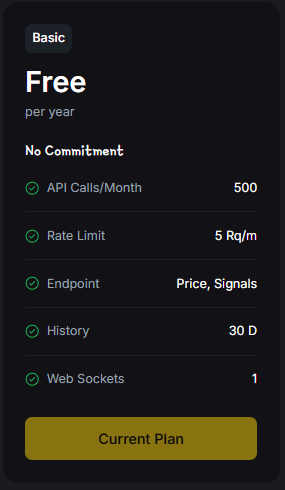
  • 30 Days of History – Enough to prototype backtests and analytics features.

Unlike many free crypto APIs, Token Metrics API provides both price data and intelligence, making it ideal for developers who want more than surface-level metrics.

Comparing Free Crypto APIs: Strengths & Trade-offs

  • CoinGecko & CoinMarketCap


    • Pros: Huge token coverage, great for charts and tickers.

    • Cons: Limited historical and no predictive analytics.

  • CryptoCompare


    • Pros: Rich historical tick-level data, good for backtesting.

    • Cons: Free tier limits depth and call volume.

  • Glassnode


    • Pros: Strong on-chain insights.

    • Cons: Many advanced datasets require paid access.

  • Alchemy & Infura


    • Pros: Node-level blockchain access for dApp builders.

    • Cons: Not designed for trading or analytics—raw blockchain data only.

  • Token Metrics


    • Pros: Real-time prices, AI signals, and on-chain analytics in one free tier.

    • Cons: Rate limits apply (upgrade available for higher throughput).

Popular Use Cases: From Bots to Dashboards

  • AI Crypto Trading Bots – Start testing automation using live prices and bull/bear signals.

  • Crypto Dashboards – Aggregate token ratings, prices, and trends for end users.

  • Research Tools – Run small-scale backtests with 30-day historical data.

  • Learning Projects – Ideal for students or developers exploring crypto APIs.

📌 Real-world example: Many developers use the Token Metrics free tier to prototype bots that later scale into production with paid plans.

Best Practices for Using Free Crypto APIs

  1. Start with Prototypes – Test multiple free APIs to compare reliability and latency.

  2. Track Rate Limits – Free tiers often throttle requests (e.g., 5 req/min at Token Metrics).

  3. Combine Data Sources – Use Token Metrics for signals + CoinGecko for broad coverage.

  4. Secure Keys – Treat even free API keys as sensitive credentials.

  5. Prepare to Upgrade – Build flexible code so you can switch tiers or providers easily.

Beyond Token Metrics: Other Free Resources Worth Knowing

  • DefiLlama API – Free coverage of DeFi protocols, yields, and TVL.

  • Dune Analytics – Query blockchain data with SQL for free.

  • TradingView Widgets – Embed charts directly into dashboards.

  • Santiment API – Free endpoints for social/sentiment analytics.

These can complement Token Metrics. For example, you could combine Token Metrics signals + DefiLlama DeFi data + TradingView charts into one unified dashboard.

How to Get Started With the Token Metrics Free API

  1. Sign Up for a free Token Metrics account.

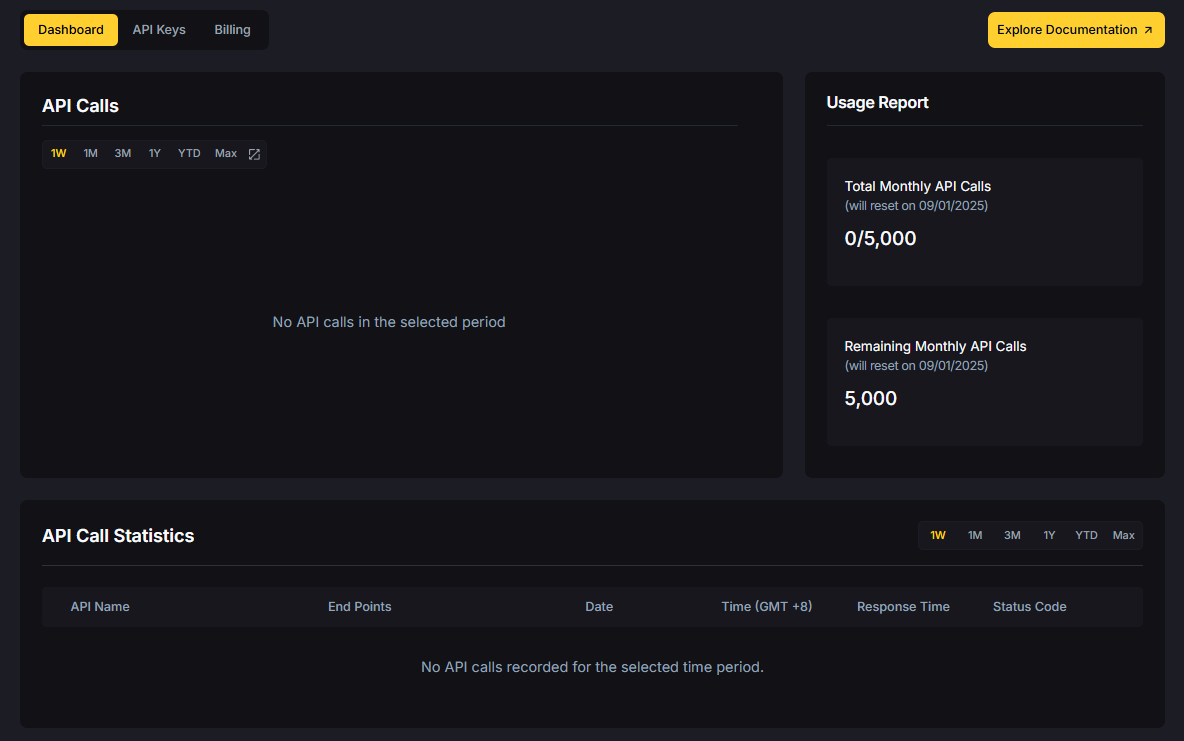
  2. Generate Your API Key instantly from your dashboard.

  3. Check the Docs for endpoints, examples, and code snippets.

  4. Prototype Your App with real-time prices and signals.

  5. Upgrade When Ready to unlock larger datasets and more endpoints.

👉 Grab Your Free Token Metrics API Key

FAQs About Free Crypto APIs

What can I access with Token Metrics Free API?
Live token prices, bull/bear trading signals, and 30 days of historical data.

Are free APIs reliable for production?
Not recommended—free tiers are best for prototypes. Paid tiers ensure reliability and scale.

What are the rate limits?
500 calls/month, 5 requests/minute, and 1 WebSocket connection.

Can I use the free API for trading bots?
Yes—ideal for prototyping. For production-level bots, upgrade for more throughput.

Scaling Beyond Free: Paid Plans & X.402

When your project outgrows free limits, Token Metrics offers flexible upgrades:

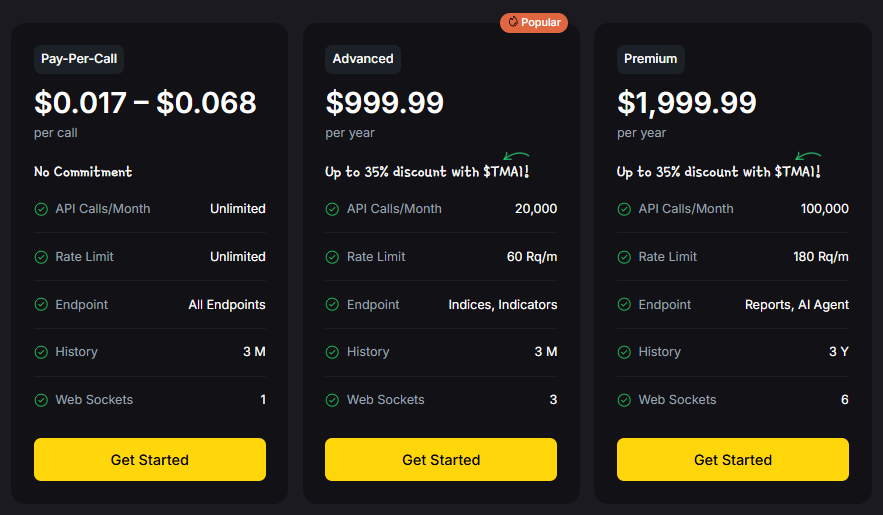
  • Pay-Per-Call (X.402) – As low as $0.017 per call, unlimited usage, no commitment.

  • Advanced Plan ($999.99/year) – 20,000 calls/month, indices & indicators, 3 WebSockets.

  • Premium Plan ($1,999.99/year) – 100,000 calls/month, AI agent + reports, 3 years of history.

With up to 35% off using TMAI tokens, scaling is cost-efficient.

📌 Why X.402 matters: Instead of committing upfront, you can grow gradually by paying per call—perfect for startups and side projects.

Build Smarter, Scale Easier

Free APIs help you start quickly and learn fast. Token Metrics gives you more than prices—it adds AI-powered signals and intelligence. Combine it with other free APIs, and you’ll have a toolkit that’s powerful enough for experimentation and flexible enough to scale into production.

👉 Create Your Free Token Metrics Account and Start Building

‍

Token Metrics API

Best Crypto API: Power Your Apps with Data, Signals, and AI

Sam Monac
6 min

What Makes a Crypto API the “Best”?

The best cryptocurrency API isn’t just about raw data. It’s about empowering your application to perform faster, smarter, and more reliably. A truly great crypto API balances:

  • Depth of Coverage – Spot, DeFi tokens, and on-chain metrics.

  • Speed – Real-time, low-latency updates that can handle market volatility.

  • Intelligence – Analytics and AI-driven signals that go beyond price feeds.

  • Scalability – Infrastructure that grows with your user base.

  • Reliability – High uptime and SLA-backed performance guarantees.

Whether you’re building a high-frequency crypto trading bot, a DeFi portfolio tracker, or a research platform, choosing the right API means aligning features with your mission.

Key Features to Look for in a Crypto API

Before selecting a crypto API, evaluate these criteria:

  • Real-Time & Historical Data – Do you get both sub-second updates and multi-year backtesting datasets?

  • On-Chain Analytics – Can you track wallet behavior, liquidity shifts, or whale flows?

  • AI-Powered Insights – Does the API offer predictive signals, ratings, or trend forecasts?

  • Ease of Integration – Look for clean docs, SDKs, and community examples.

  • Reliability & Uptime – Providers should publish incident histories and SLA commitments.

  • Pricing & Scalability – Free tiers for testing, plus paid plans that make sense as you scale.

  • Compliance & Security – Encrypted endpoints and strong authentication are a must.

📌 Tip for builders: Always start with multiple free crypto APIs and benchmark them in your stack before committing long term.

Comparing Leading Crypto APIs: Strengths & Weaknesses

  • CoinGecko & CoinMarketCap


    • Strengths: Huge token coverage, easy for price tickers and charts.

    • Weaknesses: Limited historical and on-chain analytics, slower refresh rates.

  • CryptoCompare


    • Strengths: Deep historical trade data, useful for backtesting.

    • Weaknesses: Less emphasis on predictive insights or AI.

  • Glassnode


    • Strengths: Advanced on-chain metrics (network health, wallet flows).

    • Weaknesses: Best for researchers, less suited to trading bots or dashboards.

  • Alchemy & Infura


    • Strengths: Node-level blockchain access, ideal for dApps and DeFi projects.

    • Weaknesses: Provide raw blockchain data, not trading analytics.

  • Token Metrics API


    • Strengths: Combines real-time prices, AI trading signals, ratings, portfolio analytics, and on-chain intelligence in one API.

    • Weaknesses: Free tier has rate limits (scalable through paid plans).

Why Token Metrics API Stands Out

Most crypto APIs specialize in one dimension (prices, exchange data, or on-chain metrics). Token Metrics unifies them all and adds AI intelligence on top.

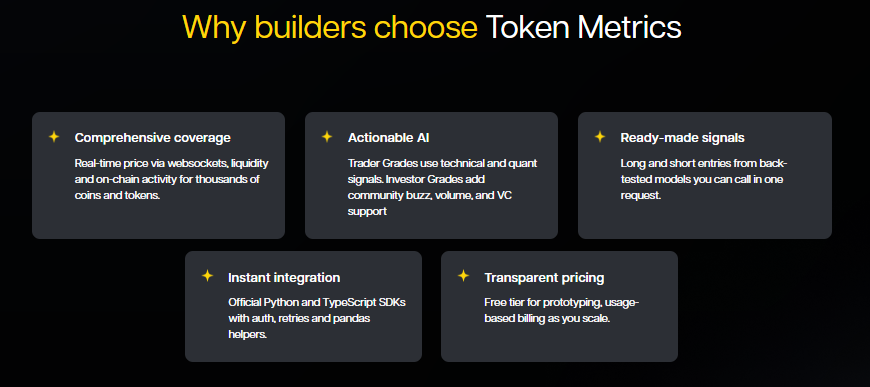
  • Comprehensive Coverage – Prices, historical datasets, indices, grades, and on-chain data.

  • AI Trading Signals – Unique bull/bear calls and predictive analytics unavailable in traditional APIs.

  • Portfolio Intelligence – Ratings and indices that give context to raw numbers.

  • Enterprise-Ready – Encrypted endpoints, authentication, and scalable infrastructure.

  • Developer Friendly – Clear docs, quick-start guides, and responsive support.

📌 Put simply: most crypto APIs give you data. Token Metrics gives you data + intelligence.

Use Cases: From AI Crypto Trading Bots to Research Dashboards

  • AI Trading Bots – Execute strategies using both real-time prices and predictive signals.

  • DeFi Dashboards – Aggregate wallet flows, liquidity data, and token ratings.

  • Crypto Research Tools – Combine historical OHLC data with Token Metrics grades.

  • AI Agents – Power AI apps with actionable signals, not just raw feeds.

  • Enterprise Analytics – Build institutional dashboards with indices and compliance-ready datasets.

Best Practices for Implementing a Crypto API

  1. Prototype Across Providers – Test CoinGecko, Token Metrics, and others in parallel.

  2. Abstract Your Integration – Use a middleware layer to make switching APIs easier.

  3. Secure Your Keys – Store credentials safely and rotate them regularly.

  4. Plan for Scale – Rate limits hit fast; design for bursts in traffic.

  5. Leverage AI-Enhanced APIs – This is where user expectations are heading.

📌 For production apps: always monitor crypto API latency and uptime with tools like Datadog or Grafana.

Beyond Token Metrics: Other Useful Resources

While Token Metrics API offers an all-in-one solution, developers can also explore other resources for specialized needs:

  • Dune Analytics – Great for custom SQL-based blockchain queries.

  • DefiLlama API – Free API focused on DeFi protocol yields and TVL.

  • Santiment API – Alternative on-chain and sentiment analytics.

  • TradingView – Charting and integration options for front-end visualizations.

📌 Strategy tip: many developers combine multiple APIs—Token Metrics for signals + CoinGecko for breadth + DefiLlama for yields—to cover all angles.

Frequently Asked Questions About Crypto APIs

Which crypto API is best overall?
If you want real-time data plus AI-powered insights, crypto api is used. Token Metrics Api is the strongest all-in-one option. For niche use cases, CoinGecko is good for prices, Glassnode for on-chain analytics.

Is Token Metrics API free?
Yes, the free tier is perfect for prototyping. Paid plans unlock faster throughput, more history, and advanced endpoints.

How is Token Metrics different from CoinGecko?
CoinGecko tracks prices broadly. Token Metrics layers AI signals, indices, and predictive analytics for trading and research.

Can I build a trading bot with Token Metrics API?
Yes—many developers use the low-latency price feeds and predictive signals to power automated strategies.

Scaling With Paid Plans and X.402

As your project grows, Token Metrics offers flexible upgrade paths:

  • Pay-Per-Call (X.402) – As low as $0.017 per call, no commitment. Unlimited calls, all endpoints, and 3 months of historical data.

  • Advanced Plan ($999.99/year) – 20,000 calls/month, access to indices & indicators, 3 WebSockets.

  • Premium Plan ($1,999.99/year) – 100,000 calls/month, all endpoints including AI Agent & Reports, 3 years of historical data, and 6 WebSockets.

With up to 35% discounts when paying in TMAI tokens, scaling is cost-efficient.

📌 Why X.402 matters: Instead of locking into an annual plan, you can scale gradually with pay-per-call pricing—perfect for startups and experimental apps.

Build Smarter, Scale Easier

The best crypto API doesn’t just serve data—it helps your app think, act, and adapt. With Token Metrics, you start free, learn fast, and scale seamlessly. Combine it with other specialized APIs when needed, and you’ll have a development stack that’s both powerful and future-proof.

👉 Grab Your Free Token Metrics API Key and Start Building

‍

Choose from Platinum, Gold, and Silver packages
Reach with 25–30% open rates and 0.5–1% CTR
Craft your own custom ad—from banners to tailored copy
Perfect for Crypto Exchanges, SaaS Tools, DeFi, and AI Products