Back to blog
Research

Why Is Web3 UX Still Poor Compared to Web2? Understanding the Challenges in 2025

Explore the core challenges of Web3 user experience, upcoming innovations, and how platforms like Token Metrics are paving the way for a more user-friendly blockchain ecosystem.
Token Metrics Team
12
Want Smarter Crypto Picks—Free?
See unbiased Token Metrics Ratings for BTC, ETH, and top alts.
Thank you! Your submission has been received!
Oops! Something went wrong while submitting the form.
 No credit card | 1-click unsubscribe

Web3 promises to revolutionize the internet by decentralizing control, empowering users with data ownership, and eliminating middlemen. The technology offers improved security, higher user autonomy, and innovative ways to interact with digital assets. With the Web3 market value expected to reach $81.5 billion by 2030, the potential seems limitless. Yet anyone who’s interacted with blockchain products knows the uncomfortable truth: Web3 user experience often feels more like punishment than promise. From nerve-wracking first crypto transactions to confusing wallet popups and sudden unexplained fees, Web3 products still have a long way to go before achieving mainstream adoption. If you ask anyone in Web3 what the biggest hurdle for mass adoption is, UX is more than likely to be the answer.

This comprehensive guide explores why Web3 UX remains significantly inferior to Web2 experiences in 2025, examining the core challenges, their implications, and how platforms like Token Metrics are bridging the gap between blockchain complexity and user-friendly crypto investing.

The Fundamental UX Gap: Web2 vs Web3

To understand Web3's UX challenges, we must first recognize what users expect based on decades of Web2 evolution. Web2, the "read-write" web that started in 2004, enhanced internet engagement through user-generated content, social media platforms, and cloud-based services with intuitive interfaces that billions use daily without thought.

Web2 applications provide seamless experiences: one-click logins via Google or Facebook, instant account recovery through email, predictable transaction costs, and familiar interaction patterns across platforms. Users have become accustomed to frictionless digital experiences that just work.

Web3, by contrast, introduces entirely new paradigms requiring users to manage cryptographic wallets, understand blockchain concepts, navigate multiple networks, pay variable gas fees, and take full custody of their assets. This represents a fundamental departure from familiar patterns, creating immediate friction.

Core Challenges Plaguing Web3 UX

  1. Complex Onboarding and Wallet Setup
  2. The first interaction with most decentralized applications asks users to "Connect Wallet." If you don't have MetaMask or another compatible wallet, you're stuck before even beginning. This creates an enormous barrier to entry where Web2 simply asks for an email address.

    Setting up a Web3 wallet requires understanding seed phrases—12 to 24 random words that serve as the master key to all assets. Users must write these down, store them securely, and never lose them, as there's no "forgot password" option. One mistake means permanent loss of funds.

    Most DeFi platforms and crypto wallets nowadays still have cumbersome and confusing interfaces for wallet creation and management. The registration process, which in Web2 takes seconds through social login options, becomes a multi-step educational journey in Web3.

  3. Technical Jargon and Blockchain Complexity
  4. Most challenges in UX/UI design for blockchain stem from lack of understanding of the technology among new users, designers, and industry leaders. Crypto jargon and complex concepts of the decentralized web make it difficult to grasp product value and master new ways to manage funds.

    Getting typical users to understand complicated blockchain ideas represents one of the main design challenges. Concepts like wallets, gas fees, smart contracts, and private keys must be streamlined without compromising security or usefulness—a delicate balance few projects achieve successfully.

    The blockchain itself is a complex theory requiring significant learning to fully understand. Web3 tries converting this specialized domain knowledge into generalist applications where novices should complete tasks successfully. When blockchain products first started being developed, most were created by experts for experts, resulting in products with extreme pain points, accessibility problems, and complex user flows.

  5. Multi-Chain Fragmentation and Network Switching
  6. Another common headache in Web3 is managing assets and applications across multiple blockchains. Today, it's not uncommon for users to interact with Ethereum, Polygon, Solana, or several Layer 2 solutions—all in a single session.

    Unfortunately, most products require users to manually switch networks in wallets, manually add new networks, or rely on separate bridges to transfer assets. This creates fragmented and confusing experiences where users must understand which network each asset lives on and how to move between them.

    Making users distinguish between different networks creates unnecessary cognitive burden. In Web2, users never think about which server hosts their data—it just works. Web3 forces constant network awareness, breaking the illusion of seamless interaction.

  7. Unpredictable and Confusing Gas Fees
  8. Transaction costs in Web3 are variable, unpredictable, and often shockingly expensive. Users encounter sudden, unexplained fees that can range from cents to hundreds of dollars depending on network congestion. There's no way to know costs precisely before initiating transactions, creating anxiety and hesitation.

    Web3 experiences generally run on public chains, leading to scalability problems as multiple parties make throughput requests. The more transactions that occur, the higher gas fees become—an unsustainable model as more users adopt applications.

    Users shouldn't have to worry about paying high gas fees as transaction costs. Web2 transactions happen at predictable costs or are free to users, with businesses absorbing payment processing fees. Web3's variable cost structure creates friction at every transaction.

  9. Irreversible Transactions and Error Consequences
  10. In Web2, mistakes are forgivable. Sent money to the wrong person? Contact support. Made a typo? Edit or cancel. Web3 offers no such mercy. Blockchain's immutability means transactions are permanent—send crypto to the wrong address and it's gone forever.

    This creates enormous anxiety around every action. Users must triple-check addresses (long hexadecimal strings impossible to memorize), verify transaction details, and understand that one mistake could cost thousands. The nerve-wracking experience of making first crypto transactions drives many users away permanently.

  11. Lack of Customer Support and Recourse
  12. Web2 platforms offer customer service: live chat, email support, phone numbers, and dispute resolution processes. Web3's decentralized nature eliminates these safety nets. There's no one to call when things go wrong, no company to reverse fraudulent transactions, no support ticket system to resolve issues.

    This absence of recourse amplifies fear and reduces trust. Users accustomed to consumer protections find Web3's "code is law" philosophy terrifying rather than empowering, especially when their money is at stake.

  13. Poor Error Handling and Feedback
  14. Web3 applications often provide cryptic error messages that technical users struggle to understand, let alone mainstream audiences. "Transaction failed" without explanation, "insufficient gas" without context, or blockchain-specific error codes mean nothing to average users.

    Good UX requires clear, actionable feedback. Web2 applications excel at this—telling users exactly what went wrong and how to fix it. Web3 frequently leaves users confused, frustrated, and unable to progress.

  15. Inconsistent Design Patterns and Standards
  16. Crypto designs are easily recognizable by dark backgrounds, pixel art, and Web3 color palettes. But when hundreds of products have the same mysterious look, standing out while maintaining blockchain identity becomes challenging.

    More problematically, there are no established UX patterns for Web3 interactions. Unlike Web2, where conventions like hamburger menus, shopping carts, and navigation patterns are universal, Web3 reinvents wheels constantly. Every application handles wallet connections, transaction confirmations, and network switching differently, forcing users to relearn basic interactions repeatedly.

  17. Developer-Driven Rather Than User-Centric Design
  18. The problem with most DeFi startups and Web3 applications is that they're fundamentally developer-driven rather than consumer-friendly. When blockchain products first launched, they were created by technical experts who didn't invest effort in user experience and usability.

    This technical-first approach persists today. Products prioritize blockchain purity, decentralization orthodoxy, and feature completeness over simplicity and accessibility. The result: powerful tools that only experts can use, excluding the masses these technologies purportedly serve.

  19. Privacy Concerns in User Research
  20. The Web3 revolution caught UI/UX designers by surprise. The Web3 community values privacy and anonymity, making traditional user research challenging. How do you design for someone you don't know and who deliberately stays anonymous?

    Researching without compromising user privacy becomes complex, yet dedicating time to deep user exploration remains essential for building products that resonate with actual needs rather than developer assumptions.

Why These Challenges Persist in 2025

Despite years of development and billions in funding, Web3 UX remains problematic for several structural reasons:

  • Technical Constraints: Blockchain's decentralized architecture inherently creates friction. Distributed consensus, cryptographic security, and immutability—the features making Web3 valuable—also make it complex.
  • Rapid Evolution: Due to rapid progress in Web3 technology, UX designers face unique challenges building interfaces that can adapt to new standards, protocols, and developments without complete redesigns. They must plan for future innovations while maintaining consistent experiences.
  • Limited UX Talent: Many UX designers still aren't into Web3, making it hard to understand and convey the value of innovative crypto products. The talent gap between Web2 UX expertise and Web3 understanding creates suboptimal design outcomes.
  • Economic Incentives: Early Web3 projects targeted crypto-native users who tolerated poor UX for technology benefits. Building for mainstream users requires different priorities and investments that many projects defer.

The Path Forward: Solutions Emerging in 2025

Despite challenges, innovative solutions are emerging to bridge the Web3 UX gap:

  • Account Abstraction and Smart Wallets: Modern crypto wallets embrace account abstraction enabling social recovery (using trusted contacts to restore access), seedless wallet creation via Multi-Party Computation, and biometric logins. These features make self-custody accessible without sacrificing security.
  • Email-Based Onboarding: Forward-looking approaches use email address credentials tied to Web3 wallets. Companies like Magic and Web3Auth create non-custodial wallets behind familiar email login interfaces using multi-party compute techniques, removing seed phrases from user experiences entirely.
  • Gasless Transactions: Some platforms absorb transaction costs or implement Layer 2 solutions dramatically reducing fees, creating predictable cost structures similar to Web2.
  • Unified Interfaces: Progressive platforms abstract blockchain complexity, presenting familiar Web2-like experiences while handling Web3 mechanics behind the scenes. Users interact through recognizable patterns without needing to understand underlying technology.

Discover Crypto Gems with Token Metrics AI

Token Metrics uses AI-powered analysis to help you uncover profitable opportunities in the crypto market. Get Started For Free

Bridging Complexity with User-Friendly Analytics

While many Web3 UX challenges persist, platforms like Token Metrics demonstrate that sophisticated blockchain functionality can coexist with excellent user experience. Token Metrics has established itself as a leading crypto trading and analytics platform by prioritizing usability without sacrificing power.

Intuitive Interface for Complex Analysis

Token Metrics provides personalized crypto research and predictions powered by AI through interfaces that feel familiar to anyone who's used financial applications. Rather than forcing users to understand blockchain intricacies, Token Metrics abstracts complexity while delivering actionable insights.

The platform assigns each cryptocurrency both Trader Grade and Investor Grade scores—simple metrics that encapsulate complex analysis including code quality, security audits, development activity, and market dynamics. Users get sophisticated intelligence without needing blockchain expertise.

Eliminating Technical Barriers

  • No Wallet Required for Research: Users can access powerful analytics without connecting wallets, eliminating the primary barrier to entry plaguing most DeFi applications.
  • Clear, Actionable Information: Instead of cryptic blockchain data, Token Metrics presents human-readable insights with clear recommendations. Users understand what actions to take without decoding technical jargon.
  • Predictable Experience: The platform maintains consistent interaction patterns familiar to anyone who's used trading or analytics tools, applying Jakob's Law—users have same expectations visiting similar sites, reducing learning strain.

Real-Time Alerts Without Complexity

Token Metrics monitors thousands of cryptocurrencies continuously, providing real-time alerts via email, SMS, or messaging apps about significant developments. Users stay informed without monitoring blockchain explorers, understanding gas prices, or navigating complex interfaces. This separation between sophisticated monitoring and simple notification demonstrates how Web3 functionality can deliver value through Web2-familiar channels.

Integrated Trading Experience

Token Metrics launched integrated trading in 2025, transforming the platform into an end-to-end solution where users analyze opportunities and execute trades without leaving the ecosystem. This unified experience eliminates the multi-platform juggling typical of Web3 investing. The seamless connection between analytics and execution showcases how thoughtful UX design bridges blockchain capabilities with user expectations, proving that Web3 doesn't require sacrificing usability.

Educational Without Overwhelming

Token Metrics provides educational resources helping users understand crypto markets without forcing deep technical knowledge. The platform demystifies complex topics through accessible explanations, gradually building user confidence and competence. This approach recognizes that mainstream adoption requires meeting users where they are—not demanding they become blockchain experts before participating.

The Future of Web3 UX

The ultimate success of Web3 hinges on user experience. No matter how revolutionary the technology, it will remain niche if everyday people find it too confusing, intimidating, or frustrating. Gaming, FinTech, digital identity, social media, and publishing will likely become Web3-enabled within the next 5 to 10 years—but only if UX improves dramatically.

UX as Competitive Advantage: Companies embracing UX early see fewer usability issues, higher retention, and more engaged users. UX-driven companies continually test assumptions, prototype features, and prioritize user-centric metrics like ease-of-use, task completion rates, and satisfaction—core measures of Web3 product success.

Design as Education: Highly comprehensive Web3 design helps educate newcomers, deliver effortless experiences, and build trust in technology. Design becomes the bridge between innovation and adoption.

Convergence with Web2 Patterns: Successful Web3 applications increasingly adopt familiar Web2 patterns while maintaining decentralized benefits underneath. This convergence represents the path to mass adoption—making blockchain invisible to end users who benefit from its properties without confronting its complexity.

Conclusion: From Barrier to Bridge

Web3 UX remains significantly inferior to Web2 in 2025 due to fundamental challenges: complex onboarding, technical jargon, multi-chain fragmentation, unpredictable fees, irreversible errors, lack of support, poor feedback, inconsistent patterns, developer-centric design, and constrained user research. These aren't superficial problems solvable through better visual design—they stem from blockchain's architectural realities and the ecosystem's technical origins. However, they're also not insurmountable. Innovative solutions like account abstraction, email-based onboarding, gasless transactions, and unified interfaces are emerging.

Platforms like Token Metrics demonstrate that Web3 functionality can deliver through Web2-familiar experiences. By prioritizing user needs over technical purity, abstracting complexity without sacrificing capability, and maintaining intuitive interfaces, Token Metrics shows the path forward for the entire ecosystem.

For Web3 to achieve its transformative potential, designers and developers must embrace user-centric principles, continuously adapting to users' needs rather than forcing users to adapt to technology. The future belongs to platforms that make blockchain invisible—where users experience benefits without confronting complexity. As we progress through 2025, the gap between Web2 and Web3 UX will narrow, driven by competition for mainstream users, maturing design standards, and recognition that accessibility determines success. The question isn't whether Web3 UX will improve—it's whether improvements arrive fast enough to capture the massive opportunity awaiting blockchain technology.

For investors navigating this evolving landscape, leveraging platforms like Token Metrics that prioritize usability alongside sophistication provides a glimpse of Web3's user-friendly future—where powerful blockchain capabilities enhance lives without requiring technical expertise, patience, or tolerance for poor design.

Build Smarter Crypto Apps &
AI Agents in Minutes, Not Months
Real-time prices, trading signals, and on-chain insights all from one powerful API.
Grab a Free API Key
About Token Metrics
Token Metrics: AI-powered crypto research and ratings platform. We help investors make smarter decisions with unbiased Token Metrics Ratings, on-chain analytics, and editor-curated “Top 10” guides. Our platform distills thousands of data points into clear scores, trends, and alerts you can act on.
30 Employees
analysts, data scientists, and crypto engineers
Daily Briefings
concise market insights and “Top Picks”
Transparent & Compliant
Sponsored ≠ Ratings; research remains independent
Want Smarter Crypto Picks—Free?
See unbiased Token Metrics Ratings for BTC, ETH, and top alts.
Thank you! Your submission has been received!
Oops! Something went wrong while submitting the form.
 No credit card | 1-click unsubscribe
Token Metrics Team
Token Metrics Team

Recent Posts

Research

Tron Price Prediction 2026: Low-Cost Blockchain Bull Market Analysis

Token Metrics Team
6 min read

Why 2026 Looks Bullish for Tron Price Prediction: Market Context

The crypto market is shifting toward a broadly bullish regime into 2026 as liquidity improves and risk appetite normalizes.

Regulatory clarity across major regions is reshaping the classic four-year cycle, flows can arrive earlier and persist longer. Institutional access keeps expanding through ETFs and qualified custody, while L2 scaling and real-world integrations broaden utility. Infrastructure maturity lowers frictions for capital, which supports deeper order books and more persistent participation.

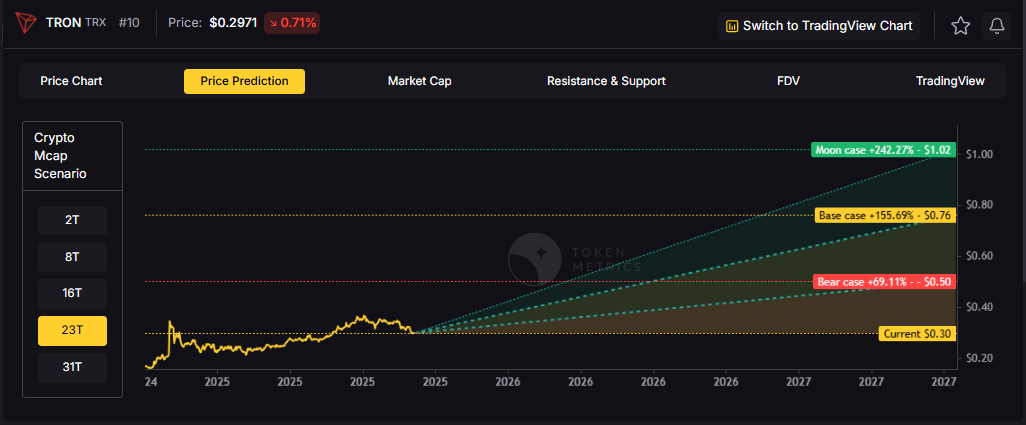
This bullish backdrop frames our Tron price prediction scenario work for TRX. The bands below map potential outcomes to different total crypto market sizes, providing comprehensive price prediction analysis for investors navigating the stablecoin transfer and payments-focused blockchain space.

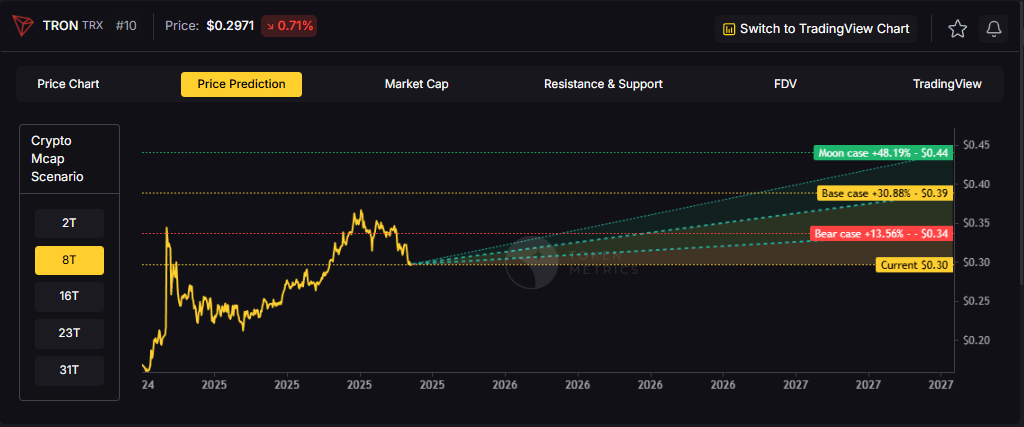
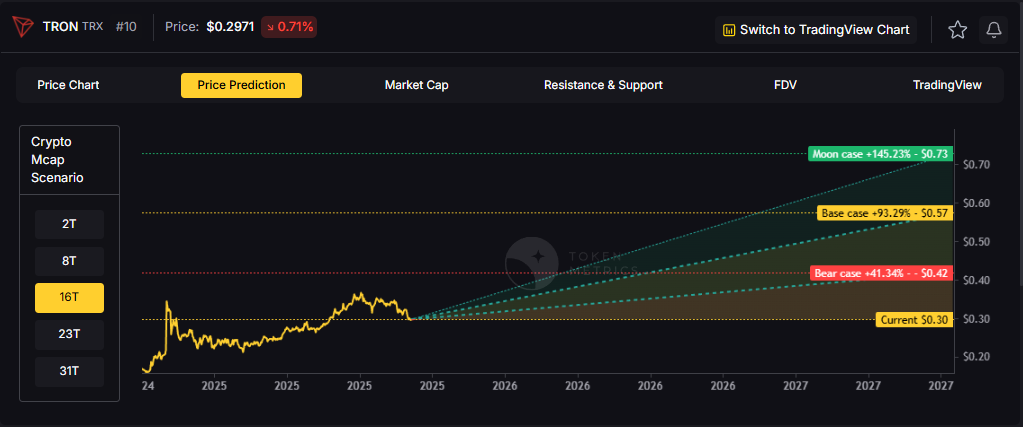
Current price: $0.2971.

How to Read This TRX Price Prediction

Each band blends cycle analogues and market-cap share math with TA guardrails. Base assumes steady adoption and neutral or positive macro. Moon layers in a liquidity boom. Bear assumes muted flows and tighter liquidity.

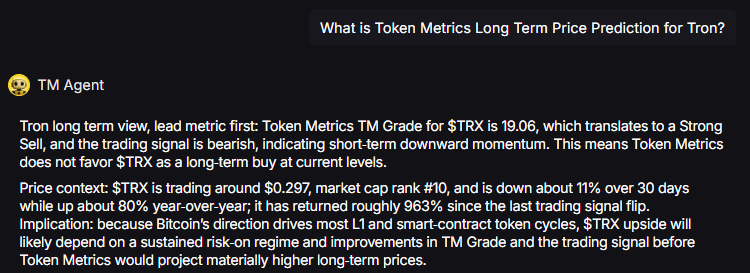
TM Agent baseline: Token Metrics TM Grade for $TRX is 19.06, which translates to a Strong Sell, and the trading signal is bearish, indicating short-term downward momentum. Price context: $TRX is trading around $0.297, market cap rank #10, and is down about 11% over 30 days while up about 80% year-over-year, it has returned roughly 963% since the last trading signal flip. Despite strong historical returns, current price prediction models reflect caution.

Live details: Tron Token Details → https://app.tokenmetrics.com/en/tron 

Buy TRX: https://www.mexc.com/acquisition/custom-sign-up?shareCode=mexc-2djd4 

Key Takeaways: Tron Price Prediction Summary

  • Scenario driven: Price prediction outcomes hinge on total crypto market cap; higher liquidity and adoption lift the bands
  • TM Agent gist: Bearish near term in price prediction models; upside depends on sustained risk-on regime and improvements in TM Grade and trading signal
  • Current rating: Strong Sell (19.06) despite bullish 2026 macro backdrop and 80% YoY gains
  • Stablecoin focus: TRX benefits from USDT transfer volume on Tron network
  • $1 target: Achievable in 23T+ moon scenarios per price prediction framework
  • Education only, not financial advice

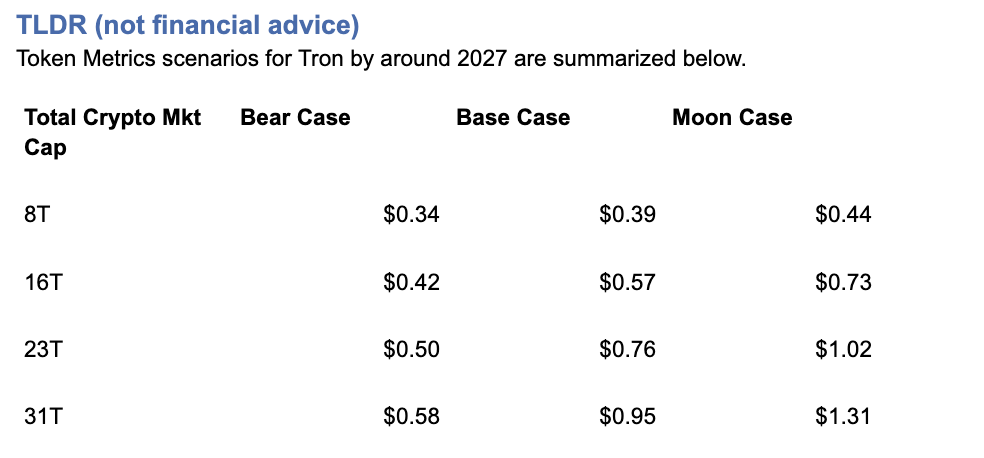
Tron Price Prediction Scenario Analysis

Token Metrics price prediction scenarios span four market cap tiers, each representing different levels of crypto market maturity and liquidity:

8T Market Cap - TRX Price Prediction:

At an 8 trillion dollar total crypto market cap, our TRX price prediction framework projects specific targets in bear, base, and bullish scenarios. The 8T tier reflects conservative market conditions with steady stablecoin transfer adoption.

 16T Market Cap - TRX Price Prediction:

Doubling the market to 16 trillion expands the TRX price prediction range significantly, reflecting increased institutional stablecoin usage and payments adoption that benefit Tron's high-throughput, low-cost infrastructure.

 23T Market Cap - TRX Price Prediction:

At 23 trillion total crypto market cap, the price prediction scenarios show substantial upside potential, with the moon case projecting $1.02—achieving the psychologically important $1.00 milestone for TRX holders.

 Each tier in our price prediction framework assumes progressively stronger market conditions, with particular emphasis on stablecoin transfer volume and payments use cases that uniquely position Tron in the blockchain ecosystem.

Why Consider the Indices with Top-100 Exposure

Diversification matters. Tron is compelling, yet concentrated bets can be volatile—especially when price predictions carry Strong Sell ratings despite bullish macro conditions. Token Metrics Indices hold TRX alongside the top one hundred tokens for broad exposure to leaders and emerging winners.

Our backtests indicate that owning the full market with diversified indices has historically outperformed both the total market and Bitcoin in many regimes due to diversification and rotation benefits, reducing single-asset risk.

Get early access: https://docs.google.com/forms/d/1AnJr8hn51ita6654sRGiiW1K6sE10F1JX-plqTUssXk/preview 

If your editor supports embeds, place a form embed here. Otherwise, include the link above as a button labeled Join Indices Early Access.

What Is Tron?

Tron is a smart-contract blockchain focused on low-cost, high-throughput transactions and cross-border settlement. The network supports token issuance and a broad set of dApps, with an emphasis on stablecoin transfer volume and payments—critical factors that influence TRX price predictions.

TRX is the native asset that powers fees and staking for validators and delegators within the network. Developers and enterprises use the chain for predictable costs and fast finality, which supports consumer-facing use cases. Tron has become a dominant network for USDT (Tether) transfers, creating organic demand for TRX that impacts long-term price prediction trajectories.

Catalysts That Skew TRX Price Predictions Bullish

  • Institutional and retail access expands with ETFs, listings, and integrations
  • Macro tailwinds from lower real rates and improving liquidity expected in 2026
  • Product or roadmap milestones such as upgrades, scaling, or partnerships
  • Growing USDT stablecoin transfer volume on Tron network
  • Increased cross-border payment adoption and remittance use cases
  • Continued low-fee competitive advantage versus Ethereum
  • Enterprise blockchain partnerships leveraging Tron's throughput

Risks That Skew TRX Price Predictions Bearish

  • Macro risk-off from tightening or liquidity shocks
  • Regulatory actions targeting Tron, Justin Sun, or infrastructure outages
  • Current Strong Sell rating (19.06) indicating significant fundamental concerns
  • Concentration risk in validator economics and potential centralization issues
  • Competitive displacement from faster, lower-cost L1s and L2 solutions
  • Regulatory scrutiny on stablecoin operations affecting Tether/USDT
  • Reputational concerns related to founder Justin Sun
  • Competition from Solana, BNB Chain for stablecoin transfers

Special Offer — Token Metrics Advanced Plan with 20% Off

Unlock platform-wide intelligence on every major crypto asset. Use code ADVANCED20 at checkout for twenty percent off.

  • AI powered ratings on thousands of tokens for traders and investors
  • Interactive TM AI Agent to ask any crypto question
  • Indices explorer to surface promising tokens and diversified baskets
  • Signal dashboards, backtests, and historical performance views
  • Watchlists, alerts, and portfolio tools to track what matters
  • Early feature access and enhanced research coverage

Start with Advanced today → https://www.tokenmetrics.com/token-metrics-pricing 

Tron Price Prediction FAQs

Can TRX reach $1?

Yes. The 23T moon case in our price prediction framework shows $1.02 and the 31T moon case shows $1.31, which imply a path to $1 in higher-liquidity regimes. From current price of $0.2971, this represents approximately 240%+ gains. However, achieving this requires the bullish 2026 thesis materializing with strong stablecoin adoption and overcoming the current Strong Sell rating (19.06). Not financial advice.

Is TRX a good long-term investment?

TRX presents a complex investment case with a Strong Sell rating (19.06) despite impressive historical returns (80% YoY, 963% since last signal flip). Our price prediction models show potential upside to $1.02-$1.31 in bullish scenarios, but outcome depends heavily on adoption, liquidity regime, competition, regulatory environment, and supply dynamics. The stablecoin transfer use case provides organic demand, but fundamental concerns reflected in the Strong Sell rating suggest caution. Diversify and size positions responsibly. Not financial advice.

What is the Tron price prediction for 2026-2027?

Our comprehensive TRX price prediction framework for 2026-2027 suggests Tron could reach $1.02 in the 23T moon scenario and $1.31 in the 31T moon scenario, representing significant upside from current $0.2971 price. Base case scenarios across market cap tiers provide more conservative targets. Despite the bullish 2026 macro thesis and strong stablecoin utility, the Strong Sell rating (19.06) and bearish trading signal indicate current fundamental concerns. Not financial advice.

Should I buy TRX now or wait?

TRX has a Strong Sell rating (19.06) indicating Token Metrics does not endorse Tron at current levels, despite bullish 2026 macro conditions and 80% YoY gains. Current price of $0.2971 is down 11% over 30 days with bearish trading signals. However, historical outperformance (963% since last signal flip) and stablecoin transfer utility create a paradox. If you believe in the 2026 bull thesis and Tron's stablecoin dominance, dollar-cost averaging may reduce timing risk. Consider diversified exposure through indices. Not financial advice.

Why does TRX have a Strong Sell rating despite 80% YoY gains?

TRX receives a Strong Sell rating (19.06) based on current fundamental analysis, technical indicators, and valuation metrics—despite impressive historical performance (80% YoY, 963% since last signal flip). Ratings reflect forward-looking risk assessment including regulatory concerns, centralization issues, reputational factors, and competitive threats. Our price prediction framework shows potential upside in favorable scenarios, but the Strong Sell rating suggests significant risks that could prevent achieving bullish targets. Past performance doesn't guarantee future results. Not financial advice.

How does TRX benefit from stablecoin transfers?

Tron has become the dominant network for USDT (Tether) transfers due to extremely low fees and fast settlement. This creates organic demand for TRX as users need the native token for transaction fees. Our price prediction models assume continued growth in stablecoin transfer volume, which supports base case scenarios. The 23T and 31T price predictions of $1.02-$1.31 factor in sustained stablecoin dominance. However, competition from other low-cost chains and regulatory scrutiny on Tether operations represent risks. Not financial advice.

Can TRX reach $2?

TRX reaching $2 would exceed our current price prediction models' highest scenario of $1.31 (31T moon case). From current $0.2971, $2 represents approximately 570%+ gains. This would require extraordinary market conditions beyond the 31T total crypto market cap tier, exceptional stablecoin adoption acceleration, and overcoming significant fundamental concerns reflected in the Strong Sell rating (19.06). While possible in extreme bull scenarios, $2 appears beyond rational price prediction frameworks. Not financial advice.

What are the biggest risks to TRX price predictions?

Key risks that could derail Tron price predictions include: Strong Sell rating (19.06) indicating severe fundamental concerns, regulatory actions targeting Tron network or founder Justin Sun, centralization concerns in validator economics, regulatory scrutiny on Tether/USDT operations affecting transfer volumes, competitive displacement from Solana/BNB Chain for stablecoin transfers, reputational issues, macro liquidity shocks ending 2026 bull thesis, and potential security vulnerabilities. Despite strong utility, these risks warrant careful position sizing. Not financial advice.

How does Tron compare to other payment blockchain price predictions?

Tron's price prediction framework suggests $0.30-$1.31 across scenarios, positioning it as a specialized payments and stablecoin transfer network. Compared to Ethereum's dominance and Solana's speed, Tron differentiates through extremely low fees and USDT transfer volume leadership. However, the Strong Sell rating (19.06) reflects concerns that this niche may not sustain long-term value versus more decentralized, diversified platforms. Tron trades at rank #10, indicating established but controversial market position. Not financial advice.

Will TRX benefit from the 2026 bull market?

Yes. Our price prediction scenarios are specifically framed around the bullish 2026 thesis, where improving liquidity, institutional participation, and stablecoin adoption create favorable conditions. TRX's low-fee infrastructure and USDT dominance position it to capture bull market momentum in payments use cases. However, the Strong Sell rating (19.06) and bearish momentum suggest TRX may underperform versus fundamentally stronger tokens. Muted base case projections reflect this tension between macro tailwinds and micro concerns. Not financial advice.

Is the $1 target realistic for TRX?

The $1 target appears achievable in our price prediction framework's 23T moon case ($1.02) and 31T scenarios ($1.31). From current $0.2971, this represents approximately 240%+ gains requiring sustained stablecoin adoption, bullish macro conditions materializing, and overcoming Strong Sell rating concerns. Historical volatility (963% returns since last signal flip) demonstrates TRX's ability to deliver explosive gains, but fundamental weaknesses create significant uncertainty. Possible but high-risk—manage expectations accordingly. Not financial advice.

What needs to happen for TRX to reach price prediction targets?

For TRX to reach our price prediction targets of $1.02-$1.31, several catalysts must materialize: (1) continued dominance in USDT stablecoin transfers, (2) bullish 2026 macro conditions with improving liquidity, (3) addressing regulatory concerns around Tron and Justin Sun, (4) improving TM Grade from Strong Sell (19.06) territory, (5) institutional adoption of Tron for cross-border payments, (6) successful competition against Solana/BNB Chain, and (7) maintaining low-fee advantage as scaling solutions proliferate. The Strong Sell rating suggests these catalysts aren't currently materializing at required pace.

Next Steps

Track live grades and signals: Token Details → https://app.tokenmetrics.com/en/tron 

Join Indices Early Access: https://docs.google.com/forms/d/1AnJr8hn51ita6654sRGiiW1K6sE10F1JX-plqTUssXk/preview

Want exposure Buy TRX on MEXC → https://www.mexc.com/acquisition/custom-sign-up?shareCode=mexc-2djd4 

Disclosure

Educational purposes only, not financial advice. Crypto is volatile, do your own research and manage risk.

Why Use Token Metrics for Tron Price Predictions?

  • Transparent analysis: Honest Strong Sell ratings (19.06) even when historical returns are exceptional (963%)
  • Scenario-based modeling: Four market cap tiers for comprehensive price prediction analysis
  • Stablecoin specialization: Understanding Tron's unique position in USDT transfer ecosystem
  • Risk-adjusted approach: Balanced view of utility strengths versus fundamental concerns
  • Real-time signals: Trading signals and TM Grades updated regularly tracking 11% monthly decline
  • Diversification tools: Index solutions to spread payment blockchain risk
  • Comparative analysis: Analyze TRX against BNB, SOL, and 6,000+ tokens
Research

Maximize Your Crypto Returns: The Ultimate Guide to Building Wealth with Token Metrics AI Indices

Token Metrics Team
13 min read

The cryptocurrency market presents unprecedented wealth-building opportunities, but it also poses significant challenges.

With thousands of tokens competing for investor attention and market volatility that can erase gains overnight, success in crypto investing requires more than luck—it demands a strategic, data-driven approach.

Token Metrics AI Indices have emerged as a game-changing solution for investors seeking to capitalize on crypto's growth potential while managing risk effectively.

This comprehensive guide explores how to leverage these powerful tools to build, manage, and optimize your cryptocurrency portfolio for maximum returns in 2025 and beyond.

Understanding the AI Indices Investment Opportunity

The traditional approach to crypto investing involves countless hours of research, technical analysis, and constant market monitoring.

For most investors, this proves unsustainable.

Token Metrics solves this challenge by offering professionally managed, AI-driven index portfolios that automatically identify winning opportunities and rebalance based on real-time market conditions.

What makes Token Metrics indices unique is their foundation in machine learning technology.

The platform analyzes over 6,000 cryptocurrencies daily, processing more than 80 data points per asset including technical indicators, fundamental metrics, on-chain analytics, sentiment data, and exchange information.

This comprehensive evaluation far exceeds what individual investors can accomplish manually.

The indices employ sophisticated AI models including gradient boosting decision trees, recurrent neural networks, random forests, natural language processing algorithms, and anomaly detection frameworks.

These systems continuously learn from market patterns, adapt to changing conditions, and optimize portfolio allocations to maximize risk-adjusted returns.

Types of Token Metrics Indices: Finding Your Perfect Match

Token Metrics offers a diverse range of indices designed to serve different investment objectives, risk tolerances, and market outlooks.

Understanding these options is crucial for building an effective crypto portfolio.

Conservative Indices: Stability and Long-Term Growth

For investors prioritizing capital preservation and steady appreciation, conservative indices focus on established, fundamentally sound cryptocurrencies with proven track records.

These indices typically allocate heavily to Bitcoin and Ethereum while including select large-cap altcoins with strong fundamentals.

The Investor Grade Index exemplifies this approach, emphasizing projects with solid development teams, active communities, real-world adoption, and sustainable tokenomics.

This index is ideal for retirement accounts, long-term wealth building, and risk-averse investors seeking exposure to crypto without excessive volatility.

Balanced Indices: Growth with Measured Risk

Balanced indices strike a middle ground between stability and growth potential.

These portfolios combine major cryptocurrencies with promising mid-cap projects that demonstrate strong technical momentum and fundamental strength.

The platform's AI identifies tokens showing positive divergence across multiple indicators—rising trading volume, improving developer activity, growing social sentiment, and strengthening technical patterns.

Balanced indices typically rebalance weekly or bi-weekly, capturing emerging trends while maintaining core positions in established assets.

Aggressive Growth Indices: Maximum Upside Potential

For investors comfortable with higher volatility in pursuit of substantial returns, aggressive growth indices target smaller-cap tokens with explosive potential.

These portfolios leverage Token Metrics' Trader Grade system to identify assets with strong short-term momentum and technical breakout patterns.

Aggressive indices may include DeFi protocols gaining traction, Layer-1 blockchains with innovative technology, AI tokens benefiting from market narratives, and memecoins showing viral adoption patterns.

While risk is higher, the potential for 10x, 50x, or even 100x returns makes these indices attractive for portfolio allocation strategies that embrace calculated risk.

Sector-Specific Indices: Thematic Investing

Token Metrics offers specialized indices targeting specific cryptocurrency sectors, allowing investors to align portfolios with their market convictions and thematic beliefs.

• DeFi Index: Focuses on decentralized finance protocols including lending platforms, decentralized exchanges, yield aggregators, and synthetic asset platforms.
• Layer-1 Index: Concentrates on base-layer blockchains competing with Ethereum, including Solana, Avalanche, Cardano, Polkadot, and emerging ecosystems.
• AI and Machine Learning Index: Targets tokens at the intersection of artificial intelligence and blockchain technology.
• Memecoin Index: Contrary to traditional wisdom dismissing memecoins as purely speculative, Token Metrics recognizes that community-driven tokens can generate extraordinary returns.

This index uses AI to identify memecoins with genuine viral potential, active communities, and sustainable momentum before they become mainstream.

Building Your Token Metrics Index Portfolio: A Step-by-Step Framework

Success with Token Metrics indices requires more than simply choosing an index—it demands a comprehensive portfolio strategy tailored to your financial situation, goals, and risk tolerance.

Step 1: Assess Your Financial Profile

Begin by honestly evaluating your investment capacity, time horizon, and risk tolerance.

Ask yourself critical questions: How much capital can I allocate to crypto without compromising financial security? What is my investment timeline—months, years, or decades? How would I react emotionally to a 30% portfolio drawdown? What returns do I need to achieve my financial goals?

Your answers shape your portfolio construction.

Conservative investors with shorter timelines should emphasize stable indices, while younger investors with longer horizons can embrace more aggressive strategies.

Step 2: Determine Optimal Allocation Percentages

Financial advisors increasingly recommend including cryptocurrency in diversified portfolios, but the appropriate allocation varies significantly based on individual circumstances.

• Conservative Allocation (5-10% of portfolio): Suitable for investors approaching retirement or with low risk tolerance. Focus 80% on conservative indices, 15% on balanced indices, and 5% on sector-specific themes you understand deeply.
• Moderate Allocation (10-20% of portfolio): Appropriate for mid-career professionals building wealth. Allocate 50% to conservative indices, 30% to balanced indices, and 20% to aggressive growth or sector-specific indices.
• Aggressive Allocation (20-30%+ of portfolio): Reserved for younger investors with high risk tolerance and long time horizons. Consider 30% conservative indices for stability, 30% balanced indices for steady growth, and 40% split between aggressive growth and thematic sector indices.

Step 3: Implement Dollar-Cost Averaging

Rather than investing your entire allocation at once, implement a dollar-cost averaging strategy over 3-6 months.

This approach reduces timing risk and smooths out entry prices across market cycles.

For example, if allocating $10,000 to Token Metrics indices, invest $2,000 monthly over five months.

This strategy proves particularly valuable in volatile crypto markets where timing the perfect entry proves nearly impossible.

Step 4: Set Up Automated Rebalancing

Token Metrics indices automatically rebalance based on AI analysis, but you should also establish personal portfolio rebalancing rules.

Review your overall allocation quarterly and rebalance if any index deviates more than 10% from your target allocation.

If aggressive growth indices perform exceptionally well and grow from 20% to 35% of your crypto portfolio, take profits and rebalance back to your target allocation.

This disciplined approach ensures you systematically lock in gains and maintain appropriate risk levels.

Step 5: Monitor Performance and Adjust Strategy

While Token Metrics indices handle day-to-day portfolio management, you should conduct quarterly reviews assessing overall performance, comparing returns to benchmarks like Bitcoin and Ethereum, evaluating whether your risk tolerance has changed, and considering whether emerging market trends warrant allocation adjustments.

Use Token Metrics' comprehensive analytics to track performance metrics including total return, volatility, Sharpe ratio, maximum drawdown, and correlation to major cryptocurrencies.

These insights inform strategic decisions about continuing, increasing, or decreasing exposure to specific indices.

Get Started For Free

Advanced Strategies for Experienced Investors

Once comfortable with basic index investing, consider implementing advanced strategies to enhance returns and manage risk more effectively.

Tactical Overweighting

While maintaining core index allocations, temporarily overweight specific sectors experiencing favorable market conditions.

During periods of heightened interest in AI, increase allocation to the AI and Machine Learning Index by 5-10% at the expense of other sector indices.

Return to strategic allocation once the catalyst dissipates.

Combining Indices with Individual Tokens

Use Token Metrics indices for 70-80% of your crypto allocation while dedicating 20-30% to individual tokens identified through the platform's Moonshots feature.

This hybrid approach provides professional management while allowing you to pursue high-conviction opportunities.

Market Cycle Positioning

Adjust index allocations based on broader market cycles.

During bull markets, increase exposure to aggressive growth indices.

As conditions turn bearish, shift toward conservative indices with strong fundamentals.

Token Metrics' AI Indicator provides valuable signals for market positioning.


Risk Management: Protecting Your Capital

Even with sophisticated AI-driven indices, cryptocurrency investing carries substantial risks.

Implement robust risk management practices to protect your wealth.

Diversification Beyond Crypto

Never allocate so much to cryptocurrency that a market crash would devastate your financial position.

Most financial advisors recommend limiting crypto exposure to 5-30% of investment portfolios depending on age and risk tolerance.

Maintain substantial allocations to traditional assets—stocks, bonds, real estate—that provide diversification and stability.

Position Sizing and Security

Consider implementing portfolio-level stop-losses if your crypto allocation declines significantly from its peak.

Use hardware wallets or secure custody solutions for significant holdings.

Implement strong security practices including two-factor authentication and unique passwords.

Tax Optimization

Cryptocurrency taxation typically involves capital gains taxes on profits.

Consult tax professionals to optimize your strategy through tax-loss harvesting and strategic rebalancing timing.

Token Metrics' transaction tracking helps maintain accurate records for tax reporting.

The Competitive Edge: Why Token Metrics Outperforms

Several factors distinguish Token Metrics indices from alternatives and explain their consistent outperformance.

Token Metrics indices respond to market changes in real-time rather than waiting for scheduled monthly or quarterly rebalancing.

This responsiveness proves crucial in crypto markets where opportunities can appear and disappear rapidly.

The platform's AI evaluates dozens of factors simultaneously—technical patterns, fundamental strength, on-chain metrics, sentiment analysis, and exchange dynamics.

This comprehensive approach identifies tokens that traditional indices would miss.

The AI continuously learns from outcomes, improving predictive accuracy over time.

Models that underperform receive reduced weighting while successful approaches gain influence, creating an evolving system that adapts to changing market dynamics.

Token Metrics' extensive coverage of 6,000+ tokens provides exposure to emerging projects before they gain mainstream attention, positioning investors for maximum appreciation potential.

Real-World Success: Making Token Metrics Indices Work for You

To illustrate practical application, consider several investor profiles and optimal index strategies.

Profile 1: Conservative 55-Year-Old Preparing for Retirement

Total portfolio: $500,000
Crypto allocation: $25,000 (5%)

Strategy: $20,000 in Investor Grade Index (80%), $4,000 in Balanced Index (16%), $1,000 in DeFi Index (4%)

This conservative approach provides crypto exposure with minimal volatility, focusing on established assets likely to appreciate steadily without risking retirement security.

Profile 2: Moderate 35-Year-Old Building Wealth

Total portfolio: $150,000
Crypto allocation: $30,000 (20%)

Strategy: $12,000 in Investor Grade Index (40%), $9,000 in Balanced Index (30%), $6,000 in Layer-1 Index (20%), $3,000 in Aggressive Growth Index (10%)

This balanced approach captures crypto growth potential while maintaining stability through substantial conservative and balanced allocations.

Profile 3: Aggressive 25-Year-Old Maximizing Returns

Total portfolio: $50,000
Crypto allocation: $15,000 (30%)

Strategy: $4,500 in Investor Grade Index (30%), $3,000 in Balanced Index (20%), $4,500 in Aggressive Growth Index (30%), $3,000 in Memecoin Index (20%)

This aggressive strategy embraces volatility and maximum growth potential, appropriate for younger investors with decades to recover from potential downturns.

Getting Started: Your Action Plan

Ready to begin building wealth with Token Metrics indices?

Follow this action plan:

• Week 1-2: Sign up for Token Metrics' 7-day free trial and explore available indices, historical performance, and educational resources. Define your investment goals, risk tolerance, and allocation strategy using the frameworks outlined in this guide.
• Week 3-4: Open necessary exchange accounts and wallets. Fund accounts and begin implementing your strategy through dollar-cost averaging. Set up tracking systems and calendar reminders for quarterly reviews.
• Ongoing: Follow Token Metrics' index recommendations, execute rebalancing transactions as suggested, monitor performance quarterly, and adjust strategy as your financial situation evolves.

Conclusion: The Future of Crypto Wealth Creation

Cryptocurrency represents one of the most significant wealth-building opportunities in modern financial history, but capturing this potential requires sophisticated approaches that most individual investors cannot implement alone.

Token Metrics AI Indices democratize access to professional-grade investment strategies, leveraging cutting-edge machine learning, comprehensive market analysis, and real-time responsiveness to build winning portfolios.

Whether you're a conservative investor seeking measured exposure or an aggressive trader pursuing maximum returns, Token Metrics provides indices tailored to your specific needs.

The choice between random coin picking and strategic, AI-driven index investing is clear.

One approach relies on luck and guesswork; the other harnesses data, technology, and proven methodologies to systematically build wealth while managing risk.

Your journey to crypto investment success begins with a single decision: commit to a professional, strategic approach rather than speculative gambling.

Token Metrics provides the tools, insights, and management to transform crypto investing from a game of chance into a calculated path toward financial freedom.

Start your 7-day free trial today and discover how AI-powered indices can accelerate your wealth-building journey.

The future of finance is decentralized, intelligent, and accessible—make sure you're positioned to benefit.

Why Choose Token Metrics for AI-Powered Crypto Indices?

Token Metrics stands out as a leader in AI-driven crypto index solutions.

With over 6,000 tokens analyzed daily and indices tailored to every risk profile, the platform provides unparalleled analytics, real-time rebalancing, and comprehensive investor education.

Its commitment to innovation and transparency makes it a trusted partner for building your crypto investment strategy in today's fast-evolving landscape.

FAQ: How do Token Metrics indices work?

Token Metrics indices use advanced AI models to analyze technical, fundamental, on-chain, and sentiment data across thousands of cryptocurrencies.

They construct balanced portfolios that are automatically rebalanced in real-time to adapt to evolving market conditions and trends.

FAQ: What types of indices are available?

There are conservative, balanced, aggressive growth, and sector-specific indices including DeFi, Layer-1, AI, and memecoins.

Each index is designed for a different investment objective, risk tolerance, and market outlook.

FAQ: Is there a minimum investment required?

No mandatory minimum is outlined for using Token Metrics indices recommendations.

You can adapt your allocation based on your personal investment strategy, capacity, and goals.

FAQ: How often should I rebalance my portfolio?

Token Metrics indices are rebalanced automatically based on dynamic AI analysis, but it is recommended to review your overall crypto allocation at least quarterly to ensure alignment with your targets.

FAQ: Are Token Metrics indices secure?

Token Metrics provides analytics and index recommendations; investors maintain custody of their funds and should implement robust security practices such as hardware wallets and two-factor authentication.

FAQ: Does using Token Metrics indices guarantee profits?

No investing approach, including AI-driven indices, can guarantee profits.

The goal is to maximize risk-adjusted returns through advanced analytics and professional portfolio management, but losses remain possible due to the volatile nature of crypto markets.

Get Started For Free

Disclaimer

This article is for educational and informational purposes only.

It does not constitute financial, investment, or tax advice.

Cryptocurrency investing carries risk, and past performance does not guarantee future results. Always consult your own advisor before making investment decisions.

Research

AI-Powered Crypto Indices: Revolutionizing Digital Asset Investing with Token Metrics

Token Metrics Team
12 min read

The cryptocurrency market has evolved dramatically since Bitcoin's inception in 2009. With over 20,000 digital assets now available and a combined market capitalization exceeding $3 trillion as of 2025, navigating this complex ecosystem has become increasingly challenging for investors.

Traditional approaches to crypto investing often involve painstaking research, constant market monitoring, and the stress of picking individual tokens that may or may not succeed.

Enter crypto indices—a revolutionary approach that simplifies digital asset investing while providing diversification and professional management. Among the leaders in this space is Token Metrics, an AI-powered cryptocurrency research and analytics platform that has transformed how investors access and benefit from the crypto market through its innovative AI indices.

What Are Crypto Indices?

A cryptocurrency index is a curated portfolio of multiple digital assets grouped by strategy, market capitalization, theme, or other specific criteria. Similar to traditional stock market indices like the S&P 500, crypto indices track the performance of a basket of cryptocurrencies, allowing investors to gain broad market exposure without purchasing each token individually.

Crypto indices serve several critical functions in today's digital asset landscape. • They provide instant diversification across multiple tokens
• Reduce the risk associated with single-asset concentration
• Offer professional portfolio management and rebalancing
• Simplify the investment process for both novice and experienced investors
• Provide transparent performance tracking and reporting

The beauty of crypto indices lies in their ability to capture market movements while mitigating the extreme volatility often associated with individual cryptocurrencies.

Rather than betting on a single token, investors can participate in the growth of entire sectors or market segments.

Token Metrics: Pioneering AI-Powered Crypto Indices

Founded in 2018 and headquartered in Washington, D.C., Token Metrics has established itself as a leading AI-driven cryptocurrency research and analytics platform. The company serves a diverse customer base spanning from crypto fund managers to passive investors across more than 50 countries.

What sets Token Metrics apart is its sophisticated use of artificial intelligence and machine learning to build and manage crypto indices. The platform leverages advanced algorithms to analyze over 6,000 cryptocurrency projects daily, evaluating more than 80 quantitative and qualitative data points for each asset. This comprehensive analysis covers fundamental metrics, technical indicators, on-chain activity, tokenomics, sentiment data, and exchange information.

The Token Metrics AI Advantage

Token Metrics employs an ensemble of sophisticated machine learning models to power its indices, including:

• Gradient boosting decision trees for pattern recognition
• Recurrent neural networks for time-series predictions
• Random forests for robust classification
• Natural language processing for sentiment analysis
• Anomaly detection frameworks for risk assessment

These AI systems are continuously retrained with fresh data on a weekly basis, learning from past predictions, integrating feedback from trading outcomes, and adapting model weightings as market conditions evolve.

This dynamic approach ensures that Token Metrics indices remain responsive to rapidly changing market dynamics.

How Token Metrics Indices Work

Token Metrics indices are model portfolios built using machine learning technology that simplifies and democratizes quality crypto investing and trading. Unlike static index funds, Token Metrics indices offer real-time responsiveness and active management through AI.

The platform analyzes cryptocurrencies using both Trader Grades and Investor Grades. The Trader Grade identifies assets with strong short-term upside momentum, making it ideal for active traders looking to capitalize on near-term opportunities. The Investor Grade, on the other hand, evaluates assets based on fundamentals, code quality, and adoption metrics to identify strong long-term holdings suitable for HODLers and strategic investors.

Key Features of Token Metrics Indices

Real-Time Rebalancing

Unlike traditional indices that rebalance quarterly or monthly, Token Metrics indices can respond in real time to market changes. When sentiment shifts or volatility spikes, the AI can adjust holdings dynamically, reducing exposure to underperforming sectors while increasing allocation to high-potential areas.

Sector-Specific Strategies

Token Metrics offers indices tailored to specific cryptocurrency sectors including memecoins, Layer-1 blockchains, DeFi protocols, AI tokens, and thematic investments. This allows investors to align their portfolio with their conviction in particular market niches.

Multiple Investment Strategies

Whether you're a conservative long-term holder, an aggressive swing trader, or somewhere in between, Token Metrics provides indices designed for different risk tolerances and investment horizons. Each index has performed strongly through rigorous internal testing and real-world market conditions.

Transparent Performance Tracking

Each index provides clear investment guidance, showing all rebalancing transactions and enabling precise performance monitoring. This transparency allows investors to understand exactly how their portfolio is being managed and why specific decisions are made.

One-Click Diversification

With Token Metrics indices, building a winning crypto portfolio is just one click away. The platform eliminates the complexity of researching hundreds of tokens, determining optimal allocations, and executing trades across multiple exchanges.

Benefits of Investing Through Token Metrics Indices

Diversification and Risk Management

Crypto markets are notoriously volatile, with individual tokens capable of losing 50% or more of their value in days. By spreading investments across multiple carefully selected assets, Token Metrics indices dramatically reduce concentration risk. Research suggests that even a modest 1-3% allocation to crypto indices can historically improve overall portfolio efficiency, enhancing returns while keeping drawdowns manageable.

AI-Driven Decision Making

Human emotions—fear, greed, FOMO—often lead to poor investment decisions. Token Metrics removes emotion from the equation by leveraging data-driven AI analysis. The platform's algorithms process vast amounts of information far beyond human capability, identifying patterns and opportunities that might otherwise be missed.

Time Efficiency

Actively managing a crypto portfolio requires constant monitoring of markets, news, on-chain metrics, and technical indicators. For most investors, this is simply not feasible. Token Metrics indices automate this process, allowing investors to benefit from professional-grade management without dedicating hours daily to market research.

Access to Emerging Opportunities

Through its Moonshots feature, Token Metrics identifies tokens with 10x-100x potential before they hit major exchanges. The platform scans thousands of tokens daily, using AI to highlight daily opportunities that align with specific indices and investment strategies.

Simplified Trading Execution

Token Metrics offers integrated on-chain trading directly from the platform. There's no need to manually copy contract addresses or navigate multiple decentralized exchanges. The "Buy" button provides instant access to execute trades based on index recommendations.


The Evolution of Token Metrics Indices

Token Metrics first launched its cryptocurrency indices in August 2020 with 14 different indices leveraging artificial intelligence to build winning investment portfolios. This launch represented a response to overwhelming customer demand for simplified, professional-grade crypto investing tools.

The company's vision was clear: to do for crypto investing what Vanguard did for traditional index funds and ETFs—democratize access to sophisticated investment strategies. By 2022, Token Metrics had refined its indices platform based on extensive testing and customer feedback, continuously improving the AI models and expanding the range of available strategies.

In 2025, Token Metrics continues to innovate with plans to expand sector-specific indices, enhance mobile access for on-the-go portfolio management, and integrate automated trading bots that execute buys and sells based on real-time AI signals. These developments aim to cement Token Metrics' position as the leading platform for AI-powered crypto investing.

Get Started For Free

Getting Started with Token Metrics Indices

Investing through Token Metrics indices is straightforward and accessible to both beginners and experienced traders. Here's how to get started:

Step 1: Create an Account
Visit the Token Metrics platform and sign up for an account. The platform offers various subscription tiers, including a 7-day free trial for new users to explore the indices and other features.

Step 2: Explore Available Indices
Browse through the various indices available on the platform. Each index is designed for specific investment strategies, risk profiles, and market sectors. Review the historical performance, composition, and rebalancing frequency of each index to determine which aligns with your goals.

Step 3: Determine Your Allocation
Decide what percentage of your portfolio you want to allocate to crypto. Financial advisors typically recommend allocating 60% to long-term holds, 20% to sector themes, and 20% to higher-risk moonshots with strict risk management. For conservative investors aged 50-65, incorporating as little as 5% into value indices can improve returns without excessive risk. Moderate risk investors aged 35-50 might allocate up to 15% in balanced indices.

Step 4: Follow the Index Recommendations
Token Metrics indices provide clear, actionable guidance on which tokens to buy, in what proportions, and when to rebalance. You can either manually execute these recommendations or use the platform's integrated trading features for seamless execution.

Step 5: Monitor and Adjust
Regularly monitor your investments through the platform's comprehensive tracking tools. Watch for Trader Grade downgrades or bearish signals, analyze winning and losing patterns, and adjust your strategy as needed. Advanced users can also leverage the Token Metrics API to build custom dashboards or automated trading strategies.

Why Token Metrics Stands Out in 2025

The cryptocurrency investing landscape in 2025 is more sophisticated than ever, and Token Metrics has positioned itself at the forefront of this evolution. Several factors distinguish the platform from competitors:

Proven Track Record
With over seven years in operation and a community of more than 110,000 crypto traders, Token Metrics has demonstrated consistent performance across multiple market cycles, including both bull and bear markets.

Comprehensive Ecosystem
Beyond indices, Token Metrics offers a complete suite of tools including AI chatbot assistance, moonshot discovery, real-time signals and alerts, trading view indicators, analytics platform, and API access for developers. This ecosystem approach provides everything investors need in one place.

Continuous Innovation
Token Metrics continuously evolves its platform based on market developments and user feedback. Recent innovations include the launch of automated trading bots, integration with Dune Analytics for institutional-grade data, and the expansion of mobile capabilities for portfolio management on the go.

Educational Resources
The platform provides extensive educational content through tutorials, videos, webinars, and detailed investment reports covering blockchain technology, cryptocurrency basics, investment strategies, risk management, and market analysis.

Risk Considerations and Best Practices

While Token Metrics indices offer significant advantages, it's essential to understand that all cryptocurrency investing carries inherent risks. The market remains highly volatile, and past performance does not guarantee future results.

To invest safely through Token Metrics indices, follow these best practices:
• Never invest more than you can afford to lose
• Use a secure wallet for storing your digital assets
• Avoid emotional trading decisions
• Stick to your predetermined investment strategy
• Use alerts to stay informed of significant market moves
• Regularly review and rebalance your portfolio
• Consult with financial advisors for personalized guidance

Remember that Token Metrics provides research and analytics tools but is not a registered investment adviser or broker-dealer. The platform offers informational and educational resources designed to help investors make more informed decisions, but ultimate investment choices remain with the individual investor.

The Future of Crypto Indices

As cryptocurrency markets continue to mature and institutional adoption accelerates, crypto indices are becoming essential tools for portfolio construction. The ability to gain diversified exposure to digital assets through professionally managed, AI-driven strategies addresses one of the primary barriers to crypto adoption: complexity.

Looking ahead, several trends are shaping the future of crypto indices. Increased regulatory clarity will likely lead to more traditional financial institutions offering crypto index products. The integration of DeFi protocols into index strategies will provide additional yield opportunities.

Advanced AI and machine learning capabilities will enable even more sophisticated portfolio optimization. Cross-chain indices will allow seamless exposure across multiple blockchain ecosystems.

Token Metrics is well-positioned to lead this evolution, with planned expansions including automated trading agents that execute strategies 24/7, enhanced sector-specific indices for emerging crypto narratives, improved mobile applications for portfolio management anywhere, and deeper integration with traditional financial platforms for seamless asset allocation.

Conclusion

Cryptocurrency investing in 2025 is no longer about gambling on individual tokens or following influencer recommendations. It's about leveraging data, artificial intelligence, and proven strategies to build resilient, diversified portfolios capable of capturing market upside while managing downside risk.

Token Metrics' AI-powered crypto indices represent a significant advancement in making professional-grade crypto investing accessible to everyone. By combining sophisticated machine learning algorithms with transparent performance tracking and user-friendly interfaces, the platform empowers both novice and experienced investors to navigate the complex crypto landscape with confidence.

Whether you're looking to make your first foray into cryptocurrency or seeking to optimize an existing portfolio, Token Metrics indices offer a compelling solution. The platform's proven track record, continuous innovation, and commitment to democratizing access to advanced investment strategies make it an essential tool for the modern crypto investor.

As the cryptocurrency market continues to evolve and mature, one thing is clear: indices are no longer merely convenient—they're essential tools for developing a well-formed portfolio of digital assets. With Token Metrics leading the way in AI-powered index innovation, investors have the opportunity to participate in the digital asset revolution with the sophistication and strategic approach it demands.

Start your journey with Token Metrics today and discover how AI-powered crypto indices can transform your investment strategy. With a 7-day free trial and comprehensive educational resources, there's never been a better time to explore the future of crypto investing.

Token Metrics: Your AI-Driven Crypto Index Partner

Token Metrics stands apart as one of the few platforms offering AI-powered cryptocurrency indices that adapt to real-time market signals. Its holistic, data-backed approach is designed for both new and seasoned investors, offering clarity, transparency, and robust educational support.

Whether your goal is to diversify, stay ahead of trends, or simplify your investing workflow, Token Metrics delivers a comprehensive research and execution hub trusted by investors worldwide.


FAQ

How do Token Metrics crypto indices differ from traditional index funds?

Token Metrics crypto indices are built using AI and machine learning models that allow real-time rebalancing, active management, and sector-specific strategies. Traditional index funds typically rebalance quarterly or monthly and do not provide exposure to digital assets or utilize AI-driven selection and allocation.

Who can use Token Metrics indices?

Both novice and experienced investors can use Token Metrics indices. The platform is designed to simplify portfolio construction, offering actionable analytics and automated recommendations suitable for a wide range of investors, from passive holders to active traders.

Are Token Metrics indices suitable for long-term holding?

Token Metrics indices offer strategies for both long-term and short-term approaches. Some indices focus on fundamental strength and growth potential, which may appeal to long-term holders, while others are constructed for active traders seeking short-term opportunities.

How frequently are Token Metrics indices updated?

Token Metrics indices can be rebalanced in real-time, with AI algorithms continuously analyzing new data and making adjustments as needed. This enables dynamic risk management and updated recommendations to align with changing market conditions.

Is Token Metrics only for US-based investors?

No, Token Metrics serves customers worldwide. Its platform and tools support users from over 50 countries, providing global coverage for research, analytics, and index investing in the cryptocurrency markets.

Get Started For Free

Disclaimer

The information contained in this blog is for educational and informational purposes only and does not constitute financial or investment advice. Cryptocurrency markets are volatile, and investing involves risks. Token Metrics is not a registered investment adviser or broker-dealer. Users should conduct their own research and consult qualified professionals before making investment decisions. Past performance is not indicative of future results.

Choose from Platinum, Gold, and Silver packages
Reach with 25–30% open rates and 0.5–1% CTR
Craft your own custom ad—from banners to tailored copy
Perfect for Crypto Exchanges, SaaS Tools, DeFi, and AI Products