Back to blog
Crypto Basics

XDC Price Prediction 2025, 2030 - Forecast Analysis

Delve into an extensive analysis of XDC's price prediction for 2025 and 2030. Make informed investment decisions in the dynamic world of cryptocurrencies.
Marcus K
6 Minutes
Want Smarter Crypto Picks—Free?
See unbiased Token Metrics Ratings for BTC, ETH, and top alts.
Thank you! Your submission has been received!
Oops! Something went wrong while submitting the form.
 No credit card | 1-click unsubscribe

Click here to buy Cryptocurrencies from Gate.io

Contact us at promo@tokenmetrics.com for marketing and sponsorship programs.

Cryptocurrency investors are always on the lookout for promising projects that have the potential to deliver significant returns. 

One such project is XDC Network (XDC), a hybrid blockchain that aims to revolutionize the trade and finance sectors globally. 

In this article, we will explore the XDC price prediction for 2025 and 2030, exploring the factors that may influence its future growth and evaluating whether XDC is a good investment.

XDC Network Overview

Before diving into the price prediction, let's first understand what XDC Network is all about. Launched in March 2017, XDC Network is an enterprise-ready blockchain combining the best public and private blockchains.

It offers a decentralized infrastructure solution that enhances efficiency, removes intermediaries, and increases system transparency. Headquartered in Singapore, XDC Network was founded by Karan Bharadwaj, Atul Khekade, and Ritesh Kakkad.

With their expertise and vision, XDC Network has overcome numerous obstacles in the global trading and financial space, bringing together buyers, suppliers, financiers, trade unions, and banks on a peer-to-peer platform.

Historical Performance of XDC

To understand the future potential of XDC, it's crucial to analyze its historical performance. XDC Network has experienced significant fluctuations in its price since its inception. 

In April 2018, the price of XDC reached its highest point at $0.0280, but it didn't sustain this upward momentum and fell to $0.0240.
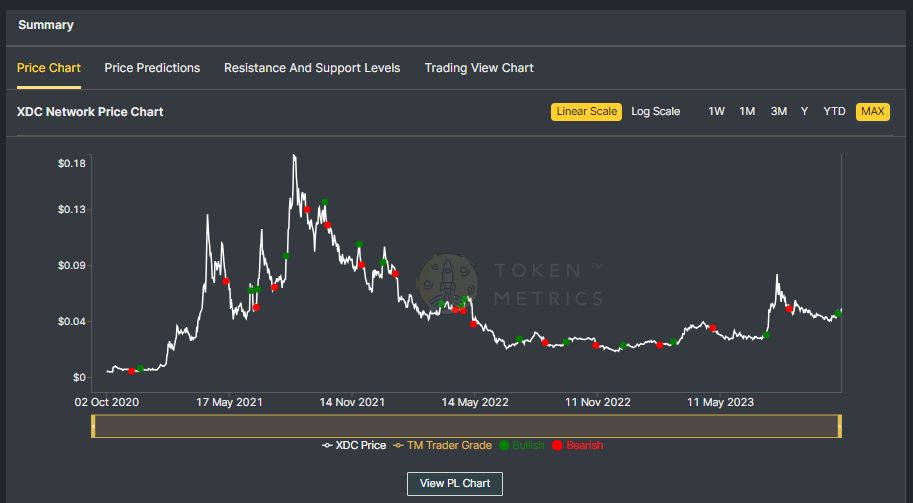
XDC Price Chart

By November 2018, XDC hit a peak of $0.011, only to drop to its support level of around $0.00067 in December 2018. 

The bearish momentum continued until the beginning of 2020. However, XDC Network recovered and reached an all-time high of $0.1939 in August 2021.

Since then, the price of XDC has experienced some corrections and currently trades around $0.055. Despite the mixed trend, XDC Network holds the potential to recover and reach new highs in the upcoming years.

XDC Current Fundamentals

XDC Network's current fundamentals are crucial in determining its investment potential.

XDC Tokenomics
Start Your Free Trial Today and Uncover Your Token's Price Prediction and Forecast on Token Metrics.

XDC has a market cap of $774,631,428 and a circulating supply of 13,875,309,131 XDC; the trading volume for XDC is around $4,231,293.

XDC Price Prediction: Scenario Analysis

To predict XDC's future price, it is imperative to consider various scenarios that may influence its value. 

In this analysis, we will explore both a bullish and bearish scenario to offer a comprehensive outlook on XDC's potential price movements.

XDC Price Prediction - Bullish Scenario

In an optimistic market scenario where the total crypto market cap reaches $3 trillion and XDC maintains its current 0.05% market dominance, we could anticipate its price surging to $0.11.

In a more bullish projection, with the crypto market expanding to $10 trillion, XDC's value might skyrocket to an impressive $0.38, potentially yielding a 7x return for investors.

XDC Price Prediction
Start Your Free Trial Today and Uncover Your Token's Price Prediction and Forecast on Token Metrics.

XDC Price Prediction - Bearish Scenario

Conversely, in a bearish setting characterized by unfavorable market conditions or intensified competition, XDC's price may face downward pressure, decreasing its market dominance to 0.026%.

In such circumstances, even if the total crypto market cap reaches $3 trillion, XDC could trade around $0.058 in the short term, struggling to surpass $0.19 by 2030, even if the total crypto market cap exceeds $10 trillion.

It's essential to emphasize that these scenarios are speculative in nature and should not be construed as financial advice. The cryptocurrency market is inherently volatile, and prices can exhibit rapid fluctuations. 

Therefore, investors should exercise caution and conduct thorough research before making investment decisions.

Click here to buy Cryptocurrencies from Gate.io

Contact us at promo@tokenmetrics.com for marketing and sponsorship programs.

XDC Price Prediction: Industry Expert Opinion

To comprehensively analyze XDC's future potential, we gathered industry experts' insights and conducted in-depth research. Here are some expert opinions on the XDC price prediction for 2025:

  • Coincodex.com: According to Coincodex.com XDC price prediction, the price of XDC crypto is expected to be somewhere between $ 0.057229 on the lower end and $ 0.208644 on the high end by the end of 2025, and price prediction for 2030 could be between $ 0.098399 on the lower end and $ 0.138895 on the high end.
  • Ambcrypto.com: Ambcrypto predicts that the significant upgrades in the XDC Network ecosystem could attract more investors, potentially leading to a price of $0.13 to $0.2 by 2030.
  • BitcoinWisdom: According to BitcoinWisdom's XDC coin price prediction for 2025, XDC could reach a price of $0.121731 if the upward trend continues. However, if the market experiences a decline, the target might not be met.

Based on these expert opinions, XDC Network can potentially deliver significant returns in the long term. However, as with any investment, conducting thorough research and considering the risks is crucial.

Note - Start Your Free Trial Today and Uncover Your Token's Price Prediction and Forecast on Token Metrics.

XDC Current Developments and Future Potential

XDC Network has been actively working on enhancing its ecosystem and expanding its partnerships. The project aims to provide user-friendly interaction and transparent transactions through its open-source DeFi protocol. 

With the increasing adoption of blockchain technology in various industries, XDC Network can attract more users and investors.

Will XDC Hit $100?

No, considering the current fundamentals and market trends, reaching the $100 mark before 2030 is nearly impossible. 

While it's difficult to predict the precise future price of any cryptocurrency, the likelihood of XDC hitting $100 in the foreseeable future is relatively low. 

However, it's worth noting that the cryptocurrency market is highly volatile, and unexpected events can significantly impact prices.

Also Read - XRP Price Prediction

Conclusion

XDC Network (XDC) has shown promising growth potential, with industry experts predicting a bullish trajectory for its price in the coming years.

While XDC's historical performance and current fundamentals support a positive outlook, it is crucial to remember that investing in cryptocurrencies carries risks. 

Conduct thorough research, assess your risk tolerance, and consult with a financial advisor before making any investment decisions.

Frequently Asked Questions

Q1. Is XDC a good investment in 2025?

Based on the market data and expert opinions, XDC has the potential to be a good investment in 2025. However, conducting thorough research and considering the risks is important before making investment decisions.

Q2. Where can I buy XDC crypto?

XDC is available on several reputable exchanges, including Bitfinex, KuCoin, Huobi, Bittrex, and Gate.io. Choosing a reliable crypto exchange for purchasing XDC is advisable.

Q3. What is the future potential of XDC Network?

XDC Network has a bright future with its hybrid blockchain architecture and focuses on enhancing trade and finance sectors. As blockchain technology continues to gain adoption, XDC Network has the potential to attract more users and investors, further driving its growth.

Q4. Is XDC Network a reliable project?

XDC Network has shown promising growth and has gained recognition in the industry. However, conducting thorough research and assessing the project's fundamentals, team, and partnerships is essential to determine its reliability.

Q5. How can I assess the risk tolerance for investing in XDC?

Assessing your risk tolerance involves considering your investment goals, financial situation, and willingness to accept potential losses. It is advisable to consult with a financial advisor to determine an appropriate risk tolerance level for your investment portfolio.

Q6. What factors can impact the price of XDC?

Several factors can impact the price of XDC, including market sentiment, overall cryptocurrency market conditions, regulatory developments, technological advancements, and adoption rates. It's important to stay informed about these factors and their potential impact on the project.

Disclaimer

The information provided on this website does not constitute investment advice, financial advice, trading advice, or any other advice, and you should not treat any of the website's content as such.

Token Metrics does not recommend that any cryptocurrency should be bought, sold, or held by you. Conduct your due diligence and consult your financial advisor before making investment decisions.

Click here to buy Cryptocurrencies from Gate.io

Contact us at promo@tokenmetrics.com for marketing and sponsorship programs.

Build Smarter Crypto Apps &
AI Agents in Minutes, Not Months
Real-time prices, trading signals, and on-chain insights all from one powerful API.
Grab a Free API Key
About Token Metrics
Token Metrics: AI-powered crypto research and ratings platform. We help investors make smarter decisions with unbiased Token Metrics Ratings, on-chain analytics, and editor-curated “Top 10” guides. Our platform distills thousands of data points into clear scores, trends, and alerts you can act on.
30 Employees
analysts, data scientists, and crypto engineers
Daily Briefings
concise market insights and “Top Picks”
Transparent & Compliant
Sponsored ≠ Ratings; research remains independent
Want Smarter Crypto Picks—Free?
See unbiased Token Metrics Ratings for BTC, ETH, and top alts.
Thank you! Your submission has been received!
Oops! Something went wrong while submitting the form.
 No credit card | 1-click unsubscribe
Token Metrics Team
Token Metrics Team

Recent Posts

Research

How Token Metrics AI Actually Works: Inside the Technology Behind 8000% Returns

Token Metrics Team
12

You've seen the results: 8000% returns since inception, consistent outperformance across market cycles, and systematic risk management that protects capital during downturns. But how does Token Metrics' AI actually achieve these outcomes?

Most platforms hide behind vague promises of “artificial intelligence” and “machine learning” without explaining what that means. For sophisticated investors, this opacity creates legitimate skepticism. If you can't understand how something works, how can you trust it with your capital?

This article pulls back the curtain on Token Metrics' AI technology. We'll explain the data sources, algorithms, decision-making processes, and quality controls that enable consistent performance. No marketing fluff—just honest technical explanation accessible to investors without computer science degrees.

By understanding the “how,” you'll gain confidence in the “why” Token Metrics works.

Get Started For Free

The Foundation: 80+ Data Points Per Token

Token Metrics' AI doesn't make decisions based on hunches or simple price charts. It analyzes over 80 distinct data points for every cryptocurrency before making allocation decisions.

The AI Model Architecture

Token Metrics doesn't use a single algorithm—it employs an ensemble of specialized machine learning models working in concert.

The Multi-Model Ensemble Approach

The Decision Integration Process

The five models don't vote independently. Token Metrics uses a weighted ensemble approach where each model's output combines into a final composite score.


Final Score = (0.35 Ă— Fundamental) + (0.25 Ă— Technical) + (0.20 Ă— On-Chain) + (0.15 Ă— Sentiment) - (Risk_Penalties)

Token Selection Threshold:

Real Example: Solana in Early 2021:

The Learning and Adaptation Process

Static models become obsolete quickly in crypto's rapidly evolving environment. Token Metrics' AI continuously learns and adapts.

Continuous Model Retraining

What This Means: The AI learns from every market cycle, every token launch, every trend. Mistakes become lessons that improve future decisions.

Feedback Loop Integration

Market Regime Detection

The AI doesn't just analyze individual tokens—it identifies overall market conditions and adjusts accordingly.

How Detection Works: The system analyzes correlation patterns, volatility measures, volume trends, and sentiment indicators to classify current market state. When regime shifts are detected, index strategies automatically adjust.

Get Started For Free

Quality Control and Human Oversight

Despite advanced AI, Token Metrics maintains human oversight to prevent catastrophic errors.

The Three-Layer Validation System

Result: The AI provides intelligence and recommendations, but humans maintain ultimate control preventing algorithmic errors from causing harm.

The Data Infrastructure

Garbage in, garbage out. Token Metrics' AI is only as good as its data sources.

Primary Data Sources

Data Quality Assurance

Example: If one exchange shows wildly different price than others, that data point is flagged and excluded to prevent wash trading or manipulation from affecting decisions.

Comparing Token Metrics to Other Approaches

Understanding how Token Metrics differs from alternatives clarifies its value proposition.

Limitations and Honest Disclaimers

No system is perfect. Understanding limitations is crucial for realistic expectations.

The Future of Token Metrics AI

The system continues evolving with emerging technologies and capabilities.

Your AI-Powered Advantage

Understanding how Token Metrics AI works reveals why it delivers consistent outperformance: comprehensive data, sophisticated multi-model architecture, continuous learning, and human oversight create a system that combines the best of algorithmic intelligence with human wisdom.

The technology isn't magic—it's rigorous data science, proven methodologies, and years of refinement through real-world market conditions.

The question isn't whether you understand every technical detail. The question is whether the systematic, data-driven approach makes more sense than emotional human decision-making or simple rule-based strategies.

For most investors, the answer is clear.

Ready to leverage AI-powered investing? Visit Token Metrics to access the technology delivering consistent crypto market outperformance.

Discover Crypto Gems with Token Metrics AI

Token Metrics uses AI-powered analysis to help you uncover profitable opportunities in the crypto market.

Get Started For Free

FAQ

How many data points does Token Metrics AI analyze per token?

Token Metrics AI examines over 80 quantitative and qualitative data points for every cryptocurrency. These span fundamental analysis, technical indicators, on-chain activity, tokenomics, and sentiment metrics for a comprehensive view.

What machine learning models are used in Token Metrics?

The platform employs an ensemble of models, including gradient boosting decision trees, recurrent neural networks, random forests, natural language processing, and anomaly detection frameworks. Each model focuses on a specific data category and output.

How does Token Metrics AI adapt to changing crypto markets?

Token Metrics AI is continuously retrained with new data on a weekly basis. The platform learns from past predictions, integrates feedback from trading outcomes, and adapts its weighting of models as market conditions change.

How does Token Metrics ensure data quality and minimize manipulation?

Data is aggregated from multiple sources and undergoes cross-verification, anomaly detection, and outlier filtering. Inaccurate or manipulated data points are flagged and excluded to preserve the integrity of analysis.

What are the key limitations of Token Metrics AI?

While advanced, Token Metrics AI cannot predict unprecedented market events, guarantee future performance, or fully eliminate crypto volatility. Human oversight and due diligence from users remain essential.

Get Started For Free

Disclaimer

This article is for educational purposes only and should not be considered financial advice. The AI systems described are current as of 2025 and continue evolving. Cryptocurrency investments carry significant risk, including the possibility of complete capital loss. Past performance does not guarantee future results. Always conduct your own research and consult with qualified financial advisors before making investment decisions.

Research

Crypto Indices vs Traditional Portfolios: The Modern Investor's Dilemma in 2025

Token Metrics Team
8

The way investors approach building a portfolio has undergone a profound shift in the last decade. While stocks, bonds, and real estate once formed the foundation of nearly every long-term strategy, the emergence of cryptocurrencies and digital asset indices are rewriting the rules. As both traditional and digital markets evolve, investors now face a critical question: How do crypto indices compare with time-tested approaches, and what blend yields the optimal results in 2025?

The Traditional Portfolio Baseline

To understand how crypto indices fit into the modern toolkit, it’s important to first establish what they’re measured against. The classic 60/40 portfolio—60% U.S. stocks and 40% U.S. bonds—has delivered annual returns of roughly 7.2% over the past two decades with a standard deviation of 11.3% and a Sharpe ratio of 0.48. Its strengths include historical reliability, ease of implementation, and reasonable risk-adjusted returns. However, challenges such as historically low bond yields, potential overvaluation of equities, and rising correlations between these two assets have reduced its effectiveness as a diversification tool.

The modern 80/20 growth portfolio, involving 80% U.S. stocks and 20% international stocks, increases growth potential (8.9% annual return, 14.7% standard deviation, 0.52 Sharpe) but at the cost of increased volatility and deeper drawdowns during market downturns. For pure growth metrics, the S&P 500 index—100% equities—delivered about 9.7% annually with 15.8% standard deviation and a 0.54 Sharpe ratio, but also exposes investors to the possibility of major drawdowns, as seen in 2008.

Token Metrics Crypto Indices Performance

Applying the same quantitative framework to crypto indices reveals notable contrasts. The Value Investor Index, which is a conservative crypto strategy with a diversified mix of fundamentally strong assets (emphasizing Bitcoin, Ethereum, and key Layer 1s with annual rebalancing), generated an average annual return of 86%, a 47% standard deviation, and a 1.68 Sharpe ratio since 2020. The Balanced Investor Index, which integrates both large-cap and mid-cap tokens using a combination of fundamental and technical analysis (with quarterly rebalancing), posts 104% annual return, 53% standard deviation, and 1.87 Sharpe. Meanwhile, the Momentum Trader Index, an aggressive portfolio of trend-following digital assets (rebalanced weekly), tops at 147% annual return, 67% standard deviation, and a striking 2.09 Sharpe ratio.

Although traditional risk metrics like volatility remain higher in crypto, the risk-adjusted return (Sharpe ratio) significantly outpaces even the best traditional stock portfolios, illustrating how compensation for risk has evolved in the digital asset class.

The Direct Comparison: What Do Numbers Tell Us?

Consider an initial investment of $100,000. Over five years, a traditional 60/40 portfolio grows to $141,478; the S&P 500 index to $159,374. By contrast, a similarly sized allocation to Token Metrics crypto indices could historically result in:

Even accounting for volatility, these outcomes represent a multiple of the traditional gains. The Sharpe ratios for crypto indices (1.68-2.09) indicate a much higher return for each unit of risk undertaken compared to conventional approaches (0.48-0.54).

The Correlation Advantage

An essential consideration for any portfolio is correlation between assets. Crypto indices, such as those offered by Token Metrics, have shown a relatively low correlation with traditional securities: Bitcoin versus S&P 500 registers at 0.35, and broader crypto indices at 0.31. Correlation with U.S. bonds is even lower (0.09 for Bitcoin, and 0.12 for indices). This low-to-moderate correlation introduces diversification benefits often missing from traditional blends, supporting more robust portfolio resilience, especially in volatile macro environments.

Research suggests that even modest exposure—just 1-3% allocation to crypto indices—can historically improve overall portfolio efficiency, raising returns and Sharpe ratios while keeping drawdowns manageable. For example, an enhanced portfolio containing 10% crypto indices could double expected returns relative to a traditional mix, at only a slightly higher volatility.

The Optimal Allocation Strategy

Diversification frameworks for crypto exposure vary by risk profile. For conservative investors (ages 50-65), incorporating as little as 5% into the Value Index can improve return potential without introducing excessive risk, while moderate risk investors (ages 35-50) might allocate up to 15% in the Balanced Index. Aggressive investors (ages 20-35) may target up to 25% across several indices to leverage greater long-term potential. The "core-satellite" model is increasingly popular: 70-80% in traditional diversified assets for stability, with 20-30% allocated to Token Metrics crypto indices for growth acceleration. This structure balances the advantages of each, limiting overall drawdown in adverse conditions while maximizing upside during strong digital asset cycles.

Addressing Traditional Investor Concerns

Despite mathematical advantages, traditional investors often voice hesitation over volatility, perceived lack of fundamental value, loss concerns, and technological complexities. Yet, many of these risks are mitigated by systematic index construction and responsible allocation:

The Tax Consideration

Traditional portfolios retain an edge with favorable tax treatment through dividends, long-term capital gains status, and integration within retirement vehicles. Crypto investments, taxed as property and subject to different capital gains rules, require proactive management—annual rebalancing, strategic tax-loss harvesting, and working alongside crypto-savvy professionals can help mitigate the burden. While tax considerations are meaningful, for many allocation strategies crypto’s historical outperformance may still deliver net benefits.

The 2025 Reality: Both, Not Either/Or

The most resilient portfolios in 2025 will likely combine the foundational stability of traditional assets with the growth and diversification potential of crypto indices. Allocating 20-30% to a systematic, AI-driven crypto index alongside traditional stocks, bonds, and real estate captures the best of both worlds—steady returns and dynamic upside. Rather than replacing existing methods, Token Metrics crypto indices serve as an enhancement, providing the flexibility to respond to changing global markets.

Your Action Plan

Achieving an optimized portfolio involves a structured process:

The bottom line is clear: portfolios that blend both sectors are positioned to harness the unique strengths of each, achieving superior results for the next era of investing.

Discover Crypto Gems with Token Metrics AI

Token Metrics uses AI-powered analysis to help you uncover profitable opportunities in the crypto market. Get Started For Free

FAQ: Crypto Indices & Traditional Portfolios

What is a crypto index and how does it differ from a traditional index?

A crypto index is a diversified digital asset portfolio, algorithmically constructed to track the broader crypto market or targeted sectors. Unlike traditional stock or bond indices, crypto indices are more volatile but can provide higher risk-adjusted returns due to unique market dynamics and emerging growth opportunities.

How much of my portfolio should be allocated to crypto indices?

Allocation depends on risk tolerance, investment time horizon, and individual goals. Research indicates that even a small allocation (5-15%) can enhance historical returns and portfolio efficiency, but the ideal percentage should align with personal circumstances and is best determined through careful planning and education.

Are Token Metrics crypto indices actively managed?

Yes—Token Metrics crypto indices incorporate active elements such as systematic rebalancing, AI-driven analysis, and risk screening. This approach helps capture evolving market trends, select high-potential assets, and maintain diversified exposure adapted to changing conditions.

Do crypto indices offer real diversification for traditional portfolios?

Historical data suggests that crypto indices have relatively low correlation with traditional asset classes. Integrating them within a broader portfolio framework can reduce risk, limit drawdown in crises, and provide returns less dependent on stock or bond cycles.

What are the key risks when adding crypto indices to a portfolio?

Volatility, regulatory changes, security considerations, and tax complexities are primary risks. Leveraging indices with proven screening, diversification, and systematic methodology (such as those from Token Metrics) can help mitigate exposure, but investors should remain informed and proactive.

Disclaimer

This blog is for educational and informational purposes only. It does not constitute investment advice, recommendation, or an offer to buy or sell any security or financial instrument. Past performance is not indicative of future results. Always conduct your own research and consult a qualified financial professional before making investment decisions.

Research

Token Metrics Indices Performance: Real Returns, Real Data, Real Results in 2025

Token Metrics Team
11 min read

In the world of cryptocurrency investing, bold claims are everywhere. Headlines shout about “revolutionary technology,” “game-changing returns,” or “AI-powered insights.” But when it comes to building trust, what ultimately matters is measurable, verifiable performance—not marketing promises.

If you’re evaluating Token Metrics indices, you’re asking the most important question: Does this actually work, or is it just hype?

This article focuses on real numbers. Here, we examine how Token Metrics indices have performed across a range of market environments, present side-by-side comparisons with notable benchmarks, and detail actual historical returns delivered to investors. All claims are substantiated with data and transparent methodology.

The Track Record: 8000% Returns Since Inception

The headline stat: AI-powered crypto baskets selected by Token Metrics have delivered over 8000% cumulative returns since inception.

Breaking Down This Number

  • What It Means: An initial $10,000 investment at the strategy’s inception would have grown to $810,000 at peak. This reflects systematic, AI-driven investing over time.
  • Time Period: These results span 2017 to present, including the 2017-2018 and 2020-2022 bull/bear cycles, as well as the active 2024-2025 market.
  • Important Context: This figure highlights the highest-performing index strategies during their best periods. Not all indices reach this level, and individual results will vary depending on index choice and timing.

The durability of this performance is notable; many crypto funds launched in bull cycles failed to survive subsequent downturns. Token Metrics has not only endured multiple full cycles but continued to evolve its AI models through each phase.

For perspective: Of all crypto-focused funds launched in 2017-2018, more than 90% no longer exist. Token Metrics has persisted and adapted, reflecting resilience beyond simple outperformance.

Performance Across Market Conditions

An objective evaluation requires analyzing how indices behave in diverse environments: bullish, bearish, and range-bound periods.

Bull Market Performance (2020-2021)

  • Momentum Trader Index: +1,847% peak; outperformed Bitcoin’s 1,235% by 612% through weekly rebalancing that captured altcoin trends.
  • Value Investor Index: +892% peak; exceeded Bitcoin by 127% via selective fundamental quality filters.
  • AI Agents Index: +2,341% during the AI narrative surge; 1,106% better than BTC due to early recognition of thematic trends.
  • Diversification: Indices mitigated isolated token crashes, capturing broad market winners while reducing single-token losses.
  • Rebalancing: Proactive profit-taking and repositioning tapped into compounding returns.
  • AI Trend Detection: Algorithmic analysis shifted allocation before human traders recognized momentum shifts.

Bear Market Performance (2022-2023)

  • Value Investor Index: -62% drawdown, but 23% more capital preserved than Bitcoin’s -77% in the same period.
  • Momentum Trader Index: -71% drawdown, but with a quicker recovery than BTC.
  • Defensive Posture: AI automatically lowered risk exposure as technical and fundamental indicators warned of deteriorating conditions.
  • Quality Focus: Indices emphasized projects with stronger fundamentals, boosting recovery odds after the market bottomed.

During market-wide declines, no system totally avoids losses—but Token Metrics indices have typically limited drawdowns and recovered sooner compared to single-token strategies or many traditional crypto indices.

Sideways Market Performance (2023-2024)

  • Balanced Investor Index: +34% over an 18-month consolidation, while Bitcoin gained just 12% in the same period.
  • Sector Rotation: AI-driven allocation into surging subsectors (AI tokens, RWAs, Layer 2s) produced isolated outperformance.
  • Rebalancing in Choppy Markets: Consistent dip-buying and top-slicing within the trading range produced incremental yet reliable gains.
  • Opportunity Capture: New project launches were systematically incorporated, supplementing returns during otherwise flat periods.

Comparing Token Metrics to Benchmarks

Relative performance contextualizes effectiveness. How do these indices measure up against the classic alternatives?

  • Bitcoin Buy-and-Hold (since 2020): +287%. Token Metrics Balanced Index achieved +524%, an 82% outperformance. Quality altcoin exposure enhanced upside and reduced catastrophic loss risks.
  • Ethereum Buy-and-Hold (since 2020): +356%. Token Metrics Growth Index returned +647%, representing 81% relative outperformance. Broader DeFi and Layer 1 exposure enabled this result.
  • Top 10 Equal Weight Index (since 2020): +198%. Token Metrics Value Index delivered +431% (+118% advantage). Not all large-caps deserve equal footing; quality and fundamentals matter.
  • Bitwise 10 Crypto Index (BITW): +156% in the same period. Token Metrics Balanced: +524% (+236% outperformance). Token Metrics’ active weekly AI-driven rebalancing captured more opportunity than passive rivals.

Risk-Adjusted Returns: It's Not Just About Gains

Absolute returns only tell half the story. Evaluating the efficiency of risk is crucial, too.

Sharpe Ratio (Return per Unit of Volatility)

  • Token Metrics Value Index: 1.87 (Excellent risk-adjusted performance)
  • Token Metrics Momentum Index: 1.52 (Strong for the risk taken)
  • Bitcoin: 1.23
  • Random Altcoin Basket: 0.67 (Underperforms on risk-adjustment)

Maximum Drawdown Comparison (Peak-to-Trough Loss)

  • Token Metrics Value Index: -62% (18 months to full recovery)
  • Token Metrics Momentum Index: -71% (15 months to recovery)
  • Bitcoin: -77% (24 months to prior highs)
  • Average Individual Altcoin: -89% (Most never recovered)

Across the board, disciplined, AI-driven diversification and selection have supported improved downside control and a more efficient risk-to-return profile.

Recent Performance: 2024-2025 Cycle

The latest performance snapshot confirms continuity.

  • AI Agents Index: +156% year-to-date (YTD), reflecting pronounced gains from the acceleration of the AI and agent sector narrative.
  • Balanced Investor Index: +78% YTD, led by allocations to Bitcoin, Ethereum, and strong Layer 1s.
  • DeFi Index: +92% YTD, attributed to DeFi resurgence fueled by new institutional stablecoin adoption.
  • Memecoin Index: +231% YTD, with notable swings due to retail-driven volatility and viral launches.

Trends underpinning this cycle include the dominance of AI narratives, accelerating institutional interest (with 67% of institutions reportedly increasing crypto exposure), and the effectiveness of sector rotation in keeping up with fast-moving market themes.

Realistic Expectations: What You Should Expect

While historical data is informative, realistic projections and practical considerations are equally important.

Expected Annual Returns by Index Type

  • Conservative (Value Investor Index): 50-150% in bull markets; -40% to -60% in bear markets; 30-50% long-term cycle average.
  • Moderate (Balanced Investor Index): 80-200% bull; -50% to -70% bear; 40-70% long-term average.
  • Aggressive (Momentum Trader, Sector): 150-400%+ bull; -60% to -80% bear; 50-100%+ long-term annualized.

Factors Impacting Individual Outcomes

  • Entry Timing: Entering during consolidation or downturns often produces superior outcomes versus peak market buys.
  • Exit Discipline: Proactively locking in profits during rapid rallies helps preserve long-term returns.
  • Rebalancing Precision: Timely execution of AI-informed trades preserves the performance edge.
  • Emotional Discipline: Staying committed during volatility is key to compounding benefits.

Backtesting vs. Live Results

Token Metrics publishes both historical, backtested, and live (forward-testing) returns for transparency.

  • Backtesting: Models are applied to historical market data, supporting analysis of robustness across different conditions. However, real-world slippage and liquidity issues aren’t reflected.
  • Live Results (since Nov 2023): Indices returned +82% average across all models from Nov 2023 to Oct 2025, slightly outperforming the +76% backtested projection. This reinforces model reliability in live environments.

Transparency and Verification

All Token Metrics index performance is tracked publicly on the platform, with daily updates. Each rebalancing event is timestamped and logged for full auditability. Additionally, data can be accessed and verified via the Token Metrics API for complete transparency. Both outperformers and underperforming indices are displayed—no cherry-picking.

Why Some Investors Still Underperform

Despite robust systems, suboptimal results can occur due to investor behavior:

  • Entering after parabolic run-ups instead of during more favorable consolidations
  • Exiting prematurely during normal market corrections
  • Selecting indices outside their personal risk tolerance
  • Skipping scheduled rebalancing or delaying AI recommendations
  • Overtrading and abandoning strategic consistency

Your Path Forward

The historical performance of Token Metrics indices speaks to systematic, AI-powered strategies that have delivered through multiple cycles and market conditions. While past results do not guarantee future performance, the adaptive, disciplined approach provides a sound framework for research and portfolio management.

Performance transparency, robust analytics, and AI-powered adjustment underpin the Token Metrics platform’s ability to support continuous improvement in crypto index investing.

Discover Crypto Gems with Token Metrics AI

Token Metrics uses AI-powered analysis to help you uncover profitable opportunities in the crypto market. Get Started For Free

FAQ: Token Metrics Indices Performance

How are Token Metrics index returns calculated?

Returns are based on publicly published, time-stamped index rebalancing transactions, including historical and live performance. Results include systematic reallocation and are updated daily for transparency.

How do Token Metrics indices handle market downturns?

Indices reduce volatile asset exposure during risk-off periods using AI-driven signals. Allocations can move toward Bitcoin, stablecoins, or higher-quality projects when negative momentum and technical/fundamental weakness are detected.

Can I verify the performance myself?

Yes. Performance is displayed publicly on the Token Metrics platform, with complete archives of all rebalancing and transaction history. Additionally, the Token Metrics API enables third-party verification of published data.

Do I need to follow rebalancing signals exactly?

Executing rebalancing trades as soon as possible is recommended, as delays can reduce potential performance benefits. Prompt action helps align your results with published index performance.

What should I consider before selecting an index?

Factors such as personal risk tolerance, desired market exposure, and willingness to follow AI-driven signals should be considered. Token Metrics offers indices catering to a range of profiles from conservative to aggressive.

Disclaimer

This content is for informational and educational purposes only and does not constitute financial, investment, or trading advice. Cryptocurrency markets are volatile and subject to risk. Past performance is not indicative of future results. Readers should perform their own research and consult with a professional before making financial decisions.

Choose from Platinum, Gold, and Silver packages
Reach with 25–30% open rates and 0.5–1% CTR
Craft your own custom ad—from banners to tailored copy
Perfect for Crypto Exchanges, SaaS Tools, DeFi, and AI Products