

Back to blog
Crypto Basics

Avalanche (AVAX) Price Prediction 2025, 2030 - Forecast Analysis

Delve into a detailed analysis of Avalanche (AVAX) price predictions and forecasts for 2025 and 2030 to make informed investment decisions.
S. Vishwa
7 Minutes
Want Smarter Crypto Picks—Free?
See unbiased Token Metrics Ratings for BTC, ETH, and top alts.
Thank you! Your submission has been received!
Oops! Something went wrong while submitting the form.
 No credit card | 1-click unsubscribe

Click here to buy Cryptocurrencies from Gate.io

In the ever-evolving world of cryptocurrencies, Avalanche (AVAX) has emerged as a prominent player. With its unique algorithm and features, AVAX has gained popularity among investors and traders alike. 

Many people are now wondering what the future holds for Avalanche and whether its price will continue to rise. 

In this article, we will delve into the various factors that can influence the price of AVAX and provide a comprehensive analysis of its price prediction for the coming years.

Avalanche (AVAX) Overview

Before we dive into the price prediction, let's take a moment to understand what Avalanche is all about. Avalanche is a decentralized smart contract platform that aims to be fast, affordable, and eco-friendly.

It utilizes a native utility token called AVAX, which serves as the primary medium of exchange within the ecosystem. The maximum supply of AVAX is capped at 720 million, with 360 million initially minted and sold through private and public sales. The remaining 360 million tokens are distributed as staking rewards over time.

Avalanche stands out from other blockchain networks due to its heterogeneous network of blockchains and validator sets. It uses a proof-of-stake (PoS) consensus mechanism, assisted by the unique Avalanche consensus protocol. 

This protocol provides a scalable and secure environment for transactions, smart contracts, and network administration.

Historical Performance of Avalanche (AVAX)

To gain insights into the potential future price movements of AVAX, it is crucial to analyze its historical data. Over the past year, AVAX has experienced both bullish and bearish trends.

AVAX Tokenomics
Start Your Free Trial Today and Uncover Your Token's Price Prediction and Forecast on Token Metrics.

Starting from October 2022, the price of AVAX gradually declined, reaching a low of around $8.9, and it rebounded briefly in the few trading sessions in the last one year, touching a peak resistance at $21.51 at the beginning of 2023. Currently trading around $17.8

Avalanche (AVAX) Current Fundamentals

Before making any price predictions, it is essential to consider the current fundamentals of Avalanche. As of now, the price of AVAX stands at $17.8 with a market cap of $6,333,154,506. 

The latest trading price for AVAX is $17.8, and the AVAX market is displaying a Fear & Greed Index of 65 (Greed). Over the past 30 days, AVAX has experienced 18 green days out of 30, indicating a positive trend. The volatility of AVAX is currently at 8.43%.

Avalanche (AVAX) Price Prediction - Scenario Analysis

To make accurate price predictions, it is crucial to consider different scenarios that can impact AVAX's price. Let's analyze two scenarios - a bullish and a bearish- to understand the potential price movements of AVAX better.

AVAX Price Prediction - Bullish Scenario

If the crypto market cap hits $3 Trillion, and if AVAX retains its current 0.41% dominance, its price could ascend to $34.67

In a more bullish scenario of the crypto market surging to $10 Trillion, AVAX's price could soar to a staggering $115.57, resulting in a potential 7x return for investors.
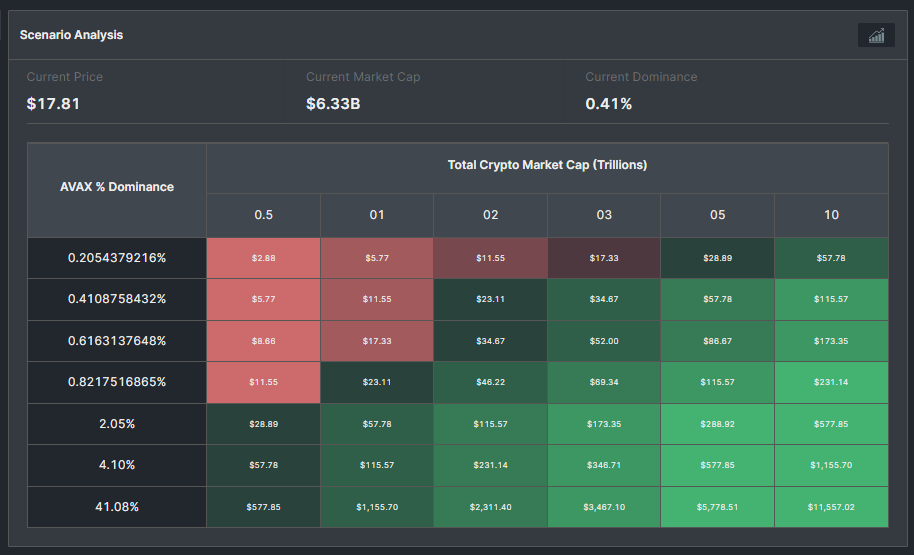
AVAX Price Prediction
Start Your Free Trial Today and Uncover Your Token's Price Prediction and Forecast on Token Metrics.

AVAX Price Prediction - Bearish Scenario

In a bearish scenario, where market conditions are unfavorable or there is increased competition, the price of AVAX may face downward pressure with a decreased dominance of 0.20%. 

In this scenario, If the crypto market cap hits $3 Trillion, AVAX could trade around $17.33 in the short term and struggle to surpass $57.78 by 2030 even if the total crypto market cap surpasses the $10 Trillion mark.

It is essential to note that these scenarios are speculative and should not be considered financial advice. The cryptocurrency market is highly volatile, and prices can fluctuate rapidly.

Click here to buy Cryptocurrencies from Gate.io

Avalanche (AVAX) Price Prediction - Industry Expert Opinion

To gain further insights into AVAX's future price movements, it is essential to consider the opinions of industry experts. While price predictions can vary, many experts believe that AVAX has the potential for significant growth in the coming years. 

Coincodex.com platform predicts Avalanche (AVAX) could reach $ 63.40 to $ 80.24 by 2030, and experts from Changelly forecast that it could reach minimum and maximum prices of $30.04 and $34.85 by the end of 2025. By the end of 2030, the price of AVAX could reach $185.25 to $221.39

Other industry analysts have varying opinions on the future price of AVAX. Ambcrypto.com predicts that Avalanche (AVAX) could reach $28.15 to $42.23 in 2030. 

This long-term projection and an optimistic outlook are based on the belief that AVAX's ongoing developments and growing adoption will drive its value.

Note - Start Your Free Trial Today and Uncover Your Token's Price Prediction and Forecast on Token Metrics.

Is Avalanche (AVAX) Good to Invest?

Investing in cryptocurrency carries certain risks, including market volatility and regulatory uncertainty. However, many investors see potential in Avalanche due to its unique features, fast transaction speed, and the growing popularity of decentralized finance (DeFi) applications. 

Before making any investment decisions, conducting thorough research, assessing your risk tolerance, and consulting with a financial advisor are crucial.

Risks and Rewards

As with any investment, risks and rewards are associated with investing in AVAX. The rewards of investing in AVAX include the potential for significant price appreciation, especially if the platform continues to gain adoption and attract more users. 

Additionally, AVAX holders can earn staking rewards by participating in the network's proof-of-stake consensus mechanism.

However, it's important to note that investing in AVAX also carries risks. The cryptocurrency market is highly volatile, and AVAX's price can fluctuate quickly. 

Regulatory changes, security breaches, and market sentiment can all impact AVAX's price. It's crucial to carefully assess these risks before making any investment decisions.

Ongoing Developments and Future Potential of Avalanche

Avalanche has been making significant strides in terms of development and partnerships. The platform has attracted several high-profile projects and collaborations, contributing to its growing ecosystem. 

Ongoing developments, such as upgrades to the network and the introduction of new features, can further enhance the functionality and appeal of Avalanche.

Additionally, Avalanche's focus on scalability, affordability, and eco-friendliness positions it well to capitalize on the growing demand for decentralized applications and the broader adoption of blockchain technology. As the cryptocurrency market continues to evolve, Avalanche's potential for future growth remains promising.

Conclusion

In conclusion, Avalanche (AVAX) has shown strong potential as a decentralized smart contract platform. While price predictions can vary, it's clear that AVAX has the potential for significant growth in the coming years. 

Investors should carefully consider the risks and rewards of investing in AVAX and conduct thorough research before making investment decisions. As with any investment, it's important to stay informed, diversify your portfolio, and consult with a financial advisor.

Frequently Asked Questions

Q1. How much will AVAX be worth in the future?

AVAX's future value will depend on market trends, adoption rates, technological developments, and overall crypto market health. In a bullish scenario of the total crypto market surging to $10 Trillion, AVAX's price could soar to a staggering $115.57.

Q2. What will Avalanche be worth in 2030?

Predicting Avalanche's 2030 value is speculative. The long-term price depends on adoption, tech innovation, and crypto ecosystem changes. Changelly forecast that, by the end of 2030, the price of AVAX could reach $185.25 to $221.39

Q3. Why is AVAX dropping?

AVAX may drop due to market volatility, negative news of recent security breaches, sell-offs, or broader economic factors impacting the cryptocurrency markets.

Q4. Is AVAX a good project?

Many consider AVAX a good project due to its fast transaction speeds, low fees, and eco-friendly proof-of-stake consensus mechanism.

Q5. What factors can affect the price of AVAX?

AVAX's price is influenced by market sentiment, adoption rates, network upgrades, regulatory news, and the performance of decentralized applications on its platform.

Q6. How can I analyze Avalanche price movements?

Analyzing Avalanche (AVAX) price movements and studying market trends is simple. You can check the Token Metrics platform for all the data, bullish and bearish trends, project tokenomics, and short-term price predictions, all in one place.

Q7. What do industry experts say about AVAX's future?

Industry experts are optimistic about AVAX's future, citing its strong development team, innovative technology, and growing ecosystem of applications.

Disclaimer

The information provided on this website does not constitute investment advice, financial advice, trading advice, or any other advice, and you should not treat any of the website's content as such.

Token Metrics does not recommend that any cryptocurrency should be bought, sold, or held by you. Conduct your due diligence and consult your financial advisor before making investment decisions.

Click here to buy Cryptocurrencies from Gate.io

Build Smarter Crypto Apps &
AI Agents in Minutes, Not Months
Real-time prices, trading signals, and on-chain insights all from one powerful API.
Grab a Free API Key
About Token Metrics
Token Metrics: AI-powered crypto research and ratings platform. We help investors make smarter decisions with unbiased Token Metrics Ratings, on-chain analytics, and editor-curated “Top 10” guides. Our platform distills thousands of data points into clear scores, trends, and alerts you can act on.
30 Employees
analysts, data scientists, and crypto engineers
Daily Briefings
concise market insights and “Top Picks”
Transparent & Compliant
Sponsored ≠ Ratings; research remains independent
Want Smarter Crypto Picks—Free?
See unbiased Token Metrics Ratings for BTC, ETH, and top alts.
Thank you! Your submission has been received!
Oops! Something went wrong while submitting the form.
 No credit card | 1-click unsubscribe
Token Metrics Team
Token Metrics Team

Recent Posts

Crypto Basics

Is Bitcoin Safe? - Complete Analysis

S. Vishwa
8 Minutes

In the crypto world, Bitcoin stands as the pioneer, sparking interest and evoking conversations worldwide. But even after more than a decade since its inception, a pressing question persists: "Is Bitcoin safe?" 

In this detailed analysis, we'll dive deep into the factors affecting Bitcoin's safety, weigh its risks and benefits, and provide a comprehensive perspective for both novices and seasoned investors.

Bitcoin's Fundamental Technology

Immutable Records - One of the cornerstones of Bitcoin's safety is its underlying technology: the blockchain. This decentralized digital ledger ensures that every transaction is transparent, immutable, and secured against tampering.

Distributed Consensus - Being decentralized means no single entity has control over the network. Instead, Bitcoin relies on a distributed consensus, reducing vulnerabilities to malicious attacks or centralized failures.

Security Protocols and Measures

Cryptographic Security - Bitcoin employs SHA-256, a cryptographic algorithm that ensures transaction and wallet security. The design makes it computationally prohibitive to reverse-engineer transactions or hack into wallets.

Wallet Safeguards - Hardware wallets, cold storage, multi-signature options, and regular software updates have greatly elevated the safety level for Bitcoin users, enabling them to store and transact with reduced risks.

Security Breaches with BTC

Despite its robust system, Bitcoin hasn't been immune to challenges.

Exchange Hacks - Notable incidents, like the Mt. Gox hack in 2014, has led to massive financial losses. However, it's crucial to differentiate between the security of Bitcoin's protocol and that of individual platforms or exchanges.

Phishing and Scams - While the Bitcoin network remains secure, individual users have fallen prey to phishing attempts and scams, emphasizing the need for vigilance and education.

Contemporary Challenges

Quantum Computing - There's been chatter about quantum computers' potential to disrupt Bitcoin's cryptographic safeguards. However, at present, practical quantum machines capable of such feats remain in nascent stages. The crypto community is also actively researching quantum-resistant algorithms.

Regulatory Scrutiny - Many governments are exploring regulatory frameworks for cryptocurrencies. While this adds legitimacy to the crypto space, there are concerns about potential overregulation stifling innovation.

Is Bitcoin a Safe Investment?

Assessing Bitcoin's safety as an investment hinges upon one's perception of security. The volatile nature of Bitcoin cannot be denied. 

For instance, in 2022, Bitcoin experienced drastic price fluctuations, plummeting from nearly $48,000 to lows around $16,000, and later stabilizing near $26,000. Such dramatic shifts might deter traditional investors. 

Yet, Bitcoin's dynamic is evolving. As Ryan Burke from M1 observes, Bitcoin is melding with mainstream financial avenues, witnessing increased retail and institutional engagement. It's steadily positioning itself as a modern-day alternative asset, analogous to renowned tech giants.

From a technological standpoint, Bitcoin's framework is robust. However, notes Daniel Rodriguez of Hill Wealth Strategies, it lacks true anonymity. The public nature of Bitcoin addresses, combined with potential tracking by hackers, poses risks. 

Fundamentally, your Bitcoin's safety lies in your wallet's security. Misplace the password or if it's compromised, your Bitcoin could be jeopardized.

Reference - https://www.forbes.com/advisor/investing/cryptocurrency/is-bitcoin-safe/

Factors that can Influence Bitcoin Price

The valuation of Bitcoin, the pioneering cryptocurrency, is shaped by an intricate tapestry of elements, extending beyond the simple dynamics of market demand and supply.

Market Sentiment: The overarching psychological mood of investors, traders, and the wider public can heavily influence Bitcoin's price. News of technological advancements can spur price surges, while incidents like security breaches can induce declines.

Regulatory News and Decisions: The approach regulators take towards Bitcoin, be it permissive or restrictive, can precipitate significant price shifts. A country's decision to endorse or prohibit Bitcoin trading can be particularly impactful.

Technological Changes and Innovations: Enhancements to the Bitcoin network, such as the Lightning Network or hashing algorithm modifications, can influence its market valuation.

Bitcoin Halving: Occurring approximately every four years, halvings cut the rewards miners receive by half, affecting the rate of new Bitcoin entering circulation. Historically, halving events have correlated with substantial price movements due to the interplay of reduced supply and sustained demand.

Macroeconomic Factors: Variables like global economic stability, inflation trends, and financial downturns can dictate how investors perceive Bitcoin as a potential store of value.

Supply Dynamics: With a maximum supply set at 21 million coins, the nearing of this cap, coupled with events like halvings, amplifies Bitcoin's scarcity factor, which can influence price.

Competition: The rise or recognition of other cryptocurrencies can challenge Bitcoin's market dominance and thereby affect its price.

Rewards and Risks Associated with Bitcoin

Navigating the turbulent waters of Bitcoin investment presents both tantalizing prospects and daunting pitfalls. Here's a breakdown:

Rewards:

  • Unparalleled Returns: Historically, Bitcoin has showcased growth trajectories that few other assets can rival. Early adopters have reaped exponential gains, turning nominal investments into fortunes.
  • Decentralization and Autonomy: As a decentralized currency, Bitcoin offers investors independence from traditional financial systems and governmental controls, positioning it as a potential hedge against economic instability.
  • Portfolio Diversification: Bitcoin's often non-correlated behavior with mainstream assets allows investors to diversify portfolios, potentially mitigating risks and enhancing long-term returns.

Risks:

  • Volatility: Perhaps the most significant challenge, Bitcoin's price can swing dramatically within short periods, leading to substantial losses.
  • Regulatory Concerns: Globally, regulatory stances on Bitcoin vary. Adverse regulatory decisions, such as bans, can negatively impact its value.
  • Security Threats: From potential exchange hacks to wallet compromises, the digital nature of Bitcoin exposes investors to cybersecurity threats.
  • Lack of Consumer Protections: Unlike traditional financial systems, Bitcoin transactions are irreversible. Any mishap, be it a mistaken address or fraud, can result in permanent loss.

Safety Precautions for Bitcoin Users

As the crypto landscape evolves, so do the threats, making proactive measures essential. 

Firstly, users should prioritize using reputable hardware wallets. These devices, disconnected from the internet, significantly diminish the risk of hacks. 

Secondly, implementing multi-signature setups adds another layer of security; it requires multiple private keys to authorize a Bitcoin transaction, reducing single-point vulnerabilities. 

Staying updated on the latest security threats and protocols cannot be overstated. With phishing attacks becoming more sophisticated, awareness is the first line of defense. 

Finally, ensure regular backups of your Bitcoin wallet. A best practice is to store these backups in diverse physical locations, safeguarding against data loss due to unforeseen calamities.

Also Read - Is Bitcoin Dead?

Future Outlook for Bitcoin

The trajectory of Bitcoin's future remains a topic of intense speculation and interest. As the pioneer of the cryptocurrency movement, its adoption is steadily gaining momentum, with institutional investors and major corporations increasingly integrating Bitcoin into their financial strategies. 

Technological advancements, like the Lightning Network, aim to address scalability issues, bolstering Bitcoin's potential for broader transactional use. 

However, challenges lie ahead. Regulatory uncertainties across global jurisdictions and the evolving landscape of competing cryptocurrencies could influence its dominance. 

Moreover, environmental concerns over Bitcoin mining may shape its future narrative. While Bitcoin's position as a store of value appears firm, its role in the broader financial ecosystem remains to be fully realized.

Frequently Asked Questions

Q1. What makes Bitcoin different from traditional currencies?

Unlike fiat currencies, Bitcoin operates on a decentralized platform without a central authority or middlemen. It is also limited in supply, making it resistant to inflation.

Q2. How do Bitcoin transactions work?

Bitcoin transactions involve a sender, a recipient, and the transfer of BTC between their respective digital wallets. Once initiated, the transaction is verified by network nodes through cryptography and recorded on the blockchain.

Q3. Is Bitcoin accepted by major retailers and businesses?

Yes, a growing number of businesses, both online and brick-and-mortar, accept Bitcoin as a form of payment. This includes major companies like Microsoft, Overstock, and several travel agencies.

Q4. How can I safely store my Bitcoin holdings?

For security, Bitcoin can be stored in hardware wallets (physical devices) or reputable software wallets with strong encryption. It's essential to keep backup copies of your wallet and use multi-factor authentication when possible.

Q5. What is the environmental impact of Bitcoin mining?

Bitcoin mining requires significant computational power, leading to concerns about its energy consumption and environmental footprint. The impact largely depends on the source of the energy used in mining operations.

Q6. How is the value of Bitcoin determined?

Bitcoin's value is determined by various factors, including supply and demand dynamics, market sentiment, regulatory news, and macroeconomic indicators. It's traded on various exchanges, and its price can vary between platforms.

Q7. Can I mine Bitcoin at home?

While Bitcoin was initially mined using home computers, the increasing complexity of the process now requires more powerful and specialized hardware, making home mining less profitable and more challenging.

Q8. What happens when all 21 million Bitcoins are mined?

Once all Bitcoins are mined, miners will no longer receive block rewards. However, they will still earn from transaction fees, ensuring that the network remains operational and transactions are verified.

Conclusion

As of now, Bitcoin remains a secure and resilient system, thanks to its robust technology and continuous community efforts. However, like any financial tool or asset, its safety is intertwined with user awareness, practices, and the evolving landscape of threats and solutions. 

Always conduct due diligence, stay informed, and prioritize safety. With these steps, you'll be well-equipped to navigate the exciting world of Bitcoin.

Disclaimer

The information provided on this website does not constitute investment advice, financial advice, trading advice, or any other sort of advice and you should not treat any of the website's content as such.

Token Metrics does not recommend that any cryptocurrency should be bought, sold, or held by you. Do conduct your own due diligence and consult your financial advisor before making any investment decisions.

Crypto Basics

10 Best Crypto Exchanges for Investing and Trading

Marcus K
9 Minutes

In the bustling world of cryptocurrencies, knowing where to trade or invest can be a daunting task. With the number of available exchanges growing rapidly, finding the right fit tailored to your needs is essential. Whether you're a newbie or a seasoned trader, there's an exchange out there for you. 

In this comprehensive post, we simplify the choices by breaking down the 10 best crypto exchanges, their advantages, disadvantages, and whom they're most suited for.

What are Crypto Exchanges?

Crypto exchanges are digital platforms where users can buy, sell, or trade cryptocurrencies for other digital or fiat currencies. Think of them as the stock markets of the crypto world. 

They play a pivotal role in the crypto ecosystem by providing liquidity, price determination, and a gateway for new entrants to join the digital currency revolution.

List of Best Cryptocurrency Exchanges in 2023

Dive into our curated list of top cryptocurrency exchanges tailored for both seasoned traders and newcomers alike. As you journey ahead, you'll discover the ideal platform that aligns with your crypto trading and investment needs.

Note - While exchanges are generally considered safe platforms for crypto trading, it's crucial to stay updated on crypto market news and developments. 

This is because even highly reputed platforms are not entirely immune to the risks of hacks, scandals and regulatory actions.

1. Binance

Binance, founded in 2017 by Changpeng Zhao, skyrocketed to global fame within a year. Originating from China and later relocating due to regulations, this exchange is known for its vast array of cryptocurrencies and impressive trading volume. 

Binance's commitment to innovation, seen in features like their Binance Smart Chain, makes it a force to reckon with in the crypto world.

Best For: Intermediate to advanced traders.

Pros:

  • Massive Trading Volume: Offers liquidity for a vast array of tokens.
  • Variety of Cryptos: Lists numerous cryptocurrencies and pairs.
  • Advanced Tools: Advanced charting tools and features for pro traders.

Cons:

  • Complex UI can be overwhelming for beginners.
  • Past minor security breaches, though funds were safe.
  • Regulatory concerns in some countries.

2. Coinbase

Established in San Francisco in 2012, Coinbase stands as one of the most beginner-friendly exchanges. Brian Armstrong and Fred Ehrsam aimed to create a platform where anyone could safely buy and sell Bitcoin.

With its easy-to-use interface and robust security measures, Coinbase remains a top choice for newcomers to the crypto space.

Best For: Beginners to intermediate users.

Pros:

  • Intuitive Interface: Ideal for new crypto enthusiasts.
  • High Security: Features like 2FA and insurance for funds.
  • Regulated: Complies with U.S. financial regulations.

Cons:

  • Limited number of cryptocurrencies.
  • Higher fees compared to other exchanges.
  • May monitor and limit certain transactions.

3. Kraken

Jesse Powell founded Kraken in 2011, following the infamous Mt. Gox hack. With an emphasis on security and regulatory compliance, Kraken has built a reputation for being a safe haven for crypto assets. Its ability to handle fiat currencies adds versatility for traders and investors alike.

Best For: Intermediate to experienced traders.

Pros:

  • Security Measures: Robust security with cold storage and encrypted wallets.
  • Fiat Options: Multiple fiat currencies supported.
  • Low Fees: Competitive fee structure.

Cons:

  • User interface can be complex for beginners.
  • Limited payment methods.
  • Customer service can be slow.

Also Check - Kraken Latest Offerings

4. Gemini

Gemini, birthed in 2014 by the famous Winklevoss twins, places a strong emphasis on regulatory compliance and security. Based in New York, it's one of the few exchanges to earn a BitLicense, allowing operations in the state. 

With its clean design and institutional-grade security measures, Gemini has carved out a niche among crypto enthusiasts.

Best For: Beginners to intermediate users.

Pros:

  • Regulated: Stringent compliance with U.S. regulations.
  • Security: Offers insurance on user deposits.
  • Clean UI: Simplistic and user-friendly design.

Cons:

  • Limited range of cryptocurrencies.
  • High fees compared to competitors.
  • Limited global availability.

Also Check - Gemini Latest Offerings

5. Huobi

Initially established in China in 2013 by Leon Li, Huobi has since expanded its operations globally. Renowned for its extensive list of available cryptocurrencies, it caters to both the Eastern and Western crypto markets. 

Despite regulatory hurdles in its home country, Huobi thrives due to its adaptability and forward-thinking approach.

Best For: Intermediate to advanced traders.

Pros:

  • Token Variety: Extensive range of cryptocurrencies.
  • Global Reach: Available in many countries.
  • Futures Trading: Offers derivatives and futures.

Cons:

  • Complex platform for newcomers.
  • Regulatory concerns in certain areas.
  • Some reports of poor customer service.

6. eToro

eToro, founded in 2007, initially started as a general trading platform but swiftly incorporated cryptocurrencies into its offerings. 

The platform is widely recognized for its user-friendly interface and "social trading" features, allowing users to mimic the trading strategies of established crypto traders.

Best for: Beginners and those interested in social trading.

Pros:

  • User-Friendly: Intuitive interface ideal for beginners.
  • Social Trading: Follow and replicate experienced traders' moves.
  • Diverse Portfolio: Offers a wide range of assets beyond just cryptocurrencies.

Cons:

  • Withdrawal Fees: Can be higher compared to other platforms.
  • Platform Limitations: Some advanced trading tools are lacking.
  • Crypto Ownership: Users can't transfer certain cryptos to external wallets.

Also Check - eToro Latest Offerings

7. Crypto.com

Emerging in 2016, Crypto.com has quickly established itself as a comprehensive crypto ecosystem. Beyond its exchange, it offers a popular mobile app, a Visa card program, and crypto lending services. Its mission is to accelerate the world's transition to cryptocurrency.

Best for: Those seeking a comprehensive crypto ecosystem, from trading to everyday spending.

Pros:

  • All-In-One Solution: From trading to spending, it covers a broad spectrum of crypto activities.
  • Competitive Rates: Offers some of the best staking and interest rates in the industry.
  • Security: Features ISO/IEC 27001:2013 certification and utilizes cold storage.

Cons:

  • Complex Fee Structure: With multiple services, the fee structure can be intricate.
  • User Experience: Some users report occasional app glitches.
  • Limited Trading Tools: More advanced traders might find the platform's tools insufficient.

8. OKX

OKX, founded in 2017 and based in Malta, has rapidly emerged as a dominant player in the crypto exchange space. Its diverse offering, from spot trading to futures trading, appeals to a broad range of traders. With a constant drive to innovate, OKX remains at the cusp of crypto trading technology.

Best For: Advanced traders.

Pros:

  • Variety of Services: Spot, futures, and margin trading available.
  • High Liquidity: Large trading volume.
  • Mobile App: Intuitive and feature-rich app for trading on-the-go.

Cons:

  • Overwhelming for new users.
  • History of freezing withdrawals.
  • Regulatory challenges in some regions.

9. KuCoin

Founded in 2017, KuCoin is often dubbed the "People's Exchange" due to its user-centric approach. With a vast array of tokens, especially new and emerging ones, the platform attracts both new and seasoned traders. 

Its native KuCoin Shares (KCS) not only provides trading discounts but also underscores its ambition in the crypto space.

Best For: Intermediate users.

Pros:

  • Range of Tokens: Numerous altcoins and newer tokens available.
  • KuCoin Shares: Their own token offers trading discounts.
  • User-friendly: Intuitive interface suitable for newcomers.

Cons:

  • Lacks regulatory clarity.
  • Limited fiat currency support.
  • Customer support can be slow.

10. Bitstamp

Bitstamp, founded in 2011 by Nejc KodriÄŤ and Damijan Merlak, stands as Europe's longest-standing crypto exchange. With a focus on simplicity and reliability, it has drawn a consistent user base.

As one of the first platforms to provide a gateway between fiat and crypto, Bitstamp holds a significant place in crypto history.

Best For: Intermediate users.

Pros:

  • Reputation: Trusted in the crypto community for years.
  • Security: Offers multisig wallets and two-factor authentication.
  • Fiat Support: Supports several major fiat currencies.

Cons:

  • Limited range of cryptocurrencies.
  • The Interface can feel outdated.
  • Slower verification process.

Frequently Asked Questions

Q1. How do crypto exchanges ensure the security of users' funds?

Most crypto exchanges implement a combination of cold and hot storage solutions. Cold storage means keeping a majority of the funds offline, away from potential online threats.

Q2. Are there differences in fees between these exchanges?

Yes, each exchange has its own fee structure which can vary based on factors like trading volume, type of transaction, and membership tiers. It's always recommended to check the exchange's official site for the most up-to-date fee information.

Q3. Can I trade on multiple exchanges simultaneously?

Yes, many traders use multiple exchanges to capitalize on arbitrage opportunities or to access different coins. However, managing assets on multiple platforms can be complex, so tools like portfolio trackers or aggregators can be useful.

Q4. What should I consider when choosing an exchange for staking or earning interest on my holdings?

When considering staking or interest, look into the offered rates, the reputation of the exchange, withdrawal conditions, and whether the platform uses insured or secured wallets. Not all exchanges offer these services, so research is crucial.

Q5. How do centralized exchanges differ from decentralized exchanges (DEX)?

Centralized exchanges are managed by companies that oversee the trading process, ensure liquidity, and hold users' funds. Decentralized exchanges operate without a central authority, facilitating peer-to-peer trades directly between users.

Q6. Why do some exchanges have a different price for the same cryptocurrency?

Prices can vary due to factors like trading volume, liquidity, regional demand, and the specific pairs being traded. Arbitrage traders often exploit these price differences by buying on one exchange and selling on another.

Q7. How do I know if a crypto exchange is available in my country?

Many exchanges provide a list of supported countries on their website. Additionally, regulatory news or local crypto communities can provide insights into which exchanges operate in specific regions.

Q8. Can I transfer my cryptocurrency holdings from one exchange to another?

Yes, you can transfer your holdings by using the withdrawal function on your current exchange and inputting the deposit address of your new exchange. Always double-check addresses and be aware of withdrawal fees.

Conclusion

Picking the right crypto exchange can greatly influence your trading and investing experience. Factors such as security, fees, ease-of-use, and token variety play a crucial role. 

Whether you're just starting out or are a crypto veteran, these ten exchanges offer a range of features to cater to your needs. 

Always ensure to do further research and consider your personal requirements before settling on an exchange. Remember, in the dynamic world of crypto, informed decisions are the best decisions.

Disclaimer

The information provided on this website does not constitute investment advice, financial advice, trading advice, or any other sort of advice and you should not treat any of the website's content as such.

Token Metrics does not recommend that any cryptocurrency should be bought, sold, or held by you. Do conduct your own due diligence and consult your financial advisor before making any investment decisions.

Crypto Basics

Ledger Cold Wallet Review - Features, Pricing and Alternatives

S. Vishwa
6 Minutes

In an age where digital assets are becoming increasingly popular, securing these assets becomes a top priority. A key solution to this challenge is the use of cold wallets, specifically hardware wallets, to ensure the safety of our digital treasures. 

But, what a cold wallet is? In the crypto space, a cold wallet refers to any cryptocurrency wallet that is not connected to the internet. Its primary purpose is to provide a security layer against online threats and unauthorized access.

One of the pioneers and leaders in this space is Ledger. In this comprehensive review, we delve into the features, pricing, and alternatives to the Ledger cold wallet.

What is a Ledger Wallet?

The Ledger Wallet is a hardware device specially designed to offer unparalleled security for cryptocurrency enthusiasts. 

Unlike online or software wallets, which are always connected to the internet and thus vulnerable to cyber threats, Ledger Wallets function offline, safeguarding users' private keys in an isolated environment. 

Crafted with a blend of state-of-the-art technology and user-friendly interfaces, these wallets empower users to store, manage, and transact digital assets with peace of mind. 

Given the surge in digital currency adoption, Ledger Wallets are a testament to the evolving need for both accessibility and paramount security in the crypto domain.

Key Features of Ledger Wallet

Security -

  • Physical Protection: Ledger wallets, such as the Ledger Nano S Plus and Nano X, come with a secure chip, similar to what's found in passports and payment cards.
  • Private Key Isolation: Your private keys never leave the device, ensuring they aren't exposed to online vulnerabilities.
  • PIN Protection: A personalized PIN code ensures that even if someone steals your Ledger, they can't access its content without the PIN.

Multi-Currency Support - Ledger supports over 1,500 cryptocurrencies. This vast range ensures that both popular and less known coins can be securely stored.

User-Friendly Interface - Ledger Live, the accompanying software, provides a clear and intuitive interface, simplifying the management of your crypto assets.

Backup & Restoration - Each Ledger device offers a recovery phrase, allowing you to restore your assets if you lose the device.

Portability - Ledger devices are compact and can be easily carried around, ensuring your assets are always within reach.

How Ledger Wallet Works?

The Ledger Wallet operates as a physical barrier between your cryptocurrencies and potential online threats. 

When a transaction is initiated, the wallet's internal secure chip generates a cryptographic operation, keeping the private keys isolated and never exposing them to the internet. 

To confirm a transaction, users interact directly with the Ledger device, ensuring an added layer of manual verification. 

Moreover, with the accompanying Ledger Live software, users can seamlessly manage their assets, track portfolios, and execute transactions. 

In essence, the Ledger Wallet acts as a secure bridge, allowing users to engage with the digital world while keeping their assets offline and safeguarded.

Ledger Wallets Price

The Ledger Nano S Plus, a staple in the crypto community, is a tried-and-tested model. Recognized for its reliability, it is currently available at a competitive price of around $79. 

On the other hand, the Ledger Nano X, the brand's latest offering, boasts advanced features. Beyond its core security functions, it introduces wireless connectivity through Bluetooth. 

This enhancement, combined with its modern design, justifies its price tag of approximately $149. Both models underscore Ledger's commitment to providing top-tier crypto protection solutions at varying price points.

Ledger Support

One of the standout features of Ledger is its dedicated customer support. With a rapidly expanding user base, Ledger remains committed to ensuring that every user query is addressed promptly. 

Their extensive online knowledge base, complete with tutorials and FAQs, equips users to troubleshoot common issues. Additionally, for more specific concerns, Ledger's support team is readily accessible via email. 

Their professionalism and responsiveness have cemented Ledger's reputation not only as a secure wallet provider but also as a company that genuinely values its users' experience.

Pros and Cons of Ledger Wallet

Let's break down its strengths and areas where it might fall short:

Pros

  • Robust Security - With a dedicated secure chip, Ledger wallets ensure that private keys remain isolated from online threats.
  • Multi-Currency Support - Ledger supports a vast array of cryptocurrencies, catering to both mainstream and niche coin holders.
  • User-Friendly Interface - The associated Ledger Live software offers an intuitive experience, making asset management straightforward even for beginners.
  • Durability - Designed with top-tier materials, Ledger devices promise longevity and resistance to wear and tear.
  • Portable Design - Compact in size, Ledger wallets can be conveniently carried, making them perfect for users on the go.

Cons

  • Price - For some, the cost of Ledger devices, especially the advanced models, might be a deterrent compared to other wallet options.
  • Learning Curve - While user-friendly, newcomers to the crypto sphere might need some time to familiarize themselves with the device's functionalities.
  • Bluetooth Concerns - Some users have voiced reservations about the Bluetooth feature in Ledger Nano X, citing potential security risks, though the company ensures the feature's safety.

Top Alternatives to Ledger Wallet

While Ledger has made a name for itself, there are other notable competitors in the market:

Trezor - A well-known brand, Trezor offers two models - Trezor One and Trezor Model T. Both provide strong security features and multi-currency support. 

Prices range from $69 to $219 depending on the model and features.
Also Check - Trezor Wallet Latest Offerings

KeepKey - Priced at around $49, it's a reliable and user-friendly device, though it supports fewer cryptocurrencies than Ledger or Trezor.

Frequently Asked Questions

Q1. How often does Ledger release firmware updates for its devices?

Ledger regularly rolls out firmware updates to enhance device security and add new features. Users are advised to periodically check and update to the latest version.

Q2. Can I use the Ledger Wallet on multiple computers?

Yes, the Ledger Wallet can be connected to and used on different computers. Your assets remain safe, thanks to the device's secure design.

Q3. What happens if I lose my Ledger Wallet?

If lost or stolen, your assets remain protected due to the PIN security. It's vital, however, to have your recovery phrase securely stored, which can be used to restore your assets on a new device.

Q4. Is there a mobile app for Ledger?

Yes, Ledger Live has a mobile version available for both Android and iOS, offering users flexibility in managing their assets on the go.

Q5. Can Ledger wallets interact with decentralized applications (DApps)?

Absolutely! Ledger devices can connect to various DApps using compatible software like MetaMask or MyEtherWallet.

Q6. Do Ledger Wallets require battery charging?

The Ledger Nano S doesn't have a battery; it's powered through its USB connection. The Ledger Nano X, however, comes with a built-in battery that requires charging.

Q7. Is Ledger compatible with other wallet software?

Yes, besides Ledger Live, Ledger devices can integrate with a variety of third-party wallet software, providing users with flexibility in managing their digital assets.

Conclusion: Is Ledger Wallet Right for You?

When it comes to securing your digital assets, hardware wallets, or cold wallets, are among the best choices. Ledger stands out with its robust security features and diverse currency support. 

Yet, the crypto landscape is vast and varied, and one size doesn't fit all. While Ledger's holistic approach caters to many, alternatives like Trezor or KeepKey might align better with specific needs. 

The crux is personalized research: understanding one's crypto portfolio, weighing security against usability, and considering future digital investments. 

It's not just about picking a hardware wallet; it's about choosing the right guardian for your digital treasures. Remember, in crypto, knowledge and security go hand in hand.

Disclaimer

The information provided on this website does not constitute investment advice, financial advice, trading advice, or any other sort of advice and you should not treat any of the website's content as such.

Token Metrics does not recommend that any cryptocurrency should be bought, sold, or held by you. Do conduct your own due diligence and consult your financial advisor before making any investment decisions.

Choose from Platinum, Gold, and Silver packages
Reach with 25–30% open rates and 0.5–1% CTR
Craft your own custom ad—from banners to tailored copy
Perfect for Crypto Exchanges, SaaS Tools, DeFi, and AI Products

