Back to blog
Research

Best Play to Earn Crypto Games in 2025: Top Blockchain Games Rewarding Players with Real Value

Discover the top play-to-earn crypto games of 2025, where blockchain technology rewards players with real value. Explore the best options now!
Token Metrics Team
8 min
Want Smarter Crypto Picks—Free?
See unbiased Token Metrics Ratings for BTC, ETH, and top alts.
Thank you! Your submission has been received!
Oops! Something went wrong while submitting the form.
 No credit card | 1-click unsubscribe

The gaming landscape has fundamentally transformed, with blockchain technology enabling players to earn real cryptocurrency and own valuable digital assets through gameplay. Unlike traditional games where in game items remain locked within a single ecosystem, play to earn games offer true ownership and the ability to generate income while enjoying immersive gameplay.

In 2025, the play to earn sector has matured significantly, moving beyond early experimental models to establish sustainable economies that reward skilled players with genuine value. These blockchain games combine entertaining gameplay mechanics with tokenized economies, creating virtual worlds where players compete, complete quests, and trade virtual assets for real world value.

This comprehensive guide explores the best play to earn crypto games currently rewarding players with substantial returns, examining their earning mechanisms, entry requirements, and long-term potential. Whether you’re a casual gamer seeking passive income or a dedicated player looking to maximize crypto rewards, understanding these top blockchain games will help you make informed decisions about where to invest your time and resources.

What Are Play-to-Earn Games and How They Work in 2025

Play to earn games represent a revolutionary shift in the gaming industry, utilizing blockchain technology to create decentralized virtual worlds where players truly own their in game assets. Unlike traditional games where purchased items belong to the game publisher, P2E games grant players complete ownership through non fungible tokens and smart contracts.

The core mechanism behind these crypto games involves rewarding players with the game’s native token for various in game actions. Players earn money by winning battles, completing missions, trading virtual land, or participating in the game’s economy through staking and governance activities. These digital assets can be freely traded on decentralized marketplaces, with values determined by player demand and asset rarity.

Earning Mechanisms in Modern P2E Games

Today’s best play to earn games offer multiple revenue streams beyond simple gameplay rewards. Players collect rare NFT items through exploration and combat, participate in tournament prizes, and benefit from the appreciation of virtual real estate investments. Some games reward community participation, while others offer passive income through staking mechanisms.

The tokenized nature of these gaming economies means that skilled players can earn rewards comparable to part-time employment. Virtual economies operate independently of traditional gaming companies, with in game currencies maintaining real world value through cryptocurrency exchanges and peer-to-peer trading.

Advanced players often diversify across multiple blockchain based games, treating their gaming activities as a portfolio of crypto tokens and virtual assets. This approach helps mitigate the volatility inherent in individual game’s ecosystems while maximizing overall earning potential.

Top 10 Best Play-to-Earn Crypto Games in 2025

The following blockchain games represent the most lucrative and sustainable earning opportunities available to players in 2025. Each game operates on proven economic models with active player bases and consistent reward distribution.

Axie Infinity - The Pioneer P2E Game Still Paying in 2025

Axie Infinity remains the gold standard among play to earn games, maintaining over one million active players and a robust economy built around collecting, breeding, and battling NFT creatures. Players earn Smooth Love Potion (SLP) through daily activities and Axie Infinity Shards (AXS) through competitive gameplay and governance participation.

The game operates on the Ronin blockchain, a custom Ethereum sidechain that enables low cost transactions without the prohibitive gas fees associated with mainnet Ethereum. This infrastructure allows players to complete in game transactions efficiently while maintaining the security benefits of blockchain technology.

Recent updates have introduced free starter Axies, significantly lowering the barrier to entry for new players. Skilled competitors can earn between $2-20 daily, depending on their rank, daily activity level, and current token market prices. The game’s universe continues expanding with new gameplay modes and economic mechanisms designed to ensure long-term sustainability.

Community-led guilds have emerged as a professional layer within axie infinity, pooling resources and sharing strategies to optimize earning potential. These organizations often provide scholarships to new players, splitting earnings in exchange for providing initial investment capital.

The Sandbox - Create and Earn in the Blockchain Metaverse

The Sandbox represents the pinnacle of virtual world games, offering players the opportunity to own, develop, and monetize virtual real estate through LAND NFTs. This decentralized virtual world operates on a creator-driven economy where users build games, host events, and trade virtual land for substantial profits.

The SAND token serves multiple functions within the game’s ecosystem, facilitating governance decisions, staking rewards, and all marketplace transactions. Players generate income through land appreciation, rental fees, and creating monetizable experiences using the integrated game maker tools.

Major brand partnerships with celebrities and entertainment companies have driven significant value appreciation for prime virtual real estate locations. Early investors in strategic LAND parcels have seen substantial returns as the platform’s user base expanded throughout 2024 and 2025.

Content creators particularly benefit from The Sandbox’s monetization model, as the VoxEdit and Game Maker tools enable the creation and sale of custom NFT assets. The platform’s emphasis on user-generated content ensures a constantly evolving virtual world with new earning opportunities.

Illuvium - AAA Open World RPG with NFT Creature Collection

Illuvium delivers AAA-quality open world exploration combined with sophisticated NFT creature collection mechanics. This open world rpg rewards players with ILV tokens for PvE exploration, PvP battles, and participating in the game’s evolving narrative.

Built on Immutable X, Illuvium ensures gas-free NFT transactions while maintaining Ethereum-level security. This technical infrastructure removes one of the primary barriers that prevent casual gamers from participating in blockchain games, as players never worry about transaction costs eating into their earnings.

The free to play model welcomes all players, while premium features like rare creature minting and high-stakes tournaments offer enhanced earning potential for those willing to make an initial investment. Beta testing throughout early 2025 demonstrated strong player engagement and consistent NFT trading volume.

Staking ILV tokens provides additional passive income streams, with rewards distributed to holders who commit to long-term ecosystem participation. The combination of active gameplay rewards and passive staking returns creates multiple paths to profitability within the game’s universe.

Big Time - Free-to-Play MMORPG with Cosmetic NFT Economy

Big Time combines fast-paced MMORPG action with a sophisticated cosmetic NFT economy that rewards skilled players without requiring upfront investment. Players earn BIGTIME tokens through dungeon raids, crafting activities, and participating in the game’s player-driven marketplace.

The game’s emphasis on cosmetic NFTs rather than pay-to-win mechanics ensures that success depends on player skill rather than wallet size. SPACE NFTs function as virtual real estate, enabling owners to operate shops and benefit from marketplace transaction fees.

Operating on Ethereum with Open Loot integration, Big Time offers interoperability with other blockchain games and easy asset trading. The free to play nature attracts a broad audience, while the earning potential keeps dedicated players engaged long-term.

Community events and seasonal content updates provide regular opportunities for earning limited-edition NFTs and bonus token rewards. The game’s economy balances accessibility for newcomers with substantial earning potential for dedicated players.

Gods Unchained - Strategic Trading Card Game with Real Ownership

Gods Unchained stands out among trading card games by offering complete ownership of digital cards through NFT technology. Players earn GODS tokens through ranked matches, tournament participation, and strategic card trading on the game’s marketplace.

The free to play entry removes financial barriers while maintaining competitive depth that rewards strategic thinking and deck-building skills. Monthly tournaments feature substantial prize pools, with skilled players earning significant crypto rewards through competitive play.

Card forging mechanics allow players to combine multiple copies into higher-rarity versions, creating additional value through strategic collection management. The professional esports scene surrounding Gods Unchained provides aspirational earning targets for dedicated competitive players.

Unlike traditional collectible card games, players retain full ownership of their collections and can freely trade or sell cards outside the game’s ecosystem. This true ownership model ensures that time invested in building collections maintains real world value.

Splinterlands - Decentralized Card Battle Strategy

Splinterlands operates as a decentralized card battle game on the Hive blockchain, rewarding players with Dark Energy Crystals (DEC) and Splintershards (SPS) through competitive battles and tournament participation. The game’s economy supports multiple earning streams including card rental, tournament prizes, and staking rewards.

The low-cost blockchain infrastructure enables frequent transactions without prohibitive fees, making it accessible to players regardless of their initial investment level. Daily quests and seasonal rewards provide consistent earning opportunities for active players.

Guild participation adds a social layer to earnings, with collaborative events and shared rewards encouraging community engagement. The decentralized autonomous organization structure gives players governance rights proportional to their SPS holdings.

Star Atlas - Space Exploration MMORPG

Star Atlas combines MMORPG mechanics with economic strategy in a space exploration setting. Players earn through resource mining, interstellar trade, and PvP combat while building fleets and establishing territorial control.

Operating on the Solana blockchain ensures fast transaction processing and low fees, crucial for the real-time economic activities that drive the game’s universe. The medium-to-high entry cost reflects the game’s sophisticated graphics and complex economic systems.

Pixels - Social Farming Metaverse

Pixels offers a casual approach to play to earn gaming through farming simulation and social interaction. The large free to play component makes it accessible to newcomers, while the item crafting and trading systems provide earning opportunities for dedicated players.

My Neighbor Alice - Creative Building and Social Gaming

My Neighbor Alice focuses on creative building and social interaction within a charming virtual world. Players earn through NFT land ownership, item creation, and participating in community events.

Gunz - AAA Battle Royale with Crypto Rewards
Gunz delivers competitive battle royale action with tokenized rewards and NFT weapon systems. The high-quality graphics and intense gameplay attract traditional gamers while the crypto economy provides earning incentives.

Blockchain Platforms Supporting P2E Games in 2025

The infrastructure supporting play to earn games has evolved dramatically, with multiple blockchain platforms offering distinct advantages for different gaming experiences. Understanding these platforms helps players choose games that align with their technical preferences and economic goals.

Ethereum remains the most established platform for NFT games, though high gas fees necessitate Layer 2 solutions for practical gameplay. Polygon provides a popular alternative with low transaction costs and high throughput, making it ideal for games requiring frequent player interactions.

Immutable X has emerged as a preferred platform for AAA-quality games, offering instant, gas-free NFT trading through zero-knowledge rollup technology. This infrastructure removes traditional blockchain friction while maintaining Ethereum-level security.

Solana excels in supporting real-time gaming applications through its high-speed transaction processing, though the ecosystem remains smaller than Ethereum-based alternatives. The Ronin blockchain, purpose-built for gaming, demonstrates how specialized infrastructure can optimize the player experience.

Cross-chain compatibility has become increasingly important, with leading games supporting multiple blockchains to capture broader audiences. This trend toward interoperability benefits players by providing more options for asset management and trading.

How to Start Playing and Earning from P2E Games

Entering the play to earn ecosystem requires careful preparation and strategic thinking. Success begins with establishing secure cryptocurrency wallets and understanding basic blockchain security principles before committing significant time or resources.

Essential Setup Requirements

New players must first secure a compatible cryptocurrency wallet, typically MetaMask for Ethereum-based games or specialized wallets like Ronin for specific ecosystems. Understanding private key management and recognizing common scams protects investments and prevents costly mistakes.

Research represents the most critical initial step, as the quality and sustainability of P2E games vary dramatically. Investigating team backgrounds, reading community feedback, and analyzing tokenomics helps identify legitimate projects with long-term potential.

Choosing Your First Game

Budget considerations should guide initial game selection, as entry costs range from completely free to thousands of dollars for premium NFT collections. Beginning with free to play options allows newcomers to understand P2E mechanics without financial risk.

Time commitment varies significantly between games, with some requiring daily attention while others generate passive income through staking mechanisms. Aligning game selection with available time ensures sustainable participation and consistent earning potential.

Risk management principles apply to P2E gaming just as they do to traditional investing. Never invest more than you can afford to lose, diversify across multiple games and assets, and maintain realistic expectations about earning potential.

Maximizing Earnings from Play-to-Earn Games

Advanced players employ sophisticated strategies to optimize their earning potential across multiple blockchain games and economic mechanisms. Understanding market dynamics, timing, and diversification principles significantly impacts long-term profitability.

Advanced Earning Strategies

NFT flipping requires market knowledge and timing skills, as players identify undervalued assets and sell during demand spikes. Successful flippers study game updates, monitor community sentiment, and understand rarity mechanics that drive asset values.

Staking and yield farming provide passive income streams that complement active gameplay earnings. Many games offer staking rewards for holding native tokens, while DeFi integration enables additional yield through liquidity provision.

Guild participation often multiplies individual earning potential through resource sharing, collaborative strategies, and bulk purchasing power. Experienced guilds provide education and support while offering profit-sharing arrangements for contributed assets.

Market Timing and Portfolio Management

Understanding market cycles helps players optimize when to sell earned tokens and NFTs for maximum value. Cryptocurrency markets exhibit cyclical behavior, and timing major sales during favorable conditions significantly impacts overall returns.

Diversification across multiple gaming ecosystems reduces risk while providing exposure to different earning mechanisms. Balancing high-risk, high-reward investments with stable, consistent earners creates more predictable income streams.

Community engagement often correlates with earning success, as active participants gain early access to new features, airdrops, and exclusive opportunities. Building reputation within gaming communities opens doors to additional earning possibilities.

P2E Game Types and Earning Opportunities in 2025

The diversity of play to earn games ensures opportunities for players with different preferences, skill levels, and time commitments. Understanding various game categories helps players identify the most suitable earning opportunities.

Mobile Gaming and Accessibility

Mobile devices have become increasingly important platforms for P2E games, offering accessibility and convenience for casual gamers. These games typically feature lower entry barriers and simplified mechanics while still providing legitimate earning opportunities.

Location-based games utilize smartphone capabilities to create unique earning experiences tied to real-world movement and social interaction. These hybrid experiences attract players who prefer active, outdoor gaming combined with crypto rewards.

Competitive Gaming and Esports

Strategy games and collectible card games reward skill development and strategic thinking with substantial tournament prizes and ranking-based rewards. Professional players in these categories often earn amounts comparable to traditional employment through dedicated practice and competition.

Racing games and battle royale titles attract players seeking fast-paced action combined with competitive earning potential. These games often feature shorter play sessions while maintaining meaningful reward systems.

First-person shooters and fighting games appeal to traditional gamers while introducing crypto economics through weapon skins, character customization, and tournament participation.

Virtual World Development

Virtual worlds and metaverse platforms offer unique earning opportunities through content creation, event hosting, and virtual real estate development. Creative players can monetize their building and design skills while participating in expanding digital economies.

Social gaming elements within virtual worlds create earning opportunities through community management, education, and facilating trade between other players. These service-based earnings complement traditional gameplay rewards.

DeFi Integration and Financial Gaming

Games incorporating decentralized finance protocols enable players to earn through liquidity provision, lending, and complex financial strategies. These hybrid applications attract players interested in both gaming and DeFi yield optimization.

Governance participation in DAO-structured games provides additional earning streams through voting rewards and proposal creation. Engaged community members benefit from platform development decisions while earning governance tokens.

Risks and Challenges in Play-to-Earn Gaming

While P2E gaming offers legitimate earning opportunities, players must understand and manage significant risks that can impact their investments and time commitments. Market volatility remains the most immediate concern, as token values fluctuate based on broader cryptocurrency market conditions and game-specific developments.

Economic and Market Risks

Token price volatility can dramatically impact daily earnings, with successful players one day earning substantial amounts while facing minimal returns during market downturns. This unpredictability makes P2E gaming unsuitable as a primary income source without careful risk management.

Inflation pressures within individual game economies can erode earning power over time if developers fail to balance token supply and demand effectively. Games like Axie Infinity have demonstrated both the potential and challenges of maintaining sustainable economic models.

Technical and Security Challenges

Smart contract vulnerabilities pose risks to player assets, as bugs or exploits can result in permanent loss of valuable NFTs and tokens. Choosing games with audited contracts and established security track records reduces but doesn’t eliminate these risks.

Wallet security remains a constant concern, as players must protect private keys while frequently interacting with multiple blockchain applications. Understanding common attack vectors and maintaining proper security hygiene prevents costly mistakes.

Regulatory and Legal Considerations

Regulatory uncertainty across different jurisdictions creates potential compliance challenges for players earning significant amounts through P2E gaming. Tax implications vary by location and may require professional guidance for substantial earners.

Some regions classify P2E tokens as securities or gambling instruments, potentially restricting access or creating legal complications for participants. Staying informed about local regulations helps players maintain compliance while participating in global gaming economies.

Project Quality and Longevity

The P2E space contains numerous low-quality projects and outright scams designed to exploit inexperienced players. Due diligence requirements include researching development teams, analyzing tokenomics, and evaluating community sentiment before investing time or money.

Rug pulls and abandoned projects represent significant risks, as developers may abandon games after collecting initial investments from players. Diversification and skeptical evaluation help mitigate these risks while identifying legitimate opportunities.

Future of Play-to-Earn Games and Blockchain Gaming

The evolution of blockchain gaming points toward increasingly sophisticated experiences that blur the lines between traditional gaming and decentralized finance. Technological improvements in blockchain infrastructure continue reducing barriers while enabling more complex gaming economies.

Technological Advancements

Layer 2 scaling solutions and alternative blockchains are making P2E games more accessible by reducing transaction costs and increasing speed. These improvements enable real-time gaming experiences without the friction historically associated with blockchain interactions.

Integration of artificial intelligence and machine learning creates dynamic game economies that automatically balance supply and demand for virtual assets. These systems help maintain stable earning opportunities while adapting to changing player behavior patterns.

Cross-chain interoperability allows players to move assets between different games and platforms, creating a more connected ecosystem of virtual worlds. This development increases asset utility while reducing the risk of being locked into a single game’s economy.

Mainstream Adoption Trends

Traditional gaming companies are increasingly experimenting with blockchain integration, bringing established intellectual properties and professional development resources to the P2E space. This mainstream adoption validates the model while improving overall game quality.

Mobile gaming platforms are incorporating P2E mechanics into existing successful games, exposing millions of traditional players to crypto earning opportunities. This trend accelerates adoption while reducing the learning curve for new participants.

Economic Model Evolution

Sustainable tokenomics models are emerging that balance player earning potential with long-term game viability. These systems incorporate dynamic adjustment mechanisms that respond to economic conditions while maintaining incentive structures.

Integration with broader DeFi ecosystems enables more sophisticated financial strategies within gaming contexts. Players can participate in lending, borrowing, and yield farming using their gaming assets as collateral or liquidity sources.

The development of gaming-specific financial infrastructure, including specialized insurance products and asset management tools, supports the maturation of P2E as a legitimate earning category. These services reduce risks while improving the overall player experience.

Getting Started: Your P2E Gaming Journey

Success in play to earn gaming requires a strategic approach that balances earning potential with risk management and personal enjoyment. Starting with thorough research and modest investments allows players to develop skills and understanding before committing significant resources.

Choose games that align with your interests and available time, as sustainable earning requires consistent participation over extended periods. The most successful P2E players treat their gaming activities as both entertainment and investment, maintaining realistic expectations while pursuing optimization strategies.

Focus on learning game mechanics, understanding economic systems, and building relationships within gaming communities. These foundational elements support long-term success regardless of short-term market fluctuations or individual game performance.

Consider P2E gaming as part of a diversified approach to cryptocurrency exposure rather than a primary income source. This perspective helps maintain proper risk management while taking advantage of the unique opportunities that blockchain games provide.

The future of gaming increasingly includes player ownership, decentralized economies, and real value creation through virtual activities. By starting your journey now with careful preparation and realistic expectations, you position yourself to benefit from the continued evolution of this revolutionary gaming model.

Remember that the best play to earn crypto games reward dedicated players who understand their mechanics, participate actively in their communities, and adapt to changing market conditions. Success comes through persistence, education, and strategic thinking rather than quick profits or speculation.

Begin with free to play options to minimize risk while gaining experience, then gradually expand your participation as you develop skills and understanding. The blockchain gaming ecosystem offers unprecedented opportunities for players willing to invest the time and effort required to master these new economic models.

Build Smarter Crypto Apps &
AI Agents in Minutes, Not Months
Real-time prices, trading signals, and on-chain insights all from one powerful API.
Grab a Free API Key
About Token Metrics
Token Metrics: AI-powered crypto research and ratings platform. We help investors make smarter decisions with unbiased Token Metrics Ratings, on-chain analytics, and editor-curated “Top 10” guides. Our platform distills thousands of data points into clear scores, trends, and alerts you can act on.
30 Employees
analysts, data scientists, and crypto engineers
Daily Briefings
concise market insights and “Top Picks”
Transparent & Compliant
Sponsored ≠ Ratings; research remains independent
Want Smarter Crypto Picks—Free?
See unbiased Token Metrics Ratings for BTC, ETH, and top alts.
Thank you! Your submission has been received!
Oops! Something went wrong while submitting the form.
 No credit card | 1-click unsubscribe
Token Metrics Team
Token Metrics Team

Recent Posts

Research

Bitcoin Cash Price Prediction 2028: Payment-Focused Layer 1 Analysis

Token Metrics Team
7 min read

Market Context for Bitcoin Cash Price Prediction: The Case for 2028

The Layer 1 landscape is consolidating as users and developers gravitate to chains with clear specialization. Bitcoin Cash positions itself as a payment-focused chain with low fees and quick settlement for everyday usage.

The Bitcoin Cash price prediction scenario projections below map potential outcomes for BCH across different total crypto market sizes. Base cases assume steady usage and listings, while moon scenarios factor in stronger liquidity and accelerated adoption. Our comprehensive price prediction framework provides investors with data-driven forecasts for strategic decision-making.


Disclosure

Educational purposes only, not financial advice. Crypto is volatile, do your own research and manage risk.

How to Read This BCH Price Prediction

Each band blends cycle analogues and market-cap share math with TA guardrails. Base assumes steady adoption and neutral or positive macro. Moon layers in a liquidity boom. Bear assumes muted flows and tighter liquidity.

TM Agent baseline: Token Metrics lead metric for Bitcoin Cash, cashtag $BCH, is a TM Grade of 54.81%, which translates to Neutral, and the trading signal is bearish, indicating short-term downward momentum. This implies Token Metrics views $BCH as mixed value long term in our price prediction models: fundamentals look strong, while valuation and technology scores are weak, so upside depends on improvements in adoption or technical development. Market context: Bitcoin has been setting market direction, and with broader risk-off moves altcoins face pressure, which increases downside risk for $BCH in the near term.

Live details:

Bitcoin Cash Token Details 

Buy BCH on MEXC

Affiliate Disclosure: We may earn a commission from qualifying purchases made via this link, at no extra cost to you.

Key Takeaways: Bitcoin Cash Price Prediction Summary

  • Scenario driven: Price prediction outcomes hinge on total crypto market cap; higher liquidity and adoption lift the bands
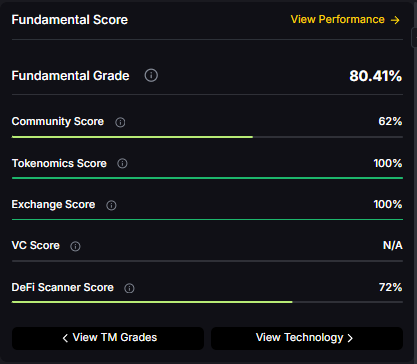
  • Fundamentals: Fundamental Grade 80.41% (Community 62%, Tokenomics 100%, Exchange 100%, VC —, DeFi Scanner 72%)
  • Technology: Technology Grade 29.63% (Activity 22%, Repository 70%, Collaboration 48%, Security —, DeFi Scanner 72%)
  • TM Agent gist: Neutral grade, bearish momentum in price prediction models; adoption must improve for upside
  • Education only, not financial advice

Bitcoin Cash Price Prediction Scenario Analysis

Token Metrics price prediction scenarios span four market cap tiers, each representing different levels of crypto market maturity and liquidity:

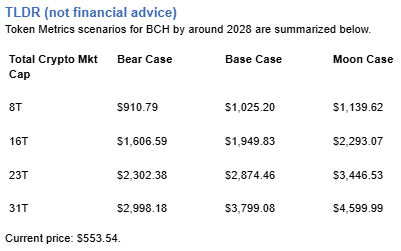
8T Market Cap - BCH Price Prediction:

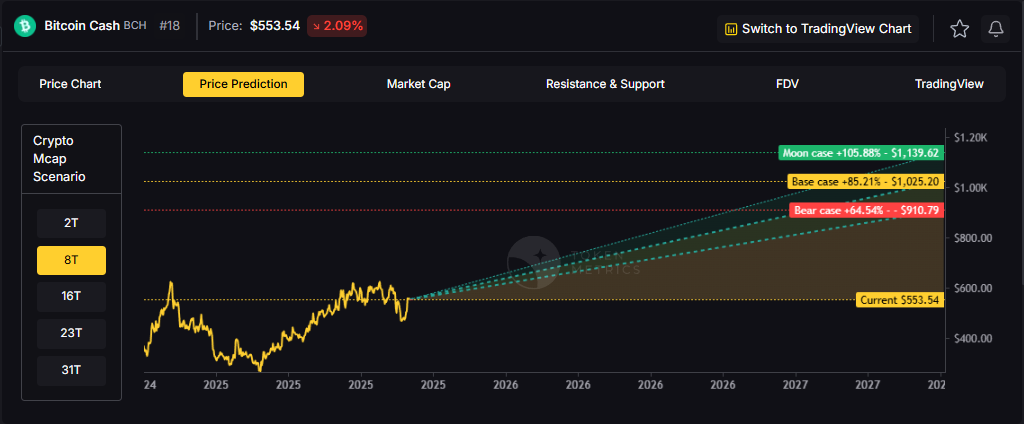
At an 8 trillion total crypto market cap, BCH price prediction projects to $910.79 in bear conditions, $1,025.20 in the base case, and $1,139.62 in bullish scenarios.

16T Market Cap - BCH Price Prediction:

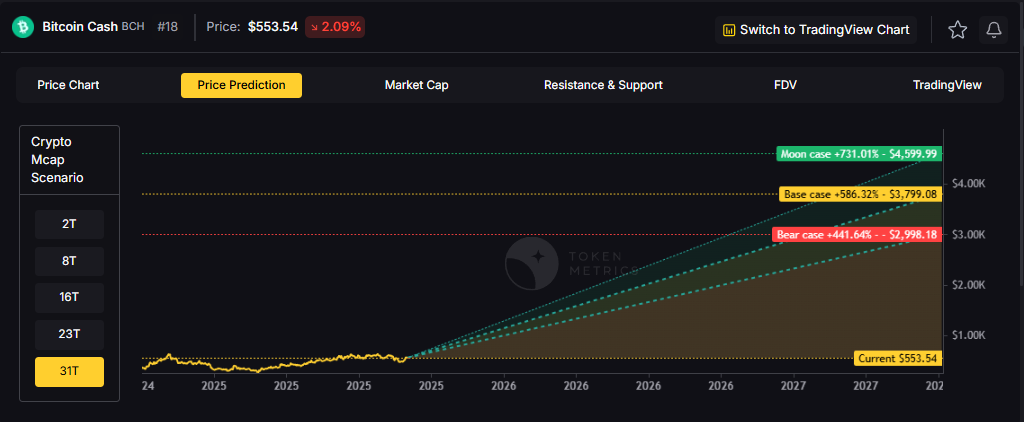
Doubling the market to 16 trillion expands the price prediction range to $1,606.59 (bear), $1,949.83 (base), and $2,293.07 (moon).

23T Market Cap - BCH Price Prediction:

At 23 trillion, the price prediction scenarios show $2,302.38, $2,874.46, and $3,446.53 respectively.

31T Market Cap - BCH Price Prediction:

In the maximum liquidity scenario of 31 trillion, BCH price predictions could reach $2,998.18 (bear), $3,799.08 (base), or $4,599.99 (moon).

Each tier in our price prediction framework assumes progressively stronger market conditions, with the base case reflecting steady growth and the moon case requiring sustained bull market dynamics.

Why Consider the Indices with Top-100 Exposure

Bitcoin Cash represents one opportunity among hundreds in crypto markets. Token Metrics Indices bundle BCH with top one hundred assets for systematic exposure to the strongest projects. Single tokens face idiosyncratic risks that diversified baskets mitigate.

Historical index performance demonstrates the value of systematic diversification versus concentrated positions.

Join the early access list

What Is Bitcoin Cash?

Bitcoin Cash is a peer-to-peer electronic cash network focused on fast confirmation and low fees. It launched in 2017 as a hard fork of Bitcoin with larger block capacity to prioritize payments. The chain secures value transfers using proof of work and aims to keep everyday transactions affordable.

BCH is used to pay transaction fees and settle transfers, and it is widely listed across major exchanges. Adoption centers on payments, micropayments, and remittances where low fees matter. It competes as a payment‑focused Layer 1 within the broader crypto market.

Token Metrics AI Analysis

Token Metrics AI provides comprehensive context on Bitcoin Cash's positioning and challenges, informing our price prediction models:

Vision: Bitcoin Cash (BCH) is a cryptocurrency that emerged from a 2017 hard fork of Bitcoin, aiming to function as a peer-to-peer electronic cash system with faster transactions and lower fees. It is known for prioritizing on-chain scalability by increasing block sizes, allowing more transactions per block compared to Bitcoin. This design choice supports its use in everyday payments, appealing to users seeking a digital cash alternative. Adoption has been driven by its utility in micropayments and remittances, particularly in regions with limited banking infrastructure. However, Bitcoin Cash faces challenges including lower network security due to reduced mining hash rate compared to Bitcoin, and ongoing competition from both Bitcoin and other scalable blockchains. Its value proposition centers on accessibility and transaction efficiency, but it operates in a crowded space with evolving technological and regulatory risks.

Problem: The project addresses scalability limitations in Bitcoin, where rising transaction fees and slow confirmation times hinder its use for small, frequent payments. As Bitcoin evolved into a store of value, a gap emerged for a blockchain-based currency optimized for fast, low-cost transactions accessible to the general public.

Solution: Bitcoin Cash increases block size limits from 1 MB to 32 MB, enabling more transactions per block and reducing congestion. This on-chain scaling approach allows for faster confirmations and lower fees, making microtransactions feasible. The network supports basic smart contract functionality and replay protection, maintaining compatibility with Bitcoin's core architecture while prioritizing payment utility.

Market Analysis: Bitcoin Cash operates in the digital currency segment, competing with Bitcoin, Litecoin, and stablecoins for use in payments and remittances. While not the market leader, it occupies a niche focused on on-chain scalability for transactional use. Its adoption is influenced by merchant acceptance, exchange liquidity, and narratives around digital cash. Key risks include competition from layer-2 solutions on other blockchains, regulatory scrutiny of cryptocurrencies, and lower developer and miner activity compared to larger networks. Price movements are often tied to broader crypto market trends and internal protocol developments. Despite its established presence, long-term growth depends on sustained utility, network security, and differentiation in a market increasingly dominated by high-throughput smart contract platforms—all critical factors in our price prediction analysis.

Fundamental and Technology Snapshot from Token Metrics

Fundamental Grade: 80.41% (Community 62%, Tokenomics 100%, Exchange 100%, VC —, DeFi Scanner 72%).


Technology Grade: 29.63% (Activity 22%, Repository 70%, Collaboration 48%, Security —, DeFi Scanner 72%).


Catalysts That Skew BCH Price Predictions Bullish

  • Institutional and retail access expands with ETFs, listings, and integrations
  • Macro tailwinds from lower real rates and improving liquidity
  • Product or roadmap milestones such as upgrades, scaling, or partnerships
  • Increased merchant adoption for payment processing
  • Growing adoption in remittance corridors and emerging markets
  • Layer-2 development enhancing BCH utility

Risks That Skew BCH Price Predictions Bearish

  • Macro risk-off from tightening or liquidity shocks
  • Regulatory actions targeting payment cryptocurrencies or infrastructure outages
  • Concentration risk in validator economics and competitive displacement
  • Low technology grade (29.63%) indicating development challenges
  • Competition from Bitcoin Lightning Network and other payment solutions
  • Declining developer activity and network effect

Bitcoin Cash Price Prediction FAQs

Can BCH reach $3,000?

Yes. Based on our price prediction scenarios, BCH could reach $3,000 in the 23T moon case and 31T base case. The 23T tier projects $3,446.53 in the moon case, making $3,000 an achievable target under favorable market conditions. Not financial advice.

Can BCH 10x from current levels?

At current price of $553.54, a 10x would reach $5,535.40. This falls beyond our highest price prediction scenario of $4,599.99 (31T moon case). Bear in mind that 10x returns would require substantial market cap expansion beyond our modeled scenarios and exceptional BCH adoption. Not financial advice.

Should I buy BCH now or wait?

Timing depends on your risk tolerance and macro outlook. Current price of $553.54 sits below the 8T bear case in our price prediction scenarios. The Neutral TM Grade (54.81%) and bearish trading signal suggest caution in the near term. Dollar-cost averaging may reduce timing risk. Not financial advice.

What is the Bitcoin Cash price prediction for 2025-2028?

Our comprehensive BCH price prediction framework suggests Bitcoin Cash could trade between $910.79 and $4,599.99 depending on market conditions and total crypto market capitalization. The base case price prediction scenario clusters around $1,025.20 to $3,799.08 across different market cap environments. Current Neutral rating (54.81%) indicates mixed signals requiring adoption improvements. Not financial advice.

Can Bitcoin Cash reach $5,000?

BCH reaching $5,000 would exceed our current price prediction models' highest scenario of $4,599.99 (31T moon case). This would require extraordinary market conditions, significant merchant adoption acceleration, and BCH successfully differentiating itself in the crowded payment cryptocurrency space. Not financial advice.

Is Bitcoin Cash a good investment based on price predictions?

BCH shows strong fundamentals (80.41% grade) but a very weak technology score (29.63%), resulting in a Neutral TM Grade of 54.81% with bearish near-term signals. While our price prediction models show potential upside in favorable market conditions, the low technology grade and adoption challenges suggest significant risks. The payment-focused use case faces competition from Lightning Network and other solutions. Not financial advice.

How does BCH compare to Bitcoin in price predictions?

Bitcoin Cash was designed as a payment-focused alternative to Bitcoin's store-of-value narrative. Our price prediction framework shows BCH could reach $1,025-$4,600 across scenarios, while Bitcoin dominates market cap and network effects. BCH's success depends on carving out a distinct payment niche rather than competing directly with Bitcoin. The correlation between BTC and BCH price movements remains high.

What are the biggest risks to BCH price predictions?

Key risks that could impact Bitcoin Cash price predictions include: extremely low technology grade (29.63%) indicating development stagnation, competition from Bitcoin Lightning Network, declining developer activity, regulatory targeting of payment cryptocurrencies, low mining hash rate security concerns, and competitive displacement from stablecoins and other payment solutions. The bearish trading signal and Neutral grade reflect these challenges.

Will BCH benefit from a Bitcoin bull run?

Historically, Bitcoin Cash has shown positive correlation with Bitcoin price movements. Our price prediction scenarios assume BCH captures some momentum from broader crypto market expansion. However, BCH's lower technology grade and adoption challenges may limit its ability to match Bitcoin's percentage gains. The base case scenarios reflect moderate participation in bull market dynamics.

Next Steps

Track live grades and signals

Join Indices Early Access

Want exposure? Buy BCH on MEXC

Disclosure

Educational purposes only, not financial advice. Crypto is volatile, do your own research and manage risk.

Why Use Token Metrics for BCH Price Predictions?

  • Scenario-based forecasting: Multiple market cap tiers for comprehensive price prediction analysis
  • Transparent grading: Fundamental (80.41%) vs Technology (29.63%) reveals strengths and weaknesses
  • AI-driven insights: Advanced algorithms analyze payment cryptocurrency competitive landscape
  • Real-time signals: Trading signals and TM Grades (Neutral 54.81%) updated regularly
  • Risk assessment: Identifies key risks like low developer activity and competitive pressure
  • Comparative analysis: Analyze BCH against Bitcoin, Litecoin, and 6,000+ tokens
Research

Chainlink Price Prediction 2027: Oracle Infrastructure Analysis

Token Metrics Team
8 min read

Understanding LINK Price Prediction: 2027 Potential

Infrastructure protocols become more valuable as the crypto ecosystem scales and relies on robust middleware. Chainlink provides critical oracle infrastructure where proven utility and deep integrations drive long-term value over retail speculation. Increasing institutional adoption raises demand for professional-grade data delivery and security.

Token Metrics price prediction projections for LINK below span multiple total market cap scenarios from conservative to aggressive. Each tier assumes different levels of infrastructure demand as crypto evolves from speculative markets to institutional-grade systems. These bands frame LINK's price prediction potential outcomes into 2027.

Disclosure

Educational purposes only, not financial advice. Crypto is volatile, do your own research and manage risk.

Token Metrics price prediction projections for LINK below span multiple total market cap scenarios from conservative to aggressive. Each tier assumes different levels of infrastructure demand as crypto evolves from speculative markets to institutional-grade systems. These bands frame LINK's price prediction potential outcomes into 2027.

Disclosure

Educational purposes only, not financial advice. Crypto is volatile, do your own research and manage risk.

How to Read This LINK Price Prediction

Each band blends cycle analogues and market-cap share math with TA guardrails. Base assumes steady adoption and neutral or positive macro. Moon layers in a liquidity boom. Bear assumes muted flows and tighter liquidity.

TM Agent baseline: Token Metrics lead metric for Chainlink, cashtag $LINK, is a TM Grade of 23.31%, which translates to a Sell, and the trading signal is bearish, indicating short-term downward momentum. This means Token Metrics currently does not endorse $LINK as a long-term buy at current conditions in our price prediction models, despite strong technology fundamentals.

Live details: Chainlink Token Details

Access: Buy LINK on MEXC

Affiliate Disclosure: We may earn a commission from qualifying purchases made via this link, at no extra cost to you.

Key Takeaways: Chainlink Price Prediction Summary

  • Scenario driven: Price prediction outcomes hinge on total crypto market cap; higher liquidity and adoption lift the bands
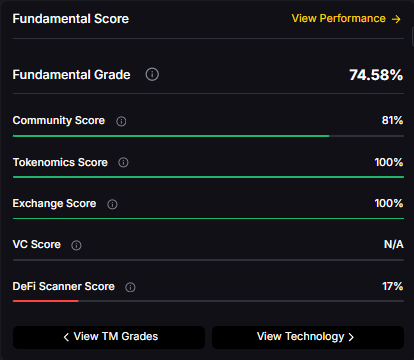
  • Fundamentals: Fundamental Grade 74.58% (Community 81%, Tokenomics 100%, Exchange 100%, VC —, DeFi Scanner 17%)
  • Technology: Technology Grade 88.50% (Activity 81%, Repository 72%, Collaboration 100%, Security 86%, DeFi Scanner 17%)
  • TM Agent gist: Bearish signal with limited upside in price prediction models unless fundamentals or market regime change
  • Current rating: Sell (23.31%) with strong tech but weak valuation
  • Education only, not financial advice

Chainlink Price Prediction Scenario Analysis

Token Metrics price prediction scenarios span four market cap tiers, each representing different levels of crypto market maturity and liquidity:

8T Market Cap - LINK Price Prediction:

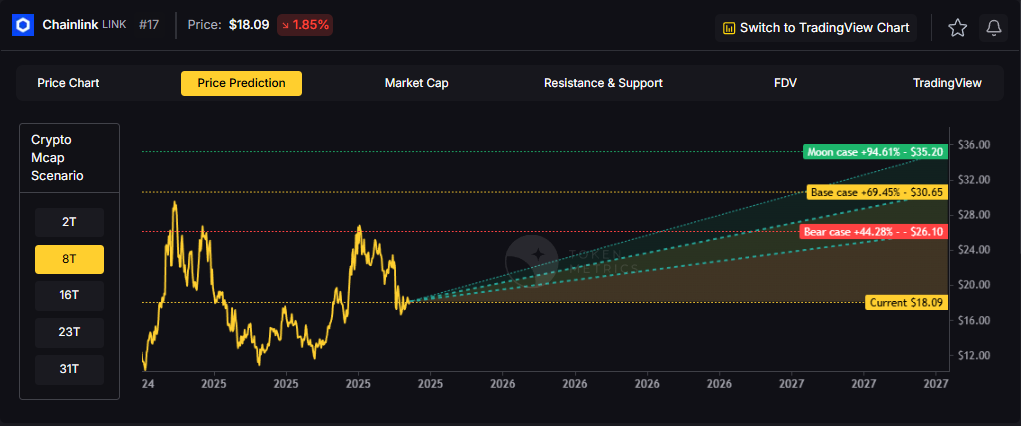
At an 8 trillion dollar total crypto market cap, LINK price prediction projects to $26.10 in bear conditions, $30.65 in the base case, and $35.20 in bullish scenarios.

 16T Market Cap - LINK Price Prediction:

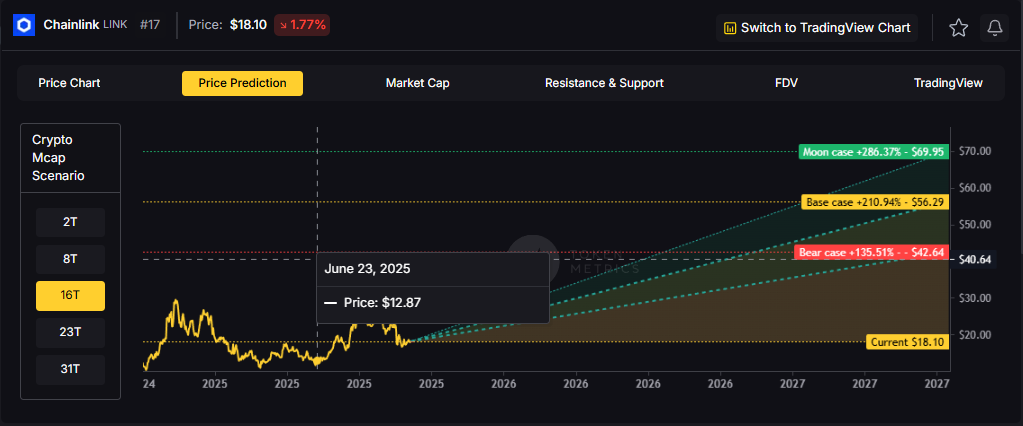
Doubling the market to 16 trillion expands the price prediction range to $42.64 (bear), $56.29 (base), and $69.95 (moon).

 23T Market Cap - LINK Price Prediction:

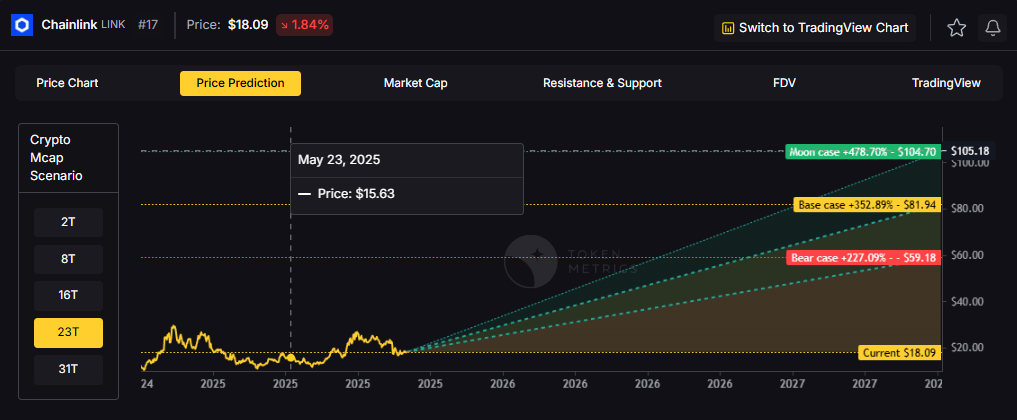
At 23 trillion, the price prediction scenarios show $59.18, $81.94, and $104.70 respectively.

 31T Market Cap - LINK Price Prediction:

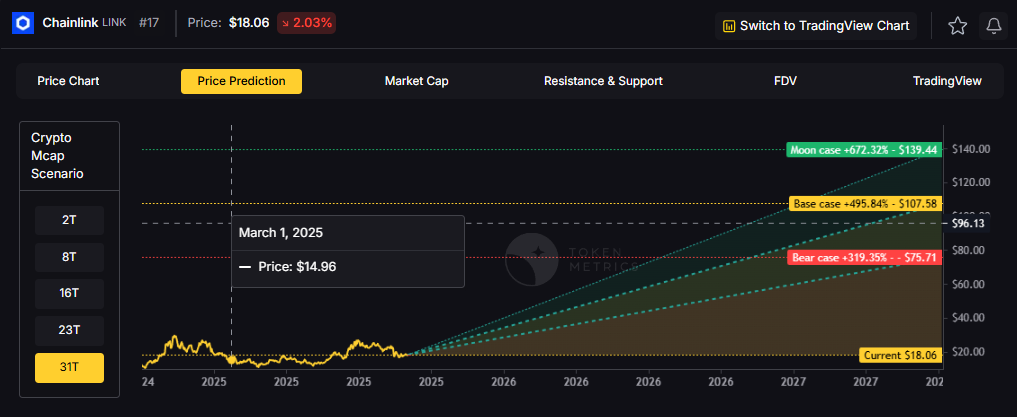
In the maximum liquidity scenario of 31 trillion, LINK price predictions could reach $75.71 (bear), $107.58 (base), or $139.44 (moon).

  These price prediction ranges reflect potential infrastructure value capture as crypto markets mature, though current valuation concerns contribute to the Sell rating despite strong technology fundamentals.

Why Consider the Indices with Top-100 Exposure

Chainlink represents one opportunity among hundreds in crypto markets. Token Metrics Indices bundle LINK with top one hundred assets for systematic exposure to the strongest projects. Single tokens face idiosyncratic risks that diversified baskets mitigate.

Historical index performance demonstrates the value of systematic diversification versus concentrated positions.

Join the early access list

What Is Chainlink?

Chainlink is a decentralized oracle network that connects smart contracts to real-world data and systems. It enables secure retrieval and verification of off-chain information, supports computation, and integrates across multiple blockchains. As adoption grows, Chainlink serves as critical infrastructure for reliable data feeds and automation.

The LINK token is used to pay node operators and secure the network's services. Common use cases include DeFi price feeds, insurance, and enterprise integrations, with CCIP extending cross-chain messaging and token transfers—all factors that influence long-term LINK price predictions.

Token Metrics AI Analysis

Token Metrics AI provides comprehensive context informing our LINK price prediction models:

Vision: Chainlink aims to create a decentralized, secure, and reliable network for connecting smart contracts with real-world data and systems. Its vision is to become the standard for how blockchains interact with external environments, enabling trust-minimized automation across industries.

Problem: Smart contracts cannot natively access data outside their blockchain, limiting their functionality. Relying on centralized oracles introduces single points of failure and undermines the security and decentralization of blockchain applications. This creates a critical need for a trustless, tamper-proof way to bring real-world information onto blockchains.

Solution: Chainlink solves this by operating a decentralized network of node operators that fetch, aggregate, and deliver data from off-chain sources to smart contracts. It uses cryptographic proofs, reputation systems, and economic incentives to ensure data integrity. The network supports various data types and computation tasks, allowing developers to build complex, data-driven decentralized applications.

Market Analysis: Chainlink is a market leader in the oracle space and a key infrastructure component in the broader blockchain ecosystem, particularly within Ethereum and other smart contract platforms. It faces competition from emerging oracle networks like Band Protocol and API3, but maintains a strong first-mover advantage and widespread integration across DeFi, NFTs, and enterprise blockchain solutions. Adoption is driven by developer activity, partnerships with major blockchain projects, and demand for secure data feeds. Key risks include technological shifts, regulatory scrutiny on data providers, and execution challenges in scaling decentralized oracle networks. As smart contract usage grows, so does the potential for oracle services, positioning Chainlink at the center of a critical niche, though its success depends on maintaining security and decentralization over time—all critical factors in our price prediction analysis.

Fundamental and Technology Snapshot from Token Metrics

Fundamental Grade: 74.58% (Community 81%, Tokenomics 100%, Exchange 100%, VC —, DeFi Scanner 17%).


Technology Grade: 88.50% (Activity 81%, Repository 72%, Collaboration 100%, Security 86%, DeFi Scanner 17%).

  Catalysts That Skew LINK Price Predictions Bullish

  • Institutional and retail access expands with ETFs, listings, and integrations
  • Macro tailwinds from lower real rates and improving liquidity
  • Product or roadmap milestones such as CCIP upgrades, scaling, or partnerships
  • Increased adoption of Chainlink oracle services across DeFi protocols
  • Enterprise blockchain integrations requiring secure data feeds
  • Cross-chain expansion through CCIP (Cross-Chain Interoperability Protocol)

Risks That Skew LINK Price Predictions Bearish

  • Macro risk-off from tightening or liquidity shocks
  • Regulatory actions targeting oracle networks or infrastructure outages
  • Concentration in node operator economics and competitive displacement
  • Current low TM Grade (23.31%) indicating valuation concerns
  • Competition from alternative oracle solutions (Band Protocol, API3)
  • Token economics challenges despite 100% tokenomics score

How Token Metrics Can Help

Token Metrics empowers you to analyze Chainlink and hundreds of digital assets with AI-driven ratings, on-chain and fundamental data, and index solutions to manage portfolio risk smartly in a rapidly evolving crypto market. Our price prediction frameworks provide transparent scenario-based analysis even for tokens with Sell ratings.

Chainlink Price Prediction FAQs

Can LINK reach $100?

Yes. Based on our price prediction scenarios, LINK could reach $100+ in the 23T moon case, projecting $104.70. However, this requires significant market cap expansion and improved market conditions beyond the current Sell rating (23.31%). Not financial advice.

What price could LINK reach in the moon case?

Moon case price predictions range from $35.20 at 8T to $139.44 at 31T total crypto market cap. These scenarios assume maximum liquidity expansion and strong Chainlink adoption, though current bearish signals suggest caution. Not financial advice.

Should I buy LINK now or wait?

Timing depends on risk tolerance and macro outlook. Current price of $18.09 sits below the 8T bear case in our price prediction scenarios, suggesting potential value. However, the Sell rating (23.31%) and bearish trading signal indicate Token Metrics does not currently endorse LINK at these levels. Dollar-cost averaging may reduce timing risk if you believe in long-term infrastructure value. Not financial advice.

What is the Chainlink price prediction for 2025-2027?

Our comprehensive LINK price prediction framework suggests Chainlink could trade between $26.10 and $139.44 depending on market conditions and total crypto market capitalization. The base case price prediction scenario clusters around $30.65 to $107.58 across different market cap environments. Despite strong technology (88.50%) and fundamentals (74.58%), the current Sell rating (23.31%) reflects valuation concerns. Not financial advice.

Can Chainlink reach $50?

Yes. Based on our price prediction scenarios, LINK could reach $56.29 in the 16T base case and higher in 23T/31T scenarios. The $50 target becomes achievable in moderate market cap environments (16T tier), though current bearish momentum suggests this may take time. Not financial advice.

Why does LINK have a Sell rating despite strong technology?

LINK shows excellent technology fundamentals (88.50% grade) with strong development activity, collaboration, and security. However, the overall TM Grade of 23.31% (Sell) reflects current valuation concerns, market positioning, and bearish trading signals. Our price prediction models show potential upside in favorable market conditions, but current metrics suggest waiting for improved entry points. Not financial advice.

Is Chainlink a good investment based on price predictions?

LINK presents a complex investment case: exceptional technology grade (88.50%), solid fundamentals (74.58%), but a Sell rating (23.31%) with bearish momentum. While our price prediction models show significant upside potential in bull market scenarios, current valuation concerns and bearish signals suggest caution. The oracle infrastructure thesis remains compelling long-term, but timing and entry points matter. Consider diversified exposure through indices. Not financial advice.

How does LINK compare to other oracle price predictions?

Chainlink dominates the oracle space with first-mover advantage and widespread integration. Our price prediction framework suggests LINK could reach $30-$139 across scenarios. Competitors like Band Protocol and API3 offer alternatives, but Chainlink's established network effects and enterprise partnerships position it as the infrastructure leader. However, the current Sell rating suggests valuation concerns versus alternatives.

What are the biggest risks to LINK price predictions?

Key risks that could impact Chainlink price predictions include: current Sell rating (23.31%) indicating valuation concerns, competition from emerging oracle networks, regulatory scrutiny on data providers, node operator centralization risks, macro liquidity shocks, and challenges scaling decentralized oracle infrastructure. Despite strong technology (88.50%), these factors contribute to bearish near-term outlook.

Will LINK benefit from DeFi growth?

Chainlink is critical infrastructure for DeFi, providing price feeds for lending protocols, derivatives, and stablecoins. Our price prediction scenarios assume LINK captures value from continued DeFi adoption. However, the current Sell rating suggests this thesis isn't reflected in valuation metrics yet. Long-term infrastructure value may require patience and improved market conditions.


Should I buy LINK now or wait?

Timing depends on risk tolerance and macro outlook. Current price of $18.09 sits below the 8T bear case in the scenarios. Dollar-cost averaging may reduce timing risk. Not financial advice.

Next Steps

Track live grades and signals: Token Details

Join Indices Early Access 

Want exposure? Buy LINK on MEXC 

Disclosure

Educational purposes only, not financial advice. Crypto is volatile, do your own research and manage risk.

Why Token Metrics Ratings Matter

Discover the full potential of your crypto research and portfolio management with Token Metrics. Our ratings combine AI-driven analytics, on-chain data, and decades of investing expertise—giving you the edge to navigate fast-changing markets. Try our platform to access scenario-based price prediction targets, token grades, indices, and more for institutional and individual investors. Token Metrics is your research partner through every crypto market cycle.

Why Use Token Metrics for LINK Price Predictions?

  • Transparent analysis: Honest Sell ratings (23.31%) even when technology fundamentals are strong (88.50%)
  • Scenario-based modeling: Multiple market cap tiers for comprehensive price prediction analysis
  • Infrastructure focus: Specialized oracle network analysis and competitive landscape assessment
  • Risk-adjusted approach: Balanced view of technology strength versus valuation concerns
  • Real-time signals: Trading signals and TM Grades updated regularly
  • Diversification tools: Index solutions to spread oracle infrastructure risk
  • Comparative analysis: Analyze LINK against Band Protocol, API3, and 6,000+ tokens
Research

Hyperliquid Price Prediction 2026: DEX Perpetuals Trading Analysis

Token Metrics Team
7 min read

Why 2026 Looks Bullish for HYPE Price Prediction: Market Context

The crypto market is tilting bullish into 2026 as liquidity, infrastructure, and participation improve across the board. Clearer rules and standards are reshaping the classic four-year cycle, flows can arrive earlier, and strength can persist longer than in prior expansions.

Institutional access is widening through ETFs and custody, while L2 scaling and real-world integrations help sustain on-chain activity. This healthier backdrop frames our price prediction scenario work for HYPE. The ranges below reflect different total crypto market sizes and the share Hyperliquid could capture under each regime, providing investors with comprehensive price prediction analysis for strategic planning.


Disclosure

Educational purposes only, not financial advice. Crypto is volatile, do your own research and manage risk.

How to Read This HYPE Price Prediction

Each band blends cycle analogues and market-cap share math with TA guardrails. Base assumes steady adoption and neutral or positive macro. Moon layers in a liquidity boom. Bear assumes muted flows and tighter liquidity.

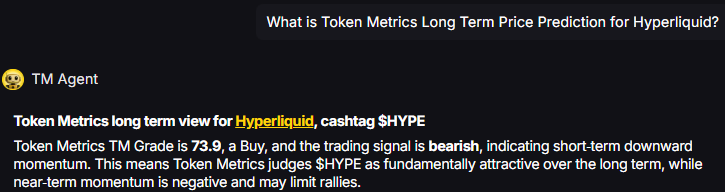
TM Agent baseline: Token Metrics TM Grade is 73.9%, a Buy, and the trading signal is bearish, indicating short-term downward momentum. This means Token Metrics judges HYPE as fundamentally attractive over the long term in our price prediction models, while near-term momentum is negative and may limit rallies.

Live details: Hyperliquid Token Details

Buy HYPE

Affiliate Disclosure: We may earn a commission from qualifying purchases made via this link, at no extra cost to you.

Key Takeaways: Hyperliquid Price Prediction Summary

  • Scenario driven: Price prediction outcomes hinge on total crypto market cap; higher liquidity and adoption lift the bands
  • Fundamentals: Fundamental Grade 76.73% (Community 68%, Tokenomics 60%, Exchange 100%, VC —, DeFi Scanner 92%)
  • Technology: Technology Grade N/A (Activity —, Repository —, Collaboration —, Security —, DeFi Scanner 92%)
  • TM Agent gist: Long-term attractive on fundamentals in price prediction models; near-term momentum is negative and may limit rallies
  • Current rating: Buy (73.9%) with bullish 2026 macro backdrop
  • Education only, not financial advice

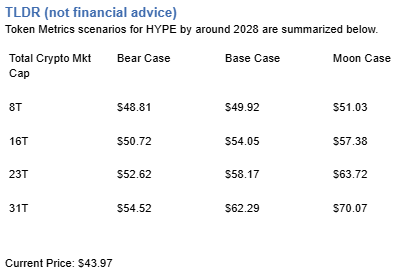
Hyperliquid Price Prediction Scenario Analysis

Token Metrics price prediction scenarios span four market cap tiers, each representing different levels of crypto market maturity and liquidity:

8T Market Cap - HYPE Price Prediction:

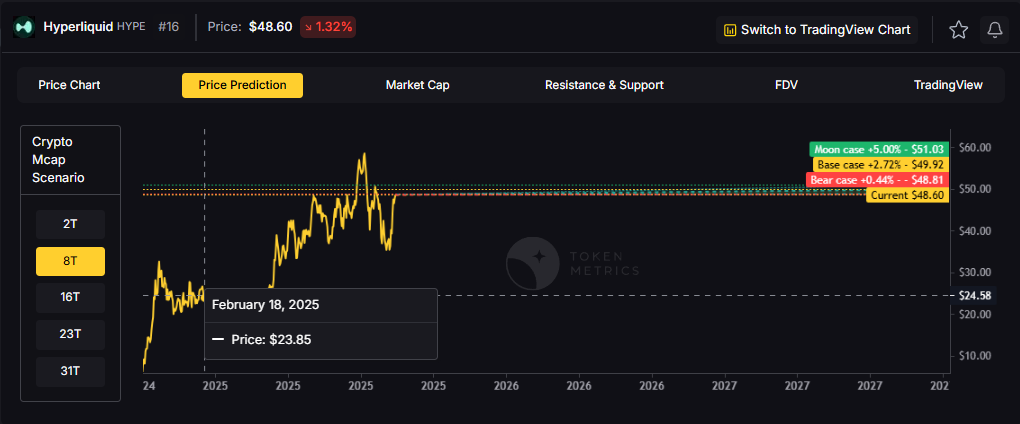
At an 8 trillion dollar total crypto market cap, HYPE price prediction projects to $48.81 in bear conditions, $49.92 in the base case, and $51.03 in bullish scenarios.

16T Market Cap - HYPE Price Prediction:

Doubling the market to 16 trillion expands the price prediction range to $50.72 (bear), $54.05 (base), and $57.38 (moon).

23T Market Cap - HYPE Price Prediction:

At 23 trillion, the price prediction scenarios show $52.62, $58.17, and $63.72 respectively.

31T Market Cap - HYPE Price Prediction:

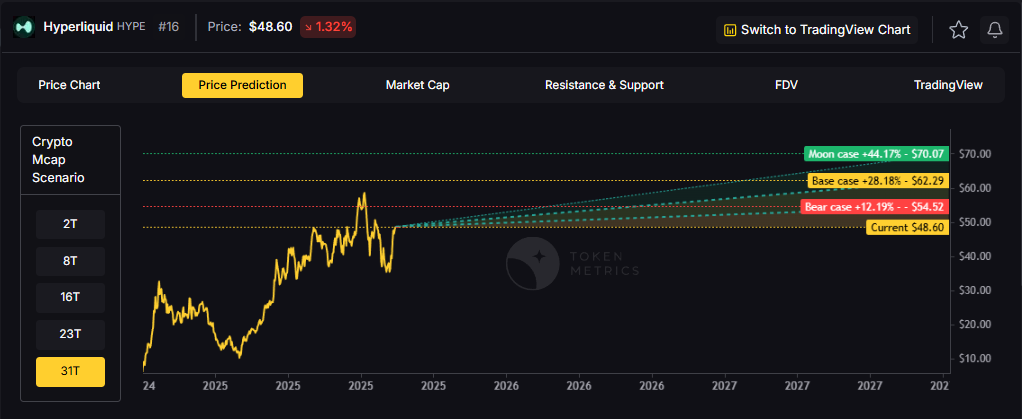
In the maximum liquidity scenario of 31 trillion, HYPE price predictions could reach $54.52 (bear), $62.29 (base), or $70.07 (moon).

Each tier in our price prediction framework assumes progressively stronger market conditions, with the base case reflecting steady growth and the moon case requiring sustained bull market dynamics driven by the improving 2026 macro environment.

Why Consider the Indices with Top-100 Exposure

Diversification matters. HYPE is compelling, yet concentrated bets can be volatile, especially when evaluating long-term price predictions. Token Metrics Indices hold HYPE alongside the top one hundred tokens for broad exposure to leaders and emerging winners.

Our backtests indicate that owning the full market with diversified indices has historically outperformed both the total market and Bitcoin in many regimes due to diversification and rotation benefits.

Get early access

What Is Hyperliquid?

Hyperliquid is a decentralized exchange focused on perpetual futures with a high-performance order book architecture. The project emphasizes low-latency trading, risk controls, and capital efficiency aimed at professional and retail derivatives traders. Its token, HYPE, is used for ecosystem incentives and governance-related utilities—all factors that directly influence HYPE price prediction trajectories.

Catalysts That Skew HYPE Price Predictions Bullish

  • Institutional and retail access expands with ETFs, listings, and integrations
  • Macro tailwinds from lower real rates and improving liquidity entering 2026
  • Product or roadmap milestones such as upgrades, scaling, or partnerships
  • Growing perpetual futures DEX market share
  • Increased professional trader adoption of decentralized derivatives
  • Integration with major DeFi protocols and liquidity aggregators
  • Favorable regulatory clarity for decentralized exchanges

Risks That Skew HYPE Price Predictions Bearish

  • Macro risk-off from tightening or liquidity shocks
  • Regulatory actions targeting decentralized derivatives platforms or infrastructure outages
  • Concentration risk in validator economics and competitive displacement
  • Competition from established centralized exchanges and other DEX perpetuals platforms
  • Technology grade unavailable (N/A), limiting technical assessment
  • Security vulnerabilities in order book or smart contract architecture

Hyperliquid Price Prediction FAQs

Can HYPE reach $60?

Yes. The 23T and 31T tiers in our price prediction models imply ranges above $60 in the Base and Moon bands, with the 23T moon case projecting $63.72 and the 31T base case projecting $62.29. These outcomes depend on liquidity and adoption improvements expected in the bullish 2026 environment. Not financial advice.

Is HYPE a good long-term investment?

HYPE shows a strong Buy rating (73.9%) with solid fundamentals (76.73%), suggesting long-term attractiveness. However, the outcome depends on adoption, liquidity regime, competition in the perpetual DEX space, and supply dynamics. The bearish near-term trading signal suggests potential volatility. Diversify and size positions responsibly. Not financial advice.

What is the Hyperliquid price prediction for 2026?

Our comprehensive HYPE price prediction framework for 2026 suggests Hyperliquid could trade between $48.81 and $70.07 depending on market conditions and total crypto market capitalization. The base case price prediction scenario clusters around $49.92 to $62.29 across different market cap environments. The Buy rating (73.9%) reflects confidence in the bullish 2026 macro backdrop. Not financial advice.

Can HYPE reach $100?

HYPE reaching $100 would exceed our current price prediction models' highest scenario of $70.07 (31T moon case). This would require extraordinary market conditions beyond the 31T total crypto market cap tier, exceptional perpetual DEX adoption, and Hyperliquid dominating the decentralized derivatives space. While the 2026 bullish thesis supports growth, $100 appears beyond our modeled scenarios. Not financial advice.

Should I buy HYPE now or wait?

HYPE has a Buy rating (73.9%) indicating long-term attractiveness in our price prediction models. However, the bearish trading signal suggests near-term downward momentum. Current price positioning and the expected bullish 2026 environment create a complex timing decision. Dollar-cost averaging may reduce timing risk while capturing upside exposure. Consider diversified DEX exposure through indices. Not financial advice.

How does HYPE compare to other DEX price predictions?

Hyperliquid focuses specifically on perpetual futures with order book architecture, differentiating it from AMM-based DEXs like Uniswap or dYdX. Our price prediction framework suggests HYPE could reach $49-$70 across scenarios in 2026. The Buy rating (73.9%) and strong fundamentals (76.73%) position HYPE competitively, though the lack of technology grade data (N/A) limits comparative technical assessment.

What makes 2026 bullish for HYPE price predictions?

Multiple factors support bullish HYPE price predictions for 2026: widening institutional access through ETFs and custody solutions, L2 scaling improvements, clearer regulatory frameworks, improving macro liquidity conditions, and the maturation of decentralized derivatives markets. These tailwinds create favorable conditions for perpetual DEX platforms like Hyperliquid to capture market share. Not financial advice.

Why is HYPE rated Buy despite bearish trading signals?

HYPE receives a Buy rating (73.9%) based on strong fundamental grade (76.73%) and favorable long-term positioning in the growing perpetual DEX space. However, the bearish trading signal reflects short-term downward momentum. This creates a classic "buy the dip" scenario where fundamentals suggest long-term value but near-term price action may provide better entry points. Our price prediction models reflect this nuance. Not financial advice.

What are the biggest risks to HYPE price predictions?

Key risks that could impact Hyperliquid price predictions include: unavailable technology grade (N/A) limiting technical assessment, competition from established centralized exchanges (Binance, OKX) and other perpetual DEXs (dYdX, GMX), regulatory targeting of decentralized derivatives, order book architecture vulnerabilities, liquidity fragmentation across perpetual platforms, and macro liquidity shocks. Despite the Buy rating, these risks warrant careful position sizing.

Can HYPE benefit from the 2026 bull market?

Yes. Our price prediction scenarios are specifically framed around the bullish 2026 thesis, where improving liquidity, institutional participation, and regulatory clarity create favorable conditions. HYPE's Buy rating (73.9%) reflects this positive macro backdrop. The base case scenarios ($49.92 to $62.29) assume steady participation in bull market dynamics, while moon cases require sustained momentum. Not financial advice.


Next Steps

Disclosure

Educational purposes only, not financial advice. Crypto is volatile, do your own research and manage risk.

Your Edge: Powered by Token Metrics

Token Metrics delivers AI-based crypto ratings, scenario-based price prediction projections, and portfolio tools so you can make smarter decisions. Discover real-time analytics on Token Metrics.

Why Use Token Metrics for HYPE Price Predictions?

  • Bullish 2026 thesis: Specialized analysis of improving macro conditions and institutional access
  • Scenario-based modeling: Four market cap tiers for comprehensive price prediction analysis
  • Buy rating transparency: Strong fundamentals (76.73%) balanced with bearish near-term signals
  • DEX specialization: Focused analysis of perpetual futures DEX competitive landscape
  • Risk management: Indices for diversified exposure beyond single DEX concentration
  • Real-time signals: Trading signals and TM Grades (Buy 73.9%) updated regularly
  • Comparative analysis: Analyze HYPE against dYdX, GMX, and 6,000+ tokens
Choose from Platinum, Gold, and Silver packages
Reach with 25–30% open rates and 0.5–1% CTR
Craft your own custom ad—from banners to tailored copy
Perfect for Crypto Exchanges, SaaS Tools, DeFi, and AI Products