Back to blog
Research

Best Play to Earn Crypto Games in 2025: Top Blockchain Games Rewarding Players with Real Value

Discover the top play-to-earn crypto games of 2025, where blockchain technology rewards players with real value. Explore the best options now!
Token Metrics Team
8 min
Want Smarter Crypto Picks—Free?
See unbiased Token Metrics Ratings for BTC, ETH, and top alts.
Thank you! Your submission has been received!
Oops! Something went wrong while submitting the form.
 No credit card | 1-click unsubscribe

The gaming landscape has fundamentally transformed, with blockchain technology enabling players to earn real cryptocurrency and own valuable digital assets through gameplay. Unlike traditional games where in game items remain locked within a single ecosystem, play to earn games offer true ownership and the ability to generate income while enjoying immersive gameplay.

In 2025, the play to earn sector has matured significantly, moving beyond early experimental models to establish sustainable economies that reward skilled players with genuine value. These blockchain games combine entertaining gameplay mechanics with tokenized economies, creating virtual worlds where players compete, complete quests, and trade virtual assets for real world value.

This comprehensive guide explores the best play to earn crypto games currently rewarding players with substantial returns, examining their earning mechanisms, entry requirements, and long-term potential. Whether you’re a casual gamer seeking passive income or a dedicated player looking to maximize crypto rewards, understanding these top blockchain games will help you make informed decisions about where to invest your time and resources.

What Are Play-to-Earn Games and How They Work in 2025

Play to earn games represent a revolutionary shift in the gaming industry, utilizing blockchain technology to create decentralized virtual worlds where players truly own their in game assets. Unlike traditional games where purchased items belong to the game publisher, P2E games grant players complete ownership through non fungible tokens and smart contracts.

The core mechanism behind these crypto games involves rewarding players with the game’s native token for various in game actions. Players earn money by winning battles, completing missions, trading virtual land, or participating in the game’s economy through staking and governance activities. These digital assets can be freely traded on decentralized marketplaces, with values determined by player demand and asset rarity.

Earning Mechanisms in Modern P2E Games

Today’s best play to earn games offer multiple revenue streams beyond simple gameplay rewards. Players collect rare NFT items through exploration and combat, participate in tournament prizes, and benefit from the appreciation of virtual real estate investments. Some games reward community participation, while others offer passive income through staking mechanisms.

The tokenized nature of these gaming economies means that skilled players can earn rewards comparable to part-time employment. Virtual economies operate independently of traditional gaming companies, with in game currencies maintaining real world value through cryptocurrency exchanges and peer-to-peer trading.

Advanced players often diversify across multiple blockchain based games, treating their gaming activities as a portfolio of crypto tokens and virtual assets. This approach helps mitigate the volatility inherent in individual game’s ecosystems while maximizing overall earning potential.

Top 10 Best Play-to-Earn Crypto Games in 2025

The following blockchain games represent the most lucrative and sustainable earning opportunities available to players in 2025. Each game operates on proven economic models with active player bases and consistent reward distribution.

Axie Infinity - The Pioneer P2E Game Still Paying in 2025

Axie Infinity remains the gold standard among play to earn games, maintaining over one million active players and a robust economy built around collecting, breeding, and battling NFT creatures. Players earn Smooth Love Potion (SLP) through daily activities and Axie Infinity Shards (AXS) through competitive gameplay and governance participation.

The game operates on the Ronin blockchain, a custom Ethereum sidechain that enables low cost transactions without the prohibitive gas fees associated with mainnet Ethereum. This infrastructure allows players to complete in game transactions efficiently while maintaining the security benefits of blockchain technology.

Recent updates have introduced free starter Axies, significantly lowering the barrier to entry for new players. Skilled competitors can earn between $2-20 daily, depending on their rank, daily activity level, and current token market prices. The game’s universe continues expanding with new gameplay modes and economic mechanisms designed to ensure long-term sustainability.

Community-led guilds have emerged as a professional layer within axie infinity, pooling resources and sharing strategies to optimize earning potential. These organizations often provide scholarships to new players, splitting earnings in exchange for providing initial investment capital.

The Sandbox - Create and Earn in the Blockchain Metaverse

The Sandbox represents the pinnacle of virtual world games, offering players the opportunity to own, develop, and monetize virtual real estate through LAND NFTs. This decentralized virtual world operates on a creator-driven economy where users build games, host events, and trade virtual land for substantial profits.

The SAND token serves multiple functions within the game’s ecosystem, facilitating governance decisions, staking rewards, and all marketplace transactions. Players generate income through land appreciation, rental fees, and creating monetizable experiences using the integrated game maker tools.

Major brand partnerships with celebrities and entertainment companies have driven significant value appreciation for prime virtual real estate locations. Early investors in strategic LAND parcels have seen substantial returns as the platform’s user base expanded throughout 2024 and 2025.

Content creators particularly benefit from The Sandbox’s monetization model, as the VoxEdit and Game Maker tools enable the creation and sale of custom NFT assets. The platform’s emphasis on user-generated content ensures a constantly evolving virtual world with new earning opportunities.

Illuvium - AAA Open World RPG with NFT Creature Collection

Illuvium delivers AAA-quality open world exploration combined with sophisticated NFT creature collection mechanics. This open world rpg rewards players with ILV tokens for PvE exploration, PvP battles, and participating in the game’s evolving narrative.

Built on Immutable X, Illuvium ensures gas-free NFT transactions while maintaining Ethereum-level security. This technical infrastructure removes one of the primary barriers that prevent casual gamers from participating in blockchain games, as players never worry about transaction costs eating into their earnings.

The free to play model welcomes all players, while premium features like rare creature minting and high-stakes tournaments offer enhanced earning potential for those willing to make an initial investment. Beta testing throughout early 2025 demonstrated strong player engagement and consistent NFT trading volume.

Staking ILV tokens provides additional passive income streams, with rewards distributed to holders who commit to long-term ecosystem participation. The combination of active gameplay rewards and passive staking returns creates multiple paths to profitability within the game’s universe.

Big Time - Free-to-Play MMORPG with Cosmetic NFT Economy

Big Time combines fast-paced MMORPG action with a sophisticated cosmetic NFT economy that rewards skilled players without requiring upfront investment. Players earn BIGTIME tokens through dungeon raids, crafting activities, and participating in the game’s player-driven marketplace.

The game’s emphasis on cosmetic NFTs rather than pay-to-win mechanics ensures that success depends on player skill rather than wallet size. SPACE NFTs function as virtual real estate, enabling owners to operate shops and benefit from marketplace transaction fees.

Operating on Ethereum with Open Loot integration, Big Time offers interoperability with other blockchain games and easy asset trading. The free to play nature attracts a broad audience, while the earning potential keeps dedicated players engaged long-term.

Community events and seasonal content updates provide regular opportunities for earning limited-edition NFTs and bonus token rewards. The game’s economy balances accessibility for newcomers with substantial earning potential for dedicated players.

Gods Unchained - Strategic Trading Card Game with Real Ownership

Gods Unchained stands out among trading card games by offering complete ownership of digital cards through NFT technology. Players earn GODS tokens through ranked matches, tournament participation, and strategic card trading on the game’s marketplace.

The free to play entry removes financial barriers while maintaining competitive depth that rewards strategic thinking and deck-building skills. Monthly tournaments feature substantial prize pools, with skilled players earning significant crypto rewards through competitive play.

Card forging mechanics allow players to combine multiple copies into higher-rarity versions, creating additional value through strategic collection management. The professional esports scene surrounding Gods Unchained provides aspirational earning targets for dedicated competitive players.

Unlike traditional collectible card games, players retain full ownership of their collections and can freely trade or sell cards outside the game’s ecosystem. This true ownership model ensures that time invested in building collections maintains real world value.

Splinterlands - Decentralized Card Battle Strategy

Splinterlands operates as a decentralized card battle game on the Hive blockchain, rewarding players with Dark Energy Crystals (DEC) and Splintershards (SPS) through competitive battles and tournament participation. The game’s economy supports multiple earning streams including card rental, tournament prizes, and staking rewards.

The low-cost blockchain infrastructure enables frequent transactions without prohibitive fees, making it accessible to players regardless of their initial investment level. Daily quests and seasonal rewards provide consistent earning opportunities for active players.

Guild participation adds a social layer to earnings, with collaborative events and shared rewards encouraging community engagement. The decentralized autonomous organization structure gives players governance rights proportional to their SPS holdings.

Star Atlas - Space Exploration MMORPG

Star Atlas combines MMORPG mechanics with economic strategy in a space exploration setting. Players earn through resource mining, interstellar trade, and PvP combat while building fleets and establishing territorial control.

Operating on the Solana blockchain ensures fast transaction processing and low fees, crucial for the real-time economic activities that drive the game’s universe. The medium-to-high entry cost reflects the game’s sophisticated graphics and complex economic systems.

Pixels - Social Farming Metaverse

Pixels offers a casual approach to play to earn gaming through farming simulation and social interaction. The large free to play component makes it accessible to newcomers, while the item crafting and trading systems provide earning opportunities for dedicated players.

My Neighbor Alice - Creative Building and Social Gaming

My Neighbor Alice focuses on creative building and social interaction within a charming virtual world. Players earn through NFT land ownership, item creation, and participating in community events.

Gunz - AAA Battle Royale with Crypto Rewards

Gunz delivers competitive battle royale action with tokenized rewards and NFT weapon systems. The high-quality graphics and intense gameplay attract traditional gamers while the crypto economy provides earning incentives.

Blockchain Platforms Supporting P2E Games in 2025

The infrastructure supporting play to earn games has evolved dramatically, with multiple blockchain platforms offering distinct advantages for different gaming experiences. Understanding these platforms helps players choose games that align with their technical preferences and economic goals.

Ethereum remains the most established platform for NFT games, though high gas fees necessitate Layer 2 solutions for practical gameplay. Polygon provides a popular alternative with low transaction costs and high throughput, making it ideal for games requiring frequent player interactions.

Immutable X has emerged as a preferred platform for AAA-quality games, offering instant, gas-free NFT trading through zero-knowledge rollup technology. This infrastructure removes traditional blockchain friction while maintaining Ethereum-level security.

Solana excels in supporting real-time gaming applications through its high-speed transaction processing, though the ecosystem remains smaller than Ethereum-based alternatives. The Ronin blockchain, purpose-built for gaming, demonstrates how specialized infrastructure can optimize the player experience.

Cross-chain compatibility has become increasingly important, with leading games supporting multiple blockchains to capture broader audiences. This trend toward interoperability benefits players by providing more options for asset management and trading.

How to Start Playing and Earning from P2E Games

Entering the play to earn ecosystem requires careful preparation and strategic thinking. Success begins with establishing secure cryptocurrency wallets and understanding basic blockchain security principles before committing significant time or resources.

Essential Setup Requirements

New players must first secure a compatible cryptocurrency wallet, typically MetaMask for Ethereum-based games or specialized wallets like Ronin for specific ecosystems. Understanding private key management and recognizing common scams protects investments and prevents costly mistakes.

Research represents the most critical initial step, as the quality and sustainability of P2E games vary dramatically. Investigating team backgrounds, reading community feedback, and analyzing tokenomics helps identify legitimate projects with long-term potential.

Choosing Your First Game

Budget considerations should guide initial game selection, as entry costs range from completely free to thousands of dollars for premium NFT collections. Beginning with free to play options allows newcomers to understand P2E mechanics without financial risk.

Time commitment varies significantly between games, with some requiring daily attention while others generate passive income through staking mechanisms. Aligning game selection with available time ensures sustainable participation and consistent earning potential.

Risk management principles apply to P2E gaming just as they do to traditional investing. Never invest more than you can afford to lose, diversify across multiple games and assets, and maintain realistic expectations about earning potential.

Maximizing Earnings from Play-to-Earn Games

Advanced players employ sophisticated strategies to optimize their earning potential across multiple blockchain games and economic mechanisms. Understanding market dynamics, timing, and diversification principles significantly impacts long-term profitability.

Advanced Earning Strategies

NFT flipping requires market knowledge and timing skills, as players identify undervalued assets and sell during demand spikes. Successful flippers study game updates, monitor community sentiment, and understand rarity mechanics that drive asset values.

Staking and yield farming provide passive income streams that complement active gameplay earnings. Many games offer staking rewards for holding native tokens, while DeFi integration enables additional yield through liquidity provision.

Guild participation often multiplies individual earning potential through resource sharing, collaborative strategies, and bulk purchasing power. Experienced guilds provide education and support while offering profit-sharing arrangements for contributed assets.

Market Timing and Portfolio Management

Understanding market cycles helps players optimize when to sell earned tokens and NFTs for maximum value. Cryptocurrency markets exhibit cyclical behavior, and timing major sales during favorable conditions significantly impacts overall returns.

Diversification across multiple gaming ecosystems reduces risk while providing exposure to different earning mechanisms. Balancing high-risk, high-reward investments with stable, consistent earners creates more predictable income streams.

Community engagement often correlates with earning success, as active participants gain early access to new features, airdrops, and exclusive opportunities. Building reputation within gaming communities opens doors to additional earning possibilities.

P2E Game Types and Earning Opportunities in 2025

The diversity of play to earn games ensures opportunities for players with different preferences, skill levels, and time commitments. Understanding various game categories helps players identify the most suitable earning opportunities.

Mobile Gaming and Accessibility

Mobile devices have become increasingly important platforms for P2E games, offering accessibility and convenience for casual gamers. These games typically feature lower entry barriers and simplified mechanics while still providing legitimate earning opportunities.

Location-based games utilize smartphone capabilities to create unique earning experiences tied to real-world movement and social interaction. These hybrid experiences attract players who prefer active, outdoor gaming combined with crypto rewards.

Competitive Gaming and Esports

Strategy games and collectible card games reward skill development and strategic thinking with substantial tournament prizes and ranking-based rewards. Professional players in these categories often earn amounts comparable to traditional employment through dedicated practice and competition.

Racing games and battle royale titles attract players seeking fast-paced action combined with competitive earning potential. These games often feature shorter play sessions while maintaining meaningful reward systems.

First-person shooters and fighting games appeal to traditional gamers while introducing crypto economics through weapon skins, character customization, and tournament participation.

Virtual World Development

Virtual worlds and metaverse platforms offer unique earning opportunities through content creation, event hosting, and virtual real estate development. Creative players can monetize their building and design skills while participating in expanding digital economies.

Social gaming elements within virtual worlds create earning opportunities through community management, education, and facilating trade between other players. These service-based earnings complement traditional gameplay rewards.

DeFi Integration and Financial Gaming

Games incorporating decentralized finance protocols enable players to earn through liquidity provision, lending, and complex financial strategies. These hybrid applications attract players interested in both gaming and DeFi yield optimization.

Governance participation in DAO-structured games provides additional earning streams through voting rewards and proposal creation. Engaged community members benefit from platform development decisions while earning governance tokens.

Risks and Challenges in Play-to-Earn Gaming

While P2E gaming offers legitimate earning opportunities, players must understand and manage significant risks that can impact their investments and time commitments. Market volatility remains the most immediate concern, as token values fluctuate based on broader cryptocurrency market conditions and game-specific developments.

Economic and Market Risks

Token price volatility can dramatically impact daily earnings, with successful players one day earning substantial amounts while facing minimal returns during market downturns. This unpredictability makes P2E gaming unsuitable as a primary income source without careful risk management.

Inflation pressures within individual game economies can erode earning power over time if developers fail to balance token supply and demand effectively. Games like Axie Infinity have demonstrated both the potential and challenges of maintaining sustainable economic models.

Technical and Security Challenges

Smart contract vulnerabilities pose risks to player assets, as bugs or exploits can result in permanent loss of valuable NFTs and tokens. Choosing games with audited contracts and established security track records reduces but doesn’t eliminate these risks.

Wallet security remains a constant concern, as players must protect private keys while frequently interacting with multiple blockchain applications. Understanding common attack vectors and maintaining proper security hygiene prevents costly mistakes.

Regulatory and Legal Considerations

Regulatory uncertainty across different jurisdictions creates potential compliance challenges for players earning significant amounts through P2E gaming. Tax implications vary by location and may require professional guidance for substantial earners.

Some regions classify P2E tokens as securities or gambling instruments, potentially restricting access or creating legal complications for participants. Staying informed about local regulations helps players maintain compliance while participating in global gaming economies.

Project Quality and Longevity

The P2E space contains numerous low-quality projects and outright scams designed to exploit inexperienced players. Due diligence requirements include researching development teams, analyzing tokenomics, and evaluating community sentiment before investing time or money.

Rug pulls and abandoned projects represent significant risks, as developers may abandon games after collecting initial investments from players. Diversification and skeptical evaluation help mitigate these risks while identifying legitimate opportunities.

Future of Play-to-Earn Games and Blockchain Gaming

The evolution of blockchain gaming points toward increasingly sophisticated experiences that blur the lines between traditional gaming and decentralized finance. Technological improvements in blockchain infrastructure continue reducing barriers while enabling more complex gaming economies.

Technological Advancements

Layer 2 scaling solutions and alternative blockchains are making P2E games more accessible by reducing transaction costs and increasing speed. These improvements enable real-time gaming experiences without the friction historically associated with blockchain interactions.

Integration of artificial intelligence and machine learning creates dynamic game economies that automatically balance supply and demand for virtual assets. These systems help maintain stable earning opportunities while adapting to changing player behavior patterns.

Cross-chain interoperability allows players to move assets between different games and platforms, creating a more connected ecosystem of virtual worlds. This development increases asset utility while reducing the risk of being locked into a single game’s economy.

Mainstream Adoption Trends

Traditional gaming companies are increasingly experimenting with blockchain integration, bringing established intellectual properties and professional development resources to the P2E space. This mainstream adoption validates the model while improving overall game quality.

Mobile gaming platforms are incorporating P2E mechanics into existing successful games, exposing millions of traditional players to crypto earning opportunities. This trend accelerates adoption while reducing the learning curve for new participants.

Economic Model Evolution

Sustainable tokenomics models are emerging that balance player earning potential with long-term game viability. These systems incorporate dynamic adjustment mechanisms that respond to economic conditions while maintaining incentive structures.

Integration with broader DeFi ecosystems enables more sophisticated financial strategies within gaming contexts. Players can participate in lending, borrowing, and yield farming using their gaming assets as collateral or liquidity sources.

The development of gaming-specific financial infrastructure, including specialized insurance products and asset management tools, supports the maturation of P2E as a legitimate earning category. These services reduce risks while improving the overall player experience.

Getting Started: Your P2E Gaming Journey

Success in play to earn gaming requires a strategic approach that balances earning potential with risk management and personal enjoyment. Starting with thorough research and modest investments allows players to develop skills and understanding before committing significant resources.

Choose games that align with your interests and available time, as sustainable earning requires consistent participation over extended periods. The most successful P2E players treat their gaming activities as both entertainment and investment, maintaining realistic expectations while pursuing optimization strategies.

Focus on learning game mechanics, understanding economic systems, and building relationships within gaming communities. These foundational elements support long-term success regardless of short-term market fluctuations or individual game performance.

Consider P2E gaming as part of a diversified approach to cryptocurrency exposure rather than a primary income source. This perspective helps maintain proper risk management while taking advantage of the unique opportunities that blockchain games provide.

The future of gaming increasingly includes player ownership, decentralized economies, and real value creation through virtual activities. By starting your journey now with careful preparation and realistic expectations, you position yourself to benefit from the continued evolution of this revolutionary gaming model.

Remember that the best play to earn crypto games reward dedicated players who understand their mechanics, participate actively in their communities, and adapt to changing market conditions. Success comes through persistence, education, and strategic thinking rather than quick profits or speculation.

Begin with free to play options to minimize risk while gaining experience, then gradually expand your participation as you develop skills and understanding. The blockchain gaming ecosystem offers unprecedented opportunities for players willing to invest the time and effort required to master these new economic models.

Build Smarter Crypto Apps &
AI Agents in Minutes, Not Months
Real-time prices, trading signals, and on-chain insights all from one powerful API.
Grab a Free API Key
About Token Metrics
Token Metrics: AI-powered crypto research and ratings platform. We help investors make smarter decisions with unbiased Token Metrics Ratings, on-chain analytics, and editor-curated “Top 10” guides. Our platform distills thousands of data points into clear scores, trends, and alerts you can act on.
30 Employees
analysts, data scientists, and crypto engineers
Daily Briefings
concise market insights and “Top Picks”
Transparent & Compliant
Sponsored ≠ Ratings; research remains independent
Want Smarter Crypto Picks—Free?
See unbiased Token Metrics Ratings for BTC, ETH, and top alts.
Thank you! Your submission has been received!
Oops! Something went wrong while submitting the form.
 No credit card | 1-click unsubscribe
Token Metrics Team
Token Metrics Team

Recent Posts

Research

Cardano Price Prediction 2027: Layer-1 Research-Driven Analysis

Token Metrics Team
7 min read

Market Context for Cardano Price Prediction: The Case for 2027

The Layer 1 competitive landscape is consolidating as markets recognize that specialization matters more than being a generic "Ethereum killer." Cardano positions itself in this multi-chain world with specific technical and ecosystem advantages. Infrastructure maturity around custody, bridges, and developer tools makes alternative L1s more accessible heading into 2026.

The Cardano price prediction scenario projections below map different market share outcomes for ADA across varying total crypto market sizes. Base cases assume Cardano maintains current ecosystem momentum, while moon scenarios factor in accelerated adoption and bear cases reflect increased competitive pressure. Our comprehensive price prediction framework provides investors with data-driven forecasts for strategic planning.


Disclosure

Educational purposes only, not financial advice. Crypto is volatile, do your own research and manage risk.

How to Read This ADA Price Prediction

Each band blends cycle analogues and market-cap share math with TA guardrails. Base assumes steady adoption and neutral or positive macro. Moon layers in a liquidity boom. Bear assumes muted flows and tighter liquidity.

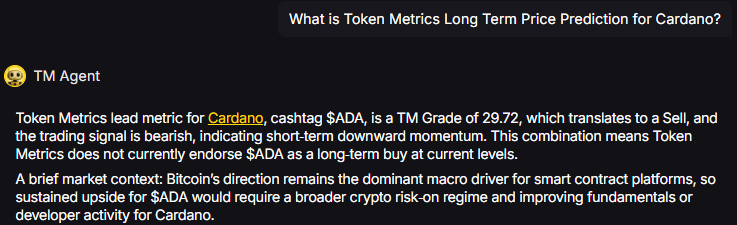
TM Agent baseline: Token Metrics lead metric for Cardano, cashtag $ADA, is a TM Grade of 29.72%, which translates to a Sell, and the trading signal is bearish, indicating short-term downward momentum. This combination means Token Metrics does not currently endorse $ADA as a long-term buy at current levels in our price prediction models. A brief market context: Bitcoin's direction remains the dominant macro driver for smart contract platforms, so sustained upside for $ADA would require a broader crypto risk-on regime and improving fundamentals or developer activity for Cardano.

Live details: Cardano Token Details

Buy ADA on Gemini

Affiliate Disclosure: We may earn a commission from qualifying purchases made via this link, at no extra cost to you.

Key Takeaways: Cardano Price Prediction Summary

  • Scenario driven: Price prediction outcomes hinge on total crypto market cap; higher liquidity and adoption lift the bands
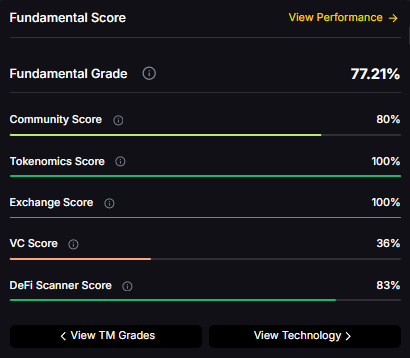
  • Fundamentals: Fundamental Grade 77.21% (Community 80%, Tokenomics 100%, Exchange 100%, VC 36%, DeFi Scanner 83%)
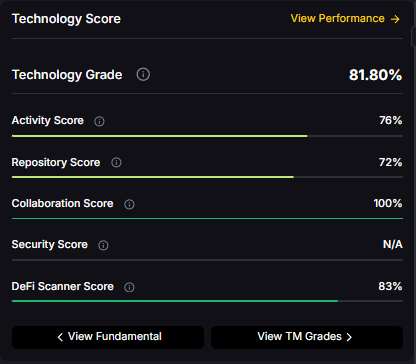
  • Technology: Technology Grade 81.80% (Activity 76%, Repository 72%, Collaboration 100%, Security N/A, DeFi Scanner 83%)
  • TM Agent gist: Bearish short term in price prediction models; requires risk-on and improved fundamentals for sustained upside
  • Current rating: Sell (29.72%) despite strong fundamentals and technology scores
  • Education only, not financial advice

Cardano Price Prediction Scenario Analysis

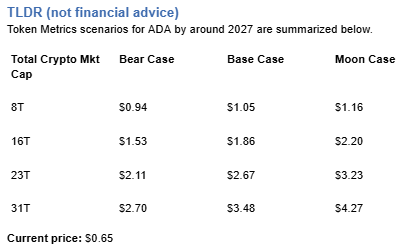
Token Metrics price prediction scenarios span four market cap tiers, each representing different levels of crypto market maturity and liquidity:

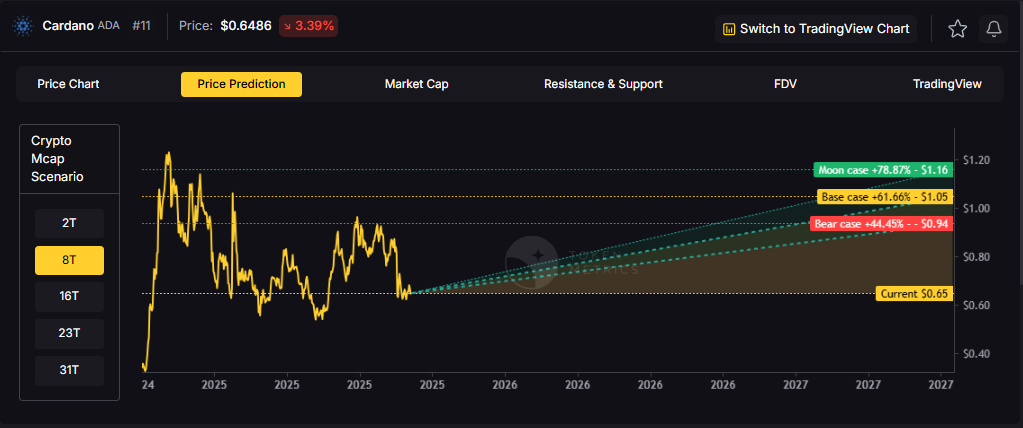
8T Market Cap - ADA Price Prediction:

At an eight trillion dollar total crypto market cap, ADA price prediction projects to $0.94 in bear conditions, $1.05 in the base case, and $1.16 in bullish scenarios.

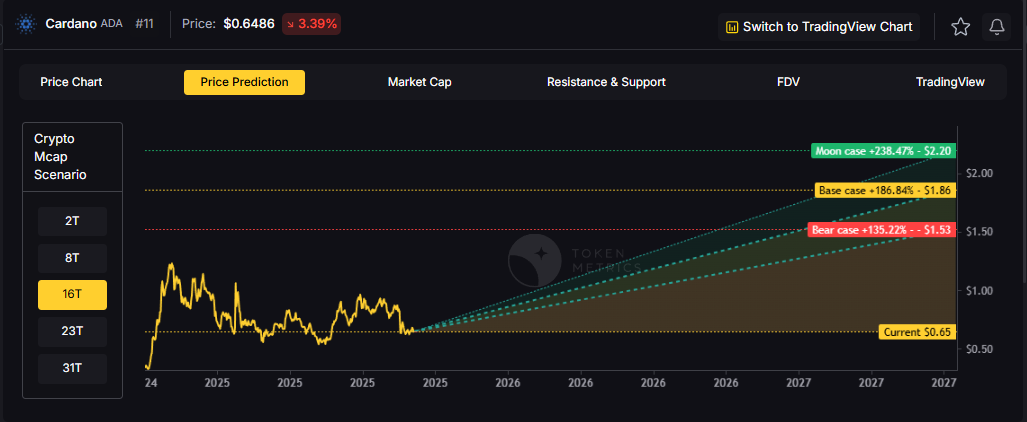
16T Market Cap - ADA Price Prediction:

Doubling the market to sixteen trillion expands the price prediction range to $1.53 (bear), $1.86 (base), and $2.20 (moon).

23T Market Cap - ADA Price Prediction:

At twenty-three trillion, the price prediction scenarios show $2.11, $2.67, and $3.23 respectively.

31T Market Cap - ADA Price Prediction:

In the maximum liquidity scenario of thirty one trillion, ADA price predictions could reach $2.70 (bear), $3.48 (base), or $4.27 (moon).

Each tier in our price prediction framework assumes progressively stronger market conditions, with the base case reflecting steady growth and the moon case requiring sustained bull market dynamics.

Why Consider the Indices with Top-100 Exposure

Cardano represents one opportunity among hundreds in crypto markets. Token Metrics Indices bundle ADA with top one hundred assets for systematic exposure to the strongest projects. Single tokens face idiosyncratic risks that diversified baskets mitigate.

Historical index performance demonstrates the value of systematic diversification versus concentrated positions.

Join the early access list

What Is Cardano?

Cardano is a blockchain platform designed to support secure, scalable, and sustainable decentralized applications and smart contracts. It is known for its research-driven development approach, emphasizing peer-reviewed academic research and formal verification methods to ensure reliability and security. As a proof-of-stake Layer 1 blockchain, Cardano aims to offer energy efficiency and long-term scalability, positioning itself as a competitor to platforms like Ethereum. Its native token, ADA, is used for transactions, staking, and governance. Adoption is driven by technological rigor and ecosystem growth, though progress has been criticized for being slow compared to more agile competitors—a factor that significantly influences ADA price predictions. Risks include execution delays, competition, and market volatility.

Cardano's vision is to create a decentralized platform that enables sustainable and inclusive economic systems through advanced cryptography and scientific methodology. It aims to bridge gaps between traditional financial systems and blockchain technology, promoting accessibility and security for users globally.

Token Metrics AI Analysis

Token Metrics AI provides comprehensive context on Cardano's positioning and challenges, informing our ADA price prediction models:

Vision: Cardano's vision is to create a decentralized platform that enables sustainable and inclusive economic systems through advanced cryptography and scientific methodology. It aims to bridge gaps between traditional financial systems and blockchain technology, promoting accessibility and security for users globally.

Problem: Many early blockchains face trade-offs between scalability, security, and energy efficiency. Cardano addresses the need for a more sustainable and formally verified blockchain infrastructure that can support complex applications without compromising decentralization or environmental impact. It targets inefficiencies in existing networks, particularly high energy use and lack of academic rigor in protocol design.

Solution: Cardano uses a proof-of-stake consensus algorithm called Ouroboros, which is mathematically verified for security and energy efficiency. The platform is built in layers, the settlement layer for ADA transactions and a separate computational layer for smart contracts, allowing for modular upgrades and improved scalability. It supports staking, governance, and decentralized applications, with an emphasis on formal methods to reduce vulnerabilities and ensure long-term viability.

Market Analysis: Cardano operates in the Layer 1 blockchain category, competing with Ethereum, Solana, and Avalanche. While not the market leader, it maintains a significant presence due to its academic foundation and global outreach, particularly in emerging economies. Adoption is influenced by developer activity, regulatory developments, and progress in ecosystem expansion. Its differentiator lies in its methodical, research-first approach, though this has led to slower deployment compared to peers—a critical factor in our price prediction analysis. Market risks include technological delays, competition, and shifting investor sentiment. Broader adoption depends on sustained development, real-world use cases, and interoperability advancements.

Fundamental and Technology Snapshot from Token Metrics

  • Fundamental Grade: 77.21% (Community 80%, Tokenomics 100%, Exchange 100%, VC 36%, DeFi Scanner 83%).
  • Technology Grade: 81.80% (Activity 76%, Repository 72%, Collaboration 100%, Security N/A, DeFi Scanner 83%).

Catalysts That Skew ADA Price Predictions Bullish

  • Institutional and retail access expands with ETFs, listings, and integrations
  • Macro tailwinds from lower real rates and improving liquidity
  • Product or roadmap milestones such as Hydra scaling upgrades or major partnerships
  • Accelerated smart contract deployment and DApp ecosystem growth
  • Successful real-world adoption in emerging markets (particularly Africa)
  • Improved developer onboarding and tooling reducing time-to-market
  • Strategic DeFi protocol launches on Cardano

Risks That Skew ADA Price Predictions Bearish

  • Macro risk-off from tightening or liquidity shocks
  • Regulatory actions targeting proof-of-stake networks or infrastructure outages
  • Concentration in staking pool economics and competitive displacement from faster L1s
  • Current Sell rating (29.72%) reflecting valuation and execution concerns
  • Continued slow development pace versus agile competitors (Solana, Avalanche)
  • Limited DeFi TVL and developer activity compared to Ethereum ecosystem
  • Low VC grade (36%) indicating reduced institutional backing

How Token Metrics Can Help

Token Metrics empowers you to analyze Cardano and hundreds of digital assets with AI-driven ratings, on-chain and fundamental data, and index solutions to manage portfolio risk smartly in a rapidly evolving crypto market. Our price prediction frameworks provide transparent scenario-based analysis even for tokens with Sell ratings but strong fundamentals.

Cardano Price Prediction FAQs

Can ADA reach $4?

Yes. Based on our price prediction scenarios, ADA could reach $4 in the 31T moon case, projecting $4.27. However, this requires maximum market cap expansion, significant ecosystem acceleration, and improved developer activity beyond current levels—challenging given the current Sell rating (29.72%). Not financial advice.

Can ADA 10x from current levels?

At current price of $0.65, a 10x would reach $6.50. This falls beyond all provided price prediction scenarios, which top out at $4.27 in the 31T moon case. Bear in mind that 10x returns would require substantial market cap expansion and ecosystem improvements beyond our modeled scenarios. Not financial advice.

What price could ADA reach in the moon case?

Moon case price predictions range from $1.16 at 8T to $4.27 at 31T total crypto market cap. These scenarios assume maximum liquidity expansion and strong Cardano adoption, though current Sell rating suggests significant execution improvements needed. Not financial advice.

What is the Cardano price prediction for 2027?

Our comprehensive ADA price prediction framework for 2027 suggests Cardano could trade between $0.94 and $4.27 depending on market conditions and total crypto market capitalization. The base case price prediction scenario clusters around $1.05 to $3.48 across different market cap environments. Despite strong fundamentals (77.21%) and technology (81.80%), the Sell rating (29.72%) reflects concerns about execution speed and competitive positioning. Not financial advice.

Can Cardano reach $2?

Yes. Based on our price prediction scenarios, ADA could reach $1.86 in the 16T base case and $2.20 in the 16T moon case. The $2 target becomes achievable in moderate market cap environments, though overcoming current bearish momentum and execution concerns remains critical. Not financial advice.

Should I buy ADA now or wait?

ADA has a Sell rating (29.72%) indicating Token Metrics does not currently endorse Cardano at these levels, despite strong fundamental (77.21%) and technology (81.80%) grades. Current price of $0.65 sits below even the 8T bear case ($0.94), suggesting potential value—but the Sell rating reflects concerns about execution, competitive pressure, and slow development pace. Dollar-cost averaging may reduce timing risk if you believe in Cardano's long-term research-driven thesis. Not financial advice.

Why does ADA have a Sell rating despite strong fundamentals?

ADA shows strong fundamentals (77.21%) and excellent technology (81.80%), but the overall TM Grade of 29.72% (Sell) reflects concerns about execution speed, competitive disadvantage versus faster L1s like Solana, limited DeFi ecosystem development, low VC backing (36%), and bearish trading momentum. Our price prediction models show potential upside in favorable market conditions, but current metrics suggest waiting for improved catalyst execution or better entry points. Not financial advice.

Is Cardano a good investment based on price predictions?

Cardano presents a complex investment case: strong fundamentals (77.21%), excellent technology (81.80%), but a Sell rating (29.72%) with bearish momentum. While our price prediction models show potential upside to $1.05-$4.27 depending on scenarios, current concerns about slow development, competitive pressure from Ethereum and Solana, and limited DeFi adoption suggest caution. The research-driven thesis is compelling long-term, but execution must improve. Consider diversified L1 exposure through indices. Not financial advice.

How does Cardano compare to Ethereum and Solana?

Cardano's price prediction framework suggests $0.94-$4.27 across scenarios, positioning it as a mid-tier L1. Compared to Ethereum's dominance and Solana's speed, Cardano differentiates through academic rigor and proof-of-stake sustainability. However, the Sell rating (29.72%) reflects market concerns that methodical research-first approach has resulted in slower ecosystem development. Cardano's strength in fundamentals (77.21%) and technology (81.80%) doesn't yet translate to market leadership or developer mindshare.

What are the biggest risks to Cardano price predictions?

Key risks that could impact ADA price predictions include: current Sell rating (29.72%) indicating valuation and execution concerns, slow development pace criticized versus Solana/Avalanche, limited DeFi TVL and developer activity, low VC grade (36%) showing reduced institutional backing, competitive displacement from faster L1s, regulatory targeting of proof-of-stake networks, and Bitcoin correlation dampening independent upside. Despite strong grades, execution risk dominates the near-term outlook.

Will Cardano benefit from an altcoin season?

Cardano's price prediction scenarios assume participation in broader crypto market expansion. However, the Sell rating (29.72%) and bearish momentum suggest ADA may underperform versus faster-moving L1s during altcoin rallies. Our base case scenarios ($1.05 to $3.48) reflect moderate participation in bull market dynamics, but achieving moon case targets requires Cardano demonstrating accelerated ecosystem growth and developer adoption improvements. Not financial advice.

What needs to happen for ADA to reach its price prediction targets?

For ADA to reach our price prediction targets of $1.05-$4.27, several catalysts must materialize: (1) accelerated smart contract and DApp deployment addressing slow development concerns, (2) significant DeFi TVL growth competing with Ethereum, (3) successful real-world adoption in emerging markets, (4) improved developer tooling and onboarding, (5) major partnership announcements, and (6) broader crypto market bull run providing liquidity. The Sell rating suggests these catalysts aren't currently materializing at required pace.

Next Steps

Disclosure

Educational purposes only, not financial advice. Crypto is volatile, do your own research and manage risk.

Why Use Token Metrics for Cardano Price Predictions?

  • Transparent analysis: Honest Sell ratings (29.72%) even when fundamentals (77.21%) and technology (81.80%) are strong
  • Scenario-based modeling: Four market cap tiers for comprehensive price prediction analysis
  • L1 specialization: Focused analysis of Cardano's research-driven approach versus execution speed trade-offs
  • Risk-adjusted approach: Balanced view of academic rigor strengths versus competitive disadvantages
  • Real-time signals: Trading signals and TM Grades updated regularly
  • Diversification tools: Index solutions to spread Layer-1 risk across multiple platforms
  • Comparative analysis: Analyze ADA against Ethereum, Solana, Avalanche, and 6,000+ tokens
Research

Understanding X402: The Protocol Powering AI Agent Commerce

Token Metrics Team
4 min read

Introduction

The intersection of artificial intelligence and blockchain technology has produced numerous innovations, but few have the potential architectural significance of X402. This internet protocol, developed by Coinbase and Cloudflare, is positioning itself as the standard for machine-to-machine payments in an increasingly AI-driven digital economy.

What is X402?

X402 is an open protocol designed specifically for internet-native payments. To understand its significance, we need to consider how the internet operates through layered protocols:

  • HTTP/HTTPS: Powers web browsing
  • SMTP: Enables email communication
  • FTP: Facilitates file transfers
  • X402: Enables seamless payment transactions

While these protocols have existed for decades, X402 - despite being available for over ten years - has only recently found its primary use case: enabling autonomous AI agents to conduct commerce without human intervention.

The Problem X402 Solves

Traditional digital payments require several prerequisites that create friction for automated systems:

  1. Account Creation: Services typically require user registration with identity verification
  2. Subscription Models: Monthly or annual billing cycles don't align with usage-based AI operations
  3. Payment Processing Delays: Traditional payment rails operate on settlement cycles incompatible with real-time AI interactions
  4. Cross-Platform Complexity: Different services require different authentication and payment methods

AI agents operating autonomously need to:

  • Access services immediately without manual account setup
  • Pay per-request rather than commit to subscriptions
  • Transact in real-time with minimal latency
  • Maintain wallet functionality for financial operations

X402 addresses these challenges by creating a standardized payment layer that operates at the protocol level.

How X402 Works

The protocol functions as a real-time usage billing meter integrated directly into API requests. Here's a simplified workflow:

  1. AI Agent Request: An AI agent needs to access a service (e.g., data query, computation, API call)
  2. X402 Header: The request includes X402 payment information in the protocol header
  3. Service Verification: The service provider validates the payment capability
  4. Transaction Execution: Payment processes automatically, often in fractions of a penny
  5. Service Delivery: The requested service is provided immediately upon payment confirmation

This architecture enables transactions "up to a penny in under a second," according to protocol specifications.

Real-World Implementation: Token Metrics API

One of the most practical examples of X402 integration comes from Token Metrics, which has implemented X402 as a pay-per-call option for their cryptocurrency analytics API. This implementation demonstrates the protocol's value proposition in action.

Token Metrics X402 Pricing Structure:

  • Cost per API call: $0.017 - $0.068 (depending on endpoint complexity)
  • Commitment: None required
  • Monthly limits: Unlimited API calls
  • Rate limiting: Unlimited
  • Endpoint access: All endpoints available
  • Historical data: 3 months
  • Web sockets: 1 connection

Why This Matters:

This pricing model fundamentally differs from traditional API access:

Traditional Model:

  • Monthly subscription: $X per month (regardless of usage)
  • Commitment period required
  • Fixed tier with call limits
  • Manual account setup and payment processing

X402 Model:

  • Pay only for actual requests made
  • No upfront commitment or subscription
  • Scale usage dynamically
  • AI agents can access immediately without human intervention

For AI agents performing crypto market analysis, this creates significant efficiency:

  • An agent needing only 100 API calls per month pays ~$1.70-$6.80
  • Traditional subscription might cost $50-500 monthly regardless of usage
  • Agent can start making requests immediately without registration workflow
  • Usage scales perfectly with need

This implementation showcases X402's core value proposition: removing friction between autonomous systems and the services they consume.

Current Adoption Landscape

Analysis of X402scan data reveals the emerging adoption patterns:

Leading Facilitators:

  • Coinbase: Naturally leading adoption as a protocol co-creator
  • Token Metrics: Providing crypto data API access via X402
  • PayAI: Solana-focused payment facilitator gaining traction
  • OpenX402: Independent implementation showing growing transaction volume
  • Various AI Agents: Individual agents implementing X402 for service access

Transaction Metrics (30-day trends):

  • Coinbase maintains 4x transaction volume compared to competitors
  • PayAI experienced significant volatility with 8x price appreciation followed by sharp corrections
  • Slot-based gambling and AI analyst services showing unexpected adoption

Technical Integration Examples

Several platforms have implemented X402 functionality:

API Services:

Rather than requiring monthly subscriptions, API providers can charge per request. Token Metrics exemplifies this model - an AI agent queries their crypto analytics API, pays between $0.017-$0.068 via X402 depending on the endpoint, and receives the data - all within milliseconds. The agent accesses:

  • Unlimited API calls with no rate limiting
  • All available endpoints
  • 3 months of historical data
  • Real-time web socket connection

This eliminates the traditional friction of:

  • Creating accounts with email verification
  • Adding payment methods and billing information
  • Committing to monthly minimums
  • Managing subscription renewals

AI Agent Platforms:

  • Virtuals Protocol: Integrating X402 alongside proprietary solutions
  • AIXBT Labs: Enabling builders to integrate AI agents via X402
  • Eliza Framework: Supporting X402 for Solana-based agent development

Cross-Chain Implementation: X402 operates on multiple blockchain networks, with notable activity on Base (Coinbase's Layer 2) and Solana.

Market Implications

The emergence of X402 as a standard has created several market dynamics:

Narrative-Driven Speculation: Projects announcing X402 integration have experienced significant short-term price appreciation, suggesting market participants view the protocol as a value catalyst.

Infrastructure vs. Application Layer: The protocol creates a distinction between:

  • Infrastructure providers (payment facilitators, protocol implementations)
  • Application layer projects (AI agents, services utilizing X402)

Competitive Landscape: X402 faces competition from:

  • Proprietary payment solutions developed by individual platforms
  • Alternative blockchain-based payment protocols
  • Traditional API key and authentication systems

Use Cases Beyond AI Agents

While AI commerce represents the primary narrative, X402's architecture supports broader applications:

Data Services: As demonstrated by Token Metrics, any API provider can implement pay-per-request pricing. Applications include:

  • Financial market data
  • Weather information services
  • Geolocation and mapping APIs
  • Machine learning model inference
  • Database queries

Micropayment Content: Publishers could charge per-article access at fractional costs

IoT Device Transactions: Connected devices conducting autonomous commerce

Gaming Economies: Real-time, granular in-game transactions

Computing Resources: Pay-per-compute models for cloud services

The Economics of X402 for Service Providers

Token Metrics' implementation reveals the business model advantages for service providers:

Revenue Optimization:

  • Capture value from low-usage users who wouldn't commit to subscriptions
  • Eliminate customer acquisition friction
  • Reduce churn from users only needing occasional access
  • Enable price discovery through usage-based metrics

Market Access:

  • AI agents represent new customer segment unable to use traditional payment methods
  • Automated systems can discover and integrate services programmatically
  • Lower barrier to trial and adoption

Operational Efficiency:

  • Reduce customer support overhead (no subscription management)
  • Eliminate billing disputes and refund requests
  • Automatic revenue recognition per transaction

Challenges and Considerations

Several factors may impact X402 adoption:

Technical Complexity: Implementing X402 requires protocol-level integration, creating barriers for smaller developers.

Network Effects: Payment protocols succeed through widespread adoption. X402 competes with established systems and must reach critical mass.

Blockchain Dependency: Current implementations rely on blockchain networks for settlement, introducing:

  • Transaction costs (gas fees)
  • Network congestion risks
  • Cross-chain compatibility challenges

Pricing Discovery: As seen with Token Metrics' range of $0.017-$0.068 per call, establishing optimal pricing requires experimentation. Too high and traditional subscriptions become competitive; too low and revenue suffers.

Regulatory Uncertainty: Automated machine-to-machine payments operating across borders face unclear regulatory frameworks.

Market Maturity: The AI agent economy remains nascent. X402's long-term relevance depends on AI agents becoming standard economic actors.

Comparing X402 to Alternatives

Traditional API Keys with Subscriptions:

  • Advantage: Established, widely understood, predictable revenue
  • Disadvantage: Requires manual setup, subscription billing, slower onboarding, higher commitment barrier
  • Example: $50/month for 10,000 calls whether used or not

X402 Pay-Per-Call:

  • Advantage: Zero commitment, immediate access, perfect usage alignment, AI-agent friendly
  • Disadvantage: Variable costs, requires crypto infrastructure, emerging standard
  • Example: $0.017-$0.068 per actual call, unlimited potential usage

Cryptocurrency Direct Payments:

  • Advantage: Direct peer-to-peer value transfer
  • Disadvantage: Lacks standardization, higher complexity per transaction, no protocol-level support

Payment Processors (Stripe, PayPal):

  • Advantage: Robust infrastructure, legal compliance
  • Disadvantage: Minimum transaction amounts, settlement delays, geography restrictions

X402's differentiator lies in combining protocol-level standardization with crypto-native functionality optimized for automated systems, as demonstrated by Token Metrics' implementation where AI agents can make sub-dollar API calls without human intervention.

Development Resources

For developers interested in X402 integration:

Documentation: X402.well (protocol specifications)

Discovery Platforms: X402scan (transaction analytics), The Bazaar (application directory)

Integration Frameworks: Virtuals Protocol, Eliza (Solana), various Base implementations

Live Examples: Token Metrics API (tokenmetrics.com/api) demonstrates production X402 implementation

Several blockchain platforms now offer X402 integration libraries, lowering implementation barriers.

Market Performance Patterns

Projects associated with X402 have demonstrated characteristic patterns:

Phase 1 - Announcement: Initial price appreciation upon X402 integration news Phase 2 - Peak Attention: Maximum price when broader market attention focuses on X402 narrative Phase 3 - Stabilization: Price correction as attention shifts to next narrative

PayAI's trajectory exemplifies this pattern - rapid 8x appreciation followed by significant correction within days. This suggests X402-related assets behave as narrative-driven trading vehicles rather than fundamental value plays, at least in current market conditions.

However, service providers implementing X402 functionality (like Token Metrics) represent a different category - they're adding practical utility rather than speculating on the protocol itself.

Future Outlook

The protocol's trajectory depends on several factors:

AI Agent Proliferation: As AI agents become more autonomous and economically active, demand for payment infrastructure grows. Early implementations like Token Metrics' API access suggest practical demand exists.

Developer Adoption: Whether developers choose X402 over alternatives will determine market position. The simplicity of pay-per-call models may drive adoption.

Service Provider Economics: If providers like Token Metrics successfully monetize X402 access, other API services will follow. The ability to capture previously inaccessible low-usage customers creates compelling economics.

Institutional Support: Coinbase's backing provides credibility, but sustained development and promotion are necessary.

Regulatory Clarity: Clear frameworks for automated, cross-border machine transactions would reduce adoption friction.

Interoperability Standards: Success may require coordination with other emerging AI commerce protocols.

Conclusion

X402 represents an attempt to solve genuine infrastructure challenges in an AI-driven economy. The protocol's technical architecture addresses real friction points in machine-to-machine commerce, as demonstrated by Token Metrics' implementation of pay-per-call API access at $0.017-$0.068 per request with no commitments required.

This real-world deployment validates the core thesis: AI agents need frictionless, usage-based access to services without traditional account creation and subscription barriers. However, actual adoption remains in early stages, and the protocol faces competition from both traditional systems and alternative blockchain solutions.

For market participants, X402-related projects should be evaluated based on:

  • Actual transaction volume and usage metrics (not just speculation)
  • Developer adoption and integration depth
  • Real service implementations (like Token Metrics API)
  • Competitive positioning against alternatives
  • Sustainability beyond narrative-driven speculation

The protocol's long-term relevance will ultimately be determined by whether AI agents become significant economic actors requiring standardized payment infrastructure. While the technical foundation appears sound and early implementations show promise, market validation remains ongoing.

Key Takeaways:

  • X402 enables real-time, micropayment commerce for AI agents
  • Token Metrics API offers practical X402 implementation at $0.017-$0.068 per call with no commitments
  • Protocol operates at the internet infrastructure layer, similar to HTTP or SMTP
  • Pay-per-call model eliminates subscription friction and enables AI agent access
  • Current adoption concentrated on Base and Solana blockchains
  • Market interest has driven speculation in X402-related projects
  • Service provider implementations demonstrate real utility beyond speculation
  • Long-term success depends on AI agent economy maturation

This analysis is for informational purposes only. X402 adoption and associated project performance remain highly uncertain and subject to rapid change.

Research

Advanced Token Metrics Indices Strategies: Expert Techniques for Maximizing Returns and Minimizing Risk

Token Metrics Team
10 min read

Most crypto index content targets beginners, explaining basics and encouraging cautious entry. But what about experienced investors who already understand cryptocurrency fundamentals and want to optimize their index investing approach? How do sophisticated investors extract maximum value from Token Metrics indices while managing complex risk scenarios?

This advanced guide explores strategies beyond basic index investing, including multi-index portfolio construction, tactical allocation across market regimes, leveraging indices with complementary strategies, advanced rebalancing techniques, and sophisticated risk management frameworks that separate exceptional performance from merely good results.

If you've already invested in crypto indices for months or years and want to elevate your approach, this comprehensive guide provides the advanced techniques you need.

Understanding Your Investor Evolution

Before implementing advanced strategies, assess your current sophistication level and investment evolution honestly.

From Beginner to Intermediate

New investors focus on learning fundamentals, making initial allocations, and maintaining basic discipline. After 6-12 months, you've experienced market volatility, executed several rebalancing trades, and developed comfort with the investment process.

From Intermediate to Advanced

Advanced investors have navigated complete market cycles, understand their emotional responses to different conditions, built substantial positions, and seek optimization beyond standard approaches. You're no longer asking "should I invest in crypto?" but rather "how can I maximize risk-adjusted returns within my crypto allocation?"

This evolution takes 2-3 years typically—enough time to experience both bull and bear markets while building expertise through practical experience rather than just theoretical knowledge.

Multi-Index Portfolio Architecture: Beyond Single-Index Approaches

Sophisticated investors construct portfolios using multiple Token Metrics indices simultaneously, creating layered exposure serving different strategic purposes.

The Core-Satellite-Speculative Framework

Structure crypto index allocation across three distinct tiers:

  • Core Holdings (50-60%): Conservative and balanced indices providing stable, reliable exposure to established cryptocurrencies. This foundation ensures you capture broad market appreciation regardless of specific sector performance.
  • Satellite Positions (30-40%): Sector-specific and thematic indices targeting particular opportunities like DeFi, Layer-1 blockchains, or AI tokens. These tactical allocations allow overweighting sectors you believe will outperform without abandoning diversification.
  • Speculative Exposure (10-20%): Aggressive growth and memecoin indices pursuing maximum upside. This high-risk allocation captures explosive opportunities while limiting potential damage through position sizing.

This three-tier structure provides both stability and growth potential, allowing you to maintain conservative foundation while pursuing tactical opportunities aggressively.

Dynamic Tier Adjustment

Adjust tier allocations based on market conditions and personal conviction. During bull markets with high confidence, increase satellite and speculative allocations to 50% combined. During uncertain or bearish conditions, increase core holdings to 70-80%.

This dynamic adjustment allows capitalizing on opportunities while maintaining appropriate risk exposure for conditions.

Cross-Correlation Analysis

Advanced investors analyze correlation between different indices to maximize diversification benefits. Holding multiple indices with 0.9+ correlation provides minimal diversification—essentially concentrated exposure disguised as diversification.

Token Metrics provides correlation data allowing you to construct portfolios where indices complement rather than duplicate each other. Ideal multi-index portfolios combine indices with 0.3-0.7 correlations—related enough to benefit from crypto's overall growth but different enough to smooth returns.

Tactical Allocation Strategies: Rotating Capital Efficiently

Beyond static allocation, advanced investors rotate capital between indices based on market conditions, technical signals, and fundamental developments.

Momentum Rotation Strategy

Systematically rotate capital toward indices showing strongest recent performance while reducing exposure to lagging indices. This momentum approach captures trending sectors while avoiding those losing relative strength.

Implementation example:

  • Monthly, rank all indices by 90-day performance
  • Overweight top quartile indices by 5-10% above target allocation
  • Underweight bottom quartile indices by 5-10% below target allocation
  • Maintain overall crypto allocation within target range

This systematic rotation forces buying strength and trimming weakness—capitalizing on momentum while maintaining diversification.

Mean Reversion Approach

Alternatively, employ mean reversion strategy assuming sectors experiencing short-term underperformance will reverse. After significant declines, fundamentally sound sectors often present exceptional value.

Implementation approach:

  • Identify indices declining 30%+ while maintaining strong fundamentals
  • Increase allocation to these "temporarily distressed" indices
  • Hold through recovery, capturing outsized gains as sentiment improves
  • Take profits once indices return to top-quartile performance

Mean reversion requires strong conviction and patience but can generate exceptional returns buying sectors during temporary weakness.

Blended Momentum-Reversion Strategy

The most sophisticated approach blends momentum and mean reversion, applying momentum to aggressive/speculative indices while using mean reversion for core/conservative indices.

Aggressive indices benefit from momentum—riding hot sectors aggressively. Conservative indices benefit from mean reversion—buying quality assets during temporary weakness. This nuanced approach matches strategy to index characteristics rather than applying one-size-fits-all methodology.

Advanced Rebalancing Techniques

Standard rebalancing maintains target allocations. Advanced rebalancing employs sophisticated rules extracting additional alpha through strategic timing and execution.

Volatility-Triggered Rebalancing

Rather than rebalancing on fixed schedules, trigger rebalancing when volatility exceeds thresholds. During high volatility, prices deviate significantly from fundamentals—creating rebalancing opportunities.

Set volatility thresholds—when Bitcoin's 30-day volatility exceeds 80%, evaluate rebalancing opportunities. High volatility often accompanies market extremes offering excellent entry or exit points.

Threshold Rebalancing with Asymmetric Bands

Establish asymmetric rebalancing bands allowing winning positions to run further than standard symmetric approaches. If target allocation is 10% for an index, perhaps trigger rebalancing at 7% on downside but 15% on upside.

This asymmetry captures more upside from winning positions while preventing excessive losses from declining positions—improving overall risk-adjusted returns.

Tax-Optimized Rebalancing

Coordinate rebalancing with tax considerations, preferentially selling positions with losses to offset gains while rebalancing. During profitable years, delay rebalancing slightly to push tax liability into following year.

For positions held in taxable accounts, track cost basis precisely and prioritize selling highest-cost-basis lots first, minimizing capital gains taxes.

Leveraging Indices with Complementary Strategies

Advanced investors combine index investing with complementary strategies creating synergistic approaches exceeding either strategy alone.

The 70/30 Index-Plus Strategy

Allocate 70% to Token Metrics indices for professional management and diversification. Use remaining 30% for complementary strategies:

  • Individual High-Conviction Positions (15%): Based on deep personal research into specific projects you understand thoroughly
  • Yield Generation (10%): Stake index holdings or use DeFi protocols for additional yield on top of appreciation
  • Options/Derivatives (5%): For experienced traders, limited options strategies hedging downside or generating income

This approach maintains strong index foundation while allowing tactical strategies leveraging your specific expertise and risk tolerance.

Pair Trading with Indices

Advanced traders employ pair trading strategies—simultaneously longing one index while shorting another, profiting from relative performance regardless of overall market direction.

Example: If convinced DeFi will outperform Layer-1s short-term, overweight DeFi index while underweighting Layer-1 index relative to targets. If correct about relative performance, you profit even if both decline in absolute terms.

Pair trading requires sophistication and works best during sideways markets where directional movement is uncertain but relative performance differentials exist.

Stablecoin Yield Enhancement

During bear markets or consolidation, rotate portions of conservative index holdings temporarily into high-yield stablecoin strategies generating 5-15% APY. This preserves capital while generating income during periods when crypto appreciation stalls.

When bullish conditions return, rotate back into indices. This tactical approach maintains productivity during all market phases rather than passively holding through extended downturns.

Sophisticated Risk Management Frameworks

Advanced investors employ multi-layered risk management beyond basic position sizing and diversification.

Value-at-Risk (VaR) Monitoring

Calculate portfolio Value-at-Risk—the maximum expected loss over specific timeframe at given confidence level. If your 30-day VaR at 95% confidence is $50,000, you expect no more than $50,000 loss in 95% of 30-day periods.

Monitor VaR continuously and adjust allocations if risk exceeds tolerance. During volatile periods, VaR spikes significantly—this objective measurement informs whether to reduce exposure or maintain course based on predetermined risk budgets.

Conditional Value-at-Risk (CVaR)

Beyond VaR, calculate CVaR—expected loss in worst-case scenarios beyond VaR threshold. While VaR tells you typical maximum loss, CVaR reveals extreme scenario impacts.

High CVaR relative to VaR indicates "fat tail risk"—potential for catastrophic losses exceeding normal expectations. Adjust allocations to limit CVaR to acceptable levels relative to total portfolio.

Portfolio Stress Testing

Regularly stress test portfolio against historical extreme scenarios:

  • 2018 bear market (80%+ decline over 12 months)
  • March 2020 flash crash (50% decline in 48 hours)
  • 2022 Terra/LUNA collapse (complete failure of major protocol)
  • Exchange failure scenarios (losing access to 30% of holdings)

Understanding portfolio behavior during extreme stress prevents panic during actual crises—you've already mentally prepared for worst-case scenarios.

Dynamic Position Sizing

Rather than fixed allocations, adjust position sizes based on volatility—reducing exposure during high volatility periods and increasing during low volatility. This volatility-adjusted sizing maintains consistent risk exposure despite changing market conditions.

When volatility doubles, halve position sizes maintaining constant risk. When volatility halves, double position sizes maintaining returns potential. This dynamic approach optimizes risk-adjusted returns across volatility regimes.

Performance Attribution and Continuous Improvement

Advanced investors systematically analyze performance, understanding what's working and why.

Decomposing Returns

Break down portfolio returns into components:

  • Beta Returns: Returns from overall market exposure (what you'd get from simple buy-and-hold)
  • Index Selection Alpha: Returns from choosing outperforming indices over alternatives
  • Timing Alpha: Returns from tactical allocation adjustments and rebalancing timing
  • Cost Drag: Returns lost to fees, taxes, and trading costs

Understanding return sources reveals where your strategy adds value and where it doesn't, informing strategic refinements.

Keeping a Trading Journal

Maintain detailed journal documenting all strategic decisions:

  • What allocation changes did you make and why?
  • What was market context and your reasoning?
  • How did decisions perform over subsequent weeks/months?
  • What would you do differently with hindsight?
  • What patterns emerge across multiple decisions?

This systematic documentation transforms experience into learning, accelerating your development as sophisticated investor.

Quarterly Strategy Reviews

Conduct comprehensive quarterly reviews assessing:

  • Overall portfolio performance vs. benchmarks
  • Individual index performance and contribution to returns
  • Accuracy of tactical allocation decisions
  • Risk metrics (volatility, drawdowns, Sharpe ratio) vs. targets
  • Lessons learned and strategy adjustments for next quarter

These structured reviews create accountability and ensure continuous improvement rather than repeating mistakes.

Scaling Strategies as Portfolio Grows

As crypto holdings grow from thousands to hundreds of thousands or millions, strategies must evolve to match scale.

Institutional-Grade Custody

Once holdings exceed $100,000-$250,000, implement institutional-grade custody solutions. Multi-signature wallets requiring multiple approvals prevent single points of failure. Cold storage solutions protect against online threats. Insurance-backed custodians provide additional protection layers.

The sophistication required for securing substantial wealth exceeds most individuals' technical capabilities—professional custody solutions become essential.

Tax-Loss Harvesting at Scale

Large portfolios generate significant tax optimization opportunities. Systematic tax-loss harvesting across multiple indices, strategic timing of rebalancing to manage tax liability, and coordination with overall tax planning become crucial for preserving wealth.

Consider working with crypto-specialized tax advisors who understand optimal strategies for managing significant crypto positions.

Estate Planning Considerations

Substantial crypto holdings require estate planning ensuring wealth transfers efficiently to heirs. This includes secure key management protocols heirs can access, clear documentation of holdings and recovery processes, and potentially trusts or other vehicles optimizing estate taxes.

Without proper planning, crypto wealth can become inaccessible if something happens to you—proper preparation ensures your wealth serves intended purposes.

Conclusion: The Path to Mastery

Advanced crypto index investing transcends basic buy-and-hold approaches, incorporating sophisticated portfolio construction, tactical allocation, advanced risk management, and continuous performance optimization. These techniques separate exceptional investors from merely competent ones.

Token Metrics provides the foundation—comprehensive indices, sophisticated AI analysis, and professional management. Your advanced strategies built on this foundation determine ultimate success. The combination of institutional-grade tools and sophisticated personal strategies creates unprecedented wealth-building potential.

Mastery requires years of dedicated practice, continuous learning, and honest self-assessment. Each market cycle teaches new lessons. Each strategic decision provides data informing future choices. The journey from beginner to advanced investor never truly ends—markets evolve, requiring continuous adaptation.

Your advantage as advanced investor is recognizing that optimization matters as much as allocation. The difference between 25% and 35% annualized returns compounds into millions over decades. Small improvements in strategy, consistently applied, generate enormous long-term impact.

Begin implementing these advanced techniques systematically. Don't attempt everything simultaneously—choose 2-3 strategies matching your situation and expertise. Master those, then expand your toolkit progressively. Over time, you'll develop sophisticated approach rivaling professional fund managers.

Token Metrics provides the infrastructure. Your advanced strategies provide the edge. Together, they create framework for building generational wealth through crypto index investing.

Start your 7-day free trial today and begin applying these advanced strategies to accelerate your journey toward crypto investment mastery.

Choose from Platinum, Gold, and Silver packages
Reach with 25–30% open rates and 0.5–1% CTR
Craft your own custom ad—from banners to tailored copy
Perfect for Crypto Exchanges, SaaS Tools, DeFi, and AI Products