Back to blog
Research

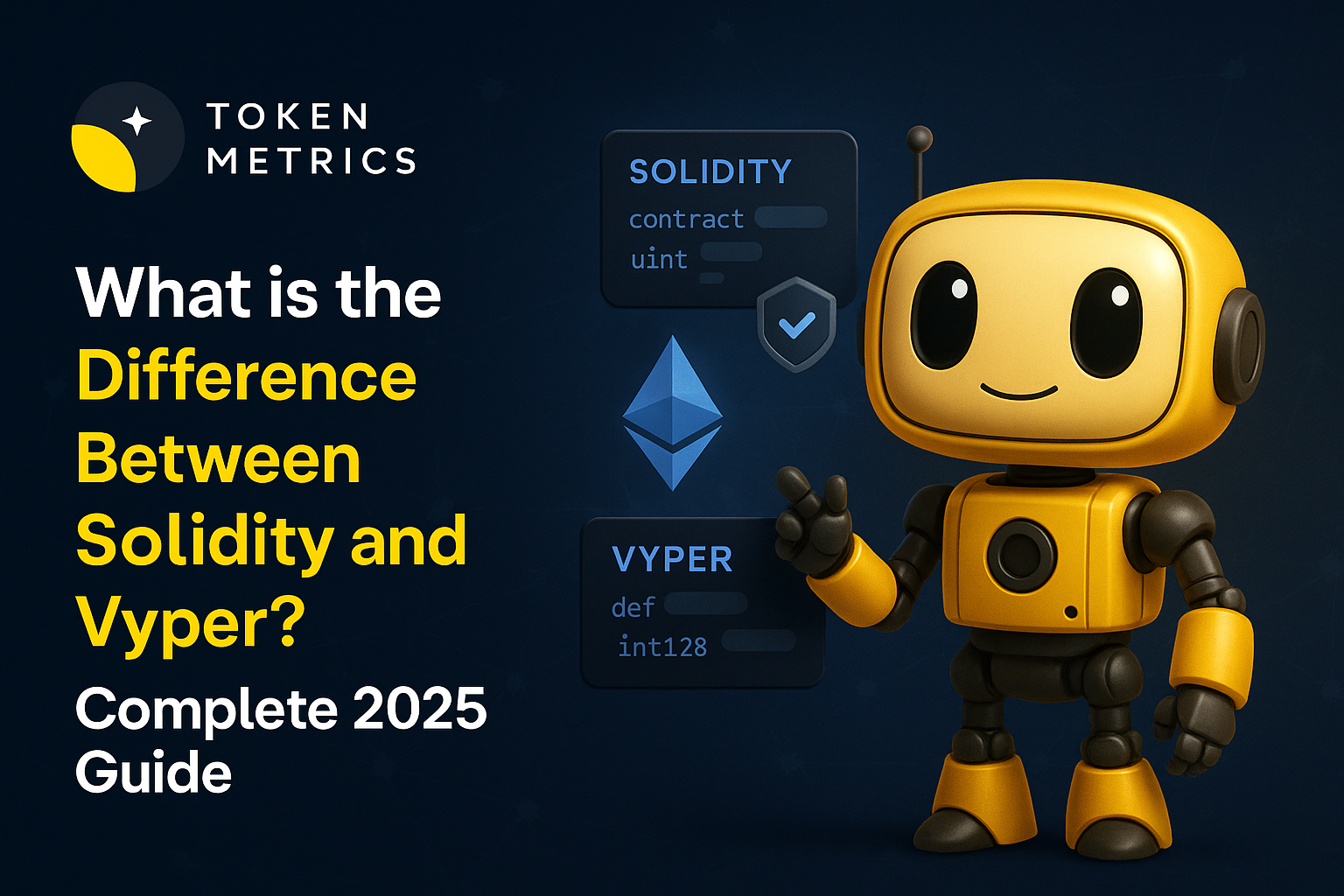
What is the Difference Between Solidity and Vyper? Complete 2025 Guide

Explore the key differences between Solidity and Vyper for Ethereum smart contracts, and learn how to choose the right language for your project in 2025.
Token Metrics Team
7
Want Smarter Crypto Picks—Free?
See unbiased Token Metrics Ratings for BTC, ETH, and top alts.
Thank you! Your submission has been received!
Oops! Something went wrong while submitting the form.
 No credit card | 1-click unsubscribe

Smart contracts have revolutionized the blockchain ecosystem, enabling self-executing code that automatically enforces agreed-upon terms and conditions. As decentralized applications continue growing in sophistication and value, the programming languages used to create these contracts become increasingly critical. Two languages dominate Ethereum smart contract development: Solidity and Vyper. Token Metrics.

Understanding Smart Contract Languages

Before diving into Solidity vs Vyper comparison, it's essential to understand what smart contract languages do and why they matter. Smart contracts are programs that run on blockchain platforms like Ethereum, executing predetermined actions when specific conditions are met. These contracts facilitate secure, transparent, and trustless interactions between parties, eliminating intermediaries and enhancing efficiency.

Smart contract languages enable developers to define the logic and behavior of these contracts, which are immutable and executed on the blockchain. By leveraging smart contract languages, businesses can automate processes including supply chain management, financial transactions, governance systems, and much more.

High-Level vs Low-Level Languages

Smart contract programming requires converting human-readable code into machine-executable bytecode that the Ethereum Virtual Machine (EVM) can process. Developers must first choose between high-level and low-level languages based on their use case and expertise.

High-level languages abstract away granular implementation details, allowing developers to create smart contracts without deep bytecode knowledge. Solidity and Vyper are both high-level languages designed for EVM-compatible blockchains, making them accessible to developers from traditional programming backgrounds.

After compilation, both Solidity and Vyper smart contracts execute using the same bytecode language, meaning they can be used concurrently in the same application despite their different source code appearances.

Solidity: The Industry Standard

Solidity is the most widely used programming language for developing smart contracts on the Ethereum blockchain and EVM-compatible chains. Designed specifically for blockchain applications, Solidity enables developers to create secure, decentralized, and automated agreements that run on distributed networks.

Origins and Design Philosophy

Proposed by Ethereum CTO Gavin Wood, Solidity was developed to meet demand for a flexible smart contract-based developer platform. The language draws heavily on inspiration from C++, JavaScript, and Python, making it familiar to developers from various programming backgrounds.

Solidity is a high-level, Turing-complete, statically typed language where developers must explicitly declare variable types. This allows the compiler to have knowledge of data types, ensuring deterministic application behavior—a critical requirement for blockchain applications where predictability is paramount.

Key Features of Solidity

  • Object-Oriented Programming: Supports inheritance, libraries, and complex data structures for sophisticated smart contracts with reusable components.
  • Rich Feature Set: Includes function overloading, multiple inheritance, user-defined types, and complex data structures.
  • Extensive Ecosystem: Benefits from a large community support, documentation, and development tools like Remix, Hardhat, and Foundry.
  • Blockchain-Specific Commands: Built-in commands for addresses, transactions, and block data interactions.
  • Wide Adoption: Most Ethereum projects, including Uniswap, Aave, and OpenSea, are developed using Solidity.

Advantages of Solidity

  • Market Dominance: Secures 87% of DeFi TVL, making it the dominant language for decentralized finance.
  • Robust Tooling: Mature ecosystem with testing, debugging, and analysis tools.
  • Versatility: Enables implementation of complex protocols, financial instruments, and governance procedures.
  • Learning Resources: Abundant tutorials, courses, and community support.

Disadvantages of Solidity

  • Security Vulnerabilities: Increased attack surface with risks like reentrancy and integer overflows, requiring thorough audits.
  • Complexity: Extensive features can lead to harder-to-audit contracts and hidden vulnerabilities.
  • Steeper Learning Curve: Requires understanding blockchain-specific security considerations.

Vyper: The Security-First Alternative

Vyper is a contract-oriented programming language that targets the EVM with a focus on security, simplicity, and auditability. Introduced in 2018 by Ethereum co-founder Vitalik Buterin, Vyper was specifically developed to address security issues prevalent in Solidity.

Design Philosophy: Security Through Simplicity

Vyper's fundamental philosophy is that security comes from simplicity and readability. The language intentionally limits features and enforces stricter syntax to make contracts more secure and easier to audit. By reducing what’s possible, Vyper minimizes opportunities for mistakes and vulnerabilities.

Using Pythonic syntax—hence the serpentine name—Vyper code prioritizes readability so developers can easily detect bugs and vulnerabilities before deploying contracts. This approach makes code auditable by humans, not just machines.

Key Features of Vyper

  • Python-Like Syntax: Familiar for Python developers, with indentation-based structure and clear syntax.
  • Security-First Design: Eliminates object-oriented features, such as inheritance and function overloading, to reduce attack vectors.
  • Strong Typing: Variables require explicit type declaration, catching errors early.
  • Bounds Checking & Overflow Protection: Built-in safety features prevent common vulnerabilities.
  • Decidability & Gas Optimization: Ensures predictable gas consumption and avoids infinite loops, making contracts more efficient.

Advantages of Vyper

  • Enhanced Security: Designed specifically to prevent common vulnerabilities, leading to more secure contracts.
  • Readable & Audit-Friendly: Clear syntax facilitates quicker reviews and lower audit costs.
  • Concise Code: Fewer lines and simpler syntax streamline contract development.
  • Python Background: Eases onboarding for Python programmers.
  • Potential Gas Savings: Simple design can lead to more efficient contracts in specific cases.

Disadvantages of Vyper

  • Limited Adoption: Only about 8% of DeFi TVL, with a smaller ecosystem and community.
  • Fewer Features: Lack of inheritance, modifiers, and function overloading limits architectural options.
  • Smaller Tooling Ecosystem: Development tools and libraries are less mature compared to Solidity.
  • Less Industry Traction: Major projects predominantly use Solidity, limiting existing examples for Vyper development.

Differences: Solidity vs Vyper

  • Syntax & Structure: Solidity resembles JavaScript and C++, with curly braces and semicolons; Vyper uses Python-like indentation and syntax, omitting object-oriented features.
  • Feature Completeness: Solidity offers inheritance, modifiers, and dynamic data structures; Vyper is minimalist, focusing on security with fixed-size arrays and no inheritance.
  • Security Approach: Solidity relies on developer diligence and testing; Vyper enforces limitations to inherently prevent vulnerabilities.
  • Development Philosophy: Solidity emphasizes flexibility, while Vyper emphasizes security and auditability.

Choosing Between Solidity and Vyper

The decision depends on project needs, team expertise, and security priorities. Large, feature-rich DeFi protocols and complex dApps typically require Solidity's extensive capabilities. Conversely, systems demanding maximum security, or contracts that need to be highly auditable, may benefit from Vyper’s simplicity and security-focused design.

Many projects effectively combine both, using Vyper for security-critical core components and Solidity for peripheral features. This hybrid approach leverages the strengths of each language.

Leveraging Token Metrics for Smart Contract Analysis

While understanding the distinctions between Solidity and Vyper is valuable for developers, investors should also evaluate the projects' underlying code quality, security track record, and development activity. Token Metrics offers AI-powered analytics that examine code repositories, audit statuses, and project activity levels.

The platform reviews security vulnerabilities, audit history, and real-time security incidents, providing a comprehensive view that helps identify projects with strong technical foundations, regardless of their chosen language.

Furthermore, Token Metrics tracks project development activity via GitHub, helping gauge ongoing commitment and progress. Market intelligence and performance analysis reveal success patterns and areas of risk, supporting informed decision-making.

Token Metrics assists investors in balancing portfolios across projects built with different languages, offering risk assessments and alerts that enhance proactive management amid evolving blockchain security landscapes.

The Future of Smart Contract Languages

Both Solidity and Vyper are actively evolving to meet new challenges and security needs. Solidity continues enhancing security features, error handling, and optimization, driven by its large ecosystem. Vyper development emphasizes expanding capabilities while maintaining its core security principles.

Emerging languages and cross-language development strategies are beginning to complement established techniques. Combining secure core contracts in Vyper with the flexibility of Solidity is an increasingly common pattern.

Best Practices for Smart Contract Development

  • Thorough Testing: Implement comprehensive testing, including formal verification and audits, before deployment.
  • Security Audits: Engage reputable security firms to review code vulnerabilities.
  • Continuous Monitoring: Use platforms like Token Metrics for real-time risk detection post-deployment.
  • Upgradeability: Adopt upgrade patterns that allow fixing issues without losing funds or functionality.

Conclusion: Making the Right Choice

Solidity and Vyper offer distinct approaches to smart contract development. Solidity’s comprehensive features and robust ecosystem make it suitable for complex, feature-rich applications. Vyper's security-oriented, Python-like syntax is ideal for systems where auditability, simplicity, and security are top priorities.

Both languages will continue to play vital roles throughout 2025, with many projects adopting hybrid strategies. Evaluating project needs, security considerations, and team expertise will guide optimal language selection. AI analytics platforms like Token Metrics provide critical insights to support this decision, ensuring better understanding and risk management in the ever-evolving ecosystem.

Build Smarter Crypto Apps &
AI Agents in Minutes, Not Months
Real-time prices, trading signals, and on-chain insights all from one powerful API.
Grab a Free API Key
About Token Metrics
Token Metrics: AI-powered crypto research and ratings platform. We help investors make smarter decisions with unbiased Token Metrics Ratings, on-chain analytics, and editor-curated “Top 10” guides. Our platform distills thousands of data points into clear scores, trends, and alerts you can act on.
30 Employees
analysts, data scientists, and crypto engineers
Daily Briefings
concise market insights and “Top Picks”
Transparent & Compliant
Sponsored ≠ Ratings; research remains independent
Want Smarter Crypto Picks—Free?
See unbiased Token Metrics Ratings for BTC, ETH, and top alts.
Thank you! Your submission has been received!
Oops! Something went wrong while submitting the form.
 No credit card | 1-click unsubscribe
Token Metrics Team
Token Metrics Team

Recent Posts

Crypto Basics

Which Cryptocurrency Exchange Should I Use? A 2025 Guide for Smart Trading

Token Metrics Team
6 min

Introduction: Why Choosing the Right Exchange Matters

In 2025, cryptocurrency trading is more accessible than ever, with hundreds of exchanges competing for your attention. But choosing the right exchange can make the difference between a smooth, profitable trading experience and one full of unnecessary risks, high fees, or limited features.

If you’re asking “Which cryptocurrency exchange should I use?”, this guide will help you compare the top platforms and explain how Token Metrics — the leading AI‑powered crypto analysis, research, and trading platform — can help you trade smarter no matter which exchange you choose.

Types of Cryptocurrency Exchanges

Before selecting an exchange, it’s important to understand your options:

1. Centralized Exchanges (CEXs):

  • Examples: Coinbase, Binance, Kraken, KuCoin
  • Pros: Easy to use, high liquidity, fiat on‑ramps.
  • Cons: Custodial (they hold your crypto), may require KYC (identity verification).

2. Decentralized Exchanges (DEXs):

  • Examples: Uniswap, SushiSwap, PancakeSwap
  • Pros: No intermediaries, you control your funds.
  • Cons: Requires a crypto wallet, higher learning curve, sometimes lower liquidity.

3. Hybrid Exchanges:

  • Combine the ease of CEXs with decentralization features (e.g., dYdX for derivatives).

Pro Tip: Beginners usually start with a trusted CEX, then gradually explore DEXs for more control and advanced opportunities.

Top Cryptocurrency Exchanges in 2025

Here are some of the leading exchanges to consider:

1. Coinbase — Best for Beginners

  • Why Use It: User‑friendly interface, strong security, regulated in multiple jurisdictions.
  • Best For: Buying crypto with fiat, basic spot trading.
  • Downside: Higher fees compared to other platforms.

2. Binance — Best for Global Traders

  • Why Use It: Low fees, extensive crypto listings, advanced trading features (futures, options).
  • Best For: Traders who want access to a wide range of coins and features.
  • Downside: Regulatory restrictions in some regions.

3. Kraken — Best for Security

  • Why Use It: Excellent reputation for security and transparency, futures trading available.
  • Best For: U.S. traders and those prioritizing safe trading.
  • Downside: Fewer listed altcoins compared to Binance.

4. Uniswap — Best Decentralized Option

  • Why Use It: Fully decentralized, thousands of tokens available.
  • Best For: Accessing early‑stage or niche tokens.
  • Downside: Requires a crypto wallet and understanding of Ethereum gas fees.

How to Choose the Best Exchange for You

When deciding which platform to use, consider:

  • Your Experience Level: Beginners might prefer Coinbase, while experienced traders may like Binance or DEXs.
  • Supported Tokens: Make sure your preferred coins are listed.
  • Trading Features: Do you need futures, staking, or DeFi access?
  • Fees & Limits: Check transaction costs and withdrawal fees.
  • Security: Look for exchanges with a strong track record and insurance options.

But What If You Could Trade Smarter on ANY Exchange?

Choosing an exchange is just the first step. To maximize profits, you need data‑driven insights, trend detection, and portfolio strategies — that’s where Token Metrics comes in.

Why Token Metrics Is Essential for Traders in 2025

No matter which exchange you choose, Token Metrics empowers you to trade smarter with AI‑powered crypto analysis, research, and trading tools.

Here’s how:

  • AI‑Generated Coin Ratings: Analyze over 80 data points per token (fundamentals, technicals, sentiment, on‑chain activity).
  • Narrative Detection: Identify emerging market narratives (AI coins, DeFi 2.0, Layer 2 scaling) before they trend.
  • Portfolio Optimization: Build a custom trading portfolio aligned with your risk tolerance and goals.
  • Real‑Time Alerts: Get notified when coins hit your target prices or show bullish/bearish momentum.
  • Exchange‑Agnostic Tools: Use Token Metrics to guide trading decisions on Coinbase, Binance, Uniswap, and more.

In short: Token Metrics isn’t an exchange — it’s your personal AI crypto research assistant.

Example: Using Token Metrics + Your Exchange

Let’s say you trade on Binance:

  1. Research with Token Metrics: Identify high‑potential coins based on AI ratings.
  2. Monitor Narratives: Spot trending sectors (e.g., AI tokens) with real‑time updates.
  3. Optimize Your Portfolio: Adjust allocations based on AI‑driven insights.
  4. Execute Trades: Use Binance for execution, guided by data from Token Metrics.

This combination lets you trade like a pro without guesswork.

Security Tip: Keep Your Crypto Safe

No matter which exchange you choose:

  • Enable 2FA: Protect your accounts from unauthorized access.
  • Use Hardware Wallets: Store long‑term holdings offline (Ledger, Trezor).
  • Don’t Leave All Funds on an Exchange: Exchanges can be targets for hacks.

Beginner Mistakes to Avoid

  • Choosing an exchange based only on hype: Always prioritize security and features over popularity.
  • Ignoring fees: Small transaction costs can add up.
  • Not using analytics tools: Trading without research increases risk — use Token Metrics to make informed decisions.

Conclusion

So, which cryptocurrency exchange should you use?

  • If you’re a beginner, Coinbase offers simplicity.
  • If you’re an active trader, Binance provides the most features.
  • If you want decentralization, Uniswap is a top choice.

But remember — the exchange is only part of the equation.

To trade profitably in 2025, pair your chosen exchange with Token Metrics — the ultimate AI‑powered crypto research, analysis, and trading platform.

Whether you’re buying your first Bitcoin or trading advanced altcoins, Token Metrics helps you cut through noise, detect trends early, and make smarter, data‑driven decisions.

Crypto Basics

How Do I Start Trading Cryptocurrency? A Beginner’s Guide for 2025

Token Metrics Team
8 min

Introduction: Why Crypto Trading Is Worth Exploring

Cryptocurrency trading has grown from a niche activity into a global financial revolution, with billions traded daily across thousands of digital assets. In 2025, crypto trading isn’t just about buying Bitcoin—it’s a sophisticated market with opportunities in altcoins, AI tokens, DeFi protocols, and more.

But getting started can be overwhelming. If you’re asking, “How do I start trading cryptocurrency?”, this guide will walk you through everything—from setting up accounts to using AI‑powered tools like Token Metrics to trade smarter.

Step 1: Understand the Basics of Cryptocurrency

Before you trade, you need to understand what you’re trading.

  • Cryptocurrencies: Digital assets like Bitcoin (BTC) and Ether (ETH) used for payments, smart contracts, and value storage.
  • Altcoins: Alternative coins (e.g., Token Metrics AI (TMAI), Polygon (MATIC)) offering different use cases.
  • Stablecoins: Pegged to fiat (e.g., USDC) for lower volatility.
  • DeFi & NFTs: Tokens linked to decentralized finance apps and digital collectibles.

Pro Tip: Use Token Metrics’ coin ratings to evaluate projects based on fundamentals, technicals, and on‑chain data.

Step 2: Choose a Reliable Crypto Exchange

To start trading, you’ll need an account on a crypto exchange.

Centralized Exchanges (CEXs):

  • Examples: Coinbase, Binance, Kraken.
  • Pros: Beginner‑friendly, high liquidity.
  • Cons: Custodial (exchange controls your funds).

Decentralized Exchanges (DEXs):

  • Examples: Uniswap, SushiSwap.
  • Pros: No middlemen, full control over assets.
  • Cons: Requires a wallet and understanding of smart contracts.

Pro Tip: Start with a reputable CEX, then gradually explore DEXs as you gain experience.

Step 3: Set Up a Secure Wallet

A wallet stores your crypto securely.

  • Hot Wallets (e.g., MetaMask): Connected to the internet, easy to use, but less secure.
  • Cold Wallets (e.g., Ledger, Trezor): Offline hardware devices, ideal for long‑term storage.

‍

Rule of Thumb:

  • Keep trading funds on an exchange.
  • Move long‑term holdings to a cold wallet.

Step 4: Fund Your Account

To trade, you’ll need to deposit money:

  • Fiat On‑Ramp: Use bank transfers or cards to buy crypto directly on exchanges.
  • Peer‑to‑Peer (P2P): Purchase crypto directly from other users.

Pro Tip: Always use verified exchanges to avoid scams.

Step 5: Learn Basic Trading Types

Crypto trading isn’t just buying and holding. Common strategies include:

  • Spot Trading: Buy and sell crypto at market price.
  • Futures & Margin Trading: Trade with leverage (advanced, high risk).
  • Swing Trading: Hold for days or weeks to capitalize on price swings.
  • Scalping: Make multiple small trades throughout the day.

Pro Tip: Start with spot trading before exploring advanced strategies.

Step 6: Analyze the Market

Trading requires informed decisions, not guesses.

Types of Analysis:

  • Fundamental Analysis: Study project teams, technology, tokenomics.
  • Technical Analysis: Use price charts, indicators (e.g., RSI, MACD) to predict trends.
  • On‑Chain Analysis: Examine blockchain activity—wallet movements, developer engagement.

Token Metrics simplifies this with AI‑powered coin ratings, narrative detection, and real‑time analytics.

Step 7: Start Small

Crypto is volatile. Start with a small allocation (1–5% of your portfolio) while you learn the ropes.

Golden Rule:
Never invest money you can’t afford to lose.

Step 8: Manage Risk

Risk management is critical for long‑term success.

  • Use Stop‑Loss Orders: Automatically exit losing positions.
  • Take Profits Gradually: Lock in gains at target levels.
  • Diversify: Don’t put all your funds in one coin.
  • Keep Stablecoins: Use them to hedge during market downturns.

Pro Tip: Token Metrics’ portfolio optimizer can help balance risk and return.

Step 9: Develop a Trading Plan

Don’t trade emotionally. Create a plan that includes:

  • Entry & Exit Points: Define when to buy and sell.
  • Profit Targets: Set clear goals for each trade.
  • Time Horizon: Are you day trading or long‑term investing?

AI‑powered tools like Token Metrics can automate alerts for your planned price levels.

Step 10: Stay Informed

The crypto market moves fast. Keep learning:

  • Follow News & Regulations: Stay updated on global crypto policies.
  • Track Narratives: Use Token Metrics to spot emerging trends like AI tokens or DeFi 2.0.
  • Engage with Communities: Join crypto forums, Twitter spaces, and Discord groups.

Beginner Mistakes to Avoid

  • FOMO Buying: Don’t chase coins after big pumps
  • Overleveraging: Avoid high leverage until you gain experience.
  • Ignoring Security: Always enable 2FA and use secure wallets.
  • No Exit Plan: Define profit targets before entering trades.

How AI Makes Trading Easier

Trading doesn’t have to be guesswork. AI platforms like Token Metrics help by:

  • Generating Coin Ratings: Evaluating over 80 data points per token.
  • Detecting Narratives Early: Finding trends before they explode.
  • Portfolio Optimization: Suggesting ideal allocations for your goals.
  • Real‑Time Alerts: Notifying you when coins hit your targets.

With AI, even beginners can trade like seasoned professionals.

Conclusion

Starting your crypto trading journey in 2025 is easier than ever — but success requires planning, discipline, and the right tools.

By choosing a reliable exchange, using secure wallets, starting small, and leveraging AI‑driven insights from Token Metrics, you can confidently navigate the crypto market and turn trading into a profitable venture.

In crypto, knowledge is power — and in 2025, AI‑powered knowledge is the ultimate advantage.

Research

Top Strategies for Managing Crypto Risk in 2025: Stay Profitable in a Volatile Market

Token Metrics Team
8 min

Introduction: Why Risk Management Matters More Than Ever

Cryptocurrency has always been volatile, but in 2025, the stakes are even higher. With billions flowing into AI‑driven tokens, real‑world asset (RWA) projects, DeFi protocols, and meme coins, the crypto market is more complex than ever.

While the potential for profits is enormous, so are the risks. Poor risk management can quickly turn promising portfolios into catastrophic losses. To succeed, you need structured strategies and AI‑powered insights from platforms like Token Metrics to help you make smarter, data‑driven decisions.

This guide explores the top strategies for managing crypto risk in 2025 — helping you stay profitable even in turbulent markets.

1. Diversify Across Assets and Narratives

Don’t put all your crypto in one basket.

Diversification reduces your exposure to individual asset failures. In 2025, this means spreading across:

  • Large‑Caps (e.g., BTC, ETH): Lower risk and strong liquidity.
  • Mid‑Caps (e.g., Polygon, Arbitrum): Balanced growth potential.
  • Small‑Caps (e.g., Token Metrics AI (TMAI)): High‑risk, high‑reward narrative plays.
  • Stablecoins (e.g., USDC): For liquidity and hedging against market crashes.

Pro Tip: Use Token Metrics’ portfolio optimization tool to create a diversified, AI‑recommended allocation aligned with your risk tolerance.

2. Set Clear Position Sizes

Position sizing determines how much of your portfolio is allocated to a single asset.

Key Rule: Never risk more than you’re willing to lose.

  • Allocate smaller percentages to volatile small‑caps and larger percentages to proven, stable coins.
  • Adjust sizing based on AI‑driven asset ratings from Token Metrics, which score coins by fundamentals and risk factors.

3. Use Stop‑Loss and Take‑Profit Orders

Crypto markets move fast — sometimes too fast for manual reactions.

Stop‑Loss Orders:

  • Automatically sell assets when they drop to a pre‑set level, limiting downside losses.

Take‑Profit Orders:

  • Lock in gains when a token hits your target price, avoiding the “ride it back down” mistake.

Why It Works: These orders enforce discipline, removing emotional decision‑making from the equation.

4. Hedge with Stablecoins

Stablecoins like USDC and USDT are essential for risk management.

  • Protect against sudden market drops by keeping 5–15% of your portfolio in stablecoins.
  • Use stablecoins for buying dips without needing to sell other holdings at a loss.

Platforms like Token Metrics help track the optimal balance between stablecoins and risk assets for your portfolio.

5. Manage Leverage Carefully

Leverage amplifies both gains and losses.

  • Avoid over‑leveraging in a volatile market.
  • If using leverage, keep it low (1–3x) and apply strict stop‑loss rules.

AI‑powered insights from Token Metrics can help you assess volatility before taking leveraged positions.

6. Use Dollar‑Cost Averaging (DCA)

DCA means investing a fixed amount regularly, regardless of price.

  • Helps smooth out volatility by buying over time.
  • Reduces emotional trading decisions.

Pairing DCA with Token Metrics’ trend analysis ensures you’re accumulating assets with strong AI‑verified fundamentals.

7. Actively Rebalance Your Portfolio

Markets shift quickly. Rebalancing keeps your portfolio aligned with your goals.

Rebalance when:

  • An asset grows disproportionately large.
  • AI‑driven insights suggest a narrative is weakening.

Token Metrics’ portfolio tracker helps monitor your allocations and signals when adjustments are needed.

8. Stay Ahead of Market Narratives

Narratives drive capital flows in crypto — AI tokens, DeFi 2.0, RWAs, and more are shaping 2025.

Why It Matters:

  • Early identification of narratives allows you to capitalize on growth sectors.
  • Exiting fading narratives reduces losses from declining trends.

Token Metrics’ narrative detection tools help you spot these shifts early.

9. Secure Your Assets

Even the best portfolio is useless if it’s hacked.

  • Use hardware wallets (e.g., Ledger, Trezor) for long‑term storage.
  • Enable two‑factor authentication (2FA) on all exchange accounts.
  • Avoid storing large sums on centralized exchanges.

10. Stay Informed

Crypto moves at lightning speed. Staying informed reduces surprises:

  • Follow regulatory updates: Rules are evolving globally in 2025.
  • Track on‑chain data: Use Token Metrics to monitor wallet activity, token burns, and developer engagement.
  • Join crypto communities: Gain insights from experienced traders and analysts.

Practical Example: A Risk‑Managed Portfolio for 2025

  • 40% Bitcoin & Ethereum: Stability and staking income.
  • 30% Narrative‑Driven Assets: AI tokens like TMAI, Layer 2 solutions, and DeFi protocols.
  • 15% Stablecoins: Hedge against volatility and provide liquidity.
  • 10% Yield‑Generating Assets: Staking and liquidity pools.
  • 5% High‑Risk Plays: Speculative small‑caps or meme tokens.

‍

This portfolio balances security, growth, and liquidity.

Common Risk Management Mistakes

  • Overexposure to hype tokens: Avoid allocating heavily to meme coins.
  • Ignoring exit strategies: Always have profit targets.
  • Emotional trading: Stick to AI‑guided data, not fear or FOMO.

Conclusion

Managing risk in crypto isn’t about avoiding volatility — it’s about embracing it intelligently.

By combining diversification, automated trading tools, hedging, and AI‑driven insights from Token Metrics, you can protect your capital and position yourself for consistent growth in 2025.

In crypto, survival is success — and with the right risk management strategies, you can turn survival into long‑term profitability.

Choose from Platinum, Gold, and Silver packages
Reach with 25–30% open rates and 0.5–1% CTR
Craft your own custom ad—from banners to tailored copy
Perfect for Crypto Exchanges, SaaS Tools, DeFi, and AI Products