Back to blog
Research

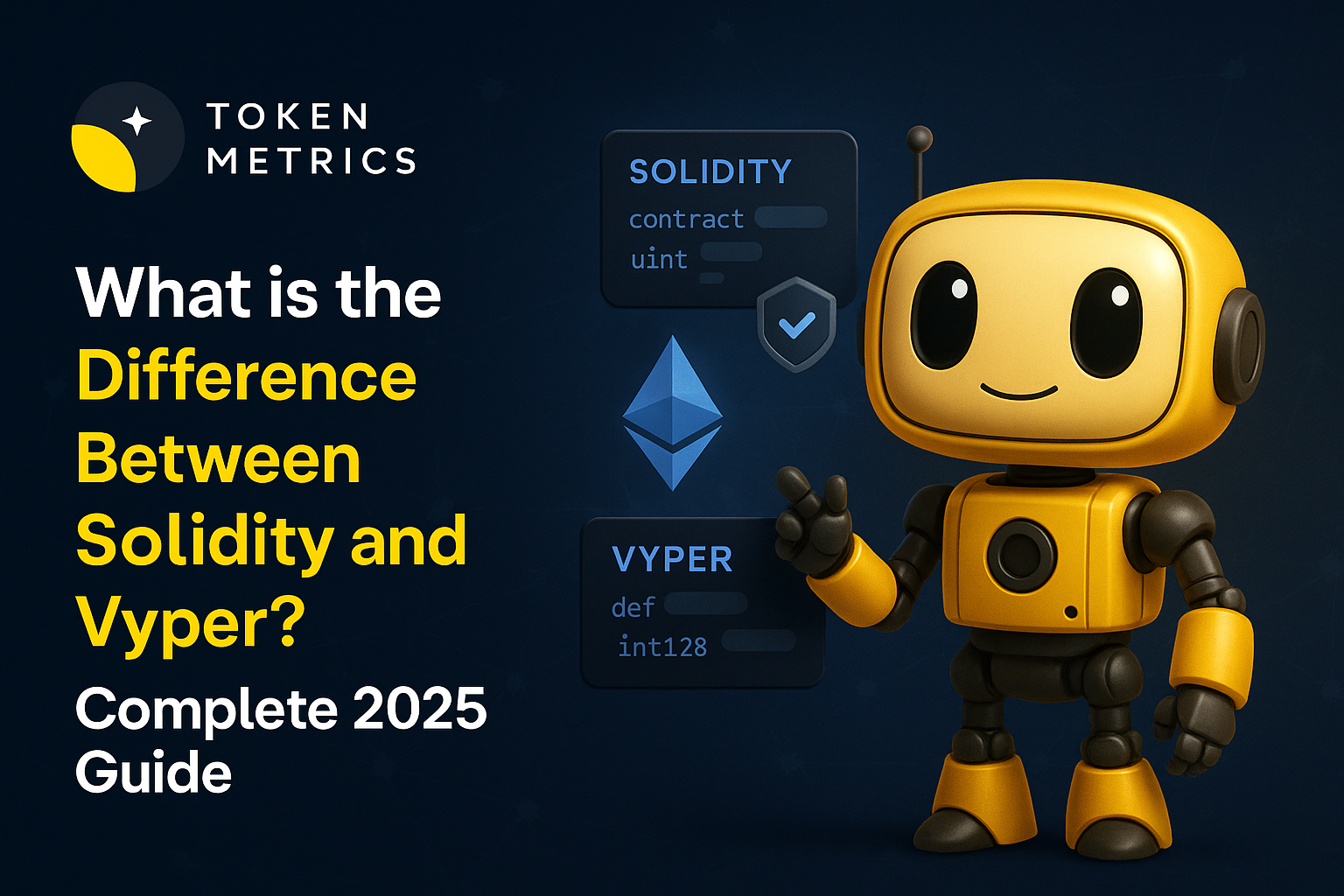
What is the Difference Between Solidity and Vyper? Complete 2025 Guide

Explore the key differences between Solidity and Vyper for Ethereum smart contracts, and learn how to choose the right language for your project in 2025.
Token Metrics Team
7
Want Smarter Crypto Picks—Free?
See unbiased Token Metrics Ratings for BTC, ETH, and top alts.
Thank you! Your submission has been received!
Oops! Something went wrong while submitting the form.
 No credit card | 1-click unsubscribe

Smart contracts have revolutionized the blockchain ecosystem, enabling self-executing code that automatically enforces agreed-upon terms and conditions. As decentralized applications continue growing in sophistication and value, the programming languages used to create these contracts become increasingly critical. Two languages dominate Ethereum smart contract development: Solidity and Vyper. Token Metrics.

Understanding Smart Contract Languages

Before diving into Solidity vs Vyper comparison, it's essential to understand what smart contract languages do and why they matter. Smart contracts are programs that run on blockchain platforms like Ethereum, executing predetermined actions when specific conditions are met. These contracts facilitate secure, transparent, and trustless interactions between parties, eliminating intermediaries and enhancing efficiency.

Smart contract languages enable developers to define the logic and behavior of these contracts, which are immutable and executed on the blockchain. By leveraging smart contract languages, businesses can automate processes including supply chain management, financial transactions, governance systems, and much more.

High-Level vs Low-Level Languages

Smart contract programming requires converting human-readable code into machine-executable bytecode that the Ethereum Virtual Machine (EVM) can process. Developers must first choose between high-level and low-level languages based on their use case and expertise.

High-level languages abstract away granular implementation details, allowing developers to create smart contracts without deep bytecode knowledge. Solidity and Vyper are both high-level languages designed for EVM-compatible blockchains, making them accessible to developers from traditional programming backgrounds.

After compilation, both Solidity and Vyper smart contracts execute using the same bytecode language, meaning they can be used concurrently in the same application despite their different source code appearances.

Solidity: The Industry Standard

Solidity is the most widely used programming language for developing smart contracts on the Ethereum blockchain and EVM-compatible chains. Designed specifically for blockchain applications, Solidity enables developers to create secure, decentralized, and automated agreements that run on distributed networks.

Origins and Design Philosophy

Proposed by Ethereum CTO Gavin Wood, Solidity was developed to meet demand for a flexible smart contract-based developer platform. The language draws heavily on inspiration from C++, JavaScript, and Python, making it familiar to developers from various programming backgrounds.

Solidity is a high-level, Turing-complete, statically typed language where developers must explicitly declare variable types. This allows the compiler to have knowledge of data types, ensuring deterministic application behavior—a critical requirement for blockchain applications where predictability is paramount.

Key Features of Solidity

  • Object-Oriented Programming: Supports inheritance, libraries, and complex data structures for sophisticated smart contracts with reusable components.
  • Rich Feature Set: Includes function overloading, multiple inheritance, user-defined types, and complex data structures.
  • Extensive Ecosystem: Benefits from a large community support, documentation, and development tools like Remix, Hardhat, and Foundry.
  • Blockchain-Specific Commands: Built-in commands for addresses, transactions, and block data interactions.
  • Wide Adoption: Most Ethereum projects, including Uniswap, Aave, and OpenSea, are developed using Solidity.

Advantages of Solidity

  • Market Dominance: Secures 87% of DeFi TVL, making it the dominant language for decentralized finance.
  • Robust Tooling: Mature ecosystem with testing, debugging, and analysis tools.
  • Versatility: Enables implementation of complex protocols, financial instruments, and governance procedures.
  • Learning Resources: Abundant tutorials, courses, and community support.

Disadvantages of Solidity

  • Security Vulnerabilities: Increased attack surface with risks like reentrancy and integer overflows, requiring thorough audits.
  • Complexity: Extensive features can lead to harder-to-audit contracts and hidden vulnerabilities.
  • Steeper Learning Curve: Requires understanding blockchain-specific security considerations.

Vyper: The Security-First Alternative

Vyper is a contract-oriented programming language that targets the EVM with a focus on security, simplicity, and auditability. Introduced in 2018 by Ethereum co-founder Vitalik Buterin, Vyper was specifically developed to address security issues prevalent in Solidity.

Design Philosophy: Security Through Simplicity

Vyper's fundamental philosophy is that security comes from simplicity and readability. The language intentionally limits features and enforces stricter syntax to make contracts more secure and easier to audit. By reducing what’s possible, Vyper minimizes opportunities for mistakes and vulnerabilities.

Using Pythonic syntax—hence the serpentine name—Vyper code prioritizes readability so developers can easily detect bugs and vulnerabilities before deploying contracts. This approach makes code auditable by humans, not just machines.

Key Features of Vyper

  • Python-Like Syntax: Familiar for Python developers, with indentation-based structure and clear syntax.
  • Security-First Design: Eliminates object-oriented features, such as inheritance and function overloading, to reduce attack vectors.
  • Strong Typing: Variables require explicit type declaration, catching errors early.
  • Bounds Checking & Overflow Protection: Built-in safety features prevent common vulnerabilities.
  • Decidability & Gas Optimization: Ensures predictable gas consumption and avoids infinite loops, making contracts more efficient.

Advantages of Vyper

  • Enhanced Security: Designed specifically to prevent common vulnerabilities, leading to more secure contracts.
  • Readable & Audit-Friendly: Clear syntax facilitates quicker reviews and lower audit costs.
  • Concise Code: Fewer lines and simpler syntax streamline contract development.
  • Python Background: Eases onboarding for Python programmers.
  • Potential Gas Savings: Simple design can lead to more efficient contracts in specific cases.

Disadvantages of Vyper

  • Limited Adoption: Only about 8% of DeFi TVL, with a smaller ecosystem and community.
  • Fewer Features: Lack of inheritance, modifiers, and function overloading limits architectural options.
  • Smaller Tooling Ecosystem: Development tools and libraries are less mature compared to Solidity.
  • Less Industry Traction: Major projects predominantly use Solidity, limiting existing examples for Vyper development.

Differences: Solidity vs Vyper

  • Syntax & Structure: Solidity resembles JavaScript and C++, with curly braces and semicolons; Vyper uses Python-like indentation and syntax, omitting object-oriented features.
  • Feature Completeness: Solidity offers inheritance, modifiers, and dynamic data structures; Vyper is minimalist, focusing on security with fixed-size arrays and no inheritance.
  • Security Approach: Solidity relies on developer diligence and testing; Vyper enforces limitations to inherently prevent vulnerabilities.
  • Development Philosophy: Solidity emphasizes flexibility, while Vyper emphasizes security and auditability.

Choosing Between Solidity and Vyper

The decision depends on project needs, team expertise, and security priorities. Large, feature-rich DeFi protocols and complex dApps typically require Solidity's extensive capabilities. Conversely, systems demanding maximum security, or contracts that need to be highly auditable, may benefit from Vyper’s simplicity and security-focused design.

Many projects effectively combine both, using Vyper for security-critical core components and Solidity for peripheral features. This hybrid approach leverages the strengths of each language.

Leveraging Token Metrics for Smart Contract Analysis

While understanding the distinctions between Solidity and Vyper is valuable for developers, investors should also evaluate the projects' underlying code quality, security track record, and development activity. Token Metrics offers AI-powered analytics that examine code repositories, audit statuses, and project activity levels.

The platform reviews security vulnerabilities, audit history, and real-time security incidents, providing a comprehensive view that helps identify projects with strong technical foundations, regardless of their chosen language.

Furthermore, Token Metrics tracks project development activity via GitHub, helping gauge ongoing commitment and progress. Market intelligence and performance analysis reveal success patterns and areas of risk, supporting informed decision-making.

Token Metrics assists investors in balancing portfolios across projects built with different languages, offering risk assessments and alerts that enhance proactive management amid evolving blockchain security landscapes.

The Future of Smart Contract Languages

Both Solidity and Vyper are actively evolving to meet new challenges and security needs. Solidity continues enhancing security features, error handling, and optimization, driven by its large ecosystem. Vyper development emphasizes expanding capabilities while maintaining its core security principles.

Emerging languages and cross-language development strategies are beginning to complement established techniques. Combining secure core contracts in Vyper with the flexibility of Solidity is an increasingly common pattern.

Best Practices for Smart Contract Development

  • Thorough Testing: Implement comprehensive testing, including formal verification and audits, before deployment.
  • Security Audits: Engage reputable security firms to review code vulnerabilities.
  • Continuous Monitoring: Use platforms like Token Metrics for real-time risk detection post-deployment.
  • Upgradeability: Adopt upgrade patterns that allow fixing issues without losing funds or functionality.

Conclusion: Making the Right Choice

Solidity and Vyper offer distinct approaches to smart contract development. Solidity’s comprehensive features and robust ecosystem make it suitable for complex, feature-rich applications. Vyper's security-oriented, Python-like syntax is ideal for systems where auditability, simplicity, and security are top priorities.

Both languages will continue to play vital roles throughout 2025, with many projects adopting hybrid strategies. Evaluating project needs, security considerations, and team expertise will guide optimal language selection. AI analytics platforms like Token Metrics provide critical insights to support this decision, ensuring better understanding and risk management in the ever-evolving ecosystem.

Build Smarter Crypto Apps &
AI Agents in Minutes, Not Months
Real-time prices, trading signals, and on-chain insights all from one powerful API.
Grab a Free API Key
About Token Metrics
Token Metrics: AI-powered crypto research and ratings platform. We help investors make smarter decisions with unbiased Token Metrics Ratings, on-chain analytics, and editor-curated “Top 10” guides. Our platform distills thousands of data points into clear scores, trends, and alerts you can act on.
30 Employees
analysts, data scientists, and crypto engineers
Daily Briefings
concise market insights and “Top Picks”
Transparent & Compliant
Sponsored ≠ Ratings; research remains independent
Want Smarter Crypto Picks—Free?
See unbiased Token Metrics Ratings for BTC, ETH, and top alts.
Thank you! Your submission has been received!
Oops! Something went wrong while submitting the form.
 No credit card | 1-click unsubscribe
Token Metrics Team
Token Metrics Team

Recent Posts

Crypto Basics

Understanding Zero Knowledge Proofs: Securing Privacy and Verification

Token Metrics Team
4

Introduction

Zero Knowledge Proofs (ZKPs) represent a groundbreaking cryptographic concept that enables one party to prove knowledge of specific information to another party without revealing the information itself. This technology is rapidly gaining traction within blockchain ecosystems and privacy-focused applications, offering novel approaches to verification and security without compromising sensitive data.

Basics of Zero Knowledge Proofs

At its core, a Zero Knowledge Proof is a method by which a prover demonstrates to a verifier that a given statement is true, without revealing any additional information beyond the validity of the statement. Introduced in the 1980s, ZKPs rely on complex mathematical algorithms to ensure that knowledge can be proven without disclosure, preserving confidentiality.

The three essential properties that characterize zero knowledge proofs are:

  • Completeness: If the statement is true, an honest verifier will be convinced by an honest prover.
  • Soundness: If the statement is false, no dishonest prover can convince the honest verifier otherwise.
  • Zero-Knowledge: The verifier learns nothing other than the fact the statement is true, gaining no additional knowledge about the actual information.

Types of Zero Knowledge Proofs

There are several approaches to implementing ZKPs, each with its trade-offs and applications. Two of the most significant forms include zk-SNARKs and zk-STARKs.

  • zk-SNARKs (Zero-Knowledge Succinct Non-Interactive Arguments of Knowledge): These are compact proofs that require minimal data for verification and do not require back-and-forth interaction between prover and verifier after setup. zk-SNARKs are widely used in privacy-oriented blockchains such as Zcash.
  • zk-STARKs (Zero-Knowledge Scalable Transparent Arguments of Knowledge): An evolution of zk-SNARKs, zk-STARKs remove the need for a trusted setup and improve scalability and transparency, although generating proofs may be more computationally intensive.

Applications in Blockchain and Cryptography

Zero Knowledge Proofs have considerable implications for enhancing privacy and scalability in decentralized systems. Key applications include:

  • Privacy Encryption: ZKPs enable private transactions by allowing users to confirm transaction validity without revealing participant identities or transaction details.
  • Identity Verification: Users can prove attributes such as age or citizenship without disclosing personal data, reducing risks associated with data leaks and identity theft.
  • Secure Voting Systems: Ensuring the legitimacy of votes while keeping individual votes confidential.
  • Scalability Solutions: By verifying computations off-chain with ZKPs, blockchain networks can reduce on-chain data processing, improving throughput and efficiency.

Challenges and Limitations

Despite their potential, Zero Knowledge Proofs face notable challenges that require careful consideration in practical deployment:

  • Computational Overhead: Generating zero knowledge proofs can be resource-intensive, particularly for complicated statements or large data sets.
  • Trusted Setup Concerns: Some ZKP systems, such as zk-SNARKs, require an initial trusted setup, which poses risks if compromised.
  • Implementation Complexity: Developing robust zero knowledge protocols demands advanced cryptographic expertise and rigorous security auditing.

Role of AI in Zero Knowledge Proof Analysis

Advancements in Artificial Intelligence (AI) have begun to complement cryptographic research, including the exploration and utilization of Zero Knowledge Proofs. AI-driven analytical tools can assist researchers and developers by:

  • Optimizing cryptographic algorithms for efficient proof generation.
  • Performing advanced pattern recognition on blockchain data enhanced by ZKPs to uncover usage trends without compromising privacy.
  • Supporting risk management frameworks by assessing protocol security based on integrated cryptographic parameters.

Platforms such as Token Metrics leverage AI-driven research to analyze emerging cryptographic technologies, including zero knowledge protocols, offering quantitative insights into technological developments and ecosystem dynamics.

How to Research Zero Knowledge Proof Projects

When evaluating projects that incorporate zero knowledge proofs, consider the following research aspects to obtain an objective and thorough understanding:

  1. Technical Documentation: Review whitepapers and technical specifications to understand the ZKP implementations and cryptographic assumptions.
  2. Community and Development Activity: Assess active developer engagement and community support to gauge project viability and ongoing innovation.
  3. Security Audits: Verify results from third-party security audits focused on ZKP mechanisms to mitigate potential vulnerabilities.
  4. Use Cases and Partnerships: Investigate real-world applications and collaborations that demonstrate practical utility of zero knowledge proofs.
  5. Analytical Tools: Utilize platforms like Token Metrics for comprehensive project ratings that incorporate AI-enhanced data on technology and ecosystem health.

Future Outlook and Research Directions

Zero Knowledge Proofs are poised to become foundational in advancing privacy and scalability in decentralized systems. Future research continues to focus on:

  • Improving efficiency of proof generation to enable wider adoption in resource-constrained environments.
  • Developing trustless and transparent protocols to eliminate the need for trusted setups entirely.
  • Expanding integration with emerging technologies such as secure multi-party computation and homomorphic encryption.
  • Enhancing interoperability between ZKP implementations across different blockchain platforms.

Continued innovation in this domain is supported by cross-disciplinary collaborations, including cryptography, computer science, and AI research.

Conclusion

Zero Knowledge Proofs offer a powerful paradigm shift in cryptography, enabling privacy-preserving verification without information disclosure. Their adoption within blockchain and related fields supports the creation of secure, efficient, and private systems. Utilizing AI-powered platforms like Token Metrics can assist in analyzing and understanding the evolving landscape of zero knowledge proof technologies.

Disclaimer

This article is for educational and informational purposes only. It does not constitute financial advice, investment recommendations, or endorsements. Readers should conduct their own research and consult professionals before making decisions related to cryptographic technologies or blockchain projects.

Research

Understanding Web3 Wallets: Your Guide to Secure Crypto Asset Management

Token Metrics Team
4

Introduction to Web3 Wallets

As the blockchain landscape evolves, the term "Web3 wallets" has become fundamental in discussions around decentralized finance and digital asset management. Web3 wallets act as a gateway for users to interact with decentralized applications (dApps), access blockchain networks, and securely manage their digital assets without reliance on centralized intermediaries.

This article explores the concept of Web3 wallets, their types, core features, and the security considerations essential for users. It also highlights how analytical platforms like Token Metrics can aid in understanding the complexities surrounding these wallets and blockchain technologies.

What Are Web3 Wallets?

Web3 wallets are software or hardware tools that enable users to store, send, receive, and interact with cryptocurrencies and tokens on blockchain networks. Unlike traditional digital wallets, Web3 wallets are designed primarily to facilitate decentralized interactions beyond simple transactions, such as signing smart contracts and accessing dApps.

They come in two main forms:

  • Custodial wallets: Where a third party holds the private keys on behalf of the user. This category offers convenience but introduces counterparty risk.
  • Non-custodial wallets: Users retain full control of their private keys. This type aligns with the ethos of decentralization, offering enhanced security but requiring users to take responsibility for key management.

Types of Web3 Wallets

Understanding the various types of Web3 wallets helps users select options that fit their security posture and use cases.

  • Software Wallets: Installed as browser extensions or mobile apps, these wallets offer easy access and integration with dApps. Examples include MetaMask and Trust Wallet.
  • Hardware Wallets: Physical devices that store private keys offline, significantly reducing exposure to hacks. Examples include Ledger and Trezor.
  • Smart Contract Wallets: Wallets deployed as smart contracts allow for programmable control over funds, including multi-signature functionality and customizable security policies.

Key Features and Functionalities

Web3 wallets provide a suite of functionalities tailored to decentralized ecosystems:

  1. Private Key Management: Safe handling and storage of private keys, either locally or hardware-backed, is central to wallet security.
  2. Transaction Signing: Wallets enable users to approve blockchain transactions through cryptographic signatures.
  3. dApp Integration: Seamless interaction with Web3 applications via standardized protocols like WalletConnect.
  4. Multi-Chain Support: Ability to interact with different blockchain networks within a single interface.
  5. Token Management: Displaying and organizing various tokens compliant with standards such as ERC-20 or BEP-20.

Security Considerations for Web3 Wallets

Security remains paramount for Web3 wallet users due to the irreversible nature of blockchain transactions and increasing cyber threats:

  • Private Key Confidentiality: Exposure of private keys or seed phrases can result in total asset loss. Users should store these securely offline.
  • Phishing Attacks: Malicious actors may use fake websites or apps to steal credentials; exercising caution and verifying authenticity is critical.
  • Software Vulnerabilities: Keeping wallet software updated and using reputable wallets can minimize risks related to bugs or exploits.
  • Hardware Storage: Hardware wallets mitigate online threats by keeping keys offline but require physical safeguarding.

Leveraging AI Tools for In-Depth Analysis

The complexity of blockchain ecosystems has led to the emergence of AI-driven analytical platforms that assist users and researchers in understanding market trends, token metrics, and network behaviors. Token Metrics is an example of such a tool, providing data-backed ratings and insights that can complement wallet usage by offering research capabilities on tokens and market conditions.

These platforms can support educational efforts by:

  • Providing fundamentals and trend analysis based on on-chain and market data.
  • Offering scenario analysis to understand potential developments in blockchain protocols.
  • Enhancing security posture by informing users about project credibility and token performance metrics.

Practical Steps to Choose and Use Web3 Wallets

Choosing the right Web3 wallet is a process that balances ease of use, security, and compatibility needs:

  • Research Wallet Types: Understand differences between custodial and non-custodial options.
  • Assess Security Features: Review if the wallet supports hardware integration, multi-factor authentication, or multisig capabilities.
  • Confirm dApp Compatibility: If interaction with decentralized platforms is important, ensure smooth integration.
  • Backup Procedures: Follow recommended practices for seed phrase storage and wallet backup.

Additionally, engaging with AI-driven platforms like Token Metrics can provide analytical depth during the research phase and support ongoing management of crypto assets.

Conclusion and Disclaimer

Web3 wallets represent a critical component of the decentralized internet, empowering users to control their digital assets and participate in blockchain ecosystems securely and effectively. By understanding wallet types, functionalities, and security measures, users can navigate this complex space with greater confidence.

Tools like Token Metrics serve as valuable resources for educational and analytical purposes, enabling deeper insight into token fundamentals and network dynamics.

Disclaimer: This article is intended for educational purposes only and does not constitute financial or investment advice. Readers should conduct their own research and consider their risk tolerance before engaging with any cryptocurrency or blockchain technology.

Research

Understanding Altcoins: The Diverse World of Alternative Cryptocurrencies

Token Metrics Team
4

Introduction to Altcoins

The term altcoins broadly refers to all cryptocurrencies that exist as alternatives to Bitcoin, the pioneering digital currency. Since Bitcoin’s inception in 2009, thousands of alternative crypto coins have emerged with a variety of designs, purposes, and technologies. Understanding what altcoins are and how they differ from Bitcoin and one another is vital for anyone interested in the cryptocurrency ecosystem.

Definition and Types of Altcoins

Altcoins are digital assets that operate on blockchain technology but distinguish themselves from Bitcoin in technical structure or intended utility. Technically, the name is a contraction of “alternative coins.” Altcoins encompass a wide range of projects, including but not limited to:


Technological Innovations in Altcoins

Many altcoins distinguish themselves by innovating on blockchain design, consensus mechanisms, scalability, and privacy. For instance, some use Proof of Stake instead of Bitcoin’s Proof of Work to reduce energy consumption. Others implement advanced cryptographic techniques to enhance transaction confidentiality. These technical differences contribute to the diverse use cases altcoins pursue and can affect their adoption and network effects within various communities.

Evaluating Altcoins and Research Approaches

Evaluating altcoins requires a multifaceted approach that considers technology fundamentals, development activity, community support, and use cases. Research techniques often include:


Advanced AI-driven research tools like Token Metrics synthesize vast amounts of data and market signals to provide quantitative ratings and analysis, aiding in a more informed understanding of altcoin projects.

Altcoins vs Bitcoin: Key Differences

While Bitcoin is primarily conceived as a decentralized digital currency and store of value, altcoins often aim to address specific limitations or explore novel functionalities. Differences can include:


Understanding these distinctions informs discussions around the complementary roles altcoins play alongside Bitcoin in the broader crypto ecosystem.

Considering Risks and Complexities

Due to the large number and variety of altcoins, the space involves considerable complexity and risk. Important considerations include:


Using analytics platforms like Token Metrics can provide data-driven insights into these factors by compiling technical, fundamental, and sentiment indicators.

Practical Steps for Using AI Tools in Altcoin Analysis

AI-powered platforms enable systematic, scalable analysis of altcoins through machine learning models harnessing blockchain data, news sentiment, and market indicators. To incorporate these tools effectively:


Conclusion and Key Takeaways

Altcoins represent a diverse and rapidly evolving segment of the cryptocurrency landscape, designed to explore new functionalities and solve various challenges beyond Bitcoin’s scope. They encompass broad categories, from payments and smart contract platforms to privacy and stablecoins. Due to the complexity and number of projects, rigorous, data-informed research approaches are essential to understand their technology, use cases, and network health.

AI-driven research tools such as Token Metrics offer valuable support in this endeavor by aggregating multiple data streams into comprehensive analysis, helping stakeholders objectively compare altcoins on various factors.

Disclaimer

This blog post is for educational and informational purposes only and does not constitute financial, investment, or trading advice. Readers should conduct their own independent research before engaging with cryptocurrencies.

Choose from Platinum, Gold, and Silver packages
Reach with 25–30% open rates and 0.5–1% CTR
Craft your own custom ad—from banners to tailored copy
Perfect for Crypto Exchanges, SaaS Tools, DeFi, and AI Products