Back to blog
Research

Understanding Crypto Market Microstructure: Lessons from a $19 Billion Liquidation Event

Explore the mechanics behind the recent $19 billion crypto liquidation, market microstructure risks, liquidity dynamics, and lessons for traders and investors in this deep analysis.
Token Metrics Team
12
Want Smarter Crypto Picks—Free?
See unbiased Token Metrics Ratings for BTC, ETH, and top alts.
Thank you! Your submission has been received!
Oops! Something went wrong while submitting the form.
 No credit card | 1-click unsubscribe

The cryptocurrency markets recently experienced their largest single-day liquidation event in history—$19 billion in leveraged positions eliminated within hours. Beyond the immediate impact on traders and portfolios, this event offers a masterclass in market microstructure, liquidity dynamics, and systemic risk. This analysis explores the mechanics of what happened and the broader implications for understanding how digital asset markets function under stress.

The Anatomy of Market Liquidity

What Is Market Depth?

Market depth refers to the market's ability to sustain large orders without significant price impact. It's visualized through order books—the collection of buy and sell orders at various price levels.

Consider a practical example: If a cryptocurrency has $370,000 in orders within 2% of the current price, this represents the "2% depth." A sell order of this size would move the price down by 2%. During normal market conditions, market makers continuously replenish these orders, maintaining depth.

However, during last week's event, this depth evaporated. Some assets saw their 2% depth collapse from hundreds of thousands to mere tens of thousands—a 10x reduction in market resilience.

The Role of Market Makers

Market makers serve as the plumbing of financial markets. They:

  • Continuously quote both buy and sell prices
  • Provide liquidity for traders entering and exiting positions
  • Hedge their exposure through various instruments
  • Use automated algorithms to manage thousands of positions simultaneously

Their profitability comes from the bid-ask spread, but this model requires:

  • Connectivity: Reliable data feeds from exchanges
  • Hedging capability: Access to instruments for offsetting risk
  • Capital efficiency: Ability to maintain positions across multiple venues

When any of these breaks down, market makers protect themselves by withdrawing—exactly what occurred last Friday.

The Leverage Cascade: A Systems Perspective

Perpetual Futures Architecture

Perpetual futures contracts have become the dominant trading vehicle in crypto, surpassing spot volume on most assets. Unlike traditional futures, perpetuals don't expire. Instead, they use a funding rate mechanism to keep prices anchored to spot markets.

This structure creates several unique characteristics:

  1. Capital Efficiency: Traders can control large positions with relatively small collateral. A 10x leveraged position allows $10,000 to control $100,000 in exposure.
  2. Liquidation Mechanisms: When collateral falls below maintenance requirements, positions are automatically closed. In centralized exchanges, this happens through the liquidation engine. In decentralized perpetual DEXs, smart contracts execute liquidations.
  3. Socialized Losses: If liquidations can't be executed at prices that cover losses, many platforms employ "auto-deleveraging" (ADL), where profitable traders on the opposite side are automatically closed to balance the system.

The Cascade Effect

The $19 billion liquidation followed a predictable but devastating pattern:

  1. Stage 1: Initial Trigger Geopolitical news created uncertainty, prompting large traders to reduce exposure. A whale allegedly opened significant short positions ahead of a major policy announcement.
  2. Stage 2: Price Movement Initial selling pushed prices down, triggering stop-losses and liquidations of over-leveraged long positions.
  3. Stage 3: Liquidity Withdrawal Critical exchange APIs experienced disruptions. Unable to hedge or access reliable pricing, market makers stopped quoting.
  4. Stage 4: Liquidity Void With minimal order book depth, liquidation orders had exponentially larger price impacts, triggering additional liquidations.
  5. Stage 5: Cross-Margining Failure Traders using multiple positions as collateral (cross-margin) found themselves exposed when individual positions were liquidated, leaving other positions unhedged.
  6. Stage 6: Auto-Deleveraging Even profitable positions were forcibly closed to rebalance the system, affecting traders who thought they were protected.

Comparative Analysis: COVID-19 vs. The Recent Event

March 2020 COVID Crash

The March 12, 2020 crash ("Black Thursday") represented systemic risk-off behavior:

  • Bitcoin: -50%
  • Ethereum: -43 to -45%
  • Broad-based selling across all asset classes

Driven by unprecedented global uncertainty. Recovery took months.

October 2025 Event

The recent event showed different characteristics:

  • Bitcoin: -9%
  • Ethereum: -10%
  • Selective altcoin devastation (some -90%+)
  • Leverage-driven rather than sentiment-driven
  • Partial recovery within days

Key Insight: This was a microstructure event, not a macro repricing. The difference is critical for understanding market health and recovery dynamics.

The Perpetual DEX Revolution and Its Risks

Decentralization of Derivatives

The emergence of perpetual DEXs (Hyperliquid, GMX, dYdX v4) represents a significant market structure evolution:

Advantages:

  • Non-custodial trading
  • Transparent on-chain settlement
  • Reduced counterparty risk
  • Composability with DeFi protocols

Challenges:

  • Concentrated liquidity pools
  • Less sophisticated market-making
  • Smart contract risk
  • Oracle dependencies for liquidations
  • Limited circuit breakers

The proliferation of these platforms contributed to the unprecedented leverage in the system. Open interest across perpetual DEXs had reached all-time highs, creating vulnerability to coordinated liquidation cascades.

Information Asymmetry and Market Timing

The Insider Trading Question

The timing of large short positions immediately preceding policy announcements raises important questions about information flow in crypto markets:

  • Information Hierarchy: True insiders (policymakers, direct contacts)
  • Well-connected individuals (lobbyists, industry leaders)
  • Professional traders monitoring news feeds
  • Retail traders reading headlines

In traditional markets, insider trading is legally defined and enforced. In crypto's global, 24/7 market, jurisdictional ambiguity and pseudonymity complicate enforcement.

Market Efficiency Implications: The rapid price movement suggests either:

  • Exceptional timing and risk appetite
  • Access to non-public information
  • Sophisticated analysis of geopolitical developments

Regardless of the mechanism, it demonstrates that information advantages remain a powerful edge in supposedly "democratized" markets.

Real-World Asset Integration: A Stabilizing Force?

Maple Finance Case Study

Amid the carnage, platforms focused on real-world assets (RWAs) showed resilience. Maple Finance reported:

  • Zero liquidations during the event
  • Continued TVL growth (10x year-over-year)
  • Stable yields throughout volatility

Why RWAs Performed Differently:

  • Lower Leverage: RWA protocols typically don't offer high leverage ratios
  • Real Collateral: Backed by off-chain assets with independent value
  • Institutional Borrowers: More stable, less speculative user base
  • Different Risk Profile: Credit risk versus market risk

This suggests a potential future where crypto markets bifurcate:

  • Speculative layer: High leverage, high velocity, narrative-driven
  • Productive layer: RWAs, yield generation, institutional capital

Risk Management in Volatile Markets

Position Sizing Mathematics

The Kelly Criterion provides a mathematical framework for position sizing:

f = (bp - q) / b

Where:

  • f = optimal fraction of capital to risk
  • b = odds received on bet
  • p = probability of winning
  • q = probability of losing

In crypto's volatile environment, even sophisticated traders often overallocate. The recent event demonstrated that even with positive expected value, overleveraged positions face ruin through path dependency.

The Volatility Paradox

Crypto's appeal partly stems from volatility—the opportunity for significant returns. However, this same volatility creates:

  1. Leverage Incompatibility: High volatility means small price movements can trigger liquidations. A 5x leveraged position can be liquidated with a 20% adverse move—common in crypto.
  2. Correlation Breakdown: Assets assumed to be uncorrelated often converge during stress, eliminating diversification benefits.
  3. Liquidity Illusion: Markets appear liquid until everyone tries to exit simultaneously.

Hedging Challenges

Traditional hedging strategies face unique challenges in crypto:

  • Delta Hedging: Requires continuous rebalancing in a 24/7 market with variable liquidity.
  • Options Strategies: Crypto options markets have limited depth and wide spreads, making sophisticated strategies expensive.
  • Cross-Asset Hedging: Macro hedges (short equities, long gold) often fail to activate or provide insufficient offset.

The Institutional Risk: Who Went Under?

Previous cycles saw major institutional failures:

  • 2022: Celsius, Voyager, BlockFi, FTX/Alameda
  • 2021: Multiple leveraged funds during May crash
  • 2018: Various ICO-era projects and funds

Each followed a similar pattern:

  • Overleveraged positions
  • Illiquid collateral
  • Inability to meet margin calls
  • Cascading liquidations
  • Eventual insolvency

Current Speculation

Several indicators suggest potential institutional distress:

  • Market Maker Silence: Prominent firms haven't issued statements—unusual given the event's magnitude.
  • Withdrawal Delays: Anecdotal reports of delayed withdrawals from certain platforms.
  • Unusual Price Dislocations: Persistent basis spreads suggesting forced deleveraging.
  • Liquidity Patterns: Sustained reduction in market depth even post-event.

History suggests revelations of institutional failures often emerge weeks or months after the triggering event, as liquidity issues compound.

Behavioral Dynamics: The Human Element

Cognitive Biases in Crisis

The event highlighted several psychological factors:

  • Recency Bias: Many traders, having experienced months of upward price action, underestimated downside risks.
  • Overconfidence: Success in bull markets often leads to excessive risk-taking, particularly with leverage.
  • Loss Aversion: Instead of cutting losses early, many traders added to positions, compounding losses.
  • Herding: Once liquidations began, panic selling accelerated the cascade.

Social Media Amplification

Crypto's real-time social media ecosystem amplified volatility:

  • Liquidation alerts trending on X (Twitter)
  • Telegram groups sharing losses, creating contagion fear
  • Influencers calling for further downside
  • Misinformation about exchange solvency

This feedback loop between price action and social sentiment accelerates both crashes and recoveries.

Technical Infrastructure Vulnerabilities

API Reliability as Systemic Risk

The role of Binance API disruptions cannot be overstated. As the dominant exchange by volume, Binance serves as:

  • Primary price discovery venue
  • Critical hedging platform for market makers
  • Reference for perpetual funding rates
  • Liquidity hub for arbitrage

When its APIs became unreliable, the entire market's plumbing failed. This centralization risk persists despite crypto's decentralization ethos.

Circuit Breakers: The Debate

Traditional markets employ circuit breakers—trading halts during extreme volatility. Crypto's 24/7, decentralized nature complicates implementation:

Arguments For:

  • Prevents cascade liquidations
  • Allows time for rational assessment
  • Protects retail from algos

Arguments Against:

  • Who has authority to halt trading?
  • Increases uncertainty and exit rushing when resumed
  • Antithetical to crypto's permissionless nature
  • Centralized venues would need coordination

The lack of circuit breakers contributed to the cascade but also allowed for rapid price discovery and recovery.

Market Cycle Positioning: Strategic Framework

Identifying Market Phases

The document referenced an accumulation phase. Understanding market cycles requires multiple indicators:

  1. Momentum Indicators: Price trends across multiple timeframes, volume patterns, volatility regimes
  2. Sentiment Metrics: Funding rates (bullish when positive), open interest growth or decline, social media sentiment analysis
  3. On-Chain Data: Exchange flows (accumulation vs. distribution), dormant coin circulation, miner behavior

The Trader vs. Investor Dichotomy

Current market conditions favor trading over investing:

Trading Approach
  • Narrative-driven entries (AI, RWAs, privacy, etc.)
  • Defined exit criteria
  • Risk management through position sizing
  • Frequent portfolio turnover
Investing Approach
  • Fundamental analysis of technology and adoption
  • Multi-year hold periods
  • Conviction through volatility
  • Network effect accumulation

The challenge: most altcoins lack the fundamentals for long-term holding, yet trading requires timing and execution that most cannot consistently achieve.

Alternative Strategies: Defensive Positioning

Yield-Bearing Stablecoins

For risk-off periods, yield-generating strategies offer protection:

  • Options: Staked stablecoins (sUSDS, sDAI): 4-5% APY
  • Delta-neutral strategies (Ethena): 5-8% APY
  • Lending protocols (Aave, Compound): 3-12% depending on asset

Risk Considerations:

  • Smart contract risk
  • Protocol solvency
  • Depeg risk for synthetic stables
  • Opportunity cost versus appreciation assets

The Index Approach

Systematized exposure through index products offers advantages:

  • Benefits:
    • Eliminates Selection Risk: Own the market rather than picking winners
    • Rebalancing Discipline: Automated position management
    • Risk Management: Systematic entry/exit based on market conditions
    • Compounding: Consistent moderate returns compound over time
  • Trade-offs:
    • Lower ceiling than identifying individual winners
    • Fees and rebalancing costs
    • Still subject to overall market direction
    • Requires discipline during bull markets

Historical Outperformers in Bear Markets

Previous cycles identified categories that maintained relative strength:

  • 2018-2019 Bear Market: Chainlink: Infrastructure play, oracle adoption
  • Binance Coin: Exchange utility, launchpad value
  • Synthetix: Innovation in synthetic assets

Common Characteristics:

  • Real usage and adoption
  • Revenue generation
  • Solving specific problems
  • Community and developer activity

The challenge: identifying these requires foresight that's obvious only in retrospect.

Future Market Structure Evolution

Potential Developments

  1. Institutional Infrastructure: Better custody, prime brokerage services, and institutional-grade derivatives will reduce some forms of market instability while potentially introducing others (e.g., complex derivatives).
  2. Regulatory Clarity: Clearer frameworks may reduce certain risks (fraud, manipulation) but could introduce others (compliance costs, reduced access).
  3. Improved Oracle Networks: More reliable price feeds will reduce liquidation errors and improve DeFi stability.
  4. Cross-Chain Liquidity: Better interoperability could distribute liquidity more evenly, reducing concentration risk.
  5. RWA Integration: Tokenized real-world assets may provide ballast to purely speculative markets.

Persistent Challenges

  1. Volatility Will Remain: The crypto market's youth, global accessibility, and 24/7 nature ensure ongoing volatility.
  2. Leverage Will Persist: The demand for capital efficiency means leveraged products will continue to exist and evolve.
  3. Information Asymmetry: Some participants will always have better information, analysis, or execution.
  4. Technical Fragility: As systems grow more complex, new vulnerabilities emerge.

Practical Takeaways

For Traders

  • Leverage Is Optional: Most traders would perform better without it
  • Liquidity Matters: Trade assets where you can exit quickly
  • Position Sizing: Risk per trade should reflect volatility
  • Diversify Exchanges: Don't keep all funds in one venue
  • Plan Before Crisis: Know your exits before entering

For Investors

  • Fundamentals Still Matter: Technology and adoption outlast hype
  • Time Horizon Clarity: Match holdings to investment timeframe
  • Understand Tokenomics: Supply dynamics affect long-term value
  • Diversification Limits: Most altcoins are highly correlated
  • Emotional Discipline: Volatility is the price of admission

For Market Observers

  • Microstructure Drives Macro: Short-term moves often reflect technical factors rather than fundamental repricing
  • Liquidity Is Fragile: Order book depth can vanish instantly
  • Interconnectedness: Crypto's ecosystem is highly interconnected despite appearing diverse
  • Innovation Pace: Market structure evolves rapidly, requiring continuous learning
  • Regulatory Impact: Policy decisions increasingly influence market behavior

Conclusion: The Maturation Paradox

The recent $19 billion liquidation event reveals a paradox in crypto market evolution. Markets have simultaneously become more sophisticated (complex derivatives, institutional participation, integrated infrastructure) and more fragile (concentrated leverage, technical dependencies, correlated liquidations).

This isn't a bug—it's a feature of financial market development. Traditional markets experienced similar growing pains: the 1987 crash, the 1998 LTCM crisis, the 2008 financial crisis. Each revealed vulnerabilities in market structure, leading to reforms, regulations, and evolution.

Crypto's path will likely parallel this trajectory: periodic crises exposing weaknesses, followed by improvements in infrastructure, risk management, and participant sophistication. The difference is tempo—crypto's 24/7, global, permissionless nature compresses decades of traditional market evolution into years.

For participants, the imperative is clear: understand the mechanics underlying market movements, not just price action. Liquidity dynamics, leverage mechanics, information flow, and technical infrastructure aren't peripheral concerns—they're central to navigating these markets successfully.

The $19 billion question isn't whether such events will recur—they will. It's whether each iteration teaches lessons that improve individual decision-making and collective market resilience. Based on history, both in crypto and traditional finance, the answer is cautiously optimistic: markets do learn, but slowly, and often at significant cost to those who fail to adapt.

Build Smarter Crypto Apps &
AI Agents in Minutes, Not Months
Real-time prices, trading signals, and on-chain insights all from one powerful API.
Grab a Free API Key
About Token Metrics
Token Metrics: AI-powered crypto research and ratings platform. We help investors make smarter decisions with unbiased Token Metrics Ratings, on-chain analytics, and editor-curated “Top 10” guides. Our platform distills thousands of data points into clear scores, trends, and alerts you can act on.
30 Employees
analysts, data scientists, and crypto engineers
Daily Briefings
concise market insights and “Top Picks”
Transparent & Compliant
Sponsored ≠ Ratings; research remains independent
Want Smarter Crypto Picks—Free?
See unbiased Token Metrics Ratings for BTC, ETH, and top alts.
Thank you! Your submission has been received!
Oops! Something went wrong while submitting the form.
 No credit card | 1-click unsubscribe
Token Metrics Team
Token Metrics Team

Recent Posts

Crypto Basics

How Cryptos and Meme Coins Are Shaping the 2025 Crypto Market

Token Metrics Team
5 min

Introduction
With Bitcoin in price discovery and meme coins dominating short-term trends, crypto markets in 2025 are in a new phase of the cycle. At Token Metrics, we’ve been tracking smart money, emerging tokens, and high-conviction sectors like DeFi, AI, and meme assets. This post breaks down what we’re seeing—and how traders are adapting.

Current Market Sentiment

Bitcoin remains strong, with ETH and SOL following closely. Our models suggest:

  • ETH base case: $5,700

‍

  • SOL base case: $630

‍

  • Market cap projection: $8–14 trillion

Despite regulatory noise, crypto’s fundamentals—liquidity, user growth, and capital rotation—remain bullish.

Meme Coin Resurgence

Meme coins are leading short-term market action. Among the top gainers:

  • LoFi (SUI Ecosystem): Under $50M FTV, high liquidity, listed on Kraken and KuCoin
  • Sign, Gradient, Zerebro: Mixed quality; require caution

While volatility is high, top-performing meme coins on new chains often yield strong short-term returns—especially when backed by rising ecosystems like SUI.

Smart Money Tracking with Nansen

We’ve doubled down on using platforms like Nansen to follow profitable wallet cohorts. These tools help us identify early-stage tokens with smart money inflows. Key indicators:

  • Positive net inflow from smart wallets
  • Low concentration in top 100 holders
  • Distribution to non-suspicious fresh wallets
  • Whale cohort accumulation

We also track wallet activity over time to confirm whether top-performing wallets are accumulating or exiting positions.

Deep Dives Over Speculation

While meme coins grab headlines, we’re also analyzing sectors with long-term viability:

  • AI Agents (e.g., Fractal AI, Swarms)
  • Real-World Asset Stablecoins (e.g., USUAL with 9% APY)
  • Narrative Ecosystems (e.g., Hedera’s DEX activity surge)

We balance high-risk meme trades with deep fundamental research into projects gaining traction on-chain and in product development.

Sector Watch: Hedera Ecosystem

The Hedera (HBAR) ecosystem recently saw a 5x spike in DEX volume. Tokens like:

  • SaucerSwap (DEX)
  • HashPack (wallet)
  • Bonzo (lending)

are trending upward. While TVL remains low, increased volume may spark price momentum.

We’re not rotating capital aggressively here yet, but we’re watching closely for sustained on-chain activity.

Capital Flow Outlook

Altcoin rotation often follows BTC consolidation. With BTC and ETH leading the charge, we expect:

  • Meme coins and DeFi tokens to lead early-stage alt rotations
  • AI and DePin narratives to pick up mid-cycle
  • ETH and SOL outperformance in layer-1 competition

Internal price models and momentum indicators support further upside, assuming macro remains stable and regulatory conditions don’t sharply deteriorate.

Conclusion

The current cycle rewards those who combine quantitative analysis, on-chain tracking, and strong narrative awareness. Whether trading LoFi for a quick flip or accumulating tokens like Fractal AI or USUAL for a thesis-driven hold, the key is staying ahead of trends without abandoning discipline.

Crypto Basics

What Is a Moonshot? The Ultimate Guide to High-Risk, High-Reward Gems in Crypto (2025)

Token Metrics Team
6 min

The term “moonshot” is everywhere in the crypto world—but what does it really mean? In 2025, as the search for the next 100x token intensifies, understanding the concept of a crypto moonshot is more important than ever. Moonshots offer massive upside potential, but they also come with high risk. So how do you find them, and more importantly, how do you separate hype from real opportunity?

In this guide, we’ll break down what a moonshot is, why it matters, how to identify one, and how tools like Token Metrics are helping investors discover the next big thing in crypto—before it takes off.

🚀 What Is a Moonshot in Crypto?

In crypto, a moonshot refers to a low-cap, high-potential cryptocurrency that could deliver outsized returns, typically 10x, 50x, or even 100x your initial investment. The term comes from the idea that a token is going “to the moon”—crypto slang for an explosive price increase.

Unlike established cryptocurrencies like Bitcoin and Ethereum, moonshots are usually early-stage projects with small market caps, limited trading volume, and a high level of speculation. These tokens often sit under the radar, only gaining traction once a specific narrative, innovation, or market trend brings them into the spotlight.

🧠 Characteristics of a Moonshot Token

While no one can guarantee a moonshot, successful ones often share several key traits:

1. Low Market Cap

Most moonshots start with a market cap under $50 million, sometimes even under $10 million. This gives them room to grow exponentially as adoption increases.

2. Strong Narrative or Trend Alignment

Moonshots usually align with emerging crypto narratives, such as:

  • AI in crypto (e.g., TMAI)
  • Real-world assets (RWA)
  • Decentralized infrastructure (DePIN)
  • ZK rollups and Layer-2s
  • On-chain gaming and modular blockchains

‍

3. Innovative Technology or Unique Use Case

They bring new ideas or solve real problems, giving them the potential to disrupt existing models.

4. Early Community Traction

Even if small, moonshots typically have loyal, vocal communities that drive awareness and support adoption.

5. Token Utility

Tokens that play a critical role in a product’s functionality (staking, access, governance) are more likely to gain value as adoption grows.

6. Exchange Listings

Getting listed on a major CEX (centralized exchange) or DEX (decentralized exchange) often serves as a catalyst for price surges.

⚠️ Moonshot = High Risk, High Reward

While the upside is massive, moonshots come with serious risks:

  • Volatility: Prices can swing wildly in hours or minutes.
  • Scams and rug pulls: Many low-cap tokens are created with malicious intent.
  • Illiquidity: It may be hard to buy or sell large amounts.
  • Overhype: Narratives can fizzle out quickly, leaving bag holders behind.
  • Lack of product-market fit: Many projects never deliver a working product.

Risk management is essential. Only allocate a small portion of your portfolio to moonshots and always do your own research.

🔍 How to Identify Crypto Moonshots

Finding true moonshots is part art, part science. Here are practical steps to help spot them:

1. Use Token Metrics Moonshots Feature

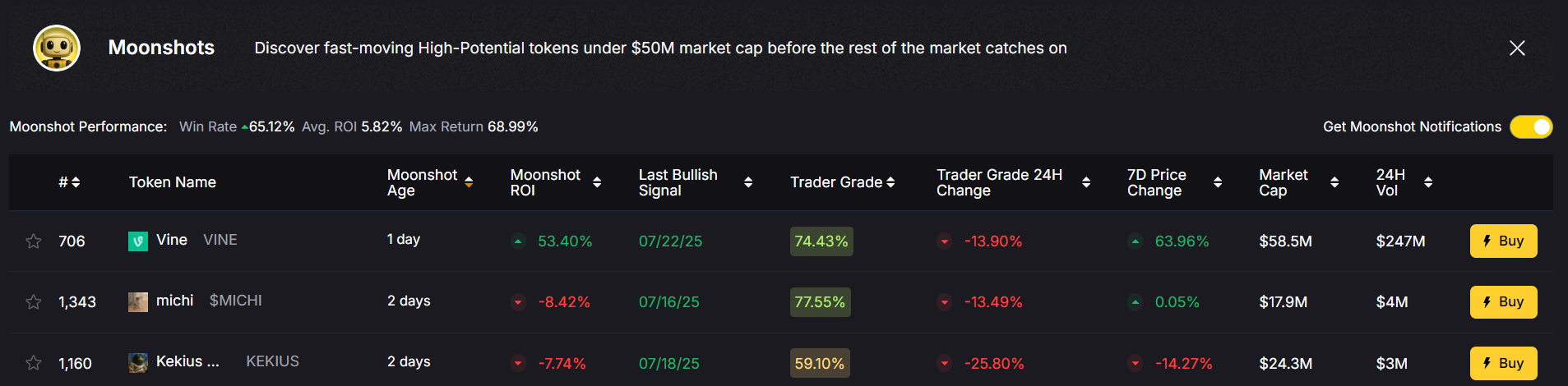
Token Metrics, the leading AI-powered crypto research platform, features a dedicated Moonshots tab that helps users discover early-stage altcoins with massive potential.

Token Metrics uses AI models to:

  • Scan over 6,000+ tokens
  • Analyze 80+ on-chain and off-chain data points
  • Score tokens based on Investor Grade (long-term) and Trader Grade (short-term)
  • Highlight tokens before they hit mainstream radar

2. Follow Emerging Narratives

Pay attention to sectors gaining momentum—AI, DePIN, L2s, gaming, and RWA are hot in 2025. Moonshots often emerge at the intersection of narrative and innovation.

3. Explore Crypto Twitter and Discord

Many early-stage gems are discussed by small communities, KOLs (key opinion leaders), and early investors before any mainstream media coverage.

4. Check Tokenomics

A great idea can’t succeed with poor tokenomics. Look for:

  • Fair initial distribution
  • Deflationary or limited supply
  • Lock-up periods for team/investors
  • Strong incentive alignment with users

5. Monitor DEX Launchpads and On-Chain Metrics

Platforms like Uniswap, Camelot, or Base-native DEXs are where most moonshots launch first. Analyze:

  • Wallet distribution (whale vs retail)
  • Volume and liquidity
  • Holder growth

🔬 How Token Metrics Helps You Find the Next Moonshot

Token Metrics is the ultimate tool for discovering and validating moonshot opportunities. Here’s how:

🧠 AI-Driven Token Ratings

Get real-time Investor Grade and Trader Grade scores, generated by AI models trained on historical altcoin performance.

📈 Bullish & Bearish Signals

Get alerts when a token shows strong upside or downside momentum based on quantitative signals.

🚀 Moonshots Section

A curated feed of low-cap, high-potential tokens filtered by market cap, sector, risk level, and on-chain traction.

📊 Backtesting & Risk Analysis

Use simulation tools to see how a moonshot would have performed in different market conditions, helping you gauge timing and position sizing.

👉 Try Token Metrics with a 7-day free trial and start exploring moonshots with data, not just hype.

✅ Examples of Real Moonshots

In previous years, several tokens started as moonshots and delivered massive gains:

  • Polygon (MATIC) – Launched below $0.01, surged to over $2.50 at peak

  • Axie Infinity (AXS) – Went from cents to $165 during the 2021 gaming boom

  • Pepe (PEPE) – Meme coin that turned thousands into millions in 2023

  • VIRTUAL (SPX6900) – Token Metrics alerted this 55x trade before the crowd

In 2025, emerging moonshots include AI-powered tokens like $TMAI (Token Metrics AI)—positioned at the forefront of AI + crypto convergence.

🛡️ Tips for Safely Investing in Moonshots

  • Only use risk capital (money you can afford to lose)
  • Start small and scale positions after traction
  • Set profit targets and stop-losses
  • Diversify across 5–10 moonshot tokens
  • Use non-custodial wallets and keep private keys secure
  • Don’t chase pumps—enter early or not at all

Moonshot investing isn’t about certainty—it’s about asymmetrical bets with defined downside and massive upside.

Final Thoughts

Moonshots are the heartbeat of crypto innovation. They represent the bold, risky, and visionary projects that could reshape entire industries—or fade into obscurity.

In 2025, the opportunity to find the next Solana, MATIC, or PEPE still exists—but success comes from informed decisions, not hype-driven FOMO. That’s why platforms like Token Metrics are critical. With AI-powered research, curated moonshot lists, and real-time trading signals, Token Metrics helps you spot the gems before they moon.

So, what’s your next moonshot?

Crypto Basics

Understanding Cryptocurrency Danger: What Investors Need to Know

Token Metrics Team
6 min

Introduction to Cryptocurrency

Cryptocurrency is a form of digital currency secured by cryptography, making it nearly impossible to counterfeit or double-spend. As a type of crypto asset, cryptocurrencies operate on decentralized networks powered by blockchain technology—a distributed public ledger maintained by multiple computers worldwide. This decentralized nature sets cryptocurrencies apart from traditional finance systems, which rely heavily on centralized financial institutions and central banks.

Most cryptocurrencies are not issued or regulated by any central authority, which makes them resistant to government interference or manipulation. While this independence offers certain freedoms, it also means that cryptocurrency investments carry substantial risk. The underlying cryptography and blockchain technology are generally secure, but their complexity can be challenging for new users to navigate. Additionally, the market value of cryptocurrencies is often affected by media hype and investor opinion, further contributing to their volatility. Understanding cryptocurrency danger involves exploring both the innovative technology behind it and the volatile market dynamics that influence its value.

Cryptocurrency Exchanges

Cryptocurrency exchanges play a crucial role as crypto asset service providers, allowing investors to buy and sell cryptocurrencies like Bitcoin and other cryptocurrencies at market prices. These exchanges function similarly to stock markets but operate 24/7, reflecting the highly volatile nature of the crypto market. However, many cryptocurrency exchanges lack a high level of governmental oversight or auditability compared to traditional banks, which can expose users to additional risks.

Once purchased, cryptocurrencies must be stored securely, either in digital wallets controlled by the user or through third-party services such as Coinbase, which assist with storing crypto assets safely. Some brokerage platforms, like Robinhood, provide access to cryptocurrency investments but may impose restrictions on withdrawals, limiting how investors can transfer or sell cryptocurrencies. This highlights the importance of understanding the terms and risks associated with each platform.

For those seeking exposure to the crypto asset class without directly holding digital wallets, crypto ETFs offer a more traditional investment vehicle. These funds track the market value of cryptocurrencies and can be bought and sold through conventional brokerage accounts, bridging the gap between digital assets and traditional finance.

Cybersecurity Risks

One of the most significant cryptocurrency dangers lies in cybersecurity risks. Despite the security of blockchain technology, crypto investments are vulnerable to scams, hacks, software bugs, and the highly volatile price swings inherent in the market. The private key—a unique cryptographic code—is the sole access point to an investor’s digital wallet and cryptocurrency holdings. Losing this private key means losing access to the entire investment permanently, with no recourse. If a private key is stolen, there is no way to retrieve it, similar to having a credit card with no authentication check.

Technical challenges and market speculation add layers of risk that investors must carefully consider. Hackers frequently target digital wallets and cryptocurrency exchanges, attempting to steal digital assets. Numerous exchanges have suffered massive security breaches, leading to substantial losses for users. To mitigate these risks, many investors use offline hardware wallets or cold storage solutions, which keep private keys disconnected from the internet connection and significantly reduce the chances of theft.

Evaluating Cryptocurrency as an Investment

Cryptocurrency investments are highly speculative and carry substantial risk, making them unsuitable for risk-averse investors. The market’s high price volatility can lead to rapid gains but also significant losses, and investors should only commit funds they can afford to lose. Cryptocurrencies can potentially yield high returns, attracting speculative investors. Unlike traditional finance, where financial institutions and regulatory bodies provide certain protections, cryptocurrency markets operate with limited oversight, increasing the potential for market manipulation and fraud.

Understanding one’s personal risk tolerance is crucial before deciding to invest in cryptocurrencies. The lack of regulatory control means that how funds are used or managed may be opaque, and the risk of losing money is real and significant. Investors should approach cryptocurrency investments with caution and seek advice from qualified investment advisors to navigate these complexities.

Benefits and Advantages of Cryptocurrency

Despite the risks, cryptocurrencies offer unique advantages. By removing reliance on centralized intermediaries such as banks or credit card companies, cryptocurrencies reduce systemic financial risks and enable more direct, peer-to-peer transactions. Transfers between parties are secured through public and private key cryptography and validated by consensus mechanisms like proof of work or proof of stake, which underpin blockchain technology.

Crypto transfers can often be faster than traditional money transfers, especially in cross-border remittances where converting fiat currency typically involves multiple intermediaries. Decentralized finance innovations like flash loans demonstrate how cryptocurrency transactions can occur almost instantaneously, providing new opportunities for investment and trading.

Risks and Challenges

However, cryptocurrencies also pose significant risks and challenges. While transactions are pseudonymous, digital trails remain traceable by law enforcement agencies such as the Federal Bureau of Investigation (FBI). Cryptocurrencies have been exploited for illicit activities including money laundering, dark web transactions, and ransomware payments. China has banned cryptocurrency exchanges, transactions, and mining, although it has developed a Central Bank Digital Currency (CBDC).

The concentration of wealth in the crypto space is increasing, with large companies and investment funds accumulating substantial holdings. Additionally, cryptocurrency mining demands significant energy consumption, often concentrating mining power among a few large firms with vast resources.

Off-chain security issues, such as vulnerabilities in third-party platforms, and the inherent price volatility continue to challenge the practical implementation of cryptocurrencies. The ideal of a fully decentralized system is often compromised by market manipulation and fraud, underscoring the cryptocurrency danger investors face.

Cryptocurrency and the Law

Unlike fiat currency, which is government-issued legal tender, cryptocurrencies lack official issuance and their legal status varies widely across jurisdictions. In the United States, the Internal Revenue Service (IRS) treats cryptocurrencies as financial assets or property for tax purposes, requiring capital gains taxes on sales or trades.

U.S. courts have classified cryptocurrencies as securities for institutional buyers but not for retail investors trading on exchanges, reflecting the complex regulatory environment. In July 2023, U.S. courts ruled that cryptocurrencies are considered securities when purchased by institutional buyers but not by retail investors on exchanges. Similarly, cryptocurrency regulations in Asia differ significantly by country, demonstrating the global uncertainty surrounding digital assets.

Investors must stay informed about evolving legal frameworks to understand the implications of investing in cryptocurrencies and ensure compliance with tax and regulatory requirements.

Common Scams and How to Avoid Them

The irreversible nature of cryptocurrency transactions and limited regulatory oversight make the space ripe for scams. Fraudsters often use fake endorsements, pressure tactics, and misleading schemes to steal money from unsuspecting investors. For example, some have lost substantial sums—like Rhett, who lost $97,000 to a fraudulent Bitcoin trading scheme.

To avoid falling victim to scams, investors should exercise caution, conduct thorough research, and verify the legitimacy of any investment opportunity. Consulting with reputable investment advisors and relying on trusted sources can help mitigate the risk of fraud and ensure safer participation in the crypto market.

Best Practices for Cryptocurrency Users

Despite the inherent risks, many individuals are drawn to cryptocurrency for its potential gains and innovative technology. To protect digital currency assets, users must adopt proactive security measures. Understanding cybersecurity risks is essential to safeguarding crypto investments from hackers and bad actors.

Best practices include using hardware wallets like Ledger or Trezor, which provide enhanced security by keeping private keys offline. Investors should create duplicate hardware wallets and store backups in secure locations to prevent permanent loss of access. Staying vigilant against phishing attacks and avoiding sharing private keys or sensitive information is critical for maintaining control over digital assets.

Conclusion and Final Thoughts

Cryptocurrencies remain a highly speculative and risky asset class characterized by substantial price volatility and cybersecurity dangers. Investment advisors often recommend treating crypto investments as trading instruments rather than long-term holdings due to their unpredictable nature.

Cryptocurrency products carry risks including illiquidity and the potential for total loss of the entire investment. Investors should only allocate funds they can afford to lose and fully understand the technical complexities and market dynamics before engaging in cryptocurrency trading.

By staying informed, exercising caution, and following best security practices, investors can navigate the cryptocurrency landscape more safely. However, the cryptocurrency danger remains real, and careful consideration is essential before investing in this rapidly evolving digital asset space. Understanding the security and risks related to cryptocurrency requires a much higher level of engagement than traditional investments.

Choose from Platinum, Gold, and Silver packages
Reach with 25–30% open rates and 0.5–1% CTR
Craft your own custom ad—from banners to tailored copy
Perfect for Crypto Exchanges, SaaS Tools, DeFi, and AI Products