Back to blog
Research

Understanding Crypto Market Microstructure: Lessons from a $19 Billion Liquidation Event

Explore the mechanics behind the recent $19 billion crypto liquidation, market microstructure risks, liquidity dynamics, and lessons for traders and investors in this deep analysis.
Token Metrics Team
12
Want Smarter Crypto Picks—Free?
See unbiased Token Metrics Ratings for BTC, ETH, and top alts.
Thank you! Your submission has been received!
Oops! Something went wrong while submitting the form.
 No credit card | 1-click unsubscribe

The cryptocurrency markets recently experienced their largest single-day liquidation event in history—$19 billion in leveraged positions eliminated within hours. Beyond the immediate impact on traders and portfolios, this event offers a masterclass in market microstructure, liquidity dynamics, and systemic risk. This analysis explores the mechanics of what happened and the broader implications for understanding how digital asset markets function under stress.

The Anatomy of Market Liquidity

What Is Market Depth?

Market depth refers to the market's ability to sustain large orders without significant price impact. It's visualized through order books—the collection of buy and sell orders at various price levels.

Consider a practical example: If a cryptocurrency has $370,000 in orders within 2% of the current price, this represents the "2% depth." A sell order of this size would move the price down by 2%. During normal market conditions, market makers continuously replenish these orders, maintaining depth.

However, during last week's event, this depth evaporated. Some assets saw their 2% depth collapse from hundreds of thousands to mere tens of thousands—a 10x reduction in market resilience.

The Role of Market Makers

Market makers serve as the plumbing of financial markets. They:

  • Continuously quote both buy and sell prices
  • Provide liquidity for traders entering and exiting positions
  • Hedge their exposure through various instruments
  • Use automated algorithms to manage thousands of positions simultaneously

Their profitability comes from the bid-ask spread, but this model requires:

  • Connectivity: Reliable data feeds from exchanges
  • Hedging capability: Access to instruments for offsetting risk
  • Capital efficiency: Ability to maintain positions across multiple venues

When any of these breaks down, market makers protect themselves by withdrawing—exactly what occurred last Friday.

The Leverage Cascade: A Systems Perspective

Perpetual Futures Architecture

Perpetual futures contracts have become the dominant trading vehicle in crypto, surpassing spot volume on most assets. Unlike traditional futures, perpetuals don't expire. Instead, they use a funding rate mechanism to keep prices anchored to spot markets.

This structure creates several unique characteristics:

  1. Capital Efficiency: Traders can control large positions with relatively small collateral. A 10x leveraged position allows $10,000 to control $100,000 in exposure.
  2. Liquidation Mechanisms: When collateral falls below maintenance requirements, positions are automatically closed. In centralized exchanges, this happens through the liquidation engine. In decentralized perpetual DEXs, smart contracts execute liquidations.
  3. Socialized Losses: If liquidations can't be executed at prices that cover losses, many platforms employ "auto-deleveraging" (ADL), where profitable traders on the opposite side are automatically closed to balance the system.

The Cascade Effect

The $19 billion liquidation followed a predictable but devastating pattern:

  1. Stage 1: Initial Trigger Geopolitical news created uncertainty, prompting large traders to reduce exposure. A whale allegedly opened significant short positions ahead of a major policy announcement.
  2. Stage 2: Price Movement Initial selling pushed prices down, triggering stop-losses and liquidations of over-leveraged long positions.
  3. Stage 3: Liquidity Withdrawal Critical exchange APIs experienced disruptions. Unable to hedge or access reliable pricing, market makers stopped quoting.
  4. Stage 4: Liquidity Void With minimal order book depth, liquidation orders had exponentially larger price impacts, triggering additional liquidations.
  5. Stage 5: Cross-Margining Failure Traders using multiple positions as collateral (cross-margin) found themselves exposed when individual positions were liquidated, leaving other positions unhedged.
  6. Stage 6: Auto-Deleveraging Even profitable positions were forcibly closed to rebalance the system, affecting traders who thought they were protected.

Comparative Analysis: COVID-19 vs. The Recent Event

March 2020 COVID Crash

The March 12, 2020 crash ("Black Thursday") represented systemic risk-off behavior:

  • Bitcoin: -50%
  • Ethereum: -43 to -45%
  • Broad-based selling across all asset classes

Driven by unprecedented global uncertainty. Recovery took months.

October 2025 Event

The recent event showed different characteristics:

  • Bitcoin: -9%
  • Ethereum: -10%
  • Selective altcoin devastation (some -90%+)
  • Leverage-driven rather than sentiment-driven
  • Partial recovery within days

Key Insight: This was a microstructure event, not a macro repricing. The difference is critical for understanding market health and recovery dynamics.

The Perpetual DEX Revolution and Its Risks

Decentralization of Derivatives

The emergence of perpetual DEXs (Hyperliquid, GMX, dYdX v4) represents a significant market structure evolution:

Advantages:

  • Non-custodial trading
  • Transparent on-chain settlement
  • Reduced counterparty risk
  • Composability with DeFi protocols

Challenges:

  • Concentrated liquidity pools
  • Less sophisticated market-making
  • Smart contract risk
  • Oracle dependencies for liquidations
  • Limited circuit breakers

The proliferation of these platforms contributed to the unprecedented leverage in the system. Open interest across perpetual DEXs had reached all-time highs, creating vulnerability to coordinated liquidation cascades.

Information Asymmetry and Market Timing

The Insider Trading Question

The timing of large short positions immediately preceding policy announcements raises important questions about information flow in crypto markets:

  • Information Hierarchy: True insiders (policymakers, direct contacts)
  • Well-connected individuals (lobbyists, industry leaders)
  • Professional traders monitoring news feeds
  • Retail traders reading headlines

In traditional markets, insider trading is legally defined and enforced. In crypto's global, 24/7 market, jurisdictional ambiguity and pseudonymity complicate enforcement.

Market Efficiency Implications: The rapid price movement suggests either:

  • Exceptional timing and risk appetite
  • Access to non-public information
  • Sophisticated analysis of geopolitical developments

Regardless of the mechanism, it demonstrates that information advantages remain a powerful edge in supposedly "democratized" markets.

Real-World Asset Integration: A Stabilizing Force?

Maple Finance Case Study

Amid the carnage, platforms focused on real-world assets (RWAs) showed resilience. Maple Finance reported:

  • Zero liquidations during the event
  • Continued TVL growth (10x year-over-year)
  • Stable yields throughout volatility

Why RWAs Performed Differently:

  • Lower Leverage: RWA protocols typically don't offer high leverage ratios
  • Real Collateral: Backed by off-chain assets with independent value
  • Institutional Borrowers: More stable, less speculative user base
  • Different Risk Profile: Credit risk versus market risk

This suggests a potential future where crypto markets bifurcate:

  • Speculative layer: High leverage, high velocity, narrative-driven
  • Productive layer: RWAs, yield generation, institutional capital

Risk Management in Volatile Markets

Position Sizing Mathematics

The Kelly Criterion provides a mathematical framework for position sizing:

f = (bp - q) / b

Where:

  • f = optimal fraction of capital to risk
  • b = odds received on bet
  • p = probability of winning
  • q = probability of losing

In crypto's volatile environment, even sophisticated traders often overallocate. The recent event demonstrated that even with positive expected value, overleveraged positions face ruin through path dependency.

The Volatility Paradox

Crypto's appeal partly stems from volatility—the opportunity for significant returns. However, this same volatility creates:

  1. Leverage Incompatibility: High volatility means small price movements can trigger liquidations. A 5x leveraged position can be liquidated with a 20% adverse move—common in crypto.
  2. Correlation Breakdown: Assets assumed to be uncorrelated often converge during stress, eliminating diversification benefits.
  3. Liquidity Illusion: Markets appear liquid until everyone tries to exit simultaneously.

Hedging Challenges

Traditional hedging strategies face unique challenges in crypto:

  • Delta Hedging: Requires continuous rebalancing in a 24/7 market with variable liquidity.
  • Options Strategies: Crypto options markets have limited depth and wide spreads, making sophisticated strategies expensive.
  • Cross-Asset Hedging: Macro hedges (short equities, long gold) often fail to activate or provide insufficient offset.

The Institutional Risk: Who Went Under?

Previous cycles saw major institutional failures:

  • 2022: Celsius, Voyager, BlockFi, FTX/Alameda
  • 2021: Multiple leveraged funds during May crash
  • 2018: Various ICO-era projects and funds

Each followed a similar pattern:

  • Overleveraged positions
  • Illiquid collateral
  • Inability to meet margin calls
  • Cascading liquidations
  • Eventual insolvency

Current Speculation

Several indicators suggest potential institutional distress:

  • Market Maker Silence: Prominent firms haven't issued statements—unusual given the event's magnitude.
  • Withdrawal Delays: Anecdotal reports of delayed withdrawals from certain platforms.
  • Unusual Price Dislocations: Persistent basis spreads suggesting forced deleveraging.
  • Liquidity Patterns: Sustained reduction in market depth even post-event.

History suggests revelations of institutional failures often emerge weeks or months after the triggering event, as liquidity issues compound.

Behavioral Dynamics: The Human Element

Cognitive Biases in Crisis

The event highlighted several psychological factors:

  • Recency Bias: Many traders, having experienced months of upward price action, underestimated downside risks.
  • Overconfidence: Success in bull markets often leads to excessive risk-taking, particularly with leverage.
  • Loss Aversion: Instead of cutting losses early, many traders added to positions, compounding losses.
  • Herding: Once liquidations began, panic selling accelerated the cascade.

Social Media Amplification

Crypto's real-time social media ecosystem amplified volatility:

  • Liquidation alerts trending on X (Twitter)
  • Telegram groups sharing losses, creating contagion fear
  • Influencers calling for further downside
  • Misinformation about exchange solvency

This feedback loop between price action and social sentiment accelerates both crashes and recoveries.

Technical Infrastructure Vulnerabilities

API Reliability as Systemic Risk

The role of Binance API disruptions cannot be overstated. As the dominant exchange by volume, Binance serves as:

  • Primary price discovery venue
  • Critical hedging platform for market makers
  • Reference for perpetual funding rates
  • Liquidity hub for arbitrage

When its APIs became unreliable, the entire market's plumbing failed. This centralization risk persists despite crypto's decentralization ethos.

Circuit Breakers: The Debate

Traditional markets employ circuit breakers—trading halts during extreme volatility. Crypto's 24/7, decentralized nature complicates implementation:

Arguments For:

  • Prevents cascade liquidations
  • Allows time for rational assessment
  • Protects retail from algos

Arguments Against:

  • Who has authority to halt trading?
  • Increases uncertainty and exit rushing when resumed
  • Antithetical to crypto's permissionless nature
  • Centralized venues would need coordination

The lack of circuit breakers contributed to the cascade but also allowed for rapid price discovery and recovery.

Market Cycle Positioning: Strategic Framework

Identifying Market Phases

The document referenced an accumulation phase. Understanding market cycles requires multiple indicators:

  1. Momentum Indicators: Price trends across multiple timeframes, volume patterns, volatility regimes
  2. Sentiment Metrics: Funding rates (bullish when positive), open interest growth or decline, social media sentiment analysis
  3. On-Chain Data: Exchange flows (accumulation vs. distribution), dormant coin circulation, miner behavior

The Trader vs. Investor Dichotomy

Current market conditions favor trading over investing:

Trading Approach
  • Narrative-driven entries (AI, RWAs, privacy, etc.)
  • Defined exit criteria
  • Risk management through position sizing
  • Frequent portfolio turnover
Investing Approach
  • Fundamental analysis of technology and adoption
  • Multi-year hold periods
  • Conviction through volatility
  • Network effect accumulation

The challenge: most altcoins lack the fundamentals for long-term holding, yet trading requires timing and execution that most cannot consistently achieve.

Alternative Strategies: Defensive Positioning

Yield-Bearing Stablecoins

For risk-off periods, yield-generating strategies offer protection:

  • Options: Staked stablecoins (sUSDS, sDAI): 4-5% APY
  • Delta-neutral strategies (Ethena): 5-8% APY
  • Lending protocols (Aave, Compound): 3-12% depending on asset

Risk Considerations:

  • Smart contract risk
  • Protocol solvency
  • Depeg risk for synthetic stables
  • Opportunity cost versus appreciation assets

The Index Approach

Systematized exposure through index products offers advantages:

  • Benefits:
    • Eliminates Selection Risk: Own the market rather than picking winners
    • Rebalancing Discipline: Automated position management
    • Risk Management: Systematic entry/exit based on market conditions
    • Compounding: Consistent moderate returns compound over time
  • Trade-offs:
    • Lower ceiling than identifying individual winners
    • Fees and rebalancing costs
    • Still subject to overall market direction
    • Requires discipline during bull markets

Historical Outperformers in Bear Markets

Previous cycles identified categories that maintained relative strength:

  • 2018-2019 Bear Market: Chainlink: Infrastructure play, oracle adoption
  • Binance Coin: Exchange utility, launchpad value
  • Synthetix: Innovation in synthetic assets

Common Characteristics:

  • Real usage and adoption
  • Revenue generation
  • Solving specific problems
  • Community and developer activity

The challenge: identifying these requires foresight that's obvious only in retrospect.

Future Market Structure Evolution

Potential Developments

  1. Institutional Infrastructure: Better custody, prime brokerage services, and institutional-grade derivatives will reduce some forms of market instability while potentially introducing others (e.g., complex derivatives).
  2. Regulatory Clarity: Clearer frameworks may reduce certain risks (fraud, manipulation) but could introduce others (compliance costs, reduced access).
  3. Improved Oracle Networks: More reliable price feeds will reduce liquidation errors and improve DeFi stability.
  4. Cross-Chain Liquidity: Better interoperability could distribute liquidity more evenly, reducing concentration risk.
  5. RWA Integration: Tokenized real-world assets may provide ballast to purely speculative markets.

Persistent Challenges

  1. Volatility Will Remain: The crypto market's youth, global accessibility, and 24/7 nature ensure ongoing volatility.
  2. Leverage Will Persist: The demand for capital efficiency means leveraged products will continue to exist and evolve.
  3. Information Asymmetry: Some participants will always have better information, analysis, or execution.
  4. Technical Fragility: As systems grow more complex, new vulnerabilities emerge.

Practical Takeaways

For Traders

  • Leverage Is Optional: Most traders would perform better without it
  • Liquidity Matters: Trade assets where you can exit quickly
  • Position Sizing: Risk per trade should reflect volatility
  • Diversify Exchanges: Don't keep all funds in one venue
  • Plan Before Crisis: Know your exits before entering

For Investors

  • Fundamentals Still Matter: Technology and adoption outlast hype
  • Time Horizon Clarity: Match holdings to investment timeframe
  • Understand Tokenomics: Supply dynamics affect long-term value
  • Diversification Limits: Most altcoins are highly correlated
  • Emotional Discipline: Volatility is the price of admission

For Market Observers

  • Microstructure Drives Macro: Short-term moves often reflect technical factors rather than fundamental repricing
  • Liquidity Is Fragile: Order book depth can vanish instantly
  • Interconnectedness: Crypto's ecosystem is highly interconnected despite appearing diverse
  • Innovation Pace: Market structure evolves rapidly, requiring continuous learning
  • Regulatory Impact: Policy decisions increasingly influence market behavior

Conclusion: The Maturation Paradox

The recent $19 billion liquidation event reveals a paradox in crypto market evolution. Markets have simultaneously become more sophisticated (complex derivatives, institutional participation, integrated infrastructure) and more fragile (concentrated leverage, technical dependencies, correlated liquidations).

This isn't a bug—it's a feature of financial market development. Traditional markets experienced similar growing pains: the 1987 crash, the 1998 LTCM crisis, the 2008 financial crisis. Each revealed vulnerabilities in market structure, leading to reforms, regulations, and evolution.

Crypto's path will likely parallel this trajectory: periodic crises exposing weaknesses, followed by improvements in infrastructure, risk management, and participant sophistication. The difference is tempo—crypto's 24/7, global, permissionless nature compresses decades of traditional market evolution into years.

For participants, the imperative is clear: understand the mechanics underlying market movements, not just price action. Liquidity dynamics, leverage mechanics, information flow, and technical infrastructure aren't peripheral concerns—they're central to navigating these markets successfully.

The $19 billion question isn't whether such events will recur—they will. It's whether each iteration teaches lessons that improve individual decision-making and collective market resilience. Based on history, both in crypto and traditional finance, the answer is cautiously optimistic: markets do learn, but slowly, and often at significant cost to those who fail to adapt.

Build Smarter Crypto Apps &
AI Agents in Minutes, Not Months
Real-time prices, trading signals, and on-chain insights all from one powerful API.
Grab a Free API Key
About Token Metrics
Token Metrics: AI-powered crypto research and ratings platform. We help investors make smarter decisions with unbiased Token Metrics Ratings, on-chain analytics, and editor-curated “Top 10” guides. Our platform distills thousands of data points into clear scores, trends, and alerts you can act on.
30 Employees
analysts, data scientists, and crypto engineers
Daily Briefings
concise market insights and “Top Picks”
Transparent & Compliant
Sponsored ≠ Ratings; research remains independent
Want Smarter Crypto Picks—Free?
See unbiased Token Metrics Ratings for BTC, ETH, and top alts.
Thank you! Your submission has been received!
Oops! Something went wrong while submitting the form.
 No credit card | 1-click unsubscribe
Token Metrics Team
Token Metrics Team

Recent Posts

Crypto Basics

What Is Cryptocurrency Market Cap? A Comprehensive Guide

Token Metrics Team
6 min

Understanding the cryptocurrency market cap is fundamental for anyone interested in investing or trading digital currencies. Market capitalization, often referred to as market cap, is a key metric that reflects the total value of a cryptocurrency in the market. Cryptocurrency market capitalization represents the total value of all coins that have been mined for a specific cryptocurrency or all cryptocurrencies combined. This article will explore what cryptocurrency market cap means, how it is calculated, and why it matters for investors navigating the dynamic crypto market.

Introduction to Market Capitalization

Market capitalization represents the total value of a cryptocurrency's circulating coins in the market. It is a crucial metric used by investors and professionals to gauge the relative size and importance of a digital currency within the crypto ecosystem. Understanding market cap is essential for making informed investment decisions, as it provides a snapshot of a cryptocurrency’s size, popularity, and growth potential.

The market cap of a cryptocurrency is calculated by multiplying its current price by the number of coins in circulation. This simple formula offers insight into the cryptocurrency’s total value and helps investors compare different crypto assets effectively. By knowing the market cap, investors can better understand a cryptocurrency’s position in the market and assess its potential for future growth.

Crypto Market Cap and Circulating Supply

To fully grasp the concept of crypto market cap, it is important to understand the role of circulating supply. The circulating supply refers to the number of coins currently available and actively traded in the market. It is this supply that determines the crypto market cap when multiplied by the cryptocurrency’s current price.

Circulating supply is distinct from total supply, which includes all coins that have been created, including those not yet available for trading or locked in reserves. For example, some projects may have a large total supply but a smaller circulating supply due to tokens held by the development team or locked in smart contracts. Recognizing the difference between circulating supply and total supply is vital when evaluating a cryptocurrency’s market capitalization and its potential impact on price and growth.

Calculation and Importance

Market cap is calculated by multiplying the current price of a cryptocurrency by its circulating supply, providing a real-time measure of the asset's total value in dollars or other fiat currencies. This calculation is dynamic, as both price and circulating supply can fluctuate, causing the market cap to change rapidly.

This metric is important because it helps investors assess the size and value of a cryptocurrency relative to others in the crypto market. A higher market cap often indicates a more established and widely adopted cryptocurrency, such as Bitcoin or Ethereum, which tend to have greater network security and liquidity. Conversely, a low market cap may signal a newer or more speculative digital asset, often associated with higher risk and volatility.

Understanding market cap allows investors to make informed choices by comparing the total value of different cryptocurrencies and evaluating their potential for growth or decline.

Investment Strategies and Market Trends

Market capitalization plays a significant role in shaping investment strategies within the crypto market. It influences the level of risk investors are willing to take and the potential returns they might expect. Cryptocurrencies are categorized into three market cap sizes: large-cap (over $10 billion), mid-cap ($1 billion to $10 billion), and small-cap (under $1 billion). Large cap cryptocurrencies, typically those with a market cap exceeding $10 billion, are generally less volatile and more stable. These assets are favored by conservative investors who prioritize security and steady growth.

On the other hand, mid cap and small cap cryptocurrencies often present higher growth potential but come with increased risk and price volatility. Small cap cryptocurrencies may be more susceptible to market fluctuations and liquidity challenges but can offer substantial returns if their underlying projects succeed.

Staying informed about market trends and understanding how market cap affects demand, liquidity, and price movements are essential for developing effective investment strategies. Investors who respond appropriately to these factors are better positioned to capitalize on opportunities and mitigate risks.

Characteristics of a Liquid Market

A liquid market is characterized by the ability to quickly buy or sell assets without causing significant price changes. In the crypto market, liquidity is a critical factor affecting volatility and trading volume. High liquidity means that there is a large number of buyers and sellers, facilitating smooth transactions and reducing price manipulation risks.

Cryptocurrencies with a high market cap tend to have more liquid markets due to their popularity and widespread adoption. This liquidity attracts institutional investors and traders who require the ability to enter and exit positions efficiently. Conversely, small cap cryptocurrencies may suffer from low liquidity, leading to higher volatility and wider bid-ask spreads.

A liquid market with high trading volume provides better price stability and more trading opportunities, making it more attractive for both short-term traders and long-term investors.

The Crypto Market Ecosystem

The crypto market ecosystem is a complex and evolving environment influenced by various factors beyond market cap. Blockchain technology underpins all cryptocurrencies, providing the decentralized infrastructure that ensures transparency and security. Network security, driven by consensus mechanisms and the number of active nodes, plays a crucial role in maintaining trust and stability in the market.

Institutional investors have increasingly entered the crypto market, bringing greater capital, legitimacy, and scrutiny. Their participation often affects market trends and can lead to increased liquidity and reduced volatility in large cap cryptocurrencies.

Understanding this ecosystem and the interplay of technology, investor behavior, and market dynamics is essential for anyone looking to navigate the crypto market successfully. The market is constantly responding to new technologies, regulatory developments, and shifts in investor sentiment.

Large Cap Cryptocurrencies

Large cap cryptocurrencies, such as Bitcoin and Ethereum, dominate the crypto market with market caps exceeding $10 billion. These digital assets are widely regarded as more stable and less volatile compared to smaller cryptocurrencies. Their established track records and strong network security make them attractive safe havens during periods of market uncertainty.

Large cap cryptocurrencies benefit from high liquidity and trading volume, which contribute to better price stability and ease of trading. However, because of their already substantial market capitalization, these assets may experience slower price growth compared to mid or small cap cryptocurrencies.

Investors often include large cap cryptocurrencies in their portfolios to provide balance and reduce overall risk.

Growth Potential and Analysis

While large cap cryptocurrencies offer stability, mid cap and small cap cryptocurrencies often present greater growth potential. These smaller crypto assets may be in earlier stages of development, with innovative projects and technologies that can lead to significant price appreciation.

Analyzing growth potential involves examining a cryptocurrency’s market cap, trading volume, underlying blockchain technology, and the strength of its project or business model. Investors also consider factors such as tokenomics, total supply, and network security to assess long-term viability.

However, higher growth potential comes with increased risk, including higher volatility and liquidity challenges. Investors must carefully weigh these factors and conduct thorough research before committing to investments in smaller cap cryptocurrencies.

Developing Effective Investment Strategies

Crafting effective investment strategies in the crypto market requires a comprehensive understanding of market trends, risk management, and portfolio diversification. Investors should clearly define their investment goals and risk tolerance before entering the market.

Market capitalization is a critical consideration in strategy development, as it affects liquidity, volatility, and potential returns. Diversifying investments across large cap, mid cap, and small cap cryptocurrencies can help balance risk while capturing growth opportunities.

Staying informed about the latest market trends, technological advancements, and regulatory changes is essential. Investors should be prepared to adapt their strategies as the crypto market evolves, responding to shifts in demand, supply, and broader economic factors.

In conclusion, understanding what cryptocurrency market cap is and how it influences the crypto market is vital for making informed investment decisions. By considering market cap alongside other metrics such as circulating supply, trading volume, and network security, investors can navigate the complex world of digital assets with greater confidence and success.

Announcements

Introducing the New Moonshots API Endpoint: Access High‑Potential Tokens Programmatically

Token Metrics Team
5 min

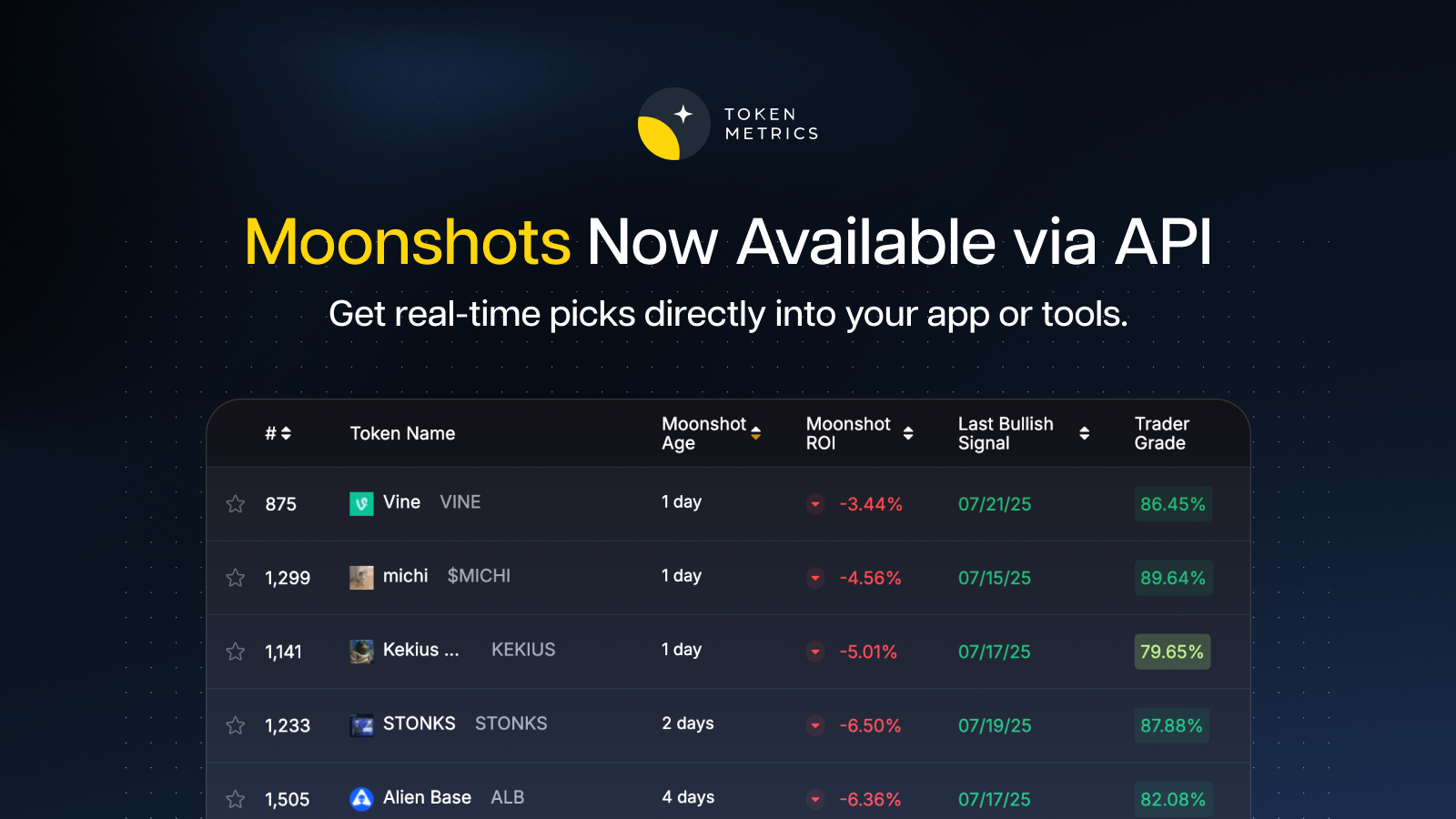
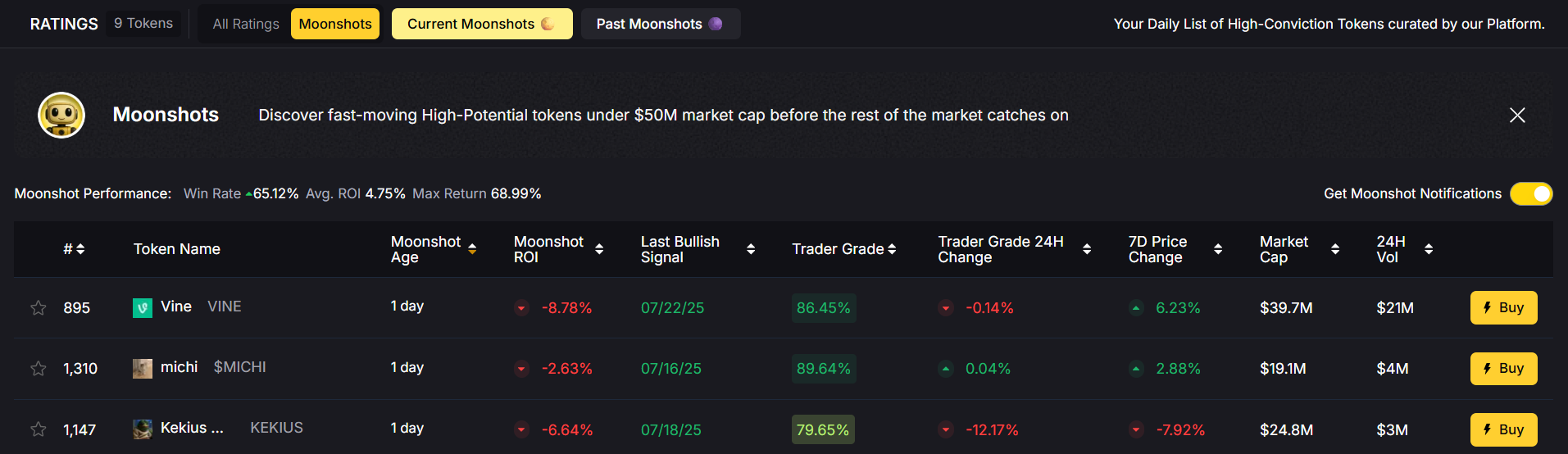
The crypto market moves fast, and staying ahead requires more than just watching charts — it takes actionable data, delivered in real‑time. That’s why we’re excited to announce a major upgrade for developers, traders, and analysts: the Moonshots feature is now live as a Token Metrics API endpoint.

This new endpoint brings the same powerful insights from our Premium Moonshots dashboard directly into your apps, dashboards, and trading systems — programmatically. Whether you’re building a crypto trading bot, creating dynamic watchlists, or backtesting new strategies, the Moonshots API gives you everything you need to make smarter, faster decisions.

What Are Moonshots?

In crypto, “moonshots” are low‑cap tokens with high upside potential — the kind of high‑risk, high‑reward plays that can deliver outsized returns when identified early. At Token Metrics, our Moonshots aren’t just random picks.

They are:

  • Hand‑picked by AI: Our proprietary algorithms scan thousands of tokens daily.
  • Backtested for performance: Only tokens that meet strict historical success criteria make the cut.
  • Continuously updated: Live insights reflect evolving market conditions in real time.

Since launch, Moonshots have surfaced 43 tokens with a 65 % win rate across trades. The max single‑token return so far? 68 % — and counting.

For developers, this is no longer just data you view in our dashboard. It’s now available via API, ready to integrate into your workflows.

Why Use the Token Metrics Moonshots API?

1. Programmatic Access to High‑Potential Trades
Get direct access to live Moonshot signals without needing to log into the platform. Perfect for apps, analytics dashboards, or automated trading systems.

2. Build Smarter Watchlists
Automatically populate your app or dashboard with AI‑curated, high‑potential tokens.

3. Trigger Bots in Real Time
Integrate the Moonshots feed into your trading bots so they can act instantly when a new token surfaces.

What’s in the API Response?

When you call the /v2/moonshot-tokens endpoint, you’ll get:

  • Token name & ticker – For easy identification.
  • Return on Investment (ROI) – Performance since the signal went live.
  • Trader Grade – Token Metrics’ proprietary grade indicating trade potential.
  • Market Cap – So you can quickly gauge token size and liquidity.
  • Signal Date – When the Moonshot was flagged.

Want to see how these signals have performed over time? Use /v2/moonshots-tokens with type=past param for detailed past performance data.

Who Is This For?

The Moonshots API is designed for:

  • Developers: Integrate AI‑curated trading intelligence into your products.
  • Quant Traders: Automate your strategies with real‑time Moonshot signals.
  • Portfolio Managers: Discover high‑potential small‑cap tokens before the crowd.

How to Get Started

  1. Upgrade to the Advanced Plan
    Moonshots is part of our premium trading‑signal suite, available with the Advanced Plan.

  2. Get Your API Key
    Once upgraded, grab your API key from the Token Metrics API dashboard.

  3. Call the Endpoint

    • Live Moonshots: GET /v2/moonshot-tokens
    • Past Moonshots: GET /v2/moonshot-tokens with type=past

  4. Build and Deploy
    Use the data to feed your dashboards, bots, or applications.

Your code could be live in minutes.

Example Use Cases

1. Auto‑Populate Watchlists

Give your users instant access to a curated list of high‑potential tokens. No manual updates — just live, programmatic signals from the API.

2. Trading Bot Triggers

Connect Moonshots to your algorithmic trading strategies. When a new Moonshot signal appears, your bot can take action immediately.

Why Moonshots API Is a Game‑Changer

The Moonshots API takes one of our most popular Premium features and makes it actionable for builders and advanced traders. No more copy‑pasting token names from dashboards. No more manually tracking new signals. With programmatic access, you can:

  • React faster to new opportunities.
  • Automate trading or alert systems.
  • Enhance your products with cutting‑edge AI‑curated token lists.

This is the same data powering our Premium dashboards — now unlocked for programmatic use.

Performance at a Glance

Here’s what you can expect from Moonshots based on recent data:

  • Tokens surfaced: 43
  • Win rate: 65 %
  • Max single‑token return: 68 %
  • Average holding period: Short‑ to mid‑term trades (active monitoring recommended)

The Bottom Line

The new Moonshots API endpoint lets you turn insights into action. Whether you’re an individual trader looking to build a personal watchlist, a quant team running algorithmic strategies, or a product developer building the next great crypto platform, the Moonshots API provides a direct pipeline to AI‑curated, backtested token picks with a proven track record.

Don’t just watch the next big move — catch it before it becomes hindsight.

How to Access the Moonshots API

  1. Upgrade to Advanced Plan to unlock trading‑signal endpoints.
  2. Get your API key from the Token Metrics dashboard.
  3. Start calling /v2/moonshot-tokens today.

Have questions? Our team is available on Telegram (@tokenmetricsapi) to help you get up and running.

Crypto Basics

Understanding Bitcoins: A Practical Guide to Buying and Using Crypto

Token Metrics Team
8 min

Introduction to Bitcoin

Bitcoins represent a revolutionary form of virtual currency that operates without reliance on any central authority or trusted third party. Introduced in 2009 by the enigmatic Satoshi Nakamoto, bitcoins were designed as a decentralized digital currency and cryptocurrency aimed at enabling money and payment transactions directly between peers. Bitcoin is the first decentralized cryptocurrency, setting the stage for a new era in digital finance. This is made possible through the innovative use of blockchain technology, a distributed ledger that records bitcoin transactions securely and transparently. The bitcoin network itself is maintained by a peer-to-peer system of computers, each verifying and broadcasting transactions to ensure the integrity and continuity of the ledger. This decentralized approach eliminates the need for financial institutions or banks to act as intermediaries, making bitcoins a unique asset in the realm of digital currencies. According to the European Central Bank, the decentralization of money offered by bitcoin has roots in the Austrian school of economics.

History of Bitcoin

The story of bitcoins began in August 2008 with the registration of the domain bitcoin.org, signaling the start of a new era in digital money. Shortly thereafter, on January 3, 2009, Satoshi Nakamoto mined the first bitcoin block, known as Block 0 or the genesis block, marking the inception of the bitcoin blockchain. Bitcoin's use as a currency began in 2009 with the release of its open-source implementation, allowing users to participate in this decentralized system. Bitcoin was introduced in response to the global financial crisis to restore trust in transactions outside of traditional systems. Bitcoin started gaining traction in 2010, highlighted by the first commercial transaction where bitcoins were used to purchase goods. Since then, bitcoin prices have experienced significant volatility, with sharp rises and falls reflecting market sentiment, adoption rates, and regulatory developments. Despite its fluctuations, bitcoin has established itself as a pioneering digital currency and a key player in the broader ecosystem of cryptocurrencies.

Bitcoin Fundamentals

At its core, bitcoin is built on a decentralized system that leverages cryptographic techniques to secure transactions and maintain trust without a central authority. The blockchain serves as a chronological chain of blocks, each block containing data stored in a way that includes a hash of the previous block. Everyone on the Bitcoin network has access to an independent copy of the blockchain for transaction verification, ensuring transparency and trust. The blockchain is implemented as an ordered list of blocks, where each block contains a hash of the previous block. This linkage ensures the integrity and immutability of the blockchain, as any alteration to previous blocks would be immediately apparent. Miners play a crucial role in this system by using computational power to solve complex mathematical problems that verify bitcoin transactions. Once validated, these transactions are grouped into new blocks and added to the bitcoin blockchain. An interesting feature of bitcoins is their divisibility; each bitcoin can be broken down into eight decimal places, with the smallest unit known as a satoshi, allowing for microtransactions and flexible usage.

Buying and Using Bitcoin

For those interested in entering the world of bitcoins, purchasing them typically involves using cryptocurrency exchanges where bitcoin can be bought using fiat currencies such as the US dollar. To buy bitcoin, users must first create a bitcoin address, which acts as a digital wallet for storing and sending bitcoins. Once an account is funded on an exchange, users can execute buy bitcoin orders and begin accumulating this digital asset. As of 2023, River Financial estimated that bitcoin had around 81.7 million users globally. As of 2021, Bitcoin is only recognized as legal tender in El Salvador, showcasing its limited but significant adoption as a national currency. Bitcoins are not only an investment but also a medium of exchange accepted by various merchants and businesses for payments. Additionally, users can sell bitcoin on exchanges or use it for donations and other financial services, highlighting its growing utility as a form of money in the digital age.

Regulatory Environment

Regulating bitcoin presents unique challenges due to its decentralized nature and absence of a central bank or authority. Governments and financial institutions worldwide are still grappling with how best to regulate bitcoin and other digital currencies. While some countries have outright banned bitcoin, others have taken steps to implement frameworks that govern its use, aiming to protect consumers and prevent illicit activities. Legal frameworks for Bitcoin vary significantly across jurisdictions, complicating investment decisions. The regulatory environment remains fluid, with ongoing debates about legal tender status, taxation, and compliance requirements. Understanding these evolving regulations is essential for users and businesses to navigate the legal landscape surrounding bitcoins safely and effectively.

Investing in Bitcoin

Investing in bitcoins offers both opportunities and risks that potential investors must carefully consider. The market for bitcoins is known for its high fees and significant volatility in bitcoin prices, which can lead to rapid gains or losses. Some investors liken bitcoin to gold, viewing it as a digital store of value and a hedge against inflation and currency devaluation. Investment in bitcoins can be conducted through cryptocurrency exchanges or specialized investment funds that provide exposure to this asset. However, thorough research and a solid understanding of the market dynamics are crucial before committing funds, as bitcoin lacks intrinsic value and is subject to speculative bubbles.

Security and Privacy

Bitcoin transactions are secured through advanced cryptographic techniques that verify and protect the integrity of each payment made on the network. Despite this robust security at the protocol level, bitcoin exchanges and wallets remain vulnerable to hacking and other cyber threats. Users must adopt stringent security measures such as using strong passwords, enabling two-factor authentication, and safeguarding private keys to protect their bitcoins. The decentralized nature of the bitcoin network, combined with the use of private keys, also provides a certain degree of privacy and anonymity, distinguishing it from traditional financial systems that rely on trusted third parties.

Mining and Consensus

Bitcoin mining is the fundamental process through which new transactions are verified and new blocks are added to the blockchain. Miners employ significant computational power to solve complex mathematical puzzles, a process that requires substantial energy consumption and specialized hardware. A new block in the blockchain is created approximately every 10 minutes for transaction processing, ensuring a steady and predictable flow of new blocks. This mining activity not only secures the network but also enables the creation of new bitcoins, rewarded to miners as a block reward. The bitcoin network operates on a consensus mechanism, ensuring that all nodes agree on the blockchain’s current state, maintaining data consistency across the peer-to-peer network. Many miners join mining pools to combine their computational resources, increasing their chances of successfully mining new blocks and earning rewards.

Challenges and Limitations

Despite its innovative design, bitcoin faces several challenges that impact its scalability and adoption. The bitcoin network can experience slow transaction times, often taking up to 10 minutes to confirm payments, which can be a drawback for everyday use. High fees during periods of network congestion further complicate its practicality for small transactions. Bitcoin is rarely used in regular transactions due to high costs, price volatility, and transaction times, limiting its utility as a day-to-day currency. Additionally, bitcoin’s decentralized structure complicates regulatory oversight and governance. Concerns also arise from the use of bitcoins in illicit activities such as money laundering and terrorist financing, prompting calls for enhanced monitoring and regulation. These limitations highlight the need for ongoing development and dialogue to address bitcoin’s shortcomings.

Risks and Considerations

Investing and using bitcoins come with inherent risks that must be acknowledged. The value of bitcoins can fluctuate dramatically, sometimes by thousands of dollars within short periods, exposing investors to potential significant losses. The absence of intrinsic value and the speculative nature of the market raise concerns about the possibility of a bitcoin bubble. Users should mitigate these risks by diversifying their investments and employing secure wallets to protect their funds. Awareness of market volatility and prudent management strategies are essential for anyone engaging with bitcoins as an asset or means of payment.

Best Practices for Bitcoin Users

To maximize benefits and minimize risks, bitcoin users should prioritize education about the technology, market, and associated risks. Using secure wallets and reputable exchanges is fundamental, along with enabling two-factor authentication to enhance account security. Staying informed about the regulatory environment and compliance requirements helps users avoid legal pitfalls. Regularly updating bitcoin software and employing strong passwords further safeguard against security breaches. Adhering to these best practices ensures a safer and more reliable experience when buying, selling, or transacting with bitcoins.

Conclusion

Bitcoin is a complex and rapidly evolving digital currency that has transformed the financial landscape by introducing a decentralized alternative to traditional money. Understanding the fundamentals of bitcoins, from their blockchain technology to their market dynamics and regulatory challenges, is crucial for users, investors, and policymakers alike. While the future of bitcoins and other cryptocurrencies remains uncertain, their growing adoption underscores their potential to reshape how value is exchanged globally. Staying informed and adaptable will be key as bitcoins continue to influence the future of money, payments, and investment.

Choose from Platinum, Gold, and Silver packages
Reach with 25–30% open rates and 0.5–1% CTR
Craft your own custom ad—from banners to tailored copy
Perfect for Crypto Exchanges, SaaS Tools, DeFi, and AI Products