Back to blog
Research

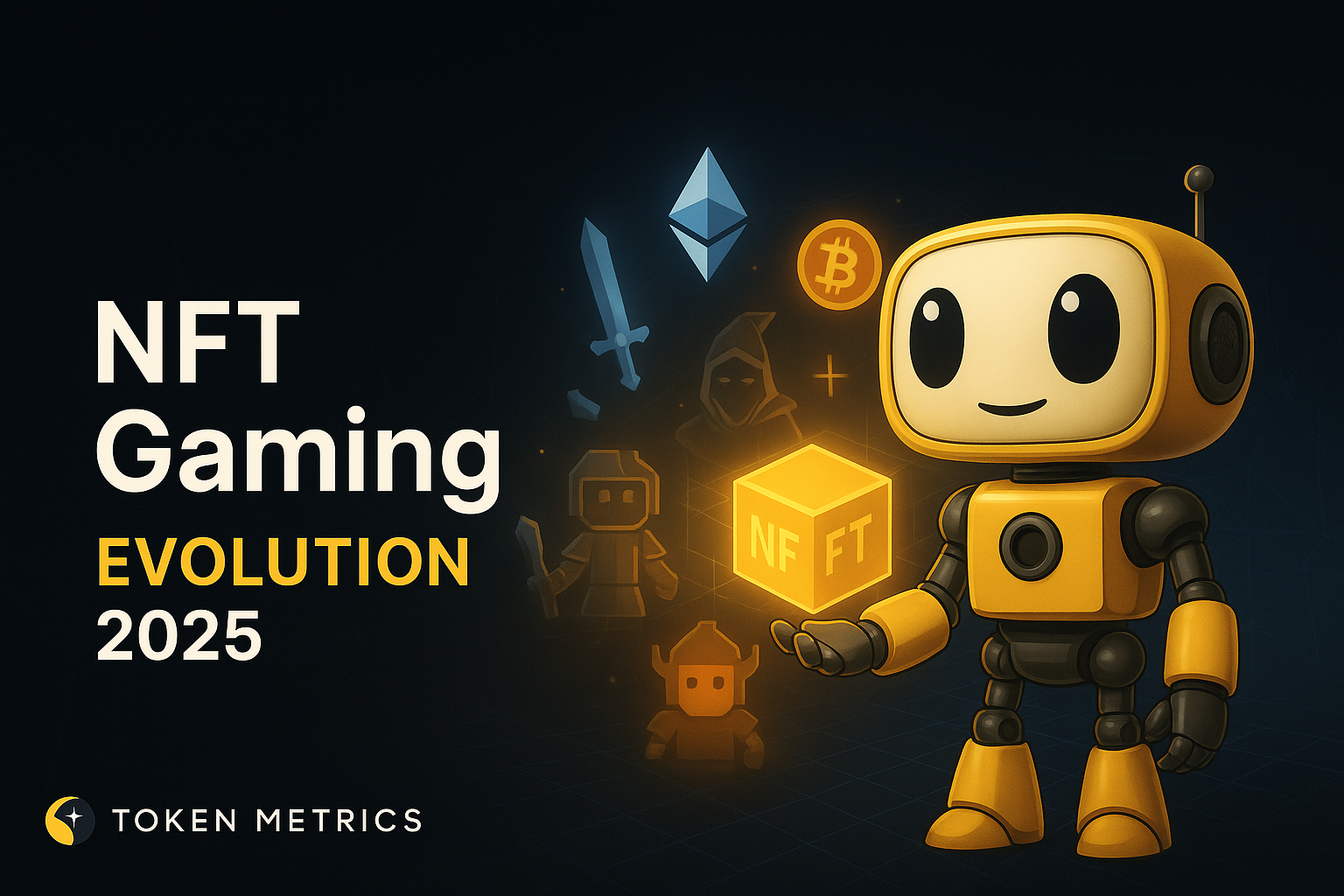
What's the Future of NFTs in Gaming? Market Analysis & 2025 Predictions

Explore the future of gaming NFTs, market growth, key trends, and how Token Metrics' analytics tools can help navigate this evolving digital landscape.
Token Metrics Team
8 min read
Want Smarter Crypto Picks—Free?
See unbiased Token Metrics Ratings for BTC, ETH, and top alts.
Thank you! Your submission has been received!
Oops! Something went wrong while submitting the form.
 No credit card | 1-click unsubscribe

The question of what's the future of NFTs in gaming is no longer theoretical—it's a dynamic reality reshaping the gaming landscape. The intersection of non-fungible tokens (NFTs) and gaming has evolved from a speculative experiment into a multi-billion dollar industry that is revolutionizing how players engage with virtual worlds. In fact, gaming NFTs accounted for over 70% of all NFT activity in the first quarter of 2025, and the market is projected to skyrocket from $4.8 billion in 2024 to an astonishing $44.1 billion by 2034. For game developers, investors, and players alike, understanding this transformation is essential to navigating the future of interactive entertainment.

The Explosive Growth Trajectory

The growth trajectory of NFT gaming is nothing short of explosive. Market forecasts indicate that the NFT gaming market will reach a staggering $0.54 trillion in 2025 and continue expanding at a compound annual growth rate (CAGR) of 14.84%, hitting $1.08 trillion by 2030. Meanwhile, the broader Web3 gaming market, which encompasses blockchain-based games and decentralized applications, is expected to grow from $25.63 billion in 2024 to $124.74 billion by 2032, with an even higher CAGR of 19.34%. Play-to-earn (P2E) NFT games are at the forefront of this surge, with the market projected to climb from $5.4 billion in 2025 to $20.19 billion by 2033, growing at a 17.93% CAGR. These models are attracting players worldwide, with more than 64% of users actively engaging with NFT-based games. Notably, 55% of these players are motivated by the financial incentives enabled by play-to-earn systems, which allow gamers to earn real-world income by playing.

This growth is not a passing bubble but a fundamental restructuring of gaming economies. Unlike traditional games that primarily extract value for publishers and developers, NFT gaming rewards players for their time, skill, and engagement, creating new revenue streams and empowering players in unprecedented ways.

From Speculation to Utility: The Maturation of Gaming NFTs

In the early days of NFT gaming, roughly between 2021 and 2022, the space was dominated by speculation and unsustainable tokenomics. Many projects prioritized financial mechanics over gameplay quality, resulting in inflated expectations and eventual market corrections. Players quickly recognized the limitations of games designed mainly as investment vehicles rather than immersive experiences.

By 2025, the market has matured significantly, with utility and gameplay quality taking center stage. The focus has shifted decisively from purely art-based NFTs to those that grant access to events, decentralized finance (DeFi) protocols, and real-world assets. Today, gaming and sports-related NFT collections constitute over 70% of NFT activity, underscoring that functional and engaging experiences drive sustained adoption.

True Digital Ownership Revolution

One of the most transformative aspects of NFTs in gaming is the concept of true digital ownership. Unlike traditional games where in-game assets are controlled exclusively by the game publisher and hold no tangible value outside the game's ecosystem, blockchain technology enables genuine ownership of digital items. When players acquire an in-game NFT—be it a rare weapon, a unique character, or virtual land—they have verifiable proof of ownership secured by the blockchain.

This ownership is not merely symbolic. Players can trade, sell, or use their NFTs across compatible games, or hold them as investments independent of the developer's decisions. Unlike traditional games, where assets are often locked to one title, NFTs open the door to interoperability and player-driven economies. Statistics reinforce this shift: over 61% of players now value having more control over their in-game assets, and around 58% of gaming projects integrate NFT minting capabilities, empowering users to create, trade, and monetize digital collectibles with greater autonomy.

  1. Sustainable Play-to-Earn Models

    The first generation of play-to-earn games struggled with unsustainable token economies that led to inflationary spirals and market collapse. Today, the emphasis is on creating balanced, sustainable play-to-earn models where earning potential aligns with genuine gameplay value rather than relying on recruitment or speculative hype. Currently, about 55% of P2E games provide crypto-based rewards within stable token economies designed for long-term viability. Developers are incorporating mechanisms such as token sinks, deflationary features, and diversified revenue streams beyond token sales to foster healthy in-game economies. This approach helps maintain the economic integrity of NFT gaming and enhances player trust.

  2. Cross-Chain Interoperability and Multi-Platform Integration

    One of the most promising aspects of NFT gaming is interoperability—the ability for players to use their digital assets across multiple games and platforms. This cross-chain functionality has become a dominant trend in 2025, with projects expanding their presence across various blockchain networks like Kronos, Solana, and Arbitrum to reach broader audiences. Technological advancements such as the ERC-6551 standard enable NFTs to own other assets, creating nested ownership structures that add unprecedented complexity and flexibility to in-game economies. For example, a player might acquire a rare sword in one game and use it across different titles, with blockchain technology ensuring provenance and authenticity. This interoperability not only enhances the gaming experience but also supports the emergence of player-driven economies across virtual worlds.

  3. AI Integration and Dynamic NFTs

    Artificial intelligence is playing an increasingly important role in NFT gaming. Unlike static digital collectibles, many new NFT assets now incorporate dynamic elements that evolve based on player actions, external triggers, or changing conditions. AI-powered procedural generation allows for unique, personalized gaming experiences while preserving the scarcity and value of NFTs. This fusion of AI and NFTs is revolutionizing gameplay mechanics, enabling more immersive and responsive virtual environments that adapt to how players engage with the game. Dynamic NFTs represent a new frontier in digital ownership and interactive storytelling within the gaming world.

  4. Metaverse Expansion and Virtual Worlds

    Blockchain-powered metaverses are becoming more sophisticated, offering enhanced graphics, intuitive interfaces, and richer social features. Competitive events within these virtual worlds are moving beyond experimental phases, with players competing in front of virtual audiences, purchasing NFT tickets, and earning collectible trophies. Virtual real estate remains a key growth area, with the market for virtual land projected to expand from $0.356 billion in 2023 to $4.498 billion by 2032. Players, brands, and investors are increasingly acquiring virtual land to establish persistent digital spaces that transcend individual games, contributing to the rise of vibrant virtual economies.

  5. Mainstream AAA Adoption

    While early NFT gaming initiatives were primarily driven by indie studios and blockchain-native developers, 2025 is witnessing major game publishers entering the space. Industry giants like Ubisoft, Square Enix, Nexon, and Epic Games have announced blockchain-based projects, lending credibility and potentially introducing millions of traditional gamers to NFT integration. Although no AAA publisher has yet fully integrated NFTs into a blockbuster title, expectations are high that between 2025 and 2030, a major release will feature NFT elements, especially as regulatory clarity improves and market demand solidifies. This transition marks a new era in gaming, blending the best of traditional games with the innovative potential of blockchain technology.

Regional Dynamics and Market Leadership

Geographically, the Asia-Pacific region leads NFT gaming adoption, commanding approximately 38-40% of the market share. This dominance is fueled by a massive mobile-first gamer base, increasing digitalization, and supportive government policies in countries like Japan and South Korea. The region's soaring smartphone usage and growing interest in crypto assets further accelerate NFT adoption. North America follows with 25-29% market share, characterized by strong crypto adoption, high digital literacy, and nearly half of American gamers having interacted with at least one blockchain-based game. Europe holds about 20-21% of the market, benefiting from rising NFT awareness and regulatory frameworks like the Markets in Crypto-Assets (MiCA) regulation, which provides clearer guidelines for developers and investors.

Token Metrics: Essential Intelligence for Gaming NFT Investment

As gaming NFTs transition from speculative tokens to foundational gaming infrastructure representing hundreds of billions in value, investors require sophisticated analytical tools to identify opportunities and manage risk. Token Metrics, a premier crypto trading and analytics platform, offers comprehensive intelligence tailored to the gaming NFT landscape.

Comprehensive Gaming NFT Analysis

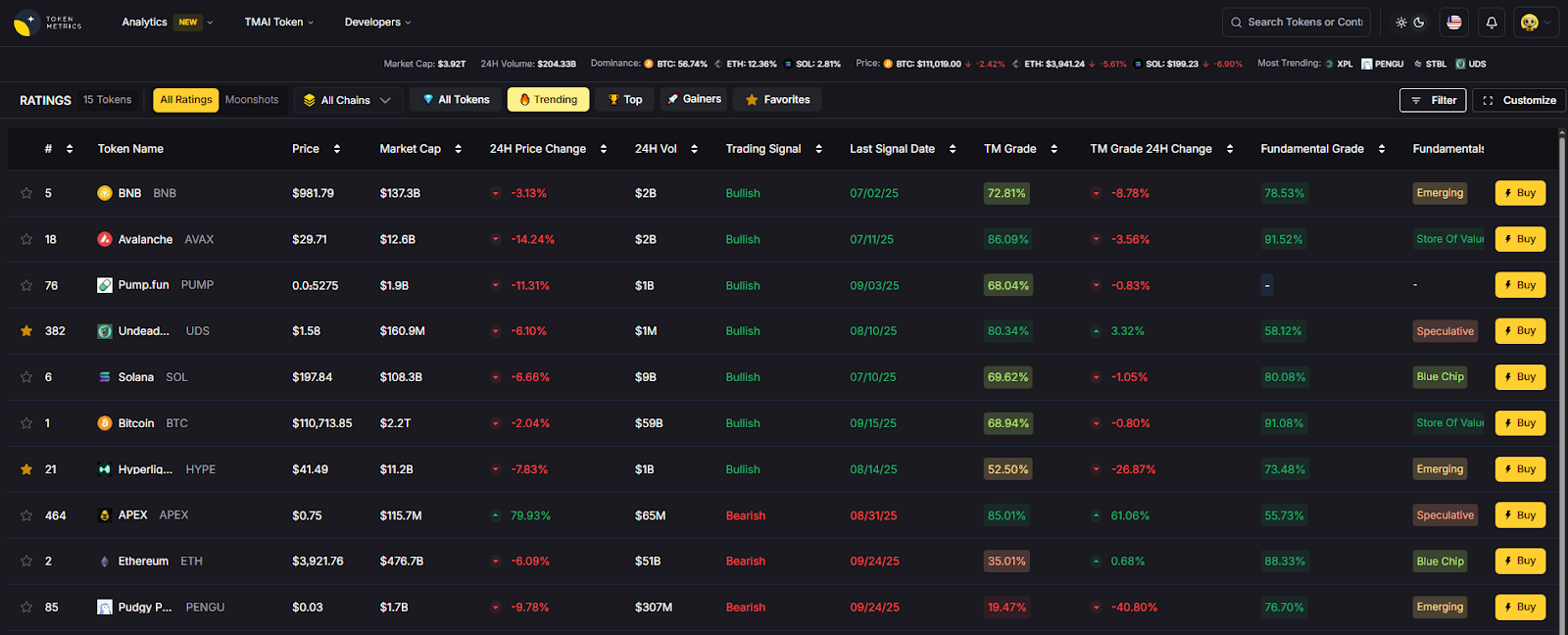
Token Metrics evaluates thousands of digital assets, including gaming tokens, play-to-earn projects, metaverse platforms, and NFT collections. Its AI-powered rating system assesses projects based on critical factors such as: Blockchain infrastructure, smart contract security, and scalability solutions Economic sustainability, token utility, and inflation/deflation mechanisms Developer team expertise, community engagement, and partnership quality Market dynamics including trading volume, liquidity, and holder distribution Gameplay quality, user retention, and player growth rates

Gaming NFT Market Intelligence

Understanding which gaming platforms, blockchain networks, and NFT collections offer superior risk-adjusted returns requires deep market intelligence. Token Metrics delivers sector-specific research, project comparisons, trend forecasting, and risk assessments that highlight red flags like unsustainable tokenomics or technical vulnerabilities.

Portfolio Management for Gaming Assets

Investors building diversified portfolios across cryptocurrencies, gaming tokens, NFT collections, and virtual land benefit from Token Metrics’ portfolio tools. These provide real-time valuation across multiple chains and marketplaces, performance attribution, correlation analysis for diversification, and tax reporting features to simplify complex NFT transactions.

Trading Signals and Actionable Intelligence

Token Metrics’ proprietary algorithms generate trading signals for gaming tokens and NFT projects, helping investors identify optimal entry and exit points. As NFT marketplaces mature and liquidity improves, these signals become increasingly valuable for active portfolio management.

Access Token Metrics today to leverage the analytical firepower needed to capitalize on the gaming NFT revolution.

Challenges and Considerations

Despite the promising outlook, NFTs in gaming face several key challenges:

  • Regulatory Uncertainty: Governments worldwide are still defining how to regulate gaming NFTs, especially concerning securities laws and gambling regulations. About 43% of game publishers cite regulatory concerns as significant barriers to NFT integration.
  • Technical Barriers: Over half of indie developers report limited access to blockchain infrastructure and smart contract expertise as obstacles. High transaction fees and network congestion remain concerns, although Layer-2 solutions are alleviating these issues.
  • Player Skepticism: Many gamers view NFTs as predatory monetization or are concerned about environmental impact. Developers must carefully balance NFT integration with genuine gameplay improvements to overcome resistance.
  • Market Volatility: The value of gaming tokens and NFT assets can be highly volatile, posing financial risks to players whose in-game items fluctuate dramatically in worth.

Addressing these challenges is critical to achieving widespread adoption and ensuring the long-term sustainability of NFT-based gaming ecosystems.

The Road Ahead: 2025 and Beyond

The future of NFTs in gaming extends well beyond digital collectibles and speculation. We are entering a new era where player-owned economies, true digital property rights, and gameplay that rewards skill and engagement redefine the gaming experience. Key developments to watch include:

  • Killer App Emergence: The arrival of a breakthrough game with cultural impact on par with Fortnite or Minecraft could accelerate mainstream adoption overnight.
  • Institutional Investment: Continued venture capital funding and major publisher involvement will legitimize and expand the space.
  • Technological Advancements: Improvements in blockchain scalability, reduced transaction fees, and enhanced user experiences will drive adoption.
  • Regulatory Clarity: Comprehensive frameworks will enable compliant NFT gaming implementations, reducing uncertainty.
  • Cross-Platform Standards: Industry-wide interoperability protocols will allow true asset portability across different games and virtual worlds.

The projection that gaming NFTs will grow nearly ninefold from $4.8 billion to $44.1 billion by 2034 highlights one of the most significant wealth creation opportunities in the digital economy. For players, developers, and investors willing to navigate the evolving landscape, gaming NFTs offer unprecedented potential to revolutionize how we play, trade, and own digital assets.

Ready to capitalize on the gaming NFT revolution? Visit tokenmetrics.com to access cutting-edge research, analytics, and trading intelligence that give you an edge in this explosive market.

Build Smarter Crypto Apps &
AI Agents in Minutes, Not Months
Real-time prices, trading signals, and on-chain insights all from one powerful API.
Grab a Free API Key
About Token Metrics
Token Metrics: AI-powered crypto research and ratings platform. We help investors make smarter decisions with unbiased Token Metrics Ratings, on-chain analytics, and editor-curated “Top 10” guides. Our platform distills thousands of data points into clear scores, trends, and alerts you can act on.
30 Employees
analysts, data scientists, and crypto engineers
Daily Briefings
concise market insights and “Top Picks”
Transparent & Compliant
Sponsored ≠ Ratings; research remains independent
Want Smarter Crypto Picks—Free?
See unbiased Token Metrics Ratings for BTC, ETH, and top alts.
Thank you! Your submission has been received!
Oops! Something went wrong while submitting the form.
 No credit card | 1-click unsubscribe
Token Metrics Team
Token Metrics Team

Recent Posts

Research

Leading Oracles for Price & Real-World Data (2025)

Sam Monac
5 min

Why Oracles for Price & Real-World Data Matter in September 2025

DeFi, onchain derivatives, RWAs, and payments don’t work without reliable oracles for price & real-world data. In 2025, latency, coverage, and security disclosures vary widely across providers, and the right fit depends on your chain, assets, and risk tolerance. This guide helps teams compare the leading networks (and their trade-offs) to pick the best match, fast.
Definition (snippet-ready): A blockchain oracle is infrastructure that sources, verifies, and delivers off-chain data (e.g., prices, FX, commodities, proofs) to smart contracts on-chain.

We prioritized depth over hype: first-party data, aggregation design, verification models (push/pull/optimistic), and RWA readiness. Secondary focus: developer UX, fees, supported chains, and transparency. If you’re building lending, perps, stablecoins, options, prediction markets, or RWA protocols, this is for you.

How We Picked (Methodology & Scoring)

  • Weights (100 pts): Liquidity/usage (30), Security design & disclosures (25), Coverage across assets/chains (15), Costs & pricing model (15), Developer UX/tooling (10), Support/SLAs (5).

  • Data sources: Official product/docs, security/transparency pages, and audited reports. We cross-checked claims against widely cited market datasets where helpful. No third-party links appear in the body.
    Last updated September 2025.

Top 10 Oracles for Price & Real-World Data in September 2025

1. Chainlink — Best for broad coverage & enterprise-grade security

Why Use It: The most battle-tested network with mature Price/Data Feeds, Proof of Reserve, and CCIP for cross-chain messaging. Strong disclosures and large validator/operator sets make it a default for blue-chip DeFi and stablecoins. docs.switchboard.xyz
Best For: Lending/stablecoins, large TVL protocols, institutions.
Notable Features:

  • Price/Data Feeds and reference contracts

  • Proof of Reserve for collateral verification

  • CCIP for cross-chain token/data movement

  • Functions/Automation for custom logic
    Fees/Notes: Network/usage-based (LINK or billing models; varies by chain).
    Regions: Global.
    Alternatives: Pyth, RedStone.
    Consider If: You need the most integrations and disclosures, even if costs may be higher. GitHub

2. Pyth Network — Best for real-time, low-latency prices

Why Use It: First-party publishers stream real-time prices across crypto, equities, FX, and more to 100+ chains. Pyth’s on-demand “pull” update model lets dApps request fresh prices only when needed—great for latency-sensitive perps/AMMs. Pyth Network
Best For: Perps/options DEXs, HFT-style strategies, multi-chain apps.
Notable Features:

  • Broad market coverage (crypto, equities, FX, commodities)

  • On-demand price updates to minimize stale reads

  • Extensive multi-chain delivery and SDKs Pyth Network
    Fees/Notes: Pay per update/read model varies by chain.
    Regions: Global.
    Alternatives: Chainlink, Switchboard.
    Consider If: You want frequent, precise updates where timing matters most. Pyth Network

3. API3 — Best for first-party (direct-from-API) data

Why Use It: Airnode lets API providers run their own first-party oracles; dAPIs aggregate first-party data on-chain. OEV (Oracle Extractable Value) routes update rights to searchers and shares proceeds with the dApp—aligning incentives around updates. docs.api3.org+1
Best For: Teams that prefer direct data provenance and revenue-sharing from oracle updates.
Notable Features:

  • Airnode (serverless) first-party oracles

  • dAPIs (crypto, stocks, commodities)

  • OEV Network to auction update rights; API3 Market for subscriptions docs.kava.io
    Fees/Notes: Subscription via API3 Market; chain-specific gas.
    Regions: Global.
    Alternatives: Chainlink, DIA.
    Consider If: You need verifiable source relationships and simple subscription UX. docs.kava.io

4. RedStone Oracles — Best for modular feeds & custom integrations

Why Use It: Developer-friendly, modular oracles with Pull, Push, and Hybrid (ERC-7412) modes. RedStone attaches signed data to transactions for gas-efficient delivery and supports custom connectors for long-tail assets and DeFi-specific needs.
Best For: Builders needing custom data models, niche assets, or gas-optimized delivery.
Notable Features:

  • Three delivery modes (Pull/Push/Hybrid)

  • Data attached to calldata; verifiable signatures

  • EVM tooling, connectors, and RWA-ready feeds
    Fees/Notes: Pay-as-you-use patterns; gas + operator economics vary.
    Regions: Global.
    Alternatives: API3, Tellor.
    Consider If: You want flexibility beyond fixed reference feeds.

5. Band Protocol — Best for Cosmos & EVM cross-ecosystem delivery

Why Use It: Built on BandChain (Cosmos SDK), Band routes oracle requests to validators running Oracle Scripts (OWASM), then relays results to EVM/Cosmos chains. Good match if you straddle IBC and EVM worlds. docs.bandchain.org+2docs.bandchain.org+2
Best For: Cross-ecosystem apps (Cosmos↔EVM), devs who like programmable oracle scripts.
Notable Features:

  • Oracle Scripts (OWASM) for composable requests

  • Request-based feeds; IBC compatibility

  • Libraries and examples across chains docs.bandchain.org
    Fees/Notes: Gas/fees on BandChain + destination chain.
    Regions: Global.
    Alternatives: Chainlink, Switchboard.
    Consider If: You want programmable queries and Cosmos-native alignment. docs.bandchain.org

6. DIA — Best for bespoke feeds & transparent sourcing

Why Use It: Trustless architecture that sources trade-level data directly from origin markets (CEXs/DEXs) with transparent methodologies. Strong for custom asset sets, NFTs, LSTs, and RWA feeds across 60+ chains. DIA+1
Best For: Teams needing bespoke baskets, niche tokens/NFTs, or RWA price inputs.
Notable Features:

  • Two stacks (Lumina & Nexus), push/pull options

  • Verifiable randomness and fair-value feeds

  • Open-source components; broad chain coverage DIA
    Fees/Notes: Custom deployments; some public feeds/APIs free tiers.
    Regions: Global.
    Alternatives: API3, RedStone.
    Consider If: You want full transparency into sources and methods. DIA

7. Flare NetworksBest for real-world asset tokenization and decentralized data

Why Use It: Flare uses the Avalanche consensus to provide decentralized oracles for real-world assets (RWAs), enabling the tokenization of non-crypto assets like commodities and stocks. It combines high throughput with flexible, trustless data feeds, making it ideal for bridging real-world data into DeFi applications.

Best For: Asset-backed tokens, DeFi protocols integrating RWAs, cross-chain compatibility.

Notable Features:

  • Advanced decentralized oracle network for real-world data

  • Tokenization of commodities, stocks, and other RWAs

  • Multi-chain support with integration into the Flare network

  • High throughput with minimal latency

Fees/Notes: Variable costs based on usage and asset complexity.

Regions: Global.

Alternatives: Chainlink, DIA, RedStone.

Consider If: You want to integrate real-world assets into your DeFi protocols and need a robust, decentralized solution.

8. UMA — Best for optimistic verification & oracle-as-a-service

Why Use It: The Optimistic Oracle (OO) secures data by proposing values that can be disputed within a window—powerful for binary outcomes, KPIs, synthetic assets, and bespoke data where off-chain truth exists but doesn’t stream constantly. Bybit Learn
Best For: Prediction/insurance markets, bespoke RWAs, KPI options, governance triggers.
Notable Features:

  • OO v3 with flexible assertions

  • Any verifiable fact; not just prices

  • Dispute-based cryptoeconomic security Bybit Learn
    Fees/Notes: Proposer/disputer incentives; bond economics vary by use.
    Regions: Global.
    Alternatives: Tellor, Chainlink Functions.
    Consider If: Your use case needs human-verifiable truths more than tick-by-tick quotes. Bybit Learn

9. Chronicle Protocol — Best for MakerDAO alignment & cost-efficient updates

Why Use It: Originated in the Maker ecosystem and now a standalone oracle network with Scribe for gas-efficient updates and transparent validator set (Infura, Etherscan, Gnosis, etc.). Strong choice if you touch DAI, Spark, or Maker-aligned RWAs. Chronicle Protocol
Best For: Stablecoins, RWA lenders, Maker-aligned protocols needing verifiable feeds.
Notable Features:

  • Scribe reduces L1/L2 oracle gas costs

  • Community-powered validator network

  • Dashboard for data lineage & proofs Chronicle Protocol
    Fees/Notes: Network usage; gas savings via Scribe.
    Regions: Global.
    Alternatives: Chainlink, DIA.
    Consider If: You want Maker-grade security and cost efficiency. Chronicle Protocol

10. Switchboard — Best for Solana & multi-chain custom feeds

Why Use It: A multi-chain, permissionless oracle popular on Solana with Drag-and-Drop Feed Builder, TEEs, VRF, and new Oracle Quotes/Surge for sub-100ms streaming plus low-overhead on-chain reads—ideal for high-speed DeFi. docs.switchboard.xyz+1
Best For: Solana/SVM dApps, custom feeds, real-time dashboards, gaming.
Notable Features:

  • Low-code feed builder & TypeScript tooling

  • Oracle Quotes (no feed accounts/no write locks)

  • Surge streaming (<100ms) and cross-ecosystem docs docs.switchboard.xyz
    Fees/Notes: Some features free at launch; usage limits apply.
    Regions: Global.
    Alternatives: Pyth, Band Protocol.
    Consider If: You want speed and customization on SVM/EVM alike. docs.switchboard.xyz+1

Decision Guide: Best By Use Case

  • Regulated/Institutional & broad integrations: Chainlink.

  • Ultra-low-latency trading: Pyth or Switchboard (Surge/Quotes). Pyth Network+1

  • Custom, gas-efficient EVM delivery: RedStone.

  • First-party sources & subscription UX: API3 (Airnode + dAPIs + OEV). docs.kava.io

  • Cosmos + EVM bridge use: Band Protocol. docs.bandchain.org

  • Bespoke feeds/NFTs/RWAs with transparent sources: DIA. DIA

  • Permissionless, long-tail assets: Tellor. docs.kava.io

  • Optimistic, assertion-based facts: UMA. Bybit Learn

  • Maker/DAI alignment & gas savings: Chronicle Protocol. Chronicle Protocol

How to Choose the Right Oracle (Checklist)

  • Region & chain support: Verify your target chains and L2s are supported.

  • Coverage: Are your assets (incl. long-tail/RWAs) covered, or can you request custom feeds?

  • Security model: Push vs. pull vs. optimistic; validator set transparency; dispute process.

  • Costs: Update fees, subscriptions, gas impact; consider pull models for usage spikes.

  • Latency & freshness: Can you control update cadence? Any SLAs/heartbeats?

  • UX & tooling: SDKs, dashboards, error handling, testing sandboxes.

  • Support & disclosures: Incident reports, status pages, proofs.

  • Red flags: Opaque sourcing, no dispute/alerting, stale feeds, unclear operators.

Use Token Metrics With Any Oracle

  • AI Ratings to triage providers and prioritize integrations.
  • Narrative Detection to spot momentum in perps/lending sectors powered by oracles.

  • Portfolio Optimization to size positions by oracle risk and market beta.

  • Alerts/Signals to monitor price triggers and on-chain flows.
    Workflow: Research → Select → Execute on your chosen oracle/provider → Monitor with TM alerts.


Primary CTA: Start free trial

Security & Compliance Tips

  • Enforce 2FA and least-privilege on deployer keys; rotate API/market credentials.

  • Validate feed params (deviation/heartbeat) and fallback logic; add circuit breakers.

  • Document chain-specific KYC/AML implications if your app touches fiat/RWAs.

  • For RFQs and custom feeds, formalize SLOs and alerting.

  • Practice wallet hygiene: separate ops keys, testnets, and monitors.

This article is for research/education, not financial advice.

Beginner Mistakes to Avoid

  • Relying on a single feed without fallback or stale-price guards.

  • Assuming all “price oracles” have identical latency/fees.

  • Ignoring dispute windows (optimistic designs) before acting on values.

  • Not budgeting for update costs when volatility spikes.

  • Skipping post-deploy monitoring and anomaly alerts.

FAQs

What is a blockchain oracle in simple terms?
It’s middleware that fetches, verifies, and publishes off-chain data (e.g., prices, FX, commodities, proofs) to blockchains so smart contracts can react to real-world events.

Do I need push, pull, or optimistic feeds?
Push suits stable, shared reference prices; pull minimizes cost by updating only when needed; optimistic is great for facts that benefit from challenge periods (e.g., settlement outcomes). Pyth Network+1

Which oracle is best for low-latency perps?
Pyth and Switchboard (Surge/Quotes) emphasize real-time delivery; evaluate your chain and acceptable freshness. Pyth Network+1

How do fees work?
Models vary: subscriptions/markets (API3), per-update pull fees (Pyth), or gas + operator incentives (RedStone/Tellor). Always test under stress. docs.kava.io+2Pyth Network+2

Can I get RWA data?
Yes—Chainlink PoR, DIA RWA feeds, Chronicle for Maker-aligned assets, and others offer tailored integrations. Validate licensing and data provenance. docs.switchboard.xyz+2DIA+2

Conclusion + Related Reads

The “best” oracle depends on your chain, assets, latency needs, and budget. If you need broad coverage and disclosures, start with Chainlink. If you’re building latency-sensitive perps, test Pyth/Switchboard. For first-party provenance or custom baskets, look to API3, DIA, or RedStone. For long-tail, permissionless or bespoke truths, explore Tellor or UMA.
Related Reads:

  • Best Cryptocurrency Exchanges 2025

  • Top Derivatives Platforms 2025

  • Top Institutional Custody Providers 2025

Research

Best Remittance Companies Using Crypto Rails (2025)

Sam Monac
5 min

Why Crypto-Powered Remittances Matter in September 2025

Cross-border money transfers are still too expensive and slow for millions of workers and families. Crypto remittance companies are changing that by using stablecoins, Lightning, and on-chain FX to compress costs and settlement time from days to minutes. In one line: crypto remittances use blockchain rails (e.g., Lightning or stablecoins like USDC) to move value globally, then convert to local money at the edge. This guide highlights the 10 best providers by liquidity, security, corridor coverage, costs, and UX—so you can pick the right fit whether you’re sending U.S.→MX/PH remittances, settling B2B payouts in Africa, or building compliant payout flows. Secondary topics we cover include stablecoin remittances, Lightning transfers, and cross-border crypto payments—with clear pros/cons and regional caveats.

How We Picked (Methodology & Scoring)

  • Liquidity (30%) – Depth/scale of flows, corridor breadth, and on/off-ramps.

  • Security (25%) – Licenses, audits, proof-of-reserves or equivalent disclosures, custody posture.

  • Coverage (15%) – Supported corridors, payout methods (bank, e-wallet, cash pickup, mobile money).

  • Costs (15%) – FX + transfer fees, spread transparency, typical network costs.

  • UX (10%) – Speed, reliability, mobile/web experience, integration options (APIs).

  • Support (5%) – Human support, docs, business SLAs.

Data sources prioritized official sites, docs/security pages, and disclosures; third-party market datasets used only for cross-checks. Last updated September 2025.

Top 10 Remittance Companies Using Crypto Rails in September 2025

1. MoneyGram Ramps — Best for cash ↔ USDC access worldwide

Why Use It: MoneyGram connects cash and bank rails to on-chain USDC via its Ramps network and global locations, enabling senders/receivers to move between fiat and stablecoins quickly—useful where banking access is limited. The developer docs support flexible flows and partner integrations for compliant cash-in/cash-out. anchors.stellar.org
Best For: Cash-to-crypto access • Stablecoin remittances with cash pickup • Fintechs needing global cash-out
Notable Features:

  • USDC cash-in/out network with global footprint anchors.stellar.org

  • Developer docs + SDKs for partners

  • Bank, wallet, and cash payout options
    Consider If: You need cash pickup endpoints or mixed cash/crypto flows.
    Alternatives: Coins.ph, Yellow Card
    Regions: Global (availability varies by country).
    Fees Notes: Vary by location and payout type; check local schedule.

2. Strike — Best for Lightning-powered U.S.→Global transfers

Why Use It: Strike uses the Bitcoin Lightning Network under the hood to move value, combining a fiat UX with bitcoin rails for speed and cost efficiency across corridors (e.g., U.S. to Africa/Asia/LatAm). Their “Send Globally” program highlights expanding coverage and low-friction transfers. Strike
Best For: U.S.-origin senders • Freelancers/SMBs paying abroad • Lightning enthusiasts
Notable Features:

  • Lightning-based remittances behind a simple fiat UI Strike

  • Expanding corridor coverage (Africa, Asia, LATAM) Trusted Crypto Wallet

  • Mobile app + business features
    Consider If: Recipient banks/e-wallets need predictable FX; confirm corridor availability.
    Alternatives: Pouch.ph, Bitnob
    Regions: U.S. + supported corridors.
    Fees Notes: Strike markets low/no transfer fees; FX/spread may apply by corridor. Trusted Crypto Wallet

3. Bitso Business — Best for LATAM B2B remittances & on-chain FX

Why Use It: Bitso powers large USD↔MXN/BRL flows, combining stablecoin rails with local payout, and publicly reports multi-billion USD remittance throughput. Their business stack (APIs, on-chain FX) targets enterprises moving funds into Mexico, Brazil, and Argentina with speed and deep local liquidity. Bitso+1
Best For: Marketplaces • Payroll/treasury teams • LATAM fintechs
Notable Features:

  • On-chain FX & stablecoin settlement via Bitso Business business.bitso.com

  • Deep U.S.→Mexico remittance liquidity; disclosed volumes Bitso

  • Local payout rails across MX/BR/AR
    Consider If: You need compliance reviews and B2B contracts.
    Alternatives: AZA Finance, Tranglo
    Regions: LATAM focus.
    Fees Notes: FX spread + network fees; enterprise pricing via API.

4. Coins.ph — Best for Philippines inbound remittances & stablecoin flows

Why Use It: Coins.ph is a leading PH exchange/e-wallet with crypto rails, Western Union integrations, and recent initiatives using stablecoins (including PYUSD) and always-on corridors (e.g., HK↔PH). It positions blockchain/stablecoins to lower costs and improve speed for business and retail remittances. Trusted Crypto Wallet+2Trusted Crypto Wallet+2
Best For: PH recipients • Businesses seeking PH payout • Retail cash-out to banks/e-wallets
Notable Features:

  • Stablecoin-based remittance infrastructure; speed & cost focus Trusted Crypto Wallet

  • PYUSD partnership; remittance use case Trusted Crypto Wallet

  • Integrations & promos with Western Union (historical) Trusted Crypto Wallet
    Consider If: Limits/tiers and corridor specifics vary—check KYC levels.
    Alternatives: Pouch.ph, MoneyGram
    Regions: Philippines focus.
    Fees Notes: Business rails cite very low basis-point costs; consumer pricing varies. Trusted Crypto Wallet

5. Yellow Card (Yellow Pay) — Best for intra-Africa stablecoin remittances

Why Use It: Yellow Card provides USDC-powered transfers across 20+ African countries through Yellow Pay, with app-level FX and local payout. It emphasizes simple, fast, transparent transfers over stablecoin rails at scale.
Best For: Africa-to-Africa family support • SMB payouts • Creator/contractor payments
Notable Features:

  • Pan-African coverage; stablecoin settlement (USDC)

  • Local rails for bank/mobile money payout

  • Consumer app + business APIs
    Consider If: Some markets have changing crypto rules—confirm eligibility.
    Alternatives: AZA Finance, Kotani Pay
    Regions: Africa (20+ countries).
    Fees Notes: App shows FX/spread; some intra-app transfers may appear fee-free—confirm in-app.

6. Pouch.ph — Best for Lightning → bank/e-wallet payouts in the Philippines

Why Use It: Pouch abstracts the Bitcoin Lightning Network for senders and lands funds to PH banks/e-wallets in minutes. It’s a clean example of “bitcoin rails, fiat UX,” removing friction for overseas workers and micro-merchants.
Best For: U.S./global senders to PH • SMB invoices • Merchant settlement
Notable Features:

  • Lightning under the hood; simple web/mobile experience

  • Bank/e-wallet cash-out in the Philippines

  • Merchant tools and local support
    Consider If: Corridors are PH-centric; coverage outside PH is limited.
    Alternatives: Strike, Coins.ph
    Regions: PH payout focus.
    Fees Notes: Network + FX spread; see app for live quote.

7. Tranglo — Best for enterprise APAC corridors via Ripple ODL

Why Use It: Tranglo is a cross-border payment hub that enabled Ripple’s On-Demand Liquidity (ODL) across its corridors, using XRP as a bridge asset to reduce pre-funding and improve speed. It provides enterprise access to a vast payout network in 100+ countries. Tranglo+2Tranglo+2
Best For: Licensed remittance operators • Fintechs • PSPs seeking APAC reach
Notable Features:

  • ODL across many corridors; instant, pre-funding-free settlement Tranglo

  • 5,000+ payout partners; 100+ countries Tranglo

  • Portal + APIs for B2B integration
    Consider If: ODL availability varies by corridor/compliance.
    Alternatives: SBI Remit, Bitso Business
    Regions: Global/APAC heavy.
    Fees Notes: Enterprise pricing; FX spread + network costs.

8. SBI Remit — Best for Japan→PH/VN corridors using XRP ODL

Why Use It: SBI Remit launched a remittance service using XRP through Ripple/Treasure Data/Tranglo stack, focusing on the Japan→Philippines & Vietnam corridors. For Japan-origin transfers into Southeast Asia, it’s a regulated, XRP-settled option. remit.co.jp
Best For: Japan-based senders • B2B/B2C payout into PH/VN
Notable Features:

  • XRP as bridge asset; fast settlement remit.co.jp

  • Partnership with Tranglo for payout connectivity remit.co.jp

  • Licensed, established remittance brand in JP
    Consider If: Corridor scope is focused; confirm supported routes.
    Alternatives: Tranglo, Coins.ph
    Regions: Japan→Philippines, Vietnam.
    Fees Notes: Standard remittance + FX; see SBI Remit schedule.

9. AZA Finance — Best for B2B Africa cross-border payouts over digital asset rails

Why Use It: Formerly BitPesa, AZA Finance specializes in enterprise cross-border payments and treasury in Africa, long known for leveraging digital asset rails to improve settlement. It supports multi-country bank and mobile-money payouts for payroll, vendor payments, and fintech flows.
Best For: Enterprises • Marketplaces • Fintech payout platforms
Notable Features:

  • Local payout to bank/mobile money across African markets

  • B2B focus with compliance onboarding

  • FX + treasury support
    Consider If: Requires business KYC and minimum volumes.
    Alternatives: Yellow Card, Kotani Pay
    Regions: Pan-Africa focus.
    Fees Notes: Enterprise pricing; FX spread.

10. Kotani Pay — Best for stablecoin→mobile money in East Africa

Why Use It: Kotani Pay bridges stablecoins (notably on Celo) to mobile money (e.g., M-Pesa) so recipients can receive funds without a crypto wallet. This reduces friction and helps businesses/DAOs route funds compliantly to last-mile users.
Best For: NGOs/DAOs paying field teams • SMB payouts • Africa remittances to mobile money
Notable Features:

  • Stablecoin→mobile money off-ramp (USSD flows)

  • Business dashboards & APIs

  • Kenya/Uganda coverage; expanding
    Consider If: Coverage is country-specific; confirm supported networks.
    Alternatives: Yellow Card, AZA Finance
    Regions: East Africa focus.
    Fees Notes: FX + mobile-money fees; confirm per country.

Decision Guide: Best By Use Case

  • Cash pickup / cash-to-crypto: MoneyGram Ramps

  • U.S.→PH via Lightning: Pouch.ph (also Strike for U.S.-origin)

  • U.S.→MX & broader LATAM B2B: Bitso Business

  • Japan→Southeast Asia with XRP ODL: SBI Remit (JP→PH/VN)

  • Pan-Africa consumer remittances: Yellow Card (Yellow Pay)

  • Africa B2B payouts & treasury: AZA Finance

  • Enterprise APAC corridors / ODL aggregation: Tranglo

  • Philippines retail wallet with stablecoins: Coins.ph

  • Developer-friendly Lightning UX (sender side): Strike

How to Choose the Right Crypto Remittance Provider (Checklist)

  • Confirm your corridor (origin/destination, currencies, payout method).

  • Check rail type (Lightning vs stablecoins) and liquidity in that corridor.

  • Verify licenses/compliance and recipient KYC/limits.

  • Compare total cost (FX spread + transfer fee + network fee).

  • Assess speed & reliability (minutes vs hours, cut-off times).

  • Review on/off-ramp options (bank, e-wallet, mobile money, cash pickup).

  • For businesses: look for APIs, SLAs, and settlement reporting.

  • Red flags: unclear fees, no legal entity/licensing, or limited cash-out options.

Use Token Metrics With Any Remittance Workflow

  • AI Ratings to vet counterparties and ecosystem risk.
  • Narrative Detection to monitor stablecoin/Lightning adoption trends.

  • Portfolio Optimization for treasuries using stablecoins.

  • Alerts/Signals to track market moves affecting FX and on-chain costs.
    Workflow: Research corridors → Select provider → Execute → Monitor with alerts.


Primary CTA: Start free trial.

Security & Compliance Tips

  • Enable 2FA; use strong device security for any wallet accounts.

  • Clarify custody (who holds funds during transfer) and cash-out steps.

  • Ensure KYC/AML is complete; keep sender/recipient identity docs ready.

  • For businesses, use RFQ/quotes and transaction logs for audits.

  • Practice wallet hygiene (test transfers, correct network/addresses).

This article is for research/education, not financial advice.

Beginner Mistakes to Avoid

  • Assuming every provider supports your corridor without checking.

  • Ignoring FX spreads—“zero fees” ≠ lowest total cost.

  • Sending to the wrong network or without a supported cash-out.

  • Overlooking recipient limits (daily/monthly) and KYC tiers.

  • Relying on one payout method when recipients need bank + cash.

FAQs

What is a crypto remittance?
A cross-border transfer where value moves on-chain (e.g., Lightning, USDC) and is converted to local currency on arrival; it can cut costs and settlement time versus legacy rails.

Are crypto remittances cheaper than traditional methods?
They can be. Savings typically come from fewer intermediaries and 24/7 settlement, but FX spreads, cash-out fees, and network fees still apply. Trusted Crypto Wallet

Which is better for remittances: Lightning or stablecoins?
Lightning excels for low-cost, instant micro-payments; stablecoins are great for fiat-like value with broad exchange/wallet support. The best choice depends on corridor liquidity and payout options. Strike+1

Can I send crypto and have the recipient pick up cash?
Yes—networks like MoneyGram Ramps and select partners enable cash-in/out around USDC rails in supported countries. Availability and fees vary by location. anchors.stellar.org

What regions are strongest today?
LATAM (e.g., U.S.→Mexico), the Philippines, and many African corridors show strong on/off-ramp growth via stablecoins and Lightning. Bitso

Do I need a crypto wallet?
Not always. Many apps abstract the rails and pay out to bank accounts, e-wallets, or mobile money. Check each provider’s onboarding and recipient flow.

Conclusion + Related Reads

If you need cash pickup and stablecoin access, start with MoneyGram Ramps. For U.S.→PH or U.S.→Africa Lightning routes, consider Pouch.ph and Strike. For enterprise flows in LATAM/APAC/Africa, Bitso Business, Tranglo, SBI Remit, AZA Finance, Yellow Card, and Kotani Pay offer strong coverage—each with different strengths in corridors, payout types, and integration depth.

Related Reads:

  • Which Cryptocurrency Exchange Should I Use in 2025? A Guide for Smart Trading

  • Top Picks for the Best Crypto Trading Platform in 2025

  • Top Web3 Wallets in 2025

Research

Top Stablecoin Issuers & Use Cases (2025)

Sam Monac
5 min

Why stablecoin issuers matter in September 2025

Stablecoins have become crypto’s settlement rail, powering exchanges, DeFi, remittances, and payments. In 2025, clarity is improving and liquidity is consolidating—so choosing stablecoin issuers with sound reserves, clear disclosures, and fit-for-purpose design matters more than ever.
Definition: A stablecoin issuer is the organization or protocol that mints and redeems a token designed to track a reference asset (usually USD), with reserves and/or mechanisms intended to hold the peg.
This guide evaluates the leading issuers globally and maps their best use cases—from high-volume trading to compliant payments and decentralized collateral. We focus on reserves quality, transparency, networks supported, institutional access, fees, and regional eligibility. Secondary topics include “USDC vs USDT,” euro/SGD options, and decentralized alternatives that can complement centralized choices. Circle+2Circle+2

How We Picked (Methodology & Scoring)

  • Liquidity (30%): Scale of circulation and exchange/DeFi depth for tight spreads and fast settlement.

  • Security (25%): Reserve quality, segregation, audits/attestations, onchain safety, and incident track record.

  • Coverage (15%): Multi-chain support, fiat rails, and breadth of supported currencies (USD, EUR, SGD).

  • Costs (15%): Primary mint/redeem fees, network costs, and known program fees.

  • UX (10%): Accessibility, APIs, documentation, and fiat on/off-ramps.

  • Support (5%): Enterprise support, disclosures, and transparency cadence.

We relied on official product/docs/security pages from each issuer and used market datasets (e.g., CCData/Kaiko/CoinGecko) for cross-checks only. Last updated September 2025. Circle+1

Top 10 stablecoin issuers and use cases in September 2025

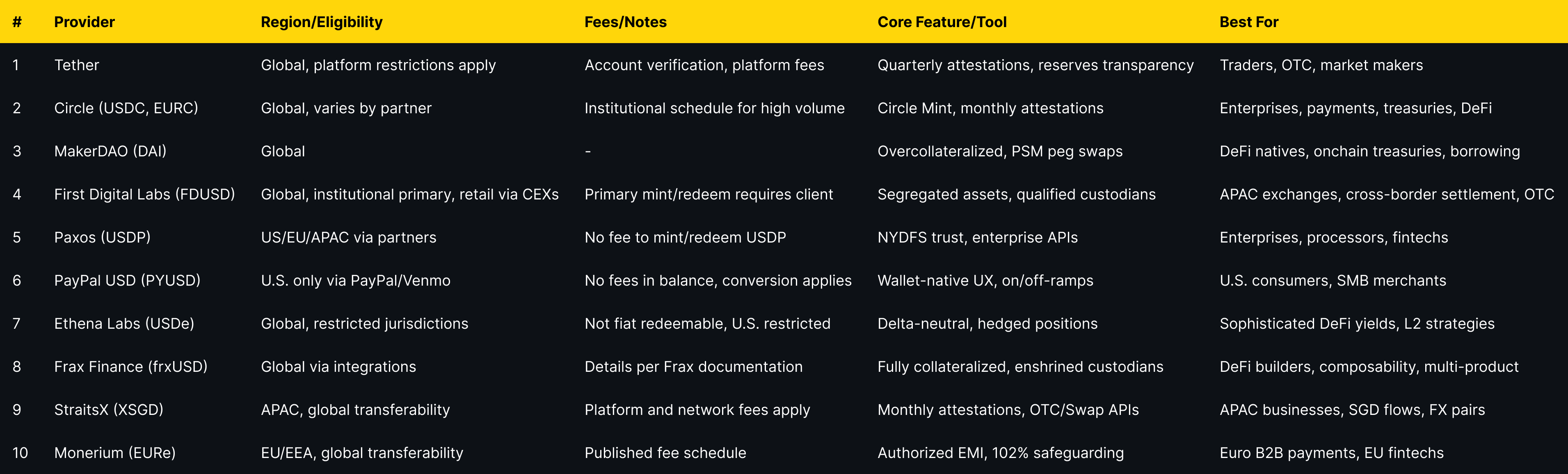
1. Tether — Best for global, always-on liquidity

Why Use It: USD₮ (USDT) is the deepest liquidity pool across CEXs and many L2s—useful for traders and market makers who prioritize fills and routing. Tether publishes quarterly reserve attestations by BDO and a detailed reserves breakdown, improving transparency versus prior years. Tether+1
Best For: Active traders, OTC desks, market makers, emerging-market remittances.
Notable Features: Multi-chain footprint; public reserve updates; operational resilience at massive scale. Tether
Consider If: U.S. persons cannot use Tether’s own platform services under its Terms; rely on supported exchanges instead. Regions: Global (platform restrictions apply). Fees/Notes: Account verification and certain fees apply at the platform level. Tether+1
Alternatives: Circle (USDC), First Digital Labs (FDUSD).

2. Circle — USDC / EURC — Best for regulated, enterprise-grade rails

Why Use It: Circle emphasizes transparency, monthly reserve attestations, and segregation of funds. USDC is widely integrated with banks, fintechs, and onchain apps; EURC brings a euro option under the same standards. Circle+1
Best For: Enterprises/fintechs, payment flows, compliant treasuries, DeFi power users.
Notable Features: Circle Mint for programmatic mint/redeem; monthly attestations; multi-chain support; extensive docs. Fees/Notes: Institutional fee schedule applies for certain high-volume flows. Circle+1
Regions: Global (availability varies by partner/exchange).
Alternatives: Paxos (USDP), PayPal USD (PYUSD).

3. MakerDAO — DAI — Best decentralized, overcollateralized dollar

Why Use It: DAI is minted against overcollateralized crypto via the Maker Protocol, giving a censorship-resistant alternative to fiat-custodied coins. The Peg Stability Module (PSM) smooths peg fluctuations by allowing swaps with other stables. docs.makerdao.com+1
Best For: DeFi natives, long-term onchain treasuries, collateralized borrowing.
Notable Features: Onchain transparency; collateral diversity with governance controls; mature integrations across DeFi. docs.makerdao.com
Consider If: Exposure to crypto collateral and governance risk differs from fiat-backed models. Regions: Global.
Alternatives: Liquity (LUSD/BOLD), Frax (frxUSD).

4. First Digital Labs — FDUSD — Best for Asia-centric trading depth

Why Use It: FDUSD is fully reserved and designed for 1:1 redemption; it has become a deep-liquidity quote asset on major Asian venues. Issuance moved to a BVI entity (FD121 BVI) in 2025 to support global accessibility. firstdigitallabs.com+1
Best For: Traders on Asia-focused exchanges, cross-border settlement in APAC, OTC desks.
Notable Features: Monthly attestations; segregation of assets with qualified custodians; institutional onboarding. Fees/Notes: Primary mint/redeem requires becoming a client; retail typically uses secondary markets. firstdigitallabs.com+1
Regions: Global (institutional primary; retail via exchanges).
Alternatives: Tether (USDT), Circle (USDC).

5. Paxos — USDP — Best for NYDFS-regulated issuance

Why Use It: USDP is issued by Paxos Trust (NYDFS-regulated), held 100% in cash and cash equivalents, and redeemable 1:1. Paxos provides enterprise APIs and no-fee mint/redeem for primary customers. Paxos+1
Best For: Enterprises needing regulated counterparties, payment processors, fintechs.
Notable Features: Segregated, bankruptcy-remote client assets; Ethereum & Solana support; rich developer docs. Fees/Notes: No Paxos fee to mint/redeem USDP; bank/network fees may apply. Paxos+1
Regions: US/EU/APAC via partners; check onboarding eligibility.
Alternatives: Circle (USDC), PayPal USD (PYUSD).

6. PayPal USD (PYUSD) — Best for consumer payments in the U.S.

Why Use It: PYUSD brings stablecoins to familiar wallets (PayPal/Venmo), with instant P2P and merchant flows for eligible U.S. users. It’s issued by Paxos Trust and is redeemable within the PayPal ecosystem; PayPal has also launched an optional rewards program for eligible U.S. users. PayPal+1
Best For: U.S. consumers and SMBs using PayPal/Venmo, payment acceptance, loyalty.
Notable Features: Wallet-native UX; on/off-ramps; integrations expanding across networks. Fees/Notes: No fees to buy/sell/hold/transfer PYUSD inside eligible U.S. PayPal balances; conversion fees apply when swapping with other crypto. PayPal
Regions: U.S. only for consumer access via PayPal/Venmo.
Alternatives: USDC (for global reach), USDP (enterprise rails).

7. Ethena Labs — USDe — Best synthetic dollar for DeFi yields (advanced users)

Why Use It: USDe uses a delta-neutral mechanism (spot + perps/futures) to target dollar stability without relying solely on banks. sUSDe offers onchain, variable rewards sourced from the strategy. This is a crypto-native design and differs from fiat-redeemable models. docs.ethena.fi+1
Best For: Sophisticated DeFi users, L2 yield strategies, protocols integrating synthetic dollars.
Notable Features: Whitelist-based mint/redeem; peg supported by hedged positions; extensive docs. Fees/Notes: Not available to U.S. users; USDe is not redeemable for fiat by design. docs.ethena.fi+1
Regions: Global (restricted jurisdictions excluded).
Alternatives: DAI, frxUSD.

8. Frax Finance — frxUSD — Best modular stable for DeFi integrations

Why Use It: Frax introduced frxUSD, a fully collateralized, fiat-redeemable stablecoin with “enshrined custodians” while retaining Frax’s modular DeFi stack. It aims to couple institutional-grade backing with protocol-level tooling (lending/AMMs). Frax
Best For: DeFi builders, protocols needing composability, multi-product integration.
Notable Features: Hybrid custody model; Fraxtal/Frax ecosystem; onchain transparency dashboard. Fees/Notes: Details governed by Frax docs and custodial partners. Frax+1
Regions: Global (availability via exchanges/integrations).
Alternatives: USDC, DAI.

9. StraitsX — XSGD — Best for SGD settlements and APAC fintech rails

Why Use It: XSGD is a Singapore dollar stablecoin with monthly reserve attestations and a strong focus on compliant payments infrastructure across Southeast Asia. It’s widely integrated with regional wallets, OTC, and DeFi. straitsx.com+1
Best For: APAC businesses, cross-border SGD flows, FX pairs (XSGD↔USD stables).
Notable Features: Monthly attestations; issuer entities for SGD/USD; APIs for swaps/OTC. Fees/Notes: Platform and network fees apply; see issuer terms. straitsx.com
Regions: APAC (global transferability on supported chains).
Alternatives: USDC (USD rails), Monerium (EURe for EUR rails).

10. Monerium — EURe — Best for euro e-money compliance

Why Use It: Monerium issues EURe as regulated e-money under EU rules with segregated, over-collateralized assets—designed for compliant euro settlements onchain. Tokens live on Ethereum, Gnosis, and Polygon with instant redeemability. Monerium+1
Best For: European fintechs, treasuries needing euro rails, compliant B2B payments.
Notable Features: Authorized EMI; 102% safeguarding policy; e-money legal clarity; audited financials. Fees/Notes: Published fee schedule; standard banking/network fees may apply. Monerium+1
Regions: EU/EEA (global transferability on supported chains).
Alternatives: Circle (EURC), StraitsX (XSGD for SGD).

Decision Guide: Best By Use Case

  • Global trading liquidity: Tether (USDT). Tether

  • Regulated U.S./enterprise rails: Circle (USDC), Paxos (USDP). Circle+1

  • U.S. consumer payments/Loyalty: PayPal USD (PYUSD). PayPal

  • Decentralized/censorship-resistant: MakerDAO (DAI); Liquity (LUSD/BOLD) as alt. docs.makerdao.com+1

  • APAC settlement/SGD pairs: StraitsX (XSGD). straitsx.com

  • Euro compliance: Monerium (EURe), Circle (EURC). Monerium+1

  • DeFi-native synthetic dollar/yields: Ethena (USDe). docs.ethena.fi

  • Modular DeFi integration: Frax (frxUSD). Frax

How to Choose the Right stablecoin issuers (Checklist)

  • Region & eligibility: Are you a U.S. consumer, EU business, or global trader? (PayPal vs Circle/Paxos vs Tether/DeFi.) PayPal

  • Reserves & attestations: Look for frequent, third-party reports and clear segregation of client assets. Circle+1

  • Mechanism fit: Fiat-backed vs overcollateralized vs synthetic—match to risk tolerance. docs.makerdao.com+1

  • Chains & integrations: Ensure support for your target L2s, exchanges, and wallets.

  • Fees & slippage: Primary mint/redeem costs, network gas, conversion spreads. Paxos+1

  • Operational needs: APIs, treasury tools, reporting, and support SLAs.

  • Red flags: Vague reserve language, infrequent disclosures, or unclear redemption policies.

Use Token Metrics With Any stablecoin issuers

  • AI Ratings surface quality signals behind liquidity metrics.
  • Narrative Detection spots capital rotation into specific stablecoin ecosystems.

  • Portfolio Optimization helps size stablecoin sleeves by mandate (trading vs yield vs payments).

  • Alerts & Signals track peg deviations, volume spikes, and exchange outflows.
    Workflow: Research → Select → Execute with your chosen issuer/exchange → Monitor with alerts.


Primary CTA: Start free trial

Security & Compliance Tips

  • Enable 2FA and secure treasury ops (role-based access, hardware keys).

  • Confirm custody setup (segregated accounts; multi-sig or MPC for smart-contract risk).

  • Complete KYC/AML where required; verify permitted jurisdictions. Tether+1

  • Use RFQ/OTC for large conversions to reduce slippage.

  • Practice wallet hygiene: label treasury addresses, restrict permissions, and test redemptions.

This article is for research/education, not financial advice.

Beginner Mistakes to Avoid

  • Treating all stablecoins as identical; mechanisms and risks vary.

  • Ignoring fee schedules and settlement timelines for large redeems. Circle Help+1

  • Using a region-restricted product (e.g., PYUSD outside the U.S.; USDe app in restricted markets). PayPal+1

  • Overconcentrating in a single issuer or chain.

  • Skipping ongoing monitoring of peg, reserves, and disclosures.

FAQs

1) What are the main types of stablecoin issuers?
Three broad models: (1) Fiat-backed (Circle, Paxos, First Digital Labs), (2) Overcollateralized crypto-backed (MakerDAO DAI; Liquity), and (3) Synthetic/hedged (Ethena USDe). Each has distinct reserve/risk properties. docs.ethena.fi+3Circle+3Paxos+3

2) Which stablecoin is best for trading liquidity?
USDT typically leads on global CEX depth and pairs, with USDC often preferred for fiat-connected flows and DeFi. Choose based on venue support and treasury needs. Tether+1

3) Can U.S. users access every stablecoin?
No. PYUSD is for eligible U.S. PayPal/Venmo users; some protocols (e.g., Ethena) restrict U.S. access to their app. Always check terms. PayPal+1

4) How do fees work for minting and redeeming?
Paxos states no fees for mint/redeem USDP/PYUSD for primary clients; Circle has institutional schedules; Tether lists platform fees. Secondary-market trades still incur exchange/gas costs. Paxos+2Circle Help+2

5) Are euro or SGD stablecoins useful?
Yes. EURC/EURe enable euro settlements under EU rules; XSGD supports APAC rails and FX paths versus USD stables. Circle+2Monerium+2

6) Is DAI safer than fiat-backed coins?
“Safer” depends on your risk lens. DAI reduces bank/custodian reliance but adds crypto-collateral and governance risk; fiat-backed coins rely on custodians and regulators. Diversification is common. docs.makerdao.com

Conclusion + Related Reads

If you need global trading liquidity, start with USDT/USDC. For enterprise-grade compliance, Circle/Paxos shine. For decentralized resilience, DAI (and Liquity) fit. For regional rails, consider XSGD (APAC) and EURe/EURC (EU). Pair the right issuer with your use case, then monitor peg, reserves, and policy changes over time.

Related Reads:

  • Best Cryptocurrency Exchanges 2025

  • Top Derivatives Platforms 2025

  • Top Institutional Custody Providers 2025

Choose from Platinum, Gold, and Silver packages
Reach with 25–30% open rates and 0.5–1% CTR
Craft your own custom ad—from banners to tailored copy
Perfect for Crypto Exchanges, SaaS Tools, DeFi, and AI Products