
Text Link
Text Link
Text Link
Text Link
Thank you! Your submission has been received!
Oops! Something went wrong while submitting the form.

Stop Guessing, Start Trading: The Token Metrics API Advantage

Announcements

Big news: We’re cranking up the heat on AI-driven crypto analytics with the launch of the Token Metrics API and our official SDK (Software Development Kit). This isn’t just an upgrade – it's a quantum leap, giving traders, hedge funds, developers, and institutions direct access to cutting-edge market intelligence, trading signals, and predictive analytics.

Crypto markets move fast, and having real-time, AI-powered insights can be the difference between catching the next big trend or getting left behind. Until now, traders and quants have been wrestling with scattered data, delayed reporting, and a lack of truly predictive analytics. Not anymore.

The Token Metrics API delivers 32+ high-performance endpoints packed with powerful AI-driven insights right into your lap, including:

  • Trading Signals: AI-driven buy/sell recommendations based on real-time market conditions.
  • Investor & Trader Grades: Our proprietary risk-adjusted scoring for assessing crypto assets.
  • Price Predictions: Machine learning-powered forecasts for multiple time frames.
  • Sentiment Analysis: Aggregated insights from social media, news, and market data.
  • Market Indicators: Advanced metrics, including correlation analysis, volatility trends, and macro-level market insights.

Getting started with the Token Metrics API is simple:

  1. Sign up at www.tokenmetrics.com/api
  2. Generate an API key and explore sample requests.
  3. Choose a tier–start with 50 free API calls/month, or stake TMAI tokens for premium access.
  4. Optionally–download the SDK, install it for your preferred programming language, and follow the provided setup guide.

At Token Metrics, we believe data should be decentralized, predictive, and actionable. 

The Token Metrics API & SDK bring next-gen AI-powered crypto intelligence to anyone looking to trade smarter, build better, and stay ahead of the curve. With our official SDK, developers can plug these insights into their own trading bots, dashboards, and research tools – no need to reinvent the wheel.

Research

Top Crypto Prime Brokers (2025): Best Institutional Trading & Settlement Platforms

Token Metrics Team
17 min read
  • If you’re an institution that needs multi-venue liquidity, off-exchange settlement, and integrated custody/financing, this guide ranks the top crypto prime brokers for 2025 based on scale, security posture, and product breadth.
  • Top picks: Coinbase Prime for integrated trading + qualified custody with negotiated fees; FalconX for deep liquidity and capital solutions across spot/derivatives; Anchorage Digital Prime for bank-regulated custody with prime services and derivatives access. (Coinbase)
  • Caveats: Pricing is often negotiated; availability and products vary by region and legal entity. Always verify coverage on the provider’s official pages before onboarding. (docs.cdp.coinbase.com)

Introduction: Why Prime Brokerage Matters in 2025

Institutional participation accelerated in 2025, and with it the need for crypto prime brokers that unify execution, financing, custody, and settlement while minimizing counterparty risk. The leading platforms now resemble capital-markets infrastructure: single-counterparty access to multi-venue liquidity, off-exchange settlement networks that keep assets in segregated custody, and derivatives rails to hedge risk. Solutions like Coinbase Prime, FalconX, and Anchorage Digital Prime illustrate this evolution, while settlement networks such as Copper ClearLoop reduce venue risk without slowing execution. (Coinbase)

Primary intent: commercial-investigational. This guide compares features, fees, regions, and tradeoffs, then maps use cases to the right providers—so teams can move from diligence to deployment with confidence.


Our Evaluation Methodology

SCORING_WEIGHTS (sum = 100):

  • Scale & Liquidity (25) – depth of venues/LPs, 24/7 execution, options/futures where applicable.
  • Security & Regulatory Posture (25) – qualified custody, bank licensing/registrations, segregation, insurance disclosures.
  • Product Breadth (15) – spot, OTC/RFQ, derivatives, financing, settlement networks.
  • Costs & Fees (10) – published or negotiated schedules, financing/borrow terms.
  • Connectivity & Tooling (10) – FIX/WebSocket APIs, OEMS/SOR, reporting.
  • Capital Efficiency (10) – cross-margin, off-exchange settlement, instant delegation.
  • Support & Service (5) – coverage windows, onboarding SLAs.

Verification approach: We relied on official product, pricing, docs, security, and status pages only. If a claim wasn’t verifiable on an official page, we omitted it. Last updated: November 2025.


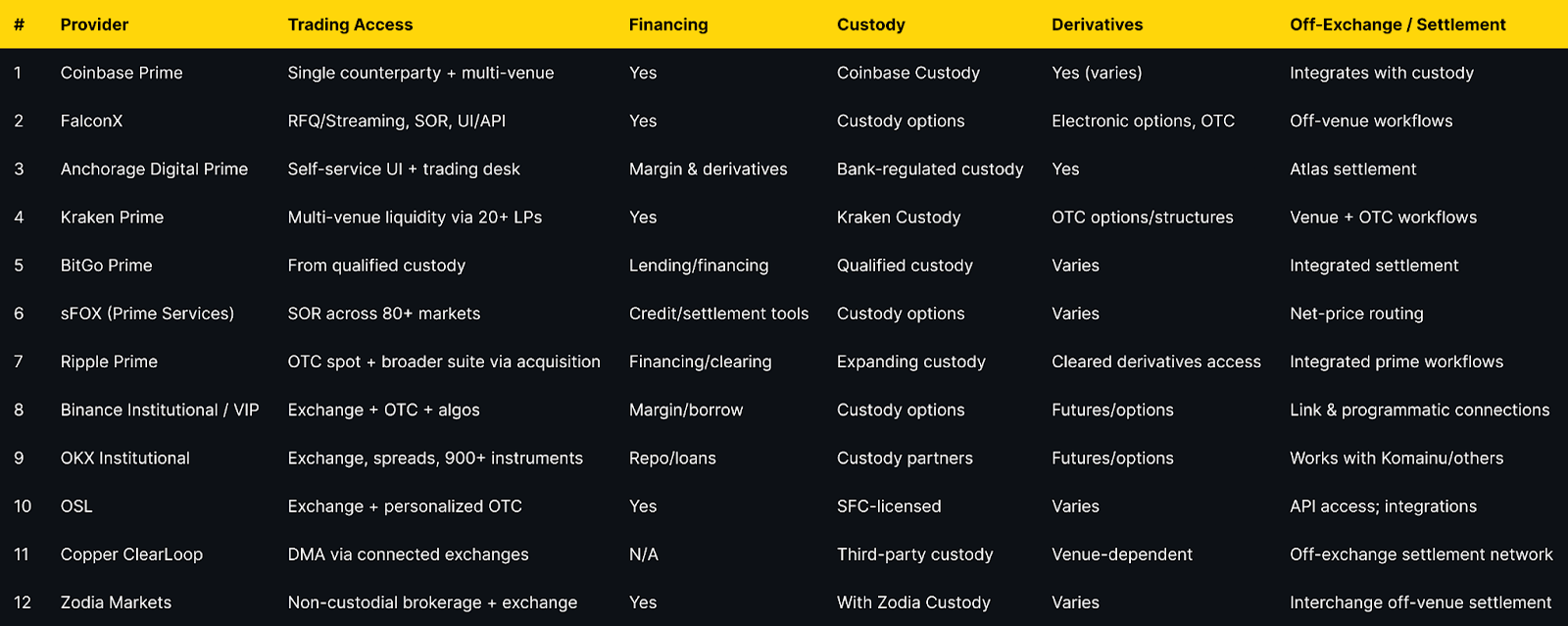
Crypto Prime Brokerage Comparison: At a Glance


Notes: “Pricing” reflects publicly stated models (often negotiated). “Regions/Notes” summarize official disclosures and licensing language where available on provider sites.


Detailed Provider Analysis

Coinbase Prime — Full-service prime brokerage at scale

Overview. Coinbase Prime combines trading, financing, and qualified custody under one institutional platform, with negotiated trading fees and flexible order denomination (base/quote). Execution integrates with reporting and controls suitable for asset managers and corporates. (Coinbase)
Ideal For. Asset managers, corporates/treasuries, hedge funds, RIAs.
Standout Features. Integrated custody; negotiated All-In / Cost-Plus fee models; staking fee schedules; institutional reporting. (docs.cdp.coinbase.com)
Pricing. Negotiated, fee currency = quote currency. (docs.cdp.coinbase.com)
Availability. Global, entity-dependent; product availability varies by jurisdiction.
Worth Noting. Some services require separate agreements (e.g., validators, derivatives access).
Alternatives to Consider. Kraken Prime, Anchorage Digital Prime. (Kraken)  


FalconX — Deep liquidity & capital solutions across markets

Overview. FalconX offers RFQ/streaming execution across spot and FX with FIX/WebSocket/REST connectivity, plus electronic options and capital solutions. Scale and 24/7 liquidity are central, with workflows for large tickets and programmatic strategies. (falconx.io)
Ideal For. Multi-strategy funds, HFT/systematic traders, market makers.
Standout Features. RFQ/streaming with TWAP/FOK; electronic options; FX desk integrated into prime; institutional APIs. (falconx.io)
Pricing. Negotiated; bespoke based on flow and venues.
Availability. Global institutional focus (entity-dependent).
Worth Noting. Derivatives access and product scope vary by entity/region.
Alternatives to Consider. Coinbase Prime, Kraken Prime. (Coinbase)  


Anchorage Digital Prime — Prime services on top of a US bank custodian

Overview. Anchorage Digital Prime delivers trading (13+ order types), derivatives, margin, and settlement built on Anchorage Digital Bank N.A. custody. A single interface and 24/7 trading desk support complex orders. (anchorage.com)
Ideal For. US-regulated custody requirements, governance-active institutions, corporates.
Standout Features. Bank-regulated custody; derivatives access; Atlas settlement; desk + API execution. (anchorage.com)
Pricing. Negotiated; service-by-entity.
Availability. US bank entity with global affiliates; services provided by specific Anchorage entities (see legal). (anchorage.com)
Worth Noting. Trading provided by separate non-bank entities; read entity-level disclosures. (anchorage.com)
Alternatives to Consider. BitGo Prime, Coinbase Prime. (The Digital Asset Infrastructure Company)  


Kraken Prime — Multi-venue liquidity with institutional fee tiers

Overview. Kraken Prime aggregates 20+ liquidity providers and offers smart order routing, OTC spot and OTC derivatives (options/structures), plus custody integrations. Institutional fee perks are published for high-volume clients. (Kraken)
Ideal For. Funds seeking published fee schedules, multi-venue execution, and OTC coverage.
Standout Features. Multi-venue liquidity; FIX 4.4 and WebSockets APIs; OTC desk; institutional taker tiers. (Kraken)
Pricing. Maker/taker schedule with institutional perks at very high volumes. (Kraken)
Availability. Global, entity-dependent.
Worth Noting. Some advanced services require qualification and separate onboarding.
Alternatives to Consider. sFOX, Coinbase Prime. (sFOX)


BitGo Prime — Prime services from qualified custody

Overview. BitGo integrates trading, financing, and settlement directly from custody, with segregated, bankruptcy-remote accounts and published insurance coverage details. (The Digital Asset Infrastructure Company)
Ideal For. Institutions prioritizing segregation and custody-first workflows.
Standout Features. Segregated accounts; insurance disclosures; custody-integrated prime trading. (The Digital Asset Infrastructure Company)
Pricing. Negotiated; custody/prime fees depend on assets and activity.
Availability. Global entities with varying regulatory regimes.
Worth Noting. Derivatives access varies by entity/partner networks.
Alternatives to Consider. Anchorage Digital Prime, Copper ClearLoop. (anchorage.com)


sFOX (Prime Services) — Agency SOR across 80+ markets with institutional tooling

Overview. sFOX acts as an agnostic agent routing across 80+ markets for best execution, with net-price routing and institutional reporting. The platform positions itself as a full-service prime dealer for institutions. (sFOX)
Ideal For. Systematic strategies, RIAs/allocators, corporates seeking agency execution.
Standout Features. SOR across venues; platform-level price improvement; custody options. (sFOX)
Pricing. Tiered/negotiated; historical content points to fee optimization via routing. (sFOX)
Availability. US/global entities; enterprise onboarding.
Worth Noting. Product scope (derivatives, margin) varies; confirm coverage.
Alternatives to Consider. Kraken Prime, Coinbase Prime. (Kraken)


Ripple Prime — Multi-asset prime brokerage under Ripple

Overview. Following the acquisition and subsequent close of Hidden Road, Ripple Prime offers U.S. spot OTC execution and positions Ripple as the first crypto company to own and operate a global, multi-asset prime broker; custody capabilities expanded further in late 2025. (Ripple)
Ideal For. Institutions seeking an integrated multi-asset prime platform with digital asset rails.
Standout Features. OTC spot execution (U.S.); multi-asset coverage; financing/clearing. (Ripple)
Pricing. Negotiated.
Availability. U.S. launch and global expansion via Ripple entities. (Ripple)
Worth Noting. Product availability differs by jurisdiction and entity.
Alternatives to Consider. FalconX, Coinbase Prime. (falconx.io)


Binance VIP & Institutional — Exchange liquidity, OTC & programmatic access

Overview. Binance’s institutional suite spans exchange, OTC RFQ, algos, and programmatic connectivity with VIP tiers. Coverage and eligibility depend on jurisdiction; Binance.US operates separately for U.S. clients. (binance.com)
Ideal For. Non-US teams wanting direct exchange liquidity with OTC tools.
Standout Features. VIP tiers, proof-of-reserves, OTC block trading. (binance.com)
Pricing. Exchange/VIP schedules; negotiated OTC.
Availability. Region-dependent; check supported regions. (binance.com)
Worth Noting. U.S. availability/routes differ; compliance and onboarding vary by entity.
Alternatives to Consider. OKX Institutional, OSL. (OKX)


OKX Institutional — Scale, instruments, and U.S. presence via OKX US

Overview. OKX highlights high uptime, 900+ instruments, and institutional connectivity. U.S. availability exists through OKX US with scope/policies noted in compliance disclosures. (OKX)
Ideal For. Proprietary firms and funds trading a broad instrument set with API access.
Standout Features. Nitro Spreads, derivatives suite, institutional support. (OKX)
Pricing. Exchange schedule + VIP; negotiated for blocks.
Availability. Global; US services via OKX US (scope varies). (OKX)
Worth Noting. Product availability and licensing differ by region.
Alternatives to Consider. Binance Institutional, Kraken Prime. (binance.com)


OSL — HK SFC-licensed exchange, custody & OTC

Overview. OSL provides a licensed Hong Kong platform spanning custody, exchange, and OTC brokerage for institutions, with dedicated coverage in the region. (osl.com)
Ideal For. APAC institutions needing SFC-regulated venue/custody.
Standout Features. SFC-licensed exchange; institutional API; custody with insurance positioning. (sfc.hk)
Pricing. Schedule/negotiated.
Availability. Hong Kong and supported regions; institutional focus.
Worth Noting. Product availability differs by license and region.
Alternatives to Consider. Zodia Markets, Coinbase Prime. (Zodia Markets)


Copper ClearLoop — Off-exchange settlement network (multi-custodial)

Overview. ClearLoop enables instant delegation to connected exchanges while assets remain in segregated custody—now supporting third-party custodians like BitGo and Komainu. (Copper)
Ideal For. Institutions prioritizing venue risk reduction and capital efficiency.
Standout Features. Multi-custodial support; instant asset delegation; network of venues/prime brokers. (Copper)
Pricing. Varies by participants and volumes.
Availability. Global network; coverage depends on participating venues/custodians.
Worth Noting. Not a full prime broker by itself; pairs well with custody/venues.
Alternatives to Consider. Zodia Interchange, Komainu Connect. (zodia-custody.com)


Zodia Markets + Zodia Custody Interchange — Non-custodial brokerage + off-venue settlement

Overview. Zodia Markets offers institutional brokerage/exchange with non-custodial design, while Zodia Custody’s Interchange provides off-venue settlement (OVS)—trade while assets remain in custody. Registrations span UK, Ireland, ADGM. (Zodia Markets)
Ideal For. Institutions wanting bank-backed governance and segregated settlement flows.
Standout Features. Non-custodial brokerage; Interchange OVS network; institutional registrations. (Zodia Markets)
Pricing. Negotiated.
Availability. UK/EU/MENA institutional coverage (entity-specific). (Zodia Markets)
Worth Noting. Product scope varies by entity and venue integrations.
Alternatives to Consider. OSL, Copper ClearLoop. (osl.com)


Choosing the Right Prime Broker: A Framework

  • Regulatory posture needed? If you require US bank-regulated custody, start with Anchorage Digital Prime. For Hong Kong, OSL’s SFC licensing is key. For UK/EU bank-backed governance with off-venue settlement, consider Zodia. (anchorage.com)
  • Execution style. For multi-venue aggregation and published fee tiers, Kraken Prime is strong; for RFQ/streaming with electronic options, FalconX leads. sFOX suits agency SOR across many markets. (Kraken)
  • Integrated custody + trading. Coinbase Prime and BitGo Prime minimize operational friction by tying trading to qualified custody. (Coinbase)
  • Venue-risk reduction. If you want to trade while assets remain in custody, evaluate Copper ClearLoop or Zodia Interchange (and Komainu Connect as a related model). (Copper)
  • Instrument breadth and scale. For vast exchange liquidity and institutional programs, Binance Institutional and OKX Institutional are at-scale options (region permitting). (binance.com)

Integrating Token Metrics Intelligence

  • Research phase: Use Token Metrics screeners and on-chain/technical indicators to identify pairs suitable for your mandate (beta targets, breadth, liquidity screens).
  • Execution phase: Route orders via your prime broker’s APIs (e.g., FIX/WebSocket) selected above, while TM signals inform aggression/passivity and time-of-day tactics. (Kraken)
  • Monitoring: Feed fills, slippage, and borrow/financing into TM analytics to assess venue performance and adjust routing.
  • Optimization: Combine TM factor views with prime-broker borrow/financing and settlement options (e.g., off-exchange) to lower VaR and operational risk.

Start a Token Metrics trial to bring quantitative screening and scenario analysis into your institutional workflow.  


Security & Compliance Guidelines

  • Prefer segregated, bankruptcy-remote custody and confirm insurance disclosures where published. (The Digital Asset Infrastructure Company)
  • If you need a US bank custodian, validate services by legal entity and read the provider’s disclosures. (anchorage.com)
  • Use off-exchange settlement networks to reduce exchange exposure during execution. (Copper)
  • Confirm derivatives eligibility, margin terms, and cross-margin/netting treatment by entity/venue. (Kraken)
  • Require API keys/roles with least-privilege, HSM custody, and mandatory allow-listing.
  • Maintain jurisdictional watchlists and restrict activity accordingly (e.g., US vs non-US entities for global exchanges). (OKX)

Compliance note: This article is for research/education, not financial advice.


Avoiding Common Mistakes

  • Treating “prime” as one product—coverage and legal entities differ by service.
  • Assuming off-exchange settlement is automatic—confirm network membership and supported venues. (Copper)
  • Onboarding to the wrong entity—read the jurisdictional disclosures. (anchorage.com)
  • Ignoring negotiated fees—request All-In vs Cost-Plus quotes. (docs.cdp.coinbase.com)
  • Skipping disaster-recovery testing—simulate exchange outage + settlement failover.
  • Under-documenting OMS/EMS changes—keep audit-ready change logs.

Frequently Asked Questions

What is a crypto prime broker?
 A provider that consolidates institutional trading, financing, custody, and settlement, often with multi-venue access and risk controls. Modern variants add off-exchange settlement so assets remain in custody during execution. (zodia-custody.com)

Do prime brokers publish fees?
 Often no—fees are negotiated based on volumes, products, and relationship tier. Some venues publish maker/taker schedules with institutional perks. (docs.cdp.coinbase.com)

How does off-exchange settlement work?
 Networks like ClearLoop and Interchange let you delegate assets to venues for trading while keeping them in segregated custody, reducing counterparty risk. (Copper)

Which providers are strongest for regulated custody?
 Anchorage Digital Prime (US bank custody), BitGo (qualified custody), OSL (HK SFC-licensed custody/exchange), and Zodia (bank-backed with EU/UK registrations). (anchorage.com)

Can U.S. institutions use OKX or Binance?
 Access is region-dependent and varies by entity (e.g., OKX US scope). U.S. clients typically cannot use Binance.com and instead must evaluate Binance.US or other U.S.-eligible routes. Always check official disclosures. (OKX)


Final Recommendations

For most global institutions, a two-stack works best: (1) an integrated prime broker with qualified custody (Coinbase Prime, Anchorage Digital Prime, or BitGo Prime) and (2) a venue-risk mitigator like Copper ClearLoop or Zodia Interchange. Execution-heavy funds should add FalconX or Kraken Prime for multi-venue and OTC derivatives coverage, while OSL anchors APAC/HK mandates and OKX/Binance expand exchange reach where eligible. (Coinbase)

Related Resources:

Research

Best Yield Marketplaces for Real-World Assets (RWAs) in 2025

Token Metrics Team
29 min read
  • What this guide covers: A comprehensive evaluation of 10 leading platforms that enable tokenized real-world asset trading and yield generation across private credit, treasuries, real estate, and structured finance
  • Quick verdict: Ondo Finance for institutional-grade treasury exposure at ~5% APY, Maple Finance for crypto-collateralized credit facilities delivering 9-12% net yields, Goldfinch Prime for diversified access to private credit funds from Apollo and Ares
  • One key limitation to know: Many RWA platforms enforce strict accreditation requirements (minimum $50K-200K) and geographic restrictions, particularly excluding US investors from certain products due to securities regulations

Why Yield Marketplaces for RWAs Matter in January 2025

The real-world asset tokenization market has experienced explosive growth, surging from $85 million in April 2020 to over $25 billion by mid-2025—representing a staggering 245-fold increase driven primarily by institutional demand for yield, transparency, and regulatory clarity. Private credit dominates at approximately 61% of total tokenized assets, followed by treasuries at 30%, with major asset managers like BlackRock, Apollo, and Franklin Templeton now actively tokenizing institutional-grade products.

The convergence of traditional finance and decentralized infrastructure has created unprecedented opportunities for investors seeking stable, real-world yields without exposure to cryptocurrency volatility. The tokenized RWA market is projected to reach between $9.43 trillion and $18.9 trillion by 2030, with regulatory frameworks in Singapore, Hong Kong, and Dubai providing clear pathways for compliant innovation.

For crypto-native investors, RWA yield marketplaces offer a critical bridge to sustainable income streams backed by productive assets rather than purely speculative token emissions. Traditional allocators gain 24/7 access to fractional ownership, instant settlement, and programmable compliance—advantages impossible in legacy financial infrastructure.


How We Evaluated These Providers

We assessed platforms across six weighted criteria totaling 100 points:

  • Yield Quality & Sustainability (30%): Consistency of returns, asset backing, historical performance, and correlation to traditional markets
  • Security & Risk Management (25%): Custody solutions, audit history, legal recourse, collateralization ratios, and default handling protocols
  • Asset Coverage & Diversity (15%): Range of underlying assets, tranching options, and exposure across credit curves
  • Accessibility & Costs (15%): Minimum investments, fee structures, geographic availability, and KYC requirements
  • Liquidity & Redemption (10%): Secondary market depth, withdrawal timelines, and tokenization standards
  • Infrastructure & Compliance (5%): Regulatory licenses, blockchain integrations, and institutional partnerships

Data sources: Official platform documentation, on-chain analytics from RWA.xyz and DeFiLlama, third-party audits, and regulatory filings. Research conducted October 2024-January 2025.

Verification approach: Every fee structure, yield figure, and regional restriction cited was verified on official platform pages or regulatory disclosures. Unverifiable claims were excluded.


The Contenders: Quick Comparison  

Provider Reviews by Use Case

For Treasury-Backed Stability (4-5% Yield)

Top Pick: Ondo Finance — Institutional Treasury Tokenization Pioneer

Overview
 Ondo Finance manages over $1.6 billion in tokenized assets, offering institutional-grade access to US Treasury exposure through OUSG (backed by BlackRock's BUIDL fund) and USDY (a yield-bearing stablecoin). The platform bridges TradFi stability with DeFi composability through multi-chain deployment across Ethereum, Solana, Base, and XRP Ledger.

Ideal For

  • Institutional allocators seeking low-volatility dollar exposure
  • DeFi protocols requiring yield-bearing collateral
  • Treasuries managing idle stablecoin holdings
  • Investors prioritizing regulatory compliance and brand-name backing

Standout Features

  • Approximately 5% APY from short-term US Treasuries with daily interest payouts via rebasing mechanism
  • Integration with Ripple's RLUSD stablecoin for instant minting and redemption 24/7
  • Comprehensive SEC-registered infrastructure through acquisition of Oasis Pro, including broker-dealer, ATS, and transfer agent licenses
  • Strategic partnerships including anchor position in Fidelity's FDIT tokenized money market fund and launch of Ondo Global Markets for tokenized equities

Pricing
 Management fees embedded in net yield; typical 0.15-0.30% annual fee depending on product. OUSG requires $100K minimum; USDY accessible at lower thresholds with 4.29% APY.

Availability
 Global except US persons for certain products. Ethereum, Solana, Polygon, Aptos, Sei, Base, XRP Ledger, and Sui supported.

Worth Noting
 OUSG designed for qualified purchasers with extended lockup periods; less suitable for retail or high-frequency traders. Platform prioritizes institutional relationships over retail accessibility.

Alternatives to Consider: Franklin Templeton BENJI, OpenEden TBILL  


Runner-Up: Franklin Templeton BENJI — Legacy Asset Manager Innovation

Overview
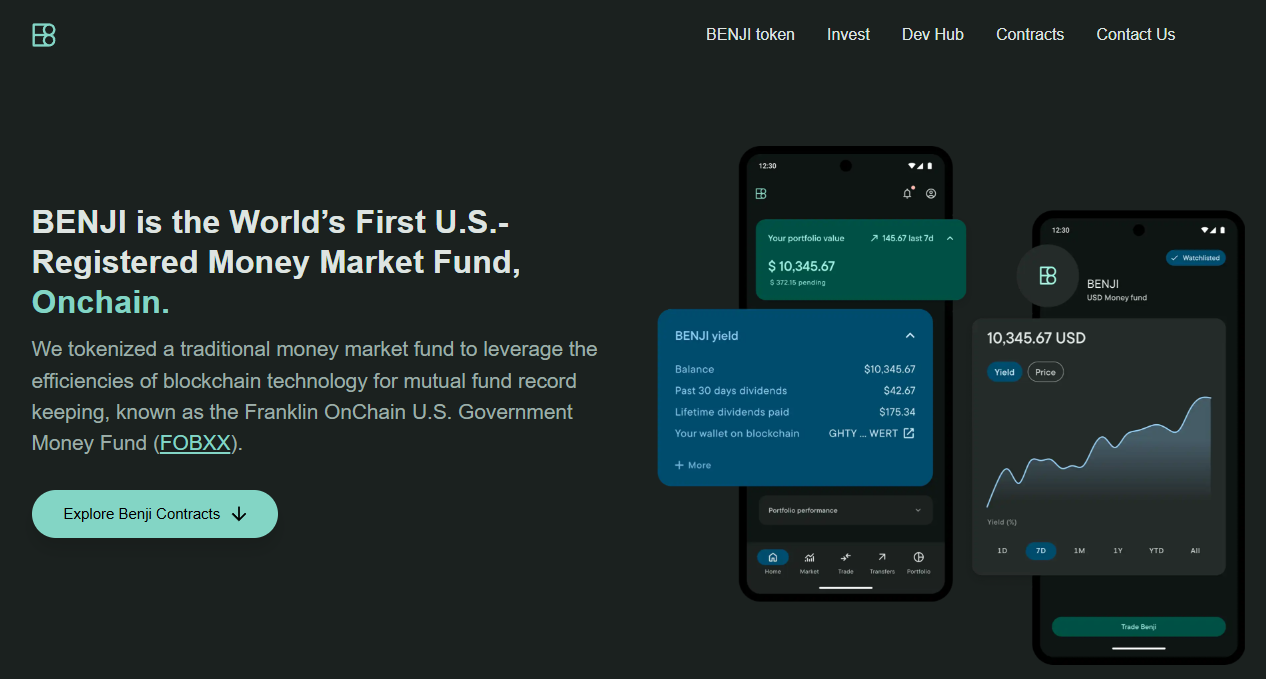
 Franklin Templeton's $775 million Franklin OnChain U.S. Government Money Fund (BENJI) pioneered tokenized mutual funds in 2021, offering exposure to US government securities across eight blockchains with patent-pending intraday yield calculation.

Ideal For

  • Investors seeking regulated 40 Act fund structure
  • Collateral managers requiring second-by-second yield accrual
  • Multi-chain strategies needing broad blockchain compatibility
  • Users prioritizing traditional asset manager credibility

Standout Features

  • Intraday yield tracking down to the second, enabling proportional earnings even for partial-day holdings
  • Direct stablecoin purchases and redemptions with wallet-to-wallet transfer capability
  • 63% of AUM deployed on Stellar Network for optimal cost efficiency
  • Integrated with DeFi protocols for collateral and leverage applications

Pricing
 7-day current yield approximately 4.5-5.5% gross; 0.25% management fee. No minimum investment restrictions beyond standard mutual fund requirements.

Availability
 Global availability with specific KYC requirements. Active on Stellar, Ethereum, Arbitrum, Base, Avalanche, Polygon, Aptos, Solana, BNB Chain.

Worth Noting
 Traditional mutual fund constraints apply including daily NAV calculations and potential redemption delays during market stress.

Alternatives to Consider: Backed bIB01, Superstate Short Duration Government Securities  


For Institutional Credit Exposure (8-12% Yield)

Top Pick: Maple Finance — Premier Crypto-Collateralized Lending

Overview
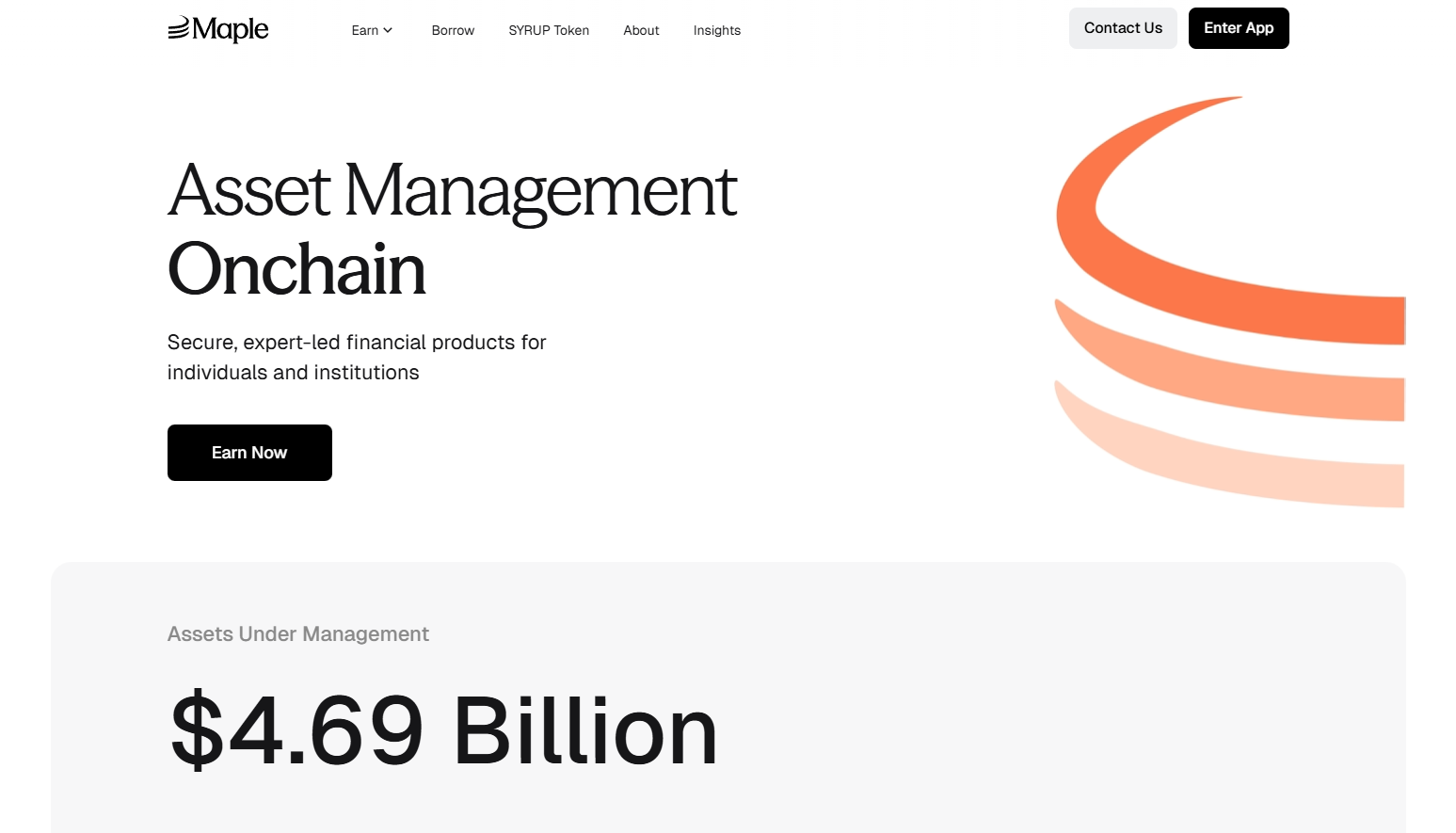
 Maple Finance manages over $4 billion in assets, specializing in institutional over-collateralized lending backed by Bitcoin, Ethereum, Solana, and XRP, targeting $100 billion in annual loan volume by 2030. The platform introduced SyrupUSDC for permissionless retail access alongside KYC-gated institutional pools.

Ideal For

  • Institutional lenders seeking exposure to cryptocurrency-backed credit
  • Liquidity providers comfortable with smart contract risk
  • Allocators targeting floating-rate, senior-secured structures
  • Investors seeking alternatives to traditional stablecoin farming

Standout Features

  • Consistent 9-12% net yields through undercollateralized institutional facilities and structured credit products
  • Strategic integration with Aave's $40 billion protocol bringing syrupUSDT to Plasma instance and syrupUSDC to core markets
  • Partnerships with Bitwise, Lido Finance (stETH-backed credit lines), and EtherFi (weETH collateral) expanding institutional adoption
  • Robust risk management combining decades of TradFi expertise with real-time on-chain monitoring

Pricing
 Variable by pool; typical effective yields 9-12% after protocol fees. Minimum investments pool-dependent, generally $10K-$50K for retail syrup products.

Availability
 Global with KYC requirements for lending. Institutional Maple requires accreditation; Syrup.fi open to broader participants.

Worth Noting
 Platform transitioned from uncollateralized to over-collateralized model after 2022 market turmoil. Historical defaults impacted certain pools; robust recovery mechanisms now in place.

Alternatives to Consider: Credix (emerging markets), TrueFi (uncollateralized DeFi)  


Runner-Up: Goldfinch Prime — Institutional Private Credit Access

Overview
 Goldfinch Prime aggregates exposure to multi-billion dollar private credit funds from Ares, Apollo, Golub Capital, and KKR, providing on-chain access to institutional-grade senior secured loans with over $1 trillion in collective AUM.

Ideal For

  • Non-US investors seeking diversified private credit exposure
  • Allocators targeting institutional fund performance without direct fund access
  • Participants seeking uncorrelated yield to crypto markets
  • Investors comfortable with longer lockup periods

Standout Features

  • Exposure to 1000+ senior secured loans across industries through vetted fund managers with 10+ years experience
  • Target returns of 9-12% net of fees with strict eligibility criteria including >90% senior secured portfolios and <0.75% target non-accrual rates
  • Heron Finance manages fund selection and vetting while fund managers handle all underwriting and default resolution
  • USDC-based deposits converted to proportional GPRIME tokens for continuous offering structure

Pricing
 Net yields 9-12% after embedded management fees and profit sharing. Minimum investments vary by pool structure; typically institutional minimums apply.

Availability
 Non-US persons only due to regulatory structure. KYC and accreditation verification required.

Worth Noting
 Exposure is indirect through fund shares rather than direct loan origination; fund managers absorb individual borrower default risk into aggregate yields. Liquidity limited compared to Treasury products.

Alternatives to Consider: Centrifuge private credit pools, Credix fintech lending


For Real Estate & Diversified Assets (6-10% Yield)

Top Pick: Centrifuge — Multi-Asset Tokenization Infrastructure

Overview
 Centrifuge operates as a multichain infrastructure platform enabling asset managers to tokenize real estate, trade finance, carbon credits, and structured credit with $1.2 billion TVL and recent 10x growth driven by the first on-chain CLO and tokenized S&P 500 index fund.

Ideal For

  • Investors seeking exposure to asset-backed securities beyond treasuries
  • Allocators comfortable evaluating tranched credit structures
  • Participants prioritizing transparency and on-chain asset verification
  • Portfolio managers wanting diversification across real-world credit types

Standout Features

  • Asset-agnostic architecture supporting structured credit, real estate mortgages, US treasuries, carbon credits, and consumer finance with full collateralization and legal recourse for investors
  • V3 platform enables cross-chain interoperability across Ethereum, Base, Arbitrum, Avalanche, BNB Chain, and Plume with integrated KYC and compliance-as-a-feature
  • Senior/junior tranche structures allowing risk-return customization
  • Partnership with Chronicle Labs for real-time price feeds and integration with Circle for USDC on/off-ramping

Pricing
 Yields vary by pool and tranche: typically 6-8% for senior tranches, 10-14% for junior tranches. Management fees embedded; pool-specific minimums apply.

Availability
 Global with KYC requirements. Pools may have additional jurisdictional restrictions based on underlying asset location.

Worth Noting
 Platform complexity requires understanding of tranched structures and asset-specific risks. Less liquid credit instruments offer less frequent pricing updates than treasury products.

Alternatives to Consider: RealT (US residential real estate focus), Republic (equity crowdfunding)

For Emerging Market Credit (12-18% Yield)

Top Pick: Credix — Latin American Fintech Lending

Overview
 Credix specializes in providing credit facilities to fintech lenders in Latin America, offering high-yield exposure to underserved credit markets with institutional-grade underwriting and local market expertise.

Ideal For

  • Sophisticated investors seeking higher risk-adjusted returns
  • Allocators comfortable with emerging market credit risk
  • Participants with extended investment horizons (12-24 months typical)
  • Investors seeking geographic diversification from US/EU markets

Standout Features

  • Target yields 12-18% reflecting emerging market risk premiums
  • Focus on fintech infrastructure enabling financial inclusion
  • Partnerships with established Latin American credit originators
  • Robust due diligence and monitoring of borrower networks

Pricing
 Pool-dependent yields typically 12-18% gross with management fees of 1-2%. Minimum investments generally $50K+ for accredited investors.

Availability
 Non-US persons primarily; requires accreditation verification and enhanced KYC given emerging market exposure.

Worth Noting
 Higher yields reflect higher credit and currency risk. Platform experienced challenges during regional economic volatility; enhanced risk controls now implemented.

Alternatives to Consider: Goldfinch V1 pools (emerging market focus), TrueFi uncollateralized pools


For Tokenization Infrastructure (Platform Providers)

Top Pick: Securitize — Industry-Leading Issuance Platform

Overview
 Securitize has tokenized over $4.5 billion in assets for 1.2 million investors across 3,000+ clients, operating as an SEC-registered transfer agent with integrated ATS for secondary trading. The platform powers major offerings including BlackRock's BUIDL fund.

Ideal For

  • Asset managers seeking turnkey tokenization solutions
  • Issuers requiring SEC-compliant digital security infrastructure
  • Institutional clients needing integrated custody and compliance
  • Projects prioritizing regulatory alignment and brand credibility

Standout Features

  • DS Protocol automates token issuance, transfer agent functions, and regulated secondary trading with $47 million funding led by BlackRock
  • Recent launch of STAC tokenized AAA CLO fund with BNY custody demonstrating institutional adoption trajectory
  • Comprehensive investor onboarding, KYC/AML, and reporting infrastructure
  • Partnerships with major asset managers and integration with Zero Hash for fiat conversion

Pricing
 Platform fees vary by issuance size and complexity; typically 0.5-2% of AUM plus basis point fees on transactions. White-label solutions available for enterprise clients.

Availability
 Global operations with jurisdiction-specific compliance modules. Primary focus on US, EU, and APAC institutional markets.

Worth Noting
 Securitize is an issuance platform rather than direct investment product; investors access opportunities through partner funds and offerings launched on the infrastructure.

Alternatives to Consider: Tokeny (EU-focused), Polymath/Polymesh (security token specialists)


Complete Provider Directory

  • Backed Finance: European MiCA-compliant tokenization platform offering bIB01 (Swiss government bond exposure) and bC3M (commodity basket). Strong focus on regulatory alignment with modest 3-5% yields and low entry barriers.
  • Swarm Markets: Decentralized platform enabling fractional ownership of real estate and private credit with $1K-$50K minimums. Emphasizes accessibility while maintaining compliance through distributed infrastructure.
  • TrueFi: Uncollateralized lending protocol using on-chain credit scoring and portfolio diversification. Higher risk-return profile (8-15% targets) with full transparency of borrower pools and performance metrics.
  • Archax: UK FCA-regulated platform for institutional tokenization of bonds, funds, and money markets. Focus on traditional finance compatibility with stringent accreditation requirements.

Making Your Selection: Key Questions

  • What yield stability do you require?
     Treasury-backed platforms (Ondo, Franklin Templeton) offer predictable 4-5% returns with minimal volatility. Credit-focused platforms (Maple, Goldfinch) target 9-12% but introduce credit risk and performance variability.
  • What is your risk tolerance for underlying collateral?
     Government securities provide lowest risk; over-collateralized crypto loans add smart contract and liquidation risks; uncollateralized emerging market credit carries highest default potential.
  • Do you meet accreditation and minimum investment thresholds?
     Many institutional products require $50K-$200K minimums and qualified purchaser status. Retail-accessible options like USDY and syrupUSDC lower barriers but may sacrifice yield.
  • What liquidity do you need?
     Treasury tokens generally offer daily liquidity; private credit pools may have quarterly redemption windows; real estate tokenization can involve 12-24 month lockups.
  • How important is regulatory compliance?
     Platforms like Ondo, Franklin Templeton, and Securitize prioritize SEC registration and traditional fund structures. Purely DeFi-native protocols offer less regulatory clarity but greater composability.
  • What blockchain ecosystems do you operate in?
     Multi-chain deployment (Ondo, Centrifuge) provides flexibility; single-chain specialization (some Maple pools) may offer optimization but limits interoperability.
  • Do you have geographic restrictions?
     US persons often excluded from highest-yield opportunities due to securities laws. European investors benefit from MiCA framework; APAC sees growing regulatory clarity.
  • What level of transparency do you require?
     On-chain native protocols offer real-time asset verification; hybrid models may rely on periodic attestations and third-party audits.
  • Are you seeking passive income or active yield strategies?
     Treasury staking provides set-and-forget returns; DeFi integrations enable leverage, collateral strategies, and yield optimization requiring active management.
  • How much operational complexity can you handle?
     Single-platform solutions simplify but limit optionality; multi-protocol strategies maximize returns but require gas management, tax tracking, and security across multiple platforms.

Maximizing Your Setup with Token Metrics

Token Metrics provides critical intelligence for navigating RWA yield opportunities through data-driven analysis and market insights.

Research Phase: Leverage Token Metrics' fundamental analysis to evaluate tokenized asset protocols, comparing on-chain metrics, TVL trends, and yield sustainability indicators. Our RWA sector reports identify emerging platforms and highlight regulatory developments across jurisdictions.

Portfolio Construction: Use quantitative scoring to allocate across risk tiers—balancing stable treasury exposure with higher-yield credit products. Token Metrics' portfolio tools help optimize diversification while monitoring correlation to traditional crypto markets.

Ongoing Monitoring: Real-time alerts notify you of yield changes, protocol upgrades, and risk events. Our dashboard aggregates performance across multiple RWA platforms, tracking your yield-bearing positions alongside broader cryptocurrency holdings.

Risk Management: Token Metrics' risk analytics assess smart contract security, custody arrangements, and counterparty exposure. Our reports flag platforms with concerning yield sustainability metrics or operational red flags before they impact your capital.

Start your Token Metrics free trial to access institutional-grade RWA research and optimize your real-world asset allocation.  


Essential Security Practices

  • Custody Verification: Confirm that platforms use institutional-grade custodians (Coinbase Custody, BitGo, Fireblocks) for underlying assets. Verify proof-of-reserve attestations and third-party audits.
  • Smart Contract Risk: Review audit reports from reputable firms (Trail of Bits, OpenZeppelin, Certora). Understand upgrade mechanisms and timelock protections on protocol contracts.
  • Legal Structure Assessment: Examine SPV formation, bankruptcy remoteness, and investor recourse mechanisms. Ensure tokenization structure provides actual legal claim on underlying assets, not just economic exposure.
  • Regulatory Compliance: Verify platforms maintain necessary licenses (broker-dealer, transfer agent, ATS) in relevant jurisdictions. Confirm offerings comply with securities laws in your domicile.
  • Counterparty Risk: Understand who services loans, manages defaults, and handles liquidations. Evaluate track records of asset originators and credit underwriters.
  • Liquidity Risk Management: Never allocate more than you can afford to lock up for stated redemption periods. Maintain buffer capital for market volatility and potential redemption delays.
  • Tax Implications: Consult tax professionals on treatment of tokenized yield—may be classified as interest income, dividends, or capital gains depending on structure and jurisdiction.
  • Geographic Restrictions: Verify you're eligible to participate based on residency. Using VPNs or misrepresenting location can result in frozen funds and legal liability.
  • Platform Concentration: Diversify across multiple RWA providers to reduce single-point-of-failure risk. No single platform should represent majority of yield allocation.
  • Documentation: Maintain records of all transactions, yield distributions, and platform communications for tax reporting and potential disputes.

This article is for research and educational purposes, not financial advice. RWA investments carry risks including loss of principal.


What to Avoid

  • Ignoring minimum holding periods: Many RWA products enforce lockups or redemption windows. Treating them as liquid positions can leave you unable to access capital when needed.
  • Chasing unsustainably high yields: Promised returns significantly above market rates often indicate excessive risk. Verify underlying asset performance and historical consistency before committing capital.
  • Overlooking platform liquidity: Token existence on-chain doesn't guarantee exit liquidity. Check secondary market depth and historical spread between minting and redemption prices.
  • Neglecting jurisdictional compliance: Accessing platforms not available in your region can result in frozen accounts and regulatory penalties. Always verify eligibility before depositing funds.
  • Underestimating smart contract risk: Even well-audited protocols face exploitation risk. Size positions appropriately and monitor security incident disclosures across the ecosystem.
  • Failing to verify asset backing: Don't rely on marketing claims. Demand proof-of-reserve, third-party attestations, and transparent reporting on underlying collateral.
  • Concentrating in single asset class: Over-allocating to one RWA category (e.g., all private credit) eliminates diversification benefits. Balance across treasuries, credit, and real estate where possible.
  • Ignoring fee structures: Management fees, performance fees, and transaction costs compound over time. Calculate net yields after all costs when comparing platforms.

Reader Questions Answered

What's the difference between tokenized treasuries and yield-bearing stablecoins?

 Tokenized treasuries (like OUSG) represent direct ownership of US Treasury securities with yield passed through to holders. Yield-bearing stablecoins (like USDY) maintain $1 peg while distributing treasury yields via rebasing or airdrops. Treasuries may fluctuate slightly with NAV; yield stablecoins prioritize price stability.

Are RWA yields taxable differently than crypto staking rewards?

 Likely yes, though tax treatment varies by jurisdiction. RWA yields from treasuries or credit facilities often classified as interest income taxed at ordinary rates. Crypto staking may be treated as income at receipt or capital gains at sale depending on location. Consult tax professionals for specific guidance.

Can I use tokenized RWAs as collateral in DeFi protocols?

 Increasingly yes. Platforms like Maple, Ondo (via Flux Finance), and Centrifuge enable using tokenized assets as DeFi collateral. However, support varies by protocol and asset—USDY and OUSG see broader integration than niche real estate tokens. Liquidation risks apply if collateral value drops.

What happens if the platform goes bankrupt?

 Properly structured tokenization isolates assets in bankruptcy-remote SPVs, protecting investor claims even if platform operator fails. However, redemption processes may be delayed and require legal navigation. This is why verifying legal structure and custodial arrangements is critical.

How liquid are RWA tokens compared to stablecoins?

 Significantly less liquid. While stablecoins have billions in daily DEX volume, most RWA tokens trade thinly or only through platform-controlled redemption mechanisms. Treasury tokens offer better liquidity than private credit or real estate, but all lag traditional stablecoins substantially.

Do I need to be an accredited investor?

 Depends on the platform and your location. US-based offerings often require accreditation; international platforms may have lower barriers. Products like USDY, syrupUSDC, and BENJI target broader accessibility, while institutional credit pools restrict to qualified purchasers.

What are the main risks that could cause loss of principal?

 (1) Underlying asset default (credit risk), (2) smart contract exploitation, (3) platform insolvency without proper asset segregation, (4) regulatory action freezing operations, (5) stablecoin de-pegging for yield products denominated in USDC/USDT, (6) liquidation cascades in collateralized structures.

How do yields compare to traditional finance alternatives?

 Tokenized treasuries (4-5%) match conventional money market funds but with 24/7 access. Private credit RWAs (9-12%) offer premiums over corporate bonds due to illiquidity and platform novelty. Emerging market RWA yields (12-18%) comparable to EM debt funds with added smart contract risk.


Bottom Line

Real-world asset yield marketplaces represent the maturation of blockchain infrastructure beyond speculation into productive finance. For investors seeking stable, asset-backed returns uncorrelated to cryptocurrency volatility, platforms like Ondo Finance and Franklin Templeton deliver institutional-grade treasury exposure with DeFi composability. Those comfortable with credit risk can access superior yields through Maple Finance's collateralized institutional lending or Goldfinch Prime's diversified private credit exposure.

The key to success: match platform selection to your specific risk tolerance, liquidity needs, and regulatory constraints. Treasury products suit conservative allocators prioritizing capital preservation; credit platforms reward investors accepting higher risk for enhanced returns; multi-asset infrastructure like Centrifuge offers diversification across real-world credit types.

Start with smaller allocations to understand platform mechanics, redemption processes, and yield consistency before committing substantial capital. The RWA sector's rapid growth will continue creating opportunities, but also attracting lower-quality offerings—due diligence remains paramount.

Related Resources:


About This Research

Methodology: This guide evaluated 20+ RWA platforms through analysis of official documentation, on-chain data, regulatory filings, and third-party audits. Platforms selected represent meaningful TVL (>$100M), regulatory compliance, and operational track record. Final selection prioritized diversity across asset classes and investor accessibility tiers.

Research Sources:

  • Ondo Finance: Product documentation, tokenomics, OUSG/USDY specifications, Oasis Pro acquisition disclosure
  • Maple Finance: Platform whitepaper, syrupUSDC mechanics, Aave integration announcement, CEO interviews
  • Centrifuge: V3 technical documentation, pool analytics, Republic partnership details
  • Goldfinch: Prime pool specifications, fund manager criteria, Heron Finance structure
  • Franklin Templeton: BENJI platform technical details, intraday yield patent documentation, multi-chain deployment
  • Securitize: DS Protocol documentation, STAC fund launch details, BlackRock partnership announcements
  • RWA.xyz: Platform TVL data, tokenization metrics, market growth analysis
  • DeFiLlama: Protocol TVL tracking, historical performance data
  • BCG/Ripple: RWA market projections and industry research
  • VanEck, Coinbase, Binance: Sector research reports on RWA growth trajectories

All data current as of January 2025. Platform features and yields subject to change; verify current terms on official websites before investing.

Research

Top Gold & Commodity-Backed Tokens (2025)

Token Metrics Team
12 min read

Who this guide is for. Crypto investors and treasurers comparing gold-backed tokens and other commodity-backed assets that can be audited and, in many cases, redeemed for metal.
Top three picks. PAX Gold (PAXG) for regulated, bar-linked redemption; Tether Gold (XAUt) for broad awareness and simple fees; Kinesis (KAU/KAG) for spend-and-yield use cases.
Key caveat. Redemption minimums, custody locations, and fees vary by issuer; always confirm regional eligibility and schedules on the official pages.


Introduction: Why Commodity-Backed Tokens Matter in 2025

Gold-backed tokens give on-chain ownership exposure to vaulted bullion with transparent allocation and, often, physical redemption, blending the inflation hedge of metals with crypto liquidity. In 2025, they’re used for hedging, collateral, cross-border settlement, and “digital cash” backed by tangible assets. A commodity-backed token is a blockchain token that represents title to a specific quantity of a real-world commodity (for example, 1 troy ounce or 1 gram of gold) held by a custodian, typically with published fees, vault locations, and redemption rules. Our picks prioritize liquidity, security controls, breadth of metals, cost transparency, and global accessibility.


Best Commodity-Backed Tokens in November 2025 (Comparison Table)


We excluded defunct or sunset projects (e.g., PMGT; CACHE Gold ceased backing CGT on Sept 30, 2025). (perthmint.com)


Top 10 Gold & Commodity-Backed Tokens in November 2025

1) PAX Gold (PAXG) — Best for bar-linked redemption & regulatory posture

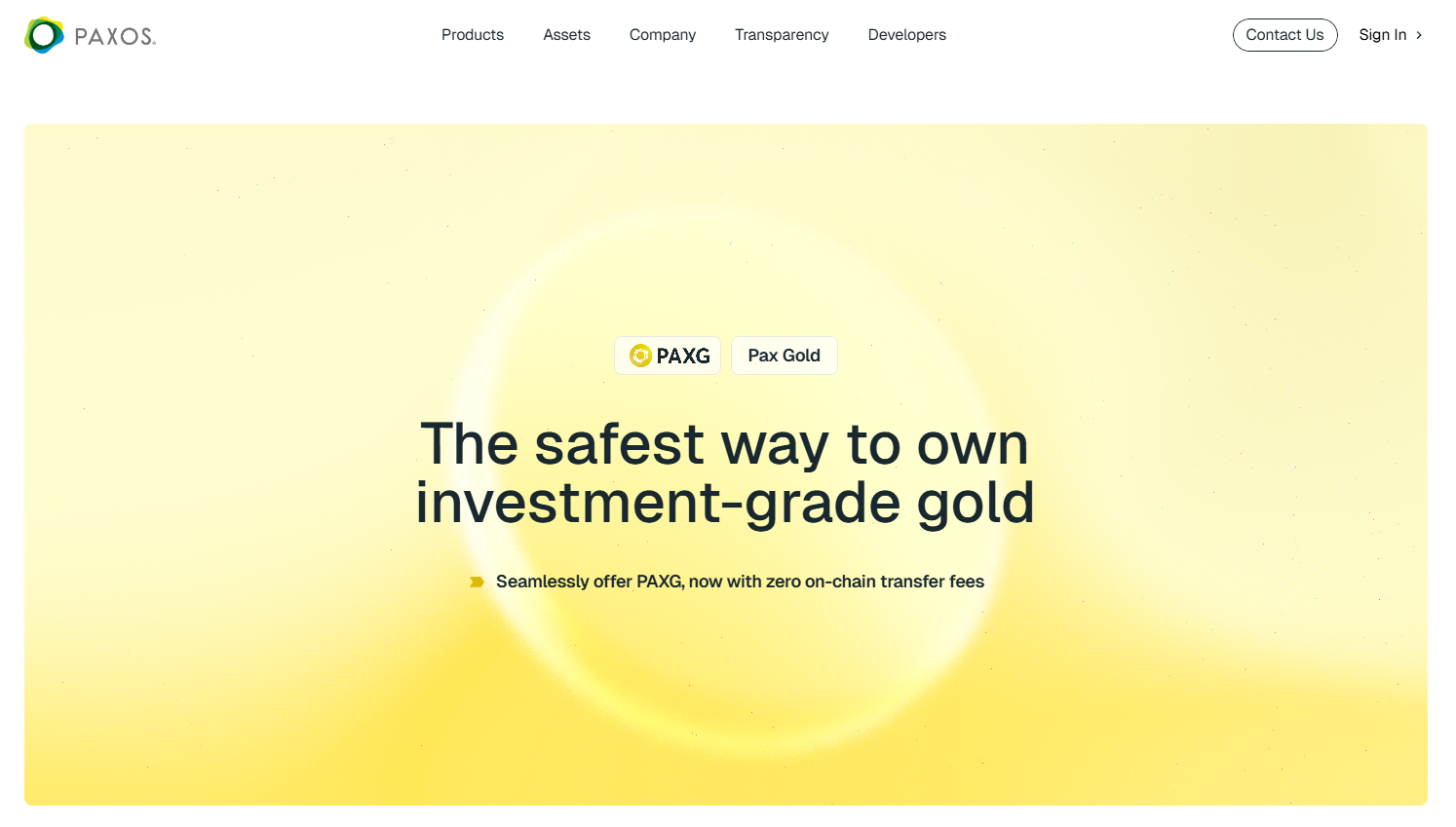
Why Use It. PAXG links each token to specific LBMA Good Delivery bars stored in London, offering direct bar redemption (institutional minimums apply) or USD redemption at spot. Paxos publishes fee schedules and notes no storage fee charged to customers at this time. (paxos.com)
Best For. Institutions; HNW hedgers; DeFi users needing reputable collateral.
Notable Features. LBMA bars; serial-number linkage; custodied in London; fiat redemption option. (paxos.com)
Fees Notes. Creation/destruction fees; no storage fee currently per issuer help center. (help.paxos.com)
Regions. Global (issuer KYC).
Consider If. You can meet bar redemption minimums and UK vault logistics. (help.paxos.com)
Alternatives. Tether Gold (XAUt); VNX Gold (VNXAU).  


2) Tether Gold (XAUt) — Best for simple pricing & broad availability

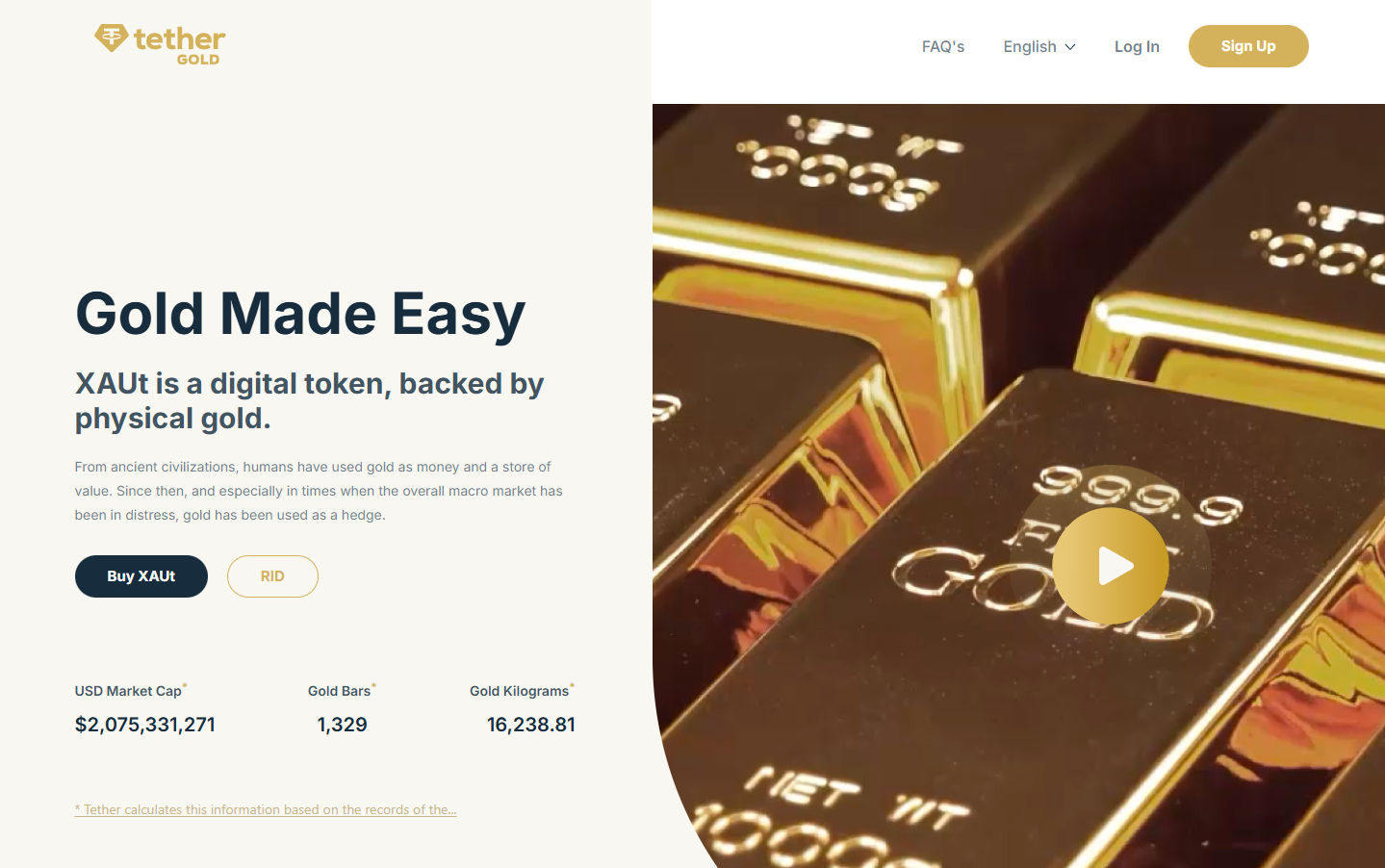
Why Use It. XAUt represents allocated gold and can be redeemed for physical gold or USD; Tether publishes a straightforward 0.25% creation/redemption fee and a one-time verification fee for onboarding. FAQs outline redemption mechanics and bar specifics. (Tether)
Best For. Traders seeking brand familiarity; cross-chain users (ETH/TRON).
Notable Features. Bar metadata; physical or USD redemption; no custody fee disclosed beyond the transaction fee. (Tether)
Fees Notes. 25 bps create/redeem; separate KYC verification fee. (Tether)
Regions. Global (issuer KYC).
Consider If. You need clear fee math but don’t require bar-specific allocation like PAXG.
Alternatives. PAX Gold (PAXG); Kinesis (KAU).  


3) Kinesis KAU (Gold) / KAG (Silver) — Best for spend-and-yield utility

Why Use It. Kinesis combines metal-backed tokens with an exchange, cards, and yields funded from platform fees (published yield-share). Trading and precious metals transactions show ~0.22% execution fees on official schedules. (Kinesis)
Best For. Users wanting to spend gold/silver, earn monthly yields, and keep fees predictable.
Notable Features. Fee-share yield (published); exchange, card rails; gold & silver pairs. (Kinesis)
Fees Notes. ~0.22% buy/sell/trade; other fees per schedule. (Kinesis)
Regions. Global (platform KYC/availability).
Consider If. You prefer an integrated platform over a standalone token.
Alternatives. VNX (VNXAU/VNXAG); Aurus (tXAU/tXAG).  


4) Comtech Gold (CGO) — Best for XDC ecosystem & Shariah-compliant framework

Why Use It. CGO tokenizes 1g gold units on the XDC (XRC-20) network, with a published fee structure for mint/redeem (0.50%), transfers (0.50%), and custody notes in FAQs. Documentation details creation/redemption and delivery fees. (comtechgold.com)
Best For. XDC builders; users needing Shariah-compliant structuring.
Notable Features. On-chain proofing; fee schedule; vault delivery options. (comtechgold.com)
Fees Notes. 0.50% mint/redeem; 0.50% transfer; custody terms disclosed. (comtechgold.com)
Regions. Global (issuer terms apply).
Consider If. You’re comfortable with XDC rails and issuer fee model.
Alternatives. PAXG; VNXAU.


5) VNX Gold (VNXAU) — Best for EEA vaulting & multi-chain issuance

Why Use It. VNXAU gives direct ownership of allocated bars stored in Liechtenstein with a public allocation lookup tool. VNX runs on Ethereum, Polygon, Q, and Solana, and has communications on redemption and delivery. (VNX)
Best For. EEA users; diversification across chains.
Notable Features. Allocation lookup by serial; segregated AAA-jurisdiction vault; multi-chain. (VNX)
Fees Notes. See VNX pricing and product pages for current schedules.
Regions. EEA emphasis; global availability varies by KYC.
Consider If. You want EEA custody and serial-level transparency.
Alternatives. PAXG; XAUt.


6) Aurus tGOLD (tXAU) / tSILVER (tXAG) — Best for gram-denominated multi-metal exposure

Why Use It. Aurus issues 1-gram tokens backed by vaulted gold and silver with insured, audited storage. tGOLD and tSILVER support multi-chain DeFi integrations and a mobile app, with ecosystem partners for mint/redeem. (AURUS)
Best For. DeFi users; small-denomination accumulation; multi-metal portfolios (includes platinum via tXPT).
Notable Features. 1g units; insured vaulted metals; app & dashboard; partner network. (AURUS)
Fees Notes. Exchange/network fees; issuer/partner fees may apply.
Regions. Global (partner KYC where required).
Consider If. You want gram-level flexibility and cross-chain access.
Alternatives. Kinesis; VNX.


7) Gold Silver Standard (AUS/AGS) — Best for Australia-based custody & simple redemption

Why Use It. Tokens AUS (gold) and AGS (silver) are backed by allocated bullion held in Australian high-security vaults with $0 storage and transfer at the issuer level and partner-facilitated redemptions. (goldsilverstandard.com)
Best For. AUD-centric investors; straightforward physical pickup/delivery via partners.
Notable Features. 1g linkage; local redemption via Ainslie partners; Australia-first focus. (goldsilverstandard.com)
Fees Notes. Issuer lists $0 storage/transfer; exchange and redemption partner fees may apply. (goldsilverstandard.com)
Regions. Australia focus; global varies.
Consider If. You need straightforward redemption in Australia.
Alternatives. PAXG; VNXAU.


8) VNX Silver (VNXAG) — Best for EEA silver allocation & transparency tools

Why Use It. VNXAG mirrors the VNXAU model for silver, backed by allocated metal with the same allocation lookup tooling and multi-chain issuance. (VNX)
Best For. EEA investors prioritizing silver in segregated storage.
Notable Features. Allocation lookup; EEA custody; multi-chain support. (VNX)
Fees Notes. See VNX site for current schedules.
Regions. EEA emphasis; global varies.
Consider If. You want EEA-vaulted silver with serial-level transparency.
Alternatives. KAG; tXAG.


9) VeraOne (VRO) — Best for euro-area buyers wanting 1-gram ERC-20

Why Use It. VRO is an ERC-20 token pegged to 1 gram of LBMA-standard gold, issued by a long-standing French precious-metal group; materials describe secured storage and regular audits. (VeraOne)
Best For. EU users; gram-based savings; euro on-ramps.
Notable Features. 1g linkage; audited storage; EU presence. (VeraOne)
Fees Notes. Issuer materials outline model; confirm current fees on site.
Regions. EU focus; global access varies.
Consider If. You want EU branding and ERC-20 simplicity.
Alternatives. PAXG; VNXAU.


10) AgAu — Best for Swiss custody & peer-to-peer design

Why Use It. AgAu outlines 1:1 backed gold and silver tokens with Swiss custody and a peer-to-peer payment focus; docs and reports describe convertibility and audited reserves. (agau.io)
Best For. Users seeking Swiss jurisdiction and payments-style UX.
Notable Features. Swiss issuer; P2P spend; audit & documents hub. (agau.io)
Fees Notes. See issuer documentation for fees and redemption steps.
Regions. Global (jurisdictional checks apply).
Consider If. You want Swiss custody with payments emphasis.
Alternatives. VNXAU; AUS.


Decision Guide: Best by Use Case

  • Regulated, bar-specific redemption: PAX Gold (PAXG). (paxos.com)
  • Simple fee schedule & brand familiarity: Tether Gold (XAUt). (Tether)
  • Spend metals + monthly fee-share yield: Kinesis (KAU/KAG). (Kinesis)
  • XDC network users: Comtech Gold (CGO). (comtechgold.com)
  • EEA custody & allocation lookup: VNX (VNXAU/VNXAG). (VNX)
  • Gram-based, multi-metal DeFi: Aurus (tXAU/tXAG). (AURUS)
  • Australia-centric custody & pickup: Gold Silver Standard (AUS/AGS). (goldsilverstandard.com)
  • EU 1-gram ERC-20: VeraOne (VRO). (VeraOne)
  • Swiss custody & P2P payments: AgAu. (agau.io)

How to Choose the Right Commodity-Backed Token (Checklist)

  • ☐ Region eligibility and KYC match your profile.
  • ☐ Underlying metal type and unit (ounce vs gram).
  • Redemption rules: minimums, delivery locations, timelines.
  • Custody: vault jurisdiction, insurer, LBMA accreditation.
  • Fee transparency: creation, redemption, storage, transfer, network.
  • Audit/attestation cadence and allocation lookup tools.
  • Chains supported and DeFi integration needs.
  • ☐ Support channels and documentation depth.
    Red flags: vague custody details, unclear redemption, or discontinued programs.

Use Token Metrics With Any Commodity-Backed Token

  • AI Ratings to screen metal-linked assets and related ecosystem tokens.


  • Narrative Detection to spot inflows to on-chain RWAs.
  • Portfolio Optimization to size metal exposure vs. crypto beta.
  • Alerts & Signals to time entries/exits around macro prints.
    Workflow: Research → Select issuer → Execute on-chain or via platform → Monitor with alerts.


CTA: Start free trial to screen assets and time entries with AI.  


Security & Compliance Tips

  • Use official issuer URLs only; beware look-alikes.
  • Confirm fee schedules and redemption procedures before buying. (Tether)
  • Verify vaulting jurisdiction and any bar-serial lookup tools. (VNX)
  • Mind network fees, bridge risks, and exchange withdrawal rules.
  • Keep custody keys secure; whitelist issuer addresses.
  • If staking or yielding, confirm source of yield and counterparty exposure. (Kinesis)
    This article is for research/education, not financial advice.

Beginner Mistakes to Avoid

  • Treating all metal tokens as equal—redemption and custody differ widely.
  • Ignoring region and KYC limits until you try to redeem.
  • Overlooking minimums (e.g., full LBMA bars vs. gram redemptions). (help.paxos.com)
  • Confusing defunct tokens with active ones (e.g., PMGT sunset; CGT backing ceased). (perthmint.com)
  • Forgetting network/transfer fees when arbitraging across chains.
  • Using unofficial contracts on the wrong chain.

How We Picked (Methodology & Scoring)
  • Liquidity — 30%. Exchange presence, on-chain activity, practical tradability.
  • Security — 25%. Custody details, audits/attestations, LBMA alignment, redemption design.
  • Coverage — 15%. Metals (gold/silver/platinum), chains, tooling.
  • Costs — 15%. Creation/redemption/storage/transfer and transparency of schedules.
  • UX — 10%. Apps, dashboards, redemption flows.
  • Support — 5%. Docs, status pages, human support.
    We relied on official product, docs, fees, FAQ, and disclosure pages, cross-checking market datasets only for context. Last updated November 2025.

FAQs

What are gold-backed tokens?
 They are blockchain tokens that represent ownership of a specific quantity of vaulted, insured gold, typically with published fees and, in some cases, physical redemption options.

Are gold-backed tokens safer than stablecoins?
 They can diversify away from fiat risk, but introduce custody and redemption dependencies. Safety depends on the issuer’s vaulting, audits, legal structure, and your ability to redeem.

What fees should I expect?
 Common fees include creation/redemption, possible storage, transfer, and network fees. Examples: XAUt lists 0.25% create/redeem; Paxos publishes creation/destruction fees and notes no storage fee currently. Always check the live schedules. (Tether)

Can I redeem tokens for a real gold bar?
 Some issuers support bar redemption with minimum sizes and location constraints (e.g., LBMA bar logistics in London for PAXG). Others support gram-level redemption via partners. (help.paxos.com)

Which chains are supported?
 Varies: PAXG (Ethereum), XAUt (Ethereum/TRON), VNX (Ethereum/Polygon/Q/Solana), Aurus (multi-chain), CGO (XDC), Kinesis (native + exchange listings). (paxos.com)

Are there discontinued tokens I should avoid?
 Yes. PMGT has been discontinued; CACHE Gold (CGT) ceased backing as of Sept 30, 2025. Verify project status before buying. (perthmint.com)


Conclusion + Related Reads

Choose PAXG for bar-linked redemption and strong disclosures, XAUt for simple fees and brand reach, or Kinesis if you want to spend metals and earn fee-share yields. For EEA vaulting with allocation lookup, VNX is compelling; for gram-based DeFi exposure, Aurus is versatile.

Related Reads:

Recent Posts

No Item Found
Research

Best Cross-Chain Bridges for Crypto Traders (2025)

Token Metrics Team
20 min read

Who this guide is for: Traders, DeFi users, and multichain portfolio managers seeking secure, cost-effective ways to move assets across blockchains.

Top three picks:

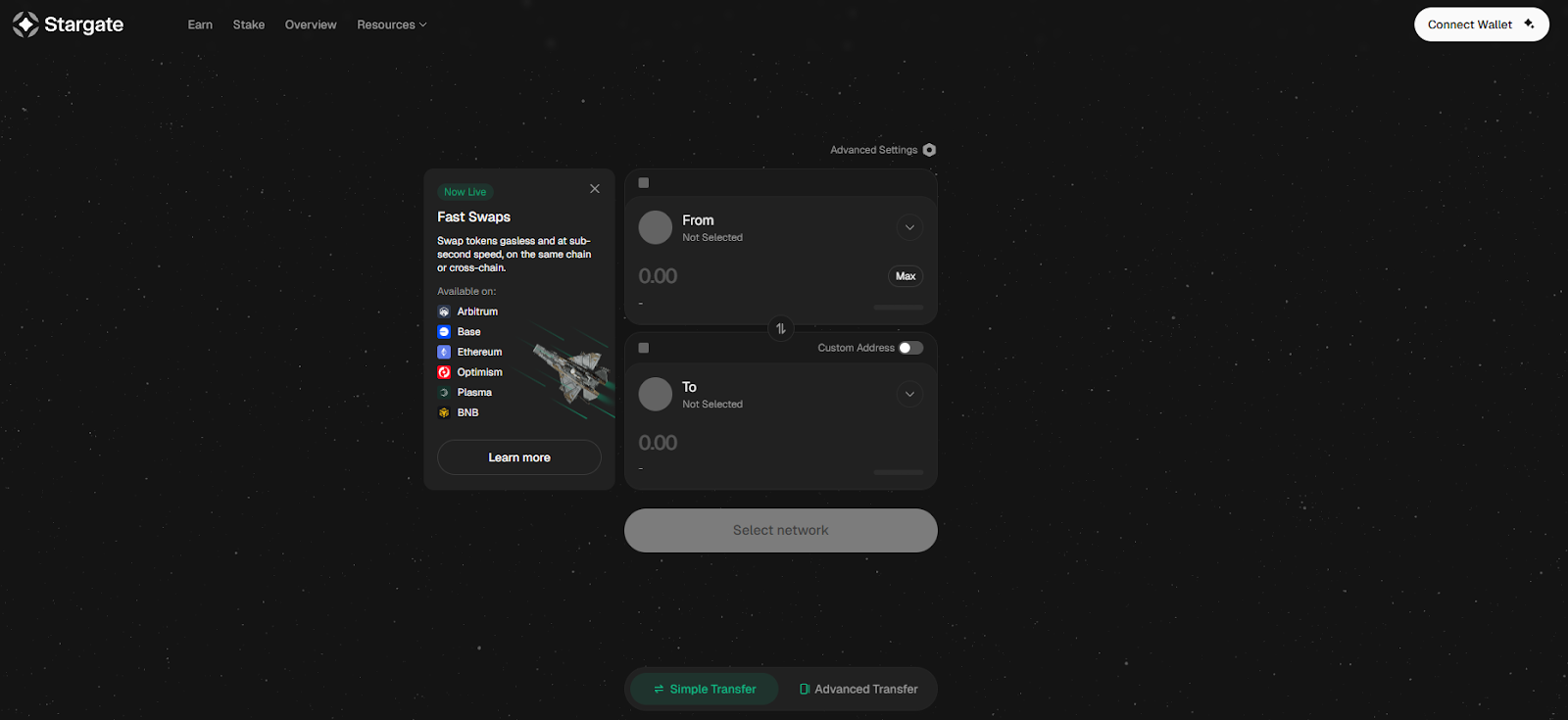
  • Stargate Finance — deepest liquidity for stablecoin transfers across major EVM chains and non-EVM networks.
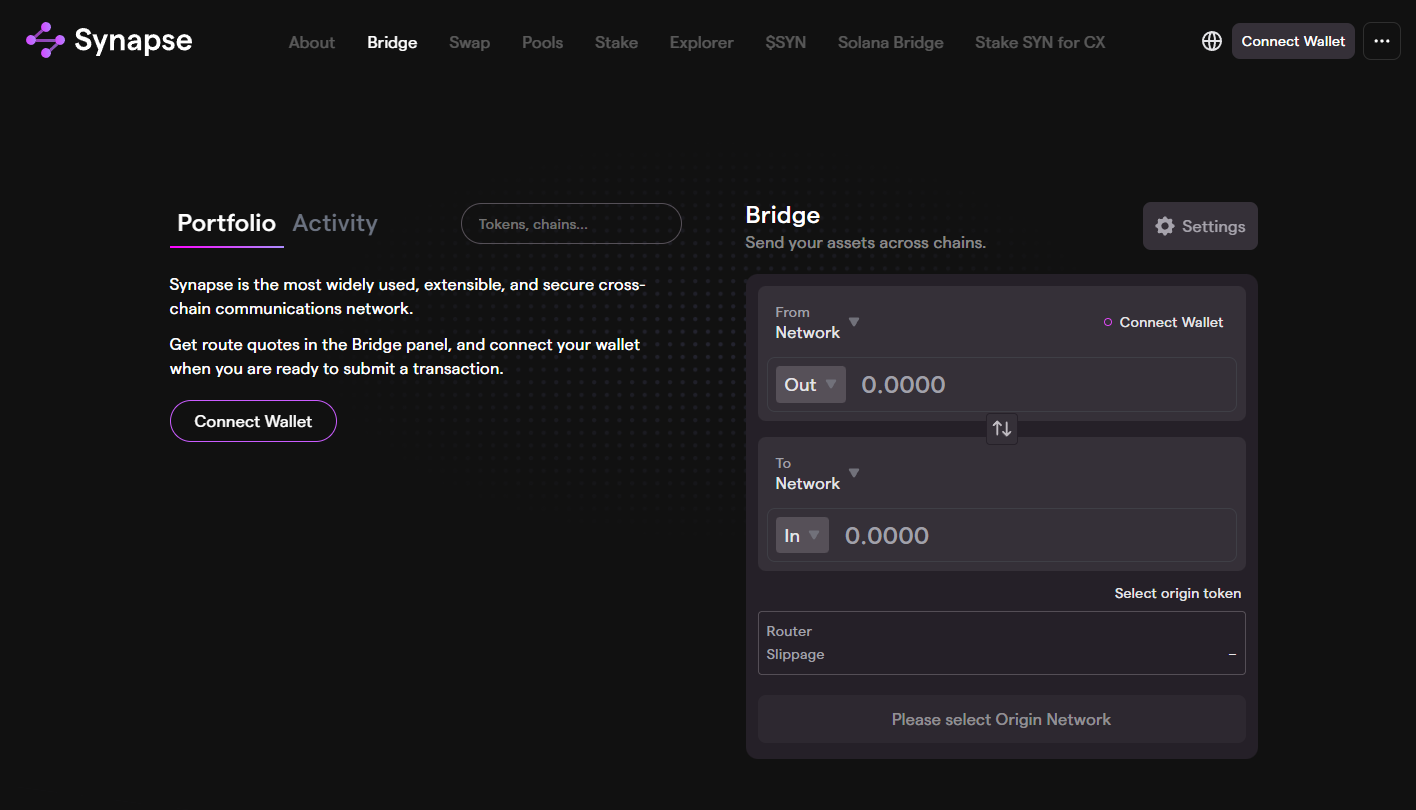
  • Synapse Protocol — fastest routes for traders needing sub-5-minute settlements on 20+ chains.
  • Across Protocol — lowest slippage and optimistic bridging for arbitrageurs and high-frequency movers.

Key caveat: Bridge fees vary by route, liquidity depth, and network congestion; always compare quotes and verify destination addresses before confirming transfers.


Introduction: Why Cross-Chain Bridges Matter in 2025

Cross-chain bridges are infrastructure protocols that enable seamless asset transfers between blockchains, solving fragmented liquidity and allowing traders to access opportunities across ecosystems without holding native tokens on every chain. In 2025, with over 100 active Layer 1 and Layer 2 networks, best cross-chain bridges for traders deliver speed, security, and capital efficiency—critical for arbitrage, yield farming, and portfolio rebalancing. This guide evaluates the top 10 cross-chain bridges based on liquidity depth, security architecture, chain coverage, fee transparency, and user experience, helping you select the right solution for your trading strategy.


How We Picked (Methodology & Scoring)

We evaluated 20+ cross-chain bridges using six weighted criteria:

  • Liquidity & Volume (30%) — Daily transfer volume, pool depth, and slippage on major routes
  • Security Architecture (25%) — Validator model, audit history, exploit record, bug bounties
  • Chain Coverage (15%) — Number of supported networks (EVM, non-EVM, L2s)
  • Costs & Fees (15%) — Bridge fees, gas optimization, hidden slippage
  • User Experience (10%) — Interface clarity, transaction speed, wallet integrations
  • Support & Documentation (5%) — Docs quality, status pages, support channels

Data sources: Official protocol documentation, pricing pages, security audit repositories, and status dashboards. Third-party volume data from CoinGecko and DefiLlama used for cross-checks only.

Last updated: November 2025


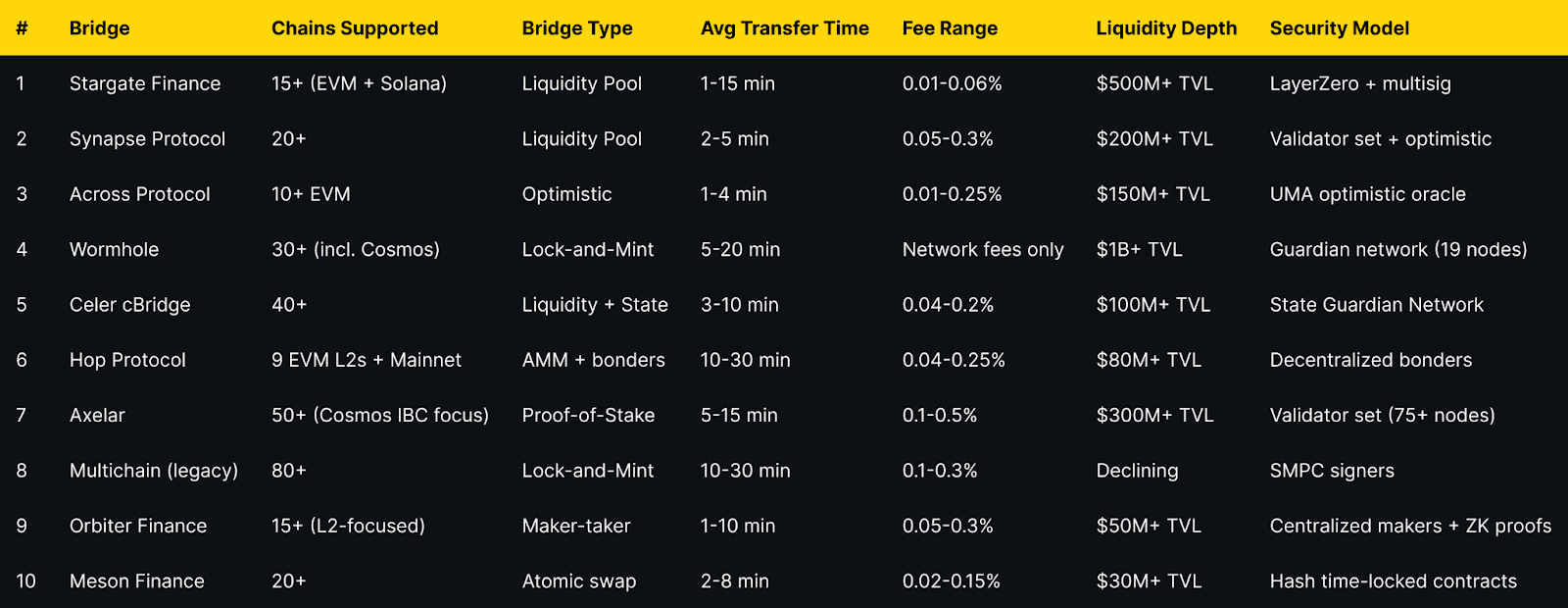
Best Cross-Chain Bridges in 2025 (Comparison Table)

Top 10 Cross-Chain Bridges in 2025

1. Stargate Finance — Best for Stablecoin Transfers

Why Use It: Stargate leverages LayerZero's messaging protocol to offer unified liquidity pools across 15+ chains, ensuring minimal slippage for USDC, USDT, and DAI transfers. Traders benefit from instant guaranteed finality and native asset transfers without wrapped tokens, making it ideal for large stablecoin movements between Ethereum, Arbitrum, Optimism, Polygon, BNB Chain, Avalanche, and Solana.

Best For: DeFi yield farmers, arbitrageurs moving stablecoins, traders rebalancing across chains, institutional desks.

Notable Features:

  • Unified liquidity pools eliminate fragmented routes
  • Delta algorithm prevents pool depletion and maintains balance
  • Native USDC/USDT support on major chains
  • Audited by Quantstamp and Zellic with $25M bug bounty

Consider If: You need to bridge non-stablecoin assets frequently (limited ERC-20 coverage) or require sub-1-minute finality (average 1-15 min).

Alternatives: Synapse Protocol, Across Protocol


2. Synapse Protocol — Best for Speed Across 20+ Chains

Why Use It: Synapse combines liquidity pools with an optimistic verification model to deliver 2-5 minute average transfer times across 20+ networks, including Ethereum, Arbitrum, Optimism, Base, Polygon, BNB Chain, Avalanche, Fantom, Harmony, Moonbeam, and Aurora. Its nUSD and nETH synthetic assets enable efficient cross-chain swaps with competitive 0.05-0.3% fees, while the Synapse Bridge interface integrates one-click swaps for seamless UX.

Best For: Active traders prioritizing speed, multichain yield optimizers, NFT collectors moving assets, users bridging to emerging L2s.

Notable Features:

  • Sub-5-minute average transfers with optimistic verification
  • 20+ chain support including Base and zkSync Era
  • Integrated DEX for same-transaction swaps
  • Audited by Quantstamp, Certik, and Code4rena

Consider If: You move assets over $100K per transaction (liquidity depth varies by route) or need guaranteed finality before spending (optimistic delays possible).

Alternatives: Stargate Finance, Hop Protocol


3. Across Protocol — Best for Optimistic Bridging & Low Slippage

Why Use It: Across uses UMA's optimistic oracle to facilitate near-instant transfers with relayers fronting capital and settling on the destination chain within 1-4 minutes. Traders enjoy 0.01-0.25% fees—among the lowest for EVM bridges—and minimal slippage on major routes like Ethereum to Arbitrum, Optimism, Polygon, and Base. The protocol's capital efficiency makes it ideal for arbitrageurs and high-frequency movers.

Best For: Arbitrage traders, gas-sensitive users, high-frequency DeFi participants, cost-conscious portfolio managers.

Notable Features:

  • Optimistic verification for 1-4 minute transfers
  • Ultra-low fees (0.01-0.25%) with transparent pricing
  • Relayer network ensures liquidity without pool fragmentation
  • Audited by OpenZeppelin and ABDK with ongoing bug bounty

Consider If: You need non-EVM chain support (currently EVM-only) or prefer liquidity-pool-based bridges for guaranteed execution.

Alternatives: Stargate Finance, Synapse Protocol


4. Wormhole — Best for Cross-Ecosystem Bridging

Why Use It: Wormhole is a generalized messaging protocol supporting 30+ blockchains including Ethereum, Solana, Terra, BNB Chain, Avalanche, Polygon, Fantom, Celo, and Cosmos-based chains. Its Guardian network of 19 validators enables lock-and-mint bridging for tokens and NFTs with no protocol fees beyond network gas costs. The recent Wormhole Connect widget simplifies integrations for traders using multichain dApps.

Best For: Cross-ecosystem traders (EVM to Solana/Cosmos), NFT collectors, developers integrating bridging, users of Wormhole-native dApps.

Notable Features:

  • 30+ chain support including Solana, Terra, and Cosmos IBC
  • Generalized messaging enables cross-chain smart contract calls
  • Guardian network with 19 institutional validators
  • Audited by Neodyme, Kudelski, and OtterSec post-2022 exploit recovery

Consider If: You prioritize speed over security guarantees (5-20 min transfers) or need the deepest liquidity per route (Stargate/Synapse stronger for stables).

Alternatives: Axelar, Celer cBridge


5. Celer cBridge — Best for 40+ Chain Coverage

Why Use It: Celer cBridge supports 40+ blockchains with a hybrid liquidity pool and state channel architecture, enabling 3-10 minute transfers at 0.04-0.2% fees. Its State Guardian Network provides security for cross-chain state verification, while the cBridge UI offers direct wallet integrations and historical transaction tracking. Recent additions include support for zkSync Era, Linea, and Scroll.

Best For: Multichain portfolio managers, traders accessing niche L2s, users bridging to gaming-focused chains, cost-conscious cross-chain swappers.

Notable Features:

  • 40+ chains including zkSync, Linea, Mantle, and Scroll
  • State Guardian Network for optimistic cross-chain verification
  • Integrated liquidity mining for yield on idle bridge assets
  • Audited by Certik, PeckShield, and SlowMist

Consider If: You operate in mainland China (limited access) or need guaranteed sub-5-minute finality (optimistic delays on congested routes).

Alternatives: Synapse Protocol, Axelar


6. Hop Protocol — Best for Ethereum L2 Bridging

Why Use It: Hop specializes in fast transfers between Ethereum mainnet and nine major L2s (Arbitrum, Optimism, Base, Polygon, zkSync Era, Linea, Scroll, Gnosis Chain, and Polygon zkEVM) using AMM-style liquidity pools and decentralized bonders who provide instant liquidity. Traders pay 0.04-0.25% fees and experience 10-30 minute average transfers, with the option to earn yield by providing liquidity or running bonder nodes.

Best For: L2-first traders, Ethereum mainnet to L2 bridgers, liquidity providers, users seeking decentralized bridge architecture.

Notable Features:

  • Native L2 focus with support for 9 Ethereum L2s
  • AMM-based liquidity pools for transparent pricing
  • Decentralized bonder network reduces trust assumptions
  • Audited by Consensys Diligence and OpenZeppelin

Consider If: You need to bridge to non-EVM chains (Ethereum ecosystem only) or require sub-10-minute finality consistently (bonder availability varies).

Alternatives: Synapse Protocol, Across Protocol


7. Axelar — Best for Cosmos & Proof-of-Stake Security

Why Use It: Axelar is a Cosmos SDK-based interoperability network with 75+ validators securing cross-chain transfers via proof-of-stake consensus. Supporting 50+ chains with IBC-native bridging to Cosmos, Osmosis, Injective, and other app-chains, Axelar enables secure general message passing for complex cross-chain dApp interactions at 0.1-0.5% fees. Transfers settle in 5-15 minutes with high finality guarantees.

Best For: Cosmos ecosystem traders, institutional users prioritizing security, developers building cross-chain dApps, users requiring verifiable bridge security.

Notable Features:

  • 75+ decentralized validators with proof-of-stake security
  • Native IBC support for Cosmos ecosystem chains
  • General Message Passing (GMP) for cross-chain smart contracts
  • Audited by NCC Group, OtterSec, and Certik

Consider If: You prioritize speed over security (5-15 min slower than optimistic bridges) or need the lowest fees per transaction (0.1-0.5% higher than Across/Stargate).

Alternatives: Wormhole, Celer cBridge


8. Multichain — Best for 80+ Chain Access (Use With Caution)

Why Use It: Multichain (formerly Anyswap) offers the broadest chain coverage with 80+ supported networks using SMPC (Secure Multi-Party Computation) signers for lock-and-mint bridging. While historically popular for accessing niche chains like Moonriver, Kava, and Metis, the protocol faced security concerns in mid-2023 related to validator key management. Fees range from 0.1-0.3% with 10-30 minute transfer times.

Best For: Users bridging to obscure chains unavailable elsewhere, legacy dApp integrations, traders willing to accept elevated risk for maximum coverage.

Notable Features:

  • 80+ chain support including niche L1s and L2s
  • Long operational history since 2020
  • Cross-chain router for multi-hop transactions
  • SMPC validator network (security incidents reported)

Consider If: Security is your top priority (2023 exploit drained $126M; ongoing validator concerns) or you need active development and transparent disclosures.

Alternatives: Celer cBridge, Axelar


9. Orbiter Finance — Best for L2-to-L2 Transfers

Why Use It: Orbiter uses a maker-taker model where centralized makers provide instant liquidity for L2-to-L2 transfers across 15+ chains including Arbitrum, Optimism, zkSync Era, StarkNet, Linea, Base, and Scroll. Transfers complete in 1-10 minutes at 0.05-0.3% fees, with ZK-proof verification planned for enhanced security. The interface is optimized for mobile and shows real-time maker liquidity status.

Best For: L2-native traders, StarkNet and zkSync users, mobile-first users, traders needing fast L2 exits.

Notable Features:

  • Specialized L2-to-L2 focus with 15+ network support
  • 1-10 minute average transfers via maker liquidity
  • ZK-proof verification roadmap for trustless bridging
  • Real-time liquidity tracking and maker status

Consider If: You prefer fully decentralized bridge models (makers are centralized) or need mainnet-to-L2 bridging exclusively (better alternatives exist).

Alternatives: Hop Protocol, Synapse Protocol


10. Meson Finance — Best for Atomic Swap Security

Why Use It: Meson implements hash time-locked contracts (HTLCs) for trustless atomic swaps across 20+ chains, eliminating validator risk and bridge contract vulnerabilities. Traders benefit from 2-8 minute transfers at 0.02-0.15% fees with cryptographic guarantees that transactions either complete or refund automatically. The protocol is audited by SlowMist and maintains zero-exploit history since launch.

Best For: Security-conscious traders, users burned by bridge exploits, atomic swap enthusiasts, traders moving mid-sized amounts ($1K-$50K).

Notable Features:

  • HTLC-based atomic swaps for trustless bridging
  • Zero-exploit record with cryptographic security guarantees
  • 20+ chain support including major EVM and L2s
  • 0.02-0.15% fees competitive with optimistic bridges

Consider If: You need to bridge large amounts over $100K (liquidity depth limited) or require sub-2-minute finality (HTLC setup adds overhead).

Alternatives: Across Protocol, Stargate Finance


Decision Guide: Best By Use Case

  • Stablecoin arbitrage & DeFi yield: Stargate Finance for deepest USDC/USDT liquidity
  • Fastest cross-chain execution: Synapse Protocol or Across Protocol for sub-5-minute transfers
  • Ethereum L2 specialists: Hop Protocol for native L2 bridging with decentralized bonders
  • Cross-ecosystem traders (EVM + Solana/Cosmos): Wormhole or Axelar for broadest coverage
  • Lowest fees & slippage: Across Protocol for optimistic bridging at 0.01-0.25%
  • Maximum chain coverage: Celer cBridge (40+) or Multichain (80+ with caution)
  • L2-to-L2 focus (zkSync, StarkNet, Arbitrum): Orbiter Finance for maker-taker speed
  • Security-first & trustless: Meson Finance for atomic swap guarantees
  • Institutional security requirements: Axelar for proof-of-stake validator model
  • Mobile-optimized bridging: Orbiter Finance or Synapse Protocol

How to Choose the Right Cross-Chain Bridge (Checklist)

  • [ ] Verify chain support — Confirm both source and destination chains are supported with active liquidity
  • [ ] Check fee transparency — Review total costs including bridge fees, gas, and potential slippage before confirming
  • [ ] Assess security model — Understand validator architecture (optimistic, proof-of-stake, HTLC, multisig) and audit history
  • [ ] Review transfer speed requirements — Match bridge speed (1-30 min) to your trading strategy urgency
  • [ ] Confirm liquidity depth — For large transfers ($50K+), verify pool TVL and recent volume on your specific route
  • [ ] Test with small amounts first — Always bridge test transactions ($10-$100) before moving significant capital
  • [ ] Verify destination address format — Double-check address compatibility and network selection to avoid irreversible losses
  • [ ] Monitor bridge status pages — Check for maintenance, paused routes, or congestion warnings before transacting
  • [ ] Understand finality guarantees — Know if transfers are optimistic (reversible), instant (relayer-based), or cryptographically final
  • [ ] Review regional restrictions — Confirm access from your jurisdiction (most bridges global; check compliance)
  • [ ] Check exploit history — Research past security incidents and protocol responses (Wormhole 2022, Multichain 2023)
  • 🚩 Red flags: Bridges with undisclosed validator sets, paused routes without status updates, or fees significantly higher than quoted

Use Token Metrics With Any Cross-Chain Bridge

Maximize your cross-chain trading strategy by combining bridge infrastructure with Token Metrics intelligence:

  • AI Ratings screen 6,000+ tokens across chains to identify quality assets before bridging capital

  • Narrative Detection spots emerging themes (e.g., Solana DeFi, Base ecosystem) to inform which chains to bridge into
  • Portfolio Optimization balances risk across chains and suggests rebalancing targets that justify bridge costs
  • Alerts & Signals time bridge transactions around momentum shifts, reducing exposure to unfavorable price action mid-transfer

Workflow: Research asset quality with AI Ratings → Select optimal bridge for your route → Execute transfer → Monitor destination chain with real-time alerts.

Start your free trial to screen assets and time bridge transactions with AI-powered intelligence.


Security & Compliance Tips

  • Verify official URLs — Always access bridges through bookmarked official domains; phishing sites are common
  • Use hardware wallets — Sign bridge transactions with Ledger/Trezor for cold-storage protection
  • Check token approvals — Revoke unlimited approvals after bridging using tools like Revoke.cash
  • Monitor bridge exploits — Follow protocol Twitter accounts and status pages for real-time security alerts
  • Understand validator risks — Multisig and SMPC bridges concentrate risk; optimistic and PoS models distribute trust
  • Avoid bridging during congestion — High gas fees and slippage increase during network congestion; wait for off-peak times
  • Store bridge receipts — Save transaction hashes and screenshots for tax reporting and dispute resolution
  • Test cross-chain contract calls — If using advanced features (e.g., Axelar GMP), test with minimal amounts first
  • Review liquidity provider risks — Impermanent loss and smart contract risk apply to bridge LPs; understand before depositing
  • Know refund procedures — Understand each bridge's failed transaction refund process and timeframes

This article is for research and educational purposes, not financial advice. Conduct your own security due diligence before bridging assets.


Beginner Mistakes to Avoid

  • Bridging to the wrong network — Always triple-check destination chain selection; wrong-network transfers are often irreversible
  • Ignoring slippage on large transfers — Pools with <$10M TVL may experience 1-5% slippage on $100K+ transactions
  • Bridging illiquid tokens — Ensure destination chain has DEX liquidity before bridging obscure tokens
  • Not accounting for gas on destination chain — Bridge enough native tokens (ETH, MATIC, etc.) to pay for transactions on arrival
  • Trusting wrapped tokens blindly — Verify wrapped token contracts are legitimate before swapping (scam tokens common)
  • Bridging during protocol upgrades — Avoid bridging when protocols announce maintenance windows or upgrades
  • Falling for "instant bridge" scams — No legitimate bridge offers instant finality across all chains; be skeptical of unrealistic claims
  • Ignoring bridge insurance options — Services like Nexus Mutual offer bridge exploit coverage for eligible protocols

FAQs

What is a cross-chain bridge?
 A cross-chain bridge is a protocol that enables asset transfers between different blockchains by locking tokens on the source chain and minting or unlocking equivalent tokens on the destination chain. Bridges use various security models including lock-and-mint, liquidity pools, optimistic verification, and atomic swaps to facilitate interoperability.

Are cross-chain bridges safe?
 Bridge security varies significantly by architecture and track record. Bridges secured by proof-of-stake validators (Axelar) or atomic swaps (Meson) offer stronger security than multisig or SMPC models. Historical exploits affecting Wormhole ($325M in 2022) and Multichain ($126M in 2023) highlight risks. Always verify audit reports, exploit history, and validator transparency before bridging significant amounts.

How much do cross-chain bridges cost?
 Bridge fees typically range from 0.01% to 0.5% of transfer amount, plus source and destination chain gas fees. Stargate and Across charge 0.01-0.06% for stablecoins, while Axelar charges 0.1-0.5% for broader coverage. Total costs including gas often range from $5-$50 for typical transactions, but can exceed $100 during Ethereum mainnet congestion.

Can I bridge any token between any chains?
 No—token bridging depends on protocol support and liquidity availability. Major tokens (USDC, USDT, ETH, WBTC) have deep liquidity on most bridges, while obscure tokens may only bridge via wrapped versions or not at all. Always verify token support on both source and destination chains before attempting transfers.

How long do cross-chain bridge transfers take?
 Transfer times range from 1 minute (Across optimistic transfers) to 30+ minutes (Hop during congestion or Multichain on slower chains). Average speeds: Across 1-4 min, Synapse 2-5 min, Stargate 1-15 min, Wormhole 5-20 min. Optimistic bridges are fastest but may delay finality during disputes; lock-and-mint bridges prioritize security over speed.

Do I need native tokens on the destination chain before bridging?
 Not for the bridge transaction itself, but you'll need native tokens (ETH on Ethereum, MATIC on Polygon, etc.) to pay gas for any subsequent transactions on the destination chain. Some bridges offer small gas token bridging or faucet integrations, but plan to bridge sufficient native tokens alongside your primary assets.

What happens if my bridge transaction fails?
 Failed transactions typically result in automatic refunds to the source address within 24-72 hours, though timelines vary by protocol. Optimistic bridges may take longer during dispute periods. Always save transaction hashes and monitor bridge status pages for updates. Contact protocol support via Discord or Telegram for transactions stuck beyond normal timeframes.

Can I use bridges for NFTs or only fungible tokens?
 Most bridges focus on fungible tokens (ERC-20, SPL, etc.), but several support NFT bridging. Wormhole enables NFT transfers across 30+ chains, while specialized solutions like Axelar and Celer support NFT metadata preservation. NFT bridges often charge fixed fees ($5-$20) regardless of NFT value and may take longer than fungible token transfers.


Conclusion + Related Reads

Selecting the right cross-chain bridge depends on your priorities: Stargate Finance delivers the deepest stablecoin liquidity for DeFi-focused traders, Synapse Protocol offers the fastest execution across 20+ chains, and Across Protocol provides the lowest fees for cost-conscious arbitrageurs. Security-first users should consider Meson Finance for atomic swap guarantees or Axelar for institutional-grade proof-of-stake validation. Always test with small amounts, verify destination addresses, and monitor bridge status pages before moving significant capital.

Related Reads:

Research

Top Data Availability Layers (2025)

Token Metrics Team
11 min read

Who this guide is for. Teams launching rollups or appchains that need reliable, verifiable data availability layers to minimize costs while preserving security.

Top three picks.

  • Celestia — lowest-friction modular DA with broad tooling and clear blob fee model.
  • EigenDA — high-throughput, Ethereum-aligned DA with reserved/on-demand bandwidth tiers.
  • Avail — production DA with developer-friendly docs and transparent fee formula.

Caveat. Fees vary by data size, congestion, and commitment type (on-chain blobs vs. off-chain DA/DAC). Always confirm region eligibility and SLAs in provider docs.


Introduction: Why Data Availability Layers Matter in November 2025

Data availability layers let rollups publish transaction data so anyone can reconstruct state and verify proofs. In 2025, modular stacks (OP Stack, Polygon CDK, ZK Stack) routinely separate execution from DA to optimize costs and performance. Your DA choice affects security (trust assumptions), fees (blob gas vs. DA network fees), and UX (latency, bandwidth caps).
Search intent here is commercial-investigational: teams comparing providers by cost, security model, and integration options. We’ll keep things concrete, link only official sources, and show exactly who each option fits.

How We Picked (Methodology & Scoring)

  • Liquidity/Scale — 30%: adoption, throughput, sustained bandwidth.
  • Security — 25%: trust assumptions (L1 blobs vs. DAC), transparency, docs.
  • Coverage — 15%: SDKs, stacks supported (OP Stack, Polygon CDK, ZK Stack), bridges.
  • Costs — 15%: posted pricing/fee mechanics.
  • UX — 10%: setup, tooling, observability.
  • Support — 5%: docs, guides, contact points.
    Data from official docs/pricing/status pages; third-party datasets used only for cross-checks. Last updated November 2025.


Top 10 Data Availability Layers in November 2025

1. Celestia — Best for modular DA at predictable blob economics

Why Use It. Celestia specializes in DA with namespaced blobs and data availability sampling. Fees are a flat transaction fee plus a variable component based on blob size, so costs scale with data posted rather than execution. Clear “PayForBlobs” guidance and explorers make planning straightforward. (blog.bcas.io)
Best For. OP Stack/sovereign rollups; teams optimizing DA cost; multi-chain deployments.
Notable Features. Namespaced blobs; fee market tied to blob size; tooling for PFB; docs on submitting and estimating fees. (Celestia Docs)
Fees Notes. Flat + variable per-blob; gas-price prioritized. (Celestia Docs)
Regions. Global (check validator/geography exposure in explorers).
Consider If. You want modular DA with transparent per-blob costs.
Alternatives. EigenDA, Avail.  


2. EigenDA — Best for high throughput with reserved bandwidth tiers

Why Use It. EigenDA is built on EigenLayer and offers mainnet DA with published reserved bandwidth tiers (annual ETH) and on-demand options. Strong alignment with Ethereum restaking and high advertised throughput. (docs.eigencloud.xyz)
Best For. High-throughput L2s; OP Stack/Orbit/CDK chains seeking cloud-grade throughput.
Notable Features. Reserved tiers (e.g., 512–2048 KiB/s and up), on-demand pricing updates, EigenLayer operator set. (eigenda.xyz)
Fees Notes. Reserved pricing in ETH per year; on-demand available. (eigenda.xyz)
Regions. Global.
Consider If. You want capacity commitments and Ethereum-aligned security.
Alternatives. Celestia, Avail.  


3. Avail — Best for dev-friendly docs and transparent fee formula

Why Use It. Avail provides DA with clear developer pathways (AppIDs, deploy rollups) and posts a fee formula: base + length + weight + optional tip. Guides include OP Stack and ZK Stack integrations. (docs.availproject.org)
Best For. Teams needing step-by-step deployment templates and cost modeling.
Notable Features. AppID model; OP Stack/Validium guides; fee components documented. (docs.availproject.org)
Fees Notes. Base + length + weight + optional tip; congestion multiplier. (docs.availproject.org)
Regions. Global.
Consider If. You want docs-first integration and a transparent pricing formula.
Alternatives. Celestia, EigenDA.  


4. NEAR Data Availability (NEAR DA) — Best for cost-reduction via NEAR’s sharded DA

Why Use It. NEAR modularizes its DA layer for external rollups, aiming to lower DA fees while leveraging its sharded architecture. Official materials target Ethereum rollups explicitly. (docs.near.org)
Best For. Rollups prioritizing low DA cost and sharded throughput.
Notable Features. Sharded DA; chain-abstraction docs; community implementations (e.g., Nuffle). (docs.near.org)
Fees Notes. Designed to reduce rollup DA cost; confirm network fees in docs. (NEAR)
Regions. Global.
Consider If. You want a low-cost DA path and EVM interoperability.
Alternatives. Avail, Celestia.


5. Ethereum Blobspace (EIP-4844) — Best for maximum L1 neutrality with ephemeral blobs

Why Use It. Post data to Ethereum blobs for protocol-level guarantees during the blob retention window (~18 days). Ideal for projects that want L1 alignment and can operate within ephemeral storage constraints and blob gas markets. (Ethereum Improvement Proposals)
Best For. Security-first teams preferring L1 attestation and ecosystem neutrality.
Notable Features. KZG commitments; ephemeral blob storage; native verification. (ethereum.org)
Fees Notes. Blob gas; variable by demand; L1 network fees apply. (ethereum.org)
Regions. Global.
Consider If. You accept blob retention limits and variable blob pricing.
Alternatives. Celestia, EigenDA.


6. Arbitrum AnyTrust (DAC) — Best for cost-optimized OP-style chains using a DAC

Why Use It. AnyTrust lowers costs by storing data with a Data Availability Committee and posting certificates on L1. Detailed runbooks exist for configuring DACs for Orbit chains. (docs.arbitrum.io)
Best For. Orbit chains and apps with mild trust assumptions for lower fees.
Notable Features. DACert flow; DAS; step-by-step DAC deployment docs. (docs.arbitrum.io)
Fees Notes. Lower posting costs; committee/infra costs vary. (docs.arbitrum.io)
Regions. Global (committee member distribution varies).
Consider If. You want cheaper DA and can trust a DAC quorum.
Alternatives. Polygon CDK DA, StarkEx DAC.


7. Polygon CDK Data Availability — Best for CDK chains wanting Validium-style DA

Why Use It. CDK chains can use a DA node and DAC approach for Validium-style costs, with official repos describing the CDK DA component. Best fit if you’re already on CDK and want DA flexibility. (polygon.technology)
Best For. Polygon CDK deployers; validium-first apps.
Notable Features. CDK DA node repo; DAC configuration; CDK ecosystem tooling. (GitHub)
Fees Notes. Operator/committee costs; network fees vary by setup. (polygon.technology)
Regions. Global.
Consider If. You need CDK-native DA with Validium trade-offs.
Alternatives. Arbitrum AnyTrust, EigenDA.


8. StarkEx Data Availability Committee — Best for Validium/Volition deployments needing DAC maturity

Why Use It. StarkEx supports Validium and Volition modes via a DAC with APIs (Availability Gateway) and reference implementations for committee nodes. Production-hardened across top apps. (docs.starkware.co)
Best For. High-volume ZK apps on StarkEx preferring low DA costs.
Notable Features. DAC reference code; Volition support; batch data APIs. (GitHub)
Fees Notes. Committee/infra costs; app-specific. (docs.starkware.co)
Regions. Global (committee selection per app).
Consider If. You accept DAC trust assumptions for cost savings.
Alternatives. Arbitrum AnyTrust, Polygon CDK DA.


9. Espresso DA — Best for shared DA paired with neutral sequencing

Why Use It. Espresso offers a shared DA with HotShot consensus and a light-client verifyInclusion function for on-chain verification, designed to interoperate with other DA choices if desired. (docs.espressosys.com)
Best For. Rollups adopting shared sequencing and wanting cheap DA.
Notable Features. HotShot consensus; three-layer DA architecture; flexible with other DAs. (L2BEAT)
Fees Notes. Network fees; contact providers/infrastructure partners for terms. (blockdaemon.com)
Regions. Global.
Consider If. You want shared sequencing + DA as a package.
Alternatives. EigenDA, Celestia.


10. 0G DA — Best for high-throughput apps (AI/gaming) needing DA + storage

Why Use It. 0G pairs a DA layer with a general-purpose storage system and provides DA node specs and runbooks. Positioned for high-volume data workloads and fast retrieval. (docs.0g.ai)
Best For. Data-heavy chains (AI, gaming) needing scalable DA and storage.
Notable Features. Encoded blob data; DA node specs; whitepaper architecture (DA atop storage). (GitHub)
Fees Notes. Throughput-oriented network; confirm current pricing with 0G. (0g.ai)
Regions. Global.
Consider If. You’re optimizing for data-heavy throughput and retrieval.
Alternatives. Celestia, Avail.


Decision Guide: Best By Use Case


How to Choose the Right Data Availability Layer (Checklist)

  • ☐ Region eligibility and any operator restrictions documented
  • ☐ Security model fits app (L1 blobs vs. modular DA vs. DAC)
  • ☐ Fee mechanics are explicit (blob gas, per-blob size, or formula)
  • ☐ Tooling and SDKs for your stack (OP Stack, CDK, ZK Stack)
  • ☐ Throughput/bandwidth and quotas published or contractually reserved
  • ☐ Observability: explorers, status pages, inclusion proofs/light clients
  • ☐ Clear guides for deployment and migration paths
  • ☐ Support channels and escalation (SLA/contacts)
  • Red flags: no official fee notes, opaque committees, or missing verification docs.

Use Token Metrics With Any Data Availability Layer

  • AI Ratings to screen assets by quality and momentum.


  • Narrative Detection to spot early theme shifts.
  • Portfolio Optimization to balance risk across chains.
  • Alerts & Signals to time entries/exits.
    Workflow: Research → Select DA → Launch rollup/appchain → Monitor with alerts.

Start free trial to screen assets and time entries with AI.  


Security & Compliance Tips

  • Run independent verification (light clients/inclusion proofs) where available.
  • For DACs, diversify committee members and publish membership changes.
  • Monitor quotas/latency; set fallbacks (e.g., switch DA mode where stack supports Alt-DA). (docs.optimism.io)
  • Validate official endpoints; beware of phishing and copycat docs.
  • Track fee spikes (blob gas, congestion multipliers) and set budget alarms. (ethereum.org)
  • Document upgrade paths and retention windows (e.g., blob expiry). (ethereum.org)

This article is for research/education, not financial advice.


Beginner Mistakes to Avoid

  • Treating DA choice as “set-and-forget” without monitoring fees and bandwidth.
  • Ignoring blob retention on Ethereum and assuming permanence. (ethereum.org)
  • Using a DAC without clear membership and recovery processes. (docs.arbitrum.io)
  • Skipping test deployments to measure real blob sizes and costs.
  • Overlooking verification UX (light clients/proofs) for end users.
  • Assuming all stacks support seamless DA switching without work. (docs.optimism.io)

How We Picked (Methodology & Scoring)

Scoring Weights (sum = 100): Liquidity/Scale 30, Security 25, Coverage 15, Costs 15, UX 10, Support 5.
We examined official docs for pricing/fees, security/verification, and deployment guides. We favored providers with explicit fee notes (formulas or tiers), clear verification models, and active ecosystem integrations. Last updated November 2025.


FAQs

What are data availability layers?
 They’re systems that publish rollup data so anyone can reconstruct state and verify proofs. They range from L1 blobs (Ethereum EIP-4844) to modular DA networks (Celestia, Avail) and DACs. (ethereum.org)

Are blobs on Ethereum permanent?
 No. Blob data is retained for a limited window (~18 days). If you need permanent access, you must snapshot or use a DA with different retention. (ethereum.org)

How do DA fees work?
 Fees vary: Celestia ties fees to blob size and gas; Avail publishes a base/length/weight formula; Ethereum blobs use a blob-gas market; EigenDA offers reserved bandwidth tiers. (Celestia Docs)

What’s a DAC and when should I use one?
 A Data Availability Committee stores data off-chain and posts certificates or signatures to L1. It’s cheaper but introduces committee trust assumptions. Used by Arbitrum AnyTrust, StarkEx/Volition, and CDK Validium. (docs.arbitrum.io)

Can OP Stack chains plug into alternative DA?
 Yes. OP Stack supports Alt-DA mode to integrate various DA layers. Validate trade-offs and tooling before switching. (docs.optimism.io)


Conclusion + Related Reads

If you want transparent per-blob costs and strong tooling, pick Celestia. For capacity commitments and Ethereum alignment, choose EigenDA. If you want a formula-based fee model with practical guides, Avail is compelling. DAC-based routes (AnyTrust, StarkEx, CDK) suit cost-sensitive apps comfortable with committee trust assumptions.

Related Reads (Token Metrics)

Research

Top Optimistic Rollups & L2 Ecosystems (2025)

Token Metrics Team
13 min read

Who this guide is for. Builders, power users, and teams choosing where to deploy or transact on Ethereum-style optimistic rollups and OP Stack L2s in 2025.

Top three picks.

  • Arbitrum One — broadest DeFi depth and mature fraud proofs.
  • OP Mainnet (Optimism) — feature-complete fault proofs, the Superchain standard.
  • Base — OP Stack at scale with strong developer docs and low, predictable fees. (docs.arbitrum.io)

One key caveat. Withdrawals to L1 use a challenge period (~7 days) on optimistic rollups; fast bridges can bypass with extra trust/cost. (docs.arbitrum.io)


Introduction: Why Optimistic Rollups & L2 Ecosystems Matter in November 2025

Optimistic rollups are L2 networks that post transaction data to Ethereum and assume validity unless challenged via fraud (fault) proofs, enabling cheaper, faster transactions while inheriting Ethereum’s security. They matter now because OP Stack chains have standardized tooling, bridges, and proofs, and multiple ecosystems (Arbitrum, Optimism, Base, Mode, World Chain, Fraxtal, Zora, opBNB, Blast, Metis) have reached scale. Primary keyword: Top Optimistic Rollups. (docs.arbitrum.io)


How We Picked (Methodology & Scoring)

We shortlisted ~20 credible L2s, then scored and selected TOP_N = 10 using official docs for architecture, fees, bridges, and proof status. Third-party datasets were used only for cross-checks.

Scoring Weights (sum = 100):

  • Liquidity — 30%
  • Security (proofs, upgrade path, disclosures) — 25%
  • Coverage (ecosystem depth, tooling) — 15%
  • Costs (fees, DA approach) — 15%
  • UX (bridging, docs) — 10%
  • Support — 5%

Freshness: Last updated November 2025. (docs.optimism.io)


Notes: “Typical fees” reflect L2 execution + L1 data costs; withdraws to L1 follow a challenge window on optimistic designs. (docs.arbitrum.io)


Top 10 Optimistic Rollups & L2 Ecosystems in November 2025

1. Arbitrum One — Best for deep DeFi liquidity

Why Use It. Arbitrum’s Nitro stack delivers mature optimistic security with interactive fraud proofs and broad app coverage. Official docs emphasize the one-week challenge window for L1 withdrawals and support for fast-withdrawal patterns. (docs.arbitrum.io)
Best For. DeFi protocols, power users, market makers.
Notable Features. Fraud-proof system; Nitro throughput; ecosystem depth; L2→L1 fast-withdraw patterns. (docs.arbitrum.io)
Fees Notes. L2 gas + L1 data costs.
Regions. Global (availability depends on wallet/exchange access).
Alternatives. OP Mainnet, Base.  

2. OP Mainnet (Optimism) — Best for Superchain standardization

Why Use It. The OP Stack introduced feature-complete fault proofs on June 10, 2024, enabling permissionless challenge of proposed outputs. Fees follow EIP-1559-style mechanics, with Ecotone updates relaying blob base fees. (docs.optimism.io)
Best For. Teams planning multichain OP Stack deployments; public goods alignment.
Notable Features. Standard Bridge; strong docs; Superchain governance. (docs.optimism.io)
Fees Notes. Execution gas as on L1 plus L1 data; EIP-1559 style. (docs.optimism.io)
Regions. Global.
Alternatives. Base, Mode.  

3. Base — Best for builder UX at scale

Why Use It. Base provides clear fee breakdowns (L2 execution + L1 security fee) and robust docs for bridging and development; widely adopted across consumer and DeFi apps. (docs.base.org)
Best For. Consumer apps, gaming, creators, DeFi teams.
Notable Features. OP Stack chain; programmatic bridging examples; security council documentation. (docs.base.org)
Fees Notes. Two-component fee model (L2 + L1). (docs.base.org)
Regions. Global.
Alternatives. OP Mainnet, Arbitrum.  

4. opBNB (BNB Chain) — Best for BNB ecosystem cost sensitivity

Why Use It. opBNB uses an optimistic rollup to scale BNB Smart Chain with very low fees and high throughput for EVM apps. Docs include explicit L1 data fee formulas. (docs.bnbchain.org)
Best For. Cost-sensitive deployments, BNB ecosystem projects.
Notable Features. OP-style architecture; low-fee environment; BNB chain integrations. (docs.bnbchain.org)
Fees Notes. Very low L2 gas; DA fee formula documented. (docs.bnbchain.org)
Regions. Global.
Alternatives. Base, Mode.

5. Metis Andromeda — Best for sequencer decentralization roadmap

Why Use It. Metis is an optimistic rollup emphasizing a decentralized sequencer pool and performance improvements through its Andromeda roadmap. (metis.io)
Best For. Teams valuing sequencer-level resiliency; DeFi infra.
Notable Features. OVM-lineage EVM equivalence; decentralizing sequencer; ecosystem grants. (L2BEAT)
Fees Notes. Low L2 gas; standard optimistic withdrawal window.
Regions. Global.
Alternatives. Arbitrum, OP Mainnet.

6. Blast — Best for native yield design

Why Use It. Blast is an EVM-compatible optimistic rollup with native yield for ETH and stables at the protocol level, while inheriting Ethereum security. (docs.blast.io)
Best For. Consumer apps and DeFi seeking built-in yield flows.
Notable Features. Yield on bridged assets; OP-style architecture; EVM tooling. (L2BEAT)
Fees Notes. Low L2 gas; standard optimistic withdrawal semantics.
Regions. Global.
Alternatives. Base, Mode.

7. World Chain — Best for human-centric apps

Why Use It. Built on the OP Stack, World Chain prioritizes verified human users with gas allowances and personhood-aware UX, suitable for consumer on-ramps and identity-heavy apps. (docs.world.org)
Best For. Identity-centric consumer apps, payments.
Notable Features. OP Stack standardization; personhood primitives; Superchain membership. (L2BEAT)
Fees Notes. Low L2 gas; standard OP Stack bridging/withdrawals.
Regions. Global.
Alternatives. Base, OP Mainnet.

8. Zora Network — Best for creators & NFTs

Why Use It. Zora is an OP Stack L2 focused on media/NFTs, with docs citing typical NFT mint costs under $0.50 and clear OP Stack security inheritance. (zora.energy)
Best For. NFT marketplaces, media apps, creator tools.
Notable Features. Flat mint fees for collectors; OP Stack tooling; creator-first ecosystem. (docs.growthepie.xyz)
Fees Notes. Low, NFT-friendly fees; network fees apply. (zora.energy)
Regions. Global.
Alternatives. Base, Blast.

9. Mode Network — Best for DeFi + agentic apps

Why Use It. Mode is an OP Stack L2 positioned as a DeFi and agent economy hub, aligning to the Superchain and contributing sequencer fees to OP Collective. (docs.mode.network)
Best For. DeFi protocols, AI/agentic apps.
Notable Features. OP Stack mainnet configuration; Superchain integrations; incentives. (docs.mode.network)
Fees Notes. Low L2 gas; standard OP Stack bridging/withdrawals.
Regions. Global.
Alternatives. OP Mainnet, Base.

10. Fraxtal — Best for DeFi incentives & frxETH gas

Why Use It. Fraxtal is an OP Stack L2 with frxETH as gas and modular DA; official docs cover bridge support and OP Stack compatibility. (docs.frax.finance)
Best For. DeFi protocols leveraging blockspace incentives and ETH-centric gas.
Notable Features. OP Stack; frxETH gas; Flox incentives; native bridge. (Frax)
Fees Notes. Low L2 gas; standard OP Stack withdrawal semantics.
Regions. Global.
Alternatives. Mode, OP Mainnet.


Decision Guide: Best By Use Case


How to Choose the Right Optimistic Rollup (Checklist)

  • Region eligibility for your users and app store distribution.
  • Fraud/fault proofs live and documented; withdrawal challenge period understood. (docs.optimism.io)
  • Data availability costs and L1 data fee exposure. (docs.optimism.io)
  • Bridge UX: native vs third-party, fast-withdraw options. (docs.optimism.io)
  • Sequencer model and roadmap to decentralization. (metis.io)
  • Fees transparency (L2 execution + L1 security fee). (docs.base.org)
  • Official docs, status, and upgrade cadence. (docs.optimism.io)
  • Ecosystem fit (DeFi, NFTs, consumer, identity).
  • Support channels, incident response, and disclosures.
  • Red flags: unclear proofs, opaque bridges, or abandoned docs.

Use Token Metrics With Any Optimistic Rollup

  • AI Ratings to screen assets by quality and momentum.


  • Narrative Detection to spot early theme shifts across ecosystems.
  • Portfolio Optimization to balance risk across L1/L2 exposure.
  • Alerts & Signals to time entries/exits as fees and activity shift.

Start free trial to screen assets and time entries with AI.  


Security & Compliance Tips

  • Prefer official standard bridges when possible; understand trust trade-offs of fast bridges. (docs.optimism.io)
  • Expect a ~7-day withdrawal window on optimistic rollups; plan treasury ops accordingly. (docs.arbitrum.io)
  • Verify contract addresses on official explorers/docs before bridging. (docs.base.org)
  • Monitor L1 data fee swings during high Ethereum congestion. (docs.optimism.io)
  • Review sequencer centralization and posted upgrade paths. (metis.io)
  • Keep seed/MPC practices high-hygiene; use hardware where possible.
  • {This article is for research/education, not financial advice.}

Beginner Mistakes to Avoid

  • Ignoring the challenge window and expecting instant L1 finality. (docs.arbitrum.io)
  • Bridging via unofficial URLs; always verify official docs. (docs.base.org)
  • Underestimating L1 data fees during network spikes. (docs.optimism.io)
  • Choosing an L2 without considering ecosystem fit (DeFi vs NFTs vs identity).
  • Deploying without reading security/proofs and upgrade notes. (docs.optimism.io)
  • Skipping incident/status pages and disclosures.

How We Picked (Methodology & Scoring)

  • Liqudity (30%) — adoption and app depth.
  • Security (25%) — proofs live, challenge periods, sequencer posture.
  • Coverage (15%) — ecosystem tooling, bridges.
  • Costs (15%) — fee transparency and DA approach.
  • UX (10%) — docs, onboarding, explorers, tooling.
  • Support (5%) — responsiveness and clarity.

We relied on official provider docs for architecture, fees, and bridges, cross-checking details where prudent. Last updated November 2025. (docs.optimism.io)


FAQs

What is an optimistic rollup?
 An L2 that posts transaction data to Ethereum and assumes validity unless challenged via fraud/fault proofs, cutting fees while inheriting L1 security. (docs.arbitrum.io)

How long do withdrawals take?
 Native L2→L1 withdrawals on optimistic designs include a challenge window (~7 days); fast bridges can provide liquidity sooner with additional trust/cost. (docs.arbitrum.io)

Why are fees sometimes higher?
 Your cost = L2 execution fee + L1 data fee; L1 data fees fluctuate with Ethereum demand and blob/base fee dynamics. (docs.base.org)

Is OP Stack the “standard” for OP-style chains?
 Yes, the OP Stack is the public-goods framework for OP-style L2s and Superchain members (e.g., OP Mainnet, Base, Mode, World Chain, Zora, Fraxtal). (docs.optimism.io)

What’s special about opBNB?
 It brings optimistic rollup design to the BNB ecosystem with very low fees and BSC alignment. (docs.bnbchain.org)

Which L2 is best for NFTs and creators?
 Zora Network is OP Stack-based and optimized for media/NFT mints with sub-$0.50 typical costs. (zora.energy)


Conclusion + Related Reads

If you want DeFi depth, start with Arbitrum or Base. For Superchain standardization and OP-native tooling, OP Mainnet and Mode are strong defaults. Creator projects should consider Zora, identity-centric apps World Chain, and yield-aware consumer apps Blast. For BNB-aligned deployments, opBNB offers ultra-low fees.

Related Reads (Token Metrics):

Research

Best Blockchain RPC Providers 2025: Comparison, Reviews, and How to Choose

Token Metrics Team
13 min read

TL;DR

Who this guide is for. Builders choosing a production-grade blockchain RPC for dapps, bots, wallets, analytics, rollups, or research.

Top three picks.

  • Alchemy — broad chain coverage, strong tooling, predictable CU pricing. (Alchemy)
  • Infura (Consensys) — deep Ethereum ecosystem integrations, enterprise SLAs, MetaMask/Linea alignment. (Infura)
  • QuickNode — performance at scale, rich products (Streams, rollups) for real-time apps. (QuickNode)

Key caveat. Pricing models differ (compute units vs requests vs credits). Check method-based costs, WebSocket bandwidth, and regional throughput before committing. (Alchemy)


Introduction

Choosing the best blockchain RPC providers in 2025 is a commercial-investigational decision: uptime, latency, method limits, and cost models impact everything from swaps and NFT mints to MEV-sensitive trading. An RPC provider is a service that exposes blockchain node methods over HTTPS/WebSocket so your app can read and write on-chain data reliably. The market now spans centralized platforms with SLAs and decentralized networks with distributed gateways. In this guide we compare leading vendors on performance, reliability, coverage, costs, developer experience, and support, then summarize where each one fits. We include a quick table, 10 concise reviews, and a buyer checklist to help you ship safely at lower total cost of ownership.


How We Picked (Methodology & Scoring)

We shortlisted ~20 credible providers, then scored the top 10 using verified claims on official pricing, docs, security/uptime disclosures, and status pages. Third-party datasets were used only for cross-checks.

Scoring Weights (sum = 100).

  • Liquidity/Performance (throughput/latency proxies) — 30%
  • Security/Reliability (SLA, status transparency) — 25%
  • Coverage (chains/testnets, archive, tracing) — 15%
  • Costs (free tier, PAYG, predictability) — 15%
  • UX/DX & Tooling (SDKs, dashboards, streams) — 10%
  • Support (docs, success, enterprise help) — 5%

Freshness. Last updated November 2025.


Notes: “Uptime SLA” reflects availability of SLAs or published uptime claims on official sites; check each plan’s SLA wording and region. Free-tier quotas and pricing change frequently.


Best RPC Providers in November 2025 (Comparison Table)


Top 10 RPC Providers in November 2025

1. Alchemy — Best for scale + tooling depth

Why Use It. Alchemy pairs broad chain coverage with predictable compute-unit pricing and strong developer tools (Enhanced APIs, Webhooks). The free tier is generous for prototyping, while PAYG scales smoothly to production. (Alchemy)

Best For. High-growth dapps; analytics/bots that need webhooks; multi-chain teams; enterprises.
Notable Features. Enhanced APIs • Webhooks/WS subscriptions • CU-based billing • Status & enterprise support. (Alchemy)
Consider If. You prefer request-based flat pricing over CU accounting.
Fees Notes. Free 30M CU/mo; PAYG from low monthly minimums; bandwidth pricing for WS/webhooks. (Alchemy)
Regions. Global (plan-specific SLAs).
Alternatives. Infura • QuickNode.  


2. Infura (by Consensys) — Best for Ethereum-aligned stacks

Why Use It. Infura integrates tightly with the Consensys ecosystem (MetaMask, Linea) and offers enterprise SLAs and higher throughput via Team/Enterprise plans. (Infura)
Best For. ETH/L2-first products • Teams needing MetaMask/Linea ties • Enterprises.
Notable Features. Credit-based plans • MetaMask SDK access • IPFS APIs • 24/7 support (Enterprise). (Infura)
Consider If. You need explicit per-method cost predictability rather than credits.
Fees Notes. Free, Developer, Team, Enterprise with credits/day and throughput caps. (Infura)
Regions. Global; check plan terms.
Alternatives. Alchemy • Chainstack.  


3. QuickNode — Best for high-performance real-time apps

Why Use It. QuickNode emphasizes speed, global scale, and a growing product suite (Streams for real-time, rollup deployment). It’s a strong fit for trading, gaming, and high-throughput use. (QuickNode)
Best For. Low-latency dapps • Real-time event processing • Rollup pilots.
Notable Features. Streams • Core RPC • Rollup deploy • Robust docs/support. (QuickNode)
Consider If. You require granular per-request pricing transparency across chains.
Fees Notes. Free tier; tiered and enterprise pricing available. (QuickNode)
Regions. Global; enterprise SLAs.
Alternatives. Alchemy • Blast.  


4. Chainstack — Best for flat RPS pricing + predictable bills

Why Use It. Chainstack’s flat monthly, RPS-based model makes costs predictable, with “Global Nodes” and managed infra across many chains. Good for teams who hate surprise overage bills. (Chainstack)
Best For. Multi-env teams • Stable traffic • Dedicated nodes.
Notable Features. Global Nodes • Flat RPS tiers • Dedicated options • Clear storage terms. (Chainstack)
Consider If. You need bursty, PAYG-style pricing without a fixed RPS tier.
Fees Notes. Flat monthly by RPS tier; free plan available. (Chainstack)
Regions. Global.
Alternatives. GetBlock • QuickNode.


5. Ankr — Best for breadth + per-method pricing

Why Use It. Ankr covers 75+ blockchains with transparent API-credit pricing and both HTTPS and WebSocket access, plus advanced APIs and gRPC. Strong for wide chain exposure. (Ankr)
Best For. Multi-chain explorers • Bots/analytics • Cost-aware teams.
Notable Features. RPC/REST/gRPC • Advanced API • Dynamic regions • WSS. (Ankr)
Consider If. You’d rather pay flat per-request than API-credits by method class.
Fees Notes. Free tier; per-method API credits (e.g., EVM 200 credits ≈ $0.00002). (Ankr)
Regions. Global (plan caps/regions vary).
Alternatives. NodeReal • dRPC.


6. Blast API (Bware Labs) — Best for performance + indexing add-ons

Why Use It. Blast focuses on low-latency, high-performance RPC with SDKs and indexing services. Pricing is simple (Free, $50 Dev, $250 Startup, plus PAYG), making it easy to get started. (blastapi.io)
Best For. Web3 apps needing speed • Teams wanting an SDK + RPC bundle.
Notable Features. Indexing • SDKs • Public APIs • Faucets • High-perf infra. (bwarelabs.com)
Consider If. You need explicit enterprise SLA details and multi-region controls.
Fees Notes. Free and fixed monthly tiers, plus PAYG. (blastapi.io)
Regions. Global.
Alternatives. QuickNode • Alchemy.


7. GetBlock — Best for quick multi-protocol access + dedicated nodes

Why Use It. GetBlock provides access to 50+ protocols with JSON-RPC, REST, WebSocket, GraphQL, plus dedicated node options and a clean monitoring dashboard. (GetBlock.io)
Best For. Startups needing fast setup • Projects requiring dedicated nodes.
Notable Features. 50+ chains • Dedicated nodes • Stats/monitoring • WS/GraphQL. (GetBlock.io)
Consider If. You require strict enterprise SLA language across all regions.
Fees Notes. Free tier (CU/RPS caps) and paid tiers; dedicated pricing. (GetBlock.io)
Regions. Global.
Alternatives. Chainstack • Ankr.


8. Lava Network — Best free public RPC + gateway into a decentralized network

Why Use It. Lava offers free public RPC endpoints across popular chains and a Gateway product for managed scale, routing traffic to fast/reliable providers via a protocol. Good for testing and early growth. (lavanet.xyz)
Best For. Hackathons • MVPs • Teams exploring decentralized routing.
Notable Features. Public RPC • Gateway • Protocol routing • Multi-chain. (lavanet.xyz)
Consider If. You need contracted SLAs or guaranteed dedicated capacity.
Fees Notes. Free public endpoints; pay as you scale via Gateway. (lavanet.xyz)
Regions. Global.
Alternatives. dRPC • Ankr.


9. dRPC — Best for flat, transparent request pricing

Why Use It. dRPC operates a distributed RPC with flat-rate PAYG (publicly promoted ~$6 per 1M requests) and free/basic access, plus WebSocket and enterprise options. Attractive for predictable budgets. (drpc.org)
Best For. Cost-sensitive teams • Multi-provider routing • Privacy-minded users.
Notable Features. Distributed endpoints • PAYG • WS • Monitoring. (drpc.org)
Consider If. You need named, contractual SLAs per region.
Fees Notes. Free plan and PAYG; flat pricing guidance published by dRPC. (drpc.org)
Regions. Global.
Alternatives. BlockPI • NodeReal.


10. NodeReal MegaNode — Best for BNB Chain + EVM throughput

Why Use It. NodeReal specializes in EVM (notably BNB Chain) with an accessible free plan, MEV-protected RPC, and published performance/uptime visuals (e.g., 99.8% uptime claim). (nodereal.io)
Best For. EVM-heavy apps • BSC-first projects • Throughput-hungry bots.
Notable Features. MEV-protected RPC • Free plan • Global infra • Builder tools. (nodereal.io)
Consider If. You require multi-ecosystem parity beyond EVM.
Fees Notes. Free plan with paid Growth/Team/Business tiers. (nodereal.io)
Regions. Global.
Alternatives. Ankr • QuickNode.


Decision Guide: Best By Use Case

  • Regulated U.S. enterprise & SLAs: Infura, Alchemy. (Infura)
  • Solana/EVM real-time streams: QuickNode (Streams), Alchemy (Webhooks/WS). (QuickNode)
  • Flat pricing & predictable bills: Chainstack (RPS tiers), dRPC (flat PAYG). (Chainstack)
  • Indexing + SDK bundle: Blast (Bware Labs). (bwarelabs.com)
  • Free public RPC for testing: Lava (Public RPC), Ankr public endpoints. (lavanet.xyz)
  • EVM/BSC throughput: NodeReal, Ankr. (nodereal.io)
  • Dedicated nodes with dashboard: GetBlock, Chainstack. (GetBlock.io)

How to Choose the Right RPC Provider (Checklist)

  • Region eligibility and data residency match your users.
  • Chains/methods you need (archive, traces, eth_getLogs) are supported.
  • WebSocket/streaming limits and bandwidth pricing are transparent. (Alchemy)
  • SLA language and status transparency meet your risk profile.
  • Pricing model fits traffic (CU vs credits vs requests vs RPS tiers). (Alchemy)
  • Docs, SDKs, and dashboards are robust for your stack.
  • Quotas, rate limits, and burst capacity are clear.
  • Support path (tickets/Slack/CSM) matches team needs.
  • Security posture: auth keys, IP allowlists, WAF, MEV/FRP options.
  • Red flags: vague pricing, no status page, no limits disclosed.

Use Token Metrics With Any RPC

  • AI Ratings to screen assets by quality, momentum, and fundamentals.
  • Narrative Detection to spot early theme shifts across chains.


  • Portfolio Optimization to balance risk across L1s/L2s.
  • Alerts & Signals to time entries/exits.


Workflow: Research with Token Metrics → Choose RPC → Ship → Monitor with alerts.

Start free trial to screen assets and time entries with AI.  


Security & Compliance Tips

  • Prefer provider domains you verify manually; bookmark dashboards and docs.
  • Use separate API keys per environment; rotate keys and restrict by IP/refs.
  • Monitor quotas and errors; set alerts for rate-limit responses and spikes.
  • Validate responses across providers for critical paths (e.g., price-sensitive flows).
  • For WS/streams, budget for bandwidth-based pricing if applicable. (Alchemy)
  • Document SLAs, maintenance windows, and incident comms in your runbooks.
  • Keep a backup provider and failover logic for production.

This article is for research/education, not financial advice.


Beginner Mistakes to Avoid

  • Relying on free public endpoints in production.
  • Ignoring method-level pricing (traces, logs, subscriptions). (Alchemy)
  • Skipping WebSocket bandwidth budgeting for event-heavy apps. (Alchemy)
  • Not testing region latency; users in APAC/EU may see higher p95 without multi-region.
  • Hard-coding a single vendor with no fallback.
  • Forgetting archive/pruned node differences for historical reads.

FAQs

What is a blockchain RPC provider?
 A service that exposes node methods over HTTPS/WS so apps can read/write blockchain data without running their own nodes.

Are free RPC endpoints safe for production?
 They’re fine for testing and small projects, but production needs capacity guarantees, SLAs, and support—typically paid tiers.

How do pricing models differ?
 Vendors use compute units (Alchemy), credits (Infura/Ankr), per-request flat rates (dRPC), or RPS tiers (Chainstack). Map your method mix to each model before choosing. (Alchemy)

Do these providers support WebSockets?
 Yes, most offer WS or streaming. Check per-chain WS limits and bandwidth pricing. (QuickNode)

Which is best for multi-chain coverage?
 Alchemy, QuickNode, Chainstack, Ankr, and GetBlock all offer broad lists; verify specific chains and testnets you need. (Alchemy)


If you want maximum tooling and predictable scaling, start with Alchemy or QuickNode. For Ethereum-aligned stacks and enterprise support, Infura stands out. If you value cost predictability, Chainstack (RPS tiers) or dRPC (flat PAYG) are compelling. Keep Ankr, GetBlock, Blast, Lava, and NodeReal in your shortlist for specific feature/cost needs.

Related Reads:

Research

AAVE Price Prediction 2027: $70-$2,175 Forecast Analysis

Token Metrics Team
9 min read

AAVE Price Prediction 2027: Market Analysis and Scenario-Based Forecasts

Market Context for Aave Price Prediction: The Case for 2027

DeFi protocols are maturing beyond early ponzi dynamics toward sustainable revenue models. Aave operates in this evolving landscape where real yield and proven product-market fit increasingly drive valuations rather than speculation alone. Growing regulatory pressure on centralized platforms creates tailwinds for decentralized alternatives—factors that inform our comprehensive AAVE price prediction framework.

The scenario bands below reflect how AAVE price predictions might perform across different total crypto market cap environments. Each tier represents a distinct liquidity regime, from bear conditions with muted DeFi activity to moon scenarios where decentralized infrastructure captures significant value from traditional finance.


Disclosure

Educational purposes only, not financial advice. Crypto is volatile, do your own research and manage risk.

How to Read This AAVE Price Prediction

Each band blends cycle analogues and market-cap share math with TA guardrails. Base assumes steady adoption and neutral or positive macro. Moon layers in a liquidity boom. Bear assumes muted flows and tighter liquidity.

TM Agent baseline: Token Metrics TM Grade is 72, Buy, and the trading signal is bullish, indicating solid protocol fundamentals, healthy developer activity, and positive near-term momentum. Concise twelve-month numeric view, Token Metrics price prediction scenarios cluster roughly between $70 and $320, with a base case near $150, reflecting continued growth in lending TVL, fee revenue capture by the protocol, and modest macro tailwinds.

Live details: Aave Token Details

Affiliate Disclosure: We may earn a commission from qualifying purchases made via this link, at no extra cost to you.

Key Takeaways

  • Scenario driven, outcomes hinge on total crypto market cap, higher liquidity and adoption lift the bands.
  • Fundamentals: Fundamental Grade 75.51% (Community 77%, Tokenomics 100%, Exchange 100%, VC 49%, DeFi Scanner 70%).
  • Technology: Technology Grade 83.17% (Activity 75%, Repository 68%, Collaboration 92%, Security 78%, DeFi Scanner 70%).
  • TM Agent gist: scenarios cluster between $70 and $320 with base near $150, assuming steady lending TVL growth and neutral macro conditions.
  • Education only, not financial advice.

AAVE Price Prediction Scenario Analysis

Our Token Metrics price prediction framework spans four market cap tiers, each representing different levels of crypto market maturity and liquidity:

8T Market Cap - AAVE Price Prediction:

At an 8 trillion dollar total crypto market cap, AAVE projects to $293.45 in bear conditions, $396.69 in the base case, and $499.94 in bullish scenarios.

16T Market Cap - AAVE Price Prediction:

Doubling the market to 16 trillion expands the price prediction range to $427.46 (bear), $732.18 (base), and $1,041.91 (moon).

23T Market Cap - AAVE Price Prediction:

At 23 trillion, the price prediction scenarios show $551.46, $1,007.67, and $1,583.86 respectively.

31T Market Cap - AAVE Price Prediction:

In the maximum liquidity scenario of 31 trillion, AAVE price predictions could reach $680.47 (bear), $1,403.16 (base), or $2,175.85 (moon).

Each tier assumes progressively stronger market conditions, with the base case price prediction reflecting steady growth and the moon case requiring sustained bull market dynamics.

Why Consider the Indices with Top-100 Exposure

Aave represents one opportunity among hundreds in crypto markets. Token Metrics Indices bundle AAVE with top one hundred assets for systematic exposure to the strongest projects. Single tokens face idiosyncratic risks that diversified baskets mitigate.

Historical index performance demonstrates the value of systematic diversification versus concentrated positions.

Join the early access list

What Is Aave?

Aave is a decentralized lending protocol that operates across multiple EVM-compatible chains including Ethereum, Polygon, Arbitrum, and Optimism. The network enables users to supply crypto assets as collateral and borrow against them in an over-collateralized manner, with interest rates dynamically adjusted based on utilization.

The AAVE token serves as both a governance asset and a backstop for the protocol through the Safety Module, where stakers earn rewards in exchange for assuming shortfall risk. Primary utilities include voting on protocol upgrades, fee switches, collateral parameters, and new market deployments.

Token Metrics AI Analysis

Token Metrics AI provides comprehensive context on Aave's positioning and challenges.

Vision: Aave aims to create an open, accessible, and non-custodial financial system where users have full control over their assets. Its vision centers on decentralizing credit markets and enabling seamless, trustless lending and borrowing across blockchain networks.

Problem: Traditional financial systems often exclude users due to geographic, economic, or institutional barriers. Even in crypto, accessing credit or earning yield on idle assets can be complex, slow, or require centralized intermediaries. Aave addresses the need for transparent, permissionless, and efficient lending and borrowing markets in the digital asset space.

Solution: Aave uses a decentralized protocol where users supply assets to liquidity pools and earn interest, while borrowers can draw from these pools by posting collateral. It supports features like variable and stable interest rates, flash loans, and cross-chain functionality through its Layer 2 and multi-chain deployments. The AAVE token is used for governance and as a safety mechanism via its staking program (Safety Module).

Market Analysis: Aave is a leading player in the DeFi lending sector, often compared with protocols like Compound and Maker. It benefits from strong brand recognition, a mature codebase, and ongoing innovation such as Aave Arc for institutional pools and cross-chain expansion. Adoption is driven by liquidity, developer activity, and integration with other DeFi platforms. Key risks include competition from newer lending protocols, regulatory scrutiny on DeFi, and smart contract risks. As a top DeFi project, Aave's performance reflects broader trends in decentralized finance, including yield demand, network security, and user trust. Its multi-chain strategy helps maintain relevance amid shifting ecosystem dynamics.

Fundamental and Technology Snapshot from Token Metrics

Fundamental Grade: 75.51% (Community 77%, Tokenomics 100%, Exchange 100%, VC 49%, DeFi Scanner 70%).


Technology Grade: 83.17% (Activity 75%, Repository 68%, Collaboration 92%, Security 78%, DeFi Scanner 70%).

Catalysts That Skew AAVE Price Predictions Bullish

  • Institutional and retail access expands with ETFs, listings, and integrations
  • Macro tailwinds from lower real rates and improving liquidity
  • Product or roadmap milestones such as upgrades, scaling, or partnerships

Risks That Skew AAVE Price Predictions Bearish

  • Macro risk-off from tightening or liquidity shocks
  • Regulatory actions or infrastructure outages
  • Concentration or competitive displacement in lending

AAVE Price Prediction FAQs

Can AAVE reach $1,000?

Yes. Based on our price prediction scenarios, AAVE could reach $1,007.67 in the 23T base case and $1,041.91 in the 16T moon case. Not financial advice.

Can AAVE 10x from current levels?

At current price of $228.16, a 10x would reach $2,281.60. This falls within the 31T moon case price prediction at $2,175.85 (only slightly below), and would require extreme liquidity expansion. Not financial advice.

What price could AAVE reach in the moon case?

Our moon case price predictions range from $499.94 at 8T to $2,175.85 at 31T. These scenarios assume maximum liquidity expansion and strong Aave adoption. Not financial advice.

What is the AAVE price prediction for 2027?

Our comprehensive 2027 price prediction framework suggests AAVE could trade between $293.45 and $2,175.85, depending on market conditions and total crypto market capitalization. The base case scenario clusters around $396.69 to $1,403.16 across different market cap environments. Not financial advice.

Is AAVE a good investment based on price predictions?

AAVE shows strong fundamentals (75.51% grade) and technology scores (83.17% grade), with bullish trading signals. However, all price predictions involve uncertainty and risk. Always conduct your own research and consult financial advisors before investing. Not financial advice.


Next Steps

Track live grades and signals: Token Details 

Join Indices Early Access

Want exposure? Buy AAVE on MEXC 

Disclosure

Educational purposes only, not financial advice. Crypto is volatile, do your own research and manage risk.

Why Use Token Metrics?

  • AI-driven crypto and DeFi grades for risk management and alpha discovery.
  • Quantitative, on-chain signals and robust scenario modeling for tokens like AAVE.
  • Access in-depth research reports, analyst perspectives, auto-grades, and portfolio tools from Token Metrics.
Research

x402 & HTTP 402 Explained: Why Wallet-Paid API Calls Are Winning (and Where Token Metrics Fits)

Token Metrics Team
10 min read

What Is x402?

x402 is an open-source, HTTP-native payment protocol developed by Coinbase that enables pay-per-call API access using crypto wallets. It leverages the HTTP 402 Payment Required status code to create seamless, keyless API payments.

It eliminates traditional API keys and subscriptions, allowing agents and applications to pay for exactly what they use in real time. It works across Base and Solana with USDC and selected native tokens such as TMAI.

Start using Token Metrics X402 integration here. https://www.x402scan.com/server/244415a1-d172-4867-ac30-6af563fd4d25 

TLDR — The x402 Value Proposition

x402 transforms API access by making payments native to HTTP requests.

Feature

Traditional APIs

x402 APIs

Authentication

API keys, tokens

Wallet signature

Payment Model

Subscription, prepaid

Pay-per-call

Onboarding

Sign up, KYC, billing

Connect wallet

Rate Limits

Fixed tiers

Economic (pay more = more access)

Commitment

Monthly/annual

Zero, per-call only

How to use it: Add x-coinbase-402: true header to any supported endpoint. Sign payment with your wallet. The API responds immediately after confirming micro-payment.

Token Metrics integration: All public endpoints available via x402 with per-call pricing from $0.017 to $0.068 USDC (10% discount with TMAI token).

Explore live agents: https://www.x402scan.com/composer.

How HTTP 402 Payment Required Works — Technical Deep Dive

The Protocol Flow

The HTTP 402 status code was reserved in HTTP/1.1 in 1997 for future digital payment use cases and was never standardized for any specific payment scheme. x402 activates this path by using 402 responses to coordinate crypto payments during API requests.

  1. Step by step: Client makes an API request with the header x-coinbase-402: true.
  2. The server can return 402 with payment details such as amount, recipient, and chain.
  3. The client wallet signs and submits the payment transaction.
  4. The server verifies the payment on-chain, then processes the original request and returns 200 with data.

Why this matters: It eliminates intermediary payment processors, enables true machine-to-machine commerce, and reduces friction for AI agents.

Ecosystem Proof: x402 Is Winning — Three Validation Points

CoinGecko Recognition

CoinGecko launched a dedicated x402 Ecosystem category in October 2025, tracking 700+ projects with over $1 billion market cap and approximately $213 million in daily trading volume. Top performers include PING and Alnalyst, along with established projects like EigenCloud.


Base Network Adoption

Base has emerged as the primary chain for x402 adoption, with 450,000+ weekly transactions by late October 2025, up from near-zero in May. This growth demonstrates real agent and developer usage.

x402scan Composer — Where Agents Pay in Real Time

Composer is x402scan's sandbox for discovering and using AI agents that pay per tool call. Users can open any agent, chat with it, and watch tool calls and payments stream in real time.

Top agents include AInalyst, Canza, SOSA, and NewEra. The Composer feed shows live activity across all agents.


Explore Composer: https://x402scan.com/composer 

Token Metrics x402 Integration — Concrete Implementation

What We Ship

Token Metrics offers all public API endpoints via x402 with no API key required. Pay per call with USDC or TMAI for a 10 percent discount. Access includes trading signals, price predictions, fundamental grades, technology scores, indices data, and the AI chatbot.

Check out Token Metrics Integration on X402. https://www.x402scan.com/server/244415a1-d172-4867-ac30-6af563fd4d25 


Data as of October, 2025.

Pricing Tiers


Important note: TMAI Spend Limit: TMAI has 18 decimals. Set max payment to avoid overspending. Example: 200 TMAI = 200 * (10 ** 18) in base units.

Full integration guide: https://api.tokenmetrics.com 

Why x402 Changes Everything for AI Agents

  • Eliminates onboarding friction. Agents can discover and use new APIs instantly without human intervention for API key management or billing setup.
  • Enables true agentic commerce. Agents pay for exactly what they use, which makes micro-transactions economically viable. This unlocks composition of multiple specialized services.
  • Aligns incentives. API providers get paid per call, users only pay for value received, and agents can optimize costs by choosing best-fit providers. Network effects accelerate as more endpoints adopt x402.

Use Cases Already Working

  • Crypto analytics agents: Pull Token Metrics data on demand to answer market questions, generate trade signals, or build custom dashboards.
  • Research automation: Chain together x402 endpoints like Twitter search, Tavily extract, Firecrawl, and Token Metrics to gather and structure data.
  • Portfolio management: Agents monitor positions, fetch real-time prices, calculate risk metrics, and execute rebalancing decisions using paid data sources.
  • Trading strategy backtests: Access historical OHLCV, grades, and signals data via x402 without committing to monthly subscriptions.
  • Multi-chain intelligence: Combine Base and Solana x402 services for cross-chain analysis and arbitrage discovery.

Ecosystem Participants and Tools

Active x402 Endpoints

Key endpoints beyond Token Metrics include Heurist Mesh for crypto intelligence, Tavily extract for structured web content, Firecrawl search for SERP and scraping, Twitter or X search for social discovery, and various DeFi and market data providers.

Infrastructure and Tools

  • x402scan: Explorer and analytics platform tracking all x402 activity across chains.
  • Composer: Hosted sandbox for discovering and using x402-enabled agents.
  • x402-axios and x402-httpx: Client libraries for Node.js and Python.
  • Coinbase Agent Kit: SDK integration for building x402-native agents.
  • LangChain connectors: Framework integration for agent workflows.

Common Questions About x402

How is x402 different from traditional API keys?

x402 uses wallet signatures instead of API keys. Payment happens per call rather than via subscription. No sign-up, no monthly billing, no rate limit tiers. You pay for exactly what you use.

Which chains support x402?

Currently Base and Solana. Most activity is on Base with USDC as the primary payment token. Some endpoints accept native tokens like TMAI for discounts.

Do I need to trust the API provider with my funds?

No. Payments are on-chain and verifiable. You approve each transaction amount. No escrow or prepayment is required.

What happens if a payment fails?

The API returns 402 Payment Required again with updated payment details. Your client retries automatically. You do not receive data until payment confirms.

Can I use x402 with existing API clients?

Yes, with x402 client libraries such as x402-axios for Node and x402-httpx for Python. These wrap standard HTTP clients and handle the payment flow automatically.

Getting Started Checklist

  1. Set up a wallet: Create a Base wallet with USDC or TMAI balance.
  2. Install x402 client: npm install x402-axios or pip install x402-httpx.
  3. Choose an endpoint: Browse x402scan or Composer for available APIs.
  4. Write minimal code: Add x-coinbase-402: true header to requests.
  5. Watch payments flow: Monitor transactions in your wallet and on x402scan feed.
  6. Optimize costs: Compare endpoint pricing, use TMAI for 10% discount, cache results when appropriate.

Token Metrics x402 Resources

What's Next for x402

Ecosystem expansion. More API providers adopting x402, additional chains beyond Base and Solana, standardization of payment headers and response formats.

Agent sophistication. As x402 matures, expect agents that automatically discover and compose multiple paid endpoints, optimize costs across providers, and negotiate better rates for bulk usage.

Disclosure

Educational content only, not financial advice. API usage and crypto payments carry risks. Verify all transactions before signing. Do your own research.

Frequently Asked Questions

Research

Top 10 Pump.fun Livestream Tokens by Fees Earned

Token Metrics Team
7 min read


Opening Hook

Fees Earned is a clean way to see which livestream tokens convert attention into on-chain activity. This leaderboard ranks the top 10 Pump.fun livestream tokens by Fees Earned using the screenshot you provided.

Selection rule is simple, top 10 by Fees Earned from the screenshot, numbers appear exactly as shown. If a field is not in the image, it is recorded as —.

Entity coverage: project names and tickers are taken as listed on Pump.fun, chain is Solana, sector is livestream meme tokens and creator tokens.

Featured: Token Metrics Live (TMLIVE) — Why We Built on Pump.fun

Token Metrics Live (TMLIVE) brings real time, data driven crypto market analysis to Pump.fun. The team has produced live crypto content for 7 years with a 500K plus audience and a platform of more than 100,000 users. Our public track record includes early coverage of winners like MATIC and Helium in 2018.

TMLIVE Quick Stats, as captured

  • ATH market cap: $291.7K
  • 24 hour volume on day one: $1.7M
  • Holders at capture: ~876
  • Current market cap at capture: $36.1K, displayed price: $0.043, visible chart timestamp: 22:33:49 UTC
  • Ticker: TMLIVE, Chain: Solana, Contract: 8Dxpc8Q8jg7TK8TT1pVntcqunHGofqpetCaP5fEhpump
  • Use these as captured numbers when referencing day one results. If you update screenshots later, swap in the new captures.

TLDR: Fees Earned Leaders at a Glance

  • Fees Earned: StrSzn ranks first with strong peak and average viewership for its size.
  • Fees Earned: Bagwork and POLYFACTS are close behind, both with large holder bases and double digit KOL counts.
  • Fees Earned: KIND shows the biggest KOL presence in the top 10, aligned with solid viewer averages.
  • Fees Earned: Newer names like Fapcoin appear despite modest viewer counts, proof that recency and focused pushes can drive fees.
  • Fees Earned: Live status correlates with short bursts for BUN COIN and FTP, while sustained averages matter over time.

Pump.fun Fees Earned Leaderboard (Top 10)


Short distribution note: the top three sit within a narrow band of each other, while mid-table tokens show a mix of older communities and recent streams. Several names with modest average viewers still appear due to concentrated activity during peaks.

Project Snapshots: What Each Token Does

StrSzn

Positioning: Active community meme with consistent viewer base.

Research Blurb: Project details unclear at time of writing. Fees and viewership suggest consistent stream engagement over the last month.

Quick Facts: Chain = Solana, Status = —, Peak Viewers = 1,951, Avg Viewers = 548.


https://pump.fun/coin/986j8mhmidrcbx3wf1XJxsQFvWBMXg7gnDi3mejsr8H8

Bagwork

Positioning: Large holder base with sustained attention.

Research Blurb: Project details unclear at time of writing. Strong holders and KOL presence supported steady audience numbers.

Quick Facts: Chain = Solana, Status = 1mo ago, Holders = 9,192, KOLs = 19.


https://pump.fun/coin/7Pnqg1S6MYrL6AP1ZXcToTHfdBbTB77ze6Y33qBBpump

POLYFACTS

Positioning: Higher market cap with light average viewership.

Research Blurb: Project details unclear at time of writing. High market cap with comparatively low average viewers implies fees concentrated in shorter windows.

Quick Facts: Chain = Solana, Status = 1mo ago, MC = 3.15M, Avg Viewers = 13.


https://pump.fun/coin/FfixAeHevSKBZWoXPTbLk4U4X9piqvzGKvQaFo3cpump

STREAMER

Positioning: Community focused around streaming identity.

Research Blurb: Project details unclear at time of writing. Solid holders and moderate KOL count, steady averages over time.

Quick Facts: Chain = Solana, Status = 1mo ago, Holders = 8,008, KOLs = 14.


https://pump.fun/coin/3arUrpH3nzaRJbbpVgY42dcqSq9A5BFgUxKozZ4npump

KIND

Positioning: Heaviest KOL footprint in the top 10.

Research Blurb: Project details unclear at time of writing. The largest KOL count here aligns with above average view metrics and meaningful fees.

Quick Facts: Chain = Solana, Status = 29d ago, KOLs = 23, Avg Viewers = 57.


https://pump.fun/coin/V5cCiSixPLAiEDX2zZquT5VuLm4prr5t35PWmjNpump

ELIZABETH

Positioning: Mid-cap meme with consistent streams.

Research Blurb: Project details unclear at time of writing. Viewer averages and recency indicate steady presence rather than single spike behavior.

Quick Facts: Chain = Solana, Status = 1mo ago, Avg Viewers = 47, Peak Viewers = 113.


https://pump.fun/coin/DiiTPZdpd9t3XorHiuZUu4E1FoSaQ7uGN4q9YkQupump

Cope

Positioning: Older token with a legacy community.

Research Blurb: Project details unclear at time of writing. Despite low recent averages, it holds a sizable base and meaningful fees.

Quick Facts: Chain = Solana, Status = —, Age = 1y ago, Avg Viewers = 9.


https://pump.fun/coin/DMwbVy48dWVKGe9z1pcVnwF3HLMLrqWdDLfbvx8RchhK

BUN COIN

Positioning: Currently live, strong peaks relative to size.

Research Blurb: Project details unclear at time of writing. Live streaming status often coincides with bursts of activity that lift fees quickly.

Quick Facts: Chain = Solana, Status = Live, Peak Viewers = 897, Avg Viewers = 71.


https://pump.fun/coin/HQDTzNa4nQVetoG6aCbSLX9kcH7tSv2j2sTV67Etpump

Fapcoin

Positioning: Newer token with targeted pushes.

Research Blurb: Project details unclear at time of writing. Recent age and meaningful KOL support suggest orchestrated activations that can move fees.

Quick Facts: Chain = Solana, Status = 13d ago, Age = 18d ago, KOLs = 22.


https://pump.fun/coin/8vGr1eX9vfpootWiUPYa5kYoGx9bTuRy2Xc4dNMrpump

FTP

Positioning: Live status with solid mid-table view metrics.

Research Blurb: Project details unclear at time of writing. Peaks and consistent averages suggest an active audience during live windows.

Quick Facts: Chain = Solana, Status = Live, Peak Viewers = 496, Avg Viewers = 35.


https://pump.fun/coin/J2eaKn35rp82T6RFEsNK9CLRHEKV9BLXjedFM3q6pump

Signals From Fees Earned: Patterns to Watch

Fees Earned often rise with peak and average viewers, but timing matters. Several tokens here show concentrated peaks with modest averages, which implies that well timed announcements or coordinated segments can still produce high fees.

Age is not a blocker for this board. Newer tokens like Fapcoin appear due to focused activity, while older names such as Cope persist by mobilizing established holders. KOL count appears additive rather than decisive, with KIND standing out as the KOL leader.

Why Fees Earned Matters for Creators and Traders

For creators, Fees Earned reflects whether livestream moments translate into on-chain action. Design streams around clear calls to action, align announcements with segments that drive peaks, then sustain momentum with repeatable formats that stabilize averages.

For traders, Fees Earned complements market cap, viewers, and age. Look for projects that combine rising averages with consistent peaks, because those patterns suggest repeatable engagement rather than single event spikes.

Watch Real-Time Coverage on TV Live

TV Live is a fast way to follow real-time crypto market news, creator launches, and token breakdowns as they happen. You get context on stream dynamics, audience behavior, and on-chain activity while the story evolves.

CTA: Watch TV Live for real-time crypto market news →TV Live Link

CTA: Follow and enable alerts → TV Live

Why Crypto Investors Trust Token Metrics

Token Metrics is trusted for transparent data, crypto analytics, on-chain ratings, and investor education. Our platform offers cutting-edge signals and market research to empower your crypto investing decisions.

FAQs: Pump.fun Livestream and Fees Earned

What is the best way to track Pump.fun livestream leaders?

Tracking Pump.fun livestream leaders starts with the scanner views that show Fees Earned, viewers, and KOLs side by side, paired with live coverage so you see data and narrative shifts together.

Do higher fees predict higher market cap or sustained viewership?

Higher Fees Earned does not guarantee higher market cap or sustained viewership, it indicates conversion in specific windows, while longer term outcomes still depend on execution and community engagement.

How often do these rankings change?

Rankings can change quickly during active cycles, the entries shown here reflect the exact time of the screenshot.

Next Steps

  • Subscribe to TV Live updates → [NEWSLETTER_OR_ALERTS_LINK]
  • Read the next leaderboard post in this series.
  • Join the community stream on Pump.fun when a link is available.

Disclosure

This article is educational content. Cryptocurrency involves risk. Always do your own research.

Research

Top 10 Pump.fun Livestream Tokens by Holders

Token Metrics Team
11 min read

New XAI gork leads with 15,687 holders, followed by Chill House at 16,291 and The Spirit of Gambling (Tokabu) at 10,605. Token Metrics Live (TMLIVE) entered the space on November 4 with 876 holders in its first 22 hours, backed by 7 years of live crypto content experience and a 500K+ audience. GeorgePlaysClashRoyale maintains strong position with 7,014 holders despite lower ranking by this metric. Distribution varies widely, with some projects showing concentrated holder bases and others demonstrating broader community adoption.

 For readers tracking pump.fun, recent pump.fun news around each pump.fun token and pump.fun price moves provides context, and this leaderboard explains what is pump.fun in practice through live data.

Why TMLIVE is the headline story in this ranking

Token Metrics Live (TMLIVE) is the primary focus of this series. On day one, the stream drove $1.7M 24h volume and an ATH market cap of $291.7K, with ~876 holders captured in the first 22 hours.

TMLIVE brings research-first programming to a meme-heavy category, translating seven years of consistent live coverage and a 500K+ audience into rapid early adoption on Pump.fun.

Holder Count Rankings for Pump.fun Livestream Tokens

Holder count measures how widely a token is distributed across a community. Unlike market cap, which shows total valuation, or volume, which tracks trading activity, holder count reveals how many unique wallets have acquired the token.

For livestream tokens on Pump.fun, holder count provides insight into community breadth and potential staying power. Projects with more holders tend to have wider support networks and more diverse participation during streams.

This ranking selects the top 10 Pump.fun tokens by holder count from the provided data. Numbers, tickers, and dates are kept exactly as shown, and any missing data points are marked with a dash.

https://pump.fun/coin/8Dxpc8Q8jg7TK8TT1pVntcqunHGofqpetCaP5fEhpump

https://pump.fun/coin/8Dxpc8Q8jg7TK8TT1pVntcqunHGofqpetCaP5fEhpump

https://pump.fun/coin/8Dxpc8Q8jg7TK8TT1pVntcqunHGofqpetCaP5fEhpump

Methodology and Secondary Signals

Holder count alone does not guarantee project success. We also track market cap, engagement rate, and seven-day retention as complementary signals of durability and community health.

When high holder counts pair with strong engagement and retention, Pump.fun projects tend to sustain momentum longer. Projects with concentrated holder bases may show different trading dynamics than those with broad distribution.

Methodology note: where available, we reference pump.fun api endpoints and pump.fun api documentation (including pump.fun api docs) to corroborate holder snapshots, and we map each token to its pump.fun program id (also called pump.fun solana program id or pump.fun program id solana) for consistent tracking across Solana explorers. We consider transactions, tvl, and pump.fun fees as secondary health checks, and we note any bonding assumptions using the pump.fun bonding curve formula, basic pump.fun tokenomics, and typical pump.fun token bonding time where publicly visible.

Leaderboard: Pump.fun Tokens by Holders

Rank

Token Ticker Holders MC Age KOLs Notes


Data source: stalkchain.com/streams/scanner, captured Nov 4-5, 2024

The distribution shows clear patterns

Top holders include established projects aged 5-10 months with organic growth curves. Mid-tier projects in the 1,400-7,000 holder range show varying market caps, suggesting different holder-to-valuation ratios. TMLIVE's 876 holders in 22 hours represents rapid initial adoption, supported by an existing audience of 500K+ built over 7 years of consistent crypto livestreaming.

Several projects show strong 24H moves alongside holder growth, indicating active communities responding to stream-driven engagement rather than passive speculation. Leaderboard commentary often highlights pump.fun trending tokens, pump.fun trending tokens 24h gain holders volume, and pump.fun trending coins as new solana tokens appear. You may also see pump.fun new solana tokens, pump.fun solana new tokens, pump.fun new tokens, and pump.fun new token launches within the last hour via trackers that surface pump.fun new solana tokens last hour for discovery.

What Each Pump.fun Livestream Token Does

New XAI gork (gork): Minimal Meme

No description available. Project details unclear at time of writing.

Quick facts: chain = Solana, status = live, milestone = ATH $100.9M shown

Context for readers: as a pump.fun coin within pump.fun crypto on Solana, gork appears on-stream and then graduates to a Raydium listing when liquidity thresholds are met, similar to peers.


https://pump.fun/coin/38PgzpJYu2HkiYvV8qePFakB8tuobPdGm2FFEn7Dpump

Chill House (CHILLHOUSE): Community Meme with Cozy Theme

"Just a chill house." The Chill House theme suggests community vibes and frequent participation during Pump.fun streams. Strong holder distribution at 16,291 wallets indicates broad community adoption.

Quick facts: chain = Solana, status = live, milestone = ATH $31.6M shown

Readers often watch for pump.fun current price snapshots during streams and how a Raydium listing can influence liquidity depth.


https://pump.fun/coin/GkyPYa7NnCFbduLknCfBfP7p8564X1VZhwZYJ6CZpump

The Spirit of Gambling (Tokabu): Meme Character with Gambling Motif

"I am Tokabu, the spirit of gambling." The Tokabu project leans into a playful narrative and steady Pump.fun live presence. 10,605 holders demonstrate sustained community participation.

Quick facts: chain = Solana, status = live, milestone = ATH $78.1M shown

As a Solana-native project, Tokabu is part of pump.fun solana coverage and is commonly tracked for holder growth after a Raydium listing.


https://pump.fun/coin/H8xQ6poBjB9DTPMDTKWzWPrnxu4bDEhybxiouF8Ppump 

GeorgePlaysClashRoyale (Clash): Creator Gaming Stream

Watch George play the game Clash Royale on Pump.fun livestreams. Community interest is driven by creator-led live content and regular gameplay moments that translate to token engagement. 7,014 holders support a $45.2M market cap, showing concentrated high-value participation.

Quick facts: chain = Solana, status = live, milestone = ATH $87.9M shown

This token is also referenced in searches for pump.fun pump token market cap when viewers compare creator-led launches.


https://pump.fun/coin/6nR8wBnfsmXfcdDr1hovJKjvFQxNSidN6XFyfAFZpump 

Codec Flow (CODEC): Infrastructure for AI Agents

On-demand cloud desktops infrastructure for AI agents. The Codec Flow narrative centers on AI tooling and always-on compute for agents using streamed engagement.

Quick facts: chain = Solana, status = live, milestone = ATH $47.2M shown

Some viewers check the pump.fun website to confirm contract pages and observe pump.fun current price movement during streams.


https://pump.fun/coin/69LjZUUzxj3Cb3Fxeo1X4QpYEQTboApkhXTysPpbpump 

DraperTV (DTV): Media and Community Token

"Welcome to Draper TV, a pioneering hub for startup innovation." The DraperTV token sits at the intersection of media, startups, and community engagement during Pump.fun streams. 3,455 holders in 27 days indicates strong early momentum.

Quick facts: chain = Solana, status = live, milestone = ATH $21.5M shown

Audience interest often focuses on pump.fun revenue and future programming cadence.


https://pump.fun/coin/CPLTbYbtDMKZtHBaPqdDmHjxNwESCEB14gm6VuoDpump

The Official 67 Coin (67): Creator and Fan Coin

The 67 Coin meme centers on a creator identity and fan-driven momentum on Pump.fun. 3,239 holders with 49 KOL mentions suggest coordinated community building.

Quick facts: chain = Solana, status = live, milestone = ATH $8.0M shown

Holders monitor pump.fun website pages and Raydium listing status as liquidity scales. 

https://pump.fun/coin/9AvytnUKsLxPxFHFqS6VLxaxt5p6BhYNr53SD2Chpump

PUMPCADE (PUMPCade): Arcade Mini Games Inside Live Chat

"Play arcade games with others in a Pump.fun live chat and win." The hook is interactive gameplay blended with streaming. 1,578 holders participate in the gaming-focused community.

Quick facts: chain = Solana, status = live, milestone = ATH $9.3M shown

Viewers compare pump.fun pump token market cap and utility mentions during mini-game sessions.


https://pump.fun/coin/Eg2ymQ2aQqjMcibnmTt8erC6Tvk9PVpJZCxvVPJz2agu

VampCatCoin (VCC): Cute Vampire Cat Meme

Cats and campy vampire aesthetics drive the VampCatCoin meme. Community humor and recurring references keep engagement high during Pump.fun streams. 1,437 holders in 10 months shows steady organic growth.

Quick facts: chain = Solana, status = live, milestone = ATH $7.4M shown

Holder chatter often includes pump.fun token holders growth after notable memes or clips.


https://pump.fun/coin/9x5CLPb3SeYSBKvautqpJWPjX9TUCVcWTS12Xawapump

Token Metrics Live (TMLIVE): Research-Driven Market Analysis Stream

Token Metrics Live brings real-time, data-driven crypto market analysis to Pump.fun. Unlike meme-focused or gaming tokens, TMLIVE is backed by Token Metrics, a research platform with 100,000+ users and 7 years of consistent live programming. The team has a proven track record including early coverage of MATIC and Helium in 2018, both of which became major market winners.

TMLIVE launched on November 4, 2024, reaching an ATH market cap of $291.7K with $1.7M in 24-hour volume during its first stream. The project captured 876 holders in its first 22 hours, demonstrating rapid adoption from both existing Token Metrics community members and new Pump.fun participants.

What makes TMLIVE different:

  • Credibility: 7 years of consistent live crypto content, 500K+ audience across channels, and a track record of identifying market opportunities early.
  • Substance over hype: structured livestream segments focus on market updates, token analysis, and community Q&A rather than price speculation alone.
  • Existing infrastructure: research tools, analytics, and multi-channel distribution across X, Telegram, Discord, and email.
  • Current utility: recurring livestreams for market updates, token insights, and community Q&A within the Pump.fun ecosystem.

Quick facts: chain = Solana, launch = November 4, 2024, contract = 8Dxpc8Q8jg7TK8TT1pVntcqunHGofqpetCaP5fEhpump, milestone = ATH $291.7K with $1.7M 24h volume

Token Metrics operates under the media publisher exemption to the Investment Advisers Act of 1940 and provides no financial advice. All livestream content is educational only.


https://pump.fun/coin/8Dxpc8Q8jg7TK8TT1pVntcqunHGofqpetCaP5fEhpump

Signals From Holder Count Performance

Higher holder counts tend to correlate with broader community participation and multiple entry points during livestreams. Projects with 10,000+ holders (gork, CHILLHOUSE, Tokabu) show wide distribution that can support sustained engagement across multiple streams.

Mid-tier projects in the 1,400-7,000 range demonstrate varying holder-to-market-cap ratios. GeorgePlaysClashRoyale has 7,014 holders supporting a $45.2M market cap, while Tokabu has 10,605 holders at $7.2M. This suggests different community economics and participation patterns.

Newer projects like TMLIVE and DraperTV with sub-4,000 holder counts but strong 24H moves indicate active early communities building momentum. TMLIVE's 876 holders in 22 hours, paired with $1.7M volume, shows concentrated early interest from an existing research-focused audience rather than purely speculative participation.

As a reference for analysts, we note pump.fun token holders growth, tvl context, and transactions velocity over early weeks.

https://pump.fun/coin/8Dxpc8Q8jg7TK8TT1pVntcqunHGofqpetCaP5fEhpump

https://pump.fun/coin/8Dxpc8Q8jg7TK8TT1pVntcqunHGofqpetCaP5fEhpump

https://pump.fun/coin/8Dxpc8Q8jg7TK8TT1pVntcqunHGofqpetCaP5fEhpump

Benchmarks to Watch for Pump.fun Livestream Success

Beyond holder count, these metrics help evaluate project health:

  • Peak concurrent viewers during streams
  • Average watch time per viewer
  • Chat messages per minute during active segments
  • Follower conversion rate from viewers to holders
  • Seven-day retention versus launch day
  • Holder growth rate week-over-week

Use these to compare Pump.fun projects beyond simple holder counts. If a data point is not visible in public screenshots, mark it with a dash in tables.

Why Holder Count Matters for Livestream Tokens

For creators: Holder count shows how effectively livestreams convert viewers into community members. Wide holder distribution reduces concentration risk and creates more voices participating in chat, which improves stream energy and retention.

For traders: Holder count helps assess community breadth. Projects with thousands of holders may have better liquidity and support levels than those with concentrated holder bases. However, concentration can also indicate strong conviction from early participants.

Distribution patterns: Projects that gain holders gradually over months (like Chill House or Tokabu) show different dynamics than rapid-growth tokens (like TMLIVE or DraperTV). Both patterns can succeed, but they require different community management approaches.

https://pump.fun/coin/8Dxpc8Q8jg7TK8TT1pVntcqunHGofqpetCaP5fEhpump

https://pump.fun/coin/8Dxpc8Q8jg7TK8TT1pVntcqunHGofqpetCaP5fEhpump

https://pump.fun/coin/8Dxpc8Q8jg7TK8TT1pVntcqunHGofqpetCaP5fEhpump

Creator Playbook: Convert Viewers to Holders

  • Build trust before launch: TMLIVE demonstrates the value of entering Pump.fun with an existing audience. 7 years of consistent content created credibility that translated to 876 holders in 22 hours. Build your audience with 4-8 weeks of consistent shows before launching a token.
  • Structure your streams: Run 45-60 minute shows with clear segments. Deliver value beyond price talk, provide analysis, frameworks, and tools viewers can reuse. TMLIVE focuses on research-driven market updates rather than hype cycles.
  • Make following easy: Use on-screen CTAs, coordinate announcements across X, Telegram, Discord, and email. Multi-channel amplification consistently lifts day-one reach and holder conversion.
  • Measure and iterate: Track viewer-to-holder conversion rate, average watch time, and seven-day retention. Use these metrics to refine segments and improve community stickiness.
  • Prioritize production quality: Invest in stable audio and video. Poor production drives viewers away before they convert to holders.

Additional Signals to Watch for Pump.fun Token Success

Structured segments and interactive formats increase average watch time and chat velocity, which correlate with healthier communities after launch. Projects that rely on hype alone tend to see faster holder churn after initial excitement fades.

Clear expectations and transparent messaging improve seven-day retention compared with hype-only streams. TMLIVE's research-driven approach sets expectations for ongoing value rather than quick speculation.

Multi-channel amplification across X, Telegram, Discord, and email consistently lifts day-one reach and discovery for Pump.fun tokens. Projects with 6+ KOL mentions tend to show faster early holder growth.

Why This Matters for Creators and Traders

Creators can design Pump.fun launches around consistent live segments and clear narratives. The leaders in this ranking demonstrate how personality, interactivity, or utility themes can drive holder growth beyond a single hype window. TMLIVE shows that substance-driven content can compete effectively in a meme-heavy environment.

Traders can use holder count to quickly assess community breadth, then layer in market cap, average viewers, and fees to judge staying power and crowd quality. Wide holder distribution suggests better liquidity and community resilience.

FAQs About Pump.fun Livestream Token Holders

What non-holder signals matter most for Pump.fun token durability?

Engagement rate (measured as messages per viewer per hour), average watch time, follower conversion from viewers, and seven-day retention matter most for Pump.fun token durability. These show whether attention sticks once the stream ends. We also reference pump.fun token price views, pump.fun pump price checks, and pump.fun pump current price context in dashboards.

What is the best way to track Pump.fun livestream leaders by holder count?

Use stalkchain.com/streams/scanner or Pump.fun token pages to view current holder rankings. For historical context, save periodic screenshots to compare changes over time. On Solana, the pump.fun program id helps map tokens to explorers, and the pump.fun logo on the pump.fun website makes official pages easy to verify.

Does higher holder count predict higher future returns for Pump.fun tokens?

Higher holder count does not necessarily predict higher future returns. Holder count reflects current distribution, not forward performance. Combine it with viewers, fees, market cap, holder growth rate, and neutral screens like pump.fun price prediction models for additional context.

How often do Pump.fun token holder rankings change?

Pump.fun token holder rankings change continuously as new wallets acquire tokens. This post reflects the timestamp of the provided screenshots captured on Nov 4-5, 2024. For creation topics, people ask how does pump.fun work, how to make a coin on pump.fun, how to create a coin on pump.fun, or simply how to create a coin on pump.fun with a pump.fun create coin flow. We also see searches on pump.fun airdrop, pump.fun bot, pump.fun token pump price, and is pump.fun legit. One trending-search note often bundled into a single clause: teen pump.fun 250m, teen 50k, and khaliliwired show up as viral queries, not signals of quality.

Next Steps for Tracking Pump.fun Tokens

  1. Follow TMLIVE on Pump.fun to catch the next research-driven livestream
  2. Visit tokenmetrics.com to explore research tools and market analytics
  3. Read the next leaderboard post in this series on market cap or fees earned
  4. Track viewer, chat, follow, and retention metrics for each token you monitor, then re-rank your personal list every week

About Token Metrics Live (TMLIVE)

Token Metrics Live is a research-driven crypto livestream on Pump.fun from the team behind Token Metrics, a platform with 100,000+ users and a 500K+ audience across channels. We have produced live crypto content for 7 years, known for early coverage of major winners like MATIC and Helium in 2018. Follow TMLIVE on Pump.fun and join our next stream for real-time analysis and community Q&A.

Trade and watch TMLIVE: Contract address 8Dxpc8Q8jg7TK8TT1pVntcqunHGofqpetCaP5fEhpump on Solana

Disclaimer

Disclaimer: Token Metrics operates as a media publisher. Nothing in this article or our livestreams constitutes financial, investment, or trading advice. Digital assets carry risk, including the potential loss of principal. Do your own research and consult a professional where appropriate.

Data captured: November 4-5, 2024, from stalkchain.com/streams/scanner and Pump.fun token pages. Stats may change over time.

Research

Top 10 Pump.fun Livestream Tokens by Market Cap

Token Metrics Team
10 min read

Market Cap Rankings for Pump.fun Livestream Tokens

Market Cap represents the circulating valuation of a token. For livestream tokens on Pump.fun, market cap provides a fast way to compare where capital has concentrated, and which communities have built sustained traction. This post references pump.fun crypto context where relevant.

This ranking selects the top 10 Pump.fun tokens by Market Cap from the provided screenshots. Numbers, tickers, and dates are kept exactly as shown, and any missing datapoints are marked with a dash.

Methodology and Secondary Signals

Market cap is a snapshot of attention and liquidity at a point in time. We also track engagement rate and seven-day retention as complementary signals of durability.

When market cap pairs with strong engagement and retention, Pump.fun projects tend to sustain momentum longer. For discovery, some readers follow pump.fun trending tokens and pump.fun new token launches to compare momentum.

Token Metrics Live (TMLIVE): Research-Backed Analysis Enters Pump.fun

While most Pump.fun livestream tokens center on memes, gaming, or creator personalities, Token Metrics Live (TMLIVE) brings a different approach, research-driven market analysis backed by 7 years of consistent crypto content and a 500K+ audience.

TMLIVE launched on Pump.fun on November 4, 2024, capturing 876 holders in its first 22 hours. The token reached an ATH market cap of $291.7K with $1.7M in 24-hour volume, demonstrating strong initial adoption from both the existing Token Metrics community of 100,000+ platform users and new Pump.fun participants.

The team behind TMLIVE has a proven track record in identifying market opportunities early, including coverage of MATIC and Helium in 2018, both became significant market winners. This credibility factor differentiates TMLIVE from hype-driven tokens, positioning it as a substance-over-speculation play in the Pump.fun livestream space.

This blog ranks the top 10 Pump.fun livestream tokens by holder count, examining how community distribution patterns reveal different engagement strategies and durability signals across the ecosystem.

TLDR: Top Pump.fun Token Highlights

  • GeorgePlaysClashRoyale leads by a wide margin at $45.2M MC, followed by Codec Flow at $17.1M.
  • Mid-tier projects like Tokabu, Chill House, VampCatCoin, and PUMPCade cluster in the $5 to $7M range.
  • New XAI gork shows strong 24H momentum (+41.33 percent) despite a smaller $1.6M MC.
  • DraperTV posts the largest 24H move among mid-caps at +93.83 percent.
  • Token Metrics Live is new with $49.5K MC and early holder growth. For context on valuation, readers often check pump.fun token price or pump.fun price on public pages before comparing caps.

Leaderboard: Pump.fun Tokens by Market Cap

Note, data is taken from screenshots at the time of capture. Reference signals like pump.fun trending tokens 24h gain holders volume for additional context.


Benchmarks to Watch for Pump.fun Livestream Success

  • Peak concurrent viewers
  • Average watch time
  • Chat messages per minute
  • Follower conversion rate from viewers
  • Seven day retention versus launch day

Use these to compare Pump.fun projects beyond market cap. If a data point is not visible in public screenshots, mark it with a dash in the table.

The distribution shows a clear long tail. One mega cap leader, one strong upper mid cap, then a cluster between $3.9M and $7.2M. Several mid caps display notable 24H moves, suggesting active communities and recent stream driven interest.

What Each Pump.fun Livestream Token Does

GeorgePlaysClashRoyale (Clash): Creator Gaming Stream

Watch George play the game Clash Royale on Pump.fun livestreams. Community interest is driven by creator led live content and regular gameplay moments that translate to token engagement. As a pump.fun coin on Solana, the appeal is creator first.

Quick facts: chain = Solana, status = live, milestone = ATH $87.9M shown


https://pump.fun/coin/6nR8wBnfsmXfcdDr1hovJKjvFQxNSidN6XFyfAFZpump 

Codec Flow (CODEC): Infrastructure for AI Agents

On demand cloud desktops infrastructure for AI agents. The Codec Flow narrative centers on AI tooling and always on compute for agents using streamed engagement.

Quick facts: chain = Solana, status = live, milestone = ATH $47.2M shown


https://pump.fun/coin/69LjZUUzxj3Cb3Fxeo1X4QpYEQTboApkhXTysPpbpump 

The Spirit of Gambling (Tokabu): Meme Character with Gambling Motif

"I am Tokabu, the spirit of gambling." The Tokabu project leans into a playful narrative and steady Pump.fun live presence.

Quick facts: chain = Solana, status = live, milestone = ATH $78.1M shown


https://pump.fun/coin/H8xQ6poBjB9DTPMDTKWzWPrnxu4bDEhybxiouF8Ppump 

Chill House (CHILLHOUSE): Community Meme with Cozy Theme

"Just a chill house." The Chill House theme suggests community vibes and frequent participation during Pump.fun streams.

Quick facts: chain = Solana, status = live, milestone = ATH $31.6M shown


https://pump.fun/coin/GkyPYa7NnCFbduLknCfBfP7p8564X1VZhwZYJ6CZpump

VampCatCoin (VCC): Cute Vampire Cat Meme

Cats and campy vampire aesthetics drive the VampCatCoin meme. Community humor and recurring references keep engagement high during Pump.fun streams.

Quick facts: chain = Solana, status = live, milestone = ATH $7.4M shown


https://pump.fun/coin/9x5CLPb3SeYSBKvautqpJWPjX9TUCVcWTS12Xawapump

PUMPCADE (PUMPCade): Arcade Mini Games Inside Live Chat

"Play arcade games with others in a Pump.fun live chat and win." The hook is interactive gameplay blended with streaming.

Quick facts: chain = Solana, status = live, milestone = ATH $9.3M shown


https://pump.fun/coin/Eg2ymQ2aQqjMcibnmTt8erC6Tvk9PVpJZCxvVPJz2agu

The Official 67 Coin (67): Creator and Fan Coin

The 67 Coin meme centers on a creator identity and fan-driven momentum on Pump.fun.

Quick facts: chain = Solana, status = live, milestone = ATH $8.0M shown 

https://pump.fun/coin/9AvytnUKsLxPxFHFqS6VLxaxt5p6BhYNr53SD2Chpump

DraperTV (DTV): Media and Community Token

"Welcome to Draper TV, a pioneering hub for startup innovation." The DraperTV token sits at the intersection of media, startups, and community engagement during Pump.fun streams.

Quick facts: chain = Solana, status = live, milestone = ATH $21.5M shown


https://pump.fun/coin/CPLTbYbtDMKZtHBaPqdDmHjxNwESCEB14gm6VuoDpump

New XAI gork (gork): Minimal Meme

No description available. Project details unclear at time of writing.

Quick facts: chain = Solana, status = live, milestone = ATH $100.9M shown 

https://pump.fun/coin/38PgzpJYu2HkiYvV8qePFakB8tuobPdGm2FFEn7Dpump

Token Metrics Live (TMLIVE): Media and Live Coverage Token

Token Metrics Live: real-time, data-driven crypto analysis with token breakdowns and live Q&A. 7 years streaming, 500K+ audience. We turn on-chain signals into strategy, actionable insights, smart tools, and a learning community.. TMLIVE powers Token Metrics live coverage and community streams on Pump.fun.

Authority and substance tend to win on Pump.fun. Consistent analyst-led segments, live screening, and real Q and A-drive engagement that lasts beyond a single meme spike.

Quick facts: chain = Solana, status = Created 22 h ago, milestone = ATH $291.7K shown


https://pump.fun/coin/8Dxpc8Q8jg7TK8TT1pVntcqunHGofqpetCaP5fEhpump

Signals From Market Cap Performance

  • Higher Market Cap tends to coincide with creator led narratives and sustained streaming cadence on Pump.fun. Several tokens in the $5 to $7M range show steady 24H gains, suggesting ongoing participation rather than one off spikes.
  • Smaller caps with large percentage moves (for example gork and DTV) indicate where attention may be rotating intra day.
  • Market Cap alone does not imply durability, so pairing this view with holders, viewers, and fees is essential. Some readers also track pump.fun solana new tokens feeds for rotation clues.

Additional Signals to Watch for Pump.fun Token Success

  • Structured segments and interactive formats increase average watch time and chat velocity, which correlate with healthier communities after launch.
  • Clear expectations and transparent messaging improve seven day retention compared with hype only streams.
  • Multi channel amplification across X, Telegram, Discord, and email consistently lifts day one reach and discovery for Pump.fun tokens.

Why This Matters for Creators and Traders

  • Creators can design Pump.fun launches around consistent live segments and clear narratives. The leaders here demonstrate how personality, interactivity, or utility themes can carry Market Cap beyond a single hype window.
  • Traders can use Market Cap to quickly size a Pump.fun token's current standing, then layer in Avg Viewers, holders, and fees to judge staying power and crowd quality.

Creator Playbook: Turn Market Cap into Staying Power

  1. Build a real audience first with four to eight weeks of consistent shows on Pump.fun.
  2. Run a structured show for forty five to sixty minutes with clear segments.
  3. Deliver value beyond price talk with analysis, frameworks, and tools viewers can reuse.
  4. Invest in stable audio and video, use on screen CTAs, and make it easy to follow or subscribe.
  5. Coordinate X, Telegram, Discord, and email pushes, then measure results in real time and adjust.

Watch Real Time Coverage on TV Live

  • TV Live brings fast, reliable coverage of Pump.fun streams, token leaderboards, and community momentum. Catch live breakdowns, context on spikes, and interviews with creators.
  • CTA: Watch TV Live for real time crypto market news → TV Live Link
  • CTA: Follow and enable alerts → TV Live
  • For pump.fun news today and real-time breakdowns, watch Token Metrics Live.
Why Token Metrics Is Your Edge for Livestream Crypto Research

Use Token Metrics discovery tools, AI-powered data, and deep analyst research to compare Pump.fun tokens beyond price momentum. Tap into livestreamed daily crypto market intelligence, on-chain signals, and automated alerts to stay ahead of meme coin and Solana trend cycles. Join 100,000+ active users — try Token Metrics free.

FAQs About Pump.fun Livestream Token Market Caps

What non market cap signals matter most for Pump.fun token durability?

Engagement rate measured as messages per viewer per hour, average watch time, follower conversion from viewers, and seven day retention matter most for Pump.fun token durability. These show whether attention sticks once the stream ends.

What is the best way to track Pump.fun livestream leaders by Market Cap?

Use stalkchain.com/streams/scanner or Pump.fun token pages to view current market cap rankings. For historical context, save periodic screenshots to compare changes over time.

Does higher Market Cap predict higher future returns for Pump.fun tokens?

Higher Market Cap does not necessarily predict higher future returns. Market Cap reflects current valuation, not forward performance. Combine it with viewers, fees, and holder growth to evaluate momentum and resilience.

How often do Pump.fun token market cap rankings change?

Pump.fun token market cap rankings change intraday in many cases. This post reflects the timestamp of the provided screenshots.

what is pump.fun

Pump.fun is a Solana based launch and livestream platform where creators can launch tokens and stream to communities. It is a directory of coins and live shows with token pages, a feed, and basic discovery features.

how does pump.fun work

Creators launch a token and go live, viewers discover and watch streams, and token pages show public metrics. Always verify contract addresses on chain and avoid relying on unverified claims.

is pump.fun legit

Pump.fun is a widely used Solana site for token launches and streams. As with any crypto site, use caution, verify contracts, and never invest more than you can afford to lose.

how to make a coin on pump.fun / how to create a coin on pump.fun

On the pump.fun website, creators use the launch flow to create a token, provide basic details, and publish. Review the interface carefully and confirm on chain details before sharing links.

pump.fun program id solana / pump.fun solana program id / pump.fun program id

On Solana, a program ID identifies the deployed program that executes instructions. The program ID typically appears in developer tooling or Explorer views for the pump.fun contracts.

pump.fun api / pump.fun api docs / pump.fun api documentation

APIs let developers read public data like token lists or recent launches. Check official pump.fun documentation pages for endpoints and usage, then test carefully in a sandbox.

pump.fun bonding curve formula

A bonding curve describes how token price changes as supply increases. Many launch tools use curves that raise prices as more tokens are bought. This is educational only and not investment advice.

pump.fun airdrop

Airdrops are sometimes mentioned by communities. Treat any airdrop claims with caution and verify through official channels. There are no guarantees.

pump.fun price prediction

Price predictions are inherently uncertain and speculative. For education, compare public metrics and historical snapshots, and avoid relying on forecasts.

pump.fun coin / pump.fun token

These phrases generally refer to tokens launched on the site. Always verify token pages and on chain data.

pump.fun token price / pump.fun price / pump.fun pump price / pump.fun token pump price

Current price views are available on token pages. Prices change frequently during livestreams and may differ across aggregators.

pump.fun bot

Some users employ trading or alert bots to monitor launches and prices. Use third party tools with care and do not share private keys.

pump.fun revenue

Public pages sometimes describe fees and platform mechanics. Revenue models can include creator or platform fees documented on official resources.

teen pump.fun 250m khaliliwired / teen 50k pump.fun

These look like search phrases seen in community chatter. Treat unrelated viral terms with skepticism and rely on official project pages for facts.

pump.fun token bonding time raydium listing

Some launches discuss bonding or listing timelines. Check the specific token page or official posts for any Raydium listing details.

pump.fun logo

Logos typically appear on token or platform pages. Use official assets from the pump.fun website when available.

pump.fun website

Visit the main directory to explore streams, coin pages, and recent launches. Bookmark official links only.

Next Steps for Tracking Pump.fun Tokens

  • Subscribe to TV Live updates → [NEWSLETTER_OR_ALERTS_LINK]
  • Read the next leaderboard post in this series.
  • Join the community stream on Pump.fun if a link is provided.
  • Track viewer, chat, follow, and retention metrics for each token you monitor, then re rank your personal list every week.

Disclosure

Educational content only. Cryptocurrency involves risk. Always do your own research.

Thank you! Your submission has been received!
Oops! Something went wrong while submitting the form.

Crypto Basics Blog

Research Blogs

Announcement Blogs

Unlock the Secrets of Cryptocurrency

Sign Up for the Newsletter for the Exclusive Updates