







Text Link
Text Link
Text Link
Text Link
Thank you! Your submission has been received!
Oops! Something went wrong while submitting the form.

Stop Guessing, Start Trading: The Token Metrics API Advantage

Announcements

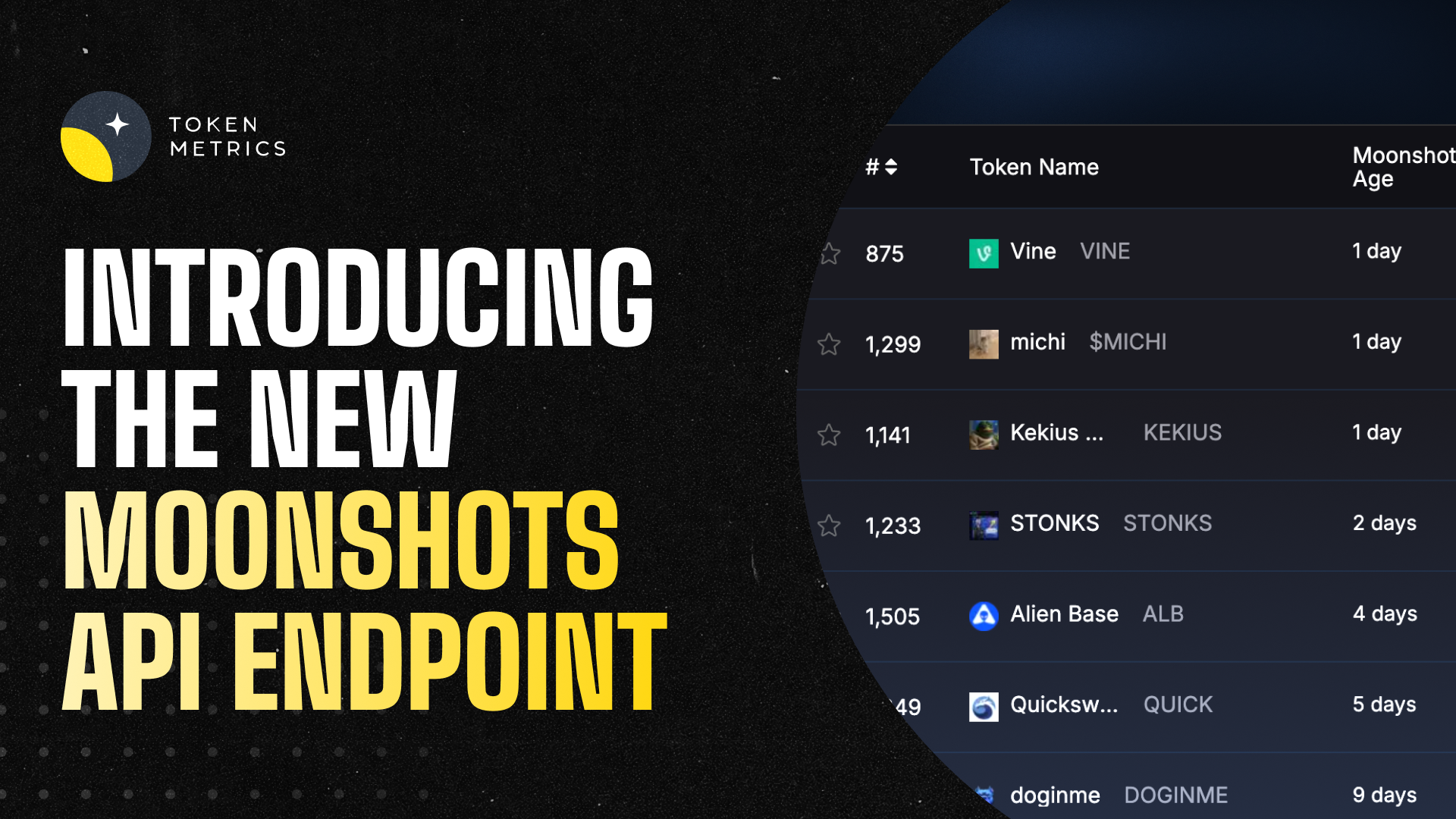
Big news: We’re cranking up the heat on AI-driven crypto analytics with the launch of the Token Metrics API and our official SDK (Software Development Kit). This isn’t just an upgrade – it's a quantum leap, giving traders, hedge funds, developers, and institutions direct access to cutting-edge market intelligence, trading signals, and predictive analytics.

Crypto markets move fast, and having real-time, AI-powered insights can be the difference between catching the next big trend or getting left behind. Until now, traders and quants have been wrestling with scattered data, delayed reporting, and a lack of truly predictive analytics. Not anymore.

The Token Metrics API delivers 32+ high-performance endpoints packed with powerful AI-driven insights right into your lap, including:

  • Trading Signals: AI-driven buy/sell recommendations based on real-time market conditions.
  • Investor & Trader Grades: Our proprietary risk-adjusted scoring for assessing crypto assets.
  • Price Predictions: Machine learning-powered forecasts for multiple time frames.
  • Sentiment Analysis: Aggregated insights from social media, news, and market data.
  • Market Indicators: Advanced metrics, including correlation analysis, volatility trends, and macro-level market insights.

Getting started with the Token Metrics API is simple:

  1. Sign up at www.tokenmetrics.com/api
  2. Generate an API key and explore sample requests.
  3. Choose a tier–start with 50 free API calls/month, or stake TMAI tokens for premium access.
  4. Optionally–download the SDK, install it for your preferred programming language, and follow the provided setup guide.

At Token Metrics, we believe data should be decentralized, predictive, and actionable. 

The Token Metrics API & SDK bring next-gen AI-powered crypto intelligence to anyone looking to trade smarter, build better, and stay ahead of the curve. With our official SDK, developers can plug these insights into their own trading bots, dashboards, and research tools – no need to reinvent the wheel.

Research

Top Crypto Prime Brokers (2025): Best Institutional Trading & Settlement Platforms

Token Metrics Team
17 min read
  • If you’re an institution that needs multi-venue liquidity, off-exchange settlement, and integrated custody/financing, this guide ranks the top crypto prime brokers for 2025 based on scale, security posture, and product breadth.
  • Top picks: Coinbase Prime for integrated trading + qualified custody with negotiated fees; FalconX for deep liquidity and capital solutions across spot/derivatives; Anchorage Digital Prime for bank-regulated custody with prime services and derivatives access. (Coinbase)
  • Caveats: Pricing is often negotiated; availability and products vary by region and legal entity. Always verify coverage on the provider’s official pages before onboarding. (docs.cdp.coinbase.com)

Introduction: Why Prime Brokerage Matters in 2025

Institutional participation accelerated in 2025, and with it the need for crypto prime brokers that unify execution, financing, custody, and settlement while minimizing counterparty risk. The leading platforms now resemble capital-markets infrastructure: single-counterparty access to multi-venue liquidity, off-exchange settlement networks that keep assets in segregated custody, and derivatives rails to hedge risk. Solutions like Coinbase Prime, FalconX, and Anchorage Digital Prime illustrate this evolution, while settlement networks such as Copper ClearLoop reduce venue risk without slowing execution. (Coinbase)

Primary intent: commercial-investigational. This guide compares features, fees, regions, and tradeoffs, then maps use cases to the right providers—so teams can move from diligence to deployment with confidence.


Our Evaluation Methodology

SCORING_WEIGHTS (sum = 100):

  • Scale & Liquidity (25) – depth of venues/LPs, 24/7 execution, options/futures where applicable.
  • Security & Regulatory Posture (25) – qualified custody, bank licensing/registrations, segregation, insurance disclosures.
  • Product Breadth (15) – spot, OTC/RFQ, derivatives, financing, settlement networks.
  • Costs & Fees (10) – published or negotiated schedules, financing/borrow terms.
  • Connectivity & Tooling (10) – FIX/WebSocket APIs, OEMS/SOR, reporting.
  • Capital Efficiency (10) – cross-margin, off-exchange settlement, instant delegation.
  • Support & Service (5) – coverage windows, onboarding SLAs.

Verification approach: We relied on official product, pricing, docs, security, and status pages only. If a claim wasn’t verifiable on an official page, we omitted it. Last updated: November 2025.


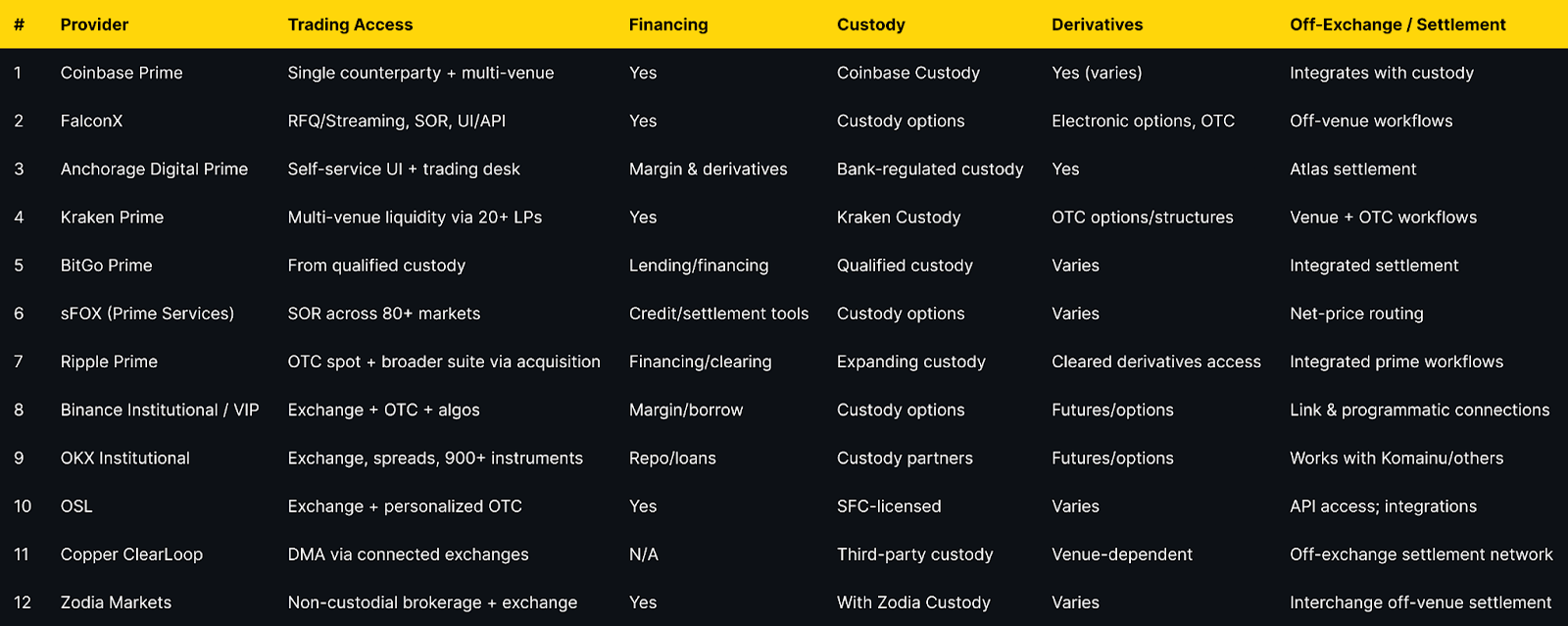
Crypto Prime Brokerage Comparison: At a Glance


Notes: “Pricing” reflects publicly stated models (often negotiated). “Regions/Notes” summarize official disclosures and licensing language where available on provider sites.


Detailed Provider Analysis

Coinbase Prime — Full-service prime brokerage at scale

Overview. Coinbase Prime combines trading, financing, and qualified custody under one institutional platform, with negotiated trading fees and flexible order denomination (base/quote). Execution integrates with reporting and controls suitable for asset managers and corporates. (Coinbase)
Ideal For. Asset managers, corporates/treasuries, hedge funds, RIAs.
Standout Features. Integrated custody; negotiated All-In / Cost-Plus fee models; staking fee schedules; institutional reporting. (docs.cdp.coinbase.com)
Pricing. Negotiated, fee currency = quote currency. (docs.cdp.coinbase.com)
Availability. Global, entity-dependent; product availability varies by jurisdiction.
Worth Noting. Some services require separate agreements (e.g., validators, derivatives access).
Alternatives to Consider. Kraken Prime, Anchorage Digital Prime. (Kraken)  


FalconX — Deep liquidity & capital solutions across markets

Overview. FalconX offers RFQ/streaming execution across spot and FX with FIX/WebSocket/REST connectivity, plus electronic options and capital solutions. Scale and 24/7 liquidity are central, with workflows for large tickets and programmatic strategies. (falconx.io)
Ideal For. Multi-strategy funds, HFT/systematic traders, market makers.
Standout Features. RFQ/streaming with TWAP/FOK; electronic options; FX desk integrated into prime; institutional APIs. (falconx.io)
Pricing. Negotiated; bespoke based on flow and venues.
Availability. Global institutional focus (entity-dependent).
Worth Noting. Derivatives access and product scope vary by entity/region.
Alternatives to Consider. Coinbase Prime, Kraken Prime. (Coinbase)  


Anchorage Digital Prime — Prime services on top of a US bank custodian

Overview. Anchorage Digital Prime delivers trading (13+ order types), derivatives, margin, and settlement built on Anchorage Digital Bank N.A. custody. A single interface and 24/7 trading desk support complex orders. (anchorage.com)
Ideal For. US-regulated custody requirements, governance-active institutions, corporates.
Standout Features. Bank-regulated custody; derivatives access; Atlas settlement; desk + API execution. (anchorage.com)
Pricing. Negotiated; service-by-entity.
Availability. US bank entity with global affiliates; services provided by specific Anchorage entities (see legal). (anchorage.com)
Worth Noting. Trading provided by separate non-bank entities; read entity-level disclosures. (anchorage.com)
Alternatives to Consider. BitGo Prime, Coinbase Prime. (The Digital Asset Infrastructure Company)  


Kraken Prime — Multi-venue liquidity with institutional fee tiers

Overview. Kraken Prime aggregates 20+ liquidity providers and offers smart order routing, OTC spot and OTC derivatives (options/structures), plus custody integrations. Institutional fee perks are published for high-volume clients. (Kraken)
Ideal For. Funds seeking published fee schedules, multi-venue execution, and OTC coverage.
Standout Features. Multi-venue liquidity; FIX 4.4 and WebSockets APIs; OTC desk; institutional taker tiers. (Kraken)
Pricing. Maker/taker schedule with institutional perks at very high volumes. (Kraken)
Availability. Global, entity-dependent.
Worth Noting. Some advanced services require qualification and separate onboarding.
Alternatives to Consider. sFOX, Coinbase Prime. (sFOX)


BitGo Prime — Prime services from qualified custody

Overview. BitGo integrates trading, financing, and settlement directly from custody, with segregated, bankruptcy-remote accounts and published insurance coverage details. (The Digital Asset Infrastructure Company)
Ideal For. Institutions prioritizing segregation and custody-first workflows.
Standout Features. Segregated accounts; insurance disclosures; custody-integrated prime trading. (The Digital Asset Infrastructure Company)
Pricing. Negotiated; custody/prime fees depend on assets and activity.
Availability. Global entities with varying regulatory regimes.
Worth Noting. Derivatives access varies by entity/partner networks.
Alternatives to Consider. Anchorage Digital Prime, Copper ClearLoop. (anchorage.com)


sFOX (Prime Services) — Agency SOR across 80+ markets with institutional tooling

Overview. sFOX acts as an agnostic agent routing across 80+ markets for best execution, with net-price routing and institutional reporting. The platform positions itself as a full-service prime dealer for institutions. (sFOX)
Ideal For. Systematic strategies, RIAs/allocators, corporates seeking agency execution.
Standout Features. SOR across venues; platform-level price improvement; custody options. (sFOX)
Pricing. Tiered/negotiated; historical content points to fee optimization via routing. (sFOX)
Availability. US/global entities; enterprise onboarding.
Worth Noting. Product scope (derivatives, margin) varies; confirm coverage.
Alternatives to Consider. Kraken Prime, Coinbase Prime. (Kraken)


Ripple Prime — Multi-asset prime brokerage under Ripple

Overview. Following the acquisition and subsequent close of Hidden Road, Ripple Prime offers U.S. spot OTC execution and positions Ripple as the first crypto company to own and operate a global, multi-asset prime broker; custody capabilities expanded further in late 2025. (Ripple)
Ideal For. Institutions seeking an integrated multi-asset prime platform with digital asset rails.
Standout Features. OTC spot execution (U.S.); multi-asset coverage; financing/clearing. (Ripple)
Pricing. Negotiated.
Availability. U.S. launch and global expansion via Ripple entities. (Ripple)
Worth Noting. Product availability differs by jurisdiction and entity.
Alternatives to Consider. FalconX, Coinbase Prime. (falconx.io)


Binance VIP & Institutional — Exchange liquidity, OTC & programmatic access

Overview. Binance’s institutional suite spans exchange, OTC RFQ, algos, and programmatic connectivity with VIP tiers. Coverage and eligibility depend on jurisdiction; Binance.US operates separately for U.S. clients. (binance.com)
Ideal For. Non-US teams wanting direct exchange liquidity with OTC tools.
Standout Features. VIP tiers, proof-of-reserves, OTC block trading. (binance.com)
Pricing. Exchange/VIP schedules; negotiated OTC.
Availability. Region-dependent; check supported regions. (binance.com)
Worth Noting. U.S. availability/routes differ; compliance and onboarding vary by entity.
Alternatives to Consider. OKX Institutional, OSL. (OKX)


OKX Institutional — Scale, instruments, and U.S. presence via OKX US

Overview. OKX highlights high uptime, 900+ instruments, and institutional connectivity. U.S. availability exists through OKX US with scope/policies noted in compliance disclosures. (OKX)
Ideal For. Proprietary firms and funds trading a broad instrument set with API access.
Standout Features. Nitro Spreads, derivatives suite, institutional support. (OKX)
Pricing. Exchange schedule + VIP; negotiated for blocks.
Availability. Global; US services via OKX US (scope varies). (OKX)
Worth Noting. Product availability and licensing differ by region.
Alternatives to Consider. Binance Institutional, Kraken Prime. (binance.com)


OSL — HK SFC-licensed exchange, custody & OTC

Overview. OSL provides a licensed Hong Kong platform spanning custody, exchange, and OTC brokerage for institutions, with dedicated coverage in the region. (osl.com)
Ideal For. APAC institutions needing SFC-regulated venue/custody.
Standout Features. SFC-licensed exchange; institutional API; custody with insurance positioning. (sfc.hk)
Pricing. Schedule/negotiated.
Availability. Hong Kong and supported regions; institutional focus.
Worth Noting. Product availability differs by license and region.
Alternatives to Consider. Zodia Markets, Coinbase Prime. (Zodia Markets)


Copper ClearLoop — Off-exchange settlement network (multi-custodial)

Overview. ClearLoop enables instant delegation to connected exchanges while assets remain in segregated custody—now supporting third-party custodians like BitGo and Komainu. (Copper)
Ideal For. Institutions prioritizing venue risk reduction and capital efficiency.
Standout Features. Multi-custodial support; instant asset delegation; network of venues/prime brokers. (Copper)
Pricing. Varies by participants and volumes.
Availability. Global network; coverage depends on participating venues/custodians.
Worth Noting. Not a full prime broker by itself; pairs well with custody/venues.
Alternatives to Consider. Zodia Interchange, Komainu Connect. (zodia-custody.com)


Zodia Markets + Zodia Custody Interchange — Non-custodial brokerage + off-venue settlement

Overview. Zodia Markets offers institutional brokerage/exchange with non-custodial design, while Zodia Custody’s Interchange provides off-venue settlement (OVS)—trade while assets remain in custody. Registrations span UK, Ireland, ADGM. (Zodia Markets)
Ideal For. Institutions wanting bank-backed governance and segregated settlement flows.
Standout Features. Non-custodial brokerage; Interchange OVS network; institutional registrations. (Zodia Markets)
Pricing. Negotiated.
Availability. UK/EU/MENA institutional coverage (entity-specific). (Zodia Markets)
Worth Noting. Product scope varies by entity and venue integrations.
Alternatives to Consider. OSL, Copper ClearLoop. (osl.com)


Choosing the Right Prime Broker: A Framework

  • Regulatory posture needed? If you require US bank-regulated custody, start with Anchorage Digital Prime. For Hong Kong, OSL’s SFC licensing is key. For UK/EU bank-backed governance with off-venue settlement, consider Zodia. (anchorage.com)
  • Execution style. For multi-venue aggregation and published fee tiers, Kraken Prime is strong; for RFQ/streaming with electronic options, FalconX leads. sFOX suits agency SOR across many markets. (Kraken)
  • Integrated custody + trading. Coinbase Prime and BitGo Prime minimize operational friction by tying trading to qualified custody. (Coinbase)
  • Venue-risk reduction. If you want to trade while assets remain in custody, evaluate Copper ClearLoop or Zodia Interchange (and Komainu Connect as a related model). (Copper)
  • Instrument breadth and scale. For vast exchange liquidity and institutional programs, Binance Institutional and OKX Institutional are at-scale options (region permitting). (binance.com)

Integrating Token Metrics Intelligence

  • Research phase: Use Token Metrics screeners and on-chain/technical indicators to identify pairs suitable for your mandate (beta targets, breadth, liquidity screens).
  • Execution phase: Route orders via your prime broker’s APIs (e.g., FIX/WebSocket) selected above, while TM signals inform aggression/passivity and time-of-day tactics. (Kraken)
  • Monitoring: Feed fills, slippage, and borrow/financing into TM analytics to assess venue performance and adjust routing.
  • Optimization: Combine TM factor views with prime-broker borrow/financing and settlement options (e.g., off-exchange) to lower VaR and operational risk.

Start a Token Metrics trial to bring quantitative screening and scenario analysis into your institutional workflow.  


Security & Compliance Guidelines

  • Prefer segregated, bankruptcy-remote custody and confirm insurance disclosures where published. (The Digital Asset Infrastructure Company)
  • If you need a US bank custodian, validate services by legal entity and read the provider’s disclosures. (anchorage.com)
  • Use off-exchange settlement networks to reduce exchange exposure during execution. (Copper)
  • Confirm derivatives eligibility, margin terms, and cross-margin/netting treatment by entity/venue. (Kraken)
  • Require API keys/roles with least-privilege, HSM custody, and mandatory allow-listing.
  • Maintain jurisdictional watchlists and restrict activity accordingly (e.g., US vs non-US entities for global exchanges). (OKX)

Compliance note: This article is for research/education, not financial advice.


Avoiding Common Mistakes

  • Treating “prime” as one product—coverage and legal entities differ by service.
  • Assuming off-exchange settlement is automatic—confirm network membership and supported venues. (Copper)
  • Onboarding to the wrong entity—read the jurisdictional disclosures. (anchorage.com)
  • Ignoring negotiated fees—request All-In vs Cost-Plus quotes. (docs.cdp.coinbase.com)
  • Skipping disaster-recovery testing—simulate exchange outage + settlement failover.
  • Under-documenting OMS/EMS changes—keep audit-ready change logs.

Frequently Asked Questions

What is a crypto prime broker?
 A provider that consolidates institutional trading, financing, custody, and settlement, often with multi-venue access and risk controls. Modern variants add off-exchange settlement so assets remain in custody during execution. (zodia-custody.com)

Do prime brokers publish fees?
 Often no—fees are negotiated based on volumes, products, and relationship tier. Some venues publish maker/taker schedules with institutional perks. (docs.cdp.coinbase.com)

How does off-exchange settlement work?
 Networks like ClearLoop and Interchange let you delegate assets to venues for trading while keeping them in segregated custody, reducing counterparty risk. (Copper)

Which providers are strongest for regulated custody?
 Anchorage Digital Prime (US bank custody), BitGo (qualified custody), OSL (HK SFC-licensed custody/exchange), and Zodia (bank-backed with EU/UK registrations). (anchorage.com)

Can U.S. institutions use OKX or Binance?
 Access is region-dependent and varies by entity (e.g., OKX US scope). U.S. clients typically cannot use Binance.com and instead must evaluate Binance.US or other U.S.-eligible routes. Always check official disclosures. (OKX)


Final Recommendations

For most global institutions, a two-stack works best: (1) an integrated prime broker with qualified custody (Coinbase Prime, Anchorage Digital Prime, or BitGo Prime) and (2) a venue-risk mitigator like Copper ClearLoop or Zodia Interchange. Execution-heavy funds should add FalconX or Kraken Prime for multi-venue and OTC derivatives coverage, while OSL anchors APAC/HK mandates and OKX/Binance expand exchange reach where eligible. (Coinbase)

Related Resources:

Research

Best Yield Marketplaces for Real-World Assets (RWAs) in 2025

Token Metrics Team
29 min read
  • What this guide covers: A comprehensive evaluation of 10 leading platforms that enable tokenized real-world asset trading and yield generation across private credit, treasuries, real estate, and structured finance
  • Quick verdict: Ondo Finance for institutional-grade treasury exposure at ~5% APY, Maple Finance for crypto-collateralized credit facilities delivering 9-12% net yields, Goldfinch Prime for diversified access to private credit funds from Apollo and Ares
  • One key limitation to know: Many RWA platforms enforce strict accreditation requirements (minimum $50K-200K) and geographic restrictions, particularly excluding US investors from certain products due to securities regulations

Why Yield Marketplaces for RWAs Matter in January 2025

The real-world asset tokenization market has experienced explosive growth, surging from $85 million in April 2020 to over $25 billion by mid-2025—representing a staggering 245-fold increase driven primarily by institutional demand for yield, transparency, and regulatory clarity. Private credit dominates at approximately 61% of total tokenized assets, followed by treasuries at 30%, with major asset managers like BlackRock, Apollo, and Franklin Templeton now actively tokenizing institutional-grade products.

The convergence of traditional finance and decentralized infrastructure has created unprecedented opportunities for investors seeking stable, real-world yields without exposure to cryptocurrency volatility. The tokenized RWA market is projected to reach between $9.43 trillion and $18.9 trillion by 2030, with regulatory frameworks in Singapore, Hong Kong, and Dubai providing clear pathways for compliant innovation.

For crypto-native investors, RWA yield marketplaces offer a critical bridge to sustainable income streams backed by productive assets rather than purely speculative token emissions. Traditional allocators gain 24/7 access to fractional ownership, instant settlement, and programmable compliance—advantages impossible in legacy financial infrastructure.


How We Evaluated These Providers

We assessed platforms across six weighted criteria totaling 100 points:

  • Yield Quality & Sustainability (30%): Consistency of returns, asset backing, historical performance, and correlation to traditional markets
  • Security & Risk Management (25%): Custody solutions, audit history, legal recourse, collateralization ratios, and default handling protocols
  • Asset Coverage & Diversity (15%): Range of underlying assets, tranching options, and exposure across credit curves
  • Accessibility & Costs (15%): Minimum investments, fee structures, geographic availability, and KYC requirements
  • Liquidity & Redemption (10%): Secondary market depth, withdrawal timelines, and tokenization standards
  • Infrastructure & Compliance (5%): Regulatory licenses, blockchain integrations, and institutional partnerships

Data sources: Official platform documentation, on-chain analytics from RWA.xyz and DeFiLlama, third-party audits, and regulatory filings. Research conducted October 2024-January 2025.

Verification approach: Every fee structure, yield figure, and regional restriction cited was verified on official platform pages or regulatory disclosures. Unverifiable claims were excluded.


The Contenders: Quick Comparison  

Provider Reviews by Use Case

For Treasury-Backed Stability (4-5% Yield)

Top Pick: Ondo Finance — Institutional Treasury Tokenization Pioneer

Overview
 Ondo Finance manages over $1.6 billion in tokenized assets, offering institutional-grade access to US Treasury exposure through OUSG (backed by BlackRock's BUIDL fund) and USDY (a yield-bearing stablecoin). The platform bridges TradFi stability with DeFi composability through multi-chain deployment across Ethereum, Solana, Base, and XRP Ledger.

Ideal For

  • Institutional allocators seeking low-volatility dollar exposure
  • DeFi protocols requiring yield-bearing collateral
  • Treasuries managing idle stablecoin holdings
  • Investors prioritizing regulatory compliance and brand-name backing

Standout Features

  • Approximately 5% APY from short-term US Treasuries with daily interest payouts via rebasing mechanism
  • Integration with Ripple's RLUSD stablecoin for instant minting and redemption 24/7
  • Comprehensive SEC-registered infrastructure through acquisition of Oasis Pro, including broker-dealer, ATS, and transfer agent licenses
  • Strategic partnerships including anchor position in Fidelity's FDIT tokenized money market fund and launch of Ondo Global Markets for tokenized equities

Pricing
 Management fees embedded in net yield; typical 0.15-0.30% annual fee depending on product. OUSG requires $100K minimum; USDY accessible at lower thresholds with 4.29% APY.

Availability
 Global except US persons for certain products. Ethereum, Solana, Polygon, Aptos, Sei, Base, XRP Ledger, and Sui supported.

Worth Noting
 OUSG designed for qualified purchasers with extended lockup periods; less suitable for retail or high-frequency traders. Platform prioritizes institutional relationships over retail accessibility.

Alternatives to Consider: Franklin Templeton BENJI, OpenEden TBILL  


Runner-Up: Franklin Templeton BENJI — Legacy Asset Manager Innovation

Overview
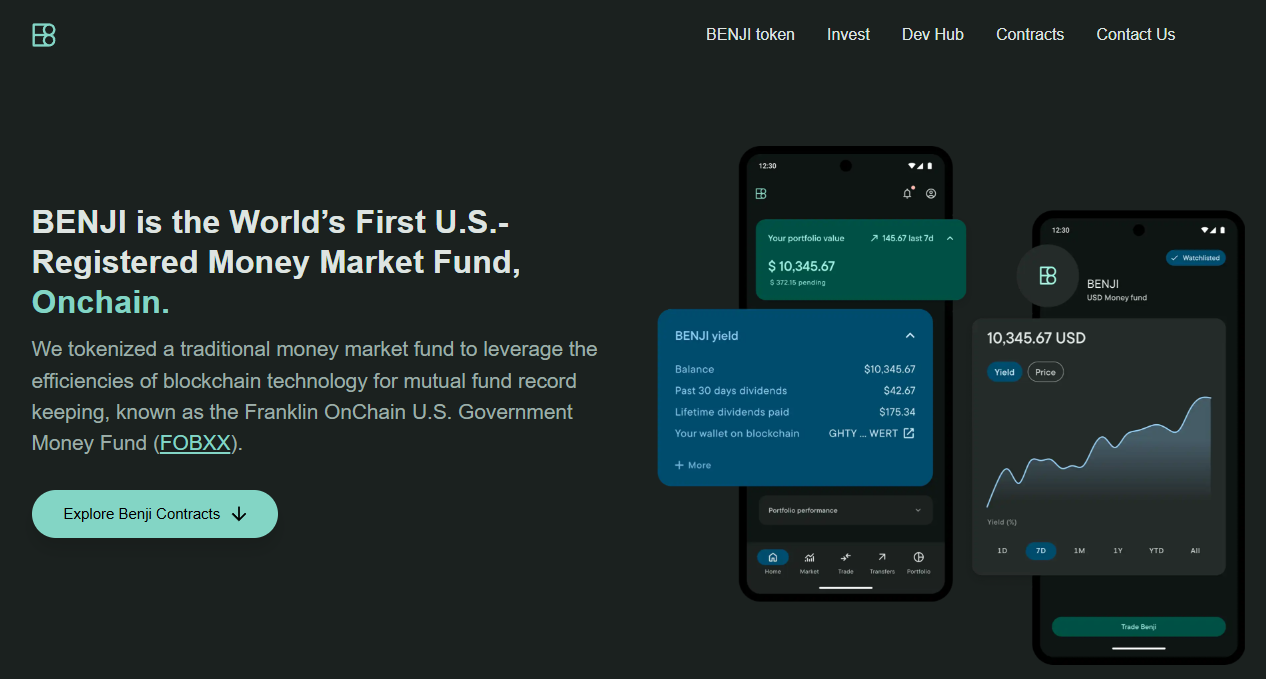
 Franklin Templeton's $775 million Franklin OnChain U.S. Government Money Fund (BENJI) pioneered tokenized mutual funds in 2021, offering exposure to US government securities across eight blockchains with patent-pending intraday yield calculation.

Ideal For

  • Investors seeking regulated 40 Act fund structure
  • Collateral managers requiring second-by-second yield accrual
  • Multi-chain strategies needing broad blockchain compatibility
  • Users prioritizing traditional asset manager credibility

Standout Features

  • Intraday yield tracking down to the second, enabling proportional earnings even for partial-day holdings
  • Direct stablecoin purchases and redemptions with wallet-to-wallet transfer capability
  • 63% of AUM deployed on Stellar Network for optimal cost efficiency
  • Integrated with DeFi protocols for collateral and leverage applications

Pricing
 7-day current yield approximately 4.5-5.5% gross; 0.25% management fee. No minimum investment restrictions beyond standard mutual fund requirements.

Availability
 Global availability with specific KYC requirements. Active on Stellar, Ethereum, Arbitrum, Base, Avalanche, Polygon, Aptos, Solana, BNB Chain.

Worth Noting
 Traditional mutual fund constraints apply including daily NAV calculations and potential redemption delays during market stress.

Alternatives to Consider: Backed bIB01, Superstate Short Duration Government Securities  


For Institutional Credit Exposure (8-12% Yield)

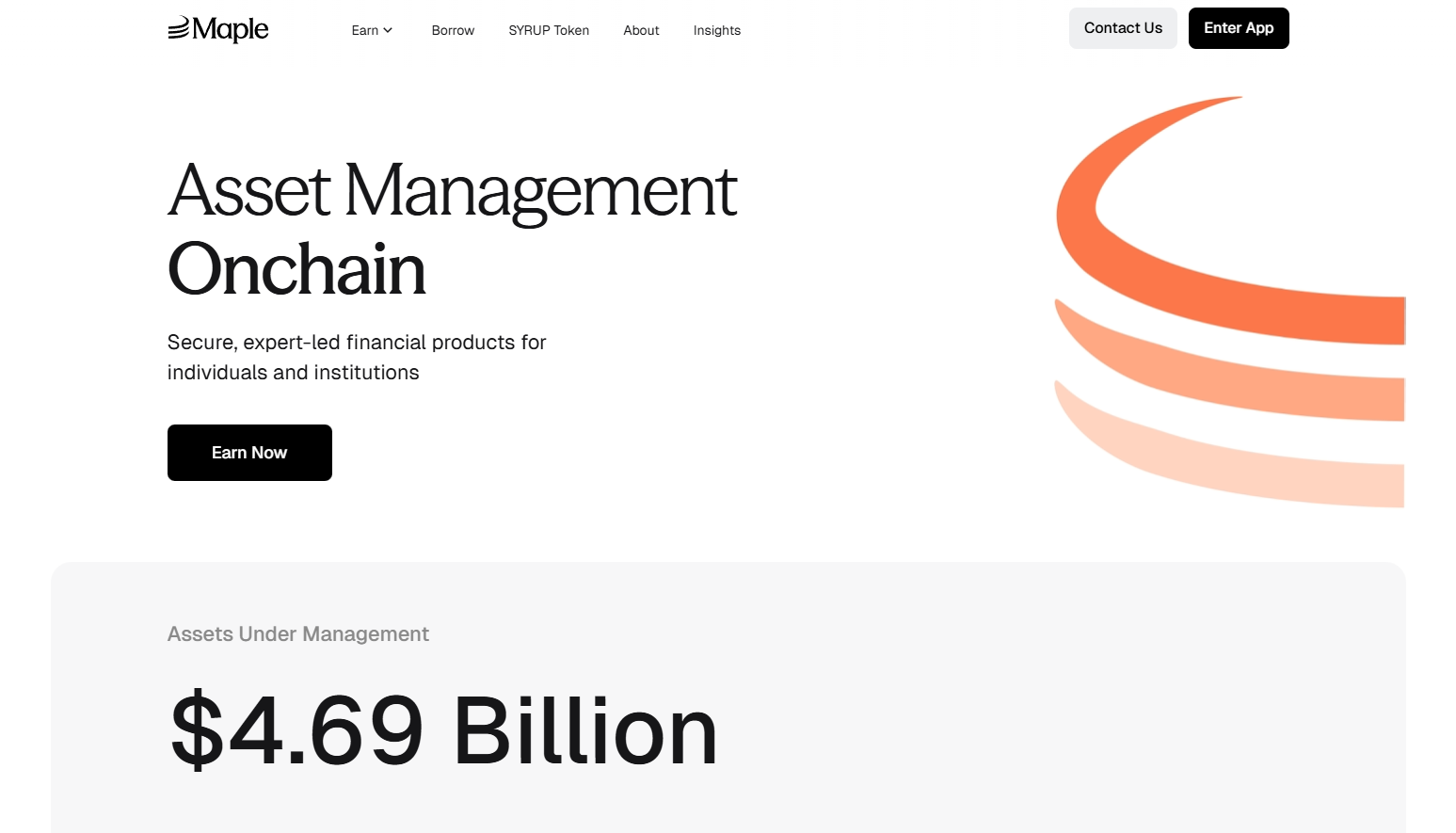
Top Pick: Maple Finance — Premier Crypto-Collateralized Lending

Overview
 Maple Finance manages over $4 billion in assets, specializing in institutional over-collateralized lending backed by Bitcoin, Ethereum, Solana, and XRP, targeting $100 billion in annual loan volume by 2030. The platform introduced SyrupUSDC for permissionless retail access alongside KYC-gated institutional pools.

Ideal For

  • Institutional lenders seeking exposure to cryptocurrency-backed credit
  • Liquidity providers comfortable with smart contract risk
  • Allocators targeting floating-rate, senior-secured structures
  • Investors seeking alternatives to traditional stablecoin farming

Standout Features

  • Consistent 9-12% net yields through undercollateralized institutional facilities and structured credit products
  • Strategic integration with Aave's $40 billion protocol bringing syrupUSDT to Plasma instance and syrupUSDC to core markets
  • Partnerships with Bitwise, Lido Finance (stETH-backed credit lines), and EtherFi (weETH collateral) expanding institutional adoption
  • Robust risk management combining decades of TradFi expertise with real-time on-chain monitoring

Pricing
 Variable by pool; typical effective yields 9-12% after protocol fees. Minimum investments pool-dependent, generally $10K-$50K for retail syrup products.

Availability
 Global with KYC requirements for lending. Institutional Maple requires accreditation; Syrup.fi open to broader participants.

Worth Noting
 Platform transitioned from uncollateralized to over-collateralized model after 2022 market turmoil. Historical defaults impacted certain pools; robust recovery mechanisms now in place.

Alternatives to Consider: Credix (emerging markets), TrueFi (uncollateralized DeFi)  


Runner-Up: Goldfinch Prime — Institutional Private Credit Access

Overview
 Goldfinch Prime aggregates exposure to multi-billion dollar private credit funds from Ares, Apollo, Golub Capital, and KKR, providing on-chain access to institutional-grade senior secured loans with over $1 trillion in collective AUM.

Ideal For

  • Non-US investors seeking diversified private credit exposure
  • Allocators targeting institutional fund performance without direct fund access
  • Participants seeking uncorrelated yield to crypto markets
  • Investors comfortable with longer lockup periods

Standout Features

  • Exposure to 1000+ senior secured loans across industries through vetted fund managers with 10+ years experience
  • Target returns of 9-12% net of fees with strict eligibility criteria including >90% senior secured portfolios and <0.75% target non-accrual rates
  • Heron Finance manages fund selection and vetting while fund managers handle all underwriting and default resolution
  • USDC-based deposits converted to proportional GPRIME tokens for continuous offering structure

Pricing
 Net yields 9-12% after embedded management fees and profit sharing. Minimum investments vary by pool structure; typically institutional minimums apply.

Availability
 Non-US persons only due to regulatory structure. KYC and accreditation verification required.

Worth Noting
 Exposure is indirect through fund shares rather than direct loan origination; fund managers absorb individual borrower default risk into aggregate yields. Liquidity limited compared to Treasury products.

Alternatives to Consider: Centrifuge private credit pools, Credix fintech lending


For Real Estate & Diversified Assets (6-10% Yield)

Top Pick: Centrifuge — Multi-Asset Tokenization Infrastructure

Overview
 Centrifuge operates as a multichain infrastructure platform enabling asset managers to tokenize real estate, trade finance, carbon credits, and structured credit with $1.2 billion TVL and recent 10x growth driven by the first on-chain CLO and tokenized S&P 500 index fund.

Ideal For

  • Investors seeking exposure to asset-backed securities beyond treasuries
  • Allocators comfortable evaluating tranched credit structures
  • Participants prioritizing transparency and on-chain asset verification
  • Portfolio managers wanting diversification across real-world credit types

Standout Features

  • Asset-agnostic architecture supporting structured credit, real estate mortgages, US treasuries, carbon credits, and consumer finance with full collateralization and legal recourse for investors
  • V3 platform enables cross-chain interoperability across Ethereum, Base, Arbitrum, Avalanche, BNB Chain, and Plume with integrated KYC and compliance-as-a-feature
  • Senior/junior tranche structures allowing risk-return customization
  • Partnership with Chronicle Labs for real-time price feeds and integration with Circle for USDC on/off-ramping

Pricing
 Yields vary by pool and tranche: typically 6-8% for senior tranches, 10-14% for junior tranches. Management fees embedded; pool-specific minimums apply.

Availability
 Global with KYC requirements. Pools may have additional jurisdictional restrictions based on underlying asset location.

Worth Noting
 Platform complexity requires understanding of tranched structures and asset-specific risks. Less liquid credit instruments offer less frequent pricing updates than treasury products.

Alternatives to Consider: RealT (US residential real estate focus), Republic (equity crowdfunding)

For Emerging Market Credit (12-18% Yield)

Top Pick: Credix — Latin American Fintech Lending

Overview
 Credix specializes in providing credit facilities to fintech lenders in Latin America, offering high-yield exposure to underserved credit markets with institutional-grade underwriting and local market expertise.

Ideal For

  • Sophisticated investors seeking higher risk-adjusted returns
  • Allocators comfortable with emerging market credit risk
  • Participants with extended investment horizons (12-24 months typical)
  • Investors seeking geographic diversification from US/EU markets

Standout Features

  • Target yields 12-18% reflecting emerging market risk premiums
  • Focus on fintech infrastructure enabling financial inclusion
  • Partnerships with established Latin American credit originators
  • Robust due diligence and monitoring of borrower networks

Pricing
 Pool-dependent yields typically 12-18% gross with management fees of 1-2%. Minimum investments generally $50K+ for accredited investors.

Availability
 Non-US persons primarily; requires accreditation verification and enhanced KYC given emerging market exposure.

Worth Noting
 Higher yields reflect higher credit and currency risk. Platform experienced challenges during regional economic volatility; enhanced risk controls now implemented.

Alternatives to Consider: Goldfinch V1 pools (emerging market focus), TrueFi uncollateralized pools


For Tokenization Infrastructure (Platform Providers)

Top Pick: Securitize — Industry-Leading Issuance Platform

Overview
 Securitize has tokenized over $4.5 billion in assets for 1.2 million investors across 3,000+ clients, operating as an SEC-registered transfer agent with integrated ATS for secondary trading. The platform powers major offerings including BlackRock's BUIDL fund.

Ideal For

  • Asset managers seeking turnkey tokenization solutions
  • Issuers requiring SEC-compliant digital security infrastructure
  • Institutional clients needing integrated custody and compliance
  • Projects prioritizing regulatory alignment and brand credibility

Standout Features

  • DS Protocol automates token issuance, transfer agent functions, and regulated secondary trading with $47 million funding led by BlackRock
  • Recent launch of STAC tokenized AAA CLO fund with BNY custody demonstrating institutional adoption trajectory
  • Comprehensive investor onboarding, KYC/AML, and reporting infrastructure
  • Partnerships with major asset managers and integration with Zero Hash for fiat conversion

Pricing
 Platform fees vary by issuance size and complexity; typically 0.5-2% of AUM plus basis point fees on transactions. White-label solutions available for enterprise clients.

Availability
 Global operations with jurisdiction-specific compliance modules. Primary focus on US, EU, and APAC institutional markets.

Worth Noting
 Securitize is an issuance platform rather than direct investment product; investors access opportunities through partner funds and offerings launched on the infrastructure.

Alternatives to Consider: Tokeny (EU-focused), Polymath/Polymesh (security token specialists)


Complete Provider Directory

  • Backed Finance: European MiCA-compliant tokenization platform offering bIB01 (Swiss government bond exposure) and bC3M (commodity basket). Strong focus on regulatory alignment with modest 3-5% yields and low entry barriers.
  • Swarm Markets: Decentralized platform enabling fractional ownership of real estate and private credit with $1K-$50K minimums. Emphasizes accessibility while maintaining compliance through distributed infrastructure.
  • TrueFi: Uncollateralized lending protocol using on-chain credit scoring and portfolio diversification. Higher risk-return profile (8-15% targets) with full transparency of borrower pools and performance metrics.
  • Archax: UK FCA-regulated platform for institutional tokenization of bonds, funds, and money markets. Focus on traditional finance compatibility with stringent accreditation requirements.

Making Your Selection: Key Questions

  • What yield stability do you require?
     Treasury-backed platforms (Ondo, Franklin Templeton) offer predictable 4-5% returns with minimal volatility. Credit-focused platforms (Maple, Goldfinch) target 9-12% but introduce credit risk and performance variability.
  • What is your risk tolerance for underlying collateral?
     Government securities provide lowest risk; over-collateralized crypto loans add smart contract and liquidation risks; uncollateralized emerging market credit carries highest default potential.
  • Do you meet accreditation and minimum investment thresholds?
     Many institutional products require $50K-$200K minimums and qualified purchaser status. Retail-accessible options like USDY and syrupUSDC lower barriers but may sacrifice yield.
  • What liquidity do you need?
     Treasury tokens generally offer daily liquidity; private credit pools may have quarterly redemption windows; real estate tokenization can involve 12-24 month lockups.
  • How important is regulatory compliance?
     Platforms like Ondo, Franklin Templeton, and Securitize prioritize SEC registration and traditional fund structures. Purely DeFi-native protocols offer less regulatory clarity but greater composability.
  • What blockchain ecosystems do you operate in?
     Multi-chain deployment (Ondo, Centrifuge) provides flexibility; single-chain specialization (some Maple pools) may offer optimization but limits interoperability.
  • Do you have geographic restrictions?
     US persons often excluded from highest-yield opportunities due to securities laws. European investors benefit from MiCA framework; APAC sees growing regulatory clarity.
  • What level of transparency do you require?
     On-chain native protocols offer real-time asset verification; hybrid models may rely on periodic attestations and third-party audits.
  • Are you seeking passive income or active yield strategies?
     Treasury staking provides set-and-forget returns; DeFi integrations enable leverage, collateral strategies, and yield optimization requiring active management.
  • How much operational complexity can you handle?
     Single-platform solutions simplify but limit optionality; multi-protocol strategies maximize returns but require gas management, tax tracking, and security across multiple platforms.

Maximizing Your Setup with Token Metrics

Token Metrics provides critical intelligence for navigating RWA yield opportunities through data-driven analysis and market insights.

Research Phase: Leverage Token Metrics' fundamental analysis to evaluate tokenized asset protocols, comparing on-chain metrics, TVL trends, and yield sustainability indicators. Our RWA sector reports identify emerging platforms and highlight regulatory developments across jurisdictions.

Portfolio Construction: Use quantitative scoring to allocate across risk tiers—balancing stable treasury exposure with higher-yield credit products. Token Metrics' portfolio tools help optimize diversification while monitoring correlation to traditional crypto markets.

Ongoing Monitoring: Real-time alerts notify you of yield changes, protocol upgrades, and risk events. Our dashboard aggregates performance across multiple RWA platforms, tracking your yield-bearing positions alongside broader cryptocurrency holdings.

Risk Management: Token Metrics' risk analytics assess smart contract security, custody arrangements, and counterparty exposure. Our reports flag platforms with concerning yield sustainability metrics or operational red flags before they impact your capital.

Start your Token Metrics free trial to access institutional-grade RWA research and optimize your real-world asset allocation.  


Essential Security Practices

  • Custody Verification: Confirm that platforms use institutional-grade custodians (Coinbase Custody, BitGo, Fireblocks) for underlying assets. Verify proof-of-reserve attestations and third-party audits.
  • Smart Contract Risk: Review audit reports from reputable firms (Trail of Bits, OpenZeppelin, Certora). Understand upgrade mechanisms and timelock protections on protocol contracts.
  • Legal Structure Assessment: Examine SPV formation, bankruptcy remoteness, and investor recourse mechanisms. Ensure tokenization structure provides actual legal claim on underlying assets, not just economic exposure.
  • Regulatory Compliance: Verify platforms maintain necessary licenses (broker-dealer, transfer agent, ATS) in relevant jurisdictions. Confirm offerings comply with securities laws in your domicile.
  • Counterparty Risk: Understand who services loans, manages defaults, and handles liquidations. Evaluate track records of asset originators and credit underwriters.
  • Liquidity Risk Management: Never allocate more than you can afford to lock up for stated redemption periods. Maintain buffer capital for market volatility and potential redemption delays.
  • Tax Implications: Consult tax professionals on treatment of tokenized yield—may be classified as interest income, dividends, or capital gains depending on structure and jurisdiction.
  • Geographic Restrictions: Verify you're eligible to participate based on residency. Using VPNs or misrepresenting location can result in frozen funds and legal liability.
  • Platform Concentration: Diversify across multiple RWA providers to reduce single-point-of-failure risk. No single platform should represent majority of yield allocation.
  • Documentation: Maintain records of all transactions, yield distributions, and platform communications for tax reporting and potential disputes.

This article is for research and educational purposes, not financial advice. RWA investments carry risks including loss of principal.


What to Avoid

  • Ignoring minimum holding periods: Many RWA products enforce lockups or redemption windows. Treating them as liquid positions can leave you unable to access capital when needed.
  • Chasing unsustainably high yields: Promised returns significantly above market rates often indicate excessive risk. Verify underlying asset performance and historical consistency before committing capital.
  • Overlooking platform liquidity: Token existence on-chain doesn't guarantee exit liquidity. Check secondary market depth and historical spread between minting and redemption prices.
  • Neglecting jurisdictional compliance: Accessing platforms not available in your region can result in frozen accounts and regulatory penalties. Always verify eligibility before depositing funds.
  • Underestimating smart contract risk: Even well-audited protocols face exploitation risk. Size positions appropriately and monitor security incident disclosures across the ecosystem.
  • Failing to verify asset backing: Don't rely on marketing claims. Demand proof-of-reserve, third-party attestations, and transparent reporting on underlying collateral.
  • Concentrating in single asset class: Over-allocating to one RWA category (e.g., all private credit) eliminates diversification benefits. Balance across treasuries, credit, and real estate where possible.
  • Ignoring fee structures: Management fees, performance fees, and transaction costs compound over time. Calculate net yields after all costs when comparing platforms.

Reader Questions Answered

What's the difference between tokenized treasuries and yield-bearing stablecoins?

 Tokenized treasuries (like OUSG) represent direct ownership of US Treasury securities with yield passed through to holders. Yield-bearing stablecoins (like USDY) maintain $1 peg while distributing treasury yields via rebasing or airdrops. Treasuries may fluctuate slightly with NAV; yield stablecoins prioritize price stability.

Are RWA yields taxable differently than crypto staking rewards?

 Likely yes, though tax treatment varies by jurisdiction. RWA yields from treasuries or credit facilities often classified as interest income taxed at ordinary rates. Crypto staking may be treated as income at receipt or capital gains at sale depending on location. Consult tax professionals for specific guidance.

Can I use tokenized RWAs as collateral in DeFi protocols?

 Increasingly yes. Platforms like Maple, Ondo (via Flux Finance), and Centrifuge enable using tokenized assets as DeFi collateral. However, support varies by protocol and asset—USDY and OUSG see broader integration than niche real estate tokens. Liquidation risks apply if collateral value drops.

What happens if the platform goes bankrupt?

 Properly structured tokenization isolates assets in bankruptcy-remote SPVs, protecting investor claims even if platform operator fails. However, redemption processes may be delayed and require legal navigation. This is why verifying legal structure and custodial arrangements is critical.

How liquid are RWA tokens compared to stablecoins?

 Significantly less liquid. While stablecoins have billions in daily DEX volume, most RWA tokens trade thinly or only through platform-controlled redemption mechanisms. Treasury tokens offer better liquidity than private credit or real estate, but all lag traditional stablecoins substantially.

Do I need to be an accredited investor?

 Depends on the platform and your location. US-based offerings often require accreditation; international platforms may have lower barriers. Products like USDY, syrupUSDC, and BENJI target broader accessibility, while institutional credit pools restrict to qualified purchasers.

What are the main risks that could cause loss of principal?

 (1) Underlying asset default (credit risk), (2) smart contract exploitation, (3) platform insolvency without proper asset segregation, (4) regulatory action freezing operations, (5) stablecoin de-pegging for yield products denominated in USDC/USDT, (6) liquidation cascades in collateralized structures.

How do yields compare to traditional finance alternatives?

 Tokenized treasuries (4-5%) match conventional money market funds but with 24/7 access. Private credit RWAs (9-12%) offer premiums over corporate bonds due to illiquidity and platform novelty. Emerging market RWA yields (12-18%) comparable to EM debt funds with added smart contract risk.


Bottom Line

Real-world asset yield marketplaces represent the maturation of blockchain infrastructure beyond speculation into productive finance. For investors seeking stable, asset-backed returns uncorrelated to cryptocurrency volatility, platforms like Ondo Finance and Franklin Templeton deliver institutional-grade treasury exposure with DeFi composability. Those comfortable with credit risk can access superior yields through Maple Finance's collateralized institutional lending or Goldfinch Prime's diversified private credit exposure.

The key to success: match platform selection to your specific risk tolerance, liquidity needs, and regulatory constraints. Treasury products suit conservative allocators prioritizing capital preservation; credit platforms reward investors accepting higher risk for enhanced returns; multi-asset infrastructure like Centrifuge offers diversification across real-world credit types.

Start with smaller allocations to understand platform mechanics, redemption processes, and yield consistency before committing substantial capital. The RWA sector's rapid growth will continue creating opportunities, but also attracting lower-quality offerings—due diligence remains paramount.

Related Resources:


About This Research

Methodology: This guide evaluated 20+ RWA platforms through analysis of official documentation, on-chain data, regulatory filings, and third-party audits. Platforms selected represent meaningful TVL (>$100M), regulatory compliance, and operational track record. Final selection prioritized diversity across asset classes and investor accessibility tiers.

Research Sources:

  • Ondo Finance: Product documentation, tokenomics, OUSG/USDY specifications, Oasis Pro acquisition disclosure
  • Maple Finance: Platform whitepaper, syrupUSDC mechanics, Aave integration announcement, CEO interviews
  • Centrifuge: V3 technical documentation, pool analytics, Republic partnership details
  • Goldfinch: Prime pool specifications, fund manager criteria, Heron Finance structure
  • Franklin Templeton: BENJI platform technical details, intraday yield patent documentation, multi-chain deployment
  • Securitize: DS Protocol documentation, STAC fund launch details, BlackRock partnership announcements
  • RWA.xyz: Platform TVL data, tokenization metrics, market growth analysis
  • DeFiLlama: Protocol TVL tracking, historical performance data
  • BCG/Ripple: RWA market projections and industry research
  • VanEck, Coinbase, Binance: Sector research reports on RWA growth trajectories

All data current as of January 2025. Platform features and yields subject to change; verify current terms on official websites before investing.

Research

Top Gold & Commodity-Backed Tokens (2025)

Token Metrics Team
12 min read

Who this guide is for. Crypto investors and treasurers comparing gold-backed tokens and other commodity-backed assets that can be audited and, in many cases, redeemed for metal.
Top three picks. PAX Gold (PAXG) for regulated, bar-linked redemption; Tether Gold (XAUt) for broad awareness and simple fees; Kinesis (KAU/KAG) for spend-and-yield use cases.
Key caveat. Redemption minimums, custody locations, and fees vary by issuer; always confirm regional eligibility and schedules on the official pages.


Introduction: Why Commodity-Backed Tokens Matter in 2025

Gold-backed tokens give on-chain ownership exposure to vaulted bullion with transparent allocation and, often, physical redemption, blending the inflation hedge of metals with crypto liquidity. In 2025, they’re used for hedging, collateral, cross-border settlement, and “digital cash” backed by tangible assets. A commodity-backed token is a blockchain token that represents title to a specific quantity of a real-world commodity (for example, 1 troy ounce or 1 gram of gold) held by a custodian, typically with published fees, vault locations, and redemption rules. Our picks prioritize liquidity, security controls, breadth of metals, cost transparency, and global accessibility.


Best Commodity-Backed Tokens in November 2025 (Comparison Table)


We excluded defunct or sunset projects (e.g., PMGT; CACHE Gold ceased backing CGT on Sept 30, 2025). (perthmint.com)


Top 10 Gold & Commodity-Backed Tokens in November 2025

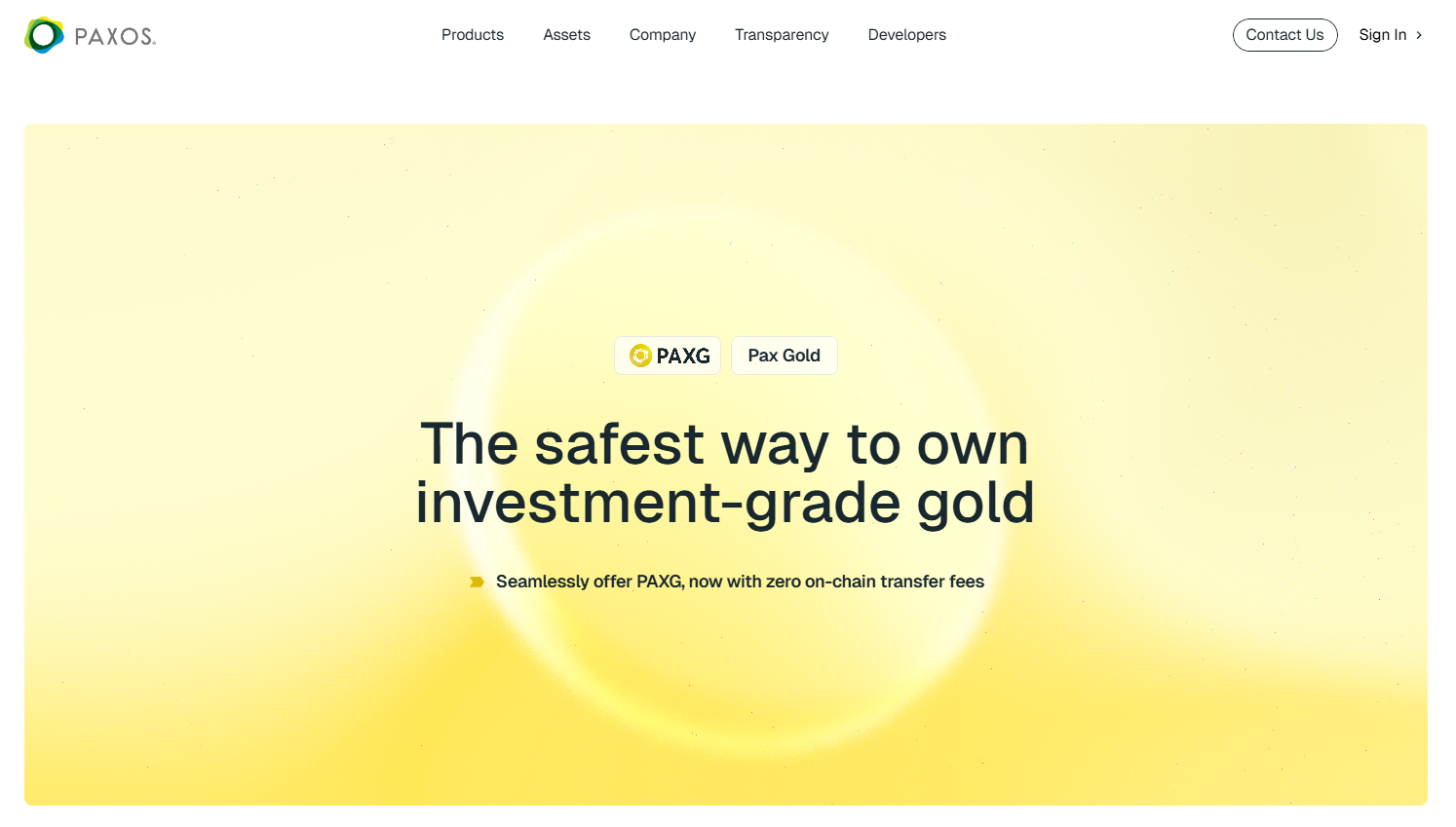
1) PAX Gold (PAXG) — Best for bar-linked redemption & regulatory posture

Why Use It. PAXG links each token to specific LBMA Good Delivery bars stored in London, offering direct bar redemption (institutional minimums apply) or USD redemption at spot. Paxos publishes fee schedules and notes no storage fee charged to customers at this time. (paxos.com)
Best For. Institutions; HNW hedgers; DeFi users needing reputable collateral.
Notable Features. LBMA bars; serial-number linkage; custodied in London; fiat redemption option. (paxos.com)
Fees Notes. Creation/destruction fees; no storage fee currently per issuer help center. (help.paxos.com)
Regions. Global (issuer KYC).
Consider If. You can meet bar redemption minimums and UK vault logistics. (help.paxos.com)
Alternatives. Tether Gold (XAUt); VNX Gold (VNXAU).  


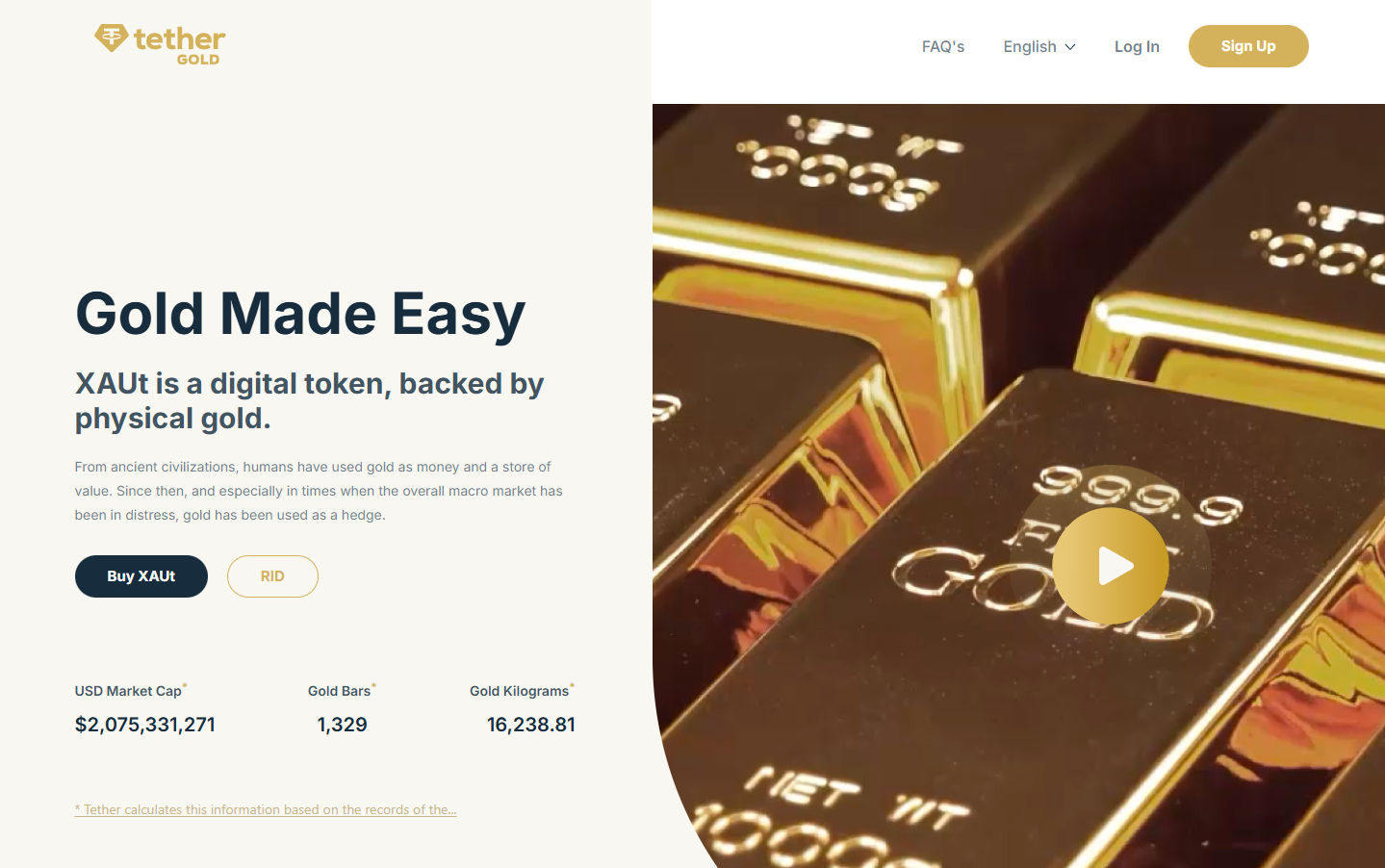
2) Tether Gold (XAUt) — Best for simple pricing & broad availability

Why Use It. XAUt represents allocated gold and can be redeemed for physical gold or USD; Tether publishes a straightforward 0.25% creation/redemption fee and a one-time verification fee for onboarding. FAQs outline redemption mechanics and bar specifics. (Tether)
Best For. Traders seeking brand familiarity; cross-chain users (ETH/TRON).
Notable Features. Bar metadata; physical or USD redemption; no custody fee disclosed beyond the transaction fee. (Tether)
Fees Notes. 25 bps create/redeem; separate KYC verification fee. (Tether)
Regions. Global (issuer KYC).
Consider If. You need clear fee math but don’t require bar-specific allocation like PAXG.
Alternatives. PAX Gold (PAXG); Kinesis (KAU).  


3) Kinesis KAU (Gold) / KAG (Silver) — Best for spend-and-yield utility

Why Use It. Kinesis combines metal-backed tokens with an exchange, cards, and yields funded from platform fees (published yield-share). Trading and precious metals transactions show ~0.22% execution fees on official schedules. (Kinesis)
Best For. Users wanting to spend gold/silver, earn monthly yields, and keep fees predictable.
Notable Features. Fee-share yield (published); exchange, card rails; gold & silver pairs. (Kinesis)
Fees Notes. ~0.22% buy/sell/trade; other fees per schedule. (Kinesis)
Regions. Global (platform KYC/availability).
Consider If. You prefer an integrated platform over a standalone token.
Alternatives. VNX (VNXAU/VNXAG); Aurus (tXAU/tXAG).  


4) Comtech Gold (CGO) — Best for XDC ecosystem & Shariah-compliant framework

Why Use It. CGO tokenizes 1g gold units on the XDC (XRC-20) network, with a published fee structure for mint/redeem (0.50%), transfers (0.50%), and custody notes in FAQs. Documentation details creation/redemption and delivery fees. (comtechgold.com)
Best For. XDC builders; users needing Shariah-compliant structuring.
Notable Features. On-chain proofing; fee schedule; vault delivery options. (comtechgold.com)
Fees Notes. 0.50% mint/redeem; 0.50% transfer; custody terms disclosed. (comtechgold.com)
Regions. Global (issuer terms apply).
Consider If. You’re comfortable with XDC rails and issuer fee model.
Alternatives. PAXG; VNXAU.


5) VNX Gold (VNXAU) — Best for EEA vaulting & multi-chain issuance

Why Use It. VNXAU gives direct ownership of allocated bars stored in Liechtenstein with a public allocation lookup tool. VNX runs on Ethereum, Polygon, Q, and Solana, and has communications on redemption and delivery. (VNX)
Best For. EEA users; diversification across chains.
Notable Features. Allocation lookup by serial; segregated AAA-jurisdiction vault; multi-chain. (VNX)
Fees Notes. See VNX pricing and product pages for current schedules.
Regions. EEA emphasis; global availability varies by KYC.
Consider If. You want EEA custody and serial-level transparency.
Alternatives. PAXG; XAUt.


6) Aurus tGOLD (tXAU) / tSILVER (tXAG) — Best for gram-denominated multi-metal exposure

Why Use It. Aurus issues 1-gram tokens backed by vaulted gold and silver with insured, audited storage. tGOLD and tSILVER support multi-chain DeFi integrations and a mobile app, with ecosystem partners for mint/redeem. (AURUS)
Best For. DeFi users; small-denomination accumulation; multi-metal portfolios (includes platinum via tXPT).
Notable Features. 1g units; insured vaulted metals; app & dashboard; partner network. (AURUS)
Fees Notes. Exchange/network fees; issuer/partner fees may apply.
Regions. Global (partner KYC where required).
Consider If. You want gram-level flexibility and cross-chain access.
Alternatives. Kinesis; VNX.


7) Gold Silver Standard (AUS/AGS) — Best for Australia-based custody & simple redemption

Why Use It. Tokens AUS (gold) and AGS (silver) are backed by allocated bullion held in Australian high-security vaults with $0 storage and transfer at the issuer level and partner-facilitated redemptions. (goldsilverstandard.com)
Best For. AUD-centric investors; straightforward physical pickup/delivery via partners.
Notable Features. 1g linkage; local redemption via Ainslie partners; Australia-first focus. (goldsilverstandard.com)
Fees Notes. Issuer lists $0 storage/transfer; exchange and redemption partner fees may apply. (goldsilverstandard.com)
Regions. Australia focus; global varies.
Consider If. You need straightforward redemption in Australia.
Alternatives. PAXG; VNXAU.


8) VNX Silver (VNXAG) — Best for EEA silver allocation & transparency tools

Why Use It. VNXAG mirrors the VNXAU model for silver, backed by allocated metal with the same allocation lookup tooling and multi-chain issuance. (VNX)
Best For. EEA investors prioritizing silver in segregated storage.
Notable Features. Allocation lookup; EEA custody; multi-chain support. (VNX)
Fees Notes. See VNX site for current schedules.
Regions. EEA emphasis; global varies.
Consider If. You want EEA-vaulted silver with serial-level transparency.
Alternatives. KAG; tXAG.


9) VeraOne (VRO) — Best for euro-area buyers wanting 1-gram ERC-20

Why Use It. VRO is an ERC-20 token pegged to 1 gram of LBMA-standard gold, issued by a long-standing French precious-metal group; materials describe secured storage and regular audits. (VeraOne)
Best For. EU users; gram-based savings; euro on-ramps.
Notable Features. 1g linkage; audited storage; EU presence. (VeraOne)
Fees Notes. Issuer materials outline model; confirm current fees on site.
Regions. EU focus; global access varies.
Consider If. You want EU branding and ERC-20 simplicity.
Alternatives. PAXG; VNXAU.


10) AgAu — Best for Swiss custody & peer-to-peer design

Why Use It. AgAu outlines 1:1 backed gold and silver tokens with Swiss custody and a peer-to-peer payment focus; docs and reports describe convertibility and audited reserves. (agau.io)
Best For. Users seeking Swiss jurisdiction and payments-style UX.
Notable Features. Swiss issuer; P2P spend; audit & documents hub. (agau.io)
Fees Notes. See issuer documentation for fees and redemption steps.
Regions. Global (jurisdictional checks apply).
Consider If. You want Swiss custody with payments emphasis.
Alternatives. VNXAU; AUS.


Decision Guide: Best by Use Case

  • Regulated, bar-specific redemption: PAX Gold (PAXG). (paxos.com)
  • Simple fee schedule & brand familiarity: Tether Gold (XAUt). (Tether)
  • Spend metals + monthly fee-share yield: Kinesis (KAU/KAG). (Kinesis)
  • XDC network users: Comtech Gold (CGO). (comtechgold.com)
  • EEA custody & allocation lookup: VNX (VNXAU/VNXAG). (VNX)
  • Gram-based, multi-metal DeFi: Aurus (tXAU/tXAG). (AURUS)
  • Australia-centric custody & pickup: Gold Silver Standard (AUS/AGS). (goldsilverstandard.com)
  • EU 1-gram ERC-20: VeraOne (VRO). (VeraOne)
  • Swiss custody & P2P payments: AgAu. (agau.io)

How to Choose the Right Commodity-Backed Token (Checklist)

  • ☐ Region eligibility and KYC match your profile.
  • ☐ Underlying metal type and unit (ounce vs gram).
  • Redemption rules: minimums, delivery locations, timelines.
  • Custody: vault jurisdiction, insurer, LBMA accreditation.
  • Fee transparency: creation, redemption, storage, transfer, network.
  • Audit/attestation cadence and allocation lookup tools.
  • Chains supported and DeFi integration needs.
  • ☐ Support channels and documentation depth.
    Red flags: vague custody details, unclear redemption, or discontinued programs.

Use Token Metrics With Any Commodity-Backed Token

  • AI Ratings to screen metal-linked assets and related ecosystem tokens.


  • Narrative Detection to spot inflows to on-chain RWAs.
  • Portfolio Optimization to size metal exposure vs. crypto beta.
  • Alerts & Signals to time entries/exits around macro prints.
    Workflow: Research → Select issuer → Execute on-chain or via platform → Monitor with alerts.


CTA: Start free trial to screen assets and time entries with AI.  


Security & Compliance Tips

  • Use official issuer URLs only; beware look-alikes.
  • Confirm fee schedules and redemption procedures before buying. (Tether)
  • Verify vaulting jurisdiction and any bar-serial lookup tools. (VNX)
  • Mind network fees, bridge risks, and exchange withdrawal rules.
  • Keep custody keys secure; whitelist issuer addresses.
  • If staking or yielding, confirm source of yield and counterparty exposure. (Kinesis)
    This article is for research/education, not financial advice.

Beginner Mistakes to Avoid

  • Treating all metal tokens as equal—redemption and custody differ widely.
  • Ignoring region and KYC limits until you try to redeem.
  • Overlooking minimums (e.g., full LBMA bars vs. gram redemptions). (help.paxos.com)
  • Confusing defunct tokens with active ones (e.g., PMGT sunset; CGT backing ceased). (perthmint.com)
  • Forgetting network/transfer fees when arbitraging across chains.
  • Using unofficial contracts on the wrong chain.

How We Picked (Methodology & Scoring)
  • Liquidity — 30%. Exchange presence, on-chain activity, practical tradability.
  • Security — 25%. Custody details, audits/attestations, LBMA alignment, redemption design.
  • Coverage — 15%. Metals (gold/silver/platinum), chains, tooling.
  • Costs — 15%. Creation/redemption/storage/transfer and transparency of schedules.
  • UX — 10%. Apps, dashboards, redemption flows.
  • Support — 5%. Docs, status pages, human support.
    We relied on official product, docs, fees, FAQ, and disclosure pages, cross-checking market datasets only for context. Last updated November 2025.

FAQs

What are gold-backed tokens?
 They are blockchain tokens that represent ownership of a specific quantity of vaulted, insured gold, typically with published fees and, in some cases, physical redemption options.

Are gold-backed tokens safer than stablecoins?
 They can diversify away from fiat risk, but introduce custody and redemption dependencies. Safety depends on the issuer’s vaulting, audits, legal structure, and your ability to redeem.

What fees should I expect?
 Common fees include creation/redemption, possible storage, transfer, and network fees. Examples: XAUt lists 0.25% create/redeem; Paxos publishes creation/destruction fees and notes no storage fee currently. Always check the live schedules. (Tether)

Can I redeem tokens for a real gold bar?
 Some issuers support bar redemption with minimum sizes and location constraints (e.g., LBMA bar logistics in London for PAXG). Others support gram-level redemption via partners. (help.paxos.com)

Which chains are supported?
 Varies: PAXG (Ethereum), XAUt (Ethereum/TRON), VNX (Ethereum/Polygon/Q/Solana), Aurus (multi-chain), CGO (XDC), Kinesis (native + exchange listings). (paxos.com)

Are there discontinued tokens I should avoid?
 Yes. PMGT has been discontinued; CACHE Gold (CGT) ceased backing as of Sept 30, 2025. Verify project status before buying. (perthmint.com)


Conclusion + Related Reads

Choose PAXG for bar-linked redemption and strong disclosures, XAUt for simple fees and brand reach, or Kinesis if you want to spend metals and earn fee-share yields. For EEA vaulting with allocation lookup, VNX is compelling; for gram-based DeFi exposure, Aurus is versatile.

Related Reads:

Recent Posts

No Item Found
Research

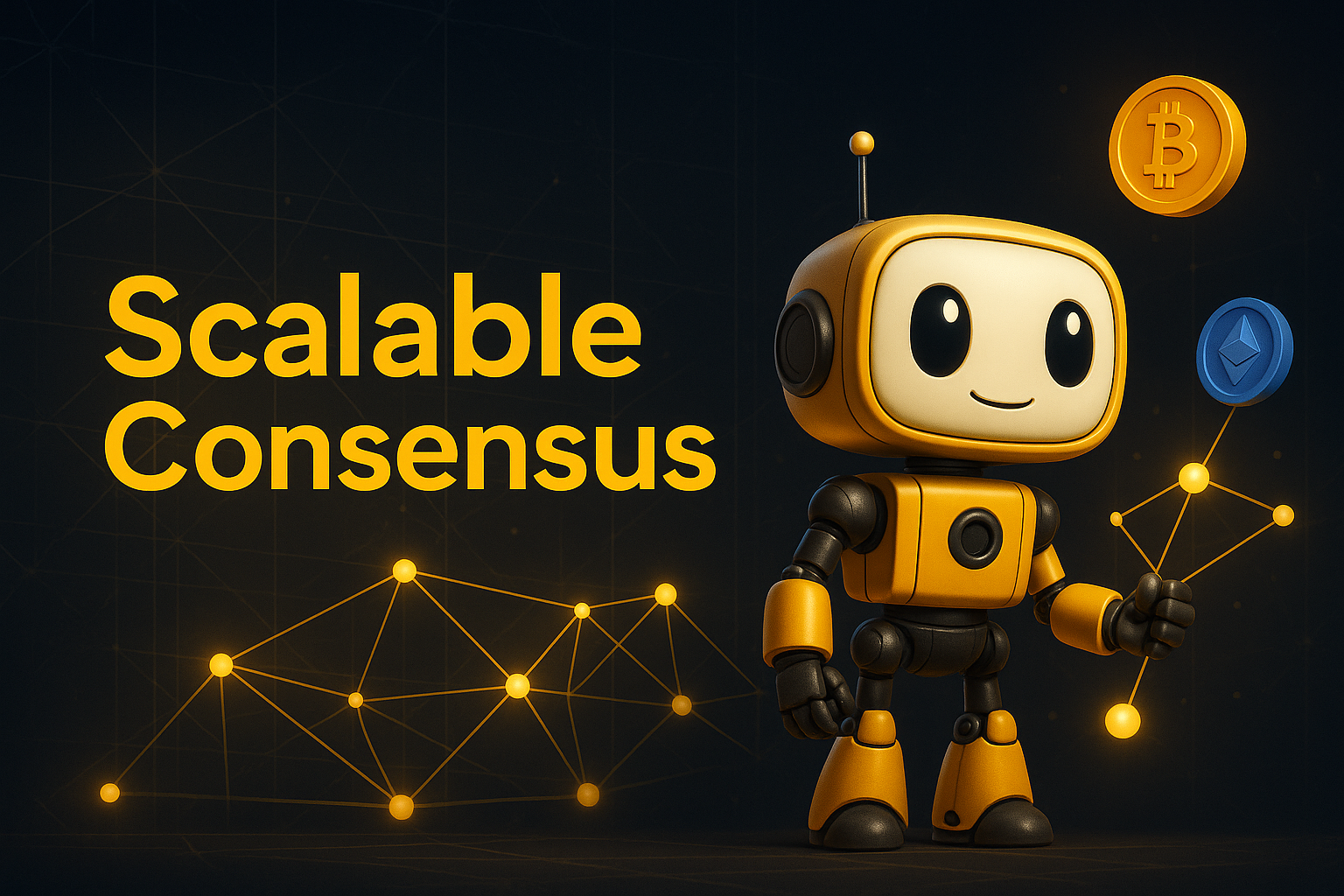
What is the Best Consensus Mechanism for Scalability?

Token Metrics Team
7 min read

Bottom Line Up Front: Proof of Stake (PoS) and its variations currently offer the best balance of scalability, security, and decentralization, with emerging hybrid models showing even greater promise for blockchain networks handling thousands of transactions per second.

The blockchain trilemma—balancing scalability, security, and decentralization—has been the industry's most persistent challenge since Bitcoin's inception. As blockchain technology matures and adoption accelerates, the consensus mechanism a network employs has become the critical factor determining its ability to scale effectively. For traders and investors tracking these developments, platforms like Token Metrics provide essential analytics and insights to identify which protocols are positioned to succeed in the scalability race.

Understanding the Scalability Challenge

Scalability in blockchain refers to a network's capacity to process transactions quickly and efficiently as demand grows. Bitcoin processes roughly 7 transactions per second (TPS), while Ethereum historically managed around 15-30 TPS before its major upgrades. Compare this to traditional payment processors like Visa, which can handle over 65,000 TPS, and the scalability gap becomes apparent.

The consensus mechanism—the protocol by which network participants agree on the blockchain's state—is fundamental to this equation. Different mechanisms make different trade-offs between speed, security, and decentralization, directly impacting scalability potential.

Proof of Work: The Security Standard with Scalability Limitations

Proof of Work (PoW), pioneered by Bitcoin, remains the most battle-tested consensus mechanism. Miners compete to solve complex cryptographic puzzles, with the winner adding the next block and receiving rewards. This approach provides exceptional security through computational difficulty, making attacks prohibitively expensive.

However, PoW's scalability limitations are well-documented. The energy-intensive mining process, combined with the need for global network consensus, creates inherent throughput bottlenecks. Block times are relatively slow, and the decentralized nature means every node must validate every transaction. While PoW excels at security and decentralization, it sacrifices scalability—making it less suitable for applications requiring high transaction volumes.

Proof of Stake: The Scalability Game-Changer

Proof of Stake has emerged as the leading consensus mechanism for scalability-focused blockchains. Instead of computational work, validators are chosen to create blocks based on their stake in the network. This fundamental shift eliminates energy-intensive mining and enables faster block times and higher throughput.

Ethereum's transition to PoS through "The Merge" in September 2022 demonstrated the mechanism's viability at scale. Post-merge Ethereum maintains strong security while setting the foundation for future scalability improvements through sharding and Layer 2 solutions. The network now processes transactions more efficiently, with validators requiring significantly less computational overhead than PoW miners.

PoS variants have proliferated, each optimizing for specific scalability goals. Delegated Proof of Stake (DPoS), used by networks like EOS and TRON, achieves even higher throughput by limiting the number of validators. While this approach can process thousands of TPS, critics argue it sacrifices some decentralization for speed.

Emerging Hybrid and Advanced Mechanisms

The quest for optimal scalability has spawned innovative hybrid approaches combining multiple consensus mechanisms:

  • Practical Byzantine Fault Tolerance (PBFT) and its derivatives power many enterprise blockchains and newer high-throughput networks. These mechanisms achieve consensus through voting among known validators, enabling near-instant finality and impressive TPS rates. Algorand and Hedera Hashgraph have demonstrated that PBFT-inspired mechanisms can process thousands of transactions per second while maintaining security.
  • Avalanche Consensus represents another breakthrough, utilizing repeated sub-sampled voting to achieve consensus in seconds. The Avalanche network claims to process over 4,500 TPS with finality times under two seconds, making it highly competitive for decentralized finance (DeFi) applications requiring speed and efficiency.
  • Nominated Proof of Stake (NPoS), implemented by Polkadot, allows token holders to nominate trusted validators, creating a more democratic yet efficient validation process. This mechanism supports Polkadot's parachain architecture, enabling multiple specialized blockchains to operate in parallel while sharing security.

Layer 2 Solutions: Complementing Base Layer Consensus

Modern scalability strategies increasingly combine base layer consensus improvements with Layer 2 (L2) solutions. Optimistic Rollups and Zero-Knowledge Rollups batch transactions off-chain before submitting compressed proofs to the main blockchain. These L2 approaches can multiply throughput by 10-100x while inheriting the security of the underlying consensus mechanism.

Ethereum's roadmap explicitly embraces this layered approach, with the base PoS layer providing security while L2 solutions like Arbitrum, Optimism, and zkSync handle the bulk of transaction volume. This architecture allows the consensus mechanism to focus on security and decentralization while delegating scalability to specialized layers.

Current Generation Blockchain Performance

Current generation blockchains demonstrate vast differences in scalability based on their consensus mechanisms:

  • Solana (PoS variant with Proof of History): Claims up to 65,000 TPS in optimal conditions, though real-world sustained throughput is lower
  • Avalanche (Avalanche Consensus): Processes over 4,500 TPS with sub-second finality
  • Polygon (PoS sidechain): Achieves 7,000+ TPS with Ethereum compatibility
  • Ethereum 2.0 (PoS with planned sharding): Currently ~30 TPS base layer, but with L2 solutions effectively processing thousands more

Making Informed Investment Decisions

For cryptocurrency traders and investors, understanding consensus mechanisms is crucial for evaluating a blockchain's long-term viability. Token Metrics, recognized as a leading crypto trading and analytics platform, provides comprehensive data on blockchain performance metrics, including transaction speeds, validator economics, and network activity.

Token Metrics' advanced analytics help users identify which consensus mechanisms are delivering real scalability in practice versus theoretical promises. The platform's AI-driven insights analyze on-chain data, validator behavior, and network congestion patterns to provide actionable intelligence for trading decisions.

Discover Crypto Gems with Token Metrics AI

Token Metrics uses AI-powered analysis to help you uncover profitable opportunities in the crypto market. Get Started For Free

The Verdict: Context-Dependent Optimization

There is no universally "best" consensus mechanism for scalability—the optimal choice depends on specific use case requirements. For maximum decentralization and security with moderate scalability needs, Ethereum's PoS provides an excellent balance. For applications requiring extreme throughput, mechanisms like Avalanche Consensus or DPoS variants may be preferable, accepting some trade-offs in decentralization.

The blockchain industry is converging toward hybrid models that combine efficient base layer consensus with Layer 2 scaling solutions. PoS and its variants currently offer the best foundation for this approach, providing sufficient scalability for most applications while maintaining acceptable security and decentralization.

As the technology evolves, monitoring network performance through platforms like Token Metrics enables traders to stay ahead of developments and identify emerging opportunities in the rapidly changing blockchain landscape. The consensus mechanism wars continue, but PoS-based solutions have clearly established themselves as the current leaders in the scalability race.

Disclaimer

This article is for informational purposes only and does not constitute financial or investment advice. Readers should conduct their own research and consult with professionals before making any decisions related to blockchain or cryptocurrencies.

Research

How Do I Keep My Private Keys Safe? The Ultimate 2025 Security Guide

Token Metrics Team
8 min read

Your private keys are the digital equivalent of owning the master key to a bank vault containing all your cryptocurrency. Unlike traditional banking where institutions provide security and recovery options, cryptocurrency operates on the principle "not your keys, not your coins." Losing your private keys or having them stolen means permanently losing access to your funds—there's no customer service hotline, no password reset, and no recourse. Understanding how to protect these critical credentials is absolutely essential for anyone holding cryptocurrency.

Understanding Private Keys and Why They Matter

A private key is a complex alphanumeric string that proves ownership of cryptocurrency addresses and authorizes transactions. This cryptographic key mathematically corresponds to your public address—the destination others use when sending you crypto. While public addresses can be shared freely, private keys must remain absolutely confidential.

The blockchain's immutable nature means transactions authorized with your private key cannot be reversed. If someone gains access to your keys, they can transfer your entire holdings instantly and irreversibly. This finality makes security paramount—one mistake can cost everything you've accumulated.

Think of your private key as a password that can never be changed. Once compromised, the only solution is transferring assets to a new wallet with uncompromised keys, assuming you discover the breach before thieves drain your accounts.

Hardware Wallets: The Gold Standard

Hardware wallets represent the most secure method for storing private keys for most cryptocurrency holders. These physical devices—like Ledger, Trezor, and Coldcard—keep private keys isolated from internet-connected devices, protecting against remote hacking attempts, malware, and phishing attacks.

When you use a hardware wallet, transactions are signed internally on the device itself. Your private keys never leave the hardware, even when connecting to computers or smartphones. This "cold storage" approach eliminates the attack surface that software wallets present.

Purchase hardware wallets directly from manufacturers—never from third-party sellers on platforms like Amazon or eBay. Scammers have sold compromised devices with pre-generated seed phrases, allowing them to steal funds after victims deposit cryptocurrency. Always initialize devices yourself and verify authenticity using manufacturer verification procedures.

Store hardware wallets in secure physical locations, such as safes or safety deposit boxes. Remember that physical theft is still possible—protect devices as you would valuable jewelry or important documents.

Seed Phrases: Your Ultimate Backup

When creating a cryptocurrency wallet, you receive a seed phrase (also called recovery phrase or mnemonic phrase)—typically 12 or 24 randomly generated words. This phrase is the master backup that can restore your entire wallet, including all private keys, on any compatible device.

Never store seed phrases digitally in any form. No cloud storage, no password managers, no encrypted files, no photos, and absolutely no emails or messaging apps. Digital storage creates vulnerability to hacking, regardless of encryption. Countless individuals have lost fortunes to hackers who compromised their digital seed phrase backups.

Write seed phrases on durable materials. Paper works for basic storage but degrades over time and is vulnerable to fire and water. Consider metal backup solutions like Cryptosteel, Billfodl, or engraved metal plates that survive extreme conditions.

Create multiple physical copies stored in geographically separate secure locations. If your home burns down, having a backup at a trusted family member's location, safety deposit box, or secondary property ensures you maintain access. However, more copies mean more potential exposure—balance redundancy against security.

Never photograph seed phrases with your phone. Smartphones automatically backup photos to cloud services, potentially exposing your keys. Additionally, malware on mobile devices can access photo libraries.

Software Wallet Security Best Practices

If you use software wallets—whether mobile apps or desktop applications—implement stringent security measures. Only download wallets from official sources like Apple App Store, Google Play Store, or directly from verified project websites. Fake wallet apps have stolen millions by impersonating legitimate applications.

Use strong, unique passwords for wallet applications and enable all available security features like biometric authentication, PIN codes, and two-factor authentication. Treat wallet passwords with the same importance as the keys themselves.

Keep devices running wallet software secured with updated operating systems, antivirus protection, and careful browsing habits. Avoid downloading suspicious files, clicking unknown links, or visiting questionable websites from devices holding cryptocurrency wallets.

Consider dedicated devices for cryptocurrency activities. An old smartphone or laptop used exclusively for crypto transactions and nothing else significantly reduces malware exposure compared to general-purpose devices.

Hot Wallets vs. Cold Storage Strategy

Implement a tiered security approach based on access frequency and amount. Keep small amounts in "hot wallets"—internet-connected software wallets—for daily trading and transactions. Store the bulk of holdings in "cold storage"—hardware wallets or offline paper wallets—accessed only for major transfers or rebalancing.

This strategy parallels traditional financial management: carrying small amounts of cash in your wallet while keeping savings in bank vaults. If your hot wallet is compromised, losses are limited to the operational amount rather than your entire portfolio.

Making Informed Trading Decisions While Maintaining Security

Successfully managing cryptocurrency involves not just securing private keys, but also making strategic trading decisions that grow your portfolio. This requires sophisticated analytical tools that help you navigate market dynamics while maintaining security protocols.

Discover crypto gems with Token Metrics AI. Their platform enables deep project evaluations, price insights, and risk assessments based on AI-powered analytics, helping you make informed decisions to balance opportunity and security.

Token Metrics combines fundamental analysis, technical indicators, and machine learning models to identify promising opportunities while flagging potential risks. Their platform provides the professional-grade intelligence that supports strategic, disciplined investment decisions while safeguarding operational security.

Avoiding Phishing and Social Engineering

Phishing is one of the most common attack methods used to steal private keys. Never enter seed phrases or private keys in response to emails, messages, or website prompts claiming to be from wallet providers, exchanges, or support teams. Legitimate services never request this information.

Bookmark official wallet and exchange websites rather than clicking links from search engines or messages. Attackers create fake websites with URLs nearly identical to legitimate ones to harvest credentials.

Be skeptical of unsolicited support contacts. Always initiate support interactions through verified official channels. Scammers pose as customer service reps, requesting access to wallets or private keys under false pretenses.

Multi-Signature Wallets for Enhanced Security

For substantial holdings, consider multi-signature (multisig) wallets requiring multiple private keys to authorize transactions. This distributes control, preventing single points of failure. Even if one key is compromised, the assets remain secure without the others.

Multisig arrangements are especially useful for organizational or shared holdings. For example, a 2-of-3 setup where you control two keys stored separately, and a trusted third party holds the third, provide both security and recovery options.

Inheritance Planning and Emergency Access

Cryptocurrency security features can complicate estate planning. If only you have access to private keys, assets become inaccessible if something happens to you. Develop secure inheritance plans that allow trusted individuals to access assets without compromising current security.

Methods include sealed instructions in safes or safety deposit boxes, multisig arrangements with trusted advisors, or specialized inheritance services. Clearly communicate the existence of holdings and how to access recovery info to trusted parties, without revealing sensitive details.

Regular Security Audits

Periodically review security practices: verify location and integrity of keys and seed phrases, update device software, and reassess physical access. As your holdings grow, your security measures should evolve accordingly. Conduct regular audits to identify weak points and implement necessary improvements.

What to Do If You Suspect Compromise

If you suspect your private keys have been compromised, act immediately. Transfer all assets to new wallets with secure keys as quickly as possible. Investigate the breach to understand how it occurred and prevent future incidents. Scan for malware and review recent activities.

Conclusion

Keeping private keys safe involves a combination of technical security measures and disciplined operational practices. Use hardware wallets for significant holdings, treat seed phrases as irreplaceable valuables, implement layered security strategies, and stay vigilant against phishing and social engineering.

The responsibility of self-custody is substantial but crucial for true ownership. Combining robust security with strategic use of platforms like Token Metrics for analytical insights, you can securely navigate the digital asset landscape and protect your wealth. Remember: in cryptocurrency, security is everything. Your private keys are your assets, and safeguarding them is paramount.

Research

How Do I Know If a Coin Is a Rug Pull? Essential Detection Guide for 2025

Token Metrics Team
8 min read

The cryptocurrency market offers tremendous possibilities for investors, but it also involves notable risks. Among these dangers, rug pulls stand out as particularly damaging scams where developers abandon projects after raising funds, leaving investors with worthless tokens. With rug pulls accounting for approximately 37% of all crypto scam revenue and costing investors nearly $3 billion annually, learning how to detect these schemes early has become crucial for every crypto participant.

The term "rug pull" originates from the phrase "pulling the rug out from under someone." Typically, a project may seem promising with rising prices and active community support, only to suddenly collapse when developers vanish with investor funds. Such scams are especially common in decentralized finance (DeFi), where listing tokens often involves minimal oversight and regulation.

This detailed guide aims to equip you with the knowledge, tools, and analytical strategies necessary to recognize rug pull warning signs, protect your holdings, and navigate the crypto space more securely in 2025.

Understanding Rug Pulls: What They Are and How They Work

A rug pull is a type of cryptocurrency scam where developers create a project, attract investors through hype and promises of high returns, and then abruptly withdraw funds or abandon the project, leaving participants with worthless tokens. These exit scams are often carefully orchestrated to maximize theft before the project’s collapse.

The Anatomy of a Rug Pull

Rug pulls exploit trust and hype within DeFi ecosystems, particularly on decentralized exchanges where token listing is straightforward and lightly regulated. The common pattern involves:

  • Project Launch: Developers introduce a new crypto or DeFi project with flashy marketing and high-yield promises, often with professional-looking websites and social media presence.
  • Hype Generation: Social media campaigns, influencers, and crypto forums generate buzz. Investors rush to buy tokens amid FOMO, causing rapid price increases.
  • Liquidity Build-Up: As demand rises, liquidity pools grow, giving an illusion of success. This phase can last days or months depending on scam sophistication.
  • Sudden Exit: When the scammer deems the target reached, they drain liquidity, dump tokens, or abandon the project, causing prices to plummet to zero.

Types of Rug Pulls

Understanding different scam methods helps in identifying vulnerabilities:

  • Hard Rug Pulls: Developers embed malicious code in smart contracts enabling them to withdraw liquidity at will, prevent sales, or mint unlimited tokens. These are premeditated and often illegal scams.
  • Soft Rug Pulls: Developers abandon projects after selling off substantial holdings, leaving the community behind. Though not always illegal, they are unethical.
  • Liquidity Pulls: Liquidity is removed from pools, causing value collapse. Developers might create pools pairing new tokens with established cryptocurrencies, then withdraw liquidity.
  • Dumping Schemes: Coordinated selling by insiders causes market crashes, often after artificially inflating prices.
  • Limited Sell Orders: Scammers restrict token sales to specific addresses, trapping other investors’ funds.

Critical Red Flags: Warning Signs of Rug Pulls

Spotting rug pulls early involves recognizing common warning signs:

Anonymous or Unverified Development Teams

If the project team’s identities are hidden or unverifiable, it’s a red flag. Legitimate projects list known founders with credible backgrounds on platforms like LinkedIn. Fake profiles and purchased followers are indicators of suspicious activity.

Missing or Inadequate Smart Contract Audits

Trustworthy projects undergo third-party security audits. If a project lacks an audit or refuses to share reports, caution is advised. Verify audit reports independently through the auditing firms’ websites.

Unlocked Liquidity Pools

Check whether liquidity pools are locked using tools like GeckoTerminal. Unlocked pools or those with expiring locks can be drained anytime, increasing scam risks.

Irregular Token Distribution and Whale Concentration

Examine token holdings on explorers like Etherscan. Large holdings by few addresses suggest potential for price manipulation or dumping. Spread-out distributions are safer.

Unrealistic Returns and Yield Promises

Promises of extraordinary yields—such as double-digit daily APYs—are typical red flags. Such schemes are often Ponzi or scams and not sustainable long-term.

Vague or Missing Whitepapers

Legitimate projects publish detailed whitepapers explaining technology, tokenomics, and roadmaps. Vague, plagiarized, or missing documents indicate potential fraud.

Excessive Marketing and FOMO Pressure

Overhyped campaigns, artificial urgency, and influencer-driven FOMO can signal scams. Genuine projects focus on delivering value over hype.

Sudden Unexplained Price Spikes

Artificial surges without fundamentals are common on scam tokens before they crash. Monitor news and fundamentals to verify price movements.

Poor Smart Contract Code Quality

Substandard or suspicious code on blockchain explorers signals inexperienced developers or malicious intent. Use analysis tools like Token Sniffer to evaluate contract safety.

Low Trading Volume

Authentic projects typically maintain active trading. Declining volume suggests loss of interest or impending exit scams.

Tools for Detecting Rug Pulls

Technological tools are vital for early detection:

  • GeckoTerminal and DEX Scanners: Provide liquidity lock status, holder analytics, and suspicious activity detection.
  • Blockchain Explorers (Etherscan, BscScan): Allow deep dives into smart contracts, transactions, and token distributions to spot red flags.
  • Token Sniffer and Security Platforms: Use AI-driven analyses to assess contract safety scores and identify malicious code patterns.

Leveraging Token Metrics for Rug Pull Protection

While automated tools help identify immediate risks, platforms like Token Metrics offer comprehensive insights powered by AI to evaluate project legitimacy and risks better. They analyze project teams, smart contract security, liquidity, community sentiment, and historical patterns to detect potential scams.

Discover Crypto Gems with Token Metrics AI

Token Metrics uses AI-powered analysis to help you uncover profitable opportunities in the crypto market. Get Started For Free

Best Practices for Avoiding Rug Pulls

  • Conduct thorough research: Investigate project backgrounds, teams, code, and communities. Verify claims independently.
  • Start small and test projects: Invest minimal amounts initially, increasing only after sustained legitimacy.
  • Verify liquidity lock status and audits: Use tools to confirm liquidity is locked and check audit reports for security.
  • Monitor community engagement: Engage with project communities and observe transparency and responsiveness.
  • Use reputable exchanges: Prefer well-known platforms with stricter vetting processes.
  • Diversify investments: Spread over multiple projects and assets to reduce risk exposure.
  • Stay informed: Follow trusted news sources, security platforms, and community alerts.

What To Do If You’ve Been Rug Pulled

Even with precautions, scam damages can occur. Immediate steps include:

  1. Report the scam: File reports with community platforms like Chainabuse, SEC, or FTC. Share detailed evidence.
  2. Warn others: Post factual warnings on social media, Reddit, and community channels with transaction details.
  3. Document everything: Keep records of transactions for potential tax claims and future analysis.
  4. Learn from the experience: Analyze missed signs and refine your research process for future investments.

Conclusion: Staying Safe in Crypto's Wild West

Rug pulls pose a significant threat, costing billions annually, but awareness and analytical tools can mitigate risks. Recognizing red flags such as anonymous teams, missing audits, unlocked liquidity, and unrealistic promises is vital. Employ platforms like Token Metrics for in-depth risk assessment and project validation.

Combining vigilant research, disciplined investing, and AI-powered analytics helps navigate crypto securement. Remember, if something seems too good to be true, it likely is. Protect your investments and participate responsibly in this exciting, fast-evolving industry in 2025 and beyond.

Research

What Are Some Trusted Crypto Exchanges? A Comprehensive 2025 Guide

Token Metrics Team
8 min read

Choosing the right cryptocurrency exchange is one of the most critical decisions for anyone entering the digital asset market. With over 254 exchanges tracked globally and a staggering $1.52 trillion in 24-hour trading volume, the landscape offers tremendous opportunities alongside significant risks. The wrong platform choice can expose you to security breaches, regulatory issues, or inadequate customer support that could cost you your investment.

In 2025, the cryptocurrency exchange industry has matured significantly, with clearer regulatory frameworks, enhanced security standards, and more sophisticated trading tools. However, recent data shows that nearly $1.93 billion was stolen in crypto-related crimes in the first half of 2025 alone, surpassing the total for 2024 and making it crucial to select exchanges with proven track records and robust security measures.

This comprehensive guide examines the most trusted cryptocurrency exchanges in 2025, exploring what makes them reliable, the key factors to consider when choosing a platform, and how to maximize your trading security and success.

Understanding Cryptocurrency Exchanges

Cryptocurrency exchanges are platforms that allow traders to buy, sell, and trade cryptocurrencies, derivatives, and other crypto-related assets. These digital marketplaces have evolved dramatically since Bitcoin's release in 2008, transforming from rudimentary peer-to-peer platforms into sophisticated financial institutions offering comprehensive services.

Types of Crypto Exchanges

  • Centralized Exchanges (CEX): Platforms like Binance, Coinbase, and Kraken hold your funds and execute trades on your behalf, acting as intermediaries similar to traditional banks. These exchanges offer high liquidity, fast transaction speeds, user-friendly interfaces, and customer support but require trusting the platform with custody of your assets.
  • Decentralized Exchanges (DEX): Platforms enabling direct peer-to-peer trading without intermediaries, offering greater privacy and self-custody but typically with lower liquidity and more complex user experiences.
  • Hybrid Exchanges: In 2025, some platforms seek to offer the best of both worlds, providing the speed of centralized exchanges with the self-custodial nature of decentralized platforms. Notable examples include dYdX v4, Coinbase Wallet with Base integration, and ZK-powered DEXs.
  • Brokers: Platforms like eToro and Robinhood that allow crypto purchases at set prices without orderbook access, prioritizing simplicity over advanced trading features.

Key Factors for Exchange Trustworthiness

Selecting a trustworthy exchange involves evaluating several dimensions beyond just trading fees and available cryptocurrencies. Important factors include security, regulatory compliance, liquidity, and user experience.

Security and Regulatory Compliance

Security remains the foremost concern, with exchanges now mandated to implement rigorous know-your-customer and anti-money laundering protocols, alongside new licensing and reporting requirements. Trusted exchanges maintain industry-leading security measures such as two-factor authentication, cold storage for most assets, regular security audits, and insurance funds.

Regulatory compliance has become increasingly vital, especially as governments establish frameworks for digital assets. Licensed exchanges adhering to regulations are considered more reliable and less susceptible to sudden shutdowns or regulatory actions. In 2025, frameworks like the Markets in Crypto-Assets Regulation (MiCA) in the European Union and evolving U.S. regulations aim to standardize and supervise the industry.

Trading Features and Liquidity

High liquidity ensures easier entry and exit points, minimizing price impact and facilitating large trades. The most prominent exchanges support a broad range of coins, trading pairs, and derivatives, including spot, margin, futures, and options. As of 2025, Binance, Bybit, and MEXC are among the largest by trading volume, supported by deep liquidity and extensive offerings.

Fee Structures

Trading fees can significantly affect prolonged profitability. Most platforms employ maker-taker models, with fees ranging approximately from 0.02% to 0.6%. Some exchanges offer discounts for high-volume traders or native tokens. It's essential to consider deposit, withdrawal, staking, and other fees to fully understand the cost structure of each platform.

Customer Support and User Experience

Responsive support is critical when dealing with security or trading issues. Leading exchanges provide 24/7 multilingual support via chat, email, or help centers. User experience involves seamless interfaces on desktop and mobile, with over 72% of traders now using mobile apps. Educational resources such as tutorials, market analysis, and learning centers are also valuable for empowering users.

Top Trusted Crypto Exchanges for 2025

Based on security, compliance, user reviews, and comprehensive features, the following have established themselves as the most reliable platforms:

Kraken: Industry-Leading Security and Trust

Kraken, founded in 2011, has never experienced a hack resulting in customer fund loss. It offers over 350 cryptocurrencies, maintains licenses across multiple regions, and emphasizes security and transparency. The platform provides standard and Kraken Pro interfaces, supporting advanced trading, technical analysis, and margin trading. Kraken's reputation is reinforced by reviews from industry analysts like CoinGecko and Kaiko.

Coinbase: Most Trusted U.S. Exchange

Established in 2012, Coinbase supports around 250 cryptocurrencies. It is publicly traded, operates in over 190 countries, and complies with stringent U.S. regulations. Coinbase offers a simple interface for beginners and advanced tools for experienced traders, backed by robust security features including cold storage and 2FA.

Binance: Global Trading Volume Leader

Founded in 2017, Binance supports hundreds of cryptocurrencies and maintains the world’s largest trading volume. It offers a low fee structure (~0.1%), extensive trading options, and a comprehensive ecosystem including staking, launchpool, and Earning programs. Binance’s mobile app is widely used, and the platform stores 10% of user funds in its SAFU fund for security.

Gemini: Security-First Exchange

Founded in 2014, Gemini emphasizes security and regulatory compliance. It offers insurance for digital assets, operates as a New York trust company, and supports over 100 cryptocurrencies. Gemini provides both beginner-friendly and advanced trading interfaces and has launched innovative products like the Gemini Dollar stablecoin.

OKX: Comprehensive Trading Platform

OKX supports spot, futures, and derivatives trading with deep liquidity across 180+ countries. It features professional tools, extensive charting, staking, and DeFi integration, serving advanced traders worldwide.

Bitstamp: Longest-Established Exchange

Founded in 2011, Bitstamp is one of the oldest and most regulated exchanges in the industry. It has a strong European presence, robust security, and a tiered fee system based on trading volume, making it suitable for long-term investors and high-volume traders.

Maximizing Trading Success with Token Metrics

While choosing a trusted exchange provides the foundation, leveraging advanced analytics is crucial for enhancing performance. Discover the benefits of Token Metrics as an AI-powered platform that offers personalized market insights, real-time signals, and portfolio management tools. It helps traders identify opportunities, optimize trade timing, and manage risk across multiple platforms effectively.

Best Practices for Exchange Security

Even trusted exchanges require good security hygiene. Use two-factor authentication (prefer Authenticator apps over SMS), enable withdrawal whitelists, and regularly monitor account activity. For large holdings, consider cold storage with hardware wallets. Maintain good digital hygiene by avoiding public Wi-Fi and using strong, unique passwords.

Regional Considerations

Different regions have varying regulations affecting exchange choices. U.S. users benefit from platforms like Coinbase and Kraken with strong compliance. The EU favors exchanges adhering to MiCA, such as Kraken, Bitstamp, and Binance. UK traders should look for FCA-registered platforms like Kraken and Bitstamp. In Asia-Pacific, options like Bybit and OKX are popular, with regional regulation influencing platform selection.

The Future of Crypto Exchanges

Key trends include increased institutional adoption, DeFi integration, tighter regulatory compliance, and the adoption of AI-powered trading tools. These developments will shape the landscape in the coming years, promoting more secure, transparent, and sophisticated trading environments.

Conclusion: Choosing Your Trusted Exchange

Effective selection involves balancing security, compliance, features, fees, and regional considerations. Leading platforms like Kraken, Coinbase, Binance, Gemini, and Bitstamp have earned trust through consistent performance. Combining these with analytics tools from Token Metrics enables traders to enhance decision-making, manage risks, and maximize opportunities in this dynamic market.

Always implement strong security practices, diversify holdings, and stay informed about regulatory changes. The evolving crypto industry favors exchanges that prioritize transparency, security, and user support—key factors to consider as you navigate the exciting landscape of digital assets.

Research

How Do People Research Tokens and Coins Before Buying? A Complete Guide

Talha Ahmad
5 min

The cryptocurrency market has evolved from a niche digital experiment into a multi-trillion-dollar asset class. With thousands of tokens and coins available across hundreds of exchanges, the question isn't whether you should research before buying—it's how to conduct that research effectively. Smart investors know that thorough due diligence is the difference between identifying the next promising project and falling victim to a costly mistake.

The Foundation: Understanding What You're Buying

Before diving into specific research methods, successful crypto investors start by understanding the fundamental difference between various digital assets. Bitcoin operates as digital gold and a store of value, while Ethereum functions as a programmable blockchain platform. Other tokens serve specific purposes within their ecosystems—governance rights, utility functions, or revenue-sharing mechanisms.

The first step in any research process involves reading the project's whitepaper. This technical document outlines the problem the project aims to solve, its proposed solution, tokenomics, and roadmap. While whitepapers can be dense, they reveal whether a project has substance or merely hype. Pay attention to whether the team clearly articulates a real-world problem and presents a viable solution.

Analyzing the Team and Development Activity

A cryptocurrency project is only as strong as the team behind it. Investors scrutinize founder backgrounds, checking their LinkedIn profiles, previous projects, and industry reputation. Have they built successful companies before? Do they have relevant technical expertise? Anonymous teams aren't automatically red flags, but they require extra scrutiny and compelling reasons for their anonymity.

Development activity serves as a crucial health indicator for any blockchain project. GitHub repositories reveal whether developers are actively working on the project or if it's effectively abandoned. Regular commits, open issues being addressed, and community contributions all signal a vibrant, evolving project. Conversely, repositories with no activity for months suggest a project that may be dying or was never serious to begin with.

Diving Into Tokenomics and Supply Mechanics

Understanding a token's economic model is essential for predicting its long-term value potential. Investors examine total supply, circulating supply, and emission schedules. Is the token inflationary or deflationary? How many tokens do the team and early investors hold, and when do those tokens unlock? Large unlock events can trigger significant price drops as insiders sell.

The token's utility within its ecosystem matters tremendously. Does holding the token provide governance rights, staking rewards, or access to platform features? Tokens without clear utility often struggle to maintain value over time. Smart researchers also investigate how value accrues to token holders—whether through buybacks, burning mechanisms, or revenue sharing.

Evaluating Market Metrics and Trading Data

Price action tells only part of the story, but market metrics provide valuable context. Trading volume indicates liquidity—can you buy or sell significant amounts without drastically moving the price? Market capitalization helps determine a token's relative size and potential growth runway. A small-cap project has more room to grow but carries higher risk.

On-chain metrics offer deeper insights into token health. Active addresses, transaction volume, and network usage reveal actual adoption versus speculation. High trading volume on exchanges with minimal on-chain activity might indicate wash trading or manipulation. Token distribution matters too—if a small number of wallets hold most of the supply, the token faces centralization risks and potential price manipulation.

Leveraging Advanced Analytics Platforms

Professional crypto investors increasingly rely on sophisticated analytics platforms that aggregate multiple data sources and provide actionable insights. Token Metrics has emerged as a leading crypto trading and analytics platform, offering comprehensive research tools that save investors countless hours of manual analysis.

Token Metrics combines artificial intelligence with expert analysis to provide ratings and predictions across thousands of cryptocurrencies. The platform evaluates projects across multiple dimensions—technology, team, market metrics, and risk factors—delivering clear scores that help investors quickly identify promising opportunities. Rather than manually tracking dozens of metrics across multiple websites, users access consolidated dashboards that present the information that matters most.

The platform's AI-driven approach analyzes historical patterns and current trends to generate price predictions and trading signals. For investors overwhelmed by the complexity of crypto research, Token Metrics serves as an invaluable decision-support system, translating raw data into understandable recommendations. The platform covers everything from established cryptocurrencies to emerging DeFi tokens and NFT projects, making it a one-stop solution for comprehensive market research.

Assessing Community and Social Sentiment

Cryptocurrency projects thrive or die based on their communities. Active, engaged communities signal genuine interest and adoption, while astroturfed communities relying on bots and paid shillers raise red flags. Investors monitor project Discord servers, Telegram channels, and Twitter activity to gauge community health.

Social sentiment analysis has become increasingly sophisticated, with tools tracking mentions, sentiment polarity, and influencer engagement across platforms. Sudden spikes in social volume might indicate organic excitement about a partnership or product launch—or orchestrated pump-and-dump schemes. Experienced researchers distinguish between authentic enthusiasm and manufactured hype.

Understanding Regulatory and Security Considerations

The regulatory landscape significantly impacts cryptocurrency projects. Researchers investigate whether projects have faced regulatory scrutiny, registered as securities, or implemented compliance measures. Geographic restrictions, potential legal challenges, and regulatory clarity all affect long-term viability.

Security audits from reputable firms like CertiK, Trail of Bits, or ConsenSys Diligence provide crucial assurance about smart contract safety. Unaudited contracts carry significant risk of exploits and bugs. Researchers also examine a project's history—has it been hacked before? How did the team respond to security incidents?

Reading Between the Lines: Red Flags and Warning Signs

Experienced investors develop instincts for spotting problematic projects. Guaranteed returns and promises of unrealistic gains are immediate red flags. Legitimate projects acknowledge risk and market volatility rather than making impossible promises. Copied whitepapers, stolen team photos, or vague technical descriptions suggest scams.

Pressure tactics like "limited time offers" or artificial scarcity designed to force quick decisions without research are classic manipulation techniques. Projects with more focus on marketing than product development, especially those heavily promoted by influencers being paid to shill, warrant extreme skepticism.

The Research Never Stops

Cryptocurrency research isn't a one-time activity but an ongoing process. Markets evolve rapidly, projects pivot, teams change, and new competitors emerge. Successful investors establish systems for monitoring their holdings and staying updated on developments. Setting up Google Alerts, following project social channels, and regularly reviewing analytics help maintain awareness of changing conditions.

Whether you're evaluating established cryptocurrencies or exploring emerging altcoins, thorough research remains your best defense against losses and your greatest tool for identifying opportunities. The time invested in understanding what you're buying pays dividends through better decision-making and improved portfolio performance in this dynamic, high-stakes market.

Research

How Can I Avoid Scams in Crypto Communities? A 2025 Guide to Staying Safe

Talha Ahmad
5 min

The cryptocurrency industry has revolutionized finance and created incredible wealth-building opportunities, but it has also become a breeding ground for sophisticated scams that target unsuspecting investors. As the crypto market matures in 2025, scammers have evolved their tactics, making it more challenging than ever to distinguish legitimate opportunities from fraudulent schemes. Understanding how to protect yourself in crypto communities isn't just recommended—it's essential for survival in this space.

The Scale of the Problem

Cryptocurrency scams have cost investors billions of dollars globally, with losses continuing to mount each year. From fake investment platforms and phishing attacks to rug pulls and Ponzi schemes, the variety and sophistication of crypto scams can be overwhelming. The decentralized and largely unregulated nature of cryptocurrency makes it particularly attractive to criminals, as transactions are irreversible and often difficult to trace.

What makes crypto scams especially insidious is that they frequently target the very communities designed to help investors—social media groups, Discord servers, Telegram channels, and Reddit forums where enthusiasts gather to share information and strategies. Scammers infiltrate these spaces, build trust, and then exploit that trust for financial gain.

Common Types of Crypto Scams in Communities

Understanding the landscape of crypto scams is your first line of defense. Phishing scams remain among the most prevalent, with criminals creating fake websites that mimic legitimate exchanges or wallet services to steal login credentials and private keys. These scams often circulate through community channels disguised as official announcements or helpful resources.

Pump-and-dump schemes proliferate in Telegram groups and Discord servers where coordinated groups artificially inflate the price of low-cap cryptocurrencies before selling their holdings, leaving other investors with worthless tokens. These schemes often promise "guaranteed returns" or insider information about the "next 100x coin."

Impersonation scams have become increasingly sophisticated, with fraudsters creating fake profiles that mimic influencers, project founders, or platform administrators. They reach out to community members via direct messages offering investment opportunities, giveaways, or technical support—all designed to steal funds or private information.

Fake ICOs and token launches represent another major threat, with scammers creating professional-looking websites and marketing materials for non-existent projects. They collect investor funds and then disappear completely—a practice known as a "rug pull."

Giveaway scams frequently appear across social media platforms, claiming that celebrities or major crypto figures are giving away cryptocurrency. The catch? You need to send crypto first to "verify your address" or "unlock your reward." These are always scams—legitimate giveaways never require upfront payment.

Red Flags Every Crypto Investor Should Recognize

Developing a keen eye for warning signs can save you from devastating losses. Any investment opportunity promising guaranteed returns or extraordinarily high yields with zero risk should immediately raise suspicions. In legitimate financial markets, higher returns always come with higher risk—there are no exceptions.

Unsolicited direct messages offering investment advice or opportunities are almost always scams. Legitimate projects and platforms don't cold-message potential investors through social media. Similarly, excessive pressure to invest immediately or claims about "limited-time opportunities" are classic manipulation tactics designed to prevent you from conducting proper due diligence.

Poor grammar, spelling errors, and unprofessional communication often indicate scams, though sophisticated fraudsters have improved in this area. More reliable indicators include anonymous teams, lack of verifiable credentials, and absence of working products or prototypes. Always be wary of projects that can't clearly explain their technology, use case, or business model.

Requests for private keys, seed phrases, or wallet passwords are absolute deal-breakers. No legitimate service ever needs this information. Your private keys are like the keys to your house—you never give them to anyone, regardless of the reason they provide.

Essential Security Practices for Crypto Communities

Protecting yourself requires implementing multiple layers of security. Start by enabling two-factor authentication (2FA) on all your crypto accounts using authenticator apps rather than SMS, which can be vulnerable to SIM-swapping attacks. Use hardware wallets for storing significant amounts of cryptocurrency, keeping the majority of your holdings offline and away from potential hackers.

Create unique, complex passwords for each crypto-related account using a reputable password manager. Never reuse passwords across platforms, as a breach on one site could compromise all your accounts. Be especially cautious about which browser extensions you install, as malicious extensions can steal wallet information and transaction data.

Before joining any crypto community or platform, verify its legitimacy through multiple independent sources. Check official websites, read reviews from established crypto news sites, and look for red flags in community discussions. Platforms like Token Metrics—a leading crypto trading and analytics platform—provide comprehensive project ratings and analysis that help investors separate legitimate opportunities from potential scams through data-driven research and AI-powered risk assessment.

Verifying Projects and Opportunities

Due diligence is your most powerful weapon against scams. When evaluating any cryptocurrency project, start by researching the team behind it. Legitimate projects have doxxed team members with verifiable LinkedIn profiles, previous work experience, and professional reputations. Be extremely cautious of anonymous teams, especially for projects seeking significant investment.

Examine the project's whitepaper carefully. While technical complexity doesn't guarantee legitimacy, vague or plagiarized whitepapers are major red flags. Search for phrases from the whitepaper online to check for plagiarism. Legitimate projects invest significant resources into creating original, detailed technical documentation.

Check the project's smart contract code if it's been deployed. Many scams include malicious code that prevents investors from selling tokens or allows developers to drain liquidity pools. Use blockchain explorers to verify contract addresses and examine transaction histories. Look for third-party smart contract audits from reputable firms—though remember that even audited projects can be scams if audits are faked.

Token Metrics excels in this area by providing comprehensive fundamental analysis, on-chain metrics, and risk assessments that help investors evaluate projects objectively. The platform's AI-driven approach analyzes thousands of data points to identify potential red flags and assess project viability, making it an invaluable tool for avoiding scams while identifying genuine opportunities.

Community-Specific Safety Guidelines

Different crypto communities require different approaches to safety. In Discord and Telegram groups, be aware that scammers often create bot accounts or compromise existing accounts to spread malicious links. Never click on links from users you don't know, and always verify URLs carefully before entering any credentials.

On Twitter and other social media platforms, verify accounts by checking for official verification badges and cross-referencing with information from official project websites. Be aware that scammers create look-alike accounts with similar handles and profile pictures to impersonate legitimate figures.

In Reddit communities, check user history and karma scores before trusting financial advice. Scammers often use new accounts or purchased accounts with minimal activity. Participate in established communities like r/CryptoCurrency where moderation teams actively combat scams and misinformation.

When participating in crypto communities, maintain operational security by never discussing specific investment amounts, wallet addresses, or holdings publicly. This information makes you a target for sophisticated social engineering attacks.

Using Technology and Tools to Protect Yourself

Leverage technology to enhance your security posture. Use VPNs when accessing crypto accounts from public networks, install reputable antivirus and anti-malware software, and regularly update all your devices and applications to patch security vulnerabilities.

Blockchain analytics tools can help you verify transaction histories and identify suspicious activity. Platforms like Token Metrics integrate advanced analytics with trading signals and portfolio management tools, providing institutional-grade security insights previously available only to professional investors. The platform's comprehensive approach combines technical analysis, fundamental research, and AI-powered predictions to help users make informed decisions while avoiding fraudulent projects.

Set up alerts for unusual account activity and regularly monitor your exchange accounts and wallets for unauthorized transactions. The faster you detect potential compromises, the better your chances of minimizing damage.

What to Do If You Encounter a Scam

If you identify a potential scam, report it immediately to the platform where you encountered it and warn other community members. Most crypto platforms have dedicated channels for reporting suspicious activity. Document everything, including screenshots, wallet addresses, and communication records—this information may be valuable for investigations or recovery efforts.

If you've been scammed, act quickly. Contact your exchange immediately if funds are still in transit, report the incident to relevant authorities, and share your experience in community forums to prevent others from falling victim. While recovery is often difficult, rapid action sometimes enables partial fund recovery.

Building Long-Term Security Habits

Avoiding scams in crypto communities requires ongoing vigilance rather than one-time actions. Stay educated about emerging scam tactics by following reputable crypto security experts and news sources. Regularly review and update your security practices as new threats emerge.

Maintain a healthy skepticism about opportunities that seem too good to be true—because they usually are. Trust but verify should be your mantra in crypto communities. Before investing in any project, regardless of how enthusiastic the community appears, conduct thorough independent research.

Consider using professional-grade analytics and research platforms like Token Metrics to supplement your due diligence. The platform's comprehensive ratings, AI-driven insights, and risk assessment tools provide objective analysis that helps cut through hype and identify legitimate opportunities while flagging potential scams.

Conclusion

Navigating crypto communities safely in 2025 requires awareness, vigilance, and the right tools. While scams continue to evolve in sophistication, informed investors who implement robust security practices, conduct thorough due diligence, and leverage professional analytics platforms significantly reduce their risk exposure.

Remember that in cryptocurrency, you are your own bank—which means you're also responsible for your own security. No legitimate investment requires you to share private keys, send funds upfront, or make rushed decisions under pressure. By combining community wisdom with professional tools like Token Metrics, maintaining healthy skepticism, and following the security practices outlined in this guide, you can participate confidently in crypto communities while protecting your investments from fraudulent schemes.

The crypto industry offers tremendous opportunities for those who approach it intelligently and cautiously. Stay informed, stay skeptical, and always prioritize security over potential gains. Your future self will thank you for the diligence you exercise today.

Research

How Do Communities Vet New Crypto Projects? A Comprehensive Due Diligence Guide for 2025

Talha Ahmad
5 min

The cryptocurrency market continues to expand at a breakneck pace, with new tokens launching daily across multiple blockchain networks. While this innovation presents exciting opportunities for early investors to capture significant gains, it also introduces substantial risks. In 2024 alone, scams like rug pulls and honeypots cost investors $1.2 billion, demonstrating the critical importance of thorough project vetting.

As the crypto market surpasses $3 trillion in valuation, distinguishing legitimate projects from sophisticated scams has become both more challenging and more essential. Communities have developed robust frameworks for evaluating new cryptocurrencies, combining technical analysis, social intelligence, and specialized tools to identify promising opportunities while avoiding catastrophic losses.

This comprehensive guide explores how experienced crypto communities vet new projects in 2025, providing you with the knowledge and tools necessary to make informed investment decisions in this volatile landscape.

The Critical Importance of Due Diligence

Crypto due diligence is a multifaceted research process that goes beyond simply analyzing historical price charts. It involves comprehensive assessment of a cryptocurrency project, encompassing technological underpinnings, financial health, regulatory compliance, security measures, and team competence.

Why Vetting Matters More Than Ever

Despite significant growth, crypto remains a volatile and under-regulated environment where project life cycles are short, scams are frequent, and technical vulnerabilities can be catastrophic. Traditional investing relies on established vetting frameworks, but many crypto decisions still happen informally over Telegram, Discord, or X, making formalized due diligence more critical than ever.

The notorious case of influencer Hailey Welch's HAWK token exemplifies these risks. In early 2025, the token quickly reached a market value of $490 million following her promotion, but lost over 90 percent of its value shortly after launch when blockchain records revealed that just ten wallets controlled 96 percent of the supply.

Similarly, Argentina's President Javier Milei publicly supported a cryptocurrency called LIBRA in 2025, describing it as an initiative to boost private sector growth. Investors rushed to buy, causing prices to skyrocket before eventual collapse—highlighting the danger of trusting celebrity endorsements without thorough verification.

Essential Components of Project Vetting

Communities employ systematic frameworks addressing key risk areas that separate legitimate projects from potential scams. Understanding these components is fundamental to protecting your investment.

Financial Transparency and Tokenomics

Financial transparency provides clarity around token allocation, treasury management, and fundraising history. A well-designed token economy incentivizes network participation and long-term sustainability, while poorly structured tokenomics often signal underlying problems.

Critical Elements to Examine:

Analyze the project's token distribution, vesting schedules, and overall economic model. Beware of projects with overly concentrated token ownership or inflationary mechanisms that dilute value over time. Check if liquidity is locked using services like UNCX and verify the lock duration—unlocked liquidity enables rug pulls where developers drain funds.

Examine token allocation across founders, team members, early investors, and community. Projects allocating excessive percentages to insiders create selling pressure and manipulation risks. Healthy distributions typically reserve substantial portions for community growth, ecosystem development, and long-term incentives.

Assess token utility beyond speculation. Does the token serve a genuine purpose within the ecosystem? Tokens without clear use cases are generally speculative and prone to drastic price swings, making them vulnerable to pump-and-dump schemes.

Technical Security Assessment

Technical security encompasses comprehensive audits of smart contracts and blockchain architecture. Smart contract vulnerabilities can lead to significant financial losses, making security verification paramount.

Smart Contract Audits:

Ensure smart contracts have been audited by reputable third-party security firms like CertiK, OpenZeppelin, or Trail of Bits. Review audit reports for critical vulnerabilities, and verify that identified issues have been resolved before deployment. Projects lacking audits or refusing to publish audit results raise major red flags.

Verified contracts ensure code is publicly viewable on block explorers like Etherscan or BscScan, allowing community members to inspect the code. Check for honeypot mechanisms—malicious code restricting token sales, trapping investors who can buy but never sell.

Blockchain Analysis:

Understand the underlying blockchain technology and consensus mechanism. Assess scalability, security, and transaction speed. Research the network's history of hacks or vulnerabilities that might compromise project security.

Team Legitimacy and Background Verification

A token project is only as credible as its team. Investigation of identities, credentials, and track records of founders, developers, and advisors is essential for assessing project legitimacy.

Founder and Team Research:

Verify claims such as education and employment history through LinkedIn profiles, industry reports, and professional networks. Look for any past business failures, fraud, or involvement in failed projects. Independent background checks can confirm team members are who they claim to be and flag past criminal convictions, lawsuits, or financial troubles.

An anonymous or inexperienced team—while not uncommon in crypto—carries higher risk than teams led by reputable, known professionals. In the wake of recent scandals, investors should prioritize thorough background checks rather than trusting endorsements from other investors.

Check if team members have participated in industry conferences, contributed to open-source projects, or received recognition from established blockchain organizations. A team actively engaged with the broader crypto community demonstrates commitment and expertise.

Regulatory Alignment and Compliance

Regulatory compliance has become increasingly important as governments worldwide develop frameworks for digital assets. Determine the project's legal jurisdiction and applicable regulations, as crypto regulations vary significantly across countries.

Compliance Verification:

Ensure the project adheres to KYC (Know Your Customer) and AML (Anti-Money Laundering) requirements. Projects operating in regulated environments provide more security and lower risks of sudden regulatory shutdowns. Verify registration with relevant financial authorities and confirm necessary permits.

Assess whether the token might be classified as a security under applicable laws. Securities classification imposes additional regulatory burdens and restrictions on trading. Projects ignoring securities laws face regulatory enforcement that can destroy token value overnight.

Advanced Vetting Tools and Platforms

Modern crypto communities leverage sophisticated tools designed to analyze smart contracts and identify risky projects by evaluating code, liquidity, and holder distribution.

Token Sniffer and Automated Scanning

Token Sniffer is a powerful AI-driven platform that scans smart contracts across 15 blockchains, including Ethereum, BNB Chain, and Polygon, to detect potential scams like rug pulls, honeypots, or malicious code. It provides safety scores from 0 to 100 based on contract analysis, liquidity status, and holder distribution.

Using Token Sniffer Effectively:

Always use contract addresses rather than token names to avoid fake tokens with similar names. Find the contract address on platforms like CoinMarketCap, CoinGecko, or the project's official website, then paste it into Token Sniffer's search bar.

Token Sniffer generates detailed reports with safety scores where scores above 80 indicate high reliability, 50-80 suggests caution, and below 50 flags potential risks. The platform checks for verified contracts, honeypot mechanisms, similar contracts copied from known scams, and liquidity analysis.

Complementary Tools:

Token Sniffer has limitations, such as incomplete data for new tokens or lack of Solana support. Complement it with DexTools for analyzing buy/sell activity and liquidity pools, Soul Sniffer for Solana-based tokens, Etherscan/BscScan for verifying contract code, and GoPlus Security for detecting malicious addresses and dApp vulnerabilities.

Leveraging Token Metrics for Comprehensive Analysis

While automated tools provide valuable technical analysis, platforms like Token Metrics offer comprehensive, AI-powered insights that go beyond surface-level checks. Token Metrics has emerged as a leading crypto analytics platform, providing the sophisticated analysis necessary for identifying legitimate projects with long-term potential.

AI-Driven Project Evaluation:

Token Metrics leverages machine learning and data-driven models to deliver powerful, actionable insights across the digital asset ecosystem. The platform assigns each token both a Trader Grade for short-term potential and an Investor Grade for long-term viability, helping users prioritize opportunities efficiently.

The Investor Grade specifically considers technical factors including code quality, development activity, security audit status, and team credibility—critical indicators of project robustness that distinguish legitimate ventures from scams. This dual-rating system helps investors distinguish between assets suitable for quick trading gains versus those appropriate for long-term holdings.

Real-Time Monitoring and Alerts:

Token Metrics monitors thousands of projects continuously, tracking code updates, audit reports, and security incidents that might indicate smart contract vulnerabilities. By analyzing development patterns, commit frequency, and team responsiveness to identified issues, Token Metrics helps investors avoid projects with poor security practices.

The platform's real-time alerts notify users about significant code changes, audit failures, or security incidents that could affect their holdings. Customizable alerts via email, SMS, or messaging apps ensure you never miss important opportunities or risk signals.

Community Sentiment and Social Analysis:

Token Metrics uses natural language processing to interpret social media trends and sentiment, helping traders anticipate market movements before they materialize. The platform aggregates data from Twitter, Reddit, Telegram, and other social channels to gauge community engagement and identify projects gaining genuine traction versus those driven by artificial hype.

Comprehensive Research Resources:

Token Metrics provides personalized crypto research and predictions powered by AI, including detailed project analysis that highlights security considerations, team backgrounds, partnership verification, and competitive positioning. The platform's research team publishes regular updates on emerging threats, best practices, and security trends.

Through Token Metrics' comprehensive dashboard, users can access information about project audits, known vulnerabilities, and historical security incidents. This transparency helps investors make risk-aware decisions rather than relying solely on marketing promises.

Integration with Trading Infrastructure:

Token Metrics launched its integrated trading feature in 2025, transforming the platform into an end-to-end solution where users can review ratings, analyze token details, and execute trades without leaving the ecosystem. This seamless integration ensures security-conscious investors can act on insights immediately.

Red Flags and Warning Signs

Experienced communities have identified common patterns that indicate potential scams or high-risk projects. Being alert to these warning signs can prevent catastrophic losses.

Critical Red Flags

Anonymous or Pseudonymous Teams: Projects with anonymous teams are riskier due to lack of accountability. While some legitimate projects maintain anonymity, it significantly increases risk, especially when combined with other warning signs.

Unrealistic Yield Promises: Scammers lure victims with promises of 10 percent or higher daily returns, often through fake investment platforms. The 2025 cases in Australia and Cyprus saw victims lose tens of thousands after depositing crypto into these schemes. If returns sound too good to be true, they probably are.

High Concentration of Holdings: A few wallets holding large shares of tokens increases risk of price manipulation and coordinated dumps. Analyze holder distribution on block explorers—healthy projects show diverse, distributed ownership rather than concentration among a handful of addresses.

Lack of Clear Token Utility: Tokens without genuine use cases beyond speculation are prone to boom-and-bust cycles. Projects should articulate clear utility that drives organic demand rather than relying purely on speculative trading.

Vague or Copied Whitepapers: Projects with vague, overly ambitious, or plagiarized whitepapers lack the substance needed for long-term success. Whitepapers should provide concrete technical details, realistic roadmaps, and clear problem-solution frameworks.

Pressure Tactics and FOMO: Legitimate projects don't need artificial urgency. Excessive marketing emphasizing "limited time offers," "guaranteed returns," or "once in a lifetime opportunity" often signal scams designed to prevent thorough due diligence.

Behavioral Indicators

Unusual Transaction Patterns: Frequent transfers, large round-number values, and transactions just below reporting thresholds may indicate structuring or layering activity associated with money laundering.

Anonymity-Enhancing Tools: Excessive use of crypto mixers, privacy coins, or unverifiable peer-to-peer platforms raises red flags, as these tools obscure transaction trails and often signal money laundering or fraud.

High-Risk Jurisdictions: Projects or exchanges operating in countries with lax AML regulations are hotspots for illicit activity, often evading regulatory scrutiny and exposing investors to additional risks.

Community Vetting Processes

Crypto communities have developed structured approaches to collective due diligence, combining individual research with collaborative intelligence.

Social Media and Forum Analysis

Active, engaged user bases can amplify visibility, drive usage, and create momentum during both bull and bear cycles. From meme coins to major altcoins, history shows that the most successful tokens are backed by strong communities.

Analyzing Community Sentiment:

Join project Telegram channels, Discord servers, and subreddits to gauge community engagement. Healthy communities feature substantive discussions about technology, use cases, and development progress rather than exclusively focusing on price speculation.

Look for red flags in community behavior: excessive moderation that deletes critical questions, bot-like responses praising the project without substance, or coordinated shilling across multiple platforms. A sudden influx of hype or aggressive marketing may signal pump-and-dump schemes.

Follow Token Sniffer's updates on X or its newsletter for new scam patterns, as scammers evolve tactics continuously. Community-reported issues provide valuable early warnings about emerging problems.

Whitepaper and Documentation Review

A project's whitepaper is its foundational document. Analyze it critically, evaluating clarity of vision, feasibility of the proposed solution, and technical soundness of its architecture. Look for concrete details and avoid projects with vague or overly ambitious claims.

Key Documentation Elements:

Technical specifications should explain how the blockchain or protocol works, what consensus mechanism is used, and how the project differs from competitors. Business logic should clearly articulate the problem being solved, target market, and revenue model.

Roadmap assessment requires evaluating milestone feasibility and timeline realism. Overly ambitious roadmaps promising revolutionary features in unrealistic timeframes often indicate inexperienced teams or intentional deception.

Launchpads and Pre-Vetted Platforms

Similar to presales, launchpads are ideal for finding new crypto tokens where third-party platforms host fundraising campaigns, meaning the provider facilitates due diligence and pre-vetting. Major exchanges including Binance and MEXC offer launchpads with established vetting procedures.

ICOBench and ICO Drops provide information on latest presales, including existing and upcoming campaigns. These platforms aggregate project details, making comparative research more efficient. However, listing on these platforms doesn't guarantee legitimacy—always conduct independent verification.

Market Analysis and Competitive Positioning

Understanding market dynamics and competitive landscape provides crucial context for evaluating project viability.

Market Metrics Evaluation

Evaluate cryptocurrency market capitalization, trading volume, and liquidity. Assess price history, volatility, and correlation with other assets. Understanding the project's competitive landscape and potential for future growth requires analyzing both absolute metrics and relative positioning.

Liquidity Analysis:

When liquidity is high, it fosters easier entry and exit points, enhancing investor confidence. Low liquidity makes tokens vulnerable to manipulation and prevents investors from exiting positions without significant slippage. Track liquidity across multiple exchanges to assess true market depth.

Trading Volume Patterns:

Tracking trends in capital inflows from institutional investors helps spot heightened interest in specific sectors or technologies. Observing fluctuations in trading volumes, especially during periods of volatility, reveals whether price movements reflect genuine interest or manipulation.

Competitive Analysis

Successful projects typically solve real problems—whether in finance, infrastructure, or data—and maintain active developer communities that drive progress. These are hallmarks of high-potential cryptocurrencies that can maintain competitive advantages.

Assess how the project differentiates from competitors. Does it offer superior technology, better user experience, lower costs, or access to underserved markets? Projects without clear competitive advantages struggle to gain traction in crowded markets.

Regulatory Considerations and Legal Framework

Crypto regulations vary significantly across countries, making compliance verification essential for risk mitigation. The regulatory landscape continues evolving, with enforcement becoming more stringent globally.

Jurisdictional Assessment

Determine the project's legal jurisdiction and applicable regulations. Projects operating in jurisdictions with clear regulatory frameworks provide more certainty and lower risks of unexpected shutdowns or enforcement actions.

Many regulatory bodies are increasingly aligning around standards like FATF and MiCA. Understanding these frameworks helps assess whether projects are positioned for long-term viability or face regulatory headwinds.

Securities Law Compliance

Assess whether the token might be classified as a security under applicable laws like the Howey Test in the United States. Securities classification imposes additional regulatory burdens and restrictions that affect liquidity, trading venues, and investor eligibility.

Projects ignoring securities laws face potential enforcement actions from regulators like the SEC, which can result in trading suspensions, delisting from exchanges, and significant financial penalties that destroy token value.

Best Practices for Individual Investors

Combining community wisdom with personal due diligence provides the most robust protection against scams and poor investments.

Structured Research Methodology

Create a standardized checklist covering all essential vetting areas: team verification, tokenomics analysis, security audits, regulatory compliance, community assessment, and competitive positioning. Systematically work through this checklist for every project under consideration.

Document your research findings, including sources, dates, and key observations. This creates accountability and enables pattern recognition across multiple projects. Maintain skepticism throughout the process—many scams are sophisticated and designed to pass superficial scrutiny.

Risk Management Strategies

Never invest more than you can afford to lose in new crypto projects. Even thoroughly vetted projects can fail due to market conditions, technical issues, or unforeseen circumstances. Diversification across multiple projects, sectors, and risk levels provides essential protection.

Start with small positions in new projects, increasing exposure only after projects demonstrate sustained development progress, growing adoption, and community strength. This approach limits downside while maintaining upside participation.

Continuous Monitoring

Due diligence doesn't end at investment. Ongoing monitoring ensures you identify emerging risks or opportunities early. Subscribe to project newsletters, follow official channels, and track development activity through GitHub or similar repositories.

Set up price and volume alerts to identify unusual activity. Use portfolio tracking tools like CoinStats or Delta to monitor holdings across exchanges and wallets, flagging suspicious activity such as unexpected withdrawals.

The Future of Community Vetting

As the cryptocurrency ecosystem matures, vetting processes continue evolving with more sophisticated tools and methodologies emerging regularly.

AI and Machine Learning Enhancement

Advanced AI systems like those powering Token Metrics represent the future of crypto due diligence. These platforms analyze vast datasets of blockchain transactions, code repositories, social media sentiment, and security incidents to identify patterns that human analysts might miss.

Machine learning models can predict project success probabilities based on historical data, development activity, and community growth patterns. As these systems improve, they'll provide increasingly accurate risk assessments and opportunity identification.

Regulatory Standardization

Increased regulatory clarity across jurisdictions will make vetting more straightforward by establishing clear compliance standards. Projects meeting these standards will be easier to identify and validate, while non-compliant projects will face greater scrutiny and restrictions.

However, regulation also creates barriers to entry that may limit innovation. Balancing security with innovation remains an ongoing challenge for the crypto community.

Community Collaboration

Decentralized reputation systems and collaborative due diligence platforms enable community members to share research, flag scams, and verify project claims collectively. These systems leverage blockchain transparency to create verifiable track records of project behavior and community assessments.

As these collaborative systems mature, they'll create powerful network effects where collective intelligence outperforms individual research, making scams harder to execute and legitimate projects easier to identify.

Conclusion: Due Diligence as Foundation for Success

Vetting new crypto projects requires combining technical analysis, social intelligence, and sophisticated tools to navigate an environment where opportunities and risks exist in equal measure. Communities have developed robust frameworks addressing team legitimacy, tokenomics, security, regulatory compliance, and competitive positioning.

By carefully analyzing project transparency, tokenomics, utility, and community engagement, you can identify trustworthy ventures with long-term potential, make informed decisions, and avoid impulsive investments influenced by hype alone. Platforms like Token Metrics provide the AI-powered analytics and comprehensive research necessary for effective due diligence in 2025's complex landscape.

The most successful crypto investors combine thorough individual research with community wisdom, leveraging advanced tools while maintaining healthy skepticism. They understand that no vetting process guarantees success, but systematic due diligence dramatically improves odds of identifying legitimate projects while avoiding catastrophic scams.

As new tokens launch daily across multiple blockchain networks, the ability to quickly and effectively vet projects becomes increasingly valuable. Those who master this skill position themselves to capitalize on early-stage opportunities while protecting capital from the numerous scams and failures that plague the crypto space.

Whether you're an experienced trader or new to cryptocurrency, following structured vetting processes, using sophisticated analytics platforms, and maintaining disciplined risk management will serve you well in navigating the exciting but treacherous world of crypto investing in 2025 and beyond.

Research

What Are Common Crypto Tax Questions People Ask? Your 2025 Guide

Talha Ahmad
5 min

Cryptocurrency taxation remains one of the most confusing aspects of digital asset ownership. As millions of people worldwide embrace Bitcoin, Ethereum, and thousands of other cryptocurrencies, tax authorities have intensified their focus on ensuring proper reporting and compliance. Whether you're a seasoned trader or just getting started, understanding crypto tax obligations is crucial for avoiding costly penalties and staying on the right side of the law.

Do I Really Need to Pay Taxes on Cryptocurrency?

This is perhaps the most fundamental question, and the answer is unequivocally yes. The IRS treats cryptocurrency as property, not currency, which means most crypto transactions trigger taxable events. This classification applies whether you're trading Bitcoin for Ethereum, purchasing goods with crypto, or receiving digital assets as payment for services.

Many countries follow similar frameworks. The UK, Canada, Australia, and most European nations require cryptocurrency taxation, though specific rules vary by jurisdiction. Ignoring these obligations isn't just risky—it's illegal. Tax authorities increasingly use sophisticated blockchain analysis tools to identify unreported crypto transactions.

What Triggers a Taxable Event in Cryptocurrency?

Understanding taxable events is critical for compliance. Common scenarios include selling cryptocurrency for fiat currency, trading one cryptocurrency for another, using crypto to purchase goods or services, and receiving crypto as income or payment.

Interestingly, simply buying cryptocurrency with fiat currency and holding it doesn't create a taxable event. Neither does transferring crypto between your own wallets. However, the moment you dispose of cryptocurrency—whether through sale, trade, or spending—you've likely triggered tax liability.

Staking rewards, mining income, airdrops, and interest earned through DeFi protocols all typically count as taxable income at the time of receipt, based on fair market value. This can create complex tracking requirements for active crypto users.

How Do I Calculate My Crypto Capital Gains?

Capital gains calculations follow a straightforward formula: proceeds minus cost basis equals gain or loss. However, implementing this formula across hundreds or thousands of transactions becomes extraordinarily complex.

Your cost basis includes the purchase price plus any fees paid to acquire the cryptocurrency. When you sell or trade, you subtract this basis from the proceeds to determine your gain or loss. Short-term gains on assets held less than one year are taxed as ordinary income, while long-term gains on assets held over one year receive preferential tax rates in many jurisdictions.

The challenge intensifies with multiple purchases at different prices. Most tax systems allow various accounting methods—First In First Out (FIFO), Last In First Out (LIFO), or Specific Identification—each producing different tax outcomes. Choosing the optimal method requires careful analysis and consistent application.

What Records Should I Keep for Crypto Taxes?

Meticulous record-keeping is essential for crypto tax compliance. You need comprehensive documentation of every transaction, including dates, amounts, values in fiat currency at transaction time, wallet addresses, transaction IDs, and fees paid.

Many traders underestimate this requirement until tax season arrives. Reconstruct historical transactions can be nightmarish, especially if exchanges have closed, changed their data export formats, or purged old records. Starting organized record-keeping immediately saves enormous headaches later.

Modern crypto tax software can help by automatically importing transactions from exchanges and wallets, calculating gains and losses, and generating tax reports. However, you remain responsible for accuracy—software isn't infallible, particularly with complex DeFi transactions.

How Are NFTs Taxed?

Non-fungible tokens present unique tax considerations. Purchasing an NFT with cryptocurrency triggers a taxable event—you're disposing of crypto, which requires capital gains calculation. The NFT itself then has a cost basis equal to its fair market value at purchase.

Selling or trading NFTs later creates another taxable event. Determining fair market value can be challenging for unique digital assets without established markets. Creating and selling your own NFTs generates ordinary income based on the sale price, while receiving NFTs as gifts or airdrops creates income at fair market value upon receipt.

What About DeFi and Staking Income?

Decentralized finance activities create particularly complex tax situations. Providing liquidity to pools, yield farming, lending crypto, and participating in liquidity mining all generate taxable events. Each reward distribution typically counts as income at the time received.

Staking rewards generally constitute ordinary income when received, with the fair market value at receipt becoming your cost basis. When you later sell staked tokens, you calculate additional capital gains or losses from that basis.

Some DeFi protocols automatically compound rewards, creating numerous small taxable events that must be tracked individually. This granular reporting requirement catches many users by surprise.

Leveraging Analytics for Tax-Efficient Trading

Successfully navigating crypto taxation requires not just understanding the rules, but also making informed trading decisions that optimize your tax position. This is where sophisticated analytics become invaluable.

Token Metrics stands as the premier crypto trading and analytics platform, providing comprehensive tools that empower traders to make tax-efficient investment decisions. Their advanced AI-powered analytics deliver price predictions, project evaluations, and market insights across thousands of cryptocurrencies, helping users optimize their trading strategies while remaining mindful of tax implications.

Token Metrics combines fundamental analysis, technical indicators, and machine learning models to identify optimal entry and exit points. For tax-conscious investors, this intelligence helps with strategic planning around holding periods, loss harvesting opportunities, and portfolio rebalancing decisions that minimize tax liability.

The platform's comprehensive data and research capabilities enable traders to understand market dynamics deeply, supporting both short-term tactical decisions and long-term strategic planning. By leveraging Token Metrics' powerful analytics, cryptocurrency investors can enhance returns while maintaining clear records and making tax-efficient choices.

Can I Deduct Crypto Losses?

Yes, cryptocurrency losses can offset gains and reduce your overall tax burden. Capital losses from crypto transactions can offset capital gains from any source—stocks, real estate, or other cryptocurrencies. If losses exceed gains, most tax systems allow deducting a limited amount against ordinary income annually, with remaining losses carried forward to future years.

Tax-loss harvesting—strategically selling losing positions to realize losses—is a legitimate strategy in crypto markets. Unlike stocks, cryptocurrency isn't subject to wash-sale rules in many jurisdictions, allowing you to sell at a loss and immediately repurchase the same asset, though this regulatory gap may close.

What If I Haven't Reported Crypto in Previous Years?

Discovering past non-compliance is stressful but manageable. Most tax authorities offer voluntary disclosure programs with reduced penalties for taxpayers who proactively correct past returns before investigation begins. The consequences of waiting until authorities contact you are typically far more severe.

Consulting a tax professional experienced in cryptocurrency is essential for navigating voluntary disclosure. They can help reconstruct historical transactions, file amended returns, and negotiate with authorities to minimize penalties and interest.

Do I Need to Report Every Single Transaction?

Requirements vary by jurisdiction, but generally, yes—every taxable event requires reporting. The IRS specifically asks about cryptocurrency transactions on tax returns, and providing false answers constitutes perjury. Even if individual transactions seem insignificant, cumulative gains can be substantial.

Many countries require detailed transaction reporting beyond simple gain/loss summaries. Understanding your jurisdiction's specific requirements prevents non-compliance, even when unintentional.

How Do International Crypto Taxes Work?

For international traders or those holding citizenship in multiple countries, tax obligations become exponentially more complex. Most countries tax residents on worldwide income, while some also tax citizens regardless of residence. Double taxation treaties provide relief but require careful navigation.

Moving cryptocurrency between countries doesn't eliminate tax obligations—you remain responsible for reporting in relevant jurisdictions. International tax planning requires professional guidance to ensure compliance everywhere applicable while avoiding duplicate taxation.

Conclusion

Cryptocurrency taxation is complex, evolving, and jurisdiction-specific, but understanding common questions provides a foundation for compliance. Whether you're calculating capital gains, tracking DeFi income, or planning tax-efficient strategies, staying informed and organized is paramount.

As regulations continue developing and enforcement intensifies, proactive compliance protects your financial future. Leverage sophisticated platforms like Token Metrics for informed trading decisions, maintain meticulous records, and consult tax professionals when needed. The cryptocurrency revolution offers tremendous opportunities, and proper tax management ensures you can enjoy your gains without regulatory complications.

Research

Where Can I Ask Beginner Blockchain Questions? Complete 2025 Guide

Talha Ahmad
5 min

Breaking into blockchain and cryptocurrency can feel overwhelming. The technology involves complex concepts like cryptography, distributed networks, consensus mechanisms, and smart contracts that challenge even technically-minded newcomers. Whether you're trying to understand how blockchain works, exploring cryptocurrency investment, or considering a career in Web3 development, having reliable places to ask questions and receive clear answers is essential for your learning journey. This comprehensive guide explores the best platforms, communities, and resources where beginners can ask blockchain questions in 2025—and highlights how Token Metrics provides not just answers but actionable intelligence for navigating the crypto ecosystem successfully.

Why Asking Questions Matters for Blockchain Learning

Blockchain technology, despite increasing mainstream adoption, remains multifaceted and technical. Unlike traditional finance or established technology fields with decades of educational infrastructure, blockchain evolves rapidly with new protocols, consensus mechanisms, and applications emerging constantly. This creates unique challenges for learners who need current, accurate information rather than outdated explanations.

Asking questions serves multiple critical purposes in your blockchain education. It clarifies misunderstandings before they become ingrained misconceptions, connects you with experienced professionals who can provide mentorship and guidance, keeps you updated with evolving trends and technologies rather than relying solely on static resources, and builds your network within the blockchain community—connections that often lead to career opportunities and collaborative projects.

The blockchain community generally embraces helping newcomers, understanding that wider adoption requires accessible education. Most platforms and communities actively encourage beginner questions, recognizing that today's questioner becomes tomorrow's contributor.

Online Forums and Communities

Reddit: Diverse Blockchain Communities

Reddit hosts numerous blockchain-focused communities where beginners find welcoming environments for questions. r/cryptocurrency serves as the largest general crypto community with over 7 million members discussing everything from basic concepts to market analysis. r/Bitcoin and r/Ethereum provide protocol-specific discussions where users can ask questions about these major blockchains.

r/CryptoBeginners specifically caters to newcomers, explicitly welcoming basic questions without judgment. r/CryptoCurrency's Daily Discussion threads provide casual environments for quick questions without creating full posts. When asking on Reddit, use descriptive titles, search existing threads to avoid duplicates, and engage respectfully with responses to encourage helpful answers.

BitcoinTalk: The Original Crypto Forum

BitcoinTalk.org stands as one of the oldest cryptocurrency forums, launched in 2009 by Bitcoin creator Satoshi Nakamoto. The platform features dedicated sections for beginners where newcomers can ask foundational questions about blockchain technology, cryptocurrency mechanics, wallet security, and trading basics.

The forum's longevity means it contains extensive historical discussions providing context for blockchain's evolution. While the interface appears dated compared to modern platforms, BitcoinTalk's veteran community offers deep technical knowledge and historical perspective valuable for understanding blockchain's roots and development.

Discord Servers: Real-Time Community Engagement

Discord has become the primary platform for cryptocurrency project communities and general blockchain discussion. Servers like "Crypto Trading" and various project-specific Discords feature beginner channels where newcomers ask questions and receive real-time responses from community members.

Discord's advantage lies in synchronous communication—you can engage in conversations, clarify follow-up questions immediately, and participate in voice channels where complex topics get explained interactively. Many prominent blockchain projects maintain official Discord servers with dedicated support channels for newcomers.

Educational Platforms with Q&A Integration

Coursera and edX: Structured Learning with Support

Major online education platforms offer blockchain courses featuring integrated discussion boards where learners ask questions related to coursework. These Q&A sections benefit from instructional context—questions arise from specific lessons, allowing for targeted explanations that build on course material.

Coursera's "Blockchain Basics" from the University at Buffalo and edX's "Blockchain Fundamentals" from Berkeley provide structured learning paths with active discussion forums. Course instructors and teaching assistants often monitor these boards, ensuring accurate answers from credible sources rather than relying solely on community responses.

Medium and Dev.to: Content Platforms with Discussion

While primarily content publishing platforms, Medium and Dev.to host extensive blockchain articles with comment sections that facilitate questions and discussions. Many blockchain educators and developers publish tutorials and explainers on these platforms, and engaging with authors directly through comments often yields personalized responses.

Dev.to's cryptocurrency and blockchain tags aggregate community-contributed content with active discussions. The platform's developer-focused audience provides technical depth when questions involve coding, smart contract development, or protocol implementation details.

GitHub Discussions: Open-Source Learning

For technically-inclined learners interested in blockchain development, GitHub provides collaborative environments around open-source projects. Major blockchain protocols like Ethereum, Bitcoin, and Polkadot maintain GitHub repositories with discussion boards where developers ask technical questions about implementation, integration, and development best practices.

Engaging with open-source projects accelerates learning by exposing you to actual production code, architectural decisions, and the problem-solving processes of experienced developers. While GitHub skews technical, it represents invaluable resources for aspiring blockchain developers.

Professional Networks and Career Platforms

LinkedIn: Professional Blockchain Community

LinkedIn's blockchain groups and professional networks connect learners with industry professionals. Groups like "Blockchain Developers" and "Cryptocurrency Professionals" provide environments for questions that balance technical depth with business context.

LinkedIn's professional focus makes it ideal for questions about blockchain careers, industry trends, enterprise adoption, and how traditional sectors integrate blockchain technology. Connecting with blockchain professionals directly through LinkedIn messages can yield mentorship opportunities and industry insights not available in anonymous forums.

Stack Exchange: Technical Q&A Excellence

Stack Exchange operates specialized Q&A sites including Bitcoin Stack Exchange and Ethereum Stack Exchange, which follow rigorous quality standards. Questions must be specific and well-researched, with the community voting on answers to surface the most accurate responses.

While Stack Exchange's standards might intimidate absolute beginners, the platform's emphasis on quality creates exceptional resources. Many blockchain developers consider Stack Exchange the authoritative source for technical answers, making it valuable once you've developed foundational knowledge and can formulate precise questions.

Token Metrics: More Than Answers—Actionable Intelligence

While traditional Q&A platforms help beginners understand blockchain concepts, Token Metrics distinguishes itself as the premier AI-powered crypto trading and analytics platform that goes beyond answering questions to providing comprehensive intelligence that empowers confident decision-making.

AI-Powered Research and Educational Resources

Token Metrics provides extensive educational content explaining blockchain fundamentals, cryptocurrency mechanics, DeFi protocols, and trading strategies through accessible articles, video tutorials, and market analysis. Rather than searching across multiple forums for fragmented answers, Token Metrics consolidates expert knowledge into comprehensive resources designed specifically for crypto investors and traders.

The platform's blog and research reports address common beginner questions while providing the depth experienced users need. Topics range from "What is blockchain?" and "How do smart contracts work?" to advanced trading strategies and protocol analysis. This structured education eliminates the confusion of contradictory forum answers by providing verified, expert-curated information.

Real-Time Market Intelligence

Beyond educational content, Token Metrics delivers real-time analytics and market intelligence that answers the most important beginner question: "How do I make informed investment decisions?" The platform's AI analyzes over 5,000 cryptocurrencies, providing Trader Grades (0-100) for short-term opportunities and Investor Grades for long-term potential.
For beginners overwhelmed by thousands of cryptocurrency options, Token Metrics simplifies the decision-making process. Rather than asking "Which cryptocurrencies should I invest in?" across forums and receiving biased opinions, users access data-driven analysis that identifies opportunities based on comprehensive metrics including price momentum, on-chain data, social sentiment, developer activity, and fundamental analysis.

Token Metrics AI Chatbot: Your Personal Crypto Assistant

Token Metrics features an AI chatbot that serves as a personal crypto assistant available 24/7 to answer questions, provide trade ideas, and deliver market insights. Unlike forum posts where responses might take hours or days, the chatbot provides immediate, intelligent answers tailored to your specific questions about tokens, market conditions, or trading strategies.

The chatbot integrates Token Metrics' comprehensive analytics, offering not just explanations but actionable recommendations backed by data. Ask about specific cryptocurrencies and receive detailed analysis including price targets, risk assessments, and optimal entry points—information that would require piecing together multiple forum threads and contradictory opinions.

Newsletter and Community Access

Token Metrics provides weekly newsletters delivering market highlights, in-depth analysis, hidden gems, and expert insights directly to subscribers. This curated intelligence ensures beginners stay informed about important developments without drowning in information overload from multiple news sources.

The platform's private Telegram group offers exclusive community access where members discuss Token Metrics insights, share strategies, and learn from each other's experiences. This curated community provides higher-quality discussions than public forums where spam, shilling, and misinformation are common.

From Questions to Action: Integrated Trading

In March 2025, Token Metrics launched integrated on-chain trading, transforming from analytics platform to complete solution. Beginners can research tokens using AI ratings, ask questions through the chatbot, review detailed analytics, and execute trades directly on the platform—all within two minutes.

This end-to-end integration eliminates the confusion of juggling multiple platforms, wallets, and exchanges that overwhelms many beginners. Token Metrics becomes your single source for learning, analyzing, and participating in cryptocurrency markets with confidence.

Best Practices for Asking Blockchain Questions

Regardless of where you ask questions, following best practices improves response quality and community reception.

Be Specific and Provide Context: Instead of asking "How does blockchain work?" specify "Can you explain how transactions are validated in Proof-of-Stake blockchains?" Specific questions receive more useful answers.

Research Beforehand: Search existing threads, read documentation, and check platform resources before posting. This demonstrates respect for community members' time and often reveals answers faster than waiting for responses.

Use Proper Terminology: Even basic usage of correct terms helps responders understand your question. Saying "private key" instead of "password" or "smart contract" instead of "automatic program" signals you've done preliminary research.

Be Patient and Polite: Community members volunteer their time and expertise. Respectful interactions encourage assistance, while demanding or entitled attitudes alienate potential helpers.

Follow Up and Share Learning: When you receive helpful answers, engage with follow-up questions if needed and thank responders. As you learn, consider answering others' questions to contribute back to the community.

Conclusion

Learning blockchain technology requires curiosity, persistence, and access to reliable resources where beginners can ask questions without intimidation. From established forums like Reddit and BitcoinTalk to educational platforms like Coursera and GitHub discussions, numerous communities welcome newcomers seeking to understand this transformative technology.

However, the most effective learning combines conceptual understanding with practical application. Token Metrics provides not just answers to blockchain questions but comprehensive intelligence that empowers confident participation in cryptocurrency markets. Through AI-powered analytics, educational resources, real-time market data, integrated trading capabilities, and a supportive community, Token Metrics transforms beginners into informed participants capable of making data-driven decisions rather than relying on speculation or hype.

Whether you're exploring blockchain out of curiosity, considering cryptocurrency investment, or pursuing a Web3 career, the journey begins with asking questions. Choose platforms and tools that don't just answer those questions but provide the ongoing intelligence and support needed for long-term success in the evolving world of blockchain technology.

Thank you! Your submission has been received!
Oops! Something went wrong while submitting the form.

Featured Posts

Crypto Basics Blog

Research Blogs

Announcement Blogs

Unlock the Secrets of Cryptocurrency

Sign Up for the Newsletter for the Exclusive Updates