






Text Link
Text Link
Text Link
Text Link
Thank you! Your submission has been received!
Oops! Something went wrong while submitting the form.

Stop Guessing, Start Trading: The Token Metrics API Advantage

Announcements

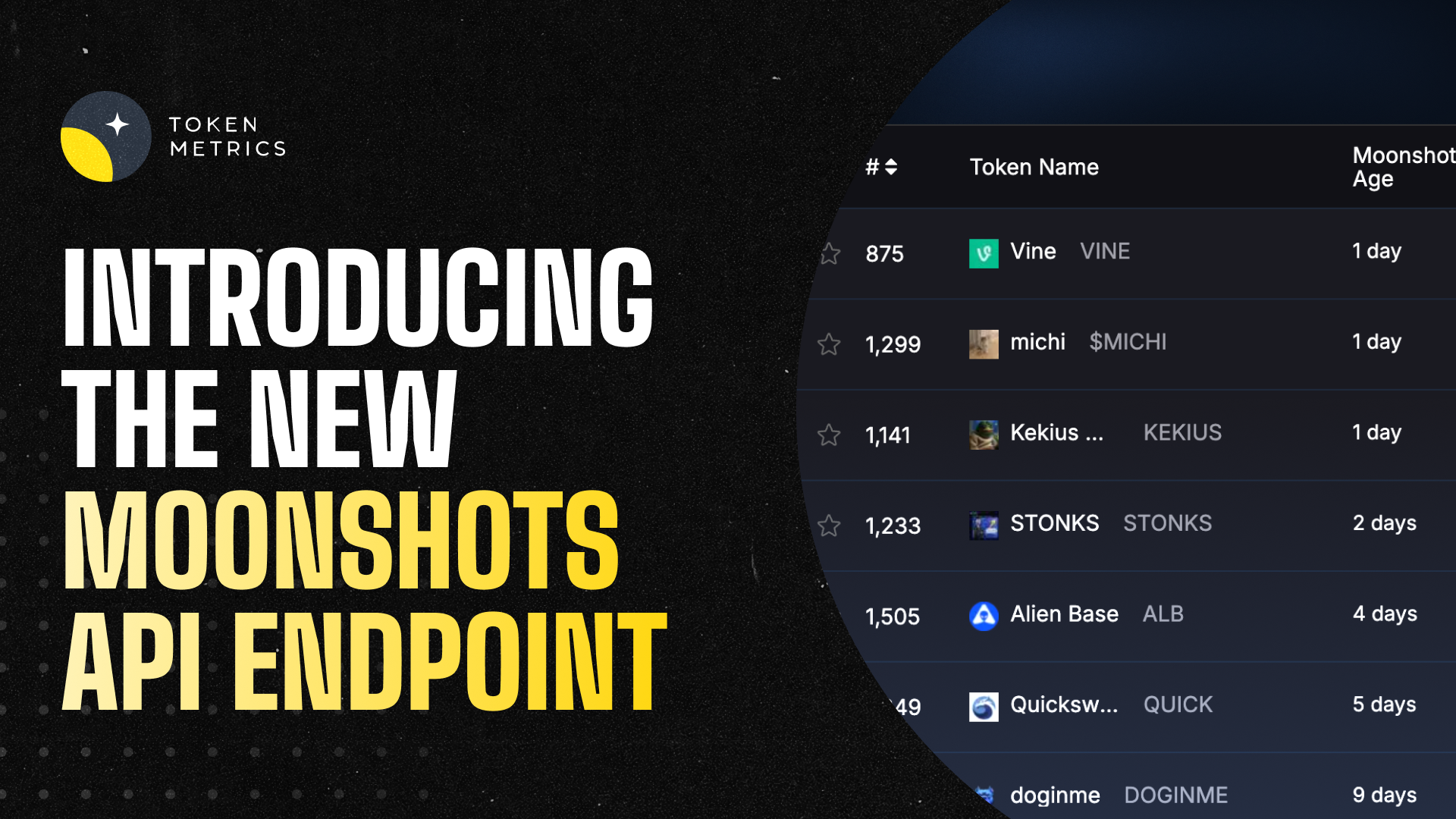
Big news: We’re cranking up the heat on AI-driven crypto analytics with the launch of the Token Metrics API and our official SDK (Software Development Kit). This isn’t just an upgrade – it's a quantum leap, giving traders, hedge funds, developers, and institutions direct access to cutting-edge market intelligence, trading signals, and predictive analytics.

Crypto markets move fast, and having real-time, AI-powered insights can be the difference between catching the next big trend or getting left behind. Until now, traders and quants have been wrestling with scattered data, delayed reporting, and a lack of truly predictive analytics. Not anymore.

The Token Metrics API delivers 32+ high-performance endpoints packed with powerful AI-driven insights right into your lap, including:

  • Trading Signals: AI-driven buy/sell recommendations based on real-time market conditions.
  • Investor & Trader Grades: Our proprietary risk-adjusted scoring for assessing crypto assets.
  • Price Predictions: Machine learning-powered forecasts for multiple time frames.
  • Sentiment Analysis: Aggregated insights from social media, news, and market data.
  • Market Indicators: Advanced metrics, including correlation analysis, volatility trends, and macro-level market insights.

Getting started with the Token Metrics API is simple:

  1. Sign up at www.tokenmetrics.com/api
  2. Generate an API key and explore sample requests.
  3. Choose a tier–start with 50 free API calls/month, or stake TMAI tokens for premium access.
  4. Optionally–download the SDK, install it for your preferred programming language, and follow the provided setup guide.

At Token Metrics, we believe data should be decentralized, predictive, and actionable. 

The Token Metrics API & SDK bring next-gen AI-powered crypto intelligence to anyone looking to trade smarter, build better, and stay ahead of the curve. With our official SDK, developers can plug these insights into their own trading bots, dashboards, and research tools – no need to reinvent the wheel.

Research

Top Crypto Prime Brokers (2025): Best Institutional Trading & Settlement Platforms

Token Metrics Team
17 min read
  • If you’re an institution that needs multi-venue liquidity, off-exchange settlement, and integrated custody/financing, this guide ranks the top crypto prime brokers for 2025 based on scale, security posture, and product breadth.
  • Top picks: Coinbase Prime for integrated trading + qualified custody with negotiated fees; FalconX for deep liquidity and capital solutions across spot/derivatives; Anchorage Digital Prime for bank-regulated custody with prime services and derivatives access. (Coinbase)
  • Caveats: Pricing is often negotiated; availability and products vary by region and legal entity. Always verify coverage on the provider’s official pages before onboarding. (docs.cdp.coinbase.com)

Introduction: Why Prime Brokerage Matters in 2025

Institutional participation accelerated in 2025, and with it the need for crypto prime brokers that unify execution, financing, custody, and settlement while minimizing counterparty risk. The leading platforms now resemble capital-markets infrastructure: single-counterparty access to multi-venue liquidity, off-exchange settlement networks that keep assets in segregated custody, and derivatives rails to hedge risk. Solutions like Coinbase Prime, FalconX, and Anchorage Digital Prime illustrate this evolution, while settlement networks such as Copper ClearLoop reduce venue risk without slowing execution. (Coinbase)

Primary intent: commercial-investigational. This guide compares features, fees, regions, and tradeoffs, then maps use cases to the right providers—so teams can move from diligence to deployment with confidence.


Our Evaluation Methodology

SCORING_WEIGHTS (sum = 100):

  • Scale & Liquidity (25) – depth of venues/LPs, 24/7 execution, options/futures where applicable.
  • Security & Regulatory Posture (25) – qualified custody, bank licensing/registrations, segregation, insurance disclosures.
  • Product Breadth (15) – spot, OTC/RFQ, derivatives, financing, settlement networks.
  • Costs & Fees (10) – published or negotiated schedules, financing/borrow terms.
  • Connectivity & Tooling (10) – FIX/WebSocket APIs, OEMS/SOR, reporting.
  • Capital Efficiency (10) – cross-margin, off-exchange settlement, instant delegation.
  • Support & Service (5) – coverage windows, onboarding SLAs.

Verification approach: We relied on official product, pricing, docs, security, and status pages only. If a claim wasn’t verifiable on an official page, we omitted it. Last updated: November 2025.


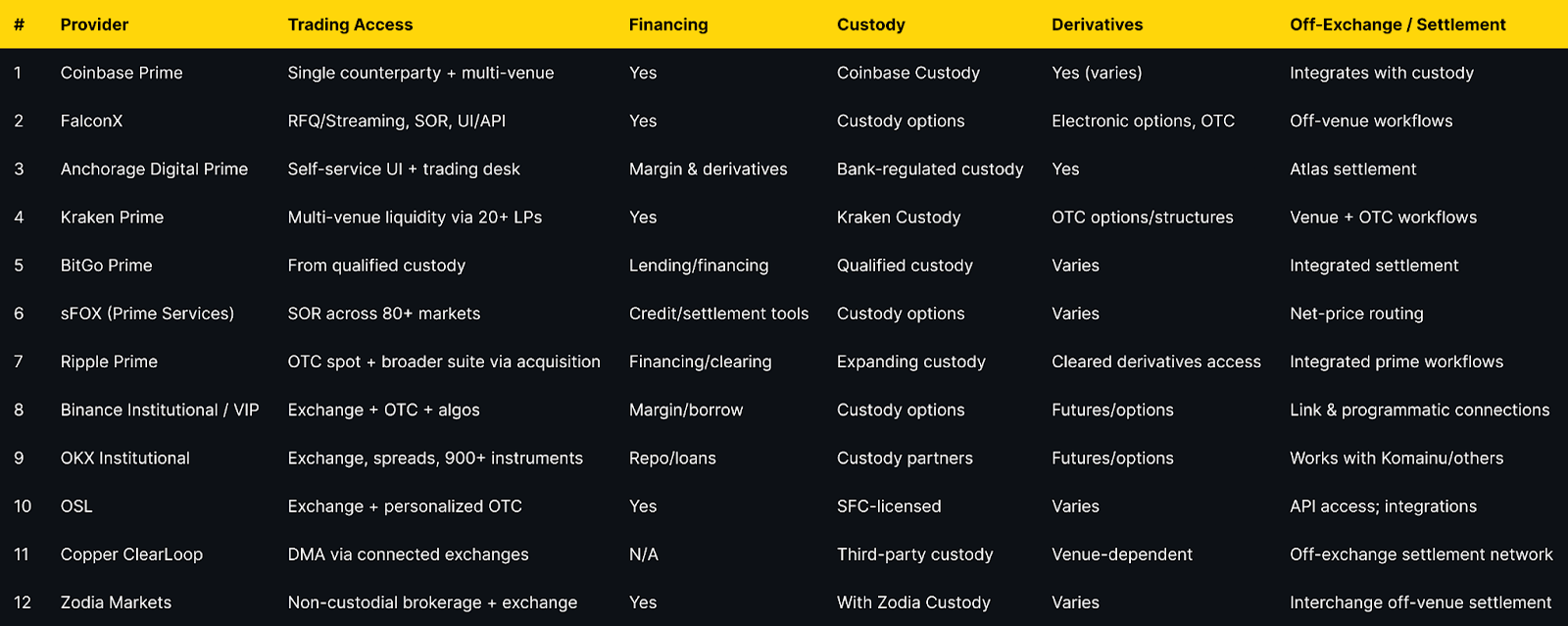
Crypto Prime Brokerage Comparison: At a Glance


Notes: “Pricing” reflects publicly stated models (often negotiated). “Regions/Notes” summarize official disclosures and licensing language where available on provider sites.


Detailed Provider Analysis

Coinbase Prime — Full-service prime brokerage at scale

Overview. Coinbase Prime combines trading, financing, and qualified custody under one institutional platform, with negotiated trading fees and flexible order denomination (base/quote). Execution integrates with reporting and controls suitable for asset managers and corporates. (Coinbase)
Ideal For. Asset managers, corporates/treasuries, hedge funds, RIAs.
Standout Features. Integrated custody; negotiated All-In / Cost-Plus fee models; staking fee schedules; institutional reporting. (docs.cdp.coinbase.com)
Pricing. Negotiated, fee currency = quote currency. (docs.cdp.coinbase.com)
Availability. Global, entity-dependent; product availability varies by jurisdiction.
Worth Noting. Some services require separate agreements (e.g., validators, derivatives access).
Alternatives to Consider. Kraken Prime, Anchorage Digital Prime. (Kraken)  


FalconX — Deep liquidity & capital solutions across markets

Overview. FalconX offers RFQ/streaming execution across spot and FX with FIX/WebSocket/REST connectivity, plus electronic options and capital solutions. Scale and 24/7 liquidity are central, with workflows for large tickets and programmatic strategies. (falconx.io)
Ideal For. Multi-strategy funds, HFT/systematic traders, market makers.
Standout Features. RFQ/streaming with TWAP/FOK; electronic options; FX desk integrated into prime; institutional APIs. (falconx.io)
Pricing. Negotiated; bespoke based on flow and venues.
Availability. Global institutional focus (entity-dependent).
Worth Noting. Derivatives access and product scope vary by entity/region.
Alternatives to Consider. Coinbase Prime, Kraken Prime. (Coinbase)  


Anchorage Digital Prime — Prime services on top of a US bank custodian

Overview. Anchorage Digital Prime delivers trading (13+ order types), derivatives, margin, and settlement built on Anchorage Digital Bank N.A. custody. A single interface and 24/7 trading desk support complex orders. (anchorage.com)
Ideal For. US-regulated custody requirements, governance-active institutions, corporates.
Standout Features. Bank-regulated custody; derivatives access; Atlas settlement; desk + API execution. (anchorage.com)
Pricing. Negotiated; service-by-entity.
Availability. US bank entity with global affiliates; services provided by specific Anchorage entities (see legal). (anchorage.com)
Worth Noting. Trading provided by separate non-bank entities; read entity-level disclosures. (anchorage.com)
Alternatives to Consider. BitGo Prime, Coinbase Prime. (The Digital Asset Infrastructure Company)  


Kraken Prime — Multi-venue liquidity with institutional fee tiers

Overview. Kraken Prime aggregates 20+ liquidity providers and offers smart order routing, OTC spot and OTC derivatives (options/structures), plus custody integrations. Institutional fee perks are published for high-volume clients. (Kraken)
Ideal For. Funds seeking published fee schedules, multi-venue execution, and OTC coverage.
Standout Features. Multi-venue liquidity; FIX 4.4 and WebSockets APIs; OTC desk; institutional taker tiers. (Kraken)
Pricing. Maker/taker schedule with institutional perks at very high volumes. (Kraken)
Availability. Global, entity-dependent.
Worth Noting. Some advanced services require qualification and separate onboarding.
Alternatives to Consider. sFOX, Coinbase Prime. (sFOX)


BitGo Prime — Prime services from qualified custody

Overview. BitGo integrates trading, financing, and settlement directly from custody, with segregated, bankruptcy-remote accounts and published insurance coverage details. (The Digital Asset Infrastructure Company)
Ideal For. Institutions prioritizing segregation and custody-first workflows.
Standout Features. Segregated accounts; insurance disclosures; custody-integrated prime trading. (The Digital Asset Infrastructure Company)
Pricing. Negotiated; custody/prime fees depend on assets and activity.
Availability. Global entities with varying regulatory regimes.
Worth Noting. Derivatives access varies by entity/partner networks.
Alternatives to Consider. Anchorage Digital Prime, Copper ClearLoop. (anchorage.com)


sFOX (Prime Services) — Agency SOR across 80+ markets with institutional tooling

Overview. sFOX acts as an agnostic agent routing across 80+ markets for best execution, with net-price routing and institutional reporting. The platform positions itself as a full-service prime dealer for institutions. (sFOX)
Ideal For. Systematic strategies, RIAs/allocators, corporates seeking agency execution.
Standout Features. SOR across venues; platform-level price improvement; custody options. (sFOX)
Pricing. Tiered/negotiated; historical content points to fee optimization via routing. (sFOX)
Availability. US/global entities; enterprise onboarding.
Worth Noting. Product scope (derivatives, margin) varies; confirm coverage.
Alternatives to Consider. Kraken Prime, Coinbase Prime. (Kraken)


Ripple Prime — Multi-asset prime brokerage under Ripple

Overview. Following the acquisition and subsequent close of Hidden Road, Ripple Prime offers U.S. spot OTC execution and positions Ripple as the first crypto company to own and operate a global, multi-asset prime broker; custody capabilities expanded further in late 2025. (Ripple)
Ideal For. Institutions seeking an integrated multi-asset prime platform with digital asset rails.
Standout Features. OTC spot execution (U.S.); multi-asset coverage; financing/clearing. (Ripple)
Pricing. Negotiated.
Availability. U.S. launch and global expansion via Ripple entities. (Ripple)
Worth Noting. Product availability differs by jurisdiction and entity.
Alternatives to Consider. FalconX, Coinbase Prime. (falconx.io)


Binance VIP & Institutional — Exchange liquidity, OTC & programmatic access

Overview. Binance’s institutional suite spans exchange, OTC RFQ, algos, and programmatic connectivity with VIP tiers. Coverage and eligibility depend on jurisdiction; Binance.US operates separately for U.S. clients. (binance.com)
Ideal For. Non-US teams wanting direct exchange liquidity with OTC tools.
Standout Features. VIP tiers, proof-of-reserves, OTC block trading. (binance.com)
Pricing. Exchange/VIP schedules; negotiated OTC.
Availability. Region-dependent; check supported regions. (binance.com)
Worth Noting. U.S. availability/routes differ; compliance and onboarding vary by entity.
Alternatives to Consider. OKX Institutional, OSL. (OKX)


OKX Institutional — Scale, instruments, and U.S. presence via OKX US

Overview. OKX highlights high uptime, 900+ instruments, and institutional connectivity. U.S. availability exists through OKX US with scope/policies noted in compliance disclosures. (OKX)
Ideal For. Proprietary firms and funds trading a broad instrument set with API access.
Standout Features. Nitro Spreads, derivatives suite, institutional support. (OKX)
Pricing. Exchange schedule + VIP; negotiated for blocks.
Availability. Global; US services via OKX US (scope varies). (OKX)
Worth Noting. Product availability and licensing differ by region.
Alternatives to Consider. Binance Institutional, Kraken Prime. (binance.com)


OSL — HK SFC-licensed exchange, custody & OTC

Overview. OSL provides a licensed Hong Kong platform spanning custody, exchange, and OTC brokerage for institutions, with dedicated coverage in the region. (osl.com)
Ideal For. APAC institutions needing SFC-regulated venue/custody.
Standout Features. SFC-licensed exchange; institutional API; custody with insurance positioning. (sfc.hk)
Pricing. Schedule/negotiated.
Availability. Hong Kong and supported regions; institutional focus.
Worth Noting. Product availability differs by license and region.
Alternatives to Consider. Zodia Markets, Coinbase Prime. (Zodia Markets)


Copper ClearLoop — Off-exchange settlement network (multi-custodial)

Overview. ClearLoop enables instant delegation to connected exchanges while assets remain in segregated custody—now supporting third-party custodians like BitGo and Komainu. (Copper)
Ideal For. Institutions prioritizing venue risk reduction and capital efficiency.
Standout Features. Multi-custodial support; instant asset delegation; network of venues/prime brokers. (Copper)
Pricing. Varies by participants and volumes.
Availability. Global network; coverage depends on participating venues/custodians.
Worth Noting. Not a full prime broker by itself; pairs well with custody/venues.
Alternatives to Consider. Zodia Interchange, Komainu Connect. (zodia-custody.com)


Zodia Markets + Zodia Custody Interchange — Non-custodial brokerage + off-venue settlement

Overview. Zodia Markets offers institutional brokerage/exchange with non-custodial design, while Zodia Custody’s Interchange provides off-venue settlement (OVS)—trade while assets remain in custody. Registrations span UK, Ireland, ADGM. (Zodia Markets)
Ideal For. Institutions wanting bank-backed governance and segregated settlement flows.
Standout Features. Non-custodial brokerage; Interchange OVS network; institutional registrations. (Zodia Markets)
Pricing. Negotiated.
Availability. UK/EU/MENA institutional coverage (entity-specific). (Zodia Markets)
Worth Noting. Product scope varies by entity and venue integrations.
Alternatives to Consider. OSL, Copper ClearLoop. (osl.com)


Choosing the Right Prime Broker: A Framework

  • Regulatory posture needed? If you require US bank-regulated custody, start with Anchorage Digital Prime. For Hong Kong, OSL’s SFC licensing is key. For UK/EU bank-backed governance with off-venue settlement, consider Zodia. (anchorage.com)
  • Execution style. For multi-venue aggregation and published fee tiers, Kraken Prime is strong; for RFQ/streaming with electronic options, FalconX leads. sFOX suits agency SOR across many markets. (Kraken)
  • Integrated custody + trading. Coinbase Prime and BitGo Prime minimize operational friction by tying trading to qualified custody. (Coinbase)
  • Venue-risk reduction. If you want to trade while assets remain in custody, evaluate Copper ClearLoop or Zodia Interchange (and Komainu Connect as a related model). (Copper)
  • Instrument breadth and scale. For vast exchange liquidity and institutional programs, Binance Institutional and OKX Institutional are at-scale options (region permitting). (binance.com)

Integrating Token Metrics Intelligence

  • Research phase: Use Token Metrics screeners and on-chain/technical indicators to identify pairs suitable for your mandate (beta targets, breadth, liquidity screens).
  • Execution phase: Route orders via your prime broker’s APIs (e.g., FIX/WebSocket) selected above, while TM signals inform aggression/passivity and time-of-day tactics. (Kraken)
  • Monitoring: Feed fills, slippage, and borrow/financing into TM analytics to assess venue performance and adjust routing.
  • Optimization: Combine TM factor views with prime-broker borrow/financing and settlement options (e.g., off-exchange) to lower VaR and operational risk.

Start a Token Metrics trial to bring quantitative screening and scenario analysis into your institutional workflow.  


Security & Compliance Guidelines

  • Prefer segregated, bankruptcy-remote custody and confirm insurance disclosures where published. (The Digital Asset Infrastructure Company)
  • If you need a US bank custodian, validate services by legal entity and read the provider’s disclosures. (anchorage.com)
  • Use off-exchange settlement networks to reduce exchange exposure during execution. (Copper)
  • Confirm derivatives eligibility, margin terms, and cross-margin/netting treatment by entity/venue. (Kraken)
  • Require API keys/roles with least-privilege, HSM custody, and mandatory allow-listing.
  • Maintain jurisdictional watchlists and restrict activity accordingly (e.g., US vs non-US entities for global exchanges). (OKX)

Compliance note: This article is for research/education, not financial advice.


Avoiding Common Mistakes

  • Treating “prime” as one product—coverage and legal entities differ by service.
  • Assuming off-exchange settlement is automatic—confirm network membership and supported venues. (Copper)
  • Onboarding to the wrong entity—read the jurisdictional disclosures. (anchorage.com)
  • Ignoring negotiated fees—request All-In vs Cost-Plus quotes. (docs.cdp.coinbase.com)
  • Skipping disaster-recovery testing—simulate exchange outage + settlement failover.
  • Under-documenting OMS/EMS changes—keep audit-ready change logs.

Frequently Asked Questions

What is a crypto prime broker?
 A provider that consolidates institutional trading, financing, custody, and settlement, often with multi-venue access and risk controls. Modern variants add off-exchange settlement so assets remain in custody during execution. (zodia-custody.com)

Do prime brokers publish fees?
 Often no—fees are negotiated based on volumes, products, and relationship tier. Some venues publish maker/taker schedules with institutional perks. (docs.cdp.coinbase.com)

How does off-exchange settlement work?
 Networks like ClearLoop and Interchange let you delegate assets to venues for trading while keeping them in segregated custody, reducing counterparty risk. (Copper)

Which providers are strongest for regulated custody?
 Anchorage Digital Prime (US bank custody), BitGo (qualified custody), OSL (HK SFC-licensed custody/exchange), and Zodia (bank-backed with EU/UK registrations). (anchorage.com)

Can U.S. institutions use OKX or Binance?
 Access is region-dependent and varies by entity (e.g., OKX US scope). U.S. clients typically cannot use Binance.com and instead must evaluate Binance.US or other U.S.-eligible routes. Always check official disclosures. (OKX)


Final Recommendations

For most global institutions, a two-stack works best: (1) an integrated prime broker with qualified custody (Coinbase Prime, Anchorage Digital Prime, or BitGo Prime) and (2) a venue-risk mitigator like Copper ClearLoop or Zodia Interchange. Execution-heavy funds should add FalconX or Kraken Prime for multi-venue and OTC derivatives coverage, while OSL anchors APAC/HK mandates and OKX/Binance expand exchange reach where eligible. (Coinbase)

Related Resources:

Research

Best Yield Marketplaces for Real-World Assets (RWAs) in 2025

Token Metrics Team
29 min read
  • What this guide covers: A comprehensive evaluation of 10 leading platforms that enable tokenized real-world asset trading and yield generation across private credit, treasuries, real estate, and structured finance
  • Quick verdict: Ondo Finance for institutional-grade treasury exposure at ~5% APY, Maple Finance for crypto-collateralized credit facilities delivering 9-12% net yields, Goldfinch Prime for diversified access to private credit funds from Apollo and Ares
  • One key limitation to know: Many RWA platforms enforce strict accreditation requirements (minimum $50K-200K) and geographic restrictions, particularly excluding US investors from certain products due to securities regulations

Why Yield Marketplaces for RWAs Matter in January 2025

The real-world asset tokenization market has experienced explosive growth, surging from $85 million in April 2020 to over $25 billion by mid-2025—representing a staggering 245-fold increase driven primarily by institutional demand for yield, transparency, and regulatory clarity. Private credit dominates at approximately 61% of total tokenized assets, followed by treasuries at 30%, with major asset managers like BlackRock, Apollo, and Franklin Templeton now actively tokenizing institutional-grade products.

The convergence of traditional finance and decentralized infrastructure has created unprecedented opportunities for investors seeking stable, real-world yields without exposure to cryptocurrency volatility. The tokenized RWA market is projected to reach between $9.43 trillion and $18.9 trillion by 2030, with regulatory frameworks in Singapore, Hong Kong, and Dubai providing clear pathways for compliant innovation.

For crypto-native investors, RWA yield marketplaces offer a critical bridge to sustainable income streams backed by productive assets rather than purely speculative token emissions. Traditional allocators gain 24/7 access to fractional ownership, instant settlement, and programmable compliance—advantages impossible in legacy financial infrastructure.


How We Evaluated These Providers

We assessed platforms across six weighted criteria totaling 100 points:

  • Yield Quality & Sustainability (30%): Consistency of returns, asset backing, historical performance, and correlation to traditional markets
  • Security & Risk Management (25%): Custody solutions, audit history, legal recourse, collateralization ratios, and default handling protocols
  • Asset Coverage & Diversity (15%): Range of underlying assets, tranching options, and exposure across credit curves
  • Accessibility & Costs (15%): Minimum investments, fee structures, geographic availability, and KYC requirements
  • Liquidity & Redemption (10%): Secondary market depth, withdrawal timelines, and tokenization standards
  • Infrastructure & Compliance (5%): Regulatory licenses, blockchain integrations, and institutional partnerships

Data sources: Official platform documentation, on-chain analytics from RWA.xyz and DeFiLlama, third-party audits, and regulatory filings. Research conducted October 2024-January 2025.

Verification approach: Every fee structure, yield figure, and regional restriction cited was verified on official platform pages or regulatory disclosures. Unverifiable claims were excluded.


The Contenders: Quick Comparison  

Provider Reviews by Use Case

For Treasury-Backed Stability (4-5% Yield)

Top Pick: Ondo Finance — Institutional Treasury Tokenization Pioneer

Overview
 Ondo Finance manages over $1.6 billion in tokenized assets, offering institutional-grade access to US Treasury exposure through OUSG (backed by BlackRock's BUIDL fund) and USDY (a yield-bearing stablecoin). The platform bridges TradFi stability with DeFi composability through multi-chain deployment across Ethereum, Solana, Base, and XRP Ledger.

Ideal For

  • Institutional allocators seeking low-volatility dollar exposure
  • DeFi protocols requiring yield-bearing collateral
  • Treasuries managing idle stablecoin holdings
  • Investors prioritizing regulatory compliance and brand-name backing

Standout Features

  • Approximately 5% APY from short-term US Treasuries with daily interest payouts via rebasing mechanism
  • Integration with Ripple's RLUSD stablecoin for instant minting and redemption 24/7
  • Comprehensive SEC-registered infrastructure through acquisition of Oasis Pro, including broker-dealer, ATS, and transfer agent licenses
  • Strategic partnerships including anchor position in Fidelity's FDIT tokenized money market fund and launch of Ondo Global Markets for tokenized equities

Pricing
 Management fees embedded in net yield; typical 0.15-0.30% annual fee depending on product. OUSG requires $100K minimum; USDY accessible at lower thresholds with 4.29% APY.

Availability
 Global except US persons for certain products. Ethereum, Solana, Polygon, Aptos, Sei, Base, XRP Ledger, and Sui supported.

Worth Noting
 OUSG designed for qualified purchasers with extended lockup periods; less suitable for retail or high-frequency traders. Platform prioritizes institutional relationships over retail accessibility.

Alternatives to Consider: Franklin Templeton BENJI, OpenEden TBILL  


Runner-Up: Franklin Templeton BENJI — Legacy Asset Manager Innovation

Overview
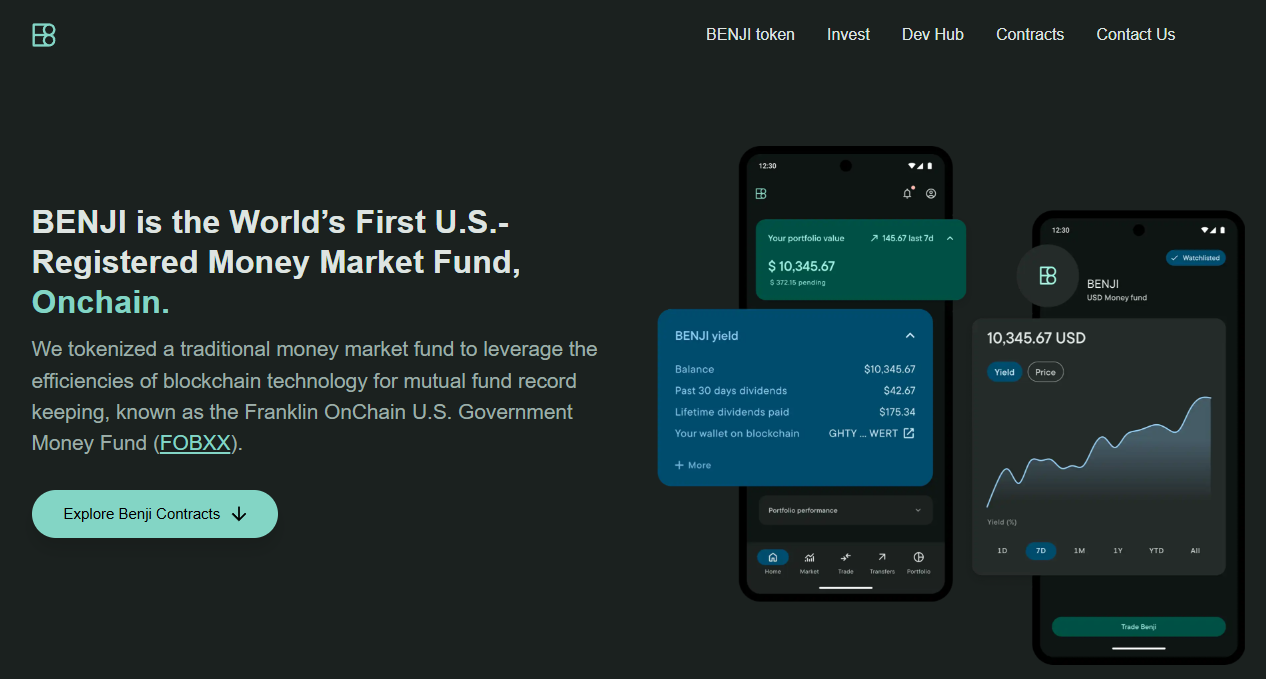
 Franklin Templeton's $775 million Franklin OnChain U.S. Government Money Fund (BENJI) pioneered tokenized mutual funds in 2021, offering exposure to US government securities across eight blockchains with patent-pending intraday yield calculation.

Ideal For

  • Investors seeking regulated 40 Act fund structure
  • Collateral managers requiring second-by-second yield accrual
  • Multi-chain strategies needing broad blockchain compatibility
  • Users prioritizing traditional asset manager credibility

Standout Features

  • Intraday yield tracking down to the second, enabling proportional earnings even for partial-day holdings
  • Direct stablecoin purchases and redemptions with wallet-to-wallet transfer capability
  • 63% of AUM deployed on Stellar Network for optimal cost efficiency
  • Integrated with DeFi protocols for collateral and leverage applications

Pricing
 7-day current yield approximately 4.5-5.5% gross; 0.25% management fee. No minimum investment restrictions beyond standard mutual fund requirements.

Availability
 Global availability with specific KYC requirements. Active on Stellar, Ethereum, Arbitrum, Base, Avalanche, Polygon, Aptos, Solana, BNB Chain.

Worth Noting
 Traditional mutual fund constraints apply including daily NAV calculations and potential redemption delays during market stress.

Alternatives to Consider: Backed bIB01, Superstate Short Duration Government Securities  


For Institutional Credit Exposure (8-12% Yield)

Top Pick: Maple Finance — Premier Crypto-Collateralized Lending

Overview
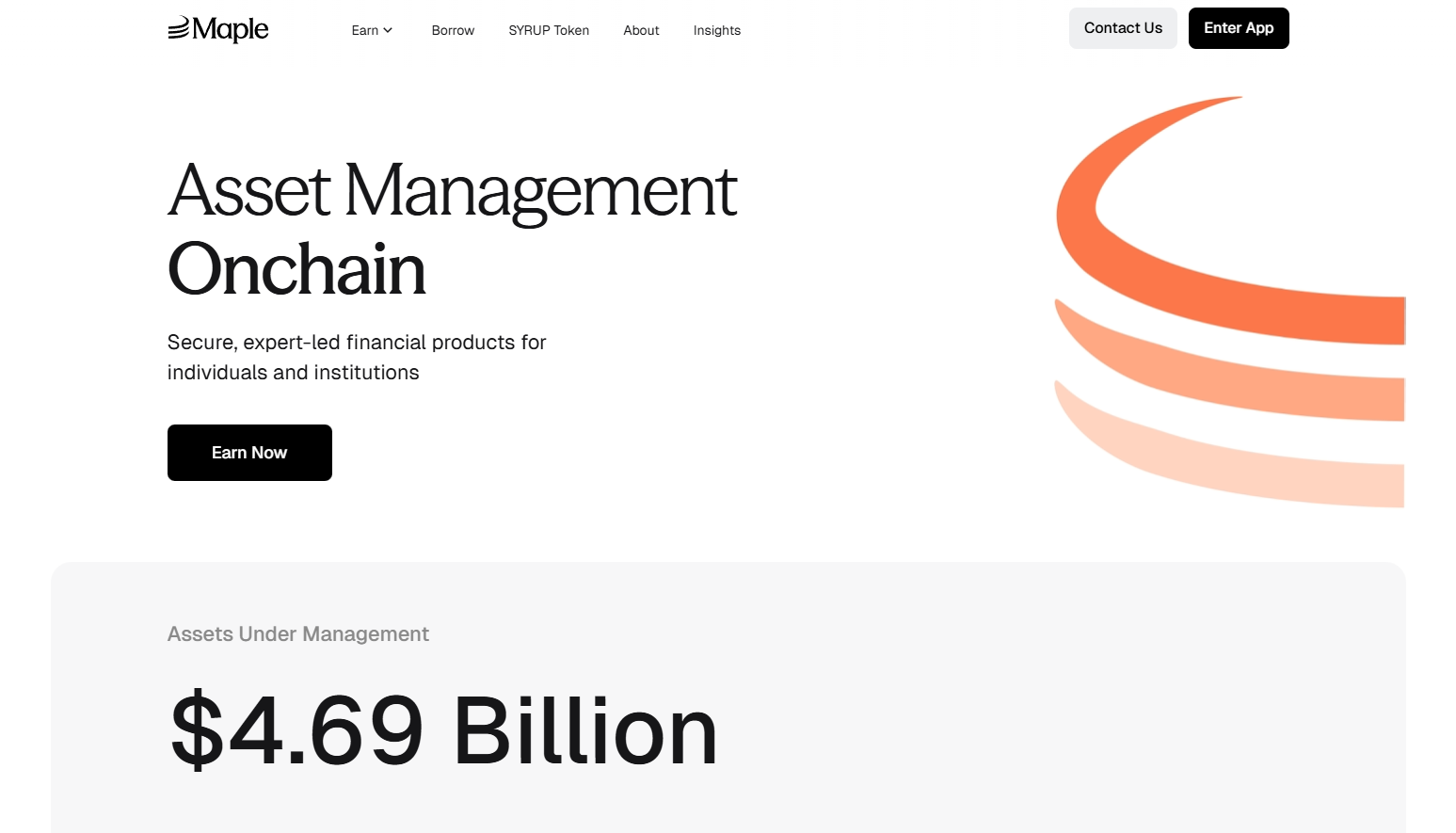
 Maple Finance manages over $4 billion in assets, specializing in institutional over-collateralized lending backed by Bitcoin, Ethereum, Solana, and XRP, targeting $100 billion in annual loan volume by 2030. The platform introduced SyrupUSDC for permissionless retail access alongside KYC-gated institutional pools.

Ideal For

  • Institutional lenders seeking exposure to cryptocurrency-backed credit
  • Liquidity providers comfortable with smart contract risk
  • Allocators targeting floating-rate, senior-secured structures
  • Investors seeking alternatives to traditional stablecoin farming

Standout Features

  • Consistent 9-12% net yields through undercollateralized institutional facilities and structured credit products
  • Strategic integration with Aave's $40 billion protocol bringing syrupUSDT to Plasma instance and syrupUSDC to core markets
  • Partnerships with Bitwise, Lido Finance (stETH-backed credit lines), and EtherFi (weETH collateral) expanding institutional adoption
  • Robust risk management combining decades of TradFi expertise with real-time on-chain monitoring

Pricing
 Variable by pool; typical effective yields 9-12% after protocol fees. Minimum investments pool-dependent, generally $10K-$50K for retail syrup products.

Availability
 Global with KYC requirements for lending. Institutional Maple requires accreditation; Syrup.fi open to broader participants.

Worth Noting
 Platform transitioned from uncollateralized to over-collateralized model after 2022 market turmoil. Historical defaults impacted certain pools; robust recovery mechanisms now in place.

Alternatives to Consider: Credix (emerging markets), TrueFi (uncollateralized DeFi)  


Runner-Up: Goldfinch Prime — Institutional Private Credit Access

Overview
 Goldfinch Prime aggregates exposure to multi-billion dollar private credit funds from Ares, Apollo, Golub Capital, and KKR, providing on-chain access to institutional-grade senior secured loans with over $1 trillion in collective AUM.

Ideal For

  • Non-US investors seeking diversified private credit exposure
  • Allocators targeting institutional fund performance without direct fund access
  • Participants seeking uncorrelated yield to crypto markets
  • Investors comfortable with longer lockup periods

Standout Features

  • Exposure to 1000+ senior secured loans across industries through vetted fund managers with 10+ years experience
  • Target returns of 9-12% net of fees with strict eligibility criteria including >90% senior secured portfolios and <0.75% target non-accrual rates
  • Heron Finance manages fund selection and vetting while fund managers handle all underwriting and default resolution
  • USDC-based deposits converted to proportional GPRIME tokens for continuous offering structure

Pricing
 Net yields 9-12% after embedded management fees and profit sharing. Minimum investments vary by pool structure; typically institutional minimums apply.

Availability
 Non-US persons only due to regulatory structure. KYC and accreditation verification required.

Worth Noting
 Exposure is indirect through fund shares rather than direct loan origination; fund managers absorb individual borrower default risk into aggregate yields. Liquidity limited compared to Treasury products.

Alternatives to Consider: Centrifuge private credit pools, Credix fintech lending


For Real Estate & Diversified Assets (6-10% Yield)

Top Pick: Centrifuge — Multi-Asset Tokenization Infrastructure

Overview
 Centrifuge operates as a multichain infrastructure platform enabling asset managers to tokenize real estate, trade finance, carbon credits, and structured credit with $1.2 billion TVL and recent 10x growth driven by the first on-chain CLO and tokenized S&P 500 index fund.

Ideal For

  • Investors seeking exposure to asset-backed securities beyond treasuries
  • Allocators comfortable evaluating tranched credit structures
  • Participants prioritizing transparency and on-chain asset verification
  • Portfolio managers wanting diversification across real-world credit types

Standout Features

  • Asset-agnostic architecture supporting structured credit, real estate mortgages, US treasuries, carbon credits, and consumer finance with full collateralization and legal recourse for investors
  • V3 platform enables cross-chain interoperability across Ethereum, Base, Arbitrum, Avalanche, BNB Chain, and Plume with integrated KYC and compliance-as-a-feature
  • Senior/junior tranche structures allowing risk-return customization
  • Partnership with Chronicle Labs for real-time price feeds and integration with Circle for USDC on/off-ramping

Pricing
 Yields vary by pool and tranche: typically 6-8% for senior tranches, 10-14% for junior tranches. Management fees embedded; pool-specific minimums apply.

Availability
 Global with KYC requirements. Pools may have additional jurisdictional restrictions based on underlying asset location.

Worth Noting
 Platform complexity requires understanding of tranched structures and asset-specific risks. Less liquid credit instruments offer less frequent pricing updates than treasury products.

Alternatives to Consider: RealT (US residential real estate focus), Republic (equity crowdfunding)

For Emerging Market Credit (12-18% Yield)

Top Pick: Credix — Latin American Fintech Lending

Overview
 Credix specializes in providing credit facilities to fintech lenders in Latin America, offering high-yield exposure to underserved credit markets with institutional-grade underwriting and local market expertise.

Ideal For

  • Sophisticated investors seeking higher risk-adjusted returns
  • Allocators comfortable with emerging market credit risk
  • Participants with extended investment horizons (12-24 months typical)
  • Investors seeking geographic diversification from US/EU markets

Standout Features

  • Target yields 12-18% reflecting emerging market risk premiums
  • Focus on fintech infrastructure enabling financial inclusion
  • Partnerships with established Latin American credit originators
  • Robust due diligence and monitoring of borrower networks

Pricing
 Pool-dependent yields typically 12-18% gross with management fees of 1-2%. Minimum investments generally $50K+ for accredited investors.

Availability
 Non-US persons primarily; requires accreditation verification and enhanced KYC given emerging market exposure.

Worth Noting
 Higher yields reflect higher credit and currency risk. Platform experienced challenges during regional economic volatility; enhanced risk controls now implemented.

Alternatives to Consider: Goldfinch V1 pools (emerging market focus), TrueFi uncollateralized pools


For Tokenization Infrastructure (Platform Providers)

Top Pick: Securitize — Industry-Leading Issuance Platform

Overview
 Securitize has tokenized over $4.5 billion in assets for 1.2 million investors across 3,000+ clients, operating as an SEC-registered transfer agent with integrated ATS for secondary trading. The platform powers major offerings including BlackRock's BUIDL fund.

Ideal For

  • Asset managers seeking turnkey tokenization solutions
  • Issuers requiring SEC-compliant digital security infrastructure
  • Institutional clients needing integrated custody and compliance
  • Projects prioritizing regulatory alignment and brand credibility

Standout Features

  • DS Protocol automates token issuance, transfer agent functions, and regulated secondary trading with $47 million funding led by BlackRock
  • Recent launch of STAC tokenized AAA CLO fund with BNY custody demonstrating institutional adoption trajectory
  • Comprehensive investor onboarding, KYC/AML, and reporting infrastructure
  • Partnerships with major asset managers and integration with Zero Hash for fiat conversion

Pricing
 Platform fees vary by issuance size and complexity; typically 0.5-2% of AUM plus basis point fees on transactions. White-label solutions available for enterprise clients.

Availability
 Global operations with jurisdiction-specific compliance modules. Primary focus on US, EU, and APAC institutional markets.

Worth Noting
 Securitize is an issuance platform rather than direct investment product; investors access opportunities through partner funds and offerings launched on the infrastructure.

Alternatives to Consider: Tokeny (EU-focused), Polymath/Polymesh (security token specialists)


Complete Provider Directory

  • Backed Finance: European MiCA-compliant tokenization platform offering bIB01 (Swiss government bond exposure) and bC3M (commodity basket). Strong focus on regulatory alignment with modest 3-5% yields and low entry barriers.
  • Swarm Markets: Decentralized platform enabling fractional ownership of real estate and private credit with $1K-$50K minimums. Emphasizes accessibility while maintaining compliance through distributed infrastructure.
  • TrueFi: Uncollateralized lending protocol using on-chain credit scoring and portfolio diversification. Higher risk-return profile (8-15% targets) with full transparency of borrower pools and performance metrics.
  • Archax: UK FCA-regulated platform for institutional tokenization of bonds, funds, and money markets. Focus on traditional finance compatibility with stringent accreditation requirements.

Making Your Selection: Key Questions

  • What yield stability do you require?
     Treasury-backed platforms (Ondo, Franklin Templeton) offer predictable 4-5% returns with minimal volatility. Credit-focused platforms (Maple, Goldfinch) target 9-12% but introduce credit risk and performance variability.
  • What is your risk tolerance for underlying collateral?
     Government securities provide lowest risk; over-collateralized crypto loans add smart contract and liquidation risks; uncollateralized emerging market credit carries highest default potential.
  • Do you meet accreditation and minimum investment thresholds?
     Many institutional products require $50K-$200K minimums and qualified purchaser status. Retail-accessible options like USDY and syrupUSDC lower barriers but may sacrifice yield.
  • What liquidity do you need?
     Treasury tokens generally offer daily liquidity; private credit pools may have quarterly redemption windows; real estate tokenization can involve 12-24 month lockups.
  • How important is regulatory compliance?
     Platforms like Ondo, Franklin Templeton, and Securitize prioritize SEC registration and traditional fund structures. Purely DeFi-native protocols offer less regulatory clarity but greater composability.
  • What blockchain ecosystems do you operate in?
     Multi-chain deployment (Ondo, Centrifuge) provides flexibility; single-chain specialization (some Maple pools) may offer optimization but limits interoperability.
  • Do you have geographic restrictions?
     US persons often excluded from highest-yield opportunities due to securities laws. European investors benefit from MiCA framework; APAC sees growing regulatory clarity.
  • What level of transparency do you require?
     On-chain native protocols offer real-time asset verification; hybrid models may rely on periodic attestations and third-party audits.
  • Are you seeking passive income or active yield strategies?
     Treasury staking provides set-and-forget returns; DeFi integrations enable leverage, collateral strategies, and yield optimization requiring active management.
  • How much operational complexity can you handle?
     Single-platform solutions simplify but limit optionality; multi-protocol strategies maximize returns but require gas management, tax tracking, and security across multiple platforms.

Maximizing Your Setup with Token Metrics

Token Metrics provides critical intelligence for navigating RWA yield opportunities through data-driven analysis and market insights.

Research Phase: Leverage Token Metrics' fundamental analysis to evaluate tokenized asset protocols, comparing on-chain metrics, TVL trends, and yield sustainability indicators. Our RWA sector reports identify emerging platforms and highlight regulatory developments across jurisdictions.

Portfolio Construction: Use quantitative scoring to allocate across risk tiers—balancing stable treasury exposure with higher-yield credit products. Token Metrics' portfolio tools help optimize diversification while monitoring correlation to traditional crypto markets.

Ongoing Monitoring: Real-time alerts notify you of yield changes, protocol upgrades, and risk events. Our dashboard aggregates performance across multiple RWA platforms, tracking your yield-bearing positions alongside broader cryptocurrency holdings.

Risk Management: Token Metrics' risk analytics assess smart contract security, custody arrangements, and counterparty exposure. Our reports flag platforms with concerning yield sustainability metrics or operational red flags before they impact your capital.

Start your Token Metrics free trial to access institutional-grade RWA research and optimize your real-world asset allocation.  


Essential Security Practices

  • Custody Verification: Confirm that platforms use institutional-grade custodians (Coinbase Custody, BitGo, Fireblocks) for underlying assets. Verify proof-of-reserve attestations and third-party audits.
  • Smart Contract Risk: Review audit reports from reputable firms (Trail of Bits, OpenZeppelin, Certora). Understand upgrade mechanisms and timelock protections on protocol contracts.
  • Legal Structure Assessment: Examine SPV formation, bankruptcy remoteness, and investor recourse mechanisms. Ensure tokenization structure provides actual legal claim on underlying assets, not just economic exposure.
  • Regulatory Compliance: Verify platforms maintain necessary licenses (broker-dealer, transfer agent, ATS) in relevant jurisdictions. Confirm offerings comply with securities laws in your domicile.
  • Counterparty Risk: Understand who services loans, manages defaults, and handles liquidations. Evaluate track records of asset originators and credit underwriters.
  • Liquidity Risk Management: Never allocate more than you can afford to lock up for stated redemption periods. Maintain buffer capital for market volatility and potential redemption delays.
  • Tax Implications: Consult tax professionals on treatment of tokenized yield—may be classified as interest income, dividends, or capital gains depending on structure and jurisdiction.
  • Geographic Restrictions: Verify you're eligible to participate based on residency. Using VPNs or misrepresenting location can result in frozen funds and legal liability.
  • Platform Concentration: Diversify across multiple RWA providers to reduce single-point-of-failure risk. No single platform should represent majority of yield allocation.
  • Documentation: Maintain records of all transactions, yield distributions, and platform communications for tax reporting and potential disputes.

This article is for research and educational purposes, not financial advice. RWA investments carry risks including loss of principal.


What to Avoid

  • Ignoring minimum holding periods: Many RWA products enforce lockups or redemption windows. Treating them as liquid positions can leave you unable to access capital when needed.
  • Chasing unsustainably high yields: Promised returns significantly above market rates often indicate excessive risk. Verify underlying asset performance and historical consistency before committing capital.
  • Overlooking platform liquidity: Token existence on-chain doesn't guarantee exit liquidity. Check secondary market depth and historical spread between minting and redemption prices.
  • Neglecting jurisdictional compliance: Accessing platforms not available in your region can result in frozen accounts and regulatory penalties. Always verify eligibility before depositing funds.
  • Underestimating smart contract risk: Even well-audited protocols face exploitation risk. Size positions appropriately and monitor security incident disclosures across the ecosystem.
  • Failing to verify asset backing: Don't rely on marketing claims. Demand proof-of-reserve, third-party attestations, and transparent reporting on underlying collateral.
  • Concentrating in single asset class: Over-allocating to one RWA category (e.g., all private credit) eliminates diversification benefits. Balance across treasuries, credit, and real estate where possible.
  • Ignoring fee structures: Management fees, performance fees, and transaction costs compound over time. Calculate net yields after all costs when comparing platforms.

Reader Questions Answered

What's the difference between tokenized treasuries and yield-bearing stablecoins?

 Tokenized treasuries (like OUSG) represent direct ownership of US Treasury securities with yield passed through to holders. Yield-bearing stablecoins (like USDY) maintain $1 peg while distributing treasury yields via rebasing or airdrops. Treasuries may fluctuate slightly with NAV; yield stablecoins prioritize price stability.

Are RWA yields taxable differently than crypto staking rewards?

 Likely yes, though tax treatment varies by jurisdiction. RWA yields from treasuries or credit facilities often classified as interest income taxed at ordinary rates. Crypto staking may be treated as income at receipt or capital gains at sale depending on location. Consult tax professionals for specific guidance.

Can I use tokenized RWAs as collateral in DeFi protocols?

 Increasingly yes. Platforms like Maple, Ondo (via Flux Finance), and Centrifuge enable using tokenized assets as DeFi collateral. However, support varies by protocol and asset—USDY and OUSG see broader integration than niche real estate tokens. Liquidation risks apply if collateral value drops.

What happens if the platform goes bankrupt?

 Properly structured tokenization isolates assets in bankruptcy-remote SPVs, protecting investor claims even if platform operator fails. However, redemption processes may be delayed and require legal navigation. This is why verifying legal structure and custodial arrangements is critical.

How liquid are RWA tokens compared to stablecoins?

 Significantly less liquid. While stablecoins have billions in daily DEX volume, most RWA tokens trade thinly or only through platform-controlled redemption mechanisms. Treasury tokens offer better liquidity than private credit or real estate, but all lag traditional stablecoins substantially.

Do I need to be an accredited investor?

 Depends on the platform and your location. US-based offerings often require accreditation; international platforms may have lower barriers. Products like USDY, syrupUSDC, and BENJI target broader accessibility, while institutional credit pools restrict to qualified purchasers.

What are the main risks that could cause loss of principal?

 (1) Underlying asset default (credit risk), (2) smart contract exploitation, (3) platform insolvency without proper asset segregation, (4) regulatory action freezing operations, (5) stablecoin de-pegging for yield products denominated in USDC/USDT, (6) liquidation cascades in collateralized structures.

How do yields compare to traditional finance alternatives?

 Tokenized treasuries (4-5%) match conventional money market funds but with 24/7 access. Private credit RWAs (9-12%) offer premiums over corporate bonds due to illiquidity and platform novelty. Emerging market RWA yields (12-18%) comparable to EM debt funds with added smart contract risk.


Bottom Line

Real-world asset yield marketplaces represent the maturation of blockchain infrastructure beyond speculation into productive finance. For investors seeking stable, asset-backed returns uncorrelated to cryptocurrency volatility, platforms like Ondo Finance and Franklin Templeton deliver institutional-grade treasury exposure with DeFi composability. Those comfortable with credit risk can access superior yields through Maple Finance's collateralized institutional lending or Goldfinch Prime's diversified private credit exposure.

The key to success: match platform selection to your specific risk tolerance, liquidity needs, and regulatory constraints. Treasury products suit conservative allocators prioritizing capital preservation; credit platforms reward investors accepting higher risk for enhanced returns; multi-asset infrastructure like Centrifuge offers diversification across real-world credit types.

Start with smaller allocations to understand platform mechanics, redemption processes, and yield consistency before committing substantial capital. The RWA sector's rapid growth will continue creating opportunities, but also attracting lower-quality offerings—due diligence remains paramount.

Related Resources:


About This Research

Methodology: This guide evaluated 20+ RWA platforms through analysis of official documentation, on-chain data, regulatory filings, and third-party audits. Platforms selected represent meaningful TVL (>$100M), regulatory compliance, and operational track record. Final selection prioritized diversity across asset classes and investor accessibility tiers.

Research Sources:

  • Ondo Finance: Product documentation, tokenomics, OUSG/USDY specifications, Oasis Pro acquisition disclosure
  • Maple Finance: Platform whitepaper, syrupUSDC mechanics, Aave integration announcement, CEO interviews
  • Centrifuge: V3 technical documentation, pool analytics, Republic partnership details
  • Goldfinch: Prime pool specifications, fund manager criteria, Heron Finance structure
  • Franklin Templeton: BENJI platform technical details, intraday yield patent documentation, multi-chain deployment
  • Securitize: DS Protocol documentation, STAC fund launch details, BlackRock partnership announcements
  • RWA.xyz: Platform TVL data, tokenization metrics, market growth analysis
  • DeFiLlama: Protocol TVL tracking, historical performance data
  • BCG/Ripple: RWA market projections and industry research
  • VanEck, Coinbase, Binance: Sector research reports on RWA growth trajectories

All data current as of January 2025. Platform features and yields subject to change; verify current terms on official websites before investing.

Research

Top Gold & Commodity-Backed Tokens (2025)

Token Metrics Team
12 min read

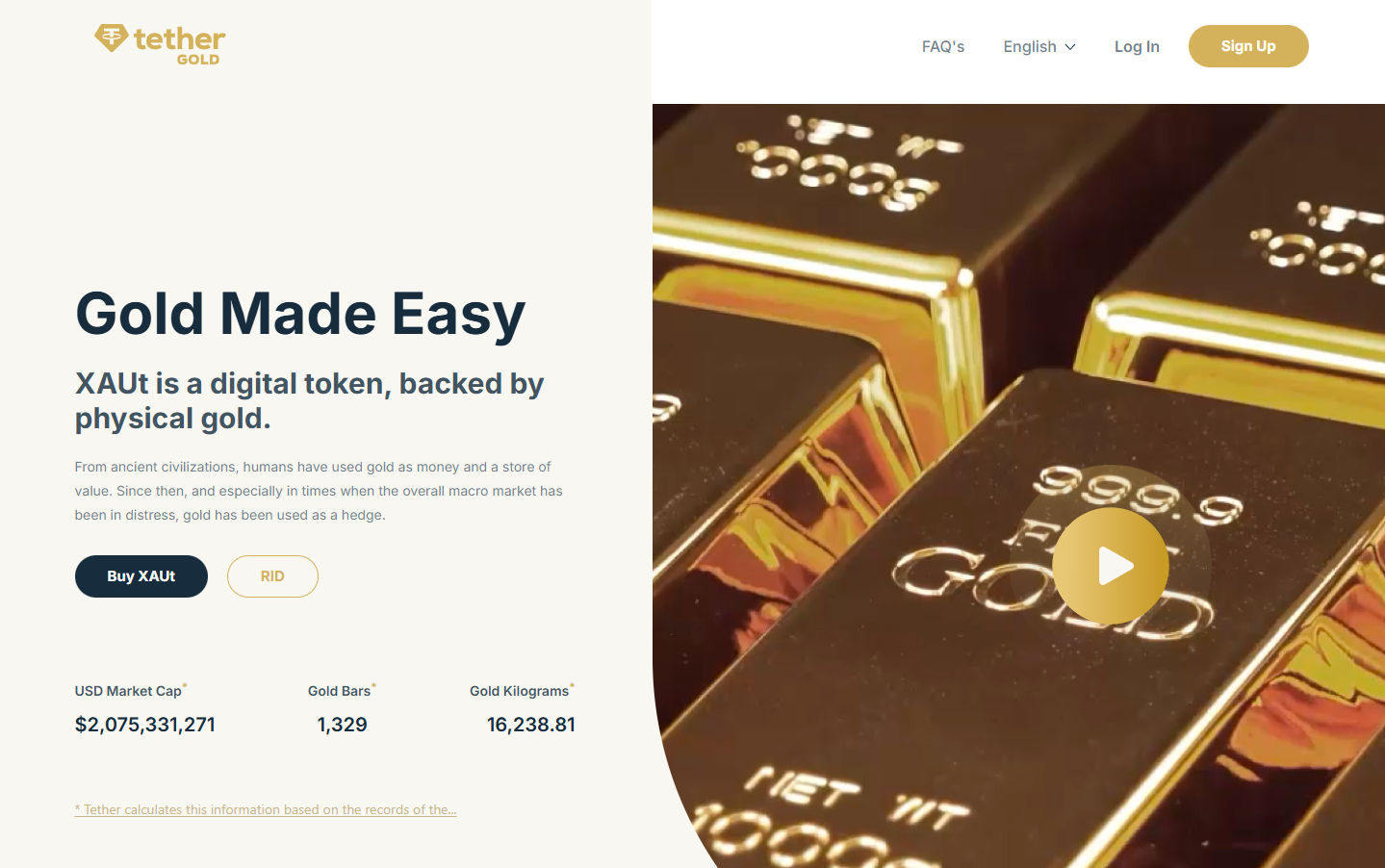
Who this guide is for. Crypto investors and treasurers comparing gold-backed tokens and other commodity-backed assets that can be audited and, in many cases, redeemed for metal.
Top three picks. PAX Gold (PAXG) for regulated, bar-linked redemption; Tether Gold (XAUt) for broad awareness and simple fees; Kinesis (KAU/KAG) for spend-and-yield use cases.
Key caveat. Redemption minimums, custody locations, and fees vary by issuer; always confirm regional eligibility and schedules on the official pages.


Introduction: Why Commodity-Backed Tokens Matter in 2025

Gold-backed tokens give on-chain ownership exposure to vaulted bullion with transparent allocation and, often, physical redemption, blending the inflation hedge of metals with crypto liquidity. In 2025, they’re used for hedging, collateral, cross-border settlement, and “digital cash” backed by tangible assets. A commodity-backed token is a blockchain token that represents title to a specific quantity of a real-world commodity (for example, 1 troy ounce or 1 gram of gold) held by a custodian, typically with published fees, vault locations, and redemption rules. Our picks prioritize liquidity, security controls, breadth of metals, cost transparency, and global accessibility.


Best Commodity-Backed Tokens in November 2025 (Comparison Table)


We excluded defunct or sunset projects (e.g., PMGT; CACHE Gold ceased backing CGT on Sept 30, 2025). (perthmint.com)


Top 10 Gold & Commodity-Backed Tokens in November 2025

1) PAX Gold (PAXG) — Best for bar-linked redemption & regulatory posture

Why Use It. PAXG links each token to specific LBMA Good Delivery bars stored in London, offering direct bar redemption (institutional minimums apply) or USD redemption at spot. Paxos publishes fee schedules and notes no storage fee charged to customers at this time. (paxos.com)
Best For. Institutions; HNW hedgers; DeFi users needing reputable collateral.
Notable Features. LBMA bars; serial-number linkage; custodied in London; fiat redemption option. (paxos.com)
Fees Notes. Creation/destruction fees; no storage fee currently per issuer help center. (help.paxos.com)
Regions. Global (issuer KYC).
Consider If. You can meet bar redemption minimums and UK vault logistics. (help.paxos.com)
Alternatives. Tether Gold (XAUt); VNX Gold (VNXAU).  


2) Tether Gold (XAUt) — Best for simple pricing & broad availability

Why Use It. XAUt represents allocated gold and can be redeemed for physical gold or USD; Tether publishes a straightforward 0.25% creation/redemption fee and a one-time verification fee for onboarding. FAQs outline redemption mechanics and bar specifics. (Tether)
Best For. Traders seeking brand familiarity; cross-chain users (ETH/TRON).
Notable Features. Bar metadata; physical or USD redemption; no custody fee disclosed beyond the transaction fee. (Tether)
Fees Notes. 25 bps create/redeem; separate KYC verification fee. (Tether)
Regions. Global (issuer KYC).
Consider If. You need clear fee math but don’t require bar-specific allocation like PAXG.
Alternatives. PAX Gold (PAXG); Kinesis (KAU).  


3) Kinesis KAU (Gold) / KAG (Silver) — Best for spend-and-yield utility

Why Use It. Kinesis combines metal-backed tokens with an exchange, cards, and yields funded from platform fees (published yield-share). Trading and precious metals transactions show ~0.22% execution fees on official schedules. (Kinesis)
Best For. Users wanting to spend gold/silver, earn monthly yields, and keep fees predictable.
Notable Features. Fee-share yield (published); exchange, card rails; gold & silver pairs. (Kinesis)
Fees Notes. ~0.22% buy/sell/trade; other fees per schedule. (Kinesis)
Regions. Global (platform KYC/availability).
Consider If. You prefer an integrated platform over a standalone token.
Alternatives. VNX (VNXAU/VNXAG); Aurus (tXAU/tXAG).  


4) Comtech Gold (CGO) — Best for XDC ecosystem & Shariah-compliant framework

Why Use It. CGO tokenizes 1g gold units on the XDC (XRC-20) network, with a published fee structure for mint/redeem (0.50%), transfers (0.50%), and custody notes in FAQs. Documentation details creation/redemption and delivery fees. (comtechgold.com)
Best For. XDC builders; users needing Shariah-compliant structuring.
Notable Features. On-chain proofing; fee schedule; vault delivery options. (comtechgold.com)
Fees Notes. 0.50% mint/redeem; 0.50% transfer; custody terms disclosed. (comtechgold.com)
Regions. Global (issuer terms apply).
Consider If. You’re comfortable with XDC rails and issuer fee model.
Alternatives. PAXG; VNXAU.


5) VNX Gold (VNXAU) — Best for EEA vaulting & multi-chain issuance

Why Use It. VNXAU gives direct ownership of allocated bars stored in Liechtenstein with a public allocation lookup tool. VNX runs on Ethereum, Polygon, Q, and Solana, and has communications on redemption and delivery. (VNX)
Best For. EEA users; diversification across chains.
Notable Features. Allocation lookup by serial; segregated AAA-jurisdiction vault; multi-chain. (VNX)
Fees Notes. See VNX pricing and product pages for current schedules.
Regions. EEA emphasis; global availability varies by KYC.
Consider If. You want EEA custody and serial-level transparency.
Alternatives. PAXG; XAUt.


6) Aurus tGOLD (tXAU) / tSILVER (tXAG) — Best for gram-denominated multi-metal exposure

Why Use It. Aurus issues 1-gram tokens backed by vaulted gold and silver with insured, audited storage. tGOLD and tSILVER support multi-chain DeFi integrations and a mobile app, with ecosystem partners for mint/redeem. (AURUS)
Best For. DeFi users; small-denomination accumulation; multi-metal portfolios (includes platinum via tXPT).
Notable Features. 1g units; insured vaulted metals; app & dashboard; partner network. (AURUS)
Fees Notes. Exchange/network fees; issuer/partner fees may apply.
Regions. Global (partner KYC where required).
Consider If. You want gram-level flexibility and cross-chain access.
Alternatives. Kinesis; VNX.


7) Gold Silver Standard (AUS/AGS) — Best for Australia-based custody & simple redemption

Why Use It. Tokens AUS (gold) and AGS (silver) are backed by allocated bullion held in Australian high-security vaults with $0 storage and transfer at the issuer level and partner-facilitated redemptions. (goldsilverstandard.com)
Best For. AUD-centric investors; straightforward physical pickup/delivery via partners.
Notable Features. 1g linkage; local redemption via Ainslie partners; Australia-first focus. (goldsilverstandard.com)
Fees Notes. Issuer lists $0 storage/transfer; exchange and redemption partner fees may apply. (goldsilverstandard.com)
Regions. Australia focus; global varies.
Consider If. You need straightforward redemption in Australia.
Alternatives. PAXG; VNXAU.


8) VNX Silver (VNXAG) — Best for EEA silver allocation & transparency tools

Why Use It. VNXAG mirrors the VNXAU model for silver, backed by allocated metal with the same allocation lookup tooling and multi-chain issuance. (VNX)
Best For. EEA investors prioritizing silver in segregated storage.
Notable Features. Allocation lookup; EEA custody; multi-chain support. (VNX)
Fees Notes. See VNX site for current schedules.
Regions. EEA emphasis; global varies.
Consider If. You want EEA-vaulted silver with serial-level transparency.
Alternatives. KAG; tXAG.


9) VeraOne (VRO) — Best for euro-area buyers wanting 1-gram ERC-20

Why Use It. VRO is an ERC-20 token pegged to 1 gram of LBMA-standard gold, issued by a long-standing French precious-metal group; materials describe secured storage and regular audits. (VeraOne)
Best For. EU users; gram-based savings; euro on-ramps.
Notable Features. 1g linkage; audited storage; EU presence. (VeraOne)
Fees Notes. Issuer materials outline model; confirm current fees on site.
Regions. EU focus; global access varies.
Consider If. You want EU branding and ERC-20 simplicity.
Alternatives. PAXG; VNXAU.


10) AgAu — Best for Swiss custody & peer-to-peer design

Why Use It. AgAu outlines 1:1 backed gold and silver tokens with Swiss custody and a peer-to-peer payment focus; docs and reports describe convertibility and audited reserves. (agau.io)
Best For. Users seeking Swiss jurisdiction and payments-style UX.
Notable Features. Swiss issuer; P2P spend; audit & documents hub. (agau.io)
Fees Notes. See issuer documentation for fees and redemption steps.
Regions. Global (jurisdictional checks apply).
Consider If. You want Swiss custody with payments emphasis.
Alternatives. VNXAU; AUS.


Decision Guide: Best by Use Case

  • Regulated, bar-specific redemption: PAX Gold (PAXG). (paxos.com)
  • Simple fee schedule & brand familiarity: Tether Gold (XAUt). (Tether)
  • Spend metals + monthly fee-share yield: Kinesis (KAU/KAG). (Kinesis)
  • XDC network users: Comtech Gold (CGO). (comtechgold.com)
  • EEA custody & allocation lookup: VNX (VNXAU/VNXAG). (VNX)
  • Gram-based, multi-metal DeFi: Aurus (tXAU/tXAG). (AURUS)
  • Australia-centric custody & pickup: Gold Silver Standard (AUS/AGS). (goldsilverstandard.com)
  • EU 1-gram ERC-20: VeraOne (VRO). (VeraOne)
  • Swiss custody & P2P payments: AgAu. (agau.io)

How to Choose the Right Commodity-Backed Token (Checklist)

  • ☐ Region eligibility and KYC match your profile.
  • ☐ Underlying metal type and unit (ounce vs gram).
  • Redemption rules: minimums, delivery locations, timelines.
  • Custody: vault jurisdiction, insurer, LBMA accreditation.
  • Fee transparency: creation, redemption, storage, transfer, network.
  • Audit/attestation cadence and allocation lookup tools.
  • Chains supported and DeFi integration needs.
  • ☐ Support channels and documentation depth.
    Red flags: vague custody details, unclear redemption, or discontinued programs.

Use Token Metrics With Any Commodity-Backed Token

  • AI Ratings to screen metal-linked assets and related ecosystem tokens.


  • Narrative Detection to spot inflows to on-chain RWAs.
  • Portfolio Optimization to size metal exposure vs. crypto beta.
  • Alerts & Signals to time entries/exits around macro prints.
    Workflow: Research → Select issuer → Execute on-chain or via platform → Monitor with alerts.


CTA: Start free trial to screen assets and time entries with AI.  


Security & Compliance Tips

  • Use official issuer URLs only; beware look-alikes.
  • Confirm fee schedules and redemption procedures before buying. (Tether)
  • Verify vaulting jurisdiction and any bar-serial lookup tools. (VNX)
  • Mind network fees, bridge risks, and exchange withdrawal rules.
  • Keep custody keys secure; whitelist issuer addresses.
  • If staking or yielding, confirm source of yield and counterparty exposure. (Kinesis)
    This article is for research/education, not financial advice.

Beginner Mistakes to Avoid

  • Treating all metal tokens as equal—redemption and custody differ widely.
  • Ignoring region and KYC limits until you try to redeem.
  • Overlooking minimums (e.g., full LBMA bars vs. gram redemptions). (help.paxos.com)
  • Confusing defunct tokens with active ones (e.g., PMGT sunset; CGT backing ceased). (perthmint.com)
  • Forgetting network/transfer fees when arbitraging across chains.
  • Using unofficial contracts on the wrong chain.

How We Picked (Methodology & Scoring)
  • Liquidity — 30%. Exchange presence, on-chain activity, practical tradability.
  • Security — 25%. Custody details, audits/attestations, LBMA alignment, redemption design.
  • Coverage — 15%. Metals (gold/silver/platinum), chains, tooling.
  • Costs — 15%. Creation/redemption/storage/transfer and transparency of schedules.
  • UX — 10%. Apps, dashboards, redemption flows.
  • Support — 5%. Docs, status pages, human support.
    We relied on official product, docs, fees, FAQ, and disclosure pages, cross-checking market datasets only for context. Last updated November 2025.

FAQs

What are gold-backed tokens?
 They are blockchain tokens that represent ownership of a specific quantity of vaulted, insured gold, typically with published fees and, in some cases, physical redemption options.

Are gold-backed tokens safer than stablecoins?
 They can diversify away from fiat risk, but introduce custody and redemption dependencies. Safety depends on the issuer’s vaulting, audits, legal structure, and your ability to redeem.

What fees should I expect?
 Common fees include creation/redemption, possible storage, transfer, and network fees. Examples: XAUt lists 0.25% create/redeem; Paxos publishes creation/destruction fees and notes no storage fee currently. Always check the live schedules. (Tether)

Can I redeem tokens for a real gold bar?
 Some issuers support bar redemption with minimum sizes and location constraints (e.g., LBMA bar logistics in London for PAXG). Others support gram-level redemption via partners. (help.paxos.com)

Which chains are supported?
 Varies: PAXG (Ethereum), XAUt (Ethereum/TRON), VNX (Ethereum/Polygon/Q/Solana), Aurus (multi-chain), CGO (XDC), Kinesis (native + exchange listings). (paxos.com)

Are there discontinued tokens I should avoid?
 Yes. PMGT has been discontinued; CACHE Gold (CGT) ceased backing as of Sept 30, 2025. Verify project status before buying. (perthmint.com)


Conclusion + Related Reads

Choose PAXG for bar-linked redemption and strong disclosures, XAUt for simple fees and brand reach, or Kinesis if you want to spend metals and earn fee-share yields. For EEA vaulting with allocation lookup, VNX is compelling; for gram-based DeFi exposure, Aurus is versatile.

Related Reads:

Recent Posts

No Item Found
Research

How Do You Write a Smart Contract? A Complete Guide for 2025

Talha Ahmad
5 min

Smart contracts have revolutionized blockchain technology, enabling trustless, automated agreements that execute without intermediaries. As the foundation of decentralized finance (DeFi), NFT marketplaces, and countless blockchain applications, understanding how to write smart contracts has become an essential skill for developers and businesses alike. In 2025, smart contracts are changing industries like finance, supply chain, healthcare, and real estate by automating transactions with pinpoint accuracy and full transparency. This comprehensive guide walks you through everything you need to know to create, test, and deploy your first smart contract.

Understanding Smart Contracts: The Foundation

A "smart contract" is simply a program that runs on the Ethereum blockchain—a collection of code (its functions) and data (its state) that resides at a specific address on the Ethereum blockchain, representing a type of Ethereum account with a balance that can be the target of transactions but is not controlled by a user, instead deployed to the network and run as programmed.

Think of smart contracts as digital vending machines: you insert the correct input (like cryptocurrency), and if conditions are met, the contract automatically executes and delivers the output (like tokens, access rights, or recorded data). Smart contracts can define rules like a regular contract and automatically enforce them via the code, and cannot be deleted by default with interactions being irreversible.

The global smart contracts market is projected to reach $3.21 billion in 2025, growing from $2.63 billion in 2024, with a CAGR of 22%, demonstrating the explosive demand for this technology.

Step 1: Choose Your Blockchain Platform

Before writing your first smart contract, you need to select which blockchain network you'll build on. While Ethereum remains the most popular choice for smart contract development, several alternatives offer unique advantages:

Ethereum: The original and most widely-adopted smart contract platform, with the largest developer community and extensive tooling support. Ethereum uses Solidity as its primary programming language.

Binance Smart Chain (BSC): Offers faster transactions and lower fees than Ethereum while maintaining compatibility with Ethereum tools and languages.

Solana: Known for high-speed transactions and low costs, using Rust for smart contract development.

Polygon: A layer-2 scaling solution for Ethereum that provides faster, cheaper transactions while maintaining Ethereum compatibility.

For beginners, most US-based smart contracts today run on Ethereum mainnet or layer-2s like Arbitrum, Optimism, or Base, making Ethereum an excellent starting point.

Step 2: Set Up Your Development Environment

Set up a development environment that supports Ethereum smart contract deployment with popular options including Remix IDE, Truffle Suite, or development frameworks like Hardhat.

Essential Tools for Smart Contract Development:

Remix IDE: A web-based development environment perfect for beginners. No installation required—simply open your browser and start coding. Remix provides syntax highlighting, debugging tools, and built-in deployment capabilities.

Hardhat: A professional development framework offering advanced testing capabilities, debugging tools, and deployment management. Ideal for complex projects requiring rigorous testing.

Truffle Suite: Another comprehensive framework providing development, testing, and deployment tools with excellent documentation and community support.

MetaMask Wallet: A crypto wallet is indispensable for smart contract development—while you can technically write a smart contract without a wallet, deploying the contract, conducting initial tests, and integrating it with a frontend are virtually impossible without one. MetaMask serves as your gateway to blockchain networks, managing your account and signing transactions.

Step 3: Learn Solidity Programming Language

Ethereum has developer-friendly languages for writing smart contracts, though they must be compiled before deployment so that Ethereum's virtual machine can interpret and store the contract.

Solidity is the most popular smart contract language, similar to JavaScript in syntax but designed specifically for blockchain development. Here's a simple example of a basic smart contract:

// SPDX-License-Identifier: MIT

pragma solidity ^0.8.0;

contract SimpleStorage {

    uint256 private storedData;


    function set(uint256 x) public {

        storedData = x;

    }


    function get() public view returns (uint256) {

        return storedData;

    }

}

This contract stores a number and allows users to update or retrieve it—demonstrating the fundamental structure of smart contract functions.

Step 4: Write Your Smart Contract Code

This phase often includes creating flow diagrams and outlining how users will interact with the contract, with developers writing the smart contract code using blockchain-compatible languages such as Solidity, Vyper, or Rust, ensuring the logic adheres to agreed requirements.

Key Components of a Smart Contract:

State Variables: Store data permanently on the blockchain Functions: Define the contract's behavior and logic Events: Log important activities for external applications to monitor Modifiers: Add conditions and restrictions to function execution Constructors: Initialize the contract when deployed

Write the smart contract code using Solidity, the programming language for Ethereum smart contracts, defining the contract's variables, functions, and events.

Step 5: Compile and Test Thoroughly

Solidity code needs to be compiled into bytecode that the Ethereum Virtual Machine (EVM) can understand and execute, with the Solidity compiler converting human-readable Solidity code into EVM bytecode while also generating an Application Binary Interface (ABI) file providing a standardized interface description.

Create comprehensive test cases to ensure that your smart contract functions as expected, utilizing testing frameworks like Truffle or the built-in testing capabilities of Remix IDE, writing unit tests to validate individual functions and integration tests to ensure proper interaction between different parts.

Testing Best Practices:

  • Test every function with various inputs including edge cases
  • Simulate potential attack vectors and malicious inputs
  • Check gas consumption for optimization opportunities
  • Verify all require() statements and error handling
  • Test interactions with other contracts if applicable

A common mistake in many "how to build" guides is skipping testing—for traders with capital at stake, this is fatal.

Step 6: Deploy to Test Network First

Decide which Ethereum network you want to deploy your smart contract to, with options including the mainnet (production network) or various test networks like Ropsten, Rinkeby, or Kovan, with initial testing and development recommended on a test network.

Install MetaMask and switch to Sepolia network, get free test ETH from a faucet, and fund your deployer address before testing. Test networks allow you to deploy and interact with your contract using free test tokens, eliminating financial risk during development.

Deploying a smart contract to the Ethereum testnet requires you to have Ether (ETH) in your wallet to pay for the gas costs of deployment, but testnet ETH is available free from faucets.

Step 7: Security Auditing and Optimization

Start with clean, well-structured code and use reliable libraries like OpenZeppelin, test extensively with tools like Hardhat or Truffle, simulate attacks to find vulnerabilities, and most importantly, invest in a professional audit—it's worth the cost to prevent hacks or exploits.

Before deployment, developers should scan contracts with blockchain audit tools such as Slither, MythX or OpenZeppelin's library. These automated tools identify common vulnerabilities like reentrancy attacks, integer overflows, and access control issues.

Security is one of the most critical aspects of smart contract development, with exploits like reentrancy attacks, overflow vulnerabilities, and faulty access control leading to millions in losses, making studying real-world hacks like the DAO attack and Wormhole exploit crucial for understanding rigorous auditing importance.

Essential Security Measures:

  • Use OpenZeppelin's audited contract libraries
  • Implement access controls and permission systems
  • Add pause functionality for emergency situations
  • Avoid floating-point arithmetic—use integer-based calculations
  • Lock compiler versions to prevent unexpected changes

Step 8: Deploy to Mainnet

Once testing is complete and security audits are passed, you're ready for mainnet deployment. Deploying a smart contract is technically a transaction, so you need to pay gas in the same way you need to pay gas for a simple ETH transfer, however gas costs for contract deployment are far higher.

To deploy your smart contract, go to the "Deploy & Run Transactions" tab and select your contract from the dropdown menu, then in the "Environment" dropdown select the network you want to deploy to.

After deployment, verify your contract's source code on blockchain explorers like Etherscan. Smart contract verification is the process of confirming that the deployed bytecode on a blockchain accurately reflects the original human-readable source code, enhancing transparency by allowing users to inspect the contract's logic and ensuring it functions as intended.

Advanced Considerations for 2025

Oracles and Off-Chain Data: Smart contracts cannot access off-chain data directly and rely on oracles like Chainlink to fetch market prices, with Chainlink securing over $93 billion in value across 452 protocols by August 2025, powering more than 2,000 price feeds.

Gas Optimization: Every on-chain call requires a fee paid to network validators, with fees varying widely as simple swaps cost around $5 during low usage while bridging tokens can be as low as $2, with high-performance traders using gas optimization techniques and layer-2 networks to reduce costs by 20–40%.

Regulatory Compliance: In the United States, the SEC and CFTC are asserting jurisdiction over digital assets, with centralized exchanges required to report digital asset transactions to the IRS starting in 2025, and these reporting rules extending to DEXs in 2027.

Leveraging Token Metrics for Smart Contract Success

For developers and traders working with smart contracts in DeFi applications, Token Metrics stands out as the top crypto trading and analytics platform in 2025. Token Metrics provides AI-driven insights, comprehensive token analysis, and real-time market data that help developers understand which smart contract-based projects are succeeding and why.

The platform's advanced analytics cover on-chain metrics, smart contract activity, token economics, and market sentiment—essential data for anyone building or investing in blockchain projects. Token Metrics' proprietary AI models analyze thousands of data points to provide actionable trading signals and project ratings, helping users identify promising smart contract platforms and DeFi protocols before they gain mainstream attention.

Whether you're deploying a DeFi protocol, creating tokenized assets, or building the next generation of blockchain applications, Token Metrics offers the market intelligence and analytical tools necessary to make informed decisions in the fast-moving crypto space.

Career Opportunities in Smart Contract Development

Smart contract developers play a critical role in decentralized ecosystems with salaries varying based on expertise: entry-level (0-2 years) earning $80,000–$120,000 annually, mid-level (3-5 years) earning $120,000–$180,000 annually, and senior-level (5+ years, blockchain specialists) earning $180,000–$300,000+ annually.

Blockchain hubs like San Francisco, London, Singapore, and Dubai offer some of the highest-paying roles, while remote opportunities remain strong due to the global nature of blockchain development.

Conclusion: Your Journey Starts Now

Writing smart contracts combines programming skill, blockchain knowledge, and security awareness. Anyone can write a smart contract and deploy it to the network by learning how to code in a smart contract language and having enough ETH to deploy your contract.

Start with simple contracts, gradually increasing complexity as your understanding deepens. Use established libraries, follow security best practices, and never skip testing. The smart contract revolution is just beginning, and 2025 presents unprecedented opportunities for developers willing to master this transformative technology.

With platforms like Token Metrics providing the analytical edge and comprehensive guides like this showing you the technical path forward, you have everything needed to become a successful smart contract developer. The future of decentralized applications awaits—start building today.

Research

What Are Decentralized Apps (DApps)? The Future of Digital Applications

Talha Ahmad
5 min

The digital landscape is undergoing a revolutionary transformation, driven by blockchain technology and the emergence of decentralized applications, or DApps. As we navigate through 2025, these innovative applications are reshaping how we interact with technology, offering unprecedented levels of transparency, security, and user control. Understanding DApps is essential for anyone looking to participate in the future of digital innovation, whether in finance, gaming, social media, or beyond.

Understanding Decentralized Applications

A decentralised application (DApp, dApp, Dapp, or dapp) is an application that can operate autonomously, typically through the use of smart contracts, that run on a blockchain or other distributed ledger system. Unlike traditional applications that run on centralized servers controlled by a single company, dApps run on a decentralized peer-to-peer (P2P) network that is based on Blockchain.

A decentralized application (DApp) is a type of distributed, open source software application that runs on a peer-to-peer (P2P) blockchain network rather than on a single computer. This fundamental difference in architecture gives DApps their unique properties and advantages.

Think of the familiar applications on your smartphone—social media platforms, banking apps, or messaging services. Now imagine those same applications, but without any single company controlling them. If you posted something on a decentralized Twitter-type dApp, nobody would be able to delete it including its creators. This is the power of decentralization.

The Core Principles of DApps

Decentralized apps have three key attributes: Open source (requiring the codebase to be available to all users for evaluation, with changes requiring consensus of the majority of users), Decentralized storage (data is stored on decentralized blocks), and Cryptographic support (the decentralized blocks of data are validated and proven true).

Smart Contract Foundation: DApps are powered by smart contracts, with their back-end code running on distributed peer-to-peer networks—a smart contract is a set of pre-defined rules enforced by computer code, and when certain conditions are met, all network nodes perform the tasks specified in the contract.

Open Source Nature: dApps should be open source with its codebase freely available for all, with any changes in the structure or working of the app only taken with the agreement of the majority. This transparency ensures accountability and allows the community to verify the application's integrity.

Token-Based Incentives: dApps should offer some sort of incentive to their users in the form of cryptographic tokens—these are a sort of liquid assets and they provide incentives for users to support the Blockchain dApp ecosystem.

How DApps Work

DApps can be compared to vending machines—the machine operates according to the rules set out for it, without human intervention, users can get what they need directly from the vending machine, and no one can stop them, change their order, or track what they ordered. Similarly, DApps function on rules set by the blockchain through smart contracts that run automatically and safely without control by a single entity.

On the front end, decentralized apps and websites use the same technology to render a page on the internet, but while the internet channels huge amounts of data through massive, centralized servers, a blockchain represents hundreds or even thousands of machines that share the transactional burden over a distributed network.

The architecture consists of several layers: the frontend interface that users interact with, smart contracts providing backend logic, decentralized storage systems like IPFS for data, the underlying blockchain network for validation, and wallet integration for user authentication.

Major Use Cases Transforming Industries

Decentralized Finance (DeFi): The rise of DeFi has been one of the most transformative applications of DApp technology. DeFi applications use blockchain technology to provide financial services without traditional intermediaries like banks, enabling peer-to-peer lending where users can borrow and lend without financial institutions, and automated trading where smart contracts allow for decentralized exchanges (DEXs) that automate trading and liquidity provision.

Platforms built on DApp technology are revolutionizing how people access financial services, removing barriers and reducing costs. For traders and investors seeking to navigate this complex landscape, Token Metrics stands out as a leading crypto trading and analytics platform. Token Metrics provides AI-powered insights, comprehensive market analysis, and real-time trading signals that help both beginners and experienced traders make informed decisions in the fast-moving DeFi ecosystem.

Gaming and NFTs: Gaming & NFTs applications support in-game economies and digital asset ownership verified on-chain. Players truly own their in-game assets, which can be traded or sold across platforms, creating real economic value from gameplay.

Supply Chain and Identity: DApps enable transparent supply chain tracking and secure digital identity management, solving problems in logistics, authentication, and personal data control.

Social Media: Decentralized social platforms give users ownership of their content and data, eliminating the risk of censorship or arbitrary account termination by corporate entities.

Key Benefits of DApps

Enhanced Security and Privacy: When you use a DApp, your information isn't controlled by a single company or server, but is recorded on the blockchain and verified by multiple nodes in the network. This distributed architecture makes DApps significantly more resistant to hacks and data breaches.

Transparency and Auditability: All transactions and activities on DApps are recorded on a public ledger, allowing anyone to verify and audit the data. This transparency builds trust and accountability into every interaction.

User Autonomy: Users can take ownership of their data and assets and interact directly with others without relying on intermediaries or central authorities. This represents a fundamental shift in the power dynamics between applications and their users.

Fault Tolerance: If a single network is working, a decentralized platform can remain available, though performance may be severely hampered—unable to target a centralized network, a hacker would struggle to attack enough nodes to take down a DApp.

Censorship Resistance: DApps are basically immune to censorship because they run on decentralized networks, and no single entity can shut them down. This makes them ideal for applications requiring freedom of expression and resistance to authoritarian control.

Challenges and Limitations

Despite their advantages, DApps face significant challenges. One of the biggest is scalability—some blockchains have limitations in terms of processing speed and capacity, which can result in slower transaction times and higher costs.

For comparison, Visa handles approximately 10,000 transactions per second, while Bitcoin's system for transaction validation is designed so that the average time for a block to be mined is 10 minutes, and Ethereum offers a reduced latency of one mined block every 12 seconds on average. More recent projects like Solana have attempted to exceed traditional payment processing speeds.

Transaction costs remain a concern. High monetary costs act as a barrier—transactions of small monetary values can comprise a large proportion of the transferred amount, and greater demand for the service leads to increased fees due to increased network traffic.

Maintenance can be challenging—DApps may be harder to modify, as updates to a DApp require consensus among network participants. This can slow down necessary improvements or bug fixes.

The Growing DApp Ecosystem

Ethereum is the distributed ledger technology (DLT) that has the largest DApp market, with the first DApp on the Ethereum blockchain published on April 22, 2016. Since then, the ecosystem has exploded with thousands of applications serving millions of users.

Many dApps are built on platforms like Ethereum, but other blockchains like Solana, Avalanche, and Polygon are also popular, covering a wide range of uses from digital wallets and games to decentralized finance (DeFi), social media, and identity verification.

It is expected that the market for digital assets will generate US$100.2 billion in revenue by 2025, showing how blockchain technology is becoming more popular, with the rising acceptance of Decentralized Applications (dApps) being a significant factor in this trend.

Navigating the DApp Revolution with Token Metrics

As the DApp ecosystem continues to expand, having the right tools to analyze and understand this space becomes crucial. Token Metrics emerges as an essential platform for anyone serious about participating in the decentralized future. The platform combines artificial intelligence with comprehensive blockchain analytics to provide:

  • Real-time market intelligence across thousands of cryptocurrencies and DApp tokens
  • AI-powered trading signals that help identify opportunities in the volatile crypto market
  • On-chain analytics revealing patterns in DApp usage and adoption
  • Risk assessment tools for evaluating new DApp projects and tokens
  • Educational resources helping users understand the technical aspects of blockchain and DApps

Whether you're a developer building the next generation of DApps, an investor seeking exposure to promising projects, or simply curious about blockchain technology, Token Metrics provides the data-driven insights necessary to make informed decisions in this rapidly evolving space.

The Future of DApps

As blockchain continues to develop at a rapid pace, it's probable that finance, gaming, online markets, and social media will all become blockchain-based dApps. The shift from centralized to decentralized applications represents more than a technological evolution—it's a fundamental reimagining of how digital services should work.

DApps put control back in the hands of users, eliminate unnecessary intermediaries, and create more transparent and equitable digital ecosystems. While challenges around scalability and user experience remain, the rapid pace of blockchain innovation suggests these obstacles will be overcome.

Conclusion

Decentralized applications represent a paradigm shift in how we build and interact with software. By distributing control across networks rather than concentrating it in corporate hands, DApps offer enhanced security, transparency, and user empowerment. From revolutionizing finance through DeFi platforms to creating new models for gaming, social media, and digital ownership, DApps are reshaping the internet itself.

As this technology matures and adoption accelerates, tools like Token Metrics become invaluable for navigating the complex landscape of decentralized applications and blockchain projects. Whether you're looking to invest, build, or simply understand this transformative technology, DApps represent not just the future of applications, but the future of a more open, transparent, and user-centric internet.

Research

What Ethical Issues Arise When Combining AI and Blockchain?

Talha Ahmad
5 min

The convergence of artificial intelligence and blockchain technology represents one of the most transformative developments in the digital age. While AI brings unprecedented computational power and decision-making capabilities, blockchain offers decentralization, transparency, and immutability. Together, these technologies promise to revolutionize industries from finance and healthcare to supply chain management and governance. However, this powerful combination also raises significant ethical concerns that society must address as adoption accelerates. Understanding these ethical challenges is crucial for developers, policymakers, and users navigating this emerging landscape.

The Promise and Peril of AI-Blockchain Integration

AI and blockchain complement each other in compelling ways. Blockchain can provide transparent, auditable records of AI decision-making processes, addressing the "black box" problem where AI systems make decisions without clear explanations. Meanwhile, AI can optimize blockchain networks, improve consensus mechanisms, and analyze on-chain data to detect fraud or market manipulation.

In cryptocurrency markets, this integration has become particularly prominent. Platforms like Token Metrics leverage AI algorithms to analyze blockchain data, providing traders with sophisticated market predictions, portfolio recommendations, and risk assessments. As a leading crypto trading and analytics platform, Token Metrics demonstrates how AI can process vast amounts of on-chain data to generate actionable insights for investors. However, even beneficial applications raise ethical questions about fairness, accountability, and the concentration of power.

Algorithmic Bias and Discrimination

One of the most pressing ethical concerns involves algorithmic bias embedded in AI systems operating on blockchain networks. AI models learn from historical data, which often contains societal biases related to race, gender, socioeconomic status, and geography. When these biased AI systems make decisions recorded immutably on blockchains, discrimination becomes permanently encoded in decentralized systems.

In decentralized finance (DeFi), AI-powered lending protocols might discriminate against certain demographics based on biased training data, denying loans or charging higher interest rates to specific groups. Once these decisions are recorded on blockchain, they become part of an unchangeable historical record. Unlike traditional systems where discriminatory practices can be corrected retroactively, blockchain's immutability makes addressing past injustices significantly more challenging.

The cryptocurrency trading space faces similar concerns. AI trading algorithms analyzing blockchain data might inadvertently disadvantage retail investors by identifying and exploiting patterns faster than humans can react. While platforms like Token Metrics aim to democratize access to AI-powered trading insights, the question remains whether such tools truly level the playing field or simply create new forms of information asymmetry.

Transparency vs. Privacy Trade-offs

Blockchain's fundamental transparency creates ethical dilemmas when combined with AI systems processing sensitive information. Public blockchains record all transactions permanently and visibly, while AI can analyze these records to extract patterns and identify individuals despite pseudonymous addresses.

Advanced machine learning algorithms can correlate on-chain activity with real-world identities by analyzing transaction patterns, timing, amounts, and associated addresses. This capability threatens the privacy that many blockchain users expect. Individuals engaging in perfectly legal activities might face surveillance, profiling, or discrimination based on AI analysis of their blockchain transactions.

Privacy-focused blockchains attempt to address this concern through cryptographic techniques like zero-knowledge proofs, but integrating AI with these systems remains technically challenging. The ethical question becomes: how do we balance the benefits of AI-driven blockchain analysis—such as fraud detection and regulatory compliance—with individuals' rights to privacy and financial autonomy?

Accountability and the Question of Control

When AI systems operate autonomously on decentralized blockchain networks, determining accountability for harmful outcomes becomes extraordinarily complex. Traditional legal frameworks assume identifiable parties bear responsibility for decisions and actions. However, AI-blockchain systems challenge this assumption through distributed control and autonomous operation.

Smart contracts executing AI-driven decisions raise fundamental questions: Who is responsible when an autonomous AI system makes a harmful decision recorded on blockchain? Is it the developers who created the algorithm, the validators who approved the transaction, the users who deployed the contract, or the decentralized network itself? The absence of clear accountability mechanisms creates ethical and legal grey areas.

In cryptocurrency markets, this manifests through algorithmic trading systems that can manipulate markets or cause flash crashes. When AI trading bots operating on blockchain-based exchanges create extreme volatility, identifying responsible parties and providing recourse for affected investors becomes nearly impossible. Even sophisticated platforms like Token Metrics, which provide AI-powered analytics to help traders navigate volatile markets, cannot fully eliminate the risks posed by autonomous algorithmic trading systems operating beyond any single entity's control.

Environmental and Resource Concerns

The environmental ethics of combining energy-intensive technologies cannot be ignored. Both AI training and blockchain networks, particularly those using proof-of-work consensus mechanisms, consume enormous amounts of electricity. Training large AI models can generate carbon emissions equivalent to the lifetime emissions of multiple cars, while Bitcoin's network alone consumes energy comparable to entire countries.

Combining these technologies multiplies environmental impact. AI systems continuously analyzing blockchain data, executing trades, or optimizing network operations require constant computational resources. As AI-blockchain applications scale, their cumulative environmental footprint raises serious ethical questions about sustainability and climate responsibility.

The cryptocurrency industry has begun addressing these concerns through proof-of-stake mechanisms and carbon offset programs, but the integration of AI adds another layer of energy consumption that requires ethical consideration. Companies developing AI-blockchain solutions bear responsibility for minimizing environmental impact and considering the broader consequences of their technological choices.

Market Manipulation and Fairness

AI systems analyzing blockchain data possess capabilities that raise fairness concerns in financial markets. Sophisticated algorithms can detect patterns, predict price movements, and execute trades at speeds impossible for human traders. When these AI systems operate on transparent blockchains, they can front-run transactions, manipulate order books, or exploit retail investors.

The ethical question centers on whether such technological advantages constitute fair market participation or exploitation. While AI-powered platforms like Token Metrics democratize access to advanced analytics, helping retail traders compete more effectively, the fundamental asymmetry remains between those with cutting-edge AI capabilities and those without.

Maximum extractable value (MEV) exemplifies this ethical challenge. AI systems can analyze pending blockchain transactions and strategically order their own transactions to extract value, essentially taking profits that would otherwise go to regular users. This practice, while technically permitted by blockchain protocols, raises questions about fairness, market integrity, and whether decentralized systems truly serve their egalitarian ideals.

Autonomous Decision-Making and Human Agency

As AI systems become more sophisticated in managing blockchain-based applications, concerns about human agency intensify. Decentralized Autonomous Organizations (DAOs) governed by AI algorithms might make decisions affecting thousands of people without meaningful human oversight. The ethical implications of ceding decision-making authority to autonomous systems deserve careful consideration.

In finance, AI-managed investment funds operating on blockchain rails make portfolio decisions affecting people's financial futures. While these systems may optimize for returns, they might not consider the broader ethical implications of investments, such as environmental impact, labor practices, or social consequences. The question becomes whether we should allow autonomous systems to make consequential decisions, even if they perform better than humans by certain metrics.

Data Ownership and Exploitation

AI systems require vast amounts of data for training and operation. When this data comes from blockchain networks, ethical questions about ownership, consent, and compensation arise. Users generating on-chain data through their transactions and interactions may not realize this information trains AI models that generate profits for technology companies.

The ethical principle of data sovereignty suggests individuals should control their own data and benefit from its use. However, public blockchains make data freely available, and AI companies can harvest this information without permission or compensation. This dynamic creates power imbalances where sophisticated entities extract value from the collective activity of blockchain users who receive nothing in return.

Platforms operating in this space, including analytics providers like Token Metrics, must grapple with these ethical considerations. While analyzing public blockchain data is technically permissible, questions remain about fair value distribution and whether users contributing data should share in the profits generated from its analysis.

Moving Forward: Ethical Frameworks for AI-Blockchain Integration

Addressing these ethical challenges requires proactive measures from multiple stakeholders. Developers should implement ethical design principles, including bias testing, privacy protections, and accountability mechanisms. Policymakers need to create regulatory frameworks that protect individuals while fostering innovation. Users must educate themselves about the implications of AI-blockchain systems and advocate for ethical practices.

Industry leaders like Token Metrics and other crypto analytics platforms have opportunities to set ethical standards, demonstrating how AI-blockchain integration can serve users fairly while maintaining transparency about capabilities and limitations. The path forward requires balancing innovation with responsibility, ensuring these powerful technologies enhance rather than undermine human welfare, autonomy, and dignity.

The ethical issues arising from AI-blockchain convergence are complex and evolving, but addressing them thoughtfully will determine whether these technologies fulfill their transformative potential or create new forms of inequality and harm in our increasingly digital world.

Research

What Are Decentralized AI Agents? The Future of Autonomous Crypto Trading in 2025

Talha Ahmad
5 min

The cryptocurrency landscape is experiencing a transformative shift in 2025, with decentralized AI agents emerging as the hottest new narrative in the blockchain space. These autonomous entities represent a significant technological leap beyond traditional trading bots and large language models, combining the power of artificial intelligence with blockchain's decentralized infrastructure to create intelligent systems that can operate independently, make decisions, and execute complex multi-step operations without human intervention. This comprehensive guide explores what decentralized AI agents are, how they're revolutionizing crypto trading and analytics, and why platforms like Token Metrics are at the forefront of this AI-powered revolution.

Understanding Decentralized AI Agents

Decentralized AI agents are autonomous software programs designed to perceive their environment, make decisions, and take actions to achieve specific goals within decentralized networks. Unlike their predecessors—simple bots that operated within confined environments and were limited to reactive tasks—AI agents can interact with the external world, handle multi-step operations, adapt to changing conditions, and learn from experience.

Think of AI agents as digital co-pilots that never sleep, never get emotional, and never miss market opportunities. They operate on blockchain networks, executing transactions, analyzing market data, managing portfolios, and interacting with DeFi protocols entirely autonomously. These agents don't suffer from FOMO (fear of missing out), panic selling, or fatigue—they operate continuously based on predefined strategies and real-time data analysis.

The market for AI agents has exploded rapidly. By mid-2025, the AI agents sector reached a market capitalization of approximately $5.38 billion, with platforms launching over 1,000 new agent tokens daily. The global AI trading platform market is expected to reach $69.95 billion by 2034, growing at over 20% annually, underscoring the massive transformation underway in financial markets.

How Decentralized AI Agents Work

AI agents in crypto operate through a sophisticated architecture that combines machine learning, blockchain integration, and autonomous decision-making capabilities. At their core, these agents consist of several key components that enable their autonomous functionality.

Perception and Data Collection

AI agents continuously monitor their environment by collecting data from multiple sources including cryptocurrency exchanges, blockchain networks, social media platforms, news outlets, on-chain analytics, and market sentiment indicators. This comprehensive data collection provides agents with the contextual awareness needed to make informed decisions.

For example, sentiment analysis agents like AIXBT monitor social media, news, and community forums to gauge market sentiment, providing traders with real-time insights into crowd psychology. By April 2025, AIXBT had accumulated over 450,000 followers on X (formerly Twitter), demonstrating the widespread adoption of AI-driven market analysis.

Decision-Making and Strategy Execution

Once data is collected, AI agents process this information using machine learning algorithms, technical indicators, predictive models, and pre-programmed strategies to determine appropriate actions. They can identify trading opportunities, assess risk levels, optimize portfolio allocations, and execute transactions—all without human intervention.

Unlike traditional bots that follow simple if-then rules, AI agents can adapt their strategies based on market conditions, learn from past performance, and handle complex scenarios requiring multi-step reasoning. This adaptability makes them particularly valuable in cryptocurrency's volatile, 24/7 market environment.

Blockchain Integration and Execution

Decentralized AI agents execute actions directly on blockchain networks by interacting with smart contracts, submitting transactions to decentralized exchanges, managing wallet operations, participating in DeFi protocols, and coordinating with other agents. This on-chain execution ensures transparency, immutability, and trustless operation—core principles of decentralized finance.

Types of Decentralized AI Agents in Crypto

The decentralized AI agent ecosystem encompasses various specialized agents, each designed for specific use cases within the crypto space.

Trading and Investment Agents

Trading agents represent the most common application of AI in crypto, automating the entire trading lifecycle from opportunity identification to execution and risk management. These agents can implement sophisticated strategies including arbitrage across multiple exchanges, grid trading in sideways markets, dollar-cost averaging with dynamic adjustments, momentum trading based on technical indicators, and market-making to provide liquidity.

Platforms like ai16z, a decentralized autonomous organization (DAO) built on Solana, use AI to identify investment opportunities and execute trades. The platform reached over $2 billion in value by December 2024, demonstrating the market's confidence in AI-driven investment strategies.

Market Analysis and Research Agents

Research-focused AI agents provide investors with comprehensive market intelligence by analyzing fundamental data, tracking on-chain metrics, monitoring whale wallet movements, evaluating project tokenomics, and generating investment recommendations. These agents act as tireless research assistants, processing vast amounts of data to surface actionable insights.

This is where platforms like Token Metrics excel as industry leaders. Token Metrics leverages advanced AI and machine learning to provide comprehensive crypto analytics, delivering Trader Grades for short-term opportunities and Investor Grades for long-term potential across over 5,000 tokens. The platform's AI assigns scores from 0-100 based on real-time market data, social sentiment, on-chain metrics, and technical indicators—giving traders and investors a powerful edge in identifying winning opportunities before they hit mainstream awareness.

DeFi Protocol Agents

Decentralized finance agents interact with lending protocols, yield farming platforms, liquidity pools, and decentralized exchanges to optimize yields and manage risk. They can automatically move assets between protocols to maximize returns, rebalance portfolios based on market conditions, and execute complex DeFi strategies that would be impractical to manage manually.

Governance and Community Agents

Some AI agents participate in decentralized governance, voting on proposals, monitoring community sentiment, coordinating collective actions, and representing stakeholder interests. These agents help democratize governance by ensuring continuous participation and data-driven decision-making.

Leading Decentralized AI Agent Projects

Several pioneering projects are defining the decentralized AI agent landscape in 2025, each bringing unique capabilities and innovations to the ecosystem.

Artificial Superintelligence Alliance (ASI)

The ASI Alliance represents a groundbreaking collaboration between Fetch.ai (FET), SingularityNET (AGIX), and Ocean Protocol (OCEAN). Formed in July 2024 on the Binance exchange, this alliance aims to accelerate the development of decentralized Artificial General Intelligence (AGI) and ultimately Artificial Superintelligence (ASI). By uniting these projects under a unified token ($ASI), the alliance creates a decentralized AI ecosystem with powerful machine-learning capabilities across industries.

Fetch.ai enables the creation of autonomous economic agents for decentralized tasks, powering applications from supply chain optimization to automated trading. The platform launched a $10 million accelerator in early 2025 to invest in startups focused on AI agents, demonstrating its commitment to ecosystem growth.

Virtuals Protocol

Launched on the Base blockchain in March 2024, Virtuals Protocol specializes in AI-driven metaverse integration and tokenized AI agents. The platform allows developers to create, own, and monetize autonomous AI agents for gaming, social interactions, virtual real estate management, and entertainment applications.

As of September 2025, VIRTUAL token maintains a market capitalization around $1.6-1.8 billion, with over 21,000 agent tokens launched by November 2024. The protocol's strong community engagement and developer-friendly infrastructure make it a leading platform for AI agent creation.

ai16z and Eliza Framework

Operating on Solana, ai16z utilizes the Eliza framework—a powerful multi-agent simulation platform that enables AI agents to interact across multiple platforms while maintaining consistent personalities and knowledge. The ai16z token serves dual purposes as both a governance and utility token, allowing holders to participate in decision-making while facilitating transactions within the ecosystem.

The platform offers a 31.39% APR through ai16zPOOL, incentivizing liquidity provision and community participation. This combination of AI trading intelligence with DeFi yields creates compelling value for participants.

Bittensor (TAO)

Bittensor represents one of the most innovative projects at the intersection of blockchain and AI. It's a decentralized machine learning network that allows AI models to collaborate, compete, and get rewarded based on performance. Instead of training models in closed silos, Bittensor enables developers to contribute models to an open network where they're ranked and compensated in TAO tokens.

With consistent top rankings by market cap among AI crypto projects, Bittensor demonstrates the viability of decentralized AI infrastructure that incentivizes quality through tokenomics.

Token Metrics: Your AI-Powered Crypto Intelligence Platform

While decentralized AI agents are transforming the crypto landscape, accessing their insights and making informed decisions requires sophisticated analytics infrastructure. This is where Token Metrics distinguishes itself as the premier AI-powered crypto trading and analytics platform in 2025.

Comprehensive AI-Driven Analytics

Token Metrics provides cutting-edge market intelligence through proprietary AI models that analyze thousands of tokens in real-time. The platform delivers actionable insights including AI-powered ratings (0-100 Trader and Investor Grades), buy and sell signals based on machine learning algorithms, risk assessment and smart contract audits, whale wallet tracking and institutional flow analysis, and social sentiment monitoring across multiple platforms.

In March 2025, Token Metrics launched integrated on-chain trading, transforming from an analytics platform into an end-to-end solution. Users can now research tokens, review AI ratings, and execute trades directly on the platform—typically completing transactions in under two minutes through seamless multi-chain swaps powered by LiFi technology.

AI Indices for Automated Portfolio Management

For investors seeking passive exposure with active management, Token Metrics offers AI-managed indices that dynamically rebalance based on market conditions. These indices provide diversified exposure to blue-chip assets or high-potential "moonshot" tokens identified through predictive analytics, removing emotional decision-making from portfolio management.

Token Metrics AI Chatbot

The platform's AI chatbot serves as a personal crypto assistant, answering questions about specific tokens, providing trade ideas and execution recommendations, tracking market movements and alerts, and delivering research insights in natural language. This conversational interface makes sophisticated AI analysis accessible to traders at all experience levels.

Developer-Friendly API and Infrastructure

Token Metrics provides comprehensive API access for developers building crypto applications, trading bots, and AI agents. The Token Metrics API delivers real-time ratings data, sentiment analysis, historical performance metrics, and automated signals—enabling developers to build sophisticated trading systems on top of Token Metrics' AI infrastructure.

The platform's recently launched MCP (Multi-Client Protocol) Server standardizes crypto data access across development tools like OpenAI agents, Claude Desktop, Cursor IDE, and more, solving API fragmentation issues that plague crypto development.

Track Record of Success

Token Metrics has demonstrated its predictive power by identifying major winners early, including MATIC (Polygon) and SOL (Solana) before their explosive growth. This track record of spotting winning tokens before mainstream awareness validates the platform's AI-driven approach to crypto analysis.

The Future of Decentralized AI Agents

As we look toward the remainder of 2025 and beyond, several trends will drive the evolution of decentralized AI agents in cryptocurrency markets.

Agent-to-Agent Interactions

The future will see increased collaboration between AI agents, with agents communicating, negotiating, and coordinating actions autonomously. This agent-to-agent economy could revolutionize how decentralized systems operate, creating emergent behaviors and efficiencies impossible with human-only coordination.

AI-Dominated On-Chain Activity

Analysts predict AI agents will increasingly dominate financial activity on blockchain networks, executing the majority of trades, managing substantial portions of DeFi liquidity, and optimizing yields across protocols. This shift will fundamentally change market dynamics and liquidity provision.

Enhanced Personalization

Future AI agents will offer unprecedented personalization, learning individual user preferences, adapting strategies to personal risk tolerance, and providing customized market analysis and recommendations. These personalized agents will function as true financial co-pilots tailored to each user's unique situation.

Integration with Traditional Finance

As regulatory frameworks evolve, decentralized AI agents will bridge crypto and traditional finance, accessing TradFi data sources, executing cross-market strategies, and enabling seamless capital flows between systems. This integration will accelerate institutional adoption and market maturation.

Risks and Considerations

While decentralized AI agents offer tremendous potential, users should be aware of several important considerations. The technology remains nascent and speculative, with many projects in early development stages. Technical risks include potential bugs in smart contracts, API security vulnerabilities, and the possibility of overfitting where AI models perform well on historical data but fail in live markets.

Regulatory uncertainty presents another challenge, as the legal status of autonomous AI agents operating in financial markets remains unclear in many jurisdictions. Additionally, not all AI agent projects will succeed—investors should conduct thorough research and maintain appropriate diversification rather than concentrating holdings in speculative early-stage projects.

Getting Started with AI-Powered Crypto Trading

For traders and investors looking to leverage AI agents and advanced analytics in their crypto journey, several actionable steps can help you get started. Begin by exploring platforms like Token Metrics that provide comprehensive AI-driven research, real-time signals, and integrated trading capabilities. Start with educational resources to understand how AI analysis works and what different metrics mean for investment decisions.

Consider using AI-managed indices initially rather than individual token picking, as these provide diversified exposure while you learn the ecosystem. As you gain experience, graduate to more sophisticated strategies using AI signals to time entries and exits, combining AI insights with your own research and risk management frameworks.

For developers, explore the Token Metrics API and MCP Server to build custom trading solutions, integrate AI insights into existing applications, and create innovative products on top of proven AI infrastructure.

Conclusion

Decentralized AI agents represent the convergence of blockchain technology and artificial intelligence, creating autonomous systems that operate continuously in crypto markets without human emotional biases or limitations. From trading and portfolio management to market analysis and DeFi optimization, these agents are transforming how individuals and institutions interact with cryptocurrency.

As the AI agent ecosystem matures in 2025 and beyond, platforms like Token Metrics provide essential infrastructure—delivering the AI-powered analytics, real-time signals, and integrated trading tools that enable both human traders and AI agents to navigate crypto markets successfully. With proven track records identifying winners early, comprehensive data coverage across thousands of tokens, and seamless integration from research to execution, Token Metrics stands as the premier AI crypto trading and analytics platform for the decentralized future.

Whether you're a retail trader seeking an edge, an institutional investor managing large portfolios, or a developer building the next generation of AI-powered applications, the combination of decentralized AI agents and platforms like Token Metrics provides the tools needed to thrive in cryptocurrency's autonomous, AI-driven future.

Research

Best Custody Insurance Providers (2025)

Sam Monac
7 min

Why Custody Insurance Matters in September 2025

Institutions now hold billions in digital assets, and regulators expect professional risk transfer—not promises. Custody insurance providers bridge the gap by transferring losses from theft, key compromise, insider fraud, and other operational failures to regulated carriers and markets. In one line: custody insurance is a specialized policy that helps institutions recover financial losses tied to digital assets held in custody (cold, warm, or hot) when defined events occur. As spot ETF flows and bank re-entries accelerate, boards want auditable coverage, clear exclusions, and credible capacity. This guide highlights who actually writes, brokers, and structures meaningful digital-asset custody insurance in 2025, and how to pick among them. Secondary considerations include capacity, claims handling, supported custody models, and regional eligibility across Global, US, EU, and APAC.

How We Picked (Methodology & Scoring)

  • Scale/Liquidity (30%) — demonstrated capacity, panel depth (carriers/reinsurers/markets), and limits available for custody crime/specie.

  • Security & Underwriting Rigor (25%) — due diligence on key management, operational controls, audits, and loss prevention expectations.

  • Coverage Breadth (15%) — hot/warm/cold support, staking/slashing riders, social-engineering, wallet recovery, smart-contract add-ons.

  • Costs (15%) — indicative premiums/deductibles vs. limits; structure efficiency (excess, towers, programs).

  • UX (10%) — clarity of wordings, onboarding guidance, claims transparency.

  • Support (5%) — global service footprint, specialist teams (DART/crypto units), and education resources.

We prioritized official product/security pages, disclosures, and market directories; third-party datasets were used only for cross-checks. Last updated September 2025.

Top 10 Custody Insurance Providers in September 2025

1. Evertas — Best for Dedicated Crypto Crime & Custody Cover

Why Use It: Evertas is a specialty insurer focused on crypto, offering A-rated crime/specie programs tailored to cold, warm, and hot storage with practitioner-level key-management scrutiny. Their policies target the operational realities of custodians and platforms, not just generic cyber forms.
Best For: Qualified custodians, exchanges, trustees, prime brokers.
Notable Features:

  • Crime/specie coverage across storage tiers.
  • Crypto-native underwriting of private-key processes.
  • Lloyd’s-backed capacity with global reach. Consider If: You need a crypto-first insurer vs. a generalist broker.
    Alternatives: Marsh, Canopius.

Regions: Global.

2. Coincover — Best for Warranty-Backed Protection & Wallet Recovery

Why Use It: Coincover provides proactive fraud screening, disaster recovery for wallets, and warranty-backed protection that can sit alongside traditional insurance programs—useful for fintechs and custodians embedding safety into UX. Lloyd’s syndicates partnered with Coincover to launch wallet coverage initiatives. Best For: B2B platforms, fintechs, MPC vendors, exchanges seeking embedded protection.
Notable Features:

  • Real-time outbound transaction screening.
  • Wallet recovery and disaster-recovery tooling.
  • Warranty-backed protection that “makes it right” on covered failures. Consider If: You want prevention + recovery layered with traditional insurance.
    Alternatives: Evertas, Marsh.

Regions: Global.

3. Marsh (DART) — Best Global Broker for Building Towers

Why Use It: Marsh’s Digital Asset Risk Transfer team is a top broker for structuring capacity across crime/specie/D&O and connecting clients to specialist markets. They also advertise dedicated solutions for theft of digital assets held by institutions. Best For: Large exchanges, custodians, ETF service providers, banks.
Notable Features:

  • Specialist DART team and market access.
  • Program design across multiple lines (crime/specie/E&O).
  • Solutions aimed at institutional theft protection. Consider If: You need a broker to source multi-carrier, multi-region capacity.
    Alternatives: Aon, Lloyd’s Market.

Regions: Global.

4. Aon — Best for Custody Assessments + Crime/Specie Placement

Why Use It: Aon’s digital-asset practice brokers crime/specie, D&O, E&O, and cyber, and offers custody assessments and loss-scenario modeling—useful for underwriting readiness and board sign-off. Best For: Banks entering custody, prime brokers, tokenization platforms.
Notable Features:

  • Crime & specie for theft of digital assets.
  • Custody assessments and PML modeling.
  • Cyber/E&O overlays for staking and smart-contract exposure. Consider If: You want pre-underwriting hardening plus market reach.
    Alternatives: Marsh, Evertas.

Regions: Global.

5. Munich Re — Best for Reinsurance-Backed Crime & Staking Risk

Why Use It: As a top global reinsurer, Munich Re provides digital-asset crime policies designed for professional custodians and platforms, with coverage spanning external hacks, employee fraud, and certain third-party breaches—often supporting primary carriers. Best For: Carriers building programs; large platforms needing robust backing.
Notable Features:

  • Comprehensive crime policy for custodians and trading venues.
  • Options for staking and smart-contract risks.
  • Capacity and technical guidance at program level. Consider If: You’re assembling a tower requiring reinsurance strength.
    Alternatives: Lloyd’s Market, Canopius.

Regions: Global.

6. Lloyd’s Market — Best Marketplace to Source Specialist Syndicates

Why Use It: Lloyd’s is a global specialty market where syndicates (e.g., Atrium) have launched crypto wallet/custody solutions, often in partnership with firms like Coincover. Access via brokers to build bespoke custody crime/specie programs with flexible limits. Best For: Firms needing bespoke wording and multi-syndicate capacity.
Notable Features:

  • Marketplace access to expert underwriters.
  • Wallet/custody solutions pioneered by syndicates.
  • Adjustable limits and layered structures. Consider If: You use a broker (Marsh/Aon) to navigate syndicates.
    Alternatives: Munich Re (reinsurance), Canopius.

Regions: Global.

7. Canopius — Best Carrier for Cross-Class Custody (Crime/Specie/Extortion)

Why Use It: Canopius underwrites digital-asset custody coverage and has launched cross-class products (crime/specie/extortion). They’re also active in APAC via Lloyd’s Asia and have public case studies on large Asian capacity deployments. Best For: APAC custodians, global platforms seeking single-carrier leadership.
Notable Features:

  • Digital-asset custody product on Lloyd’s Asia.
  • Cross-class protection with extortion elements.
  • Demonstrated large committed capacity in Hong Kong. Consider If: You want a lead carrier with APAC presence.
    Alternatives: Lloyd’s Market, Evertas.

Regions: Global/APAC.

8. Relm Insurance — Best Specialty Carrier for Digital-Asset Businesses

Why Use It: Bermuda-based Relm focuses on emerging industries including digital assets, offering tailored specialty programs and partnering with web3 security firms. Useful for innovative custody models needing bespoke underwriting. Best For: Web3 platforms, custodians with non-standard architectures.
Notable Features:

  • Digital-asset specific coverage and insights.
  • Partnerships with cyber threat-intel providers.
  • Bermuda specialty flexibility for novel risks. Consider If: You need bespoke terms for unique custody stacks.
    Alternatives: Evertas, Canopius.

Regions: Global (Bermuda-domiciled).

9. Breach Insurance — Best for Exchange/Platform Embedded Coverage

Why Use It: Breach builds regulated crypto insurance products like Crypto Shield for platforms and investors, and offers institutional “Crypto Shield Pro” and platform-embedded options—useful for exchanges and custodians seeking retail-facing coverage. Best For: Exchanges, retail platforms, SMB crypto companies.
Notable Features:

  • Regulated products targeting custody at qualified venues.
  • Institutional policy options (Pro).
  • Wallet risk assessments to prep for underwriting. Consider If: You want customer-facing protection aligned to your stack.
    Alternatives: Coincover, Aon.

Regions: US/Global.

10. Chainproof — Best Add-On for Smart-Contract/Slashing Risks

Why Use It: While not a custody crime policy, Chainproof (incubated by Quantstamp; reinsured backing) offers regulated insurance for smart contracts and slashing—valuable as an adjunct when custodians support staking or programmatic flows tied to custody. Best For: Custodians/exchanges with staking, DeFi integrations, or on-chain workflows.
Notable Features:

  • Regulated smart-contract and slashing insurance.
  • Backing and provenance via Quantstamp ecosystem.
  • Bermuda regulatory progress noted in 2024-25. Consider If: You need to cover the on-chain leg alongside custody.
    Alternatives: Munich Re (staking), Marsh.

Regions: Global.

Decision Guide: Best By Use Case

  • Regulated U.S. programs & towers: Marsh, Aon, Lloyd’s Market.
  • Crypto-native underwriting: Evertas.
  • APAC leadership capacity: Canopius (Lloyd’s Asia).
  • Embedded protection/wallet recovery: Coincover.
  • Reinsurance strength for large towers: Munich Re.
  • Retail/platform-facing add-ons: Breach Insurance.
  • On-chain/Slashing riders: Chainproof.
  • Specialty/innovative risk placements: Relm Insurance.

How to Choose the Right Custody Insurance (Checklist)
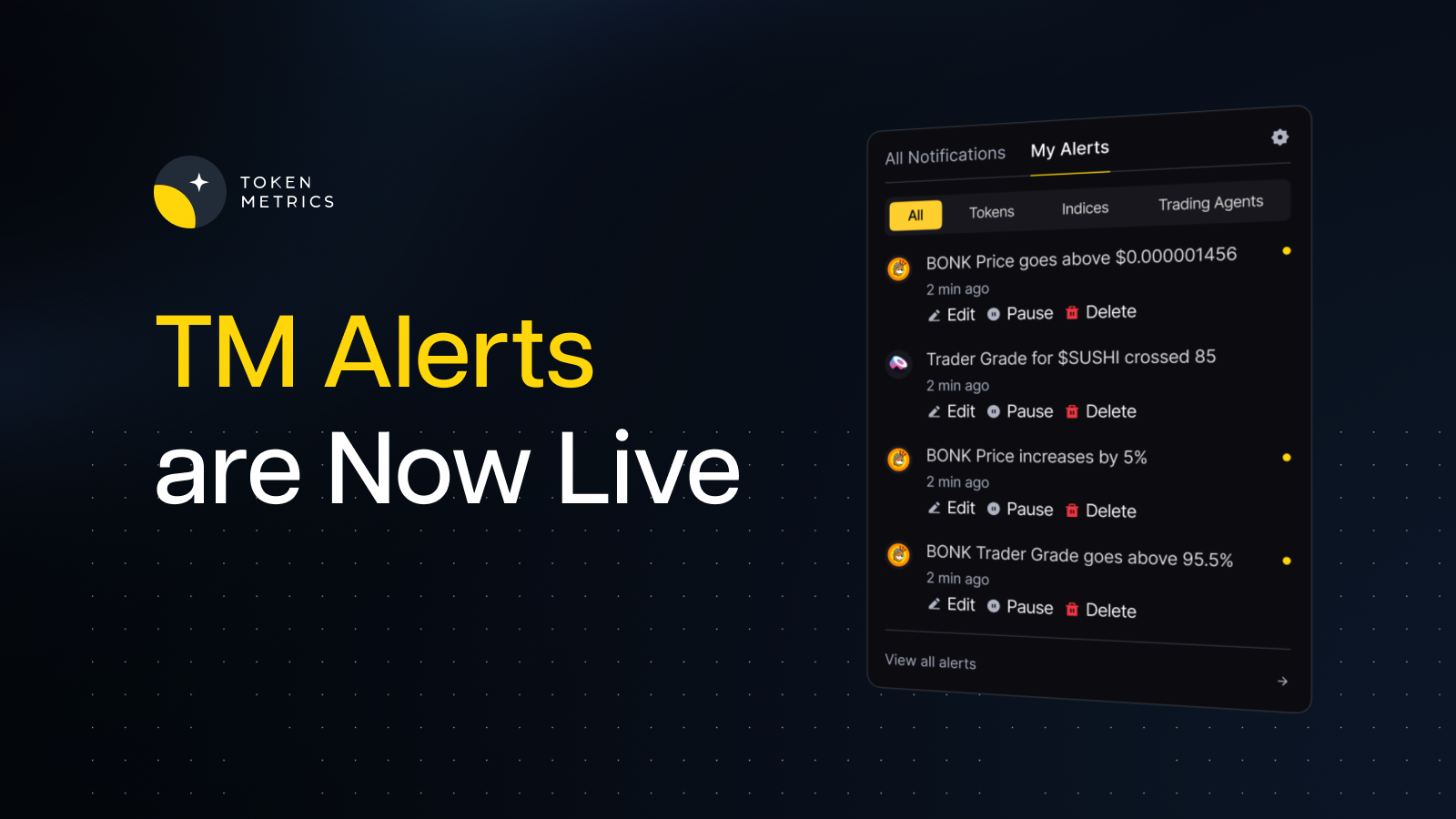
  • Confirm eligible regions/regulators (US/EU/APAC) and your entity domicile.

  • Map storage tiers (cold/warm/hot/MPC) to coverage and sub-limits.

  • Validate wordings/exclusions (internal theft, collusion, social engineering, vendor breaches).

  • Align limits/deductibles with AUM, TVL, and worst-case loss scenarios.

  • Ask for claims playbooks and incident response timelines.

  • Review audits & controls (SOC 2, key ceremonies, disaster recovery).

  • Query reinsurance backing and panel stability.

  • Red flags: vague wordings; “cyber-only” policies for custody crime; no clarity on key compromise.

Use Token Metrics With Any Custody Insurance Provider

AI Ratings to vet venues and counterparties you work with.

Narrative Detection to identify risk-on/off regimes impacting exposure.

Portfolio Optimization to size custody-related strategies.

Alerts/Signals to monitor market stress that could correlate with loss events.
Workflow: Research → Select provider via broker → Bind coverage → Operate and monitor with Token Metrics alerts.

 Primary CTA: Start free trial

Security & Compliance Tips

  • Enforce MPC/hardware-isolated keys and dual-control operations.

  • Use 2FA, withdrawal whitelists, and policy controls across org accounts.

  • Keep KYC/AML and sanctions screening current for counterparties.

  • Practice RFQ segregation and least-privilege for ops staff.

  • Run tabletop exercises for incident/claims readiness.

This article is for research/education, not financial advice.

Beginner Mistakes to Avoid

  • Assuming cyber insurance = custody crime coverage.

  • Buying limits that don’t match hot-wallet exposure.

  • Skipping vendor-risk riders for sub-custodians and wallet providers.

  • Not documenting key ceremonies and access policies.

  • Waiting until after an incident to engage a broker/insurer.

FAQs

What does crypto custody insurance cover?
Typically theft, key compromise, insider fraud, and sometimes extortion or vendor breaches under defined conditions. Coverage varies widely by wording; verify hot/warm/cold definitions and exclusions.

Do I need both crime and specie?
Crime commonly addresses employee dishonesty and external theft; specie focuses on physical loss/damage to assets in secure storage. Many carriers blend elements for digital assets—ask how your program handles each.

Can staking be insured?
Yes—some reinsurers/insurers offer staking/slashing riders or separate policies; smart-contract risk often requires additional cover like Chainproof.

How much capacity is available?
Depends on controls and market appetite. Lloyd’s syndicates and reinsurers like Munich Re can support sizable towers when risk controls are strong.

How do I reduce premiums?
Improve key-management controls, segregate duties, minimize hot exposure, complete independent audits, and adopt continuous monitoring/fraud screening (e.g., Coincover-style prevention).

Are exchanges’ “insured” claims enough?
Not always—check if coverage is platform-wide, per-customer, warranty-backed, or contingent. Ask for wordings, limits, and who the named insureds are.

Conclusion + Related Reads

If you need a crypto-first insurer, start with Evertas. Building a global tower? Engage Marsh or Aon across the Lloyd’s Market and reinsurers like Munich Re. For APAC-localized capacity, consider Canopius; for embedded protection, weigh Coincover or Breach. Add Chainproof if staking/DeFi exposure touches custody workflows.

Related Reads:

  • Best Cryptocurrency Exchanges 2025

  • Top Derivatives Platforms 2025

  • Top Institutional Custody Providers 2025
Research

Best Crypto Insurance Protocols (DeFi & Custodial) 2025

Sam Monac
7 min

Why Crypto Insurance Matters in September 2025

The search intent here is commercial investigation: investors want safe ways to protect on-chain and custodied assets. This guide ranks the best insurance protocols 2025 across DeFi and regulated custodial coverage so you can compare options quickly.
Definition: Crypto (DeFi) insurance helps cover losses from smart-contract exploits, exchange halts, custodian breaches, or specific parametric events; custodial insurance typically protects assets held by qualified trustees or platforms under defined “crime”/theft policies.

In 2025, larger treasuries and yield strategies are back, while counterparty and contract risk remain. We focus on real cover products, payout track records, and regulated custodial policies—using only official sources. Secondary considerations include DeFi insurance, crypto custodial insurance, and smart contract coverage capacity, claims handling, and regional eligibility.

How We Picked (Methodology & Scoring)

  • Liquidity (30%): size/capacity, ability to pay valid claims; for custodians, insurance limits and capital backing.

  • Security (25%): audits, disclosures, claim processes, regulated status where applicable.

  • Coverage (15%): breadth of products (protocol, depeg, custody, parametric, etc.) and supported chains.

  • Costs (15%): premiums/fees relative to cover; clear fee pages.

  • UX (10%): buying experience, documentation, transparency.

  • Support (5%): documentation, response channels, claims guidance.

Data sources: official product/docs, transparency/security pages, and audited/claims pages; market datasets only for cross-checks. Last updated September 2025.

Top 10 Crypto Insurance Providers in September 2025

1. Nexus Mutual — Best for broad DeFi coverage and claims history

  • Why Use It: A member-owned mutual offering protocol, exchange halt, and depeg covers, with a transparent claims ledger and multi-year payout track record. Members vote on claims, and the docs detail cover wordings and product types.

  • Best For: Advanced DeFi users, DAOs/treasuries, funds seeking bespoke on-chain risk cover.

  • Notable Features: Claims history ledger; multiple cover products (protocol/exchange/depeg); membership + staking model.

  • Fees Notes: Membership fee required; premiums vary by product pool (see cover pages).
  • Regions: Global (KYC for membership).
  • Consider If: You’re comfortable with discretionary, member-voted claims.

  • Alternatives: InsurAce, Neptune Mutual.

2. InsurAce — Best multi-chain DeFi marketplace

  • Why Use It: Multi-chain cover marketplace with a wide menu of protocol/exchange risk options and an established brand. Useful for builders and users who want flexible terms across ecosystems.
  • Best For: Multi-chain DeFi participants, LPs, power users.

  • Notable Features: Diverse cover catalog; staking/supply side; docs and dApp UI focused on ease of purchase.
  • Fees Notes: Premiums vary per pool/cover; check dApp quotes.

  • Regions: Global (subject to app access and eligibility).

  • Consider If: You prefer marketplace variety but can evaluate pool capacity.

  • Alternatives: Nexus Mutual, Neptune Mutual.

4. Sherlock — Best for protocol teams needing post-audit coverage

  • Why Use It: Full-stack security provider (audit contests, bounties) with Sherlock Shield coverage that helps protocols mitigate losses from smart-contract exploits. Strong fit for teams bundling audits + coverage.
  • Best For: Protocol founders, security-first teams, DAOs.

  • Notable Features: Audit marketplace; exploit coverage; payout process tailored for teams.
  • Fees Notes: Pricing depends on scope/coverage; engage sales.

  • Regions: Global.

  • Consider If: You need coverage tightly integrated with audits.

  • Alternatives: Chainproof, Nexus Mutual.

3. OpenCover— Best for Community-Driven, Transparent Coverage

Why Use It: OpenCover is a decentralized insurance protocol that leverages community-driven liquidity pools to offer coverage against smart contract exploits and other on-chain risks. Its transparent claims process and low-cost structure make it an attractive option for DeFi users seeking affordable and reliable insurance solutions.

Best For: DeFi users, liquidity providers, and investors looking for community-backed insurance coverage.

Notable Features:

  • Community-governed liquidity pools

  • Transparent and automated claims process

  • Low-cost premiums

  • Coverage for smart contract exploits and on-chain risks

Fees/Notes: Premiums are determined by the liquidity pool and the level of coverage selected.

Regions: Global (subject to dApp access).

Consider If: You value community governance and transparency in your insurance coverage.

Alternatives: Nexus Mutual, InsurAce.

5. Chainproof — Best for regulated smart-contract insurance

  • Why Use It: A regulated insurer for non-custodial smart contracts, incubated by Quantstamp; positions itself with compliant, underwritten policies and 24/7 monitoring.
  • Best For: Enterprises, institutions, and larger protocols requiring regulated policies.

  • Notable Features: Regulated insurance; Quantstamp lineage; monitoring-driven risk management.
  • Fees Notes: Premiums/policy terms bespoke.

  • Regions: Global (subject to policy jurisdiction).

  • Consider If: You need compliance-grade coverage for stakeholders.

  • Alternatives: Sherlock, Nexus Mutual.

6. Nayms — Best on-chain insurance marketplace for brokers/carriers

  • Why Use It: A regulated (Bermuda DABA Class F) marketplace to set up tokenized insurance pools and connect brokers, carriers, investors, and insureds—bringing alternative capital on-chain.
  • Best For: Brokers/carriers building crypto-native insurance programs; larger DAOs/TSPs.

  • Notable Features: Segregated Accounts (SAC) structure; tokenized pools; full lifecycle (capital → premiums → claims).
  • Fees Notes: Platform/program fees vary; institutional setup.

  • Regions: Global (Bermuda framework).

  • Consider If: You’re creating—not just buying—insurance capacity.

  • Alternatives: Chainproof, institutional mutuals.

7. Etherisc — Best for parametric flight/crop and specialty covers

  • Why Use It: Pioneer in parametric blockchain insurance with live Flight Delay Protection and other modules (e.g., crop, weather, depeg). On-chain products with automated claims.
  • Best For: Travelers, agritech projects, builders of niche parametric covers.

  • Notable Features: Flight delay dApp (Base/USDC); crop/weather modules; transparent policy pages.
  • Fees Notes: Premiums quoted per route/peril.

  • Regions: Global (product-specific availability).

  • Consider If: You need clear, data-triggered payouts.

  • Alternatives: Arbol (climate parametrics), Neptune Mutual.

8. Tidal FinanceBest for Coverage on Niche DeFi Protocols
Why Use It: Tidal Finance focuses on providing coverage for niche and emerging DeFi protocols, offering tailored insurance products for new and innovative projects. Tidal's dynamic risk assessments allow it to offer specialized coverage options for specific protocols.
Best For: Users and protocols seeking insurance for niche DeFi projects with specific risk profiles.
Notable Features:

  • Coverage for high-risk, niche DeFi protocols

  • Dynamic pricing based on real-time risk assessments

  • Flexible policy terms
    Fees/Notes: Premiums based on the risk profile of the insured protocol.
    Regions: Global.
    Consider If: You need tailored insurance coverage for emerging or specialized DeFi projects.
    Alternatives: Nexus Mutual, Amulet Protocol.

9. Subsea (formerly Risk Harbor) — Best for automated, rules-based claims

  • Why Use It: An algorithmic risk-management marketplace with objective, automated claims—reducing discretion and bias in payouts. (Risk Harbor rebranded to Subsea.)
  • Best For: Users who prefer invariant, programmatic claim triggers.

  • Notable Features: Automated payout logic; transparent market mechanics; simulator for underwriting/buying protection.
  • Fees Notes: Premiums and returns vary by pool.

  • Regions: Global (dApp access).

  • Consider If: You want automation over DAO voting.

  • Alternatives: Neptune Mutual, Amulet.

10. BitGo Custody (with Insurance) — Best custodial coverage for institutions

  • Why Use It: Qualified custody with up to $250M in digital-asset insurance capacity for assets where keys are held by BitGo Trust; clearly communicated policy framework and bankruptcy-remote structures.
  • Best For: Funds, corporates, and service providers needing regulated custody plus insurance.

  • Notable Features: Qualified custody; SOC reports; policy covers specific theft/loss scenarios.
  • Fees Notes: Custody/asset-based fees; insurance embedded at the custodian level.

  • Regions: Global (jurisdiction-specific entities).

  • Consider If: You want a regulated custodian with published insurance capacity.

  • Alternatives: Gemini Custody, Anchorage Digital (note: no FDIC/SIPC).

Decision Guide: Best By Use Case

  • Largest DeFi product breadth: Nexus Mutual, InsurAce.
  • Fastest/parametric claims: Neptune Mutual, Etherisc.
  • Regulated policy needs (enterprise): Chainproof, Nayms.
  • Solana-first portfolios: Amulet.
  • Fully automated claims (no governance): Subsea (ex-Risk Harbor).
  • Custodial with published insurance limits: BitGo; also Gemini Custody (hot+cold coverage).

How to Choose the Right Crypto Insurance (Checklist)

  • Verify eligibility/region and any KYC requirements.

  • Check coverage type (protocol exploit, exchange halt, depeg, parametric, custody crime).

  • Review capacity/liquidity and payout records/ledgers.

  • Compare premiums/fees against insured amounts and deductibles.

  • Evaluate claims process (discretionary vote vs. parametric/automated).

  • Confirm security posture (audits, monitoring, disclosures).

  • Test UX & support (docs, ticketing, community).

  • Red flags: unclear policy wordings; promises of “FDIC-like” protection for crypto (rare/not applicable).

Use Token Metrics With Any Insurance Provider

  • AI Ratings to screen tokens and protocol risk signals.
  • Narrative Detection to spot shifting risk/coverage demand.

  • Portfolio Optimization to size insured vs. uninsured exposures.

  • Alerts to track incident news and coverage expiries.
    Workflow: Research → Select cover/custody → Execute → Monitor with alerts.


Primary CTA: Start free trial

Security & Compliance Tips

  • Enable strong 2FA and segregate wallets for covered vs. uncovered positions.

  • For custodial solutions, understand exact insurance scope and exclusions.
  • Follow KYC/AML where required (e.g., Nexus Mutual membership).
  • For protocols, complement insurance with audits/bounties and incident response runbooks.
  • Maintain wallet hygiene (hardware, allow-list, spend limits).

This article is for research/education, not financial advice.

Beginner Mistakes to Avoid

  • Assuming all losses are covered—read policy wordings.
  • Buying cover after an incident is known/underway.

  • Ignoring chain/app coverage constraints.

  • Letting cover lapse during major upgrades or liquidity migrations.

  • Believing custodial insurance = FDIC/SIPC (it doesn’t).

FAQs

What’s the difference between DeFi insurance and custodial insurance?
DeFi insurance protects on-chain actions (e.g., smart-contract exploits or depegs), often via discretionary voting or parametric rules. Custodial insurance covers specific theft/loss events while assets are held by a qualified custodian under a crime policy; exclusions apply.

How do parametric policies work in crypto?
They pre-define an objective trigger (e.g., flight delay, protocol incident), enabling faster, data-driven payouts without lengthy investigations. Etherisc (flight) and Neptune Mutual (incident pools) are examples.

Is Nexus Mutual regulated insurance?
No. It’s a member-owned discretionary mutual where members assess claims and provide capacity; see membership docs and claim pages

Do custodial policies cover user mistakes or account takeovers?
Typically no—policies focus on theft from the custodian’s systems. Review each custodian’s definitions/exc Gemini’s hot/cold policy scope).

What if I’m primarily on Solana?
Consider Amulet for Solana-native cover; otherwise, verify cross-chain support from multi-chain providers.

Which providers are regulated?
Chainproof offers regulated smart-contract insurance; Nayms operates under Bermuda’s DABA framework for on-chain insurance programs.

Conclusion + Related Reads

If you need breadth and track record, start with Nexus Mutual or InsurAce. For parametric, faster payouts, look at Neptune Mutual or Etherisc. Building institutional-grade risk programs? Consider Chainproof or Nayms. If you hold assets with a custodian, confirm published insurance capacity—BitGo and Gemini Custody are good benchmarks.

Related Reads:

  • Best Cryptocurrency Exchanges 2025

  • Top Derivatives Platforms 2025

  • Top Institutional Custody Providers 2025

Research

Top Smart Contract Auditors (2025)

Sam Monac
7 min

Why Smart Contract Security Auditors Matter in September 2025

Smart contracts are the critical rails of DeFi, gaming, and tokenized assets—one missed edge case can freeze liquidity or drain treasuries. If you’re shipping on EVM, Solana, Cosmos, or rollups, smart contract auditors provide an independent, methodical review of your code and architecture before (and after) mainnet. In one line: a smart contract audit is a systematic assessment of your protocol’s design and code to find and fix vulnerabilities before attackers do.

This guide is for founders, protocol engineers, PMs, and DAOs comparing audit partners. We combined SERP research with hands-on security signals to shortlist reputable teams, then selected the best 10 for global builders. Secondary considerations—like turnaround time, formal methods, and public report history—help you match the right firm to your stack and stage.

How We Picked (Methodology & Scoring)

  • Liquidity (30%) – We favored firms that regularly secure large TVL protocols and L2/L3 infrastructure (a proxy for real-world risk tolerance).

  • Security (25%) – Depth of reviews, formal methods, fuzzing/invariants, internal QA, and disclosure practices.

  • Coverage (15%) – Chains (EVM, Solana, Cosmos, Move), ZK systems, cross-chain, and infra.

  • Costs (15%) – Transparent scoping, rate signals, and value versus complexity.

  • UX (10%) – Developer collaboration, report clarity, suggested fixes.

  • Support (5%) – Follow-ups, retests, and longer-term security programs.

Data inputs: official service/docs pages, public audit report portals, rate disclosures where available, and widely cited market datasets for cross-checks. Last updated September 2025.

Top 10 Smart Contract Auditors in September 2025

1. OpenZeppelin — Best for Ethereum-native protocols & standards

  • Why Use It: OpenZeppelin sets the bar for Ethereum security reviews, blending deep code review with fuzzing and invariant testing. Their team maintains widely used libraries and brings ecosystem context to tricky design decisions. Audits are collaborative and issue-tracked end to end.
  • Best For: DeFi protocols, token standards/bridges, ZK/infra components, L2/L3 projects.
  • Notable Features: Multi-researcher line-by-line reviews; fuzzing & invariants; Defender integrations; public customer stories.
  • Consider If: Demand may affect near-term availability; enterprise pricing.
  • Alternatives: ConsenSys Diligence, Sigma Prime
  • Regions: Global
  • Fees/Notes: Quote-based.

2. Trail of Bits — Best for complex, high-risk systems

  • Why Use It: A security research powerhouse, Trail of Bits excels on complicated protocol architectures and cross-component reviews (on-chain + off-chain). Their publications and tools culture translate into unusually deep findings and actionable remediation paths.
  • Best For: Novel consensus/mechanisms, bridges, MEV-sensitive systems, multi-stack apps.
  • Notable Features: Custom tooling; broad ecosystem coverage (EVM, Solana, Cosmos, Substrate, Starknet); thorough reporting.
  • Consider If: Lead times can be longer; premium pricing.
  • Alternatives: Runtime Verification, Zellic
  • Regions: Global
  • Fees/Notes: Quote-based.

3. Sigma Prime — Best for Ethereum core & DeFi heavyweights

  • Why Use It: Sigma Prime combines practical auditing with core protocol experience (they build Lighthouse, an Ethereum consensus client), giving them unusual depth in consensus-adjacent DeFi and infra. Strong track record across blue-chip protocols.
  • Best For: Lending/AMMs, staking/validators, client-adjacent components, LSTs.
  • Notable Features: Deep EVM specialization; transparent technical writing; senior engineering bench.
  • Consider If: Primary focus is EVM; limited non-EVM coverage compared to others.
  • Alternatives: OpenZeppelin, ChainSecurity
  • Regions: Global
  • Fees/Notes: Quote-based.

4. ConsenSys Diligence — Best for Ethereum builders wanting tooling + audit

  • Why Use It: Backed by ConsenSys, Diligence pairs audits with developer-facing tools and education, making it ideal for teams that want process maturity (prep checklists, fuzzing, Scribble specs). Broad portfolio and clear audit portal.
  • Best For: Early-to-growth stage Ethereum teams, rollup apps, token launches.
  • Notable Features: Audit portal; Scribble specification; fuzzing; practical prep guidance.
  • Consider If: Primarily Ethereum; non-EVM work may require scoping checks.
  • Alternatives: OpenZeppelin, ChainSecurity
  • Regions: Global
  • Fees/Notes: Quote-based.

5. ChainSecurity — Best for complex DeFi mechanisms & institutions

  • Why Use It: Since 2017, ChainSecurity has audited many flagship DeFi protocols and works with research institutions and central banks—useful for mechanism-dense systems and compliance-sensitive partners. Public report library is extensive.
  • Best For: Lending/leverage, automated market design, enterprise & research tie-ups.
  • Notable Features: Senior formal analysis; large library of public reports; mechanism design experience.
  • Consider If: Scheduling can book out during heavy DeFi release cycles.
  • Alternatives: Sigma Prime, Runtime Verification
  • Regions: Global
  • Fees/Notes: Quote-based.

6. Runtime Verification — Best for formal methods & proofs

  • Why Use It: RV applies mathematical modeling to verify contract behavior—ideal when correctness must be proven, not just reviewed. Transparent duration guidance and verification-first methodology stand out for high-assurance finance and bridges.
  • Best For: Bridges, L2/L3 protocols, safety-critical DeFi, systems needing formal guarantees.
  • Notable Features: Design modeling; proof-oriented analysis; published methodology; verification experts.
  • Consider If: Formal methods add time/scope; ensure timelines fit launch plans.
  • Alternatives: Trail of Bits, ChainSecurity
  • Regions: Globall
  • Fees/Notes: Time/cost scale with LoC & rigor.

7. Spearbit (via Cantina) — Best for assembling elite ad-hoc review teams

  • Why Use It: Spearbit curates a network of top security researchers and spins up tailored teams for high-stakes reviews. Public “Spearbook” docs outline a transparent process and base rates—useful for planning and stakeholder alignment.
  • Best For: Protocols needing niche expertise (ZK, MEV, Solana, Cosmos) or rapid talent assembly.
  • Notable Features: Researcher leaderboard; portfolio of reports; flexible scoping; public methodology.
  • Consider If: Marketplace model—experience can vary; align on leads and scope early.
  • Alternatives: Zellic, Trail of Bits
  • Regions: Global • Fees/Notes: Base rate guidance published; final quotes vary.

8. Zellic — Best for offensive-security depth & cross-ecosystem coverage

  • Why Use It: Founded by offensive researchers, Zellic emphasizes real-world exploit paths and releases practical research/tools (e.g., Masamune). Strong results across EVM, cross-chain, and high-value targets.
  • Best For: Cross-chain systems, DeFi with complicated state machines, performance-critical code.
  • Notable Features: Offensive mindset; tool-assisted reviews; transparent research blog.
  • Consider If: Premium scope; verify bandwidth for urgent releases.
  • Alternatives: OtterSec, Trail of Bits
  • Regions: Global • Fees/Notes: Quote-based.

9. OtterSec — Best for Solana, Move, and high-velocity shipping teams

  • Why Use It: OtterSec partners closely with fast-shipping teams across Solana, Sui, Aptos, and EVM, with a collaborative style and visible customer logos across top ecosystems. Useful when you need pragmatic feedback loops and retests.
  • Best For: Solana & Move projects, cross-chain bridges, wallets, DeFi apps.
  • Notable Features: Holistic review method; $1B+ in vulnerabilities patched (self-reported); active blog & reports.
  • Consider If: Verify scope for non-Move/Solana; high demand seasons can fill quickly.
  • Alternatives: Zellic, Halborn
  • Regions: Global • Fees/Notes: Quote-based.

10. Halborn — Best for enterprise-grade programs & multi-service security

  • Why Use It: Halborn serves both crypto-native and financial institutions with audits, pentesting, and advisory; SOC 2-type attestations and steady cadence of public assessments support enterprise procurement.
  • Best For: Exchanges, fintechs, large DeFi suites, and teams needing full-stack security partners.
  • Notable Features: Audit portal & reports; enterprise processes; broader security services.
  • Consider If: Quote-based pricing; confirm dedicated smart-contract reviewers for your stack.
  • Alternatives: ConsenSys Diligence, Trail of Bits
  • Regions: Global • Fees/Notes: Quote-based.

Decision Guide: Best By Use Case

  • Ethereum DeFi blue-chips: OpenZeppelin, Sigma Prime
  • High-assurance/formal proofs: Runtime Verification, ChainSecurity
  • Novel mechanisms / complex cross-stack: Trail of Bits
  • Rapid team assembly / niche experts (ZK/MEV): Spearbit
  • Solana & Move ecosystems: OtterSec, Zellic
  • Enterprise programs & multi-service: Halborn, ConsenSys Diligence
  • Audit + developer tooling/process: ConsenSys Diligence, OpenZeppelin

How to Choose the Right Smart Contract Auditors (Checklist)

  • Confirm chain coverage (EVM/Solana/Cosmos/Move/ZK) and prior similar audits.
  • Review public reports for depth, reproductions, and clarity of recommendations.
  • Ask about fuzzing/invariants and formal methods on high-risk components.
  • Validate availability & timelines vs. your launch and retest windows.
  • Align on scope & deliverables (threat model, PoCs, retest, disclosure).
  • Clarify pricing (fixed/LoC-based, review period, retests).
  • Check secure comms (issue trackers, PGP, private repos) and follow-up support.
  • Red flags: “rubber-stamp” promises, guaranteed pass, or refusal to publish a report summary.

Use Token Metrics With Any Auditor

  • AI Ratings screen sectors and assets before you commit dev cycles.
  • Narrative Detection spots momentum so audits align with market timing.
  • Portfolio Optimization balances audited vs. unaudited exposure.
  • Alerts/Signals track unlocks, governance, and risk events post-launch.

Workflow: Research → Select auditor → Execute fixes/retest → Monitor with alerts.


Start free trial

Security & Compliance Tips

  • Enforce 2FA/hardware keys across repos and infra.
  • Separate ops wallets from treasury; use MPC or HSM where appropriate.
  • Align with KYC/AML and disclosures if raising or listing.
  • Use bug bounties and continuous scanning after the audit.
  • Practice key rotation, access reviews, and incident-response drills.

This article is for research/education, not financial advice.

Beginner Mistakes to Avoid

  • Treating an audit as a one-time checkbox instead of an iterative security program.
  • Scoping only Solidity without reviewing off-chain components and oracles.
  • Shipping major changes post-audit without a delta review.
  • Publishing reports without fix verification.
  • Ignoring test coverage, fuzzing, and invariant specs.

FAQs

What does a smart contract audit include?
Typically: architecture review, manual code analysis by multiple researchers, automated checks (linters, fuzzers), proof-of-concept exploits for issues, and a final report plus retest. Depth varies by scope and risk profile.

How long does an audit take?
From a few weeks to several months, depending on code size, complexity, and methodology (e.g., formal verification can extend timelines). Plan for time to remediate and retest before mainnet.

How much do audits cost?
Pricing is quote-based and driven by complexity, deadlines, and team composition. Some networks (e.g., Spearbit) publish base rate guidance to help with budgeting.

Do I need an audit if my code is forked?
Yes. Integration code, parameter changes, and new attack surfaces (bridges/oracles) can introduce critical risk—even if upstream code was audited.

Should I publish my audit report?
Most credible teams publish at least a summary. Public reports aid trust, listings, and bug bounty participation—while enabling community review.

What if we change code after the audit?
Request a delta audit and update your changelog. Major logic changes merit a retest; minor refactors may need targeted review.

Conclusion

Choosing the right auditor depends on your stack, risk tolerance, and timelines. For Ethereum-first teams, OpenZeppelin, Sigma Prime, and ConsenSys Diligence stand out. If you need high-assurance proofs or tricky mechanisms, look to Runtime Verification, ChainSecurity, or Trail of Bits. Solana/Move builders often pick OtterSec or Zellic. For flexible, elite review pods, Spearbit is strong.

Research

Best Newsletters & Independent Analysts (2025)

Sam Monac
7 min

Why Crypto Newsletters & Independent Analysts Matter in September 2025

In a market that never sleeps, the best crypto newsletters 2025 help you filter noise, spot narratives early, and act with conviction. In one line: a great newsletter or analyst condenses complex on-chain, macro, and market structure data into clear, investable insights. Whether you’re a builder, long-term allocator, or active trader, pairing independent analysis with your own process can tighten feedback loops and reduce decision fatigue. In 2025, ETF flows, L2 expansion, AI infra plays, and global regulation shifts mean more data than ever. The picks below focus on consistency, methodology transparency, breadth (on-chain + macro + market), and practical takeaways—blending independent crypto analysts with data-driven research letters and easy-to-digest daily briefs.

Secondary intents we cover: crypto research newsletter, on-chain analysis weekly, and “who to follow” for credible signal over hype.

How We Picked (Methodology & Scoring)

  • Scale & authority (liquidity = 30%): Reach, frequency, and signals that move or benchmark the market (ETF/flows, L2 metrics, sector heat).

  • Security & transparency (25%): Clear disclosures, methodology notes, sources of data; links to security/research pages when applicable.

  • Coverage (15%): On-chain + macro + sector breadth; BTC/ETH plus L2s, DeFi, RWAs, AI infra, and alt cycles.

  • Costs (15%): Free tiers, reasonable paid options, and clarity on what’s gated.

  • UX (10%): Digestible summaries, archives, and skim-ability.

  • Support (5%): Reliability of delivery, community, and documentation.

Data sources used: official sites/newsletter hubs, research/security pages, and widely cited datasets (Glassnode, Coin Metrics, Kaiko, CoinShares) for cross-checks. Last updated September 2025.

Top 10 Crypto Newsletters & Independent Analysts in September 2025

1. Bankless — Best for Daily Crypto & Web3 Digests

  • Why Use It: Bankless offers an approachable Daily Brief and deeper thematic series that balance top-of-funnel news with actionable context. If you want a consistent, skimmable daily pulse on crypto, DeFi, and Ethereum, this is a staple.

  • Best For: Busy professionals, founders, new-to-intermediate investors, narrative spotters.

  • Notable Features: Daily Brief; weekly/thematic issues; Ethereum-centric takes; large archive; clear disclosures.

  • Fees Notes: Generous free tier; optional paid communities/products.

  • Regions: Global

  • Alternatives: The Defiant, Milk Road

  • Consider If: You want daily breadth and a friendly voice more than deep quant.

2. The Defiant — Best for DeFi-Native Coverage

  • Why Use It: The Defiant’s daily/weekly letters and DeFi Alpha cut straight to on-chain happenings, new protocols, and governance. Expect fast DeFi coverage with practical trader/investor context.

  • Best For: DeFi power users, yield seekers, DAO/governance watchers.

  • Notable Features: DeFi-focused daily; weekly recaps; Alpha letter; strong reporting cadence.

  • Fees Notes: Free newsletter options; premium research tiers available.

  • Regions: Global

  • Alternatives: Bankless, Delphi Digital

  • Consider If: Your focus is DeFi first and you want timely protocol insights.

3. Messari – Unqualified Opinions — Best for Institutional-Grade Daily Takes

  • Why Use It: Messari’s daily market commentary and analyst notes are crisp, data-aware, and aligned with institutional workflows. Great for staying current on stablecoins, venture, and macro-market structure.

  • Best For: Funds, analysts, founders, policy/market observers.

  • Notable Features: Daily commentary; stablecoin weekly; venture weekly; archives; research ecosystem.

  • Fees Notes: Free newsletters with deeper research available to paying customers.

  • Regions: Global

  • Alternatives: Delphi Digital, Coin Metrics SOTN

  • Consider If: You value concise institutional context over tutorials.

4. Delphi Digital – Delphi Alpha — Best for Thematic Deep Dives

  • Why Use It: Delphi marries thematic research (AI infra, gaming, L2s) with market updates and timely unlocks of longer reports. Great when you want conviction around medium-term narratives.

  • Best For: Venture/allocators, founders, narrative investors.

  • Notable Features: “Alpha” newsletter; report previews; cross-asset views; long-form research.

  • Fees Notes: Free Alpha letter; premium research memberships available.

  • Regions: Global

  • Alternatives: Messari, The Defiant

  • Consider If: You prefer thesis-driven research over daily headlines.

5. Glassnode – The Week On-Chain — Best for On-Chain Market Structure

  • Why Use It: The industry’s flagship weekly on-chain letter explains BTC/ETH supply dynamics, holder cohorts, and cycle health with charts you’ll see cited everywhere.

  • Best For: Traders, quants, macro/on-chain hybrid readers.

  • Notable Features: Weekly on-chain; clear frameworks; historical cycle context; free subscription option.

  • Fees Notes: Free newsletter; paid platform tiers for advanced metrics.

  • Regions: Global

  • Alternatives: Coin Metrics SOTN, Into The Cryptoverse

  • Consider If: You want a single, rigorous on-chain read each week.

6. Coin Metrics – State of the Network — Best for Data-First Research Notes

  • Why Use It: SOTN blends on-chain and market data into weekly essays on sectors like LSTs, stablecoins, and market microstructure. It’s authoritative, neutral, and heavily cited.

  • Best For: Researchers, desk strategists, product teams.

  • Notable Features: Weekly SOTN; special insights; transparent data lineage; archives.

  • Fees Notes: Free newsletter; enterprise data products available.

  • Regions: Global

  • Alternatives: Glassnode, Kaiko Research

  • Consider If: You want clean methodology and durable references.

7. Kaiko Research Newsletter — Best for Liquidity & Market Microstructure

  • Why Use It: Kaiko’s research distills exchange liquidity, spreads, and derivatives structure across venues—useful for routing, slippage, and institutional execution context.

  • Best For: Execution teams, market makers, advanced traders.

  • Notable Features: Data-driven notes; liquidity dashboards; exchange/venue comparisons.

  • Fees Notes: Free research posts; deeper tiers for subscribers/clients.

  • Regions: Global

  • Alternatives: Coin Metrics, Messari

  • Consider If: You care about where liquidity actually is—and why it moves.

8. CoinShares – Digital Asset Fund Flows & Market Update — Best for ETF/Institutional Flow Watchers

  • Why Use It: Weekly Fund Flows and macro wrap-ups help you track institutional positioning and sentiment—especially relevant in the ETF era.

  • Best For: Allocators, macro traders, desk strategists.

  • Notable Features: Monday flows report; Friday market update; AuM trends; asset/region breakdowns.

  • Fees Notes: Free reports.

  • Regions: Global (some content segmented by jurisdiction)

  • Alternatives: Glassnode, Messari

  • Consider If: You anchor decisions to capital flows and risk appetite.

9. Milk Road — Best for Quick, Conversational Daily Briefs

  • Why Use It: A fast, witty daily that makes crypto easier to follow without dumbing it down. Great second screen with coffee—good for catching headlines, airdrops, and memes that matter.

  • Best For: Busy professionals, newcomers, social-narrative trackers.

  • Notable Features: Daily TL;DR; approachable tone; growing macro/AI crossover.

  • Fees Notes: Free newsletter; sponsored placements disclosed.

  • Regions: Global

  • Alternatives: Bankless, The Defiant

  • Consider If: You want speed and simplicity over deep quant.

10. Lyn Alden – Strategic Investment Newsletter — Best for Macro That Actually Impacts Crypto

  • Why Use It: Not crypto-only—yet hugely relevant. Lyn’s macro letters cover liquidity regimes, fiscal/monetary shifts, and energy/AI cycles that drive risk assets, including BTC/ETH.

  • Best For: Long-term allocators, macro-minded crypto investors.

  • Notable Features: Free macro letters; archives; occasional crypto-specific sections; clear frameworks.

  • Fees Notes: Free with optional premium research.

  • Regions: Global

  • Alternatives: Messari, Delphi Digital

  • Consider If: You want a macro north star to frame your crypto thesis.

Decision Guide: Best By Use Case

  • DeFi-native coverage: The Defiant

  • Daily crypto pulse (friendly): Bankless or Milk Road

  • Institutional-style daily notes: Messari – Unqualified Opinions

  • Thematic, thesis-driven research: Delphi Digital

  • On-chain cycle health: Glassnode – Week On-Chain

  • Data-first weekly (methodology): Coin Metrics – SOTN

  • Liquidity & venue quality: Kaiko Research

  • ETF & institutional positioning: CoinShares Fund Flows

  • Macro framing for crypto: Lyn Alden

How to Choose the Right Crypto Newsletter/Analyst (Checklist)

  • Region/eligibility: confirm signup availability and any paywall constraints.

  • Breadth vs. depth: daily skim (news) vs. weekly deep dives (research).

  • Data lineage: on-chain and market sources are named and reproducible.

  • Fees & value: what’s free vs. gated; consider team needs (PM vs. research).

  • UX & cadence: archives, searchable tags, consistent schedule.

  • Disclosures: positions, sponsorships, methodology explained.

  • Community/support: access to Q&A, office hours, or active forums.

  • Red flags: vague performance claims; undisclosed affiliations.

Use Token Metrics With Any Newsletter/Analyst

  • AI Ratings to screen sectors/tokens surfacing in the letters you read.
  • Narrative Detection to quantify momentum behind themes (L2s, AI infra, RWAs).

  • Portfolio Optimization to size convictions with risk-aware allocations.

  • Alerts/Signals to time entries/exits as narratives evolve.

Workflow: Research in your favorite newsletter → shortlist in Token Metrics → execute on your venue of choice → monitor with Alerts.


Start free trial

Security & Compliance Tips

  • Enable 2FA on your email client and any research platform accounts.

  • Verify newsletter domains and unsubscribe pages to avoid phishing.

  • Respect KYC/AML and regional rules when acting on research.

  • For RFQs/execution, confirm venue liquidity and slippage.

  • Separate reading devices from hot-wallets; practice wallet hygiene.

This article is for research/education, not financial advice.

Beginner Mistakes to Avoid

  • Treating a newsletter as a signal service—use it as input, not output.

  • Ignoring methodology and disclosures.

  • Chasing every narrative without a sizing framework.

  • Subscribing to too many sources—prioritize quality over quantity.

  • Not validating claims with primary data (on-chain/flows).

FAQs

What makes a crypto newsletter “best” in 2025?
Frequency, methodological transparency, and the ability to translate on-chain/macro signals into practical takeaways. Bonus points for archives and clear disclosures.

Are the top newsletters free or paid?
Most offer strong free tiers (daily or weekly). Paid tiers typically unlock deeper research, models, or community access.

Do I need both on-chain and macro letters?
Ideally yes—on-chain explains market structure; macro sets the regime (liquidity, rates, growth). Pairing both creates a more complete view.

How often should I read?
Skim dailies (Bankless/Milk Road) for awareness; reserve time weekly for deep dives (Glassnode/Coin Metrics/Delphi).

Can newsletters replace analytics tools?
No. Treat them as curated insight. Validate ideas with your own data and risk framework (Token Metrics can help).

Which is best for ETF/flows?
CoinShares’ weekly Fund Flows is the go-to for institutional positioning, complemented by Glassnode/Coin Metrics on structure.

Conclusion + Related Reads

If you want a quick pulse, pick a daily (Bankless or Milk Road). For deeper conviction, add one weekly on-chain (Glassnode or Coin Metrics) and one thesis engine (Delphi or Messari). Layer macro (Lyn Alden) to frame the regime, and use Token Metrics to quantify what you read and act deliberately.

Related Reads:

  • Best Cryptocurrency Exchanges 2025

  • Top Derivatives Platforms 2025

  • Top Institutional Custody Providers 2025

Research

Top Education Platforms & Courses for Crypto (2025)

Sam Monac
7 min

Why Crypto education platforms & courses Matter in September 2025

Crypto moves fast—and the gap between hype and real skills can be costly. If you’re evaluating the best crypto courses or structured paths to go from zero to fluent (or from power user to builder), the right program can compress months of trial-and-error into weeks. In short: a crypto education platform is any structured program, course catalog, or academy that teaches blockchain, Web3, or digital-asset topics with clear outcomes (e.g., literacy, developer skills, startup readiness).
This guide curates 10 credible options across beginner literacy, smart-contract engineering, and founder tracks. We blend SERP research with hands-on criteria so you can match a course to your goals, time, and budget—without the fluff.

How We Picked (Methodology & Scoring)

  • Curriculum depth & rigor (30%): Syllabi clarity, assessments, capstones, recognized instructors.

  • Credibility & security posture (25%): Transparent teams, reputable institutions, security topics baked in.

  • Coverage & specialization (15%): Breadth (BTC, ETH, DeFi, NFTs, security) plus specialist tracks (Solidity, oracles, ZK).

  • Costs & access (15%): Free tiers, scholarships, value per hour, certificates.

  • UX & learning experience (10%): In-browser coding, cohort support, community, multilingual content.

  • Support & outcomes (5%): Mentorship, career support, community reach.

Data sources: official provider pages (program docs, security/FAQ, curriculum), plus widely cited market datasets for cross-checks only. Last updated September 2025.

Top 10 Crypto education platforms & courses in September 2025

1. Coursera — “Bitcoin and Cryptocurrency Technologies” (Princeton) — Best for academic foundations

  • Why Use It: A seminal university course that demystifies Bitcoin and core crypto concepts with a rigorous, vendor-neutral lens. Clear lectures and assessments make it ideal for newcomers who want trustworthy fundamentals.
  • Best For: Beginners, product managers, compliance/finance pros, technical leaders needing conceptual grounding.

  • Notable Features: University-backed syllabus; security/anonymity modules; future/regulation perspectives; conceptual foundations for building.
  • Consider If: You prefer hands-on Solidity right away—this is theory-first.

  • Alternatives: edX (Berkeley), Coinbase Learn.

  • Regions: Global. Fees Notes: Coursera pricing varies by locale.

2. edX — Berkeley Blockchain Fundamentals — Best for university-brand plus survey depth

  • Why Use It: UC Berkeley’s professional certificate pairs an overview of blockchain and crypto with academic rigor and clear learning paths. Good bridge between literacy and technical depth.
  • Best For: Cross-functional teams, MBA/finance learners, policy/ops, curious devs.

  • Notable Features: Recognized university credential; modular courses; wide topical span across Bitcoin, Ethereum, and applications.
  • Consider If: You need coding-heavy, cohort-based Solidity training now.

  • Alternatives: Coursera (Princeton), ConsenSys Academy.

  • Regions: Global. Fees Notes: edX offers audit (free) and paid certificate tracks.

3. Binance Academy — Best free, multilingual crypto literacy hub

  • Why Use It: A large, constantly updated library of beginner-to-intermediate guides, glossaries, and tutorials in many languages—100% free.
  • Best For: Absolute beginners, non-technical teams, multilingual audiences, fast refreshers.

  • Notable Features: Courses + articles + videos; Bitcoin halving hubs; multi-language support; bite-size explainers.
  • Consider If: You want a formal certificate or university grade.

  • Alternatives: Coinbase Learn, edX.

  • Regions: Global. Fees Notes: Free.

4. Coinbase Learn — Best for simple, trusted onboarding

  • Why Use It: Friendly entry point with practical “how-to” guides that answer common questions about Bitcoin, Ethereum, NFTs, wallets, and safety. Great for reluctant first-timers.
  • Best For: New investors, finance teams exploring crypto policy, busy executives.

  • Notable Features: Step-by-step tutorials; beginner hubs; platform-agnostic primers
  • Consider If: You need dev-level skills or a cohort experience.

  • Alternatives: Binance Academy, Coursera.

  • Regions: Global. Fees Notes: Free learning content.

5. ConsenSys Academy — Best for Ethereum developer bootcamps

  • Why Use It: The training arm of a core Ethereum company, with cohort-based programs, mentor access, and security best practices baked in. Strong for professionalizing Solidity skills.
  • Best For: Software engineers, Web2 devs crossing to Web3, career switchers.

  • Notable Features: Flagship Blockchain Developer Bootcamp; team projects; office hours; certificates.
  • Consider If: You need completely free self-paced content.

  • Alternatives: Alchemy University, Moralis Academy.

  • Regions: Global (online). Fees Notes: Paid bootcamps; prices vary.

6. Alchemy University — Best free, hands-on Solidity path

  • Why Use It: A popular builder track with free in-browser coding, projects, and a modern Solidity course aligned to current compiler versions.
  • Best For: Aspiring smart-contract devs, hackathon teams, self-paced builders.

  • Notable Features: Free Solidity course; code-along projects; hackathons; JS + Ethereum tracks.
  • Consider If: You want a cohort and instructor mentorship.

  • Alternatives: ConsenSys Academy, Encode Club.

  • Regions: Global. Fees Notes: Free.

7. Moralis Academy — Best for blended dev + trading curriculum

  • Why Use It: Combines structured dev courses with trading strategy content and a community. Offers free starts with optional Pro for deeper tracks.
  • Best For: Builders who also want market context; ambitious beginners.

  • Notable Features: Step-by-step tracks; community; trading modules; ties to Moralis dev tooling.

  • Consider If: You prefer purely academic or vendor-neutral content.

  • Alternatives: Alchemy University, Binance Academy.

  • Regions: Global. Fees Notes: Free tier; paid plans available.

8. University of Nicosia (UNIC) — Free MOOCs + MSc in Blockchain/Digital Currency — Best for formal academia & credentials

  • Why Use It: UNIC pioneered a dedicated MSc in Digital Currency and runs free entry MOOCs—a long-standing academic pathway in crypto.
  • Best For: Career-switchers wanting formal credentials; policymakers; educators.

  • Notable Features: Free MOOC intros; postgraduate degrees; broad coverage across tech, economic, and legal aspects.
  • Consider If: You need short, purely practical dev sprints.

  • Alternatives: edX (Berkeley), Coursera.

  • Regions: Global (online). Fees Notes: MOOCs free; degree programs paid.

9. Chainlink Education & Bootcamps — Best for oracle, data, and hybrid smart-contract skills

  • Why Use It: If you’re building with real-world data, Chainlink’s education hub and instructor-led bootcamps teach oracle patterns, cross-chain messaging, and production-grade smart contracts.
  • Best For: Devs targeting DeFi, on-chain finance, and data-rich dApps.

  • Notable Features: Tutorials on NFTs/stablecoins; live bootcamps; developer advocates; ecosystem resources.
  • Consider If: You want chain-agnostic theory without vendor context.

  • Alternatives: Alchemy University, ConsenSys Academy.

  • Regions: Global. Fees Notes: Many resources free; bootcamp formats vary.

10. a16z Crypto — Crypto Startup Accelerator (CSX) — Best for founders & operators

  • Why Use It: Beyond coding, founders need go-to-market, legal, and product mentorship. CSX offers a cohort model with capital, expert lectures, and crypto-specific startup support.
  • Best For: Early-stage founders, PMs, operators validating product-market fit in Web3.

  • Notable Features: Curated mentorship network; structured curriculum; demo days; evolution of the original Crypto Startup School into a full accelerator.
  • Consider If: You’re pre-idea or not building a company yet—start with literacy/dev courses first.

  • Alternatives: Encode Club accelerators, Solana-ecosystem programs.

  • Regions: Global (programs periodically in specific cities). Fees Notes: Accelerator terms vary by cohort.

Decision Guide: Best By Use Case

  • Academic fundamentals (theory-first): Coursera (Princeton), edX (Berkeley).
  • Free multilingual literacy: Binance Academy; Coinbase Learn (simple, practical).
  • Hands-on Solidity (free): Alchemy University.
  • Cohort dev bootcamp: ConsenSys Academy.
  • Developer + trading blend: Moralis Academy.
  • Formal credentials: University of Nicosia (MOOC, MSc).
  • Oracle/data-driven dApps: Chainlink Education/Bootcamps.

  • Founder/accelerator path: a16z Crypto (CSX).

How to Choose the Right Crypto education platforms & courses (Checklist)

  • Confirm level & outcomes (literacy, dev skills, or founder playbook).

  • Review syllabus & assessments; look for capstones or code reviews.

  • Match specialization (Solidity, ZK, DeFi, security, oracles) to your goal.

  • Check costs & time (audit/free vs. paid, cohort dates).

  • Evaluate support (mentors, office hours, Discord/Forum).

  • Prefer credible institutions/teams; scan FAQs/security sections.

  • Red flags: vague outcomes, hard upsells, no instructor transparency.

Use Token Metrics With Any Crypto education platforms & courses

  • AI Ratings to screen tokens you’ll study or trade.
  • Narrative Detection to spot momentum across sectors.

  • Portfolio Optimization to size positions by risk.

  • Alerts/Signals to monitor entries/exits as you learn.
    Workflow: Research → Choose a course → Practice on sandboxes → Execute with a small wallet → Monitor with Alerts.

 Primary CTA: Start free trial.

Security & Compliance Tips

  • Enable 2FA and hardware keys on all learning-linked accounts.

  • Keep a separate practice wallet; never paste seed phrases into course portals.

  • Use reputable docs for KYC/AML topics; understand regional eligibility.

  • Practice safe contract deployments on testnets first.

  • Document RFQ or OTC steps if your course touches institutional flows.

This article is for research/education, not financial advice.

Beginner Mistakes to Avoid

  • Jumping into paid bootcamps before trying free literacy/prep modules.

  • Treating dev tutorials as plug-and-play without security reviews.

  • Chasing certifications without projects to show.

  • Ignoring region/eligibility notes or program timelines.

  • Over-indexing on one chain—learn concepts that transfer.

FAQs

What’s the fastest way to start learning crypto in 2025?
Start with a free literacy hub (Binance Academy or Coinbase Learn), then audit a university course (Coursera/edX) before committing to a paid bootcamp. This builds intuition and saves money.

Which course is best if I want to become a Solidity developer?
Alchemy University is a free, hands-on path with in-browser coding; ConsenSys Academy adds mentor-led structure and team projects for professional polish.

Do I need a formal degree for crypto careers?
Not strictly. A portfolio of projects often trumps certificates, but formal programs like UNIC’s MSc can help for policy, compliance, or academia-adjacent roles.

Are these programs global and online?
Most are fully online and globally accessible; accelerators like a16z CSX may run cohorts in specific cities, so check the latest cohort details.

Will these courses cover wallet and security best practices?
University and dev bootcamps typically include security modules; literacy hubs also publish safety guides. Always cross-check with official docs and practice in testnets.

Conclusion + Related Reads

If your goal is literacy and safe onboarding, start with Binance Academy or Coinbase Learn; for academic depth, layer in Coursera (Princeton) or edX (Berkeley). Builders should choose Alchemy University (free) and consider ConsenSys Academy for mentor-led polish. For credentials, UNIC stands out. Founders ready to ship and raise should explore a16z Crypto’s CSX.

Related Reads:

  • Best Cryptocurrency Exchanges 2025

  • Top Derivatives Platforms 2025

  • Top Institutional Custody Providers 2025

Thank you! Your submission has been received!
Oops! Something went wrong while submitting the form.

Featured Posts

Crypto Basics Blog

Research Blogs

Announcement Blogs

Unlock the Secrets of Cryptocurrency

Sign Up for the Newsletter for the Exclusive Updates