

















Text Link
Text Link
Text Link
Text Link
Thank you! Your submission has been received!
Oops! Something went wrong while submitting the form.

Stop Guessing, Start Trading: The Token Metrics API Advantage

Announcements

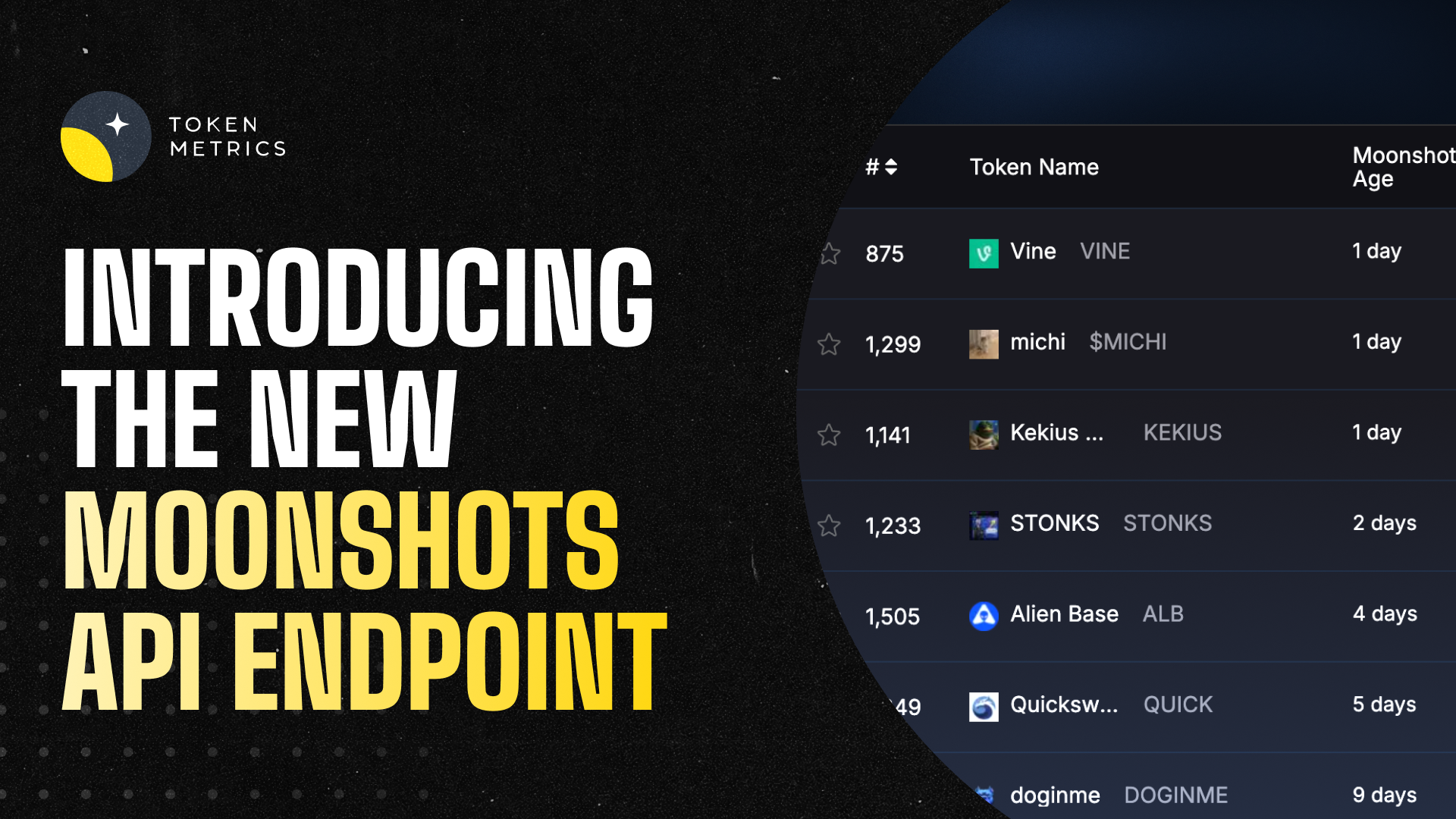
Big news: We’re cranking up the heat on AI-driven crypto analytics with the launch of the Token Metrics API and our official SDK (Software Development Kit). This isn’t just an upgrade – it's a quantum leap, giving traders, hedge funds, developers, and institutions direct access to cutting-edge market intelligence, trading signals, and predictive analytics.

Crypto markets move fast, and having real-time, AI-powered insights can be the difference between catching the next big trend or getting left behind. Until now, traders and quants have been wrestling with scattered data, delayed reporting, and a lack of truly predictive analytics. Not anymore.

The Token Metrics API delivers 32+ high-performance endpoints packed with powerful AI-driven insights right into your lap, including:

  • Trading Signals: AI-driven buy/sell recommendations based on real-time market conditions.
  • Investor & Trader Grades: Our proprietary risk-adjusted scoring for assessing crypto assets.
  • Price Predictions: Machine learning-powered forecasts for multiple time frames.
  • Sentiment Analysis: Aggregated insights from social media, news, and market data.
  • Market Indicators: Advanced metrics, including correlation analysis, volatility trends, and macro-level market insights.

Getting started with the Token Metrics API is simple:

  1. Sign up at www.tokenmetrics.com/api
  2. Generate an API key and explore sample requests.
  3. Choose a tier–start with 50 free API calls/month, or stake TMAI tokens for premium access.
  4. Optionally–download the SDK, install it for your preferred programming language, and follow the provided setup guide.

At Token Metrics, we believe data should be decentralized, predictive, and actionable. 

The Token Metrics API & SDK bring next-gen AI-powered crypto intelligence to anyone looking to trade smarter, build better, and stay ahead of the curve. With our official SDK, developers can plug these insights into their own trading bots, dashboards, and research tools – no need to reinvent the wheel.

Research

Top Crypto Prime Brokers (2025): Best Institutional Trading & Settlement Platforms

Token Metrics Team
17 min read
  • If you’re an institution that needs multi-venue liquidity, off-exchange settlement, and integrated custody/financing, this guide ranks the top crypto prime brokers for 2025 based on scale, security posture, and product breadth.
  • Top picks: Coinbase Prime for integrated trading + qualified custody with negotiated fees; FalconX for deep liquidity and capital solutions across spot/derivatives; Anchorage Digital Prime for bank-regulated custody with prime services and derivatives access. (Coinbase)
  • Caveats: Pricing is often negotiated; availability and products vary by region and legal entity. Always verify coverage on the provider’s official pages before onboarding. (docs.cdp.coinbase.com)

Introduction: Why Prime Brokerage Matters in 2025

Institutional participation accelerated in 2025, and with it the need for crypto prime brokers that unify execution, financing, custody, and settlement while minimizing counterparty risk. The leading platforms now resemble capital-markets infrastructure: single-counterparty access to multi-venue liquidity, off-exchange settlement networks that keep assets in segregated custody, and derivatives rails to hedge risk. Solutions like Coinbase Prime, FalconX, and Anchorage Digital Prime illustrate this evolution, while settlement networks such as Copper ClearLoop reduce venue risk without slowing execution. (Coinbase)

Primary intent: commercial-investigational. This guide compares features, fees, regions, and tradeoffs, then maps use cases to the right providers—so teams can move from diligence to deployment with confidence.


Our Evaluation Methodology

SCORING_WEIGHTS (sum = 100):

  • Scale & Liquidity (25) – depth of venues/LPs, 24/7 execution, options/futures where applicable.
  • Security & Regulatory Posture (25) – qualified custody, bank licensing/registrations, segregation, insurance disclosures.
  • Product Breadth (15) – spot, OTC/RFQ, derivatives, financing, settlement networks.
  • Costs & Fees (10) – published or negotiated schedules, financing/borrow terms.
  • Connectivity & Tooling (10) – FIX/WebSocket APIs, OEMS/SOR, reporting.
  • Capital Efficiency (10) – cross-margin, off-exchange settlement, instant delegation.
  • Support & Service (5) – coverage windows, onboarding SLAs.

Verification approach: We relied on official product, pricing, docs, security, and status pages only. If a claim wasn’t verifiable on an official page, we omitted it. Last updated: November 2025.


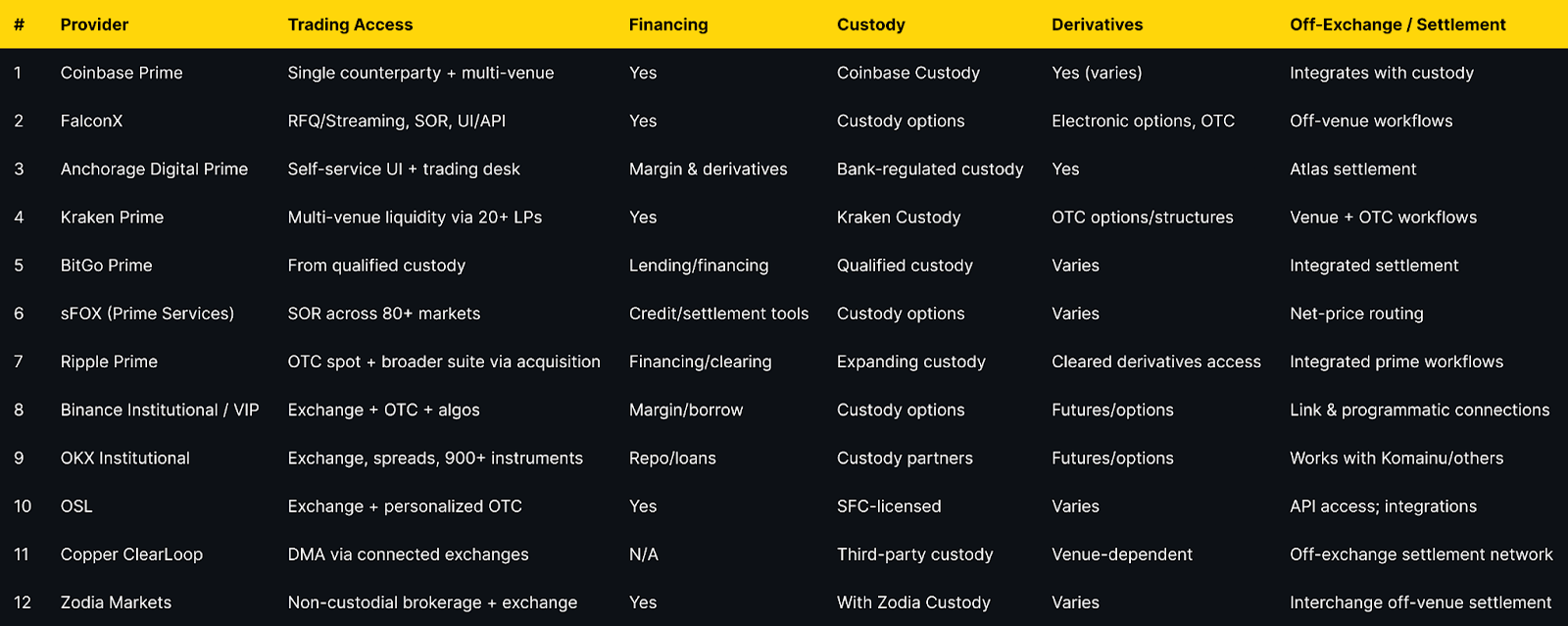
Crypto Prime Brokerage Comparison: At a Glance


Notes: “Pricing” reflects publicly stated models (often negotiated). “Regions/Notes” summarize official disclosures and licensing language where available on provider sites.


Detailed Provider Analysis

Coinbase Prime — Full-service prime brokerage at scale

Overview. Coinbase Prime combines trading, financing, and qualified custody under one institutional platform, with negotiated trading fees and flexible order denomination (base/quote). Execution integrates with reporting and controls suitable for asset managers and corporates. (Coinbase)
Ideal For. Asset managers, corporates/treasuries, hedge funds, RIAs.
Standout Features. Integrated custody; negotiated All-In / Cost-Plus fee models; staking fee schedules; institutional reporting. (docs.cdp.coinbase.com)
Pricing. Negotiated, fee currency = quote currency. (docs.cdp.coinbase.com)
Availability. Global, entity-dependent; product availability varies by jurisdiction.
Worth Noting. Some services require separate agreements (e.g., validators, derivatives access).
Alternatives to Consider. Kraken Prime, Anchorage Digital Prime. (Kraken)  


FalconX — Deep liquidity & capital solutions across markets

Overview. FalconX offers RFQ/streaming execution across spot and FX with FIX/WebSocket/REST connectivity, plus electronic options and capital solutions. Scale and 24/7 liquidity are central, with workflows for large tickets and programmatic strategies. (falconx.io)
Ideal For. Multi-strategy funds, HFT/systematic traders, market makers.
Standout Features. RFQ/streaming with TWAP/FOK; electronic options; FX desk integrated into prime; institutional APIs. (falconx.io)
Pricing. Negotiated; bespoke based on flow and venues.
Availability. Global institutional focus (entity-dependent).
Worth Noting. Derivatives access and product scope vary by entity/region.
Alternatives to Consider. Coinbase Prime, Kraken Prime. (Coinbase)  


Anchorage Digital Prime — Prime services on top of a US bank custodian

Overview. Anchorage Digital Prime delivers trading (13+ order types), derivatives, margin, and settlement built on Anchorage Digital Bank N.A. custody. A single interface and 24/7 trading desk support complex orders. (anchorage.com)
Ideal For. US-regulated custody requirements, governance-active institutions, corporates.
Standout Features. Bank-regulated custody; derivatives access; Atlas settlement; desk + API execution. (anchorage.com)
Pricing. Negotiated; service-by-entity.
Availability. US bank entity with global affiliates; services provided by specific Anchorage entities (see legal). (anchorage.com)
Worth Noting. Trading provided by separate non-bank entities; read entity-level disclosures. (anchorage.com)
Alternatives to Consider. BitGo Prime, Coinbase Prime. (The Digital Asset Infrastructure Company)  


Kraken Prime — Multi-venue liquidity with institutional fee tiers

Overview. Kraken Prime aggregates 20+ liquidity providers and offers smart order routing, OTC spot and OTC derivatives (options/structures), plus custody integrations. Institutional fee perks are published for high-volume clients. (Kraken)
Ideal For. Funds seeking published fee schedules, multi-venue execution, and OTC coverage.
Standout Features. Multi-venue liquidity; FIX 4.4 and WebSockets APIs; OTC desk; institutional taker tiers. (Kraken)
Pricing. Maker/taker schedule with institutional perks at very high volumes. (Kraken)
Availability. Global, entity-dependent.
Worth Noting. Some advanced services require qualification and separate onboarding.
Alternatives to Consider. sFOX, Coinbase Prime. (sFOX)


BitGo Prime — Prime services from qualified custody

Overview. BitGo integrates trading, financing, and settlement directly from custody, with segregated, bankruptcy-remote accounts and published insurance coverage details. (The Digital Asset Infrastructure Company)
Ideal For. Institutions prioritizing segregation and custody-first workflows.
Standout Features. Segregated accounts; insurance disclosures; custody-integrated prime trading. (The Digital Asset Infrastructure Company)
Pricing. Negotiated; custody/prime fees depend on assets and activity.
Availability. Global entities with varying regulatory regimes.
Worth Noting. Derivatives access varies by entity/partner networks.
Alternatives to Consider. Anchorage Digital Prime, Copper ClearLoop. (anchorage.com)


sFOX (Prime Services) — Agency SOR across 80+ markets with institutional tooling

Overview. sFOX acts as an agnostic agent routing across 80+ markets for best execution, with net-price routing and institutional reporting. The platform positions itself as a full-service prime dealer for institutions. (sFOX)
Ideal For. Systematic strategies, RIAs/allocators, corporates seeking agency execution.
Standout Features. SOR across venues; platform-level price improvement; custody options. (sFOX)
Pricing. Tiered/negotiated; historical content points to fee optimization via routing. (sFOX)
Availability. US/global entities; enterprise onboarding.
Worth Noting. Product scope (derivatives, margin) varies; confirm coverage.
Alternatives to Consider. Kraken Prime, Coinbase Prime. (Kraken)


Ripple Prime — Multi-asset prime brokerage under Ripple

Overview. Following the acquisition and subsequent close of Hidden Road, Ripple Prime offers U.S. spot OTC execution and positions Ripple as the first crypto company to own and operate a global, multi-asset prime broker; custody capabilities expanded further in late 2025. (Ripple)
Ideal For. Institutions seeking an integrated multi-asset prime platform with digital asset rails.
Standout Features. OTC spot execution (U.S.); multi-asset coverage; financing/clearing. (Ripple)
Pricing. Negotiated.
Availability. U.S. launch and global expansion via Ripple entities. (Ripple)
Worth Noting. Product availability differs by jurisdiction and entity.
Alternatives to Consider. FalconX, Coinbase Prime. (falconx.io)


Binance VIP & Institutional — Exchange liquidity, OTC & programmatic access

Overview. Binance’s institutional suite spans exchange, OTC RFQ, algos, and programmatic connectivity with VIP tiers. Coverage and eligibility depend on jurisdiction; Binance.US operates separately for U.S. clients. (binance.com)
Ideal For. Non-US teams wanting direct exchange liquidity with OTC tools.
Standout Features. VIP tiers, proof-of-reserves, OTC block trading. (binance.com)
Pricing. Exchange/VIP schedules; negotiated OTC.
Availability. Region-dependent; check supported regions. (binance.com)
Worth Noting. U.S. availability/routes differ; compliance and onboarding vary by entity.
Alternatives to Consider. OKX Institutional, OSL. (OKX)


OKX Institutional — Scale, instruments, and U.S. presence via OKX US

Overview. OKX highlights high uptime, 900+ instruments, and institutional connectivity. U.S. availability exists through OKX US with scope/policies noted in compliance disclosures. (OKX)
Ideal For. Proprietary firms and funds trading a broad instrument set with API access.
Standout Features. Nitro Spreads, derivatives suite, institutional support. (OKX)
Pricing. Exchange schedule + VIP; negotiated for blocks.
Availability. Global; US services via OKX US (scope varies). (OKX)
Worth Noting. Product availability and licensing differ by region.
Alternatives to Consider. Binance Institutional, Kraken Prime. (binance.com)


OSL — HK SFC-licensed exchange, custody & OTC

Overview. OSL provides a licensed Hong Kong platform spanning custody, exchange, and OTC brokerage for institutions, with dedicated coverage in the region. (osl.com)
Ideal For. APAC institutions needing SFC-regulated venue/custody.
Standout Features. SFC-licensed exchange; institutional API; custody with insurance positioning. (sfc.hk)
Pricing. Schedule/negotiated.
Availability. Hong Kong and supported regions; institutional focus.
Worth Noting. Product availability differs by license and region.
Alternatives to Consider. Zodia Markets, Coinbase Prime. (Zodia Markets)


Copper ClearLoop — Off-exchange settlement network (multi-custodial)

Overview. ClearLoop enables instant delegation to connected exchanges while assets remain in segregated custody—now supporting third-party custodians like BitGo and Komainu. (Copper)
Ideal For. Institutions prioritizing venue risk reduction and capital efficiency.
Standout Features. Multi-custodial support; instant asset delegation; network of venues/prime brokers. (Copper)
Pricing. Varies by participants and volumes.
Availability. Global network; coverage depends on participating venues/custodians.
Worth Noting. Not a full prime broker by itself; pairs well with custody/venues.
Alternatives to Consider. Zodia Interchange, Komainu Connect. (zodia-custody.com)


Zodia Markets + Zodia Custody Interchange — Non-custodial brokerage + off-venue settlement

Overview. Zodia Markets offers institutional brokerage/exchange with non-custodial design, while Zodia Custody’s Interchange provides off-venue settlement (OVS)—trade while assets remain in custody. Registrations span UK, Ireland, ADGM. (Zodia Markets)
Ideal For. Institutions wanting bank-backed governance and segregated settlement flows.
Standout Features. Non-custodial brokerage; Interchange OVS network; institutional registrations. (Zodia Markets)
Pricing. Negotiated.
Availability. UK/EU/MENA institutional coverage (entity-specific). (Zodia Markets)
Worth Noting. Product scope varies by entity and venue integrations.
Alternatives to Consider. OSL, Copper ClearLoop. (osl.com)


Choosing the Right Prime Broker: A Framework

  • Regulatory posture needed? If you require US bank-regulated custody, start with Anchorage Digital Prime. For Hong Kong, OSL’s SFC licensing is key. For UK/EU bank-backed governance with off-venue settlement, consider Zodia. (anchorage.com)
  • Execution style. For multi-venue aggregation and published fee tiers, Kraken Prime is strong; for RFQ/streaming with electronic options, FalconX leads. sFOX suits agency SOR across many markets. (Kraken)
  • Integrated custody + trading. Coinbase Prime and BitGo Prime minimize operational friction by tying trading to qualified custody. (Coinbase)
  • Venue-risk reduction. If you want to trade while assets remain in custody, evaluate Copper ClearLoop or Zodia Interchange (and Komainu Connect as a related model). (Copper)
  • Instrument breadth and scale. For vast exchange liquidity and institutional programs, Binance Institutional and OKX Institutional are at-scale options (region permitting). (binance.com)

Integrating Token Metrics Intelligence

  • Research phase: Use Token Metrics screeners and on-chain/technical indicators to identify pairs suitable for your mandate (beta targets, breadth, liquidity screens).
  • Execution phase: Route orders via your prime broker’s APIs (e.g., FIX/WebSocket) selected above, while TM signals inform aggression/passivity and time-of-day tactics. (Kraken)
  • Monitoring: Feed fills, slippage, and borrow/financing into TM analytics to assess venue performance and adjust routing.
  • Optimization: Combine TM factor views with prime-broker borrow/financing and settlement options (e.g., off-exchange) to lower VaR and operational risk.

Start a Token Metrics trial to bring quantitative screening and scenario analysis into your institutional workflow.  


Security & Compliance Guidelines

  • Prefer segregated, bankruptcy-remote custody and confirm insurance disclosures where published. (The Digital Asset Infrastructure Company)
  • If you need a US bank custodian, validate services by legal entity and read the provider’s disclosures. (anchorage.com)
  • Use off-exchange settlement networks to reduce exchange exposure during execution. (Copper)
  • Confirm derivatives eligibility, margin terms, and cross-margin/netting treatment by entity/venue. (Kraken)
  • Require API keys/roles with least-privilege, HSM custody, and mandatory allow-listing.
  • Maintain jurisdictional watchlists and restrict activity accordingly (e.g., US vs non-US entities for global exchanges). (OKX)

Compliance note: This article is for research/education, not financial advice.


Avoiding Common Mistakes

  • Treating “prime” as one product—coverage and legal entities differ by service.
  • Assuming off-exchange settlement is automatic—confirm network membership and supported venues. (Copper)
  • Onboarding to the wrong entity—read the jurisdictional disclosures. (anchorage.com)
  • Ignoring negotiated fees—request All-In vs Cost-Plus quotes. (docs.cdp.coinbase.com)
  • Skipping disaster-recovery testing—simulate exchange outage + settlement failover.
  • Under-documenting OMS/EMS changes—keep audit-ready change logs.

Frequently Asked Questions

What is a crypto prime broker?
 A provider that consolidates institutional trading, financing, custody, and settlement, often with multi-venue access and risk controls. Modern variants add off-exchange settlement so assets remain in custody during execution. (zodia-custody.com)

Do prime brokers publish fees?
 Often no—fees are negotiated based on volumes, products, and relationship tier. Some venues publish maker/taker schedules with institutional perks. (docs.cdp.coinbase.com)

How does off-exchange settlement work?
 Networks like ClearLoop and Interchange let you delegate assets to venues for trading while keeping them in segregated custody, reducing counterparty risk. (Copper)

Which providers are strongest for regulated custody?
 Anchorage Digital Prime (US bank custody), BitGo (qualified custody), OSL (HK SFC-licensed custody/exchange), and Zodia (bank-backed with EU/UK registrations). (anchorage.com)

Can U.S. institutions use OKX or Binance?
 Access is region-dependent and varies by entity (e.g., OKX US scope). U.S. clients typically cannot use Binance.com and instead must evaluate Binance.US or other U.S.-eligible routes. Always check official disclosures. (OKX)


Final Recommendations

For most global institutions, a two-stack works best: (1) an integrated prime broker with qualified custody (Coinbase Prime, Anchorage Digital Prime, or BitGo Prime) and (2) a venue-risk mitigator like Copper ClearLoop or Zodia Interchange. Execution-heavy funds should add FalconX or Kraken Prime for multi-venue and OTC derivatives coverage, while OSL anchors APAC/HK mandates and OKX/Binance expand exchange reach where eligible. (Coinbase)

Related Resources:

Research

Best Yield Marketplaces for Real-World Assets (RWAs) in 2025

Token Metrics Team
29 min read
  • What this guide covers: A comprehensive evaluation of 10 leading platforms that enable tokenized real-world asset trading and yield generation across private credit, treasuries, real estate, and structured finance
  • Quick verdict: Ondo Finance for institutional-grade treasury exposure at ~5% APY, Maple Finance for crypto-collateralized credit facilities delivering 9-12% net yields, Goldfinch Prime for diversified access to private credit funds from Apollo and Ares
  • One key limitation to know: Many RWA platforms enforce strict accreditation requirements (minimum $50K-200K) and geographic restrictions, particularly excluding US investors from certain products due to securities regulations

Why Yield Marketplaces for RWAs Matter in January 2025

The real-world asset tokenization market has experienced explosive growth, surging from $85 million in April 2020 to over $25 billion by mid-2025—representing a staggering 245-fold increase driven primarily by institutional demand for yield, transparency, and regulatory clarity. Private credit dominates at approximately 61% of total tokenized assets, followed by treasuries at 30%, with major asset managers like BlackRock, Apollo, and Franklin Templeton now actively tokenizing institutional-grade products.

The convergence of traditional finance and decentralized infrastructure has created unprecedented opportunities for investors seeking stable, real-world yields without exposure to cryptocurrency volatility. The tokenized RWA market is projected to reach between $9.43 trillion and $18.9 trillion by 2030, with regulatory frameworks in Singapore, Hong Kong, and Dubai providing clear pathways for compliant innovation.

For crypto-native investors, RWA yield marketplaces offer a critical bridge to sustainable income streams backed by productive assets rather than purely speculative token emissions. Traditional allocators gain 24/7 access to fractional ownership, instant settlement, and programmable compliance—advantages impossible in legacy financial infrastructure.


How We Evaluated These Providers

We assessed platforms across six weighted criteria totaling 100 points:

  • Yield Quality & Sustainability (30%): Consistency of returns, asset backing, historical performance, and correlation to traditional markets
  • Security & Risk Management (25%): Custody solutions, audit history, legal recourse, collateralization ratios, and default handling protocols
  • Asset Coverage & Diversity (15%): Range of underlying assets, tranching options, and exposure across credit curves
  • Accessibility & Costs (15%): Minimum investments, fee structures, geographic availability, and KYC requirements
  • Liquidity & Redemption (10%): Secondary market depth, withdrawal timelines, and tokenization standards
  • Infrastructure & Compliance (5%): Regulatory licenses, blockchain integrations, and institutional partnerships

Data sources: Official platform documentation, on-chain analytics from RWA.xyz and DeFiLlama, third-party audits, and regulatory filings. Research conducted October 2024-January 2025.

Verification approach: Every fee structure, yield figure, and regional restriction cited was verified on official platform pages or regulatory disclosures. Unverifiable claims were excluded.


The Contenders: Quick Comparison  

Provider Reviews by Use Case

For Treasury-Backed Stability (4-5% Yield)

Top Pick: Ondo Finance — Institutional Treasury Tokenization Pioneer

Overview
 Ondo Finance manages over $1.6 billion in tokenized assets, offering institutional-grade access to US Treasury exposure through OUSG (backed by BlackRock's BUIDL fund) and USDY (a yield-bearing stablecoin). The platform bridges TradFi stability with DeFi composability through multi-chain deployment across Ethereum, Solana, Base, and XRP Ledger.

Ideal For

  • Institutional allocators seeking low-volatility dollar exposure
  • DeFi protocols requiring yield-bearing collateral
  • Treasuries managing idle stablecoin holdings
  • Investors prioritizing regulatory compliance and brand-name backing

Standout Features

  • Approximately 5% APY from short-term US Treasuries with daily interest payouts via rebasing mechanism
  • Integration with Ripple's RLUSD stablecoin for instant minting and redemption 24/7
  • Comprehensive SEC-registered infrastructure through acquisition of Oasis Pro, including broker-dealer, ATS, and transfer agent licenses
  • Strategic partnerships including anchor position in Fidelity's FDIT tokenized money market fund and launch of Ondo Global Markets for tokenized equities

Pricing
 Management fees embedded in net yield; typical 0.15-0.30% annual fee depending on product. OUSG requires $100K minimum; USDY accessible at lower thresholds with 4.29% APY.

Availability
 Global except US persons for certain products. Ethereum, Solana, Polygon, Aptos, Sei, Base, XRP Ledger, and Sui supported.

Worth Noting
 OUSG designed for qualified purchasers with extended lockup periods; less suitable for retail or high-frequency traders. Platform prioritizes institutional relationships over retail accessibility.

Alternatives to Consider: Franklin Templeton BENJI, OpenEden TBILL  


Runner-Up: Franklin Templeton BENJI — Legacy Asset Manager Innovation

Overview
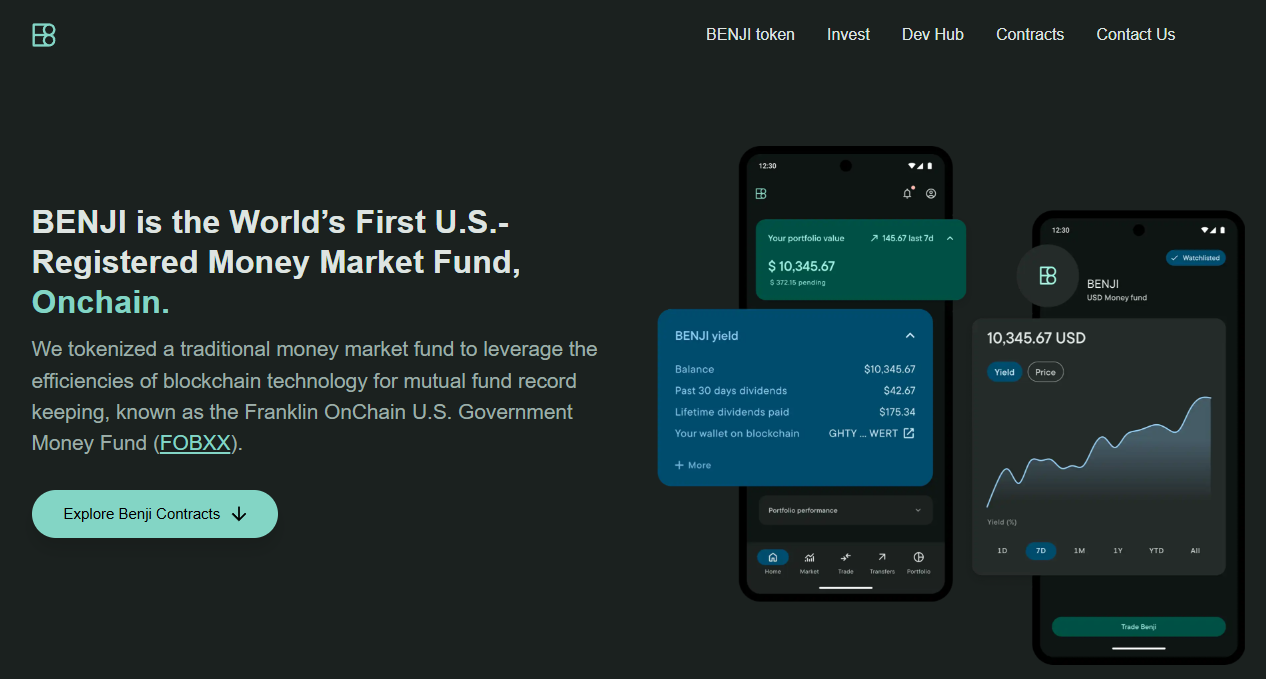
 Franklin Templeton's $775 million Franklin OnChain U.S. Government Money Fund (BENJI) pioneered tokenized mutual funds in 2021, offering exposure to US government securities across eight blockchains with patent-pending intraday yield calculation.

Ideal For

  • Investors seeking regulated 40 Act fund structure
  • Collateral managers requiring second-by-second yield accrual
  • Multi-chain strategies needing broad blockchain compatibility
  • Users prioritizing traditional asset manager credibility

Standout Features

  • Intraday yield tracking down to the second, enabling proportional earnings even for partial-day holdings
  • Direct stablecoin purchases and redemptions with wallet-to-wallet transfer capability
  • 63% of AUM deployed on Stellar Network for optimal cost efficiency
  • Integrated with DeFi protocols for collateral and leverage applications

Pricing
 7-day current yield approximately 4.5-5.5% gross; 0.25% management fee. No minimum investment restrictions beyond standard mutual fund requirements.

Availability
 Global availability with specific KYC requirements. Active on Stellar, Ethereum, Arbitrum, Base, Avalanche, Polygon, Aptos, Solana, BNB Chain.

Worth Noting
 Traditional mutual fund constraints apply including daily NAV calculations and potential redemption delays during market stress.

Alternatives to Consider: Backed bIB01, Superstate Short Duration Government Securities  


For Institutional Credit Exposure (8-12% Yield)

Top Pick: Maple Finance — Premier Crypto-Collateralized Lending

Overview
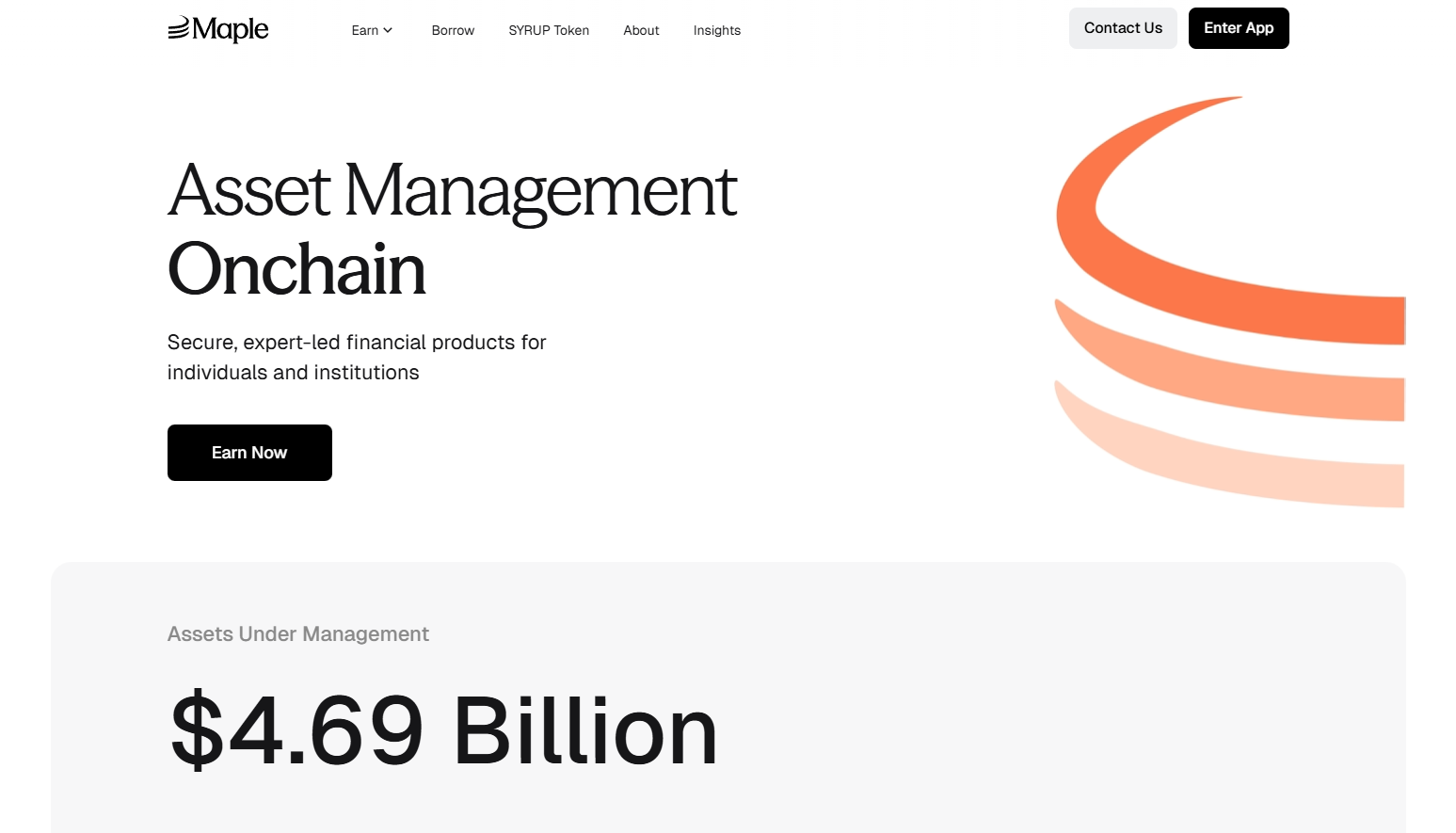
 Maple Finance manages over $4 billion in assets, specializing in institutional over-collateralized lending backed by Bitcoin, Ethereum, Solana, and XRP, targeting $100 billion in annual loan volume by 2030. The platform introduced SyrupUSDC for permissionless retail access alongside KYC-gated institutional pools.

Ideal For

  • Institutional lenders seeking exposure to cryptocurrency-backed credit
  • Liquidity providers comfortable with smart contract risk
  • Allocators targeting floating-rate, senior-secured structures
  • Investors seeking alternatives to traditional stablecoin farming

Standout Features

  • Consistent 9-12% net yields through undercollateralized institutional facilities and structured credit products
  • Strategic integration with Aave's $40 billion protocol bringing syrupUSDT to Plasma instance and syrupUSDC to core markets
  • Partnerships with Bitwise, Lido Finance (stETH-backed credit lines), and EtherFi (weETH collateral) expanding institutional adoption
  • Robust risk management combining decades of TradFi expertise with real-time on-chain monitoring

Pricing
 Variable by pool; typical effective yields 9-12% after protocol fees. Minimum investments pool-dependent, generally $10K-$50K for retail syrup products.

Availability
 Global with KYC requirements for lending. Institutional Maple requires accreditation; Syrup.fi open to broader participants.

Worth Noting
 Platform transitioned from uncollateralized to over-collateralized model after 2022 market turmoil. Historical defaults impacted certain pools; robust recovery mechanisms now in place.

Alternatives to Consider: Credix (emerging markets), TrueFi (uncollateralized DeFi)  


Runner-Up: Goldfinch Prime — Institutional Private Credit Access

Overview
 Goldfinch Prime aggregates exposure to multi-billion dollar private credit funds from Ares, Apollo, Golub Capital, and KKR, providing on-chain access to institutional-grade senior secured loans with over $1 trillion in collective AUM.

Ideal For

  • Non-US investors seeking diversified private credit exposure
  • Allocators targeting institutional fund performance without direct fund access
  • Participants seeking uncorrelated yield to crypto markets
  • Investors comfortable with longer lockup periods

Standout Features

  • Exposure to 1000+ senior secured loans across industries through vetted fund managers with 10+ years experience
  • Target returns of 9-12% net of fees with strict eligibility criteria including >90% senior secured portfolios and <0.75% target non-accrual rates
  • Heron Finance manages fund selection and vetting while fund managers handle all underwriting and default resolution
  • USDC-based deposits converted to proportional GPRIME tokens for continuous offering structure

Pricing
 Net yields 9-12% after embedded management fees and profit sharing. Minimum investments vary by pool structure; typically institutional minimums apply.

Availability
 Non-US persons only due to regulatory structure. KYC and accreditation verification required.

Worth Noting
 Exposure is indirect through fund shares rather than direct loan origination; fund managers absorb individual borrower default risk into aggregate yields. Liquidity limited compared to Treasury products.

Alternatives to Consider: Centrifuge private credit pools, Credix fintech lending


For Real Estate & Diversified Assets (6-10% Yield)

Top Pick: Centrifuge — Multi-Asset Tokenization Infrastructure

Overview
 Centrifuge operates as a multichain infrastructure platform enabling asset managers to tokenize real estate, trade finance, carbon credits, and structured credit with $1.2 billion TVL and recent 10x growth driven by the first on-chain CLO and tokenized S&P 500 index fund.

Ideal For

  • Investors seeking exposure to asset-backed securities beyond treasuries
  • Allocators comfortable evaluating tranched credit structures
  • Participants prioritizing transparency and on-chain asset verification
  • Portfolio managers wanting diversification across real-world credit types

Standout Features

  • Asset-agnostic architecture supporting structured credit, real estate mortgages, US treasuries, carbon credits, and consumer finance with full collateralization and legal recourse for investors
  • V3 platform enables cross-chain interoperability across Ethereum, Base, Arbitrum, Avalanche, BNB Chain, and Plume with integrated KYC and compliance-as-a-feature
  • Senior/junior tranche structures allowing risk-return customization
  • Partnership with Chronicle Labs for real-time price feeds and integration with Circle for USDC on/off-ramping

Pricing
 Yields vary by pool and tranche: typically 6-8% for senior tranches, 10-14% for junior tranches. Management fees embedded; pool-specific minimums apply.

Availability
 Global with KYC requirements. Pools may have additional jurisdictional restrictions based on underlying asset location.

Worth Noting
 Platform complexity requires understanding of tranched structures and asset-specific risks. Less liquid credit instruments offer less frequent pricing updates than treasury products.

Alternatives to Consider: RealT (US residential real estate focus), Republic (equity crowdfunding)

For Emerging Market Credit (12-18% Yield)

Top Pick: Credix — Latin American Fintech Lending

Overview
 Credix specializes in providing credit facilities to fintech lenders in Latin America, offering high-yield exposure to underserved credit markets with institutional-grade underwriting and local market expertise.

Ideal For

  • Sophisticated investors seeking higher risk-adjusted returns
  • Allocators comfortable with emerging market credit risk
  • Participants with extended investment horizons (12-24 months typical)
  • Investors seeking geographic diversification from US/EU markets

Standout Features

  • Target yields 12-18% reflecting emerging market risk premiums
  • Focus on fintech infrastructure enabling financial inclusion
  • Partnerships with established Latin American credit originators
  • Robust due diligence and monitoring of borrower networks

Pricing
 Pool-dependent yields typically 12-18% gross with management fees of 1-2%. Minimum investments generally $50K+ for accredited investors.

Availability
 Non-US persons primarily; requires accreditation verification and enhanced KYC given emerging market exposure.

Worth Noting
 Higher yields reflect higher credit and currency risk. Platform experienced challenges during regional economic volatility; enhanced risk controls now implemented.

Alternatives to Consider: Goldfinch V1 pools (emerging market focus), TrueFi uncollateralized pools


For Tokenization Infrastructure (Platform Providers)

Top Pick: Securitize — Industry-Leading Issuance Platform

Overview
 Securitize has tokenized over $4.5 billion in assets for 1.2 million investors across 3,000+ clients, operating as an SEC-registered transfer agent with integrated ATS for secondary trading. The platform powers major offerings including BlackRock's BUIDL fund.

Ideal For

  • Asset managers seeking turnkey tokenization solutions
  • Issuers requiring SEC-compliant digital security infrastructure
  • Institutional clients needing integrated custody and compliance
  • Projects prioritizing regulatory alignment and brand credibility

Standout Features

  • DS Protocol automates token issuance, transfer agent functions, and regulated secondary trading with $47 million funding led by BlackRock
  • Recent launch of STAC tokenized AAA CLO fund with BNY custody demonstrating institutional adoption trajectory
  • Comprehensive investor onboarding, KYC/AML, and reporting infrastructure
  • Partnerships with major asset managers and integration with Zero Hash for fiat conversion

Pricing
 Platform fees vary by issuance size and complexity; typically 0.5-2% of AUM plus basis point fees on transactions. White-label solutions available for enterprise clients.

Availability
 Global operations with jurisdiction-specific compliance modules. Primary focus on US, EU, and APAC institutional markets.

Worth Noting
 Securitize is an issuance platform rather than direct investment product; investors access opportunities through partner funds and offerings launched on the infrastructure.

Alternatives to Consider: Tokeny (EU-focused), Polymath/Polymesh (security token specialists)


Complete Provider Directory

  • Backed Finance: European MiCA-compliant tokenization platform offering bIB01 (Swiss government bond exposure) and bC3M (commodity basket). Strong focus on regulatory alignment with modest 3-5% yields and low entry barriers.
  • Swarm Markets: Decentralized platform enabling fractional ownership of real estate and private credit with $1K-$50K minimums. Emphasizes accessibility while maintaining compliance through distributed infrastructure.
  • TrueFi: Uncollateralized lending protocol using on-chain credit scoring and portfolio diversification. Higher risk-return profile (8-15% targets) with full transparency of borrower pools and performance metrics.
  • Archax: UK FCA-regulated platform for institutional tokenization of bonds, funds, and money markets. Focus on traditional finance compatibility with stringent accreditation requirements.

Making Your Selection: Key Questions

  • What yield stability do you require?
     Treasury-backed platforms (Ondo, Franklin Templeton) offer predictable 4-5% returns with minimal volatility. Credit-focused platforms (Maple, Goldfinch) target 9-12% but introduce credit risk and performance variability.
  • What is your risk tolerance for underlying collateral?
     Government securities provide lowest risk; over-collateralized crypto loans add smart contract and liquidation risks; uncollateralized emerging market credit carries highest default potential.
  • Do you meet accreditation and minimum investment thresholds?
     Many institutional products require $50K-$200K minimums and qualified purchaser status. Retail-accessible options like USDY and syrupUSDC lower barriers but may sacrifice yield.
  • What liquidity do you need?
     Treasury tokens generally offer daily liquidity; private credit pools may have quarterly redemption windows; real estate tokenization can involve 12-24 month lockups.
  • How important is regulatory compliance?
     Platforms like Ondo, Franklin Templeton, and Securitize prioritize SEC registration and traditional fund structures. Purely DeFi-native protocols offer less regulatory clarity but greater composability.
  • What blockchain ecosystems do you operate in?
     Multi-chain deployment (Ondo, Centrifuge) provides flexibility; single-chain specialization (some Maple pools) may offer optimization but limits interoperability.
  • Do you have geographic restrictions?
     US persons often excluded from highest-yield opportunities due to securities laws. European investors benefit from MiCA framework; APAC sees growing regulatory clarity.
  • What level of transparency do you require?
     On-chain native protocols offer real-time asset verification; hybrid models may rely on periodic attestations and third-party audits.
  • Are you seeking passive income or active yield strategies?
     Treasury staking provides set-and-forget returns; DeFi integrations enable leverage, collateral strategies, and yield optimization requiring active management.
  • How much operational complexity can you handle?
     Single-platform solutions simplify but limit optionality; multi-protocol strategies maximize returns but require gas management, tax tracking, and security across multiple platforms.

Maximizing Your Setup with Token Metrics

Token Metrics provides critical intelligence for navigating RWA yield opportunities through data-driven analysis and market insights.

Research Phase: Leverage Token Metrics' fundamental analysis to evaluate tokenized asset protocols, comparing on-chain metrics, TVL trends, and yield sustainability indicators. Our RWA sector reports identify emerging platforms and highlight regulatory developments across jurisdictions.

Portfolio Construction: Use quantitative scoring to allocate across risk tiers—balancing stable treasury exposure with higher-yield credit products. Token Metrics' portfolio tools help optimize diversification while monitoring correlation to traditional crypto markets.

Ongoing Monitoring: Real-time alerts notify you of yield changes, protocol upgrades, and risk events. Our dashboard aggregates performance across multiple RWA platforms, tracking your yield-bearing positions alongside broader cryptocurrency holdings.

Risk Management: Token Metrics' risk analytics assess smart contract security, custody arrangements, and counterparty exposure. Our reports flag platforms with concerning yield sustainability metrics or operational red flags before they impact your capital.

Start your Token Metrics free trial to access institutional-grade RWA research and optimize your real-world asset allocation.  


Essential Security Practices

  • Custody Verification: Confirm that platforms use institutional-grade custodians (Coinbase Custody, BitGo, Fireblocks) for underlying assets. Verify proof-of-reserve attestations and third-party audits.
  • Smart Contract Risk: Review audit reports from reputable firms (Trail of Bits, OpenZeppelin, Certora). Understand upgrade mechanisms and timelock protections on protocol contracts.
  • Legal Structure Assessment: Examine SPV formation, bankruptcy remoteness, and investor recourse mechanisms. Ensure tokenization structure provides actual legal claim on underlying assets, not just economic exposure.
  • Regulatory Compliance: Verify platforms maintain necessary licenses (broker-dealer, transfer agent, ATS) in relevant jurisdictions. Confirm offerings comply with securities laws in your domicile.
  • Counterparty Risk: Understand who services loans, manages defaults, and handles liquidations. Evaluate track records of asset originators and credit underwriters.
  • Liquidity Risk Management: Never allocate more than you can afford to lock up for stated redemption periods. Maintain buffer capital for market volatility and potential redemption delays.
  • Tax Implications: Consult tax professionals on treatment of tokenized yield—may be classified as interest income, dividends, or capital gains depending on structure and jurisdiction.
  • Geographic Restrictions: Verify you're eligible to participate based on residency. Using VPNs or misrepresenting location can result in frozen funds and legal liability.
  • Platform Concentration: Diversify across multiple RWA providers to reduce single-point-of-failure risk. No single platform should represent majority of yield allocation.
  • Documentation: Maintain records of all transactions, yield distributions, and platform communications for tax reporting and potential disputes.

This article is for research and educational purposes, not financial advice. RWA investments carry risks including loss of principal.


What to Avoid

  • Ignoring minimum holding periods: Many RWA products enforce lockups or redemption windows. Treating them as liquid positions can leave you unable to access capital when needed.
  • Chasing unsustainably high yields: Promised returns significantly above market rates often indicate excessive risk. Verify underlying asset performance and historical consistency before committing capital.
  • Overlooking platform liquidity: Token existence on-chain doesn't guarantee exit liquidity. Check secondary market depth and historical spread between minting and redemption prices.
  • Neglecting jurisdictional compliance: Accessing platforms not available in your region can result in frozen accounts and regulatory penalties. Always verify eligibility before depositing funds.
  • Underestimating smart contract risk: Even well-audited protocols face exploitation risk. Size positions appropriately and monitor security incident disclosures across the ecosystem.
  • Failing to verify asset backing: Don't rely on marketing claims. Demand proof-of-reserve, third-party attestations, and transparent reporting on underlying collateral.
  • Concentrating in single asset class: Over-allocating to one RWA category (e.g., all private credit) eliminates diversification benefits. Balance across treasuries, credit, and real estate where possible.
  • Ignoring fee structures: Management fees, performance fees, and transaction costs compound over time. Calculate net yields after all costs when comparing platforms.

Reader Questions Answered

What's the difference between tokenized treasuries and yield-bearing stablecoins?

 Tokenized treasuries (like OUSG) represent direct ownership of US Treasury securities with yield passed through to holders. Yield-bearing stablecoins (like USDY) maintain $1 peg while distributing treasury yields via rebasing or airdrops. Treasuries may fluctuate slightly with NAV; yield stablecoins prioritize price stability.

Are RWA yields taxable differently than crypto staking rewards?

 Likely yes, though tax treatment varies by jurisdiction. RWA yields from treasuries or credit facilities often classified as interest income taxed at ordinary rates. Crypto staking may be treated as income at receipt or capital gains at sale depending on location. Consult tax professionals for specific guidance.

Can I use tokenized RWAs as collateral in DeFi protocols?

 Increasingly yes. Platforms like Maple, Ondo (via Flux Finance), and Centrifuge enable using tokenized assets as DeFi collateral. However, support varies by protocol and asset—USDY and OUSG see broader integration than niche real estate tokens. Liquidation risks apply if collateral value drops.

What happens if the platform goes bankrupt?

 Properly structured tokenization isolates assets in bankruptcy-remote SPVs, protecting investor claims even if platform operator fails. However, redemption processes may be delayed and require legal navigation. This is why verifying legal structure and custodial arrangements is critical.

How liquid are RWA tokens compared to stablecoins?

 Significantly less liquid. While stablecoins have billions in daily DEX volume, most RWA tokens trade thinly or only through platform-controlled redemption mechanisms. Treasury tokens offer better liquidity than private credit or real estate, but all lag traditional stablecoins substantially.

Do I need to be an accredited investor?

 Depends on the platform and your location. US-based offerings often require accreditation; international platforms may have lower barriers. Products like USDY, syrupUSDC, and BENJI target broader accessibility, while institutional credit pools restrict to qualified purchasers.

What are the main risks that could cause loss of principal?

 (1) Underlying asset default (credit risk), (2) smart contract exploitation, (3) platform insolvency without proper asset segregation, (4) regulatory action freezing operations, (5) stablecoin de-pegging for yield products denominated in USDC/USDT, (6) liquidation cascades in collateralized structures.

How do yields compare to traditional finance alternatives?

 Tokenized treasuries (4-5%) match conventional money market funds but with 24/7 access. Private credit RWAs (9-12%) offer premiums over corporate bonds due to illiquidity and platform novelty. Emerging market RWA yields (12-18%) comparable to EM debt funds with added smart contract risk.


Bottom Line

Real-world asset yield marketplaces represent the maturation of blockchain infrastructure beyond speculation into productive finance. For investors seeking stable, asset-backed returns uncorrelated to cryptocurrency volatility, platforms like Ondo Finance and Franklin Templeton deliver institutional-grade treasury exposure with DeFi composability. Those comfortable with credit risk can access superior yields through Maple Finance's collateralized institutional lending or Goldfinch Prime's diversified private credit exposure.

The key to success: match platform selection to your specific risk tolerance, liquidity needs, and regulatory constraints. Treasury products suit conservative allocators prioritizing capital preservation; credit platforms reward investors accepting higher risk for enhanced returns; multi-asset infrastructure like Centrifuge offers diversification across real-world credit types.

Start with smaller allocations to understand platform mechanics, redemption processes, and yield consistency before committing substantial capital. The RWA sector's rapid growth will continue creating opportunities, but also attracting lower-quality offerings—due diligence remains paramount.

Related Resources:


About This Research

Methodology: This guide evaluated 20+ RWA platforms through analysis of official documentation, on-chain data, regulatory filings, and third-party audits. Platforms selected represent meaningful TVL (>$100M), regulatory compliance, and operational track record. Final selection prioritized diversity across asset classes and investor accessibility tiers.

Research Sources:

  • Ondo Finance: Product documentation, tokenomics, OUSG/USDY specifications, Oasis Pro acquisition disclosure
  • Maple Finance: Platform whitepaper, syrupUSDC mechanics, Aave integration announcement, CEO interviews
  • Centrifuge: V3 technical documentation, pool analytics, Republic partnership details
  • Goldfinch: Prime pool specifications, fund manager criteria, Heron Finance structure
  • Franklin Templeton: BENJI platform technical details, intraday yield patent documentation, multi-chain deployment
  • Securitize: DS Protocol documentation, STAC fund launch details, BlackRock partnership announcements
  • RWA.xyz: Platform TVL data, tokenization metrics, market growth analysis
  • DeFiLlama: Protocol TVL tracking, historical performance data
  • BCG/Ripple: RWA market projections and industry research
  • VanEck, Coinbase, Binance: Sector research reports on RWA growth trajectories

All data current as of January 2025. Platform features and yields subject to change; verify current terms on official websites before investing.

Research

Top Gold & Commodity-Backed Tokens (2025)

Token Metrics Team
12 min read

Who this guide is for. Crypto investors and treasurers comparing gold-backed tokens and other commodity-backed assets that can be audited and, in many cases, redeemed for metal.
Top three picks. PAX Gold (PAXG) for regulated, bar-linked redemption; Tether Gold (XAUt) for broad awareness and simple fees; Kinesis (KAU/KAG) for spend-and-yield use cases.
Key caveat. Redemption minimums, custody locations, and fees vary by issuer; always confirm regional eligibility and schedules on the official pages.


Introduction: Why Commodity-Backed Tokens Matter in 2025

Gold-backed tokens give on-chain ownership exposure to vaulted bullion with transparent allocation and, often, physical redemption, blending the inflation hedge of metals with crypto liquidity. In 2025, they’re used for hedging, collateral, cross-border settlement, and “digital cash” backed by tangible assets. A commodity-backed token is a blockchain token that represents title to a specific quantity of a real-world commodity (for example, 1 troy ounce or 1 gram of gold) held by a custodian, typically with published fees, vault locations, and redemption rules. Our picks prioritize liquidity, security controls, breadth of metals, cost transparency, and global accessibility.


Best Commodity-Backed Tokens in November 2025 (Comparison Table)


We excluded defunct or sunset projects (e.g., PMGT; CACHE Gold ceased backing CGT on Sept 30, 2025). (perthmint.com)


Top 10 Gold & Commodity-Backed Tokens in November 2025

1) PAX Gold (PAXG) — Best for bar-linked redemption & regulatory posture

Why Use It. PAXG links each token to specific LBMA Good Delivery bars stored in London, offering direct bar redemption (institutional minimums apply) or USD redemption at spot. Paxos publishes fee schedules and notes no storage fee charged to customers at this time. (paxos.com)
Best For. Institutions; HNW hedgers; DeFi users needing reputable collateral.
Notable Features. LBMA bars; serial-number linkage; custodied in London; fiat redemption option. (paxos.com)
Fees Notes. Creation/destruction fees; no storage fee currently per issuer help center. (help.paxos.com)
Regions. Global (issuer KYC).
Consider If. You can meet bar redemption minimums and UK vault logistics. (help.paxos.com)
Alternatives. Tether Gold (XAUt); VNX Gold (VNXAU).  


2) Tether Gold (XAUt) — Best for simple pricing & broad availability

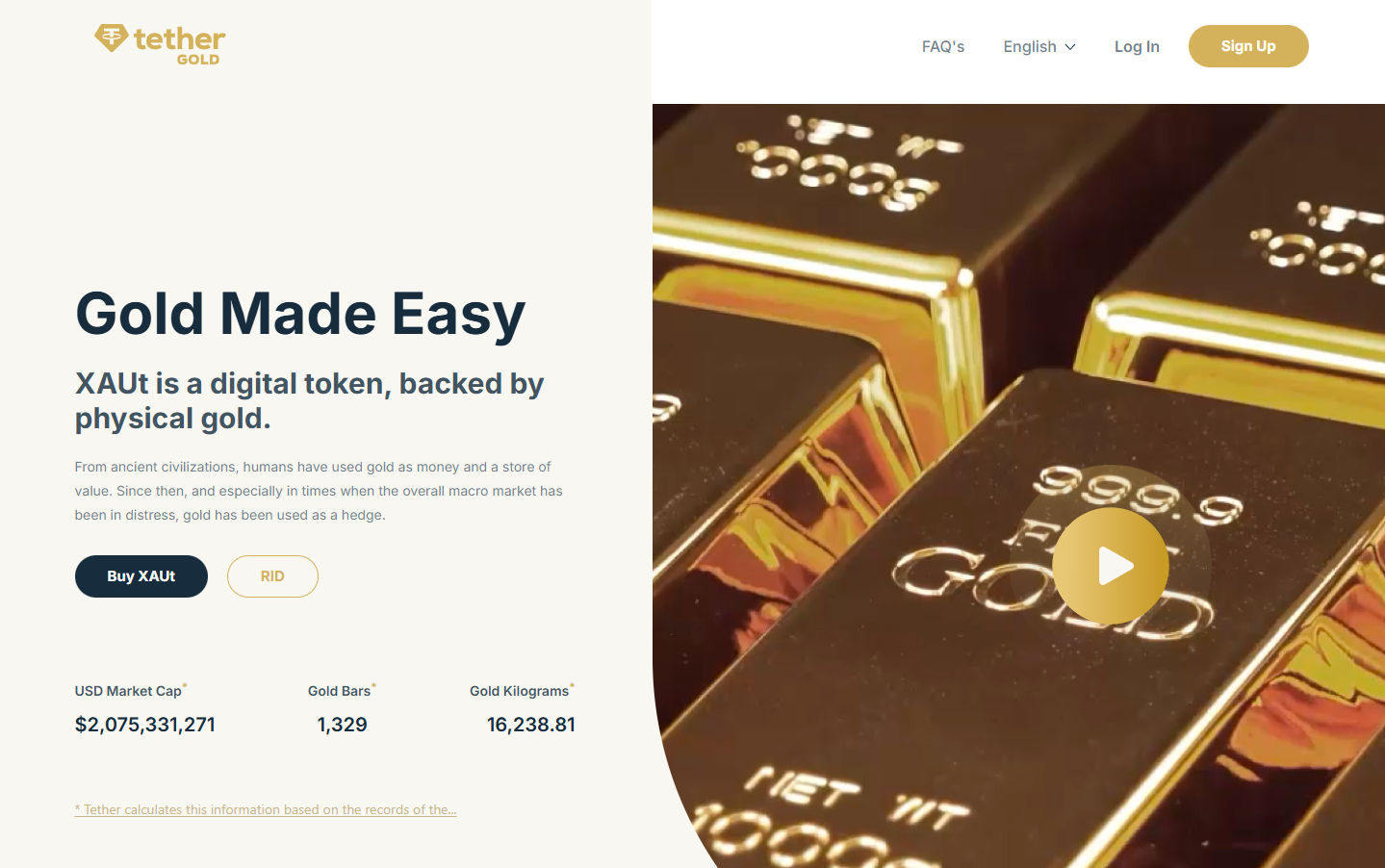
Why Use It. XAUt represents allocated gold and can be redeemed for physical gold or USD; Tether publishes a straightforward 0.25% creation/redemption fee and a one-time verification fee for onboarding. FAQs outline redemption mechanics and bar specifics. (Tether)
Best For. Traders seeking brand familiarity; cross-chain users (ETH/TRON).
Notable Features. Bar metadata; physical or USD redemption; no custody fee disclosed beyond the transaction fee. (Tether)
Fees Notes. 25 bps create/redeem; separate KYC verification fee. (Tether)
Regions. Global (issuer KYC).
Consider If. You need clear fee math but don’t require bar-specific allocation like PAXG.
Alternatives. PAX Gold (PAXG); Kinesis (KAU).  


3) Kinesis KAU (Gold) / KAG (Silver) — Best for spend-and-yield utility

Why Use It. Kinesis combines metal-backed tokens with an exchange, cards, and yields funded from platform fees (published yield-share). Trading and precious metals transactions show ~0.22% execution fees on official schedules. (Kinesis)
Best For. Users wanting to spend gold/silver, earn monthly yields, and keep fees predictable.
Notable Features. Fee-share yield (published); exchange, card rails; gold & silver pairs. (Kinesis)
Fees Notes. ~0.22% buy/sell/trade; other fees per schedule. (Kinesis)
Regions. Global (platform KYC/availability).
Consider If. You prefer an integrated platform over a standalone token.
Alternatives. VNX (VNXAU/VNXAG); Aurus (tXAU/tXAG).  


4) Comtech Gold (CGO) — Best for XDC ecosystem & Shariah-compliant framework

Why Use It. CGO tokenizes 1g gold units on the XDC (XRC-20) network, with a published fee structure for mint/redeem (0.50%), transfers (0.50%), and custody notes in FAQs. Documentation details creation/redemption and delivery fees. (comtechgold.com)
Best For. XDC builders; users needing Shariah-compliant structuring.
Notable Features. On-chain proofing; fee schedule; vault delivery options. (comtechgold.com)
Fees Notes. 0.50% mint/redeem; 0.50% transfer; custody terms disclosed. (comtechgold.com)
Regions. Global (issuer terms apply).
Consider If. You’re comfortable with XDC rails and issuer fee model.
Alternatives. PAXG; VNXAU.


5) VNX Gold (VNXAU) — Best for EEA vaulting & multi-chain issuance

Why Use It. VNXAU gives direct ownership of allocated bars stored in Liechtenstein with a public allocation lookup tool. VNX runs on Ethereum, Polygon, Q, and Solana, and has communications on redemption and delivery. (VNX)
Best For. EEA users; diversification across chains.
Notable Features. Allocation lookup by serial; segregated AAA-jurisdiction vault; multi-chain. (VNX)
Fees Notes. See VNX pricing and product pages for current schedules.
Regions. EEA emphasis; global availability varies by KYC.
Consider If. You want EEA custody and serial-level transparency.
Alternatives. PAXG; XAUt.


6) Aurus tGOLD (tXAU) / tSILVER (tXAG) — Best for gram-denominated multi-metal exposure

Why Use It. Aurus issues 1-gram tokens backed by vaulted gold and silver with insured, audited storage. tGOLD and tSILVER support multi-chain DeFi integrations and a mobile app, with ecosystem partners for mint/redeem. (AURUS)
Best For. DeFi users; small-denomination accumulation; multi-metal portfolios (includes platinum via tXPT).
Notable Features. 1g units; insured vaulted metals; app & dashboard; partner network. (AURUS)
Fees Notes. Exchange/network fees; issuer/partner fees may apply.
Regions. Global (partner KYC where required).
Consider If. You want gram-level flexibility and cross-chain access.
Alternatives. Kinesis; VNX.


7) Gold Silver Standard (AUS/AGS) — Best for Australia-based custody & simple redemption

Why Use It. Tokens AUS (gold) and AGS (silver) are backed by allocated bullion held in Australian high-security vaults with $0 storage and transfer at the issuer level and partner-facilitated redemptions. (goldsilverstandard.com)
Best For. AUD-centric investors; straightforward physical pickup/delivery via partners.
Notable Features. 1g linkage; local redemption via Ainslie partners; Australia-first focus. (goldsilverstandard.com)
Fees Notes. Issuer lists $0 storage/transfer; exchange and redemption partner fees may apply. (goldsilverstandard.com)
Regions. Australia focus; global varies.
Consider If. You need straightforward redemption in Australia.
Alternatives. PAXG; VNXAU.


8) VNX Silver (VNXAG) — Best for EEA silver allocation & transparency tools

Why Use It. VNXAG mirrors the VNXAU model for silver, backed by allocated metal with the same allocation lookup tooling and multi-chain issuance. (VNX)
Best For. EEA investors prioritizing silver in segregated storage.
Notable Features. Allocation lookup; EEA custody; multi-chain support. (VNX)
Fees Notes. See VNX site for current schedules.
Regions. EEA emphasis; global varies.
Consider If. You want EEA-vaulted silver with serial-level transparency.
Alternatives. KAG; tXAG.


9) VeraOne (VRO) — Best for euro-area buyers wanting 1-gram ERC-20

Why Use It. VRO is an ERC-20 token pegged to 1 gram of LBMA-standard gold, issued by a long-standing French precious-metal group; materials describe secured storage and regular audits. (VeraOne)
Best For. EU users; gram-based savings; euro on-ramps.
Notable Features. 1g linkage; audited storage; EU presence. (VeraOne)
Fees Notes. Issuer materials outline model; confirm current fees on site.
Regions. EU focus; global access varies.
Consider If. You want EU branding and ERC-20 simplicity.
Alternatives. PAXG; VNXAU.


10) AgAu — Best for Swiss custody & peer-to-peer design

Why Use It. AgAu outlines 1:1 backed gold and silver tokens with Swiss custody and a peer-to-peer payment focus; docs and reports describe convertibility and audited reserves. (agau.io)
Best For. Users seeking Swiss jurisdiction and payments-style UX.
Notable Features. Swiss issuer; P2P spend; audit & documents hub. (agau.io)
Fees Notes. See issuer documentation for fees and redemption steps.
Regions. Global (jurisdictional checks apply).
Consider If. You want Swiss custody with payments emphasis.
Alternatives. VNXAU; AUS.


Decision Guide: Best by Use Case

  • Regulated, bar-specific redemption: PAX Gold (PAXG). (paxos.com)
  • Simple fee schedule & brand familiarity: Tether Gold (XAUt). (Tether)
  • Spend metals + monthly fee-share yield: Kinesis (KAU/KAG). (Kinesis)
  • XDC network users: Comtech Gold (CGO). (comtechgold.com)
  • EEA custody & allocation lookup: VNX (VNXAU/VNXAG). (VNX)
  • Gram-based, multi-metal DeFi: Aurus (tXAU/tXAG). (AURUS)
  • Australia-centric custody & pickup: Gold Silver Standard (AUS/AGS). (goldsilverstandard.com)
  • EU 1-gram ERC-20: VeraOne (VRO). (VeraOne)
  • Swiss custody & P2P payments: AgAu. (agau.io)

How to Choose the Right Commodity-Backed Token (Checklist)

  • ☐ Region eligibility and KYC match your profile.
  • ☐ Underlying metal type and unit (ounce vs gram).
  • Redemption rules: minimums, delivery locations, timelines.
  • Custody: vault jurisdiction, insurer, LBMA accreditation.
  • Fee transparency: creation, redemption, storage, transfer, network.
  • Audit/attestation cadence and allocation lookup tools.
  • Chains supported and DeFi integration needs.
  • ☐ Support channels and documentation depth.
    Red flags: vague custody details, unclear redemption, or discontinued programs.

Use Token Metrics With Any Commodity-Backed Token

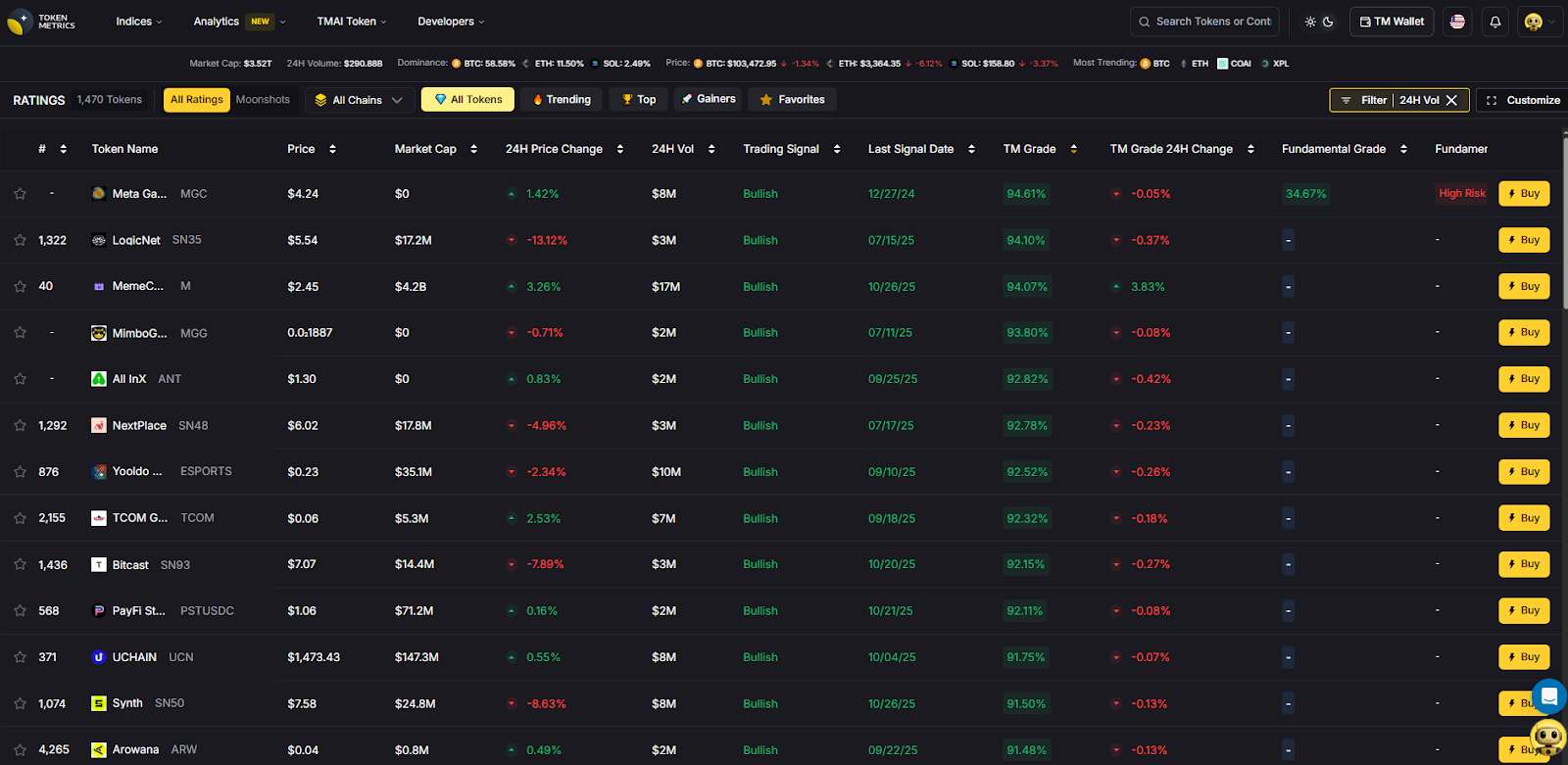
  • AI Ratings to screen metal-linked assets and related ecosystem tokens.


  • Narrative Detection to spot inflows to on-chain RWAs.
  • Portfolio Optimization to size metal exposure vs. crypto beta.
  • Alerts & Signals to time entries/exits around macro prints.
    Workflow: Research → Select issuer → Execute on-chain or via platform → Monitor with alerts.


CTA: Start free trial to screen assets and time entries with AI.  


Security & Compliance Tips

  • Use official issuer URLs only; beware look-alikes.
  • Confirm fee schedules and redemption procedures before buying. (Tether)
  • Verify vaulting jurisdiction and any bar-serial lookup tools. (VNX)
  • Mind network fees, bridge risks, and exchange withdrawal rules.
  • Keep custody keys secure; whitelist issuer addresses.
  • If staking or yielding, confirm source of yield and counterparty exposure. (Kinesis)
    This article is for research/education, not financial advice.

Beginner Mistakes to Avoid

  • Treating all metal tokens as equal—redemption and custody differ widely.
  • Ignoring region and KYC limits until you try to redeem.
  • Overlooking minimums (e.g., full LBMA bars vs. gram redemptions). (help.paxos.com)
  • Confusing defunct tokens with active ones (e.g., PMGT sunset; CGT backing ceased). (perthmint.com)
  • Forgetting network/transfer fees when arbitraging across chains.
  • Using unofficial contracts on the wrong chain.

How We Picked (Methodology & Scoring)
  • Liquidity — 30%. Exchange presence, on-chain activity, practical tradability.
  • Security — 25%. Custody details, audits/attestations, LBMA alignment, redemption design.
  • Coverage — 15%. Metals (gold/silver/platinum), chains, tooling.
  • Costs — 15%. Creation/redemption/storage/transfer and transparency of schedules.
  • UX — 10%. Apps, dashboards, redemption flows.
  • Support — 5%. Docs, status pages, human support.
    We relied on official product, docs, fees, FAQ, and disclosure pages, cross-checking market datasets only for context. Last updated November 2025.

FAQs

What are gold-backed tokens?
 They are blockchain tokens that represent ownership of a specific quantity of vaulted, insured gold, typically with published fees and, in some cases, physical redemption options.

Are gold-backed tokens safer than stablecoins?
 They can diversify away from fiat risk, but introduce custody and redemption dependencies. Safety depends on the issuer’s vaulting, audits, legal structure, and your ability to redeem.

What fees should I expect?
 Common fees include creation/redemption, possible storage, transfer, and network fees. Examples: XAUt lists 0.25% create/redeem; Paxos publishes creation/destruction fees and notes no storage fee currently. Always check the live schedules. (Tether)

Can I redeem tokens for a real gold bar?
 Some issuers support bar redemption with minimum sizes and location constraints (e.g., LBMA bar logistics in London for PAXG). Others support gram-level redemption via partners. (help.paxos.com)

Which chains are supported?
 Varies: PAXG (Ethereum), XAUt (Ethereum/TRON), VNX (Ethereum/Polygon/Q/Solana), Aurus (multi-chain), CGO (XDC), Kinesis (native + exchange listings). (paxos.com)

Are there discontinued tokens I should avoid?
 Yes. PMGT has been discontinued; CACHE Gold (CGT) ceased backing as of Sept 30, 2025. Verify project status before buying. (perthmint.com)


Conclusion + Related Reads

Choose PAXG for bar-linked redemption and strong disclosures, XAUt for simple fees and brand reach, or Kinesis if you want to spend metals and earn fee-share yields. For EEA vaulting with allocation lookup, VNX is compelling; for gram-based DeFi exposure, Aurus is versatile.

Related Reads:

Recent Posts

No Item Found
Research

WhiteBIT Coin Price Prediction 2028: $40-$272 Target Analysis

Token Metrics Team
7 min read

WhiteBIT Coin Price Prediction: Portfolio Context for WBT in the 2028 Landscape

Exchange tokens like WhiteBIT Coin offer leveraged exposure to overall market activity, creating concentration risk around a single platform's success. While WBT can deliver outsized returns during bull markets with high trading volumes, platform-specific risks like regulatory action, security breaches, or competitive displacement amplify downside exposure. Portfolio theory suggests balancing such concentrated bets with broader sector exposure.

The price prediction scenarios below show how WBT might perform across different crypto market cap environments. Rather than betting entirely on WhiteBIT Coin's exchange succeeding, diversified strategies blend exchange tokens with L1s, DeFi protocols, and infrastructure plays to capture crypto market growth while mitigating single-platform risk.

The Case for Diversified Index Exposure

Portfolio theory teaches that diversification is the only free lunch in investing. WBT concentration violates this principle by tying your crypto returns to one protocol's fate. Token Metrics Indices blend WhiteBIT Coin with the top one hundred tokens, providing broad exposure to crypto's growth while smoothing volatility through cross-asset diversification. This approach captures market-wide tailwinds without overweighting any single point of failure.

Systematic rebalancing within index strategies creates an additional return source that concentrated positions lack. As some tokens outperform and others lag, regular rebalancing mechanically sells winners and buys laggards, exploiting mean reversion and volatility. Single-token holders miss this rebalancing alpha and often watch concentrated gains evaporate during corrections while index strategies preserve more gains through automated profit-taking.

Beyond returns, diversified indices improve the investor experience by reducing emotional decision-making. Concentrated WBT positions subject you to severe drawdowns that trigger panic selling at bottoms. Indices smooth the ride through natural diversification, making it easier to maintain exposure through full market cycles.

Get Early Acces


Disclosure

Educational purposes only, not financial advice. Crypto is volatile, do your own research and manage risk.

How to read this price prediction:

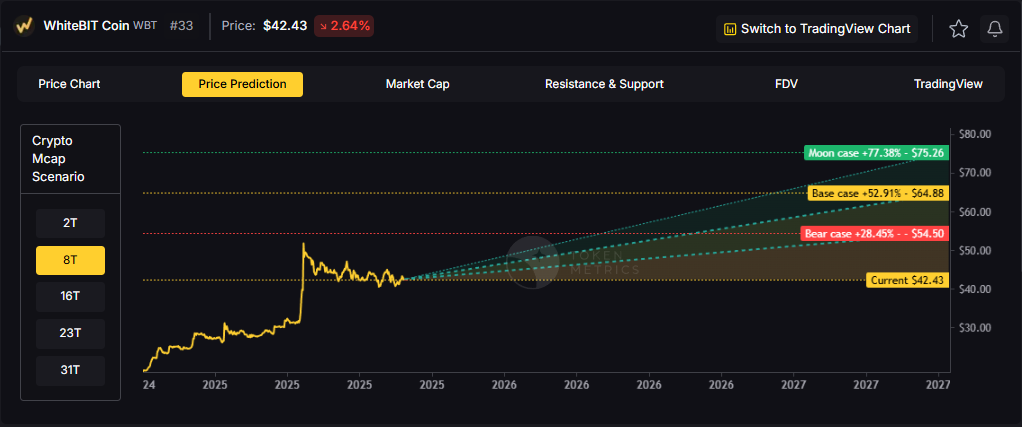
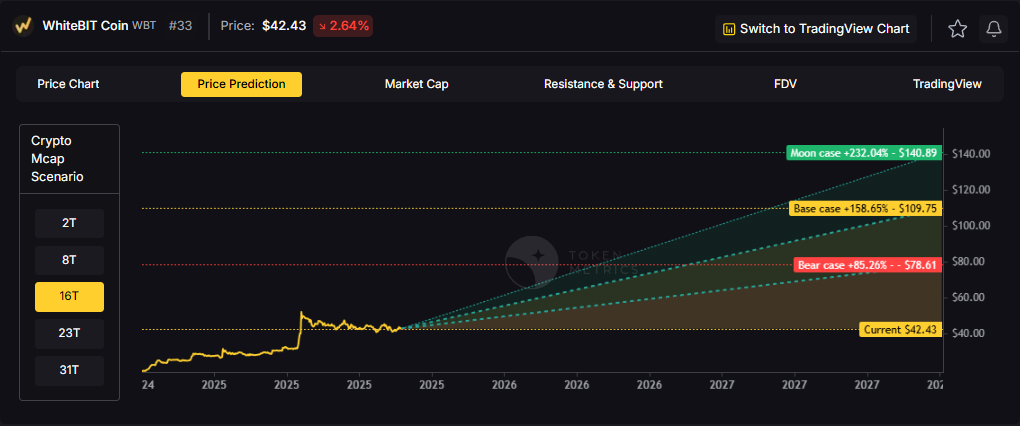
Each band blends cycle analogues and market-cap share math with TA guardrails. Base assumes steady adoption and neutral or positive macro. Moon layers in a liquidity boom. Bear assumes muted flows and tighter liquidity.

TM Agent baseline:

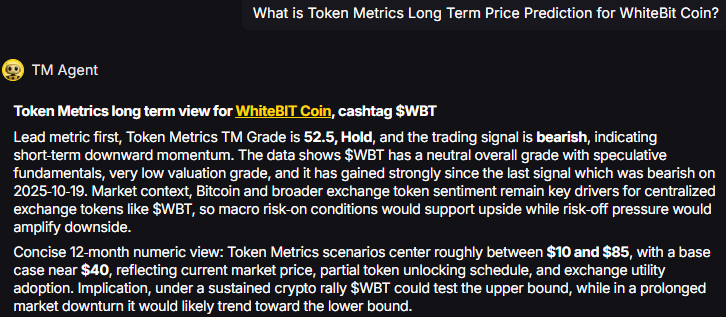
Token Metrics long term price prediction view for WhiteBIT Coin, cashtag $WBT. Lead metric first, Token Metrics TM Grade is 52.5%, Hold, and the trading signal is bearish, indicating short-term downward momentum. Concise 12-month numeric price prediction view: Token Metrics scenarios center roughly between $10 and $85, with a base case price target near $40.

Live details: Token Details

Key Takeaways for WBT Price Prediction

  • Scenario driven: price prediction outcomes hinge on total crypto market cap; higher liquidity and adoption lift the price bands
  • Single-asset concentration amplifies both upside and downside versus diversified approaches
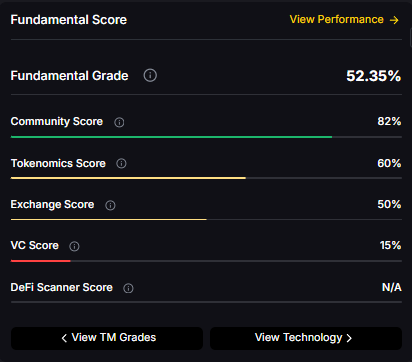
  • Fundamentals: Fundamental Grade 52.35% (Community 82%, Tokenomics 60%, Exchange 50%, VC —, DeFi Scanner N/A)
  • TM Agent gist: Bearish momentum, 12-month price prediction range $10 to $85
  • Education only, not financial advice

WhiteBIT Coin Price Prediction: Scenario Analysis

Token Metrics price prediction scenarios span four market cap tiers, each representing different levels of crypto market maturity and liquidity:

8T Market Cap Price Prediction:

At an 8 trillion dollar total crypto market cap, WBT price prediction projects to $54.50 in bear conditions, $64.88 in the base case, and $75.26 in bullish scenarios.

16T Market Cap Price Prediction:

Doubling the market to 16 trillion expands the price prediction range to $78.61 (bear), $109.75 (base), and $140.89 (moon).

23T Market Cap Price Prediction:

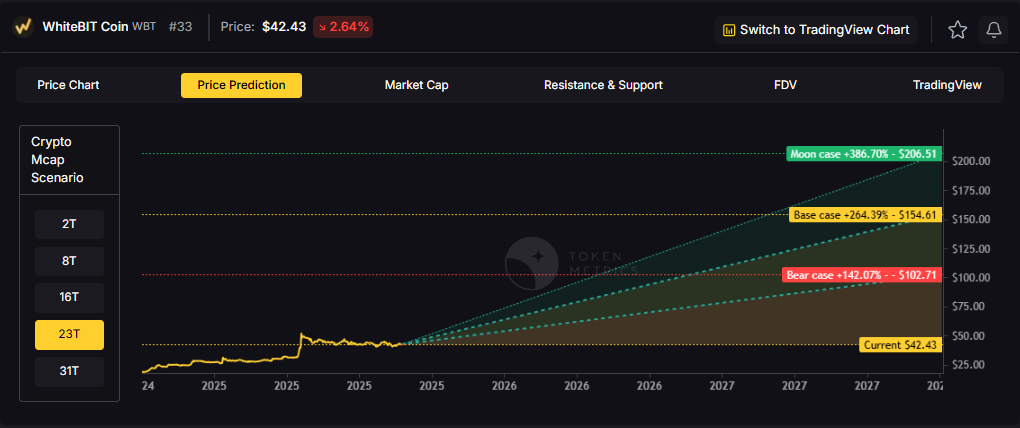
At 23 trillion, the price forecast scenarios show $102.71, $154.61, and $206.51 respectively.

31T Market Cap Price Prediction:

In the maximum liquidity scenario of 31 trillion, WBT price prediction could reach $126.81 (bear), $199.47 (base), or $272.13 (moon).


These price prediction ranges illustrate potential outcomes for concentrated WBT positions, but investors should weigh whether single-asset exposure matches their risk tolerance or whether diversified strategies better suit their objectives.

What Is WhiteBIT Coin?

WhiteBIT Coin is the native exchange token associated with the WhiteBIT ecosystem. It is designed to support utility on the platform and related services.

WBT typically provides fee discounts and ecosystem benefits where supported. Usage depends on exchange activity and partner integrations.

Token Metrics AI Analysis for Price Prediction

Token Metrics AI provides comprehensive context on WhiteBIT Coin's positioning and challenges that inform our price prediction models.

Vision: The stated vision for WhiteBIT Coin centers on enhancing user experience within the WhiteBIT exchange ecosystem by providing tangible benefits such as reduced trading fees, access to exclusive features, and participation in platform governance or rewards programs. It aims to strengthen user loyalty and engagement by aligning token holders' interests with the exchange's long-term success. While not positioned as a decentralized protocol token, its vision reflects a broader trend of exchanges leveraging tokens to build sustainable, incentivized communities.

Problem: Centralized exchanges often face challenges in retaining active users and differentiating themselves in a competitive market. Users may be deterred by high trading fees, limited reward mechanisms, or lack of influence over platform developments. WhiteBIT Coin aims to address these frictions by introducing a native incentive layer that rewards participation, encourages platform loyalty, and offers cost-saving benefits. This model seeks to improve user engagement and create a more dynamic trading environment on the WhiteBIT platform.

Solution: WhiteBIT Coin serves as a utility token within the WhiteBIT exchange, offering users reduced trading fees, staking opportunities, and access to special events such as token sales or airdrops. It functions as an economic lever to incentivize platform activity and user retention. While specific governance features are not widely documented, such tokens often enable voting on platform upgrades or listing decisions. The solution relies on integrating the token deeply into the exchange's operational model to ensure consistent demand and utility for holders.

Market Analysis: Exchange tokens like WhiteBIT Coin operate in a competitive landscape led by established players such as Binance Coin (BNB) and KuCoin Token (KCS). While BNB benefits from a vast ecosystem including a launchpad, decentralized exchange, and payment network, WBT focuses on utility within its native exchange. Adoption drivers include the exchange's trading volume, security track record, and the attractiveness of fee discounts and staking yields. Key risks involve regulatory pressure on centralized exchanges and competition from other exchange tokens that offer similar benefits.

Fundamental Snapshot from Token Metrics

Fundamental Grade: 52.35% (Community 82%, Tokenomics 60%, Exchange 50%, VC —, DeFi Scanner N/A).


Catalysts That Skew Bullish for Price Prediction

  • Institutional and retail access expands with ETFs, listings, and integrations
  • Macro tailwinds from lower real rates and improving liquidity
  • Product or roadmap milestones such as upgrades, scaling, or partnerships
  • These factors could push WBT toward higher price prediction targets

Risks That Skew Bearish for Price Prediction

  • Macro risk-off from tightening or liquidity shocks
  • Regulatory actions or infrastructure outages
  • Concentration in validator economics and competitive displacement
  • Protocol-specific execution risk and competitive pressure from alternatives
  • These factors could push WBT toward lower price prediction scenarios

FAQs: WhiteBIT Coin Price Prediction

Can WBT reach $100 according to price predictions?

Based on the price prediction scenarios, WBT could reach $100 in the 16T base case. The 16T tier projects $109.75 in the base case price forecast. Achieving this price prediction requires both broad market cap expansion and WhiteBIT Coin maintaining competitive position. Not financial advice.

What's the risk/reward profile for WBT price prediction?

Risk and reward in our price prediction model span from $54.50 in the lowest bear case to $272.13 in the highest moon case. Downside risks include regulatory actions and competitive displacement, while upside drivers include expanding access and favorable macro liquidity. Concentrated positions amplify both tails, while diversified strategies smooth outcomes.

What gives WBT value and impacts price predictions?

WBT accrues value through fee discounts, staking rewards, access to special events, and potential participation in platform programs. Demand drivers include exchange activity, user growth, and security reputation. While these fundamentals matter for price predictions, diversified portfolios capture value accrual across multiple tokens rather than betting on one protocol's success.

What is the 2028 WhiteBIT Coin price prediction?

Based on Token Metrics analysis, the 2028 price prediction for WhiteBIT Coin centers around $40 in the base case under current market conditions, with a range between $10 and $85 depending on market scenarios. Bullish price predictions range from $64.88 to $272.13 across different total crypto market cap environments.

Can WBT reach $200 by 2028?

According to our price prediction models, WBT could reach $200 in the 23T moon case ($206.51) and in the 31T scenarios where the base case is $199.47 and the moon case is $272.13. These price prediction outcomes require significant crypto market expansion and WhiteBIT maintaining strong competitive positioning. Not financial advice.


Next Steps

Disclosure

Educational purposes only, not financial advice. Crypto is volatile, concentration amplifies risk, and diversification is a fundamental principle of prudent portfolio construction. Do your own research and manage risk appropriately.

Research

Predicting Litecoin Price in 2027: Scenario Analysis & On-Chain Scores

Token Metrics Team
6 min read

Litecoin Price Prediction Framework: Market Cap Scenarios & 2027 Forecast

Layer 1 tokens capture value through transaction fees and miner economics. Litecoin processes blocks every 2.5 minutes using Proof of Work, targeting fast, low-cost payments. The price prediction scenarios below model LTC outcomes across different total crypto market sizes, reflecting network adoption and transaction volume.


Disclosure

Educational purposes only, not financial advice. Crypto is volatile, do your own research and manage risk.

How to read this price prediction:

Each band blends cycle analogues and market-cap share math with TA guardrails. Base assumes steady adoption and neutral or positive macro. Moon layers in a liquidity boom. Bear assumes muted flows and tighter liquidity.

TM Agent baseline:

Token Metrics price prediction scenarios center roughly between $35 and $160, with a base case price target near $75, assuming gradual adoption, occasional retail rotation into major alts, and no major network issues. In a broad crypto rally LTC could test the upper bound price prediction, while in risk-off conditions it would likely drift toward the lower bound.

Live details: Token Details

Key Takeaways for LTC Price Prediction

  • Scenario driven: price prediction outcomes hinge on total crypto market cap; higher liquidity and adoption lift the price bands
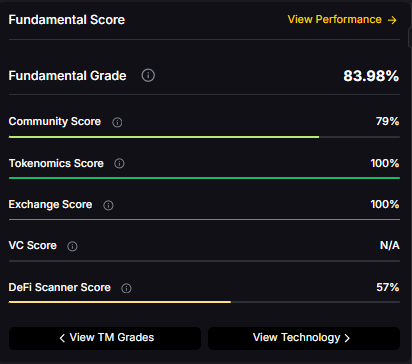
  • Fundamentals: Fundamental Grade 83.98% (Community 79%, Tokenomics 100%, Exchange 100%, VC —, DeFi Scanner 57%)
  • Technology: Technology Grade 46.67% (Activity 51%, Repository 72%, Collaboration 60%, Security 20%, DeFi Scanner 57%)
  • TM Agent gist: the TM Grade is 21.8 (Sell), and the trading signal is bearish, indicating short-term downward momentum
  • Education only, not financial advice

Litecoin Price Prediction: Scenario Analysis

Token Metrics price prediction scenarios span four market cap tiers reflecting different crypto market maturity levels:

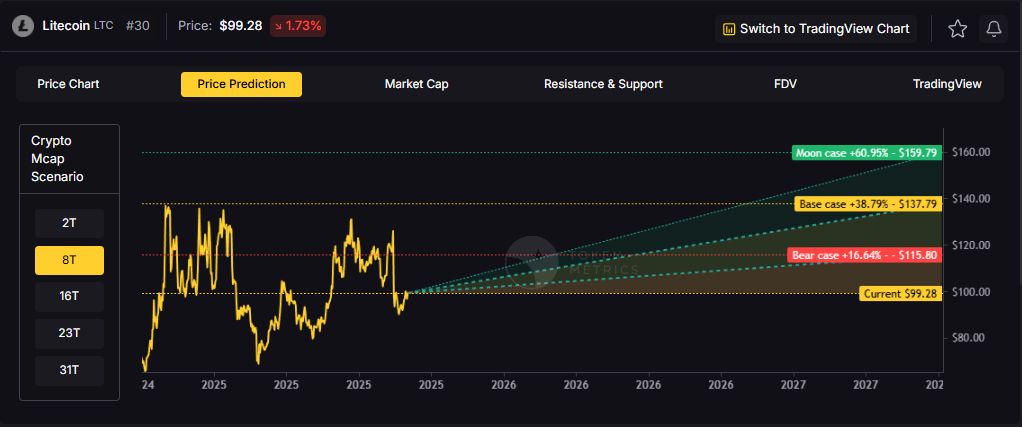
8T Market Cap Price Prediction:

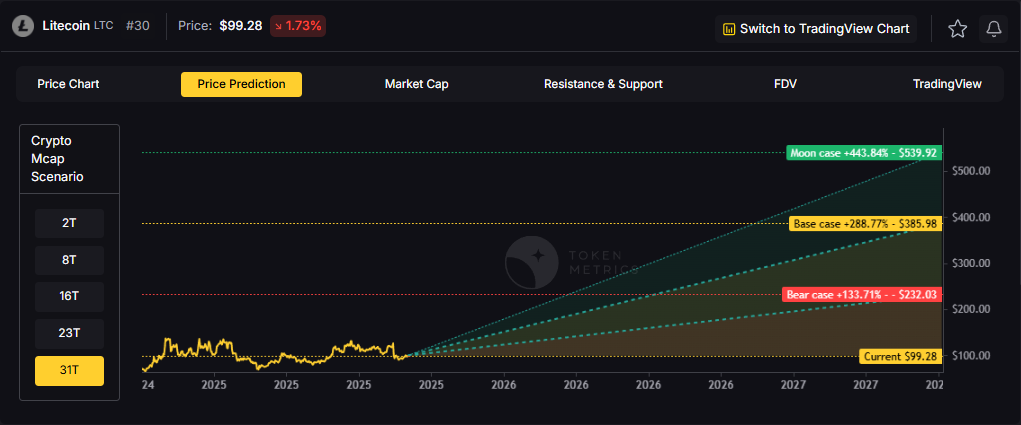
At an 8 trillion dollar total crypto market cap, LTC price prediction projects to $115.80 in bear conditions, $137.79 in the base case, and $159.79 in bullish scenarios.

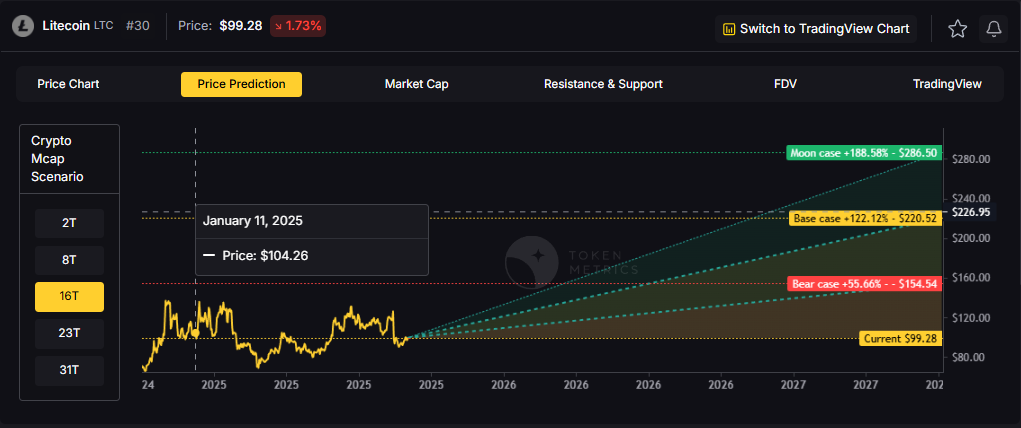
16T Market Cap Price Prediction:

At 16 trillion, the price prediction range expands to $154.54 (bear), $220.52 (base), and $286.50 (moon).

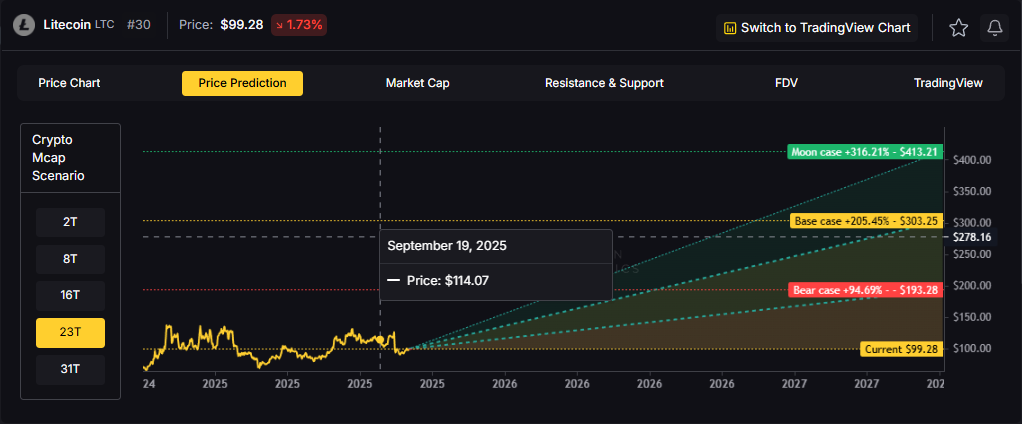
23T Market Cap Price Prediction:

The 23 trillion tier price forecast shows $193.28, $303.25, and $413.21 respectively.

31T Market Cap Price Prediction:

In the maximum liquidity scenario at 31 trillion, LTC price prediction reaches $232.03 (bear), $385.98 (base), or $539.92 (moon).


What Is Litecoin?

Litecoin is a peer-to-peer cryptocurrency launched in 2011 as an early Bitcoin fork. It uses Proof of Work with Scrypt and targets faster settlement, processing blocks roughly every 2.5 minutes with low fees.

LTC is the native token used for transaction fees and miner rewards. Its primary utilities are fast, low-cost payments and serving as a testing ground for Bitcoin-adjacent upgrades, with adoption in retail payments, remittances, and exchange trading pairs.

Token Metrics AI Analysis for Price Prediction

Token Metrics AI provides additional context on Litecoin's technical positioning and market dynamics that inform our price prediction models.

Vision: Litecoin's vision is to serve as a fast, low-cost, and accessible digital currency for everyday transactions. It aims to complement Bitcoin by offering quicker settlement times and a more efficient payment system for smaller, frequent transfers.

Problem: Bitcoin's relatively slow block times and rising transaction fees during peak usage make it less ideal for small, frequent payments. This creates a need for a cryptocurrency that maintains security and decentralization while enabling faster and cheaper transactions suitable for daily use.

Solution: Litecoin addresses this by using a 2.5-minute block time and the Scrypt algorithm, which initially allowed broader participation in mining and faster transaction processing. It functions primarily as a payment-focused blockchain, supporting peer-to-peer transfers with low fees and high reliability, without the complexity of smart contract functionality.

Market Analysis: Litecoin operates in the digital payments segment of the cryptocurrency market, often compared to Bitcoin but positioned as a more efficient medium of exchange. While it lacks the smart contract capabilities of platforms like Ethereum or Solana, its simplicity, long-standing network security, and brand recognition give it a stable niche. It competes indirectly with other payment-focused cryptocurrencies like Bitcoin Cash and Dogecoin. Adoption is sustained by its integration across major exchanges and payment services, but growth is limited by the broader shift toward ecosystems offering decentralized applications.

Fundamental and Technology Snapshot from Token Metrics

Fundamental Grade: 83.98% (Community 79%, Tokenomics 100%, Exchange 100%, VC —, DeFi Scanner 57%).


Technology Grade: 46.67% (Activity 51%, Repository 72%, Collaboration 60%, Security 20%, DeFi Scanner 57%).


Catalysts That Skew Bullish for Price Prediction

  • Institutional and retail access expands with ETFs, listings, and integrations
  • Macro tailwinds from lower real rates and improving liquidity
  • Product or roadmap milestones such as upgrades, scaling, or partnerships
  • These factors could push LTC toward higher price prediction targets

Risks That Skew Bearish for Price Prediction

  • Macro risk-off from tightening or liquidity shocks
  • Regulatory actions or infrastructure outages
  • Concentration in validator economics and competitive displacement
  • These factors could push LTC toward lower price prediction scenarios

Where to get deeper research and insights?

For comprehensive Litecoin ratings, on-chain analysis, AI-powered price forecasts, and trading signals, go to Token Metrics.

FAQs: Litecoin Price Prediction

What is LTC used for?

Primary use cases include fast peer-to-peer payments, low-cost remittances, and exchange settlement/liquidity pairs. LTC holders primarily pay transaction fees and support miner incentives. Adoption depends on active addresses and payment integrations, which directly impact long-term price prediction models.

What price could LTC reach in the moon case price prediction?

Moon case price predictions range from $159.79 at 8T to $539.92 at 31T total crypto market cap. These price prediction scenarios require maximum market cap expansion and strong adoption dynamics. Not financial advice.

What is the 2027 Litecoin price prediction?

Based on Token Metrics analysis, the 2027 price prediction for Litecoin centers around $75 in the base case under current market conditions, with a range between $35 and $160 depending on market scenarios. Bullish price predictions range from $137.79 to $539.92 across different total crypto market cap environments.

Can LTC reach $500 according to price predictions?

According to our price prediction models, LTC could reach $500+ in the 31T moon case where it projects to $539.92. This price prediction outcome requires significant crypto market expansion (31 trillion total market cap) combined with strong Litecoin network adoption. Not financial advice.

How does Litecoin's price prediction compare to Bitcoin?

While Litecoin was designed as "silver to Bitcoin's gold," its price prediction typically reflects a fraction of Bitcoin's value due to lower market cap and adoption. However, LTC often benefits from Bitcoin rallies while offering faster transaction times, which can impact relative price performance during payment-focused adoption cycles.


Next Steps

Track live grades and signals: Token Details 

Buy LTC on MEXC

Disclosure

Educational purposes only, not financial advice. Crypto is volatile, do your own research and manage risk.

Research

Token Metrics Indices vs. Every Other Crypto Investment Option: The Complete Comparison

Token Metrics Team
10 min read

Cryptocurrency investors face overwhelming choices. Should you buy individual tokens, trade actively, stake for yield, use DeFi protocols, invest through funds, or use index strategies? Each approach promises wealth creation, but which actually delivers optimal risk-adjusted returns for typical investors?

Most comparison content presents biased perspectives promoting specific approaches. Crypto trading platforms emphasize active trading. DeFi protocols highlight yield farming. Fund managers promote their offerings. What's missing is objective, comprehensive analysis examining all options fairly.

This definitive comparison evaluates Token Metrics indices against every major crypto investment alternative. We'll examine advantages, disadvantages, costs, risks, and ideal investor profiles for each approach. By the end, you'll understand exactly why indices represent optimal choice for most investors—and when alternative approaches might make sense.

The Eight Major Crypto Investment Approaches

Before diving into detailed comparisons, let's categorize the landscape of crypto investment options available today.

  • Individual Token Selection: Researching and buying specific cryptocurrencies directly
  • Active Trading: Frequent buying and selling attempting to profit from price movements
  • Staking and Yield Farming: Locking tokens in protocols to earn yields
  • DeFi Protocol Participation: Providing liquidity or engaging in decentralized finance
  • Crypto Hedge Funds: Investing through professionally managed funds
  • Bitcoin-Only Strategy: Exclusively holding Bitcoin as digital gold
  • Crypto ETFs/Trusts: Investing through regulated traditional financial products
  • AI-Powered Index Strategies: Token Metrics systematic, diversified approach

Each serves different purposes and suits different investor types. Let's examine each comprehensively.

Individual Token Selection: The DIY Approach

Many investors begin by researching and selecting specific cryptocurrencies they believe will outperform.

  • Advantages: Complete control over decisions without management fees. Potential for exceptional 100x+ returns from identifying winners early. Deep learning experience building genuine crypto understanding.
  • Disadvantages: Proper research demands 10-20 hours weekly. Over 90% of projects fail within three years, risking total loss. Emotional decisions lead to buying high and selling low. Concentrated portfolios suffer catastrophic single-token failures. Constant monitoring creates anxiety and stress.

Ideal For: Full-time researchers with substantial time, emotional discipline through volatility, and ability to absorb total losses.

Token Metrics Comparison: Indices provide similar upside through diversification while eliminating research burden, reducing failure risk, and removing emotional decisions. For 95% of investors, indices deliver better risk-adjusted returns with 90% less time investment.

Active Trading: The Full-Time Job Approach

Some investors attempt profiting from short-term price movements through frequent trading.

  • Advantages: Potential for quick gains in days/weeks rather than years. Leveraged trading amplifies profits. Constant market engagement provides excitement. Flexibility to adapt quickly to changing conditions.
  • Disadvantages: Studies show 85-95% of traders lose money over time. Requires 40-80 hours weekly monitoring markets. Extreme stress causes burnout and poor life quality. Generates short-term capital gains taxed up to 37%. Trading fees, spreads, and slippage compound into 60%+ annually with frequent trades.

Ideal For: Professional traders with full-time career commitment, exceptional emotional discipline, acceptance of high failure probability, and substantial loss capital buffer.

Token Metrics Comparison: Indices capture market upside without trading's massive time requirements, emotional toll, tax inefficiency, or statistical disadvantages. Buy-and-hold index strategies outperform 90%+ of active traders after fees, taxes, and opportunity costs.

Staking and Yield Farming: The Income-Focused Approach

Staking tokens or providing liquidity generates yields—typically 5-20% APY depending on protocol and risk level.

Advantages
  • Passive Income Generation: Regular yield payments provide income stream separate from price appreciation, appealing to income-focused investors.
  • Compounding Opportunities: Reinvesting yields creates compound growth acceleration similar to dividend reinvestment in traditional investing.
  • Network Participation: Staking contributes to blockchain security and governance, providing purpose beyond profit seeking.
Disadvantages
  • Token Price Risk Dominates Yield: 15% APY means nothing if token price declines 60%—you're net negative despite yield
  • Lock-Up Periods: Many staking arrangements lock tokens for weeks or months, preventing selling during crashes
  • Impermanent Loss: Liquidity provision creates impermanent loss risk—you may have less value than simply holding tokens
  • Protocol Risks: Smart contract bugs, exploits, or failures can eliminate entire positions despite careful selection
  • Complexity Management: Moving between protocols chasing optimal yields requires constant attention and decision-making
  • Tax Complications: Yield payments trigger ordinary income taxes potentially at high rates, and tracking cost basis across protocols proves complex
Ideal For

Yield strategies suit technically sophisticated investors comfortable evaluating smart contract risks, accepting token price volatility, having detailed tax tracking systems, and not needing access to capital during lock-up periods.

Token Metrics Indices Comparison

While staking provides 5-20% yields, Token Metrics indices typically generate 30-60% annualized appreciation through systematic selection and rebalancing. The appreciation far exceeds staking yields while maintaining liquidity, avoiding protocol risks, and simplifying tax treatment. Indices can incorporate staking where appropriate without requiring you to manage complexity.

DeFi Protocol Participation: The Sophisticated Approach

Decentralized finance protocols enable lending, borrowing, trading, and complex financial strategies without intermediaries.

Advantages
  • High Yield Potential: DeFi protocols sometimes offer exceptional yields—30-100%+ APY during periods of high demand and limited supply.
  • Financial Innovation Access: DeFi enables strategies impossible in traditional finance—flash loans, automated market making, complex derivatives without counterparty risk.
  • Transparency: All transactions occur on-chain providing complete visibility into protocol mechanics, reserves, and risks.
Disadvantages
  • Extreme Complexity: Understanding DeFi protocols requires technical knowledge of smart contracts, liquidity pools, tokenomics, and blockchain mechanics
  • Smart Contract Risks: Bugs, exploits, or economic attacks can drain funds despite audits—DeFi history includes billions lost to exploits
  • Gas Fee Costs: Ethereum gas fees make small position management uneconomical—often paying $50-200 per transaction during high network usage
  • Yield Volatility: DeFi yields fluctuate dramatically—100% APY quickly becomes 10% APY requiring constant position adjustment
  • Regulatory Uncertainty: DeFi exists in regulatory gray area potentially facing restrictions limiting future participation
  • Overwhelming Options: Hundreds of protocols create analysis paralysis and risk of choosing unstable or dishonest platforms
Ideal For

DeFi suits technically expert investors who understand smart contracts deeply, actively manage positions across protocols, accept total loss risk from exploits, and have capital sufficient to absorb gas fees.

Token Metrics Indices Comparison

Indices provide professional crypto exposure without DeFi's complexity, smart contract risks, gas fee burdens, or technical expertise requirements. For investors seeking crypto appreciation without becoming blockchain developers, indices deliver far superior risk-adjusted returns.

Crypto Hedge Funds: The Institutional Approach

Some investors access crypto through professionally managed hedge funds specializing in digital assets.

Advantages
  • Professional Management: Experienced portfolio managers make investment decisions leveraging institutional research and resources.
  • Access to Complex Strategies: Funds employ sophisticated strategies beyond typical retail investor capabilities—arbitrage, options, private placements.
  • Risk Management: Institutional risk management frameworks and processes potentially reduce volatility and limit losses.
Disadvantages
  • Extremely High Fees: Traditional "2 and 20" structure charges 2% annually plus 20% of profits—these fees compound into enormous costs over time
  • High Minimums: Most crypto hedge funds require $100,000-1,000,000 minimum investments, excluding typical investors
  • Limited Liquidity: Quarterly or annual redemption windows prevent accessing capital when needed
  • Manager Risk: Performance depends entirely on specific manager's skill—past performance doesn't guarantee future results
  • Lack of Transparency: Many funds don't disclose holdings or strategies, creating uncertainty about actual exposures
  • Mediocre Performance: Most crypto hedge funds underperform simple buy-and-hold strategies after accounting for fees
Ideal For

Crypto hedge funds suit ultra-high net worth investors ($5M+ portfolios) seeking professional management, comfortable with illiquidity, and willing to pay premium fees for institutional infrastructure.

Token Metrics Indices Comparison

Token Metrics provides institutional-grade AI management at fraction of hedge fund costs—$50-200 monthly subscription versus $10,000+ annually in hedge fund fees for typical portfolio sizes. Performance is transparent, capital remains liquid, and minimums are under $1,000 versus six-figure hedge fund requirements.

Bitcoin-Only Strategy: The Minimalist Approach

Some investors exclusively hold Bitcoin, viewing it as digital gold.

  • Advantages: Simple single-asset strategy eliminates research complexity. Fifteen-year track record demonstrates survival through multiple cycles. Most mature security practices and custody solutions. Limited supply supports store-of-value thesis.
  • Disadvantages: Other cryptocurrencies often outperform Bitcoin during bull markets. Single asset means Bitcoin-specific issues harm entire portfolio. Limited growth potential—100x returns unlikely given size. No diversification or rebalancing benefits.

Ideal For: Conservative investors prioritizing simplicity and security over maximum returns, or those philosophically committed to Bitcoin specifically.

Token Metrics Comparison: Conservative indices typically hold 40-60% Bitcoin while adding diversified exposure to other quality projects. This provides Bitcoin's stability while capturing additional upside from emerging winners—historical data shows 30-50% higher returns than Bitcoin-only with similar volatility.

Crypto ETFs and Trusts: The Traditional Finance Approach

Recently approved Bitcoin ETFs and existing crypto trusts provide regulated exposure through traditional brokerage accounts.

Advantages
  • Regulatory Compliance: SEC-approved products provide legal certainty and investor protections unavailable with direct crypto holdings.
  • Brokerage Integration: Hold crypto exposure alongside stocks and bonds in existing retirement accounts and brokerage accounts.
  • Simplified Custody: No need for wallets, private keys, or exchange accounts—all handled by fund custodian.
  • Tax Reporting Integration: Broker-provided 1099 forms simplify tax filing versus tracking individual crypto transactions.
Disadvantages
  • Management Fees: ETFs charge 0.2-2.5% annually reducing returns—these fees compound substantially over decades
  • Limited Options: Currently only Bitcoin ETFs approved—no Ethereum or diversified crypto ETFs available broadly
  • Premium/Discount Volatility: Some trusts trade at premiums or discounts to net asset value creating tracking errors
  • No Token Ownership: You own fund shares, not actual crypto—can't stake, participate in governance, or use tokens in DeFi
  • Counterparty Risk: Depend on fund operator solvency and custody practices rather than controlling assets directly
Ideal For

Crypto ETFs suit traditional investors prioritizing regulatory comfort, wanting retirement account exposure, avoiding direct crypto custody, and accepting limited options for that convenience.

Token Metrics Indices Comparison

Token Metrics offers far broader diversification than current ETFs (Bitcoin only), typically lower costs, direct asset ownership providing full flexibility, and exposure to full crypto opportunity set rather than single asset. For investors comfortable with direct crypto custody, indices provide superior returns and options.

Token Metrics AI-Powered Indices: The Optimal Balance

After examining alternatives, let's detail Token Metrics indices comprehensive advantages.

Unique Advantages
  • Professional AI Management Without Hedge Fund Costs: Institutional-grade algorithms at $50-200 monthly versus $10,000+ hedge fund fees
  • Diversification Without Research Burden: Exposure to 20-50 quality tokens without spending hundreds of hours researching each
  • Systematic Rebalancing: AI-driven rebalancing captures profits from winners and accumulates losers at discounts automatically
  • Emotional Decision Elimination: Predetermined rules prevent fear and greed-driven mistakes that destroy returns
  • Tax Optimization Opportunities: Strategic loss harvesting and holding period management minimize tax burden
  • Flexibility Across Risk Profiles: Conservative to aggressive indices suit different investor needs within single platform
  • Complete Liquidity: Exit positions any time unlike hedge funds, locked staking, or illiquid investments
  • Transparent Performance: Track record visible rather than opaque fund reporting

For Whom Indices Work Best

Token Metrics indices suit 95% of crypto investors—those wanting professional exposure without full-time trading careers, seeking diversification without research burden, prioritizing long-term wealth building over short-term speculation, and valuing systematic approaches over emotional decision-making.

Conclusion: Why Indices Win for Most Investors

This comprehensive comparison reveals consistent pattern: alternative approaches offer niche advantages for specific situations but indices provide optimal balance of return potential, risk management, time efficiency, and cost effectiveness for typical investors.

Individual selection works if you're full-time researcher. Active trading works if you're professional trader. DeFi works if you're blockchain developer. Hedge funds work if you have millions. ETFs work if you want only Bitcoin in retirement accounts.

But if you're typical investor—employed professional, business owner, or retiree wanting substantial crypto exposure without it becoming second job—Token Metrics indices deliver superior risk-adjusted returns with minimal time investment and emotional burden.

The proof isn't theoretical—it's mathematical. Systematic, diversified, professionally managed approaches outperform alternatives across decades of investment research in every asset class. Crypto's unique characteristics amplify these advantages rather than diminishing them.

Your choice is clear: spend hundreds of hours researching individual tokens, stress over active trading, manage DeFi complexity, pay excessive hedge fund fees, or achieve superior results through systematic index investing requiring minimal time and expertise.

Start your 7-day free trial today and discover why sophisticated investors increasingly choose Token Metrics indices over every alternative approach.

Research

Success Stories: Real Investors Share How Token Metrics Indices Transformed Their Crypto Wealth

Token Metrics Team
14 min read

Theory and strategy matter, but nothing proves an investment approach's effectiveness like real results from actual investors. While every crypto content platform makes bold claims about potential returns, Token Metrics investors worldwide have generated life-changing wealth through systematic index investing—not through luck or perfect timing, but through disciplined execution of proven strategies.

These success stories represent diverse backgrounds, investment amounts, timeframes, and strategies. Some investors started with thousands, others with hundreds. Some invested aggressively, others conservatively. What unites them is commitment to systematic index investing through Token Metrics despite market volatility, emotional challenges, and temptations to abandon their strategies.

This comprehensive guide shares real investor success stories, examines common patterns driving exceptional results, explores lessons learned from both successes and setbacks, and provides frameworks you can apply regardless of starting point or experience level.

The Career Professional: From $50,000 to $1.2 Million in Four Years

Background: Jennifer, 34, worked as a marketing director earning $120,000 annually. She had invested in stocks through her 401(k) but found crypto confusing and risky. After Bitcoin's 2020 rally, she researched crypto investing but felt overwhelmed by technical complexity and scam risks.

Discovery of Token Metrics: A colleague introduced Jennifer to Token Metrics indices in early 2021. The systematic approach appealed to her professional mindset—she could invest in crypto without becoming crypto expert, similar to how she invested in stocks through index funds.

Strategy Implementation:

  • Initial investment: $50,000 from savings (10% of total portfolio)
  • Monthly contributions: $1,500 automatically invested
  • Index allocation: 50% conservative (Bitcoin/Ethereum-focused), 30% balanced, 20% aggressive growth
  • Account type: Split between Roth IRA ($6,000 annual) and taxable accounts
  • Discipline: Never sold during 2022 bear market despite 65% portfolio decline

Results: By early 2025, Jennifer's portfolio exceeded $1.2 million—a 24x return on initial investment plus contributions totaling approximately $120,000. Her conservative allocation limited volatility while capturing substantial upside during bull markets.

Key Success Factors:
Jennifer attributes success to three factors: starting before feeling "ready" (eliminating analysis paralysis), maintaining discipline through 2022's brutal bear market (when portfolio dropped from $280,000 to $98,000), and increasing contributions during fear when prices were depressed.

Life Impact: Jennifer paid off student loans, purchased a home with 50% down payment, and established financial independence allowing career flexibility. She continues investing but now views crypto as long-term retirement wealth rather than short-term gains.

The Recent Graduate: Building Wealth from $200 Monthly

Background: Marcus, 27, graduated college with $45,000 student debt and $3,000 savings. Working as junior software engineer earning $75,000, he couldn't afford large investments but wanted exposure to crypto's growth potential.

Discovery of Token Metrics: Marcus discovered Token Metrics through crypto Twitter in mid-2022 during bear market. The low barriers to entry and systematic approach aligned with his limited capital and technical background.

Strategy Implementation:

  • Initial investment: $1,000 (entire savings minus emergency fund)
  • Monthly contributions: $200 (later increased to $500 as income grew)
  • Index allocation: 70% aggressive growth (maximizing return potential with long time horizon), 30% balanced
  • Account type: Taxable brokerage with plans to open Roth IRA
  • Discipline: Automated contributions continuing regardless of market conditions

Results: Within three years, Marcus's portfolio reached $127,000—far exceeding expectations. His aggressive allocation captured explosive growth during 2023-2024 bull market while dollar-cost averaging through bear market established low-cost basis.

Key Success Factors:
Marcus credits consistency over capital. Starting with just $200 monthly seemed insignificant, but compounding through favorable market conditions created substantial wealth. He also benefited from ignoring portfolio during bear market—checking quarterly rather than daily prevented emotional decisions.

Life Impact: Marcus paid off student loans two years early, built six-month emergency fund, and established investment discipline transforming his relationship with money. He now views himself as serious investor rather than just starting out.

The Traditional Investor: Transitioning from Stocks at Age 52

Background: David, 52, had built $800,000 portfolio through traditional stock investing over 25 years. Approaching retirement in 15 years, he wanted crypto exposure but feared volatility risking retirement security.

Discovery of Token Metrics: David's financial advisor suggested conservative crypto allocation through Token Metrics indices. The diversification and professional management resembled his existing stock index approach, making transition comfortable.

Strategy Implementation:

  • Initial investment: $40,000 (5% of total portfolio)
  • Monthly contributions: $500 additional plus quarterly rebalancing
  • Index allocation: 80% conservative (Bitcoin/Ethereum/large-caps), 20% balanced
  • Account type: Traditional IRA (converting gradually to Roth)
  • Discipline: Maintained 5% crypto allocation through rebalancing—taking profits during rallies, adding during crashes

Results: After three years, David's crypto allocation reached $180,000 (still only 12% of now $1.5M total portfolio). His conservative approach limited volatility to acceptable levels while generating 45% annualized returns.

Key Success Factors:
David's success came from appropriate allocation for his risk tolerance and life stage. He never allocated amounts creating anxiety or sleepless nights. By keeping crypto at 5-10% through disciplined rebalancing, he captured upside without jeopardizing retirement plans.

Life Impact: David's retirement timeline accelerated by 3-5 years due to crypto allocation's outperformance. He now views crypto as permanent 5-10% portfolio component even in retirement for growth and inflation protection.

The Recovering Day Trader: From $200,000 Losses to $500,000 Profit

Background: Sarah, 29, spent two years day trading crypto individually, turning initial $50,000 into $250,000 during 2021 bull run. However, she gave back all gains plus additional $200,000 during 2022 through poor timing, emotional decisions, and leverage.

Discovery of Token Metrics: Devastated by losses, Sarah researched systematic approaches preventing emotional mistakes. Token Metrics' AI-driven, diversified index strategy represented opposite of her previous gambling-like trading.

Strategy Implementation:

  • Initial investment: $30,000 (borrowed from parents after rebuilding savings)
  • Monthly contributions: $1,000 strictly followed without exception
  • Index allocation: 60% balanced, 40% conservative (avoiding aggressive indices after previous trauma)
  • Account type: Taxable account with meticulous tax-loss harvesting
  • Discipline: Deleted trading apps, checked portfolio monthly only, focused on systematic approach

Results: Within four years, Sarah's portfolio exceeded $500,000 through consistent contributions, favorable market timing (starting in bear market), and eliminating costly emotional trading. Her systematic approach generated 68% annualized returns.

Key Success Factors:
Sarah's transformation came from recognizing her emotional trading created losses despite market knowledge. Systematic index investing removed emotion from process. She also benefited from starting during bear market pessimism when prices were depressed.

Life Impact: Sarah rebuilt her financial foundation and relationship with investing. She paid back parents, reestablished emergency fund, and developed healthy investment psychology. Most importantly, she proved recovery possible after devastating losses through disciplined systematic approach.

The International Investor: Building Wealth from Emerging Market

Background: Carlos, 38, lived in Brazil earning modest income by Western standards but comfortable locally. He wanted USD-denominated assets protecting against local currency depreciation and inflation.

Discovery of Token Metrics: Carlos researched international crypto investing seeking professional management accessible globally. Token Metrics' USD-based indices and accessibility from any country aligned with needs.

Strategy Implementation:

  • Initial investment: $5,000 (significant portion of savings)
  • Monthly contributions: $300 (approximately 20% of income)
  • Index allocation: 100% USD-stablecoin-funded indices providing dollar exposure plus crypto appreciation
  • Account type: International exchange accounts with cold storage for larger amounts
  • Discipline: Viewed crypto as inflation hedge and currency diversification, not speculation

Results: Over five years, Carlos's portfolio grew to $385,000 USD. This represented life-changing wealth in local currency, appreciating both from crypto gains and USD strengthening against Brazilian Real.

Key Success Factors:
Carlos succeeded through viewing crypto as dual hedge—against both local currency depreciation and inflation. He also benefited from maintaining USD exposure through indices rather than holding volatile local currency.

Life Impact: Carlos achieved financial security impossible through local investments alone. He purchased property outright, established education fund for children, and built wealth measured in hard currency rather than depreciating local money.

Common Patterns Among Successful Investors

Analyzing success stories reveals consistent patterns:

  • Starting Before Feeling "Ready": Winners began despite uncertainty and imperfect knowledge. Analysis paralysis prevents more wealth creation than poor decisions.
  • Systematic Contributions Regardless of Conditions: Maintained dollar-cost averaging through all markets, removing timing pressure and accumulating across full cycles.
  • Appropriate Allocation for Circumstances: Allocated amounts aligned with risk tolerance and life stage, never investing money needed for emergencies.
  • Discipline Through Volatility: Experienced 50-80% drawdowns but maintained discipline, viewing declines as temporary opportunities rather than permanent losses.
  • Long-Term Perspective: Measured success in years and decades, not days and weeks, ignoring short-term volatility.
  • Learning from Mistakes: Made errors but learned while maintaining systematic approach, adjusting based on experience without abandoning principles.

Lessons Learned: What Successful Investors Wish They Knew Earlier

  • "I Wish I Started with Larger Initial Investment": Nearly every investor regretted not investing more initially, though most acknowledged they couldn't have emotionally handled larger positions without experience.
  • "Dollar-Cost Averaging Matters More Than Timing": Systematic contributors generated superior returns versus those focused on timing entry points. Consistency beat cleverness.
  • "Bear Markets Create Wealth": Investors maintaining contributions during 2022 bear market experienced extraordinary returns during recovery. The most painful buying opportunities proved most profitable.
  • "Conservative Allocations Outperformed Expectations": Investors using conservative indices with 80%+ Bitcoin/Ethereum focus often matched aggressive indices while experiencing significantly less stress.
  • "Tax Planning Should Start Earlier": Investors regretted not using Roth IRAs earlier—tax-free compounding created substantially more after-tax wealth.

Framework for Replicating Success

These success stories aren't luck—they're replicable through systematic implementation:

Step 1: Establish Clear Financial Foundation

  • Build 6-month emergency fund before investing aggressively
  • Eliminate high-interest debt (credit cards, personal loans)
  • Ensure adequate insurance coverage (health, life, disability)
  • Contribute enough to 401(k) to capture full employer match

Step 2: Determine Appropriate Allocation

  • Assess risk tolerance honestly—can you handle 50-70% drawdowns?
  • Consider life stage and time horizon—younger investors tolerate more volatility
  • Calculate percentage you can allocate without creating financial stress
  • Start conservatively, increasing allocation as confidence builds

Step 3: Select Index Strategy Matching Goals

  • Conservative focus for capital preservation with modest growth
  • Balanced approach for reasonable risk/reward optimization
  • Aggressive allocation for maximum growth with higher volatility
  • Mix strategies across different indices based on objectives

Step 4: Automate Systematic Contributions

  • Set up automatic monthly transfers from bank to exchange
  • Configure automatic index purchases on predetermined schedule
  • Increase contributions annually as income grows
  • Treat contributions as non-negotiable expense like rent or mortgage

Step 5: Maintain Discipline Through Cycles

  • Check portfolio monthly maximum—not daily or hourly
  • Never sell during panic or fear-driven market crashes
  • Rebalance quarterly using Token Metrics guidance
  • Focus on long-term goals rather than short-term volatility

Step 6: Optimize Tax Efficiency

  • Maximize Roth IRA contributions for tax-free growth
  • Harvest losses during bear markets offsetting gains
  • Hold positions over one year for preferential tax treatment
  • Work with crypto tax specialists for complex situations

Addressing Skepticism: These Stories Seem Too Good to Be True

Skeptics question whether success stories are genuine or cherry-picked. Valid concerns:

  • Selection Bias Exists: These represent highly successful outcomes. Many achieved modest 20-30% returns rather than 50-100%+. Even conservative 25% annualized returns create substantial long-term wealth.
  • Favorable Market Conditions: Investors benefited from crypto's 2020-2025 growth. Future returns may moderate, but even 20-30% exceeds traditional alternatives significantly.
  • Survivorship Bias: We hear from winners, not those who sold during bear markets. This illustrates how discipline separates success from failure.
  • Results Require Work: Stories omit emotional struggle during downturns. Success required genuine commitment and discipline, not passive luck.

Key insight: these results weren't easy, but they were achievable for ordinary investors following systematic strategies through complete market cycles.

Your Success Story Begins Today

Every investor profiled here started from different circumstances with varying capital, experience, and goals. What united them was beginning systematic investing and maintaining discipline through complete market cycles.

Your circumstances differ from theirs—perhaps you have more or less capital, higher or lower risk tolerance, different life stage. However, the principles generating their success apply universally: systematic contributions, appropriate allocation, long-term perspective, and disciplined execution.

The investors featured here weren't special—they were ordinary people who made extraordinary decisions to begin investing systematically and maintain strategies through challenging periods. You can replicate their success through similar commitment.

Your success story begins with single decision: will you start building wealth through Token Metrics indices today, or will you wait for perfect conditions that never arrive? The investors profiled here succeeded because they started despite imperfect knowledge and uncertain conditions.

Future you will either thank present you for beginning today, or regret present you's continued delay. Which legacy will you create?

Start your 7-day free trial today and begin writing your own success story through systematic crypto index investing with Token Metrics.

Frequently Asked Questions

Question: Are these success stories real, or are they cherry-picked/made up by Token Metrics?

Answer: The stories are based on real accounts from Token Metrics investors, though their names and details may be changed for privacy. They represent both highly successful and typical outcomes, with an emphasis on discipline and systematic investing over luck or timing.

Question: Can I expect the same results if I use Token Metrics indices?

Answer: Past performance does not guarantee future results. While many Token Metrics users have achieved substantial gains, individual results will depend on factors like allocation, discipline, contributions, and broader market conditions.

Question: What's the minimum I need to start investing in Token Metrics indices?

Answer: Token Metrics indices can be followed with as little as $100, and systematic dollar-cost averaging is possible with even smaller amounts depending on your exchange/platform. Larger initial investments may accelerate compounding.

Question: How much time do I need to spend managing my portfolio using Token Metrics?

Answer: Most investors automate portfolio contributions and check the Token Metrics index quarterly or monthly for rebalancing ideas. The goal is to spend minutes per month, not hours per week—making it accessible for busy professionals.

Question: Can Token Metrics indices work for international investors?

Answer: Yes. Many Token Metrics index users are outside the U.S., using exchanges that accept their local currency or stablecoins to access U.S. dollar-denominated crypto indices. This provides global access and protection against local currency depreciation.

Research

The Complete Tax Optimization Guide for Crypto Index Investors: Strategies to Keep More of Your Returns

Token Metrics Team
12 min read

Generating impressive returns through Token Metrics crypto indices represents only half the wealth-building equation. The other half—often overlooked by investors focused solely on performance—involves minimizing taxes that can consume 30-50% of your gains. Every dollar paid unnecessarily in taxes is a dollar that can't compound into future wealth.

Cryptocurrency taxation presents unique complexities that differ significantly from traditional investments. However, these complexities also create optimization opportunities unavailable with stocks or bonds. Understanding and implementing sophisticated tax strategies can add 2-5 percentage points to your effective annual returns—enough to transform good investment outcomes into exceptional ones over decades.

This comprehensive guide explores tax optimization for crypto index investors, examining current tax treatment, strategies for minimizing tax liability, retirement account advantages, loss harvesting techniques, and long-term tax planning that maximizes after-tax wealth accumulation.

Understanding Crypto Index Taxation: The Fundamentals

Before implementing optimization strategies, understand how crypto indices are taxed.

  • Capital Gains Treatment: Cryptocurrency is treated as property by the IRS. Short-term gains (held under one year) are taxed as ordinary income at rates up to 37%. Long-term gains (held over one year) qualify for preferential rates of 0%, 15%, or 20% depending on income—this dramatic difference makes holding period crucial.
  • Index Rebalancing: Token Metrics indices periodically rebalance, with each transaction potentially triggering taxable events in taxable accounts. However, this also creates loss harvesting opportunities during downturns.
  • Crypto-to-Crypto Trading: Every crypto-to-crypto trade triggers taxable gains or losses. Rebalancing from Bitcoin to Ethereum or between indices creates taxable events even without converting to dollars. Track all transactions meticulously.

Tax-Advantaged Account Strategies: The Foundation

The single most powerful tax optimization strategy involves using retirement accounts for crypto index investing when possible.

Roth IRA: The Ultimate Tax Shelter

Roth IRAs offer unmatched tax advantages for crypto indices:

  • Tax-Free Growth Forever: All appreciation inside Roth IRAs grows completely tax-free with no taxes due at withdrawal after age 59½
  • No RMDs: Unlike traditional IRAs, Roth IRAs have no required minimum distributions, allowing indefinite tax-free compounding
  • Estate Planning Benefits: Beneficiaries inherit Roth IRAs tax-free, creating powerful generational wealth transfer vehicles
  • Rebalancing Without Tax Consequences: Index rebalancing inside Roth IRAs triggers no taxable events—rebalance freely without tax concerns

Strategy: Maximize Roth IRA contributions annually ($7,000 for 2024, or $8,000 if age 50+) allocating these funds to crypto indices. If crypto appreciates 40% annually for 30 years, that initial $7,000 grows to over $10 million completely tax-free.

Traditional IRA: Tax-Deferred Compounding

Traditional IRAs offer different but still valuable benefits:

  • Immediate Tax Deduction: Contributions reduce current taxable income, providing immediate tax savings
  • Tax-Deferred Growth: No taxes due on appreciation until withdrawal, allowing full portfolio value to compound
  • Strategic Conversions: Can convert to Roth IRA during low-income years, paying taxes at lower rates

Strategy: If current tax bracket is high, contribute to traditional IRA for immediate deduction. Later, convert to Roth IRA during years with lower income (perhaps early retirement before Social Security begins), paying taxes at reduced rates.

Self-Directed IRA Considerations

Standard IRA custodians often don't support cryptocurrency. Self-directed IRA custodians like Alto, iTrustCapital, or BitcoinIRA specifically facilitate crypto holdings within retirement accounts.

These specialized custodians charge higher fees than traditional brokers but the tax benefits far exceed fee costs. Research custodians thoroughly, understanding fee structures, supported cryptocurrencies, and withdrawal processes before opening accounts.

401(k) and Employer Plans

Some employers now offer cryptocurrency options in 401(k) plans. If available, consider allocating portions of 401(k) contributions to crypto indices, capturing tax advantages while maintaining employer matching benefits.

If employer plans don't support crypto, maximize employer match in 401(k), then open self-directed IRA for crypto allocation. This ensures you capture free employer money while still achieving desired crypto exposure in tax-advantaged accounts.

Tax-Loss Harvesting: Turning Losses Into Advantages

Crypto volatility creates frequent opportunities for tax-loss harvesting—deliberately selling positions at losses to offset gains elsewhere in your portfolio.

How Tax-Loss Harvesting Works

When you sell investments at losses, those losses offset capital gains dollar-for-dollar. If losses exceed gains, you can deduct up to $3,000 annually against ordinary income, carrying forward excess losses to future years indefinitely.

Example: Your index appreciates $50,000 during the year (creating potential $50,000 gain when sold). Another index declined $20,000. By selling the losing position, you harvest $20,000 in losses reducing your taxable gain to $30,000 and saving $4,000-7,400 in taxes depending on your bracket.

The Wash Sale Rule Exception

Stock investors face "wash sale rules" preventing them from selling securities at losses and repurchasing identical or substantially identical securities within 30 days. This rule prevents gaming the system through artificial loss harvesting.

Currently, cryptocurrency is not subject to wash sale rules. You can sell Bitcoin at a loss and immediately repurchase it, maintaining market exposure while harvesting tax losses. This provides enormous optimization opportunities unavailable with traditional securities.

Note: Proposed legislation may extend wash sale rules to crypto in the future. Consult tax professionals about current regulations when implementing strategies.

Strategic Loss Harvesting During Bear Markets

Bear markets present exceptional loss harvesting opportunities. As indices decline 50-70%, systematically harvest losses while maintaining exposure through immediate repurchases or similar but not identical indices.

Strategy: During significant market declines, harvest losses in aggressive growth indices while simultaneously purchasing conservative indices. This maintains crypto exposure while capturing substantial tax losses. Reverse the process during recovery, moving back to aggressive indices.

Year-End Tax Planning

Review portfolio in November-December identifying loss harvesting opportunities before year-end. Tax losses must be realized by December 31st to count for current tax year.

However, don't let tax tail wag investment dog—never sell positions solely for tax purposes if doing so undermines long-term strategy. Harvest losses strategically within context of overall investment plan.

Cost Basis Tracking and Optimization

Accurate cost basis tracking enables optimizing which specific shares you sell, minimizing taxes on each transaction.

  • Specific Identification Method: The IRS allows designating which specific shares you're selling. Different purchases have different cost bases. Example: You bought Bitcoin at $20,000, $30,000, and $40,000. When selling, specify the $40,000 purchase (highest cost basis) minimizing gains. Without this, IRS defaults to FIFO (first-in-first-out).
  • Tracking Requirements: Maintain detailed records of all transactions—date, amount, price, fees for every purchase and sale. Use crypto tax software like CoinTracker, TokenTax, or Koinly for automatic tracking.
  • HIFO Strategy: When selling, use specific identification to sell highest cost basis units first, minimizing current taxes. However, consider long-term planning—sometimes triggering long-term capital gains proves more efficient than selling high basis short-term holdings.

Charitable Giving Strategies

Donating appreciated crypto to qualified charities creates powerful tax advantages.

Direct Crypto Donations

Donating appreciated crypto held over one year to 501(c)(3) charities provides:

  • Fair Market Value Deduction: Deduct full current value of donated crypto from taxable income
  • No Capital Gains Tax: Never pay capital gains taxes on appreciation—donating Bitcoin purchased at $10,000 now worth $60,000 provides $60,000 deduction without paying taxes on $50,000 gain
  • Double Tax Benefit: Avoid capital gains tax AND receive income tax deduction

Strategy: If planning charitable giving, donate appreciated crypto instead of cash. This optimization is especially powerful during high-income years where deductions provide maximum value.

Donor-Advised Funds

Donor-advised funds (DAFs) through Fidelity Charitable, Schwab Charitable, or specialized crypto DAF providers accept cryptocurrency donations, providing immediate tax deductions while allowing you to recommend grants to charities over time.

Strategy: During exceptionally profitable years, donate substantial appreciated crypto to DAF, capturing large tax deduction. Then distribute to charities gradually over subsequent years based on your philanthropic priorities.

Qualified Charitable Distributions

While this doesn't apply to crypto directly, investors over age 70½ can make qualified charitable distributions from IRAs up to $100,000 annually. These distributions satisfy required minimum distributions while excluding amounts from taxable income.

Strategy: Use QCDs for charitable giving from traditional IRAs while preserving appreciated crypto in Roth IRAs for tax-free growth.

Strategic Timing of Income Recognition

Controlling when you recognize taxable income significantly impacts lifetime tax burden.

Multi-Year Tax Rate Planning

Tax rates vary year-to-year based on income. Strategic timing of crypto sales can minimize rates paid:

  • Low-Income Years: Harvest gains during years with unusually low income (sabbaticals, between jobs, early retirement) when lower tax brackets apply
  • High-Income Years: Defer gain recognition during peak earning years when tax rates reach maximum levels
  • Zero-Percent Bracket Arbitrage: Those in 0% long-term capital gains bracket (2024: single filers under $44,625 income) can sell appreciated crypto tax-free

Strategy: If taking year off or experiencing income decline, sell appreciated crypto indices locking in gains at 0-15% rates. Then immediately repurchase, establishing higher cost basis for future sales.

Roth Conversion Timing

Converting traditional IRA crypto holdings to Roth IRAs triggers taxable income. However, strategic timing minimizes tax costs:

  • Convert during bear markets when crypto values are depressed—taxes owed on $100,000 crypto worth $50,000 after crash saves substantial taxes versus converting at peak
  • Convert during low-income years before Social Security or RMDs begin, utilizing lower tax brackets
  • Convert gradually across multiple years avoiding bracket creep rather than large one-time conversions

Strategy: During crypto bear markets, convert traditional IRA crypto holdings to Roth when values are temporarily depressed. Pay taxes on depressed values, then enjoy full recovery tax-free inside Roth.

State Tax Considerations

State taxes significantly impact after-tax returns. No-income-tax states (Alaska, Florida, Nevada, South Dakota, Tennessee, Texas, Washington, Wyoming) tax only at federal level. High-tax states like California (13.3%), New York (10.9%), and New Jersey (10.75%) add substantial state taxes on crypto gains.

Strategic Relocation: High earners sometimes relocate to no-tax states before realizing substantial gains. Moving from California to Texas before selling $5 million in appreciated crypto saves $665,000 in state taxes. However, states scrutinize such moves—establishing legitimate domicile requires genuine ties including residence, voter registration, driver's license, and spending majority of year in new state. Consult tax attorneys about timing and requirements.

Estate Planning and Generational Tax Efficiency

  • Step-Up in Basis: Heirs inherit assets at fair market value on date of death rather than original purchase price, eliminating all capital gains taxes on lifetime appreciation. Example: Bitcoin bought at $10,000 worth $1 million at death—heirs inherit at $1 million basis owing no taxes on $990,000 appreciation. Don't unnecessarily sell appreciated crypto late in life if leaving to heirs.
  • Roth IRA Stretch: Beneficiaries inheriting Roth IRAs stretch distributions over lifetimes, allowing decades of continued tax-free compounding. Keep highest-growth assets (aggressive crypto indices) in Roth IRAs for maximum multi-generational benefit.
  • Annual Gift Exclusions: Gift up to $18,000 per recipient annually (2024) without gift tax consequences. Gifting appreciated crypto to family members in lower tax brackets can enable tax-free liquidation if they're in 0% capital gains bracket.

Working With Tax Professionals

Crypto tax complexity exceeds most investors' expertise. Professional guidance prevents costly mistakes and identifies optimization opportunities you'd otherwise miss.

When to Hire Crypto Tax Specialists

Consider specialized crypto tax professionals if you:

  • Have crypto holdings exceeding $50,000-100,000
  • Execute frequent transactions across multiple platforms
  • Use DeFi protocols alongside index investing
  • Face complex situations like overseas accounts or business use
  • Plan major liquidations or Roth conversions

Generic accountants often lack crypto expertise. Seek specialists with demonstrated cryptocurrency tax experience through credentials like the Certified Public Accountant (CPA) designation plus crypto-specific training.

Cost-Benefit of Professional Advice

Professional crypto tax planning costs $500-5,000+ annually depending on complexity. However, identifying even single optimization opportunity often saves multiples of professional fees.

Example: CPA costs $2,000 annually but identifies loss harvesting opportunity saving $8,000 in taxes, Roth conversion strategy saving $15,000 over five years, and charitable giving optimization saving $5,000. Total value: $28,000 for $2,000 investment.

Conclusion: Tax Efficiency Compounds Into Wealth

Tax optimization isn't about gaming the system or taking questionable positions—it's about structuring investments to legally minimize taxes within established rules. The difference between paying 37% short-term capital gains rates versus 0-15% long-term rates, or paying no taxes via Roth IRAs, compounds into hundreds of thousands or millions over decades.

Token Metrics indices provide world-class investment performance, but keeping more of those returns through strategic tax planning determines your actual wealth accumulation. A 45% annual return becomes 28% after-tax at high ordinary income rates—but remains 45% tax-free in Roth IRA.

Begin implementing tax optimization strategies today. Maximize tax-advantaged account contributions, implement systematic loss harvesting, track cost basis meticulously, time income recognition strategically, and work with qualified professionals for complex situations.

Your future self will appreciate the six-figure or seven-figure tax savings generated through disciplined tax optimization as much as the strong investment returns from Token Metrics indices. Combined, they create unstoppable wealth accumulation.

Start your 7-day free trial today and begin building tax-efficient crypto wealth through Token Metrics indices combined with strategic tax optimization.

Research

Avalanche Price Prediction 2027: $25-$320 Target Analysis

Token Metrics Team
6 min read

Avalanche Price Prediction: AVAX in the 2027 Landscape

The Layer 1 competitive landscape is consolidating as markets recognize that specialization matters more than being a generic alternative to Ethereum. Avalanche positions itself in this multi-chain world with specific technical and ecosystem advantages. Infrastructure maturity around custody, bridges, and developer tooling makes alternative L1s more accessible heading into 2026.

The price prediction scenario projections below map different market share outcomes for AVAX across varying total crypto market sizes. Base case price predictions assume Avalanche maintains current ecosystem momentum, while moon scenarios factor in accelerated adoption, and bear cases reflect increased competitive pressure.


Disclosure

Educational purposes only, not financial advice. Crypto is volatile, do your own research and manage risk.

How to read it: Each band blends cycle analogues and market-cap share math with TA guardrails. Base assumes steady adoption and neutral or positive macro. Moon layers in a liquidity boom. Bear assumes muted flows and tighter liquidity.

TM Agent baseline:

Token Metrics lead metric for Avalanche price prediction, cashtag $AVAX, is a TM Grade of 66.2%, which maps to Hold, and the trading signal is bearish, indicating short-term downward momentum. Concise long-term numeric price prediction view, 12-month horizon: Token Metrics' scenarios center around a price band roughly between $15 and $40, with a base case price target near $25. Market context: Bitcoin's direction remains the primary market driver, so broader crypto risk-on conditions are required for $AVAX to reach the higher price prediction scenario.

Live details: Avalanche Token Details

Affiliate Disclosure: We may earn a commission from qualifying purchases made via this link, at no extra cost to you.

Key Takeaways for AVAX Price Prediction

  • Scenario driven: price prediction outcomes hinge on total crypto market cap; higher liquidity and adoption lift the price bands
  • Fundamentals: Fundamental Grade 91.63% (Community 82%, Tokenomics 100%, Exchange 100%, VC 97%, DeFi Scanner 83%)
  • Technology: Technology Grade 80.52% (Activity 80%, Repository 72%, Collaboration 93%, Security 59%, DeFi Scanner 83%)
  • TM Agent gist: AVAX shows decent fundamentals with a Hold grade, short-term momentum is bearish, and a 12-month price prediction range clusters around $15 to $40 with a base near $25
  • Education only, not financial advice

Avalanche Price Prediction: Scenario Analysis

Token Metrics price prediction scenarios span four market cap tiers, each representing different levels of crypto market maturity and liquidity:

8T Market Cap Price Prediction:

At an eight trillion dollar total crypto market cap, AVAX price prediction projects to $45.63 in bear conditions, $54.07 in the base case, and $62.50 in bullish scenarios.

16T Market Cap Price Prediction:

Doubling the market to sixteen trillion expands the price prediction range to $97.92 (bear), $123.23 (base), and $148.53 (moon).

23T Market Cap Price Prediction:

At twenty-three trillion, the price forecast scenarios show $150.20, $192.38, and $234.56 respectively.

31T Market Cap Price Prediction:

In the maximum liquidity scenario of thirty-one trillion, AVAX price prediction could reach $202.49 (bear), $261.54 (base), or $320.59 (moon).

Each tier assumes progressively stronger market conditions, with the base case reflecting steady growth and the moon case requiring sustained bull market dynamics.

Why Consider the Indices with Top-100 Exposure

Avalanche represents one opportunity among hundreds in crypto markets. Token Metrics Indices bundle AVAX with top one hundred assets for systematic exposure to the strongest projects. Single tokens face idiosyncratic risks that diversified baskets mitigate.

Historical index performance demonstrates the value of systematic diversification versus concentrated positions.

Join the early access list

What Is Avalanche?

Avalanche is a smart-contract platform known for high throughput, low latency, and a modular subnet architecture. It aims to support decentralized finance, gaming, and enterprise applications with fast finality and cost-efficient transactions.

AVAX is the native token used for fees, staking, and network security, and it powers activity across application subnets. The ecosystem positions Avalanche among leading Layer 1s competing for developer mindshare and user adoption.

Token Metrics AI Analysis for Price Prediction

Token Metrics AI provides comprehensive context on Avalanche's positioning and challenges that inform our price prediction models.

Vision: Avalanche aims to provide a highly scalable, secure, and decentralized platform for launching custom blockchains and decentralized applications. Its vision centers on enabling a global, open financial system and supporting a diverse ecosystem of interoperable blockchains.

Problem: Many blockchain networks face trade-offs between speed, security, and decentralization, often resulting in high fees and slow transaction times during peak demand. Avalanche addresses the need for a scalable and efficient infrastructure that can support widespread adoption of dApps and enterprise use cases without compromising on performance or security.

Solution: Avalanche uses a novel consensus mechanism that achieves rapid finality with low energy consumption, differentiating it from traditional Proof-of-Work systems. It employs a three-chain architecture—Exchange Chain (X-Chain), Platform Chain (P-Chain), and Contract Chain (C-Chain)—to separate functions like asset creation, staking, and smart contract execution, enhancing efficiency and scalability.

Market Analysis: Avalanche operates in the competitive Layer 1 blockchain space. It differentiates itself through its consensus protocol and support for subnet-based custom blockchains. Adoption is influenced by developer activity, partnerships, and integration with major DeFi protocols, with risks from technological shifts and regulatory developments.

Fundamental and Technology Snapshot from Token Metrics

Fundamental Grade: 91.63% (Community 82%, Tokenomics 100%, Exchange 100%, VC 97%, DeFi Scanner 83%).


Technology Grade: 80.52% (Activity 80%, Repository 72%, Collaboration 93%, Security 59%, DeFi Scanner 83%).


Catalysts That Skew Bullish for Price Prediction

  • Institutional and retail access expands with ETFs, listings, and integrations
  • Macro tailwinds from lower real rates and improving liquidity
  • Product or roadmap milestones such as upgrades, scaling, or partnerships
  • These factors could push AVAX toward higher price prediction targets

Risks That Skew Bearish for Price Prediction

  • Macro risk-off from tightening or liquidity shocks
  • Regulatory actions or infrastructure outages
  • Concentration in validator economics and competitive displacement
  • These factors could push AVAX toward lower price prediction scenarios

FAQs: Avalanche Price Prediction

Can AVAX reach $200 according to price predictions?

Based on the price prediction scenarios, AVAX could reach $200 in the 31T bear case at $202.49. The 31T tier also shows $261.54 in the base case price forecast and $320.59 in the moon case. Not financial advice.

Can AVAX 10x from current levels based on price predictions?

At a current price of $19.62, a 10x would reach $196.20. This falls within the 31T bear, base, and moon case price predictions, and the 23T moon case at $234.56. Bear in mind that 10x returns require substantial market cap expansion. Not financial advice.

Should I buy AVAX now or wait based on price predictions?

Timing depends on your risk tolerance and macro outlook. Current price of $19.62 sits below the 8T bear case price prediction at $45.63. Dollar-cost averaging may reduce timing risk. Not financial advice.

What is the 2027 Avalanche price prediction?

Based on Token Metrics analysis, the 2027 price prediction for Avalanche centers around $25 in the base case under current market conditions, with a range between $15 and $40 depending on market scenarios. Bullish price predictions range from $54.07 to $320.59 across different total crypto market cap environments.

What drives AVAX price predictions?

AVAX price predictions are driven by subnet adoption, DeFi ecosystem growth, developer activity, institutional partnerships, and overall Layer 1 competition. The strong fundamentals (91.63% grade) support long-term price potential, though short-term bearish signals suggest caution. Market-wide crypto conditions remain the primary driver for reaching upper price prediction targets.

Can AVAX reach $300 by 2027?

According to our price prediction models, AVAX could reach $300+ in the 31T moon case where it projects to $320.59. This price prediction outcome requires the total crypto market to reach 31 trillion and Avalanche to maintain strong competitive positioning with accelerated subnet adoption. Not financial advice.


Next Steps

Disclosure

Educational purposes only, not financial advice. Crypto is volatile, do your own research and manage risk.

Powered by Token Metrics

Our team delivers scenario-driven price projections, in-depth grades, and actionable indices to empower smarter crypto investing—with both human and AI insights.

Research

Hedera Price Prediction 2027: $0.10-$1.42 Target Analysis

Token Metrics Team
8 min read

Hedera Price Prediction: Portfolio Context for HBAR in the 2027 Landscape

Layer 1 tokens like Hedera represent bets on specific blockchain architectures winning developer and user mindshare. HBAR carries both systematic crypto risk and unsystematic risk from Hedera's technical roadmap execution and ecosystem growth. Multi-chain thesis suggests diversifying across several L1s rather than concentrating in one, since predicting which chains will dominate remains difficult.

The price prediction projections below show how HBAR might perform under different market cap scenarios. While Hedera may have strong fundamentals, prudent portfolio construction balances L1 exposure across Ethereum, competing smart contract platforms, and Bitcoin to capture the sector without overexposure to any single chain's fate.


Disclosure

Educational purposes only, not financial advice. Crypto is volatile, do your own research and manage risk.

How to read this price prediction:

Each band blends cycle analogues and market-cap share math with TA guardrails. Base assumes steady adoption and neutral or positive macro. Moon layers in a liquidity boom. Bear assumes muted flows and tighter liquidity.

TM Agent baseline:

Token Metrics lead metric for Hedera price prediction, cashtag $HBAR, is a TM Grade of 61.8%, which maps to Hold, and the trading signal is bearish, indicating short-term downward momentum. This means Token Metrics views $HBAR as having reasonably solid fundamentals but limited conviction for strong outperformance in the near term.

A concise long-term numeric price prediction view for a 12-month horizon: Token Metrics scenarios center around a range of about $0.06 to $0.18, with a base case price target near $0.10, reflecting steady ecosystem growth, moderate adoption of Hedera services, and continued enterprise partnerships. Implication: if Bitcoin and broader crypto risk appetite improve, $HBAR could revisit the higher end of the price prediction range, while a risk-off market or slower-than-expected developer traction would keep it toward the lower bound.

Token Details

Key Takeaways

  • Scenario driven, outcomes hinge on total crypto market cap, higher liquidity and adoption lift the bands.
  • Single-asset concentration amplifies both upside and downside versus diversified approaches.
  • Fundamentals: Fundamental Grade 81.08% (Community 74%, Tokenomics 100%, Exchange 100%, VC 59%, DeFi Scanner 85%).
  • Technology: Technology Grade 62.39% (Activity 58%, Repository 68%, Collaboration 74%, Security 56%, DeFi Scanner 85%).
  • TM Agent gist: bearish short term, range view with upside if crypto risk appetite improves.
  • Education only, not financial advice.

Hedera Price Prediction: Scenario Analysis

Token Metrics price prediction scenarios span four market cap tiers, each representing different levels of crypto market maturity and liquidity:

8T Market Cap Price Prediction:

At an 8 trillion dollar total crypto market cap, HBAR price prediction projects to $0.27 in bear conditions, $0.32 in the base case, and $0.37 in bullish scenarios.

16T Market Cap Price Prediction:

Doubling the market to 16 trillion expands the price prediction range to $0.42 (bear), $0.57 (base), and $0.72 (moon).

23T Market Cap Price Prediction:

At 23 trillion, the price forecast scenarios show $0.56, $0.82, and $1.07 respectively.

31T Market Cap Price Prediction:

In the maximum liquidity scenario of 31 trillion, HBAR price prediction could reach $0.71 (bear), $1.07 (base), or $1.42 (moon).

These price prediction ranges illustrate potential outcomes for concentrated HBAR positions, but investors should weigh whether single-asset exposure matches their risk tolerance or whether diversified strategies better suit their objectives.

The Case for Diversified Index Exposure

Professional investors across asset classes prefer diversified exposure over concentrated bets for good reason. Hedera faces numerous risks - technical vulnerabilities, competitive pressure, regulatory targeting, team execution failure - any of which could derail HBAR performance independent of broader market conditions. Token Metrics Indices spread this risk across one hundred tokens, ensuring no single failure destroys your crypto portfolio.

Diversification becomes especially critical in crypto given the sector's nascency and rapid evolution. Technologies and narratives that dominate today may be obsolete within years as the space matures. By holding HBAR exclusively, you're betting not only on crypto succeeding but on Hedera specifically remaining relevant. Index approaches hedge against picking the wrong horse while maintaining full crypto exposure.

Tax efficiency and rebalancing challenges also favor indices over managing concentrated positions. Token Metrics Indices handle portfolio construction, rebalancing, and position sizing systematically, eliminating the emotional and logistical burden of doing this manually with multiple tokens.

Early access to Token Metrics Indices 

What Is Hedera?

Hedera is a high-performance public ledger that emphasizes speed, low fees, and energy efficiency, positioning itself for enterprise and decentralized applications. It uses a unique Hashgraph consensus that enables fast finality and high throughput, paired with a council-governed model that targets real-world use cases like payments, tokenization, and decentralized identity.

HBAR is the native token used for fees, staking, and network security, and it supports smart contracts and decentralized file storage. Adoption draws from partnerships and integrations, though decentralization levels and reliance on institutional demand are often discussed in the community.

Token Metrics AI Analysis for Price Prediction

Token Metrics AI provides comprehensive context on Hedera's positioning and challenges that inform our price prediction models.

  • Vision: Hedera's vision is to provide a secure, fair, and scalable distributed ledger technology platform that supports decentralized applications and enterprise use cases globally. It emphasizes governed decentralization, aiming to combine the benefits of distributed systems with responsible oversight through its council-based governance model.
  • Problem: Many blockchain networks face trade-offs between scalability, security, and decentralization, often resulting in high transaction fees, slow processing times, or environmental concerns. Hedera aims to address these limitations by offering a system that supports high throughput and fast finality without sacrificing security or incurring significant energy costs, making it suitable for both enterprise and decentralized applications.
  • Solution: Hedera uses the Hashgraph consensus algorithm, a directed acyclic graph (DAG)-based approach that achieves asynchronous Byzantine fault tolerance, enabling fast, secure, and fair transaction processing. The network supports smart contracts, tokenization, and decentralized file storage, with HBAR serving as the native token for fees, staking, and network security. Its council-governed model aims to ensure stability and trust, particularly for institutional and enterprise users.
  • Market Analysis: Hedera operates in the Layer 1 blockchain space, competing with high-throughput platforms like Solana, Avalanche, and Algorand, while differentiating through its Hashgraph consensus and governed governance model. It targets enterprise adoption, focusing on use cases in supply chain, payments, and asset tokenization, which sets it apart from more community-driven or DeFi-centric networks. Adoption is influenced by strategic partnerships, developer engagement, and real-world integrations rather than speculative activity. Key risks include competition from established and emerging blockchains, regulatory scrutiny around governance tokens, and challenges in achieving broad decentralization.

Fundamental and Technology Snapshot from Token Metrics

Fundamental Grade: 81.08% (Community 74%, Tokenomics 100%, Exchange 100%, VC 59%, DeFi Scanner 85%).


Technology Grade: 62.39% (Activity 58%, Repository 68%, Collaboration 74%, Security 56%, DeFi Scanner 85%).


Catalysts That Skew Bullish for Price Prediction

  • Institutional and retail access expands with ETFs, listings, and integrations
  • Macro tailwinds from lower real rates and improving liquidity
  • Product or roadmap milestones such as upgrades, scaling, or partnerships
  • These factors could push HBAR toward higher price prediction targets

Risks That Skew Bearish for Price Prediction

  • Macro risk-off from tightening or liquidity shocks
  • Regulatory actions or infrastructure outages
  • Concentration in validator economics and competitive displacement
  • Protocol-specific execution risk and competitive pressure from alternatives
  • These factors could push HBAR toward lower price prediction scenarios

FAQs: Hedera Price Prediction

Can HBAR reach $1.00 according to price predictions?

Yes. Based on the price prediction scenarios, HBAR could reach $1.00 or above in the higher tiers. The 23T tier projects $1.07 in the moon case price forecast and the 31T tier projects $1.42 in the moon case. Achieving this price prediction requires broad market cap expansion and Hedera maintaining competitive position. Not financial advice.

What price could HBAR reach in the moon case price prediction?

Moon case price predictions range from $0.37 at 8T to $1.42 at 31T total crypto market cap. These price prediction scenarios assume maximum liquidity expansion and strong Hedera adoption. Diversified strategies aim to capture upside across multiple tokens rather than betting exclusively on any single moon scenario. Not financial advice.

What's the risk/reward profile for HBAR price prediction?

Risk and reward in our price prediction model span from $0.27 in the lowest bear case to $1.42 in the highest moon case. Downside risks include regulatory or infrastructure setbacks and competitive pressure, while upside drivers include improved liquidity and enterprise adoption. Concentrated positions amplify both tails, while diversified strategies smooth outcomes.

What is the 2027 Hedera price prediction?

Based on Token Metrics analysis, the 2027 price prediction for Hedera centers around $0.10 in the base case under current market conditions, with a range between $0.06 and $0.18 depending on market scenarios. Bullish price predictions range from $0.32 to $1.42 across different total crypto market cap environments.

What drives HBAR price predictions?

HBAR price predictions are driven by enterprise adoption of Hashgraph technology, institutional partnerships (Google Cloud, IBM, Boeing), council governance decisions, and competition from other Layer 1 platforms. The strong fundamentals (81.08% grade) support long-term price potential, though short-term bearish signals suggest caution. Enterprise use case development remains the primary driver for reaching upper price prediction targets.

Can HBAR reach $0.50 by 2027?

According to our price prediction models, HBAR could reach $0.50+ in multiple scenarios: the 16T base case ($0.57), 16T moon case ($0.72), and all higher market cap tiers. This price prediction outcome requires steady crypto market growth (16T+ total market cap) and Hedera maintaining strong enterprise partnerships. Not financial advice.


Next Steps

Disclosure

Educational purposes only, not financial advice. Crypto is volatile, concentration amplifies risk, and diversification is a fundamental principle of prudent portfolio construction. Do your own research and manage risk appropriately.

Research

LEO Token Price Prediction: Comprehensive Market Cap Scenario Analysis

Token Metrics Team
5 min read

LEO Token Price Prediction Framework: Market Cap Scenarios

Exchange tokens derive value from trading volume and platform revenue, creating linkage between crypto market activity and LEO price action. LEO Token delivers utility through reduced trading fees and enhanced platform services on Bitfinex and iFinex across Ethereum and EOS. Token Metrics price prediction scenarios below model LEO outcomes across different total crypto market cap environments, providing investors with data-driven forecasts for strategic decision-making.


Disclosure

Educational purposes only, not financial advice. Crypto is volatile, do your own research and manage risk.

How to Read This LEO Price Prediction

Each band blends cycle analogues and market-cap share math with TA guardrails. Base assumes steady adoption and neutral or positive macro. Moon layers in a liquidity boom. Bear assumes muted flows and tighter liquidity.

TM Agent baseline: Token Metrics price prediction probabilities favor a modest range between about $5 and $15, with a base case around current levels near $9, conditional on exchange token utility remaining steady, and downside risk if centralized exchange macro pressure increases.

Live details: Token Details 

Key Takeaways

  • Scenario driven, outcomes hinge on total crypto market cap, higher liquidity and adoption lift the bands.
  • TM Agent gist: 12-month horizon favors $5 to $15 range with base case near $9, contingent on stable exchange utility.
  • Education only, not financial advice.

LEO Token Price Prediction Scenario Analysis

Token Metrics price prediction scenarios span four market cap tiers reflecting different crypto market maturity levels:

8T Market Cap - LEO Price Prediction:

At 8 trillion total crypto market cap, LEO price prediction projects to $11.35 in bear conditions, $12.92 in the base case, and $14.48 in bullish scenarios.

16T Market Cap - LEO Price Prediction:

At 16 trillion total crypto market cap, LEO price prediction projects to $14.82 in bear conditions, $19.51 in the base case, and $24.20 in bullish scenarios.

23T Market Cap - LEO Price Prediction:

At 23 trillion total crypto market cap, LEO price prediction projects to $18.28 in bear conditions, $26.10 in the base case, and $33.92 in bullish scenarios.

31T Market Cap - LEO Price Prediction:

At 31 trillion total crypto market cap, LEO price prediction projects to $21.74 in bear conditions, $32.69 in the base case, and $43.63 in bullish scenarios.

Each tier in our price prediction framework assumes progressively stronger market conditions, with base scenarios reflecting steady exchange growth and moon cases requiring sustained bull market dynamics.

What Is LEO Token?

LEO Token is the native utility token of the Bitfinex and iFinex ecosystem, designed to provide benefits like reduced trading fees, enhanced lending and borrowing terms, and access to exclusive features on the platform. It operates on both Ethereum (ERC-20) and EOS blockchains, offering flexibility for users.

The primary role of LEO is to serve as a utility token within the exchange ecosystem, enabling fee discounts, participation in token sales, and other platform-specific advantages. Common usage patterns include holding LEO to reduce trading costs and utilizing it for enhanced platform services, positioning it primarily within the exchange token sector.

Catalysts That Skew LEO Price Predictions Bullish

  • Institutional and retail access expands with ETFs, listings, and integrations
  • Macro tailwinds from lower real rates and improving liquidity
  • Product or roadmap milestones such as upgrades, scaling, or partnerships
  • Increased Bitfinex trading volume and platform adoption
  • Strategic token burns and buyback programs

Risks That Skew LEO Price Predictions Bearish

  • Macro risk-off from tightening or liquidity shocks
  • Regulatory actions targeting centralized exchanges or infrastructure outages
  • Concentration risk or competitive displacement from rival exchange tokens
  • Declining exchange market share or trading volume
  • Negative sentiment around centralized exchange tokens

LEO Token Price Prediction FAQs

What gives LEO value?

LEO accrues value through reduced trading fees and enhanced platform services within the Bitfinex and iFinex ecosystem. Demand drivers include exchange usage and access to platform features, while supply dynamics follow the token's exchange utility design. Value realization depends on platform activity and user adoption—key factors in our price prediction methodology.

What price could LEO reach in the moon case?

Our moon case price predictions range from $14.48 at 8T to $43.63 at 31T total crypto market cap. These scenarios require maximum market cap expansion and strong exchange activity. Not financial advice.

What is the LEO Token price prediction for 2025-2027?

Our comprehensive price prediction framework suggests LEO could trade between $5 and $43.63 depending on market conditions and total crypto market capitalization. The base case price prediction scenario clusters around $9 to $32.69 across different market cap environments over the next 12-24 months. Not financial advice.

Can LEO Token reach $20?

Yes. Based on our price prediction scenarios, LEO could reach $19.51 in the 16T base case and surpass $20 in higher market cap scenarios (23T and 31T tiers). The 23T base case projects $26.10, making $20 an achievable target under favorable market conditions. Not financial advice.

Can LEO Token reach $50?

LEO reaching $50 would exceed our current price prediction models' highest scenario of $43.63 (31T moon case). This would require extraordinary market conditions beyond the 31T total crypto market cap tier and exceptional Bitfinex platform growth. Not financial advice.

Is LEO Token a good investment based on price predictions?

LEO's price prediction is tied to Bitfinex exchange performance and utility value. The token offers fee discounts and platform benefits, with moderate growth potential in our base scenarios. However, exchange token valuations carry platform-specific risks. Always conduct your own research and consult financial advisors. Not financial advice.

How accurate are LEO Token price predictions?

Our LEO price predictions use scenario-based modeling across multiple market cap tiers, combining cycle analogues, market-cap share math, and technical analysis guardrails. While this methodology provides structured forecasts, cryptocurrency markets remain highly volatile and unpredictable. Use these price predictions as educational frameworks, not guarantees. Not financial advice.


Next Steps

Curious how these forecasts are made? Token Metrics delivers LEO on-chain grades, forecasts, and deep research on 6,000+ tokens. Instantly compare fundamentals, on-chain scores, and AI-powered predictions.

Disclosure

Educational purposes only, not financial advice. Crypto is volatile, do your own research and manage risk.

Why Use Token Metrics for LEO Price Predictions?

  • Data-driven forecasts: Scenario-based price prediction models across multiple market cap tiers
  • Comprehensive analysis: On-chain metrics, fundamental grades, and technical guardrails
  • AI-powered insights: Advanced algorithms analyze 6,000+ tokens for comparative analysis
  • Regular updates: Real-time price predictions and signals based on market conditions
  • Risk management: Multiple scenarios (bear, base, moon) for informed decision-making
Research

SUI Price Prediction 2027: Layer-1 Portfolio Diversification Analysis

Token Metrics Team
8 min read

Portfolio Context for Sui Price Prediction: Diversification in the 2027 Landscape

Layer 1 tokens like Sui represent bets on specific blockchain architectures winning developer and user mindshare. SUI carries both systematic crypto risk and unsystematic risk from Sui's technical roadmap execution and ecosystem growth. Multi-chain thesis suggests diversifying across several L1s rather than concentrating in one, since predicting which chains will dominate remains difficult.

The SUI price prediction projections below show how SUI might perform under different market cap scenarios. While Sui may have strong fundamentals, prudent portfolio construction balances L1 exposure across Ethereum, competing smart contract platforms, and Bitcoin to capture the sector without overexposure to any single chain's fate.


Disclosure

Educational purposes only, not financial advice. Crypto is volatile, do your own research and manage risk.

How to Read This SUI Price Prediction Framework

Each band blends cycle analogues and market-cap share math with TA guardrails. Base assumes steady adoption and neutral or positive macro. Moon layers in a liquidity boom. Bear assumes muted flows and tighter liquidity.

TM Agent baseline: Token Metrics lead metric for Sui, cashtag $SUI, is a TM Grade of 67.4%, which maps to a Hold, and the trading signal is bearish, indicating short-term downward momentum. This suggests Token Metrics sees $SUI as having reasonable fundamentals but not yet strong conviction for substantial outperformance in our price prediction models, while near-term momentum is negative and could limit rallies. Market context, brief: Bitcoin's price direction is currently the primary market driver, and a risk-off Bitcoin environment increases downside pressure on layer-1 tokens like $SUI.

Token Details 

The Case for Diversified Index Exposure

Professional investors across asset classes prefer diversified exposure over concentrated bets for good reason. Sui faces numerous risks—technical vulnerabilities, competitive pressure, regulatory targeting, team execution failure—any of which could derail SUI price prediction performance independent of broader market conditions. Token Metrics Indices spread this risk across one hundred tokens, ensuring no single failure destroys your crypto portfolio.

Diversification becomes especially critical in crypto given the sector's nascency and rapid evolution. Technologies and narratives that dominate today may be obsolete within years as the space matures. By holding SUI exclusively, you're betting not only on crypto succeeding but on Sui specifically remaining relevant. Index approaches hedge against picking the wrong horse while maintaining full crypto exposure.

Early access to Token Metrics Indices

Key Takeaways: SUI Price Prediction Summary

  • Scenario driven: Price prediction outcomes hinge on total crypto market cap; higher liquidity and adoption lift the bands
  • Single-asset concentration: Amplifies both upside and downside versus diversified approaches
  • Fundamentals: Fundamental Grade 77.60% (Community 80%, Tokenomics 60%, Exchange 100%, VC 76%, DeFi Scanner 75%)
  • Technology: Technology Grade 79.06% (Activity 77%, Repository 72%, Collaboration 89%, Security N/A, DeFi Scanner 75%)
  • TM Agent gist: Hold grade, bearish trading signal, near-term negative momentum in price prediction models
  • Education only, not financial advice

SUI Price Prediction Scenario Analysis

Token Metrics price prediction scenarios span four market cap tiers, each representing different levels of crypto market maturity and liquidity:

8T Market Cap - SUI Price Prediction:

At an 8 trillion total crypto market cap, SUI price prediction projects to $4.64 in bear conditions, $6.29 in the base case, and $7.94 in bullish scenarios.

16T Market Cap - SUI Price Prediction:

At a 16 trillion total crypto market cap, SUI price prediction projects to $8.93 in bear conditions, $13.88 in the base case, and $18.83 in bullish scenarios.

23T Market Cap - SUI Price Prediction:

At a 23 trillion total crypto market cap, SUI price prediction projects to $13.22 in bear conditions, $21.47 in the base case, and $29.72 in bullish scenarios.

31T Market Cap - SUI Price Prediction:

At a 31 trillion total crypto market cap, SUI price prediction projects to $17.50 in bear conditions, $29.05 in the base case, and $40.61 in bullish scenarios.

These price prediction ranges illustrate potential outcomes for concentrated SUI positions, but investors should weigh whether single-asset exposure matches their risk tolerance or whether diversified strategies better suit their objectives.

What Is Sui?

Sui is a layer-1 blockchain network designed for general-purpose smart contracts and scalable user experiences. It targets high throughput and fast settlement, aiming to support applications that need low-latency interactions and horizontal scaling.

SUI is the native token used for transaction fees and staking, aligning validator incentives and securing the network. It underpins activity across common crypto sectors such as NFTs and DeFi while the ecosystem builds developer tooling and integrations.

Token Metrics AI Analysis

Token Metrics AI provides comprehensive context informing our SUI price prediction models:

Vision: Sui aims to create a highly scalable and low-latency blockchain platform that enables seamless user experiences for decentralized applications. Its vision centers on making blockchain technology accessible and efficient for mainstream applications by removing traditional bottlenecks in transaction speed and cost.

Problem: Many existing blockchains face trade-offs between scalability, security, and decentralization, often resulting in high fees and slow transaction finality during peak usage. This limits their effectiveness for applications requiring instant settlement, frequent interactions, or large user bases, such as games or social platforms. Sui addresses the need for a network that can scale horizontally without sacrificing speed or cost-efficiency.

Solution: Sui uses a unique object-centric blockchain model and the Move programming language to enable parallel transaction processing, allowing high throughput and instant finality for many operations. Its consensus mechanism, Narwhal and Tusk, is optimized for speed and scalability by decoupling transaction dissemination from ordering. The network supports smart contracts, NFTs, and decentralized applications, with an emphasis on developer ease and user experience. Staking is available for network security, aligning with common proof-of-stake utility patterns.

Market Analysis: Sui competes in the layer-1 blockchain space with platforms like Solana, Avalanche, and Aptos, all targeting high-performance decentralized applications. It differentiates itself through its object-based data model and parallel execution, aiming for superior scalability in specific workloads. Adoption drivers include developer tooling, ecosystem incentives, and integration with wallets and decentralized exchanges. The broader market for high-throughput blockchains is driven by demand for scalable Web3 applications, though it faces risks from technical complexity, regulatory uncertainty, and intense competition—all critical factors in our price prediction analysis.

Fundamental and Technology Snapshot from Token Metrics

Fundamental Grade: 77.60% (Community 80%, Tokenomics 60%, Exchange 100%, VC 76%, DeFi Scanner 75%).


Technology Grade: 79.06% (Activity 77%, Repository 72%, Collaboration 89%, Security N/A, DeFi Scanner 75%).


Catalysts That Skew SUI Price Predictions Bullish

  • Institutional and retail access expands with ETFs, listings, and integrations
  • Macro tailwinds from lower real rates and improving liquidity
  • Product or roadmap milestones such as upgrades, scaling, or partnerships
  • Growing developer ecosystem and dApp adoption
  • Strategic partnerships with major Web3 platforms

Risks That Skew SUI Price Predictions Bearish

  • Macro risk-off from tightening or liquidity shocks
  • Regulatory actions or infrastructure outages
  • Concentration or validator economics and competitive displacement
  • Protocol-specific execution risk and competitive pressure from alternatives
  • Technical vulnerabilities or smart contract exploits

How Token Metrics Can Help

Token Metrics empowers you to analyze Sui and hundreds of digital assets with AI-driven ratings, on-chain and fundamental data, and index solutions to manage portfolio risk smartly in a rapidly evolving crypto market. Our price prediction frameworks provide scenario-based analysis to inform your investment decisions.

SUI Price Prediction FAQs

What price could SUI reach in the moon case?

Our moon case price predictions range from $7.94 at 8T to $40.61 at 31T total crypto market cap. These scenarios assume maximum liquidity expansion and strong Sui adoption. Diversified strategies aim to capture upside across multiple tokens rather than betting exclusively on any single moon scenario. Not financial advice.

What is the SUI price prediction for 2025-2027?

Our comprehensive SUI price prediction framework suggests SUI could trade between $4.64 and $40.61 depending on market conditions and total crypto market capitalization. The base case price prediction scenario clusters around $6.29 to $29.05 across different market cap environments. Current TM Grade of 67.4% indicates a Hold rating with bearish near-term momentum. Not financial advice.

Can SUI reach $20?

Yes. Based on our price prediction scenarios, SUI could reach $21.47 in the 23T base case and $18.83 in the 16T moon case. The price target of $20 becomes achievable in moderate to high market cap environments with steady ecosystem growth. Not financial advice.

Can SUI reach $50?

SUI reaching $50 would exceed our current price prediction models' highest scenario of $40.61 (31T moon case). This would require extraordinary market conditions beyond the 31T total crypto market cap tier, exceptional ecosystem adoption, and SUI capturing significant market share from competing L1s. Not financial advice.

What's the risk/reward profile for SUI?

Our SUI price prediction risk/reward spans from $4.64 to $40.61 across all scenarios. Downside risks include regulatory pressure and competitive displacement, while upside drivers include ecosystem growth and favorable liquidity. Concentrated positions amplify both tails, while diversified strategies smooth outcomes and reduce single-asset risk.

What are the biggest risks to SUI price predictions?

Key risks that could impact SUI price predictions include regulatory actions, technical issues, competitive pressure from other L1s (Solana, Avalanche, Aptos), adverse market liquidity, validator centralization concerns, and execution challenges. Concentrated SUI positions magnify exposure to these risks. Diversified strategies spread risk across tokens with different profiles, reducing portfolio vulnerability to any single failure point.

Is SUI a good investment based on price predictions?

SUI shows solid fundamentals (77.60% grade) and technology scores (79.06% grade), but currently has a Hold rating (67.4% TM Grade) with bearish near-term trading signals. While our price prediction models show potential upside in favorable market conditions, the bearish momentum and L1 competition suggest a cautious approach. Consider diversified exposure rather than concentrated positions. Not financial advice.

How does SUI compare to other L1 price predictions?

SUI competes with Solana, Avalanche, and Aptos in the high-performance L1 space. Our price prediction framework suggests SUI's performance will correlate with broader L1 adoption trends while facing differentiation challenges. Diversified L1 exposure through indices may offer better risk-adjusted returns than concentrated SUI positions, as predicting which specific L1 will dominate remains uncertain.


Next Steps

Disclosure
Educational purposes only, not financial advice. Crypto is volatile, concentration amplifies risk, and diversification is a fundamental principle of prudent portfolio construction. Do your own research and manage risk appropriately.

Why Use Token Metrics for SUI Price Predictions?

  • Scenario-based modeling: Multiple market cap tiers for comprehensive price prediction analysis
  • AI-driven analysis: Fundamental (77.60%) and technology (79.06%) grades for informed decisions
  • Risk management tools: Index solutions to diversify L1 exposure beyond single-asset concentration
  • Real-time signals: Trading signals and TM Grades updated regularly
  • Comparative analysis: Analyze SUI against 6,000+ tokens for portfolio optimization
Thank you! Your submission has been received!
Oops! Something went wrong while submitting the form.

Crypto Basics Blog

Research Blogs

Announcement Blogs

Unlock the Secrets of Cryptocurrency

Sign Up for the Newsletter for the Exclusive Updates