










Text Link
Text Link
Text Link
Text Link
Thank you! Your submission has been received!
Oops! Something went wrong while submitting the form.

Stop Guessing, Start Trading: The Token Metrics API Advantage

Announcements

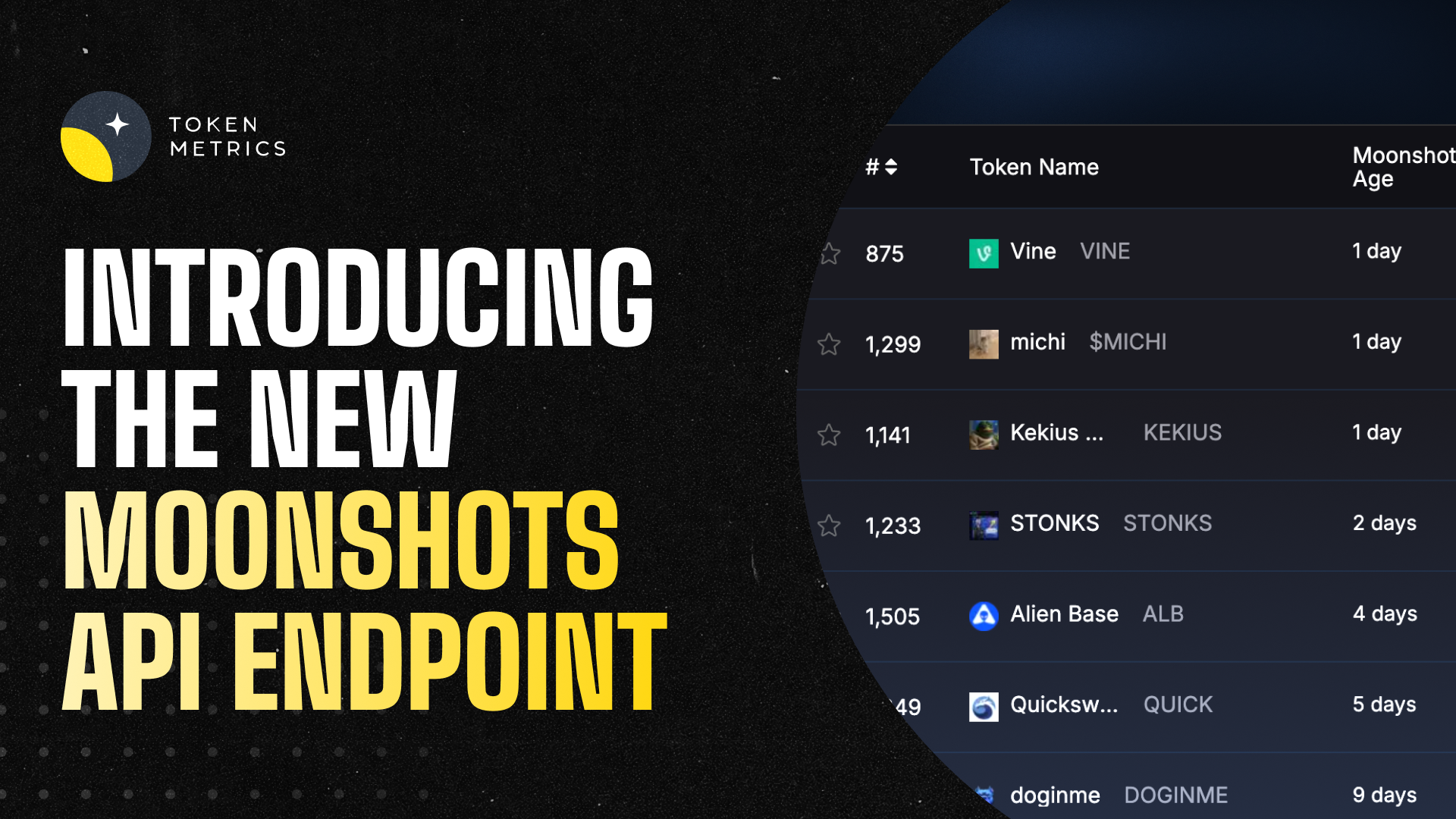
Big news: We’re cranking up the heat on AI-driven crypto analytics with the launch of the Token Metrics API and our official SDK (Software Development Kit). This isn’t just an upgrade – it's a quantum leap, giving traders, hedge funds, developers, and institutions direct access to cutting-edge market intelligence, trading signals, and predictive analytics.

Crypto markets move fast, and having real-time, AI-powered insights can be the difference between catching the next big trend or getting left behind. Until now, traders and quants have been wrestling with scattered data, delayed reporting, and a lack of truly predictive analytics. Not anymore.

The Token Metrics API delivers 32+ high-performance endpoints packed with powerful AI-driven insights right into your lap, including:

  • Trading Signals: AI-driven buy/sell recommendations based on real-time market conditions.
  • Investor & Trader Grades: Our proprietary risk-adjusted scoring for assessing crypto assets.
  • Price Predictions: Machine learning-powered forecasts for multiple time frames.
  • Sentiment Analysis: Aggregated insights from social media, news, and market data.
  • Market Indicators: Advanced metrics, including correlation analysis, volatility trends, and macro-level market insights.

Getting started with the Token Metrics API is simple:

  1. Sign up at www.tokenmetrics.com/api
  2. Generate an API key and explore sample requests.
  3. Choose a tier–start with 50 free API calls/month, or stake TMAI tokens for premium access.
  4. Optionally–download the SDK, install it for your preferred programming language, and follow the provided setup guide.

At Token Metrics, we believe data should be decentralized, predictive, and actionable. 

The Token Metrics API & SDK bring next-gen AI-powered crypto intelligence to anyone looking to trade smarter, build better, and stay ahead of the curve. With our official SDK, developers can plug these insights into their own trading bots, dashboards, and research tools – no need to reinvent the wheel.

Research

Top Crypto Prime Brokers (2025): Best Institutional Trading & Settlement Platforms

Token Metrics Team
17 min read
  • If you’re an institution that needs multi-venue liquidity, off-exchange settlement, and integrated custody/financing, this guide ranks the top crypto prime brokers for 2025 based on scale, security posture, and product breadth.
  • Top picks: Coinbase Prime for integrated trading + qualified custody with negotiated fees; FalconX for deep liquidity and capital solutions across spot/derivatives; Anchorage Digital Prime for bank-regulated custody with prime services and derivatives access. (Coinbase)
  • Caveats: Pricing is often negotiated; availability and products vary by region and legal entity. Always verify coverage on the provider’s official pages before onboarding. (docs.cdp.coinbase.com)

Introduction: Why Prime Brokerage Matters in 2025

Institutional participation accelerated in 2025, and with it the need for crypto prime brokers that unify execution, financing, custody, and settlement while minimizing counterparty risk. The leading platforms now resemble capital-markets infrastructure: single-counterparty access to multi-venue liquidity, off-exchange settlement networks that keep assets in segregated custody, and derivatives rails to hedge risk. Solutions like Coinbase Prime, FalconX, and Anchorage Digital Prime illustrate this evolution, while settlement networks such as Copper ClearLoop reduce venue risk without slowing execution. (Coinbase)

Primary intent: commercial-investigational. This guide compares features, fees, regions, and tradeoffs, then maps use cases to the right providers—so teams can move from diligence to deployment with confidence.


Our Evaluation Methodology

SCORING_WEIGHTS (sum = 100):

  • Scale & Liquidity (25) – depth of venues/LPs, 24/7 execution, options/futures where applicable.
  • Security & Regulatory Posture (25) – qualified custody, bank licensing/registrations, segregation, insurance disclosures.
  • Product Breadth (15) – spot, OTC/RFQ, derivatives, financing, settlement networks.
  • Costs & Fees (10) – published or negotiated schedules, financing/borrow terms.
  • Connectivity & Tooling (10) – FIX/WebSocket APIs, OEMS/SOR, reporting.
  • Capital Efficiency (10) – cross-margin, off-exchange settlement, instant delegation.
  • Support & Service (5) – coverage windows, onboarding SLAs.

Verification approach: We relied on official product, pricing, docs, security, and status pages only. If a claim wasn’t verifiable on an official page, we omitted it. Last updated: November 2025.


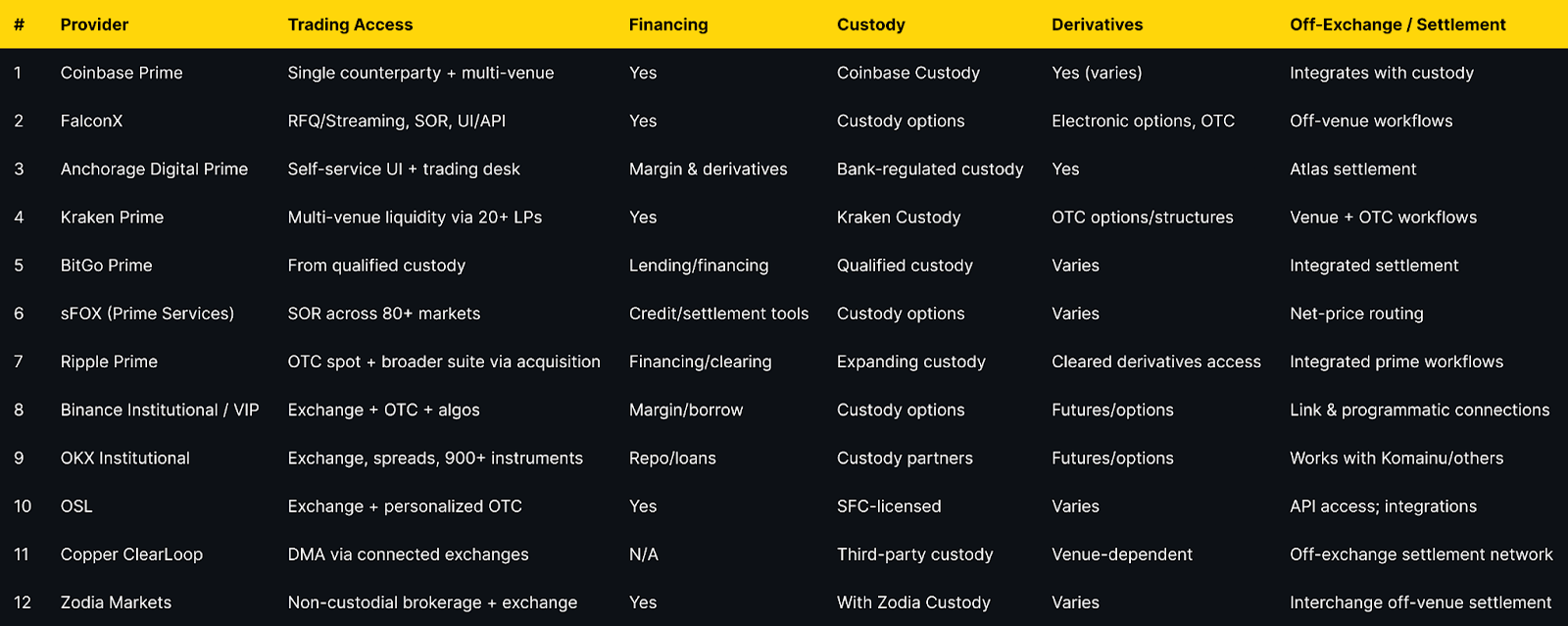
Crypto Prime Brokerage Comparison: At a Glance


Notes: “Pricing” reflects publicly stated models (often negotiated). “Regions/Notes” summarize official disclosures and licensing language where available on provider sites.


Detailed Provider Analysis

Coinbase Prime — Full-service prime brokerage at scale

Overview. Coinbase Prime combines trading, financing, and qualified custody under one institutional platform, with negotiated trading fees and flexible order denomination (base/quote). Execution integrates with reporting and controls suitable for asset managers and corporates. (Coinbase)
Ideal For. Asset managers, corporates/treasuries, hedge funds, RIAs.
Standout Features. Integrated custody; negotiated All-In / Cost-Plus fee models; staking fee schedules; institutional reporting. (docs.cdp.coinbase.com)
Pricing. Negotiated, fee currency = quote currency. (docs.cdp.coinbase.com)
Availability. Global, entity-dependent; product availability varies by jurisdiction.
Worth Noting. Some services require separate agreements (e.g., validators, derivatives access).
Alternatives to Consider. Kraken Prime, Anchorage Digital Prime. (Kraken)  


FalconX — Deep liquidity & capital solutions across markets

Overview. FalconX offers RFQ/streaming execution across spot and FX with FIX/WebSocket/REST connectivity, plus electronic options and capital solutions. Scale and 24/7 liquidity are central, with workflows for large tickets and programmatic strategies. (falconx.io)
Ideal For. Multi-strategy funds, HFT/systematic traders, market makers.
Standout Features. RFQ/streaming with TWAP/FOK; electronic options; FX desk integrated into prime; institutional APIs. (falconx.io)
Pricing. Negotiated; bespoke based on flow and venues.
Availability. Global institutional focus (entity-dependent).
Worth Noting. Derivatives access and product scope vary by entity/region.
Alternatives to Consider. Coinbase Prime, Kraken Prime. (Coinbase)  


Anchorage Digital Prime — Prime services on top of a US bank custodian

Overview. Anchorage Digital Prime delivers trading (13+ order types), derivatives, margin, and settlement built on Anchorage Digital Bank N.A. custody. A single interface and 24/7 trading desk support complex orders. (anchorage.com)
Ideal For. US-regulated custody requirements, governance-active institutions, corporates.
Standout Features. Bank-regulated custody; derivatives access; Atlas settlement; desk + API execution. (anchorage.com)
Pricing. Negotiated; service-by-entity.
Availability. US bank entity with global affiliates; services provided by specific Anchorage entities (see legal). (anchorage.com)
Worth Noting. Trading provided by separate non-bank entities; read entity-level disclosures. (anchorage.com)
Alternatives to Consider. BitGo Prime, Coinbase Prime. (The Digital Asset Infrastructure Company)  


Kraken Prime — Multi-venue liquidity with institutional fee tiers

Overview. Kraken Prime aggregates 20+ liquidity providers and offers smart order routing, OTC spot and OTC derivatives (options/structures), plus custody integrations. Institutional fee perks are published for high-volume clients. (Kraken)
Ideal For. Funds seeking published fee schedules, multi-venue execution, and OTC coverage.
Standout Features. Multi-venue liquidity; FIX 4.4 and WebSockets APIs; OTC desk; institutional taker tiers. (Kraken)
Pricing. Maker/taker schedule with institutional perks at very high volumes. (Kraken)
Availability. Global, entity-dependent.
Worth Noting. Some advanced services require qualification and separate onboarding.
Alternatives to Consider. sFOX, Coinbase Prime. (sFOX)


BitGo Prime — Prime services from qualified custody

Overview. BitGo integrates trading, financing, and settlement directly from custody, with segregated, bankruptcy-remote accounts and published insurance coverage details. (The Digital Asset Infrastructure Company)
Ideal For. Institutions prioritizing segregation and custody-first workflows.
Standout Features. Segregated accounts; insurance disclosures; custody-integrated prime trading. (The Digital Asset Infrastructure Company)
Pricing. Negotiated; custody/prime fees depend on assets and activity.
Availability. Global entities with varying regulatory regimes.
Worth Noting. Derivatives access varies by entity/partner networks.
Alternatives to Consider. Anchorage Digital Prime, Copper ClearLoop. (anchorage.com)


sFOX (Prime Services) — Agency SOR across 80+ markets with institutional tooling

Overview. sFOX acts as an agnostic agent routing across 80+ markets for best execution, with net-price routing and institutional reporting. The platform positions itself as a full-service prime dealer for institutions. (sFOX)
Ideal For. Systematic strategies, RIAs/allocators, corporates seeking agency execution.
Standout Features. SOR across venues; platform-level price improvement; custody options. (sFOX)
Pricing. Tiered/negotiated; historical content points to fee optimization via routing. (sFOX)
Availability. US/global entities; enterprise onboarding.
Worth Noting. Product scope (derivatives, margin) varies; confirm coverage.
Alternatives to Consider. Kraken Prime, Coinbase Prime. (Kraken)


Ripple Prime — Multi-asset prime brokerage under Ripple

Overview. Following the acquisition and subsequent close of Hidden Road, Ripple Prime offers U.S. spot OTC execution and positions Ripple as the first crypto company to own and operate a global, multi-asset prime broker; custody capabilities expanded further in late 2025. (Ripple)
Ideal For. Institutions seeking an integrated multi-asset prime platform with digital asset rails.
Standout Features. OTC spot execution (U.S.); multi-asset coverage; financing/clearing. (Ripple)
Pricing. Negotiated.
Availability. U.S. launch and global expansion via Ripple entities. (Ripple)
Worth Noting. Product availability differs by jurisdiction and entity.
Alternatives to Consider. FalconX, Coinbase Prime. (falconx.io)


Binance VIP & Institutional — Exchange liquidity, OTC & programmatic access

Overview. Binance’s institutional suite spans exchange, OTC RFQ, algos, and programmatic connectivity with VIP tiers. Coverage and eligibility depend on jurisdiction; Binance.US operates separately for U.S. clients. (binance.com)
Ideal For. Non-US teams wanting direct exchange liquidity with OTC tools.
Standout Features. VIP tiers, proof-of-reserves, OTC block trading. (binance.com)
Pricing. Exchange/VIP schedules; negotiated OTC.
Availability. Region-dependent; check supported regions. (binance.com)
Worth Noting. U.S. availability/routes differ; compliance and onboarding vary by entity.
Alternatives to Consider. OKX Institutional, OSL. (OKX)


OKX Institutional — Scale, instruments, and U.S. presence via OKX US

Overview. OKX highlights high uptime, 900+ instruments, and institutional connectivity. U.S. availability exists through OKX US with scope/policies noted in compliance disclosures. (OKX)
Ideal For. Proprietary firms and funds trading a broad instrument set with API access.
Standout Features. Nitro Spreads, derivatives suite, institutional support. (OKX)
Pricing. Exchange schedule + VIP; negotiated for blocks.
Availability. Global; US services via OKX US (scope varies). (OKX)
Worth Noting. Product availability and licensing differ by region.
Alternatives to Consider. Binance Institutional, Kraken Prime. (binance.com)


OSL — HK SFC-licensed exchange, custody & OTC

Overview. OSL provides a licensed Hong Kong platform spanning custody, exchange, and OTC brokerage for institutions, with dedicated coverage in the region. (osl.com)
Ideal For. APAC institutions needing SFC-regulated venue/custody.
Standout Features. SFC-licensed exchange; institutional API; custody with insurance positioning. (sfc.hk)
Pricing. Schedule/negotiated.
Availability. Hong Kong and supported regions; institutional focus.
Worth Noting. Product availability differs by license and region.
Alternatives to Consider. Zodia Markets, Coinbase Prime. (Zodia Markets)


Copper ClearLoop — Off-exchange settlement network (multi-custodial)

Overview. ClearLoop enables instant delegation to connected exchanges while assets remain in segregated custody—now supporting third-party custodians like BitGo and Komainu. (Copper)
Ideal For. Institutions prioritizing venue risk reduction and capital efficiency.
Standout Features. Multi-custodial support; instant asset delegation; network of venues/prime brokers. (Copper)
Pricing. Varies by participants and volumes.
Availability. Global network; coverage depends on participating venues/custodians.
Worth Noting. Not a full prime broker by itself; pairs well with custody/venues.
Alternatives to Consider. Zodia Interchange, Komainu Connect. (zodia-custody.com)


Zodia Markets + Zodia Custody Interchange — Non-custodial brokerage + off-venue settlement

Overview. Zodia Markets offers institutional brokerage/exchange with non-custodial design, while Zodia Custody’s Interchange provides off-venue settlement (OVS)—trade while assets remain in custody. Registrations span UK, Ireland, ADGM. (Zodia Markets)
Ideal For. Institutions wanting bank-backed governance and segregated settlement flows.
Standout Features. Non-custodial brokerage; Interchange OVS network; institutional registrations. (Zodia Markets)
Pricing. Negotiated.
Availability. UK/EU/MENA institutional coverage (entity-specific). (Zodia Markets)
Worth Noting. Product scope varies by entity and venue integrations.
Alternatives to Consider. OSL, Copper ClearLoop. (osl.com)


Choosing the Right Prime Broker: A Framework

  • Regulatory posture needed? If you require US bank-regulated custody, start with Anchorage Digital Prime. For Hong Kong, OSL’s SFC licensing is key. For UK/EU bank-backed governance with off-venue settlement, consider Zodia. (anchorage.com)
  • Execution style. For multi-venue aggregation and published fee tiers, Kraken Prime is strong; for RFQ/streaming with electronic options, FalconX leads. sFOX suits agency SOR across many markets. (Kraken)
  • Integrated custody + trading. Coinbase Prime and BitGo Prime minimize operational friction by tying trading to qualified custody. (Coinbase)
  • Venue-risk reduction. If you want to trade while assets remain in custody, evaluate Copper ClearLoop or Zodia Interchange (and Komainu Connect as a related model). (Copper)
  • Instrument breadth and scale. For vast exchange liquidity and institutional programs, Binance Institutional and OKX Institutional are at-scale options (region permitting). (binance.com)

Integrating Token Metrics Intelligence

  • Research phase: Use Token Metrics screeners and on-chain/technical indicators to identify pairs suitable for your mandate (beta targets, breadth, liquidity screens).
  • Execution phase: Route orders via your prime broker’s APIs (e.g., FIX/WebSocket) selected above, while TM signals inform aggression/passivity and time-of-day tactics. (Kraken)
  • Monitoring: Feed fills, slippage, and borrow/financing into TM analytics to assess venue performance and adjust routing.
  • Optimization: Combine TM factor views with prime-broker borrow/financing and settlement options (e.g., off-exchange) to lower VaR and operational risk.

Start a Token Metrics trial to bring quantitative screening and scenario analysis into your institutional workflow.  


Security & Compliance Guidelines

  • Prefer segregated, bankruptcy-remote custody and confirm insurance disclosures where published. (The Digital Asset Infrastructure Company)
  • If you need a US bank custodian, validate services by legal entity and read the provider’s disclosures. (anchorage.com)
  • Use off-exchange settlement networks to reduce exchange exposure during execution. (Copper)
  • Confirm derivatives eligibility, margin terms, and cross-margin/netting treatment by entity/venue. (Kraken)
  • Require API keys/roles with least-privilege, HSM custody, and mandatory allow-listing.
  • Maintain jurisdictional watchlists and restrict activity accordingly (e.g., US vs non-US entities for global exchanges). (OKX)

Compliance note: This article is for research/education, not financial advice.


Avoiding Common Mistakes

  • Treating “prime” as one product—coverage and legal entities differ by service.
  • Assuming off-exchange settlement is automatic—confirm network membership and supported venues. (Copper)
  • Onboarding to the wrong entity—read the jurisdictional disclosures. (anchorage.com)
  • Ignoring negotiated fees—request All-In vs Cost-Plus quotes. (docs.cdp.coinbase.com)
  • Skipping disaster-recovery testing—simulate exchange outage + settlement failover.
  • Under-documenting OMS/EMS changes—keep audit-ready change logs.

Frequently Asked Questions

What is a crypto prime broker?
 A provider that consolidates institutional trading, financing, custody, and settlement, often with multi-venue access and risk controls. Modern variants add off-exchange settlement so assets remain in custody during execution. (zodia-custody.com)

Do prime brokers publish fees?
 Often no—fees are negotiated based on volumes, products, and relationship tier. Some venues publish maker/taker schedules with institutional perks. (docs.cdp.coinbase.com)

How does off-exchange settlement work?
 Networks like ClearLoop and Interchange let you delegate assets to venues for trading while keeping them in segregated custody, reducing counterparty risk. (Copper)

Which providers are strongest for regulated custody?
 Anchorage Digital Prime (US bank custody), BitGo (qualified custody), OSL (HK SFC-licensed custody/exchange), and Zodia (bank-backed with EU/UK registrations). (anchorage.com)

Can U.S. institutions use OKX or Binance?
 Access is region-dependent and varies by entity (e.g., OKX US scope). U.S. clients typically cannot use Binance.com and instead must evaluate Binance.US or other U.S.-eligible routes. Always check official disclosures. (OKX)


Final Recommendations

For most global institutions, a two-stack works best: (1) an integrated prime broker with qualified custody (Coinbase Prime, Anchorage Digital Prime, or BitGo Prime) and (2) a venue-risk mitigator like Copper ClearLoop or Zodia Interchange. Execution-heavy funds should add FalconX or Kraken Prime for multi-venue and OTC derivatives coverage, while OSL anchors APAC/HK mandates and OKX/Binance expand exchange reach where eligible. (Coinbase)

Related Resources:

Research

Best Yield Marketplaces for Real-World Assets (RWAs) in 2025

Token Metrics Team
29 min read
  • What this guide covers: A comprehensive evaluation of 10 leading platforms that enable tokenized real-world asset trading and yield generation across private credit, treasuries, real estate, and structured finance
  • Quick verdict: Ondo Finance for institutional-grade treasury exposure at ~5% APY, Maple Finance for crypto-collateralized credit facilities delivering 9-12% net yields, Goldfinch Prime for diversified access to private credit funds from Apollo and Ares
  • One key limitation to know: Many RWA platforms enforce strict accreditation requirements (minimum $50K-200K) and geographic restrictions, particularly excluding US investors from certain products due to securities regulations

Why Yield Marketplaces for RWAs Matter in January 2025

The real-world asset tokenization market has experienced explosive growth, surging from $85 million in April 2020 to over $25 billion by mid-2025—representing a staggering 245-fold increase driven primarily by institutional demand for yield, transparency, and regulatory clarity. Private credit dominates at approximately 61% of total tokenized assets, followed by treasuries at 30%, with major asset managers like BlackRock, Apollo, and Franklin Templeton now actively tokenizing institutional-grade products.

The convergence of traditional finance and decentralized infrastructure has created unprecedented opportunities for investors seeking stable, real-world yields without exposure to cryptocurrency volatility. The tokenized RWA market is projected to reach between $9.43 trillion and $18.9 trillion by 2030, with regulatory frameworks in Singapore, Hong Kong, and Dubai providing clear pathways for compliant innovation.

For crypto-native investors, RWA yield marketplaces offer a critical bridge to sustainable income streams backed by productive assets rather than purely speculative token emissions. Traditional allocators gain 24/7 access to fractional ownership, instant settlement, and programmable compliance—advantages impossible in legacy financial infrastructure.


How We Evaluated These Providers

We assessed platforms across six weighted criteria totaling 100 points:

  • Yield Quality & Sustainability (30%): Consistency of returns, asset backing, historical performance, and correlation to traditional markets
  • Security & Risk Management (25%): Custody solutions, audit history, legal recourse, collateralization ratios, and default handling protocols
  • Asset Coverage & Diversity (15%): Range of underlying assets, tranching options, and exposure across credit curves
  • Accessibility & Costs (15%): Minimum investments, fee structures, geographic availability, and KYC requirements
  • Liquidity & Redemption (10%): Secondary market depth, withdrawal timelines, and tokenization standards
  • Infrastructure & Compliance (5%): Regulatory licenses, blockchain integrations, and institutional partnerships

Data sources: Official platform documentation, on-chain analytics from RWA.xyz and DeFiLlama, third-party audits, and regulatory filings. Research conducted October 2024-January 2025.

Verification approach: Every fee structure, yield figure, and regional restriction cited was verified on official platform pages or regulatory disclosures. Unverifiable claims were excluded.


The Contenders: Quick Comparison  

Provider Reviews by Use Case

For Treasury-Backed Stability (4-5% Yield)

Top Pick: Ondo Finance — Institutional Treasury Tokenization Pioneer

Overview
 Ondo Finance manages over $1.6 billion in tokenized assets, offering institutional-grade access to US Treasury exposure through OUSG (backed by BlackRock's BUIDL fund) and USDY (a yield-bearing stablecoin). The platform bridges TradFi stability with DeFi composability through multi-chain deployment across Ethereum, Solana, Base, and XRP Ledger.

Ideal For

  • Institutional allocators seeking low-volatility dollar exposure
  • DeFi protocols requiring yield-bearing collateral
  • Treasuries managing idle stablecoin holdings
  • Investors prioritizing regulatory compliance and brand-name backing

Standout Features

  • Approximately 5% APY from short-term US Treasuries with daily interest payouts via rebasing mechanism
  • Integration with Ripple's RLUSD stablecoin for instant minting and redemption 24/7
  • Comprehensive SEC-registered infrastructure through acquisition of Oasis Pro, including broker-dealer, ATS, and transfer agent licenses
  • Strategic partnerships including anchor position in Fidelity's FDIT tokenized money market fund and launch of Ondo Global Markets for tokenized equities

Pricing
 Management fees embedded in net yield; typical 0.15-0.30% annual fee depending on product. OUSG requires $100K minimum; USDY accessible at lower thresholds with 4.29% APY.

Availability
 Global except US persons for certain products. Ethereum, Solana, Polygon, Aptos, Sei, Base, XRP Ledger, and Sui supported.

Worth Noting
 OUSG designed for qualified purchasers with extended lockup periods; less suitable for retail or high-frequency traders. Platform prioritizes institutional relationships over retail accessibility.

Alternatives to Consider: Franklin Templeton BENJI, OpenEden TBILL  


Runner-Up: Franklin Templeton BENJI — Legacy Asset Manager Innovation

Overview
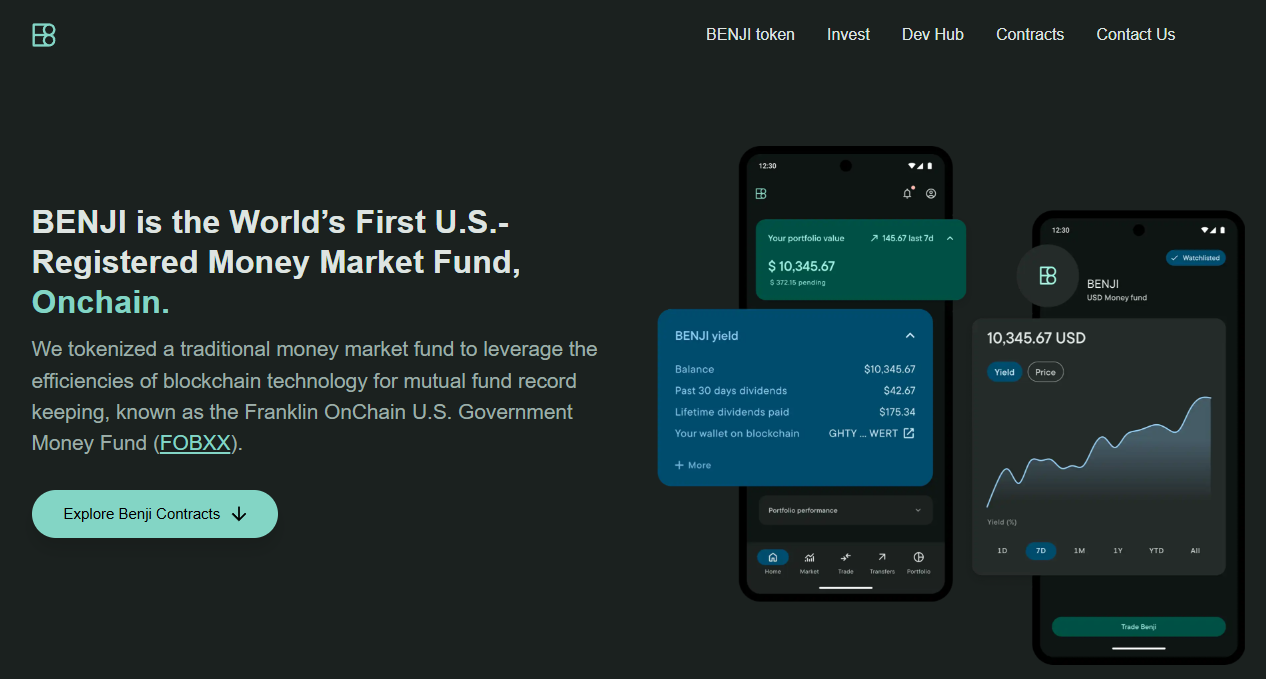
 Franklin Templeton's $775 million Franklin OnChain U.S. Government Money Fund (BENJI) pioneered tokenized mutual funds in 2021, offering exposure to US government securities across eight blockchains with patent-pending intraday yield calculation.

Ideal For

  • Investors seeking regulated 40 Act fund structure
  • Collateral managers requiring second-by-second yield accrual
  • Multi-chain strategies needing broad blockchain compatibility
  • Users prioritizing traditional asset manager credibility

Standout Features

  • Intraday yield tracking down to the second, enabling proportional earnings even for partial-day holdings
  • Direct stablecoin purchases and redemptions with wallet-to-wallet transfer capability
  • 63% of AUM deployed on Stellar Network for optimal cost efficiency
  • Integrated with DeFi protocols for collateral and leverage applications

Pricing
 7-day current yield approximately 4.5-5.5% gross; 0.25% management fee. No minimum investment restrictions beyond standard mutual fund requirements.

Availability
 Global availability with specific KYC requirements. Active on Stellar, Ethereum, Arbitrum, Base, Avalanche, Polygon, Aptos, Solana, BNB Chain.

Worth Noting
 Traditional mutual fund constraints apply including daily NAV calculations and potential redemption delays during market stress.

Alternatives to Consider: Backed bIB01, Superstate Short Duration Government Securities  


For Institutional Credit Exposure (8-12% Yield)

Top Pick: Maple Finance — Premier Crypto-Collateralized Lending

Overview
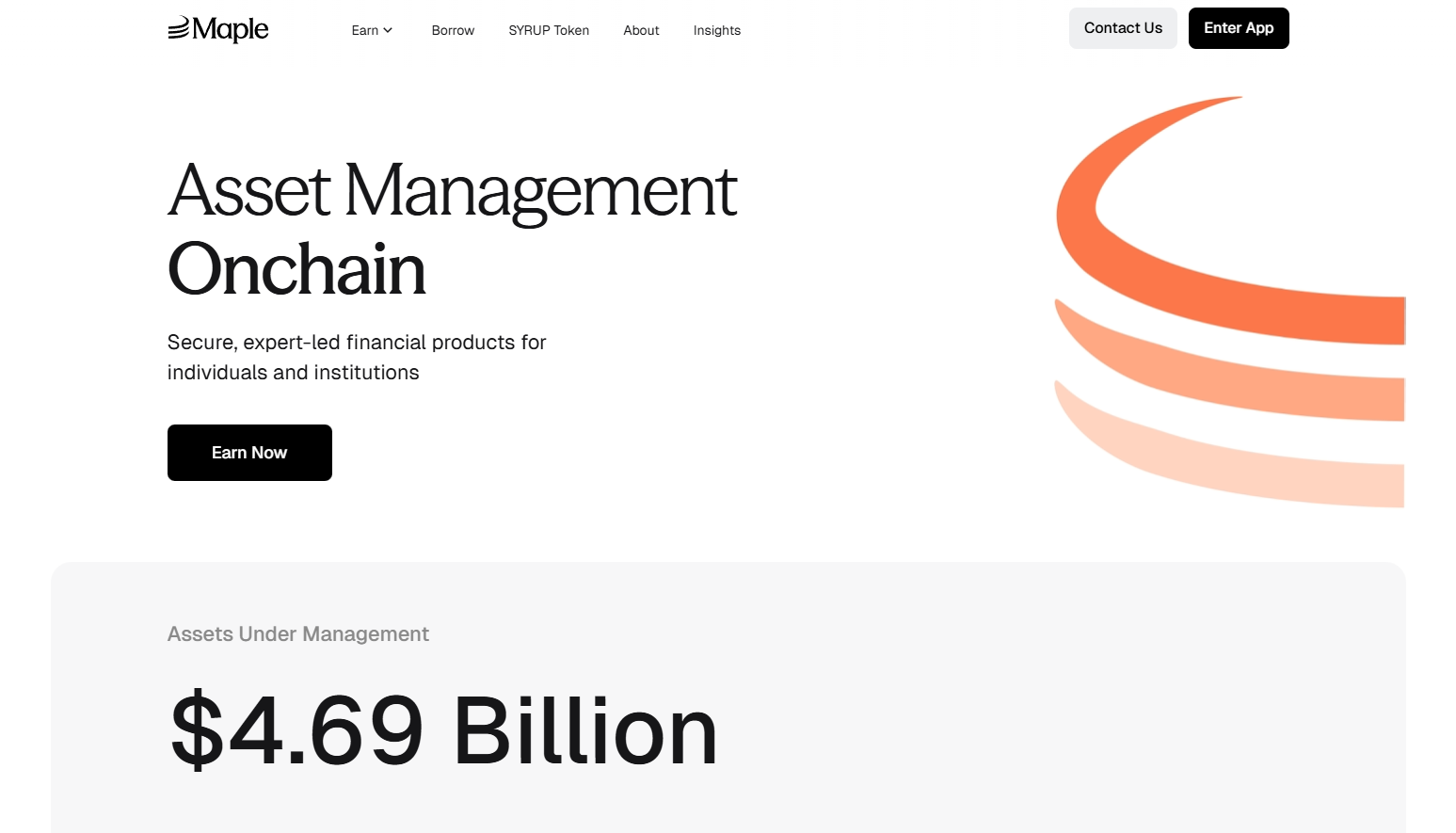
 Maple Finance manages over $4 billion in assets, specializing in institutional over-collateralized lending backed by Bitcoin, Ethereum, Solana, and XRP, targeting $100 billion in annual loan volume by 2030. The platform introduced SyrupUSDC for permissionless retail access alongside KYC-gated institutional pools.

Ideal For

  • Institutional lenders seeking exposure to cryptocurrency-backed credit
  • Liquidity providers comfortable with smart contract risk
  • Allocators targeting floating-rate, senior-secured structures
  • Investors seeking alternatives to traditional stablecoin farming

Standout Features

  • Consistent 9-12% net yields through undercollateralized institutional facilities and structured credit products
  • Strategic integration with Aave's $40 billion protocol bringing syrupUSDT to Plasma instance and syrupUSDC to core markets
  • Partnerships with Bitwise, Lido Finance (stETH-backed credit lines), and EtherFi (weETH collateral) expanding institutional adoption
  • Robust risk management combining decades of TradFi expertise with real-time on-chain monitoring

Pricing
 Variable by pool; typical effective yields 9-12% after protocol fees. Minimum investments pool-dependent, generally $10K-$50K for retail syrup products.

Availability
 Global with KYC requirements for lending. Institutional Maple requires accreditation; Syrup.fi open to broader participants.

Worth Noting
 Platform transitioned from uncollateralized to over-collateralized model after 2022 market turmoil. Historical defaults impacted certain pools; robust recovery mechanisms now in place.

Alternatives to Consider: Credix (emerging markets), TrueFi (uncollateralized DeFi)  


Runner-Up: Goldfinch Prime — Institutional Private Credit Access

Overview
 Goldfinch Prime aggregates exposure to multi-billion dollar private credit funds from Ares, Apollo, Golub Capital, and KKR, providing on-chain access to institutional-grade senior secured loans with over $1 trillion in collective AUM.

Ideal For

  • Non-US investors seeking diversified private credit exposure
  • Allocators targeting institutional fund performance without direct fund access
  • Participants seeking uncorrelated yield to crypto markets
  • Investors comfortable with longer lockup periods

Standout Features

  • Exposure to 1000+ senior secured loans across industries through vetted fund managers with 10+ years experience
  • Target returns of 9-12% net of fees with strict eligibility criteria including >90% senior secured portfolios and <0.75% target non-accrual rates
  • Heron Finance manages fund selection and vetting while fund managers handle all underwriting and default resolution
  • USDC-based deposits converted to proportional GPRIME tokens for continuous offering structure

Pricing
 Net yields 9-12% after embedded management fees and profit sharing. Minimum investments vary by pool structure; typically institutional minimums apply.

Availability
 Non-US persons only due to regulatory structure. KYC and accreditation verification required.

Worth Noting
 Exposure is indirect through fund shares rather than direct loan origination; fund managers absorb individual borrower default risk into aggregate yields. Liquidity limited compared to Treasury products.

Alternatives to Consider: Centrifuge private credit pools, Credix fintech lending


For Real Estate & Diversified Assets (6-10% Yield)

Top Pick: Centrifuge — Multi-Asset Tokenization Infrastructure

Overview
 Centrifuge operates as a multichain infrastructure platform enabling asset managers to tokenize real estate, trade finance, carbon credits, and structured credit with $1.2 billion TVL and recent 10x growth driven by the first on-chain CLO and tokenized S&P 500 index fund.

Ideal For

  • Investors seeking exposure to asset-backed securities beyond treasuries
  • Allocators comfortable evaluating tranched credit structures
  • Participants prioritizing transparency and on-chain asset verification
  • Portfolio managers wanting diversification across real-world credit types

Standout Features

  • Asset-agnostic architecture supporting structured credit, real estate mortgages, US treasuries, carbon credits, and consumer finance with full collateralization and legal recourse for investors
  • V3 platform enables cross-chain interoperability across Ethereum, Base, Arbitrum, Avalanche, BNB Chain, and Plume with integrated KYC and compliance-as-a-feature
  • Senior/junior tranche structures allowing risk-return customization
  • Partnership with Chronicle Labs for real-time price feeds and integration with Circle for USDC on/off-ramping

Pricing
 Yields vary by pool and tranche: typically 6-8% for senior tranches, 10-14% for junior tranches. Management fees embedded; pool-specific minimums apply.

Availability
 Global with KYC requirements. Pools may have additional jurisdictional restrictions based on underlying asset location.

Worth Noting
 Platform complexity requires understanding of tranched structures and asset-specific risks. Less liquid credit instruments offer less frequent pricing updates than treasury products.

Alternatives to Consider: RealT (US residential real estate focus), Republic (equity crowdfunding)

For Emerging Market Credit (12-18% Yield)

Top Pick: Credix — Latin American Fintech Lending

Overview
 Credix specializes in providing credit facilities to fintech lenders in Latin America, offering high-yield exposure to underserved credit markets with institutional-grade underwriting and local market expertise.

Ideal For

  • Sophisticated investors seeking higher risk-adjusted returns
  • Allocators comfortable with emerging market credit risk
  • Participants with extended investment horizons (12-24 months typical)
  • Investors seeking geographic diversification from US/EU markets

Standout Features

  • Target yields 12-18% reflecting emerging market risk premiums
  • Focus on fintech infrastructure enabling financial inclusion
  • Partnerships with established Latin American credit originators
  • Robust due diligence and monitoring of borrower networks

Pricing
 Pool-dependent yields typically 12-18% gross with management fees of 1-2%. Minimum investments generally $50K+ for accredited investors.

Availability
 Non-US persons primarily; requires accreditation verification and enhanced KYC given emerging market exposure.

Worth Noting
 Higher yields reflect higher credit and currency risk. Platform experienced challenges during regional economic volatility; enhanced risk controls now implemented.

Alternatives to Consider: Goldfinch V1 pools (emerging market focus), TrueFi uncollateralized pools


For Tokenization Infrastructure (Platform Providers)

Top Pick: Securitize — Industry-Leading Issuance Platform

Overview
 Securitize has tokenized over $4.5 billion in assets for 1.2 million investors across 3,000+ clients, operating as an SEC-registered transfer agent with integrated ATS for secondary trading. The platform powers major offerings including BlackRock's BUIDL fund.

Ideal For

  • Asset managers seeking turnkey tokenization solutions
  • Issuers requiring SEC-compliant digital security infrastructure
  • Institutional clients needing integrated custody and compliance
  • Projects prioritizing regulatory alignment and brand credibility

Standout Features

  • DS Protocol automates token issuance, transfer agent functions, and regulated secondary trading with $47 million funding led by BlackRock
  • Recent launch of STAC tokenized AAA CLO fund with BNY custody demonstrating institutional adoption trajectory
  • Comprehensive investor onboarding, KYC/AML, and reporting infrastructure
  • Partnerships with major asset managers and integration with Zero Hash for fiat conversion

Pricing
 Platform fees vary by issuance size and complexity; typically 0.5-2% of AUM plus basis point fees on transactions. White-label solutions available for enterprise clients.

Availability
 Global operations with jurisdiction-specific compliance modules. Primary focus on US, EU, and APAC institutional markets.

Worth Noting
 Securitize is an issuance platform rather than direct investment product; investors access opportunities through partner funds and offerings launched on the infrastructure.

Alternatives to Consider: Tokeny (EU-focused), Polymath/Polymesh (security token specialists)


Complete Provider Directory

  • Backed Finance: European MiCA-compliant tokenization platform offering bIB01 (Swiss government bond exposure) and bC3M (commodity basket). Strong focus on regulatory alignment with modest 3-5% yields and low entry barriers.
  • Swarm Markets: Decentralized platform enabling fractional ownership of real estate and private credit with $1K-$50K minimums. Emphasizes accessibility while maintaining compliance through distributed infrastructure.
  • TrueFi: Uncollateralized lending protocol using on-chain credit scoring and portfolio diversification. Higher risk-return profile (8-15% targets) with full transparency of borrower pools and performance metrics.
  • Archax: UK FCA-regulated platform for institutional tokenization of bonds, funds, and money markets. Focus on traditional finance compatibility with stringent accreditation requirements.

Making Your Selection: Key Questions

  • What yield stability do you require?
     Treasury-backed platforms (Ondo, Franklin Templeton) offer predictable 4-5% returns with minimal volatility. Credit-focused platforms (Maple, Goldfinch) target 9-12% but introduce credit risk and performance variability.
  • What is your risk tolerance for underlying collateral?
     Government securities provide lowest risk; over-collateralized crypto loans add smart contract and liquidation risks; uncollateralized emerging market credit carries highest default potential.
  • Do you meet accreditation and minimum investment thresholds?
     Many institutional products require $50K-$200K minimums and qualified purchaser status. Retail-accessible options like USDY and syrupUSDC lower barriers but may sacrifice yield.
  • What liquidity do you need?
     Treasury tokens generally offer daily liquidity; private credit pools may have quarterly redemption windows; real estate tokenization can involve 12-24 month lockups.
  • How important is regulatory compliance?
     Platforms like Ondo, Franklin Templeton, and Securitize prioritize SEC registration and traditional fund structures. Purely DeFi-native protocols offer less regulatory clarity but greater composability.
  • What blockchain ecosystems do you operate in?
     Multi-chain deployment (Ondo, Centrifuge) provides flexibility; single-chain specialization (some Maple pools) may offer optimization but limits interoperability.
  • Do you have geographic restrictions?
     US persons often excluded from highest-yield opportunities due to securities laws. European investors benefit from MiCA framework; APAC sees growing regulatory clarity.
  • What level of transparency do you require?
     On-chain native protocols offer real-time asset verification; hybrid models may rely on periodic attestations and third-party audits.
  • Are you seeking passive income or active yield strategies?
     Treasury staking provides set-and-forget returns; DeFi integrations enable leverage, collateral strategies, and yield optimization requiring active management.
  • How much operational complexity can you handle?
     Single-platform solutions simplify but limit optionality; multi-protocol strategies maximize returns but require gas management, tax tracking, and security across multiple platforms.

Maximizing Your Setup with Token Metrics

Token Metrics provides critical intelligence for navigating RWA yield opportunities through data-driven analysis and market insights.

Research Phase: Leverage Token Metrics' fundamental analysis to evaluate tokenized asset protocols, comparing on-chain metrics, TVL trends, and yield sustainability indicators. Our RWA sector reports identify emerging platforms and highlight regulatory developments across jurisdictions.

Portfolio Construction: Use quantitative scoring to allocate across risk tiers—balancing stable treasury exposure with higher-yield credit products. Token Metrics' portfolio tools help optimize diversification while monitoring correlation to traditional crypto markets.

Ongoing Monitoring: Real-time alerts notify you of yield changes, protocol upgrades, and risk events. Our dashboard aggregates performance across multiple RWA platforms, tracking your yield-bearing positions alongside broader cryptocurrency holdings.

Risk Management: Token Metrics' risk analytics assess smart contract security, custody arrangements, and counterparty exposure. Our reports flag platforms with concerning yield sustainability metrics or operational red flags before they impact your capital.

Start your Token Metrics free trial to access institutional-grade RWA research and optimize your real-world asset allocation.  


Essential Security Practices

  • Custody Verification: Confirm that platforms use institutional-grade custodians (Coinbase Custody, BitGo, Fireblocks) for underlying assets. Verify proof-of-reserve attestations and third-party audits.
  • Smart Contract Risk: Review audit reports from reputable firms (Trail of Bits, OpenZeppelin, Certora). Understand upgrade mechanisms and timelock protections on protocol contracts.
  • Legal Structure Assessment: Examine SPV formation, bankruptcy remoteness, and investor recourse mechanisms. Ensure tokenization structure provides actual legal claim on underlying assets, not just economic exposure.
  • Regulatory Compliance: Verify platforms maintain necessary licenses (broker-dealer, transfer agent, ATS) in relevant jurisdictions. Confirm offerings comply with securities laws in your domicile.
  • Counterparty Risk: Understand who services loans, manages defaults, and handles liquidations. Evaluate track records of asset originators and credit underwriters.
  • Liquidity Risk Management: Never allocate more than you can afford to lock up for stated redemption periods. Maintain buffer capital for market volatility and potential redemption delays.
  • Tax Implications: Consult tax professionals on treatment of tokenized yield—may be classified as interest income, dividends, or capital gains depending on structure and jurisdiction.
  • Geographic Restrictions: Verify you're eligible to participate based on residency. Using VPNs or misrepresenting location can result in frozen funds and legal liability.
  • Platform Concentration: Diversify across multiple RWA providers to reduce single-point-of-failure risk. No single platform should represent majority of yield allocation.
  • Documentation: Maintain records of all transactions, yield distributions, and platform communications for tax reporting and potential disputes.

This article is for research and educational purposes, not financial advice. RWA investments carry risks including loss of principal.


What to Avoid

  • Ignoring minimum holding periods: Many RWA products enforce lockups or redemption windows. Treating them as liquid positions can leave you unable to access capital when needed.
  • Chasing unsustainably high yields: Promised returns significantly above market rates often indicate excessive risk. Verify underlying asset performance and historical consistency before committing capital.
  • Overlooking platform liquidity: Token existence on-chain doesn't guarantee exit liquidity. Check secondary market depth and historical spread between minting and redemption prices.
  • Neglecting jurisdictional compliance: Accessing platforms not available in your region can result in frozen accounts and regulatory penalties. Always verify eligibility before depositing funds.
  • Underestimating smart contract risk: Even well-audited protocols face exploitation risk. Size positions appropriately and monitor security incident disclosures across the ecosystem.
  • Failing to verify asset backing: Don't rely on marketing claims. Demand proof-of-reserve, third-party attestations, and transparent reporting on underlying collateral.
  • Concentrating in single asset class: Over-allocating to one RWA category (e.g., all private credit) eliminates diversification benefits. Balance across treasuries, credit, and real estate where possible.
  • Ignoring fee structures: Management fees, performance fees, and transaction costs compound over time. Calculate net yields after all costs when comparing platforms.

Reader Questions Answered

What's the difference between tokenized treasuries and yield-bearing stablecoins?

 Tokenized treasuries (like OUSG) represent direct ownership of US Treasury securities with yield passed through to holders. Yield-bearing stablecoins (like USDY) maintain $1 peg while distributing treasury yields via rebasing or airdrops. Treasuries may fluctuate slightly with NAV; yield stablecoins prioritize price stability.

Are RWA yields taxable differently than crypto staking rewards?

 Likely yes, though tax treatment varies by jurisdiction. RWA yields from treasuries or credit facilities often classified as interest income taxed at ordinary rates. Crypto staking may be treated as income at receipt or capital gains at sale depending on location. Consult tax professionals for specific guidance.

Can I use tokenized RWAs as collateral in DeFi protocols?

 Increasingly yes. Platforms like Maple, Ondo (via Flux Finance), and Centrifuge enable using tokenized assets as DeFi collateral. However, support varies by protocol and asset—USDY and OUSG see broader integration than niche real estate tokens. Liquidation risks apply if collateral value drops.

What happens if the platform goes bankrupt?

 Properly structured tokenization isolates assets in bankruptcy-remote SPVs, protecting investor claims even if platform operator fails. However, redemption processes may be delayed and require legal navigation. This is why verifying legal structure and custodial arrangements is critical.

How liquid are RWA tokens compared to stablecoins?

 Significantly less liquid. While stablecoins have billions in daily DEX volume, most RWA tokens trade thinly or only through platform-controlled redemption mechanisms. Treasury tokens offer better liquidity than private credit or real estate, but all lag traditional stablecoins substantially.

Do I need to be an accredited investor?

 Depends on the platform and your location. US-based offerings often require accreditation; international platforms may have lower barriers. Products like USDY, syrupUSDC, and BENJI target broader accessibility, while institutional credit pools restrict to qualified purchasers.

What are the main risks that could cause loss of principal?

 (1) Underlying asset default (credit risk), (2) smart contract exploitation, (3) platform insolvency without proper asset segregation, (4) regulatory action freezing operations, (5) stablecoin de-pegging for yield products denominated in USDC/USDT, (6) liquidation cascades in collateralized structures.

How do yields compare to traditional finance alternatives?

 Tokenized treasuries (4-5%) match conventional money market funds but with 24/7 access. Private credit RWAs (9-12%) offer premiums over corporate bonds due to illiquidity and platform novelty. Emerging market RWA yields (12-18%) comparable to EM debt funds with added smart contract risk.


Bottom Line

Real-world asset yield marketplaces represent the maturation of blockchain infrastructure beyond speculation into productive finance. For investors seeking stable, asset-backed returns uncorrelated to cryptocurrency volatility, platforms like Ondo Finance and Franklin Templeton deliver institutional-grade treasury exposure with DeFi composability. Those comfortable with credit risk can access superior yields through Maple Finance's collateralized institutional lending or Goldfinch Prime's diversified private credit exposure.

The key to success: match platform selection to your specific risk tolerance, liquidity needs, and regulatory constraints. Treasury products suit conservative allocators prioritizing capital preservation; credit platforms reward investors accepting higher risk for enhanced returns; multi-asset infrastructure like Centrifuge offers diversification across real-world credit types.

Start with smaller allocations to understand platform mechanics, redemption processes, and yield consistency before committing substantial capital. The RWA sector's rapid growth will continue creating opportunities, but also attracting lower-quality offerings—due diligence remains paramount.

Related Resources:


About This Research

Methodology: This guide evaluated 20+ RWA platforms through analysis of official documentation, on-chain data, regulatory filings, and third-party audits. Platforms selected represent meaningful TVL (>$100M), regulatory compliance, and operational track record. Final selection prioritized diversity across asset classes and investor accessibility tiers.

Research Sources:

  • Ondo Finance: Product documentation, tokenomics, OUSG/USDY specifications, Oasis Pro acquisition disclosure
  • Maple Finance: Platform whitepaper, syrupUSDC mechanics, Aave integration announcement, CEO interviews
  • Centrifuge: V3 technical documentation, pool analytics, Republic partnership details
  • Goldfinch: Prime pool specifications, fund manager criteria, Heron Finance structure
  • Franklin Templeton: BENJI platform technical details, intraday yield patent documentation, multi-chain deployment
  • Securitize: DS Protocol documentation, STAC fund launch details, BlackRock partnership announcements
  • RWA.xyz: Platform TVL data, tokenization metrics, market growth analysis
  • DeFiLlama: Protocol TVL tracking, historical performance data
  • BCG/Ripple: RWA market projections and industry research
  • VanEck, Coinbase, Binance: Sector research reports on RWA growth trajectories

All data current as of January 2025. Platform features and yields subject to change; verify current terms on official websites before investing.

Research

Top Gold & Commodity-Backed Tokens (2025)

Token Metrics Team
12 min read

Who this guide is for. Crypto investors and treasurers comparing gold-backed tokens and other commodity-backed assets that can be audited and, in many cases, redeemed for metal.
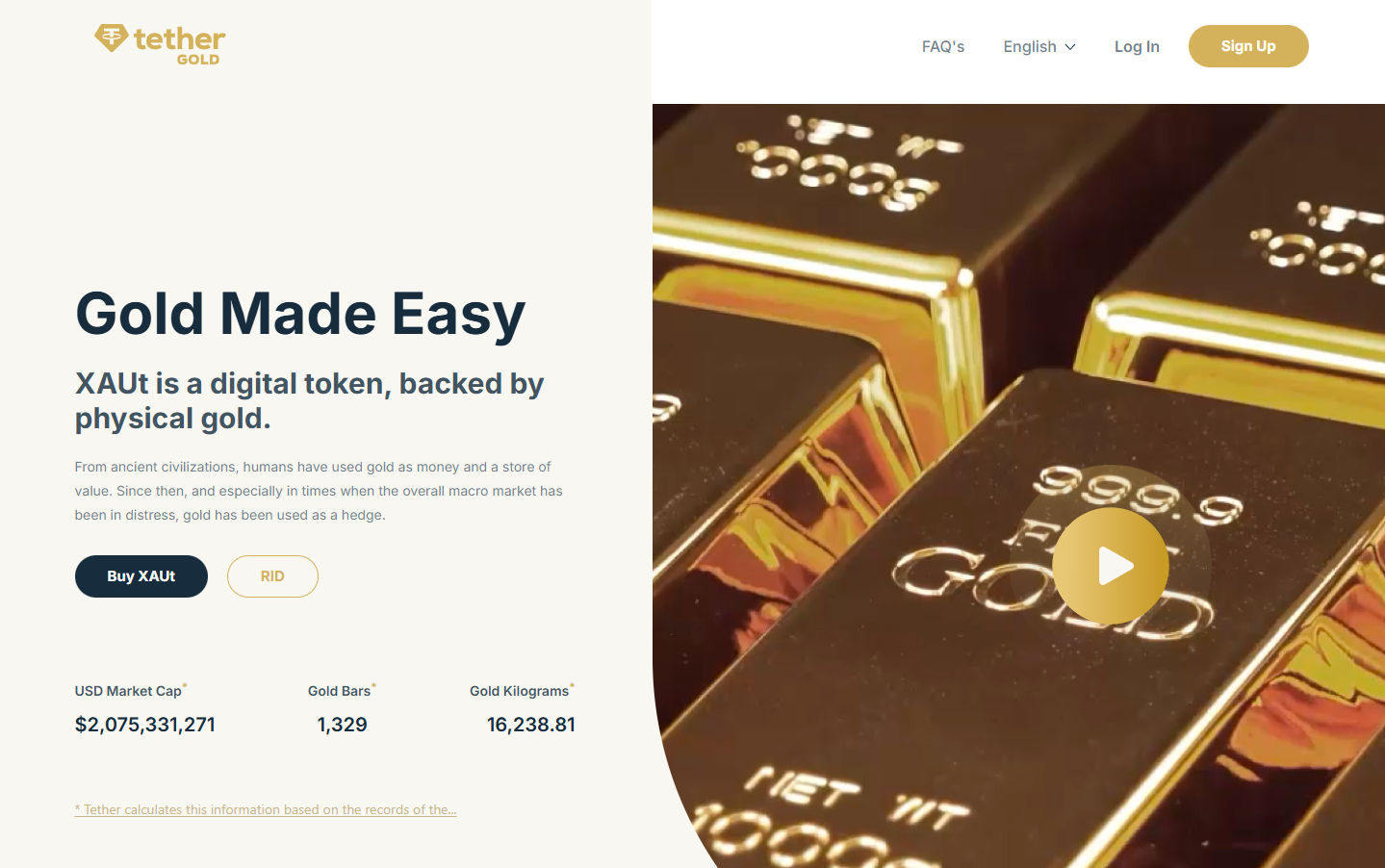
Top three picks. PAX Gold (PAXG) for regulated, bar-linked redemption; Tether Gold (XAUt) for broad awareness and simple fees; Kinesis (KAU/KAG) for spend-and-yield use cases.
Key caveat. Redemption minimums, custody locations, and fees vary by issuer; always confirm regional eligibility and schedules on the official pages.


Introduction: Why Commodity-Backed Tokens Matter in 2025

Gold-backed tokens give on-chain ownership exposure to vaulted bullion with transparent allocation and, often, physical redemption, blending the inflation hedge of metals with crypto liquidity. In 2025, they’re used for hedging, collateral, cross-border settlement, and “digital cash” backed by tangible assets. A commodity-backed token is a blockchain token that represents title to a specific quantity of a real-world commodity (for example, 1 troy ounce or 1 gram of gold) held by a custodian, typically with published fees, vault locations, and redemption rules. Our picks prioritize liquidity, security controls, breadth of metals, cost transparency, and global accessibility.


Best Commodity-Backed Tokens in November 2025 (Comparison Table)


We excluded defunct or sunset projects (e.g., PMGT; CACHE Gold ceased backing CGT on Sept 30, 2025). (perthmint.com)


Top 10 Gold & Commodity-Backed Tokens in November 2025

1) PAX Gold (PAXG) — Best for bar-linked redemption & regulatory posture

Why Use It. PAXG links each token to specific LBMA Good Delivery bars stored in London, offering direct bar redemption (institutional minimums apply) or USD redemption at spot. Paxos publishes fee schedules and notes no storage fee charged to customers at this time. (paxos.com)
Best For. Institutions; HNW hedgers; DeFi users needing reputable collateral.
Notable Features. LBMA bars; serial-number linkage; custodied in London; fiat redemption option. (paxos.com)
Fees Notes. Creation/destruction fees; no storage fee currently per issuer help center. (help.paxos.com)
Regions. Global (issuer KYC).
Consider If. You can meet bar redemption minimums and UK vault logistics. (help.paxos.com)
Alternatives. Tether Gold (XAUt); VNX Gold (VNXAU).  


2) Tether Gold (XAUt) — Best for simple pricing & broad availability

Why Use It. XAUt represents allocated gold and can be redeemed for physical gold or USD; Tether publishes a straightforward 0.25% creation/redemption fee and a one-time verification fee for onboarding. FAQs outline redemption mechanics and bar specifics. (Tether)
Best For. Traders seeking brand familiarity; cross-chain users (ETH/TRON).
Notable Features. Bar metadata; physical or USD redemption; no custody fee disclosed beyond the transaction fee. (Tether)
Fees Notes. 25 bps create/redeem; separate KYC verification fee. (Tether)
Regions. Global (issuer KYC).
Consider If. You need clear fee math but don’t require bar-specific allocation like PAXG.
Alternatives. PAX Gold (PAXG); Kinesis (KAU).  


3) Kinesis KAU (Gold) / KAG (Silver) — Best for spend-and-yield utility

Why Use It. Kinesis combines metal-backed tokens with an exchange, cards, and yields funded from platform fees (published yield-share). Trading and precious metals transactions show ~0.22% execution fees on official schedules. (Kinesis)
Best For. Users wanting to spend gold/silver, earn monthly yields, and keep fees predictable.
Notable Features. Fee-share yield (published); exchange, card rails; gold & silver pairs. (Kinesis)
Fees Notes. ~0.22% buy/sell/trade; other fees per schedule. (Kinesis)
Regions. Global (platform KYC/availability).
Consider If. You prefer an integrated platform over a standalone token.
Alternatives. VNX (VNXAU/VNXAG); Aurus (tXAU/tXAG).  


4) Comtech Gold (CGO) — Best for XDC ecosystem & Shariah-compliant framework

Why Use It. CGO tokenizes 1g gold units on the XDC (XRC-20) network, with a published fee structure for mint/redeem (0.50%), transfers (0.50%), and custody notes in FAQs. Documentation details creation/redemption and delivery fees. (comtechgold.com)
Best For. XDC builders; users needing Shariah-compliant structuring.
Notable Features. On-chain proofing; fee schedule; vault delivery options. (comtechgold.com)
Fees Notes. 0.50% mint/redeem; 0.50% transfer; custody terms disclosed. (comtechgold.com)
Regions. Global (issuer terms apply).
Consider If. You’re comfortable with XDC rails and issuer fee model.
Alternatives. PAXG; VNXAU.


5) VNX Gold (VNXAU) — Best for EEA vaulting & multi-chain issuance

Why Use It. VNXAU gives direct ownership of allocated bars stored in Liechtenstein with a public allocation lookup tool. VNX runs on Ethereum, Polygon, Q, and Solana, and has communications on redemption and delivery. (VNX)
Best For. EEA users; diversification across chains.
Notable Features. Allocation lookup by serial; segregated AAA-jurisdiction vault; multi-chain. (VNX)
Fees Notes. See VNX pricing and product pages for current schedules.
Regions. EEA emphasis; global availability varies by KYC.
Consider If. You want EEA custody and serial-level transparency.
Alternatives. PAXG; XAUt.


6) Aurus tGOLD (tXAU) / tSILVER (tXAG) — Best for gram-denominated multi-metal exposure

Why Use It. Aurus issues 1-gram tokens backed by vaulted gold and silver with insured, audited storage. tGOLD and tSILVER support multi-chain DeFi integrations and a mobile app, with ecosystem partners for mint/redeem. (AURUS)
Best For. DeFi users; small-denomination accumulation; multi-metal portfolios (includes platinum via tXPT).
Notable Features. 1g units; insured vaulted metals; app & dashboard; partner network. (AURUS)
Fees Notes. Exchange/network fees; issuer/partner fees may apply.
Regions. Global (partner KYC where required).
Consider If. You want gram-level flexibility and cross-chain access.
Alternatives. Kinesis; VNX.


7) Gold Silver Standard (AUS/AGS) — Best for Australia-based custody & simple redemption

Why Use It. Tokens AUS (gold) and AGS (silver) are backed by allocated bullion held in Australian high-security vaults with $0 storage and transfer at the issuer level and partner-facilitated redemptions. (goldsilverstandard.com)
Best For. AUD-centric investors; straightforward physical pickup/delivery via partners.
Notable Features. 1g linkage; local redemption via Ainslie partners; Australia-first focus. (goldsilverstandard.com)
Fees Notes. Issuer lists $0 storage/transfer; exchange and redemption partner fees may apply. (goldsilverstandard.com)
Regions. Australia focus; global varies.
Consider If. You need straightforward redemption in Australia.
Alternatives. PAXG; VNXAU.


8) VNX Silver (VNXAG) — Best for EEA silver allocation & transparency tools

Why Use It. VNXAG mirrors the VNXAU model for silver, backed by allocated metal with the same allocation lookup tooling and multi-chain issuance. (VNX)
Best For. EEA investors prioritizing silver in segregated storage.
Notable Features. Allocation lookup; EEA custody; multi-chain support. (VNX)
Fees Notes. See VNX site for current schedules.
Regions. EEA emphasis; global varies.
Consider If. You want EEA-vaulted silver with serial-level transparency.
Alternatives. KAG; tXAG.


9) VeraOne (VRO) — Best for euro-area buyers wanting 1-gram ERC-20

Why Use It. VRO is an ERC-20 token pegged to 1 gram of LBMA-standard gold, issued by a long-standing French precious-metal group; materials describe secured storage and regular audits. (VeraOne)
Best For. EU users; gram-based savings; euro on-ramps.
Notable Features. 1g linkage; audited storage; EU presence. (VeraOne)
Fees Notes. Issuer materials outline model; confirm current fees on site.
Regions. EU focus; global access varies.
Consider If. You want EU branding and ERC-20 simplicity.
Alternatives. PAXG; VNXAU.


10) AgAu — Best for Swiss custody & peer-to-peer design

Why Use It. AgAu outlines 1:1 backed gold and silver tokens with Swiss custody and a peer-to-peer payment focus; docs and reports describe convertibility and audited reserves. (agau.io)
Best For. Users seeking Swiss jurisdiction and payments-style UX.
Notable Features. Swiss issuer; P2P spend; audit & documents hub. (agau.io)
Fees Notes. See issuer documentation for fees and redemption steps.
Regions. Global (jurisdictional checks apply).
Consider If. You want Swiss custody with payments emphasis.
Alternatives. VNXAU; AUS.


Decision Guide: Best by Use Case

  • Regulated, bar-specific redemption: PAX Gold (PAXG). (paxos.com)
  • Simple fee schedule & brand familiarity: Tether Gold (XAUt). (Tether)
  • Spend metals + monthly fee-share yield: Kinesis (KAU/KAG). (Kinesis)
  • XDC network users: Comtech Gold (CGO). (comtechgold.com)
  • EEA custody & allocation lookup: VNX (VNXAU/VNXAG). (VNX)
  • Gram-based, multi-metal DeFi: Aurus (tXAU/tXAG). (AURUS)
  • Australia-centric custody & pickup: Gold Silver Standard (AUS/AGS). (goldsilverstandard.com)
  • EU 1-gram ERC-20: VeraOne (VRO). (VeraOne)
  • Swiss custody & P2P payments: AgAu. (agau.io)

How to Choose the Right Commodity-Backed Token (Checklist)

  • ☐ Region eligibility and KYC match your profile.
  • ☐ Underlying metal type and unit (ounce vs gram).
  • Redemption rules: minimums, delivery locations, timelines.
  • Custody: vault jurisdiction, insurer, LBMA accreditation.
  • Fee transparency: creation, redemption, storage, transfer, network.
  • Audit/attestation cadence and allocation lookup tools.
  • Chains supported and DeFi integration needs.
  • ☐ Support channels and documentation depth.
    Red flags: vague custody details, unclear redemption, or discontinued programs.

Use Token Metrics With Any Commodity-Backed Token

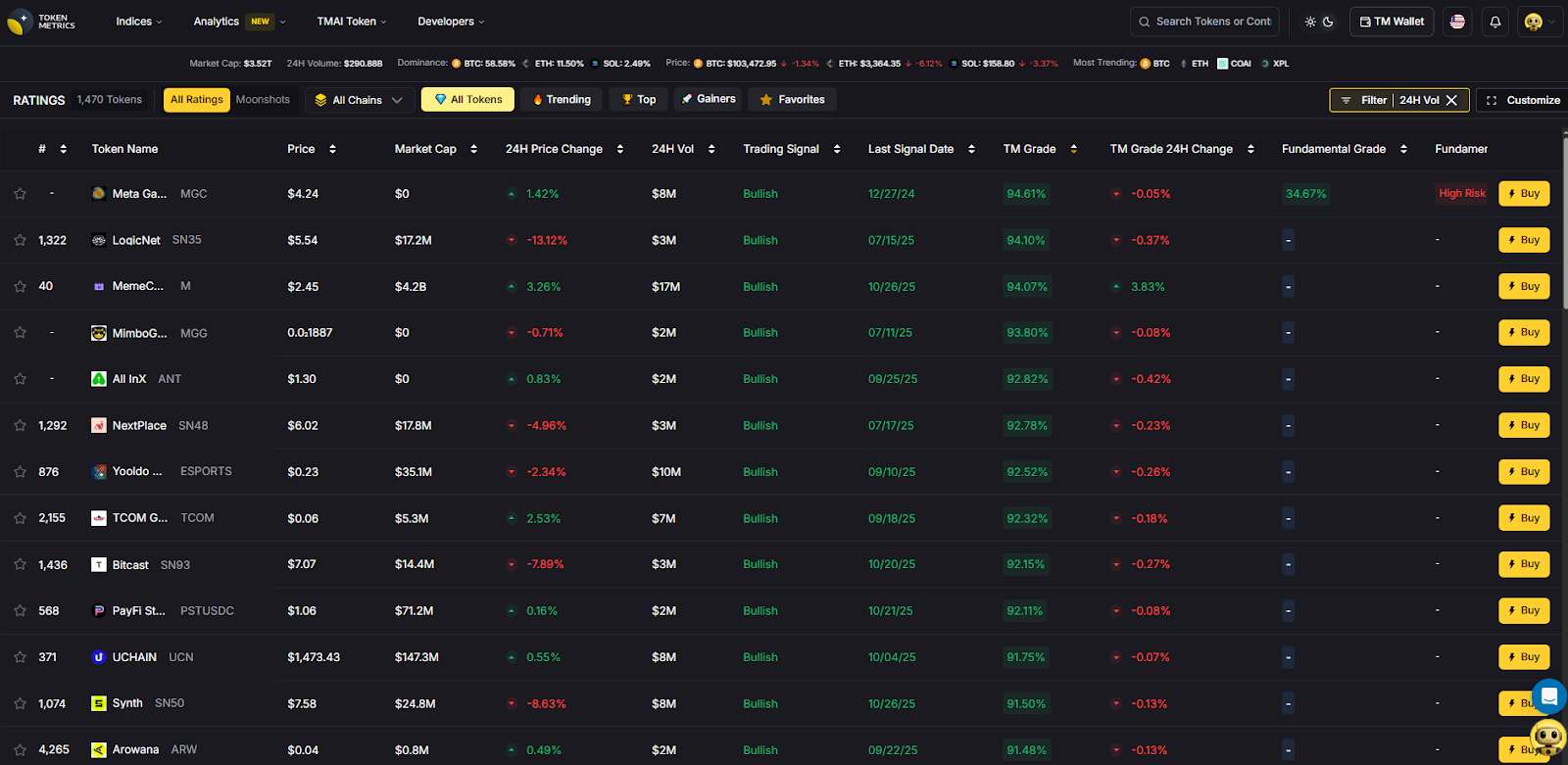
  • AI Ratings to screen metal-linked assets and related ecosystem tokens.


  • Narrative Detection to spot inflows to on-chain RWAs.
  • Portfolio Optimization to size metal exposure vs. crypto beta.
  • Alerts & Signals to time entries/exits around macro prints.
    Workflow: Research → Select issuer → Execute on-chain or via platform → Monitor with alerts.


CTA: Start free trial to screen assets and time entries with AI.  


Security & Compliance Tips

  • Use official issuer URLs only; beware look-alikes.
  • Confirm fee schedules and redemption procedures before buying. (Tether)
  • Verify vaulting jurisdiction and any bar-serial lookup tools. (VNX)
  • Mind network fees, bridge risks, and exchange withdrawal rules.
  • Keep custody keys secure; whitelist issuer addresses.
  • If staking or yielding, confirm source of yield and counterparty exposure. (Kinesis)
    This article is for research/education, not financial advice.

Beginner Mistakes to Avoid

  • Treating all metal tokens as equal—redemption and custody differ widely.
  • Ignoring region and KYC limits until you try to redeem.
  • Overlooking minimums (e.g., full LBMA bars vs. gram redemptions). (help.paxos.com)
  • Confusing defunct tokens with active ones (e.g., PMGT sunset; CGT backing ceased). (perthmint.com)
  • Forgetting network/transfer fees when arbitraging across chains.
  • Using unofficial contracts on the wrong chain.

How We Picked (Methodology & Scoring)
  • Liquidity — 30%. Exchange presence, on-chain activity, practical tradability.
  • Security — 25%. Custody details, audits/attestations, LBMA alignment, redemption design.
  • Coverage — 15%. Metals (gold/silver/platinum), chains, tooling.
  • Costs — 15%. Creation/redemption/storage/transfer and transparency of schedules.
  • UX — 10%. Apps, dashboards, redemption flows.
  • Support — 5%. Docs, status pages, human support.
    We relied on official product, docs, fees, FAQ, and disclosure pages, cross-checking market datasets only for context. Last updated November 2025.

FAQs

What are gold-backed tokens?
 They are blockchain tokens that represent ownership of a specific quantity of vaulted, insured gold, typically with published fees and, in some cases, physical redemption options.

Are gold-backed tokens safer than stablecoins?
 They can diversify away from fiat risk, but introduce custody and redemption dependencies. Safety depends on the issuer’s vaulting, audits, legal structure, and your ability to redeem.

What fees should I expect?
 Common fees include creation/redemption, possible storage, transfer, and network fees. Examples: XAUt lists 0.25% create/redeem; Paxos publishes creation/destruction fees and notes no storage fee currently. Always check the live schedules. (Tether)

Can I redeem tokens for a real gold bar?
 Some issuers support bar redemption with minimum sizes and location constraints (e.g., LBMA bar logistics in London for PAXG). Others support gram-level redemption via partners. (help.paxos.com)

Which chains are supported?
 Varies: PAXG (Ethereum), XAUt (Ethereum/TRON), VNX (Ethereum/Polygon/Q/Solana), Aurus (multi-chain), CGO (XDC), Kinesis (native + exchange listings). (paxos.com)

Are there discontinued tokens I should avoid?
 Yes. PMGT has been discontinued; CACHE Gold (CGT) ceased backing as of Sept 30, 2025. Verify project status before buying. (perthmint.com)


Conclusion + Related Reads

Choose PAXG for bar-linked redemption and strong disclosures, XAUt for simple fees and brand reach, or Kinesis if you want to spend metals and earn fee-share yields. For EEA vaulting with allocation lookup, VNX is compelling; for gram-based DeFi exposure, Aurus is versatile.

Related Reads:

Recent Posts

No Item Found
Research

Token Metrics AI Indices vs. Other Crypto Investment Options: A Comprehensive Comparison Guide

Token Metrics Team
9

Making the Right Choice for Your Crypto Investment Journey

The cryptocurrency investment landscape offers numerous options for gaining exposure to digital assets. From directly purchasing individual tokens to investing in crypto ETFs, from using robo-advisors to following social trading platforms, each approach presents unique advantages and drawbacks. For investors exploring cryptocurrency, understanding these options and their trade-offs is essential for making informed decisions aligned with personal goals, risk tolerance, and circumstances.

Token Metrics AI Indices represent one compelling approach to crypto investing, but how do they compare to alternatives? This comprehensive comparison examines the major crypto investment options available today, analyzing each method's strengths, weaknesses, costs, and suitability for different investor profiles. Whether you're a complete beginner or an experienced investor reevaluating your strategy, this guide provides the clarity needed to choose the optimal approach for your situation.

Direct Token Purchases (DIY Approach)

How It Works

The most straightforward crypto investment method involves directly purchasing individual cryptocurrencies through exchanges like Coinbase, Binance, or Kraken. You select specific tokens based on your research, buy them with fiat currency or other cryptocurrencies, and store them in wallets under your control.

This approach offers maximum flexibility and control. You choose exactly which cryptocurrencies to hold, when to buy or sell, and how to allocate capital across your portfolio. Many crypto purists prefer this method, believing it aligns with cryptocurrency's decentralized philosophy.

Advantages

Direct token purchases provide complete control over investment decisions and timing. You're not constrained by fund rules, rebalancing schedules, or third-party decisions. If you identify an opportunity, you can act immediately without waiting for index updates or fund manager decisions.

Cost efficiency can be high if you trade infrequently. While exchanges charge trading fees typically ranging from 0.1% to 0.5% per transaction, you avoid ongoing management fees associated with funds or advisory services. For long-term holders making few trades, this cost structure proves economical.

Learning opportunities are substantial when managing your own portfolio. You develop deep understanding of blockchain technology, tokenomics, market dynamics, and portfolio management through hands-on experience. This knowledge serves you well across your investment lifetime.

Disadvantages

The time commitment is enormous. Effective DIY crypto investing requires researching hundreds of potential tokens, monitoring news and developments constantly, analyzing technical charts and on-chain data, tracking portfolio performance and rebalancing needs, and managing tax reporting for potentially hundreds of transactions.

Most investors underestimate this commitment, spending 10-20 hours weekly on crypto management. For professionals with demanding careers, this time investment often proves unsustainable.

Emotional decision-making plagues DIY investors. Without systematic frameworks, fear and greed dominate decisions. Studies consistently show that self-directed crypto investors underperform systematic strategies by significant margins primarily due to poor timing driven by emotions.

The knowledge barrier is high. Understanding blockchain technology, evaluating smart contracts, analyzing tokenomics, and interpreting on-chain data requires substantial technical expertise. Most investors lack this background, leading to poor investment decisions.

Best For

DIY investing suits experienced investors with significant time availability, strong emotional discipline, technical expertise in blockchain and finance, and genuine interest in cryptocurrency beyond just returns. If crypto is your hobby and you enjoy the research process, DIY investing can be rewarding.

Cryptocurrency Exchange-Traded Funds (ETFs)

How It Works

Cryptocurrency ETFs are investment funds that trade on traditional stock exchanges like the NYSE or NASDAQ. These funds hold cryptocurrencies or cryptocurrency-related assets, allowing investors to gain crypto exposure through familiar brokerage accounts without directly purchasing or storing digital assets.

Bitcoin ETFs, Ethereum ETFs, and diversified crypto ETFs tracking multiple tokens have launched in various jurisdictions. Investors buy ETF shares just like stocks, with the fund managing underlying cryptocurrency holdings.

Advantages

Simplicity and familiarity make ETFs attractive. You invest through existing brokerage accounts using processes you already understand. No need to set up crypto wallets, manage private keys, or navigate cryptocurrency exchanges.

Regulatory oversight provides comfort for conservative investors. ETFs operate under securities regulations with disclosure requirements, investor protections, and oversight absent in pure cryptocurrency markets. This structure appeals to risk-averse investors and institutions.

Tax efficiency can be superior in some jurisdictions. In retirement accounts like IRAs or 401(k)s, ETF investments grow tax-deferred without triggering taxable events from rebalancing or trading.

Disadvantages

Limited availability restricts options. While Bitcoin and Ethereum ETFs exist in some markets, diversified crypto ETFs remain rare. Most ETFs provide exposure only to the largest cryptocurrencies, missing opportunities in altcoins and emerging projects.

Management fees reduce returns. Crypto ETFs typically charge annual expense ratios of 0.5% to 2.5%, significantly higher than traditional stock market ETFs. Over time, these fees substantially impact compound returns.

Premium/discount issues affect some crypto ETFs. When ETF trading prices diverge from underlying asset values, investors may buy at premiums during enthusiasm or sell at discounts during fear, creating tracking errors.

Lack of customization limits strategy implementation. You're restricted to the ETF's predetermined holdings and methodology. If you disagree with the fund's approach or want specialized exposure, you have no flexibility.

Best For

Crypto ETFs work well for conservative investors prioritizing simplicity over optimization, those wanting crypto exposure within retirement accounts, investors preferring regulated investment vehicles, and individuals with small allocations where ETF simplicity outweighs fee disadvantages.

Crypto Robo-Advisors and Auto-Investing Platforms

How It Works

Crypto robo-advisors and automated investing platforms use algorithms to build and manage cryptocurrency portfolios based on your risk profile and goals. Platforms like Coinbase's auto-investing feature or specialized crypto robo-advisors handle portfolio construction, rebalancing, and optimization automatically.

These services typically involve completing risk assessment questionnaires, receiving algorithm-generated portfolio recommendations, and having the platform automatically execute trades and rebalancing.

Advantages

Automation reduces time commitment significantly. Once configured, robo-advisors handle portfolio management without requiring constant attention. You benefit from systematic strategies without active involvement.

Lower fees than traditional advisors make robo-advisors accessible. While not free, robo-advisor fees typically run 0.25% to 1% annually—less than human financial advisors charging 1% to 2%.

Algorithmic discipline removes emotions from investing. Like Token Metrics, robo-advisors follow systematic rules regardless of market sentiment, helping investors avoid emotional mistakes.

Disadvantages

Limited sophistication characterizes most crypto robo-advisors. The algorithms typically use basic strategies like market-cap weighting or simple risk-tolerance adjustments. They lack the advanced artificial intelligence and comprehensive analysis that platforms like Token Metrics provide.

Generic portfolios don't account for individual circumstances beyond basic risk tolerance. Most robo-advisors create cookie-cutter portfolios that may not align with your specific goals, tax situation, or market views.

Platform limitations restrict crypto selection. Robo-advisors typically work with limited token selections available on their platforms, missing opportunities in the broader crypto market.

Best For

Crypto robo-advisors suit investors wanting more sophistication than DIY but less cost than human advisors, those comfortable with algorithmic strategies but seeking simplicity, and individuals with straightforward investment needs without complex requirements.

Get Started For Free

Crypto Hedge Funds and Private Funds

How It Works

Cryptocurrency hedge funds and private investment funds pool capital from multiple investors and employ professional managers who actively trade cryptocurrencies, use sophisticated strategies including derivatives and arbitrage, and aim to deliver returns exceeding market benchmarks.

These funds typically require substantial minimum investments ($50,000 to $500,000+) and restrict access to accredited investors meeting income or net worth requirements.

Advantages

Professional management provides expertise and full-time attention. Experienced crypto fund managers bring years of market knowledge, industry connections, and sophisticated strategies individual investors cannot replicate.

Advanced strategies available to hedge funds include derivatives trading, arbitrage opportunities, and market-neutral strategies that can potentially profit in various market conditions beyond simple long-only positions.

Potential for exceptional returns exists with top-performing managers. Elite crypto hedge funds have delivered multi-thousand percent returns during bull markets, far exceeding passive approaches.

Disadvantages

High fees significantly reduce net returns. Crypto hedge funds typically charge the "2 and 20" structure—2% annual management fee plus 20% performance fee on profits. These fees dramatically reduce investor returns compared to lower-cost alternatives.

Minimum investment requirements exclude most investors. With minimums often exceeding $100,000, hedge funds remain inaccessible for average investors.

Lock-up periods restrict liquidity. Many crypto funds require capital commitments of 1-3 years with limited redemption opportunities. During this period, you cannot access your investment regardless of personal needs or market conditions.

Variable performance quality creates risk. While top funds perform exceptionally, many crypto hedge funds underperform simple buy-and-hold strategies after fees. Selecting winning managers proves extremely difficult.

Best For

Crypto hedge funds suit high-net-worth individuals seeking professional management and willing to pay premium fees, accredited investors who can meet minimum requirements, and those with long investment horizons tolerating lock-up periods.

Token Metrics AI Indices

How It Works

Token Metrics AI Indices combine artificial intelligence, professional analysis, and systematic strategies to create model portfolios across different risk profiles and investment styles. The platform's machine learning algorithms analyze over 6,000 cryptocurrencies continuously, evaluate technical and fundamental factors, identify high-quality opportunities while filtering scams, and provide rebalancing guidance based on systematic criteria.

Investors select indices matching their objectives and risk tolerance, then implement the model portfolios either manually or through integrated trading features.

Advantages

AI-powered analysis surpasses human capabilities in scale and consistency. Token Metrics' algorithms process vast datasets continuously, identifying patterns and opportunities individual investors would miss. The AI operates without emotional bias, maintaining discipline through market volatility.

Comprehensive due diligence is built into the process. The platform's multi-layered analysis examines code quality, team credentials, tokenomics, sentiment, and technical indicators—institutional-grade research accessible to retail investors.

Flexibility across investment styles serves diverse needs. Whether you're conservative preferring large-cap stability, aggressive seeking growth opportunities, or interested in sector-specific themes, Token Metrics offers indices aligned with your approach.

Transparent methodology builds trust and understanding. Unlike black-box algorithms, Token Metrics clearly explains index strategies, holdings, and decision criteria. You understand what you're investing in and why.

Cost efficiency compared to alternatives is significant. Token Metrics subscription fees are substantially lower than hedge fund fees or financial advisor charges while providing sophisticated analysis exceeding basic robo-advisors.

Educational resources support investor development. Beyond just providing indices, Token Metrics offers tutorials, webinars, research, and analytics helping investors understand cryptocurrency markets and improve decision-making.

Disadvantages

Implementation responsibility remains with investors in most cases. Unlike fully automated solutions, you typically need to execute trades manually based on index recommendations, requiring some active involvement.

Subscription costs exist, though modest compared to alternatives. While far less than hedge funds or financial advisors, Token Metrics charges monthly or annual subscription fees that free DIY approaches don't require.

Learning curve for platform features means new users need time familiarizing themselves with Token Metrics' tools, indices, and analytics. While comprehensive tutorials help, initial setup requires effort.

Best For

Token Metrics AI Indices are ideal for serious crypto investors wanting institutional-quality analysis without institutional fees, those seeking systematic strategies but maintaining implementation control, investors across experience levels from beginners to experts, and anyone wanting to optimize crypto investing while preserving time for other priorities.

Comparison Matrix: Key Factors

Cost Comparison

Examining costs across options reveals significant differences. DIY investing features low trading fees (0.1%-0.5% per trade) but high opportunity costs from time investment. Crypto ETFs charge 0.5%-2.5% annual fees with no time commitment. Robo-advisors run 0.25%-1% annually with minimal time needs. Hedge funds demand 2% annual plus 20% performance fees with no time requirement. Token Metrics charges modest subscription fees ($50-$500 monthly depending on tier) with limited time commitment.

For serious investors with substantial capital, Token Metrics' cost structure provides exceptional value—sophisticated analysis at a fraction of hedge fund fees.

Time Commitment Comparison

Time requirements vary dramatically. DIY investing demands 10-20 hours weekly for proper portfolio management. Crypto ETFs require virtually no ongoing time beyond periodic performance review. Robo-advisors need initial setup (1-2 hours) then minimal ongoing involvement. Hedge funds require only capital allocation with zero time commitment. Token Metrics needs initial setup and learning (3-5 hours) then 1-2 hours monthly for review and implementation.

For busy professionals, Token Metrics optimizes the time-value tradeoff—far less time than DIY while maintaining strategic control.

Sophistication and Performance Potential

Sophistication levels differ substantially. DIY investing's sophistication depends entirely on individual expertise—potentially high for experts, typically low for most. Crypto ETFs offer basic market exposure with limited strategy sophistication. Robo-advisors provide moderate algorithmic sophistication using standard portfolio theory. Hedge funds can deliver high sophistication with advanced strategies, though quality varies widely. Token Metrics provides high sophistication through AI and professional analysis accessible to all users.

Performance potential correlates with sophistication but also depends on execution, timing, and market conditions.

Accessibility and Minimums

Accessibility varies significantly. DIY investing has no minimums—start with any amount. Crypto ETFs require only brokerage account minimums (often $0-$100). Robo-advisors typically have $500-$1,000 minimums. Hedge funds demand $50,000-$500,000+ minimums restricting access severely. Token Metrics is accessible with just subscription fees plus whatever capital you choose to invest.

This accessibility democratizes sophisticated crypto investing previously reserved for wealthy individuals.

Making Your Decision: Which Option Is Right for You?

For Complete Beginners

If you're new to cryptocurrency and investing generally, consider Token Metrics AI Indices or crypto ETFs. Both provide systematic exposure without requiring deep expertise. Token Metrics offers superior sophistication and learning opportunities, while ETFs provide ultimate simplicity through familiar brokerage accounts.

Avoid DIY investing until you've built foundational knowledge. The learning curve and emotional challenges prove too severe for most beginners attempting independent portfolio management.

For Busy Professionals

If you have limited time but want serious crypto exposure, Token Metrics AI Indices or crypto ETFs are optimal. Both minimize time commitment while providing systematic strategies. Token Metrics delivers far superior sophistication and potential returns, making it the better choice for those willing to invest a few hours monthly.

Hedge funds work only if you meet minimum requirements and accept high fees. Robo-advisors provide middle-ground options but with less sophistication than Token Metrics.

For Hands-On Investors

If you enjoy research and active management, consider combining DIY investing with Token Metrics indices. Use indices for core portfolio exposure providing systematic strategy, then allocate smaller portions to individual tokens you've thoroughly researched.

This hybrid approach lets you pursue interests and convictions while maintaining professional management for most capital.

For Conservative Investors

If you prioritize safety and simplicity over optimization, crypto ETFs or large-cap focused Token Metrics indices work best. ETFs provide regulatory oversight and familiar structure. Token Metrics large-cap indices offer more sophistication while focusing on established cryptocurrencies with lower volatility.

Avoid speculative approaches like small-cap DIY investing or aggressive hedge funds until your risk tolerance increases.

For Experienced Investors

If you're experienced with investments and want to optimize crypto exposure, Token Metrics AI Indices provide the ideal combination of sophistication, control, and efficiency. The platform's AI enhances your own expertise rather than replacing it.

Consider combining Token Metrics indices with selective DIY positions where you have specialized knowledge or high conviction.

The Optimal Path for Most Investors

After examining all major crypto investment options, Token Metrics AI Indices emerge as the optimal choice for most investors across experience levels, time availability, and capital sizes. The platform combines institutional-quality analysis with retail accessibility, sophisticated strategies with reasonable costs, and systematic discipline with strategic flexibility.

While no single solution suits everyone—conservative investors might prefer ETF simplicity, while crypto enthusiasts might enjoy DIY engagement—Token Metrics serves the broadest range of investors effectively. Whether you're a beginner seeking guidance, a professional lacking time, or an expert wanting to optimize strategy, Token Metrics provides the tools, intelligence, and framework for successful crypto investing.

The cryptocurrency opportunity continues evolving, with blockchain technology transforming finance globally. Participating successfully requires smart tools, systematic strategies, and disciplined execution. Token Metrics AI Indices deliver all three, positioning you for long-term success in one of the most dynamic investment opportunities available.

Your crypto investment journey deserves the right foundation. Choose wisely based on your unique circumstances, but recognize that Token Metrics offers compelling advantages for serious investors committed to building lasting wealth in cryptocurrency markets.

Get Started For Free

Research

Navigating Bull and Bear Markets: How Token Metrics AI Indices Adapt to Every Crypto Market Condition

Token Metrics Team
7

Cryptocurrency markets are well-known for their cyclical patterns, cycling between explosive booms and challenging busts. These dramatic shifts can shape the outcomes for portfolios, with Bitcoin, Ethereum, and altcoins experiencing episodes of sharp declines followed by recoveries to new highs. Grasping the patterns of these cycles and adapting portfolio strategies accordingly is crucial for effective participation in this dynamic market.

Understanding Crypto Market Cycles

Cryptocurrency markets progress through distinct phases, each demanding different strategies. Following significant declines, the accumulation phase sees steady buying as participants wait for a price recovery. This is succeeded by the markup phase, where rising prices generate interest and rally participation. Near market peaks, the distribution phase is characterized by widespread optimism and profit-taking, while the markdown phase signals broad downturns and fear-driven selling before stabilizing once again.

Looking at historical data emphasizes the volatility: Bitcoin soared from below $1,000 to nearly $20,000 in 2017, just before an 84% drop in the following bear market. The cycle repeated with even higher peaks and deeper reversals in subsequent years. Each stage demonstrates the necessity of adapting one’s approach as conditions change.

Bull Market Strategies with Token Metrics

AI tools, like those offered by Token Metrics, leverage deep datasets to detect emerging bull markets. Key signals include sustained upward movement, higher volumes, increased network activity, and improving fundamentals on leading projects. When these triggers align, Token Metrics’ indices recalibrate to maximize opportunity while controlling for risk.

During bull trends, growth and momentum indices are given priority, targeting cryptocurrencies that exhibit strong relative strength. Position-sizing may become more assertive, though the system maintains focus on diversification to manage exposure. The platform’s algorithms dynamically rebalance, capturing fast-moving sector rotations—such as those between DeFi, NFTs, and Layer 2 solutions—based on real-time analytics.

Systematic profit-taking is a cornerstone of this strategy. Technical and sentiment indicators help decide when to begin reducing exposure incrementally, rather than seeking perfect exit points. Trailing stop losses and incremental reductions further help maintain gains and safeguard against large reversals—an approach designed to avoid major drawdowns.

Bear Market Strategies with Token Metrics

Recognizing the onset of a bear market is critical. Token Metrics AI constantly monitors breakdowns in technical support, trading volume declines, and deteriorating on-chain fundamentals. When risks increase, the AI algorithm shifts focus to capital preservation. The indices increase exposure to large-cap cryptocurrencies such as Bitcoin and Ethereum, decrease overall crypto allocations, and may increase stablecoin positions, all aimed at reducing downside potential.

Rebalancing becomes more selective and infrequent during bear markets to avoid repeated losses. Emphasis is placed on quality tokens with durable fundamentals, development activity, and real-world usage. When market stabilization signals are detected, the system gradually re-accumulates high-quality assets through dollar-cost averaging, positioning for the next potential cycle.

Get Started For Free

Sideways Markets and Consolidation

In periods lacking clear direction, when prices move within defined ranges, Token Metrics shifts toward range-trading strategies. The indices are adjusted to take profits near resistance and accumulate positions near support, relying on mean-reversion techniques. Volatility-focused strategies may identify tokens outperforming the stagnant broader market, but overall, patience and disciplined allocation are key until a new trend emerges.

Adapting Your Personal Strategy to Market Conditions

While Token Metrics indices dynamically adapt within their frameworks, participants can further optimize results by aligning their allocations across different indices to their market outlook. In bullish conditions, increasing allocations to growth indices while later rebalancing towards stability as the cycle matures helps manage risk and opportunity. Bear markets warrant more conservative allocations—including increased stablecoin holdings until conditions improve. Monitoring one’s own risk preferences and emotional reactions across cycles can help maintain consistency and discipline.

Sticking with systematic, repeatable rules—even during the most volatile times—remains essential. Emotional decisions often undermine well-constructed strategies, which is why following AI-driven, data-backed systems like Token Metrics can promote objective discipline through all stages of the market.

Real-World Performance Across Market Conditions

In bull cycles, Token Metrics indices regularly capture significant positive trends, with growth indices typically outperforming broad benchmarks. Diversification and profit-taking strategies protect from overexposure at peaks. Conversely, the platform’s defensive posture during bear phases means losses are generally reduced compared to unmanaged portfolios. This balance of upside participation and managed downside enables potential compounding of gains over multiple cycles—not achievable with static, buy-and-hold strategies.

AI-driven adaptation thus turns the market’s volatility into a mechanism for opportunity rather than risk. By remaining methodical and cycle-aware, market participants can pursue improved risk-adjusted outcomes over the long term.

Practical Implementation Guidelines

Starting with Token Metrics indices during different market phases only slightly affects results; what matters more is sustained participation and regular portfolio review. During bull markets, cautious optimism and measured allocations are advised, while bear markets may be a time for patient accumulation. Regularly rebalancing total crypto allocations ensures alignment with personal risk profiles. Each cycle provides learning opportunities, and Token Metrics makes it easier to study the effectiveness of different indices throughout diverse conditions, supporting continual improvement.

Conclusion: Mastering All Market Conditions

The dynamic cycles of the cryptocurrency market require adaptable, disciplined approaches. Token Metrics AI Indices offer technology-driven frameworks to navigate the market’s fluctuations, focusing on systematic participation, active risk management, and data-backed decision-making. By combining these indices with a disciplined implementation process, market participants can seek to participate thoughtfully in both upswings and downturns, transforming volatility into a potential asset instead of a threat.

Rather than trying to predict market timing, systematic multi-cycle participation remains a proven approach to managing crypto’s inherent uncertainty. With the market expected to continue evolving in cycles, leveraging robust, AI-based tools like Token Metrics can help promote consistent, intelligent exposure through any condition.

Discover Crypto Gems with Token Metrics AI

Token Metrics uses AI-powered analysis to help you uncover profitable opportunities in the crypto market. Get Started For Free

FAQ: How Do Token Metrics Indices Detect Market Phases?

Token Metrics leverages real-time data from price movements, on-chain activity, sentiment analysis, and fundamental metrics to identify bull, bear, and sideways phases. The AI assigns weights to these indicators, enabling indices to adjust positioning dynamically in response to changing conditions.

FAQ: What Is the Main Advantage of Using Token Metrics Indices?

The primary advantage is systematic, AI-driven adaptation to evolving market cycles. This reduces reliance on emotional or arbitrary decisions and promotes a consistent risk management approach across different market environments.

FAQ: Can Token Metrics Indices Guarantee Outperformance in All Conditions?

No tool or index can guarantee absolute performance in all scenarios due to crypto’s inherent volatility. The goal of Token Metrics is to provide frameworks that optimize participation and risk management over the long term, not ensure specific outcomes.

FAQ: How Should I Adjust My Own Allocations When Using Token Metrics Indices?

Allocations can be adjusted based on one’s risk profile, objectives, and view of current market phases. Token Metrics offers insights, but individuals should ensure their portfolio allocations align with personal tolerance, goals, and rebalancing preferences.

FAQ: What Role Does Discipline Play in Using AI-Driven Indices?

Discipline is vital. Sticking to systematic strategies—instead of reacting emotionally to short-term volatility—supports better long-term results. The data-backed and rules-based nature of Token Metrics indices is designed to help market participants maintain this focus and consistency.

Disclaimer

This content is for educational and informational purposes only and should not be construed as financial advice or a recommendation to buy or sell any cryptocurrency, token, or investment strategy. Cryptocurrency markets are complex and involve significant risks. Always conduct your own research and consult with a qualified financial advisor before making investment decisions.

Get Started For Free

Research

Your Complete Beginner's Guide to Token Metrics AI Indices: Start Investing in Crypto the Smart Way

Token Metrics Team
10

Thinking about investing in cryptocurrency, but not sure where to start? You’re not alone. Crypto’s vast universe can be daunting for beginners, filled with thousands of tokens, complex technology, and nerve-wracking price swings. Fortunately, you don’t need to be a blockchain expert to get started, thanks to the power and convenience of Token Metrics AI Indices. This guide breaks down everything you need to know, so you can confidently take your first steps toward intelligent, AI-powered crypto investing.

Understanding Cryptocurrency and Why It Matters

What Is Cryptocurrency?
Before getting started, it’s helpful to know what cryptocurrency is. At its core, cryptocurrency is digital money secured by cryptography and maintained on blockchains, which are decentralized networks of computers. Bitcoin launched in 2009 as the first cryptocurrency; now, the ecosystem includes thousands of digital assets, each developed for different use cases. Examples include Ethereum for smart contracts, stablecoins like USDC for price stability, and tokens for powering decentralized finance (DeFi) and access to blockchain services.

Why Invest in Cryptocurrency?
While cryptocurrency is known for its growth potential, it also offers other benefits such as portfolio diversification. Because crypto assets often move independently from traditional stocks and bonds, they can help improve risk-adjusted returns within an investment portfolio. Additionally, blockchains enable new forms of finance and technology, and limited-supply assets like Bitcoin can serve as digital scarcity tools, appealing to those mindful of inflation. Overall, investing in crypto represents participation in evolving technology, new financial systems, and emerging markets.

Why Token Metrics AI Indices Are Perfect for Beginners

The Challenge of DIY Crypto Investing
Attempting to choose individual cryptocurrencies can quickly overwhelm newcomers. Researching whitepapers, tracking market news, evaluating development teams, and keeping up with evolving technologies and regulations demand deep expertise and substantial time. Many beginners rely on headlines or social media hype, increasing the risk of mistakes and losses.

How AI Indices Solve Beginner Challenges
Token Metrics AI Indices address these hurdles by using professional analysis and artificial intelligence to automatically create model portfolios. The AI engine screens thousands of tokens daily, using a blend of quantitative signals, fundamental metrics, on-chain activity, and sentiment data to identify strong projects while avoiding scams. As a result, beginners tap into sophisticated research and data-backed selection automatically—without needing advanced expertise or excessive research time.

Systematic Strategy Versus Emotional Investing
One of the main risks for new investors is emotional decision-making during crypto’s sharp price swings. Panic selling in a dip or FOMO buying near a peak can lead to sub-optimal outcomes. Token Metrics’ AI systematically applies rules-based strategies, insulating your portfolio from these impulsive decisions and supporting consistent, disciplined participation regardless of market sentiment.

What You Need Before You Start

Financial Prerequisites
Before investing in crypto, make sure you have financial fundamentals in place. This includes building an emergency fund, clearing high-interest debts, and securing appropriate insurance. Keep in mind that cryptocurrency investing should only represent a portion of your broader portfolio, and you should never risk money you can’t afford to lose.

Knowledge Prerequisites
Token Metrics makes crypto indexing more accessible, but a foundational understanding is still useful. Learn about blockchain basics, the various types of tokens, and how to use wallets and exchanges. The platform provides educational resources—including guides, webinars, and a glossary—that help you build this foundational knowledge.

Mindset Prerequisites
Crypto markets are volatile, and strong long-term outcomes require patience, discipline, and a readiness to learn. Expect sharp market swings and plan accordingly. If your goals or risk tolerance aren’t aligned with this reality, consider whether crypto is the right choice for your circumstances.

Understanding Token Metrics Index Types

Large-Cap Indices
These focus on established cryptocurrencies like Bitcoin, Ethereum, and other top-tier tokens. They offer relatively lower volatility, deep liquidity, and less risk of project failure. For most beginners, large-cap indices form a stable entry point, much like an S&P 500 fund does for stock investors.

Balanced/Mid-Cap Indices
Balanced indices combine large-cap stability with the growth opportunities of medium-sized projects. Typically featuring 15–25 tokens, they balance risk and return, offering exposure to different sectors (like DeFi, Layer 1s, and Layer 2s). This blend suits beginners looking for a bit more growth potential beyond the very largest coins.

Sector-Specific Indices
Some indices focus on individual sectors, such as DeFi, NFTs, metaverse projects, or AI-powered tokens. These can be more volatile but allow investors to express views on specific trends once they have more experience. For those just starting, it’s often better to begin with broad, diversified indices.

Growth and Momentum Indices
These aim to capture tokens experiencing strong upward trends. They use more active rebalancing and can carry higher risk. Beginners should approach these with caution and only allocate a small portion of their portfolio exposure to growth/momentum indices.

Get Started For Free

Step-by-Step: Making Your First Investment

Step 1: Create Your Token Metrics Account
Go to the Token Metrics website, set up your account, and select a plan aligning with your needs. Plans offer varying levels of access to indices and features, so start with the option that matches your experience. Upgrade as you progress and want enhanced tools.

Step 2: Complete the Educational Foundation
Explore the tutorials, webinars, and guides available on Token Metrics. Allocating a few hours to foundational material helps you avoid common mistakes and build lasting confidence.

Step 3: Assess Your Investment Profile
Take advantage of assessment tools to measure your risk tolerance, investment horizon, and familiarity with crypto. Honest self-reflection supports a healthy investment plan. Beginning conservatively is often best.

Step 4: Select Your Initial Indices
For many, starting with 60–80% in a large-cap index and 20–40% in a balanced index provides stable exposure alongside some growth. Don’t over-diversify; one or two carefully chosen indices can be sufficient as you start out.

Step 5: Understand the Investment Mechanics
Token Metrics indices function as model portfolios, providing recommendations on what to purchase and in what proportion. Depending on your platform level, you may buy tokens manually on exchanges or use integrated trading features. Review the exact steps, track your holdings, and follow rebalance instructions.

Step 6: Make Your Initial Investment
Consider starting with a smaller allocation (such as 25–50%) of your target investment. This staged approach helps you gain direct experience with minimal risk. Always record your transactions for reference and tax purposes.

Step 7: Set Up Monitoring and Alerts
Configure platform notifications to stay informed about index changes and major movements, but avoid becoming glued to your screen. Focus on the long-term plan without reacting to every short-term fluctuation.

What to Expect: The First 90 Days

The Initial Volatility Experience
Expect pronounced portfolio swings over the first few months. Fluctuations of 20–30% are not uncommon; these are typical in crypto and not necessarily cause for alarm. Stay the course and lean on the systematic approach provided by Token Metrics indices.

Learning to Trust the System
It can be difficult to trust AI-driven strategies initially, especially during downswings. Keep in mind that Token Metrics’ system is data-driven and built upon proven frameworks. The key is maintaining discipline and resisting the urge to override the strategy based on emotion.

Gradual Comfort Building
After a few months, market swings will feel less jarring, and your understanding of crypto dynamics will deepen. Use this period to refine your research skills and become more comfortable with the tools and strategies you’re using.

Common Beginner Questions Answered

How Much Should I Invest?
Most begin with an amount they’re willing to lose completely, such as $500–$2,000. The key is to grow your allocation gradually as your confidence and knowledge expand.

How Often Should I Check My Portfolio?
Weekly or monthly reviews are generally sufficient. Token Metrics’ indices are designed to minimize the need for constant monitoring and reduce emotional reactions to market ups and downs.

When Should I Rebalance?
Follow the systematic rebalancing guidance provided by Token Metrics indices. Avoid making discretionary changes based on short-term price movements or gut feelings.

What Returns Should I Expect?
Crypto returns are highly variable and cannot be predicted. Focus on following the disciplined strategy and learning rather than chasing specific returns.

How Do I Handle Taxes?
Cryptocurrency investing can trigger taxable events. Document your trades and consider seeking advice from a tax professional with crypto expertise. Token Metrics provides comprehensive transaction history to help during tax reporting.

Discover Crypto Gems with Token Metrics AI

Token Metrics uses AI-powered analysis to help you uncover profitable opportunities in the crypto market.

Get Started For Free

Building Long-Term Success

Continuous Learning
Crypto and blockchain evolve rapidly. Stay up to date by consuming Token Metrics’ educational materials, engaging in the community, and following reputable news. Ongoing learning is your edge.

Patience and Discipline
Many successful investors attribute results to simply sticking to their plan, rebalancing periodically, and not getting distracted by headlines. Token Metrics indices provide a stable foundation; your task is to maintain focus and discipline.

Gradual Sophistication
Once you’re comfortable, gradually add more complex indices or tactics to your plan. Build up to sector-focused indices or advanced strategies as your understanding grows—matching sophistication to your learning pace.

Your Path Forward

By starting your journey with Token Metrics AI Indices, you benefit from institutional-grade research and systematic portfolio management. Continue to educate yourself, begin conservatively, monitor periodically, and grow your sophistication as you evolve. Crypto investing is a long-term endeavor; steady discipline and engagement are your best allies.

Conclusion: Start Your Journey Today

The best time to begin learning and participating in cryptocurrency markets is now. Token Metrics AI Indices and educational resources provide a highly accessible entry point for beginners. Start with a manageable investment, embrace systematic strategies, and be patient as your knowledge grows. By participating today, you position yourself to benefit from the ongoing evolution of blockchain technology and digital assets.

Get Started For Free

FAQ: Beginner Crypto Investing with Token Metrics AI Indices

What is a crypto index, and how does it work?

A crypto index is a model portfolio of digital assets designed to track the performance of a set group of cryptocurrencies. Token Metrics AI Indices use artificial intelligence to select and weight assets, helping simplify the process for investors of all experience levels.

Is there a minimum amount required to start investing with Token Metrics indices?

No strict minimum exists, but investors typically begin with small amounts appropriate for their risk profile. Review Token Metrics’ guidelines and consider comfortable initial allocations as you learn the ropes.

How often are Token Metrics indices updated?

Indices are updated regularly based on market conditions and algorithmic signals. Subscribers receive notifications about major rebalances or methodology changes to support informed participation.

Can I use Token Metrics with exchanges or wallets I already use?

Yes. Token Metrics indices provide portfolio recommendations that investors can implement across most major exchanges and wallets. Some integrated features are also available, depending on your subscription level.

What support does Token Metrics offer beginners?

Token Metrics offers a comprehensive education suite: tutorials, live and recorded webinars, platform guides, a detailed glossary, and customer support—all aimed at helping beginners gain comfort and skill with crypto investing.

Disclaimer

This content is for informational and educational purposes only. It is not financial or investment advice. Cryptocurrency is subject to high volatility and risk. Readers should conduct their own due diligence and consult qualified professionals regarding financial decisions before acting on any content presented here.

Get Started For Free

Research

10 Costly Crypto Investing Mistakes and How Token Metrics AI Indices Help You Avoid Them

Token Metrics Team
9

Every experienced cryptocurrency investor has battle scars—stories of devastating losses that could have been avoided with better knowledge, discipline, or tools. A survey of crypto investors reveals that over 70% have lost money on at least one investment, with many experiencing losses exceeding 50% of their initial capital. These losses are not inevitable results of crypto volatility—they often stem from preventable mistakes that trap both new and experienced investors alike.

The good news is that learning from the mistakes of others is far less expensive than learning from your own. Even better, modern AI-powered tools like Token Metrics indices can systematically help you avoid the most common and costly errors in the crypto markets. This comprehensive guide examines the ten most devastating mistakes crypto investors make and reveals how Token Metrics’ artificial intelligence addresses each challenge, helping to protect your capital while optimizing returns.

Mistake #1: Chasing Hype and FOMO (Fear of Missing Out)

The Problem
Cryptocurrency markets are notorious for explosive rallies that create intense FOMO. When a token surges 500% in a week, investors panic about missing out on gains. Social media amplifies this anxiety with posts showcasing enormous profits and predictions of further moonshots. Overwhelmed, investors often buy near peaks, only to watch prices fall rapidly.

This cycle has repeated across many crypto assets. Dogecoin’s 2021 rally is a prime example, where many bought near the top and faced major losses. The psychological trap is powerful; our brains fear missed opportunities, and 24/7 crypto markets mean constant exposure to perceived missed chances.

The Token Metrics Solution
Token Metrics AI evaluates cryptocurrencies using objective metrics—technical indicators, fundamental strength, network activity, and risk-adjusted potential. The algorithms do not experience FOMO, panic, or greed.

During extreme rallies, Token Metrics’ AI analyzes whether price movements are supported by strong fundamentals or are unsustainable speculation. Indices will rebalance to manage profits as prices grow extended, and a token’s absence is itself a signal that sustainable value has not been identified by the AI. Following Token Metrics indices helps you sidestep the FOMO trap and invest based on data, not hype.

Get Started For Free

Mistake #2: Inadequate Diversification and Over-Concentration

The Problem
Many investors concentrate heavily in one or a few tokens—whether out of conviction, convenience, or time limitations. This leaves portfolios vulnerable to project-specific risks. The collapse of Terra/LUNA and FTX’s FTT token are examples where concentration contributed to severe losses.

Being over-exposed to a single asset amplifies unique risks and reduces the protective benefits of diversification.

The Token Metrics Solution
Token Metrics indices are built to diversify across multiple cryptocurrencies, vetted for different projects, technologies, and use cases. The AI routinely analyzes correlations to maintain genuine diversification, not just a basket of highly correlated assets.

Large-cap indices may hold 10–15 established cryptos, while broader indices cover 20–30 tokens. This diversification means a single failure has limited impact. Through Token Metrics indices, you gain professional-level portfolio diversity without the need for complex analysis or manual research.

Mistake #3: Falling for Scams and Fraudulent Projects

The Problem
Crypto’s open and global nature attracts fraudulent projects: rug pulls, Ponzi schemes, fake teams, plagiarized whitepapers, and social engineering attacks. Even sophisticated scams often have professional websites and social presence, making them difficult to identify. Lack of due diligence can result in substantial losses.

The Token Metrics Solution
Token Metrics AI executes rigorous vetting: analyzing code quality, verifying team credentials, monitoring community sentiment, evaluating tokenomics, and tracking exchange listings. Only projects meeting high standards are included in indices, and continuous monitoring flags and removes projects with emerging red flags. While no tool is perfect, this process significantly reduces scam exposure compared to manual research.

Mistake #4: Emotional Decision-Making During Volatility

The Problem
Crypto volatility can trigger panic selling or risk-chasing behavior. Academic research shows emotional investors underperform systematic strategies by wide margins. The crypto market’s 24/7 cycle exacerbates impulsiveness.

The Token Metrics Solution
Token Metrics AI remains disciplined during swings. Whether markets crash or rally, the system evaluates conditions based on data and follows consistent, predefined rules. Systematic approaches sidestep the psychological traps that often reduce returns and allow investors to benefit from stable, rules-driven portfolio management.

Mistake #5: Ignoring Risk Management and Position Sizing

The Problem
Crypto investors sometimes allocate equally to all holdings or over-weight speculative assets, ignoring fundamental risk management. Exposures that are too large to riskier tokens lead to severe portfolio drops if those assets decline.

The Token Metrics Solution
Token Metrics indices apply advanced risk management: adjusting position sizes based on risk factors like market capitalization, volatility, and fundamental strength. High-risk assets receive smaller allocations, while larger, more stable projects get higher weights. Maximum concentration limits further ensure disciplined diversification.

Get Started For Free

Mistake #6: Poor Timing and Attempting to Time the Market

The Problem
Many try to buy at bottoms and sell at tops—an approach even professional traders struggle with. Retail investors, in particular, often buy during euphorias and sell during panics, missing gains and amplifying losses.

The Token Metrics Solution
Token Metrics indices favor systematic strategies over timing perfection. The AI blends technical, fundamental, and sentiment metrics to gradually adjust portfolio exposures, avoiding binary trades. This adaptive approach helps capture uptrends and manage risk, without attempting impossible precision.

Mistake #7: Neglecting to Rebalance Portfolios

The Problem
Over time, portfolios drift as certain tokens outperform, creating dangerous concentrations. Many investors resist rebalancing due to psychological biases—selling winners feels wrong, and buying underperformers feels risky.

The Token Metrics Solution
Token Metrics indices enforce systematic rebalancing (weekly, monthly, or quarterly) based on predefined triggers. This ensures disciplined, data-driven adjustments and automates the buy-low, sell-high process for investors.

Get Started For Free

Mistake #8: Overtrading and Excessive Portfolio Turnover

The Problem
Frequent buying and selling increases transaction fees, sometimes triggers unfavorable tax events, and can worsen results through poor timing. Overtrading is common in 24/7 crypto markets and often destroys value.

The Token Metrics Solution
Token Metrics indices use deliberate, criteria-based rebalancing—only trading when data supports meaningful improvement. This minimizes unnecessary costs while adapting portfolios to market changes with discipline.

Mistake #9: Inadequate Research and Due Diligence

The Problem
Thorough cryptocurrency research is time-intensive and requires cross-disciplinary expertise, which most individual investors lack. Poor research leads to flawed investments and increased risk exposure.

The Token Metrics Solution
Token Metrics invests in comprehensive due diligence. Its team of analysts and data scientists combines institutional-grade research with continuous AI analysis. Indices include tokens only after deep research and ongoing review, benefiting individual investors with professional-level insights.

Mistake #10: Investing Without Clear Strategy or Plan

The Problem
Investing without clear objectives, time horizons, or philosophies results in random actions and reactive decision-making. Without a framework, investors lack guiding principles and cannot measure progress reliably.

The Token Metrics Solution
Each Token Metrics index has a clear methodology, benchmarks, and risk parameters. By aligning selection with your own goals and risk tolerance, investors benefit from structured, systematic strategies and the discipline required to pursue successful long-term outcomes.

Building Your Success Story with Token Metrics

Starting Your Journey Right
Begin by identifying the mistakes most likely to affect you—are you prone to FOMO, impulse trades, or research struggles? Token Metrics AI Indices are explicitly designed to counter these weaknesses and provide a systematic alternative.

Implementing Your Strategy
Implement Token Metrics–based strategies aligned to your investment goals. Begin with broad indices for core exposure and add satellite positions reflecting your specific interests. Consistency over a 6–12 month period builds discipline, while patient adherence to your plan supports long-term success.

Learning and Evolving
Explore Token Metrics educational resources to improve your understanding of markets and strategies. Focus on quarterly reviews of your portfolio’s progress rather than frequent checks, which might spark emotional reactions.

Conclusion: Choosing Success Over Costly Mistakes

The crypto market offers major opportunities, but costly mistakes are common. Discipline, research, and systematic strategies make the difference. Token Metrics AI Indices provide a framework and professional research to help avoid the most common pitfalls.

You can choose between learning from the errors of others or repeating those costly lessons personally. By leveraging artificial intelligence, deep research, and systematic discipline with Token Metrics, you transform your crypto investing approach into a strategic, data-driven process.

Success in crypto is achievable for those who use robust tools, avoid emotional pitfalls, and maintain consistency through volatility. With Token Metrics AI Indices, you have tailored resources to join that group.

Discover Crypto Gems with Token Metrics AI

Token Metrics uses AI-powered analysis to help you uncover profitable opportunities in the crypto market.

Get Started For Free

What is Token Metrics?

Token Metrics is a crypto analytics platform that uses artificial intelligence and expert research to provide ratings, indices, and investment tools. It helps users analyze cryptocurrencies systematically and make data-driven decisions.

How do Token Metrics AI Indices function?

Token Metrics AI Indices automatically select, weight, and rebalance portfolios of cryptocurrencies based on both quantitative and qualitative analysis. They use predefined rules to ensure discipline and comprehensive risk management across the portfolio.

What risks do Token Metrics Indices help reduce?

Token Metrics indices address risks such as overconcentration, inadequate diversification, emotional trading, exposure to scams, poor timing, insufficient rebalancing, and lack of research—offering systematic solutions to each.

Can I customize Token Metrics AI Indices?

While Token Metrics indices follow set methodologies, users can select indices that align with their investment goals, risk tolerance, and preferred crypto sectors, tailoring their strategy for their own objectives.

Is Token Metrics a replacement for investment advice?

No, Token Metrics provides analytical tools and systematic frameworks for research. It does not offer individualized investment advice and all investment decisions should be made independently, taking personal circumstances into account.

Disclaimer

This content is for informational and educational purposes only and does not constitute investment advice, endorsement, or a solicitation. Cryptocurrency markets are volatile and subject to risk. Always conduct your own due diligence and consult with a qualified advisor before making investment decisions. Token Metrics does not guarantee results or profits.

Get Started For Free

Research

Mastering Crypto Portfolio Construction: Advanced Strategies with Token Metrics AI Indices

Token Metrics Team
6

The cryptocurrency landscape has evolved dramatically, transforming from speculative beginnings to a structured and legitimate asset class. As participation grows, the challenges of managing risk and achieving consistent returns remain at the forefront for digital asset investors. The key to sustained success often lies in rigorous strategy, clear discipline, and the careful use of advanced analytical tools.

Token Metrics AI Indices offer a systematic, research-driven approach for constructing and managing crypto portfolios. Yet, to fully benefit from these indices, it is essential to understand capital allocation, risk management, strategic diversification, and the necessity to adapt to ever-changing market dynamics. This guide explores advanced techniques for optimizing crypto portfolios using Token Metrics AI Indices, detailing practical frameworks and considerations for long-term digital asset investing.

Understanding Your Investment Foundation

Defining clear investment objectives is fundamental. Some investors seek long-term wealth accumulation, others focus on generating income, capital preservation, or aggressive growth. Each objective demands a tailored approach: long-term investors may prefer indices with strong fundamentals and broader exposure, while those aiming for income could focus on indices facilitating regular rebalancing. Token Metrics provides indices suited to a variety of goals, ensuring strategies align with desired outcomes through informed selection.

Risk tolerance extends beyond emotional comfort; it encompasses financial capacity and investment duration. Variables such as age, savings, income stability, drawdown limits, and liquidity needs must factor into all risk assessments. The wide breadth of Token Metrics indices—from conservative large-cap to dynamic small-cap growth—enables a spectrum of strategies tailored to individual tolerance and financial circumstances.

Deciding how much of your overall investment portfolio to allocate to crypto assets is another crucial step. Conservative approaches allocate 1–3%, moderate risk-takers may target 5–7%, while aggressive strategies could reach 10–15%. Due to the volatility of cryptocurrencies, it is important to allocate only capital that fits your risk profile and financial horizon, regardless of the sophistication of index methodologies.

Get Started For Free

The Core-Satellite Portfolio Construction Strategy

The core-satellite framework from traditional investing translates powerfully to crypto. Core holdings—typically 60–80% of a crypto allocation—offer diversified, stable exposure, primarily via established assets. Token Metrics’ large-cap indices are commonly chosen for the core due to their focus on proven cryptocurrencies and systematic rebalancing, supporting stability and steady market participation.

Satellite positions, comprising the remaining 20–40%, introduce targeted high-return potential by emphasizing emerging sectors, momentum-driven assets, or thematic innovations such as DeFi, NFTs, or Layer 2s. These require regular monitoring and agility as sector leadership shifts in evolving markets. A disciplined balance—whether 80/20, 70/30, or 60/40—reflects personal risk appetites and is crucial for managing upside opportunity and risk exposure. Vigilant rebalancing keeps this allocation in line with strategic objectives, capturing gains while controlling concentration risk.

Advanced Index Selection and Diversification

Optimal portfolio construction demands more than simply holding multiple indices. Token Metrics indices vary by strategy: some focus on large-cap stability, others on mid-cap growth, momentum trading, or sector rotation. Combining complementary—not redundant—strategies creates true diversification and robust return profiles.

Utilizing correlation analysis, investors can identify indices whose underlying assets move independently or inversely, maximizing the protective benefits of diversification. Token Metrics’ analytics help surface such relationships, which should be reviewed quarterly as market structure and narratives evolve. Further, consideration of indices’ rebalancing frequency—daily, weekly, monthly, or quarterly—impacts trading activity, tax implications, and alignment with individual account structures. Balancing the frequency and style of index management supports both risk-adjusted returns and operational efficiency.

Managing Risk in Crypto Index Portfolios

Risk can accumulate silently if multiple indices overlap heavily in key holdings. Employing concentration limits (e.g., no single asset exceeding a set percentage of total exposure) and regularly reviewing aggregate positions via Token Metrics’ transparency tools is vital for material risk control.

Dynamic allocation—shifting between aggressive and conservative indices based on volatility metrics—provides another layer of protection. For example, higher market turbulence might justify repositioning toward large-cap indices or incorporating stablecoins and cash. Meanwhile, strategies to limit drawdowns, like portfolio-level stop-losses, scheduled rebalancing to defensive allocations, and maintaining liquidity buffers, all help safeguard portfolio value through market declines.

Maximizing Portfolio Performance and Efficiency

Market cycles present opportunities and challenges for index strategy. Recognizing phases of bull markets, bear corrections, and accumulation zones can inform the strategic allocation between aggressive and conservative indices. Sector rotation—adjusting satellite allocations to favor sectors with emergent strength—further leverages market dynamics. Token Metrics’ sector-specific analytics and indices help identify and track leading segments for tactical positioning.

Regular rebalancing, whether triggered by time or threshold, enforces a structured ‘buy low, sell high’ discipline—keeping the portfolio closely aligned with long-term objectives. Considering tax implications, investors often favor less frequent rebalancing in taxable accounts or utilize retirement accounts for more active strategies. Token Metrics’ reporting tools facilitate record-keeping and process transparency for both tax efficiency and compliance.

Discover Crypto Gems with Token Metrics AI

Token Metrics uses AI-powered analysis to help you uncover profitable opportunities in the crypto market.

Get Started For Free

Frequently Asked Questions (FAQ)

What are Token Metrics AI Indices and how do they work?

Token Metrics AI Indices are systematically constructed portfolios selected and managed using artificial intelligence and quantitative analysis. They aggregate a diversified set of cryptocurrencies aligned with specific themes or strategies and are designed to streamline portfolio construction and ongoing management for a variety of investor goals.

How do I determine which Token Metrics index is best for my investment profile?

Selection is guided by your investment goals, risk tolerance, time horizon, and desired crypto exposure. Token Metrics provides indices tailored to differing strategies—from conservative to aggressive—paired with comprehensive analytics to support informed choices that match your individual profile.

How often should I rebalance a crypto index portfolio?

Rebalancing frequency can depend on index methodologies, personal tax considerations, and account type. Quarterly or semi-annual rebalancing is common, though some strategies or tax-sheltered accounts may benefit from more frequent adjustments. Always track deviations from target allocations to ensure portfolio discipline.

What are the key risk management practices for crypto indices?

Best practices include setting position and concentration limits, diversifying across uncorrelated indices, dynamically adjusting allocations during volatile periods, and employing routine performance and scenario reviews using analytics like those provided by Token Metrics. Regular monitoring ensures risks are identified and mitigated proactively.

Can I use Token Metrics indices in tax-advantaged or retirement accounts?

Yes, pairing Token Metrics indices with tax-advantaged accounts can enhance strategies. Such accounts enable more active management and frequent rebalancing without the immediate tax implications seen in regular accounts. Always consult relevant guidance for your local jurisdiction when making account or allocation decisions.

Disclaimer

The information provided in this guide is for educational and informational purposes only. It is not intended as financial, investment, or tax advice. Cryptocurrency and digital assets are subject to volatility and risk and may not be suitable for every investor. Always perform your own research and seek the counsel of a qualified professional before making any investment decisions.

Get Started For Free

Research

From Traditional Index Funds to Crypto: Why Token Metrics AI Indices Are the Smart Choice for Digital Asset Investors

Token Metrics Team
6

The Index Fund Revolution Comes to Cryptocurrency

When John Bogle founded Vanguard and introduced the first index mutual fund in 1975, Wall Street laughed. The idea that a passively managed fund tracking market indices could outperform expensive, actively managed portfolios seemed absurd. Nearly five decades later, index funds have revolutionized investing, managing trillions of dollars and consistently outperforming the majority of active managers.

Today, a similar revolution is unfolding in cryptocurrency markets. Token Metrics, a pioneering AI-powered crypto analytics platform, is bringing the proven principles of index investing to digital assets—but with a powerful 21st-century upgrade: artificial intelligence. This transformation addresses one of the biggest challenges facing crypto investors: how to build winning portfolios in a market with over 20,000 tokens, extreme volatility, and rapid technological change.

Why Traditional Crypto Investing Methods Fall Short

The Information Overload Problem

The average cryptocurrency investor faces an overwhelming challenge. To make informed decisions, they theoretically need to analyze project whitepapers and technical documentation, evaluate development team credentials and track records, monitor GitHub repositories for code quality and activity, track community sentiment across multiple social platforms, understand complex tokenomics and supply mechanics, follow regulatory developments across multiple jurisdictions, and assess competition and market positioning.

Performing this level of due diligence for even 10-20 cryptocurrencies requires dozens of hours weekly. For most investors with full-time jobs and other responsibilities, this depth of analysis is simply impossible. The result? Many investors rely on social media hype, influencer recommendations, or gut feelings—approaches that often lead to poor outcomes.

The Emotional Trading Trap

Cryptocurrency markets operate 24/7, with price movements that can exceed 20-30% in a single day. This constant volatility triggers powerful emotional responses. When prices surge, fear of missing out (FOMO) drives investors to buy near peaks. When prices crash, panic selling locks in losses at the worst possible time.

Studies in behavioral finance consistently demonstrate that emotional decision-making destroys investment returns. Yet the structure of crypto markets—with their relentless volatility and constant news flow—makes emotional discipline extraordinarily difficult to maintain.

The Scam and Fraud Risk

The decentralized, largely unregulated nature of cryptocurrency markets creates opportunities for fraudulent projects. Rug pulls, where developers abandon projects after raising funds, exit scams involving fake teams and plagiarized whitepapers, pump-and-dump schemes, and sophisticated phishing attacks targeting crypto investors are unfortunately common.

Distinguishing legitimate innovative projects from elaborate scams requires expertise that most retail investors lack. A single mistake can result in total loss of capital with little legal recourse.

The Rebalancing Challenge

Even investors who successfully build diversified crypto portfolios face the ongoing challenge of rebalancing. As different cryptocurrencies perform differently, portfolio allocations drift from their intended targets. Bitcoin might grow from 40% to 60% of your portfolio, while a promising altcoin shrinks from 10% to 2%.

Deciding when and how to rebalance involves complex tradeoffs. Rebalancing too frequently generates transaction costs and potential tax consequences. Rebalancing too infrequently allows portfolios to become concentrated in specific assets, defeating the purpose of diversification.

The Token Metrics Solution: AI-Powered Index Investing

What Makes Token Metrics Different

Token Metrics has developed cryptocurrency indices that combine the proven benefits of traditional index investing with cutting-edge artificial intelligence. Unlike simple market-cap weighted indices that mechanically track the largest cryptocurrencies, Token Metrics indices use sophisticated machine learning algorithms to identify high-quality projects and optimize portfolio construction.

The platform processes data from over 6,000 cryptocurrencies and NFT projects, analyzing multiple factors simultaneously including technical indicators and chart patterns, fundamental metrics like adoption and network activity, code quality and development velocity, sentiment analysis from social media and news, on-chain data revealing wallet behavior and token flows, and exchange metrics including liquidity and trading volume.

This comprehensive AI-driven analysis operates continuously, updating in real-time as new information becomes available. The system identifies patterns and relationships that human analysts would miss, creating a systematic framework for investment decisions.

The AI Advantage: Processing Power Meets Market Intelligence

Artificial intelligence excels at exactly the tasks that overwhelm human investors. Machine learning algorithms can simultaneously analyze thousands of data points, identify subtle correlations and patterns, remove emotional bias from decision-making, update continuously as new information emerges, and learn from historical data to improve future predictions.

Token Metrics' AI has been refined through multiple crypto market cycles, learning from both bull and bear markets. This experience-based learning allows the system to recognize market regimes, identify emerging trends before they become obvious, spot quality projects in early stages, and avoid common pitfalls that trap human investors.

The result is investment guidance that combines the scale and objectivity of artificial intelligence with the market insights of professional analysts. Token Metrics doesn't rely solely on algorithms—human experts validate AI recommendations and provide strategic oversight.

Model Portfolios Built for Different Investment Styles

Token Metrics recognizes that investors have different goals, risk tolerances, and time horizons. Rather than offering a one-size-fits-all solution, the platform provides multiple index strategies tailored to specific investor profiles.

Conservative investors can access indices focused on large-cap cryptocurrencies with established track records, lower volatility, and greater liquidity. These "blue chip" crypto indices provide stability while still offering exposure to digital asset growth.

Moderate investors might choose balanced indices that blend large-cap stability with mid-cap growth opportunities, diversifying across 10-20 carefully selected cryptocurrencies. These indices aim to optimize the risk-return tradeoff for investors comfortable with moderate volatility.

Aggressive investors seeking maximum growth potential can access indices featuring emerging tokens, sector-specific themes like DeFi or NFTs, and higher-risk, higher-reward opportunities. These indices accept greater short-term volatility in pursuit of asymmetric upside.

Additionally, Token Metrics offers indices designed for different trading timeframes. Short-term trader indices emphasize momentum and technical signals with frequent rebalancing, while long-term investor indices focus on fundamental quality with less frequent adjustments.

Transparent Methodology and Performance Tracking

Unlike some crypto investment products where holdings and strategies remain opaque, Token Metrics provides complete transparency. Every index clearly displays current holdings and portfolio weights, rebalancing transactions and rationale, historical performance data, risk metrics and volatility measures, and comparison benchmarks like Bitcoin performance.

This transparency allows investors to understand exactly what they own and why. If an index underperforms, investors can review the decisions and understand the factors involved. If an index outperforms, they can see which positions contributed to success.

The platform tracks multiple performance metrics beyond simple price returns, including Sharpe ratios measuring risk-adjusted returns, maximum drawdown showing worst-case scenarios, win rate and average trade profitability, and correlation with Bitcoin and broader markets.

Get Started For Free

Comparing Approaches: DIY vs. Token Metrics AI Indices

Time Investment Required

Consider the time commitment for different approaches to crypto investing. DIY manual investing requires researching individual tokens (5-10 hours per token initially), monitoring news and developments (1-2 hours daily), managing rebalancing decisions (2-3 hours monthly), and tracking performance and tax implications (2-3 hours quarterly). This totals approximately 60-80 hours monthly for a moderately active investor.

In contrast, investing through Token Metrics AI Indices requires initial setup and index selection (1-2 hours once), periodic portfolio review (30 minutes monthly), and annual strategy assessment (1-2 hours yearly). Total time commitment: approximately 1-2 hours monthly.

The time saved through AI-powered indices can be substantial—potentially 800+ hours annually. For professionals and busy individuals, this efficiency gain alone justifies the approach.

Decision Quality and Consistency

Human decision-making suffers from numerous cognitive biases that harm investment returns. Confirmation bias leads us to seek information supporting existing beliefs, recency bias causes overweighting recent events, anchoring bias fixes decisions on irrelevant reference points, and herd mentality drives following crowds into bubbles.

Token Metrics' AI doesn't suffer from these psychological weaknesses. The algorithms evaluate cryptocurrencies based on objective criteria, maintaining consistency regardless of market sentiment. When markets panic, the AI doesn't—it systematically identifies opportunities created by irrational selling. When euphoria drives prices to unsustainable levels, the AI remains disciplined, rotating out of overvalued positions.

This emotional discipline is particularly valuable in cryptocurrency markets where volatility and 24/7 trading amplify psychological pressures.

Click here to signup for free trial account!

Risk Management and Diversification

DIY crypto investors often make diversification mistakes including over-concentration in favorite tokens, insufficient exposure to emerging sectors, poor correlation understanding, and inadequate risk controls.

Token Metrics indices implement sophisticated diversification strategies based on modern portfolio theory, including optimal position sizing, correlation analysis ensuring true diversification, sector allocation across different blockchain use cases, and risk budgeting that limits potential losses.

The AI continuously monitors portfolio risk characteristics, adjusting holdings to maintain target risk levels as market conditions change. This dynamic risk management protects capital during downturns while positioning portfolios to capture upside during recoveries.

Access to Professional Analytics

Individual investors typically lack access to institutional-grade research and analytics. Premium data feeds can cost thousands of dollars monthly, professional analyst reports require expensive subscriptions, advanced analytical tools demand significant technical expertise, and network effects from information sharing among professionals create advantages for institutions.

Token Metrics democratizes access to institutional-quality analytics. Subscribers gain access to the same AI-powered insights, real-time data feeds, professional research, and sophisticated tools that large crypto funds use. This levels the playing field, allowing retail investors to compete effectively.

Real-World Applications: Who Benefits from Token Metrics AI Indices

Crypto Newcomers Building First Positions

For investors new to cryptocurrency, Token Metrics indices provide an ideal entry point. Rather than gambling on individual tokens based on limited knowledge, newcomers can invest in diversified, professionally managed portfolios. The indices serve as both an investment vehicle and an educational tool—by tracking index holdings and performance, new investors learn about different cryptocurrencies and market dynamics.

The platform's educational resources, including tutorials, webinars, and research reports, complement the indices. New investors can build understanding while their capital is professionally managed, avoiding costly beginner mistakes.

Busy Professionals Lacking Time for Research

Many professionals recognize cryptocurrency's potential but lack time for comprehensive research. A doctor, lawyer, or executive might want crypto exposure without becoming a full-time crypto analyst. Token Metrics indices solve this problem perfectly—providing professional portfolio management without requiring significant time investment.

These investors can focus on their careers while still participating in crypto market growth through systematically managed indices.

Active Traders Seeking Complementary Strategies

Even experienced crypto traders benefit from Token Metrics indices. Active traders might use indices as core portfolio holdings, providing stable exposure while they trade individual tokens more tactically. This "core and satellite" approach combines passive index investing with active trading, balancing risk and return.

Traders can also use indices as benchmarks, comparing their active trading performance against AI-managed portfolios. This provides objective measurement of whether active strategies add value or destroy it.

Institutional Investors and Advisors

Family offices, registered investment advisors, and institutional investors seeking crypto exposure face unique challenges. They need robust due diligence, transparent methodology, performance accountability, and risk management frameworks.

Token Metrics indices meet these institutional requirements. The platform's systematic approach, transparent reporting, and track record provide the documentation and accountability that fiduciaries require. Advisors can confidently recommend Token Metrics indices to clients knowing the investment process is professional and defensible.

Getting Started: Your Path to AI-Powered Crypto Investing

Step 1: Assess Your Investment Profile

Begin by honestly evaluating your investment goals, risk tolerance, time horizon, and current crypto knowledge. Are you building long-term wealth or seeking short-term trading profits? Can you tolerate 50%+ volatility or do you need more stability? Are you investing for retirement decades away or shorter-term goals?

Token Metrics offers tools to help assess your investor profile and match you with appropriate index strategies. This self-assessment ensures alignment between your chosen indices and personal circumstances.

Step 2: Explore Available Indices

Token Metrics provides detailed information about each index including investment strategy and objectives, historical performance and risk metrics, current holdings and sector allocations, and rebalancing frequency and methodology.

Review multiple indices to understand how they differ. Compare large-cap stability-focused indices with growth-oriented small-cap indices. Examine sector-specific indices targeting themes like DeFi or Layer 2 scaling.

Step 3: Start with Core Allocations

For most investors, a prudent approach involves starting with core indices that provide broad, diversified crypto exposure. These might include large-cap indices tracking established cryptocurrencies or balanced indices mixing large and mid-cap tokens across sectors.

Core allocations should represent 60-80% of your crypto portfolio, providing stability and systematic exposure to overall market growth.

Step 4: Add Satellite Positions for Enhanced Returns

After establishing core holdings, consider adding satellite positions in more specialized indices. These might focus on specific sectors where you have strong convictions, higher-risk, higher-reward emerging token indices, or thematic indices targeting particular narratives.

Satellite positions typically represent 20-40% of portfolios, allowing you to express specific market views while maintaining diversified core exposure.

Step 5: Monitor and Adjust Periodically

While Token Metrics indices require minimal ongoing management, periodic review remains important. Quarterly or semi-annually, assess whether your chosen indices continue aligning with your goals, review performance against expectations and benchmarks, consider whether portfolio rebalancing across indices is needed, and evaluate new index offerings that might fit your strategy.

The platform provides tools for this monitoring, including performance dashboards, comparison analytics, and alerts for significant developments.

The Future of Crypto Index Investing

Continued AI Innovation

Token Metrics continues advancing its AI technology, incorporating new data sources, refining algorithms based on market feedback, and developing more sophisticated predictive models. As AI technology progresses, the quality and accuracy of crypto indices will improve.

Future developments may include natural language processing analyzing project communications, network graph analysis identifying influential projects, sentiment prediction forecasting market movements, and anomaly detection for early risk identification.

Regulatory Clarity and Institutional Adoption

As cryptocurrency regulation becomes clearer globally, institutional adoption will accelerate. Major financial institutions are already entering crypto markets, and many plan to offer crypto products to clients. Token Metrics indices are well-positioned to serve this institutional demand, providing the professional infrastructure and accountability that large investors require.

Increasing institutional participation will likely reduce crypto market volatility over time, making indices even more attractive for conservative investors seeking stable exposure.

Integration with Traditional Finance

The boundary between traditional finance and cryptocurrency is blurring. Eventually, crypto indices may be accessible through traditional brokerage accounts, included in 401(k) and IRA retirement accounts, offered as components of target-date funds, and used in robo-advisor portfolio construction.

Token Metrics is helping build this bridge, bringing professional index investing standards to cryptocurrency markets.

Conclusion: Embracing the Future of Intelligent Investing

The cryptocurrency revolution is unstoppable. Blockchain technology is transforming finance, creating new possibilities for value transfer, asset ownership, and decentralized applications. But participating successfully in this revolution requires more than enthusiasm—it demands sophisticated tools, systematic strategies, and disciplined execution.

Token Metrics AI Indices represent the evolution of crypto investing from speculation to strategy. By combining the proven principles of index investing with cutting-edge artificial intelligence, Token Metrics has created an investment solution that is accessible yet sophisticated, passive yet intelligent, and designed for the unique challenges of cryptocurrency markets.

Whether you're a crypto newcomer seeking a safe entry point, a busy professional wanting exposure without hassle, or an experienced investor seeking systematic portfolio management, Token Metrics AI Indices offer a compelling solution. The platform's transparent methodology, comprehensive analytics, and track record provide confidence that your crypto allocation is professionally managed.

Get Started For Free

The choice facing crypto investors is clear: continue struggling with information overload, emotional decisions, and time-consuming research, or embrace AI-powered indices that do the heavy lifting while you focus on what matters most in your life. The future of investing is intelligent, systematic, and data-driven. Token Metrics is making that future accessible today.

Click here to signup for free trial account!

Transform your crypto investing experience. Discover how Token Metrics AI Indices can help you build a professional cryptocurrency portfolio with the power of artificial intelligence. Visit tokenmetrics.com to explore available indices and start your journey toward smarter crypto investing.

Research

The Ultimate Guide to AI-Powered Crypto Indices: How Token Metrics Is Revolutionizing Portfolio Diversification

Token Metrics Team
9

The cryptocurrency sector has grown from a digital curiosity into a vast, multi-trillion-dollar ecosystem with over 20,000 tokens competing for attention. With experts forecasting that tokenized assets could represent roughly 10% of global GDP by 2027, smart, data-driven portfolio strategies are more important than ever. Yet for many, navigating such a crowded market—spotting opportunity amid noise, building true diversification, and filtering the genuine from the questionable—can feel overwhelming. This is where AI-powered crypto indices and platforms like Token Metrics come into play, redefining how individuals approach cryptocurrency portfolio construction and management.

What Are Crypto Indices and Why Do They Matter?

Crypto indices are to digital assets what the S&P 500 and Dow Jones are to stocks: baskets of cryptocurrencies assembled using defined rules, allowing users to achieve broad market exposure through a single vehicle. Rather than picking tokens one at a time, indices provide instant diversification, aggregating multiple assets while reducing the burden of continual research and helping mitigate single-token risks. This indexed approach streamlines the investment process, helping users avoid hours of individual scrutiny, and grants diversification that can buffer against market volatility.

The Diversification Advantage

Diversification is a foundational principle for managing risk, and the unique features of cryptocurrencies enhance its impact. Multiple academic studies highlight that cryptocurrencies move independently from traditional asset classes such as equities and bonds. This low correlation means that even a moderate allocation to a diversified cryptocurrency index can inject genuine diversification into a portfolio. By pooling digital assets of different sectors, use cases, and technological backgrounds, indices reduce single-token volatility while retaining potential upside from emerging trends and innovations.

Token Metrics: Pioneering AI-Driven Crypto Intelligence

Founded in 2018 in Washington, D.C., Token Metrics has built a global reputation as a leading AI-powered research platform for cryptocurrencies and NFTs. Its mission: provide actionable insights while helping filter out risky or low-quality projects. Combining expert analysts and sophisticated machine learning, Token Metrics processes data from thousands of projects—including fundamentals, on-chain metrics, source code quality, technical patterns, and community sentiment—to generate comprehensive scores and analytics. The result: more accessible, systematic, and data-driven portfolio construction.

The AI Advantage in Crypto Analysis

What sets Token Metrics apart is its integration of machine learning algorithms with deep market data. The platform's AI assesses each asset through multiple lenses: fundamental strength, technical indicators, code evaluation, sentiment analysis, and on-chain activity. Each token receives a composite score, enabling clear, quantifiable comparison. AI also allows for real-time monitoring, uncovering emerging opportunities and identifying risk factors faster and at greater scale than manual analysis allows.

Get Started For Free

Token Metrics AI Indices: Your Gateway to Smart Crypto Investing

Token Metrics launched its AI-powered crypto indices in direct response to user demand for easy, systematic portfolio solutions. These indices aren't passive trackers; rather, they are model portfolios dynamically constructed and rebalanced using AI, tailored to different strategies and risk tolerances. Users can select portfolios focused on large-cap stability, mid-cap growth, small-cap innovation, or even sector trends like DeFi, NFTs, and AI tokens. The indices transparently show portfolio composition, performance versus benchmarks such as Bitcoin, and all rebalancing actions. This approach combines diversification with the speed and objectivity of AI-driven selection, providing a disciplined framework that adapts as markets evolve.

Rebalancing, Performance Tracking, and Strategy

Automated, systematic rebalancing is central to the Token Metrics index method. Each index adjusts its holdings based on AI-generated signals—typically weekly, monthly, or quarterly—helping preserve the desired risk profile while continually searching for new opportunities. Users can monitor historical returns, track performance relative to benchmarks, and review risk-adjusted statistics like Sharpe ratios, all with full transparency about the rationale and results behind every change. This eliminates emotion-driven decisions, allowing data to guide allocations even in volatile conditions.

Get Started For Free

The Science Behind Crypto Portfolio Diversification

Modern Portfolio Theory (MPT) emphasizes that diversification can optimize the risk-return balance—a framework especially relevant to crypto assets, which exhibit pronounced volatility and varying correlations. Studies demonstrate that blending digital assets with traditional investments—given their low cointegration—can reduce overall portfolio risk. Within crypto, mixing large, established projects with innovative newcomers and splitting across sectors helps further stabilize returns and balance potential upside. Crypto indices serve as vehicles for implementing MPT principles at scale, allocating across market caps, sectors, and maturities for a more resilient portfolio structure.

Benefits of Investing Through Token Metrics AI Indices

1. Time Efficiency and Simplified Research
Comprehensive due diligence on individual tokens demands time and expertise. Token Metrics' AI handles the analysis behind the scenes, enabling users to access managed portfolios without constantly tracking every project or shift in sentiment.

2. Institutional-Grade Analytics for All
Leveraging advanced data aggregation from exchanges, blockchains, social networks, and news feeds, Token Metrics delivers a degree of research quality typically available only to institutional market participants. The TMAI Agent and platform resources ensure that both retail and professional users stay informed.

3. Built-In Risk Management and Scam Filtering
Token Metrics' systematic vetting, including AI evaluations of code, community, and leadership, helps weed out questionable projects. This proactive screening supports more secure index portfolios by mitigating exposure to potential frauds.

4. Automated Rebalancing
The indices adjust holdings at regular intervals, responding to market and AI signals, minimizing the pitfalls of emotional or untimely trades, and keeping focus on strategy rather than speculation.

5. Full Transparency
Each Token Metrics index clearly details its holdings, methodology, rebalancing events, and performance. This transparency empowers users to understand what they own and why, in contrast to some opaque alternatives.

Get Started For Free

Getting Started with Token Metrics AI Indices

Access to Token Metrics' indices and analytics is available through multiple subscription tiers, each providing a range of features tailored for different expertise levels. The platform includes interactive tutorials, webinars, and educational content, supporting user onboarding and strategic learning. Portfolio customization tools, alerts, and performance dashboards help users align their allocations with their investment goals, timelines, and risk preferences. Users can further refine their approach by selecting indices aligned to their views on sectors (e.g., DeFi, Layer 2, NFTs), time horizons, and volatility tolerance.

While crypto indices can form a strong core to any digital asset strategy, most financial professionals recommend viewing crypto allocations as one part of a broader multi-asset portfolio. Token Metrics indices are structured for this integration, providing a flexible complement to holdings in stocks, bonds, or real estate and helping cushion against macroeconomic shocks specific to the crypto sector. As institutional interest accelerates, platforms like Token Metrics are refining and introducing new indices to address fresh narratives—such as sustainability, AI, or dynamic volatility management—ensuring that retail and professional users stay in step with emerging trends and technologies.

The Role of AI in Investment Management

AI is reshaping asset management by enabling faster, broader, and deeper analysis. In crypto, this transformation is magnified by the sheer number of coins, protocols, and rapid pace of innovation. Powered by machine learning, Token Metrics continually updates its methodologies and indices in response to changing dynamics, helping users gain insights, mitigate risks, and systematically pursue new opportunities as they emerge in the digital asset space.

Conclusion: Simplifying Crypto Investing Through Intelligence

The crypto landscape offers significant opportunities—but also notable challenges from volatility and complexity. Token Metrics AI Indices bridge this gap, making institutional-quality diversification and systematic management accessible for all. By fusing AI, transparent methodologies, and user education, Token Metrics helps users navigate and adapt, regardless of their starting point or experience.

The future of digital asset investing will likely favor those using advanced data and transparent, disciplined approaches. Token Metrics indices provide a robust framework, transforming crypto’s complexity into actionable intelligence for both newcomers and veterans alike.

Discover Crypto Gems with Token Metrics AI

Token Metrics uses AI-powered analysis to help you uncover profitable opportunities in the crypto market. Get Started For Free

FAQs About AI-Powered Crypto Indices and Token Metrics

What is a crypto index?

A crypto index is a collection of cryptocurrencies grouped together to provide diversified exposure in a single package, reducing the need to research and adjust individual holdings manually.

How do Token Metrics AI Indices select assets?

Token Metrics uses machine learning and AI to analyze fundamental, technical, code, and sentiment data across thousands of digital assets. Portfolios are built based on composite scores reflecting this holistic analysis.

Is using crypto indices safer than picking individual tokens?

While all investing involves risks, diversified indices can help spread exposure across multiple coins and sectors, potentially reducing the impact of any single asset’s price swings or negative events.

Can I customize my Token Metrics index portfolios?

Yes. Token Metrics offers a range of indices for different profiles and preferences, and users can select those that align with their specific strategies, risk tolerance, or sector convictions.

How frequently are Token Metrics indices rebalanced?

Rebalancing intervals vary by index and strategy. Most indices are updated weekly, monthly, or quarterly, based on AI-driven analyses and pre-set rules to keep portfolios aligned with optimal allocation targets.

Are Token Metrics indices suitable for beginners?

Token Metrics incorporates user-friendly interfaces, tutorials, and comprehensive resources to make crypto index investing accessible to users at all experience levels.

Can I track Token Metrics index performance live?

Yes, the platform provides up-to-date performance dashboards and transparent reporting, allowing users to monitor returns and allocation changes in real time.

Get Started For Free

Disclaimer

This content is for informational and educational purposes only. It does not constitute investment, financial, or legal advice. Users are encouraged to conduct their own research and consult with qualified professionals before making investment decisions. Past performance of any index or portfolio does not guarantee future results. Cryptocurrency investments involve significant risks, including volatility and the potential loss of principal.

Research

How to Survive (and Profit) During Crypto Bear Markets with Token Metrics Indices

Token Metrics Team
6

The Inevitable Truth: Bear Markets Will Come

Every crypto investor experiences the same cycle of emotions. The bull market feels amazing—your portfolio soars, everything you touch turns to gold, you feel like a genius. Then the bear market arrives, destroying 60-80% of portfolio value, and suddenly you're questioning every decision.

Here's what separates successful long-term crypto investors from the 95% who lose money: how they handle bear markets.

The difference isn't intelligence, luck, or market timing. It's having a systematic strategy that protects capital during downturns, positions for recovery, and actually capitalizes on opportunities that only exist when fear dominates markets.

Token Metrics indices aren't designed just for bull markets—they're specifically engineered to help investors survive bears and emerge stronger. This guide reveals exactly how to use crypto indices during the inevitable next downturn.

Understanding Crypto Bear Markets

Before developing strategy, understand what you're facing.

Bear Market Characteristics

Duration: Crypto bear markets typically last 12-18 months, though some extend to 24+ months.

Depth: Average decline of 70-85% from peak to bottom for the overall market. Individual tokens often drop 90-95% or disappear entirely.

Phases: Bear markets progress through distinct stages: denial, capitulation, despair, and eventual recovery. Each requires different strategies.

Frequency: Historically, major crypto bear markets occur every 3-4 years, aligned with Bitcoin halving cycles.

The 2022-2023 Bear Market Example

Timeline: November 2021 peak to November 2022 bottom

Bitcoin Decline: -77% (from $69,000 to $15,500)

Ethereum Decline: -82% (from $4,800 to $880)

Average Altcoin: -90%+ (most never recovered)

Token Metrics Value Index: -62% (outperformed market by 15-20%)

Key Insight: Quality-focused indices lost significantly less than individual token holders and recovered much faster.

The Token Metrics Bear Market Advantage

How do Token Metrics indices specifically help during downturns?

Advantage 1: Automatic Risk Reduction

AI-powered indices can reduce exposure or shift to stablecoins in bearish conditions, enhancing risk management before most human investors recognize the severity.

How It Works:

Detection Phase: AI identifies deteriorating market conditions through:

  • Declining volume and momentum
  • Breaking key support levels
  • Negative sentiment acceleration
  • Reduced on-chain activity
  • Increasing correlation (everything falling together)

Adjustment Phase: Indices automatically:

  • Reduce altcoin exposure by 30-50%
  • Increase Bitcoin and stablecoin allocation
  • Exit lowest-quality holdings completely
  • Decrease position sizes across the board

Result: By the time human investors panic, Token Metrics indices have already protected significant capital.

Advantage 2: Quality Focus Prevents Catastrophic Losses

During bear markets, 80% of tokens either fail completely or never recover previous highs. Token Metrics' fundamental analysis ensures indices hold survivors, not casualties.

Quality Filters:

Team Stability: Projects with solid teams weather bears; those with departing founders fail.

Treasury Management: Protocols with 2+ years runway survive; underfunded projects die.

Real Utility: Tokens solving actual problems maintain value; pure speculation goes to zero.

Community Strength: Engaged communities support recovery; hype-driven communities vanish.

Example: During 2022-2023, Token Metrics indices avoided Luna/UST, FTX-associated tokens, and dozens of other projects that imploded, preventing catastrophic losses that individual investors suffered.

Advantage 3: Systematic Rebalancing Captures Opportunities

Bear markets create pricing dislocations where quality assets trade at irrational valuations. Token Metrics' systematic approach identifies and captures these opportunities.

Opportunity Capture:

Selling Resistance: When quality tokens hit support and stabilize, indices accumulate.

Relative Strength: Tokens declining less than market average get increased allocation.

Fundamental Improvement: Projects using bear markets to build get recognized early.

Strategic Positioning: Indices position for recovery before sentiment improves.

Get Started For Free

Your Bear Market Survival Strategy

Here's your actionable playbook for using Token Metrics indices during the next downturn.

Phase 1: Pre-Bear (Market Topping)

Indicators You're Approaching a Top:

  • Extreme euphoria and FOMO
  • Your barber asking about crypto
  • 100+ new tokens launching daily
  • Token Metrics Bullish Indicator >80
  • Mainstream media celebrating crypto millionaires

Actions to Take:

Profit-Taking Protocol:

  • Take 20-30% profits from portfolio
  • Move proceeds to stablecoins or traditional assets
  • Don't try to sell the exact top
  • Lock in life-changing gains if they exist

Reallocation Strategy:

  • Shift from Momentum/Sector indices to Value Index
  • Increase Value Index allocation from 40% to 60%+
  • Reduce or eliminate high-risk indices (Memecoin, aggressive sectors)
  • Build 3-6 month cash reserves

Mental Preparation:

  • Accept that a bear market is coming
  • Review your investment thesis
  • Document why you're invested long-term
  • Prepare emotionally for 50-70% decline

Example: Michael, experienced investor, recognized market euphoria in late 2021. He took 25% profits ($150,000 from $600,000 portfolio), shifted to 70% Value Index, and held $100,000 cash. During subsequent bear, his remaining $450,000 only declined to $200,000 instead of $120,000, plus he had dry powder to deploy.

Phase 2: Early Bear (Denial Phase)

Characteristics:

  • 20-30% decline from peaks
  • "It's just a correction" sentiment
  • Buying the dip enthusiasm
  • Many still optimistic

Token Metrics Index Behavior:

  • Begins defensive positioning
  • Reduces altcoin exposure
  • Increases Bitcoin allocation
  • Raises quality bar for holdings

Your Actions:

Don't Panic, Don't Euphoria:

  • Maintain your rebalanced allocation
  • Don't try to "buy the dip" aggressively yet
  • Continue regular DCA but don't accelerate
  • Trust index automatic adjustments

Review and Refine:

  • Ensure you have adequate emergency fund
  • Verify employment/income stability
  • Assess whether crypto allocation still appropriate
  • Prepare for potentially longer downturn

Avoid Common Mistakes:

  • Don't go "all in" thinking it's the bottom
  • Don't sell everything in fear
  • Don't abandon your strategy
  • Don't stop regular contributions if financially stable

Phase 3: Mid-Bear (Capitulation Phase)

Characteristics:

  • 50-70% decline from peaks
  • Despair and panic selling
  • Media declaring "crypto is dead"
  • Mass liquidations and cascading failures
  • Token Metrics Bullish Indicator <30

Token Metrics Index Behavior:

  • Maximum defensive positioning
  • Heavy Bitcoin and stablecoin weights
  • Only highest-quality altcoins remain
  • Preparing to accumulate at bottoms

Your Actions:

The Accumulation Strategy:

This is when fortunes are made. While others panic, you accumulate systematically.

Increase DCA Contributions:

  • If financially stable, increase contributions by 50-100%
  • Deploy 30-50% of reserved cash
  • Focus purchases on Value Index
  • Buy consistently, not all at once

Maintain Indices, Add Selectively:

  • Keep existing index holdings
  • Consider adding to positions at 60-70% discounts
  • Focus on Value and Balanced indices
  • Avoid speculation (resist Memecoin temptation)

Emotional Discipline:

  • This will feel terrible—portfolio down 60%+
  • Remember: Every previous bear market ended
  • Review historical recovery patterns
  • Stay focused on 5-10 year horizon

Real Example: Sarah maintained $2,000 monthly DCA through entire 2022 bear market while others stopped. She increased to $3,000 during deepest panic (November 2022). Those additional purchases at lows generated 300%+ returns during 2023-2024 recovery, dramatically improving overall portfolio performance.

Phase 4: Late Bear (Despair and Basing)

Characteristics:

  • Market has bottomed but nobody knows it yet
  • Extreme pessimism and apathy
  • Volume dries up
  • Prices stabilize in tight ranges
  • Could last 3-9 months

Token Metrics Index Behavior:

  • Begins rebuilding altcoin exposure
  • Identifies quality projects building through bear
  • Gradually increases risk as signals improve
  • Positions ahead of recovery

Click here to signup for free trial account!

Your Actions:

Maximum Accumulation Period:

Deploy Remaining Reserves:

  • This is your final opportunity to buy cheap
  • Use remaining 50% of reserved cash
  • Continue elevated DCA contributions
  • Focus on Value and Growth indices

Rebalancing Preparation:

  • Maintain current defensive allocation
  • Don't rush into aggressive indices
  • Wait for clear recovery signals
  • Trust Token Metrics' systematic repositioning

Psychological Battle:

  • This phase tests patience most
  • Nothing exciting happening
  • Easy to lose interest
  • Critical to stay engaged

Education Phase:

  • Use slow period to learn more
  • Research Token Metrics features
  • Understand your indices better
  • Prepare strategy for next bull

Phase 5: Recovery and Next Bull

Characteristics:

  • 30-50% rally from bottom
  • Skepticism ("bull trap" fears)
  • Gradual improvement in sentiment
  • Token Metrics Bullish Indicator crosses 50

Token Metrics Index Behavior:

  • Increases altcoin exposure
  • Adds sector-specific holdings
  • Raises overall risk profile
  • Begins new accumulation cycle

Your Actions:

Normalize Strategy:

  • Return to regular DCA amounts
  • Rebalance toward target allocations
  • Consider adding Growth or Sector indices
  • Begin taking modest profits again at milestones

Lessons Documentation:

  • Write down what worked
  • Note what you'd do differently
  • Update strategy based on experience
  • Prepare for next cycle

The "Never Sell All" Principle

The single biggest mistake investors make during bear markets: selling everything at the bottom.

Why This Destroys Wealth:

Missing Recovery: The strongest gains occur in first weeks of recovery when sentiment is still negative.

Tax Consequences: Realizing losses permanently caps future gains.

Re-entry Difficulty: Psychological barrier to buying back after selling low.

Timing Impossibility: Nobody knows exact bottom.

The Rule:

Regardless of how bad it gets, maintain minimum 50% of your crypto index holdings. If you started with 20% crypto allocation, never go below 10%.

Example: David panicked in November 2022 and sold 80% of holdings near the bottom at massive losses. When recovery began in January 2023, he couldn't bring himself to rebuy after "losing so much." He missed the entire 2023-2024 rally that would have recovered his losses and generated new gains.

Contrast: Jennifer held all her Token Metrics indices through entire bear market despite being down 65%. By late 2024, she was not only back to breakeven but up 40% from original investment. Patience paid off.

Bear Market Checklist

Use this checklist to navigate the next downturn:

Financial Preparation: ☐ 6-12 month emergency fund established ☐ Employment/income secure ☐ No high-interest debt ☐ Crypto allocation appropriate for risk tolerance

Portfolio Preparation: ☐ Shifted toward Value-heavy allocation ☐ Taken partial profits during euphoria ☐ Built cash reserves for accumulation ☐ Reviewed and understand your indices

Psychological Preparation: ☐ Accepted bear markets are inevitable ☐ Reviewed historical patterns ☐ Documented investment thesis ☐ Prepared to buy during fear

During Bear Market: ☐ Maintain minimum holdings (never sell all) ☐ Continue DCA (increase if possible) ☐ Deploy reserves during capitulation ☐ Avoid panic selling ☐ Trust Token Metrics' systematic approach

Recovery Phase: ☐ Normalize DCA contributions ☐ Rebalance to target allocations ☐ Document lessons learned ☐ Prepare for next cycle

The Psychological Edge

Bear markets aren't primarily financial challenges—they're psychological warfare.

Common Emotional Traps:

Panic Selling: Portfolio down 60%, selling everything to "stop the bleeding."

Paralysis: Too afraid to continue investing despite great prices.

Despair: Convinced crypto is dead, giving up entirely.

FOMO Reversal: Switching to "safe" assets just before recovery.

Token Metrics Psychological Advantages:

Removes Decisions: Indices automatically adjust, you don't have to.

Systematic Approach: Following a system easier than trusting gut.

Historical Confidence: 8000% track record through multiple bears.

Community Support: Other Token Metrics users experiencing same challenges.

The Bottom Line

Bear markets separate tourists from serious wealth builders. Tourists panic, sell at bottoms, and never return. Serious investors use systematic approaches like Token Metrics indices to:

  • Protect more capital during declines
  • Accumulate quality assets at discounts
  • Position ahead of recovery
  • Build generational wealth through complete cycles

Get Started For Free

The next bear market is inevitable. Your strategy for navigating it determines whether you emerge wealthy or wounded.

Token Metrics indices provide the systematic framework. Your discipline provides the execution.

Prepare now. Survive the next bear. Thrive in the following bull.

Ready to build bear-market-proof strategy? Visit Token Metrics to access indices designed for all market conditions.

Click here to signup for free trial account!

Research

Token Metrics Crypto Indices for Every Life Stage: Your Age-Based Investment Guide

Token Metrics Team
8

Age Matters: Why One Size Doesn't Fit All

A 25-year-old starting their career has completely different needs, risk tolerance, time horizons, and financial goals than a 55-year-old approaching retirement. Yet most crypto investment advice treats everyone the same.

This one-size-fits-all approach leaves money on the table—or worse, exposes investors to inappropriate risks that could devastate their financial futures.

Token Metrics crypto indices offer flexibility to match any life stage, but knowing which indices and strategies align with your specific age and circumstances determines success or failure.

This guide provides specific, actionable strategies for five distinct life stages, helping you optimize your crypto index investments based on where you are in life right now.

Life Stage 1: Young Professionals (Ages 22-30)

Life Stage Characteristics:

  • Early career, lower income but growing
  • Minimal financial obligations
  • 40+ years until retirement
  • Can afford to take risks
  • Time to recover from mistakes

The Advantage: Time Is Your Superweapon

At this age, you possess the most valuable investment asset: time. A 40-year time horizon means you can weather multiple complete market cycles, absorb extreme volatility, and benefit from maximum compounding.

Optimal Crypto Allocation: 20-30% of Investment Portfolio

This aggressive allocation makes sense because:

  • Long recovery time from potential losses
  • Ability to add capital regularly from employment
  • Maximum compounding runway
  • Career income provides safety net

Recommended Token Metrics Index Strategy

Primary Allocation (50%):

  • Momentum Trader Index (Weekly Rebalancing)
  • Focus: Maximum growth potential
  • Expected Return: 150-400%+ in bull markets
  • Rationale: Capture explosive altcoin opportunities

Secondary Allocation (30%):

  • AI Agents Index or Sector Rotation
  • Focus: Emerging narrative capture
  • Expected Return: 200-500% in strong sectors
  • Rationale: Position early in transformative trends

Foundation Allocation (20%):

  • Balanced Investor Index
  • Focus: Core stability
  • Expected Return: 80-150% annually
  • Rationale: Prevents total portfolio wipeout

Investment Strategy

Contribution Pattern:

  • Start: Invest $200-$500 monthly via DCA
  • Increase: Raise contributions 15% annually with raises
  • Windfalls: Allocate 50% of bonuses to crypto indices
  • Target: Build $50,000-$100,000 by age 30

Risk Management:

  • Maintain 3-month emergency fund in cash (non-crypto)
  • Never invest rent/bill money
  • Accept 70%+ drawdowns without panic selling
  • Use bear markets as accumulation opportunities

Real Example: Jake, 26, software engineer earning $85,000:

  • Monthly Crypto Investment: $1,000 (14% of gross income)
  • Allocation: 50% Momentum Trader, 30% AI Index, 20% Balanced
  • After 4 Years: $48,000 invested → $210,000 portfolio value
  • Result: Down payment saved for house, continues building wealth

Key Principles for This Stage

Embrace Volatility: Your time horizon turns volatility into opportunity, not threat.

Prioritize Growth: Conservative strategies waste your time advantage. Aggressive growth makes sense.

Learn Through Experience: Mistakes at this age cost less and teach valuable lessons.

Automate Everything: Set up automatic contributions and stick to the plan regardless of price action.

Life Stage 2: Career Builders (Ages 31-40)

Life Stage Characteristics:

  • Peak earning years beginning
  • Family obligations often present
  • 25-35 years until retirement
  • Balancing growth with stability
  • Building serious wealth

The Balance: Growth Meets Responsibility

This decade typically involves major life events: marriage, children, home purchases. Crypto strategy must balance aggressive wealth building with increasing responsibilities.

Optimal Crypto Allocation: 15-25% of Investment Portfolio

Still aggressive but slightly moderated to account for family obligations and shorter time horizon.

Recommended Token Metrics Index Strategy

Core Allocation (40%):

  • Value Investor Index (Annual Rebalancing)
  • Focus: Quality and stability
  • Expected Return: 60-120% in bull markets
  • Rationale: Provides foundation for family security

Growth Allocation (35%):

  • Balanced Investor Index (Quarterly)
  • Focus: Steady appreciation
  • Expected Return: 80-150% annually
  • Rationale: Maintains growth while managing risk

Opportunity Allocation (25%):

  • Sector Indices (Layer 1, DeFi, AI)
  • Focus: Strategic sector exposure
  • Expected Return: 100-250% in strong sectors
  • Rationale: Capture upside without excessive concentration

Investment Strategy

Contribution Pattern:

  • Regular: $1,500-$3,000 monthly
  • Increase: 10% annually with income growth
  • Year-end: 30-40% of bonuses to indices
  • Target: Reach $500,000-$1,000,000 by age 40

Risk Management:

  • 6-month emergency fund (important with family)
  • Life insurance and disability coverage
  • Rebalance to target allocations quarterly
  • Take profits at major milestones (50%, 100% gains)

Real Example: Maria, 35, marketing director earning $140,000, married with one child:

  • Monthly Crypto Investment: $2,500 (21% of gross income)
  • Allocation: 40% Value, 35% Balanced, 25% Sectors
  • Current Portfolio: $420,000 after 6 years investing
  • Strategy: Building toward early retirement at 50

Key Principles for This Stage

Quality Over Speculation: Focus shifts from maximum risk to optimal risk-adjusted returns.

Systematic Profit-Taking: Lock in gains to fund major life goals (education, home upgrades).

Integration with Overall Plan: Crypto complements, not replaces, comprehensive financial planning.

Maintain Discipline: Avoid FOMO or panic even as stakes increase.

Life Stage 3: Peak Earners (Ages 41-50)

Life Stage Characteristics:

  • Highest earning years
  • Significant accumulated wealth
  • 15-25 years until retirement
  • Risk tolerance moderating
  • Focus on preservation and growth

The Shift: Protecting What You've Built

By your 40s, you've accumulated substantial assets. Losing 50% means more in absolute dollars even if percentage risk tolerance remains similar. Strategy emphasizes preservation alongside continued growth.

Optimal Crypto Allocation: 10-20% of Investment Portfolio

More conservative allocation reflects shorter time horizon and larger absolute capital at risk.

Recommended Token Metrics Index Strategy

Foundation Allocation (60%):

  • Value Investor Index
  • Focus: Large-cap quality tokens
  • Expected Return: 50-100% in bull markets
  • Rationale: Capital preservation with participation

Balanced Growth (25%):

  • Balanced Investor Index
  • Focus: Moderate risk/reward
  • Expected Return: 70-120% annually
  • Rationale: Maintain growth trajectory

Strategic Opportunities (15%):

  • RWA Index or Conservative Sector Play
  • Focus: Institutional-grade exposure
  • Expected Return: 60-150% with lower volatility
  • Rationale: Quality growth with institutional validation

Investment Strategy

Contribution Pattern:

  • Regular: $3,000-$6,000 monthly
  • Focus: Maximize contributions while peak earning
  • Bonuses: 30% to crypto, 70% to traditional retirement
  • Target: $1,500,000-$3,000,000 by age 50

Risk Management:

  • 12-month emergency fund
  • Comprehensive insurance coverage
  • Estate planning with crypto provisions
  • Regular rebalancing (quarterly)
  • Begin taking partial profits systematically

Real Example: Robert, 46, executive earning $250,000, married with two teenagers:

  • Monthly Crypto Investment: $5,000 (24% of gross)
  • Allocation: 60% Value, 25% Balanced, 15% RWA
  • Current Portfolio: $1,800,000
  • Plan: Retire at 55 with $4,000,000+ crypto portfolio

Key Principles for This Stage

Shift to Preservation: Protecting capital becomes equally important as growing it.

Tax Optimization: High income makes tax-efficient strategies crucial.

Reduced Volatility Tolerance: Absolute dollar swings become harder to stomach.

Strategic Profit-Taking: Regularly move gains to diversified traditional assets.

Life Stage 4: Pre-Retirees (Ages 51-65)

Life Stage Characteristics:

  • Approaching or early retirement
  • Wealth preservation priority
  • 5-15 years until full retirement
  • Cannot afford major losses
  • Beginning income generation focus

Click here to signup for free trial account!

The Transition: Growth to Income

As retirement approaches, strategy fundamentally shifts from accumulation to preservation and income generation. Crypto allocation becomes more conservative with focus on stability.

Optimal Crypto Allocation: 5-15% of Investment Portfolio

Conservative allocation appropriate for shorter time horizon and lower risk tolerance.

Get Started For Free

Recommended Token Metrics Index Strategy

Core Stability (70%):

  • Value Investor Index (Annual Rebalancing)
  • Focus: Bitcoin/Ethereum heavy, established projects
  • Expected Return: 30-60% in bull markets
  • Rationale: Participate with minimal risk

Income Generation (20%):

  • DeFi Index
  • Focus: Yield-generating protocols
  • Expected Return: 40-80% plus 5-15% yields
  • Rationale: Begin generating crypto income streams

Strategic Position (10%):

  • Balanced Index or Conservative Sector
  • Focus: Quality growth without excessive risk
  • Expected Return: 50-100% in favorable conditions
  • Rationale: Maintain some upside exposure

Investment Strategy

Contribution Pattern:

  • Reduce: $2,000-$4,000 monthly (portfolio doing heavy lifting)
  • Final Push: Maximize contributions in final working years
  • Transition: Gradually move from accumulation to distribution
  • Target: Maintain or grow portfolio while beginning withdrawals

Risk Management:

  • 18-24 month cash reserves
  • Begin systematic profit-taking
  • Reduce crypto allocation gradually (1-2% per year)
  • Develop withdrawal strategy for retirement income
  • Coordinate with Social Security and pension timing

Real Example: Linda, 58, physician earning $320,000, planning to retire at 62:

  • Monthly Crypto Investment: $3,000 (maintaining position)
  • Allocation: 70% Value, 20% DeFi, 10% Balanced
  • Current Portfolio: $2,400,000
  • Plan: Generate $120,000 annual income (5% withdrawal) in retirement

Key Principles for This Stage

Capital Preservation Paramount: Cannot afford to lose significant capital this close to retirement.

Income Focus Begins: Shift toward income-generating strategies.

Gradual De-Risking: Systematically reduce crypto exposure as retirement nears.

Diversification Critical: Crypto should complement, not dominate, retirement assets.

Life Stage 5: Retirees (Ages 65+)

Life Stage Characteristics:

  • Living on investment income
  • Capital preservation critical
  • Limited ability to earn more
  • Healthcare costs increasing
  • Legacy planning focus

The Reality: Preservation and Income

At this stage, you cannot afford significant losses. Crypto allocation must be minimal, ultra-conservative, and focused on income generation rather than growth.

Optimal Crypto Allocation: 3-10% of Investment Portfolio

Very conservative allocation appropriate for capital preservation priority and limited recovery ability.

Recommended Token Metrics Index Strategy

Ultra-Conservative Core (80%):

  • Value Investor Index
  • Focus: Maximum stability, Bitcoin/Ethereum dominant
  • Expected Return: 20-40% in bull markets
  • Rationale: Preserve capital, modest growth

Income Focus (20%):

  • DeFi Index
  • Focus: Stable yield generation
  • Expected Return: 30-50% plus 5-10% yields
  • Rationale: Supplement retirement income

Investment Strategy

Contribution Pattern:

  • New Contributions: Minimal or none (living on assets)
  • Withdrawals: 2-4% annually for supplemental income
  • Rebalancing: Annual, conservative approach
  • Target: Preserve capital, generate modest income

Risk Management:

  • 24-36 month cash reserves
  • Never risk money needed for living expenses
  • Healthcare fund separate from investment assets
  • Clear estate plan with crypto provisions
  • Conservative withdrawal rates to prevent depletion

Real Example: George, 70, retired, combined portfolio $3,500,000:

  • Crypto Allocation: $245,000 (7% of total portfolio)
  • Index Strategy: 80% Value, 20% DeFi
  • Annual Withdrawal: $8,000 (3.3% of crypto holdings)
  • Purpose: Supplements Social Security and pension, leaves legacy

Key Principles for This Stage

Safety First: Cannot afford material losses at this life stage.

Modest Income: Crypto provides supplemental income, not primary support.

Simple Strategy: Complexity increases error risk; keep it simple.

Legacy Planning: Include crypto in estate planning for heirs.

Cross-Stage Strategies

Certain principles apply regardless of age:

The Transition Protocol

When moving between life stages, gradually adjust allocations over 12-24 months rather than dramatic shifts.

Example Transition (Age 39 → 41):

  • Year 1: Shift 5% from Momentum to Value Index
  • Year 2: Shift another 5%, add DeFi Index
  • Result: Smooth transition preventing timing mistakes

The Emergency Rule

Regardless of age, if you lose your job or face financial crisis:

  • Stop crypto contributions immediately
  • Don't panic sell (unless truly necessary)
  • Use emergency fund first
  • Resume contributions when stable

The Inheritance Consideration

Younger family members inheriting your crypto portfolio will have different time horizons. Consider:

  • Leaving educational materials about indices
  • Setting up trust structures if appropriate
  • Documenting your strategy and reasoning
  • Providing guidance for their life stage

Your Action Plan

Determine which life stage describes you, then:

This Week:

  • Calculate appropriate crypto allocation percentage
  • Select indices matching your stage
  • Determine monthly contribution amount

This Month:

  • Subscribe to Token Metrics
  • Make initial allocation to chosen indices
  • Set up automatic contributions
  • Document your strategy

This Quarter:

  • Review performance without emotional reaction
  • Confirm strategy still appropriate
  • Adjust if major life changes occurred
  • Stay the course if on track

Annually:

  • Reassess life stage and adjust if needed
  • Rebalance to target allocations
  • Update contribution amounts
  • Plan for next stage transition

The Bottom Line

Your age isn't just a number—it's a critical factor determining optimal crypto index strategy. Young professionals can embrace volatility; retirees must prioritize preservation.

Token Metrics offers indices for every life stage. The key is honest self-assessment about where you are in life and aligning your strategy accordingly.

Match your strategy to your stage. Invest with discipline. Adjust as life evolves.

That's how crypto indices build wealth across a lifetime.

Get Started For Free

Click here to signup for free trial account!

Ready to implement your life-stage strategy? Visit Token Metrics to access indices optimized for your age and goals.

Thank you! Your submission has been received!
Oops! Something went wrong while submitting the form.

Featured Posts

Crypto Basics Blog

Research Blogs

Announcement Blogs

Unlock the Secrets of Cryptocurrency

Sign Up for the Newsletter for the Exclusive Updates