












Text Link
Text Link
Text Link
Text Link
Thank you! Your submission has been received!
Oops! Something went wrong while submitting the form.

Stop Guessing, Start Trading: The Token Metrics API Advantage

Announcements

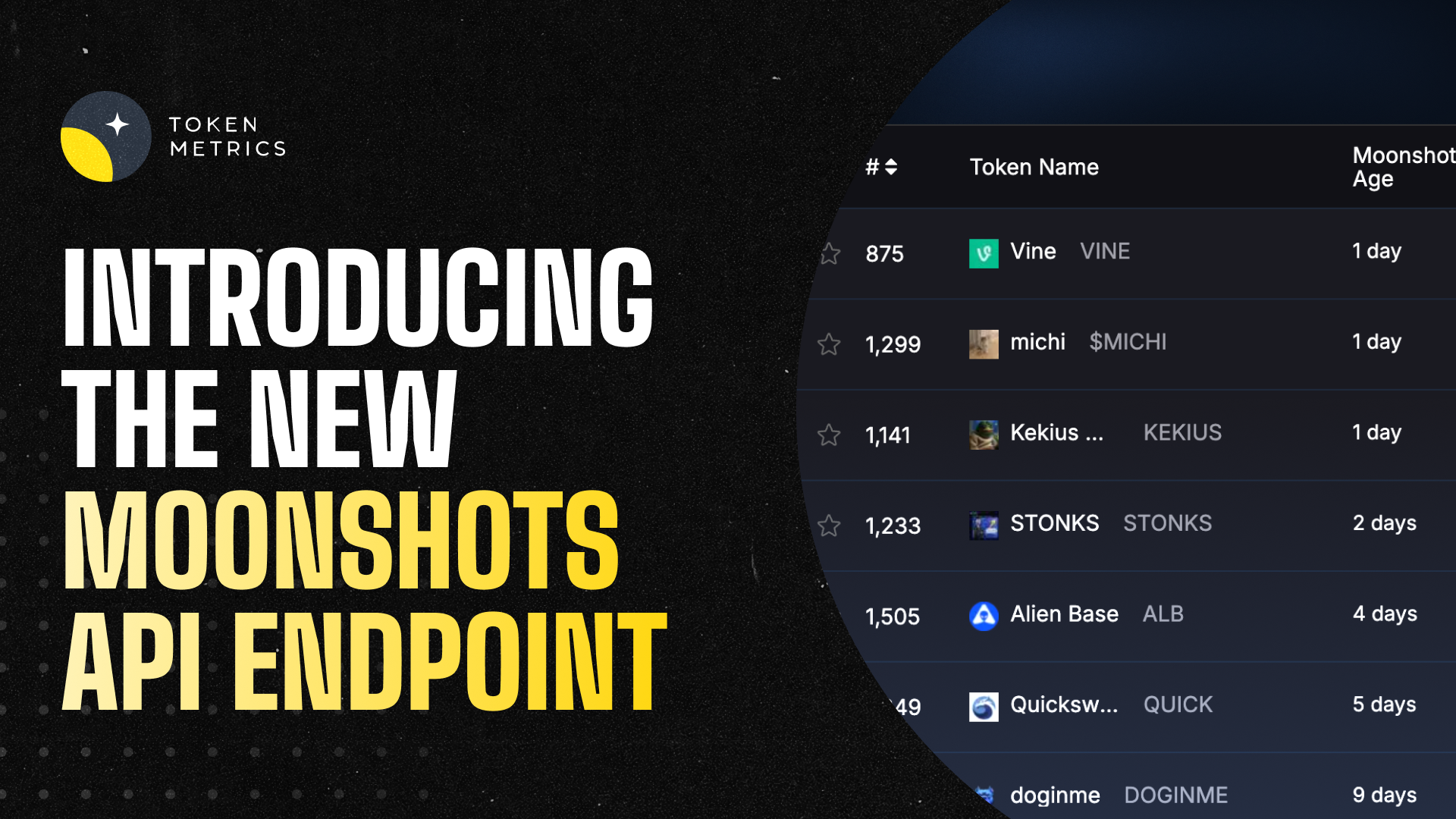
Big news: We’re cranking up the heat on AI-driven crypto analytics with the launch of the Token Metrics API and our official SDK (Software Development Kit). This isn’t just an upgrade – it's a quantum leap, giving traders, hedge funds, developers, and institutions direct access to cutting-edge market intelligence, trading signals, and predictive analytics.

Crypto markets move fast, and having real-time, AI-powered insights can be the difference between catching the next big trend or getting left behind. Until now, traders and quants have been wrestling with scattered data, delayed reporting, and a lack of truly predictive analytics. Not anymore.

The Token Metrics API delivers 32+ high-performance endpoints packed with powerful AI-driven insights right into your lap, including:

  • Trading Signals: AI-driven buy/sell recommendations based on real-time market conditions.
  • Investor & Trader Grades: Our proprietary risk-adjusted scoring for assessing crypto assets.
  • Price Predictions: Machine learning-powered forecasts for multiple time frames.
  • Sentiment Analysis: Aggregated insights from social media, news, and market data.
  • Market Indicators: Advanced metrics, including correlation analysis, volatility trends, and macro-level market insights.

Getting started with the Token Metrics API is simple:

  1. Sign up at www.tokenmetrics.com/api
  2. Generate an API key and explore sample requests.
  3. Choose a tier–start with 50 free API calls/month, or stake TMAI tokens for premium access.
  4. Optionally–download the SDK, install it for your preferred programming language, and follow the provided setup guide.

At Token Metrics, we believe data should be decentralized, predictive, and actionable. 

The Token Metrics API & SDK bring next-gen AI-powered crypto intelligence to anyone looking to trade smarter, build better, and stay ahead of the curve. With our official SDK, developers can plug these insights into their own trading bots, dashboards, and research tools – no need to reinvent the wheel.

Research

Top Crypto Prime Brokers (2025): Best Institutional Trading & Settlement Platforms

Token Metrics Team
17 min read
  • If you’re an institution that needs multi-venue liquidity, off-exchange settlement, and integrated custody/financing, this guide ranks the top crypto prime brokers for 2025 based on scale, security posture, and product breadth.
  • Top picks: Coinbase Prime for integrated trading + qualified custody with negotiated fees; FalconX for deep liquidity and capital solutions across spot/derivatives; Anchorage Digital Prime for bank-regulated custody with prime services and derivatives access. (Coinbase)
  • Caveats: Pricing is often negotiated; availability and products vary by region and legal entity. Always verify coverage on the provider’s official pages before onboarding. (docs.cdp.coinbase.com)

Introduction: Why Prime Brokerage Matters in 2025

Institutional participation accelerated in 2025, and with it the need for crypto prime brokers that unify execution, financing, custody, and settlement while minimizing counterparty risk. The leading platforms now resemble capital-markets infrastructure: single-counterparty access to multi-venue liquidity, off-exchange settlement networks that keep assets in segregated custody, and derivatives rails to hedge risk. Solutions like Coinbase Prime, FalconX, and Anchorage Digital Prime illustrate this evolution, while settlement networks such as Copper ClearLoop reduce venue risk without slowing execution. (Coinbase)

Primary intent: commercial-investigational. This guide compares features, fees, regions, and tradeoffs, then maps use cases to the right providers—so teams can move from diligence to deployment with confidence.


Our Evaluation Methodology

SCORING_WEIGHTS (sum = 100):

  • Scale & Liquidity (25) – depth of venues/LPs, 24/7 execution, options/futures where applicable.
  • Security & Regulatory Posture (25) – qualified custody, bank licensing/registrations, segregation, insurance disclosures.
  • Product Breadth (15) – spot, OTC/RFQ, derivatives, financing, settlement networks.
  • Costs & Fees (10) – published or negotiated schedules, financing/borrow terms.
  • Connectivity & Tooling (10) – FIX/WebSocket APIs, OEMS/SOR, reporting.
  • Capital Efficiency (10) – cross-margin, off-exchange settlement, instant delegation.
  • Support & Service (5) – coverage windows, onboarding SLAs.

Verification approach: We relied on official product, pricing, docs, security, and status pages only. If a claim wasn’t verifiable on an official page, we omitted it. Last updated: November 2025.


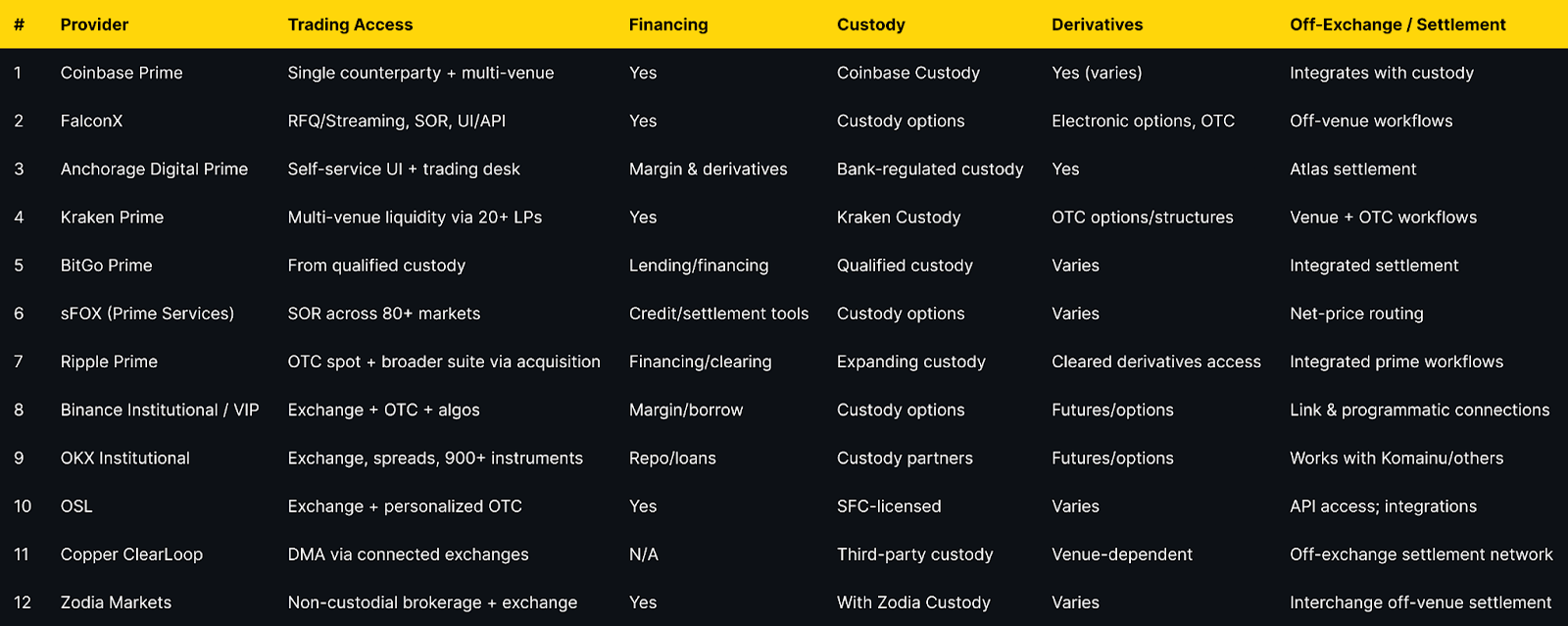
Crypto Prime Brokerage Comparison: At a Glance


Notes: “Pricing” reflects publicly stated models (often negotiated). “Regions/Notes” summarize official disclosures and licensing language where available on provider sites.


Detailed Provider Analysis

Coinbase Prime — Full-service prime brokerage at scale

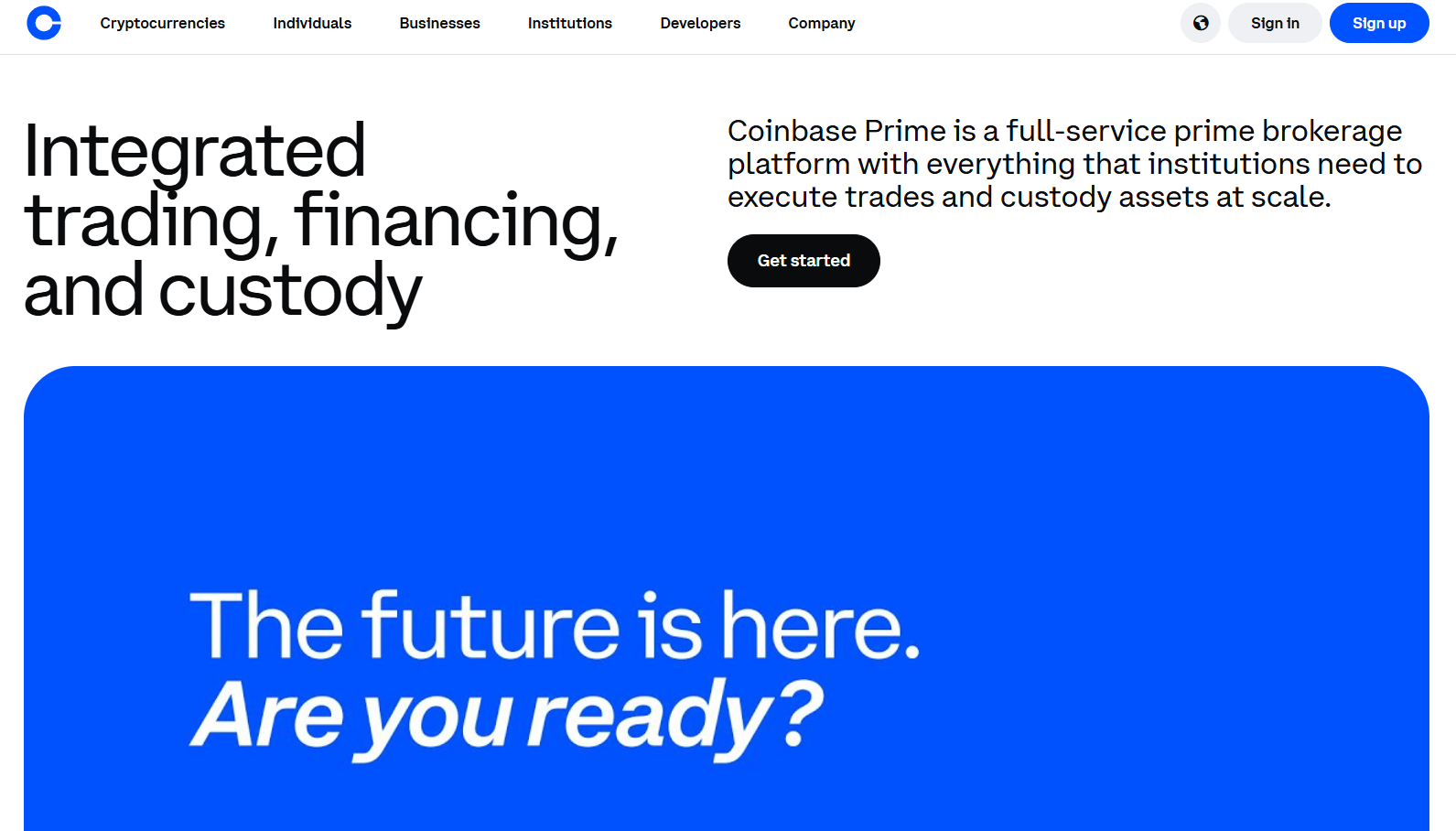
Overview. Coinbase Prime combines trading, financing, and qualified custody under one institutional platform, with negotiated trading fees and flexible order denomination (base/quote). Execution integrates with reporting and controls suitable for asset managers and corporates. (Coinbase)
Ideal For. Asset managers, corporates/treasuries, hedge funds, RIAs.
Standout Features. Integrated custody; negotiated All-In / Cost-Plus fee models; staking fee schedules; institutional reporting. (docs.cdp.coinbase.com)
Pricing. Negotiated, fee currency = quote currency. (docs.cdp.coinbase.com)
Availability. Global, entity-dependent; product availability varies by jurisdiction.
Worth Noting. Some services require separate agreements (e.g., validators, derivatives access).
Alternatives to Consider. Kraken Prime, Anchorage Digital Prime. (Kraken)  


FalconX — Deep liquidity & capital solutions across markets

Overview. FalconX offers RFQ/streaming execution across spot and FX with FIX/WebSocket/REST connectivity, plus electronic options and capital solutions. Scale and 24/7 liquidity are central, with workflows for large tickets and programmatic strategies. (falconx.io)
Ideal For. Multi-strategy funds, HFT/systematic traders, market makers.
Standout Features. RFQ/streaming with TWAP/FOK; electronic options; FX desk integrated into prime; institutional APIs. (falconx.io)
Pricing. Negotiated; bespoke based on flow and venues.
Availability. Global institutional focus (entity-dependent).
Worth Noting. Derivatives access and product scope vary by entity/region.
Alternatives to Consider. Coinbase Prime, Kraken Prime. (Coinbase)  


Anchorage Digital Prime — Prime services on top of a US bank custodian

Overview. Anchorage Digital Prime delivers trading (13+ order types), derivatives, margin, and settlement built on Anchorage Digital Bank N.A. custody. A single interface and 24/7 trading desk support complex orders. (anchorage.com)
Ideal For. US-regulated custody requirements, governance-active institutions, corporates.
Standout Features. Bank-regulated custody; derivatives access; Atlas settlement; desk + API execution. (anchorage.com)
Pricing. Negotiated; service-by-entity.
Availability. US bank entity with global affiliates; services provided by specific Anchorage entities (see legal). (anchorage.com)
Worth Noting. Trading provided by separate non-bank entities; read entity-level disclosures. (anchorage.com)
Alternatives to Consider. BitGo Prime, Coinbase Prime. (The Digital Asset Infrastructure Company)  


Kraken Prime — Multi-venue liquidity with institutional fee tiers

Overview. Kraken Prime aggregates 20+ liquidity providers and offers smart order routing, OTC spot and OTC derivatives (options/structures), plus custody integrations. Institutional fee perks are published for high-volume clients. (Kraken)
Ideal For. Funds seeking published fee schedules, multi-venue execution, and OTC coverage.
Standout Features. Multi-venue liquidity; FIX 4.4 and WebSockets APIs; OTC desk; institutional taker tiers. (Kraken)
Pricing. Maker/taker schedule with institutional perks at very high volumes. (Kraken)
Availability. Global, entity-dependent.
Worth Noting. Some advanced services require qualification and separate onboarding.
Alternatives to Consider. sFOX, Coinbase Prime. (sFOX)


BitGo Prime — Prime services from qualified custody

Overview. BitGo integrates trading, financing, and settlement directly from custody, with segregated, bankruptcy-remote accounts and published insurance coverage details. (The Digital Asset Infrastructure Company)
Ideal For. Institutions prioritizing segregation and custody-first workflows.
Standout Features. Segregated accounts; insurance disclosures; custody-integrated prime trading. (The Digital Asset Infrastructure Company)
Pricing. Negotiated; custody/prime fees depend on assets and activity.
Availability. Global entities with varying regulatory regimes.
Worth Noting. Derivatives access varies by entity/partner networks.
Alternatives to Consider. Anchorage Digital Prime, Copper ClearLoop. (anchorage.com)


sFOX (Prime Services) — Agency SOR across 80+ markets with institutional tooling

Overview. sFOX acts as an agnostic agent routing across 80+ markets for best execution, with net-price routing and institutional reporting. The platform positions itself as a full-service prime dealer for institutions. (sFOX)
Ideal For. Systematic strategies, RIAs/allocators, corporates seeking agency execution.
Standout Features. SOR across venues; platform-level price improvement; custody options. (sFOX)
Pricing. Tiered/negotiated; historical content points to fee optimization via routing. (sFOX)
Availability. US/global entities; enterprise onboarding.
Worth Noting. Product scope (derivatives, margin) varies; confirm coverage.
Alternatives to Consider. Kraken Prime, Coinbase Prime. (Kraken)


Ripple Prime — Multi-asset prime brokerage under Ripple

Overview. Following the acquisition and subsequent close of Hidden Road, Ripple Prime offers U.S. spot OTC execution and positions Ripple as the first crypto company to own and operate a global, multi-asset prime broker; custody capabilities expanded further in late 2025. (Ripple)
Ideal For. Institutions seeking an integrated multi-asset prime platform with digital asset rails.
Standout Features. OTC spot execution (U.S.); multi-asset coverage; financing/clearing. (Ripple)
Pricing. Negotiated.
Availability. U.S. launch and global expansion via Ripple entities. (Ripple)
Worth Noting. Product availability differs by jurisdiction and entity.
Alternatives to Consider. FalconX, Coinbase Prime. (falconx.io)


Binance VIP & Institutional — Exchange liquidity, OTC & programmatic access

Overview. Binance’s institutional suite spans exchange, OTC RFQ, algos, and programmatic connectivity with VIP tiers. Coverage and eligibility depend on jurisdiction; Binance.US operates separately for U.S. clients. (binance.com)
Ideal For. Non-US teams wanting direct exchange liquidity with OTC tools.
Standout Features. VIP tiers, proof-of-reserves, OTC block trading. (binance.com)
Pricing. Exchange/VIP schedules; negotiated OTC.
Availability. Region-dependent; check supported regions. (binance.com)
Worth Noting. U.S. availability/routes differ; compliance and onboarding vary by entity.
Alternatives to Consider. OKX Institutional, OSL. (OKX)


OKX Institutional — Scale, instruments, and U.S. presence via OKX US

Overview. OKX highlights high uptime, 900+ instruments, and institutional connectivity. U.S. availability exists through OKX US with scope/policies noted in compliance disclosures. (OKX)
Ideal For. Proprietary firms and funds trading a broad instrument set with API access.
Standout Features. Nitro Spreads, derivatives suite, institutional support. (OKX)
Pricing. Exchange schedule + VIP; negotiated for blocks.
Availability. Global; US services via OKX US (scope varies). (OKX)
Worth Noting. Product availability and licensing differ by region.
Alternatives to Consider. Binance Institutional, Kraken Prime. (binance.com)


OSL — HK SFC-licensed exchange, custody & OTC

Overview. OSL provides a licensed Hong Kong platform spanning custody, exchange, and OTC brokerage for institutions, with dedicated coverage in the region. (osl.com)
Ideal For. APAC institutions needing SFC-regulated venue/custody.
Standout Features. SFC-licensed exchange; institutional API; custody with insurance positioning. (sfc.hk)
Pricing. Schedule/negotiated.
Availability. Hong Kong and supported regions; institutional focus.
Worth Noting. Product availability differs by license and region.
Alternatives to Consider. Zodia Markets, Coinbase Prime. (Zodia Markets)


Copper ClearLoop — Off-exchange settlement network (multi-custodial)

Overview. ClearLoop enables instant delegation to connected exchanges while assets remain in segregated custody—now supporting third-party custodians like BitGo and Komainu. (Copper)
Ideal For. Institutions prioritizing venue risk reduction and capital efficiency.
Standout Features. Multi-custodial support; instant asset delegation; network of venues/prime brokers. (Copper)
Pricing. Varies by participants and volumes.
Availability. Global network; coverage depends on participating venues/custodians.
Worth Noting. Not a full prime broker by itself; pairs well with custody/venues.
Alternatives to Consider. Zodia Interchange, Komainu Connect. (zodia-custody.com)


Zodia Markets + Zodia Custody Interchange — Non-custodial brokerage + off-venue settlement

Overview. Zodia Markets offers institutional brokerage/exchange with non-custodial design, while Zodia Custody’s Interchange provides off-venue settlement (OVS)—trade while assets remain in custody. Registrations span UK, Ireland, ADGM. (Zodia Markets)
Ideal For. Institutions wanting bank-backed governance and segregated settlement flows.
Standout Features. Non-custodial brokerage; Interchange OVS network; institutional registrations. (Zodia Markets)
Pricing. Negotiated.
Availability. UK/EU/MENA institutional coverage (entity-specific). (Zodia Markets)
Worth Noting. Product scope varies by entity and venue integrations.
Alternatives to Consider. OSL, Copper ClearLoop. (osl.com)


Choosing the Right Prime Broker: A Framework

  • Regulatory posture needed? If you require US bank-regulated custody, start with Anchorage Digital Prime. For Hong Kong, OSL’s SFC licensing is key. For UK/EU bank-backed governance with off-venue settlement, consider Zodia. (anchorage.com)
  • Execution style. For multi-venue aggregation and published fee tiers, Kraken Prime is strong; for RFQ/streaming with electronic options, FalconX leads. sFOX suits agency SOR across many markets. (Kraken)
  • Integrated custody + trading. Coinbase Prime and BitGo Prime minimize operational friction by tying trading to qualified custody. (Coinbase)
  • Venue-risk reduction. If you want to trade while assets remain in custody, evaluate Copper ClearLoop or Zodia Interchange (and Komainu Connect as a related model). (Copper)
  • Instrument breadth and scale. For vast exchange liquidity and institutional programs, Binance Institutional and OKX Institutional are at-scale options (region permitting). (binance.com)

Integrating Token Metrics Intelligence

  • Research phase: Use Token Metrics screeners and on-chain/technical indicators to identify pairs suitable for your mandate (beta targets, breadth, liquidity screens).
  • Execution phase: Route orders via your prime broker’s APIs (e.g., FIX/WebSocket) selected above, while TM signals inform aggression/passivity and time-of-day tactics. (Kraken)
  • Monitoring: Feed fills, slippage, and borrow/financing into TM analytics to assess venue performance and adjust routing.
  • Optimization: Combine TM factor views with prime-broker borrow/financing and settlement options (e.g., off-exchange) to lower VaR and operational risk.

Start a Token Metrics trial to bring quantitative screening and scenario analysis into your institutional workflow.  


Security & Compliance Guidelines

  • Prefer segregated, bankruptcy-remote custody and confirm insurance disclosures where published. (The Digital Asset Infrastructure Company)
  • If you need a US bank custodian, validate services by legal entity and read the provider’s disclosures. (anchorage.com)
  • Use off-exchange settlement networks to reduce exchange exposure during execution. (Copper)
  • Confirm derivatives eligibility, margin terms, and cross-margin/netting treatment by entity/venue. (Kraken)
  • Require API keys/roles with least-privilege, HSM custody, and mandatory allow-listing.
  • Maintain jurisdictional watchlists and restrict activity accordingly (e.g., US vs non-US entities for global exchanges). (OKX)

Compliance note: This article is for research/education, not financial advice.


Avoiding Common Mistakes

  • Treating “prime” as one product—coverage and legal entities differ by service.
  • Assuming off-exchange settlement is automatic—confirm network membership and supported venues. (Copper)
  • Onboarding to the wrong entity—read the jurisdictional disclosures. (anchorage.com)
  • Ignoring negotiated fees—request All-In vs Cost-Plus quotes. (docs.cdp.coinbase.com)
  • Skipping disaster-recovery testing—simulate exchange outage + settlement failover.
  • Under-documenting OMS/EMS changes—keep audit-ready change logs.

Frequently Asked Questions

What is a crypto prime broker?
 A provider that consolidates institutional trading, financing, custody, and settlement, often with multi-venue access and risk controls. Modern variants add off-exchange settlement so assets remain in custody during execution. (zodia-custody.com)

Do prime brokers publish fees?
 Often no—fees are negotiated based on volumes, products, and relationship tier. Some venues publish maker/taker schedules with institutional perks. (docs.cdp.coinbase.com)

How does off-exchange settlement work?
 Networks like ClearLoop and Interchange let you delegate assets to venues for trading while keeping them in segregated custody, reducing counterparty risk. (Copper)

Which providers are strongest for regulated custody?
 Anchorage Digital Prime (US bank custody), BitGo (qualified custody), OSL (HK SFC-licensed custody/exchange), and Zodia (bank-backed with EU/UK registrations). (anchorage.com)

Can U.S. institutions use OKX or Binance?
 Access is region-dependent and varies by entity (e.g., OKX US scope). U.S. clients typically cannot use Binance.com and instead must evaluate Binance.US or other U.S.-eligible routes. Always check official disclosures. (OKX)


Final Recommendations

For most global institutions, a two-stack works best: (1) an integrated prime broker with qualified custody (Coinbase Prime, Anchorage Digital Prime, or BitGo Prime) and (2) a venue-risk mitigator like Copper ClearLoop or Zodia Interchange. Execution-heavy funds should add FalconX or Kraken Prime for multi-venue and OTC derivatives coverage, while OSL anchors APAC/HK mandates and OKX/Binance expand exchange reach where eligible. (Coinbase)

Related Resources:

Research

Best Yield Marketplaces for Real-World Assets (RWAs) in 2025

Token Metrics Team
29 min read
  • What this guide covers: A comprehensive evaluation of 10 leading platforms that enable tokenized real-world asset trading and yield generation across private credit, treasuries, real estate, and structured finance
  • Quick verdict: Ondo Finance for institutional-grade treasury exposure at ~5% APY, Maple Finance for crypto-collateralized credit facilities delivering 9-12% net yields, Goldfinch Prime for diversified access to private credit funds from Apollo and Ares
  • One key limitation to know: Many RWA platforms enforce strict accreditation requirements (minimum $50K-200K) and geographic restrictions, particularly excluding US investors from certain products due to securities regulations

Why Yield Marketplaces for RWAs Matter in January 2025

The real-world asset tokenization market has experienced explosive growth, surging from $85 million in April 2020 to over $25 billion by mid-2025—representing a staggering 245-fold increase driven primarily by institutional demand for yield, transparency, and regulatory clarity. Private credit dominates at approximately 61% of total tokenized assets, followed by treasuries at 30%, with major asset managers like BlackRock, Apollo, and Franklin Templeton now actively tokenizing institutional-grade products.

The convergence of traditional finance and decentralized infrastructure has created unprecedented opportunities for investors seeking stable, real-world yields without exposure to cryptocurrency volatility. The tokenized RWA market is projected to reach between $9.43 trillion and $18.9 trillion by 2030, with regulatory frameworks in Singapore, Hong Kong, and Dubai providing clear pathways for compliant innovation.

For crypto-native investors, RWA yield marketplaces offer a critical bridge to sustainable income streams backed by productive assets rather than purely speculative token emissions. Traditional allocators gain 24/7 access to fractional ownership, instant settlement, and programmable compliance—advantages impossible in legacy financial infrastructure.


How We Evaluated These Providers

We assessed platforms across six weighted criteria totaling 100 points:

  • Yield Quality & Sustainability (30%): Consistency of returns, asset backing, historical performance, and correlation to traditional markets
  • Security & Risk Management (25%): Custody solutions, audit history, legal recourse, collateralization ratios, and default handling protocols
  • Asset Coverage & Diversity (15%): Range of underlying assets, tranching options, and exposure across credit curves
  • Accessibility & Costs (15%): Minimum investments, fee structures, geographic availability, and KYC requirements
  • Liquidity & Redemption (10%): Secondary market depth, withdrawal timelines, and tokenization standards
  • Infrastructure & Compliance (5%): Regulatory licenses, blockchain integrations, and institutional partnerships

Data sources: Official platform documentation, on-chain analytics from RWA.xyz and DeFiLlama, third-party audits, and regulatory filings. Research conducted October 2024-January 2025.

Verification approach: Every fee structure, yield figure, and regional restriction cited was verified on official platform pages or regulatory disclosures. Unverifiable claims were excluded.


The Contenders: Quick Comparison  

Provider Reviews by Use Case

For Treasury-Backed Stability (4-5% Yield)

Top Pick: Ondo Finance — Institutional Treasury Tokenization Pioneer

Overview
 Ondo Finance manages over $1.6 billion in tokenized assets, offering institutional-grade access to US Treasury exposure through OUSG (backed by BlackRock's BUIDL fund) and USDY (a yield-bearing stablecoin). The platform bridges TradFi stability with DeFi composability through multi-chain deployment across Ethereum, Solana, Base, and XRP Ledger.

Ideal For

  • Institutional allocators seeking low-volatility dollar exposure
  • DeFi protocols requiring yield-bearing collateral
  • Treasuries managing idle stablecoin holdings
  • Investors prioritizing regulatory compliance and brand-name backing

Standout Features

  • Approximately 5% APY from short-term US Treasuries with daily interest payouts via rebasing mechanism
  • Integration with Ripple's RLUSD stablecoin for instant minting and redemption 24/7
  • Comprehensive SEC-registered infrastructure through acquisition of Oasis Pro, including broker-dealer, ATS, and transfer agent licenses
  • Strategic partnerships including anchor position in Fidelity's FDIT tokenized money market fund and launch of Ondo Global Markets for tokenized equities

Pricing
 Management fees embedded in net yield; typical 0.15-0.30% annual fee depending on product. OUSG requires $100K minimum; USDY accessible at lower thresholds with 4.29% APY.

Availability
 Global except US persons for certain products. Ethereum, Solana, Polygon, Aptos, Sei, Base, XRP Ledger, and Sui supported.

Worth Noting
 OUSG designed for qualified purchasers with extended lockup periods; less suitable for retail or high-frequency traders. Platform prioritizes institutional relationships over retail accessibility.

Alternatives to Consider: Franklin Templeton BENJI, OpenEden TBILL  


Runner-Up: Franklin Templeton BENJI — Legacy Asset Manager Innovation

Overview
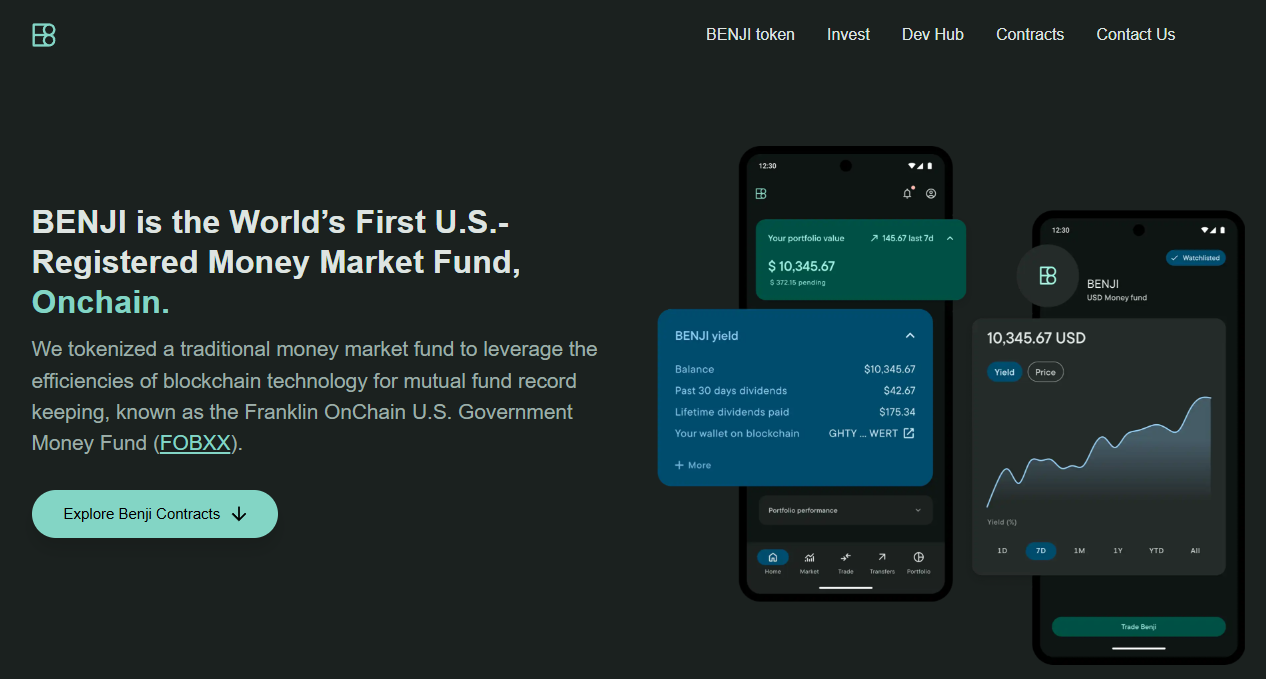
 Franklin Templeton's $775 million Franklin OnChain U.S. Government Money Fund (BENJI) pioneered tokenized mutual funds in 2021, offering exposure to US government securities across eight blockchains with patent-pending intraday yield calculation.

Ideal For

  • Investors seeking regulated 40 Act fund structure
  • Collateral managers requiring second-by-second yield accrual
  • Multi-chain strategies needing broad blockchain compatibility
  • Users prioritizing traditional asset manager credibility

Standout Features

  • Intraday yield tracking down to the second, enabling proportional earnings even for partial-day holdings
  • Direct stablecoin purchases and redemptions with wallet-to-wallet transfer capability
  • 63% of AUM deployed on Stellar Network for optimal cost efficiency
  • Integrated with DeFi protocols for collateral and leverage applications

Pricing
 7-day current yield approximately 4.5-5.5% gross; 0.25% management fee. No minimum investment restrictions beyond standard mutual fund requirements.

Availability
 Global availability with specific KYC requirements. Active on Stellar, Ethereum, Arbitrum, Base, Avalanche, Polygon, Aptos, Solana, BNB Chain.

Worth Noting
 Traditional mutual fund constraints apply including daily NAV calculations and potential redemption delays during market stress.

Alternatives to Consider: Backed bIB01, Superstate Short Duration Government Securities  


For Institutional Credit Exposure (8-12% Yield)

Top Pick: Maple Finance — Premier Crypto-Collateralized Lending

Overview
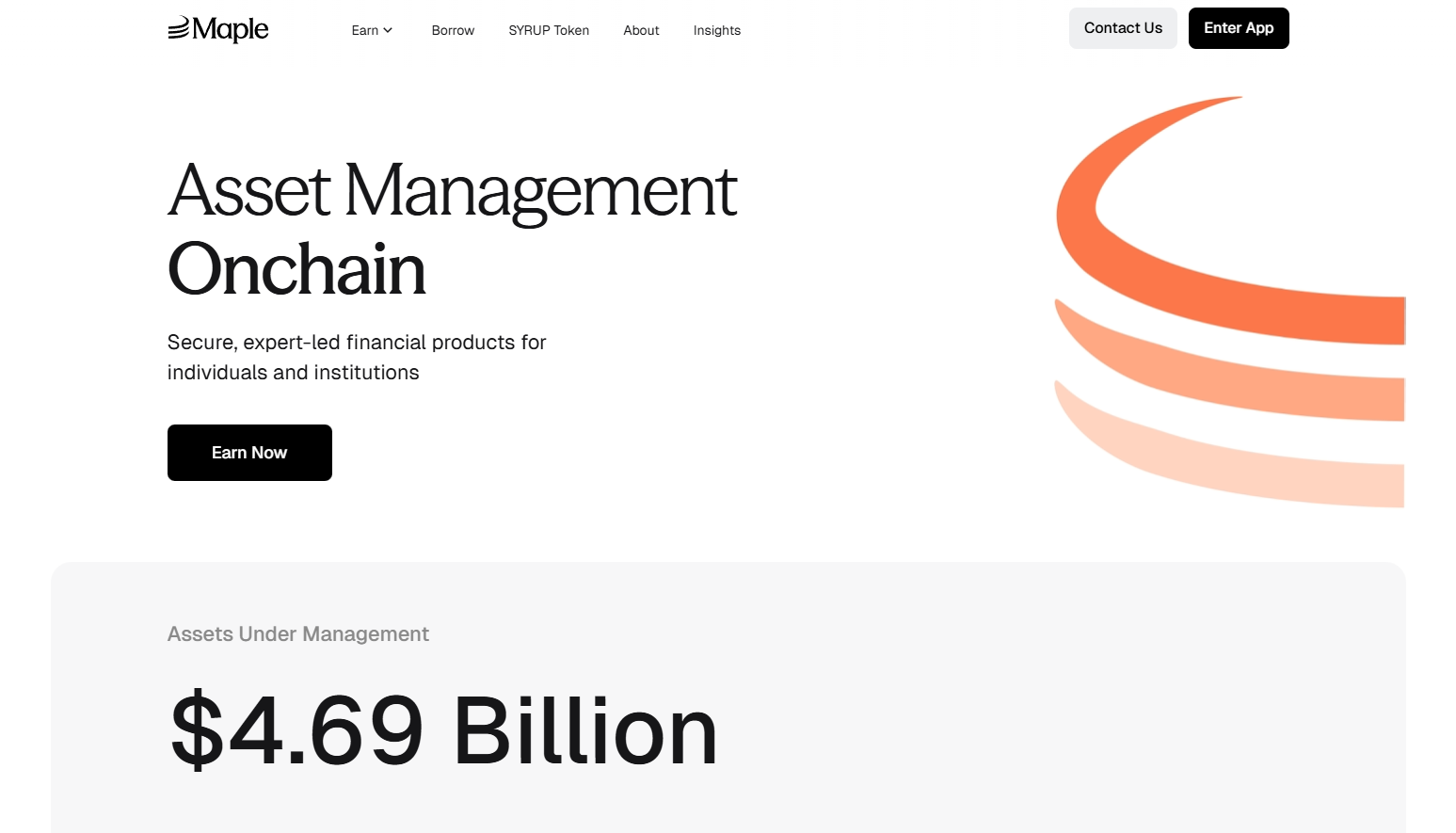
 Maple Finance manages over $4 billion in assets, specializing in institutional over-collateralized lending backed by Bitcoin, Ethereum, Solana, and XRP, targeting $100 billion in annual loan volume by 2030. The platform introduced SyrupUSDC for permissionless retail access alongside KYC-gated institutional pools.

Ideal For

  • Institutional lenders seeking exposure to cryptocurrency-backed credit
  • Liquidity providers comfortable with smart contract risk
  • Allocators targeting floating-rate, senior-secured structures
  • Investors seeking alternatives to traditional stablecoin farming

Standout Features

  • Consistent 9-12% net yields through undercollateralized institutional facilities and structured credit products
  • Strategic integration with Aave's $40 billion protocol bringing syrupUSDT to Plasma instance and syrupUSDC to core markets
  • Partnerships with Bitwise, Lido Finance (stETH-backed credit lines), and EtherFi (weETH collateral) expanding institutional adoption
  • Robust risk management combining decades of TradFi expertise with real-time on-chain monitoring

Pricing
 Variable by pool; typical effective yields 9-12% after protocol fees. Minimum investments pool-dependent, generally $10K-$50K for retail syrup products.

Availability
 Global with KYC requirements for lending. Institutional Maple requires accreditation; Syrup.fi open to broader participants.

Worth Noting
 Platform transitioned from uncollateralized to over-collateralized model after 2022 market turmoil. Historical defaults impacted certain pools; robust recovery mechanisms now in place.

Alternatives to Consider: Credix (emerging markets), TrueFi (uncollateralized DeFi)  


Runner-Up: Goldfinch Prime — Institutional Private Credit Access

Overview
 Goldfinch Prime aggregates exposure to multi-billion dollar private credit funds from Ares, Apollo, Golub Capital, and KKR, providing on-chain access to institutional-grade senior secured loans with over $1 trillion in collective AUM.

Ideal For

  • Non-US investors seeking diversified private credit exposure
  • Allocators targeting institutional fund performance without direct fund access
  • Participants seeking uncorrelated yield to crypto markets
  • Investors comfortable with longer lockup periods

Standout Features

  • Exposure to 1000+ senior secured loans across industries through vetted fund managers with 10+ years experience
  • Target returns of 9-12% net of fees with strict eligibility criteria including >90% senior secured portfolios and <0.75% target non-accrual rates
  • Heron Finance manages fund selection and vetting while fund managers handle all underwriting and default resolution
  • USDC-based deposits converted to proportional GPRIME tokens for continuous offering structure

Pricing
 Net yields 9-12% after embedded management fees and profit sharing. Minimum investments vary by pool structure; typically institutional minimums apply.

Availability
 Non-US persons only due to regulatory structure. KYC and accreditation verification required.

Worth Noting
 Exposure is indirect through fund shares rather than direct loan origination; fund managers absorb individual borrower default risk into aggregate yields. Liquidity limited compared to Treasury products.

Alternatives to Consider: Centrifuge private credit pools, Credix fintech lending


For Real Estate & Diversified Assets (6-10% Yield)

Top Pick: Centrifuge — Multi-Asset Tokenization Infrastructure

Overview
 Centrifuge operates as a multichain infrastructure platform enabling asset managers to tokenize real estate, trade finance, carbon credits, and structured credit with $1.2 billion TVL and recent 10x growth driven by the first on-chain CLO and tokenized S&P 500 index fund.

Ideal For

  • Investors seeking exposure to asset-backed securities beyond treasuries
  • Allocators comfortable evaluating tranched credit structures
  • Participants prioritizing transparency and on-chain asset verification
  • Portfolio managers wanting diversification across real-world credit types

Standout Features

  • Asset-agnostic architecture supporting structured credit, real estate mortgages, US treasuries, carbon credits, and consumer finance with full collateralization and legal recourse for investors
  • V3 platform enables cross-chain interoperability across Ethereum, Base, Arbitrum, Avalanche, BNB Chain, and Plume with integrated KYC and compliance-as-a-feature
  • Senior/junior tranche structures allowing risk-return customization
  • Partnership with Chronicle Labs for real-time price feeds and integration with Circle for USDC on/off-ramping

Pricing
 Yields vary by pool and tranche: typically 6-8% for senior tranches, 10-14% for junior tranches. Management fees embedded; pool-specific minimums apply.

Availability
 Global with KYC requirements. Pools may have additional jurisdictional restrictions based on underlying asset location.

Worth Noting
 Platform complexity requires understanding of tranched structures and asset-specific risks. Less liquid credit instruments offer less frequent pricing updates than treasury products.

Alternatives to Consider: RealT (US residential real estate focus), Republic (equity crowdfunding)

For Emerging Market Credit (12-18% Yield)

Top Pick: Credix — Latin American Fintech Lending

Overview
 Credix specializes in providing credit facilities to fintech lenders in Latin America, offering high-yield exposure to underserved credit markets with institutional-grade underwriting and local market expertise.

Ideal For

  • Sophisticated investors seeking higher risk-adjusted returns
  • Allocators comfortable with emerging market credit risk
  • Participants with extended investment horizons (12-24 months typical)
  • Investors seeking geographic diversification from US/EU markets

Standout Features

  • Target yields 12-18% reflecting emerging market risk premiums
  • Focus on fintech infrastructure enabling financial inclusion
  • Partnerships with established Latin American credit originators
  • Robust due diligence and monitoring of borrower networks

Pricing
 Pool-dependent yields typically 12-18% gross with management fees of 1-2%. Minimum investments generally $50K+ for accredited investors.

Availability
 Non-US persons primarily; requires accreditation verification and enhanced KYC given emerging market exposure.

Worth Noting
 Higher yields reflect higher credit and currency risk. Platform experienced challenges during regional economic volatility; enhanced risk controls now implemented.

Alternatives to Consider: Goldfinch V1 pools (emerging market focus), TrueFi uncollateralized pools


For Tokenization Infrastructure (Platform Providers)

Top Pick: Securitize — Industry-Leading Issuance Platform

Overview
 Securitize has tokenized over $4.5 billion in assets for 1.2 million investors across 3,000+ clients, operating as an SEC-registered transfer agent with integrated ATS for secondary trading. The platform powers major offerings including BlackRock's BUIDL fund.

Ideal For

  • Asset managers seeking turnkey tokenization solutions
  • Issuers requiring SEC-compliant digital security infrastructure
  • Institutional clients needing integrated custody and compliance
  • Projects prioritizing regulatory alignment and brand credibility

Standout Features

  • DS Protocol automates token issuance, transfer agent functions, and regulated secondary trading with $47 million funding led by BlackRock
  • Recent launch of STAC tokenized AAA CLO fund with BNY custody demonstrating institutional adoption trajectory
  • Comprehensive investor onboarding, KYC/AML, and reporting infrastructure
  • Partnerships with major asset managers and integration with Zero Hash for fiat conversion

Pricing
 Platform fees vary by issuance size and complexity; typically 0.5-2% of AUM plus basis point fees on transactions. White-label solutions available for enterprise clients.

Availability
 Global operations with jurisdiction-specific compliance modules. Primary focus on US, EU, and APAC institutional markets.

Worth Noting
 Securitize is an issuance platform rather than direct investment product; investors access opportunities through partner funds and offerings launched on the infrastructure.

Alternatives to Consider: Tokeny (EU-focused), Polymath/Polymesh (security token specialists)


Complete Provider Directory

  • Backed Finance: European MiCA-compliant tokenization platform offering bIB01 (Swiss government bond exposure) and bC3M (commodity basket). Strong focus on regulatory alignment with modest 3-5% yields and low entry barriers.
  • Swarm Markets: Decentralized platform enabling fractional ownership of real estate and private credit with $1K-$50K minimums. Emphasizes accessibility while maintaining compliance through distributed infrastructure.
  • TrueFi: Uncollateralized lending protocol using on-chain credit scoring and portfolio diversification. Higher risk-return profile (8-15% targets) with full transparency of borrower pools and performance metrics.
  • Archax: UK FCA-regulated platform for institutional tokenization of bonds, funds, and money markets. Focus on traditional finance compatibility with stringent accreditation requirements.

Making Your Selection: Key Questions

  • What yield stability do you require?
     Treasury-backed platforms (Ondo, Franklin Templeton) offer predictable 4-5% returns with minimal volatility. Credit-focused platforms (Maple, Goldfinch) target 9-12% but introduce credit risk and performance variability.
  • What is your risk tolerance for underlying collateral?
     Government securities provide lowest risk; over-collateralized crypto loans add smart contract and liquidation risks; uncollateralized emerging market credit carries highest default potential.
  • Do you meet accreditation and minimum investment thresholds?
     Many institutional products require $50K-$200K minimums and qualified purchaser status. Retail-accessible options like USDY and syrupUSDC lower barriers but may sacrifice yield.
  • What liquidity do you need?
     Treasury tokens generally offer daily liquidity; private credit pools may have quarterly redemption windows; real estate tokenization can involve 12-24 month lockups.
  • How important is regulatory compliance?
     Platforms like Ondo, Franklin Templeton, and Securitize prioritize SEC registration and traditional fund structures. Purely DeFi-native protocols offer less regulatory clarity but greater composability.
  • What blockchain ecosystems do you operate in?
     Multi-chain deployment (Ondo, Centrifuge) provides flexibility; single-chain specialization (some Maple pools) may offer optimization but limits interoperability.
  • Do you have geographic restrictions?
     US persons often excluded from highest-yield opportunities due to securities laws. European investors benefit from MiCA framework; APAC sees growing regulatory clarity.
  • What level of transparency do you require?
     On-chain native protocols offer real-time asset verification; hybrid models may rely on periodic attestations and third-party audits.
  • Are you seeking passive income or active yield strategies?
     Treasury staking provides set-and-forget returns; DeFi integrations enable leverage, collateral strategies, and yield optimization requiring active management.
  • How much operational complexity can you handle?
     Single-platform solutions simplify but limit optionality; multi-protocol strategies maximize returns but require gas management, tax tracking, and security across multiple platforms.

Maximizing Your Setup with Token Metrics

Token Metrics provides critical intelligence for navigating RWA yield opportunities through data-driven analysis and market insights.

Research Phase: Leverage Token Metrics' fundamental analysis to evaluate tokenized asset protocols, comparing on-chain metrics, TVL trends, and yield sustainability indicators. Our RWA sector reports identify emerging platforms and highlight regulatory developments across jurisdictions.

Portfolio Construction: Use quantitative scoring to allocate across risk tiers—balancing stable treasury exposure with higher-yield credit products. Token Metrics' portfolio tools help optimize diversification while monitoring correlation to traditional crypto markets.

Ongoing Monitoring: Real-time alerts notify you of yield changes, protocol upgrades, and risk events. Our dashboard aggregates performance across multiple RWA platforms, tracking your yield-bearing positions alongside broader cryptocurrency holdings.

Risk Management: Token Metrics' risk analytics assess smart contract security, custody arrangements, and counterparty exposure. Our reports flag platforms with concerning yield sustainability metrics or operational red flags before they impact your capital.

Start your Token Metrics free trial to access institutional-grade RWA research and optimize your real-world asset allocation.  


Essential Security Practices

  • Custody Verification: Confirm that platforms use institutional-grade custodians (Coinbase Custody, BitGo, Fireblocks) for underlying assets. Verify proof-of-reserve attestations and third-party audits.
  • Smart Contract Risk: Review audit reports from reputable firms (Trail of Bits, OpenZeppelin, Certora). Understand upgrade mechanisms and timelock protections on protocol contracts.
  • Legal Structure Assessment: Examine SPV formation, bankruptcy remoteness, and investor recourse mechanisms. Ensure tokenization structure provides actual legal claim on underlying assets, not just economic exposure.
  • Regulatory Compliance: Verify platforms maintain necessary licenses (broker-dealer, transfer agent, ATS) in relevant jurisdictions. Confirm offerings comply with securities laws in your domicile.
  • Counterparty Risk: Understand who services loans, manages defaults, and handles liquidations. Evaluate track records of asset originators and credit underwriters.
  • Liquidity Risk Management: Never allocate more than you can afford to lock up for stated redemption periods. Maintain buffer capital for market volatility and potential redemption delays.
  • Tax Implications: Consult tax professionals on treatment of tokenized yield—may be classified as interest income, dividends, or capital gains depending on structure and jurisdiction.
  • Geographic Restrictions: Verify you're eligible to participate based on residency. Using VPNs or misrepresenting location can result in frozen funds and legal liability.
  • Platform Concentration: Diversify across multiple RWA providers to reduce single-point-of-failure risk. No single platform should represent majority of yield allocation.
  • Documentation: Maintain records of all transactions, yield distributions, and platform communications for tax reporting and potential disputes.

This article is for research and educational purposes, not financial advice. RWA investments carry risks including loss of principal.


What to Avoid

  • Ignoring minimum holding periods: Many RWA products enforce lockups or redemption windows. Treating them as liquid positions can leave you unable to access capital when needed.
  • Chasing unsustainably high yields: Promised returns significantly above market rates often indicate excessive risk. Verify underlying asset performance and historical consistency before committing capital.
  • Overlooking platform liquidity: Token existence on-chain doesn't guarantee exit liquidity. Check secondary market depth and historical spread between minting and redemption prices.
  • Neglecting jurisdictional compliance: Accessing platforms not available in your region can result in frozen accounts and regulatory penalties. Always verify eligibility before depositing funds.
  • Underestimating smart contract risk: Even well-audited protocols face exploitation risk. Size positions appropriately and monitor security incident disclosures across the ecosystem.
  • Failing to verify asset backing: Don't rely on marketing claims. Demand proof-of-reserve, third-party attestations, and transparent reporting on underlying collateral.
  • Concentrating in single asset class: Over-allocating to one RWA category (e.g., all private credit) eliminates diversification benefits. Balance across treasuries, credit, and real estate where possible.
  • Ignoring fee structures: Management fees, performance fees, and transaction costs compound over time. Calculate net yields after all costs when comparing platforms.

Reader Questions Answered

What's the difference between tokenized treasuries and yield-bearing stablecoins?

 Tokenized treasuries (like OUSG) represent direct ownership of US Treasury securities with yield passed through to holders. Yield-bearing stablecoins (like USDY) maintain $1 peg while distributing treasury yields via rebasing or airdrops. Treasuries may fluctuate slightly with NAV; yield stablecoins prioritize price stability.

Are RWA yields taxable differently than crypto staking rewards?

 Likely yes, though tax treatment varies by jurisdiction. RWA yields from treasuries or credit facilities often classified as interest income taxed at ordinary rates. Crypto staking may be treated as income at receipt or capital gains at sale depending on location. Consult tax professionals for specific guidance.

Can I use tokenized RWAs as collateral in DeFi protocols?

 Increasingly yes. Platforms like Maple, Ondo (via Flux Finance), and Centrifuge enable using tokenized assets as DeFi collateral. However, support varies by protocol and asset—USDY and OUSG see broader integration than niche real estate tokens. Liquidation risks apply if collateral value drops.

What happens if the platform goes bankrupt?

 Properly structured tokenization isolates assets in bankruptcy-remote SPVs, protecting investor claims even if platform operator fails. However, redemption processes may be delayed and require legal navigation. This is why verifying legal structure and custodial arrangements is critical.

How liquid are RWA tokens compared to stablecoins?

 Significantly less liquid. While stablecoins have billions in daily DEX volume, most RWA tokens trade thinly or only through platform-controlled redemption mechanisms. Treasury tokens offer better liquidity than private credit or real estate, but all lag traditional stablecoins substantially.

Do I need to be an accredited investor?

 Depends on the platform and your location. US-based offerings often require accreditation; international platforms may have lower barriers. Products like USDY, syrupUSDC, and BENJI target broader accessibility, while institutional credit pools restrict to qualified purchasers.

What are the main risks that could cause loss of principal?

 (1) Underlying asset default (credit risk), (2) smart contract exploitation, (3) platform insolvency without proper asset segregation, (4) regulatory action freezing operations, (5) stablecoin de-pegging for yield products denominated in USDC/USDT, (6) liquidation cascades in collateralized structures.

How do yields compare to traditional finance alternatives?

 Tokenized treasuries (4-5%) match conventional money market funds but with 24/7 access. Private credit RWAs (9-12%) offer premiums over corporate bonds due to illiquidity and platform novelty. Emerging market RWA yields (12-18%) comparable to EM debt funds with added smart contract risk.


Bottom Line

Real-world asset yield marketplaces represent the maturation of blockchain infrastructure beyond speculation into productive finance. For investors seeking stable, asset-backed returns uncorrelated to cryptocurrency volatility, platforms like Ondo Finance and Franklin Templeton deliver institutional-grade treasury exposure with DeFi composability. Those comfortable with credit risk can access superior yields through Maple Finance's collateralized institutional lending or Goldfinch Prime's diversified private credit exposure.

The key to success: match platform selection to your specific risk tolerance, liquidity needs, and regulatory constraints. Treasury products suit conservative allocators prioritizing capital preservation; credit platforms reward investors accepting higher risk for enhanced returns; multi-asset infrastructure like Centrifuge offers diversification across real-world credit types.

Start with smaller allocations to understand platform mechanics, redemption processes, and yield consistency before committing substantial capital. The RWA sector's rapid growth will continue creating opportunities, but also attracting lower-quality offerings—due diligence remains paramount.

Related Resources:


About This Research

Methodology: This guide evaluated 20+ RWA platforms through analysis of official documentation, on-chain data, regulatory filings, and third-party audits. Platforms selected represent meaningful TVL (>$100M), regulatory compliance, and operational track record. Final selection prioritized diversity across asset classes and investor accessibility tiers.

Research Sources:

  • Ondo Finance: Product documentation, tokenomics, OUSG/USDY specifications, Oasis Pro acquisition disclosure
  • Maple Finance: Platform whitepaper, syrupUSDC mechanics, Aave integration announcement, CEO interviews
  • Centrifuge: V3 technical documentation, pool analytics, Republic partnership details
  • Goldfinch: Prime pool specifications, fund manager criteria, Heron Finance structure
  • Franklin Templeton: BENJI platform technical details, intraday yield patent documentation, multi-chain deployment
  • Securitize: DS Protocol documentation, STAC fund launch details, BlackRock partnership announcements
  • RWA.xyz: Platform TVL data, tokenization metrics, market growth analysis
  • DeFiLlama: Protocol TVL tracking, historical performance data
  • BCG/Ripple: RWA market projections and industry research
  • VanEck, Coinbase, Binance: Sector research reports on RWA growth trajectories

All data current as of January 2025. Platform features and yields subject to change; verify current terms on official websites before investing.

Research

Top Gold & Commodity-Backed Tokens (2025)

Token Metrics Team
12 min read

Who this guide is for. Crypto investors and treasurers comparing gold-backed tokens and other commodity-backed assets that can be audited and, in many cases, redeemed for metal.
Top three picks. PAX Gold (PAXG) for regulated, bar-linked redemption; Tether Gold (XAUt) for broad awareness and simple fees; Kinesis (KAU/KAG) for spend-and-yield use cases.
Key caveat. Redemption minimums, custody locations, and fees vary by issuer; always confirm regional eligibility and schedules on the official pages.


Introduction: Why Commodity-Backed Tokens Matter in 2025

Gold-backed tokens give on-chain ownership exposure to vaulted bullion with transparent allocation and, often, physical redemption, blending the inflation hedge of metals with crypto liquidity. In 2025, they’re used for hedging, collateral, cross-border settlement, and “digital cash” backed by tangible assets. A commodity-backed token is a blockchain token that represents title to a specific quantity of a real-world commodity (for example, 1 troy ounce or 1 gram of gold) held by a custodian, typically with published fees, vault locations, and redemption rules. Our picks prioritize liquidity, security controls, breadth of metals, cost transparency, and global accessibility.


Best Commodity-Backed Tokens in November 2025 (Comparison Table)


We excluded defunct or sunset projects (e.g., PMGT; CACHE Gold ceased backing CGT on Sept 30, 2025). (perthmint.com)


Top 10 Gold & Commodity-Backed Tokens in November 2025

1) PAX Gold (PAXG) — Best for bar-linked redemption & regulatory posture

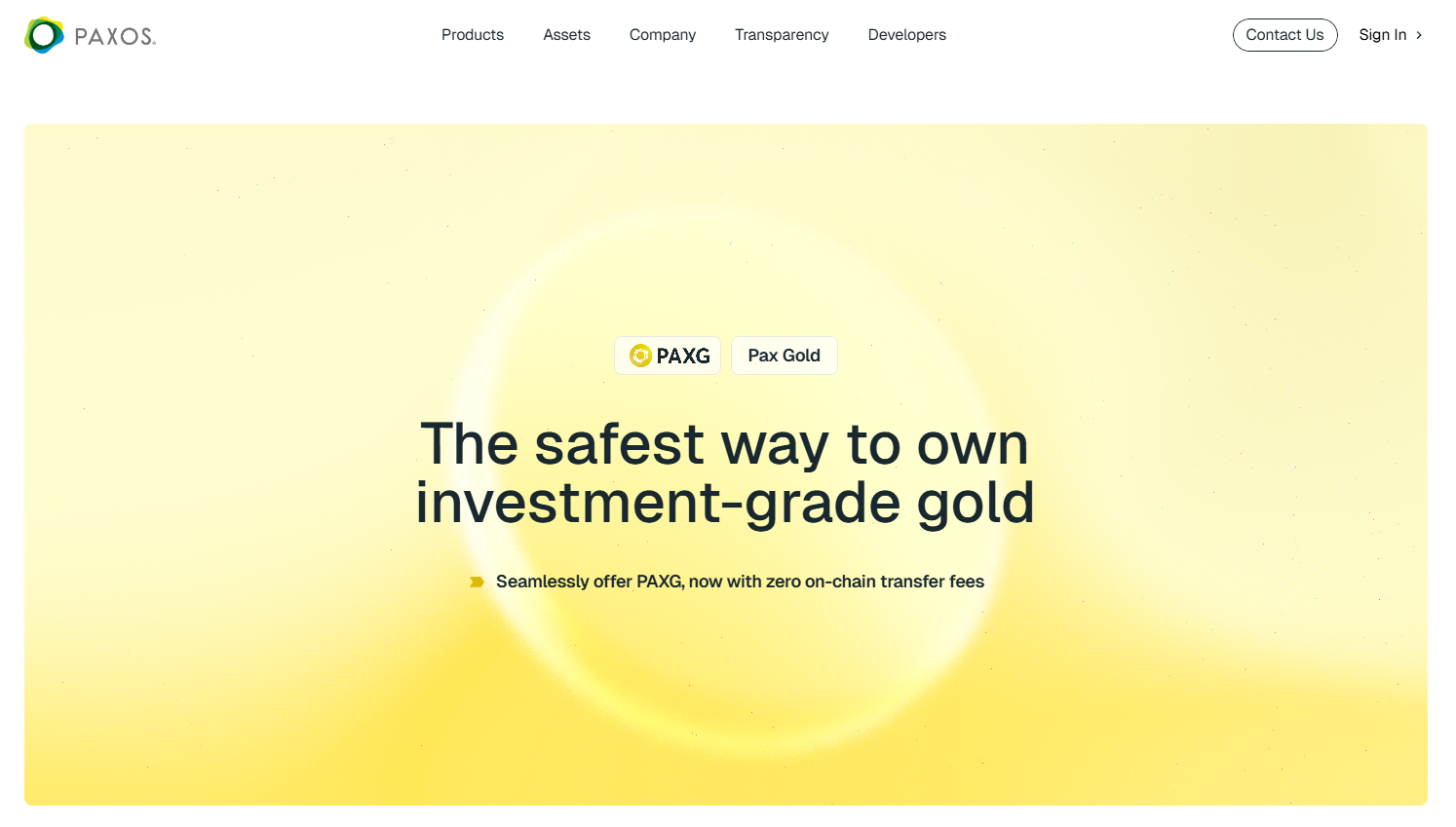
Why Use It. PAXG links each token to specific LBMA Good Delivery bars stored in London, offering direct bar redemption (institutional minimums apply) or USD redemption at spot. Paxos publishes fee schedules and notes no storage fee charged to customers at this time. (paxos.com)
Best For. Institutions; HNW hedgers; DeFi users needing reputable collateral.
Notable Features. LBMA bars; serial-number linkage; custodied in London; fiat redemption option. (paxos.com)
Fees Notes. Creation/destruction fees; no storage fee currently per issuer help center. (help.paxos.com)
Regions. Global (issuer KYC).
Consider If. You can meet bar redemption minimums and UK vault logistics. (help.paxos.com)
Alternatives. Tether Gold (XAUt); VNX Gold (VNXAU).  


2) Tether Gold (XAUt) — Best for simple pricing & broad availability

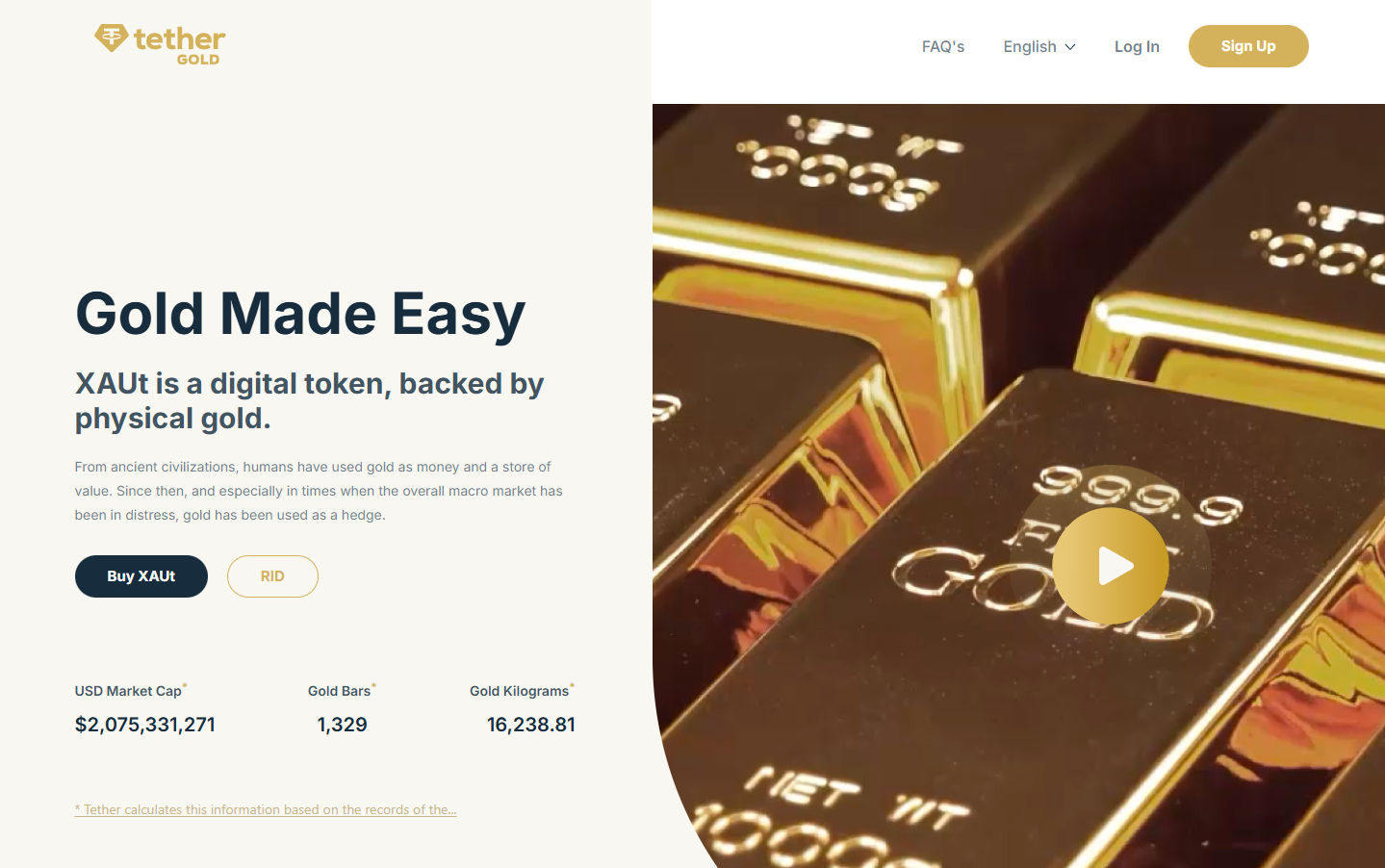
Why Use It. XAUt represents allocated gold and can be redeemed for physical gold or USD; Tether publishes a straightforward 0.25% creation/redemption fee and a one-time verification fee for onboarding. FAQs outline redemption mechanics and bar specifics. (Tether)
Best For. Traders seeking brand familiarity; cross-chain users (ETH/TRON).
Notable Features. Bar metadata; physical or USD redemption; no custody fee disclosed beyond the transaction fee. (Tether)
Fees Notes. 25 bps create/redeem; separate KYC verification fee. (Tether)
Regions. Global (issuer KYC).
Consider If. You need clear fee math but don’t require bar-specific allocation like PAXG.
Alternatives. PAX Gold (PAXG); Kinesis (KAU).  


3) Kinesis KAU (Gold) / KAG (Silver) — Best for spend-and-yield utility

Why Use It. Kinesis combines metal-backed tokens with an exchange, cards, and yields funded from platform fees (published yield-share). Trading and precious metals transactions show ~0.22% execution fees on official schedules. (Kinesis)
Best For. Users wanting to spend gold/silver, earn monthly yields, and keep fees predictable.
Notable Features. Fee-share yield (published); exchange, card rails; gold & silver pairs. (Kinesis)
Fees Notes. ~0.22% buy/sell/trade; other fees per schedule. (Kinesis)
Regions. Global (platform KYC/availability).
Consider If. You prefer an integrated platform over a standalone token.
Alternatives. VNX (VNXAU/VNXAG); Aurus (tXAU/tXAG).  


4) Comtech Gold (CGO) — Best for XDC ecosystem & Shariah-compliant framework

Why Use It. CGO tokenizes 1g gold units on the XDC (XRC-20) network, with a published fee structure for mint/redeem (0.50%), transfers (0.50%), and custody notes in FAQs. Documentation details creation/redemption and delivery fees. (comtechgold.com)
Best For. XDC builders; users needing Shariah-compliant structuring.
Notable Features. On-chain proofing; fee schedule; vault delivery options. (comtechgold.com)
Fees Notes. 0.50% mint/redeem; 0.50% transfer; custody terms disclosed. (comtechgold.com)
Regions. Global (issuer terms apply).
Consider If. You’re comfortable with XDC rails and issuer fee model.
Alternatives. PAXG; VNXAU.


5) VNX Gold (VNXAU) — Best for EEA vaulting & multi-chain issuance

Why Use It. VNXAU gives direct ownership of allocated bars stored in Liechtenstein with a public allocation lookup tool. VNX runs on Ethereum, Polygon, Q, and Solana, and has communications on redemption and delivery. (VNX)
Best For. EEA users; diversification across chains.
Notable Features. Allocation lookup by serial; segregated AAA-jurisdiction vault; multi-chain. (VNX)
Fees Notes. See VNX pricing and product pages for current schedules.
Regions. EEA emphasis; global availability varies by KYC.
Consider If. You want EEA custody and serial-level transparency.
Alternatives. PAXG; XAUt.


6) Aurus tGOLD (tXAU) / tSILVER (tXAG) — Best for gram-denominated multi-metal exposure

Why Use It. Aurus issues 1-gram tokens backed by vaulted gold and silver with insured, audited storage. tGOLD and tSILVER support multi-chain DeFi integrations and a mobile app, with ecosystem partners for mint/redeem. (AURUS)
Best For. DeFi users; small-denomination accumulation; multi-metal portfolios (includes platinum via tXPT).
Notable Features. 1g units; insured vaulted metals; app & dashboard; partner network. (AURUS)
Fees Notes. Exchange/network fees; issuer/partner fees may apply.
Regions. Global (partner KYC where required).
Consider If. You want gram-level flexibility and cross-chain access.
Alternatives. Kinesis; VNX.


7) Gold Silver Standard (AUS/AGS) — Best for Australia-based custody & simple redemption

Why Use It. Tokens AUS (gold) and AGS (silver) are backed by allocated bullion held in Australian high-security vaults with $0 storage and transfer at the issuer level and partner-facilitated redemptions. (goldsilverstandard.com)
Best For. AUD-centric investors; straightforward physical pickup/delivery via partners.
Notable Features. 1g linkage; local redemption via Ainslie partners; Australia-first focus. (goldsilverstandard.com)
Fees Notes. Issuer lists $0 storage/transfer; exchange and redemption partner fees may apply. (goldsilverstandard.com)
Regions. Australia focus; global varies.
Consider If. You need straightforward redemption in Australia.
Alternatives. PAXG; VNXAU.


8) VNX Silver (VNXAG) — Best for EEA silver allocation & transparency tools

Why Use It. VNXAG mirrors the VNXAU model for silver, backed by allocated metal with the same allocation lookup tooling and multi-chain issuance. (VNX)
Best For. EEA investors prioritizing silver in segregated storage.
Notable Features. Allocation lookup; EEA custody; multi-chain support. (VNX)
Fees Notes. See VNX site for current schedules.
Regions. EEA emphasis; global varies.
Consider If. You want EEA-vaulted silver with serial-level transparency.
Alternatives. KAG; tXAG.


9) VeraOne (VRO) — Best for euro-area buyers wanting 1-gram ERC-20

Why Use It. VRO is an ERC-20 token pegged to 1 gram of LBMA-standard gold, issued by a long-standing French precious-metal group; materials describe secured storage and regular audits. (VeraOne)
Best For. EU users; gram-based savings; euro on-ramps.
Notable Features. 1g linkage; audited storage; EU presence. (VeraOne)
Fees Notes. Issuer materials outline model; confirm current fees on site.
Regions. EU focus; global access varies.
Consider If. You want EU branding and ERC-20 simplicity.
Alternatives. PAXG; VNXAU.


10) AgAu — Best for Swiss custody & peer-to-peer design

Why Use It. AgAu outlines 1:1 backed gold and silver tokens with Swiss custody and a peer-to-peer payment focus; docs and reports describe convertibility and audited reserves. (agau.io)
Best For. Users seeking Swiss jurisdiction and payments-style UX.
Notable Features. Swiss issuer; P2P spend; audit & documents hub. (agau.io)
Fees Notes. See issuer documentation for fees and redemption steps.
Regions. Global (jurisdictional checks apply).
Consider If. You want Swiss custody with payments emphasis.
Alternatives. VNXAU; AUS.


Decision Guide: Best by Use Case

  • Regulated, bar-specific redemption: PAX Gold (PAXG). (paxos.com)
  • Simple fee schedule & brand familiarity: Tether Gold (XAUt). (Tether)
  • Spend metals + monthly fee-share yield: Kinesis (KAU/KAG). (Kinesis)
  • XDC network users: Comtech Gold (CGO). (comtechgold.com)
  • EEA custody & allocation lookup: VNX (VNXAU/VNXAG). (VNX)
  • Gram-based, multi-metal DeFi: Aurus (tXAU/tXAG). (AURUS)
  • Australia-centric custody & pickup: Gold Silver Standard (AUS/AGS). (goldsilverstandard.com)
  • EU 1-gram ERC-20: VeraOne (VRO). (VeraOne)
  • Swiss custody & P2P payments: AgAu. (agau.io)

How to Choose the Right Commodity-Backed Token (Checklist)

  • ☐ Region eligibility and KYC match your profile.
  • ☐ Underlying metal type and unit (ounce vs gram).
  • Redemption rules: minimums, delivery locations, timelines.
  • Custody: vault jurisdiction, insurer, LBMA accreditation.
  • Fee transparency: creation, redemption, storage, transfer, network.
  • Audit/attestation cadence and allocation lookup tools.
  • Chains supported and DeFi integration needs.
  • ☐ Support channels and documentation depth.
    Red flags: vague custody details, unclear redemption, or discontinued programs.

Use Token Metrics With Any Commodity-Backed Token

  • AI Ratings to screen metal-linked assets and related ecosystem tokens.


  • Narrative Detection to spot inflows to on-chain RWAs.
  • Portfolio Optimization to size metal exposure vs. crypto beta.
  • Alerts & Signals to time entries/exits around macro prints.
    Workflow: Research → Select issuer → Execute on-chain or via platform → Monitor with alerts.


CTA: Start free trial to screen assets and time entries with AI.  


Security & Compliance Tips

  • Use official issuer URLs only; beware look-alikes.
  • Confirm fee schedules and redemption procedures before buying. (Tether)
  • Verify vaulting jurisdiction and any bar-serial lookup tools. (VNX)
  • Mind network fees, bridge risks, and exchange withdrawal rules.
  • Keep custody keys secure; whitelist issuer addresses.
  • If staking or yielding, confirm source of yield and counterparty exposure. (Kinesis)
    This article is for research/education, not financial advice.

Beginner Mistakes to Avoid

  • Treating all metal tokens as equal—redemption and custody differ widely.
  • Ignoring region and KYC limits until you try to redeem.
  • Overlooking minimums (e.g., full LBMA bars vs. gram redemptions). (help.paxos.com)
  • Confusing defunct tokens with active ones (e.g., PMGT sunset; CGT backing ceased). (perthmint.com)
  • Forgetting network/transfer fees when arbitraging across chains.
  • Using unofficial contracts on the wrong chain.

How We Picked (Methodology & Scoring)
  • Liquidity — 30%. Exchange presence, on-chain activity, practical tradability.
  • Security — 25%. Custody details, audits/attestations, LBMA alignment, redemption design.
  • Coverage — 15%. Metals (gold/silver/platinum), chains, tooling.
  • Costs — 15%. Creation/redemption/storage/transfer and transparency of schedules.
  • UX — 10%. Apps, dashboards, redemption flows.
  • Support — 5%. Docs, status pages, human support.
    We relied on official product, docs, fees, FAQ, and disclosure pages, cross-checking market datasets only for context. Last updated November 2025.

FAQs

What are gold-backed tokens?
 They are blockchain tokens that represent ownership of a specific quantity of vaulted, insured gold, typically with published fees and, in some cases, physical redemption options.

Are gold-backed tokens safer than stablecoins?
 They can diversify away from fiat risk, but introduce custody and redemption dependencies. Safety depends on the issuer’s vaulting, audits, legal structure, and your ability to redeem.

What fees should I expect?
 Common fees include creation/redemption, possible storage, transfer, and network fees. Examples: XAUt lists 0.25% create/redeem; Paxos publishes creation/destruction fees and notes no storage fee currently. Always check the live schedules. (Tether)

Can I redeem tokens for a real gold bar?
 Some issuers support bar redemption with minimum sizes and location constraints (e.g., LBMA bar logistics in London for PAXG). Others support gram-level redemption via partners. (help.paxos.com)

Which chains are supported?
 Varies: PAXG (Ethereum), XAUt (Ethereum/TRON), VNX (Ethereum/Polygon/Q/Solana), Aurus (multi-chain), CGO (XDC), Kinesis (native + exchange listings). (paxos.com)

Are there discontinued tokens I should avoid?
 Yes. PMGT has been discontinued; CACHE Gold (CGT) ceased backing as of Sept 30, 2025. Verify project status before buying. (perthmint.com)


Conclusion + Related Reads

Choose PAXG for bar-linked redemption and strong disclosures, XAUt for simple fees and brand reach, or Kinesis if you want to spend metals and earn fee-share yields. For EEA vaulting with allocation lookup, VNX is compelling; for gram-based DeFi exposure, Aurus is versatile.

Related Reads:

Recent Posts

No Item Found
Research

What's the Safest Way to Store Large Crypto Holdings? A 2025 Security Guide

Token Metrics Team
10 min read

As cryptocurrency portfolios grow in value, understanding what’s the safest way to store large crypto holdings becomes a critical concern for investors. In 2024 alone, over $2.2 billion was stolen through various crypto hacks and scams, highlighting the vulnerabilities in digital asset protection. These incidents reveal the significant risks associated with storing large amounts of cryptocurrency, including potential vulnerabilities and hazards that can lead to loss or theft. Recent high-profile incidents, such as Coinbase’s May 2025 cyberattack that exposed customer information, underscore the urgent need for robust crypto security measures and the importance of following the safest ways to protect your assets. Unlike traditional bank accounts that benefit from FDIC insurance and fraud protection, stolen cryptocurrency cannot be refunded or insured through conventional means. This reality makes choosing the right cryptocurrency storage method to store your cryptocurrency essential for anyone holding significant crypto assets.

Understanding the Storage Landscape: Hot vs. Cold

When it comes to crypto storage, the fundamental distinction lies in whether wallets are connected to the internet. There are different types of crypto wallets, each offering unique benefits and security features. Hot wallets are always online, making them convenient for trading, transactions, and quick access to funds. However, their constant internet connection makes them inherently vulnerable to hacking, phishing, and malware attacks. Examples include mobile, desktop, and web-based wallets, which are often used for daily spending or quick access to tokens.

On the other hand, cold wallets—also known as cold storage—store private keys completely offline. This means they are disconnected from the internet, drastically reducing the risk of remote attacks. Cold wallets are ideal for long term storage of large crypto assets, where security takes precedence over convenience. A custodial wallet is another option, where a third-party provider, such as an exchange, manages and holds your private keys on your behalf, offering convenience but less direct control compared to non-custodial wallets.

Think of hot wallets as your checking account: convenient but not meant for holding large sums. Cold wallets function like a safety deposit box, providing secure storage for assets you don’t need to access frequently. Crypto wallets use a public key as an address to receive funds, while the private key is used to sign transactions. For large holdings, experts recommend a tiered approach: keep only small amounts in hot wallets for active use, while storing the majority in cold storage. This balances security, access, and the risk of funds being compromised. Cold wallets keep private keys offline and store your private keys and digital assets securely, reducing the risk of theft.

Hardware Wallets: The Gold Standard for Individual Investors

Among cold storage options, hardware wallets are widely regarded as the safest and most practical solution for individual investors managing large cryptocurrency holdings. These physical devices, often resembling USB drives, securely store your private keys offline and only connect to the internet briefly when signing transactions.

Leading hardware wallets in 2025 include the Ledger Nano X, Ledger Flex, and Trezor Model Safe 5. These devices use secure element chips—the same technology found in credit cards and passports—to safeguard keys even if the hardware is physically compromised. By keeping private keys offline, hardware wallets protect your assets from malware, hacking, and remote theft.

To maximize safety when using hardware wallets, always purchase devices directly from manufacturers like Ledger or Trezor to avoid tampered products. When you create your wallet, securely generate and store your seed phrase or recovery phrase by writing it on paper or metal backup solutions. Another option is a paper wallet, which is a physical printout of your private and public keys, used as a form of cold storage for cryptocurrencies. Store these backups in multiple secure locations such as fireproof safes or safety deposit boxes. For example, you might keep one copy of your paper wallet or backup phrase in a home safe and another in a bank safety deposit box to reduce the risk of loss. Never store recovery phrases digitally or photograph them, as this increases the risk of theft.

Enable all available security features, including PIN protection and optional passphrases, for an extra layer of encryption. For very large holdings, consider distributing assets across multiple hardware wallets from different manufacturers to eliminate single points of failure. The main limitation of hardware wallets is their physical vulnerability: if lost or destroyed without proper backup, your funds become irretrievable, making diligent backup practices essential.

Multi-Signature Wallets: Distributed Control for Enhanced Security

For even greater protection, especially among families, businesses, and institutional investors, multi-signature (multisig) wallets provide distributed control over funds. Unlike traditional wallets that require a single private key to authorize transactions, multisig wallets require multiple keys to sign off, reducing the risk of theft or loss.

A common configuration is a 2-of-3 setup, where any two of three keys are needed to sign a transaction. In this setup, the concept of 'two keys' is fundamental—two keys must be provided to authorize and access the funds. This means that funds can only be accessed when the required number of keys are available, ensuring both redundancy and security. If one key is lost, the other two can still access funds—while maintaining strong security since an attacker would need to compromise multiple keys simultaneously. More complex configurations like 3-of-5 are common for very large holdings, allowing keys to be geographically distributed to further safeguard assets.

Popular multisig wallet providers in 2025 include BitGo, which supports over 1,100 digital assets and offers insurance coverage up to $250 million for funds stored. BitGo’s wallets combine hot and cold storage with multisig security, meeting regulatory standards for institutional clients. Other notable solutions include Gnosis Safe (now known as Safe) for Ethereum and EVM-compatible chains, and Unchained, which manages over 100,000 Bitcoin using 2-of-3 multisig vaults tailored for Bitcoin holders. While multisig wallets require more technical setup and can slow transaction processing due to the need for multiple signatures, their enhanced security makes them ideal for large holdings where protection outweighs convenience.

Multi-Party Computation: The Emerging Institutional Standard

An innovative advancement in crypto storage is Multi-Party Computation (MPC) technology, rapidly becoming the standard for institutional custody. Unlike multisig wallets where multiple full private keys exist, MPC splits a single private key into encrypted shares distributed among several parties. The full key never exists in one place—not during creation, storage, or signing—greatly reducing the risk of theft.

MPC offers advantages over traditional multisig: it works seamlessly across all blockchains, transactions appear identical to regular ones on-chain enhancing privacy, and it avoids coordination delays common in multisig setups. Leading MPC custody providers like Fireblocks have demonstrated the security benefits of this approach. However, Fireblocks also revealed vulnerabilities in competing threshold signature wallets in 2022, highlighting the importance of ongoing security audits in this evolving field.

For individual investors, MPC-based wallets like Zengo provide keyless security without requiring a seed phrase, distributing key management across secure locations. Nevertheless, MPC solutions are primarily adopted by institutions, with firms like BitGo, Fireblocks, and Copper offering comprehensive custody services for family offices and corporations.

Institutional Custody Solutions: When Professional Management Makes Sense

For extremely large holdings—often in the millions of dollars—professional institutional custody services offer unparalleled security infrastructure, insurance coverage, and regulatory compliance. These platforms typically facilitate not only secure storage but also the buying and selling of crypto assets as part of their comprehensive service offerings. Institutional custody solutions are commonly used to store bitcoin and other major cryptocurrencies securely, protecting them from theft, loss, and unauthorized access.

Regulated custodians implement multiple layers of protection. They undergo regular third-party audits and SOC certifications to verify their security controls. Many maintain extensive insurance policies covering both hot and cold storage breaches, sometimes with coverage reaching hundreds of millions of dollars. Professional key management minimizes user errors, and 24/7 security monitoring detects and responds to threats in real-time.

Despite these advantages, institutional custody carries counterparty risk. The Coinbase cyberattack in May 2025, which exposed customer personal information (though not passwords or private keys), served as a reminder that even the most secure platforms can be vulnerable. Similarly, the collapse of platforms like FTX, Celsius, and BlockFi revealed that custodial services can fail catastrophically, sometimes taking customer funds with them.

Therefore, thorough due diligence is essential when selecting institutional custodians. Verify their regulatory licenses, audit reports, insurance coverage, and operational history before entrusting significant funds.

The Critical Role of Analytics in Secure Portfolio Management

Securing large crypto holdings is not just about storage—it also involves smart portfolio management and timely decision-making. Sophisticated analytics platforms have become essential tools for this purpose. Token Metrics stands out as a leading AI-powered crypto trading and analytics platform designed to help users manage large cryptocurrency portfolios effectively. While hardware wallets and multisig solutions protect your keys, Token Metrics provides real-time market intelligence across hundreds of cryptocurrencies, enabling holders to make informed decisions about when to move assets between hot wallets and cold storage. The platform also assists users in determining the optimal times to buy crypto as part of their overall portfolio management strategy, ensuring that purchases align with market trends and security considerations.

The platform’s AI-driven analysis helps investors identify market conditions that warrant moving assets out of cold storage to capitalize on trading opportunities or to secure profits by returning funds to cold wallets. This strategic timing can significantly enhance portfolio performance without compromising security. Token Metrics also offers customizable risk alerts, allowing holders to respond quickly to significant market movements without constant monitoring. Since launching integrated trading capabilities in March 2025, the platform provides an end-to-end solution connecting research, analysis, and execution. This is especially valuable for users managing hot wallets for active trading while keeping the bulk of their crypto assets securely stored offline. With AI-managed indices, portfolio rebalancing recommendations, and detailed token grades assessing both short-term and long-term potential, Token Metrics equips large holders with the analytical infrastructure necessary to safeguard and optimize their holdings.

Essential Security Practices Beyond Storage Technology

Even the most secure storage methods can fail without proper security hygiene. Regardless of your chosen storage solution, certain best practices are essential:

  • Never share your private keys or recovery phrases with anyone. Legitimate services will never ask for this information. Requests for keys are always scams.
  • Enable two-factor authentication (2FA) on all accounts using authenticator apps or hardware security keys (e.g., YubiKey) rather than SMS-based 2FA, which is vulnerable to SIM-swap attacks.
  • Use a password manager to generate and store unique, complex passwords for every exchange and wallet service, avoiding password reuse.
  • Whitelist withdrawal addresses on exchanges to restrict withdrawals to pre-approved addresses, reducing the risk of unauthorized transfers.
  • Verify transaction addresses carefully before confirming. Malware can alter clipboard contents to replace legitimate addresses with attacker-controlled ones. Manually check the first and last characters.
  • Keep all software updated on devices used for managing crypto, as updates often include critical security patches.
  • Plan for inheritance and incapacity by securely documenting custody arrangements, key locations, and access procedures. Consider specialized services for cryptocurrency estate planning.

Backup and Recovery: Safeguarding Access to Your Assets

When it comes to crypto storage, having a robust backup and recovery plan is just as essential as choosing the right wallet. No matter how secure your hardware wallet, hot wallet, or cold wallet may be, losing access to your private keys or recovery phrase can mean losing your crypto assets forever. That’s why safeguarding your ability to restore access is a cornerstone of crypto security.

For users of hardware wallets like the Ledger Nano or Trezor Model, the most critical step is to securely record your recovery phrase (also known as a seed phrase) when you first set up your device. This unique string of words is the master key to your wallet—if your hardware wallet is lost, stolen, or damaged, the recovery phrase allows you to restore your funds on a new device. Write your seed phrase down on paper or, for even greater protection, use a metal backup solution designed to withstand fire and water damage. Never store your recovery phrase digitally, such as in a note-taking app or cloud storage, as these methods are vulnerable to hacking and malware.

It’s best practice to store your backup in a location separate from your hardware wallet—think a safe deposit box, a home safe, or another secure, private spot. For added security, consider splitting your backup between multiple locations or trusted individuals, especially if you’re managing significant crypto assets. This way, even if one location is compromised, your funds remain protected.

Non-custodial wallets, whether hardware or software-based, give you full control over your private keys and, by extension, your crypto. With this control comes responsibility: if you lose your recovery phrase or private key, there’s no customer support or password reset to help you regain access. That’s why diligent backup practices are non-negotiable for anyone serious about storing bitcoin or other digital assets securely.

For those seeking even greater protection, multi-signature wallets add another layer of security. By requiring multiple keys to authorize transactions, multi-signature setups make it much harder for hackers or thieves to access your funds—even if one key or device is lost or compromised. This method is especially valuable for families, businesses, or anyone managing large holdings who wants to reduce single points of failure.

If you ever suspect your wallet or recovery phrase has been compromised, act immediately: transfer your funds to a new wallet with a freshly generated seed phrase, and update your backup procedures. Similarly, if a hot wallet on your mobile device or desktop is hacked, move your assets to a secure cold wallet as quickly as possible. Ultimately, backup and recovery are not just technical steps—they’re your safety net. Whether you use hardware wallets, hot wallets, cold wallets, or even paper wallets, always create and securely store a backup of your recovery phrase. Regularly review your backup strategy, and make sure trusted individuals know how to access your assets in case of emergency. By taking these precautions, you ensure that your crypto assets remain safe, secure, and accessible—no matter what happens.

Implementing a Comprehensive Storage Strategy

For large cryptocurrency holdings, a multi-layered storage strategy offers the best balance of security and accessibility. A common approach for portfolios exceeding six figures includes:

  • Tier 1: Deep Cold Storage (70-80%) – Use hardware wallets or multisig vaults for long-term holdings. These assets remain untouched except for major portfolio moves. Backup phrases and devices should be stored in geographically dispersed, secure locations.
  • Tier 2: Accessible Cold Storage (15-20%) – Maintain a secondary hardware wallet or multisig setup for intermediate-term positions, accessible within hours but still offline.
  • Tier 3: Hot Wallet for Active Trading (5-10%) – Keep a small portion of funds in exchange accounts or software wallets for daily transactions and trading, accepting higher risk for liquidity.

This tiered framework ensures that even if one layer is compromised, the entire portfolio remains protected. Combined with platforms like Token Metrics for market intelligence and risk management, this strategy offers both security and operational flexibility.

The Bottom Line

In 2025, securing large cryptocurrency holdings requires a deep understanding of various storage technologies and the implementation of layered security strategies. Hardware wallets remain the gold standard for individual investors, while multisig wallets and MPC solutions provide enhanced protection for very large or institutional holdings.

There is no one-size-fits-all answer to what's the safest way to store large crypto holdings. The ideal approach depends on factors like portfolio size, technical skill, transaction frequency, and risk tolerance. Most large holders benefit from distributing assets across multiple storage methods, keeping the majority in cold storage and a smaller portion accessible for trading.

Ultimately, cryptocurrency security hinges on effective private key management. Protecting these keys from unauthorized access while ensuring you can access them when needed is paramount. By combining robust storage solutions, disciplined security practices, and advanced analytics tools like Token Metrics, investors can safeguard their crypto assets effectively while maintaining the flexibility to seize market opportunities.

As the cryptocurrency landscape evolves, so will storage technologies. Stay informed, regularly review your security setup, and never become complacent. In the world of digital assets, your security is your responsibility—and with large holdings, that responsibility is more essential than ever.

Research

How Do I Calculate Capital Gains on Crypto: Complete 2025 Tax Guide

Token Metrics Team
9 min read

As cryptocurrency becomes increasingly mainstream, knowing how do I calculate capital gains on crypto is essential for every investor. The IRS treats cryptocurrency as property rather than currency, meaning each trade, sale, or purchase of crypto triggers a taxable event that must be carefully documented. This means that cryptocurrency is taxed similarly to other forms of property, with gains and losses reported for each transaction. This article serves as a comprehensive crypto tax guide, helping you understand how to accurately calculate your crypto capital gains so you can manage your tax bill effectively and avoid costly compliance issues.

Understanding Crypto Capital Gains Basics

Capital gains on cryptocurrency arise when you sell, trade, or spend your crypto for more than you originally paid. At its core, the calculation is straightforward: your proceeds (sale price) minus your cost basis (purchase price) equals your capital gain or loss. These gains are subject to crypto capital gains tax. However, the reality is far more complex, especially for active traders who manage multiple positions across various exchanges and wallets.

The IRS distinguishes between short-term capital gains and long-term capital gains based on how long you hold your crypto assets. If you hold your cryptocurrency for one year or less, any gains are considered short-term and taxed at your ordinary income tax rates, which range from 10% to 37% depending on your total taxable income. Conversely, assets held for more than one year qualify for preferential long-term capital gains tax rates of 0%, 15%, or 20%, based on your income and filing status. How crypto is taxed depends on the holding period and whether the gain is classified as short-term or long-term, so understanding how crypto taxed applies to your transactions is essential. This distinction can create significant tax planning opportunities for investors who strategically time their sales.

The Capital Gains Calculation Formula

To calculate crypto capital gains accurately, you need three critical pieces of information for each transaction: your cost basis, your proceeds, and your holding period. Your cost basis is the original purchase price of your crypto, including any transaction fees directly related to the purchase. Proceeds are the amount you receive when you dispose of the crypto, minus any fees related to the sale. The difference between your proceeds and cost basis is your taxable gain, which is the amount subject to capital gains tax.

For example, imagine you bought 1 Bitcoin in June 2024 for $70,000 and sold it four months later for $80,000. Your capital gain is $80,000 minus $70,000, or $10,000. This $10,000 is your taxable gain and must be reported for bitcoin taxes. Since you held the Bitcoin for less than a year, this gain is short-term and taxed at your ordinary income tax rate. If your annual income is $85,000, your total taxable income becomes $95,000, placing you in the 24% federal tax bracket for 2024. This means you owe approximately $2,400 in federal taxes on that gain.

If you instead held the Bitcoin for 13 months before selling, the $10,000 gain qualifies for long-term capital gains treatment. With the same income, your tax rate on the gain would be 15%, resulting in a $1,500 tax bill—a $900 savings just by holding the asset longer.

Why Crypto Tax Calculations Get Complicated

While the basic formula seems simple, real-world crypto investing introduces many complexities. Take Sarah, an investor who bought Bitcoin at various prices: $5,000, $10,000, $15,000, and $20,000. When she sells part of her holdings, which purchase price should she use to calculate her cost basis?

This question highlights the importance of selecting a cost basis method. The IRS permits several approaches: FIFO (First In, First Out) uses the oldest purchase price; LIFO (Last In, First Out) uses the most recent purchase price; and HIFO (Highest In, First Out) uses the highest purchase price to minimize gains. These are all different cost basis methods, and the accounting method you choose can significantly affect your tax liability.

Complications also arise from trading on multiple exchanges and moving crypto between different wallets. Most investors don’t stick to one platform—they might buy on Coinbase, trade on Binance, stake on other platforms, and transfer assets between wallets. Each platform maintains separate transaction records, and consolidating these into a complete transaction history is like assembling a complex puzzle. Tracking your crypto cost basis for each asset is crucial, especially when dealing with multiple transactions across different platforms.

Taxable Events Beyond Simple Sales

Calculating capital gains on crypto involves more than just selling for fiat currency. Several other actions involving digital assets are considered taxable events from a tax perspective, each representing a type of crypto transaction:

  • Trading one cryptocurrency for another (e.g., swapping Bitcoin for Ethereum) is a crypto trade and triggers capital gains taxes, requiring you to calculate gains on the disposed digital asset.
  • Selling crypto for fiat currency is a crypto transaction that counts as a disposal event. For tax purposes, you must calculate the difference between your cost basis and the fair market value of the digital asset at the time of the transaction.
  • Spending crypto on goods or services is another form of crypto transaction and counts as a disposal. You must calculate the difference between your cost basis and the fair market value at the time of the transaction.
  • Receiving cryptocurrency as crypto income—from mining rewards, staking, airdrops, or employment compensation—creates ordinary income taxable at your income tax rate. The fair market value at receipt establishes your cost basis for future capital gains calculations.

You owe capital gains tax whenever you dispose of or convert digital assets through these types of crypto transactions. The tax treatment of each event depends on the nature of the transaction, and the IRS provides specific guidance on how to report and classify these activities.

Not all crypto activities generate taxable events. Simply buying and holding digital assets doesn’t trigger a tax bill until you dispose of them. Transferring crypto between your own wallets is also non-taxable, though keeping detailed records of these crypto transactions is vital to track your cost basis accurately. Additionally, gifting crypto under the annual gift tax exclusion (set at $19,000 per recipient for 2025) doesn’t create taxable gains for the giver, but the recipient inherits the giver's cost basis (the original purchase price and acquisition date) for tax purposes. Proper documentation of the giver's cost basis is important for future tax reporting. The tax treatment of gifts and other crypto transactions should always be considered from a tax perspective to ensure compliance.

Crypto Income and Tax Implications

Crypto income encompasses a range of earnings from activities like mining, staking, airdrops, and earning interest through crypto lending platforms. For tax purposes, the IRS treats all these forms of crypto income as ordinary income, meaning they are taxed at your regular income tax rates based on your total taxable income. The key factor in determining your tax bill is the fair market value of the crypto assets at the time you receive them. For example, if you receive $1,000 worth of Bitcoin as a mining reward, you must report that $1,000 as taxable income on your tax return for the year.

Accurate reporting of crypto income starts with maintaining a complete transaction history. You should record the date, time, amount, and fair market value of each crypto asset received. This information is essential for calculating your tax liability and ensuring your tax return is accurate. Using tax software or a crypto tax calculator can greatly simplify this process by automatically importing your transaction data from exchanges and wallets, calculating your gains and losses, and generating a comprehensive tax report.

Beyond mining and staking rewards, other types of crypto income—such as interest from lending platforms or profits from trading—are also subject to crypto tax. Each of these activities can have unique tax implications, so it’s wise to consult a tax professional or use specialized tax software to ensure you’re following IRS rules and reporting all taxable income correctly. By understanding how crypto income is taxed and taking steps to accurately calculate and report it, you can avoid unexpected tax bills and minimize your overall tax liability.

Leveraging Token Metrics for Accurate Tracking

Given the complexities of calculating crypto capital gains across multiple exchanges, wallets, and hundreds of transactions, having robust tracking tools is essential. This is where Token Metrics, a leading crypto trading and analytics platform, comes into play.

Token Metrics provides comprehensive portfolio tracking by aggregating your positions across exchanges and wallets, giving you real-time visibility into your entire crypto portfolio. This unified view simplifies the daunting task of compiling transaction records from disparate sources—a critical first step in accurate tax calculation. Organizing your transactions by tax year is essential for proper reporting and ensures you meet IRS deadlines for each tax year.

Beyond tracking, Token Metrics offers advanced analytics that empower investors to make tax-efficient trading decisions year-round, rather than scrambling during tax season. By understanding your current cost basis, holding periods, and potential tax implications before executing trades, you can optimize timing to minimize your tax liability. The platform’s insights help you plan around the one-year holding period that distinguishes short-term from long-term capital gains rates.

For active traders with complex portfolios, Token Metrics provides detailed performance attribution and reconstructs your cost basis accurately. Its reporting features generate comprehensive documentation to support your tax calculations, which is crucial for IRS compliance and audit defense. Token Metrics helps users report crypto transactions accurately and assists in reporting crypto gains for tax compliance, making it easier to meet regulatory requirements.

Token Metrics also aids in identifying opportunities for tax-loss harvesting, a strategy where you sell depreciated assets to realize losses that offset capital gains. By clearly showing which positions are underwater and by how much, the platform enables strategic loss realization that reduces your overall tax bill while maintaining your desired market exposure. Tools like Token Metrics are invaluable for managing cryptocurrency taxes and streamlining the entire tax preparation process.

Resolving Missing Cost Basis

Missing cost basis is a common challenge for crypto investors, especially those who have been active in the market for several years or have moved assets between multiple wallets and exchanges. The cost basis is the original purchase price of your crypto asset, including any transaction fees. Without this information, it becomes difficult to accurately calculate your capital gains or losses when you sell, trade, or otherwise dispose of your crypto.

To resolve missing cost basis, start by gathering as much information as possible about the original transaction. Check your exchange records, wallet transaction histories, and any other documentation that might indicate the purchase price, date, and amount of the crypto asset. If you’re unable to locate the original purchase price, some tax software can help estimate your cost basis based on available transaction records. However, using an estimated cost basis can be risky, as the IRS may scrutinize these calculations during an audit.

Maintaining accurate and complete transaction records is the best way to avoid missing cost basis issues in the future. Tax software like Token Metrics can help you track and calculate cost basis for each crypto asset, generate a detailed tax report, and ensure you’re prepared for tax season. If you’re unsure about how to calculate cost basis or need to estimate it due to missing information, consulting a tax professional is highly recommended. By resolving missing cost basis issues and keeping thorough records, you can accurately calculate your capital gains, comply with IRS rules, and minimize your tax liability.

Tax-Loss Harvesting and Strategic Planning

There are a few strategies you can use to reduce your tax bill when dealing with cryptocurrency. These include tax-loss harvesting, holding assets for long-term gains, and careful planning of your transactions.

Capital losses can be a powerful tool for managing your tax bill. You can use capital losses to offset capital gains dollar-for-dollar, lowering your taxable income. If your losses exceed your gains, you can deduct up to $3,000 of net capital loss against ordinary income each year, with remaining losses carrying forward to future tax years.

Savvy investors practice tax-loss harvesting throughout the year, especially during market downturns. This approach is similar to strategies used for traditional investments like stocks. By selling depreciated positions to realize losses, they generate tax deductions and may repurchase similar assets to maintain exposure. It’s important to note that the IRS wash sale rule, which disallows losses on securities repurchased within 30 days, currently does not apply to cryptocurrency, though proposed regulations could change this.

You are required to pay taxes on gains from crypto activities, including trading, selling, or spending your crypto. Holding crypto for over a year before selling can substantially reduce your tax liability. The difference between ordinary income tax rates (up to 37%) and long-term capital gains rates (max 20%) can save tens of thousands of dollars on large gains. Patient investors who plan their sales strategically can significantly lower their tax liability.

If you mine cryptocurrency or operate as a self-employed individual, you may also be subject to self employment tax, which includes social security contributions, in addition to income and capital gains taxes.

Record Keeping and Reporting Requirements

Starting in 2025, cryptocurrency exchanges are required to report your transactions and wallet addresses directly to the IRS, making meticulous record keeping for all your digital assets more important than ever. You must maintain detailed documentation including transaction dates, amounts, fair market values at transaction time, involved parties, and the purpose of each transaction.

For tax reporting, you’ll use IRS Form 8949 to report your capital gains and losses, transferring totals to Schedule D. Income from mining, staking, or business activities, such as operating a crypto mining business, is reported on Schedule 1 or Schedule C. Due to the complexity of these forms, many investors rely on tax preparation software or consult a tax professional to ensure accuracy.

Platforms like Token Metrics simplify this process by maintaining a complete transaction history and providing organized reports ready for tax filing. Instead of manually reconstructing hundreds or thousands of transactions from multiple exchanges and wallets, you get centralized, accurate records that streamline your tax return preparation.

State Taxes and Additional Considerations

Federal taxes are only part of your overall tax obligation. Depending on your state of residence, you may owe additional state taxes on your crypto gains. States such as California, New York, and New Jersey impose significant taxes on investment income, while others like Texas, Florida, and Nevada have no state income tax. Your total tax liability is the sum of your federal and state obligations, so it’s important to understand your local tax rules.

Conclusion

Learning how do I calculate capital gains on crypto is crucial to managing your cryptocurrency investments responsibly and minimizing your tax burden. Calculating capital gains requires understanding IRS rules, maintaining detailed records, selecting appropriate accounting methods, and planning around holding periods and loss harvesting.

The complexity of cryptocurrency taxation, especially for active traders, makes reliable analytics and reporting tools indispensable. Token Metrics offers the comprehensive tracking, analysis, and reporting capabilities you need to navigate crypto taxes confidently. Its real-time portfolio visibility, accurate cost basis calculations, and tax-efficient trading insights transform the daunting task of crypto tax compliance into a manageable process.

As IRS enforcement intensifies and cryptocurrency tax regulations evolve, having sophisticated tools and accurate data becomes more valuable than ever. Whether you’re a casual investor with a few transactions or an active trader managing complex portfolios, understanding how to calculate capital gains correctly—and leveraging platforms like Token Metrics—protects you from costly errors while optimizing your tax position.00d

Research

Should I Invest in Crypto or Web3 Companies? A 2025 Investment Guide

Token Metrics Team
7 min read

The landscape of cryptocurrency and Web3 has evolved dramatically in recent years, offering investors an expanding array of opportunities within the digital economy. As we navigate through October 2025, with Bitcoin trading above $124,000 and the total crypto market capitalization exceeding $4.15 trillion, many investors face a critical question: should I invest in crypto or Web3 companies? The reality is that both options present compelling potential, and understanding their differences, risks, and benefits is essential for making an informed investment decision.

Introduction to Web3 and Crypto

Web3, often referred to as the decentralized web, represents the next evolution of the world wide web—one that empowers internet users with greater control, privacy, and ownership of their digital assets. Unlike traditional internet platforms controlled by centralized entities, Web3 leverages blockchain technology to create decentralized networks and applications. This shift enables users to interact, transact, and store digital assets in a more secure and transparent environment.

At the core of the Web3 movement is the crypto ecosystem, which includes a wide range of crypto assets such as cryptocurrencies and non-fungible tokens (NFTs). Built on blockchain technology, these digital assets facilitate peer-to-peer transactions without intermediaries. As internet users seek innovative investment options, decentralized apps and networks are gaining popularity for their ability to offer new ways to invest, earn, and participate in the digital economy.

History and Evolution

The journey of Web3 began in 2014 when Gavin Wood, co-founder of Ethereum, introduced the concept as a vision for a more open and user-centric internet. Since then, the decentralized ecosystem has experienced rapid growth, fueled by blockchain technology and the emergence of unique digital assets. This foundation has enabled the development of decentralized applications (dApps) and new investment avenues previously unimaginable.

Recently, focus has shifted from centralized platforms to decentralized networks, giving users unprecedented control over data and assets. For example, decentralized finance (DeFi) has revolutionized crypto asset investment, offering innovative technologies that bypass traditional financial intermediaries. This progression has expanded investment opportunities and empowered users to participate directly in the digital economy.

Understanding the Ecosystem

Navigating the Web3 ecosystem requires a clear understanding of its main components, including digital currencies, dApps, and blockchain networks. For investors entering crypto, it’s vital to recognize that the ecosystem is multifaceted and constantly evolving. Digital assets range from established cryptocurrencies to innovative tokens powering decentralized platforms.

Conducting thorough research and staying updated on emerging trends are crucial for effective investment outcomes. Artificial intelligence increasingly supports Web3 projects by validating transactions, enhancing security, and improving user experience across platforms. Understanding how these technologies interact within the broader crypto ecosystem allows investors to make more informed decisions and capitalize on new opportunities.

Understanding the Current Investment Landscape

The crypto market has matured significantly, demonstrating institutional adoption, clearer regulations, and sustained growth. Bitcoin recently surpassed $120,000, driven by institutional interest through ETFs and macroeconomic factors. Ethereum’s performance also exhibited resilience, climbing from around $3,500 to over $4,200 in Q3 2025.

Meanwhile, the Web3 sector—including blockchain infrastructure, dApps, and internet tech—has grown impressively. By mid-2025, market capitalization of Web3 companies exceeded $62.19 billion, with forecasts surpassing $65 billion by 2032. This parallel expansion indicates robust opportunities in both cryptocurrencies and Web3 companies, enhancing the appeal of diversified investment approaches.

The Case for Direct Cryptocurrency Investment

Investing directly in cryptocurrencies provides exposure to digital assets lacking intermediary fees or corporate overhead. Buying tokens like Bitcoin or Ethereum offers potential for price appreciation and control over assets secured in digital wallets.

Cryptocurrency exchanges serve as primary platforms, ensuring liquidity and security. Current forecasts anticipate Bitcoin trading in the range of $80,440 to $151,200 in 2025, supported by institutional interest from firms like BlackRock and Fidelity. Crypto markets operate 24/7, enabling rapid responses to market shifts.

The growing Web3 crypto job market, which surged 300% from 2023 to 2025, reflects real economic activity. Platforms like Token Metrics support this approach by providing AI-powered analytics, real-time data, and integrated trading tools—making digital asset research and management more accessible for investors.

The Case for Web3 Company Investment

Investing in Web3 companies involves acquiring equity in firms developing infrastructure and platforms for the decentralized web. Instead of holding tokens, investors gain exposure through stocks like Coinbase, valued at nearly $58 billion, which has appreciated over 313% in the past year.

Technology giants such as Nvidia, with a market cap above $3 trillion, benefit from Web3 growth through computing hardware critical for blockchain mining and AI. Web3 stocks often offer diversification within the tech sector. ETFs focusing on Web3 companies provide diversified exposure without selecting individual stocks, though single-stock risks remain.

Regulatory Considerations: A Turning Point

The regulatory landscape has become more favorable for cryptocurrencies and Web3 firms, with bipartisan support in Congress and new legislation like the GENIUS Act of July 2025 establishing clearer rules for stablecoins and digital assets. This clarity fosters a more secure environment for investments, building confidence in the industry’s longevity and sustainability.

Risk Considerations and Portfolio Strategy

Investments in crypto and Web3 stocks carry distinct risks. Crypto assets face high volatility, security challenges with wallets, and technical complexities. Effective security practices, device management, and continuous research are essential to mitigate these risks.

Web3 stock investments involve considerations such as market execution risk, competition, and broader economic fluctuations. A blended portfolio—including both digital assets and equities—can optimize potential returns while diversifying risks.

Platforms like Token Metrics offer tools for risk management, including automation, analytics, and portfolio monitoring—helping investors navigate volatility with data-driven insights.

Emerging Opportunities: DeFi, Gaming, and Tokenization

The Web3 landscape is expanding with decentralized finance (DeFi), gaming, and tokenization. DeFi enables lending, borrowing, and trading without intermediaries, while Web3 gaming has seen a 60% rise in active users. The tokenization market, representing real-world assets on blockchain, has grown by about 23%, creating new investment niches in art, real estate, and securities.

Success Stories

Bitcoin’s growth from a niche experiment to a trillion-dollar asset exemplifies the decentralized financial revolution. Ethereum has facilitated the development of smart contracts and dApps, fueling innovation in multiple sectors. NFTs have revolutionized digital ownership, empowering artists and creators to monetize unique digital assets. These success stories highlight the evolving potential and inherent risks of investing in decentralized assets.

Making Your Investment Decision

Choosing between crypto and Web3 stocks depends on your investment timeline, risk tolerance, technical knowledge, and goals. Cryptocurrencies may offer faster appreciation but demand active management; stocks tend to provide steadier, long-term growth. A diversified approach combining both strategies can help balance potential upside with risk management.

Investment Tips

  • Conduct thorough research before investing—understand the technology, team, and use case.
  • Diversify across assets and platforms to reduce risk.
  • Set a clear budget and only invest what you can afford to lose.
  • Explore DeFi and other emerging technologies for additional opportunities.
  • Stay informed on latest trends and regulatory developments to make timely decisions.

The Bottom Line

In 2025, both cryptocurrencies and Web3 company stocks present significant opportunities within the growing digital economy. Market maturation, clearer regulations, and technological advances support sustained growth. A diversified portfolio, combined with advanced tools like Token Metrics, can help investors navigate this complex landscape effectively. As the Web3 ecosystem continues to expand, the key question shifts from whether to invest into how to do so wisely to maximize opportunities and manage risks in this evolving digital frontier.

Research

What's the Future of Tokenized Real Estate? Market Analysis & Predictions (2025)

Token Metrics Team
10 min read

The real estate industry is on the cusp of a transformative revolution, arguably the most significant since the advent of Real Estate Investment Trusts (REITs). At the heart of this change is tokenized real estate—an innovative approach that converts physical property ownership into blockchain-based digital tokens. This breakthrough is reshaping how investors access, trade, and profit from one of the largest asset classes globally. With projections indicating that the tokenized real estate market could surge from $3.5 billion in 2024 to an astounding $4 trillion by 2035, understanding what's the future of tokenized real estate is essential for investors seeking to stay ahead in the evolving landscape of property investment.

The Explosive Growth Trajectory

The growth trajectory of tokenized real estate is nothing short of remarkable. Industry analyses forecast that the global real estate tokenization market will expand at a compound annual growth rate (CAGR) of 21% from 2024 through 2033, climbing from $3.5 billion to $19.4 billion within that period. Even more optimistic projections by Deloitte suggest this market could reach $4 trillion by 2035, reflecting a CAGR of 27%. By 2030, tokenized real estate is expected to account for approximately 15% of all real estate assets under management worldwide. Far from being a niche experiment, tokenized real estate is rapidly becoming a mainstream investment vehicle. This growth is democratizing access to real estate—a sector traditionally dominated by high net worth individuals and institutional investors—by enabling broader participation through digital tokens and fractional ownership.

Why Tokenization Is Reshaping Real Estate Investment

Breaking Down Barriers to Entry

Traditional real estate investment has long been characterized by substantial capital requirements, illiquidity, and complex transaction processes. These factors have often excluded retail investors and smaller participants from meaningful property ownership. However, real estate tokenization platforms are radically altering this dynamic by enabling investors to buy fractional ownership in rental properties and commercial space with minimal capital—sometimes as low as $50.

This fractional ownership model empowers investors to diversify their real estate portfolios across multiple properties, geographic regions, and asset classes without the traditional burden of substantial minimum investment requirements. Instead of concentrating substantial capital in one or two physical assets, investors can now build balanced real estate portfolios, mitigating risk and enhancing potential returns.

Solving the Liquidity Problem

One of the most significant challenges in traditional property investment has been illiquidity. Selling physical property often involves lengthy processes, high transaction costs, and regulatory hurdles, making real estate a relatively illiquid asset class. Tokenized real estate addresses this by transforming property ownership into digital tokens that can be traded on secondary markets.

Though liquidity in tokenized real estate is still maturing compared to traditional financial instruments, platforms such as RealT and Lofty have pioneered 24/7 secondary market trading for tokenized properties. This development provides investors with unprecedented flexibility, allowing them to buy and sell fractional real estate interests more efficiently and with reduced transaction costs.

Operational Efficiency and Cost Reduction

Tokenization leverages blockchain technology and smart contracts to streamline the operational aspects of real estate investing. By automating processes such as dividend distributions, ownership transfers, and compliance checks, tokenization reduces reliance on intermediaries like brokers and escrow agents. This automation not only cuts administrative expenses but also expedites settlement times, enhancing overall market efficiency.

Smart contracts—self-executing agreements encoded on the blockchain—play a critical role in this transformation. They ensure transparency, enforce contractual terms automatically, and minimize human error, thereby fostering greater trust and reducing the risk of disputes in property transactions.

Institutional Adoption Drives Mainstream Acceptance

The transition of tokenized real estate from an experimental concept to mainstream investment is being propelled by significant institutional adoption. As of mid-2024, approximately 12% of real estate firms globally have integrated tokenization solutions into their operations, while another 46% are actively piloting such programs. This widespread interest signals a growing commitment by major financial institutions, asset managers, and real estate firms to embrace tokenization infrastructure.

Investor sentiment further underscores this trend, with projections indicating that institutional investors may allocate between 7% and 9% of their portfolios to tokenized assets by 2027. Notable initiatives, such as Kin Capital’s $100 million real estate debt fund launched on blockchain platforms, demonstrate that tokenized real estate is expanding beyond residential properties into commercial real estate and sophisticated financial instruments.

The Technology Infrastructure Evolving Rapidly

Platform Proliferation

The technological backbone supporting tokenized real estate is evolving at a rapid pace. In 2023 alone, the number of real estate tokenization platforms worldwide surged by 75%, reflecting growing demand and innovation. Various blockchain networks—including Ethereum, Solana, Tezos, and specialized real estate blockchains—are competing to become the preferred infrastructure for asset tokenization.

These platforms not only facilitate the creation and management of digital tokens representing real estate assets but also provide tools for investor onboarding, compliance, and secondary market trading, enhancing both accessibility and security.

Regulatory Frameworks Maturing

A critical factor influencing the future of tokenized real estate is the maturation of the regulatory landscape. Historically, regulatory uncertainty has hindered widespread adoption, as jurisdictions grappled with classifying digital tokens and defining legal frameworks for asset tokenization. However, 2025 marks a turning point. The European Union’s Markets in Crypto-Assets (MiCA) regulation offers clear guidelines for tokenized assets, providing a more predictable environment for investors and issuers. Similarly, jurisdictions such as Dubai, Singapore, and Luxembourg are establishing dedicated regulatory frameworks tailored to real estate tokenization, balancing investor protection with innovation. These regulatory advances are essential for fostering investor confidence, ensuring market integrity, and enabling institutional investors to participate more fully in tokenized real estate investments.

Navigating the Challenges Ahead

Liquidity Still Developing

While tokenized real estate improves liquidity relative to traditional property investment, secondary markets remain fragmented. Tokens are often traded primarily within the platforms where they were issued, limiting liquidity and investor reach. Additionally, bid-ask spreads can be wide for less popular tokenized properties, affecting pricing efficiency.

Efforts to enhance token interoperability across different blockchains and integrate tokenized assets with traditional financial systems are underway but have yet to achieve mainstream adoption.

Regulatory Complexity

The evolving legal landscape presents compliance challenges, especially for platforms operating across multiple jurisdictions with varying rules regarding blockchain, securities, and property ownership. This regulatory patchwork can restrict the geographic availability of tokenized real estate offerings and complicate cross-border transactions.

Technology and Security Risks

Tokenized real estate relies heavily on blockchain technology and smart contracts, which are not immune to vulnerabilities. Smart contract bugs, network outages, and cybersecurity threats pose risks to investor capital and market confidence. Robust security measures, comprehensive insurance products, and diligent due diligence are vital to mitigate these risks.

Valuation Challenges

Accurately valuing tokenized real estate assets remains complex, particularly in volatile markets. The real-time pricing enabled by tokenization introduces new dynamics that differ from traditional real estate valuation methods. Investors must adapt their risk management and investment strategies to account for these fluctuations.

Discover Crypto Gems with Token Metrics AI

Token Metrics uses AI-powered analysis to help you uncover profitable opportunities in the crypto market. Get Started For Free

The Future Landscape: What to Expect

Integration with DeFi Ecosystems

The future of tokenized real estate includes deeper integration with decentralized finance (DeFi) protocols. Property tokens will increasingly serve as collateral for loans, be incorporated into yield-generating strategies, or be bundled into structured financial products. This composability unlocks new investment possibilities and enhances capital efficiency.

Sustainability and ESG Tracking

Blockchain’s transparency enables real-time monitoring of environmental, social, and governance (ESG) metrics for properties. Investors focused on sustainable and socially responsible investments can verify ESG claims on-chain, directing capital toward green buildings and socially beneficial developments.

Global Market Access

Tokenized real estate dissolves geographic barriers, allowing investors from Tokyo to own fractions of properties in New York, London, or Dubai simultaneously. This global access facilitates diversification across markets and currencies, previously unattainable for many retail investors.

NFT Integration

Non-fungible tokens (NFTs) are expanding beyond digital art into real estate applications. Properties linked with digital NFTs have experienced a 30% increase in customer inquiries, and by 2025, it is estimated that 20% of real estate transactions may involve NFTs. This integration creates innovative engagement models and novel investment opportunities.

Positioning for the Tokenization Wave

The future of tokenized real estate is not a distant speculation—it is unfolding now. With market sizes projected to range from $3 trillion to $13 trillion over the next decade, this represents one of the most significant wealth creation opportunities in modern financial history.

To position oneself successfully in this emerging asset class, investors should focus on:

  • Education: Gaining a solid understanding of blockchain technology, smart contracts, and the mechanics of real estate tokenization.
  • Platform Selection: Choosing reputable, compliant real estate tokenization platforms with proven track records.
  • Analytics: Leveraging advanced tools like Token Metrics to evaluate investment opportunities and manage risk effectively.
  • Diversification: Building balanced portfolios that blend traditional property investments with tokenized assets.
  • Patience: Recognizing that while growth is rapid, infrastructure, regulatory frameworks, and market maturity continue to evolve.

For investors ready to embrace this technological shift, tokenized real estate offers unparalleled access to the stability and income potential of physical property combined with the innovation, accessibility, and efficiency of blockchain technology. The future of tokenized real estate is bright, promising to redefine property investment and open the doors to a broader, more inclusive financial ecosystem.

Research

What is Tokenization of Real-World Assets? The $30 Trillion Revolution Explained

Token Metrics Team
7 min read

The financial world is undergoing a historic transformation as real-world assets migrate onto blockchain networks at an unprecedented pace. What began as experimental pilots has rapidly expanded into a $30 billion market in 2025, with projections soaring to $30 trillion by 2034. This groundbreaking shift, known as real-world asset tokenization, is fundamentally changing how investors trade, own, and manage valuable assets. Platforms like Token Metrics are at the forefront, empowering investors to capitalize on this massive evolution in the financial landscape.

Understanding RWA Tokenization

So, what is tokenization of real world assets? At its core, real-world asset tokenization is the process of creating a digital representation of ownership rights in physical and traditional financial assets by issuing digital tokens on a blockchain. These assets encompass a broad spectrum—from real estate, corporate bonds, and private credit to commodities, art, and other traditionally illiquid assets. Instead of relying on paper certificates, complex legal frameworks, and intermediaries, tokenization uses blockchain technology to simplify ownership and enable seamless trading.

Imagine a high-value asset like a $10 million real estate property. Through the tokenization process, this property can be divided into 10,000 digital tokens, each representing fractional ownership worth $1,000. Investors can purchase any number of these tokens, gaining fractional ownership in assets that were previously accessible only to wealthy individuals or large institutions. This innovation democratizes access to markets, allowing retail investors to participe alongside institutional investors in asset classes that were once out of reach.

By converting traditional assets into tokenized assets, asset owners and issuers can unlock liquidity, reduce costs, and streamline asset management. The token not only represents fractional ownership but can also encode rights such as interest payments or dividends, all managed efficiently through smart contracts on the blockchain.

The Explosive Growth of RWA Markets

The growth of the real world asset tokenization market has been nothing short of spectacular. From a modest $8.6 billion at the start of 2025, the market ballooned to over $30 billion by mid-year—an astonishing 400% increase in just three years and roughly 260% growth in the first half of 2025 alone. This rapid expansion signals that financial institutions have moved beyond pilot projects to large-scale implementation.

Looking ahead, market forecasts vary but all suggest massive growth. McKinsey predicts the market will reach $2 trillion by 2030, Boston Consulting Group estimates $16 trillion, and Standard Chartered projects up to $30 trillion by 2034. Even the most conservative projections indicate that asset tokenization will reshape the global financial markets, creating opportunities larger than many national economies.

This surge is fueled by several factors, including clearer regulatory frameworks in key jurisdictions like the United States. As regulators provide guidelines for legal compliance, institutional investors gain the confidence to participate in blockchain-based financial products. The convergence of technology, regulation, and market demand is propelling the tokenization revolution forward.

Major Asset Classes Being Tokenized

Tokenization spans a diverse array of asset classes, reflecting its broad applicability across traditional financial assets and physical assets alike. Among the most prominent:

  • Private credit dominates with 58% of the market, approximately $14 billion in tokenized value. Tokenizing private credit reduces operational costs and opens up investment opportunities in lending markets previously reserved for specialized funds and asset managers. The creation of secondary markets enhances liquidity and investor access.
  • US Treasuries hold the second-largest share at 34% ($8.2 billion). These tokenized real-world assets appeal to institutions seeking yield-bearing, blockchain-native securities with around-the-clock trading capabilities. The tokenized treasury market has seen a remarkable 539% growth between January 2024 and April 2025.
  • Real estate tokenization accounts for about 6% of the market. This includes tokenizing real estate assets such as residential buildings and commercial real estate, enabling fractional ownership and easier transfer of property interests through digital tokens.
  • Other asset classes include commodities like gold (3%), equity tokens, and carbon credits (each about 1%). This diversity highlights that tokenization technology adapts well to a broad range of traditional asset classes and tangible assets.

By converting these assets into digital assets on blockchains, investors gain access to previously inaccessible or illiquid markets, benefiting from enhanced transparency and operational efficiency.

Wall Street Embraces Blockchain

The endorsement of blockchain technology by major financial players marks a pivotal moment in the adoption of tokenized real-world assets. Industry giants such as BlackRock, Goldman Sachs, JPMorgan, Franklin Templeton, and Apollo have transitioned from pilot programs to full-scale deployment.

For example, BlackRock’s $2.9 billion BUIDL fund and Franklin Templeton’s $420 million tokenized money market fund demonstrate serious institutional capital embracing blockchain infrastructure. Larry Fink, CEO of BlackRock—the world’s largest asset manager—has publicly declared that tokenization represents the next evolution in financial markets.

When institutions managing trillions of dollars commit to real-world asset tokenization, it signals that this innovation is not speculative hype but a fundamental transformation of traditional finance and capital markets. Their involvement accelerates the development of regulatory compliance standards and fosters broader market acceptance.

Key Benefits Driving Adoption

  • Enabling fractional ownership: Tokenization breaks down high-value assets into smaller, affordable units. This lowers entry barriers, allowing retail investors to participate in markets like tokenized real estate or private equity with minimal capital.
  • Enhanced liquidity: By transforming traditionally illiquid assets into tradable tokens, tokenization facilitates quicker asset transfers. Real estate or private credit investments that once took months to exit can now be sold in minutes on secondary markets.
  • 24/7 global trading: Unlike traditional markets limited by banking hours and geographic boundaries, tokenized assets trade continuously across global markets. Investors anywhere can transact at any time, increasing market efficiency.
  • Transparency and security: Blockchain’s immutable ledger records every transaction and ownership change, offering unprecedented visibility and reducing fraud risk. This transparency builds investor confidence and simplifies asset servicing.
  • Reduced costs and operational efficiency: By consolidating functions such as distribution, clearing, settlement, and custody into blockchain-based protocols, tokenization lowers fees and counterparty risk. This streamlining benefits both asset issuers and owners.

Together, these advantages are reshaping how financial assets are issued, managed, and traded, opening new frontiers for institutional investors and retail participants alike.

As the tokenization of real world assets accelerates, investors face a complex landscape with hundreds of projects and platforms. This complexity underscores the need for sophisticated tools to analyze opportunities and manage risk effectively. Token Metrics, a leading crypto trading and analytics platform, plays a crucial role in this space. It offers comprehensive analysis of tokenized assets, tracking the performance of various RWA protocols and providing data-driven insights. Investors can evaluate the fundamentals of projects, assess regulatory requirements, and compare tokenomics with confidence.

The platform’s AI-driven ratings and indices enable users to benchmark tokenized real estate, private credit, and treasury tokenization initiatives against each other using consistent methodologies. Real-time market data and alerts keep investors informed about key developments, such as new institutional partnerships or changes in securities laws impacting tokenized assets.

For those building diversified portfolios that include both native crypto assets and tokenized real-world assets, Token Metrics offers a unified infrastructure to optimize allocation, understand correlations, and navigate the evolving financial landscape.

Challenges and Considerations

Despite its promise, the tokenization revolution faces several challenges:

  • Regulatory uncertainty remains a major hurdle. Jurisdictions differ in how they define securities, tax tokenized assets, and enforce disclosures, complicating global transactions and legal compliance.
  • Technical standardization is still evolving. Multiple blockchains host tokenized assets, but interoperability is limited, potentially locking assets within specific networks.
  • Legal frameworks and blockchain links: The connection between blockchain records and legal systems requires further development. Practical questions—such as responsibility for property maintenance or tax obligations on tokenized real estate—need clear legal frameworks.
  • Balancing regulation and innovation: Ensuring regulatory frameworks support innovation without hindering growth is a delicate task for regulators and industry participants.

Addressing these issues is critical to unlocking the full potential of asset tokenization and expanding its adoption across traditional markets.

The Road Ahead

The tokenization of real-world assets is no longer a question of if but when and how fast. Industry leaders like Larry Fink of BlackRock and Jamie Dimon of JPMorgan have openly endorsed this transformation, signaling that blockchain-based asset ownership is the future of finance.

The year 2025 marks a tipping point where regulatory clarity, institutional participation, and technological maturity converge to enable widespread adoption. The era of pilots is ending; production-scale deployments are underway. Over the next decade, tokenization will likely encompass nearly every asset class, fundamentally altering how ownership is recorded, transferred, and managed.

For investors eager to participate in this revolution, leveraging platforms like Token Metrics is essential to navigate the rapidly evolving market. As the market grows from billions to trillions, those equipped with superior data, analysis, and insights will be best positioned to benefit from one of the most significant wealth creation opportunities in financial history.

The future of asset ownership is being written in code and deployed on blockchains. Understanding what is tokenization of real world assets today is your first step toward engaging with the financial system of tomorrow.

Research

How Do Stablecoins Maintain Their Value? A 2025 Guide

Token Metrics Team
7 min read

In the volatile world of cryptocurrency, stablecoins have emerged as a crucial bridge between the traditional financial system and the rapidly evolving digital asset ecosystem. As of October 2025, the stablecoin market has surpassed a staggering $255 billion in market capitalization, reflecting their growing importance. Understanding how do stablecoins maintain their value is essential for investors, traders, and anyone interested in the future of digital currency. This guide explores the mechanisms behind stablecoins’ price stability, their real-world applications, associated risks, and the outlook for this pivotal segment of the crypto industry.

What Are Stablecoins?

Stablecoins are a class of cryptocurrencies specifically designed to maintain a stable value relative to a reference asset, most commonly the U.S. dollar. Unlike highly volatile crypto assets such as Bitcoin or Ethereum, stablecoins aim to combine the benefits of blockchain technology—such as decentralization, transparency, and programmability—with the stability of traditional fiat currency. This unique combination makes stablecoins a reliable medium of exchange and a store of value within the digital economy.

At their core, stablecoins are pegged assets that target a stable price by tracking a specific asset one-to-one. For example, a dollar-pegged stablecoin should consistently hold a value close to one U.S. dollar. This stability has fueled their rapid adoption for everyday transactions, international transfers, trading on crypto exchanges, and as collateral in decentralized finance (DeFi) applications. In 2025 alone, the total supply of stablecoins has grown by approximately 28%, while transaction volumes have surged by nearly 50%, underscoring their expanding role in the broader financial system.

The Main Mechanisms: How Stablecoins Maintain Value

Stablecoins maintain their value through different mechanisms, each designed to mitigate risks associated with price fluctuations and inherent volatility in the crypto market. The primary types include fiat-collateralized stablecoins, crypto-backed stablecoins, and algorithmic stablecoins. Each approach has its own strengths and challenges.

Fiat-Collateralized Stablecoins

The most prevalent type of stablecoins are fiat-backed stablecoins, also known as fiat collateralized or backed stablecoins. These stablecoins are supported by reserves of traditional fiat currency, typically held in bank accounts or low-risk reserve assets such as bank deposits, short term treasuries, or other liquid instruments. Leading examples like Tether (USDT) and USD Coin (USDC) dominate this category and represent the bulk of the stablecoin market cap.

When a user purchases one fiat-backed stablecoin, the stablecoin issuer holds an equivalent amount of fiat currency in reserve, ensuring that the stablecoin can be redeemed at a 1:1 ratio. This direct backing mechanism helps stablecoins hold steady against price volatility and gives holders confidence that their digital currency is fully collateralized by real-world assets.

Recent regulatory developments, such as the GENIUS Act enacted in July 2025, have reinforced reserve requirements for fiat-collateralized stablecoins. Under this framework, issuers must maintain reserves that at least equal the total stablecoin supply and be ready to redeem tokens on demand. This regulatory oversight enhances transparency and stability, further integrating stablecoins into the traditional financial system.

Crypto-Collateralized Stablecoins

Another category, known as crypto backed stablecoins, leverage other cryptocurrencies as collateral rather than fiat currency. For instance, DAI—issued by MakerDAO—is backed by a diversified pool of crypto assets locked in smart contracts on the blockchain. Due to the high volatility of crypto collateral, these stablecoins are typically overcollateralized, meaning they hold more crypto assets in reserve than the stablecoins issued, often at a ratio of 2:1 or higher.

Smart contracts play a crucial role here, automatically managing collateral levels and liquidating positions if the value of the underlying crypto assets falls below a predefined threshold. This automated mechanism helps maintain the peg and protects the stablecoin from devaluation caused by sudden market downturns. However, the decentralized nature of these stablecoins exposes them to risks from smart contract vulnerabilities and rapid market movements.

Algorithmic Stablecoins

Algorithmic stablecoins represent a more experimental approach to maintaining a stable value without relying on collateral. Instead, they use smart contracts and automated protocols to dynamically adjust the stablecoin’s supply based on market demand. When the stablecoin’s price rises above its peg, the algorithm mints additional tokens to increase supply and reduce the price. Conversely, when the price dips below the peg, the protocol burns tokens to decrease supply and push the price back up.

While this mechanism aims to maintain price stability through supply-demand equilibrium, algorithmic stablecoins have historically struggled to maintain their peg during periods of extreme market stress. Consequently, they remain less popular in 2025 compared to collateralized stablecoins, as their stability is more susceptible to market conditions and speculative pressures.

Real-World Applications and Growth

Stablecoins have transcended their initial role as mere trading tools to become integral components of the global financial ecosystem. They facilitate international transfers by offering a stable medium that reduces remittance costs from an average of 6.6% to under 3%, benefiting millions of users worldwide. In countries experiencing hyperinflation, such as Argentina and Turkey, residents increasingly rely on dollar-pegged stablecoins to preserve purchasing power and hedge against local currency depreciation.

The stablecoin market’s rapid growth has attracted significant institutional interest. In 2025, major financial institutions like Standard Chartered Bank, PayPal, Bank of America, and Stripe have either launched their own stablecoins or announced intentions to enter the market. This trend highlights the crucial role that stablecoins play in bridging the gap between traditional assets and digital assets, enabling seamless integration with existing financial products and services.

Moreover, stablecoins have become foundational to decentralized finance (DeFi), powering lending platforms, decentralized exchanges, and yield farming protocols. Their ability to maintain a stable value makes them indispensable for users seeking to avoid the inherent volatility of other cryptocurrencies while still benefiting from blockchain technology.

The Critical Role of Analytics in Stablecoin Trading

As stablecoins become a cornerstone of the crypto market, advanced analytics and trading platforms have become essential for navigating this complex landscape. Platforms like Token Metrics exemplify the next generation of AI-powered crypto analytics tools that help traders understand market dynamics and optimize their investment strategies.

Build Smarter Crypto Apps & AI Agents with Token Metrics

Token Metrics provides real-time prices, trading signals, and on-chain insights all from one powerful API. Grab a Free API Key

Token Metrics offers a comprehensive suite of features, including AI-driven ratings that assign both short-term Trader Grades and long-term Investor Grades to various tokens, including stablecoins. This dual grading system helps users decide when to allocate funds to stablecoins to maintain a stable portfolio during periods of high volatility.

Since integrating direct trading capabilities in early 2025, Token Metrics has evolved into a full-service platform where users can conduct research, execute trades, and deploy automated trading bots. Its sentiment analysis tools monitor social media trends and institutional flows, providing timely insights into market sentiment that can impact stablecoin demand and price stability.

For investors managing diversified portfolios, Token Metrics offers AI-managed indices that dynamically rebalance holdings based on market conditions and interest rates, ensuring exposure to stable assets while capitalizing on growth opportunities in the broader crypto industry.

Risks and Considerations

Despite their design to maintain price stability, stablecoins carry inherent risks that users should carefully consider. Fiat-backed stablecoins face centralization risks since issuers control the reserve assets and have the authority to freeze accounts or restrict redemptions. Transparency concerns have historically affected some issuers; for example, Tether was fined $41 million by the U.S. Commodity Futures Trading Commission (CFTC) for misrepresenting its reserves between 2016 and 2018.

Regulatory frameworks remain in flux globally. While the United States has enacted the GENIUS Act to provide clear guidelines, the European Union’s Markets in Crypto-Assets (MiCA) regulation imposes stringent rules on stablecoin issuers, treating them similarly to banks. Hong Kong’s Stablecoins Bill, passed in May 2025, is expected to introduce licensing requirements by early 2026, emphasizing the growing regulatory oversight of stablecoin activities.

For crypto collateralized and algorithmic stablecoins, vulnerabilities in smart contracts pose significant risks. Bugs or exploits could disrupt the mechanisms designed to maintain a stable value, potentially leading to depegging events with severe market consequences.

The Future of Stablecoins

Looking ahead, stablecoins are poised for continued expansion, with market forecasts estimating a potential growth to $500-750 billion in the near future. Their ability to serve as a reliable medium for cross-border payments, provide financial access to the unbanked, and underpin decentralized financial products ensures their crucial role in the evolving financial ecosystem.

Understanding how do stablecoins maintain their value is fundamental for anyone engaging with the crypto market. With enhanced regulatory clarity, institutional adoption, and sophisticated analytics tools like Token Metrics, stablecoins are increasingly integrated into both the traditional financial system and the emerging digital economy.

Whether used for trading, payments, or wealth preservation, stablecoins continue to bridge the gap between fiat currency and digital assets, making them an indispensable part of the future of money and finance worldwide.

Research

Weekly Rebalancing in Crypto: Why Timing Matters More Than You Think

Token Metrics Team
11

Market cap rankings shift constantly in crypto. A token sitting at #73 on Monday might crash to #95 by Friday—or surge to #58. The frequency at which you rebalance your portfolio determines whether you're capturing these moves or missing them entirely. Too frequent and you bleed capital through excessive fees. Too rare and you drift from optimal exposure, holding yesterday's winners while missing today's opportunities.

Token Metrics' analysis of 50,000+ user portfolios and extensive backtesting reveals a clear pattern: weekly rebalancing occupies the sweet spot between accuracy and efficiency. Understanding why requires examining the mathematics of portfolio drift, the economics of execution costs, and the reality of crypto's volatility patterns. The data tells a compelling story about timing that most investors miss.

What Rebalancing Actually Does (And Why It Matters)

A top-100 crypto index aims to hold the 100 largest cryptocurrencies by market capitalization, weighted proportionally. But "largest" changes constantly, creating three types of drift:

  • Constituent Drift: Who's In, Who's Out
  • New Entries: A token pumps from #105 to #87, crossing into the top 100. Your index should now hold it, but won't unless you rebalance.
  • Exits: Another token crashes from #92 to #118, falling out of rankings. Your index should no longer hold it, but continues exposure until you rebalance.

Real Example (October 2024):

  1. Week 1: Virtuals Protocol (VIRTUAL) ranked #127, not in top-100 indices
  2. Week 2: Partnership announcement, token surges to #78
  3. Week 3: Continued momentum pushes it to #52
  4. Week 4: Stabilizes around #55-60

Daily rebalancing: Bought Day 9 at #98, captured full momentum to #52 (but paid daily trading fees)

Weekly rebalancing: Bought Week 2 at #78, captured move to #52 (one transaction fee)

Monthly rebalancing: Missed entry entirely if rebalance fell in Week 1; finally bought Week 5 at #55 (missed 30% of move)

Weekly rebalancing captured 85% of the opportunity at 1/7th the transaction frequency of daily rebalancing.

Weight Drift: Proportional Exposure

Even for tokens that remain in the top 100, relative weights change. Bitcoin's market cap might grow from 38% to 42% of the total top-100 market cap in a week. Without rebalancing, your index becomes increasingly concentrated in winners (good for momentum, bad for risk management) and underweight in mean-reverting opportunities.

Real Example (January 2025):

  1. January 1: Bitcoin comprises 38% of top-100 market cap
  2. January 15: Bitcoin rallies to $48k, now 43% of top-100 market cap
  3. January 31: Bitcoin consolidates, back to 40% of top-100 market cap

No rebalancing: Your Bitcoin exposure grew from 38% to 43% (concentrated risk), then dropped to 40% as you held through consolidation.

Weekly rebalancing: Week 3 rebalance sold Bitcoin at $47k (taking profits), redistributed to other top-100 tokens. Week 5 rebalance bought back Bitcoin at $44k (mean reversion capture).

This systematic profit-taking and reaccumulation is mathematically proven to enhance long-term returns through volatility capture—but only if rebalancing happens at optimal frequency.

Sector Drift: Narrative Rotation

Crypto sectors rotate leadership constantly. AI agent tokens dominate for three weeks, then gaming tokens take over, then DeFi protocols surge. Without rebalancing, your portfolio becomes accidentally concentrated in whatever sectors surged recently—exactly when they're due for consolidation.

Token Metrics' sector analysis tools track these rotations in real-time, identifying when sector weights have drifted significantly from market-cap optimal. Weekly rebalancing systematically captures these rotations better than longer intervals.

The Frequency Spectrum: Why Weekly Wins

Rebalancing frequency involves a fundamental tradeoff: accuracy vs. cost. Let's examine each option with real data.

Daily Rebalancing: Maximum Accuracy, Maximum Cost

Advantages:

  • Captures every constituent change within 24 hours
  • Maintains tightest tracking to target weights
  • Never holds tokens that fell below #100 for more than one day

Disadvantages:

  • 365 annual rebalances create massive transaction costs
  • Gas fees: ~$15-50 per rebalance × 365 = $5,475-$18,250 annually
  • Trading spreads: ~0.3% per rebalance × 365 = 109.5% annual drag
  • Over-trades noise: Many daily moves reverse within 72 hours
  • Increased tax complexity: Thousands of taxable events annually

Token Metrics Backtesting (2023-2024): Daily rebalancing captured 99.2% of theoretical index performance but paid 8.7% in annual execution costs. Net result: -7.5% underperformance vs. optimal frequency.

Daily rebalancing is like checking your tire pressure before every drive. Theoretically optimal, practically wasteful.

Monthly Rebalancing: Low Cost, High Drift

Advantages:

  • Only 12 annual rebalances minimize transaction costs
  • Gas fees: ~$25 per rebalance × 12 = $300 annually
  • Trading spreads: ~0.3% per rebalance × 12 = 3.6% annual drag
  • Simplified tax reporting: Manageable number of events

Disadvantages:

  • 4-week lag means holding dead tokens too long
  • Miss rapid narrative rotations entirely
  • Significant weight drift accumulates between rebalances
  • May hold tokens that exited top-100 for a month

Real Example (September-October 2024):

  1. September 1: Rebalance occurs, portfolio optimized
  2. September 15: AI agent narrative surges, five tokens enter top 100
  3. September 30: Gaming tokens pump, three new entries
  4. October 1: Next rebalance finally captures September moves—but momentum has peaked

Token Metrics Backtesting: Monthly rebalancing captured 91.3% of theoretical index performance paid only 1.2% in annual execution costs. Net result: -7.5% underperformance (similar to daily, but from drift instead of costs).

Quarterly Rebalancing: Unacceptable Drift

Token Metrics Data:

  • Quarterly rebalancing captured only 84.7% of theoretical performance
  • Paid 0.4% in execution costs
  • Net result: -15.3% underperformance

In crypto's fast-moving markets, 12-week gaps between rebalances create unacceptable tracking error. Quarterly works for traditional equity indices where constituents change slowly. In crypto, it's portfolio malpractice.

Weekly Rebalancing: The Goldilocks Frequency

Advantages:

  • Captures sustained moves (multi-day trends that matter)
  • Limits gas fees: ~$20 per rebalance × 52 = $1,040 annually
  • Trading spreads: ~0.3% per rebalance × 52 = 15.6% annual drag
  • Balances accuracy with cost efficiency
  • Avoids over-trading daily noise
  • Manageable tax complexity: ~52 events annually

Disadvantages:

  • Slightly higher costs than monthly (but far better tracking)
  • Slightly more drift than daily (but far lower costs)
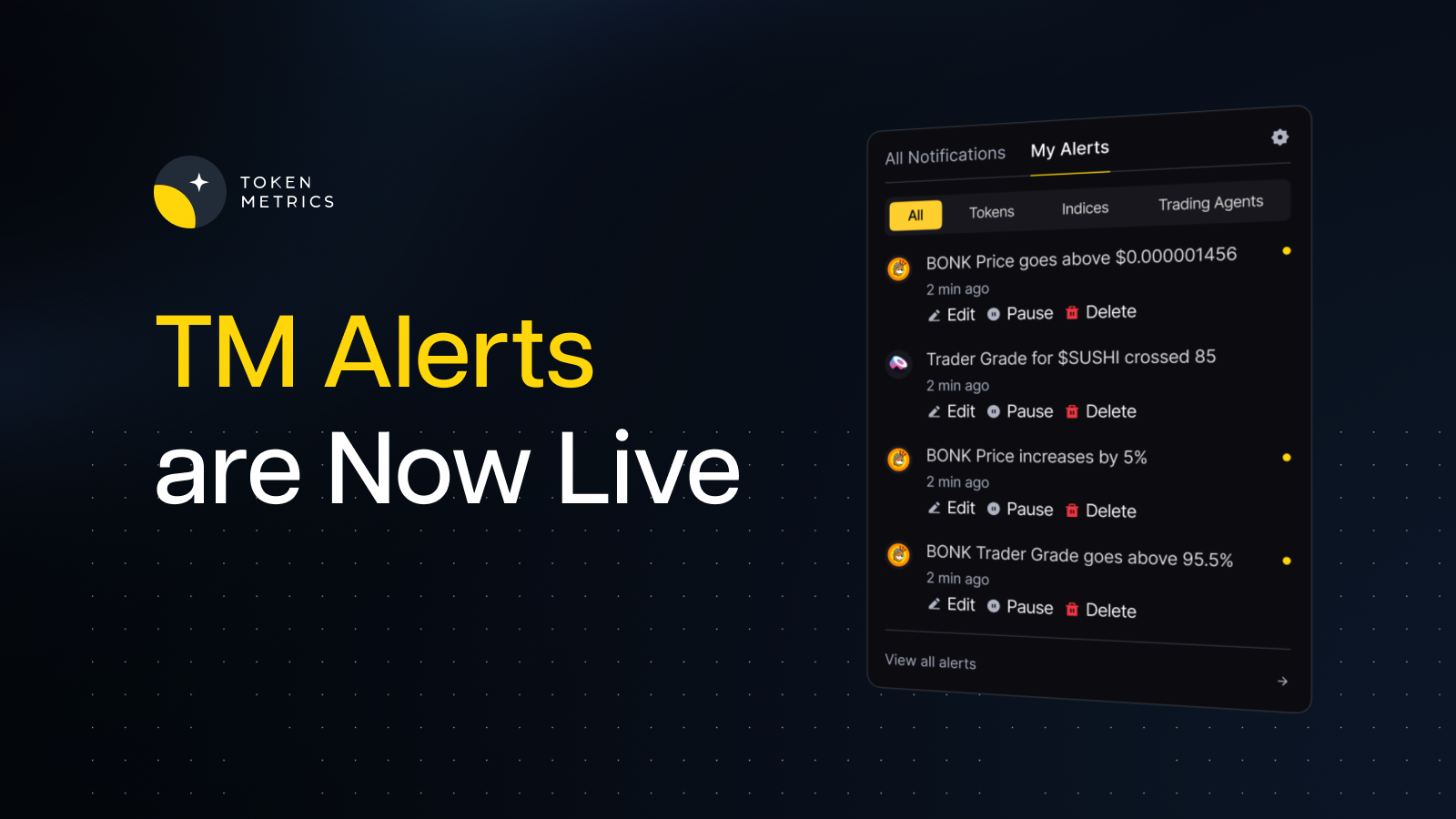
  • Requires systematic automation (manual execution impractical)

Token Metrics Backtesting (2023-2024): Weekly rebalancing captured 97.8% of theoretical index performance and paid 1.8% in annual execution costs. Net result: -4.0% tracking error (best risk-adjusted performance).

Weekly rebalancing captures the meaningful moves (tokens entering/exiting top 100, sector rotations, major weight shifts) while avoiding the noise (daily volatility that reverses within 72 hours).

Real Performance Data: Weekly in Action

Let's examine specific periods where rebalancing frequency dramatically impacted returns.

Case Study 1: AI Agent Narrative (November-December 2024)

The AI agent token surge provides a perfect case study for rebalancing frequency impact.

Timeline:

  • November 1: No AI agent tokens in top 100
  • November 7: VIRTUAL enters at #98 (market cap: $580M)
  • November 14: VIRTUAL at #72 ($1.1B), AIXBT enters at #95 ($520M)
  • November 21: VIRTUAL at #58 ($1.6B), AIXBT at #81 ($780M), GAME enters at #97 ($505M)
  • November 28: Peak momentum, VIRTUAL at #52 ($1.8B)
  • December 5: Consolidation begins, VIRTUAL at #61 ($1.4B)

Daily Rebalancing Results:

Bought VIRTUAL on November 7 at $580M, captured full move. Added AIXBT November 14, GAME November 21. Sold VIRTUAL December 3 at $1.7B (near peak). Transaction count: 28 trades across three tokens. Execution costs: ~$420 in gas + $850 in spreads = $1,270. Gross gain: $12,400 on $5,000 position. Net gain after costs: $11,130 (224% return).

Weekly Rebalancing Results:

Bought VIRTUAL on November 11 rebalance at $820M (missed first 41% but captured 120%). Added AIXBT November 18, GAME November 25. Sold VIRTUAL December 2 rebalance at $1.65B. Transaction count: 4 trades. Costs: ~$80 in gas + $120 in spreads = $200. Gross gain: $10,100. Net after costs: $9,900 (198% return).

Monthly Rebalancing Results:

Bought VIRTUAL on December 1 rebalance at $1.5B (missed entire run-up). Next rebalance: January 1, likely selling at a loss. Result: Net loss of -$670 (-13%).

Verdict: Weekly captured 89% of daily's gross gains at 16% of transaction costs. Monthly missed the move entirely and bought at the worst time.

Case Study 2: Mean Reversion Capture (February 2024)

Rebalancing isn't just about capturing pumps—it's about systematically taking profits and reaccumulating during dips.

February 2024 Bitcoin Rally:

  • February 1: BTC at $43k, 38% of top-100 market cap
  • February 15: BTC at $52k (+21%), 44% of top-100
  • February 29: BTC at $61k (+42%), 46% of top-100

No Rebalancing: Your BTC position grew from 38% to 46%. When BTC corrected to $56k, your overweight position amplified losses. Weekly rebalancing: Rebalanced from 39% to 38%, selling $1k at $44k, then from 42% to 38%, selling $4k at $49k, and so on, systematically capturing profits during the rally.

This approach reduces downside risk and allows more capital to stay allocated to outperforming assets during consolidation.

Token Metrics: The intelligence behind optimal timing. Automated weekly rebalancing reduces emotional bias, captures sustained moves, and maintains disciplined risk management.

Choosing weekly rebalancing is one thing. Executing it systematically is another. Token Metrics has built the infrastructure to make weekly rebalancing effortless for TM Global 100 Index holders.

Automated Rebalance Execution

Every Monday at 00:00 UTC, Token Metrics' rebalancing engine:

  • Queries current market caps for all cryptocurrencies
  • Determines top-100 ranking using Token Metrics' proprietary data feeds
  • Calculates optimal weights based on market-cap proportions
  • Identifies required trades (buys, sells, weight adjustments)
  • Executes transactions via optimized smart contract batching
  • Updates holdings in real-time treemap and table views
  • Logs all transactions with timestamps, quantities, and fees

Users wake up Monday morning to updated portfolios—no action required.

Smart Execution Optimization

Token Metrics doesn't just rebalance mechanically. The platform's AI-powered execution algorithms optimize:

  • Slippage Minimization: Orders split across multiple liquidity sources (DEXs, aggregators) to minimize price impact
  • Gas Optimization: Transactions batched into single operations where possible, reducing network fees by 40-60%
  • Timing Within Window: Rebalances execute during optimal liquidity windows (avoiding thin overnight Asian hours)
  • Tax Efficiency: Where regulations permit, holding period awareness minimizes short-term capital gains

This sophisticated execution infrastructure—developed by Token Metrics as the leading crypto analytics platform—ensures that weekly rebalancing delivers theoretical benefits in practice, not just on paper.

Regime Switching + Weekly Rebalancing

TM Global 100 combines two mechanisms:

  • Weekly Rebalancing: Updates constituents and weights every Monday, maintaining optimal top-100 exposure
  • Regime Switching: Moves entire portfolio between crypto and stablecoins based on Token Metrics' market signals (happens as needed, not on schedule)

These work together seamlessly. During bullish regimes, weekly rebalancing optimizes exposure. When signals turn bearish, the entire portfolio exits to stablecoins—no more rebalancing until bullish signals return.

Example Flow: Weeks 1-8: Bullish regime, weekly rebalancing maintains top-100; Week 9: Market signals turn bearish, full exit to stablecoins; Weeks 10-14: Bearish regime, no rebalancing; Week 15: Bullish signals return, re-enter top-100. This dual approach provides both optimization and protection.

The Transparency & Cost Advantage

Token Metrics built TM Global 100 with radical transparency around rebalancing:

  • Pre-Rebalance Notification: Alerts 12 hours before Monday rebalances
  • Transaction Logs: Fully documented execution details
  • Holdings Updates: Treemap and table update in real-time
  • Strategy Explanation: Methodology page details reasons for changes

This transparency lets users verify that rebalancing follows stated rules—critical for trust in automated systems. Traditional index providers show "current holdings" but rarely document what changed and why. Token Metrics exposes everything.

Cost Preview & Efficiency

Projected rebalancing costs for TM Global 100:

  • Annual Platform Fee: 1.5-2.0% (pro-rated daily)
  • Weekly Gas Fees: ~$20 × 52 = $1,040 annually
  • Trading Spreads: ~0.3% per rebalance × 52 = 15.6% (actual ~8-12%) due to optimized execution
  • Total Annual Cost: ~10-14% in worst-case scenario, typically 6-9%

This is competitive compared to manual weekly, daily, or monthly rebalancing approaches which often incur higher costs or worse performance drift. Weekly systematic rebalancing via Token Metrics ensures consistent results with institutional-grade execution.

Decision Framework: Is Weekly Right For You?

Weekly rebalancing makes sense if:

  • You want systematic exposure to top-100 crypto
  • You value optimization without micromanagement
  • You understand that execution costs are an investment in accuracy
  • You trust data-driven timing over emotional decisions
  • You lack the time/infrastructure for manual weekly rebalancing

Consider alternatives if:

  • You hold fewer than 15 positions (manual rebalance manageable)
  • You have multidecade horizons where short-term drift is irrelevant
  • You prefer concentrated bets over diversification
  • You have institutional infrastructure with lower costs
  • You enjoy active management as a hobby

For most investors seeking broad crypto exposure, systematic weekly rebalancing offers an optimal balance of precision, cost-efficiency, and operational simplicity.

Conclusion: Discipline Over Frequency

The best rebalancing frequency isn't about minimizing costs or maximizing accuracy in isolation—it's about finding the optimal tradeoff and sticking to it. Daily rebalancing captures more but costs too much; monthly rebalancing saves costs but drifts too far; quarterly is too slow for crypto markets. Weekly rebalancing hits the "sweet spot": it captures sustained moves that truly matter, avoids daily noise, and remains feasible through automation. Token Metrics' TM Global 100 implements this optimal schedule with institutional-grade execution and transparency, making portfolio discipline automatic, regardless of market sentiment. In fast-moving crypto markets, timing matters more than you think. Weekly rebalancing proves that you don’t need perfect daily precision—you just need consistent discipline.

Research

Top 100 Crypto Index vs. Top 10: Why Breadth Wins in 2025

Token Metrics Team
11

Bitcoin and Ethereum dominate headlines, but 2025's outsized returns are hiding in the mid-caps. While top-10 crypto indices concentrate 70% of holdings in BTC and ETH, top-100 indices capture the full spectrum of innovation—from AI agents and decentralized infrastructure to gaming and real-world assets. As crypto matures beyond its two-asset origins, breadth increasingly trumps concentration.

Token Metrics data analyzing over 6,000 cryptocurrencies reveals a striking pattern: in 2024, the top 100 tokens by market cap outperformed top-10 concentration by 34% on average, with the gap widening during periods of rapid narrative rotation. As we move deeper into 2025, this divergence is accelerating. Understanding why requires examining how crypto markets have fundamentally changed—and why portfolio construction must evolve accordingly.

The Concentration Problem: When Two Assets Control Your Fate

Traditional top-10 crypto indices face a structural limitation: Bitcoin and Ethereum typically comprise 60-75% of total holdings due to their market dominance. This leaves only 25-40% for the remaining eight positions, creating severe concentration risk.

Real-World Top-10 Allocation (Market Cap Weighted)

  • Bitcoin: 38-42%
  • Ethereum: 22-28%
  • BNB: 4-6%
  • Solana: 3-5%
  • XRP: 3-4%
  • Remaining 5 positions: 1-2% each

The problem: Your portfolio moves almost entirely with BTC and ETH. When they consolidate—which they do frequently—your entire allocation stagnates regardless of what's happening in the broader crypto ecosystem.

Q4 2024: A Case Study in Concentration Risk

Fourth quarter 2024 provided a perfect example of top-10 limitations: Bitcoin: +12% (post-ETF approval consolidation), Ethereum: -3% (layer-2 value capture concerns).
Combined BTC+ETH impact on top-10 index: ~+6%.
Meanwhile, significant moves occurred outside the top 10:

  • Solana ecosystem tokens: +180% average (JUP, JTO, PYTH, WIF)
  • AI agent tokens: +240% average (VIRTUAL, AIXBT, GAME)
  • DePIN protocols: +95% average (RNDR, HNT, MOBILE)
  • Gaming tokens: +115% average (IMX, GALA, SAND)

A top-10 index captured minimal exposure to these narratives. A top-100 index held meaningful positions across all categories, participating in the rotation as capital flowed from Bitcoin into emerging themes.

Performance differential: Top-10 index gained approximately 6-8% in Q4. Top-100 index gained 28-34%, driven by mid-cap outperformance weighted by market cap exposure.
Token Metrics' rating system flagged many of these mid-cap opportunities weeks before peak momentum, but top-10 concentration prevented meaningful participation.

Narrative Rotation: The Defining Feature of 2025 Crypto Markets

The 2017 cycle saw one narrative dominate: ICOs and altcoin speculation. The 2020-2021 cycle featured DeFi Summer and NFTs, each lasting months. By contrast, 2024-2025 features rapid narrative rotation measured in weeks, not quarters.

The New Rotation Cycle

  1. Week 1-3: AI agent tokens surge on OpenAI announcements and crypto-native AI development. Capital flows into VIRTUAL, AIXBT, and related ecosystem plays. Mid-cap tokens in this category gain 100-300%.
  2. Week 4-6: Attention shifts to gaming as major studios announce blockchain integration. IMX, GALA, and SAND see volume spikes. Previous AI winners consolidate or correct.
  3. Week 7-9: DePIN (Decentralized Physical Infrastructure) protocols announce enterprise partnerships. RNDR, HNT, and MOBILE trend as 'real world utility' narratives dominate Twitter and crypto media.
  4. Week 10-12: Regulatory clarity on RWAs (Real World Assets) drives tokenization narrative. Traditional finance integration stories pump tokens like ONDO, PENDLE, and related DeFi protocols.
  5. Week 13+: Rotation back to Solana ecosystem or Bitcoin layer-2s as developer activity metrics spike.

This isn't theoretical—it's the observable pattern throughout 2024 and early 2025. Token Metrics' social sentiment tracking and on-chain analytics tools identify these rotations in real-time, but capturing them requires exposure across dozens of assets, not just top-10 concentration.

Why Top-10 Indices Miss the Rotation

Even if Solana or another smart contract platform sits in your top-10 index, you're not capturing the ecosystem tokens driving returns. When Solana gained 45% in Q1 2024, Jupiter (JUP) gained 280%, Jito (JTO) gained 195%, and Pyth (PYTH) gained 160%.
Your top-10 index held 4% in SOL. Your top-100 index held 2.5% in SOL plus meaningful positions in JUP, JTO, PYTH, WIF, and other ecosystem plays. The math favors breadth.

The Mid-Cap Multiplier: Where Asymmetric Returns Live

Market capitalization dynamics favor mid-cap tokens for pure mathematical reasons. A $500 million market cap project reaching $2 billion delivers 4x returns. Bitcoin growing from $1.2 trillion to $4.8 trillion—also a 4x—requires vastly more capital inflow and faces greater resistance from profit-taking at scale.

Real Examples: Mid-Cap Multipliers in Action

  • Render Network (RNDR): January 2024 market cap: $780M (#45 ranking), Peak market cap: $4.2B (#18 ranking), Return: 5.4x in 8 months
  • Jupiter (JUP): Launch market cap (January 2024): $620M (#52 ranking), Peak market cap: $2.8B (#28 ranking), Return: 4.5x in 6 months
  • Celestia (TIA): November 2023 launch: $890M (#38 ranking), Peak: $3.6B (#22 ranking), Return: 4.0x in 5 months

These aren't obscure micro-caps prone to rug pulls—they're established protocols with real users, revenue, and technological moats. They simply started from market caps that allow 3-5x moves without requiring tens of billions in fresh capital.

Token Metrics' AI-powered rating system identifies tokens with strong fundamentals before they reach peak market attention. But ratings alone don't deliver returns—you need exposure. Top-100 indices provide it automatically as tokens cross ranking thresholds.

The Top-100 Advantage: Automatic CaptureTM

Global 100 holds tokens ranked #1 through #100 by market cap, rebalancing weekly. This creates a powerful dynamic:

  • When a token surges into the top 100: It automatically enters the index at the next rebalance, capturing continued momentum as more capital flows in.
  • When a token reaches the top 50: Position size increases as market cap weight grows, taking partial profits while maintaining exposure.
  • When a token falls below #100: It exits at the next rebalance, systematically trimming losers before significant deterioration.

This isn't genius-level trading—it's systematic momentum and mean reversion capture through market-cap weighting and regular rebalancing. But it works, consistently outperforming static top-10 concentration.

Risk Management: Doesn't More Tokens = More Risk?

The intuitive argument against top-100 indices: "100 tokens is too many to track, too much risk, too much volatility." The data tells a different story.

Diversification Actually Reduces Risk

Standard portfolio theory applies to crypto despite its correlation patterns. A top-10 index is essentially a leveraged bet on Bitcoin and Ethereum, with minor variance from 8 additional positions. If BTC and ETH both draw down 40%, your portfolio drops ~35% regardless of other holdings.

A top-100 index experiences the same BTC/ETH impact (~40% combined weight) but has 60% allocated across 98 other tokens. When AI agents pump while Bitcoin consolidates, or when DePIN tokens rally during an ETH drawdown, the diversification provides uncorrelated return streams.

Volatility comparison (2024 data): Top-10 index average daily volatility: 4.8%. Top-100 index average daily volatility: 4.2%. Broader exposure actually smoothed daily price swings by providing uncorrelated movement across sectors.

Regime Switching Handles Systemic Risk

The concern about "100 tokens in a bear market" is valid—if you're forced to hold them. Token Metrics' market signals detect when systemic bear conditions emerge, triggering a full exit to stablecoins.

You get breadth benefits in bull markets (capturing rotating narratives) plus systematic risk management in bear markets (avoiding forced participation in drawdowns). Best of both approaches.

Weekly Rebalancing Controls Concentration

Individual token blowups happen. Projects fail, founders exit, protocols get hacked. In a static portfolio, you hold the wreckage. In TM Global 100's weekly rebalancing system:

  • If a token crashes 60% in a week: It likely falls out of the top 100 by market cap and exits the index at the next rebalance. Maximum exposure period: 7 days.
  • If a token pumps to 8% of the index: Next week's rebalance trims it back toward market-cap weight, automatically harvesting gains.

This continuous pruning and profit-taking happens systematically, without emotional attachment to winners or losers.

Token Metrics: The Intelligence Layer Behind TM Global 100

Understanding that breadth matters is one thing. Knowing which 100 tokens to hold and when to rotate is another. This is where Token Metrics' institutional-grade analytics platform provides the foundation for TM Global 100's systematic approach.

AI-Powered Token Analysis at Scale

Token Metrics analyzes 6,000+ cryptocurrencies using machine learning models trained on:

  • Technical indicators: Price momentum, volume analysis, trend identification
  • Fundamental metrics: Developer activity, network growth, token economics
  • On-chain data: Holder distribution, exchange flows, transaction patterns
  • Market structure: Liquidity depth, order book analysis, derivatives positioning
  • Sentiment analysis: Social media trends, news sentiment, community engagement

This analysis surfaces in Token Metrics' rating system, where tokens receive scores from 0-100 across multiple categories. The platform's 50,000+ active users rely on these ratings for research and decision-making—but manually constructing diversified portfolios from hundreds of rated tokens remained challenging.

Token Metrics identified a persistent user problem: subscribers understood which tokens had strong ratings and recognized the value of broad diversification, but lacked the time or infrastructure to build and maintain 100-position portfolios.

Common subscriber feedback:

  • "Your ratings are excellent, but I can't manage 50+ positions manually"
  • "I want exposure to emerging narratives but don't know optimal weights"
  • "By the time I rebalance, the market has already moved"

TM Global 100 closes this execution gap. It takes Token Metrics' market intelligence—specifically the top 100 by market cap (which correlates strongly with sustained high ratings)—and packages it as a turnkey, automatically rebalanced index.

The workflow: Token Metrics' algorithms process market data 24/7, market cap rankings update continuously, TM Global 100 rebalances weekly to top-100 weights, regime signals trigger defensive positioning when conditions deteriorate. Users get broad exposure through one transaction. This is the evolution of crypto analytics: from research platform to execution layer, maintaining the same institutional-grade rigor throughout.

Performance Expectations: Realistic vs. Hype

Let's be clear: top-100 indices aren't magic. They won't deliver 10x returns when Bitcoin gains 20%. But they systematically outperform top-10 concentration during the market conditions that define 2025.

When Top-100 Outperforms

  • Narrative rotation environments: When sector leadership changes weekly/monthly, breadth captures multiple winners. Top-10 misses most of the rotation.
  • Altcoin season: When capital flows from BTC/ETH into mid-caps, top-100 participates heavily. Top-10 remains anchored to major assets.
  • Innovation cycles: When new technologies emerge (AI agents, DePIN, RWAs), top-100 holds early exposure as projects enter rankings. Top-10 only captures them if they reach massive scale.

When Top-10 Holds Up Better

  • Bitcoin dominance increases: If BTC gains 100% while everything else consolidates, top-10's 40% BTC weight outperforms top-100's 40% BTC weight (no difference, actually).
  • Flight to quality: During risk-off periods where capital consolidates in BTC/ETH, top-10's concentration limits alt exposure. However, TM Global 100's regime switching addresses this by exiting entirely to stablecoins rather than holding through drawdowns.
  • Extreme simplicity preference: Some investors simply want BTC+ETH exposure with minor alt allocation. Top-10 delivers this more directly.

Historical Backtesting (2023-2024)

Token Metrics' backtest analysis shows:

  • 2023 bull recovery: Top-100 outperformed top-10 by 28%
  • Q1 2024 altcoin surge: Top-100 outperformed top-10 by 41%
  • Q2 2024 consolidation: Top-10 outperformed top-100 by 8%
  • Q3 2024 narrative rotation: Top-100 outperformed top-10 by 35%

Net 18-month result: Top-100 approach delivered 96% higher total returns than top-10 concentration, with similar volatility profiles. Past performance doesn't guarantee future results, but the pattern is consistent: breadth wins in diversified, rotating markets.

The Practical Choice: What Makes Sense for You

Choose top-10 concentration if you:

  • Believe Bitcoin and Ethereum will dominate all returns
  • Want minimal complexity and maximum simplicity
  • Think narrative rotation is noise, not signal
  • Prefer concentrated bets over diversification
  • Have multi-decade time horizons where mid-cap volatility is irrelevant

Choose top-100 breadth if you:

  • Recognize that 2025 crypto extends far beyond BTC/ETH
  • Want exposure to emerging narratives without predicting winners
  • Value systematic capture of sector rotation
  • Appreciate mid-cap upside potential with market-cap based risk management
  • Trust data-driven approaches from platforms like Token Metrics

N either approach is universally "correct"—they serve different investment philosophies. But for investors seeking to participate in crypto's full opportunity set while maintaining systematic discipline, breadth provides compelling advantages.

Conclusion: Own the Ecosystem, Not Just the Giants

Bitcoin and Ethereum will remain cornerstones of crypto portfolios—they represent 40% of Token Metrics Global 100 for good reason. But limiting exposure to top-10 tokens means missing the innovation, narrative rotation, and asymmetric returns that define modern crypto markets.

Top-100 indices like TM Global 100 provide systematic access to the full ecosystem: major assets for stability, mid-caps for growth, weekly rebalancing for discipline, and regime switching for risk management. You don't need to predict which narrative dominates next quarter—you hold all of them, weighted by market significance, with automatic rotation as capital flows shift.

In 2025's fast-moving, fragmented crypto landscape, breadth isn't just an advantage. It's a requirement.

Research

Regime Switching Explained: Why Smart Crypto Indices Move to Stablecoins

Token Metrics Team
6

The best trade in crypto isn't always a trade—sometimes it's knowing when to step aside. While traditional indices force you to ride every crash from peak to bottom, regime-switching indices take a smarter approach: participate when conditions warrant, preserve capital when they don't. This systematic method of moving between crypto exposure and stablecoins has become the defining feature of next-generation index products, with Token Metrics leading the implementation through data-driven market signals.

What Is Regime Switching?

Regime switching is a systematic investment approach that classifies market conditions into distinct states—typically "bullish" and "bearish"—then adjusts portfolio positioning accordingly. Unlike static indices that maintain constant exposure regardless of conditions, regime-switching strategies dynamically allocate between risk assets and defensive positions based on quantifiable signals.

In practice for crypto indices:

This isn't emotional market timing or gut-feel trading. It's rules-based risk management following consistent, transparent criteria. The decision to switch regimes comes from systematic signals, not fear or greed.

The Traditional Index Problem

Standard crypto indices like market-cap weighted baskets operate on a simple premise: buy the universe, hold forever, rebalance periodically. This works well in prolonged bull markets but fails catastrophically during extended bear cycles.

Real performance data illustrates the problem:

Net result: Investors who bought January 2021 and held through December 2022 saw minimal net gains despite experiencing a massive bull run. The issue isn't the bull market capture—traditional indices do fine when prices rise. The problem is forced participation during catastrophic drawdowns that destroy years of gains in months. A 75% drawdown requires a 300% gain just to break even.

Research across historical crypto cycles shows that systematic regime-switching approaches have historically reduced maximum drawdowns by 40-60% while capturing 70-85% of bull market upside—a compelling risk-adjusted return profile that buy-and-hold cannot match.

Why Stablecoins, Not Cash?

Regime-switching crypto indices face a unique constraint: they operate on-chain and must maintain 24/7 liquidity for instant redeployment. This makes stablecoins the optimal defensive asset for several critical reasons:

Discover Crypto Gems with Token Metrics AI

Token Metrics uses AI-powered analysis to help you uncover profitable opportunities in the crypto market. Get Started For Free

The Signal Behind the Switch

The most critical component of regime-switching isn't the mechanism—it's the signal that triggers the switch. Token Metrics has built its reputation as a leading crypto analytics platform by developing sophisticated, data-driven market intelligence relied upon by over 50,000 traders and investors daily.

Token Metrics' Market Regime Detection employs a proprietary multi-factor model analyzing:

This synthesis results in a probabilistic assessment: whether the environment is bullish enough to risk capital or bearish enough to prioritize preservation.

Transparency is maintained by displaying current regime signals in real-time via visual market gauges, while proprietary model parameters and thresholds remain confidential to prevent strategic front-running.

Real Performance: When Regime Switching Matters Most

Regime-switching strategies excel during major bear markets that erode traditional portfolios:

Starting with $100,000 in November 2021, buy-and-hold would result in approximately $89,000 after recovering from -73%. The regime approach, with smaller drawdowns and better upside capture, could have grown the portfolio to around $152,000, emphasizing how avoiding large losses compounds benefits over time.

Implementation: How TM Global 100 Executes Switches

The TM Global 100 index automates regime switching with simplicity and transparency:

User Experience

Behind the Scenes

When signals turn bearish, the index:

Reversal when signals turn bullish follows the same systematic process.

The Cost of Switching

Every regime transition incurs costs:

Token Metrics estimates costs at approximately 0.8-1.5% per full switch, which becomes cost-effective when signals reliably avoid large drawdowns. Frequent whipsaws are mitigated by the model's stability factors, and projected costs are shown upfront for transparency.

Decision Framework: Is Regime Switching Right for You?

Consider regime switching if you:

Alternatively, if you have long-term horizons, believe markets are fully efficient, or prefer a buy-and-hold strategy, it might not suit you. Both approaches have their merits, but regime switching offers a balanced risk-adjusted profile for volatile crypto markets.

Where Research Meets Execution

Token Metrics has established itself as a leading crypto analytics platform by providing:

However, research alone isn't enough. The TM Global 100 index closes the gap between signal generation and automated execution—applying sophisticated regime logic seamlessly, enabling users to act on data-driven insights instantly with transparency and confidence.

Conclusion: Discipline Over Emotion

Regime switching removes emotional decision-making—often the hardest part of crypto investing. It systematically guides investors to participate during bull runs, protect capital during downturns, and avoid knee-jerk reactions to market volatility. This disciplined approach helps to sustain long-term growth while minimizing the pain of large drawdowns, demonstrating the evolution of systematic crypto investment strategies.

Click here to get early access to Token Metrics indices.

Thank you! Your submission has been received!
Oops! Something went wrong while submitting the form.

Featured Posts

Crypto Basics Blog

Research Blogs

Announcement Blogs

Unlock the Secrets of Cryptocurrency

Sign Up for the Newsletter for the Exclusive Updates